
Ezekiel 14:8

Hebrew (Westminster Leningrad Codex) Ezekiel 14:8 appears in the Hebrew Old Testament. The text above is from the Westminster Leningrad Codex. Each word links to its Strong’s number, a concise gloss, and parsing drawn from the Open Scriptures Hebrew Bible morphology. Click any word for its full Brown-Driver-Briggs (BDB) entry.
Download image
Cite this verse

Ezekiel 14:8 (World English Bible). Public Domain. Lemma interlinear Bible study tool, https://lemma.gebible.app/v/ezekiel/14/8.

Show BibTeX & RIS
BibTeX
RIS
English Translation
and I will set my face against that man, and will make him an astonishment, for a sign and a proverb, and I will cut him off from the midst of my people; and you shall know that I am Yahweh.
World English Bible · Public Domain
Download a study sheet

One document with this verse’s original text, its word-by-word gloss line, the meaning frame, cross-references with their text, attributed commentary, and full source and license credits — printable, and it pastes into notes with its structure intact.

This verse Autodidact and up

Study sheet (.html) Plain text (.txt)

A passage Seminary Student

Up to 50 verses in one chapter. A passage sheet keeps up to 6 commentary sources and 12 cross-references per verse, in the order this page ranks them, and says so on the sheet whenever that leaves anything out. Ask for a single verse and you get the Autodidact verse sheet above.

Everything on this page stays free to read, with no account — the sheet is a download of what is already on screen, not access to it.

Want to remove ads? Support Godless Engineer
Compare translations 3

The same verse in 3 English versions, stacked beneath the original-language interlinear above. Click any original word for its lexicon entry.

Each is an independent rendering of the whole verse — the interlinear is not word-aligned to these translations.

Highlighted words mark where these versions differ — a whole-verse word diff, not a word-by-word alignment.

  • World English Bible Public Domain
    and I will set my face against that man, and will make him an astonishment, for a sign and a proverb, and I will cut him off from the midst of my people; and you shall know that I am Yahweh.
  • King James Version Public Domain
    And I will set my face against that man, and will make him a sign and a proverb, and I will cut him off from the midst of my people; and ye shall know that I am the LORD.
  • unfoldingWord Literal Text CC BY-SA 4.0
    So I will set my face against that man and make him a sign and a proverb, for I will cut him off from the midst of my people, and you will know that I am Yahweh.

unfoldingWord Literal Text — © unfoldingWord, licensed CC BY-SA 4.0. Word-aligned USFM3 via Door43 (git.door43.org/unfoldingWord/en_ult).

Versions to compare (up to 4)

3 of 4 selected

Show all 18 translations

Every available English version of this verse, each an independent rendering of the whole verse.

  • World English Bible Public Domain
    and I will set my face against that man, and will make him an astonishment, for a sign and a proverb, and I will cut him off from the midst of my people; and you shall know that I am Yahweh.
  • Berean Standard Bible Public Domain
    I will set My face against that man and make him a sign and a proverb; I will cut him off from among My people. Then you will know that I am the LORD.
  • Majority Standard Bible Public Domain
    I will set My face against that man and make him a sign and a proverb; I will cut him off from among My people. Then you will know that I am the LORD.
  • King James Version Public Domain
    And I will set my face against that man, and will make him a sign and a proverb, and I will cut him off from the midst of my people; and ye shall know that I am the LORD.
  • American Standard Version (1901) Public Domain
    and I will set my face against that man, and will make him an astonishment, for a sign and a proverb, and I will cut him off from the midst of my people; and ye shall know that I am Jehovah.
  • Revised Version (1885) Public Domain
    and I will set my face against that man, and will make him an astonishment, for a sign and a proverb, and I will cut him off from the midst of my people; and ye shall know that I am the LORD.
  • Geneva Bible (1599) Public Domain
    And I will set my face against that man, and will make him an example and prouerbe, and I will cut him off from the middes of my people, and ye shall knowe that I am the Lord.
  • Douay-Rheims (1899) Public Domain
    And I will set my face against that man, and will make him an example, and a proverb, and will cut him off from the midst of my people: and you shall know that I am the Lord.
  • Young's Literal Translation Public Domain
    and I have set My face against that man, and made him for a sign, and for similes, and I have cut him off from the midst of My people, and ye have known that I `am' Jehovah.
  • Literal Standard Version CC BY-SA 4.0
    and I have set My face against that man, and made him for a sign, and for allegories, and I have cut him off from the midst of My people, and you have known that I [am] YHWH.
  • Unlocked Literal Bible CC BY-SA 4.0
    So I will set my face against that man and make him a sign and a proverb, for I will cut him off from the midst of my people, and you will know that I am Yahweh.
  • unfoldingWord Literal Text CC BY-SA 4.0
    So I will set my face against that man and make him a sign and a proverb, for I will cut him off from the midst of my people, and you will know that I am Yahweh.
  • Darby Bible Public Domain
    and I will set my face against that man, and will make him desolate, [so that he shall be] for a sign and for proverbs, and I will cut him off from the midst of my people: and ye shall know that I [am] Jehovah.
  • World Messianic Bible Public Domain
    I will set my face against that man and will make him an astonishment, for a sign and a proverb, and I will cut him off from among my people. Then you will know that I am the LORD.
  • Webster's Bible Public Domain
    And I will set my face against that man, and will make him a sign and a proverb, and I will cut him off from the midst of my people; and ye shall know that I am the LORD.
  • Free Bible Version CC BY-SA 4.0
    I will oppose anyone who does this and make any example of them that others will talk about. I will remove them from among my people. Then you will know that I am the Lord.
  • Bible in Basic English Public Domain
    And my face will be turned against that man, and I will make him a sign and a common saying, cutting him off from among my people; and you will be certain that I am the Lord.
  • JPS Tanakh (1917) Public Domain
    and I will set My face against that man, and will make him a sign and a proverb, and I will cut him off from the midst of My people; and ye shall know that I am the LORD.

Literal Standard Version (2020), Covenant Press — licensed CC BY-SA 4.0. Text via the HelloAO Bible API (eBible.org). Unlocked Literal Bible (unfoldingWord) — licensed CC BY-SA 4.0. Text via the HelloAO Bible API (eBible.org). unfoldingWord Literal Text — © unfoldingWord, licensed CC BY-SA 4.0. Word-aligned USFM3 via Door43 (git.door43.org/unfoldingWord/en_ult). Free Bible Version, Dr. Jonathan Gallagher — licensed CC BY-SA 4.0. Text via the HelloAO Bible API (eBible.org).

Word by word

More ways to search: Search by grammar → Find every occurrence → Compare this word →

Practice this passage: Drill this verse → Learn its vocabulary →

וְלִמְשָׁלִ֔ים
mâshâl
H4912
“and · to/for · proverbs”
Conjunction + Preposition + Noun, Common, Masculine, Plural, Absolute
Part of Speech
Conjunction + Preposition + Noun
Type
Common
Gender
Masculine
Number
Plural
State
Absolute
Full BDB Definition

Origin: apparently from H4910 in some original sense of superiority in mental action

TWOT: 1258a

proverb, parable - proverb, proverbial saying, aphorism - byword - similitude, parable - poem - sentences of ethical wisdom, ethical maxims
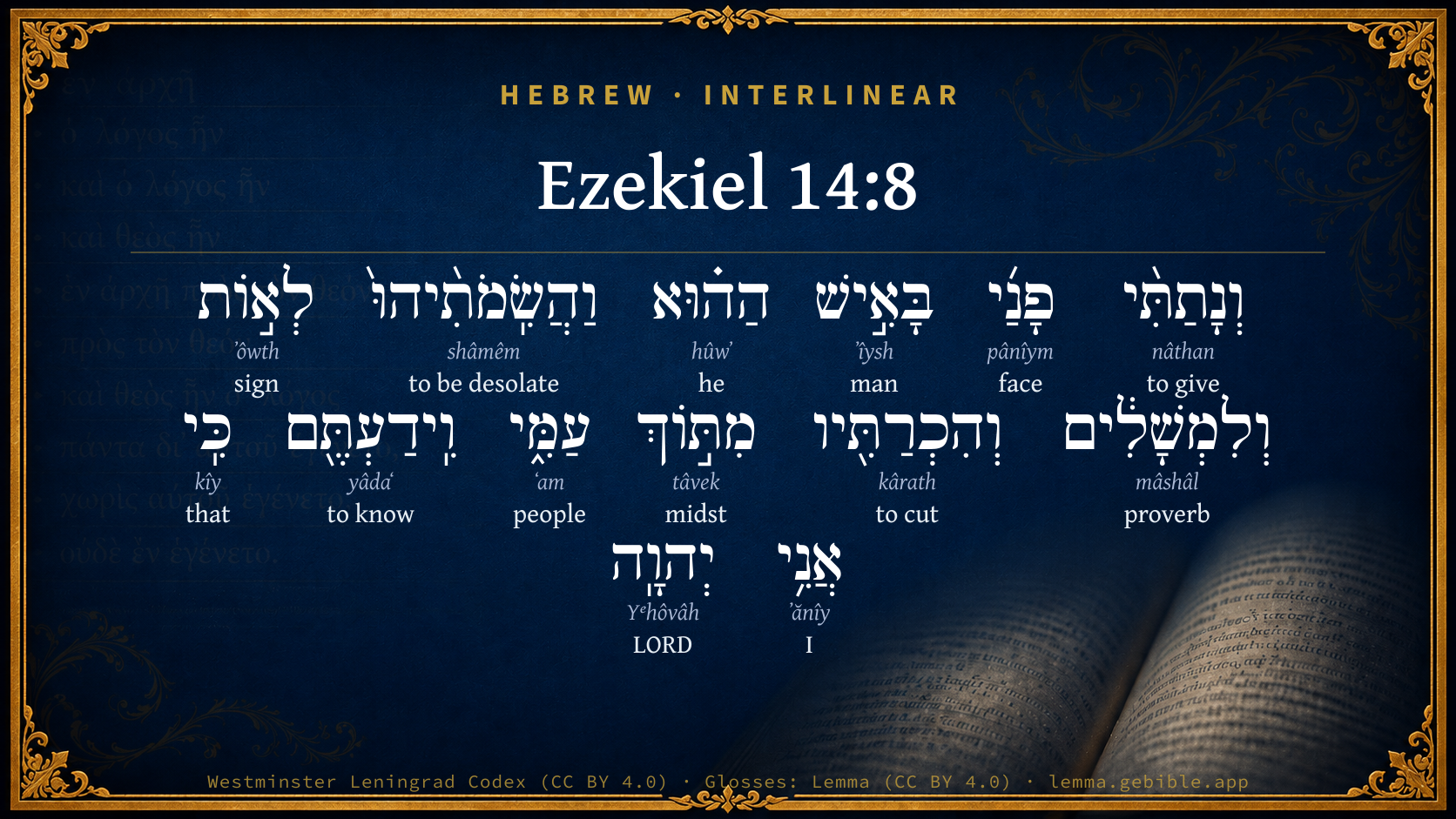
  1. וְנָתַתִּ֨י nâthan H5414 “and · to give” Conjunction + Verb, Qal, Sequential Perfect, 1st Person, Common, Singular
  2. פָנַ֜י pânîym H6440 “face(s) · my” Noun, Common, Both, Plural, Construct + Suffix, Personal, 1st Person, Common, Singular
  3. בָּאִ֣ישׁ ʼîysh H376 “in/at the · man” Preposition, Determined + Noun, Common, Masculine, Singular, Absolute
  4. הַה֗וּא hûwʼ H1931 “the · he” Particle, Definite Article + Pronoun, Personal, 3rd Person, Masculine, Singular
  5. וַהֲשִֽׂמֹתִ֨יהוּ֙ shâmêm H8074 “and · to be desolate · him” Conjunction + Verb, Hiphil, Sequential Perfect, 1st Person, Common, Singular + Suffix, Personal, 3rd Person, Masculine, Singular
  6. לְא֣וֹת ʼôwth H226 “to/for · sign” Preposition + Noun, Common, Both, Singular, Absolute
  7. וְהִכְרַתִּ֖יו kârath H3772 “and · to cut · him” Conjunction + Verb, Hiphil, Sequential Perfect, 1st Person, Common, Singular + Suffix, Personal, 3rd Person, Masculine, Singular
  8. מִתּ֣וֹךְ tâvek H8432 “from · midst of” Preposition + Noun, Common, Masculine, Singular, Construct
  9. עַמִּ֑י ʻam H5971 “people · my” Noun, Common, Masculine, Singular, Construct + Suffix, Personal, 1st Person, Common, Singular
  10. וִֽידַעְתֶּ֖ם yâdaʻ H3045 “and · to know” Conjunction + Verb, Qal, Sequential Perfect, 2nd Person, Masculine, Plural
  11. כִּֽי kîy H3588 “that” Conjunction
  12. אֲנִ֥י ʼănîy H589 “I” Pronoun, Personal, 1st Person, Common, Singular
  13. יְהוָֽה Yᵉhôvâh H3068 “LORD” Noun, Proper

About this verse

These counts appear in no published source. They are computed here, from the morphology-tagged text and Lemma’s own curated glosses. What Lemma adds →

14
words
14
distinct lemmas
Prophets
section

Shared distinctive vocabulary

וְלִמְשָׁלִ֔ים proverb H4912 occurs in 39 verses of the Hebrew Bible. Also found in:

Grammatical profile

  • 4 verbs
  • 7 nouns
  • 2 pronouns
  • 1 conjunction

Verb forms

  • וְנָתַתִּ֨י Qal · Sequential Perfect
  • וַהֲשִֽׂמֹתִ֨יהוּ֙ Hiphil · Sequential Perfect
  • וְהִכְרַתִּ֖יו Hiphil · Sequential Perfect
  • וִֽידַעְתֶּ֖ם Qal · Sequential Perfect

Hebrew & Septuagint length

In English translation the verse runs 41 words from the Hebrew and 36 from the Septuagint (LXX English) — closely comparable.

A rough comparison of the two English renderings, which tokenize alike — not a word-level alignment.

Word counts can differ between the Hebrew and the Greek without any difference in meaning — e.g. the Hebrew direct-object marker אֵת has no separate Greek word, and Greek often adds the article ὁ.

Cross-references

21

Topical passages linked to Ezekiel 14:8 in the Treasury of Scripture Knowledge — connected by theme and wording, ordered by reader-vote popularity; previews shown in the World English Bible.

  • Ezekiel 15:7 I will set my face against them; they shall go forth from the fire, but the fire shall devour them; and you shall know that I am Yahweh, when I set my face against them.
  • Jeremiah 44:11 Therefore thus says Yahweh of Hosts, the God of Israel: Behold, I will set my face against you for evil, even to cut off all Judah.
  • Ezekiel 5:15 So it shall be a reproach and a taunt, an instruction and an astonishment, to the nations that are round about you, when I shall execute judgments on you in anger and in wrath, and in wrathful rebukes; (I, Yahweh, have spoken it;)
  • Leviticus 17:10 "'Any man of the house of Israel, or of the strangers who live as foreigners among them, who eats any kind of blood, I will set my face against that soul who eats blood, and will cut him off from among his people.
  • Deuteronomy 28:37 You shall become an astonishment, a proverb, and a byword, among all the peoples where Yahweh shall lead you away.
  • Isaiah 65:15 You shall leave your name for a curse to my chosen; and the Lord Yahweh will kill you; and he will call his servants by another name:
  • Ezekiel 6:7 The slain shall fall in the midst of you, and you shall know that I am Yahweh.
  • Leviticus 20:3–6 I also will set my face against that person, and will cut him off from among his people because he has given of his seed to Molech, to defile my sanctuary, and to profane my holy name.
  • Leviticus 22:3 Tell them, 'If anyone of all your seed throughout your generations approaches the holy things, which the children of Israel make holy to Yahweh, having his uncleanness on him, that soul shall be cut off from before me. I am Yahweh.
  • Leviticus 26:17 I will set my face against you, and you will be struck before your enemies. Those who hate you will rule over you; and you will flee when no one pursues you.
  • Numbers 19:20 But the man who shall be unclean, and shall not purify himself, that soul shall be cut off from the midst of the assembly, because he has defiled the sanctuary of Yahweh: the water for impurity has not been sprinkled on him; he is unclean.
  • Numbers 26:10 and the earth opened its mouth, and swallowed them up together with Korah, when that company died; what time the fire devoured two hundred fifty men, and they became a sign.
  • Psalms 34:16 Yahweh's face is against those who do evil, To cut off the memory of them from the earth.
  • Psalms 37:22 For such as are blessed by him shall inherit the land. Those who are cursed by him shall be cut off.
  • Psalms 44:13–14 You make us a reproach to our neighbors, A scoffing and a derision to those who are around us.
  • Jeremiah 21:10 For I have set my face on this city for evil, and not for good, says Yahweh: it shall be given into the hand of the king of Babylon, and he shall burn it with fire.
  • Jeremiah 24:9 I will even give them up to be tossed back and forth among all the kingdoms of the earth for evil; to be a reproach and a proverb, a taunt and a curse, in all places where I shall drive them.
  • Jeremiah 29:22 and of them shall be taken up a curse by all the captives of Judah who are in Babylon, saying, Yahweh make you like Zedekiah and like Ahab, whom the king of Babylon roasted in the fire;
  • Ezekiel 13:23 Therefore you shall no more see false visions, nor practice divination. I will deliver my people out of your hand; and you shall know that I am Yahweh.
  • Romans 11:22 See then the goodness and severity of God. Toward those who fell, severity; but toward you, goodness, if you continue in his goodness; otherwise you also will be cut off.
  • 1 Corinthians 10:11 Now all these things happened to them by way of example, and they were written for our admonition, on whom the ends of the ages have come.

Cross-references courtesy of OpenBible.info (CC BY 4.0).

Hebrew and Greek witnesses Masoretic Hebrew ↔ Greek Septuagint

The same verse in the two great witnesses to the Old Testament, shown verse-for-verse.

These are two independent witnesses, not word-aligned to each other, and the Septuagint is shown in lemma (dictionary) form.

Hebrew Ezekiel 14:8 Masoretic · Westminster Leningrad Codex

וְנָתַתִּ֨י פָנַ֜י בָּאִ֣ישׁ הַה֗וּא וַהֲשִֽׂמֹתִ֨יהוּ֙ לְא֣וֹת וְלִמְשָׁלִ֔ים וְהִכְרַתִּ֖יו מִתּ֣וֹךְ עַמִּ֑י וִֽידַעְתֶּ֖ם כִּֽי אֲנִ֥י יְהוָֽה

and I will set my face against that man, and will make him an astonishment, for a sign and a proverb, and I will cut him off from the midst of my people; and you shall know that I am Yahweh.

World English Bible · Public Domain

Greek LXX Ezekiel 14:8 Septuagint · lemma form

καί στηρίζω ὁ πρόσωπον ἐγώ ἐπί ὁ ἄνθρωπος ἐκεῖνος καί τίθημι αὐτός εἰς ἔρημος καί εἰς ἀφανισμός καί ἐκαἴρω αὐτός ἐκ μέσος ὁ λαός ἐγώ καί ἐπιγιγνώσκω ὅτι ἐγώ κύριος

And I will set my face against that man, and will make him desolate and ruined, and will cut him off from the midst of my people; and you⌃ shall know that I am the Lord.

LXX2012 (modern English Septuagint) · Public Domain

Hebrew: Westminster Leningrad Codex (CC BY 4.0). Greek: Septuagint (public domain); English from LXX2012 (modern English Septuagint) (Public Domain). How the Septuagint differs from the Hebrew →

Targum (Aramaic paraphrase)

1

The Targum is the ancient Jewish Aramaic paraphrase of the Hebrew Scriptures — an interpretive translation, not the Hebrew text itself. Onkelos (literal) and Pseudo-Jonathan (expansive) render the Torah, and Jonathan the Prophets. Coverage is partial: where no permissively-licensed English translation exists for a verse, only the Aramaic is shown. This is verse-level text, not a word-by-word alignment to the Hebrew.

  1. Targum Jonathan Prophets (Joshua–Malachi)
    וְאֶתֵּן רוּגְזִי בְּגַבְרָא הַהוּא וַאֲשַׁוִינֵיהּ לְאָת וּלְמַתְלִין וֶאֱשֵׁיצִינֵיהּ מִגוֹ עַמִי וְתִידְעוּן אֲרֵי אֲנָא יְיָ:

    (no public-domain English translation for this verse)

    Targum Jonathan — Aramaic: “Mikraot Gedolot” (public domain). English: “Sefaria Community Translation” (CC0 1.0 (public-domain dedication)); “London "Chaldee Paraphrase," 1871” (public domain). Text via Sefaria.

Commentary

Notes on Ezekiel 14:8 from classic Christian and Jewish commentators (each source and its license shown beneath its notes). The classic Christian expositions comment on the surrounding passage and are grouped to its opening verse, so a note may address several verses; the Jewish commentaries on the Tanakh (Rashi and others) are per-verse, so they appear only where the commentator wrote on this verse.

Lemma curates 59 commentaries, every one of them public domain or Creative Commons licensed, each selected and text-cleaned for this edition rather than reprinted as found. About our sources →

Trapp's Complete Commentary

John Trapp

Eze 14:8 And I will set my face against that man, and will make him a sign and a proverb, and I will cut him off from the midst of my people; and ye shall know that I [am] the LORD.

Ver. 8. And I will set my face against that man.] Vultuose torveque illum intuear. I will look him to death. Or, Laying aside all other business, I will see to it that he be soundly paid.

And will make him a sign and a proverb.] That when men would express a great punishment upon any, they shall resemble it to his, as the Jews did to Ahab’s and Zedekiah’s, that naughty couple, {Jer 29:22} and the heathens to that of Tantalus {a} and Tityus.

And I will cut him off from the midst of my people.] This is yet a further and a more formidable menace; this is far worse than to he a byword to the people.

{a} Tantalus, q. ταλαντατος, Ut vult Plato.

John Trapp, A Commentary or Exposition upon All the Books of the Old and New Testament (1647–1656) — public domain. Text from a community e-Sword module.

Tyndale Open Study Notes

Tyndale Open Resources

14:8 Instead of answering these people through a false prophet with a word of divine guidance, the Lord would answer them directly with a terrible act of judgment, thus eliminating them from among his people. Whether this indicates death or excommunication, these half-hearted leaders would be removed from the covenant community, the only place where true life is to be found.

Tyndale Open Study Notes — © Tyndale Open Resources, licensed CC BY-SA 4.0. Text via the HelloAO Bible API.

Jamieson, Fausset & Brown

Robert Jamieson, A. R. Fausset & David Brown

And I will set my face against that man--(See on Lev 17:10).

and will make him a sign--literally, "I will destroy him so as to become a sign"; it will be no ordinary destruction, but such as will make him be an object pointed at with wonder by all, as Korah, &c. (Num 26:10; Deu 28:37).

Jamieson, Fausset & Brown — Commentary Critical and Explanatory on the Whole Bible (1871) — public domain (CC PDM 1.0). Text via the HelloAO Bible API.

John Calvin's Commentaries

Here God adds, that the execution of his wrath would be ready when the prophet had denounced it. For profane men always fabricate for themselves empty treaties, and when God threatens they say that it is only thunder without lightning. Since the prophetic threats moved the reprobate either nothing or but little, so God now shows that he would not only answer what they did not wish to hear, but they should perceive by its effect how truly he had spoken. And this ought to be understood from the last sentence; for when God answers by himself, he neither is nor strikes the air with threatening words, but denounces what he determined to fulfill and accomplish in his own time. For God never answers in himself without joining the effect with the prophecy. But hypocrites are too stupid to acknowledge this, unless a clearer explanation was afforded. This then is the reason why the Prophet brings a message respecting the effect.

He says, I will put my face upon that man: when God speaks openly against us, this is sufficient for our destruction; but he wished to express more in this case, namely, that prophets were the heralds of his wrath, and that hypocrites should be admonished about the penalties which await them, and even now hang over them, since his hand is stretched out against them. He is said to place his face against another who rises against him, or descends to a contest and engages hand to hand. So also God pronounces that he would be an adversary to all the reprobate who thus endeavored to elude him. He says, I will place him for a sign and a proverb. He marks the heaviness of the punishment by these words: for God sometimes chastises the faults of men, but after a common and accustomed manner. But when punishment excites the wonder of all and is like a portent, then God puts forth the sign of his wrath in no common fashion, as they say. The Prophet then means this, and hence at the same time admonishes us how detestable a crime it is to decline from the pure worship of God. For God chastises thefts and lewdness, drunkenness, deceits, and rapines: but not always so rigorously that the punishment is remarkable, and turns the minds of all towards itself. Hence from the greatness of the punishment the atrocity of the crime is made known. He now adds, for proverbs. This phrase is taken from the law, as the prophets who are the interpreters of Moses make use of words from it. (Deuteronomy 28:37.) When any remarkable slaughter occurs it is said to be for a proverb, as all persons usually boast when speaking of any slaughter, that none is equal to it or more horrible. But, משל, meshel, is also used for a disgrace: as if he had said, it should not only be material for remark among the whole people, but their name should be subject to reproach and contempt. At length he adds, I will cut him off from my people. This is most severe of all, for even the hope of pity is taken away. A person may be a wonder for a time: then his calamity may be the subject of vulgar taunts and proverbs: and yet God is still exorable, and may not cut him off from his people. But when any one is cut off from God’s people, his safety is already beyond hope. It is not in vain that this sentence is so often repeated, you shall know that I am Jehovah, says he, since we even formerly saw hypocrites always put a veil before them, since they think they have only to do with the prophets, and thus they despise mortals with security. Hence God here inscribes his name on his word, that they may know that he has spoken, and may experience the effect of his words by his hand. It follows —

John Calvin's Commentaries (1540-1563) — public domain. Text from the Calvin Translation Society English edition (1840s-50s) via the Christian Classics Ethereal Library (ccel.org). Calvin's coverage is partial (roughly two-thirds of the Bible); uncommented books and verses are honest gaps, never fabricated. The 19th-century editor's footnotes and remarks are omitted so the notes are faithfully Calvin's own voice.

Ellicott's Commentary for English Readers

(8) Will make him a sign.—The text of the Hebrew is here preferable to its margin, which has been followed by our translators, as well as by the ancient versions. There is a similar threat in Deu_28:37; and the clause should be rendered, “will make him desolate (or destroy him) for a sign and a proverb.” The English almost loses the idea of the wonder which will be occasioned by the severity of God’s dealings with the false worshipper.

A Bible Commentary for English Readers, edited by Charles John Ellicott (1878–1897) — public domain. Text from a community e-Sword module.

The Cambridge Bible for Schools and Colleges

gen. ed. J. J. S. Perowne

8. Jehovah’s answer to the idolatrous inquirer: he will make him a sign and a proverb, and cut him off from his people.

make him a sign] This is the traditional reading (Baer’s Ezek.—hiph. of sîm, cf. Eze_21:16; Job_4:20). R.V. follows a different text. On “sign” &c. cf. Num_26:10; Deu_28:37.

The Cambridge Bible for Schools and Colleges (gen. ed. J. J. S. Perowne; Cambridge University Press, 1878–1918) — public domain. Text from a community e-Sword module.

John Gill's Exposition

And I will set my face against that man,.... And look him out of countenance, notwithstanding all his daring impudence and presumption in coming to a prophet of the Lord, and inquiring of him by him, when guilty of gross idolatry; which mast needs be the case, when the face of God is set against a man. The Targum renders it, "my fury", or "wrath"; and indeed that is what is meant; when God sets his face against a man, he pours out his wrath, or inflicts punishment on him; see Psa 34:16. Jarchi's note is,

"as a man that says I am at leisure from all business, and I will attend to this;''

laying aside all other business, wholly giving himself up to one thing, on which he is set. Dreadful is a man's case, when the Lord thus sets himself against him!

and will make him a sign and a proverb; a spectacle of horror to look at, because of his misery; and a proverb, to be took up, and spoke of, as Zedekiah and Ahab were, Jer 29:22;

and I will cut him off from the midst of my people; by a sudden death, which the Jews call death from heaven, or by the immediate hand of God; and which is answering by himself, as in Eze 14:7;

and ye shall know that I am the Lord; that is, those that remain, are not cut off, but are reclaimed by these examples from idolatry, and are brought to repentance, the remnant among them that should be saved; these should know and acknowledge the Lord was omniscient, and knew the hypocrisy of those men above described; and was omnipotent, and could make good his threatenings, and inflict deserved punishment; and that he was holy, just, and true, in all his ways.

John Gill's Exposition of the Whole Bible (1746–1763) — public domain (CC PDM 1.0). Text via the HelloAO Bible API.

Albert Barnes' Notes on the Bible

Will make him - Or, I will make him amazed Eze 32:10; or, astonished, so as to be a sign and a proverb.

Albert Barnes' Notes on the Bible (1834–1885) — public domain. Text from a community e-Sword/MySword module.

Matthew Poole's English Annotations

My face; my displeased face, my wrath, which none can bear; the phrase Lev 17:10; 20:3; Eze 15:7.

A sign of Divine vengeance, provoked by sin and executed on the sinner.

A proverb; of whom every body shall speak with taunt and curse, Deu 28:37.

I will cut him off; either by an immediate stroke from heaven, or else in an undeniably vindictive way, Lev 20:3.

From the midst of my people; openly, as what is done in the sight of all, or as one separated from God’s people by this dreadfill excommunication, and who shall have no portion with them in this or the next life.

Matthew Poole's English Annotations on the Holy Bible (1683–1685) — public domain. Text from a community e-Sword/MySword module.

Whedon's Commentary on the Bible

Daniel D. Whedon

8. Set up their idols in their heart — Literally, taken their idol blocks into their hearts. As the prophets so are the people (xiii, 2). Notwithstanding their seeming willingness to listen to a true prophet of Jehovah, and though they may not be guilty of open idolatry, yet in the depths of their hearts they are idolaters.

The stumbling-block of their iniquity — Idolatry was the stumbling-block over which Israel was falling into sin. (See Eze_7:19.) These elders are fair representatives of the false house of Israel, whether in Jerusalem or Babylon (Eze_14:4; Eze_14:7; Eze_8:1; Eze_20:1).

Before their face — Instead of turning away their faces from their sins (Psa_16:8; Psa_101:3) their eyes are constantly set upon these seductions.

8. Will make him a sign — How different from the sense in which Ezekiel was made a sign. (See Eze_12:11.) This unrepentant idolater shall be set as a public sign of warning to men not to travel in his steps. (See Num_26:10; Deu_28:37.)

Daniel D. Whedon (gen. ed.), Commentary on the Old and New Testaments (1874–1909) — public domain. Text from a community e-Sword module.

The Pulpit Commentary

To make him, add, with Revised Version, an astonishment; or better, I will make him amazed, as in Eze_32:10. The words are an echo of Deu_28:37. The man"s punishment shall be open and notorious, so as to strike terror into others.

The Pulpit Commentary (1880–1919), ed. H.D.M. Spence-Jones & Joseph S. Exell — public domain. Text from a community e-Sword module.

John Wesley's Explanatory Notes

A sign - Of divine vengeance.

John Wesley, Explanatory Notes Upon the Whole Bible (1754–1765) — public domain. Text via the GEBible commentary corpus.

Rashi

Rabbi Shlomo Yitzchaki (Rashi)

And I shall direct My anger against that man afterward, if he does not obey the words of the prophet.

My anger Heb. פָּנַי, mes iras, ires in Old French, my anger (as in Psalms 34:17).

and I shall make him desolate Jonathan rendered: and I shall make him [a sign].

Rashi on the Tanakh — English translations: “The Judaica Press complete Tanach with Rashi, translated by A. J. Rosenberg” (CC BY 4.0); “Pentateuch with Rashi's commentary by M. Rosenbaum and A.M. Silbermann, 1929-1934” (public domain); “The Metsudah Tanach series, Lakewood, N.J” (CC BY 4.0); and “The Book of Joshua, Metsudah Publications, 1997” (CC BY 4.0). Text via Sefaria.

Lesson kit

Teaching starters — assembled from the data on this page, not authored interpretation. Every prompt links to the verse data it draws on. Edit before teaching.

Ezekiel, in the Prophets, opens this verse with 14 words (14 distinct Hebrew lemmas). Its most distinctive word is mâshâl (“proverb”). A historical commentator’s framing appears above. Read the whole chapter for the surrounding context.

Discussion questions

  1. What does “proverb” (mâshâl) contribute to the verse as a whole?
  2. Numbers 23:7 shares the word «proverb» with this verse. How do the two illuminate each other?
  3. These translations render this verse differently; the difference is in the English rendering, not the original. What questions does that raise?
  4. The verb «וְנָתַתִּ֨י» is Qal Sequential Perfect. How does its form color the action?
  5. Reading how Trapp's Complete Commentary and Tyndale Open Study Notes read this verse, where do the two commentators agree and where do they part?

Things to notice

Reading settings

Reading text

Shown beneath each verse's original-language words.

Old Testament
Old Testament edition

Read the OT as the Masoretic Hebrew (MT) or the Greek Septuagint (LXX).

English shown for the Greek Septuagint (in the Hebrew ↔ Greek comparison).

Comparing translations? Open the Compare panel on any verse page to stack up to four side by side.