
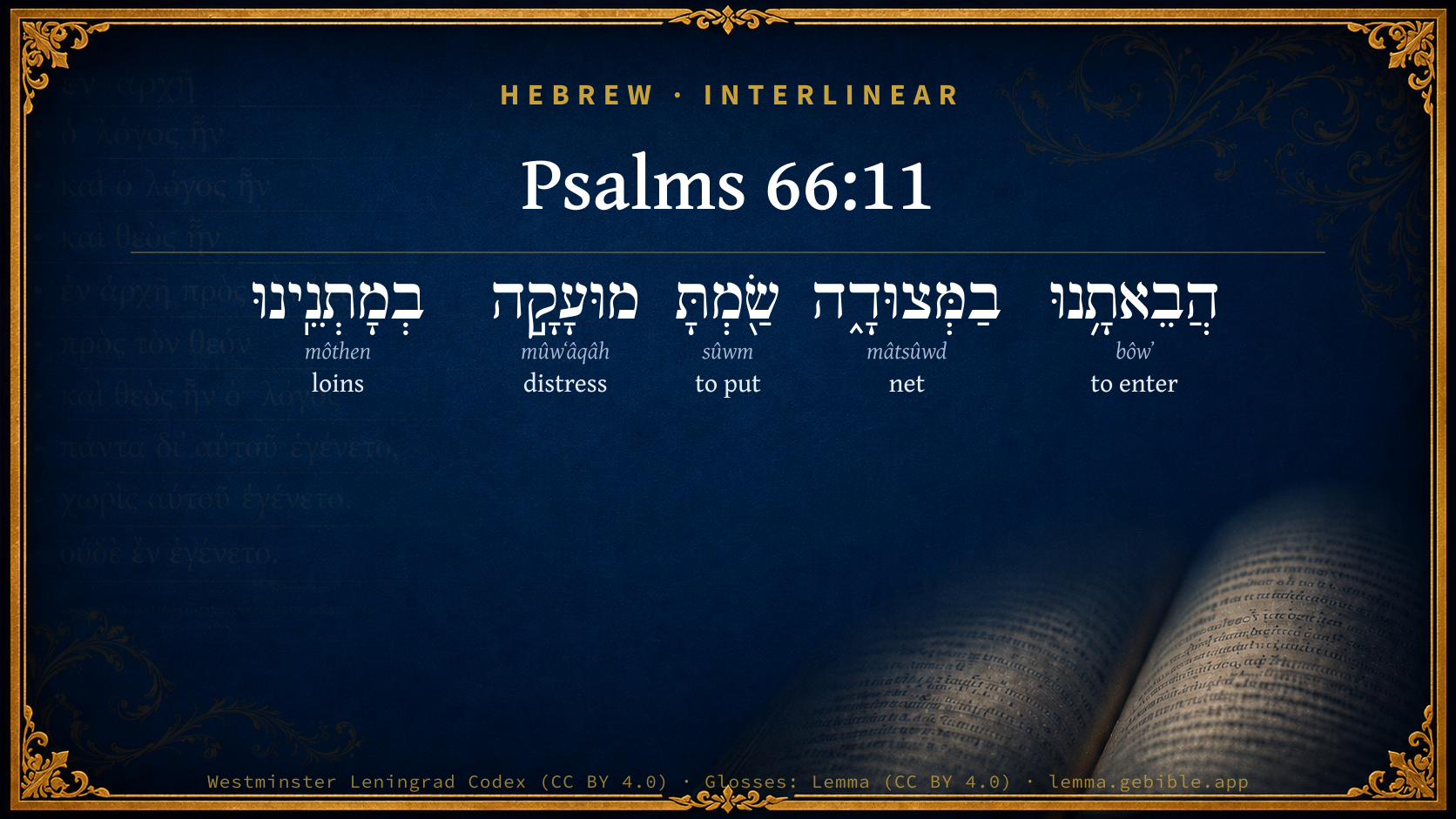
Psalms 66:11

Hebrew (Westminster Leningrad Codex) Psalms 66:11 appears in the Hebrew Old Testament. The text above is from the Westminster Leningrad Codex. Each word links to its Strong’s number, a concise gloss, and parsing drawn from the Open Scriptures Hebrew Bible morphology. Click any word for its full Brown-Driver-Briggs (BDB) entry.
Download image
Cite this verse

Psalms 66:11 (World English Bible). Public Domain. Lemma interlinear Bible study tool, https://lemma.gebible.app/v/psalms/66/11.

Show BibTeX & RIS
BibTeX
RIS
English Translation
You brought us into prison. You laid a burden on our backs.
World English Bible · Public Domain
Highlights
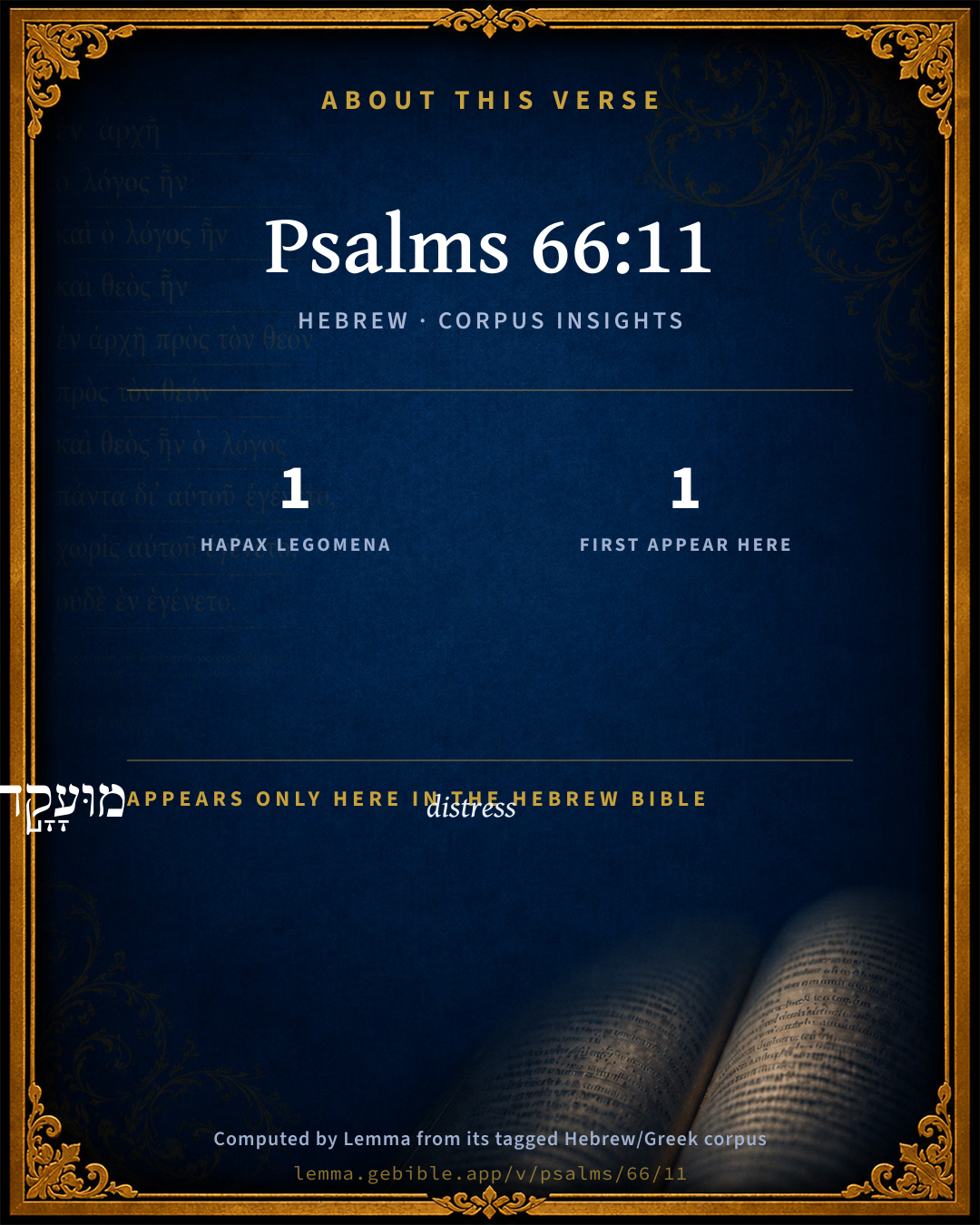
  • 1 hapax legomenon — only here in the Hebrew Bible
  • 1 first appearance in the Hebrew Bible
Full analysis ↓
Download a study sheet

One document with this verse’s original text, its word-by-word gloss line, the meaning frame, cross-references with their text, attributed commentary, and full source and license credits — printable, and it pastes into notes with its structure intact.

This verse Autodidact and up

Study sheet (.html) Plain text (.txt)

A passage Seminary Student

Up to 50 verses in one chapter. A passage sheet keeps up to 6 commentary sources and 12 cross-references per verse, in the order this page ranks them, and says so on the sheet whenever that leaves anything out. Ask for a single verse and you get the Autodidact verse sheet above.

Everything on this page stays free to read, with no account — the sheet is a download of what is already on screen, not access to it.

Want to remove ads? Support Godless Engineer
Compare translations 3

The same verse in 3 English versions, stacked beneath the original-language interlinear above. Click any original word for its lexicon entry.

Each is an independent rendering of the whole verse — the interlinear is not word-aligned to these translations.

Highlighted words mark where these versions differ — a whole-verse word diff, not a word-by-word alignment.

  • World English Bible Public Domain
    You brought us into prison. You laid a burden on our backs.
  • King James Version Public Domain
    Thou broughtest us into the net; thou laidst affliction upon our loins.
  • unfoldingWord Literal Text CC BY-SA 4.0
    You brought us into a net; you put pressure on our loins.

unfoldingWord Literal Text — © unfoldingWord, licensed CC BY-SA 4.0. Word-aligned USFM3 via Door43 (git.door43.org/unfoldingWord/en_ult).

Versions to compare (up to 4)

3 of 4 selected

Show all 18 translations

Every available English version of this verse, each an independent rendering of the whole verse.

  • World English Bible Public Domain
    You brought us into prison. You laid a burden on our backs.
  • Berean Standard Bible Public Domain
    You led us into the net; You laid burdens on our backs.
  • Majority Standard Bible Public Domain
    You led us into the net; You laid burdens on our backs.
  • King James Version Public Domain
    Thou broughtest us into the net; thou laidst affliction upon our loins.
  • American Standard Version (1901) Public Domain
    Thou broughtest us into the net; Thou layedst a sore burden upon our loins.
  • Revised Version (1885) Public Domain
    Thou broughtest us into the net; thou layedst a sore burden upon our loins.
  • Geneva Bible (1599) Public Domain
    Thou hast brought vs into the snare, and layed a strait chaine vpon our loynes.
  • Douay-Rheims (1899) Public Domain
    Thou hast brought us into a net, thou hast laid afflictions on our back:
  • Young's Literal Translation Public Domain
    Thou hast brought us into a net, Thou hast placed pressure on our loins.
  • Literal Standard Version CC BY-SA 4.0
    You have brought us into a net, || You have placed pressure on our loins.
  • Unlocked Literal Bible CC BY-SA 4.0
    You brought us into a net; you laid a heavy burden on our backs.
  • unfoldingWord Literal Text CC BY-SA 4.0
    You brought us into a net; you put pressure on our loins.
  • Darby Bible Public Domain
    Thou broughtest us into a net, thou didst lay a heavy burden upon our loins;
  • World Messianic Bible Public Domain
    You brought us into prison. You laid a burden on our backs.
  • Webster's Bible Public Domain
    Thou hast brought us into the net; thou hast laid affliction upon our loins.
  • Free Bible Version CC BY-SA 4.0
    You caught us in your net; you placed heavy burdens on our backs.
  • Bible in Basic English Public Domain
    You let us be put in prison; chains were put on our legs.
  • JPS Tanakh (1917) Public Domain
    Thou didst bring us into the hold; Thou didst lay constraint upon our loins.

Literal Standard Version (2020), Covenant Press — licensed CC BY-SA 4.0. Text via the HelloAO Bible API (eBible.org). Unlocked Literal Bible (unfoldingWord) — licensed CC BY-SA 4.0. Text via the HelloAO Bible API (eBible.org). unfoldingWord Literal Text — © unfoldingWord, licensed CC BY-SA 4.0. Word-aligned USFM3 via Door43 (git.door43.org/unfoldingWord/en_ult). Free Bible Version, Dr. Jonathan Gallagher — licensed CC BY-SA 4.0. Text via the HelloAO Bible API (eBible.org).

Word by word

More ways to search: Search by grammar → Find every occurrence → Compare this word →

Practice this passage: Drill this verse → Learn its vocabulary →

About this verse

These counts appear in no published source. They are computed here, from the morphology-tagged text and Lemma’s own curated glosses. What Lemma adds →

5
words
5
distinct lemmas
Wisdom
section

Notable vocabulary

1 hapax legomenon — a word that appears only here in the entire Hebrew Bible:

  • מוּעָקָ֣ה distress H4157

First appearance in Scripture

This word makes its first canonical appearance in the Hebrew Bible here:

  • מוּעָקָ֣ה distress H4157

Shared distinctive vocabulary

בַמְּצוּדָ֑ה net H4686 occurs in 23 verses of the Hebrew Bible. Also found in:

Grammatical profile

  • 2 verbs
  • 3 nouns

Verb forms

  • הֲבֵאתָ֥נוּ Hiphil · Perfect
  • שַׂ֖מְתָּ Qal · Perfect

Hebrew & Septuagint length

In English translation the verse runs 12 words from the Hebrew and 12 from the Septuagint (LXX English) — the same length.

A rough comparison of the two English renderings, which tokenize alike — not a word-level alignment.

Word counts can differ between the Hebrew and the Greek without any difference in meaning — e.g. the Hebrew direct-object marker אֵת has no separate Greek word, and Greek often adds the article ὁ.

Cross-references

7

Topical passages linked to Psalms 66:11 in the Treasury of Scripture Knowledge — connected by theme and wording, ordered by reader-vote popularity; previews shown in the World English Bible.

  • Lamentations 1:13 From on high has he sent fire into my bones, and it prevails against them; He has spread a net for my feet, he has turned me back: He has made me desolate and faint all the day.
  • Ezekiel 12:13 My net also will I spread on him, and he shall be taken in my snare; and I will bring him to Babylon to the land of the Chaldeans; yet shall he not see it, though he shall die there.
  • Job 19:6 Know now that God has subverted me, And has surrounded me with his net.
  • Hosea 7:12 When they go, I will spread my net on them. I will bring them down like the birds of the sky. I will chastise them, as their congregation has heard.
  • Deuteronomy 33:11 Bless, Yahweh, his substance, Accept the work of his hands: Smite through the loins of those who rise up against him, Of those who hate him, that they not rise again.
  • Lamentations 3:2–66 He has led me and caused me to walk in darkness, and not in light.
  • Matthew 6:13 Bring us not into temptation, but deliver us from the evil one. For yours is the Kingdom, the power, and the glory forever. Amen.'

Cross-references courtesy of OpenBible.info (CC BY 4.0).

Hebrew and Greek witnesses Masoretic Hebrew ↔ Greek Septuagint

The same verse in the two great witnesses to the Old Testament, shown verse-for-verse.

You’re reading Greek Psalm 65 (Hebrew Psalm 66). The Septuagint counts the superscription, so verse numbers can differ from the Hebrew — chapter-level alignment, not verse-by-verse. Numbering follows Rahlfs.

These are two independent witnesses, not word-aligned to each other, and the Septuagint is shown in lemma (dictionary) form.

Hebrew Psalms 66:11 Masoretic · Westminster Leningrad Codex

הֲבֵאתָ֥נוּ בַמְּצוּדָ֑ה שַׂ֖מְתָּ מוּעָקָ֣ה בְמָתְנֵֽינוּ

You brought us into prison. You laid a burden on our backs.

World English Bible · Public Domain

Greek LXX Greek Psalm 65:11 Septuagint · lemma form

εἰςἄγω ἐγώ εἰς ὁ παγίς τίθημι θλῖψις ἐπί ὁ νῶτον ἐγώ

You brought us into the snare; you laid afflictions on our back.

LXX2012 (modern English Septuagint) · Public Domain

On this verse, Ellicott's Commentary for English Readers discusses the Septuagint’s reading. Read the note in Commentary ↓

Hebrew: Westminster Leningrad Codex (CC BY 4.0). Greek: Septuagint (public domain); English from LXX2012 (modern English Septuagint) (Public Domain). How the Septuagint differs from the Hebrew →

Commentary

Notes on Psalms 66:11 from classic Christian and Jewish commentators (each source and its license shown beneath its notes). The classic Christian expositions comment on the surrounding passage and are grouped to its opening verse, so a note may address several verses; the Jewish commentaries on the Tanakh (Rashi and others) are per-verse, so they appear only where the commentator wrote on this verse.

Lemma curates 59 commentaries, every one of them public domain or Creative Commons licensed, each selected and text-cleaned for this edition rather than reprinted as found. About our sources →

Trapp's Complete Commentary

John Trapp

Psa 66:11 Thou broughtest us into the net; thou laidst affliction upon our loins.

Ver. 11. Thou broughtest us into the net] A metaphor from hunters or fowlers, Utitur figuris tanquam in poemate.

Thou layedst affliction upon our loins] Coarctationem in lumbis; we are not only hampered, as in a net, but fettered, as with chains; as if we had been in the jailor’s or hangman’s hands.

John Trapp, A Commentary or Exposition upon All the Books of the Old and New Testament (1647–1656) — public domain. Text from a community e-Sword module.

Joseph Benson's Commentary

Psa 66:11-12. Thou broughtest us into the net — Which our enemies had laid for us, and which could never have taken or held us but by thy permission, and the disposal of thy providence, which gave us into their hands. Thou hast caused men — Weak, mortal, and miserable men, as the word signifies, no better nor stronger than ourselves, if thou hadst not given them power over us; to ride over our heads — To trample upon us, and insult over us; to abuse, nay, and make perfect slaves of us. They have said to our souls, Bow down, that we may go over, Isa 51:23. We went through fire and water — Through afflictions of different kinds; through various and dangerous trials and calamities. The end of one trouble was the beginning of another; when we got clear of one sort of dangers, we found ourselves involved in dangers of another sort. Such may be the troubles of the best of God’s saints; but he has promised, When thou passest through the waters, through the fire, I will be with thee. Thou broughtest us into a wealthy place — Hebrew, לריוה, larevajah, a well- watered place, and therefore fruitful, like the garden of the Lord, Gen 13:10. Such was Canaan, both literally, Deu 8:7-9, and figuratively, as being replenished with divine graces, privileges, and blessings. Thus God brings his people into trouble, that their comforts afterward may be the sweeter, and that their affliction may thus yield the peaceable fruits of righteousness, which will make the poorest place in the world a wealthy place.

Joseph Benson's Commentary on the Old and New Testaments (1811–1818) — public domain. Text from a community e-Sword module.

Whedon's Commentary on the Bible

Daniel D. Whedon

11. Net—More properly a fastness, a stronghold, as the word almost always means; here referring to the prison of their captivity, like the labyrinths of a mountain cavern. Psa_66:11-12 describe their sufferings and degradation.

Daniel D. Whedon (gen. ed.), Commentary on the Old and New Testaments (1874–1909) — public domain. Text from a community e-Sword module.

J. A. Alexander on Psalms

Joseph Addison Alexander

11. (Psa 66:11) Thou hast caused us to come into the net; thou hast put pressure on our loins. The first clause is descriptive of complicated difficulties and embarrassments, the second of suffering and weakness. The word translated net occurs above in the very different sense of a tower or fortress, Psa 18:2. But even when so used, it strictly means a hunting tower, i.e. a post of observation and of safety used by hunters, and from the same root (to hunt) may be deduced the sense of net or snare, as a customary implement of hunting, in which sense it is certainly employed by Ezekiel in Eze 12:13. The word translated pressure occurs only here, but its essential meaning is clear from its etymological affinities. Compare the cognate form in Psa 55:3. Some suppose the idea to be that of a superincumbent pressure, load, or burden, corresponding to the verb as used in Amo 1:13. Others make pressure mean contraction, stricture, and by necessary implication, pain or anguish. The loins are mentioned as the seat of strength (Deu 33:11), an injury to which implies both pain and weakness. See below, on Psa 69:23.

Joseph Addison Alexander, The Psalms Translated and Explained (1850) — public domain. Text from a community e-Sword module.

Tyndale Open Study Notes

Tyndale Open Resources

66:11 God decrees and permits the many trying circumstances his people experience.

Tyndale Open Study Notes — © Tyndale Open Resources, licensed CC BY-SA 4.0. Text via the HelloAO Bible API.

Geneva Bible (1599)

Geneva Bible translators

The condition of the Church is here described, which is to be led by God’s providence into troubles to be subject under tyrants, and to enter into manifold dangers.

Geneva Bible (1599) marginal notes — public domain. Text via Bolls.life.

Jamieson, Fausset & Brown

Robert Jamieson, A. R. Fausset & David Brown

affliction--literally, "pressure," or, as in Psa 55:3, "oppression," which, laid on the

loins--the seat of strength (Deu 33:11), enfeebles the frame.

Jamieson, Fausset & Brown — Commentary Critical and Explanatory on the Whole Bible (1871) — public domain (CC PDM 1.0). Text via the HelloAO Bible API.

Adam Clarke's Commentary

Verse 11. Thou broughtest us into the net] This refers well to the case of the Israelites, when, in their departure from Egypt, pursued by the Egyptians, having the Red Sea before them, and no method of escape, Pharaoh said, "The wilderness hath shut them in,-they are entangled;" comparing their state to that of a wild beast in a net.

Affliction upon our loins.] Perhaps this alludes to that sharp pain in the back and loins which is generally felt on the apprehension of sudden and destructive danger.

Adam Clarke's Commentary on the Bible (1810–1826) — public domain. Text from a community e-Sword/MySword module.

Ellicott's Commentary for English Readers

(11) Net.—The Hebrew in Eze_12:13 certainly means “net,” as LXX. and Vulg. here. But Aquila, Symmachus, and Jerome prefer the usual meaning, “stronghold” (2Sa_5:7, &c), which is more in keeping with the other images of violence and oppression. The fortress, the hard labour, the subjection as by foes riding over the vanquished, the passage through fire and water, all raise a picture of the direst tyranny.

A Bible Commentary for English Readers, edited by Charles John Ellicott (1878–1897) — public domain. Text from a community e-Sword module.

The Cambridge Bible for Schools and Colleges

gen. ed. J. J. S. Perowne

11. Thou broughtest us into the net] God had deliberately brought them into the power of their enemies, to punish them for their sins. Cp. for the figure Job_19:6. Some commentators render into the dungeon, a figure for the loss of freedom (Isa_42:22), but the usage of the word is not in favour of this rendering.

thou laidst &c.] Thou layedst a crushing load upon our loins, bowing us down under its weight.

The Cambridge Bible for Schools and Colleges (gen. ed. J. J. S. Perowne; Cambridge University Press, 1878–1918) — public domain. Text from a community e-Sword module.

John Gill's Exposition

Thou broughtest us into the net,.... That is, suffered them to be taken in the net of wicked men, which they laid and spread for them; whereby they were drawn either into bad principles or bad practices, or into ruinous circumstances; though the Lord does not leave his own people there, but breaks the net or snare, sooner or later, and they escape; see Psa 9:15. Jarchi interprets it of a strait place, as in a prison; and which has often been literally true of the people of God, into which, though they have been cast by Satan, or by men instigated by him, yet, because permitted by the Lord, it is ascribed to him, Rev 2:10;

thou laidst affliction upon our loins: the Targum renders it "a chain": the word signifies anything that is binding and pressing; it seems to be a metaphor taken from the binding of burdens upon the backs of any creatures. Afflictions often lie heavy upon the saints, are very close upon them, and press them sore, even, as they sometimes think, beyond measure; though the Lord supports them, and will not suffer them to sink under them.

John Gill's Exposition of the Whole Bible (1746–1763) — public domain (CC PDM 1.0). Text via the HelloAO Bible API.

Albert Barnes' Notes on the Bible

Thou broughtest us into the net - That is, Thou hast suffered or permitted us to be brought into the net; thou hast suffered us to be taken captive, as beasts are caught in a snare. See the notes at Psa 9:15. The allusion here is to the efforts made by their enemies to take them, as hunters lay gins, or spread nets, to capture wild beasts. The idea here is, that those enemies had been successful; God had suffered them to fall into their hands. If we suppose this psalm to have been composed on the return from the Babylonian captivity, the propriety of this language will be apparent, for it well describes the fact that the nation had been subdued by the Babylonians, and had been led captive into a distant land. Compare Lam 1:13.

Thou laidst affliction upon our loins - The loins are mentioned as the seat of strength (compare Deu 33:11; 1Ki 12:10; Job 40:16).; and the idea here is, that he had put their strength to the test; he had tried them to see how much they could bear; he had made the test effectual by applying it to the part which was able to bear most. The idea is, that he had called them to endure as much as they were able to endure. He had tried them to the utmost.

Albert Barnes' Notes on the Bible (1834–1885) — public domain. Text from a community e-Sword/MySword module.

Matthew Poole's English Annotations

Thou broughtest us into the net which our enemies laid for us, and which could never have taken or held us but by the permission and disposal of thy providence, which gave us into their hands.

Matthew Poole's English Annotations on the Holy Bible (1683–1685) — public domain. Text from a community e-Sword/MySword module.

The Treasury of David

Charles H. Spurgeon

Ver. 11. Thou broughtest us into the net. The people of God in the olden time were often enclosed by the power of their enemies, like fishes or birds entangled in a net; there seemed no way of escape for them. The only comfort was that God himself had brought them there, but even this was not readily available, since they knew that he had led them there in anger as a punishment for their transgressions; Israel in Egypt was much like a bird in the fowler's net.

Thou laidest affliction upon our loins. They were pressed even to anguish by their burdens and pains. Not on their backs alone was the load, but their loins were pressed and squeezed with the straits and weights of adversity. God's people and affliction are intimate companions. As in Egypt every Israelite was a burden bearer, so is every believer while he is in this foreign land. As Israel cried to God by reason of their sore bondage, so also do the saints. We too often forget that God lays our afflictions upon us; if we remembered this fact, we should more patiently submit to the pressure which now pains us. The time will come when, for every ounce of present burden, we shall receive a far more exceeding and eternal weight of glory.

Ver. 11. Thou broughtest us into the net, etc. Our enemies have pursued us (like to wild beasts taken by the hunter) into most grievous straits (1Sa 13:6). They have used us like beasts of burden, and laid sore loads upon us, which they have fast bound upon our backs. Thou laidest affliction upon our loins. Coarctationenem in lumbis; we are not only hampered, as in a net, but fettered, as with chains; as if we had been in the jailor's or hangman's hands. John Trapp.

Ver. 11-12. The hand of God should be acknowledged.

I. In our temptations: Thou broughtest us.

II. In our bodily afflictions: Thou laidest, etc.

III. In our persecutions: Thou hast caused, etc.

IV. In our deliverances: Thou broughtest us out, etc. G. R.

Psalms 66:12*

Ver. 11-12. The hand of God should be acknowledged.

I. In our temptations: Thou broughtest us.

II. In our bodily afflictions: Thou laidest, etc.

III. In our persecutions: Thou hast caused, etc.

IV. In our deliverances: Thou broughtest us out, etc. G. R.

Charles H. Spurgeon's The Treasury of David (1869–1885) — public domain. Psalms only. Text from a community e-Sword/MySword module.

The Pulpit Commentary

Thou broughtest us into the net. Professor Cheyne translates "into the dungeon." But mtsudah has nowhere else this meaning. It is always either "a net" or "a stronghold." Thou laidst affliction upon oar loins; or, a sore burden (Revised Version). The meaning is, "Thou crushedst us down under a heavy weight of oppression."

The Pulpit Commentary (1880–1919), ed. H.D.M. Spence-Jones & Joseph S. Exell — public domain. Text from a community e-Sword module.

John Wesley's Explanatory Notes

Net - Which our enemies laid for us.

John Wesley, Explanatory Notes Upon the Whole Bible (1754–1765) — public domain. Text via the GEBible commentary corpus.

Rashi

Rabbi Shlomo Yitzchaki (Rashi)

You brought us into a trap A narrow place, like in a prison.

a chain Heb. מועקה, an expression of locking up, and every [expression of] מֵעִיק and מֵצִיק is like it.

Rashi on the Tanakh — English translations: “The Judaica Press complete Tanach with Rashi, translated by A. J. Rosenberg” (CC BY 4.0); “Pentateuch with Rashi's commentary by M. Rosenbaum and A.M. Silbermann, 1929-1934” (public domain); “The Metsudah Tanach series, Lakewood, N.J” (CC BY 4.0); and “The Book of Joshua, Metsudah Publications, 1997” (CC BY 4.0). Text via Sefaria.

Lesson kit

Teaching starters — assembled from the data on this page, not authored interpretation. Every prompt links to the verse data it draws on. Edit before teaching.

Psalms, in the Wisdom, opens this verse with 5 words (5 distinct Hebrew lemmas). Its most distinctive word is mûwʻâqâh (“distress”). A historical commentator’s framing appears above. Read the whole chapter for the surrounding context.

Discussion questions

  1. How does “distress” (mûwʻâqâh) shape what this verse is saying?
  2. This verse holds 1 word here found nowhere else in the Hebrew Bible. What might the rare word draw attention to?
  3. The word “distress” first appears here in Scripture. What is being introduced at this debut?
  4. 1 Samuel 22:4 shares the word «net» with this verse. How do the two illuminate each other?
  5. These translations render this verse differently. What is at stake in choosing one wording over another?
  6. The verb «הֲבֵאתָ֥נוּ» is Hiphil Perfect. How does its form color the action?
  7. Reading how Trapp's Complete Commentary and Joseph Benson's Commentary read this verse, where do the two commentators agree and where do they part?

Things to notice

  • 1 word in this verse appears nowhere else in the Hebrew Bible.
  • 1 word makes its first canonical appearance in Scripture here.
  • These translations choose different wording for 14 words in this verse.
  • 5 distinct Hebrew lemmas span 5 words in this verse.

Reading settings

Reading text

Shown beneath each verse's original-language words.

Old Testament
Old Testament edition

Read the OT as the Masoretic Hebrew (MT) or the Greek Septuagint (LXX).

English shown for the Greek Septuagint (in the Hebrew ↔ Greek comparison).

Comparing translations? Open the Compare panel on any verse page to stack up to four side by side.