
Psalms 66:9

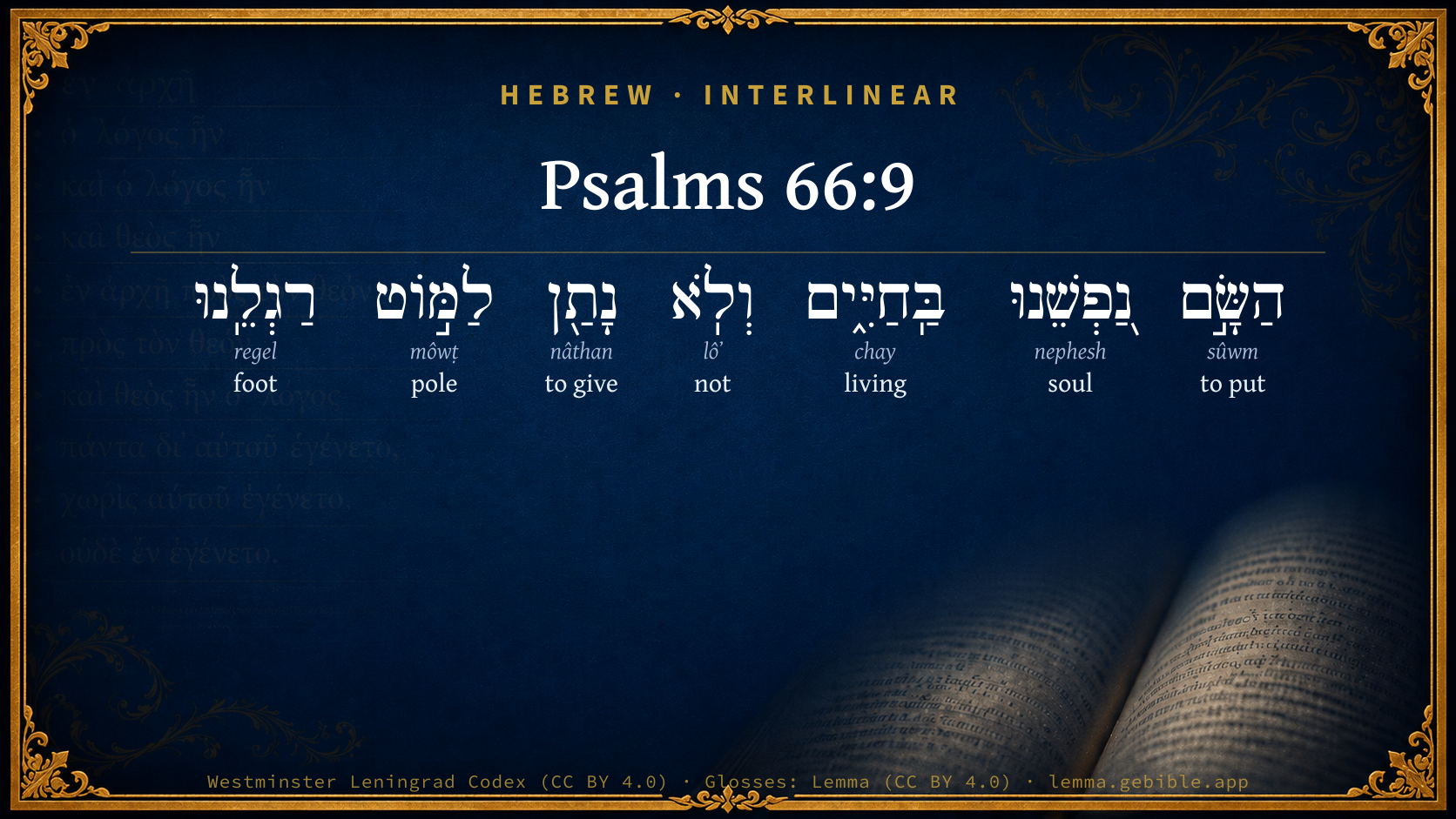
Hebrew (Westminster Leningrad Codex) Psalms 66:9 appears in the Hebrew Old Testament. The text above is from the Westminster Leningrad Codex. Each word links to its Strong’s number, a concise gloss, and parsing drawn from the Open Scriptures Hebrew Bible morphology. Click any word for its full Brown-Driver-Briggs (BDB) entry.
Download image
Cite this verse

Psalms 66:9 (World English Bible). Public Domain. Lemma interlinear Bible study tool, https://lemma.gebible.app/v/psalms/66/9.

Show BibTeX & RIS
BibTeX
RIS
English Translation
Who preserves our life among the living, And doesn't allow our feet to be moved.
World English Bible · Public Domain
Download a study sheet

One document with this verse’s original text, its word-by-word gloss line, the meaning frame, cross-references with their text, attributed commentary, and full source and license credits — printable, and it pastes into notes with its structure intact.

This verse Autodidact and up

Study sheet (.html) Plain text (.txt)

A passage Seminary Student

Up to 50 verses in one chapter. A passage sheet keeps up to 6 commentary sources and 12 cross-references per verse, in the order this page ranks them, and says so on the sheet whenever that leaves anything out. Ask for a single verse and you get the Autodidact verse sheet above.

Everything on this page stays free to read, with no account — the sheet is a download of what is already on screen, not access to it.

Want to remove ads? Support Godless Engineer
Compare translations 3

The same verse in 3 English versions, stacked beneath the original-language interlinear above. Click any original word for its lexicon entry.

Each is an independent rendering of the whole verse — the interlinear is not word-aligned to these translations.

Highlighted words mark where these versions differ — a whole-verse word diff, not a word-by-word alignment.

  • World English Bible Public Domain
    Who preserves our life among the living, And doesn't allow our feet to be moved.
  • King James Version Public Domain
    Which holdeth our soul in life, and suffereth not our feet to be moved.
  • unfoldingWord Literal Text CC BY-SA 4.0
    the one putting our soul among the living, and he does not allow our foot to slip.

unfoldingWord Literal Text — © unfoldingWord, licensed CC BY-SA 4.0. Word-aligned USFM3 via Door43 (git.door43.org/unfoldingWord/en_ult).

Versions to compare (up to 4)

3 of 4 selected

Show all 18 translations

Every available English version of this verse, each an independent rendering of the whole verse.

  • World English Bible Public Domain
    Who preserves our life among the living, And doesn't allow our feet to be moved.
  • Berean Standard Bible Public Domain
    He preserves our lives and keeps our feet from slipping.
  • Majority Standard Bible Public Domain
    He preserves our lives and keeps our feet from slipping.
  • King James Version Public Domain
    Which holdeth our soul in life, and suffereth not our feet to be moved.
  • American Standard Version (1901) Public Domain
    Who holdeth our soul in life, And suffereth not our feet to be moved.
  • Revised Version (1885) Public Domain
    Which holdeth our soul in life, and suffereth not our feet to be moved.
  • Geneva Bible (1599) Public Domain
    Which holdeth our soules in life, and suffereth not our feete to slippe.
  • Douay-Rheims (1899) Public Domain
    Who hath set my soul to live: and hath not suffered my feet to be moved:
  • Young's Literal Translation Public Domain
    Who hath placed our soul in life, And suffered not our feet to be moved.
  • Literal Standard Version CC BY-SA 4.0
    Who has placed our soul in life, || And has not permitted our feet to be moved.
  • Unlocked Literal Bible CC BY-SA 4.0
    He keeps us among the living, and he does not permit our feet to slip.
  • unfoldingWord Literal Text CC BY-SA 4.0
    the one putting our soul among the living, and he does not allow our foot to slip.
  • Darby Bible Public Domain
    Who hath set our soul in life, and suffereth not our feet to be moved.
  • World Messianic Bible Public Domain
    who preserves our life among the living, and doesn’t allow our feet to be moved.
  • Webster's Bible Public Domain
    Who holdeth our soul in life, and suffereth not our feet to be moved.
  • Free Bible Version CC BY-SA 4.0
    He has kept us alive, and he has not let us fall.
  • Bible in Basic English Public Domain
    Because he gives us life, and has not let our feet be moved.
  • JPS Tanakh (1917) Public Domain
    Who hath set our soul in life, and suffered not our foot to be moved,

Literal Standard Version (2020), Covenant Press — licensed CC BY-SA 4.0. Text via the HelloAO Bible API (eBible.org). Unlocked Literal Bible (unfoldingWord) — licensed CC BY-SA 4.0. Text via the HelloAO Bible API (eBible.org). unfoldingWord Literal Text — © unfoldingWord, licensed CC BY-SA 4.0. Word-aligned USFM3 via Door43 (git.door43.org/unfoldingWord/en_ult). Free Bible Version, Dr. Jonathan Gallagher — licensed CC BY-SA 4.0. Text via the HelloAO Bible API (eBible.org).

Word by word

More ways to search: Search by grammar → Find every occurrence → Compare this word →

Practice this passage: Drill this verse → Learn its vocabulary →

About this verse

These counts appear in no published source. They are computed here, from the morphology-tagged text and Lemma’s own curated glosses. What Lemma adds →

7
words
7
distinct lemmas
Wisdom
section

Notable vocabulary

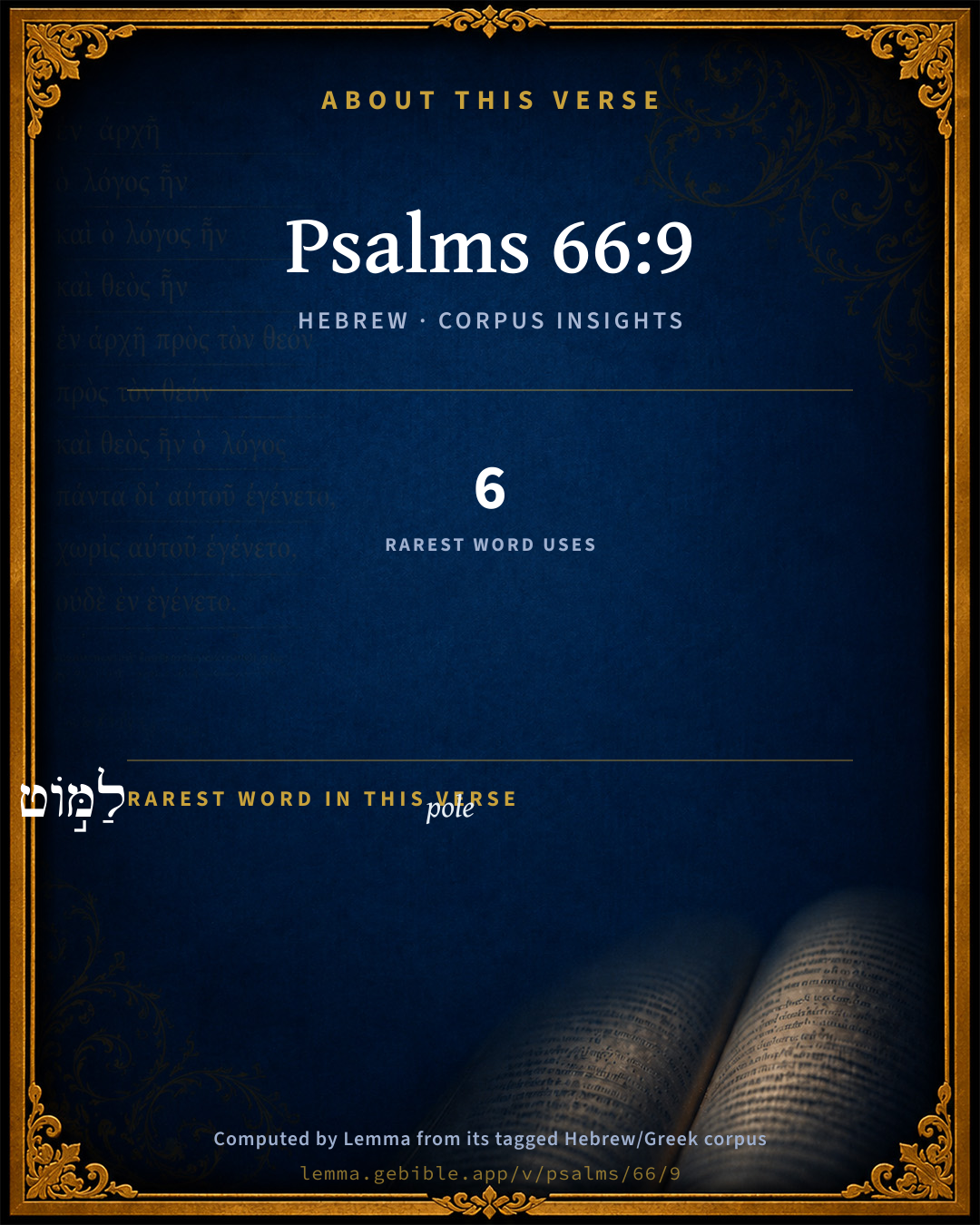
The rarest word here is לַמּ֣וֹט pole H4132 — appearing just 6 times in the whole Hebrew Bible.

Shared distinctive vocabulary

לַמּ֣וֹט pole H4132 occurs in 6 verses of the Hebrew Bible. Also found in:

Grammatical profile

  • 3 verbs
  • 3 nouns
  • 1 particle

Verb forms

  • הַשָּׂ֣ם Qal · Participle Active
  • נָתַ֖ן Qal · Perfect
  • לַמּ֣וֹט Qal · Infinitive Construct

Hebrew & Septuagint length

In English translation the verse runs 15 words from the Hebrew and 15 from the Septuagint (LXX English) — the same length.

A rough comparison of the two English renderings, which tokenize alike — not a word-level alignment.

Word counts can differ between the Hebrew and the Greek without any difference in meaning — e.g. the Hebrew direct-object marker אֵת has no separate Greek word, and Greek often adds the article ὁ.

Cross-references

12

Topical passages linked to Psalms 66:9 in the Treasury of Scripture Knowledge — connected by theme and wording, ordered by reader-vote popularity; previews shown in the World English Bible.

  • Psalms 121:3 He will not allow your foot to be moved. He who keeps you will not slumber.
  • Psalms 94:18 When I said, "My foot is slipping!" Your loving kindness, Yahweh, held me up.
  • Psalms 112:6 For he will never be shaken. The righteous will be remembered forever.
  • 1 Samuel 2:9 He will keep the feet of his holy ones; But the wicked shall be put to silence in darkness; For by strength shall no man prevail.
  • Psalms 37:23–24 A man's goings are established by Yahweh. He delights in his way.
  • 1 Samuel 25:29 Though men be risen up to pursue you, and to seek your soul, yet the soul of my lord shall be bound in the bundle of life with Yahweh your God; and the souls of your enemies, them shall he sling out, as from the hollow of a sling.
  • Psalms 22:29 All the rich ones of the earth shall eat and worship. All those who go down to the dust shall bow before him, Even he who can't keep his soul alive.
  • Psalms 62:2 He alone is my rock and my salvation, my fortress-- I will never be greatly shaken.
  • Psalms 125:3 For the scepter of wickedness won't remain over the allotment of the righteous; So that the righteous won't use their hands to do evil.
  • Acts 17:28 'For in him we live, and move, and have our being.' As some of your own poets have said, 'For we are also his offspring.'
  • Colossians 3:3–4 For you died, and your life is hidden with Christ in God.
  • Psalms 62:6 He alone is my rock and my salvation, my fortress. I will not be shaken.

Cross-references courtesy of OpenBible.info (CC BY 4.0).

Hebrew and Greek witnesses Masoretic Hebrew ↔ Greek Septuagint

The same verse in the two great witnesses to the Old Testament, shown verse-for-verse.

You’re reading Greek Psalm 65 (Hebrew Psalm 66). The Septuagint counts the superscription, so verse numbers can differ from the Hebrew — chapter-level alignment, not verse-by-verse. Numbering follows Rahlfs.

These are two independent witnesses, not word-aligned to each other, and the Septuagint is shown in lemma (dictionary) form.

Hebrew Psalms 66:9 Masoretic · Westminster Leningrad Codex

הַשָּׂ֣ם נַ֭פְשֵׁנוּ בַּֽחַיִּ֑ים וְלֹֽא נָתַ֖ן לַמּ֣וֹט רַגְלֵֽנוּ

Who preserves our life among the living, And doesn't allow our feet to be moved.

World English Bible · Public Domain

Greek LXX Greek Psalm 65:9 Septuagint · lemma form

ὁ τίθημι ὁ ψυχή ἐγώ εἰς ζωή καί μή δίδωμι εἰς σάλος ὁ πούς ἐγώ

who quickens my soul in life, and does not suffer my feet to be moved.

LXX2012 (modern English Septuagint) · Public Domain

On this verse, Ellicott's Commentary for English Readers discusses the Septuagint’s reading. Read the note in Commentary ↓

Hebrew: Westminster Leningrad Codex (CC BY 4.0). Greek: Septuagint (public domain); English from LXX2012 (modern English Septuagint) (Public Domain). How the Septuagint differs from the Hebrew →

Commentary

Notes on Psalms 66:9 from classic Christian and Jewish commentators (each source and its license shown beneath its notes). The classic Christian expositions comment on the surrounding passage and are grouped to its opening verse, so a note may address several verses; the Jewish commentaries on the Tanakh (Rashi and others) are per-verse, so they appear only where the commentator wrote on this verse.

Lemma curates 59 commentaries, every one of them public domain or Creative Commons licensed, each selected and text-cleaned for this edition rather than reprinted as found. About our sources →

Trapp's Complete Commentary

John Trapp

Psa 66:9 Which holdeth our soul in life, and suffereth not our feet to be moved.

Ver. 9. Which holdeth our soul in life] Heb. putteth, that is, bestoweth life on us, preserveth it, restoreth it. Some think this psalm was made upon David’s deliverance from the giant that sought to kill him, 2Sa 21:16.

And suffereth not our feet to be moved] David gave back divers paces, say the Hebrews, but was seasonably rescued by Abishai, who slew the Philistine.

John Trapp, A Commentary or Exposition upon All the Books of the Old and New Testament (1647–1656) — public domain. Text from a community e-Sword module.

The Biblical Illustrator

Joseph S. Exell

Psa_66:9

Which holdeth our soul in life, and suffereth not our feet to be moved.

The safety of the saints

Now, in these words we notice--

I. The life. He holdeth our soul in life. This is--

1. A life of purity in opposition to sin.

2. Of plenty in opposition to a life of poverty.

3. Of godly exercise, or exercise unto godliness.

4. Of pleasing discovery.

II. The preservation. He holdeth, etc. This applies to all the four ideas adverted to.

III. The fixation. He suffereth not our feet to be moved. Now, how is it our feet cannot be moved finally? Why, because we have, in salvation matters, a covenant ordered in all things and sure. (James Wells.)

The Biblical Illustrator, edited by Joseph S. Exell (c. 1880s–1900s) — public domain. Text from a community e-Sword module.

J. A. Alexander on Psalms

Joseph Addison Alexander

9. (Psa 66:9) The (one) putting, who puts, our soul in life, and has not given (up) to removal our foot, has not allowed it to move or slip. The unusual expression in the first clause seems to mean restoration to life, a figure for relief from great distress, which is not unfrequently described as death. See above, on Psa 30:3; Psa 49:15. To set in life is not unlike the phrase to set in safety, Psa 12:5. The form of expression in the last clause is analogous to that in Psa 55:22 above, and identical with that in Psa 121:3 below. Given up to removal, suffered to be moved from its firm position or its place of safety.

Joseph Addison Alexander, The Psalms Translated and Explained (1850) — public domain. Text from a community e-Sword module.

Tyndale Open Study Notes

Tyndale Open Resources

66:9 God guides his people into wisdom and away from folly (17:5; 37:31; 121:3).

Tyndale Open Study Notes — © Tyndale Open Resources, licensed CC BY-SA 4.0. Text via the HelloAO Bible API.

Geneva Bible (1599)

Geneva Bible translators

He signifieth some special benefit, that God had showed to his Church of the Jews, in delivering them from some great danger: whereof or of the like he promiseth that the Gentiles shall be partakers.

Geneva Bible (1599) marginal notes — public domain. Text via Bolls.life.

Jamieson, Fausset & Brown

Robert Jamieson, A. R. Fausset & David Brown

holdeth . . . in life--literally, "putteth our soul in life"; that is, out of danger (Psa 30:3; Psa 49:15).

to be moved--(Compare Psa 10:6; Psa 55:22).

Jamieson, Fausset & Brown — Commentary Critical and Explanatory on the Whole Bible (1871) — public domain (CC PDM 1.0). Text via the HelloAO Bible API.

Adam Clarke's Commentary

Verse 9. Which holdeth our soul in life] Literally, "he who placeth our soul בחיים bachaiyim, in lives." We are preserved alive, have health of body, and feel the life of God in our hearts.

And suffereth not her feet to be moved.] Keeps us steadfast in his testimonies. We have our life, our liberty, and our religion. O, what hath the Lord wrought for us! "Make, therefore, the voice of his praise to be heard." Let God and man know you are thankful.

Adam Clarke's Commentary on the Bible (1810–1826) — public domain. Text from a community e-Sword/MySword module.

Ellicott's Commentary for English Readers

(9) Which holdeth . . .—The LXX. literally, which putteth our soul into life, i.e., keeps us alive, as the parallelism shows.

A Bible Commentary for English Readers, edited by Charles John Ellicott (1878–1897) — public domain. Text from a community e-Sword module.

The Cambridge Bible for Schools and Colleges

gen. ed. J. J. S. Perowne

9. Who hath set our soul in life,

And not suffered our foot to be moved.

The nation was on the point of death and ruin, but God preserved and upheld it. The tenses indicate that the words are not the statement of a general truth (as A.V. renders them), but refer particularly to the deliverance from the trial described in the following verses.

The Cambridge Bible for Schools and Colleges (gen. ed. J. J. S. Perowne; Cambridge University Press, 1878–1918) — public domain. Text from a community e-Sword module.

John Gill's Exposition

Which holdeth our soul in life,.... Or, "putteth our soul in life" (b), or "among the living", which is not to be understood of infusing a living soul in man, nor of the preservation of natural life, which is common to all men; but of appointing and ordaining them unto eternal life, as the Targum; and of procuring it for them by Christ; and of implanting a principle of spiritual life in them, by his Spirit and grace; and of the preservation of the principle of life, that it be not lost; and of giving them a right and title to eternal life, and that itself: all which are a sufficient reason, and powerful argument, to bless our God, and praise his name. It follows:

and suffereth not our feet to be moved; that is, not to be greatly moved; or if moved so as to slip and fall, yet not so as to fall finally and totally; see Psa 55:22.

(b) "qui posuit", V. L. Pagninus, Musculus, Vatablus; "ponene", Montanus; "qui ponit", Gejerus, Michaelis.

John Gill's Exposition of the Whole Bible (1746–1763) — public domain (CC PDM 1.0). Text via the HelloAO Bible API.

Albert Barnes' Notes on the Bible

Which holdeth our soul in life - Margin, as in Hebrew, putteth. That is, He has put (or placed) us in a state of safety. The word rendered “in life” means literally “among the living.” The word soul here is equivalent to us - ourselves; and the idea is, that he keeps us among the living. What is here said of this special deliverance is true of all people at all times, that they owe the fact that they are among the living to the care of God; or, it is because he puts them among the living, or keeps them alive.

And suffereth not our feet to be moved - That is, from their firm position of safety. The idea is taken from one who is walking, and who is kept from slipping or falling.

Albert Barnes' Notes on the Bible (1834–1885) — public domain. Text from a community e-Sword/MySword module.

Matthew Poole's English Annotations

Which holdeth our soul in life; who by a succession of miracles of mercy hath kept us alive in the midst of a thousand deaths, to which we were exposed, and hath restored us to life, when we were like dead men, and dry bones scattered at the mouth of the grave.

To be moved, to wit, so as to fall into mischief and utter ruin, as our enemies designed.

Matthew Poole's English Annotations on the Holy Bible (1683–1685) — public domain. Text from a community e-Sword/MySword module.

The Treasury of David

Charles H. Spurgeon

Ver. 9. Which holdeth our soul in life. At any time the preservation of life, and especially the soul's life, is a great reason for gratitude but much more when we are called to undergo extreme trials, which of themselves would crush our being. Blessed be God, who, having put our souls into possession of life, has been pleased to preserve that heaven given life from the destroying power of the enemy.

And suffereth not our feet to be moved. This is another and precious boon. If God has enabled us not only to keep our life, but our position, we are bound to give him double praise. Living and standing is the saint's condition through divine grace. Immortal and immoveable are those whom God preserves. Satan is put to shame, for instead of being able to slay the saints, as he hoped, he is not even able to trip them up. God is able to make the weakest to stand fast, and he will do so.

Ver. 9. Which holdeth our soul in life. As the works of creation at first, and upholding all by his power and providence, are yoked together as works of a like wonder, vouchsafed the creation in common, Heb 1:2-3; so just in the like manner we find regeneration and perseverance joined, as the sum of all other works in this life. Thus "begotten again, "and "kept by the power of God to salvation, "are joined by the Apostle, 1Pe 1:3, 5, "Called and preserved in Christ Jesus; "so in Jude 1:1... "Blessed be God, "says Peter, "who, according to his abundant mercy, hath begotten us again." And, O bless our God, ye people, which holdeth our souls in life, says the psalmist. Yea, if we do narrowly eye the words in either, both Peter and the psalmist do bless God for both at once. Blessed be God for "begetting us, "who are also "kept by the power of God; "so it follows in Peter. In the psalmist both are comprehended in this one word:

1. Which putteth our souls in life (so the margin, out of the Hebrew), that is, who puts life into your soul at the first, as he did into Adam when he made him a living soul;

2. And then which holdeth, that is, continueth our souls in that life. So the translators render it also, according to the psalmist's scope, and O bless the Lord, saith the psalmist, for these and both these. Thomas Goodwin.

Ver. 9. Which holdest our soul in life. It is truth, that all we have is in the hand of God; but God keeps our life in his hand last of all, and he hath that in his hand in a special manner. Though the soul continue, life may not continue; there is the soul when there is not life: life is that which is the union of soul and body. Thou holdest our soul in life; that is, thou holdest soul and body together. So Daniel describes God to Belshazzar, Da 5:23, "The God in whose hand thy breath is, and whose are all thy ways, hast thou not glorified." The breath of princes is in the hand of God, and the same hand holds the breath of the meanest subject. This may be matter of comfort to us in times of danger, and times of death: when the hand of man is lifted up to take thy life, remember thy life is held in the hand of God; and as God said to Satan (Job 2:6): Afflict the body of Job, but save his life; so God saith still to bloody wretches, who are as the limbs of Satan: The bodies of such and such are in your hands, the estates of such and such are in your hands, but save their lives. Joseph Caryl.

Ver. 9. Putteth our soul in life. An elegant and emphatic expression, only to be understood by observing the exact force of the words. The soul is the life, as is well known, the word Myv is to place, to place upon, to press in, the word Myyx signifies properly joinings, fastenings together, and hence those faculties and powers by which nature is held together and made firm. Hermann Venema.

Ver. 9. Which holdeth our soul in life. He holdeth our soul in life, that it may not drop away of itself; for being continually in our hands, it is apt to slip through our fingers. Matthew Henry.

Ver. 9. And suffereth not our feet to be moved. It is a great mercy to be kept from desperate courses in the time of sad calamities, to be supported under burdens, that we sink not; and to be prevented from denying God, or his truth, in time of persecution. David Dickson.

Ver. 9. Perseverance the subject of gratitude.

I. The maintenance of the inner life.

II. The integrity of the outward character.

Psalms 66:10*

Charles H. Spurgeon's The Treasury of David (1869–1885) — public domain. Psalms only. Text from a community e-Sword/MySword module.

Whedon's Commentary on the Bible

Daniel D. Whedon

9. Holdeth our soul in life—Setteth up, placeth firmly, our soul in the life; that is, in the true condition and life of thy covenant people; a literal description of an anastasis, or resurrection, where the Hebrew שׂום, (seem,) to place, put, set up, and the corresponding Septuagint θεμενου, answer to the New Testament αναστασις, resurrection, “the person or thing put, [placed, set up,] regarded as standing erect rather than lying down.”—Delitzsch. This idea is here sustained by the parallelism, thus:—

Placing [erecting] our soul in the life,

And hast not given over [delivered, abandoned] our foot to the sliding.

The firm, erect posture is contrasted with the tottering and sliding condition. Comp. Psa_9:13, and the use of שׂום, (set up,) Psa_74:4; Job_5:11, et.al. This mode of speech, which is not unfrequent, belongs to a people who had an idea of the resurrection of the human body.

Daniel D. Whedon (gen. ed.), Commentary on the Old and New Testaments (1874–1909) — public domain. Text from a community e-Sword module.

The Pulpit Commentary

Which holdeth our soul in life; rather, which setteth (or, hath set) our soul in life implying a previous condition of great danger. And suffereth not our feet to be moved. In allusion, perhaps, to a threatened captivity.

The Pulpit Commentary (1880–1919), ed. H.D.M. Spence-Jones & Joseph S. Exell — public domain. Text from a community e-Sword module.

Lesson kit

Teaching starters — assembled from the data on this page, not authored interpretation. Every prompt links to the verse data it draws on. Edit before teaching.

Psalms, in the Wisdom, opens this verse with 7 words (7 distinct Hebrew lemmas). Its most distinctive word is môwṭ (“pole”). A historical commentator’s framing appears above. Read the whole chapter for the surrounding context.

Discussion questions

  1. How does “pole” (môwṭ) shape what this verse is saying?
  2. How does Numbers 4:10, which shares the word «pole», read alongside this verse?
  3. The translations on this page render this verse differently — a whole-verse word diff, not a word-by-word alignment. What might account for the different wordings?
  4. «הַשָּׂ֣ם» is a Qal Participle Active verb. How does that grammatical form shape the action described?
  5. Compare how Trapp's Complete Commentary and The Biblical Illustrator read this verse. Where do they agree or differ?

Things to notice

Reading settings

Reading text

Shown beneath each verse's original-language words.

Old Testament
Old Testament edition

Read the OT as the Masoretic Hebrew (MT) or the Greek Septuagint (LXX).

English shown for the Greek Septuagint (in the Hebrew ↔ Greek comparison).

Comparing translations? Open the Compare panel on any verse page to stack up to four side by side.