Jeremiah 10:22

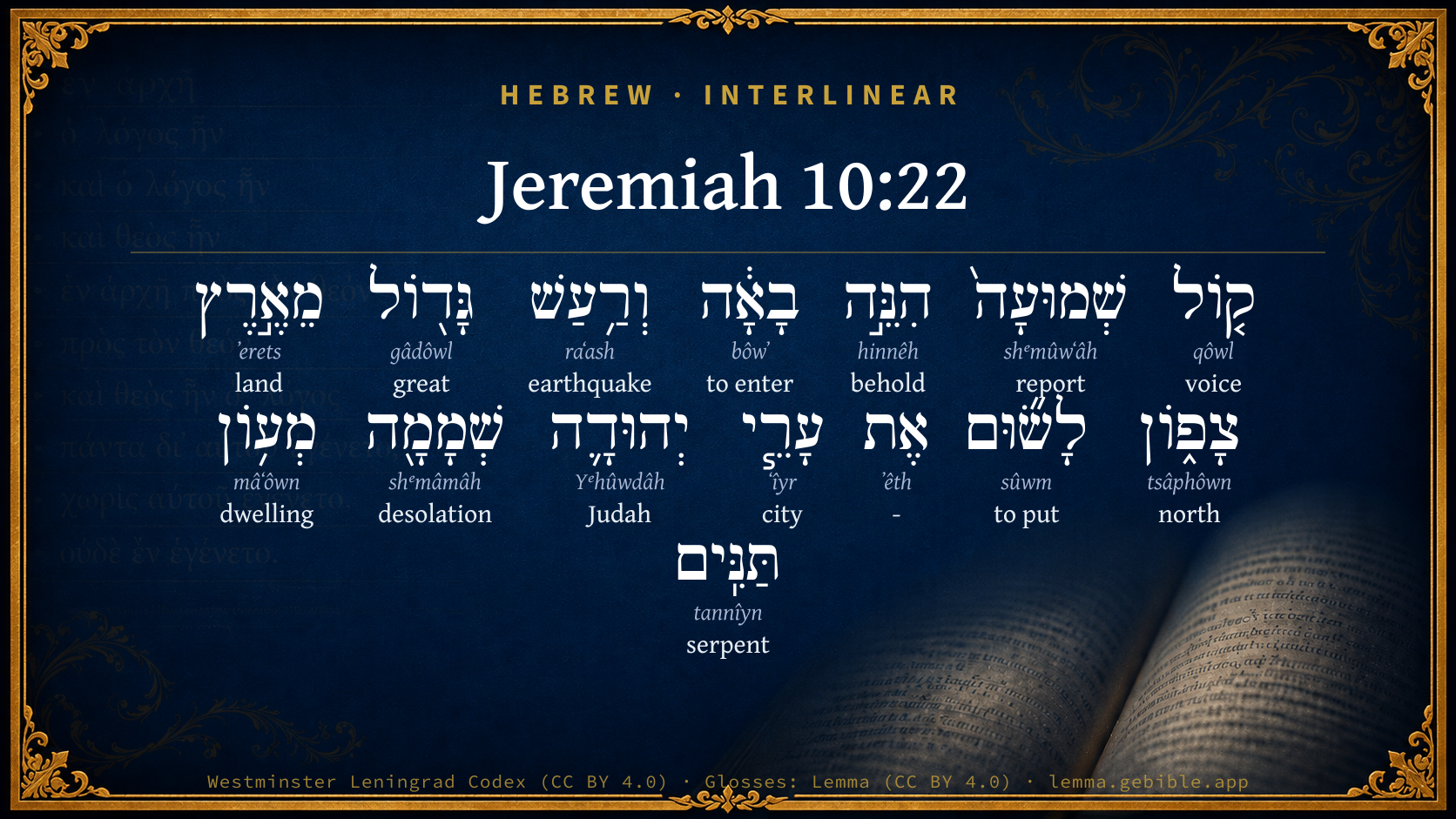
Hebrew (Westminster Leningrad Codex) Jeremiah 10:22 appears in the Hebrew Old Testament. The text above is from the Westminster Leningrad Codex. Each word links to its Strong’s number, a concise gloss, and parsing drawn from the Open Scriptures Hebrew Bible morphology. Click any word for its full Brown-Driver-Briggs (BDB) entry.
Download image
Cite this verse

Jeremiah 10:22 (World English Bible). Public Domain. Lemma interlinear Bible study tool, https://lemma.gebible.app/v/jeremiah/10/22.

Show BibTeX & RIS
BibTeX
RIS
English Translation
The voice of news, behold, it comes, and a great commotion out of the north country, to make the cities of Judah a desolation, a dwelling-place of jackals.
World English Bible · Public Domain
Download a study sheet

One document with this verse’s original text, its word-by-word gloss line, the meaning frame, cross-references with their text, attributed commentary, and full source and license credits — printable, and it pastes into notes with its structure intact.

This verse Autodidact and up

Study sheet (.html) Plain text (.txt)

A passage Seminary Student

Up to 50 verses in one chapter. A passage sheet keeps up to 6 commentary sources and 12 cross-references per verse, in the order this page ranks them, and says so on the sheet whenever that leaves anything out. Ask for a single verse and you get the Autodidact verse sheet above.

Everything on this page stays free to read, with no account — the sheet is a download of what is already on screen, not access to it.

Want to remove ads? Support Godless Engineer
Compare translations 3

The same verse in 3 English versions, stacked beneath the original-language interlinear above. Click any original word for its lexicon entry.

Each is an independent rendering of the whole verse — the interlinear is not word-aligned to these translations.

Highlighted words mark where these versions differ — a whole-verse word diff, not a word-by-word alignment.

  • World English Bible Public Domain
    The voice of news, behold, it comes, and a great commotion out of the north country, to make the cities of Judah a desolation, a dwelling-place of jackals.
  • King James Version Public Domain
    Behold, the noise of the bruit is come, and a great commotion out of the north country, to make the cities of Judah desolate, and a den of dragons.
  • unfoldingWord Literal Text CC BY-SA 4.0
    The sound of a report, Behold! It is coming, and a great commotion from the land of the north, to make the cities of Judah a desolation, a dwelling place of jackals.”

unfoldingWord Literal Text — © unfoldingWord, licensed CC BY-SA 4.0. Word-aligned USFM3 via Door43 (git.door43.org/unfoldingWord/en_ult).

Versions to compare (up to 4)

3 of 4 selected

Show all 18 translations

Every available English version of this verse, each an independent rendering of the whole verse.

  • World English Bible Public Domain
    The voice of news, behold, it comes, and a great commotion out of the north country, to make the cities of Judah a desolation, a dwelling-place of jackals.
  • Berean Standard Bible Public Domain
    Listen! The sound of a report is coming—a great commotion from the land to the north. The cities of Judah will be made a desolation, a haunt for jackals.
  • Majority Standard Bible Public Domain
    Listen! The sound of a report is coming—a great commotion from the land to the north. It will make the cities of Judah a desolation, a haunt for jackals.
  • King James Version Public Domain
    Behold, the noise of the bruit is come, and a great commotion out of the north country, to make the cities of Judah desolate, and a den of dragons.
  • American Standard Version (1901) Public Domain
    The voice of tidings, behold, it cometh, and a great commotion out of the north country, to make the cities of Judah a desolation, a dwelling-place of jackals.
  • Revised Version (1885) Public Domain
    The voice of a rumour, behold it cometh, and a great commotion out of the north country, to make the cities of Judah a desolation, a dwelling place of jackals.
  • Geneva Bible (1599) Public Domain
    Beholde, the noyse of the brute is come, and a great commotion out of the North countrey to make the cities of Iudah desolate, and a denne of dragons.
  • Douay-Rheims (1899) Public Domain
    Behold the sound of a noise cometh, a great commotion out of the land of the north: to make the cities of Juda a desert, and a dwelling for dragons.
  • Young's Literal Translation Public Domain
    A voice of a report, lo, it hath come, Even a great shaking from the north country, To make the cities of Judah a desolation, A habitation of dragons.
  • Literal Standard Version CC BY-SA 4.0
    A voice of a report, behold, it has come, || Even a great shaking from the north country, || To make the cities of Judah a desolation, || A habitation of dragons.
  • Unlocked Literal Bible CC BY-SA 4.0
    The report of news has arrived, “See! It is coming, a great earthquake is coming from the land of the north To make the cities of Judah into ruins, hideouts for jackals.”
  • unfoldingWord Literal Text CC BY-SA 4.0
    The sound of a report, Behold! It is coming, and a great commotion from the land of the north, to make the cities of Judah a desolation, a dwelling place of jackals.”
  • Darby Bible Public Domain
    The voice of a rumour! Behold, it cometh, and a great commotion out of the north country, to make the cities of Judah a desolation, a dwelling-place of jackals.
  • World Messianic Bible Public Domain
    The voice of news, behold, it comes, and a great commotion out of the north country, to make the cities of Judah a desolation, a dwelling place of jackals.
  • Webster's Bible Public Domain
    Behold, the sound of the noise is come, and a great commotion from the north country, to make the cities of Judah desolate, and a den of dragons.
  • Free Bible Version CC BY-SA 4.0
    Listen to the news that a noisy army is invading from a country to the north. The towns of Judah will be knocked down, they will be places where only jackals live.
  • Bible in Basic English Public Domain
    News is going about, see, it is coming, a great shaking is coming from the north country, so that the towns of Judah may be made waste and become the living-place of jackals.
  • JPS Tanakh (1917) Public Domain
    Hark! a report, behold, it cometh, and a great commotion out of the north country, to make the cities of Judah desolate, a dwelling-place of jackals.

Literal Standard Version (2020), Covenant Press — licensed CC BY-SA 4.0. Text via the HelloAO Bible API (eBible.org). Unlocked Literal Bible (unfoldingWord) — licensed CC BY-SA 4.0. Text via the HelloAO Bible API (eBible.org). unfoldingWord Literal Text — © unfoldingWord, licensed CC BY-SA 4.0. Word-aligned USFM3 via Door43 (git.door43.org/unfoldingWord/en_ult). Free Bible Version, Dr. Jonathan Gallagher — licensed CC BY-SA 4.0. Text via the HelloAO Bible API (eBible.org).

Word by word

More ways to search: Search by grammar → Find every occurrence → Compare this word →

Practice this passage: Drill this verse → Learn its vocabulary →

וְרַ֥עַשׁ
raʻash
H7494
“and · earthquake”
Conjunction + Noun, Common, Masculine, Singular, Absolute
Part of Speech
Conjunction + Noun
Type
Common
Gender
Masculine
Number
Singular
State
Absolute
Full BDB Definition

Origin: from H7493

TWOT: 2195a

quaking, rattling, shaking - earthquake - quaking, trembling (of person) - shaking, quivering (of dart)
  1. ק֤וֹל qôwl H6963 “voice of” Noun, Common, Masculine, Singular, Construct
  2. שְׁמוּעָה֙ shᵉmûwʻâh H8052 “report” Noun, Common, Feminine, Singular, Absolute
  3. הִנֵּ֣ה hinnêh H2009 “behold” Particle, Demonstrative
  4. בָאָ֔ה bôwʼ H935 “entering” Verb, Qal, Participle Active, Feminine, Singular, Absolute
  5. גָּד֖וֹל gâdôwl H1419 “great” Adjective, Adjective, Masculine, Singular, Absolute
  6. מֵאֶ֣רֶץ ʼerets H776 “from · land of” Preposition + Noun, Common, Both, Singular, Construct
  7. צָפ֑וֹן tsâphôwn H6828 “north” Noun, Common, Feminine, Singular, Absolute
  8. לָשׂ֞וּם sûwm H7760 “to put” Preposition + Verb, Qal, Infinitive Construct
  9. אֶת ʼêth H853 “-” Particle, Direct Object
  10. עָרֵ֧י ʻîyr H5892 “cities of” Noun, Common, Feminine, Plural, Construct
  11. יְהוּדָ֛ה Yᵉhûwdâh H3063 “Judah” Noun, Proper
  12. שְׁמָמָ֖ה shᵉmâmâh H8077 “desolation” Noun, Common, Feminine, Singular, Absolute
  13. מְע֥וֹן mâʻôwn H4583 “dwelling of” Noun, Common, Both, Singular, Construct
  14. תַּנִּֽים tannîyn H8577 “serpents” Noun, Common, Masculine, Plural, Absolute

About this verse

These counts appear in no published source. They are computed here, from the morphology-tagged text and Lemma’s own curated glosses. What Lemma adds →

15
words
15
distinct lemmas
Prophets
section

Notable vocabulary

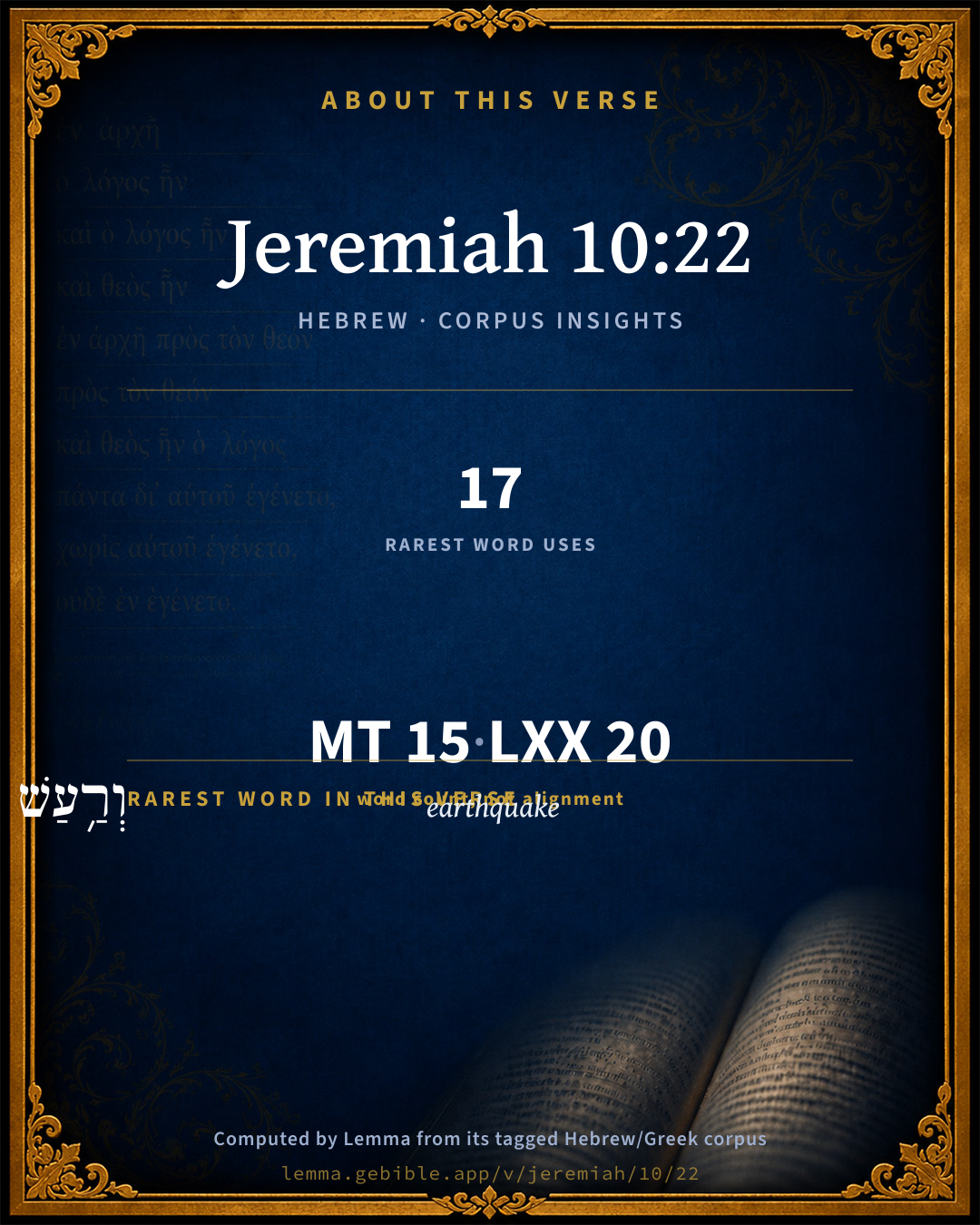
The rarest word here is וְרַ֥עַשׁ earthquake H7494 — appearing just 17 times in the whole Hebrew Bible.

Shared distinctive vocabulary

וְרַ֥עַשׁ earthquake H7494 occurs in 16 verses of the Hebrew Bible. Also found in:

Grammatical profile

  • 2 verbs
  • 10 nouns
  • 1 adjective
  • 2 particles

Verb forms

  • בָאָ֔ה Qal · Participle Active
  • לָשׂ֞וּם Qal · Infinitive Construct

Hebrew & Septuagint length

In the original languages it is 15 Hebrew tokens and 20 Greek tokens — but the two are counted differently (Hebrew bundles its prefixes and suffixes into one token; the Greek is in lemma form), so that isn’t a like-for-like length.

Cross-references

8

Topical passages linked to Jeremiah 10:22 in the Treasury of Scripture Knowledge — connected by theme and wording, ordered by reader-vote popularity; previews shown in the World English Bible.

  • Jeremiah 9:11 I will make Jerusalem heaps, a dwelling-place of jackals; and I will make the cities of Judah a desolation, without inhabitant.
  • Jeremiah 1:15 For, behold, I will call all the families of the kingdoms of the north, says Yahweh; and they shall come, and they shall set everyone his throne at the entrance of the gates of Jerusalem, and against all the walls of it round about, and against all the cities of Judah.
  • Jeremiah 4:6 Set up a standard toward Zion: flee for safety, don't stay; for I will bring evil from the north, and a great destruction.
  • Jeremiah 5:15 Behold, I will bring a nation on you from far, house of Israel, says Yahweh: it is a mighty nation, it is an ancient nation, a nation whose language you don't know, neither understand what they say.
  • Jeremiah 6:1 Flee for safety, you children of Benjamin, out of the midst of Jerusalem, and blow the trumpet in Tekoa, and raise up a signal on Beth Haccherem; for evil looks forth from the north, and a great destruction.
  • Jeremiah 6:22 Thus says Yahweh, Behold, a people comes from the north country; and a great nation shall be stirred up from the uttermost parts of the earth.
  • Habakkuk 1:6–9 For, behold, I raise up the Chaldeans, that bitter and hasty nation, that march through the breadth of the earth, to possess dwelling places that are not theirs.
  • Malachi 1:3 but Esau I hated, and made his mountains a desolation, and gave his heritage to the jackals of the wilderness."

Cross-references courtesy of OpenBible.info (CC BY 4.0).

Hebrew and Greek witnesses Masoretic Hebrew ↔ Greek Septuagint

The same verse in the two great witnesses to the Old Testament, shown verse-for-verse.

These are two independent witnesses, not word-aligned to each other, and the Septuagint is shown in lemma (dictionary) form.

Hebrew Jeremiah 10:22 Masoretic · Westminster Leningrad Codex

ק֤וֹל שְׁמוּעָה֙ הִנֵּ֣ה בָאָ֔ה וְרַ֥עַשׁ גָּד֖וֹל מֵאֶ֣רֶץ צָפ֑וֹן לָשׂ֞וּם אֶת עָרֵ֧י יְהוּדָ֛ה שְׁמָמָ֖ה מְע֥וֹן תַּנִּֽים

The voice of news, behold, it comes, and a great commotion out of the north country, to make the cities of Judah a desolation, a dwelling-place of jackals.

World English Bible · Public Domain

Greek LXX Structure differs

In the Septuagint, Jeremiah is about an eighth shorter than the Hebrew and arranges its material differently — the Oracles Against the Nations (Hebrew chapters 46–51) appear in the middle of the Greek book, after 25:13. Because the chapter and verse boundaries do not line up, a verse-for-verse comparison with the Hebrew is not shown.

A verse-for-verse comparison isn’t shown here because the chapters and verses don’t line up. Switch to the LXX edition with the MT / LXX toggle above to read the Greek directly.

Hebrew: Westminster Leningrad Codex (CC BY 4.0). Greek: Septuagint (public domain); English from a public-domain English Septuagint. How the Septuagint differs from the Hebrew →

Targum (Aramaic paraphrase)

1

The Targum is the ancient Jewish Aramaic paraphrase of the Hebrew Scriptures — an interpretive translation, not the Hebrew text itself. Onkelos (literal) and Pseudo-Jonathan (expansive) render the Torah, and Jonathan the Prophets. Coverage is partial: where no permissively-licensed English translation exists for a verse, only the Aramaic is shown. This is verse-level text, not a word-by-word alignment to the Hebrew.

  1. Targum Jonathan Prophets (Joshua–Malachi)
    קַל בְּשׂוֹרְתָא הָא אַתְיָא וּתְבָרָא רַבָּא מֵאֲרַע צִפּוּנָא לְשַׁוְאָה יַת קִרְוַיָא דְבֵית יְהוּדָה לְצָדוּ מְדוֹר יְרוֹדִין:

    (no public-domain English translation for this verse)

    Targum Jonathan — Aramaic: “Mikraot Gedolot” (public domain). English: “Sefaria Community Translation” (CC0 1.0 (public-domain dedication)); “London "Chaldee Paraphrase," 1871” (public domain). Text via Sefaria.

Commentary

Notes on Jeremiah 10:22 from classic Christian and Jewish commentators (each source and its license shown beneath its notes). The classic Christian expositions comment on the surrounding passage and are grouped to its opening verse, so a note may address several verses; the Jewish commentaries on the Tanakh (Rashi and others) are per-verse, so they appear only where the commentator wrote on this verse.

Lemma curates 59 commentaries, every one of them public domain or Creative Commons licensed, each selected and text-cleaned for this edition rather than reprinted as found. About our sources →

Trapp's Complete Commentary

John Trapp

Jer 10:22 Behold, the noise of the bruit is come, and a great commotion out of the north country, to make the cities of Judah desolate, [and] a den of dragons.

Ver. 22. Behold, the noise of the bruit is come.] This doleful peal he oft rung in their ears, but they little regarded it. See Jer 9:11.

John Trapp, A Commentary or Exposition upon All the Books of the Old and New Testament (1647–1656) — public domain. Text from a community e-Sword module.

Tyndale Open Study Notes

Tyndale Open Resources

10:22 The invading armies would reduce every town to rubble, and jackals (wild dogs) would make their dens in the tumbled ruins.

Tyndale Open Study Notes — © Tyndale Open Resources, licensed CC BY-SA 4.0. Text via the HelloAO Bible API.

Geneva Bible (1599)

Geneva Bible translators

Read Jer. 4:15.

Geneva Bible (1599) marginal notes — public domain. Text via Bolls.life.

Jamieson, Fausset & Brown

Robert Jamieson, A. R. Fausset & David Brown

bruit--rumor of invasion. The antithesis is between the voice of God in His prophets to whom they turned a deaf ear, and the cry of the enemy, a new teacher, whom they must hear [CALVIN].

north country--Babylon (Jer 1:15).

Jamieson, Fausset & Brown — Commentary Critical and Explanatory on the Whole Bible (1871) — public domain (CC PDM 1.0). Text via the HelloAO Bible API.

Adam Clarke's Commentary

Verse 22. The noise of the bruit is come] How this silly French word bruit, which signifies noise, got in here, I cannot imagine. The simple translation is this: "The voice of the report! behold, it is come; yea, great commotion from the land of the north; (Chaldea;) to make the cities of Judea a desolation, a habitation of wild beasts." That is, the report we had heard of the projected invasion of Judea by Nebuchadnezzar is confirmed. He has entered the land; the Chaldeans are at the doors, and the total desolation of Judea is their sole object.

Adam Clarke's Commentary on the Bible (1810–1826) — public domain. Text from a community e-Sword/MySword module.

John Calvin's Commentaries

Jeremiah shews in this verse that prophetic doctrine was useless to an obstinate people; for there is a contrast, no doubt, to be understood betweenthe voice of God, which had constantly resounded in Judea, and the tumultuous clamours of enemies; for the prophets, one after another, had reproved the people, but without effect. Now, then, as they were deaf to God’s voice, the Prophet declares that new teachers were now come who would address them in another way, and in an unusual manner. The voice then of rumor is heard; “ye would not hear me and other servants of God; but a voice of rumor comes from the north: the Chaldeans shall be your teachers; I send you to their school, since I have spent my labor for many years in vain, as all those have done who before me diligently sought to lead you to the right way, whom God employed, and who faithfully endeavored to secure your safety; but they were no more attended to than I am, and therefore they ceased to teach you. I now turn you over to the Chaldeans; they shall teach you.” This is the simple meaning.

The voice of rumor, he says, or literally, of hearing, שמועה, shimuoe, comes; that is, the voice which shall be heard, for they had closed their ears to the prophetic warnings; and a great tumult or commotion from the land of the north We now then see that the Chaldeans are set in opposition to the prophets, who had labored in vain among the Jews; as though Jeremiah had said that the Jews would, willing or unwilling, be made to attend to this tumultuous noise; and he says that it would be for the purpose of turning the cities of Judah to desolation and an habitation of dragons It follows —

John Calvin's Commentaries (1540-1563) — public domain. Text from the Calvin Translation Society English edition (1840s-50s) via the Christian Classics Ethereal Library (ccel.org). Calvin's coverage is partial (roughly two-thirds of the Bible); uncommented books and verses are honest gaps, never fabricated. The 19th-century editor's footnotes and remarks are omitted so the notes are faithfully Calvin's own voice.

Ellicott's Commentary for English Readers

(22) Behold, the noise of the bruit is come.—Better, A cry is heard, Behold, it cometh. The cry of terror is heard and it utters the tidings, terrible in their brevity, that the army of the invader is come, and with it the “great commotion,” the stir and rush of the army, coming from the north country of the Chaldeans. (Comp. Jer_1:13.) In Mat_25:6, “There was a cry made, Behold, the bridegroom cometh,” we have a striking parallel. The word “bruit” (here and in Nah_3:19) may be noted as one of those which have become obsolete since the date of the Authorised Version.

A den of dragons.—i.e., jackals, as in Jer_9:11.

A Bible Commentary for English Readers, edited by Charles John Ellicott (1878–1897) — public domain. Text from a community e-Sword module.

The Cambridge Bible for Schools and Colleges

gen. ed. J. J. S. Perowne

22. jackals] See on Jer_9:11.

The Cambridge Bible for Schools and Colleges (gen. ed. J. J. S. Perowne; Cambridge University Press, 1878–1918) — public domain. Text from a community e-Sword module.

John Gill's Exposition

Behold the noise of the bruit is come,.... Or, "the voice of hearing" (c); that is, the voice heard; the report that was made that the king of Babylon had invaded the land, and was coming up to besiege Jerusalem: "and a great commotion out of the north country"; a large army from Babylon, which lay north of Judea, which came with great noise, and caused a great trembling and shaking among the inhabitants of the land whither they were coming:

to make the cities of Judah desolate, and a den of dragons; this shows that the whole paragraph is to be understood of the Jewish nation, and of their destruction. See Gill on Jer 9:11.

(c) "vox auditionis", Pagninus, Montanus; "vox auditus", Vatablus, Calvin; "vox famae", Schmidt.

John Gill's Exposition of the Whole Bible (1746–1763) — public domain (CC PDM 1.0). Text via the HelloAO Bible API.

Haydock's Catholic Bible Commentary

North. He has announced this conqueror eight times. --- Dragons. Tannim means "huge reptiles," whether of sea or land. (Calmet)

George Leo Haydock (1774–1849), Haydock's Catholic Family Bible and Commentary, 1859 edition — public domain. Excludes Psalms (Douay-Rheims chapter numbering differs from Protestant) and Deuterocanonical books (Catholic canon only).

Matthew Poole's English Annotations

The prophet had divers times sounded this alarm in their ears, but to very little purpose; his words seemed but as idle tales, they believed him not: he speaks of it partly as one conceiving what dreadful commotions and concussions would be upon the land by the clattering of arms, prancings and neighings of horses, sounding of trumpets, and rattling of chariots, making as it were the earth to shake under them, when that vast army of the Chaldeans should furiously break in upon them. Partly, insinuating an antithesis, opposing the voice of God’s prophets, that had so often spoken of this, but they would not hear, against this dreadful noise, which they should not but hear, and see, and feel too. So that they that would not learn of God’s prophets shall be sent to harder masters, that shall teach them in a manner as Gideon did the men of Succoth, Jdg 8:16.

The north country: see Jer 1:14; 5:15.

A den of dragons. See Poole "Jer 9:11"

Matthew Poole's English Annotations on the Holy Bible (1683–1685) — public domain. Text from a community e-Sword/MySword module.

Whedon's Commentary on the Bible

Daniel D. Whedon

22. The noise of the bruit, etc. — Better, a voice is heard; behold it cometh, a great commotion from the north country (literally, the land of midnight) to make the cities of Judah desolate, an abode of jackals. See Jer_9:11.

Daniel D. Whedon (gen. ed.), Commentary on the Old and New Testaments (1874–1909) — public domain. Text from a community e-Sword module.

The Pulpit Commentary

Behold... is come; rather; Hark! Tidings! Behold, it cometh! The tidings are that the foe is at hand, advancing with a great commotion, with clashing spears, prancing horses, and all the hubbub of a great army. A den of dragons; rather, of jackals. (as Jer_9:11)

The Pulpit Commentary (1880–1919), ed. H.D.M. Spence-Jones & Joseph S. Exell — public domain. Text from a community e-Sword module.

John Wesley's Explanatory Notes

Noise - Rumour, report.

John Wesley, Explanatory Notes Upon the Whole Bible (1754–1765) — public domain. Text via the GEBible commentary corpus.

Lesson kit

Teaching starters — assembled from the data on this page, not authored interpretation. Every prompt links to the verse data it draws on. Edit before teaching.

Jeremiah, in the Prophets, opens this verse with 15 words (15 distinct Hebrew lemmas). Its most distinctive word is raʻash (“earthquake”). A historical commentator’s framing appears above. Read the whole chapter for the surrounding context.

Discussion questions

  1. How does “earthquake” (raʻash) shape what this verse is saying?
  2. 1 Kings 19:11 shares the word «earthquake» with this verse. How do the two illuminate each other?
  3. The translations on this page render this verse differently — a whole-verse word diff, not a word-by-word alignment. What might account for the different wordings?
  4. The verb «בָאָ֔ה» is Qal Participle Active. How does its form color the action?
  5. Reading how Trapp's Complete Commentary and Tyndale Open Study Notes read this verse, where do the two commentators agree and where do they part?

Things to notice

Reading settings

Reading text

Shown beneath each verse's original-language words.

Old Testament
Old Testament edition

Read the OT as the Masoretic Hebrew (MT) or the Greek Septuagint (LXX).

English shown for the Greek Septuagint (in the Hebrew ↔ Greek comparison).

Comparing translations? Open the Compare panel on any verse page to stack up to four side by side.