
Psalms 109:5

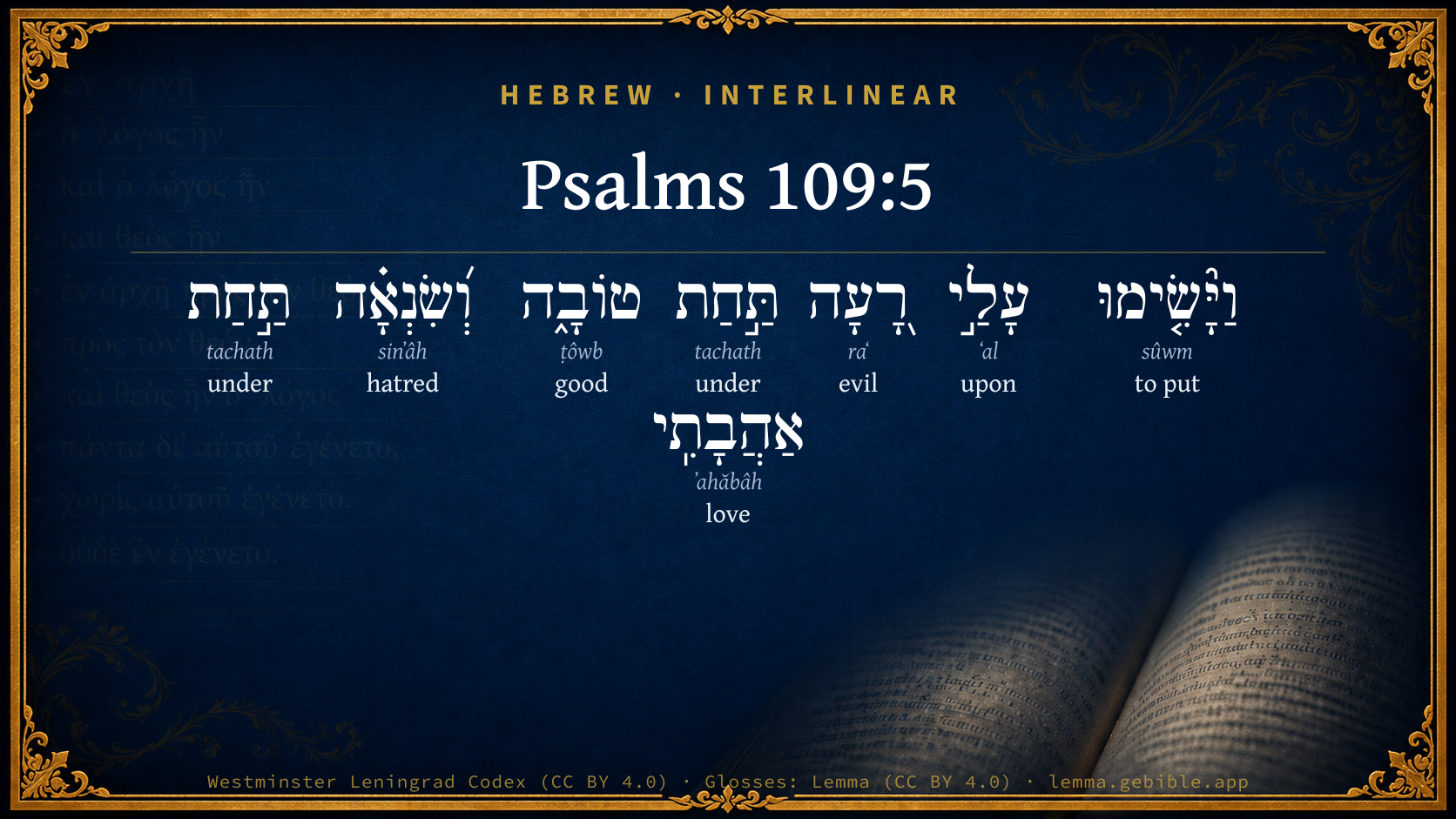
Hebrew (Westminster Leningrad Codex) Psalms 109:5 appears in the Hebrew Old Testament. The text above is from the Westminster Leningrad Codex. Each word links to its Strong’s number, a concise gloss, and parsing drawn from the Open Scriptures Hebrew Bible morphology. Click any word for its full Brown-Driver-Briggs (BDB) entry.
Download image
Cite this verse

Psalms 109:5 (World English Bible). Public Domain. Lemma interlinear Bible study tool, https://lemma.gebible.app/v/psalms/109/5.

Show BibTeX & RIS
BibTeX
RIS
English Translation
They have rewarded me evil for good, And hatred for my love.
World English Bible · Public Domain
Download a study sheet

One document with this verse’s original text, its word-by-word gloss line, the meaning frame, cross-references with their text, attributed commentary, and full source and license credits — printable, and it pastes into notes with its structure intact.

This verse Autodidact and up

Study sheet (.html) Plain text (.txt)

A passage Seminary Student

Up to 50 verses in one chapter. A passage sheet keeps up to 6 commentary sources and 12 cross-references per verse, in the order this page ranks them, and says so on the sheet whenever that leaves anything out. Ask for a single verse and you get the Autodidact verse sheet above.

Everything on this page stays free to read, with no account — the sheet is a download of what is already on screen, not access to it.

Want to remove ads? Support Godless Engineer
Compare translations 3

The same verse in 3 English versions, stacked beneath the original-language interlinear above. Click any original word for its lexicon entry.

Each is an independent rendering of the whole verse — the interlinear is not word-aligned to these translations.

Highlighted words mark where these versions differ — a whole-verse word diff, not a word-by-word alignment.

  • World English Bible Public Domain
    They have rewarded me evil for good, And hatred for my love.
  • King James Version Public Domain
    And they have rewarded me evil for good, and hatred for my love.
  • unfoldingWord Literal Text CC BY-SA 4.0
    They put upon me evil in return for good, and hatred in return for my love.

unfoldingWord Literal Text — © unfoldingWord, licensed CC BY-SA 4.0. Word-aligned USFM3 via Door43 (git.door43.org/unfoldingWord/en_ult).

Versions to compare (up to 4)

3 of 4 selected

Show all 18 translations

Every available English version of this verse, each an independent rendering of the whole verse.

  • World English Bible Public Domain
    They have rewarded me evil for good, And hatred for my love.
  • Berean Standard Bible Public Domain
    They repay me evil for good, and hatred for my love.
  • Majority Standard Bible Public Domain
    They repay me evil for good, and hatred for my love.
  • King James Version Public Domain
    And they have rewarded me evil for good, and hatred for my love.
  • American Standard Version (1901) Public Domain
    And they have rewarded me evil for good, And hatred for my love.
  • Revised Version (1885) Public Domain
    And they have rewarded me evil for good, and hatred for my love.
  • Geneva Bible (1599) Public Domain
    And they haue rewarded me euil for good, and hatred for my friendship.
  • Douay-Rheims (1899) Public Domain
    And they repaid me evil for good: and hatred for my love.
  • Young's Literal Translation Public Domain
    And they set against me evil for good, And hatred for my love.
  • Literal Standard Version CC BY-SA 4.0
    And they set against me evil for good, || And hatred for my love.
  • Unlocked Literal Bible CC BY-SA 4.0
    They repay me evil for good, and they hate my love.
  • unfoldingWord Literal Text CC BY-SA 4.0
    They put upon me evil in return for good, and hatred in return for my love.
  • Darby Bible Public Domain
    And they have rewarded me evil for good, and hatred for my love.
  • World Messianic Bible Public Domain
    They have rewarded me evil for good, and hatred for my love.
  • Webster's Bible Public Domain
    And they have rewarded me evil for good, and hatred for my love.
  • Free Bible Version CC BY-SA 4.0
    They pay me back with evil instead of good, with hatred instead of love.
  • Bible in Basic English Public Domain
    They have put on me evil for good; hate in exchange for my love.
  • JPS Tanakh (1917) Public Domain
    And they have laid upon me evil for good, and hatred for my love:

Literal Standard Version (2020), Covenant Press — licensed CC BY-SA 4.0. Text via the HelloAO Bible API (eBible.org). Unlocked Literal Bible (unfoldingWord) — licensed CC BY-SA 4.0. Text via the HelloAO Bible API (eBible.org). unfoldingWord Literal Text — © unfoldingWord, licensed CC BY-SA 4.0. Word-aligned USFM3 via Door43 (git.door43.org/unfoldingWord/en_ult). Free Bible Version, Dr. Jonathan Gallagher — licensed CC BY-SA 4.0. Text via the HelloAO Bible API (eBible.org).

Word by word

More ways to search: Search by grammar → Find every occurrence → Compare this word →

Practice this passage: Drill this verse → Learn its vocabulary →

About this verse

These counts appear in no published source. They are computed here, from the morphology-tagged text and Lemma’s own curated glosses. What Lemma adds →

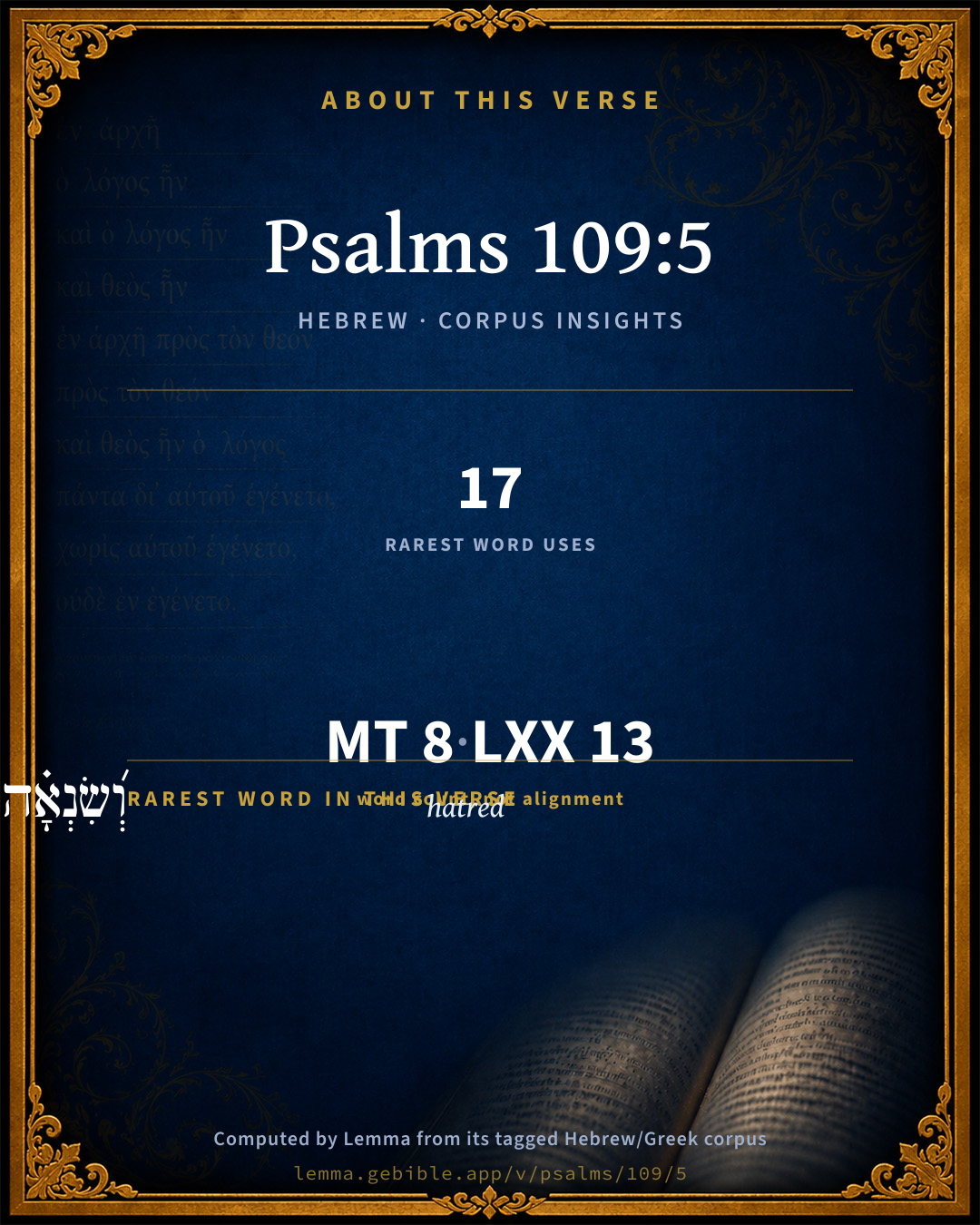
8
words
7
distinct lemmas
Wisdom
section

Notable vocabulary

The rarest word here is וְ֝שִׂנְאָ֗ה hatred H8135 — appearing just 17 times in the whole Hebrew Bible.

Shared distinctive vocabulary

וְ֝שִׂנְאָ֗ה hatred H8135 occurs in 16 verses of the Hebrew Bible. Also found in:

Grammatical profile

  • 1 verb
  • 3 nouns
  • 1 adjective
  • 3 prepositions

Verb forms

  • וַיָּ֘שִׂ֤ימוּ Qal · Sequential Imperfect

Repetition

A word recurs within this verse — often emphatic in Hebrew:

  • תַּ֣חַת under H8478 ×2

Hebrew & Septuagint length

In English translation the verse runs 12 words from the Hebrew and 12 from the Septuagint (LXX English) — the same length.

A rough comparison of the two English renderings, which tokenize alike — not a word-level alignment.

Word counts can differ between the Hebrew and the Greek without any difference in meaning — e.g. the Hebrew direct-object marker אֵת has no separate Greek word, and Greek often adds the article ὁ.

In the original languages it is 8 Hebrew tokens and 13 Greek tokens — but the two are counted differently (Hebrew bundles its prefixes and suffixes into one token; the Greek is in lemma form), so that isn’t a like-for-like length.

Cross-references

11

Topical passages linked to Psalms 109:5 in the Treasury of Scripture Knowledge — connected by theme and wording, ordered by reader-vote popularity; previews shown in the World English Bible.

  • Psalms 38:20 They who also render evil for good are adversaries to me, Because I follow what is good.
  • Proverbs 17:13 Whoever rewards evil for good, Evil shall not depart from his house.
  • Genesis 44:4 When they had gone out of the city, and were not yet far off, Joseph said to his steward, "Up, follow after the men. When you overtake them, ask them, 'Why have you rewarded evil for good?
  • 2 Samuel 15:31 One told David, saying, Ahithophel is among the conspirators with Absalom. David said, Yahweh, please turn the counsel of Ahithophel into foolishness.
  • Psalms 35:7–12 For without cause they have hidden their net in a pit for me. Without cause they have dug a pit for my soul.
  • Psalms 55:12–15 For it was not an enemy who insulted me, Then I could have endured it. Neither was it he who hated me who raised himself up against me, Then I would have hid myself from him.
  • 2 Samuel 15:12 Absalom sent for Ahithophel the Gilonite, David's counselor, from his city, even from Giloh, while he was offering the sacrifices. The conspiracy was strong; for the people increased continually with Absalom.
  • Mark 14:44–45 Now he who betrayed him had given them a sign, saying, "Whoever I will kiss, that is he. Seize him, and lead him away safely."
  • Luke 6:16 Judas the son of James; and Judas Iscariot, who also became a traitor.
  • Luke 22:47–48 While he was still speaking, behold, a multitude, and he who was called Judas, one of the twelve, was leading them. He came near to Jesus to kiss him.
  • John 13:18 I don't speak concerning all of you. I know whom I have chosen. But that the Scripture may be fulfilled, 'He who eats bread with me has lifted up his heel against me.'

Cross-references courtesy of OpenBible.info (CC BY 4.0).

Hebrew and Greek witnesses Masoretic Hebrew ↔ Greek Septuagint

The same verse in the two great witnesses to the Old Testament, shown verse-for-verse.

You’re reading Greek Psalm 108 (Hebrew Psalm 109). The Septuagint counts the superscription, so verse numbers can differ from the Hebrew — chapter-level alignment, not verse-by-verse. Numbering follows Rahlfs.

These are two independent witnesses, not word-aligned to each other, and the Septuagint is shown in lemma (dictionary) form.

Hebrew Psalms 109:5 Masoretic · Westminster Leningrad Codex

וַיָּ֘שִׂ֤ימוּ עָלַ֣י רָ֭עָה תַּ֣חַת טוֹבָ֑ה וְ֝שִׂנְאָ֗ה תַּ֣חַת אַהֲבָתִֽי

They have rewarded me evil for good, And hatred for my love.

World English Bible · Public Domain

Greek LXX Greek Psalm 108:5 Septuagint · lemma form

καί τίθημι κατά ἐγώ κακός ἀντί ἀγαθός καί μῖσος ἀντί ὁ ἀγάπησις ἐγώ

And they rewarded me evil for good, and hatred for my love.

LXX2012 (modern English Septuagint) · Public Domain

Hebrew: Westminster Leningrad Codex (CC BY 4.0). Greek: Septuagint (public domain); English from LXX2012 (modern English Septuagint) (Public Domain). How the Septuagint differs from the Hebrew →

Commentary

Notes on Psalms 109:5 from classic Christian and Jewish commentators (each source and its license shown beneath its notes). The classic Christian expositions comment on the surrounding passage and are grouped to its opening verse, so a note may address several verses; the Jewish commentaries on the Tanakh (Rashi and others) are per-verse, so they appear only where the commentator wrote on this verse.

Lemma curates 59 commentaries, every one of them public domain or Creative Commons licensed, each selected and text-cleaned for this edition rather than reprinted as found. About our sources →

Trapp's Complete Commentary

John Trapp

Psa 109:5 And they have rewarded me evil for good, and hatred for my love.

Ver. 5. And they have rewarded me] See Psa 109:4.

Flectere naturam gratia nulla potest.

John Trapp, A Commentary or Exposition upon All the Books of the Old and New Testament (1647–1656) — public domain. Text from a community e-Sword module.

The Biblical Illustrator

Joseph S. Exell

Psa_109:5

They have rewarded me evil for good.

Evil for good

Florence, when dominated by the preaching of Savonarola, became transformed; high-born ladies threw aside their jewels and finery, men turned from evil ways into sobriety, the churches were crowded with all classes of the people, from nobles to peasants; the very children were turned into instruments of the good work, going through the streets in procession, singing hymns and collecting money for the poor--and then the tide turned, and, when Savonarola was in the crisis of his struggle with the pope, almost the whole city was against him; a mob attacked his convent of San Marco; and the great friar went to his martyrdom, with the sorer martyrdom of his heart at the thought that all his work was overturned. (Hugh Black.)

The Biblical Illustrator, edited by Joseph S. Exell (c. 1880s–1900s) — public domain. Text from a community e-Sword module.

J. A. Alexander on Psalms

Joseph Addison Alexander

5. (Psa 109:5) They lay upon me evil instead of good, and hatred instead of lose. The first verb literally means they set or place. Instead of the good and the love which they owed me, or in return for my kindness and love to them, as in Psa 109:4.

Joseph Addison Alexander, The Psalms Translated and Explained (1850) — public domain. Text from a community e-Sword module.

John Calvin's Commentaries

5 But I gave myself to prayer Some are of opinion, that these words refer to David’s pouring out a prayer for his enemies at the very moment when they were furiously assaulting him, and with this opinion corresponds that which we have stated in Psalm 35:13. But the more plain, and, to me, the preferable interpretation, is, that when he was attacked in a cruel and hostile manner, he did not betake himself to such unlawful means as the rendering of evil for evil, but committed himself into the hand of God, fully satisfied that he alone could guard him from all ill. And it is assuredly a great and desirable attainment for a man so to restrain his passions as directly and immediately to make his appeal to God’s tribunal, at the very time when he is abused without a cause, and when the very injuries which he sustains are calculated to excite him to avenge them. For there are some persons who, while it is their aim to live in terms of friendship with the good, coming in contact with ill men, imagine that they are at perfect liberty to return injury for injury; and to this temptation all the godly feel that they are liable. The Holy Spirit, however, restrains us, so that though oftimes provoked by the cruelty of our enemies to seek revenge, we yet abandon all fraudulent and violent means, and betake ourselves by prayer to God alone. By this example, which David here sets before us, we are instructed that we must have recourse to the same means if we would wish to overcome our enemies through the power and protection of God. In Psalm 69:13, we have a parallel passage: “They that sit in the gate spake against me; and I was the song of those who drink strong drink. But my prayer was made to thee, O Jehovah!” In that passage, as well as in the one under review, the mode of expression is elliptical. Besides, it is the design of David in these words to inform us, that although he was aware that the whole world was opposed to him, yet he could cast all his cares upon God, and this was enough to render his mind calm and composed. And as the Holy Spirit taught David and all the godly to offer up prayers like these, it must follow, that those who, in this respect, imitate them, will be promptly helped by God when he beholds them reproachfully and vilely persecuted.

John Calvin's Commentaries (1540-1563) — public domain. Text from the Calvin Translation Society English edition (1840s-50s) via the Christian Classics Ethereal Library (ccel.org). Calvin's coverage is partial (roughly two-thirds of the Bible); uncommented books and verses are honest gaps, never fabricated. The 19th-century editor's footnotes and remarks are omitted so the notes are faithfully Calvin's own voice.

The Cambridge Bible for Schools and Colleges

gen. ed. J. J. S. Perowne

5. they have rewarded me &c.] Lit. they have laid evil upon me in return for good. Cp. Psa_35:12; Psa_38:20; Jer_18:20.

The Cambridge Bible for Schools and Colleges (gen. ed. J. J. S. Perowne; Cambridge University Press, 1878–1918) — public domain. Text from a community e-Sword module.

John Gill's Exposition

And they have rewarded me evil for good,.... For the good words and sound doctrine he delivered to them; for the good works and miracles he wrought among them, to the healing of them; see Joh 10:32.

And hatred for my love; he came to seek and save that which was lost, and yet they hated him, and would not have him to rule over them, Luk 19:10.

John Gill's Exposition of the Whole Bible (1746–1763) — public domain (CC PDM 1.0). Text via the HelloAO Bible API.

Albert Barnes' Notes on the Bible

And they have rewarded me evil for good - literally, “They have placed against me.” They have put it in my way; it is what they had to set before me. See the notes at Psa 35:12, where the same expression occurs.

And hatred for my love - Instead of loving me in return for my love, they have met me with the expressions of hatred. This often occurred in the life of David; it was constant in the life of the Saviour; it is habitually manifested by people toward God; it is often experienced by good men now; it “may” occur in the life of any man - and if it “does” occur to us, we should not think that any strange thing has happened to us.

Albert Barnes' Notes on the Bible (1834–1885) — public domain. Text from a community e-Sword/MySword module.

The Treasury of David

Charles H. Spurgeon

Ver. 5. And they have rewarded me evil for good, and hatred for my love. Evil for good is devil like. This is Satan's line of action, and his children upon earth follow it greedily; it is cruel, and wounds to the quick. The revenge which pays a man back in his own coin has a kind of natural justice in it; but what shall be said of that baseness which returns to goodness the very opposite of what it has a right to expect? Our Lord endured such base treatment all his days, and, alas, in his members, endures it still.

Thus we see the harmless and innocent man upon his knees pouring out his lamentation: we are now to observe him rising from the mercy seat, inspired with prophetic energy, and pouring forth upon his foes the forewarning of their doom. We shall hear him speak like a judge clothed with stern severity, or like the angel of doom robed in vengeance, or as the naked sword of justice when she bares her arm for execution. It is not for himself that he speaks so much as for all the slandered and the down trodden, of whom he feels himself to be the representative and mouthpiece. He asks for justice, and as his soul is stung with cruel wrongs he asks with solemn deliberation, making no stint in his demands. To pity malice would be malice to mankind; to screen the crafty seekers of human blood would be cruelty to the oppressed. Nay, love, and truth, and pity lift their wounds to heaven, and implore vengeance on the enemies of the innocent and oppressed; those who render goodness itself a crime, and make innocence a motive for hate, deserve to find no mercy from the great Preserver of men. Vengeance is the prerogative of God, and as it would be a boundless calamity if evil were for ever to go unpunished, so it is an unspeakable blessing that the Lord will recompense the wicked and cruel man, and there are times and seasons when a good man ought to pray for that blessing. When the Judge of all threatens to punish tyrannical cruelty and false hearted treachery, virtue gives her assent and consent. Amen, so let it be, saith every just man in his inmost soul.

Ver. 5. Evil for good. This is devil like. Have not men been guilty of this to parents, to those who have warned them, to saints and ministers, and especially to the Lord himself?

Ver. 5. How has the Redeemer been recompensed? Show what he deserves and what he receives from various individuals. He feels the unkindness of those who are ungrateful.

Psalms 109:6*

Charles H. Spurgeon's The Treasury of David (1869–1885) — public domain. Psalms only. Text from a community e-Sword/MySword module.

The Pulpit Commentary

And they have rewarded ms evil for good, and hatred for my love; or, "thus they rewarded me." The verse is a corollary from what has gone before, not anything additional.

The Pulpit Commentary (1880–1919), ed. H.D.M. Spence-Jones & Joseph S. Exell — public domain. Text from a community e-Sword module.

Rashi

Rabbi Shlomo Yitzchaki (Rashi)

evil instead of good I sacrifice seventy bulls every year for the seventy nations, and we request rain, yet they harm us. Shocher Tov (109:4).

Rashi on the Tanakh — English translations: “The Judaica Press complete Tanach with Rashi, translated by A. J. Rosenberg” (CC BY 4.0); “Pentateuch with Rashi's commentary by M. Rosenbaum and A.M. Silbermann, 1929-1934” (public domain); “The Metsudah Tanach series, Lakewood, N.J” (CC BY 4.0); and “The Book of Joshua, Metsudah Publications, 1997” (CC BY 4.0). Text via Sefaria.

Lesson kit

Teaching starters — assembled from the data on this page, not authored interpretation. Every prompt links to the verse data it draws on. Edit before teaching.

Psalms, in the Wisdom, opens this verse with 8 words (7 distinct Hebrew lemmas). Its most distinctive word is sinʼâh (“hatred”). A historical commentator’s framing appears above. Read the whole chapter for the surrounding context.

Discussion questions

  1. What does “hatred” (sinʼâh) contribute to the verse as a whole?
  2. How does Numbers 35:20, which shares the word «hatred», read alongside this verse?
  3. What does the repetition of “under” (2× in this one verse) do in this verse?
  4. These translations render this verse differently; the difference is in the English rendering, not the original. What questions does that raise?
  5. «וַיָּ֘שִׂ֤ימוּ» is a Qal Sequential Imperfect verb. How does that grammatical form shape the action described?
  6. Compare how Trapp's Complete Commentary and The Biblical Illustrator read this verse. Where do they agree or differ?

Things to notice

Reading settings

Reading text

Shown beneath each verse's original-language words.

Old Testament
Old Testament edition

Read the OT as the Masoretic Hebrew (MT) or the Greek Septuagint (LXX).

English shown for the Greek Septuagint (in the Hebrew ↔ Greek comparison).

Comparing translations? Open the Compare panel on any verse page to stack up to four side by side.