Psalms 19:4

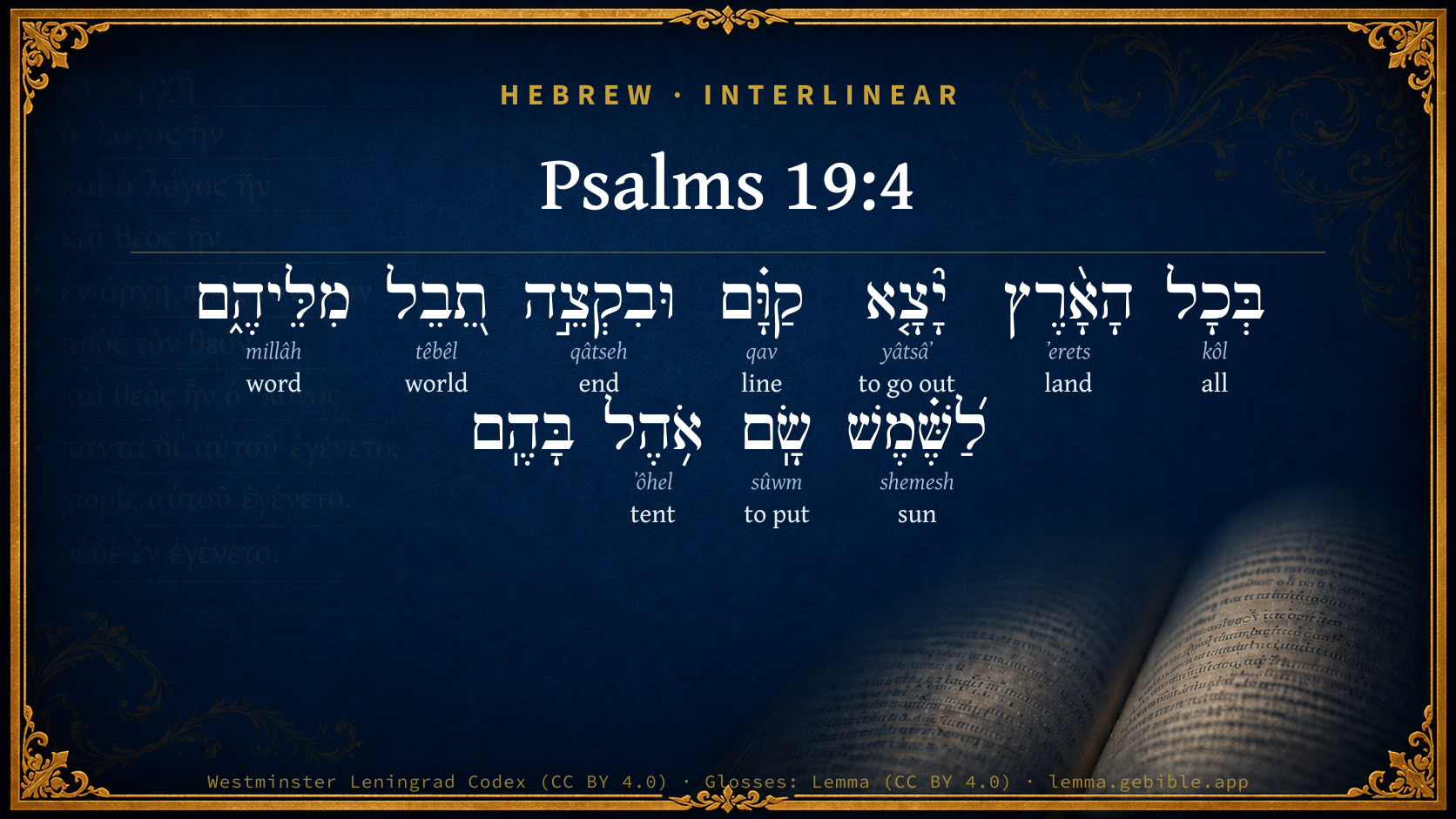
Hebrew (Westminster Leningrad Codex) Psalms 19:4 appears in the Hebrew Old Testament. The text above is from the Westminster Leningrad Codex. Each word links to its Strong’s number, a concise gloss, and parsing drawn from the Open Scriptures Hebrew Bible morphology. Click any word for its full Brown-Driver-Briggs (BDB) entry.
Download image
Cite this verse

Psalms 19:4 (World English Bible). Public Domain. Lemma interlinear Bible study tool, https://lemma.gebible.app/v/psalms/19/4.

Show BibTeX & RIS
BibTeX
RIS
English Translation
Their voice has gone out through all the earth, Their words to the end of the world. In them he has set a tent for the sun,
World English Bible · Public Domain
Download a study sheet

One document with this verse’s original text, its word-by-word gloss line, the meaning frame, cross-references with their text, attributed commentary, and full source and license credits — printable, and it pastes into notes with its structure intact.

This verse Autodidact and up

Study sheet (.html) Plain text (.txt)

A passage Seminary Student

Up to 50 verses in one chapter. A passage sheet keeps up to 6 commentary sources and 12 cross-references per verse, in the order this page ranks them, and says so on the sheet whenever that leaves anything out. Ask for a single verse and you get the Autodidact verse sheet above.

Everything on this page stays free to read, with no account — the sheet is a download of what is already on screen, not access to it.

Want to remove ads? Support Godless Engineer
Compare translations 3

The same verse in 3 English versions, stacked beneath the original-language interlinear above. Click any original word for its lexicon entry.

Each is an independent rendering of the whole verse — the interlinear is not word-aligned to these translations.

Highlighted words mark where these versions differ — a whole-verse word diff, not a word-by-word alignment.

  • World English Bible Public Domain
    Their voice has gone out through all the earth, Their words to the end of the world. In them he has set a tent for the sun,
  • King James Version Public Domain
    Their line is gone out through all the earth, and their words to the end of the world. In them hath he set a tabernacle for the sun,
  • unfoldingWord Literal Text CC BY-SA 4.0
    Their line has gone out through all of the earth, and their words to the end of the world. He has set in them a tent for the sun,

unfoldingWord Literal Text — © unfoldingWord, licensed CC BY-SA 4.0. Word-aligned USFM3 via Door43 (git.door43.org/unfoldingWord/en_ult).

Versions to compare (up to 4)

3 of 4 selected

Show all 18 translations

Every available English version of this verse, each an independent rendering of the whole verse.

  • World English Bible Public Domain
    Their voice has gone out through all the earth, Their words to the end of the world. In them he has set a tent for the sun,
  • Berean Standard Bible Public Domain
    their voice has gone out into all the earth, their words to the ends of the world. In the heavens He has pitched a tent for the sun.
  • Majority Standard Bible Public Domain
    their voice has gone out into all the earth, their words to the ends of the world. In the heavens He has pitched a tent for the sun.
  • King James Version Public Domain
    Their line is gone out through all the earth, and their words to the end of the world. In them hath he set a tabernacle for the sun,
  • American Standard Version (1901) Public Domain
    Their line is gone out through all the earth, And their words to the end of the world. In them hath he set a tabernacle for the sun,
  • Revised Version (1885) Public Domain
    Their line is gone out through all the earth, and their words to the end of the world. In them hath he set a tabernacle for the sun,
  • Geneva Bible (1599) Public Domain
    Their line is gone forth through all the earth, and their words into the endes of the world: in them hath he set a tabernacle for the sunne.
  • Douay-Rheims (1899) Public Domain
    There are no speeches nor languages, where their voices are not heard.
  • Young's Literal Translation Public Domain
    Into all the earth hath their line gone forth, And to the end of the world their sayings, For the sun He placed a tent in them,
  • Literal Standard Version CC BY-SA 4.0
    Their line has gone forth into all the earth, || And their sayings to the end of the world, || In them He placed a tent for the sun,
  • Unlocked Literal Bible CC BY-SA 4.0
    Yet their words go out over all the earth, and their speech to the end of the world. He has pitched a tent for the sun among them.
  • unfoldingWord Literal Text CC BY-SA 4.0
    Their line has gone out through all of the earth, and their words to the end of the world. He has set in them a tent for the sun,
  • Darby Bible Public Domain
    Their line is gone out through all the earth, and their language to the extremity of the world. In them hath he set a tent for the sun,
  • World Messianic Bible Public Domain
    Their voice has gone out through all the earth, their words to the end of the world. In them he has set a tent for the sun,
  • Webster's Bible Public Domain
    \\19:3\\There is no speech nor language, where their voice is not heard.
  • Free Bible Version CC BY-SA 4.0
    Yet what they say is heard all over the earth; their message goes to the whole world. God has made a home in the heavens for the sun.
  • Bible in Basic English Public Domain
    Their line has gone out through all the earth, and their words to the end of the world. In them has he put a tent for the sun,
  • JPS Tanakh (1917) Public Domain
    (19-5) Their line is gone out through all the earth, and their words to the end of the world. In them hath He set a tent for the sun,

Literal Standard Version (2020), Covenant Press — licensed CC BY-SA 4.0. Text via the HelloAO Bible API (eBible.org). Unlocked Literal Bible (unfoldingWord) — licensed CC BY-SA 4.0. Text via the HelloAO Bible API (eBible.org). unfoldingWord Literal Text — © unfoldingWord, licensed CC BY-SA 4.0. Word-aligned USFM3 via Door43 (git.door43.org/unfoldingWord/en_ult). Free Bible Version, Dr. Jonathan Gallagher — licensed CC BY-SA 4.0. Text via the HelloAO Bible API (eBible.org).

Word by word

More ways to search: Search by grammar → Find every occurrence → Compare this word →

Practice this passage: Drill this verse → Learn its vocabulary →

קַוָּ֗ם
qav
H6957
“line · their”
Noun, Common, Masculine, Singular, Construct + Suffix, Personal, 3rd Person, Masculine, Plural
Part of Speech
Noun
Type
Common
Gender
Masculine
Number
Singular
State
Construct
Full BDB Definition

Origin: from H6960 [compare H6961 ]

TWOT: 1992 , 1994a

cord, line, measuring-line - cord - measuring-line - (BDB) onomatapoetic mimicry of Isaiah's words, perhaps senseless
  1. בְּכָל kôl H3605 “in/at · all of” Preposition + Noun, Common, Masculine, Singular, Construct
  2. הָאָ֨רֶץ ʼerets H776 “the · land” Particle, Definite Article + Noun, Common, Both, Singular, Absolute
  3. יָ֘צָ֤א yâtsâʼ H3318 “to go out” Verb, Qal, Perfect, 3rd Person, Masculine, Singular
  4. וּבִקְצֵ֣ה qâtseh H7097 “and · in/at · end of” Conjunction + Preposition + Noun, Common, Both, Singular, Construct
  5. תֵ֭בֵל têbêl H8398 “world” Noun, Common, Feminine, Singular, Absolute
  6. מִלֵּיהֶ֑ם millâh H4405 “words · their” Noun, Common, Feminine, Plural, Construct + Suffix, Personal, 3rd Person, Masculine, Plural
  7. לַ֝שֶּׁ֗מֶשׁ shemesh H8121 “to/for the · sun” Preposition, Determined + Noun, Common, Both, Singular, Absolute
  8. שָֽׂם sûwm H7760 “to put” Verb, Qal, Perfect, 3rd Person, Masculine, Singular
  9. אֹ֥הֶל ʼôhel H168 “tent” Noun, Common, Masculine, Singular, Absolute

About this verse

These counts appear in no published source. They are computed here, from the morphology-tagged text and Lemma’s own curated glosses. What Lemma adds →

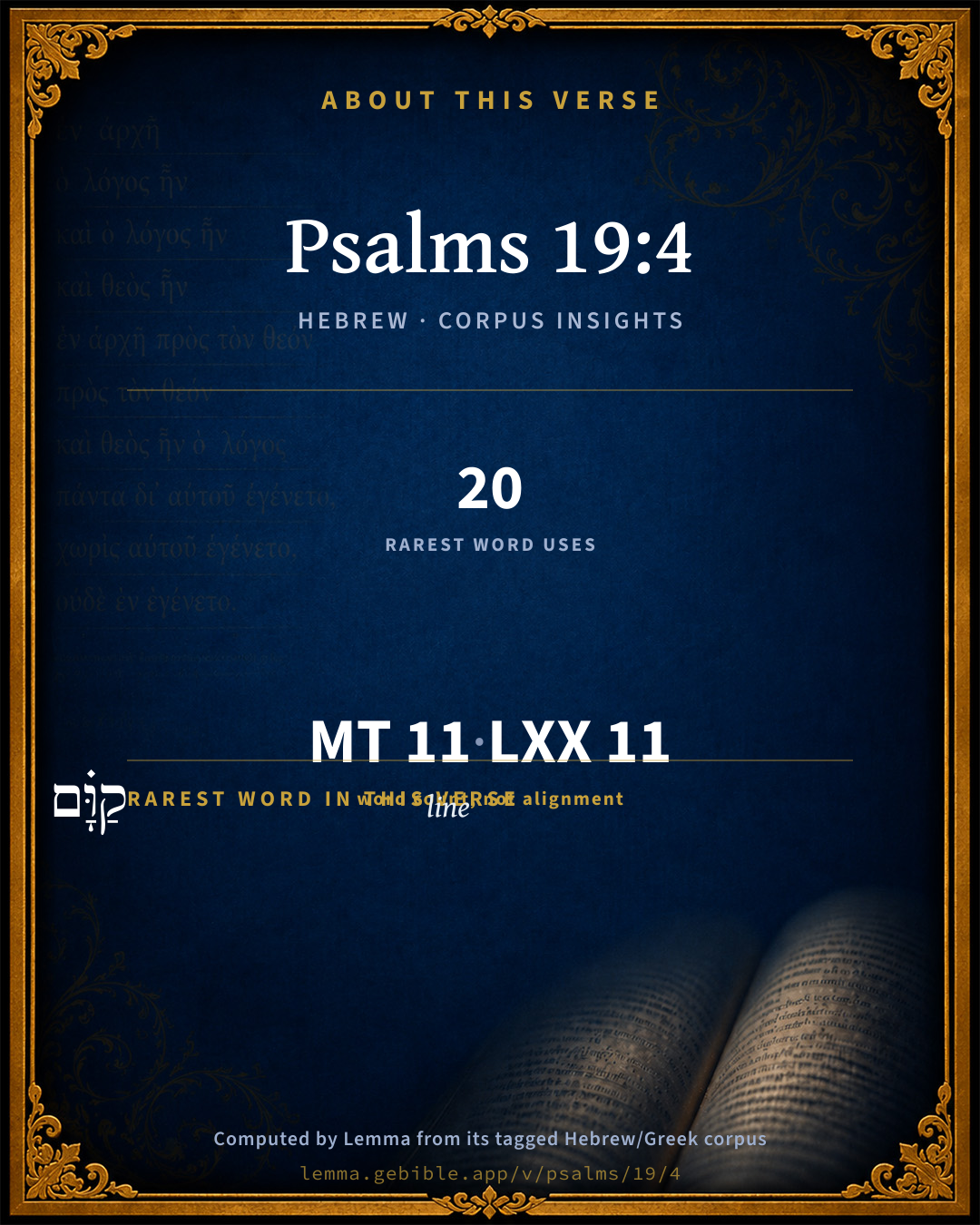
11
words
10
distinct lemmas
Wisdom
section

Notable vocabulary

The rarest word here is קַוָּ֗ם line H6957 — appearing just 20 times in the whole Hebrew Bible.

Shared distinctive vocabulary

קַוָּ֗ם line H6957 occurs in 14 verses of the Hebrew Bible. Also found in:

Grammatical profile

  • 2 verbs
  • 8 nouns
  • 1 preposition

Verb forms

  • יָ֘צָ֤א Qal · Perfect
  • שָֽׂם Qal · Perfect

Hebrew & Septuagint length

In English translation the verse runs 27 words from the Hebrew and 18 from the Septuagint (LXX English) — closely comparable.

A rough comparison of the two English renderings, which tokenize alike — not a word-level alignment.

Word counts can differ between the Hebrew and the Greek without any difference in meaning — e.g. the Hebrew direct-object marker אֵת has no separate Greek word, and Greek often adds the article ὁ.

In the original languages it is 11 Hebrew tokens and 11 Greek tokens — but the two are counted differently (Hebrew bundles its prefixes and suffixes into one token; the Greek is in lemma form), so that isn’t a like-for-like length.

Cross-references

7

Topical passages linked to Psalms 19:4 in the Treasury of Scripture Knowledge — connected by theme and wording, ordered by reader-vote popularity; previews shown in the World English Bible.

  • Romans 10:18 But I say, didn't they hear? Yes, most assuredly, "Their sound went out into all the earth, Their words to the ends of the world."
  • Genesis 1:14–18 God said, "Let there be lights in the expanse of sky to divide the day from the night; and let them be for signs, and for seasons, and for days and years;
  • Psalms 98:3 He has remembered his loving kindness and his faithfulness toward the house of Israel. All the ends of the earth have seen the salvation of our God.
  • Psalms 104:2 He covers himself with light as with a garment. He stretches out the heavens like a curtain.
  • Malachi 4:2 But to you who fear my name shall the sun of righteousness arise with healing in its wings. You will go out, and leap like calves of the stall.
  • 2 Corinthians 10:13–16 But we will not boast beyond proper limits, but within the boundaries with which God appointed to us, which reach even to you.
  • Isaiah 49:6 yes, he says, It is too light a thing that you should be my servant to raise up the tribes of Jacob, and to restore the preserved of Israel: I will also give you for a light to the Gentiles, that you may be my salvation to the end of the earth.

Cross-references courtesy of OpenBible.info (CC BY 4.0).

Hebrew and Greek witnesses Masoretic Hebrew ↔ Greek Septuagint

The same verse in the two great witnesses to the Old Testament, shown verse-for-verse.

You’re reading Greek Psalm 18 (Hebrew Psalm 19). The Septuagint counts the superscription, so verse numbers can differ from the Hebrew — chapter-level alignment, not verse-by-verse. Numbering follows Rahlfs.

These are two independent witnesses, not word-aligned to each other, and the Septuagint is shown in lemma (dictionary) form.

Hebrew Psalms 19:4 Masoretic · Westminster Leningrad Codex

בְּכָל הָאָ֨רֶץ יָ֘צָ֤א קַוָּ֗ם וּבִקְצֵ֣ה תֵ֭בֵל מִלֵּיהֶ֑ם לַ֝שֶּׁ֗מֶשׁ שָֽׂם אֹ֥הֶל בָּהֶֽם

Their voice has gone out through all the earth, Their words to the end of the world. In them he has set a tent for the sun,

World English Bible · Public Domain

Greek LXX Greek Psalm 18:4 Septuagint · lemma form

οὐ εἰμί λαλιά οὐδέ λόγος ὅς οὐ ἀκούω ὁ φωνή αὐτός

Their voice is gone out into all the earth, and their words to the ends of the world.

LXX2012 (modern English Septuagint) · Public Domain

On this verse, Ellicott's Commentary for English Readers discusses the Septuagint’s reading. Read the note in Commentary ↓

Hebrew: Westminster Leningrad Codex (CC BY 4.0). Greek: Septuagint (public domain); English from LXX2012 (modern English Septuagint) (Public Domain). How the Septuagint differs from the Hebrew →

Commentary

Notes on Psalms 19:4 from classic Christian and Jewish commentators (each source and its license shown beneath its notes). The classic Christian expositions comment on the surrounding passage and are grouped to its opening verse, so a note may address several verses; the Jewish commentaries on the Tanakh (Rashi and others) are per-verse, so they appear only where the commentator wrote on this verse.

Lemma curates 59 commentaries, every one of them public domain or Creative Commons licensed, each selected and text-cleaned for this edition rather than reprinted as found. About our sources →

Ellicott's Commentary for English Readers

(4) Their line.—Heb., kav, a cord, used of a plummet line (Zec_1:16); a measuring cord (Jer_31:39, where also same verb, gone forth). In Isa_28:10, the word is used ethically for a definition or law. But neither of these seems very appropriate here. The verse wants sound or voice, and words of this intention actually appear in the LXX., Vulg., Symmachus, Jerome, and the Syriac.

The use which St. Paul makes of these words (Rom_10:18) is as natural as striking. The march of truth has always been compared to the spread of light. But the allegorical interpretation based on the quotation, making the heavens a figure of the Church and the sun of the Gospel, loses the force and beauty of the Apostle’s application.

In them hath . . .—This clause is not only rightly joined to Psa_19:4, but concludes a stanza: the relative in the next verse of the Authorised Version mars the true construction.

A tabernacle.—The tent-chamber into which the sun retired after his day’s journey, and from which he started in the morn, Aurora, or dawn (according to Grecian mythology) drawing back the curtains for his departure, was naturally a conception common to all nations. That the phenomena of sunset should engage the poet’s attention before those of sunrise was inevitable in a race who reckoned “the evening and the morning were the first day.” The LXX. and Vulg. completely spoil the picture by rendering “he hath pitched his tent in the sun.”

A Bible Commentary for English Readers, edited by Charles John Ellicott (1878–1897) — public domain. Text from a community e-Sword module.

Trapp's Complete Commentary

John Trapp

Psa 19:4 Their line is gone out through all the earth, and their words to the end of the world. In them hath he set a tabernacle for the sun,

Ver. 4. Their line is gone out through all the earth] Or, their rule, or direction, or delineation, or Scripture, {confer Isa 28:13} Quod in coelis tanquam in volumine omnibus conspicuo descripta sit Dei gloria, because that in the heavens, as in an open book, is written down the glory of the Creator. The like is done also in other less considerable creatures; every of which do after a sort write as well as speak, and have a pen as well as a tongue. The Chaldee word כבעא for a mint signifieth also a book of histories, because in that one herb large stories of God’s wisdom, might, and love are described unto us. The same word also that signifieth an ear of grain signifieth a word, מלילח because every field of corn is a book of God’s praise, every land a leaf, every sheaf a verse, every ear a word, every corn of wheat a letter, to express the glory of God by, Praesentem narrat quaelibet herba Deum. Antony, the hermit, being asked by a certain philosopher how he could contemplate high things having no help of books? answered, That the whole world was to him instead of a well furnished library; this he had ready by him at all times and in all places, and in this he could read when he pleased the great things of God (Aug. de Doct. Christ. 1. 1; Niceph. l. 8, c. 40). Bernard also saith that was the time when he had no other masters, nisi quercus et fagos, but the oaks and beech trees.

In them hath he set a tabernacle for the sun] That prince of planets, but servant to the saints of the Most High, as his name importeth: so sweet a creature he is, that Eudoxus, the philosopher, professed that he would be content to be burnt up by the heat of it so he might be admitted to come so near it as to learn the nature of it. A tabernacle, or flitting tent, it is here said to have in the heavens; because it never stayeth in one place, but courseth about with incredible swiftness.

John Trapp, A Commentary or Exposition upon All the Books of the Old and New Testament (1647–1656) — public domain. Text from a community e-Sword module.

The Biblical Illustrator

Joseph S. Exell

Psa_19:4

Their line is gone out through all the earth.

The Christian brotherhood the support of Christian missions

All tradition has interpreted this Psalm of the goings forth of the Spirit in the everlasting Gospel. Nor could a nobler image of the diffusion, the all-pervading and all-penetrating progress of the Gospel of peace be conceived than what the visible heavens present. In antiquity there was no more favourite emblem of the all-pervading presence of Christ than the sun, which, set in heaven, is yet, in its infinite and ceaseless communications of life, present on earth also. Nor does any emblem more frequently occur in Holy Scripture of the bright and peaceful outgoings of the teachers of the faith than the stars; nor any of the streaming in of Divine grace upon the souls of men, in their onward course, than that of light. The Psalmist expresses the view of the Catholic Church, not as man has marred it, but as existing in the eternal mind. And, indeed, the first promise of its fulfilment seemed to foreshow such an end. Who would not have expected from the Acts of the Apostles a very different conclusion from what we now see? Even after the apostolic age there seemed no check in the wondrous progress of the unearthly faith. If the united voice of the Church Catholic, with one undeviating witness for her Lord, had sounded out unceasingly during the fifteen centuries that have since passed, would not the full scope of the prophetic vision have been fulfilled? But a change soon came over the Churchs course. What is our prospect now? To us--the English portion of the Catholic communion--a wider field has been opened and ampler powers given for our extension, than ever since the days when the Apostles dispersed themselves from Jerusalem, have fallen to the lot of any single people We are comparatively powerless when we work alone. We are bound together on the principle that mutual intercessions are the strength of the Churchs work. But all efforts fail unless Christ be within us as our life and power. How can we move onward unless He go forth with us? (T. T. Carter, M. A.)

The being of God proved from universal consent

David does in this place affirm the universality of religion. He supposes the heavens to speak, an universal language, heard, and understood, by all. Hence we argue the existence of God. The argument is, according to Lactantius, that universal and unanimous testimony of people and nations, through all courses of time, who, otherwise differing in language, customs, and conceits, only have agreed in this one matter of opinion. Opinion of Aristotle as to degrees of probability: that which arises from this source approaches near to demonstrable truth, Testimonies of ancient philosophers to this agreement, as well as to its force and efficacy. That men should thus conspire in opinion must needs arise either--

1. From a natural light implanted in mans nature; or,

2. From a common inclination in his soul; or,

3. From some prevalent reason, obvious to all men; or,

4. From some common fountain of instruction or primitive tradition.

And from any one of these ways being allowed our argument will gain weight and force. If we acknowledge either of the two first we do in effect yield the question: if nature forcibly drives men into this persuasion, how extravagant will it be to oppose her! And if we grant that plain reason, apparent to the generality of men, hath moved them to this consent, do we not, by dissenting from it, renounce common sense? But if we say that it arose in the last manner, from a common instruction or primitive tradition, we shall be thereby driven to inquire who that common master or author of the tradition was: of any such we have no name recorded; we find no time designated when it began to arise. Who, then, were the teachers, but the first parents of mankind? Thus does this consideration lead to another very advantageous to our purpose: first, as proving the generations of men had a beginning; secondly, as affording us their most weighty authority for the doctrine we assert. For--

1. Supposing mankind had a beginning on this earth, whence could it proceed but from such a Being as we describe?

2. Supposing this notion derived from the first men, who instilled it into them? Why should they conceive themselves to come from God if He that made them did not discover Himself to them? Thus do these two notions, that of general tradition concerning God, and that concerning mans origin on earth from one stock, mutually support each other. As to His eternity: if God made all things, He could not receive being from another; and what reason is there to suppose that He should? But as nothing can receive a being from itself, or from mere nothing spring up into being, therefore the Maker of the world must be eternal. Something of necessity must be eternal, otherwise nothing could have been at all; other things show themselves to have proceeded from the wisdom, power, and goodness of One: whence that One is eternal; and so all nations have consented that God is. That He is immortal and immutable doth also follow plainly: for He, not depending for His being, or anything thereto belonging, or any other thing, neither can He depend for His continuance or conservation; having power superior to all things, as having conferred on them whatever of power they have, nothing can oppose Him, or make any prevalent impression on Him, so as to destroy or alter anything in Him. Also, from His making, His upholding, His governing all things, is consequent, that He was ever and is everywhere: where His power is, there His hand is; for every action with effect requires a conjunction of the agent and patient; nothing can act on what is distant. That with His presence and power He doth penetrate all things, operating insensibly and imperceptibly, doth argue the spirituality of His being; and that He doth consist of such matter (so extended, so divisible) as those things do, which we by sense perceive. His overreaching wisdom implies Him incapable of being deceived; and His overbearing power signifies that He doth not need to deceive; and His transcendent goodness proves Him unwilling to deceive: the like we may say of doing wrong; whence are consequent His perfect veracity and justice. Lastly, the excellency of His nature, the eminency of His wisdom and power, the abundance of His goodness; as also, His having given being, then preserving it to all things, do infer His rightful title to supreme dominion; and accordingly, that all love, all obedience, all praise and veneration are due to Him; according to the devout acknowledgment of those blessed elders: Thou art worthy, O Lord, to receive the glory and honour and power (or authority), because Thou hast made all things; and for Thy will they are and were created. (I. Barrow, D. D.)

In them hath He set a tabernacle for the stem.--

The gifts of nature

There was once a time, in the history of the world, when it was the strongest possible temptation to mankind to worship the great objects of nature, but especially those in heaven, and of these especially the sun. In those countries more particularly where the sun is so bright, so powerful, so omnipresent throughout the year the temptation was stronger than anywhere else. Wherever in the Old Testament we hear of the worship of Baal, it is the worship of the sun; and of all the temples so dedicated, this is the most splendid, and the ancient city was called from this worship Baalbec, or the City of the Sun. We know from the Bible, we know also from the history of this very temple, that this worship was corrupted into the most shameful sensuality; so that, to the Israelites first, and to Christians afterwards, it became a duty to put it down altogether. And this corruption is in itself instructive, as teaching us that the highest love of art and the keenest appreciation of what is beautiful, if left to itself without some purer and higher principles, may and will degenerate into mere brutal self-indulgence and cruelty. But it is always better, if we can, to see what was the good element which lies at the bottom of any character or institution--what there was in the thoughts that raised these solid foundations and these towering columns, which we may also imitate for ourselves. Without falling into those dark errors and sins with which they were once connected. Therefore we could have chosen no more fitting text than the one read to you. Its words tell you of the genial life-giving power of the great light of day, of the glory of his rising, of the strength of his rays, of the regularity of his course, of the penetrating power of his heat, and they spring from a feeling common to the Hebrew Psalmist and to those who raised this heathen temple. What, then, are the good points in that ancient belief which the true religion has adopted for its own and sifted from the surrounding evil? This temple itself is connected with the history and traditions both of the wisest and greatest thoughts of ancient times, and with the basest and most foolish. Its earliest foundations are said to go back to the days of Solomon, the wisest of men. In its latest times it had for its High Priest the most infamous and effeminate of all the Roman emperors--the miserable Heliogabalus. Between the two there was at first sight but little in common. Little, indeed, there is; but it is that little which is so useful to consider.

I. The sense of deep thankfulness for the gifts of nature. Those who lived in old time expressed, as we see, their gratitude and reverence for the gifts of nature by this magnificent temple. Let us express our gratitude and reverence in the offering of pure hearts and good lives to Him who has thus graciously guided us so nearly to the close of our pilgrimage.

II. And this brings me to the second truth which the contemplation of the natural world--of the sun in his strength--suggested to the Psalmist: the order, the regularity, the law of their operations. And this law immediately recalled his mind to the highest example of all law--the unchangeable moral law of God. He tells us how the law of God (the revealed law of goodness, the natural law of conscience) is not only what we are bound to follow as our duty, but is the surest source both of our wisdom and our happiness. See how he expatiates on this theme in the remainder of the Psalm. (Dean Stanley.)

The sun of righteousness

There is no doubt that this verse describes the nativity of our Lord. The sun, that we see in the eastern heavens, is made to us an image of our incarnate Lord and Saviour, issuing from the Virgins womb to be the light and life of the Church. It is not a new or strange thing for Holy Scripture to give such a turn as this to the works of nature, the things which we see daily. Compare the figure in Malachi. Unto you that fear My name shall the Sun of Righteousness arise, with healing in His wings. And the figure used by Zacharias, The Day spring from on high hath visited us.

1. Everyone may understand that as the sun is beyond comparison the brightest object in these outward and visible heavens, so the great privilege of the kingdom of heaven, the kingdom and Church of Gods saints, is to have the Sun of Righteousness, God-made man, especially present, abiding and reigning in it. The same is true of every soul which is inwardly and spiritually conformed to Gods holy Church. It is lull of Christ, of Jesus Christ Himself, silently and mysteriously coming in and dwelling there.

2. As Christ is a sun to his Church by His glorious abiding in it, so the manner in which He came to be so is likened to a bridegroom coming out of his chamber, a figure for Christs marrying the nature of God to the nature of man, by taking on Him our flesh. Our Saviour, God made man for us, born for us, crucified and risen again, fills the whole Church and the whole world. Christ is whole in His whole Church, and in every part and member of it, as the sun in the firmament shines impartially on the whole world beneath him, and in his circuit visits each part in turn with his warming and life-giving beams. But Christs faithful people are more particularly made aware of His presence by the outward means of grace and the visible ordinances of His holy Catholic Church. (Plain Sermons by Contributors to Tracts for the Times. )

The tabernacle of the sun

It was not till the fourth day that God gathered the light together into the sun, and set the sun in heaven to give light upon the earth, and to rule the day. Like to this was the course which the same wisdom of God took in manifesting the light of truth, without which there can be no spiritual life or peace or joy. Such is the waywardness of man, that he can turn Gods choicest blessings into curses. The darkness was fighting against the light, his sin went well-nigh to choking it. But, in the fulness of time, God gathered the light together, as with the natural sun at the creation, and in His Son, to the end that all might see and know from whence and from whom the true spiritual light came If there was music in heaven when the Eternal Son left His throne, and departed to clothe himself in the weakness of humanity, what joy there must have been when He returned as conqueror. It was in the heavens that God set a tabernacle for the sun; and so in the heaven of heavens He set a tabernacle for His only-begotten Son. The Gospel, which till His ascension had been like a young half-fledged bird, which never ventured but a few paces from its nest, now suddenly put forth its wings, and flew to and fro over the earth, and ever and anon returned to its ark with an olive leaf in its mouth, telling that the waters of sin were abating. And as the sun gives not only light but heat, so does Christ soften, melt, and warm the heart by His grace There are eclipses of the sun; the shadow of the moon comes between the earth and the sun, and cuts off its light. This is like the reason of man. It was intended to give us light, but, like the moon, it can only give light as it reflects light from the sun, Christ. There are many things by which the light of Christ may be eclipsed from us. If we pray to Him diligently and heartily be assured He will not leave us in darkness. (J. C. Hare.)

The Biblical Illustrator, edited by Joseph S. Exell (c. 1880s–1900s) — public domain. Text from a community e-Sword module.

The Treasury of David

Charles H. Spurgeon

Ver. 4. Their line is gone out through all the earth, and their words to the end of the world. Although the heavenly bodies move in solemn silence, yet in reason's ear they utter precious teachings. They give forth no literal words, but yet their instruction is clear enough to be so described. Horne says that the phrase employed indicates a language of signs, and thus we are told that the heavens speak by their significant actions and operations. Nature's words are like those of the deaf and dumb, but grace tells us plainly of the Father. By their line is probably meant the measure of their domain which, together with their testimony, has gone out to the utmost end of the habitable earth. No man living beneath the copes of heaven dwells beyond the bounds of the diocese of God's Court preachers; it is easy to escape from the light of ministers, who are as stars in the right hand of the Son of Man; but even then men, with a conscience not yet seared, will find a Nathan to accuse them, a Jonah to warn them, and an Elijah to threaten them in the silent stars of night. To gracious souls the voices of the heavens are more influential far, they feel the sweet influences of the Pleiades, and are drawn towards their Father God by the bright bands of Orion.

In them hath he set a tabernacle for the sun. In the heavens the sun encamps, and marches like a mighty monarch on his glorious way. He has no fixed abode, but as a traveller pitches and removes his tent, a tent which will soon be taken down and rolled together as a scroll. As the royal pavilion stood in the centre of the host, so the sun in his place appears like a king in the midst of attendant stars.

Ver. 4. Their line is gone out, etc. "Their sound went, "etc. Ro 10:18. The relations which the gospel of Christ Jesus hath to the Psalms of David I find to be more than to all the Bible besides, that seldom anything is written in the New Testament, but we are sent to fetch our proofs from these. The margin here sends me to the Psalm, and the Psalm sends me back to this again; showing that they both speak one thing. How comes it then that it is not one, for line and "sound" are not one thing? Is there not some mistake here? Answer To fetch a proof from a place is one thing, an allusion is another. Sometimes the evangelists are enforced to bring their proofs for what they write out of the Old Testament, else we should never believe them, and then they must be very sure of the terms, when they say, "This was done that it might be fulfilled which was spoken, "etc. But the apostle was not now upon that account; only showing to the Romans the marvellous spreading of the gospel, alluding to this passage of David discoursing of "the heavens, "to which the prophet compared the publication of the word; the sun and moon and stars not only shining through, but round all the earth. The same subject Paul was now upon, and for his purpose makes use of a term fitter to express the preaching of the gospel, by the word "sound, "than that other word expressing the limitations of the law, by the word "line:" both of these agreeing that there is no fitter comparison to be fetched from anything in nature than from "the heavens, "their motions, revolutions, influences upon sublunary bodies; also in their eclipses, when one text seems to darken another, as if it were put out altogether by crossing and opposing, which is but seemingly so to the ignorant, they agree sweetly enough in themselves; no bridegroom can agree better with his bride, nor rejoice more to run his course. So they both conclude in this, that the sun never saw that nation yet where the word of truth, in one degree or other (all the world, you must think, cannot be right under the meridian) hath not shined. William Streat, in "The Dividing of the Hoof, "1654.

Ver. 4. Unto the end of the world. Venantius Fortunatus eleven hundred years ago witnesses to the peregrinations of Paul the apostle.

He passed the ocean's curled wave, As far as islands harbours have; As far as Britain yields a bay, Or Iceland's frozen shore a stay.

John Cragge, 1557.

Ver. 4. Their line is gone out through all the earth, etc. The molten sea did stand upon twelve oxen, that is, as Paul doth interpret it, upon twelve apostles (1Co 9:10); which in that they looked four ways, east, west, north, and south, they did teach all nations. And in that they looked three and three together, they did represent the blessed Trinity. Not only teaching all nations, but also in that sea of water, baptising them in the name of the Father, and of the Son, and of the Holy Ghost. Wherefore, though the two kine which carried the ark wherein were the tables of the law, went straight and kept one path, turning neither to the right hand nor to the left; yet these twelve oxen which carried the molten sea, signifying the doctrine of the gospel, went not straight, neither kept one path, but turned into the way of the Gentiles; yea, they looked all manner of ways, east, west, north, and south. And these two kine stood still and lowed no more when they came to the field of Joshua, dwelling in Bethshemesh, that is, the house of the sun. To note, that all the kine, and calves, and sacrifices, and ceremonies of the old law were to cease and stand still when they came to Jesus, who is the true Joshua, dwelling in heaven, which is the true Bethshemesh. But these twelve oxen were so far from leaving off, either to go, or to low, when they came to Christ, that even then they went much faster and lowed much louder; so that now "their sound is gone out into all lands, and their words to the end of the world; "and in them hath God set Bethshemesh, that is, a house or tabernacle for the sun. Therefore, as the material sun, through the twelve signs of the Zodiac, goeth forth from the uttermost parts of the heaven, and runneth about to the end of it again: in like sort, the spiritual Sun of Righteousness, by the twelve apostles, as by twelve signs, hath been borne round about the world, that he might be not only "the glory of his people Israel, "but also "a light to lighten the Gentiles; "and that all, "all the ends of the earth might see the salvation of our God." Thomas Playfere.

Ver. 4-6. It appears to me very likely that the Holy Ghost in these expressions which he most immediately uses about the rising of the sun, has an eye to the rising of the Sun of Righteousness from the grave, and that the expressions that the Holy Ghost here uses are conformed to such a view. The times of the Old Testament are times of night in comparison of the gospel day, and are so represented in Scripture, and therefore the approach of the day of the New Testament dispensation in the birth of Christ, is called the day spring from on high visiting the earth (Lu 1:78), "Through the tender mercy of our God; whereby the dayspring from on high hath visited us; "and the commencing of the gospel dispensation as it was introduced by Christ, is called the Sun of Righteousness rising. Mal 4:2. But this gospel dispensation commences with the resurrection of Christ. Therein the Sun of Righteousness rises from under the earth, as the sun appears to do in the morning, and comes forth as a bridegroom. He rose as the joyful, glorious bridegroom of his church; for Christ, especially as risen again, is the proper bridegroom, or husband, of his church, as the apostle teaches (Ro 7:4), "Wherefore, my brethren, ye also are become dead to the law by the body of Christ; that ye should be married to another, even to him who is raised from the dead, that we should bring forth fruit unto God." He that was covered with contempt, and overwhelmed in a deluge of sorrow, has purchased and won his spouse, for he loved the church, and gave himself for it, that he might present it to himself; now he comes forth as a bridegroom to bring home his purchased spouse to him in spiritual marriage, as he soon after did in the conversion of such multitudes, making his people willing in the day of his power, and hath also done many times since, and will do in a yet more glorious degree. And as the sun when it rises comes forth like a bridegroom gloriously adorned, so Christ in his resurrection entered on his state of glory. After his state of sufferings, he rose to shine forth in ineffable glory as the King of heaven and earth, that he might be a glorious bridegroom, in whom his church might be unspeakably happy. Here the psalmist says that God has placed a tabernacle for the sun in the heavens: so God the Father had prepared an abode in heaven for Jesus Christ; he had set a throne for him there, to which he ascended after he rose. The sun after it is risen ascends up to the midst of heaven, and then at that end of its race descends again to the earth; so Christ when he rose from the grave ascended up to the height of heaven, and far above all heavens, but at the end of the gospel day will descend again to the earth. It is here said that the risen sun "rejoiceth as a strong man to run a race." So Christ, when he rose, rose as a man of war, as the Lord strong and mighty, the Lord mighty in battle; he rose to conquer his enemies, and to show forth his glorious power in subduing all things to himself, during that race which he had to run, which is from his resurrection to the end of the world, when he will return to the earth again... That the Holy Ghost here has a mystical meaning, and has respect to the light of the Sun of Righteousness, and not merely the light of the natural sun, is confirmed by the verses that follow, in which the psalmist himself seems to apply them to the word of God, which is the light of that Sun, even of Jesus Christ, who himself revealed the word of God: see the very next words, "The law of the Lord is perfect, "etc. Jonathan Edwards, 1703-1758.

Ver. 4. In what sense God is revealed to all men.

Ver. 4-6. The Sun of Righteousness.

1. His tabernacle.

2. His appearance as a Bridegroom.

3. His joy as a champion.

4. His circuit and his influence.

Psalms 19:5*

Ver. 4-6. See Psalms on "Ps 19:4" for further information.

Ver. 4-6. See Psalms on "Ps 19:4" for further information.

Ver. 4-6. See Psalms on "Ps 19:4" for further information.

Ver. 4-6. See Psalms on "Ps 19:4" for further information.

Charles H. Spurgeon's The Treasury of David (1869–1885) — public domain. Psalms only. Text from a community e-Sword/MySword module.

Joseph Benson's Commentary

Psa 19:4-5. Their line — Their admirable structure, made with great exactness, and, as it were, by rule or line, as the word קו, kav, here used, generally signifies. Or, their lines, the singular number being put for the plural, that is, their writing, made up of several lines. In this sense, the very same word is taken, Isa 28:10. And thus understood here, the expression is peculiarly proper, because, as has just been intimated, the heavens and other works of God do not teach men with an audible voice, or by speaking to their ears, but visibly, by exhibiting things to their eyes, which is done in lines, or writing, or by draughts or delineations, as the Hebrew word may also be rendered. Their line, in this sense, is gone out — Is spread abroad, through all the earth — So as to be seen and read by all the inhabitants of it; and their words — Their magnificent appearance, their exquisite order, their regular course, and their significant actions and operations, by which they declare their Author no less intelligibly than men make known their minds by their words; to the end of the world — To the remotest parts of the globe. “The instruction which they disperse abroad is as universal as their substance, which extends itself over all the earth. And hereby they proclaim to all nations the power and wisdom, the mercy and loving-kindness, of the Lord. The apostle’s commission was the same with that of the heavens; and St. Paul has applied the natural images of this verse to the manifestation of the light of life by the preaching of those who were sent forth for that purpose.” — Horne. In them — In the heavens, hath he set a tabernacle for the sun — Which, being the most illustrious and useful of all the heavenly bodies, is here particularly mentioned. By the Creator’s setting a tabernacle, or fixing a tent, for it, he seems to intend his collecting together, and condensing into one body, the solar light, which, it seems, from Gen 1:3; Gen 1:14-18, was at first diffused abroad, in equal portions, over and around the new-made world. Which is as a bridegroom — Gloriously adorned with light, as with a beautiful garment, and smiling upon the world with a pleasant countenance; coming out of his chamber — In which he is poetically supposed to have rested all night, and thence to break forth, as it were, on a sudden. And rejoiceth as a strong man to run a race — Who, conscious of, and confiding in, his own strength, and promising himself victory, and the glory that attends it, starts for the prize with great vigour and alacrity. Dr. Dodd thinks the comparison is taken from the vehemence and force wherewith a warrior runs toward his enemy.

Joseph Benson's Commentary on the Old and New Testaments (1811–1818) — public domain. Text from a community e-Sword module.

Keil & Delitzsch

C. F. Keil & F. Delitzsch

(Heb.: 19:5-7) Since אמר and דברים are the speech and words of the heavens, which form the ruling principal notion, comprehending within itself both יום and לילה, the suffixes of קוּם and מלּיהם must unmistakeably refer to השׁמים in spite of its being necessary to assign another reference to קולם in Psa 19:4. Jer 31:39 shows how we are to understand קו in connection with יצא. The measuring line of the heavens is gone forth into all the earth, i.e., has taken entire possession of the earth. Psa 19:5 tells us what kind of measuring line is intended, viz., that of their heraldship: their words (from מלּה, which is more Aramaic than Hebrew, and consequently more poetic) reach to the end of the world, they fill it completely, from its extreme boundary inwards. Isaiah's קו, Psa 28:1-9 :10, is inapplicable here, because it does not mean commandment, but rule, and is there used as a word of derision, rhyming with צו. The ὁ φθόγγος αὐτῶν of the lxx (ὁ ἦχος αὐτῶν Symm.) might more readily be justified, inasmuch as קו might mean a harpstring, as being a cord in tension, and then, like τόνος (cf. τοναία), a tone or sound (Gesenius in his Lex., and Ewald), if the reading קולם does not perhaps lie at the foundation of that rendering. But the usage of the language presents with signification of a measuring line for קו when used with יצא (Aq. κανών, cf. Co2 10:13); and this gives a new thought, whereas in the other case we should merely have a repetition of what has been already expressed in Psa 19:4. Paul makes use of these first two lines of the strophe in order, with its very words, to testify to the spread of the apostolic message over the whole earth. Hence most of the older expositors have taken the first half of the Psalm to be an allegorical prediction, the heavens being a figure of the church and the sun a figure of the gospel. The apostle does not, however, make a formal citation in the passage referred to, he merely gives a New Testament application to Old Testament language, by taking the all-penetrating praeconium coelorum as figure of the all-penetrating praeconium evangelii; and he is fully justified in so doing by the parallel which the psalmist himself draws between the revelation of God in nature and in the written word.

The reference of בּהם to השׁמים is at once opposed by the tameness of the thought so obtained. The tent, viz., the retreat (אהל, according to its radical meaning a dwelling, from אהל, cogn. אול, to retire from the open country) of the sun is indeed in the sky, but it is more naturally at the spot where the sky and the קצה תבל meet. Accordingly בהם has the neuter signification "there" (cf. Isa 30:6); and there is so little ground for reading שׁם instead of שׂם, as Ewald does, that the poet on the contrary has written בהם and not שׁם, because he has just used שׂם (Hitzig). The name of the sun, which is always feminine in Arabic, is predominantly masculine in Hebrew and Aramaic (cf. on the other hand Gen 15:17, Nah 3:17, Isa 45:6, Mal 4:2); just as the Sabians and heathen Arabs had a sun-god (masc.). Accordingly in Psa 19:6 the sun is compared to a bridegroom, who comes forth in the morning out of his חפּה. Joe 2:16 shows that this word means a bride-chamber; properly (from חפף to cover) it means a canopy (Isa 4:5), whence in later Hebrew the bridal or portable canopy (Talmud. בּית גּננא), which is supported by four poles and borne by four boys, at the consecration of the bridal pair, and then also the marriage itself, is called chuppa. The morning light has in it a freshness and cheerfulness, as it were a renewed youth. Therefore the morning sun is compared to a bridegroom, the desire of whose heart is satisfied, who stands as it were at the beginning of a new life, and in whose youthful countenance the joy of the wedding-day still shines. And as at its rising it is like a bridegroom, so in its rapid course (Sir. 43:5) it is like a hero (vid., on Psa 18:34), inasmuch as it marches on its way ever anew, light-giving and triumphant, as often as it comes forth, with גּבוּרה (Jdg 5:31). From one end of heaven, the extreme east of the horizon, is its going forth, i.e., rising (cf. Hos 6:3; the opposite is מבוא going in = setting), and its circuit (תּקוּפה, from קוּף = נקף, Isa 29:1, to revolve) על־קצותם, to their (the heavens') end (= עד Deu 4:32), cf. 1 Esdr. 4:34: ταχὺς τῷ δρόμῳ ὁ ἥλιος, ὅτι στρέφεται ἐν τῷ κύκλῳ τοῦ οὐρανοῦ καὶ πάλιν ἀποτρέχει εἰς τὸν ἑαυτοῦ τόπον ἐν μιᾷ ἡμέρᾳ. On this open way there is not נסתּר, anything hidden, i.e., anything that remains hidden, before its heat. חמּה is the enlightening and warming influence of the sun, which is also itself called חמּה in poetry.

Keil & Delitzsch — Biblical Commentary on the Old Testament (1861–1891) — public domain (CC PDM 1.0). Text via the HelloAO Bible API. (Old Testament only.)

J. A. Alexander on Psalms

Joseph Addison Alexander

5. (Psa 19:4.) In all the earth has gone out their line, and in the end of the world (are) their words. For the sun he has pitched a tent in them. The word rendered line always means a measuring line, and in Jer 31:39 is combined in that sense with the same verb as here. The idea is, that their province or domain is co-extensive with the earth, and that they speak with authority even in its remotest parts.—Words may also be construed with the verb of the first clause, but it will then be necessary to translate the preposition to. The explanation of line as meaning the string of a musical instrument, and then the sound which it produces, although favoured by the ancient versions, is entirely at variance with Hebrew usage. The subject of the verb in the last clause is the name of God expressed in Psa 19:2 (1) above.—Pitched a tent, provided a dwelling, or without a figure, assigned a place. In them must refer to the heavens mentioned in Psa 19:2 (1), which makes it probable that all the plural pronouns in the intervening clauses have the same antecedent. The sun is introduced in this sentence probably because his apparent course is a measure of the wide domain described in the first clause. It must be co-extensive with the earth, because the sun which visits the whole earth has his habitation in the sky. The boundless extension of the heavens and their testimony is used by Paul (Rom. x. 18) to signify the general diffusion of the gospel, and the same thing might have aught the earlier Jews that their exclusive privileges were granted only for a time, and as a means to a more glorious end.

Joseph Addison Alexander, The Psalms Translated and Explained (1850) — public domain. Text from a community e-Sword module.

Geneva Bible (1599)

Geneva Bible translators

The heavens are as a line of great capital letters to show unto us God’s glory.

Geneva Bible (1599) marginal notes — public domain. Text via Bolls.life.

Jamieson, Fausset & Brown

Robert Jamieson, A. R. Fausset & David Brown

Their line--or, "instruction"--the influence exerted by their tacit display of God's perfections. Paul (Rom 10:8), quoting from the Septuagint, uses "sound," which gives the same sense.

Jamieson, Fausset & Brown — Commentary Critical and Explanatory on the Whole Bible (1871) — public domain (CC PDM 1.0). Text via the HelloAO Bible API.

The Cambridge Bible for Schools and Colleges

gen. ed. J. J. S. Perowne

4. This proclamation is universal. The phrase Their line is gone out &c., is to be explained by Jer_31:39; Zec_1:16. The measuring line marks the limits of possession. The whole earth is the sphere throughout which the heavens have to proclaim their message. The rendering of P.B.V. their sound follows LXX, Vulg., Symm., Jer., Syr., but it is not justifiable as a rendering of the present text, though it may be got by an easy emendation.

A wider application is given to these words by St Paul in Rom_10:18. But his use of them is not merely the adoption of a convenient phrase. It implies a comparison of the universality of the proclamation of the Gospel with the universality of the proclamation of God’s glory in Nature.

In them &c.] How naturally the poet singles out the Sun as the chief witness to God’s glory, and personifies it as though it were a king or hero, for whose abode the Creator has fixed a tent in the heavens.

The Cambridge Bible for Schools and Colleges (gen. ed. J. J. S. Perowne; Cambridge University Press, 1878–1918) — public domain. Text from a community e-Sword module.

John Gill's Exposition

Which is as a bridegroom coming out of his chamber,.... His nuptial chamber, on which Elias writes (y),

"we call the garment (or canopy) spread over the head of the bridegroom and bride, supported by four pillars, in the time of their espousals, ''

who looks lovely and beautiful in his nuptial robes, cheerful and pleasant in his countenance, creating pleasure and delight in all his friends that see him and hear his voice: and this simile is expressive of the brightness and glory of the sun when it rises; and of the joy and pleasure which it produces in the minds of men when they behold it: all which sets forth the loveliness and beauty of Christ, as he is held forth in the ministration of the Gospel, and the joy unspeakable and full of glory which his presence yields, after a short departure from his people; see Isa 61:10;

and rejoiceth as a strong man to run a race; in which he shows his readiness, velocity, and strength; and this denotes the swiftness of the sun in running its course, and its indefatigableness in its constant motion; though it has been employed therein for so many thousands of years, yet every morning rises with the same cheerfulness, pursues its course, and is never weary: all which may point at the readiness of Gospel ministers, their swiftness to run to and fro, and their strength to fulfil the course of their ministry, in which Christ, the sun of righteousness, is held forth in so glorious a manner.

(y) Elias, in his Tishbi, p. 119. The same word is used Isa. iv. 5. and translated "a defence".

John Gill's Exposition of the Whole Bible (1746–1763) — public domain (CC PDM 1.0). Text via the HelloAO Bible API.

Albert Barnes' Notes on the Bible

Their line - That is, of the heavens. The word used here - קו qav - means properly a cord, or line:

(a) a measuring line, Eze 47:3; Job 38:5; Isa 44:13; and then

(b) a cord or string as of a lyre or other instrument of music; and hence, a sound.

So it is rendered here by the Septuagint, φθόγγος phthongos. By Symmachus, ἦχος ēchos. By the Vulgate, sonus. DeWette renders it Klang, sound. Prof. Alexander dogmatically says that this is “entirely at variance with the Hebrew usage.” That this sense, however, is demanded in the passage seems to be plain, not only from the sense given to it by the ancient versions, but by the parallelism, where the term “words” corresponds to it:

“Their line is gone out through all the earth;

Their words to the end of the world.”

Besides, what could be the sense of saying that their line, in the sense of a measuring line, or cord, had gone through all the earth? The plain meaning is, that sounds conveying instruction, and here connected with the idea of sweet or musical sounds, had gone out from the heavens to all parts of the world, conveying the knowledge of God. There is no allusion to the notion of the “music of the spheres,” for this conception was not known to the Hebrews; but the idea is that of sweet or musical sounds, not harsh or grating, as proceeding from the movements of the heavens, and conveying these lessons to man.

And their words - The lessons or truths which they convey.

To the end of the world - To the uttermost parts of the earth. The language here is derived from the idea that the earth was a plane, and had limits. But even with our correct knowledge of the figure of the earth, we use similar language when we speak of the “uttermost parts of the earth.”

In them - That is, in the heavens, Psa 19:1. The meaning is, that the sun has his abode or dwelling-place, as it were, in the heavens. The sun is particularly mentioned, doubtless, as being the most prominent object among the heavenly bodies, as illustrating in an eminent manner the glory of God. The sense of the whole passage is, that the heavens in general proclaim the glory of God, and that this is shown in a particular and special manner by the light, the splendor, and the journeyings of the sun.

Hath he set a tabernacle for the sun - A tent; that is, a dwelling-place. He has made a dwelling-place there for the sun. Compare Hab 3:11, “The sun and moon stood still in their habitation.”

Albert Barnes' Notes on the Bible (1834–1885) — public domain. Text from a community e-Sword/MySword module.

Matthew Poole's English Annotations

Their line; either,

1. Their admirable structure made exactly, and as it were by line: see Job 38:5; Zec 1:16. Or,

2. Their lines, the singular number being put for the plural, for the line answereth to the words in the next clause. And by line or lines he may understand their writing, as this very word is taken, Isa 28:10, which is made up of several lines. And this expression may seem to be very fit and proper, because the heavens do not teach men audibly, or by speaking to their ears, but visibly, by propounding things to their eyes, which is done in lines or writongs.

Is gone out, i.e. is spread abroad or drawn forth.

Through all the earth; so as to be seen and read by all the inhabitants of the earth.

Their words, i.e. their magnificent structure, and their exquisite order, and most regular course, by which they declare their author, no less than if they used many words or long discourses to that purpose, or no less than men discover their minds by their words. See more concerning this verse upon Rom 10:18, where it is applied to the preaching of the gospel by the apostles in the several parts of the world.

A tabernacle; which is a movable habitation, and therefore fitly applied to the sun, which is here described to be in constant and perpetual motion, Psa 19:5,6.

For the sun; which being the most illustrious and useful of all the heavenly bodies, is here particularly mentioned.

Matthew Poole's English Annotations on the Holy Bible (1683–1685) — public domain. Text from a community e-Sword/MySword module.

Whedon's Commentary on the Bible

Daniel D. Whedon

4. Their line—The word generally means a measuring line, but here seems to take the sense of rule, law, as in Isa_28:10-17. The Septuagint has sound, (φθογγος,) which Paul quotes, Rom_10:18, and applies to the universal spread of the gospel.

Words—Used generally, and here figuratively, for any mode of conveying ideas or wishes, whether by words proper or other signs. Thus Pro_6:13, “He speaketh with his feet.”

In them—In the midst of them; and the figure of his tent being pitched there is in allusion to the oriental custom of putting the tent of the emir in the centre of the encampment.

Daniel D. Whedon (gen. ed.), Commentary on the Old and New Testaments (1874–1909) — public domain. Text from a community e-Sword module.

The Pulpit Commentary

Their line is gone out through all the earth. It is much disputed what "their line" means. The word used, qav (wq), means, ordinarily, a "measuring-line", (Eze_47:3 Zec_1:16, etc.) whence it comes to have the further sense of a terminus or boundary; that which the measuring-line marks out. It is also thought to have signified an architect"s rule; and, hence, anything regulative, as a decree, precept, or law. (see Isa_28:10) The LXX translated it in this place by fyoggov , "a musical sound;" and Dr. Kay supposes "the regulative chord," or "keynote." to be intended. Perhaps "decree" would be in this place the best rendering, since it would suit the "words" (minim) of the second clause. The "decree" of the heavens is one proclaiming the glory of God, and the duty of all men to worship him. And their words to the end of the world. Though they have neither speech nor language, nor any articulate words, yet they have "words" in a certain sense. Millim is said to be used of thoughts just shaping themselves into language, but not yet uttered (Kay). In them hath he set a tabernacle for the sun. God has made the heavens the sun"s dwelling-place, the place where he passes the day. There is, perhaps, a tacit allusion to the Shechinah, which dwelt in the tabernacle of the congregation:

The Pulpit Commentary (1880–1919), ed. H.D.M. Spence-Jones & Joseph S. Exell — public domain. Text from a community e-Sword module.

John Wesley's Explanatory Notes

Line - Their lines, the singular number being put for the plural. And this expression is very proper, because the heavens do not teach men audibly, or by speaking to their ears, but visibly by propounding things to their eyes, which is done in lines or writings. Gone - Is spread abroad. Earth - So as to be seen and read, by all the inhabitants of the earth. Words - Their magnificent structure, their exquisite order, and most regular course, by which they declare their author, no less than men discover their minds by their words. Sun - Which being the most illustrious and useful of all the heavenly bodies, is here particularly mentioned.

John Wesley, Explanatory Notes Upon the Whole Bible (1754–1765) — public domain. Text via the GEBible commentary corpus.

unfoldingWord translationNotes

Door43 World Missions Community

General Information:

David has just said that creation shows God's glory.

their words ... their speech

This refers to the unspoken "words" of creation that show God's glory.

their words go out

The words are described as if they were people who go out with a message. AT: "the words that creation speaks are like people who go out" (See: Personification)

their speech to the end of the world

The implied words can be included in the translation. AT: "their speech goes out to the end of the world" (See: Ellipsis)

He has pitched a tent for the sun

Here the writer speaks of the place that Yahweh created for the sun as if it were a tent. AT: "He created a place for the sun" (See: Metaphor)

among them

The word "them" probably refers to the heavens.

The sun is like a bridegroom coming out of his chamber

The writer speaks of the sun's coming out as if it were a bridegroom. AT: "The sun is like a bridegroom walking joyfully toward his bride" (See: Simile)

like a strong man who rejoices when he runs his race

This compares the sun to an athlete to emphasize the strength and brightness of the sun. (See: Simile)

a strong man

"a fast runner"

horizon

the line where the earth and the sky meet

to the other

Here "other" refers to the other horizon. This can be stated clearly in the translation. AT: "to the other horizon" (See: Assumed Knowledge and Implicit Information)

nothing escapes its heat

This can be stated in positive form. AT: "everything feels its heat" (See: Double Negatives)

translationWords

word

earth

tent

bridegroom

joy

heaven

unfoldingWord translationNotes — © Distant Shores Media and the Door43 World Missions Community, licensed CC BY-SA 4.0. Source: git.door43.org/Door43/en_tn.

Radak

Rabbi David Kimhi (Radak)

There is no speech nor words; Their voice cannot be heard. – We have interpreted this already.

Radak on the Tanakh — English translations: “Sefaria Community Translation” (CC0 1.0 (public-domain dedication)); “Eliyahu Munk, HaChut Hameshulash” (CC BY 4.0); “Rabbi Mike Feuer, Jerusalem Anthology” (CC BY 4.0); and “R. David Kimhi on the first book of Psalms, Translated by R.G. Finch, London, 1919” (public domain). Text via Sefaria.

Lesson kit

Teaching starters — assembled from the data on this page, not authored interpretation. Every prompt links to the verse data it draws on. Edit before teaching.

Psalms, in the Wisdom, opens this verse with 11 words (10 distinct Hebrew lemmas). Its most distinctive word is qav (“line”). A historical commentator’s framing appears above. Read the whole chapter for the surrounding context.

Discussion questions

  1. The word qav carries the sense “line.” How does it shape the verse?
  2. 2 Kings 21:13 shares the word «line» with this verse. How do the two illuminate each other?
  3. These translations render this verse differently. What is at stake in choosing one wording over another?
  4. The verb «יָ֘צָ֤א» is Qal Perfect. How does its form color the action?
  5. Reading how Ellicott's Commentary for English Readers and Trapp's Complete Commentary read this verse, where do the two commentators agree and where do they part?

Things to notice

Reading settings

Reading text

Shown beneath each verse's original-language words.

Old Testament
Old Testament edition

Read the OT as the Masoretic Hebrew (MT) or the Greek Septuagint (LXX).

English shown for the Greek Septuagint (in the Hebrew ↔ Greek comparison).

Comparing translations? Open the Compare panel on any verse page to stack up to four side by side.