
Ezekiel 21:19

Hebrew (Westminster Leningrad Codex) Ezekiel 21:19 appears in the Hebrew Old Testament. The text above is from the Westminster Leningrad Codex. Each word links to its Strong’s number, a concise gloss, and parsing drawn from the Open Scriptures Hebrew Bible morphology. Click any word for its full Brown-Driver-Briggs (BDB) entry.
Download image
Cite this verse

Ezekiel 21:19 (World English Bible). Public Domain. Lemma interlinear Bible study tool, https://lemma.gebible.app/v/ezekiel/21/19.

Show BibTeX & RIS
BibTeX
RIS
English Translation
Also, you son of man, appoint two ways, that the sword of the king of Babylon may come; they both shall come forth out of one land: and mark out a place, mark it out at the head of the way to the city.
World English Bible · Public Domain
Download a study sheet

One document with this verse’s original text, its word-by-word gloss line, the meaning frame, cross-references with their text, attributed commentary, and full source and license credits — printable, and it pastes into notes with its structure intact.

This verse Autodidact and up

Study sheet (.html) Plain text (.txt)

A passage Seminary Student

Up to 50 verses in one chapter. A passage sheet keeps up to 6 commentary sources and 12 cross-references per verse, in the order this page ranks them, and says so on the sheet whenever that leaves anything out. Ask for a single verse and you get the Autodidact verse sheet above.

Everything on this page stays free to read, with no account — the sheet is a download of what is already on screen, not access to it.

Want to remove ads? Support Godless Engineer
Compare translations 3

The same verse in 3 English versions, stacked beneath the original-language interlinear above. Click any original word for its lexicon entry.

Each is an independent rendering of the whole verse — the interlinear is not word-aligned to these translations.

Highlighted words mark where these versions differ — a whole-verse word diff, not a word-by-word alignment.

  • World English Bible Public Domain
    Also, you son of man, appoint two ways, that the sword of the king of Babylon may come; they both shall come forth out of one land: and mark out a place, mark it out at the head of the way to the city.
  • King James Version Public Domain
    Also, thou son of man, appoint thee two ways, that the sword of the king of Babylon may come: both twain shall come forth out of one land: and choose thou a place, choose it at the head of the way to the city.
  • unfoldingWord Literal Text CC BY-SA 4.0
    “Now you, son of man, assign two roads for the sword of the king of Babylon to come. The two roads will start in the same land, and a signpost will mark one of them as leading to a city.

unfoldingWord Literal Text — © unfoldingWord, licensed CC BY-SA 4.0. Word-aligned USFM3 via Door43 (git.door43.org/unfoldingWord/en_ult).

Versions to compare (up to 4)

3 of 4 selected

Show all 18 translations

Every available English version of this verse, each an independent rendering of the whole verse.

  • World English Bible Public Domain
    Also, you son of man, appoint two ways, that the sword of the king of Babylon may come; they both shall come forth out of one land: and mark out a place, mark it out at the head of the way to the city.
  • Berean Standard Bible Public Domain
    “Now you, son of man, mark out two roads for the sword of the king of Babylon to take, both starting from the same land. And make a signpost where the road branches off to each city.
  • Majority Standard Bible Public Domain
    “Now you, son of man, mark out two roads for the sword of the king of Babylon to take, both starting from the same land. And make a signpost where the road branches off to each city.
  • King James Version Public Domain
    Also, thou son of man, appoint thee two ways, that the sword of the king of Babylon may come: both twain shall come forth out of one land: and choose thou a place, choose it at the head of the way to the city.
  • American Standard Version (1901) Public Domain
    Also, thou son of man, appoint thee two ways, that the sword of the king of Babylon may come; they twain shall come forth out of one land: and mark out a place, mark it out at the head of the way to the city.
  • Revised Version (1885) Public Domain
    Also, thou son of man, appoint thee two ways, that the sword of the king of Babylon may come; they twain shall come forth out of one land: and mark out a place, mark it out at the head of the way to the city.
  • Geneva Bible (1599) Public Domain
    Also thou sonne of man, appoint thee two wayes, that the sworde of the King of Babel may come: both twaine shall come out of one lande, and chuse a place, and chuse it in the corner of the way of the citie.
  • Douay-Rheims (1899) Public Domain
    And thou son of man, set thee two ways, for the sword of the king of Babylon to come: both shall come forth out of one land: and with his hand he shall draw lots, he shall consult at the head of the way of the city.
  • Young's Literal Translation Public Domain
    `And thou, son of man, appoint for thee two ways, for the coming in of the sword of the king of Babylon; from one land they come forth, both of them, and a station prepare thou, at the top of the way of the city prepare `it'.
  • Literal Standard Version CC BY-SA 4.0
    “And you, son of man, appoint two ways for yourself, for the coming in of the sword of the king of Babylon; they come forth from one land, both of them. And create a station; create [it] at the top of the way of the city.
  • Unlocked Literal Bible CC BY-SA 4.0
    “Now you, son of man, assign two roads for the sword of the king of Babylon to come. The two roads will start in the same land, and a signpost will mark one of them as leading to a city.
  • unfoldingWord Literal Text CC BY-SA 4.0
    “Now you, son of man, assign two roads for the sword of the king of Babylon to come. The two roads will start in the same land, and a signpost will mark one of them as leading to a city.
  • Darby Bible Public Domain
    And thou, son of man, set thee two ways, by which the sword of the king of Babylon may come -- out of one land shall they both come -- and make thee a signpost, make it at the head of the way to the city.
  • World Messianic Bible Public Domain
    “Also, you son of man, appoint two ways, that the sword of the king of Babylon may come. They both will come out of one land, and mark out a place. Mark it out at the head of the way to the city.
  • Webster's Bible Public Domain
    Also, thou son of man, appoint thee two ways, that the sword of the king of Babylon may come: both ways shall come forth from one land: and choose thou a place, choose it at the head of the way to the city.
  • Free Bible Version CC BY-SA 4.0
    “Son of man, mark the two roads that the king of Babylon's army could take, beginning from the same country. Make a signpost where the road forks, leading to two different cities.
  • Bible in Basic English Public Domain
    And you, son of man, have two ways marked out, so that the sword of the king of Babylon may come; let the two of them come out of one land: and let there be a pillar at the top of the road:
  • JPS Tanakh (1917) Public Domain
    (21-24) 'Now, thou son of man, make thee two ways, that the sword of the king of Babylon may come; they twain shall come forth out of one land; and mark a signpost, mark it clear at the head of the way to the city.

Literal Standard Version (2020), Covenant Press — licensed CC BY-SA 4.0. Text via the HelloAO Bible API (eBible.org). Unlocked Literal Bible (unfoldingWord) — licensed CC BY-SA 4.0. Text via the HelloAO Bible API (eBible.org). unfoldingWord Literal Text — © unfoldingWord, licensed CC BY-SA 4.0. Word-aligned USFM3 via Door43 (git.door43.org/unfoldingWord/en_ult). Free Bible Version, Dr. Jonathan Gallagher — licensed CC BY-SA 4.0. Text via the HelloAO Bible API (eBible.org).

Word by word

More ways to search: Search by grammar → Find every occurrence → Compare this word →

Practice this passage: Drill this verse → Learn its vocabulary →

בָּרֵ֔א
bârâʼ
H1254
“to create”
Verb, Piel, Infinitive Absolute
Part of Speech
Verb
Stem
Piel
Form
Infinitive Absolute
Full BDB Definition

Origin: a primitive root

TWOT: 278

to create, shape, form - (Qal) to shape, fashion, create (always with God as subject) - of heaven and earth - of individual man - of new conditions and circumstances - of transformations - (Niphal) to be created - of heaven and earth - of birth - of something new - of miracles - (Piel) - to cut down - to cut out - to be fat - (Hiphil) to make yourselves fat
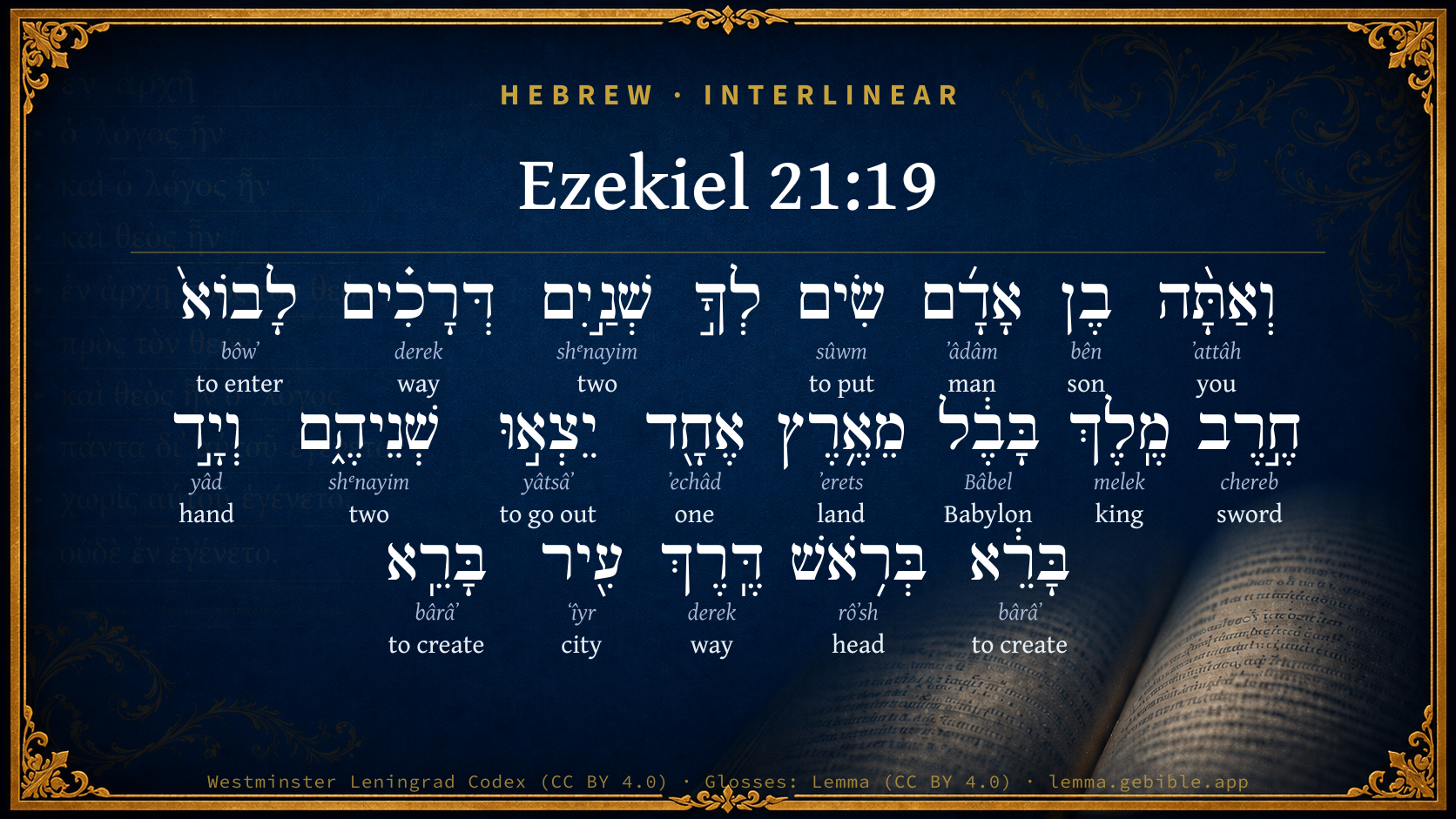
  1. וְאַתָּ֨ה ʼattâh H859 “and · you” Conjunction + Pronoun, Personal, 2nd Person, Masculine, Singular
  2. בֶן bên H1121 “son of” Noun, Common, Masculine, Singular, Construct
  3. אָדָ֜ם ʼâdâm H120 “man” Noun, Common, Masculine, Singular, Absolute
  4. שִׂים sûwm H7760 “put” Verb, Qal, Imperative, 2nd Person, Masculine, Singular
  5. שְׁנַ֣יִם shᵉnayim H8147 “two” Adjective, Cardinal number, Masculine, Dual, Absolute
  6. דְּרָכִ֗ים derek H1870 “ways” Noun, Common, Both, Plural, Absolute
  7. לָבוֹא֙ bôwʼ H935 “to enter” Preposition + Verb, Qal, Infinitive Construct
  8. חֶ֣רֶב chereb H2719 “sword of” Noun, Common, Feminine, Singular, Construct
  9. מֶֽלֶךְ melek H4428 “king of” Noun, Common, Masculine, Singular, Construct
  10. בָּבֶ֔ל Bâbel H894 “Babylon” Noun, Proper
  11. מֵאֶ֥רֶץ ʼerets H776 “from · land” Preposition + Noun, Common, Both, Singular, Absolute
  12. אֶחָ֖ד ʼechâd H259 “one” Adjective, Cardinal number, Masculine, Singular, Absolute
  13. יֵצְא֣וּ yâtsâʼ H3318 “to go out” Verb, Qal, Imperfect, 3rd Person, Masculine, Plural
  14. שְׁנֵיהֶ֑ם shᵉnayim H8147 “two · their” Adjective, Cardinal number, Masculine, Dual, Construct + Suffix, Personal, 3rd Person, Masculine, Plural
  15. וְיָ֣ד yâd H3027 “and · hand” Conjunction + Noun, Common, Both, Singular, Absolute
  16. בְּרֹ֥אשׁ rôʼsh H7218 “in/at · head of” Preposition + Noun, Common, Masculine, Singular, Construct
  17. דֶּֽרֶךְ derek H1870 “way of” Noun, Common, Both, Singular, Construct
  18. עִ֖יר ʻîyr H5892 “city” Noun, Common, Feminine, Singular, Absolute
  19. בָּרֵֽא bârâʼ H1254 “to create” Verb, Piel, Infinitive Absolute

About this verse

These counts appear in no published source. They are computed here, from the morphology-tagged text and Lemma’s own curated glosses. What Lemma adds →

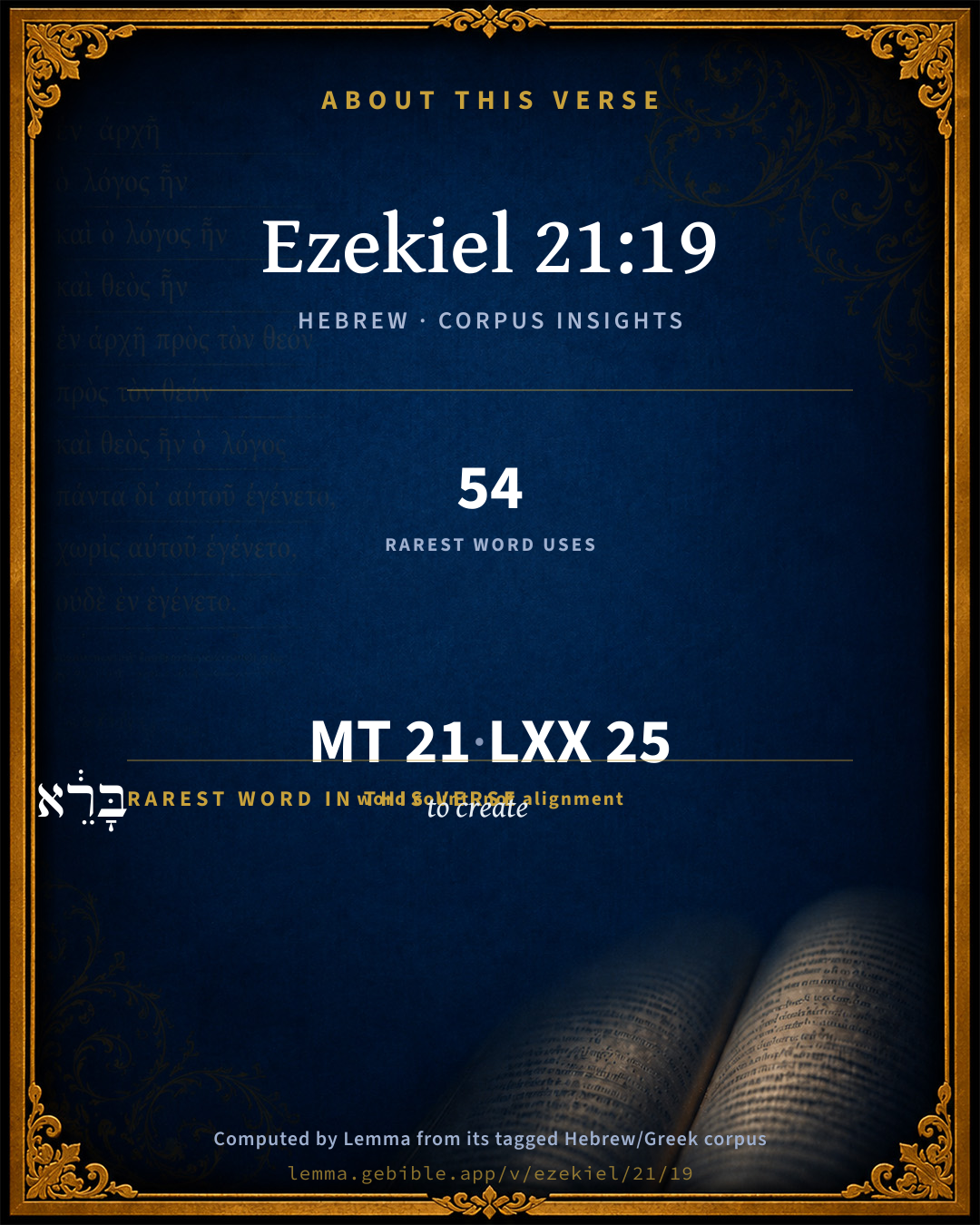
21
words
17
distinct lemmas
Prophets
section

Shared distinctive vocabulary

בָּרֵ֔א to create H1254 occurs in 46 verses of the Hebrew Bible. Also found in:

Grammatical profile

  • 5 verbs
  • 11 nouns
  • 3 adjectives
  • 1 pronoun
  • 1 preposition

Verb forms

  • שִׂים Qal · Imperative
  • לָבוֹא֙ Qal · Infinitive Construct
  • יֵצְא֣וּ Qal · Imperfect
  • בָּרֵ֔א Piel · Infinitive Absolute
  • בָּרֵֽא Piel · Infinitive Absolute

Repetition

Words recur within this verse — often emphatic in Hebrew:

  • שְׁנַ֣יִם two H8147 ×2
  • דְּרָכִ֗ים way H1870 ×2
  • בָּרֵ֔א to create H1254 ×2

Hebrew & Septuagint length

In English translation the verse runs 44 words from the Hebrew and 53 from the Septuagint (LXX English) — closely comparable.

A rough comparison of the two English renderings, which tokenize alike — not a word-level alignment.

Word counts can differ between the Hebrew and the Greek without any difference in meaning — e.g. the Hebrew direct-object marker אֵת has no separate Greek word, and Greek often adds the article ὁ.

In the original languages it is 21 Hebrew tokens and 25 Greek tokens — but the two are counted differently (Hebrew bundles its prefixes and suffixes into one token; the Greek is in lemma form), so that isn’t a like-for-like length.

Cross-references

3

Topical passages linked to Ezekiel 21:19 in the Treasury of Scripture Knowledge — connected by theme and wording, ordered by reader-vote popularity; previews shown in the World English Bible.

  • Jeremiah 1:10 behold, I have this day set you over the nations and over the kingdoms, to pluck up and to break down and to destroy and to overthrow, to build and to plant.
  • Ezekiel 4:1–3 You also, son of man, take a tile, and lay it before you, and portray on it a city, even Jerusalem:
  • Ezekiel 5:1–17 You, son of man, take a sharp sword; [as] a barber's razor shall you take it to you, and shall cause it to pass on your head and on your beard: then take balances to weigh, and divide the hair.

Cross-references courtesy of OpenBible.info (CC BY 4.0).

Hebrew and Greek witnesses Masoretic Hebrew ↔ Greek Septuagint

The same verse in the two great witnesses to the Old Testament, shown verse-for-verse.

These are two independent witnesses, not word-aligned to each other, and the Septuagint is shown in lemma (dictionary) form.

Hebrew Ezekiel 21:19 Masoretic · Westminster Leningrad Codex

וְאַתָּ֨ה בֶן אָדָ֜ם שִׂים לְךָ֣ שְׁנַ֣יִם דְּרָכִ֗ים לָבוֹא֙ חֶ֣רֶב מֶֽלֶךְ בָּבֶ֔ל מֵאֶ֥רֶץ אֶחָ֖ד יֵצְא֣וּ שְׁנֵיהֶ֑ם וְיָ֣ד בָּרֵ֔א בְּרֹ֥אשׁ דֶּֽרֶךְ עִ֖יר בָּרֵֽא

Also, you son of man, appoint two ways, that the sword of the king of Babylon may come; they both shall come forth out of one land: and mark out a place, mark it out at the head of the way to the city.

World English Bible · Public Domain

Greek LXX Ezekiel 21:19 Septuagint · lemma form

καί σύ υἱός ἄνθρωπος προφητεύω καί κροτέω χείρ ἐπί χείρ καί διπλασιάζω ῥομφαία ὁ τρίτος ῥομφαία τραυματίας εἰμί ῥομφαία τραυματίας ὁ μέγας καί ἐκἵστημι αὐτός

and you, son of man, appoint you two ways, that the sword of the king of Babylon may enter in: the two shall go forth of one country; and there shall be a force at the top of the way of the city, you shall set it at the top of the way,

LXX2012 (modern English Septuagint) · Public Domain

On this verse, The Cambridge Bible for Schools and Colleges discusses the Septuagint’s reading. Read the note in Commentary ↓

Hebrew: Westminster Leningrad Codex (CC BY 4.0). Greek: Septuagint (public domain); English from LXX2012 (modern English Septuagint) (Public Domain). How the Septuagint differs from the Hebrew →

Targum (Aramaic paraphrase)

1

The Targum is the ancient Jewish Aramaic paraphrase of the Hebrew Scriptures — an interpretive translation, not the Hebrew text itself. Onkelos (literal) and Pseudo-Jonathan (expansive) render the Torah, and Jonathan the Prophets. Coverage is partial: where no permissively-licensed English translation exists for a verse, only the Aramaic is shown. This is verse-level text, not a word-by-word alignment to the Hebrew.

  1. Targum Jonathan Prophets (Joshua–Malachi)
    וְאַתְּ בַּר אָדָם אִתְנַבֵּי וּטְפַח יַד עַל יַד וְתִתְכְּפֵיל חַרְבָא תְלִיתָאָה חֲרַב קְטוֹלִין הִיא חֲרָב פּוּרְעֲנוּת קְטוֹלָא רַבָּא דִמְזִיעָא לְהוֹן:

    (no public-domain English translation for this verse)

    Targum Jonathan — Aramaic: “Mikraot Gedolot” (public domain). English: “Sefaria Community Translation” (CC0 1.0 (public-domain dedication)); “London "Chaldee Paraphrase," 1871” (public domain). Text via Sefaria.

Commentary

Notes on Ezekiel 21:19 from classic Christian and Jewish commentators (each source and its license shown beneath its notes). The classic Christian expositions comment on the surrounding passage and are grouped to its opening verse, so a note may address several verses; the Jewish commentaries on the Tanakh (Rashi and others) are per-verse, so they appear only where the commentator wrote on this verse.

Lemma curates 59 commentaries, every one of them public domain or Creative Commons licensed, each selected and text-cleaned for this edition rather than reprinted as found. About our sources →

Trapp's Complete Commentary

John Trapp

Eze 21:19 Also, thou son of man, appoint thee two ways, that the sword of the king of Babylon may come: both twain shall come forth out of one land: and choose thou a place, choose [it] at the head of the way to the city.

Ver. 19. Appoint thee two wags.] Pinge duas vias, ut Eze 4:1; by prophetic action draw out two ways, by either of which Nebuehadnezzar may march against Egypt, his present aim, as the great Turk’s now is Italy.

Choose it at the head of the wag to the city.] All this the Jews heard and slighted, as being infatuated, and so fitted for destruction.

John Trapp, A Commentary or Exposition upon All the Books of the Old and New Testament (1647–1656) — public domain. Text from a community e-Sword module.

Joseph Benson's Commentary

Eze 21:19-20. Appoint thee two ways — So as to represent them to the eyes of thy countrymen: see Eze 4:1; “Designa in tabella, lapide, aut terra.” Mark on a map, a stone, or on the earth. — Vatablus. That the sword of the king of Babylon may come — Dr. Waterland translates this, “Appoint thee two roads for the king of Babylon’s sword to come by; let both go forth out of one land; and choose thou a way-mark; choose it at the head of the road toward the city: Eze 21:20, Point out a road for the sword to go to Rabbath, and to Judah in Jerusalem the defenced.” Instead of the defenced, Houbigant reads, that he may besiege it. God here foreshows his prophet, that when the king of Babylon should come with his army into Syria, and find the Ammonites had entered into a confederacy with Egypt as well as Zedekiah, he would be in doubt against which of the two people he should first make war, and would commit the decision of the matter to his arts of divination, described Eze 21:21; and that God should direct the divination to be for taking the road that leads to Jerusalem. The words, Let both go forth out of one land, seem to mean, that the single way should divide itself into two, leading to different places. This, as appears from what follows, was the road coming out of Arabia, which afterward parted into two, one leading to Rabbath, and the other to Jerusalem.

Joseph Benson's Commentary on the Old and New Testaments (1811–1818) — public domain. Text from a community e-Sword module.

Geneva Bible (1599)

Geneva Bible translators

This was spoken, because that when Nebuchadnezzar came against Judah, his purpose was also to go against the Ammonites: but doubting in the way, which enterprise to undertake first he consulted with his soothsayers, and so went against Judah.

Geneva Bible (1599) marginal notes — public domain. Text via Bolls.life.

Jamieson, Fausset & Brown

Robert Jamieson, A. R. Fausset & David Brown

two ways--The king coming from Babylon is represented in the graphic style of Ezekiel as reaching the point where the road branched off in two ways, one leading by the south, by Tadmor or Palmyra, to Rabbath of Ammon, east of Jordan; the other by the north, by Riblah in Syria, to Jerusalem--and hesitating which way to take. Ezekiel is told to "appoint the two ways" (as in Eze 4:1); for Nebuchadnezzar, though knowing no other control but his own will and superstition, had really this path "appointed" for him by the all-ruling God.

out of one land--namely, Babylon.

choose . . . a place--literally "a hand." So it is translated by FAIRBAIRN, "make a finger-post," namely, at the head of the two ways, the hand post pointing Nebuchadnezzar to the way to Jerusalem as the way he should select. But MAURER rightly supports English Version. Ezekiel is told to "choose the place" where Nebuchadnezzar should do as is described in Eze 21:20-21; so entirely does God order by the prophet every particular of place and time in the movements of the invader.

Jamieson, Fausset & Brown — Commentary Critical and Explanatory on the Whole Bible (1871) — public domain (CC PDM 1.0). Text via the HelloAO Bible API.

Adam Clarke's Commentary

Verse 19. Appoint thee two ways] Set off from Babylon, and lay down two ways, either of which thou mayest take; that to the right, which leads to Jerusalem; or that to the left, which leads to Rabbath of the Ammonites, Eze 21:20. But why against the Ammonites? Because both they and the Moabites were united with Zedekiah against the Chaldeans, (see Jer 27:3,) though they afterwards fought against Judea, Eze 12:6.

Adam Clarke's Commentary on the Bible (1810–1826) — public domain. Text from a community e-Sword/MySword module.

Ellicott's Commentary for English Readers

(19) Appoint thee two ways.—Or, set before thee. The prophet is directed to represent Nebuchadnezzar as about to go forth with his armies, and hesitating whether he should take first the road to Jerusalem or to the capital of the Ammonites. His choice of the former is determined, as he supposes, by his divinations, but really by the overruling hand of the Lord, who thus shows beforehand what it shall be. The whole is set forth in the vivid and concrete imagery so characteristic of Ezekiel; but it is impossible that the scene in real life was to be thus determined by the prophet’s open interference. The whole is a vision, in which life and action is conveyed by this manner of describing the course of future events as actually taking place before the eyes of his hearers. The two ways “come forth out of one land;” their starting-point is the same. Babylon, and they diverge towards different destinations.

Choose thou a place.—Literally, make a hand or, as we say, a finger-post. The verb here used never means “choose,” nor does the noun ever mean “place” but the verb is often used both in the sense of to make and to engrave, and “hand” frequently occurs in the sense of a pillar, and occasionally in that of a guide post. (See 1Sa_15:12; 2Sa_18:18; Isa_56:5.) The prophet in vision sets up this guide-post to direct the king on his march. The roads to Rabbah and to Jerusalem from Babylon would be the same for many hundred miles. It is impossible, therefore, to suppose that Ezekiel actually stood at their parting.

Head of the way, called more poetically in Eze_21:21 “mother of the way,” is the point where the road forks. From this point the road to Jerusalem would lie on the right, that to Rabbah, the capital of the Ammonites, on the left.

A Bible Commentary for English Readers, edited by Charles John Ellicott (1878–1897) — public domain. Text from a community e-Sword module.

The Cambridge Bible for Schools and Colleges

gen. ed. J. J. S. Perowne

19. appoint thee two ways] Or, make thee. The prophet is to make a representation of a way branching into two ways, i.e. the way from Babylon, which at a certain point parts into two, there being two possibilities before the king, either Rabbah or Jerusalem. Naturally the action was not performed in reality by the prophet.

choose thou a place] and grave a hand, at the head of the way to the (each) city grave it. The “hand” is the pointer or sign-post indicating direction. LXX. reads somewhat differently.

The Cambridge Bible for Schools and Colleges (gen. ed. J. J. S. Perowne; Cambridge University Press, 1878–1918) — public domain. Text from a community e-Sword module.

John Gill's Exposition

For the king of Babylon stood at the parting of the way, at the head of the two ways,.... That is, he would stand there; the prophet knew that it was certain it should be, and therefore represents it as if it was; he had, by a spirit of prophecy, seen, that when the king of Babylon was come to such a place, on the borders of the desert of Arabia, where the road from Babylon parted, where two ways met, the one leading to Jerusalem on the right, and the other to Rabbath on the left, he should make a full stop with his army, and consider which way he should take, whether that which led to Jerusalem, or that which led to Rabbath. It is very probable, when he came out of Babylon, his scheme was to make an attempt on both these important places, and take them; but be had not determined which to attack first, and was still doubtful; and now being come to the two roads, which led to the one and the other, it was necessary to make a halt, consider, and conclude, which course to steer; to determine which, he thought proper "to use divination", which was performed in the following manner:

he made his arrows bright; being made of iron or steel; in the brightness of which diviners looked, and made their observations, and accordingly directed what was to be done; as they did by looking into the brightness of a man's nails, as David Kimchi observes; though his father, Joseph Kimchi, was of opinion that the word has the signification of casting of arrows, or causing them to fly in the air; and supposes that Nebuchadnezzar cast up arrows into the air, and observed on which side they fell, and so judged which way to take; to this agrees the Targum,

"with a bow he cast out arrows;''

so the Syriac and Arabic versions (b). Jerom says the way of divining by arrows was this: arrows, with the names of the cities inscribed upon them, were put into a quiver, and mixed together; and the city upon the arrow which came out first was first attacked. To this agrees the Vulgate Latin version, which renders the words, "mingling the arrows"; and Dr. Pocock (c) prefers this sense of the word, which he observes so signifies in the Arabic language; and who gives an account of the use of divination by arrows among the Arabians, who much used it; though forbidden by Mahomet, as Schultens (d) observes. Their custom was this; when a man was about to marry a wife, or go a journey, or do any business of importance, he put three arrows into a vessel; on one was inscribed,

"my lord hath commanded me;''

on another,

"my lord hath forbid me;''

the third had nothing on it. If the first he took out had the command upon it, then he proceeded with great alacrity: but if it had the prohibition, he desisted; and if that which had nothing inscribed on it, he laid it by, till one of the other two was taken out; and there is to this day a sort of divination by arrows used by the Turks; it is commonly for the wars, though it is also performed for all sorts of things; as to know whether a man should undertake a voyage, buy such a commodity, or the like. The manner of doing it, as Monsieur Thevenot (e) relates, is this; they take four arrows, and place them with their points against one another, giving them to be held by two persons; then they lay a naked sword upon a cushion before them, and read a certain chapter of the Alcoran; with that the arrows fight together for some time, and at length the one fall upon the other: if, for instance the victorious have been named Christians (for two of them they call Turks, and the other two by the name of their enemy), it is a sign that the Christians will overcome; if otherwise, it denotes the contrary. The Jews (f) say, that in the present case of Nebuchadnezzar, that when he or his diviner cast the arrow for Antioch, or for Tyre, or for Laodicea, it was broke; but when he cast it for Jerusalem, it was not broke; by which he knew that he should destroy it. This is that sort of divination which is called "belomancy": he consulted with images; or "teraphim"; images in which, as Kimchi says, they saw things future; Heathen oracles, from whence responses were made; these were images for private use, such as were the "lares" and "penates" with the Romans; these Laban had in his house in which Rachel stole from him; and are supposed to be such as are made under certain constellations, and their influences capable of speaking; see Zac 10:2, as Aben Ezra on Gen 31:34 observes, with which men used to consult about things future or unknown; and this is thought to be one reason why Rachel took away these images from her father, that he might not, by consulting with them, know which way Jacob fled (g) with such as these the king of Babylon consulted, that he might know which way he should take:

he looked in the liver; of a beast slain, and made observations on that to direct him; as used to be done by the Aruspices among the Romans. This is that sort of divination which is called "hepatoscopy", or inspection into the liver; for though the Aruspices or Extispices, so called from their looking into the entrails of a beast, and making their observations on them, used to view the several inward parts, yet chiefly the liver, which they called the head of the intestines; and if this was wanting, or the head in it, the chief part of it, it was an ill omen; thus, in the month that Claudius Caesar was poisoned, the head of the liver was wanting in the sacrifice; or if the liver was livid, vicious, had any pustules upon it, or any purulent matter in it; or was touched, cut and wounded with the knife of the sacrificer, it foreboded great evils and misfortunes; or if the extreme part of the liver, which is called the fibre, was so placed, that from the lowest fibre the livers were replicated, or there was a double liver, this was a token for good, and portended joy and happiness (h): moreover, they used to divide the bowels or entrails into two parts, and so the liver; the one they called "familiaris", by which they judged what would befall themselves and their friends; the other "hostilis", what concerned their enemies; according to the habit, colour, and position they were in, they concluded what would befall the one and the other (i). Lucan (k) and Seneca (l) particularly have respect to this: and the king of Babylon here having two people to deal with, the Ammonites and the Jews, he inspects the liver of a creature slain for sacrifice, that he might judge which was best and safest for him to attack; which was less threatening, and more easy to be overcome (m): this divination used to be made with calves, kids, and lambs (n).

(b) So R. So. Urbin. Ohel Moed, fol. 25, 2, interprets the word. (c) Specimen Arab. Hist. p. 327. (d) Animadv. in Job, p. 169, 170. (e) Travels, par. 1. B. 1. ch. 6. p. 36. (f) Midrash Tillim in Psal. lxxix. 1. (g) See Godwin's Moses and Aaron, l. 4. c. 9. (h) Vid. Alex. ab flex. Genial. Dier. l. 5. c. 25. & Plin. Nat. Hist. l. 11. c. 37. (i) Vid. Valtrinum de Re Militari Roman. l. 1. c. 6. p. 27. Liv. & Ciceron. in ib. (k) "Cernit tabe jecur madidum, venasque minaces, Hostili de parte videt", &c. Pharsal. l. 1. (l) "Hostile valido robore insurlit latus." Oedipus, Act. 2. (m) Vid. Lydium de Re Militari, l. 1. c. 3. p. 9, 10. (n) Pausanias, l. 6. p. 345.

John Gill's Exposition of the Whole Bible (1746–1763) — public domain (CC PDM 1.0). Text via the HelloAO Bible API.

Matthew Poole's English Annotations

Appoint; paint, mark out, or describe on the or tablet, as Eze 4:1, two roads, and set it before thy countrymen in Babylon, and let them know that the arms and sword of Nebuchadnezzar are designed for exploits, where those ways lead them. Thus typically Ezekiel foretells the invasion the king of Babylon would make.

Both twain; the ways, though two in the course they lead, as stream that divide and multiply, yet must take their rise from one and the same land, that is, Babylon; there the prophet must begin to mark out the way which is to he drawn out: till it divide into two. And pitch on some convenience place, where thou mayst place Nebuchadnezzar’s army, he and his council of war consulting where this one way divides into two, which was on the edge of the desert of Arabia, as Nebuchadnezzar pursued his march from Babylon.

At the head of the way; either where the way begins, at Babylon; or rather at the head where each distinct way runs out, toward either Rabbath of the Ammonites, of Jerusalem; for there Nebuchadnezzar will cast lots.

Matthew Poole's English Annotations on the Holy Bible (1683–1685) — public domain. Text from a community e-Sword/MySword module.

Whedon's Commentary on the Bible

Daniel D. Whedon

19. Appoint thee — Rather, make thee.

Choose thou a place — Rather, engrave thee a signpost (literally, hand). This signpost was placed “at the head of the way to each city.” Such engravings or outline maps were not at all uncommon in Babylon and Egypt in Ezekiel’s day or a thousand years earlier. (See Eze_4:1-3.)

Daniel D. Whedon (gen. ed.), Commentary on the Old and New Testaments (1874–1909) — public domain. Text from a community e-Sword module.

John Wesley's Explanatory Notes

Appoint - Paint, or describe them on a tile. One land - That is, Babylon. Chuse - Pitch on some convenient place, where thou mayest place Nebuchadnezzar's army, consulting where this one way divides into two, which was on the edge of the desert of Arabia. At the head - Where each way runs, toward either Rabbath, or Jerusalem; for there Nebuchadnezzar will cast lots.

John Wesley, Explanatory Notes Upon the Whole Bible (1754–1765) — public domain. Text via the GEBible commentary corpus.

Rashi

Rabbi Shlomo Yitzchaki (Rashi)

prophesy and clap your hands one upon the other in the manner of those who lament, and what is the prophecy?

and a third sword shall be doubled I said, “A sword, a sword”; Nebuchadnezzar’s sword to destroy Jerusalem and the sword of the children of Ammon upon Gedaliah. There is yet a third sword, doubled as much as these two, and it shall be a sword of the slain; that is the sword of the great slaughter, which causes many slain to fall.

which penetrates to them Wherever you go out, it will pursue you into the innermost chambers. Behold, Johanan the son of Kareah and the generals of the armies will go to Egypt; there the sword will overtake them, and so in all the place from which they will flee, to the fortified cities, as it is stated in this piece: “by all your cities I gave the scream of the sword.”

Rashi on the Tanakh — English translations: “The Judaica Press complete Tanach with Rashi, translated by A. J. Rosenberg” (CC BY 4.0); “Pentateuch with Rashi's commentary by M. Rosenbaum and A.M. Silbermann, 1929-1934” (public domain); “The Metsudah Tanach series, Lakewood, N.J” (CC BY 4.0); and “The Book of Joshua, Metsudah Publications, 1997” (CC BY 4.0). Text via Sefaria.

Lesson kit

Teaching starters — assembled from the data on this page, not authored interpretation. Every prompt links to the verse data it draws on. Edit before teaching.

Ezekiel, in the Prophets, opens this verse with 21 words (17 distinct Hebrew lemmas). Its most distinctive word is bârâʼ (“to create”). A historical commentator’s framing appears above. Read the whole chapter for the surrounding context.

Discussion questions

  1. What does “to create” (bârâʼ) contribute to the verse as a whole?
  2. Genesis 1:1 shares the word «to create» with this verse. How do the two illuminate each other?
  3. “two” occurs 2× in this one verse. What is the effect of the repetition?
  4. These translations render this verse differently; the difference is in the English rendering, not the original. What questions does that raise?
  5. The verb «שִׂים» is Qal Imperative. How does its form color the action?
  6. Reading how Trapp's Complete Commentary and Joseph Benson's Commentary read this verse, where do the two commentators agree and where do they part?

Things to notice

Reading settings

Reading text

Shown beneath each verse's original-language words.

Old Testament
Old Testament edition

Read the OT as the Masoretic Hebrew (MT) or the Greek Septuagint (LXX).

English shown for the Greek Septuagint (in the Hebrew ↔ Greek comparison).

Comparing translations? Open the Compare panel on any verse page to stack up to four side by side.