
Psalms 85:13

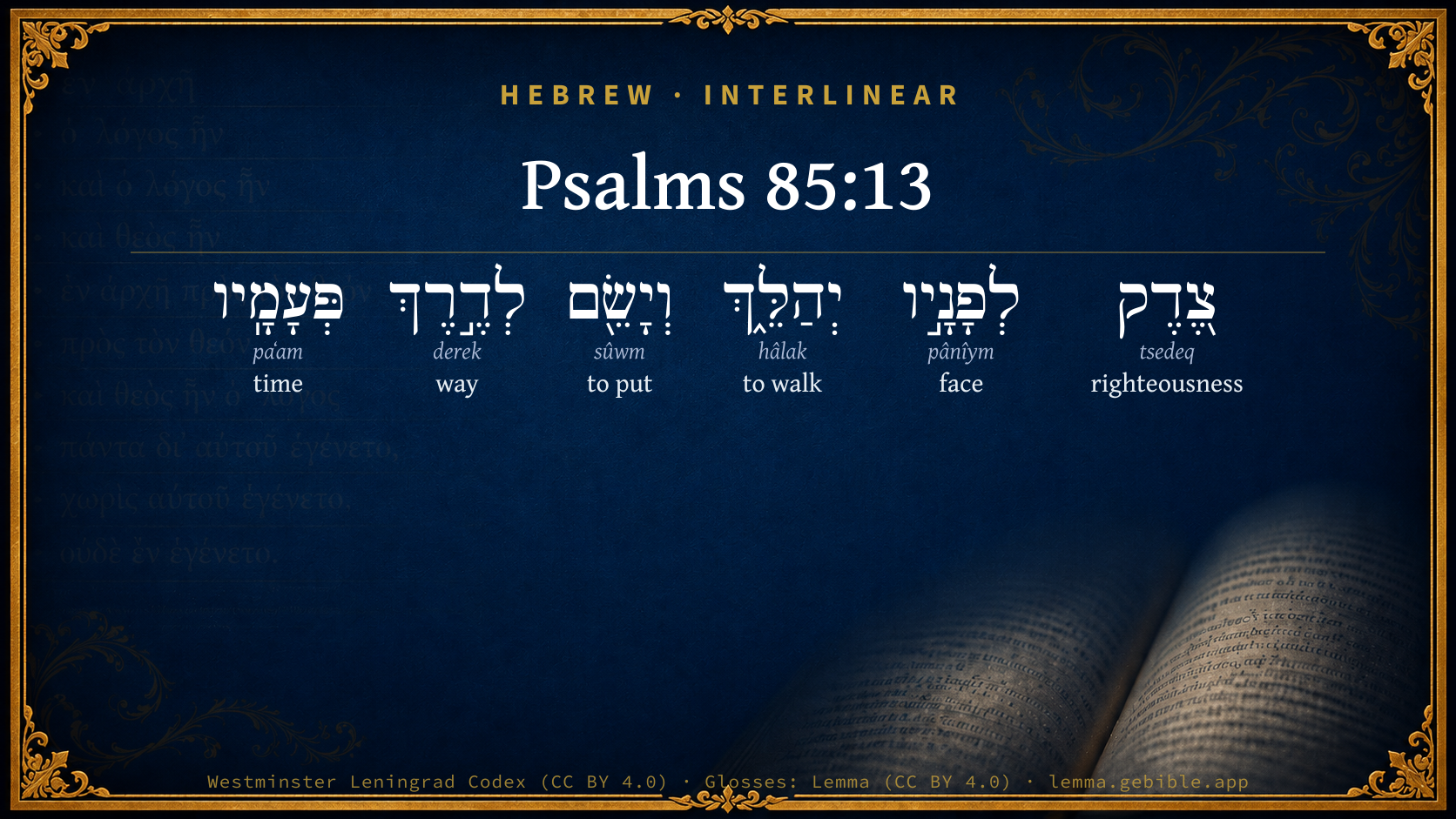
Hebrew (Westminster Leningrad Codex) Psalms 85:13 appears in the Hebrew Old Testament. The text above is from the Westminster Leningrad Codex. Each word links to its Strong’s number, a concise gloss, and parsing drawn from the Open Scriptures Hebrew Bible morphology. Click any word for its full Brown-Driver-Briggs (BDB) entry.
Download image
Cite this verse

Psalms 85:13 (World English Bible). Public Domain. Lemma interlinear Bible study tool, https://lemma.gebible.app/v/psalms/85/13.

Show BibTeX & RIS
BibTeX
RIS
English Translation
Righteousness goes before him, And prepares the way for his steps.
World English Bible · Public Domain
Download a study sheet

One document with this verse’s original text, its word-by-word gloss line, the meaning frame, cross-references with their text, attributed commentary, and full source and license credits — printable, and it pastes into notes with its structure intact.

This verse Autodidact and up

Study sheet (.html) Plain text (.txt)

A passage Seminary Student

Up to 50 verses in one chapter. A passage sheet keeps up to 6 commentary sources and 12 cross-references per verse, in the order this page ranks them, and says so on the sheet whenever that leaves anything out. Ask for a single verse and you get the Autodidact verse sheet above.

Everything on this page stays free to read, with no account — the sheet is a download of what is already on screen, not access to it.

Want to remove ads? Support Godless Engineer
Compare translations 3

The same verse in 3 English versions, stacked beneath the original-language interlinear above. Click any original word for its lexicon entry.

Each is an independent rendering of the whole verse — the interlinear is not word-aligned to these translations.

Highlighted words mark where these versions differ — a whole-verse word diff, not a word-by-word alignment.

  • World English Bible Public Domain
    Righteousness goes before him, And prepares the way for his steps.
  • King James Version Public Domain
    Righteousness shall go before him; and shall set us in the way of his steps.
  • unfoldingWord Literal Text CC BY-SA 4.0
    Righteousness walks before him, and it puts his steps in the way.

unfoldingWord Literal Text — © unfoldingWord, licensed CC BY-SA 4.0. Word-aligned USFM3 via Door43 (git.door43.org/unfoldingWord/en_ult).

Versions to compare (up to 4)

3 of 4 selected

Show all 18 translations

Every available English version of this verse, each an independent rendering of the whole verse.

  • World English Bible Public Domain
    Righteousness goes before him, And prepares the way for his steps.
  • Berean Standard Bible Public Domain
    Righteousness will go before Him to prepare the way for His steps.
  • Majority Standard Bible Public Domain
    Righteousness will go before Him to prepare the way for His steps.
  • King James Version Public Domain
    Righteousness shall go before him; and shall set us in the way of his steps.
  • American Standard Version (1901) Public Domain
    Righteousness shall go before him, And shall make his footsteps a way `to walk in'.
  • Revised Version (1885) Public Domain
    Righteousness shall go before him; and shall make his footsteps a way to walk in.
  • Geneva Bible (1599) Public Domain
    Righteousnesse shall go before him, and shall set her steps in the way.
  • Douay-Rheims (1899) Public Domain
    For the Lord will give goodness: and our earth shall yield her fruit.
  • Young's Literal Translation Public Domain
    Righteousness before Him goeth, And maketh His footsteps for a way!
  • Literal Standard Version CC BY-SA 4.0
    Righteousness goes before Him, || And makes a way for His footsteps!
  • Unlocked Literal Bible CC BY-SA 4.0
    Righteousness will go before him and make a way for his footsteps.
  • unfoldingWord Literal Text CC BY-SA 4.0
    Righteousness walks before him, and it puts his steps in the way.
  • Darby Bible Public Domain
    Righteousness shall go before him, and shall set his footsteps on the way.
  • World Messianic Bible Public Domain
    Righteousness goes before him, and prepares the way for his steps.
  • Webster's Bible Public Domain
    \\85:12\\Yes, the LORD will give that which is good; and our land shall yield her increase.
  • Free Bible Version CC BY-SA 4.0
    Truth and right go ahead of him to prepare a path for him to walk on.
  • Bible in Basic English Public Domain
    Righteousness will go before him, making a way for his footsteps.
  • JPS Tanakh (1917) Public Domain
    (85-14) Righteousness shall go before Him, and shall make His footsteps a way.

Literal Standard Version (2020), Covenant Press — licensed CC BY-SA 4.0. Text via the HelloAO Bible API (eBible.org). Unlocked Literal Bible (unfoldingWord) — licensed CC BY-SA 4.0. Text via the HelloAO Bible API (eBible.org). unfoldingWord Literal Text — © unfoldingWord, licensed CC BY-SA 4.0. Word-aligned USFM3 via Door43 (git.door43.org/unfoldingWord/en_ult). Free Bible Version, Dr. Jonathan Gallagher — licensed CC BY-SA 4.0. Text via the HelloAO Bible API (eBible.org).

Word by word

More ways to search: Search by grammar → Find every occurrence → Compare this word →

Practice this passage: Drill this verse → Learn its vocabulary →

About this verse

These counts appear in no published source. They are computed here, from the morphology-tagged text and Lemma’s own curated glosses. What Lemma adds →

6
words
6
distinct lemmas
Wisdom
section

Grammatical profile

  • 2 verbs
  • 4 nouns

Verb forms

  • יְהַלֵּ֑ךְ Piel · Imperfect
  • וְיָשֵׂ֖ם Qal · Imperfect

Hebrew & Septuagint length

In English translation the verse runs 11 words from the Hebrew and 13 from the Septuagint (LXX English) — closely comparable.

A rough comparison of the two English renderings, which tokenize alike — not a word-level alignment.

Word counts can differ between the Hebrew and the Greek without any difference in meaning — e.g. the Hebrew direct-object marker אֵת has no separate Greek word, and Greek often adds the article ὁ.

Cross-references

15

Topical passages linked to Psalms 85:13 in the Treasury of Scripture Knowledge — connected by theme and wording, ordered by reader-vote popularity; previews shown in the World English Bible.

  • Psalms 89:14 Righteousness and justice are the foundation of your throne. Loving kindness and truth go before your face.
  • John 13:34 A new commandment I give to you, that you love one another, just like I have loved you; that you also love one another.
  • 1 John 2:6 he who says he remains in him ought himself also to walk just like he walked.
  • 2 Corinthians 3:18 But we all, with unveiled face beholding as in a mirror the glory of the Lord, are transformed into the same image from glory to glory, even as from the Lord, the Spirit.
  • Galatians 2:20 I have been crucified with Christ, and it is no longer I that live, but Christ living in me. That life which I now live in the flesh, I live by faith in the Son of God, who loved me, and gave himself up for me.
  • 1 Peter 2:18–24 Servants, be in subjection to your masters with all fear; not only to the good and gentle, but also to the wicked.
  • 1 Peter 4:1 Forasmuch then as Christ suffered for us in the flesh, arm yourselves also with the same mind; for he who has suffered in the flesh has ceased from sin;
  • Psalms 119:35 Direct me in the path of your commandments, For I delight in them.
  • Isaiah 58:8 Then shall your light break forth as the morning, and your healing shall spring forth speedily; and your righteousness shall go before you; the glory of Yahweh shall by your rearward.
  • Matthew 20:27–28 Whoever desires to be first among you shall be your bondservant,
  • John 13:14–16 If I then, the Lord and the Teacher, have washed your feet, you also ought to wash one another's feet.
  • Ephesians 5:1–2 Be therefore imitators of God, as beloved children.
  • Philippians 2:5–8 Have this in your mind, which was also in Christ Jesus,
  • Hebrews 12:1–2 Therefore let us also, seeing we are surrounded by so great a cloud of witnesses, lay aside every weight and the sin which so easily entangles us, and let us run with patience the race that is set before us,
  • Psalms 72:2–3 He will judge your people with righteousness, And your poor with justice.

Cross-references courtesy of OpenBible.info (CC BY 4.0).

Hebrew and Greek witnesses Masoretic Hebrew ↔ Greek Septuagint

The same verse in the two great witnesses to the Old Testament, shown verse-for-verse.

You’re reading Greek Psalm 84 (Hebrew Psalm 85). The Septuagint counts the superscription, so verse numbers can differ from the Hebrew — chapter-level alignment, not verse-by-verse. Numbering follows Rahlfs.

These are two independent witnesses, not word-aligned to each other, and the Septuagint is shown in lemma (dictionary) form.

Hebrew Psalms 85:13 Masoretic · Westminster Leningrad Codex

צֶ֭דֶק לְפָנָ֣יו יְהַלֵּ֑ךְ וְיָשֵׂ֖ם לְדֶ֣רֶךְ פְּעָמָֽיו

Righteousness goes before him, And prepares the way for his steps.

World English Bible · Public Domain

Greek LXX Greek Psalm 84:13 Septuagint · lemma form

καί γάρ ὁ κύριος δίδωμι χρηστότης καί ὁ γῆ ἐγώ δίδωμι ὁ καρπός αὐτός

Righteousness shall go before him; and shall set his steps in the way.

LXX2012 (modern English Septuagint) · Public Domain

Hebrew: Westminster Leningrad Codex (CC BY 4.0). Greek: Septuagint (public domain); English from LXX2012 (modern English Septuagint) (Public Domain). How the Septuagint differs from the Hebrew →

Commentary

Notes on Psalms 85:13 from classic Christian and Jewish commentators (each source and its license shown beneath its notes). The classic Christian expositions comment on the surrounding passage and are grouped to its opening verse, so a note may address several verses; the Jewish commentaries on the Tanakh (Rashi and others) are per-verse, so they appear only where the commentator wrote on this verse.

Lemma curates 59 commentaries, every one of them public domain or Creative Commons licensed, each selected and text-cleaned for this edition rather than reprinted as found. About our sources →

Adam Clarke's Commentary

Verse 13. Righteousness shall go before him] Perhaps this verse may receive its best solution from Ro 3:25: "Whom God hath set for a propitiation through faith in his blood, to declare his RIGHTEOUSNESS for the remission of sins that are past." This term the apostle uses to point out God's method of justifying or saving mankind. And this, in the preaching of the pure Gospel, is ever going before to point out the Lord Jesus, and the redemption that is in his blood. And thus going before him, the sinner, who feels his need of salvation, is Set - in the way of his steps; as Bartimeus sat by the way-side begging, by which way Jesus walked; and when he came where he was, heard his prayer, and restored him his sight. Or, righteousness - the pure and holy law of God, must be proclaimed as broken by sinners, and calling aloud for vengeance, before they can see and feel their need of Christ crucified. By the preaching of the law they are prepared to receive the grace of the Gospel.

ANALYSIS OF THE EIGHTY-FIFTH PSALM

Mystically, this Psalm may be considered as treating of the redemption of the world by Jesus Christ. It has the three following parts: -

I. An acknowledgment of God's former mercies, Ps 85:1-3.

II. A petition on that ground that he would repeat them, Ps 85:4-7.

III. A profession of obedience, and an advice to continue in it, Ps 85:8. That men may be partakers of the promises, both spiritual, Ps 85:9-11; and temporal, Ps 85:12, which shall be fulfilled to those who keep in the ways of God, Ps 85:13.

I. In the three first verses, the psalmist commemorates God's mercies to his people; of which his good will or favour is the Fountain. These mercies are, 1. Temporal: "Thou hast been favourable unto thy land," c., Ps 85:1. 2. Spiritual: 1. "Thou hast forgiven the iniquities of thy people:" Justification. 2. "Thou hast taken away all thy wrath:" Reconciliation.

II. Upon this he founds a prayer: "Turn us, O God."

1. Thou hast turned away the captivity. Restore and convert us.

2. Thou hast brought us back. Revive our hearts, that they may rejoice in thee.

3. Thou hast been reconciled to our fathers. Be reconciled to us.

4. Thou hast forgiven the iniquity of thy people. Save us.

III. He promises obedience: "I will hear what God will speak" and I shall hear nothing from him but what is for his own glory, and his people's good.

1. "He will speak peace:" He will turn all their sufferings to their advantage.

2. But they must hear, and be steady. They must "not turn again to folly;" let them remember this.

3. To such his promise is sure: "His salvation is nigh them."

4. And it comes, that "glory may dwell in our land;" that it may be crowned with peace and plenty.

In this prosperity of theirs, there shall be a combination of mercy, truth, justice, and peace.

1. "Justice and peace shall embrace;" for there is such a league between these two, that where peace is made without justice, it cannot long continue: and mercy and truth must; for it is inconsistent with mercy to be in concord with falsehood.

2. "Truth shall spring out of the earth." Men shall observe it in all their transactions, contracts, and promises.

3. "Righteousness shall look down from heaven." God will smile on this state of things, and pour out upon them the continual dew of his blessing.

4. In a word, 1. They shall enjoy all spiritual blessings; for the "Lord shall give that which is good." 2. And all temporal; "for the land shall yield her increase."

For these mercies he sets down our duty: -

1. "Righteousness shall go before him." All his saints shall walk before him in righteousness and true holiness.

"And this righteousness shall set them in the way of his steps." It shall teach them to walk constantly and steadily in the way of his commandments all the days of their life.

By manor of the ancients and moderns the whole of this Psalm has been applied to Christ and his salvation. See the preceding notes.

Adam Clarke's Commentary on the Bible (1810–1826) — public domain. Text from a community e-Sword/MySword module.

Trapp's Complete Commentary

John Trapp

Psa 85:13 Righteousness shall go before him; and shall set [us] in the way of his steps.

Ver. 13. Righteousness shall go before him] Men shall walk before God in holiness and righteousness all the days of their lives, Luk 1:75; they shall not rest in outward blessings, Psa 85:12, or be satisfied with such low things, but be led up thereby to the care of higher.

And shall set us in the way of his steps] So that we shall go an upper (and therefore a better) way, Pro 15:24, having our feet where other men’s heads are; and so departing from hell beneath, which even gapeth for the unrighteous.

John Trapp, A Commentary or Exposition upon All the Books of the Old and New Testament (1647–1656) — public domain. Text from a community e-Sword module.

The Biblical Illustrator

Joseph S. Exell

Psa_85:13

Righteousness shall go before Him; and shall set us in the way of His steps.

Right steps

I. The essential steps of the Lords dealings with us. The first thing in Gods dealing towards us is that He gives His well-beloved Son; and the first thing in His manifestation of Himself to us is to open our eyes to see our need of this, and thus to bring us into the same way, the way of His steps. The next step in a way of detail as given in this psalm is that of forgiveness. The steps now described in a way of detail naturally follow. Thou hast forgiven the iniquity of Thy people. That is one of the sweetest features of the Gospel. Thou hast covered all their sin. Here is Satans universal and entire defeat, seeing He has covered all their sins; and who shall lay anything to the charge of Gods elect? Is not this a step in loving-kindness, is not this a step of grace, is not this an infinitely and an eternally advantageous step,--thus to receive Christ Jesus as to receive the forgiveness of sins?

II. The reasons why the Lord setteth us in the way of his steps.

1. That we may be supported when we fall into tribulations, adversities, and trials. If some of you are so placed at present that you may not exactly feel in your minds the force of this reason, you will before you die, because trouble is the lot of us all, affliction is the lot of us all, and the Lord brings us into His steps that we may be with Him, and be supported.

2. That He might foreshow us what we should do under difficult and trying circumstances. See Daniel in the lions den; see Mordecai. The Lord doth in ten thousand ways stir up His children, give them the spirit of prayer, make them look to Him to deliver them from their troubles; thus they shall escape ten thousand evils that they must have been entangled fatally by but for the reigning grace, power, and interposition of the blessed God.

3. The Lord keeps His people with Himself that they may be like Him. (James Wells.)

.

Psa_86:1-17

The Biblical Illustrator, edited by Joseph S. Exell (c. 1880s–1900s) — public domain. Text from a community e-Sword module.

J. A. Alexander on Psalms

Joseph Addison Alexander

14. (Psa 85:13). Righteousness before him shall march, and set (us) in the way of his steps. The verb in the first clause is a poetical intensive form of one which means to walk or go. The idea here expressed seems to be that of public and solemn manifestation. The last clause is obscure, and of dubious construction. The latest interpreters understand it as meaning, and set its steps for a way, i. e. mark out by its own steps the way in which we are to walk. This yields, in the end, the same sense as the common version above given.

Joseph Addison Alexander, The Psalms Translated and Explained (1850) — public domain. Text from a community e-Sword module.

Tyndale Open Study Notes

Tyndale Open Resources

85:13 Righteousness is like a messenger preparing the world for God’s coming in response to the prayers of his people (85:4-7; 89:14).

Tyndale Open Study Notes — © Tyndale Open Resources, licensed CC BY-SA 4.0. Text via the HelloAO Bible API.

Geneva Bible (1599)

Geneva Bible translators

Justice shall then flourish, and have free course and passage in every place.

Geneva Bible (1599) marginal notes — public domain. Text via Bolls.life.

John Calvin's Commentaries

13. Righteousness shall go before him. The word righteousness is taken by some for a righteous person; but this is unnatural. Viewed in this light, the passage, indeed, contains the useful and important truth, That the righteous man will walk before God, and will make it his object to regulate all his actions according to the principles of moral rectitude. But there being no necessity for wresting the word righteousness so violently, it will be better to adopt the more correct and simple view, which is, that under the reign of Christ order will be so well established, that righteousness will walk before God, and occupy every path. The prophet seems thus to call back the attention of the faithful to what constitutes the chief elements of blessedness; for although God may grant to his servants an abundant supply of sustenance for the body, it is unbecoming for them to have their hearts set upon this. And in truth, one difference between us and the lower animals is, that God, instead of pampering and stuffing our bellies, for the mere gratification of our animal appetites, directs our views to higher and more important objects. When it is said that righteousness shall go before God, the meaning is, that the prevalence and unobstructed course of righteousness, which is equivalent to setting her steps in the way, is to be attributed to the appointment of God. Isaiah, on the contrary, complains that equity, instead of setting her steps in the way, is prohibited from making her appearance in public, and meets with a universal repulse. “And judgment is turned away backward, and justice standeth afar off: for truth is fallen in the street, and equity cannot enter,” (Isaiah 59:14.) In this psalm prayers and holy meditations, engaged in with the view of nourishing and confirming faith, together with praises and thanksgivings, are intermingled. It having been difficult in the judgment of carnal reason for David to escape from the distresses with which he was environed, he sets in opposition to its conclusions the infinite goodness and power of God. Nor does he simply request deliverance from his enemies; but he also prays that the fear of God may be implanted and firmly established in his heart.

John Calvin's Commentaries (1540-1563) — public domain. Text from the Calvin Translation Society English edition (1840s-50s) via the Christian Classics Ethereal Library (ccel.org). Calvin's coverage is partial (roughly two-thirds of the Bible); uncommented books and verses are honest gaps, never fabricated. The 19th-century editor's footnotes and remarks are omitted so the notes are faithfully Calvin's own voice.

Ellicott's Commentary for English Readers

(13) Righteousness shall . . .—Better, Righteousness shall walk in front of Him, and follow in His steps.

Nothing is more instructive than the blending in Psa_85:12-13 of material and moral blessings. They do go together, as experience, especially national testifies. In the same spirit is Wordsworth’s well-known Ode to Duty:

“Stern Law-giver! Yet thou dost wear

The Godhead’s most benignant grace,

Nor know we anything so fair

As is the smile upon thy face.

Flowers laugh before thee on their beds,

And fragrance in thy footing treads:

Thou dost preserve the stars from wrong,

And the most ancient heavens through Thee are

fresh and strong.”

A Bible Commentary for English Readers, edited by Charles John Ellicott (1878–1897) — public domain. Text from a community e-Sword module.

The Cambridge Bible for Schools and Colleges

gen. ed. J. J. S. Perowne

13. Jehovah Himself appears to lead His people forward. Before Him as a herald goes the righteousness which moves Him to the salvation of His people; and (it) shall make his footsteps a way (to walk in); so that His people may follow without let or hindrance; an allusion possibly to the ‘way’ so often spoken of in the later chapters of Isaiah (Isa_35:8; Isa_42:16; Isa_48:17; Isa_49:11; Isa_51:10; Isa_57:14; Isa_62:10). The words are obscure, but this rendering, adopted by R.V., is the best. Other renderings are; (1) and shall set its footsteps in the way of his footsteps, i.e. follow Him closely, cp. Isa_58:8; Isa_52:12; or, (2) which gives a similar sense, shall give heed to the way of his footsteps; or (3) and shall set its footsteps in the way, march forward freely and unrestrainedly, in contrast to the gloomy picture of Isa_49:14; or (4) shall set his footsteps in the way, move God to march forth in saving might.

The Cambridge Bible for Schools and Colleges (gen. ed. J. J. S. Perowne; Cambridge University Press, 1878–1918) — public domain. Text from a community e-Sword module.

John Gill's Exposition

Righteousness shall go before him,.... The incarnate Saviour, the increase of our land, and fruit of the virgin's womb; and righteousness may be put for a righteous person, as Aben Ezra interprets it; and may design John the Baptist, a holy and just man, Mar 6:20, who was the forerunner and harbinger of Christ, went before him, and prepared the way for him, Luk 1:76.

and shall set us in the way of his steps; the business of John the Baptist being not only to prepare the way of Christ by his doctrine and baptism, but to guide the feet of his people into the way of peace; or to direct them to believe in Christ, and to be followers of him, the Lamb of God, whithersoever he went; who has left an example of grace and duty, that we should tread in his steps, Luk 1:79, the Targum renders it, "in the good way"; and such a way John taught men to walk in.

Next: Psalms Chapter 86

John Gill's Exposition of the Whole Bible (1746–1763) — public domain (CC PDM 1.0). Text via the HelloAO Bible API.

Albert Barnes' Notes on the Bible

Righteousness shall go before him - Shall anticipate his coming, and prepare his way. The idea seems to be, that in order to his appearing, there would be a proclamation of righteousness, and a preparation for his advent by the diffusion of righteousness among the people; in other words, the nation, in the prospect of his coming, would turn from sin, and would seek to be prepared for his appearing. Thus John proclaimed the coining of the Redeemer, “Repent ye, for the kingdom of heaven is at hand.” Mat 3:2. So also “The voice of one crying in the wilderness, Prepare ye the way of the Lord, make his paths straight.” Mat 3:3.

And shall set us in the way of his steps - This might be rendered, “and set its steps for a way;” that is, the steps which would be taken by him would indicate the way in which his people should walk. Perhaps, however, the common interpretation best expresses the sense of the passage. According to that, the idea is, that the effect of his coming would be to dispose people to walk in the way of the steps which he took; to be his imitators and followers. The general thought is, that his coming would have the effect of turning the people to the paths of righteousness and truth. This is the designed effect of all the visitations of God to our world.

Albert Barnes' Notes on the Bible (1834–1885) — public domain. Text from a community e-Sword/MySword module.

Matthew Poole's English Annotations

Go before him, as his harbinger or attendant. He shall work and fulfil all righteousness, he shall glorify and satisfy the righteousness of God, and shall advance the practice of righteousness and holiness among men.

Shall set us in the way of his steps, i.e. shall cause us to walk in those righteous ways wherein he walketh, and which he hath prescribed to us. But this us is not in the Hebrew, and may seem too liberal a supplement. And the words may be, and are by almost all other interpreters, rendered otherwise, he (i.e. God) shall set (which may note his stability and constancy in so doing) it (to wit, righteousness last mentioned) in the way of his steps, i.e. in the way wherein he walketh. So the sense of this last clause is the same for substance with the former, as is very usual in this book; righteousness in that clause goes before him, and in this it goes along with him.

Matthew Poole's English Annotations on the Holy Bible (1683–1685) — public domain. Text from a community e-Sword/MySword module.

The Treasury of David

Charles H. Spurgeon

Ver. 13. Righteousness shall go before him; and shall set us in the way of his steps. God's march of right will leave a track wherein his people will joyfully follow. He who smote in justice will also bless in justice, and in both will make his righteousness manifest, so as to affect the hearts and lives of all his people. Such are the blessings of our Lord's first advent, and such shall be yet more conspicuously the result of his second coming. Even so, come Lord Jesus.

Ver. 13. Righteousness shall go before him, etc. The meaning of this difficult verse may probably be as follows: Righteousness shall go before Him (Jehovah), and shall make his footsteps a pathway for his servants to walk in. Ernest Hawkins.

Ver. 13. Shall set us in the way of his steps. It is reported in the Bohemian History, that St. Wenceslaus, their king, one winter night going to his devotions, in a remote church, barefooted in the snow and sharpness of unequal and pointed ice, his servant Podavivus, who waited upon his master's piety, and endeavoured to imitate his affections, began to faint through the violence of the snow and cold; till the king commanded him to follow him, and set his feet in the same footsteps, which his feet should mark for him: the servant did so, and either fancied a cure, or found one; for he followed his prince, helped forward with shame and zeal to his imitation, and by the forming footsteps for him in the snow. In the same manner does the blessed Jesus; for, since our way is troublesome, obscure, full of objections and danger, apt to be mistaken, and to affright our industry, he commands us to mark his footsteps, to tread where his feet have stood, and not only invite us forward by the argument of his example, but he hath trodden down much of the difficulty, and made the way easier and fit for our feet. For he knows our infirmities, and himself hath felt their experience in all things but in the neighbourhoods of sin; and therefore he hath proportioned a way and a path to our strength and capacities, and like Jacob, hath marched softly and in evenness with the children and the cattle, to entertain us by the comforts of his company, and the influence of a perpetual guide. Jeremy Taylor.

Ver. 13. (last clause). The sinner who feels his need of salvation, is setin the way of his steps; as Bartimaeus sat by the way side begging, by which way Jesus walked; and when he came where he was, heard his prayer, and restored him his sight. Adam Clarke.

Ver. 13.

I. The righteousness by which we are justified long

precedes our justification: this righteousness is

gone before, etc.

II. Our justification by that righteousness precedes our

sanctification.

III. The righteousness of sanctification invariably

follows that of justification. G. R.

Charles H. Spurgeon's The Treasury of David (1869–1885) — public domain. Psalms only. Text from a community e-Sword/MySword module.

Whedon's Commentary on the Bible

Daniel D. Whedon

13. Righteousness shall go before him—That is, shall, as a herald, go before God. Psa_89:14.

And shall set us in the way of his steps— Literally, And shall set his feet to the way; that is, God shall set his feet to “the way” which his “righteousness” prepares, or in which, as a herald, it leads; and, by implication, if we would receive the blessings referred to in the previous verses, we must walk in the same steps. Thus we learn that there can be no individual or national peace and prosperity without the “truth” and “righteousness” of God being implanted and living in the hearts or men.

Daniel D. Whedon (gen. ed.), Commentary on the Old and New Testaments (1874–1909) — public domain. Text from a community e-Sword module.

The Pulpit Commentary

Righteousness shall go before him. Prepare the way, i.e., for the restoration of the people to God"s favour (compare the first clause of ver. 11, and the second of ver. 12). And shall set us in the way of his steps; i.e. cause his people to walk in the way marked out by his footstepsi.e. by the indications of his will either in nature or in the written Word.

God"s righteousness opening a way.

"The meaning of this difficult verse may probably be as follows: Righteousness shall go before him (Jehovah), and shall make his footsteps a pathway for his servants to walk in." "God"s march of right will leave a track wherein his people will joyfully follow." Aben Ezra curiously explains this verse to mean, "He shall cause the man of righteousness to walk before him, and makes his footsteps for a way to him." Plainly the verse must be treated in the harmony of the psalm. Evidently the latter tart is a vision of the spiritual and temporal deliverances and blessings which would surely come to the exiles though now in much distress if they turned heartily to Jehovah, and persisted in serving him in truth and righteousness. Among the blessings anticipated was prosperous harvesting from the land; and with this naturally goes safe guidance of national affairs, and a way out of national difficulties. God"s faithfulness would go before the people in all their public affairs, opening for them the way in which they should go (see the term "righteousness" in ver. 11).

I GOD"S RIGHTEOUSNESS, OR FAITHFULNESS, IS ACTIVE FOR HIS PEOPLE"S GOOD. It is "going before him;" it is not quiescent. "God for us" means "God working for us.

II GOD"S ACTIVE RIGHTEOUSNESS IS TRIUMPHANT OVER DIFFICULTIES. Opening ways implies that ways have been closed. Hindrances have blocked them.

III GOD"S ACTIVE RIGHTEOUSNESS WORKS FOR THE COMPLETION OF THE REDEMPTIVE PURPOSE. There is an inspiring sense in which we may be sure that God must be true to himself. If he has purposed a thing, he will surely overcome all difficulties in the way of its accomplishment. If he has planned the full redemption and sanctification of believers, it does not matter how impossible that may seem to him; "God"s righteousness will surely go before him, and make a way. R.T.

The Pulpit Commentary (1880–1919), ed. H.D.M. Spence-Jones & Joseph S. Exell — public domain. Text from a community e-Sword module.

John Wesley's Explanatory Notes

Before him - As his harbinger. He shall fulfil all righteousness, he shall satisfy the righteousness of God, and shall advance righteousness and holiness among men. Set us - Shall cause us to walk in those righteous ways wherein he walketh.

John Wesley, Explanatory Notes Upon the Whole Bible (1754–1765) — public domain. Text via the GEBible commentary corpus.

Rashi

Rabbi Shlomo Yitzchaki (Rashi)

God too will give good He will open His treasury, the heavens, to give rain, in order that His land yield its produce.

Rashi on the Tanakh — English translations: “The Judaica Press complete Tanach with Rashi, translated by A. J. Rosenberg” (CC BY 4.0); “Pentateuch with Rashi's commentary by M. Rosenbaum and A.M. Silbermann, 1929-1934” (public domain); “The Metsudah Tanach series, Lakewood, N.J” (CC BY 4.0); and “The Book of Joshua, Metsudah Publications, 1997” (CC BY 4.0). Text via Sefaria.

Lesson kit

Teaching starters — assembled from the data on this page, not authored interpretation. Every prompt links to the verse data it draws on. Edit before teaching.

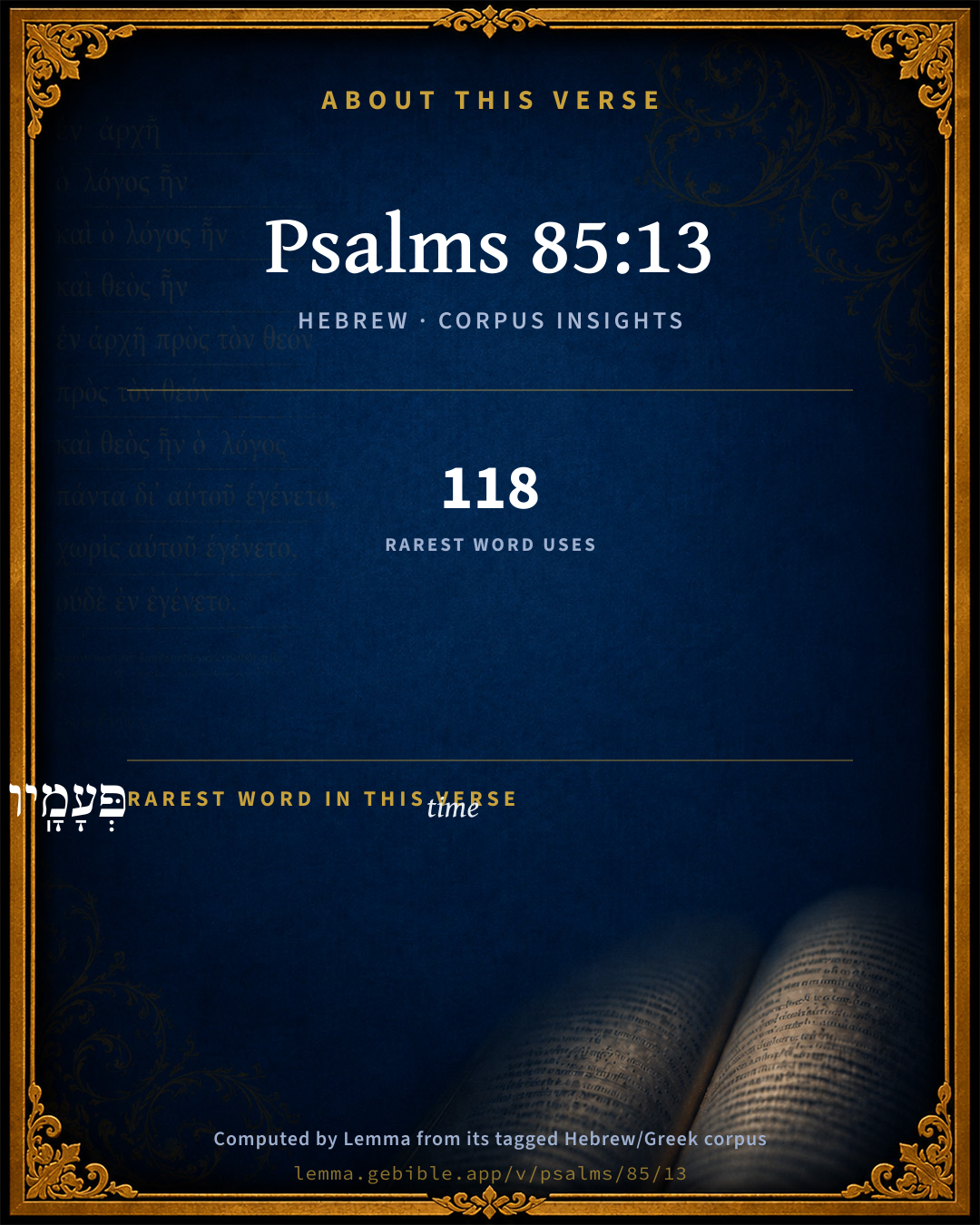
Psalms, in the Wisdom, opens this verse with 6 words (6 distinct Hebrew lemmas). Its most distinctive word is paʻam (“time”). A historical commentator’s framing appears above. Read the whole chapter for the surrounding context.

Discussion questions

  1. The word paʻam carries the sense “time.” How does it shape the verse?
  2. How does Psalms 89:14, which shares this passage’s theme, read alongside this verse?
  3. The translations on this page render this verse differently — a whole-verse word diff, not a word-by-word alignment. What might account for the different wordings?
  4. «יְהַלֵּ֑ךְ» is a Piel Imperfect verb. How does that grammatical form shape the action described?
  5. Compare how Adam Clarke's Commentary and Trapp's Complete Commentary read this verse. Where do they agree or differ?

Things to notice

Reading settings

Reading text

Shown beneath each verse's original-language words.

Old Testament
Old Testament edition

Read the OT as the Masoretic Hebrew (MT) or the Greek Septuagint (LXX).

English shown for the Greek Septuagint (in the Hebrew ↔ Greek comparison).

Comparing translations? Open the Compare panel on any verse page to stack up to four side by side.