
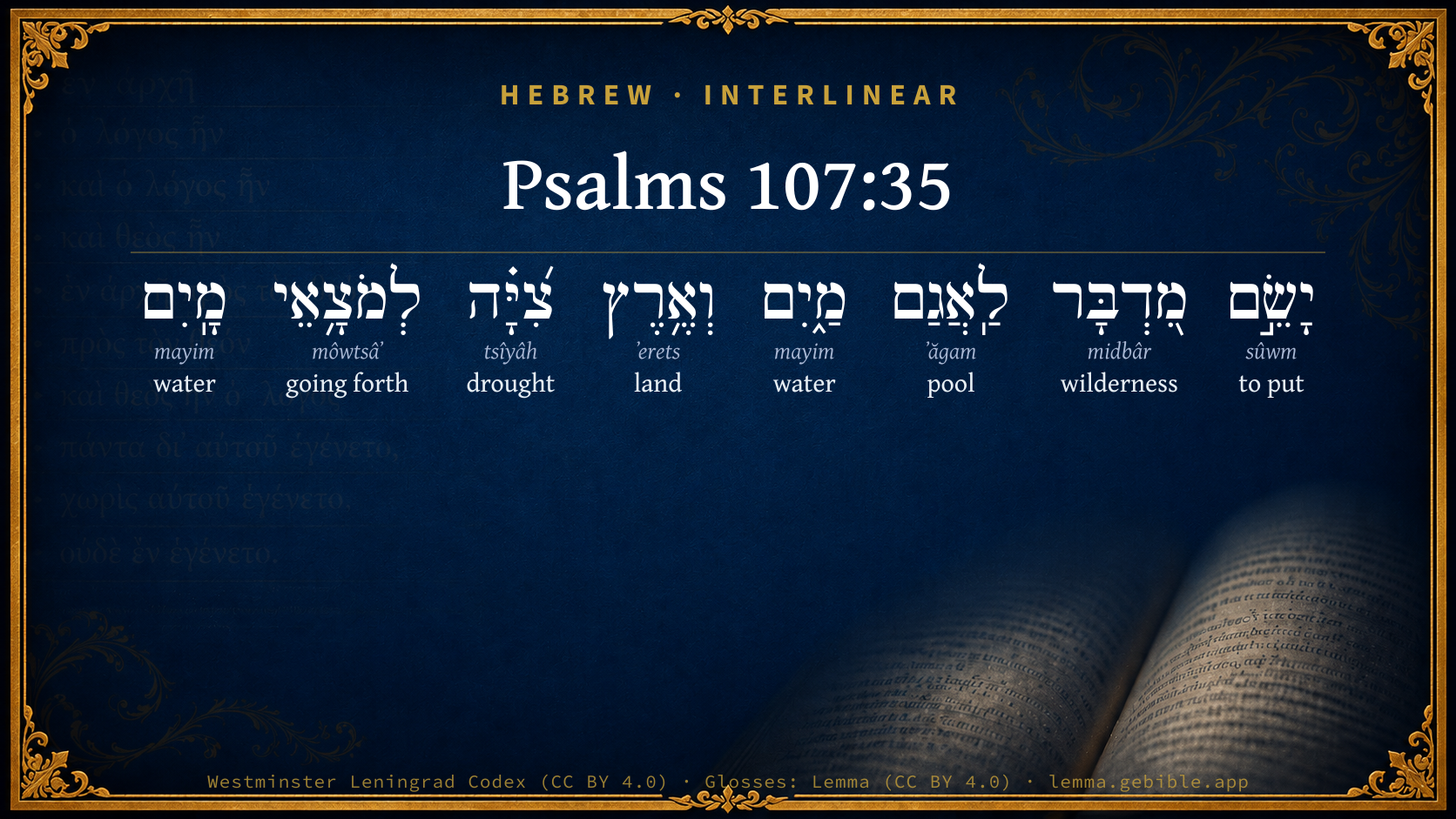
Psalms 107:35

Hebrew (Westminster Leningrad Codex) Psalms 107:35 appears in the Hebrew Old Testament. The text above is from the Westminster Leningrad Codex. Each word links to its Strong’s number, a concise gloss, and parsing drawn from the Open Scriptures Hebrew Bible morphology. Click any word for its full Brown-Driver-Briggs (BDB) entry.
Download image
Cite this verse

Psalms 107:35 (World English Bible). Public Domain. Lemma interlinear Bible study tool, https://lemma.gebible.app/v/psalms/107/35.

Show BibTeX & RIS
BibTeX
RIS
English Translation
He turns a desert into a pool of water, And a dry land into water springs.
World English Bible · Public Domain
Download a study sheet

One document with this verse’s original text, its word-by-word gloss line, the meaning frame, cross-references with their text, attributed commentary, and full source and license credits — printable, and it pastes into notes with its structure intact.

This verse Autodidact and up

Study sheet (.html) Plain text (.txt)

A passage Seminary Student

Up to 50 verses in one chapter. A passage sheet keeps up to 6 commentary sources and 12 cross-references per verse, in the order this page ranks them, and says so on the sheet whenever that leaves anything out. Ask for a single verse and you get the Autodidact verse sheet above.

Everything on this page stays free to read, with no account — the sheet is a download of what is already on screen, not access to it.

Want to remove ads? Support Godless Engineer
Compare translations 3

The same verse in 3 English versions, stacked beneath the original-language interlinear above. Click any original word for its lexicon entry.

Each is an independent rendering of the whole verse — the interlinear is not word-aligned to these translations.

Highlighted words mark where these versions differ — a whole-verse word diff, not a word-by-word alignment.

  • World English Bible Public Domain
    He turns a desert into a pool of water, And a dry land into water springs.
  • King James Version Public Domain
    He turneth the wilderness into a standing water, and dry ground into watersprings.
  • unfoldingWord Literal Text CC BY-SA 4.0
    He turns the wilderness into a pool of water and dry land into springs of water.

unfoldingWord Literal Text — © unfoldingWord, licensed CC BY-SA 4.0. Word-aligned USFM3 via Door43 (git.door43.org/unfoldingWord/en_ult).

Versions to compare (up to 4)

3 of 4 selected

Show all 18 translations

Every available English version of this verse, each an independent rendering of the whole verse.

  • World English Bible Public Domain
    He turns a desert into a pool of water, And a dry land into water springs.
  • Berean Standard Bible Public Domain
    He turns a desert into pools of water and a dry land into flowing springs.
  • Majority Standard Bible Public Domain
    He turns a desert into pools of water and a dry land into flowing springs.
  • King James Version Public Domain
    He turneth the wilderness into a standing water, and dry ground into watersprings.
  • American Standard Version (1901) Public Domain
    He turneth a wilderness into a pool of water, And a dry land into watersprings.
  • Revised Version (1885) Public Domain
    He turneth a wilderness into a pool of water, and a dry land into watersprings.
  • Geneva Bible (1599) Public Domain
    Againe hee turneth the wildernesse into pooles of water, and the drie lande into water springs.
  • Douay-Rheims (1899) Public Domain
    He hath turned a wilderness into pools of water, and a dry land into water springs.
  • Young's Literal Translation Public Domain
    He maketh a wilderness become a pool of water, And a dry land become fountains of waters.
  • Literal Standard Version CC BY-SA 4.0
    He makes a wilderness become a pool of water, || And a dry land become fountains of waters.
  • Unlocked Literal Bible CC BY-SA 4.0
    He turns the wilderness into a pool of water and dry land into springs of water.
  • unfoldingWord Literal Text CC BY-SA 4.0
    He turns the wilderness into a pool of water and dry land into springs of water.
  • Darby Bible Public Domain
    He maketh the wilderness into a pool of water, and the dry land into water-springs;
  • World Messianic Bible Public Domain
    He turns a desert into a pool of water, and a dry land into water springs.
  • Webster's Bible Public Domain
    He turneth the wilderness into a standing water, and dry ground into water-springs.
  • Free Bible Version CC BY-SA 4.0
    But he also turns around and makes pools of water in the desert, and makes water springs flow in a dry and dusty land.
  • Bible in Basic English Public Domain
    He makes a waste land into a place of water, and a dry land into water-springs.
  • JPS Tanakh (1917) Public Domain
    He turneth a wilderness into a pool of water, and a dry land into watersprings.

Literal Standard Version (2020), Covenant Press — licensed CC BY-SA 4.0. Text via the HelloAO Bible API (eBible.org). Unlocked Literal Bible (unfoldingWord) — licensed CC BY-SA 4.0. Text via the HelloAO Bible API (eBible.org). unfoldingWord Literal Text — © unfoldingWord, licensed CC BY-SA 4.0. Word-aligned USFM3 via Door43 (git.door43.org/unfoldingWord/en_ult). Free Bible Version, Dr. Jonathan Gallagher — licensed CC BY-SA 4.0. Text via the HelloAO Bible API (eBible.org).

Word by word

More ways to search: Search by grammar → Find every occurrence → Compare this word →

Practice this passage: Drill this verse → Learn its vocabulary →

About this verse

These counts appear in no published source. They are computed here, from the morphology-tagged text and Lemma’s own curated glosses. What Lemma adds →

8
words
7
distinct lemmas
Wisdom
section

Notable vocabulary

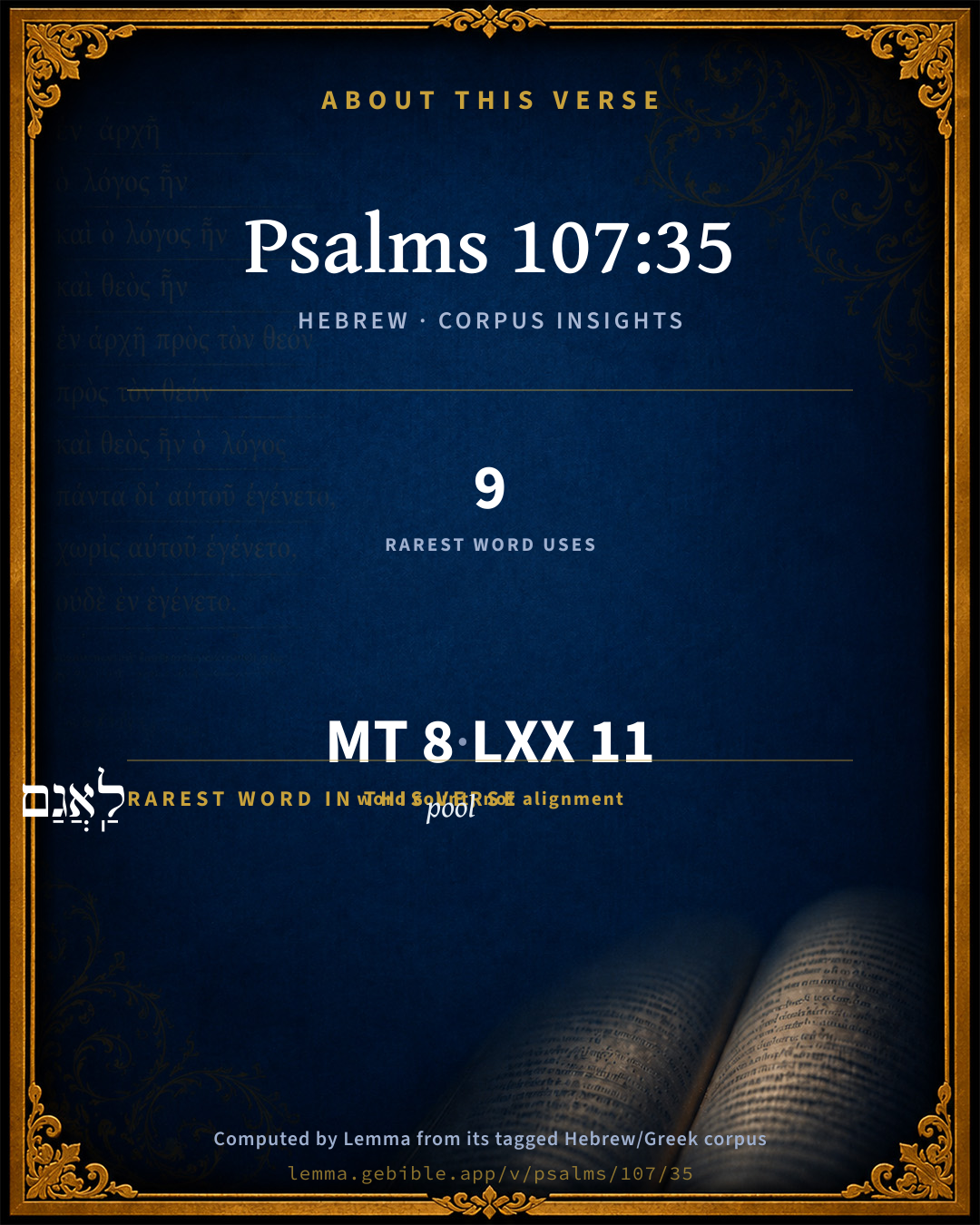
The rarest word here is לַֽאֲגַם pool H98 — appearing just 9 times in the whole Hebrew Bible.

Shared distinctive vocabulary

לַֽאֲגַם pool H98 occurs in 9 verses of the Hebrew Bible. Also found in:

Grammatical profile

  • 1 verb
  • 7 nouns

Verb forms

  • יָשֵׂ֣ם Qal · Imperfect

Repetition

A word recurs within this verse — often emphatic in Hebrew:

  • מַ֑יִם water H4325 ×2

Hebrew & Septuagint length

In English translation the verse runs 16 words from the Hebrew and 16 from the Septuagint (LXX English) — the same length.

A rough comparison of the two English renderings, which tokenize alike — not a word-level alignment.

Word counts can differ between the Hebrew and the Greek without any difference in meaning — e.g. the Hebrew direct-object marker אֵת has no separate Greek word, and Greek often adds the article ὁ.

In the original languages it is 8 Hebrew tokens and 11 Greek tokens — but the two are counted differently (Hebrew bundles its prefixes and suffixes into one token; the Greek is in lemma form), so that isn’t a like-for-like length.

Cross-references

7

Topical passages linked to Psalms 107:35 in the Treasury of Scripture Knowledge — connected by theme and wording, ordered by reader-vote popularity; previews shown in the World English Bible.

  • Psalms 114:8 Who turned the rock into a pool of water, The flint into a spring of waters.
  • Isaiah 35:6–7 Then shall the lame man leap as a hart, and the tongue of the mute shall sing; for in the wilderness shall waters break out, and streams in the desert.
  • Isaiah 41:17–19 The poor and needy seek water, and there is none, and their tongue fails for thirst; I, Yahweh, will answer them, I, the God of Israel, will not forsake them.
  • Isaiah 44:3–5 For I will pour water on him who is thirsty, and streams on the dry ground; I will pour my Spirit on your seed, and my blessing on your offspring:
  • 2 Kings 3:16–20 He said, Thus says Yahweh, Make this valley full of trenches.
  • Numbers 21:16–18 From there they traveled to Beer: that is the well of which Yahweh said to Moses, Gather the people together, and I will give them water.
  • Ezekiel 47:6–12 He said to me, Son of man, have you seen [this]? Then he brought me, and caused me to return to the bank of the river.

Cross-references courtesy of OpenBible.info (CC BY 4.0).

Hebrew and Greek witnesses Masoretic Hebrew ↔ Greek Septuagint

The same verse in the two great witnesses to the Old Testament, shown verse-for-verse.

You’re reading Greek Psalm 106 (Hebrew Psalm 107). The Septuagint counts the superscription, so verse numbers can differ from the Hebrew — chapter-level alignment, not verse-by-verse. Numbering follows Rahlfs.

These are two independent witnesses, not word-aligned to each other, and the Septuagint is shown in lemma (dictionary) form.

Hebrew Psalms 107:35 Masoretic · Westminster Leningrad Codex

יָשֵׂ֣ם מִ֭דְבָּר לַֽאֲגַם מַ֑יִם וְאֶ֥רֶץ צִ֝יָּ֗ה לְמֹצָ֥אֵי מָֽיִם

He turns a desert into a pool of water, And a dry land into water springs.

World English Bible · Public Domain

Greek LXX Greek Psalm 106:35 Septuagint · lemma form

τίθημι ἔρημος εἰς λίμνη ὕδωρ καί γῆ ἄνυδρος εἰς διέξοδος ὕδωρ

He turns a wilderness into pools of water, and a dry land into streams of water.

LXX2012 (modern English Septuagint) · Public Domain

Hebrew: Westminster Leningrad Codex (CC BY 4.0). Greek: Septuagint (public domain); English from LXX2012 (modern English Septuagint) (Public Domain). How the Septuagint differs from the Hebrew →

Commentary

Notes on Psalms 107:35 from classic Christian and Jewish commentators (each source and its license shown beneath its notes). The classic Christian expositions comment on the surrounding passage and are grouped to its opening verse, so a note may address several verses; the Jewish commentaries on the Tanakh (Rashi and others) are per-verse, so they appear only where the commentator wrote on this verse.

Lemma curates 59 commentaries, every one of them public domain or Creative Commons licensed, each selected and text-cleaned for this edition rather than reprinted as found. About our sources →

Trapp's Complete Commentary

John Trapp

Psa 107:35 He turneth the wilderness into a standing water, and dry ground into watersprings.

Ver. 35. He turneth the wilderness, &c.] Some places, again, God (to show his power and providence) of sterile maketh to become fertile; Polonia, for instance, and other northern countries. Germany and France were of old full of woods and lakes, as Caesar and Tacitus testify; now it is otherwise. So in America to this day. So various desert places of Egypt and Ethiopia, when once they became Christians, became fruitful.

John Trapp, A Commentary or Exposition upon All the Books of the Old and New Testament (1647–1656) — public domain. Text from a community e-Sword module.

J. A. Alexander on Psalms

Joseph Addison Alexander

35. (Psa 107:35) He turns a desert to a pool of water, and a dry land into springs of water. This is the reverse of the description in Psa 107:33, to which the terms are studiously conformed. In both cases the first verb literally means he sets or puts, and the noun translated springs means issues or places where the waters issue. Compare Isa 35:7; Isa 41:18; Isa 43:20.

Joseph Addison Alexander, The Psalms Translated and Explained (1850) — public domain. Text from a community e-Sword module.

Geneva Bible (1599)

Geneva Bible translators

For the love that he beareth to his Church, he changeth the order of nature for their commodity.

Geneva Bible (1599) marginal notes — public domain. Text via Bolls.life.

John Calvin's Commentaries

35. He turneth the desert into a pool of water This change, in contrast with the former, places the miraculous power of God in a more luminous position. Because, were the fields ceasing to be so productive as in former times, men of the world, as was common of old, would attribute this to the frequent crops which exhausted their productive power. But whence is it that parched grounds become so fruitful, that one would almost say that the atmosphere, as well as the nature of the soil, had undergone a change, unless it be that God hath there put forth a wonderful display of his power and goodness? Wherefore, the prophet very justly says, that the deserts were turned into pools of water, so that populous cities may rise up in waste and uncultivated places, where once there was not a single cottage. For it is as improbable that the nature of the soil is changed, as that the course of the sun and stars is changed. The clause, the hungry are filled, may mean, either that they themselves, after considerable privations, have got what may supply their need, or that those poor persons, living in a country where they cannot longer find daily bread, being constrained to leave it, and to seek a new place of abode, are there bountifully supplied by God. I am rather disposed to think, that this clause refers to what frequently occurs, namely, that the famishing, whose wants the world refuses to supply, and who are expatriated, are comfortably accommodated in these desert places, where God blesses them with abundance. The passage which I have translated, fruit of the increase, is, by not a few Hebrew expositors, considered as a repetition of two synonymous terms, and are for supplying a copulative conjunction, making it, fruit and increase But it was rather the intention of the prophet to refer to fruit yielded annually; as if he said, the fertility of these regions is not temporary, or only for a few years, it is perennial. For תבואות, tebuaoth, is the term which, in the Hebrew, denotes full-grown fruit annually produced by the earth. And when he says, that the new settlers sow and plant, he gives us to understand, that, prior to their arrival, cultivation was unknown in these places, and, consequently, in becoming so unusually fertile, they assumed a totally different aspect. And, in fine, he adds, that it was entirely owing to the Divine blessing that those who were once oppressed with poverty and want are now daily increasing in the good things of this life.

John Calvin's Commentaries (1540-1563) — public domain. Text from the Calvin Translation Society English edition (1840s-50s) via the Christian Classics Ethereal Library (ccel.org). Calvin's coverage is partial (roughly two-thirds of the Bible); uncommented books and verses are honest gaps, never fabricated. The 19th-century editor's footnotes and remarks are omitted so the notes are faithfully Calvin's own voice.

Ellicott's Commentary for English Readers

(35) Standing water.—Or, a pool of water. (See Isa_35:7; Isa_41:18-19; Isa_42:15.)

The dependence of this psalm on these passages in Isaiah is indubitable. But the images are employed in a different manner. The prophet only thinks of the joy of returning Israel (Psa_107:39-41). But here the thought is that in the reverses of fortune, which even the chosen nation must be prepared for, God will intervene to protect and save. But the construction is very awkward, owing to the mode in which, in Psa_107:40, two clauses from Job_12:21; Job_12:24 are introduced.

A Bible Commentary for English Readers, edited by Charles John Ellicott (1878–1897) — public domain. Text from a community e-Sword module.

The Cambridge Bible for Schools and Colleges

gen. ed. J. J. S. Perowne

35. He hath turned a wilderness into a pool of water, and a dry land into watersprings:

The Cambridge Bible for Schools and Colleges (gen. ed. J. J. S. Perowne; Cambridge University Press, 1878–1918) — public domain. Text from a community e-Sword module.

John Gill's Exposition

He blesseth them also, so that they are multiplied greatly,.... Not only their fields and vineyards are blessed with an increase, but these husbandmen themselves; as man at his first creation was bid to do, being blessed of God; and as the Israelites were in Egypt, Gen 1:28 and which may spiritually denote the great number of converts to Christian churches, especially in the latter day, Jer 30:19.

And suffereth not their cattle to decrease; their sheep and oxen, which is reckoned a great temporal happiness, Psa 144:13, and may signify that God does and will give a sufficient number of Gospel ministers, comparable to oxen for their laboriousness, that shall in all ages minister to his churches; see Co1 9:9.

John Gill's Exposition of the Whole Bible (1746–1763) — public domain (CC PDM 1.0). Text via the HelloAO Bible API.

Albert Barnes' Notes on the Bible

He turneth the wilderness into a standing water - A pool; a lake. See the notes at Isa 35:6-7.

And dry ground into water-springs - Not merely watering it with rain from heaven, but causing gushing fountains to break forth, and to flow continually, diffusing fertility and beauty everywhere.

Albert Barnes' Notes on the Bible (1834–1885) — public domain. Text from a community e-Sword/MySword module.

Matthew Poole's English Annotations

Into a standing water; into a well-watered and fruitful land.

Matthew Poole's English Annotations on the Holy Bible (1683–1685) — public domain. Text from a community e-Sword/MySword module.

The Treasury of David

Charles H. Spurgeon

Ver. 35. He turneth the wilderness into a standing water. With another turn of his hand he more than restores that which in judgment he took away. He does his work of mercy on a royal scale, for a deep lake is seen where before there was only a sandy waste. It is not by natural laws, working by some innate force, that this wonder is wrought, but by himselfHE TURNETH.

And dry ground into watersprings. Continuance, abundance, and perpetual freshness are all implied in watersprings, and these are created where all was dry. This wonder of mercy is the precise reversal of the deed of judgment, and wrought by the selfsame hand. Even thus in the church, and in each individual saint, the mercy of the Lord soon works wonderful changes where restoring and renewing grace begin their benign work. O that we might see this verse fulfilled in all around us, and within our own hearts: then would these words serve us for an exclamation of grateful astonishment, and a song of well deserved praise.

Ver. 35. Dry ground into watersprings. If God afflict, his justice findeth the cause of it in man; but if he do good to any man, it is of his own good pleasure, without any cause in man: therefore no reason is given here of this change, as was of the former, but simply, "He turneth dry ground into watersprings." David Dickson.

Ver. 35. Hope for decayed churches lies in God; he can work a marvellous change, he does do it"turneth": he will do it when the cause of barrenness is removed by repentance.

Ver. 35-38. Here the scene again changes. The springs again gush forth, calm lakes again repose in the midst of foliage and flowers, the hills are clothed with luxuriant vines, and the fields are covered with corn; plenty abounds both in town and country, and men and cattle increase. This picture, too, has its counterpart in experimental godliness. "Instead of the thorn shall come up", etc., "The wilderness and the solitary place shall be glad for them", etc. The one scene precedes prayer, the other follows it. A desolate wilderness before, the garden of Eden behind. G.R.

Psalms 107:36*

Charles H. Spurgeon's The Treasury of David (1869–1885) — public domain. Psalms only. Text from a community e-Sword/MySword module.

The Pulpit Commentary

He turneth the wilderness into a standing water; rather, a wilderness. (comp. Isa_35:7 Isa_41:18) And dry ground into water springs. The entire verse is antithetical to ver. 33.

The Pulpit Commentary (1880–1919), ed. H.D.M. Spence-Jones & Joseph S. Exell — public domain. Text from a community e-Sword module.

John Wesley's Explanatory Notes

Water - Into a well-watered and fruitful land.

John Wesley, Explanatory Notes Upon the Whole Bible (1754–1765) — public domain. Text via the GEBible commentary corpus.

Rashi

Rabbi Shlomo Yitzchaki (Rashi)

He makes a desert into a pool of water He makes a ruined settlement into a building and restores it to its original state.

Rashi on the Tanakh — English translations: “The Judaica Press complete Tanach with Rashi, translated by A. J. Rosenberg” (CC BY 4.0); “Pentateuch with Rashi's commentary by M. Rosenbaum and A.M. Silbermann, 1929-1934” (public domain); “The Metsudah Tanach series, Lakewood, N.J” (CC BY 4.0); and “The Book of Joshua, Metsudah Publications, 1997” (CC BY 4.0). Text via Sefaria.

Lesson kit

Teaching starters — assembled from the data on this page, not authored interpretation. Every prompt links to the verse data it draws on. Edit before teaching.

Psalms, in the Wisdom, opens this verse with 8 words (7 distinct Hebrew lemmas). Its most distinctive word is ʼăgam (“pool”). A historical commentator’s framing appears above. Read the whole chapter for the surrounding context.

Discussion questions

  1. How does “pool” (ʼăgam) shape what this verse is saying?
  2. Exodus 7:19 shares the word «pool» with this verse. How do the two illuminate each other?
  3. “water” occurs 2× in this one verse. What is the effect of the repetition?
  4. These translations render this verse differently; the difference is in the English rendering, not the original. What questions does that raise?
  5. The verb «יָשֵׂ֣ם» is Qal Imperfect. How does its form color the action?
  6. Reading how Trapp's Complete Commentary and J. A. Alexander on Psalms read this verse, where do the two commentators agree and where do they part?

Things to notice

Reading settings

Reading text

Shown beneath each verse's original-language words.

Old Testament
Old Testament edition

Read the OT as the Masoretic Hebrew (MT) or the Greek Septuagint (LXX).

English shown for the Greek Septuagint (in the Hebrew ↔ Greek comparison).

Comparing translations? Open the Compare panel on any verse page to stack up to four side by side.