
Exodus 17:12

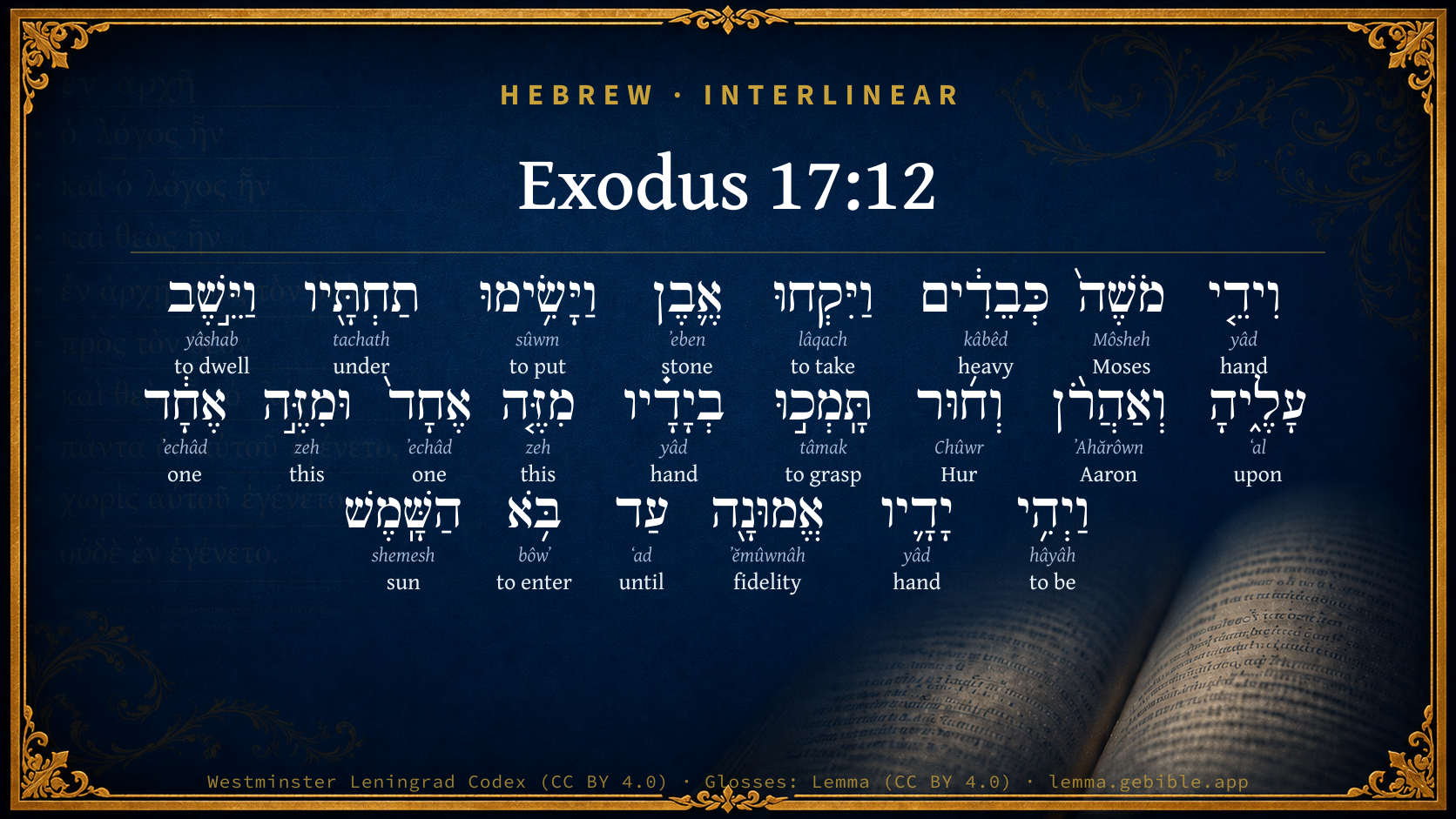
Hebrew (Westminster Leningrad Codex) Exodus 17:12 appears in the Hebrew Old Testament. The text above is from the Westminster Leningrad Codex. Each word links to its Strong’s number, a concise gloss, and parsing drawn from the Open Scriptures Hebrew Bible morphology. Click any word for its full Brown-Driver-Briggs (BDB) entry.
Download image
Cite this verse

Exodus 17:12 (World English Bible). Public Domain. Lemma interlinear Bible study tool, https://lemma.gebible.app/v/exodus/17/12.

Show BibTeX & RIS
BibTeX
RIS
English Translation
But Moses' hands were heavy; and they took a stone, and put it under him, and he sat on it. Aaron and Hur held up his hands, the one on the one side, and the other on the other side. His hands were steady until sunset.
World English Bible · Public Domain
Highlights
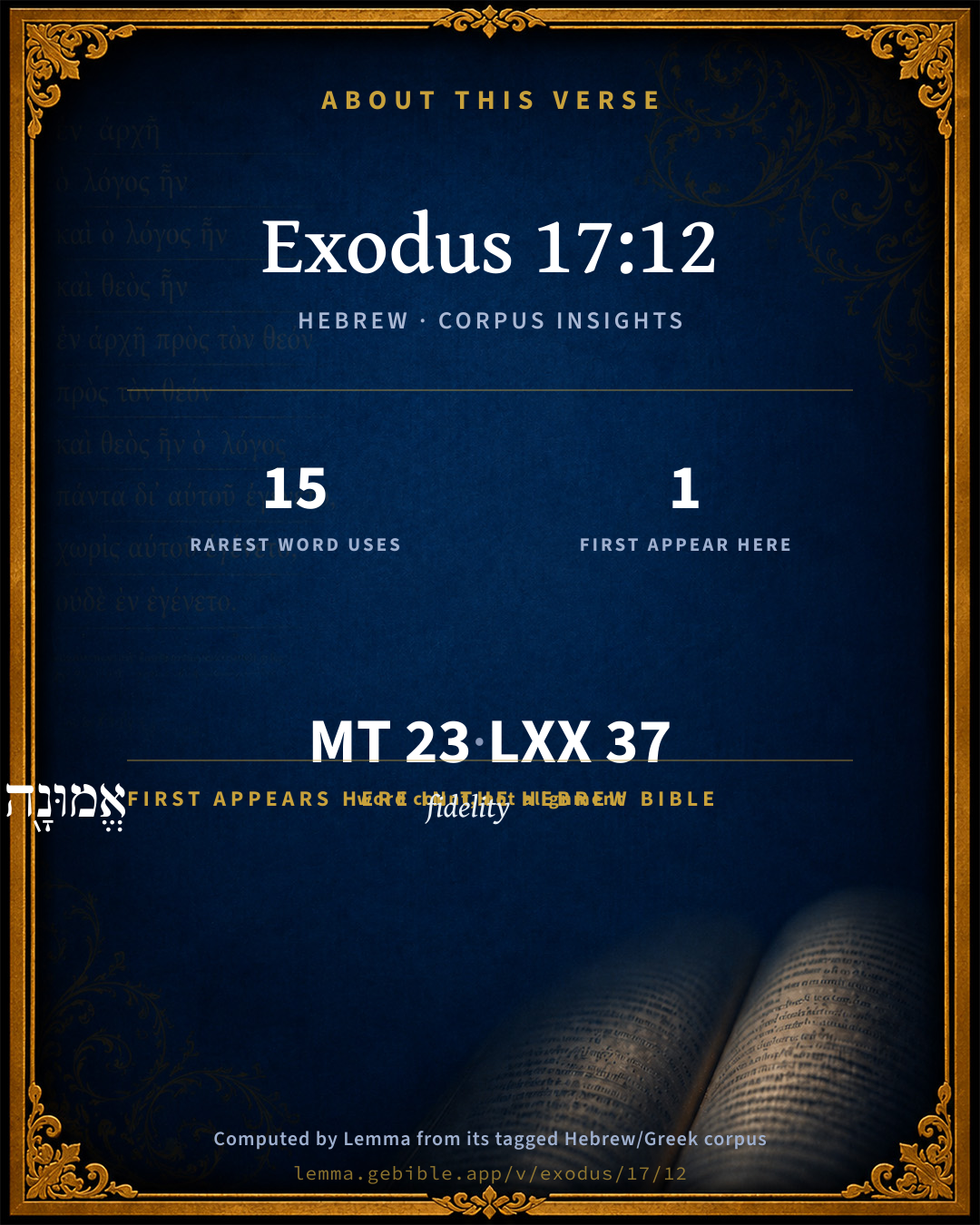
  • 1 first appearance in the Hebrew Bible
Full analysis ↓
Download a study sheet

One document with this verse’s original text, its word-by-word gloss line, the meaning frame, cross-references with their text, attributed commentary, and full source and license credits — printable, and it pastes into notes with its structure intact.

This verse Autodidact and up

Study sheet (.html) Plain text (.txt)

A passage Seminary Student

Up to 50 verses in one chapter. A passage sheet keeps up to 6 commentary sources and 12 cross-references per verse, in the order this page ranks them, and says so on the sheet whenever that leaves anything out. Ask for a single verse and you get the Autodidact verse sheet above.

Everything on this page stays free to read, with no account — the sheet is a download of what is already on screen, not access to it.

Want to remove ads? Support Godless Engineer
Compare translations 3

The same verse in 3 English versions, stacked beneath the original-language interlinear above. Click any original word for its lexicon entry.

Each is an independent rendering of the whole verse — the interlinear is not word-aligned to these translations.

Highlighted words mark where these versions differ — a whole-verse word diff, not a word-by-word alignment.

  • World English Bible Public Domain
    But Moses' hands were heavy; and they took a stone, and put it under him, and he sat on it. Aaron and Hur held up his hands, the one on the one side, and the other on the other side. His hands were steady until sunset.
  • King James Version Public Domain
    But Moses hands were heavy; and they took a stone, and put it under him, and he sat thereon; and Aaron and Hur stayed up his hands, the one on the one side, and the other on the other side; and his hands were steady until the going down of the sun.
  • unfoldingWord Literal Text CC BY-SA 4.0
    And the hands of Moses became heavy. And they took a stone and put it under him, and he sat on it, and Aaron and Hur held his hands up, one from this, and one from that. And so his hands were steady until the sun went down.

unfoldingWord Literal Text — © unfoldingWord, licensed CC BY-SA 4.0. Word-aligned USFM3 via Door43 (git.door43.org/unfoldingWord/en_ult).

Versions to compare (up to 4)

3 of 4 selected

Show all 18 translations

Every available English version of this verse, each an independent rendering of the whole verse.

  • World English Bible Public Domain
    But Moses' hands were heavy; and they took a stone, and put it under him, and he sat on it. Aaron and Hur held up his hands, the one on the one side, and the other on the other side. His hands were steady until sunset.
  • Berean Standard Bible Public Domain
    When Moses’ hands grew heavy, they took a stone and put it under him, and he sat on it. Then Aaron and Hur held his hands up, one on each side, so that his hands remained steady until the sun went down.
  • Majority Standard Bible Public Domain
    When Moses’ hands grew heavy, they took a stone and put it under him, and he sat on it. Then Aaron and Hur held his hands up, one on each side, so that his hands remained steady until the sun went down.
  • King James Version Public Domain
    But Moses hands were heavy; and they took a stone, and put it under him, and he sat thereon; and Aaron and Hur stayed up his hands, the one on the one side, and the other on the other side; and his hands were steady until the going down of the sun.
  • American Standard Version (1901) Public Domain
    But Moses' hands were heavy; and they took a stone, and put it under him, and he sat thereon; and Aaron and Hur stayed up his hands, the one on the one side, and the other on the other side; And his hands were steady until the going down of the sun.
  • Revised Version (1885) Public Domain
    But Moses’ hands were heavy; and they took a stone, and put it under him, and he sat thereon; and Aaron and Hur stayed up his hands, the one on the one side, and the other on the other side; and his hands were steady until the going down of the sun.
  • Geneva Bible (1599) Public Domain
    Nowe Moses handes were heauy: therefore they tooke a stone and put it vnder him, and hee sate vpon it: and Aaron and Hur stayed vp his hands, the one on the one side, and the other on the other side: so his hands were steady vntill the going downe of the sunne.
  • Douay-Rheims (1899) Public Domain
    And Moses' hands were heavy: so they took a stone, and put under him, and he sat on it: and Aaron and Hur stayed up his hands on both sides. And it came to pass that his hands were not weary until sunset.
  • Young's Literal Translation Public Domain
    And the hands of Moses `are' heavy, and they take a stone, and set `it' under him, and he sitteth on it: and Aaron and Hur have taken hold on his hands, on this side one, and on that one, and his hands are stedfast till the going in of the sun;
  • Literal Standard Version CC BY-SA 4.0
    And the hands of Moses [are] heavy, and they take a stone and set [it] under him, and he sits on it, and Aaron and Hur have taken hold on his hands, one on this [side] and one on that [side]; and his hands are steadfast until the going in of the sun;
  • Unlocked Literal Bible CC BY-SA 4.0
    When Moses' hands became heavy, Aaron and Hur took a stone and put it under him for him to sit on. At the same time, Aaron and Hur held his hands up, one person on one side of him, and the other person on the other side. So Moses' hands were held steady until the sun went down.
  • unfoldingWord Literal Text CC BY-SA 4.0
    And the hands of Moses became heavy. And they took a stone and put it under him, and he sat on it, and Aaron and Hur held his hands up, one from this, and one from that. And so his hands were steady until the sun went down.
  • Darby Bible Public Domain
    And Moses' hands were heavy; then they took a stone, and put [it] under him, and he sat on it; and Aaron and Hur supported his hands, one on this side, and one on that side; and his hands were steady until the going down of the sun.
  • World Messianic Bible Public Domain
    But Moses’ hands were heavy; so they took a stone, and put it under him, and he sat on it. Aaron and Hur held up his hands, the one on the one side, and the other on the other side. His hands were steady until sunset.
  • Webster's Bible Public Domain
    But Moses's hands were heavy; and they took a stone, and put it under him, and he sat upon it: and Aaron and Hur supported his hands, the one on the one side, and the other on the other side; and his hands were steady until the going down of the sun.
  • Free Bible Version CC BY-SA 4.0
    So when Moses' hands became heavy, the others took a stone and put it under him for him to sit on. Aaron and Hur stood on each side of Moses and held his hands up. In this way his hands were kept firmly up until the sun went down.
  • Bible in Basic English Public Domain
    But Moses' hands became tired; so they put a stone under him and he took his seat on it, Aaron and Hur supporting his hands, one on one side and one on the other; so his hands were kept up without falling till the sun went down.
  • JPS Tanakh (1917) Public Domain
    But Moses' hands were heavy; and they took a stone, and put it under him, and he sat thereon; and Aaron and Hur stayed up his hands, the one on the one side, and the other on the other side; and his hands were steady until the going down of the sun.

Literal Standard Version (2020), Covenant Press — licensed CC BY-SA 4.0. Text via the HelloAO Bible API (eBible.org). Unlocked Literal Bible (unfoldingWord) — licensed CC BY-SA 4.0. Text via the HelloAO Bible API (eBible.org). unfoldingWord Literal Text — © unfoldingWord, licensed CC BY-SA 4.0. Word-aligned USFM3 via Door43 (git.door43.org/unfoldingWord/en_ult). Free Bible Version, Dr. Jonathan Gallagher — licensed CC BY-SA 4.0. Text via the HelloAO Bible API (eBible.org).

Word by word

More ways to search: Search by grammar → Find every occurrence → Compare this word →

Practice this passage: Drill this verse → Learn its vocabulary →

וְח֜וּר
Chûwr
H2354
“and · Hur”
Conjunction + Noun, Proper
Part of Speech
Conjunction + Noun
Type
Proper
Full BDB Definition

Origin: the same as H2353 or H2352

TWOT: None

Hur = "hole" - a chief assistant to Moses and Aaron - grandfather of Bezaleel, the chief artificer of the tabernacle; possibly the same as 1 above - the 4th of the 5 kings of Midian who were slain with Balaam after Peor - father of Rephaiah in the time of Nehemiah - father of Ben-Hur who was commissariat officer for Solomon in Mount Ephraim
  1. וִידֵ֤י yâd H3027 “and · hands of” Conjunction + Noun, Common, Both, Dual, Construct
  2. מֹשֶׁה֙ Môsheh H4872 “Moses” Noun, Proper
  3. כְּבֵדִ֔ים kâbêd H3515 “heavy” Adjective, Adjective, Masculine, Plural, Absolute
  4. וַיִּקְחוּ lâqach H3947 “and · to take” Conjunction + Verb, Qal, Sequential Imperfect, 3rd Person, Masculine, Plural
  5. אֶ֛בֶן ʼeben H68 “stone” Noun, Common, Feminine, Singular, Absolute
  6. וַיָּשִׂ֥ימוּ sûwm H7760 “and · to put” Conjunction + Verb, Qal, Sequential Imperfect, 3rd Person, Masculine, Plural
  7. תַחְתָּ֖יו tachath H8478 “under · him” Preposition + Suffix, Personal, 3rd Person, Masculine, Singular
  8. וַיֵּ֣שֶׁב yâshab H3427 “and · to dwell” Conjunction + Verb, Qal, Sequential Imperfect, 3rd Person, Masculine, Singular
  9. עָלֶ֑יהָ ʻal H5921 “upon · her” Preposition + Suffix, Personal, 3rd Person, Feminine, Singular
  10. וְאַהֲרֹ֨ן ʼAhărôwn H175 “and · Aaron” Conjunction + Noun, Proper
  11. תָּֽמְכ֣וּ tâmak H8551 “to grasp” Verb, Qal, Perfect, 3rd Person, Common, Plural
  12. בְיָדָ֗יו yâd H3027 “in/at · hands · his” Preposition + Noun, Common, Both, Dual, Construct + Suffix, Personal, 3rd Person, Masculine, Singular
  13. מִזֶּ֤ה zeh H2088 “from · this” Preposition + Pronoun, Demonstrative, Masculine, Singular
  14. אֶחָד֙ ʼechâd H259 “one” Adjective, Cardinal number, Masculine, Singular, Absolute
  15. וּמִזֶּ֣ה zeh H2088 “and · from · this” Conjunction + Preposition + Pronoun, Demonstrative, Masculine, Singular
  16. אֶחָ֔ד ʼechâd H259 “one” Adjective, Cardinal number, Masculine, Singular, Absolute
  17. וַיְהִ֥י hâyâh H1961 “and · to be” Conjunction + Verb, Qal, Sequential Imperfect, 3rd Person, Masculine, Singular
  18. יָדָ֛יו yâd H3027 “hands · his” Noun, Common, Both, Dual, Construct + Suffix, Personal, 3rd Person, Masculine, Singular
  19. אֱמוּנָ֖ה ʼĕmûwnâh H530 “fidelity” Noun, Common, Feminine, Singular, Absolute
  20. עַד ʻad H5704 “until” Preposition
  21. בֹּ֥א bôwʼ H935 “to enter” Verb, Qal, Infinitive Construct
  22. הַשָּֽׁמֶשׁ shemesh H8121 “the · sun” Particle, Definite Article + Noun, Common, Both, Singular, Absolute

About this verse

These counts appear in no published source. They are computed here, from the morphology-tagged text and Lemma’s own curated glosses. What Lemma adds →

23
words
19
distinct lemmas
Pentateuch
section

Notable vocabulary

The rarest word here is וְח֜וּר Hur H2354 — appearing just 15 times in the whole Hebrew Bible.

First appearance in Scripture

This word makes its first canonical appearance in the Hebrew Bible here:

  • אֱמוּנָ֖ה fidelity H530

Shared distinctive vocabulary

וְח֜וּר Hur H2354 occurs in 15 verses of the Hebrew Bible. Also found in:

Grammatical profile

  • 6 verbs
  • 9 nouns
  • 3 adjectives
  • 2 pronouns
  • 3 prepositions

Verb forms

  • וַיִּקְחוּ Qal · Sequential Imperfect
  • וַיָּשִׂ֥ימוּ Qal · Sequential Imperfect
  • וַיֵּ֣שֶׁב Qal · Sequential Imperfect
  • תָּֽמְכ֣וּ Qal · Perfect
  • וַיְהִ֥י Qal · Sequential Imperfect
  • בֹּ֥א Qal · Infinitive Construct

Repetition

Words recur within this verse — often emphatic in Hebrew:

  • וִידֵ֤י hand H3027 ×3
  • אֶחָד֙ one H259 ×2
  • מִזֶּ֤ה this H2088 ×2

Hebrew & Septuagint length

In English translation the verse runs 46 words from the Hebrew and 52 from the Septuagint (LXX English) — closely comparable.

A rough comparison of the two English renderings, which tokenize alike — not a word-level alignment.

Word counts can differ between the Hebrew and the Greek without any difference in meaning — e.g. the Hebrew direct-object marker אֵת has no separate Greek word, and Greek often adds the article ὁ.

In the original languages it is 23 Hebrew tokens and 37 Greek tokens — but the two are counted differently (Hebrew bundles its prefixes and suffixes into one token; the Greek is in lemma form), so that isn’t a like-for-like length.

Cross-references

11

Topical passages linked to Exodus 17:12 in the Treasury of Scripture Knowledge — connected by theme and wording, ordered by reader-vote popularity; previews shown in the World English Bible.

  • Isaiah 35:3 Strengthen you the weak hands, and confirm the feeble knees.
  • Philippians 1:19 For I know that this will turn out to my salvation, through your supplication and the supply of the Spirit of Jesus Christ,
  • Hebrews 12:12 Therefore, lift up the hands that hang down and the feeble knees,
  • Mark 14:37–40 He came and found them sleeping, and said to Peter, "Simon, are you sleeping? Couldn't you watch one hour?
  • 2 Corinthians 1:11 you also helping together on our behalf by your supplication; that, for the gift bestowed on us by means of many, thanks may be given by many persons on your behalf.
  • Ephesians 6:18 with all prayer and requests, praying at all times in the Spirit, and being watchful to this end in all perseverance and requests for all the saints:
  • 1 Thessalonians 5:25 Brothers, pray for us.
  • Psalms 35:3 Brandish the spear and block those who pursue me. Tell my soul, "I am your salvation."
  • Matthew 26:40–45 He came to the disciples, and found them sleeping, and said to Peter, "What, couldn't you watch with me for one hour?
  • Colossians 4:2 Continue steadfastly in prayer, watching therein with thanksgiving;
  • James 1:6 But let him ask in faith, without any doubting, for he who doubts is like a wave of the sea, driven by the wind and tossed.

Cross-references courtesy of OpenBible.info (CC BY 4.0).

Hebrew and Greek witnesses Masoretic Hebrew ↔ Greek Septuagint

The same verse in the two great witnesses to the Old Testament, shown verse-for-verse.

These are two independent witnesses, not word-aligned to each other, and the Septuagint is shown in lemma (dictionary) form.

Hebrew Exodus 17:12 Masoretic · Westminster Leningrad Codex

וִידֵ֤י מֹשֶׁה֙ כְּבֵדִ֔ים וַיִּקְחוּ אֶ֛בֶן וַיָּשִׂ֥ימוּ תַחְתָּ֖יו וַיֵּ֣שֶׁב עָלֶ֑יהָ וְאַהֲרֹ֨ן וְח֜וּר תָּֽמְכ֣וּ בְיָדָ֗יו מִזֶּ֤ה אֶחָד֙ וּמִזֶּ֣ה אֶחָ֔ד וַיְהִ֥י יָדָ֛יו אֱמוּנָ֖ה עַד בֹּ֥א הַשָּֽׁמֶשׁ

But Moses' hands were heavy; and they took a stone, and put it under him, and he sat on it. Aaron and Hur held up his hands, the one on the one side, and the other on the other side. His hands were steady until sunset.

World English Bible · Public Domain

Greek LXX Exodus 17:12 Septuagint · lemma form

ὁ δέ χείρ μωυσῆς βαρύς καί λαμβάνω λίθος ὑποτίθημι ὑπό αὐτός καί καταἧμαι ἐπί αὐτός καί ααρων καί ωρ στηρίζω ὁ χείρ αὐτός ἐντεῦθεν εἷς καί ἐντεῦθεν εἷς καί γίγνομαι ὁ χείρ μωυσῆς στηρίζω ἕως δυσμή ἥλιος

But the hands of Moses were heavy, and they took a stone and put it under him, and he sat upon it; and Aaron and Or supported his hands one on this side and the other on that, and the hands of Moses were supported till the going down of the sun.

LXX2012 (modern English Septuagint) · Public Domain

Hebrew: Westminster Leningrad Codex (CC BY 4.0). Greek: Septuagint (public domain); English from LXX2012 (modern English Septuagint) (Public Domain). How the Septuagint differs from the Hebrew →

Targum (Aramaic paraphrase)

2

The Targum is the ancient Jewish Aramaic paraphrase of the Hebrew Scriptures — an interpretive translation, not the Hebrew text itself. Onkelos (literal) and Pseudo-Jonathan (expansive) render the Torah, and Jonathan the Prophets. Coverage is partial: where no permissively-licensed English translation exists for a verse, only the Aramaic is shown. This is verse-level text, not a word-by-word alignment to the Hebrew.

  1. Targum Onkelos Torah (Genesis–Deuteronomy)
    וִידֵי משֶׁה יְקָרָן וּנְסִיבוּ אַבְנָא וְשַׁוִיאוּ תְחוֹתוֹהִי וִיתֵב עֲלַהּ וְאַהֲרֹן וְחוּר סַעְדָן בִּידוֹהִי מִכָּא חַד וּמִכָּא חַד וַהֲוָה יְדוֹהִי פְּרִיסָן בִּצְלוֹ עַד דְעַל שִׁמְשָׁא:

    (no public-domain English translation for this verse)

    Targum Onkelos — Aramaic: “Onkelos Genesis” (public domain); “Onkelos Exodus” (public domain); “Onkelos Leviticus” (public domain); “Onkelos Numbers” (public domain); “Onkelos Deuteronomy” (public domain). English: “Sefaria Community Translation” (CC0 1.0 (public-domain dedication)); “J.W. Etheridge. The Targums of Onkelos and Jonathan Ben Uzziel on the Pentateuch. London: Longmans, Green, 1862” (public domain). Text via Sefaria.

  2. Targum Pseudo-Jonathan Torah (Genesis–Deuteronomy)
    וִידוֹי דְמשֶׁה הֲווֹ יַקְרִין מִן בִּגְלַל דְּעִכַּב קְרָבָא לִמְחַר וְלָא אִזְדְּרַז בְּיוֹמָא הַהוּא לְפוּרְקָנָא דְיִשְרָאֵל וְלָא הֲוָה יָכִיל לְמִיזְקַפְהוֹן בִּצְלוֹי וּמִן דַּהֲוָה צָבֵי לְסִגּוּפֵי נַפְשֵׁיהּ נְסִיבוּ אַבְנָא וְשַׁוִּיוּ תְּחוֹתוֹי וִיתֵיב עִילַוָּהּ וְאַהֲרן וְחוּר מְסַעֲדִין לִידוֹי מִיכָּא חָד וּמִכָּא חָד וְהַוָּאָה יְדוֹי פְּרִיסַן בְּהֵימְנוּתָא בִּצְלוֹ וְצוֹמָא עַד מִטְמוֹעַ שִׁמְשָׁא

    And the hands of Mosheh were heavy, because the conflict was prolonged till the morrow, and the deliverance of Israel was not prepared on that day; and he could not hold them up in prayer; on which account he would have afflicted his soul. And they took a stone, and placed it under him, and he sat upon it; and Aharon and Hur supported his hand, this the one, and that the other; and his hands were outstretched with firmness, (or, fidelity,) in prayer and fasting, until the going down of the sun.

    Targum Pseudo-Jonathan — Aramaic: “Targum Jonathan on Genesis” (public domain); “Targum Jonathan on Exodus” (public domain); “Targum Jonathan on Leviticus” (public domain); “Targum Jonathan on Numbers” (public domain); “Targum Jonathan on Deuteronomy” (public domain). English: “The Targum of Jonathan ben Uzziel, trans. J. W. Etheridge, London, 1862” (public domain). Text via Sefaria.

Commentary

Notes on Exodus 17:12 from classic Christian and Jewish commentators (each source and its license shown beneath its notes). The classic Christian expositions comment on the surrounding passage and are grouped to its opening verse, so a note may address several verses; the Jewish commentaries on the Tanakh (Rashi and others) are per-verse, so they appear only where the commentator wrote on this verse.

Lemma curates 59 commentaries, every one of them public domain or Creative Commons licensed, each selected and text-cleaned for this edition rather than reprinted as found. About our sources →

Trapp's Complete Commentary

John Trapp

Exo 17:12 But Moses’ hands [were] heavy; and they took a stone, and put [it] under him, and he sat thereon; and Aaron and Hur stayed up his hands, the one on the one side, and the other on the other side; and his hands were steady until the going down of the sun.

Ver. 12. But Moses’s hands were heavy.] It is a praise proper to God, that "his hand is stretched out still": as for men, even the best, though "the spirit" in them be "willing, yet the flesh is weak," {Mat 26:41} and will not suffer any long intention.

And Aaron and Hur stayed up his hands.] Neither did they only raise up their hands, but their minds with his. There are that here observe, that upon the fortieth day after their coming out of Egypt, Moses, Aaron, and Hur went up into the mount, where Moses’s hands are thus supported, while Amalek is discomfited; and that Moses the prophet, Hur the prince, and Aaron the priest, all put together, were a type of Christ; who on the fortieth day after his resurrection ascended into the mount of heaven; where, as our prophet, priest, and prince, he holds up the hands of his intercession for his Church militant, while she fights with spiritual Amalelk, sin, Satan, Antichrist, world, flesh, &c.

John Trapp, A Commentary or Exposition upon All the Books of the Old and New Testament (1647–1656) — public domain. Text from a community e-Sword module.

Ellicott's Commentary for English Readers

(12) Moses’ hands were heavy.—Moses writes with a clear remembrance of his feelings at the time. His hands, long stretched to heaven, grew weary, “heavy,” feeble; he could no longer raise them up, much less stretch them out, by his own muscular energy. They sank down, and dropped by his sides. If the battle was not to be lost, it was necessary to find some remedy. Apparently, Aaron and Hur bethought themselves of an effective remedy, none being suggested by Moses.

They took a stone.—Partly to give him a certain amount of rest, but, perhaps, mainly to enable them the better to sustain his hands. The fact is one of those “little” ones, which none but one engaged in the transactions would have been likely to have been acquainted with. (See “Introduction,” § 5)

Aaron and Hur stayed up his hands.—Left to himself, Moses had become exhausted both mentally and bodily, and when his hands dropped, had ceased to pray. Sustained physically by his two companions, his mind recovered itself, and was able to renew its supplications and continue them. The result was the victory.

A Bible Commentary for English Readers, edited by Charles John Ellicott (1878–1897) — public domain. Text from a community e-Sword module.

The Cambridge Bible for Schools and Colleges

gen. ed. J. J. S. Perowne

12. steady] Heb. steadiness (G.-K. § 141d); elsewhere always in a moral sense, steadfastness, faithfulness. See the writer’s note on Hab_2:4 in the Century Bible.

The Cambridge Bible for Schools and Colleges (gen. ed. J. J. S. Perowne; Cambridge University Press, 1878–1918) — public domain. Text from a community e-Sword module.

John Gill's Exposition

But Moses's hands were heavy,.... And hung down through weariness, holding up the rod first in one hand, and then in another, for so long a time; and thus sometimes, through infirmity, the best of men grow remiss in prayer, their hands are weak and hang flown through the corruptions of their hearts, the power of unbelief, the temptations of Satan, and want of immediate answers of prayer, or through long delays of it, and then the enemy gets an advantage over them:

and they took a stone, and put it under him, and he sat thereon; so that it seems not only that his hands were heavy, but he could not well stand on his feet any longer, being a corpulent man as well as in years, as Ben Gersom suggests; and therefore Aaron and Hur took a stone that lay on the mount for him to sit upon, where he might be raised as high, and be as well seen, as standing: this stone may be an emblem of Christ the stone of Israel, the foundation of his people, their prop and support, which sustains and upholds them, their Ebenezer, or stone of help in all their times of difficulty and distress:

and Aaron and Hur stayed up his hands, the one on the one side, and the other on the other side; the one was on his right, and the other on his left; and when the rod was in his right hand, he that was on that side held up that; and when it was in his left hand, he that was on the left side supported that: these may be an emblem of Christ, and of the Spirit of Christ, from whom the saints have their supports and assistance in prayer: Aaron the priest may represent Christ, from whose blood, righteousness, and sacrifice, and from whose advocacy, mediation, and intercession, the people of God receive much encouragement and strength in their addresses at the throne of grace: and Hur, who has his name from a word which signifies freedom and liberty, may be an emblem of the Holy Spirit of God; who helps the saints in prayer under all their infirmities, and makes intercession for them, by filling their hearts and mouths with arguments, and is a free spirit to them; by whom they are upheld, and where he is there is liberty, and a soul can come forth in prayer to God, and in the exercise of grace with freedom:

and his hands were steady until the going down of the sun; when the victory was decided in favour of Israel; this may denote steadiness of faith in prayer, the constant performance of it, and continuance in it as long as a man lives.

John Gill's Exposition of the Whole Bible (1746–1763) — public domain (CC PDM 1.0). Text via the HelloAO Bible API.

Albert Barnes' Notes on the Bible

Until the going down of the sun - The length of this first great battle indicates the strength and obstinacy of the assailants. It was no mere raid of Bedouins, but a deliberate attack of the Amalekites, who had been probably thoroughly trained in warfare by their struggles with Egypt.

Albert Barnes' Notes on the Bible (1834–1885) — public domain. Text from a community e-Sword/MySword module.

Matthew Poole's English Annotations

Not that both hands were erected and joined together, which was not a fit posture for one holding a rod in his hand; but that Moses shifted the rod out of one hand into the other when the former was weary, and that

Aaron and Hur did each of them with both hands hold up that hand which was next to them, successively, that they also might relieve one the other.

Matthew Poole's English Annotations on the Holy Bible (1683–1685) — public domain. Text from a community e-Sword/MySword module.

The Pulpit Commentary

But Moses" hands were heavy. Moses, no doubt, held the rod alternately with one hand and the other, until both were so tired that he could hold them up no longer. It is this natural weariness which is expressed by the words hands were heavy." When Aaron and Hut perceived this, they brought a stone for him to sit on, and then, standing one on either side of him, alternately supported his hands until the sun set and the battle was over. To reward the faith and perseverance of the three, God gave Israel in the end a complete victory.

The Pulpit Commentary (1880–1919), ed. H.D.M. Spence-Jones & Joseph S. Exell — public domain. Text from a community e-Sword module.

Rashi

Rabbi Shlomo Yitzchaki (Rashi)

וידי משה כבדים BUT MOSES HANDS BECAME HEAVY — Because he had shown himself remiss in the duty that was his, of waging war himself against Amalek, and had appointed another in his stead, his hands became heavy (cf. (Mekhilta).

ויקחו AND THEY TOOK — Aaron and Hur took —

אבן וישימו תחתיו A STONE AND THEY PUT IT UNDER HIM [AND HE SAT THEREON] — but he did not seat himself upon a cushion or a pillow, for he said, “Israel is in tribulation; I will be in tribulation together with them”. (Taanit 11a).

ויהי ידיו אמונה (lit., and he was, his hands faithfulness) — and Moses was in the condition that his hands were in faithfulness — spread forth to heaven in a confident and firm prayer.

עד בא השמש UNTIL THE GOING DOWN OF THE SUN — Because the Amalekites had calculated the hours by astrology, as to which hour they would prove victorious, Moses held back the sun against them and brought the hours into confusion (Midrash Tanchuma, Beshalach 28).

Rashi on the Tanakh — English translations: “The Judaica Press complete Tanach with Rashi, translated by A. J. Rosenberg” (CC BY 4.0); “Pentateuch with Rashi's commentary by M. Rosenbaum and A.M. Silbermann, 1929-1934” (public domain); “The Metsudah Tanach series, Lakewood, N.J” (CC BY 4.0); and “The Book of Joshua, Metsudah Publications, 1997” (CC BY 4.0). Text via Sefaria.

Ramban (Nachmanides)

Rabbi Moshe ben Nachman (Ramban / Nachmanides)

AND HIS HANDS WERE ‘EMUNAH’. This means that they remained steadily uplifted. The usage of the word is similar to the expressions: ‘va’amanah’ (And a sure) ordinance concerning the singers, as every day required; And yet for all this we make ‘amanah’ (a sure) covenant, 10:1. meaning a provision “fixed” by covenant. Similarly, a peg fastened in a place ‘ne’eman’ means [sure and] strong.By way of the Truth, [the mystic lore of the Cabala], Moses lifted his ten fingers to the height of heaven in order to allude to the ten emanations and to cleave firmly to Him Who fights for Israel.. Here is explained the matter of uplifting of hands during the blessing of the priests, and its secret.

Ramban (Nachmanides) on the Tanakh — English translation: “Commentary on the Torah by Ramban (Nachmanides). Translated and annotated by Charles B. Chavel. New York, Shilo Pub. House, 1971-1976” (CC BY 4.0). Text via Sefaria.

Lesson kit

Teaching starters — assembled from the data on this page, not authored interpretation. Every prompt links to the verse data it draws on. Edit before teaching.

Exodus, in the Pentateuch, opens this verse with 23 words (19 distinct Hebrew lemmas). Its most distinctive word is Chûwr (“Hur”). A historical commentator’s framing appears above. Read the whole chapter for the surrounding context.

Discussion questions

  1. What does “Hur” (Chûwr) contribute to the verse as a whole?
  2. This is the first place “fidelity” appears in Scripture (first appears here). What does its debut here establish?
  3. How does Exodus 17:10, which shares the word «Hur», read alongside this verse?
  4. What does the repetition of “hand” (3× in this one verse) do in this verse?
  5. These translations render this verse differently. What is at stake in choosing one wording over another?
  6. «וַיִּקְחוּ» is a Qal Sequential Imperfect verb. How does that grammatical form shape the action described?
  7. Compare how Trapp's Complete Commentary and Ellicott's Commentary for English Readers read this verse. Where do they agree or differ?

Things to notice

Reading settings

Reading text

Shown beneath each verse's original-language words.

Old Testament
Old Testament edition

Read the OT as the Masoretic Hebrew (MT) or the Greek Septuagint (LXX).

English shown for the Greek Septuagint (in the Hebrew ↔ Greek comparison).

Comparing translations? Open the Compare panel on any verse page to stack up to four side by side.