Exodus 21:13

Hebrew (Westminster Leningrad Codex) Exodus 21:13 appears in the Hebrew Old Testament. The text above is from the Westminster Leningrad Codex. Each word links to its Strong’s number, a concise gloss, and parsing drawn from the Open Scriptures Hebrew Bible morphology. Click any word for its full Brown-Driver-Briggs (BDB) entry.
Download image
Cite this verse

Exodus 21:13 (World English Bible). Public Domain. Lemma interlinear Bible study tool, https://lemma.gebible.app/v/exodus/21/13.

Show BibTeX & RIS
BibTeX
RIS
English Translation
but not if it is unintentional, but God allows it to happen: then I will appoint you a place where he shall flee.
World English Bible · Public Domain
Highlights
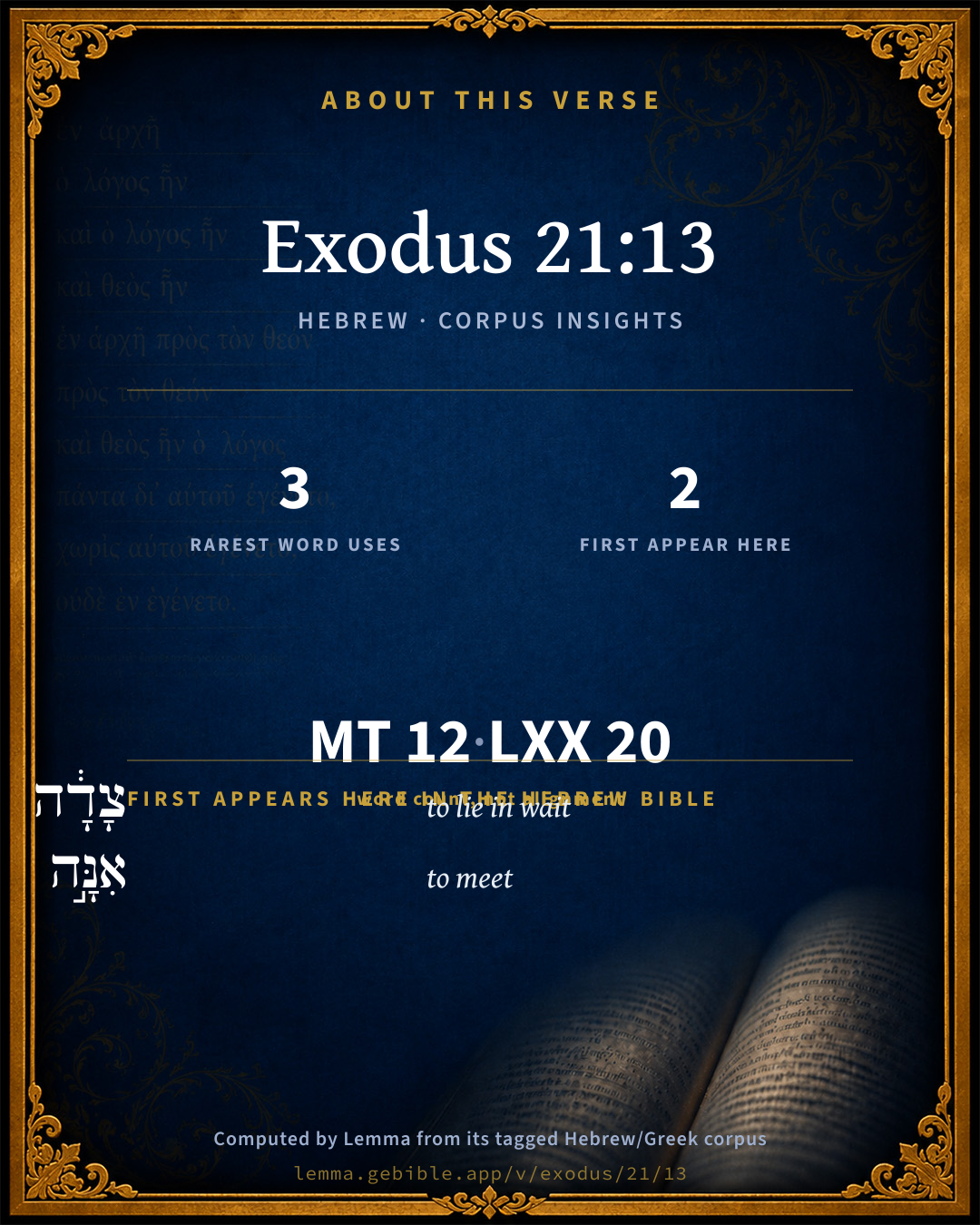
  • 2 first appearances in the Hebrew Bible
Full analysis ↓
Download a study sheet

One document with this verse’s original text, its word-by-word gloss line, the meaning frame, cross-references with their text, attributed commentary, and full source and license credits — printable, and it pastes into notes with its structure intact.

This verse Autodidact and up

Study sheet (.html) Plain text (.txt)

A passage Seminary Student

Up to 50 verses in one chapter. A passage sheet keeps up to 6 commentary sources and 12 cross-references per verse, in the order this page ranks them, and says so on the sheet whenever that leaves anything out. Ask for a single verse and you get the Autodidact verse sheet above.

Everything on this page stays free to read, with no account — the sheet is a download of what is already on screen, not access to it.

Want to remove ads? Support Godless Engineer
Compare translations 3

The same verse in 3 English versions, stacked beneath the original-language interlinear above. Click any original word for its lexicon entry.

Each is an independent rendering of the whole verse — the interlinear is not word-aligned to these translations.

Highlighted words mark where these versions differ — a whole-verse word diff, not a word-by-word alignment.

  • World English Bible Public Domain
    but not if it is unintentional, but God allows it to happen: then I will appoint you a place where he shall flee.
  • King James Version Public Domain
    And if a man lie not in wait, but God deliver him into his hand; then I will appoint thee a place whither he shall flee.
  • unfoldingWord Literal Text CC BY-SA 4.0
    But if he did not lie in wait, but God let it happen by his hand, then I will appoint a place for you where he can flee.

unfoldingWord Literal Text — © unfoldingWord, licensed CC BY-SA 4.0. Word-aligned USFM3 via Door43 (git.door43.org/unfoldingWord/en_ult).

Versions to compare (up to 4)

3 of 4 selected

Show all 18 translations

Every available English version of this verse, each an independent rendering of the whole verse.

  • World English Bible Public Domain
    but not if it is unintentional, but God allows it to happen: then I will appoint you a place where he shall flee.
  • Berean Standard Bible Public Domain
    If, however, he did not lie in wait, but God allowed it to happen, then I will appoint for you a place where he may flee.
  • Majority Standard Bible Public Domain
    If, however, he did not lie in wait, but God allowed it to happen, then I will appoint for you a place where he may flee.
  • King James Version Public Domain
    And if a man lie not in wait, but God deliver him into his hand; then I will appoint thee a place whither he shall flee.
  • American Standard Version (1901) Public Domain
    And if a man lie not in wait, but God deliver `him' into his hand; then I will appoint thee a place whither he shall flee.
  • Revised Version (1885) Public Domain
    And if a man lie not in wait, but God deliver him into his hand; then I will appoint thee a place whither he shall flee.
  • Geneva Bible (1599) Public Domain
    And if a man hath not layed wayte, but God hath offered him into his hande, then I wil appoynt thee a place whither he shall flee.
  • Douay-Rheims (1899) Public Domain
    But he that did not lie in wait for him, but God delivered him into his hands: I will appoint thee a place to which he must flee.
  • Young's Literal Translation Public Domain
    as to him who hath not laid wait, and God hath brought to his hand, I have even set for thee a place whither he doth flee.
  • Literal Standard Version CC BY-SA 4.0
    as for him who has not laid wait, but God has brought [him] to his hand, I have even set a place for you to where he flees.
  • Unlocked Literal Bible CC BY-SA 4.0
    If the man did not do it with premeditation, but instead by accident, then I will fix a place to where he can flee.
  • unfoldingWord Literal Text CC BY-SA 4.0
    But if he did not lie in wait, but God let it happen by his hand, then I will appoint a place for you where he can flee.
  • Darby Bible Public Domain
    But if he have not lain in wait, and God have delivered [him] into his hand, I will appoint thee a place to which he shall flee.
  • World Messianic Bible Public Domain
    but not if it is unintentional, but God allows it to happen; then I will appoint you a place where he shall flee.
  • Webster's Bible Public Domain
    And if a man shall not lie in wait, but God shall deliver him into his hand; then I will appoint thee a place whither he shall flee.
  • Free Bible Version CC BY-SA 4.0
    However, if it wasn't intentional and God let it happen, then I will arrange a place for you where they can run to and be safe.
  • Bible in Basic English Public Domain
    But if he had no evil purpose against him, and God gave him into his hand, I will give you a place to which he may go in flight.
  • JPS Tanakh (1917) Public Domain
    And if a man lie not in wait, but God cause it to come to hand; then I will appoint thee a place whither he may flee.

Literal Standard Version (2020), Covenant Press — licensed CC BY-SA 4.0. Text via the HelloAO Bible API (eBible.org). Unlocked Literal Bible (unfoldingWord) — licensed CC BY-SA 4.0. Text via the HelloAO Bible API (eBible.org). unfoldingWord Literal Text — © unfoldingWord, licensed CC BY-SA 4.0. Word-aligned USFM3 via Door43 (git.door43.org/unfoldingWord/en_ult). Free Bible Version, Dr. Jonathan Gallagher — licensed CC BY-SA 4.0. Text via the HelloAO Bible API (eBible.org).

Word by word

More ways to search: Search by grammar → Find every occurrence → Compare this word →

Practice this passage: Drill this verse → Learn its vocabulary →

צָדָ֔ה
tsâdâh
H6658
“to lie in wait”
Verb, Qal, Perfect, 3rd Person, Masculine, Singular
Part of Speech
Verb
Stem
Qal
Form
Perfect
Person
3rd Person
Gender
Masculine
Number
Singular
Full BDB Definition

Origin: a primitive root

TWOT: 1877 , 1878

(Qal) to lie in wait - to lay waste - (Niphal) to be laid waste
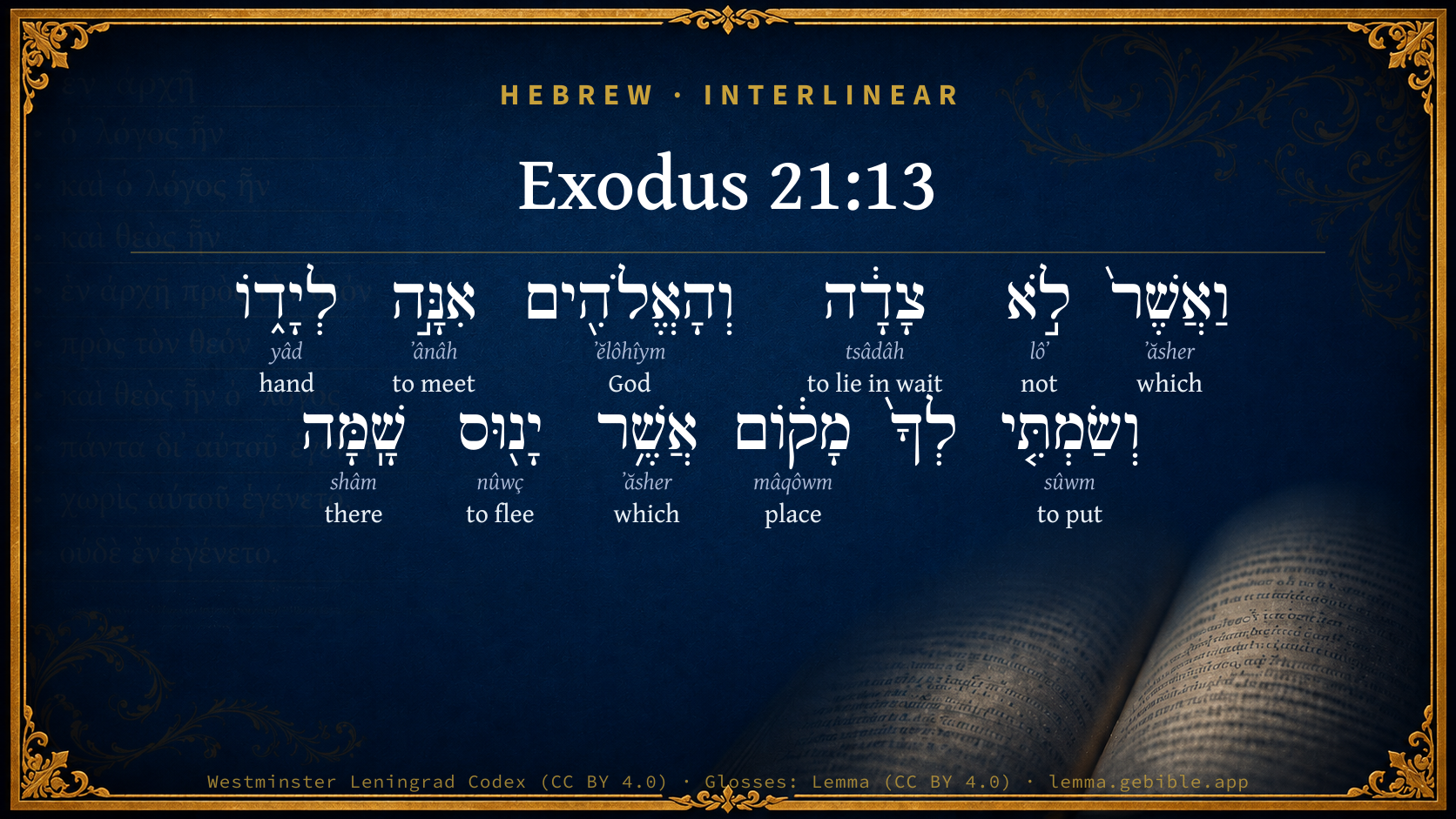
  1. וַאֲשֶׁר֙ ʼăsher H834 “and · which” Conjunction + Particle, Relative
  2. לֹ֣א lôʼ H3808 “not” Particle, Negative
  3. וְהָאֱלֹהִ֖ים ʼĕlôhîym H430 “and · the · God(s)” Conjunction + Particle, Definite Article + Noun, Common, Masculine, Plural, Absolute
  4. אִנָּ֣ה ʼânâh H579 “to meet” Verb, Piel, Perfect, 3rd Person, Masculine, Singular
  5. לְיָד֑וֹ yâd H3027 “to/for · hand · his” Preposition + Noun, Common, Both, Singular, Construct + Suffix, Personal, 3rd Person, Masculine, Singular
  6. וְשַׂמְתִּ֤י sûwm H7760 “and · to put” Conjunction + Verb, Qal, Sequential Perfect, 1st Person, Common, Singular
  7. מָק֔וֹם mâqôwm H4725 “place” Noun, Common, Masculine, Singular, Absolute
  8. אֲשֶׁ֥ר ʼăsher H834 “which” Particle, Relative
  9. יָנ֖וּס nûwç H5127 “to flee” Verb, Qal, Imperfect, 3rd Person, Masculine, Singular
  10. שָֽׁמָּה shâm H8033 “there · toward” Adverb + Suffix, Demonstrative

About this verse

These counts appear in no published source. They are computed here, from the morphology-tagged text and Lemma’s own curated glosses. What Lemma adds →

12
words
10
distinct lemmas
Pentateuch
section

Notable vocabulary

The rarest word here is צָדָ֔ה to lie in wait H6658 — appearing just 3 times in the whole Hebrew Bible.

First appearance in Scripture

These words make their first canonical appearance in the Hebrew Bible here:

  • צָדָ֔ה to lie in wait H6658
  • אִנָּ֣ה to meet H579

Shared distinctive vocabulary

צָדָ֔ה to lie in wait H6658 occurs in 3 verses of the Hebrew Bible. Also found in:

Grammatical profile

  • 4 verbs
  • 3 nouns
  • 1 preposition
  • 1 adverb
  • 3 particles

Verb forms

  • צָדָ֔ה Qal · Perfect
  • אִנָּ֣ה Piel · Perfect
  • וְשַׂמְתִּ֤י Qal · Sequential Perfect
  • יָנ֖וּס Qal · Imperfect

Repetition

A word recurs within this verse — often emphatic in Hebrew:

  • וַאֲשֶׁר֙ which H834 ×2

Hebrew & Septuagint length

In English translation the verse runs 23 words from the Hebrew and 27 from the Septuagint (LXX English) — closely comparable.

A rough comparison of the two English renderings, which tokenize alike — not a word-level alignment.

Word counts can differ between the Hebrew and the Greek without any difference in meaning — e.g. the Hebrew direct-object marker אֵת has no separate Greek word, and Greek often adds the article ὁ.

In the original languages it is 12 Hebrew tokens and 20 Greek tokens — but the two are counted differently (Hebrew bundles its prefixes and suffixes into one token; the Greek is in lemma form), so that isn’t a like-for-like length.

Cross-references

10

Topical passages linked to Exodus 21:13 in the Treasury of Scripture Knowledge — connected by theme and wording, ordered by reader-vote popularity; previews shown in the World English Bible.

  • Joshua 20:2–9 Speak to the children of Israel, saying, Assign you the cities of refuge, of which I spoke to you by Moses,
  • 1 Samuel 24:18 You have declared this day how that you have dealt well with me, because when Yahweh had delivered me up into your hand, you didn't kill me.
  • Deuteronomy 4:41–43 Then Moses set apart three cities beyond the Jordan toward the sunrise;
  • Deuteronomy 19:1–13 When Yahweh your God shall cut off the nations, whose land Yahweh your God gives you, and you succeed them, and dwell in their cities, and in their houses;
  • 1 Samuel 24:4 The men of David said to him, Behold, the day of which Yahweh said to you, Behold, I will deliver your enemy into your hand, and you shall do to him as it shall seem good to you. Then David arose, and cut off the skirt of Saul's robe secretly.
  • 1 Samuel 24:10 Behold, this day your eyes have seen how that Yahweh had delivered you today into my hand in the cave: and some bade me kill you; but [my eye] spared you; and I said, I will not put forth my hand against my lord; for he is Yahweh's anointed.
  • Numbers 35:10–34 Speak to the children of Israel, and tell them, When you pass over the Jordan into the land of Canaan,
  • 2 Samuel 16:10 The king said, What have I to do with you, you sons of Zeruiah? Because he curses, and because Yahweh has said to him, Curse David; who then shall say, Why have you done so?
  • Isaiah 10:7 However he doesn't mean so, neither does his heart think so; but it is in his heart to destroy, and to cut off not a few nations.
  • Micah 7:2 The godly man has perished out of the earth, And there is no one upright among men. They all lie in wait for blood; Every man hunts his brother with a net.

Cross-references courtesy of OpenBible.info (CC BY 4.0).

Hebrew and Greek witnesses Masoretic Hebrew ↔ Greek Septuagint

The same verse in the two great witnesses to the Old Testament, shown verse-for-verse.

These are two independent witnesses, not word-aligned to each other, and the Septuagint is shown in lemma (dictionary) form.

Hebrew Exodus 21:13 Masoretic · Westminster Leningrad Codex

וַאֲשֶׁר֙ לֹ֣א צָדָ֔ה וְהָאֱלֹהִ֖ים אִנָּ֣ה לְיָד֑וֹ וְשַׂמְתִּ֤י לְךָ֙ מָק֔וֹם אֲשֶׁ֥ר יָנ֖וּס שָֽׁמָּה

but not if it is unintentional, but God allows it to happen: then I will appoint you a place where he shall flee.

World English Bible · Public Domain

Greek LXX Exodus 21:13 Septuagint · lemma form

ὁ δέ οὐ ἑκών ἀλλά ὁ θεός παραδίδωμι εἰς ὁ χείρ αὐτός δίδωμι σύ τόπος οὗ φεύγω ἐκεῖ ὁ φονεύω

But as for him that did it not willingly, but God delivered him into his hands, I will give you a place whither the slayer may flee.

LXX2012 (modern English Septuagint) · Public Domain

On this verse, John Gill's Exposition discusses the Septuagint’s reading. Read the note in Commentary ↓

Hebrew: Westminster Leningrad Codex (CC BY 4.0). Greek: Septuagint (public domain); English from LXX2012 (modern English Septuagint) (Public Domain). How the Septuagint differs from the Hebrew →

Targum (Aramaic paraphrase)

2

The Targum is the ancient Jewish Aramaic paraphrase of the Hebrew Scriptures — an interpretive translation, not the Hebrew text itself. Onkelos (literal) and Pseudo-Jonathan (expansive) render the Torah, and Jonathan the Prophets. Coverage is partial: where no permissively-licensed English translation exists for a verse, only the Aramaic is shown. This is verse-level text, not a word-by-word alignment to the Hebrew.

  1. Targum Onkelos Torah (Genesis–Deuteronomy)
    וּדְלָא כְמַן לֵהּ וּמִן קֳדָם יְיָ אִתִּמְסַר לִידֵהּ וֶאֱשַׁוִי לָךְ אֲתַר דִי יֵעִרוֹק לְתַמָן:

    (no public-domain English translation for this verse)

    Targum Onkelos — Aramaic: “Onkelos Genesis” (public domain); “Onkelos Exodus” (public domain); “Onkelos Leviticus” (public domain); “Onkelos Numbers” (public domain); “Onkelos Deuteronomy” (public domain). English: “Sefaria Community Translation” (CC0 1.0 (public-domain dedication)); “J.W. Etheridge. The Targums of Onkelos and Jonathan Ben Uzziel on the Pentateuch. London: Longmans, Green, 1862” (public domain). Text via Sefaria.

  2. Targum Pseudo-Jonathan Torah (Genesis–Deuteronomy)
    וְדִי לָא אִיזְדַוֵּיג לֵיהּ וּמִן קֳדָם יְיָ אֲרַע עִיקְתֵיהּ לִידוֹי וַאֲזַמֵן לָךְ אֲתַר דְּיַעֲרוֹק לְתַמָּן

    But he who did not attack him, but mischance from before the Lord befell him at his hand, I will appoint thee a place where he may flee.

    Targum Pseudo-Jonathan — Aramaic: “Targum Jonathan on Genesis” (public domain); “Targum Jonathan on Exodus” (public domain); “Targum Jonathan on Leviticus” (public domain); “Targum Jonathan on Numbers” (public domain); “Targum Jonathan on Deuteronomy” (public domain). English: “The Targum of Jonathan ben Uzziel, trans. J. W. Etheridge, London, 1862” (public domain). Text via Sefaria.

Commentary

Notes on Exodus 21:13 from classic Christian and Jewish commentators (each source and its license shown beneath its notes). The classic Christian expositions comment on the surrounding passage and are grouped to its opening verse, so a note may address several verses; the Jewish commentaries on the Tanakh (Rashi and others) are per-verse, so they appear only where the commentator wrote on this verse.

Lemma curates 59 commentaries, every one of them public domain or Creative Commons licensed, each selected and text-cleaned for this edition rather than reprinted as found. About our sources →

Trapp's Complete Commentary

John Trapp

Exo 21:13 And if a man lie not in wait, but God deliver [him] into his hand; then I will appoint thee a place whither he shall flee.

Ver. 13. But God deliver him.] Who is the Lord of our lives, and to whom we have frequently forfeited them; so that it is his mercy that we are not consumed; {Lam 3:22} that we are not cut off from the land of the living.

John Trapp, A Commentary or Exposition upon All the Books of the Old and New Testament (1647–1656) — public domain. Text from a community e-Sword module.

Geneva Bible (1599)

Geneva Bible translators

Though a man be killed at unawares, yet it is God’s providence that it should so be.

Geneva Bible (1599) marginal notes — public domain. Text via Bolls.life.

Adam Clarke's Commentary

Verse 13. I will appoint thee a place whither he shall flee.] From the earliest times the nearest akin had a right to revenge the murder of his relation, and as this right was universally acknowledged, no law was ever made on the subject; but as this might be abused, and a person who had killed another accidentally, having had no previous malice against him, might be put to death by the avenger of blood, as the nearest kinsman was termed, therefore God provided the cities of refuge to which the accidental manslayer might flee till the affair was inquired into, and settled by the civil magistrate.

Adam Clarke's Commentary on the Bible (1810–1826) — public domain. Text from a community e-Sword/MySword module.

Ellicott's Commentary for English Readers

(13) If a man lie not in wait, but God deliver him into his hand.—If, that is, without malice aforethought, a man happen upon his enemy, God’s providence bringing the two into contact without man’s contrivance, and the result is that one slay the other, then the law of the refuge or asylum shall come in. A place is to be provided whither the man-slayer may flee, and where he may be safe, at any rate until the cause is inquired into. Hitherto, throughout the East, it had been regarded as the duty of the next of kin to avenge homicide of whatever kind, and blood had been exacted for blood, however sudden, however provoked, however excusable had been the homicide. No right of asylum, so far as we know, had ever been established before. The Sinaitic legislation for the first time interposed the “city of refuge,” between the “avenger of blood” and his victim. It was for the elders of the city to see that the privilege was not abused. Where the case was doubtful, the man-slayer had to be remitted for trial to the elders of his own town (Num_35:22-25); where the elders considered his claim made out, he was entitled to protection.

A Bible Commentary for English Readers, edited by Charles John Ellicott (1878–1897) — public domain. Text from a community e-Sword module.

The Cambridge Bible for Schools and Colleges

gen. ed. J. J. S. Perowne

13. Manslaughter, and the right of asylum. The distinction, not found in Homer, but thus early drawn among the Hebrews, between intentional and unintentional homicide is noteworthy: it is insisted on in all the codes (Deu_19:1-13; Num_35:9-34 P).

lie … in wait] 1Sa_24:11 (RVm.)†: cf. the derivative, ‘with lying in wait’ (i.e. with malicious intent), in P’s law of homicide, Num_35:20; Num_35:22 (‘without’)†. In Dt. and D2[187] the idea of ‘unintentional’ is expressed by unawares (lit. without knowledge), Deu_4:42; Deu_19:4, Jos_20:3; Jos_20:5; P says unwittingly (lit. in error), Num_35:11; Num_35:15, Jos_20:3; Jos_20:9.

[187] Deuteronomic passages in Josh., Jud., Kings.

deliver] in the Heb. a rare word, meaning properly, as Arabic shews, bring opportunely (cf. the derivative opportunity, Jdg_14:4). The meaning of the clause is (as we should express it), if he kills him accidentally. Cf. Ḥamm. § 249 ‘if God have struck it (a hired ox), and it die,’ 266 ‘a stroke of God’ (killing a sheep), below, p. 423.

a place whither he shall flee] i.e. an asylum where he may be safe from the avenger of blood. V. 14, which speaks of the fugitive as having taken refuge at an altar, shews that the place meant can only be the sacred place at which the altar stood. In the later legislation of Dt. (Deu_19:1-13) fixed cities are appointed for the purpose and regulations for their use are laid down. The technical term, ‘cities of refuge,’ first occurs in P (Num_35:6; Num_35:11 ff.). In ancient times ‘the right of asylum was possessed by different sanctuaries in various degrees, depending on prescription, the holiness of the place, and other circumstances; it sometimes extended to an entire city, or even to a mark beyond its walls.… In the Greek period, and later (under Roman rule), many Hellenistic cities in Syria enjoyed the privileges of asylums, the title ἄσυλος appearing on their coins’ (Moore, in EB. Asylum). Cf. Rel. Sem. 148. Moslems, adhering to the tradition of heathen times, treat tombs, esp. those of ancestors, notabilities, and saints, as asylums.

The Cambridge Bible for Schools and Colleges (gen. ed. J. J. S. Perowne; Cambridge University Press, 1878–1918) — public domain. Text from a community e-Sword module.

John Gill's Exposition

And if a man lie not in wait,.... For the life of another to take it away; or does not do it willingly, as the Septuagint version, does not seek after it, nor design it:

but God delivers him into his hand; it being suffered and ordered by the providence of God, without whose knowledge and will nothing comes to pass, even what may seem to be a contingent thing, or matter of chance, to us; or it is so brought about in providence, that one man falls into the hands of another, and his life is taken away by him, though not purposely and maliciously; because, as Aben Ezra expresses it, for another sin which he has committed, and for which he must die in this way, though not intended by the person the more immediate cause of his death:

then I will appoint thee a place whither he shall flee; and there be safe both from the avenger of blood, and the civil magistrate; which place, while Israel were in the wilderness, was the camp of the Levites, according to Jarchi, or the altar, as follows; but when they were come to Canaan's land, there were cities of refuge appointed for such persons, that killed a man unawares, to flee to, and where they were safe from private vengeance, and falling a sacrifice to public justice.

John Gill's Exposition of the Whole Bible (1746–1763) — public domain (CC PDM 1.0). Text via the HelloAO Bible API.

Albert Barnes' Notes on the Bible

There was no place of safety for the guilty murderer, not even the altar of Yahweh. Thus all superstitious notions connected with the right of sanctuary were excluded. Adonijah and Joab 1Ki 1:50; 1Ki 2:28 appear to have vainly trusted that the common feeling would protect them, if they took hold of the horns of the altar on which atonement with blood was made Lev 4:7. But for one who killed a man “at unawares,” that is, without intending to do it, the law afterward appointed places of refuge, Num. 35:6-34; Deu 4:41-43; Deu 19:2-10; Jos 20:2-9. It is very probable that there was some provision answering to the cities of refuge, that may have been based upon old usage, in the camp in the Wilderness.

Albert Barnes' Notes on the Bible (1834–1885) — public domain. Text from a community e-Sword/MySword module.

Haydock's Catholic Bible Commentary

God. When a person was slain undesignedly, the Providence of God was to be adored in silence, as nothing happens without his permission. (Haydock) See Numbers xxv. 6.

George Leo Haydock (1774–1849), Haydock's Catholic Family Bible and Commentary, 1859 edition — public domain. Excludes Psalms (Douay-Rheims chapter numbering differs from Protestant) and Deuterocanonical books (Catholic canon only).

Matthew Poole's English Annotations

If it appear that the manslayer did not intend nor desire it, but only it fell out by his heedlessness, or by some casualty, or by some unexpected providence; or, God, and not man, God without the man’s contrivance or design; for otherwise, in a general sense and way, God delivered Christ into the hands of Judas and the Jews, who did advisedly and maliciously kill him.

A place whither he shall flee, i.e. a city or place of refuge, Num 35:11; Deu 19:5.

Matthew Poole's English Annotations on the Holy Bible (1683–1685) — public domain. Text from a community e-Sword/MySword module.

Whedon's Commentary on the Bible

Daniel D. Whedon

13. Lie not in wait — That is, intending to take life, and planning, like a hunter, to insure the death of his victim.

But God deliver him into his hand — As when one is slain by the accidental blow not intended for him, as in the case supposed in Deu_19:5. Such unintentional homicide could not justly be treated as the crime of murder.

A place whither he shall flee — Such “cities of refuge” were afterward appointed. See Num_35:9-15, and parallels.

Daniel D. Whedon (gen. ed.), Commentary on the Old and New Testaments (1874–1909) — public domain. Text from a community e-Sword module.

The Pulpit Commentary

God deliver him into his hand. This does not seem to mean more than, "if he chance upon him without seeking him." God"s providence does in fact bring about the meetings which men call accidental. I will appoint thee a place . When we first hear of the actual appointment, the number of the places was six three on either side of Jordan. (see Jos_20:7, Jos_20:8; and compare Num_35:10-15, and Deu_19:2) Thus there was always a city of refuge at a reasonable distance.

The Pulpit Commentary (1880–1919), ed. H.D.M. Spence-Jones & Joseph S. Exell — public domain. Text from a community e-Sword module.

Rashi

Rabbi Shlomo Yitzchaki (Rashi)

ואשר לא צדה AND IF A MAN LIE NOT IN WAIT — i. e. if he did not lie in ambush for him (the person whom he killed), nor did he premeditate the blow (Makkot 7b).

צדה is a term denoting “lying in wait”; similarly it says, (I Samuel 24:12) “yet thou liest in wait (צדה) for my soul to take it”. It is, however, not correct to say that צדה is of the same derivation as, (Genesis 27:34) הצד ציד “he that hath hunted (הצד) venison”, for a ה has no place in the verbal forms of the term denoting “hunting beasts”. Then again, the noun form of the latter is צַיִד and that of the former צְדִיָה, whilst the participle of the verb “lying in wait” is צוֹדֶה and that of the other is צָד. I therefore say that its meaning is as the Targum gives it: “and if he did not lie in ambush for him”. Menachem ben Seruk placed it in the same section as הצד ציד (i. e. he held that the root is צד and that it has the meaning of “hunting”), but I do not agree with him. If it is to be placed in one of the sections of צד we had better place it in the same section as, (Isaiah 66:12) על צד תנשאו “ye shall be borne upon her side (צד)” and (I Samuel 20:20) “and I will shoot [three arrows] on the side thereof (צדה)”, and (Daniel 7:25) “and he shall speak towards the side of (against) the Most High”. Thus, here, the words אשד לא צדה could be taken to mean, “he did not turn aside (צִדֵּד)” to seek some side (occasion) for killing him. But there are objections even to this explanation. At any rate, even if it be connected with צד in this sense, it would still have the meaning “lying in wait”.

והאלהים אנה לידו means, BUT GOD GOT IT READY FOR HIS HAND. It has the same meaning as this root has in, (Psalms 91:10) “No evil shall be got ready (תאנה) for thee”; (Proverbs 12:21) “There shall no evil be got ready (תאנה) for the just”; (2 Kings 5:7) “he gets himself ready (מתאנה) for me”, i. e. he gets himself ready to discover some occasion against me.

והאלהים אנה לידו BUT GOD GOT IT READY FOR HIS HAND — But why should this go forth from Him (be brought about by God)? This is just what David tells us: (I Samuel 24:13) “As says the proverb of the ancient (הקדמני) “Wickedness proceededeth from the wicked”. — “The proverb of the קדמני” is the Torah, the maxim of God, Who it the “Ancient” (Whose existence preceded that) of the world. But where indeed does the Torah say, “Wickedness proceedeth from the wicked”? It says it implicitly in the verse: “But God got it ready for his hand”. For what is Scripture here speaking about? About two men, one of whom killed a person with premeditation and the other killed inadvertently, and in neither case were there witnesses to the deed who could testify about it. Consequently, the former was not put to death and the latter was not forced into banishment to a city of refuge (cf. Numbers 35:11). Now God brings them together at the same inn. He who killed with premeditation happens to sit beneath a ladder, and the other who killed inadvertently ascends the ladder and falls, when descending it, upon the man who killed with premeditation and kills him. Witnesses now being present they testify against him, so compelling him to be banished to one of the cities of refuge. The result is that he who killed inadvertently is actually banished and he who killed with premeditation actually suffers death (cf. Mekhilta and Makkot 10b).

ושמתי לך מקום AND I WILL APPOINT THEE A PLACE — in the wilderness also — WHITHER HE SHALL FLEE — Which was the place that offered him an asylum? The camp of the Levites (Mekhilta; Makkot 12b).

Rashi on the Tanakh — English translations: “The Judaica Press complete Tanach with Rashi, translated by A. J. Rosenberg” (CC BY 4.0); “Pentateuch with Rashi's commentary by M. Rosenbaum and A.M. Silbermann, 1929-1934” (public domain); “The Metsudah Tanach series, Lakewood, N.J” (CC BY 4.0); and “The Book of Joshua, Metsudah Publications, 1997” (CC BY 4.0). Text via Sefaria.

Lesson kit

Teaching starters — assembled from the data on this page, not authored interpretation. Every prompt links to the verse data it draws on. Edit before teaching.

Exodus, in the Pentateuch, opens this verse with 12 words (10 distinct Hebrew lemmas). Its most distinctive word is tsâdâh (“to lie in wait”). A historical commentator’s framing appears above. Read the whole chapter for the surrounding context.

Discussion questions

  1. What does “to lie in wait” (tsâdâh) contribute to the verse as a whole?
  2. 2 words make their first appearance in Scripture here. What does this debut establish?
  3. How does 1 Samuel 24:11, which shares the word «to lie in wait», read alongside this verse?
  4. What does the repetition of “which” (2× in this one verse) do in this verse?
  5. These translations render this verse differently. What is at stake in choosing one wording over another?
  6. «צָדָ֔ה» is a Qal Perfect verb. How does that grammatical form shape the action described?
  7. Compare how Trapp's Complete Commentary and Geneva Bible (1599) read this verse. Where do they agree or differ?

Things to notice

Reading settings

Reading text

Shown beneath each verse's original-language words.

Old Testament
Old Testament edition

Read the OT as the Masoretic Hebrew (MT) or the Greek Septuagint (LXX).

English shown for the Greek Septuagint (in the Hebrew ↔ Greek comparison).

Comparing translations? Open the Compare panel on any verse page to stack up to four side by side.