
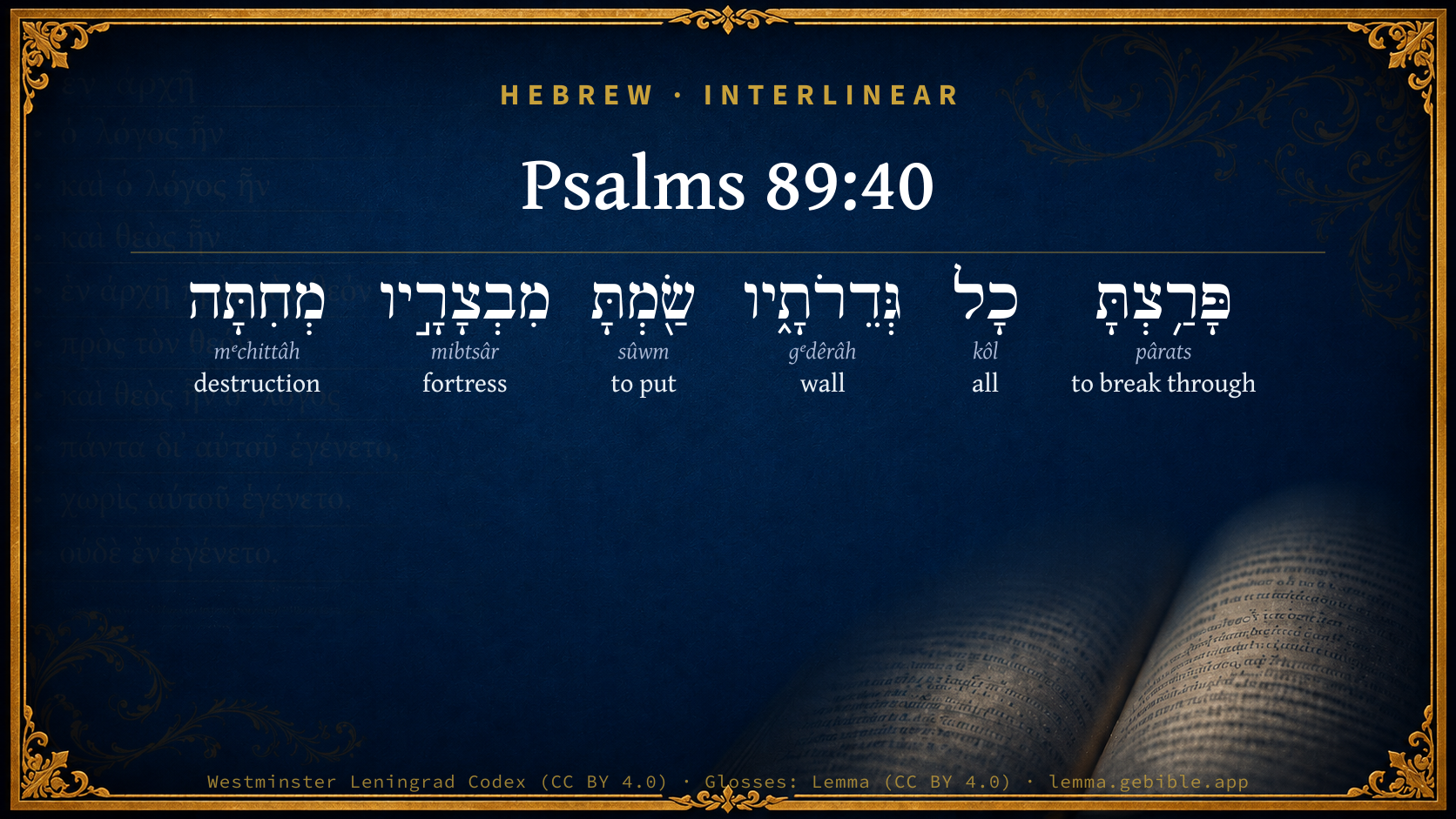
Psalms 89:40

Hebrew (Westminster Leningrad Codex) Psalms 89:40 appears in the Hebrew Old Testament. The text above is from the Westminster Leningrad Codex. Each word links to its Strong’s number, a concise gloss, and parsing drawn from the Open Scriptures Hebrew Bible morphology. Click any word for its full Brown-Driver-Briggs (BDB) entry.
Download image
Cite this verse

Psalms 89:40 (World English Bible). Public Domain. Lemma interlinear Bible study tool, https://lemma.gebible.app/v/psalms/89/40.

Show BibTeX & RIS
BibTeX
RIS
English Translation
You have broken down all his hedges. You have brought his strongholds to ruin.
World English Bible · Public Domain
Highlights
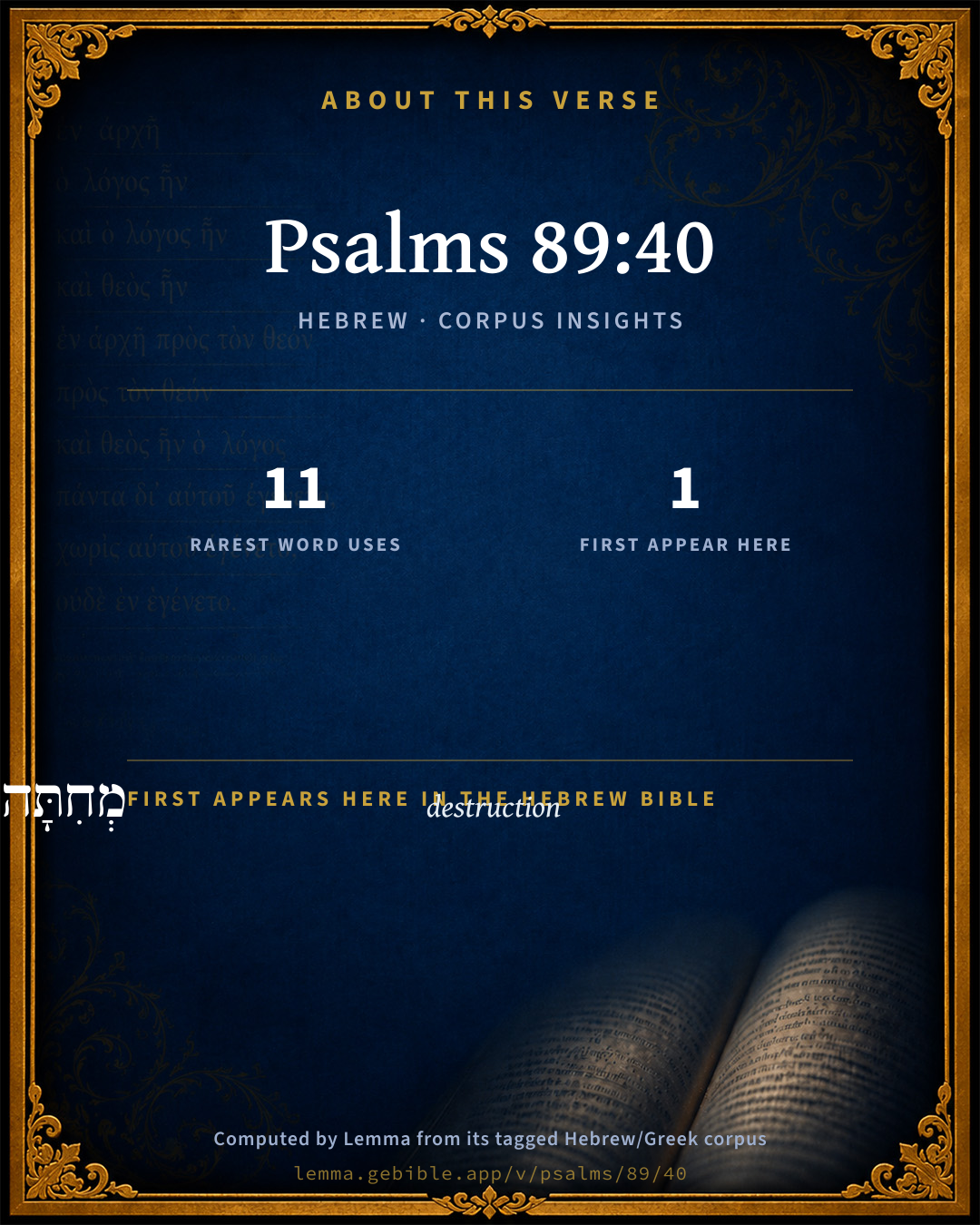
  • 1 first appearance in the Hebrew Bible
Full analysis ↓
Download a study sheet

One document with this verse’s original text, its word-by-word gloss line, the meaning frame, cross-references with their text, attributed commentary, and full source and license credits — printable, and it pastes into notes with its structure intact.

This verse Autodidact and up

Study sheet (.html) Plain text (.txt)

A passage Seminary Student

Up to 50 verses in one chapter. A passage sheet keeps up to 6 commentary sources and 12 cross-references per verse, in the order this page ranks them, and says so on the sheet whenever that leaves anything out. Ask for a single verse and you get the Autodidact verse sheet above.

Everything on this page stays free to read, with no account — the sheet is a download of what is already on screen, not access to it.

Want to remove ads? Support Godless Engineer
Compare translations 3

The same verse in 3 English versions, stacked beneath the original-language interlinear above. Click any original word for its lexicon entry.

Each is an independent rendering of the whole verse — the interlinear is not word-aligned to these translations.

Highlighted words mark where these versions differ — a whole-verse word diff, not a word-by-word alignment.

  • World English Bible Public Domain
    You have broken down all his hedges. You have brought his strongholds to ruin.
  • King James Version Public Domain
    Thou hast broken down all his hedges; thou hast brought his strong holds to ruin.
  • unfoldingWord Literal Text CC BY-SA 4.0
    You have broken down all of his walls; you have made his fortifications a ruin.

unfoldingWord Literal Text — © unfoldingWord, licensed CC BY-SA 4.0. Word-aligned USFM3 via Door43 (git.door43.org/unfoldingWord/en_ult).

Versions to compare (up to 4)

3 of 4 selected

Show all 18 translations

Every available English version of this verse, each an independent rendering of the whole verse.

  • World English Bible Public Domain
    You have broken down all his hedges. You have brought his strongholds to ruin.
  • Berean Standard Bible Public Domain
    You have broken down all his walls; You have reduced his strongholds to rubble.
  • Majority Standard Bible Public Domain
    You have broken down all his walls; You have reduced his strongholds to rubble.
  • King James Version Public Domain
    Thou hast broken down all his hedges; thou hast brought his strong holds to ruin.
  • American Standard Version (1901) Public Domain
    Thou hast broken down all his hedges; Thou hast brought his strongholds to ruin.
  • Revised Version (1885) Public Domain
    Thou hast broken down all his hedges; thou hast brought his strong holds to rain.
  • Geneva Bible (1599) Public Domain
    Thou hast broken downe all his walles: thou hast layd his fortresses in ruine.
  • Douay-Rheims (1899) Public Domain
    Thou hast overthrown the covenant of thy servant: thou hast profaned his sanctuary on the earth.
  • Young's Literal Translation Public Domain
    Thou hast broken down all his hedges, Thou hast made his fenced places a ruin.
  • Literal Standard Version CC BY-SA 4.0
    You have broken down all his hedges, || You have made his fortifications a ruin.
  • Unlocked Literal Bible CC BY-SA 4.0
    You have broken down all his walls. You have ruined his strongholds.
  • unfoldingWord Literal Text CC BY-SA 4.0
    You have broken down all of his walls; you have made his fortifications a ruin.
  • Darby Bible Public Domain
    Thou hast broken down all his hedges; thou hast brought his strongholds to ruin.
  • World Messianic Bible Public Domain
    You have broken down all his hedges. You have brought his strongholds to ruin.
  • Webster's Bible Public Domain
    \\89:39\\Thou hast made void the covenant of thy servant: thou hast profaned his crown by casting it to the ground.
  • Free Bible Version CC BY-SA 4.0
    You have torn down his defensive walls; you have ruined his fortresses.
  • Bible in Basic English Public Domain
    All his walls are broken down; you have given his strong towers to destruction.
  • JPS Tanakh (1917) Public Domain
    (89-41) Thou hast broken down all his fences; Thou hast brought his strongholds to ruin.

Literal Standard Version (2020), Covenant Press — licensed CC BY-SA 4.0. Text via the HelloAO Bible API (eBible.org). Unlocked Literal Bible (unfoldingWord) — licensed CC BY-SA 4.0. Text via the HelloAO Bible API (eBible.org). unfoldingWord Literal Text — © unfoldingWord, licensed CC BY-SA 4.0. Word-aligned USFM3 via Door43 (git.door43.org/unfoldingWord/en_ult). Free Bible Version, Dr. Jonathan Gallagher — licensed CC BY-SA 4.0. Text via the HelloAO Bible API (eBible.org).

Word by word

More ways to search: Search by grammar → Find every occurrence → Compare this word →

Practice this passage: Drill this verse → Learn its vocabulary →

About this verse

These counts appear in no published source. They are computed here, from the morphology-tagged text and Lemma’s own curated glosses. What Lemma adds →

6
words
6
distinct lemmas
Wisdom
section

Notable vocabulary

The rarest word here is גְּדֵרֹתָ֑יו wall H1448 — appearing just 11 times in the whole Hebrew Bible.

First appearance in Scripture

This word makes its first canonical appearance in the Hebrew Bible here:

  • מְחִתָּה destruction H4288

Shared distinctive vocabulary

גְּדֵרֹתָ֑יו wall H1448 occurs in 11 verses of the Hebrew Bible. Also found in:

Grammatical profile

  • 2 verbs
  • 4 nouns

Verb forms

  • פָּרַ֥צְתָּ Qal · Perfect
  • שַׂ֖מְתָּ Qal · Perfect

Hebrew & Septuagint length

In English translation the verse runs 14 words from the Hebrew and 15 from the Septuagint (LXX English) — closely comparable.

A rough comparison of the two English renderings, which tokenize alike — not a word-level alignment.

Word counts can differ between the Hebrew and the Greek without any difference in meaning — e.g. the Hebrew direct-object marker אֵת has no separate Greek word, and Greek often adds the article ὁ.

Cross-references

8

Topical passages linked to Psalms 89:40 in the Treasury of Scripture Knowledge — connected by theme and wording, ordered by reader-vote popularity; previews shown in the World English Bible.

  • Psalms 80:12 Why have you broken down its walls, So that all those who pass by the way pluck it?
  • Lamentations 2:2 The Lord has swallowed up all the habitations of Jacob, and has not pitied: He has thrown down in his wrath the strongholds of the daughter of Judah; He has brought them down to the ground; he has profaned the kingdom and the princes of it.
  • Job 1:10 Haven't you made a hedge around him, and around his house, and around all that he has, on every side? You have blessed the work of his hands, and his substance is increased in the land.
  • Lamentations 2:5 The Lord is become as an enemy, he has swallowed up Israel; He has swallowed up all her palaces, he has destroyed his strongholds; He has multiplied in the daughter of Judah mourning and lamentation.
  • 2 Chronicles 12:2–5 It happened in the fifth year of king Rehoboam, that Shishak king of Egypt came up against Jerusalem, because they had trespassed against Yahweh,
  • 2 Chronicles 15:5 In those times there was no peace to him who went out, nor to him who came in; but great vexations were on all the inhabitants of the lands.
  • Isaiah 5:5–6 Now I will tell you what I will do to my vineyard. I will take away its hedge, and it will be eaten up. I will break down its wall of it, and it will be trampled down.
  • Revelation 13:1–7 Then I stood on the sand of the sea. I saw a beast coming up out of the sea, having ten horns and seven heads. On his horns were ten crowns, and on his heads, blasphemous names.

Cross-references courtesy of OpenBible.info (CC BY 4.0).

Hebrew and Greek witnesses Masoretic Hebrew ↔ Greek Septuagint

The same verse in the two great witnesses to the Old Testament, shown verse-for-verse.

You’re reading Greek Psalm 88 (Hebrew Psalm 89). The Septuagint counts the superscription, so verse numbers can differ from the Hebrew — chapter-level alignment, not verse-by-verse. Numbering follows Rahlfs.

These are two independent witnesses, not word-aligned to each other, and the Septuagint is shown in lemma (dictionary) form.

Hebrew Psalms 89:40 Masoretic · Westminster Leningrad Codex

פָּרַ֥צְתָּ כָל גְּדֵרֹתָ֑יו שַׂ֖מְתָּ מִבְצָרָ֣יו מְחִתָּה

You have broken down all his hedges. You have brought his strongholds to ruin.

World English Bible · Public Domain

Greek LXX Greek Psalm 88:40 Septuagint · lemma form

καταστρέφω ὁ διαθήκη ὁ δοῦλος σύ βεβηλόω εἰς ὁ γῆ ὁ ἁγίασμα αὐτός

You have broken down all his hedges; you have made his strong holds a terror.

LXX2012 (modern English Septuagint) · Public Domain

Hebrew: Westminster Leningrad Codex (CC BY 4.0). Greek: Septuagint (public domain); English from LXX2012 (modern English Septuagint) (Public Domain). How the Septuagint differs from the Hebrew →

Commentary

Notes on Psalms 89:40 from classic Christian and Jewish commentators (each source and its license shown beneath its notes). The classic Christian expositions comment on the surrounding passage and are grouped to its opening verse, so a note may address several verses; the Jewish commentaries on the Tanakh (Rashi and others) are per-verse, so they appear only where the commentator wrote on this verse.

Lemma curates 59 commentaries, every one of them public domain or Creative Commons licensed, each selected and text-cleaned for this edition rather than reprinted as found. About our sources →

Trapp's Complete Commentary

John Trapp

Psa 89:40 Thou hast broken down all his hedges; thou hast brought his strong holds to ruin.

Ver. 40. Thou hast broken down all his hedges] Or, walls. The walls of Sparta were their militia, of England are their ships, of all lands their laws, Ecc 10:8.

Thou hast brought his strong holds to ruin] Or, to consternation and deadly fright.

Siqua manet gelida formidine concutis arcem

(Buchanan).

John Trapp, A Commentary or Exposition upon All the Books of the Old and New Testament (1647–1656) — public domain. Text from a community e-Sword module.

J. A. Alexander on Psalms

Joseph Addison Alexander

41. (Psa 89:40) Thou hast broken down all his walls; thou hast wide his defences a ruin. As the word translated walls is commonly used to denote the enclosures of vineyards, whether walls or hedges, this may be the figure here intended, which is then exchanged, in the last clause, for that of a walled town, with its defences or defensive works, its fortifications. See above, on Psa 80:12. Some interpreters allege that the last word always has the sense of terror; but it may be doubted whether it ever has, whereas that of ruin often occurs, particularly in the Book of Proverbs.

Joseph Addison Alexander, The Psalms Translated and Explained (1850) — public domain. Text from a community e-Sword module.

Tyndale Open Study Notes

Tyndale Open Resources

89:40 broken down the walls: The Lord’s people are completely vulnerable.

Tyndale Open Study Notes — © Tyndale Open Resources, licensed CC BY-SA 4.0. Text via the HelloAO Bible API.

Adam Clarke's Commentary

Verse 40. Thou hast broken down all his hedges] Thou hart permitted the land to be stripped of all defence; there is not even one strong place in the hands of thy people.

Adam Clarke's Commentary on the Bible (1810–1826) — public domain. Text from a community e-Sword/MySword module.

John Calvin's Commentaries

40. Thou hast broken down all his walls. The prophet, although he might easily have found another cause to which to impute the breaking down and razing of the fortifications, yet under the influence of devout and sanctified feeling acknowledges God to be the author of this calamity; being fully convinced that men could not at their pleasure have destroyed the kingdom which God had set up had not the Divine anger been kindled. Afterwards speaking metaphorically, he complains that the kingdom was exposed as a prey to all passers-by, resembling a field or garden, of which the walls were broken down, and the ground laid open to depredation. As an aggravation of a calamity which in itself was sufficiently grievous, the additional indignity is brought forward, that the king was a reproach to his neighbors. The worldly and the profane, there can be no doubt, finding an opportunity so much according to their wishes, derided him, saying, Is this that king of God’s choice, a king more excellent than the angels, and whose throne was to continue as long as the sun and the moon should endure? As these railings recoiled upon God himself, the prophet justly complains of the reproachful derision with which God’s Anointed was treated, whose dignity and royal estate were ratified and confirmed by heavenly anointing.

John Calvin's Commentaries (1540-1563) — public domain. Text from the Calvin Translation Society English edition (1840s-50s) via the Christian Classics Ethereal Library (ccel.org). Calvin's coverage is partial (roughly two-thirds of the Bible); uncommented books and verses are honest gaps, never fabricated. The 19th-century editor's footnotes and remarks are omitted so the notes are faithfully Calvin's own voice.

The Cambridge Bible for Schools and Colleges

gen. ed. J. J. S. Perowne

40. Insensibly the king is identified with the nation whose head and representative he was. The first line is taken from the description of Israel as a vine in Psa_80:12.

hedges] Or, as R.V. in Psa_80:12, fences.

The Cambridge Bible for Schools and Colleges (gen. ed. J. J. S. Perowne; Cambridge University Press, 1878–1918) — public domain. Text from a community e-Sword module.

John Gill's Exposition

All that pass by the way spoil him,.... His church, his members, which are himself, when made havoc of by their persecutors, and they took joyfully the spoiling of their goods, Heb 10:34, so the church of Christ may be spoiled, however, attempted to be spoiled, by false teachers, who are the foxes, the little foxes, that spoil the vines; crafty seducers, who spoil Christians of their peace and comfort, through philosophy and vain deceit, Sol 2:15. Christ himself may be said to be spoiled, when he was stripped of his clothes by the Roman soldiers, who also parted his garments, casting lots on his vesture; when they that passed by his cross, as he hung upon it, reviled him, and robbed him of his good name, and of his kingly and priestly offices; and he is also spoiled by false teachers, who rob him of his deity, his divine and eternal sonship, and of his satisfaction and righteousness, by whom he is trodden under foot, and his blood counted as an unholy thing; and so the Targum,

"all that pass by the way tread upon him;''

see Heb 10:29, these are they that walk not in the right way; but go out of it, and choose their own way; they are such as pass over the right way, or cross it; they are they that transgress, and abide not in the doctrine of Christ, that so use him, Jo2 1:9,

he is a reproach to his neighbours; his name and character were reproached by the Jews, his countrymen, who called him a glutton and a wine bibber; and represented him as a notorious sinner; his miracles as done by the help of Satan; his doctrine as hard sayings, novel opinions, contrary to common sense and reason, and tending to licentiousness; and his followers and members as the offscouring of all things: but all this has been or will be rolled off, and is no objection to the glory promised him.

John Gill's Exposition of the Whole Bible (1746–1763) — public domain (CC PDM 1.0). Text via the HelloAO Bible API.

Albert Barnes' Notes on the Bible

Thou hast broken down all his hedges - His walls or defenses; all that he relied on for safety.

Thou hast brought his strongholds to ruin - His towers, fortifications; defenses. The enemy has been suffered to destroy them. They are now heaps of ruins.

Albert Barnes' Notes on the Bible (1834–1885) — public domain. Text from a community e-Sword/MySword module.

Matthew Poole's English Annotations

All his hedges; all the means of his protection and safety.

Matthew Poole's English Annotations on the Holy Bible (1683–1685) — public domain. Text from a community e-Sword/MySword module.

The Treasury of David

Charles H. Spurgeon

Ver. 40. Thou hast broken down all his hedges. He was no longer sheltered from the slanderous assaults of contemptuous tongues; the awe which should guard the royal name had ceased to separate him from his fellows. The "divinity which doth hedge a king" had departed. Hitherto, the royal family had been like a vine within an enclosure, but the wall was now laid low, and the vine was unprotected. It is sorrowfully true that in many places the enclosures of the church have been destroyed, the line of demarcation between the church and the world has almost vanished, and godless men fill the sacred offices. Alas, O Lord God, shall it be always so? Shall thy true vine be deserted by thee, thou great Husbandman? Set up the boundaries again, and keep thy church as a vineyard reserved for thyself.

Thou hast brought his strong holds to ruin. The forts of the land were in the possession of the enemy and were dismantled, the defences of the kingdom were overthrown. Thus has it happened that precious truths, which were the bulwarks of the church, have been assailed by heresy, and the citadels of sound doctrine have been abandoned to the foe. O God, how canst thou suffer this? As the God of truth, wilt thou not arise and tread down falsehood?

Ver. 40. Hedges and strong holds. Both of these may refer to the appointments of a vineyard in which the king was the vine. It was usually fenced around with a stone wall, and in it was a small house or tower, wherein a keeper was set to keep away intruders. When the wall, or hedge, was thrown down, every passer by plucked at the fruit, and when the tower was gone the vineyard was left open to the neighbours who could do as they would with the vines. When the church is no longer separated from the world, and her divine Keeper has no more a dwelling place within her, her plight is wretched indeed. C.H.S.

Ver. 40.

1. What God had done. "Broken down", etc.

2. What he had not done. Not taken away sorrow for his departure and desire for his return.

Psalms 89:41*

Charles H. Spurgeon's The Treasury of David (1869–1885) — public domain. Psalms only. Text from a community e-Sword/MySword module.

Whedon's Commentary on the Bible

Daniel D. Whedon

40. His hedges—His defences, called his strongholds in the next member.

Daniel D. Whedon (gen. ed.), Commentary on the Old and New Testaments (1874–1909) — public domain. Text from a community e-Sword module.

The Pulpit Commentary

Thou hast broken down all his hedges; i.e. "all his defences the strongholds, that guarded the frontiers of the land, were brought to ruin. (comp. 2Ch_11:5-10)

The Pulpit Commentary (1880–1919), ed. H.D.M. Spence-Jones & Joseph S. Exell — public domain. Text from a community e-Sword module.

Rashi

Rabbi Shlomo Yitzchaki (Rashi)

You abrogated You nullified.

Rashi on the Tanakh — English translations: “The Judaica Press complete Tanach with Rashi, translated by A. J. Rosenberg” (CC BY 4.0); “Pentateuch with Rashi's commentary by M. Rosenbaum and A.M. Silbermann, 1929-1934” (public domain); “The Metsudah Tanach series, Lakewood, N.J” (CC BY 4.0); and “The Book of Joshua, Metsudah Publications, 1997” (CC BY 4.0). Text via Sefaria.

Lesson kit

Teaching starters — assembled from the data on this page, not authored interpretation. Every prompt links to the verse data it draws on. Edit before teaching.

Psalms, in the Wisdom, opens this verse with 6 words (6 distinct Hebrew lemmas). Its most distinctive word is gᵉdêrâh (“wall”). A historical commentator’s framing appears above. Read the whole chapter for the surrounding context.

Discussion questions

  1. What does “wall” (gᵉdêrâh) contribute to the verse as a whole?
  2. This is the first place “destruction” appears in Scripture (first appears here). What does its debut here establish?
  3. How does Numbers 32:16, which shares the word «wall», read alongside this verse?
  4. The translations on this page render this verse differently — a whole-verse word diff, not a word-by-word alignment. What might account for the different wordings?
  5. «פָּרַ֥צְתָּ» is a Qal Perfect verb. How does that grammatical form shape the action described?
  6. Compare how Trapp's Complete Commentary and J. A. Alexander on Psalms read this verse. Where do they agree or differ?

Things to notice

Reading settings

Reading text

Shown beneath each verse's original-language words.

Old Testament
Old Testament edition

Read the OT as the Masoretic Hebrew (MT) or the Greek Septuagint (LXX).

English shown for the Greek Septuagint (in the Hebrew ↔ Greek comparison).

Comparing translations? Open the Compare panel on any verse page to stack up to four side by side.