
Judges 20:36

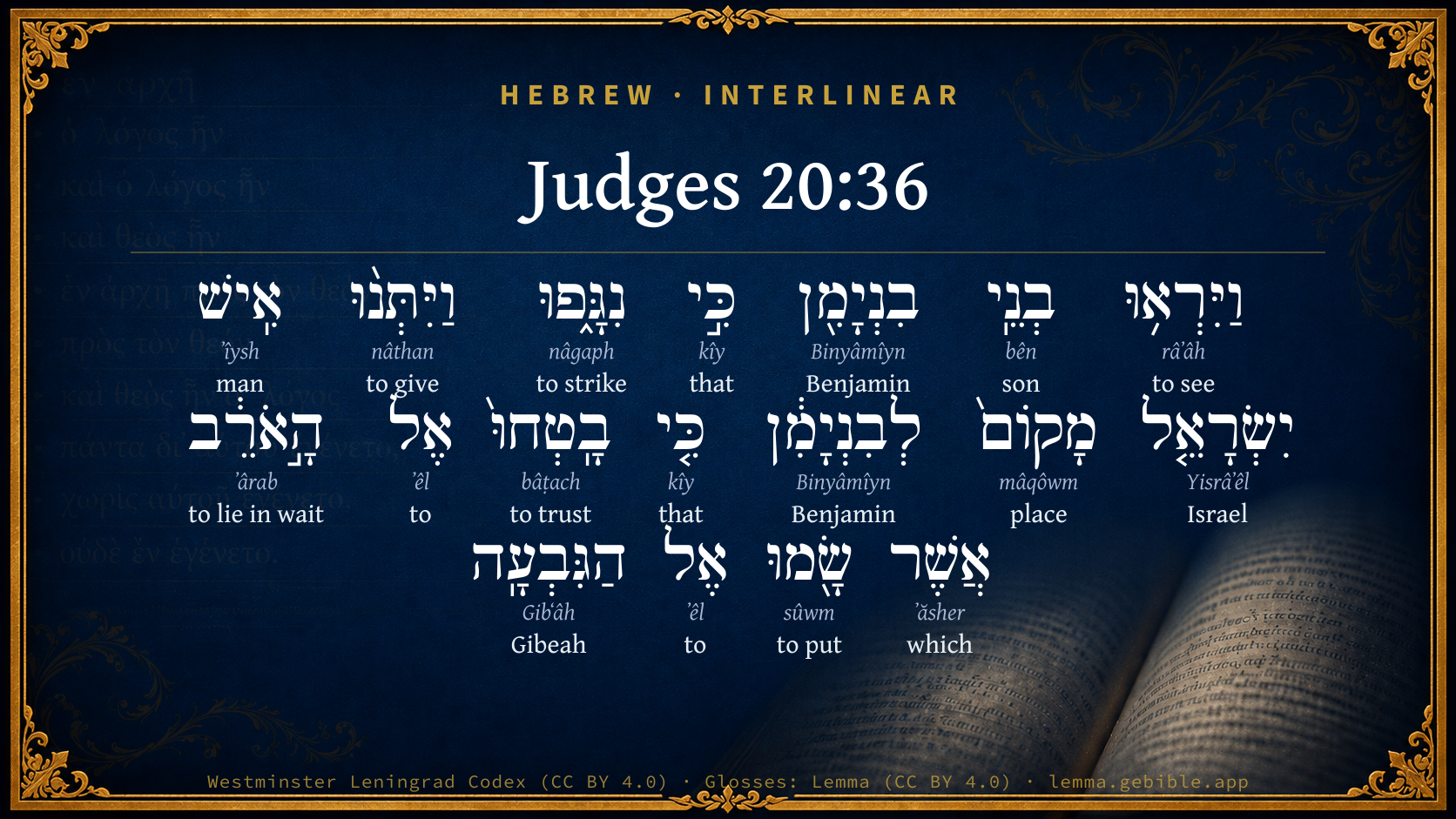
Hebrew (Westminster Leningrad Codex) Judges 20:36 appears in the Hebrew Old Testament. The text above is from the Westminster Leningrad Codex. Each word links to its Strong’s number, a concise gloss, and parsing drawn from the Open Scriptures Hebrew Bible morphology. Click any word for its full Brown-Driver-Briggs (BDB) entry.
Download image
Cite this verse

Judges 20:36 (World English Bible). Public Domain. Lemma interlinear Bible study tool, https://lemma.gebible.app/v/judges/20/36.

Show BibTeX & RIS
BibTeX
RIS
English Translation
So the children of Benjamin saw that they were struck; for the men of Israel gave place to Benjamin, because they trusted to the liers-in-wait whom they had set against Gibeah.
World English Bible · Public Domain
Download a study sheet

One document with this verse’s original text, its word-by-word gloss line, the meaning frame, cross-references with their text, attributed commentary, and full source and license credits — printable, and it pastes into notes with its structure intact.

This verse Autodidact and up

Study sheet (.html) Plain text (.txt)

A passage Seminary Student

Up to 50 verses in one chapter. A passage sheet keeps up to 6 commentary sources and 12 cross-references per verse, in the order this page ranks them, and says so on the sheet whenever that leaves anything out. Ask for a single verse and you get the Autodidact verse sheet above.

Everything on this page stays free to read, with no account — the sheet is a download of what is already on screen, not access to it.

Want to remove ads? Support Godless Engineer
Compare translations 3

The same verse in 3 English versions, stacked beneath the original-language interlinear above. Click any original word for its lexicon entry.

Each is an independent rendering of the whole verse — the interlinear is not word-aligned to these translations.

Highlighted words mark where these versions differ — a whole-verse word diff, not a word-by-word alignment.

  • World English Bible Public Domain
    So the children of Benjamin saw that they were struck; for the men of Israel gave place to Benjamin, because they trusted to the liers-in-wait whom they had set against Gibeah.
  • King James Version Public Domain
    So the children of Benjamin saw that they were smitten: for the men of Israel gave place to the Benjamites, because they trusted unto the liers in wait which they had set beside Gibeah.
  • unfoldingWord Literal Text CC BY-SA 4.0
    And the sons of Benjamin saw that they were defeated. For the men of Israel had given place to Benjamin because they were confident in the ambush that they had set against Gibeah.

unfoldingWord Literal Text — © unfoldingWord, licensed CC BY-SA 4.0. Word-aligned USFM3 via Door43 (git.door43.org/unfoldingWord/en_ult).

Versions to compare (up to 4)

3 of 4 selected

Show all 18 translations

Every available English version of this verse, each an independent rendering of the whole verse.

  • World English Bible Public Domain
    So the children of Benjamin saw that they were struck; for the men of Israel gave place to Benjamin, because they trusted to the liers-in-wait whom they had set against Gibeah.
  • Berean Standard Bible Public Domain
    Then the Benjamites realized they had been defeated. Now the men of Israel had retreated before Benjamin because they were relying on the ambush they had set against Gibeah.
  • Majority Standard Bible Public Domain
    Then the Benjamites realized they had been defeated. Now the men of Israel had retreated before Benjamin because they were relying on the ambush they had set against Gibeah.
  • King James Version Public Domain
    So the children of Benjamin saw that they were smitten: for the men of Israel gave place to the Benjamites, because they trusted unto the liers in wait which they had set beside Gibeah.
  • American Standard Version (1901) Public Domain
    So the children of Benjamin saw that they were smitten; for the men of Israel gave place to Benjamin, because they trusted unto the liers-in-wait whom they had set against Gibeah.
  • Revised Version (1885) Public Domain
    So the children of Benjamin saw that they were smitten: for the men of Israel gave place to Benjamin, because they trusted unto the liers in wait which they had set against Gibeah.
  • Geneva Bible (1599) Public Domain
    So the children of Beniamin sawe that they were striken downe: for the men of Israel gaue place to the Beniamites, because they trusted to the men that lay in waite, which they had laide beside Gibeah.
  • Douay-Rheims (1899) Public Domain
    But the children of Benjamin when they saw themselves to be too weak, began to flee. Which the children of Israel seeing, gave them place to flee, that they might come to the ambushes that were prepared, which they had set near the city.
  • Young's Literal Translation Public Domain
    And the sons of Benjamin see that they have been smitten -- and the men of Israel give place to Benjamin, for they have trusted unto the ambush which they had set against Gibeah,
  • Literal Standard Version CC BY-SA 4.0
    And the sons of Benjamin see that they have been struck—and the men of Israel give place to Benjamin, for they have trusted in the ambush which they had set against Gibeah,
  • Unlocked Literal Bible CC BY-SA 4.0
    So the soldiers of Benjamin saw they were defeated. The men of Israel had given ground to Benjamin, because they were counting on the men they had placed in hidden positions outside Gibeah.
  • unfoldingWord Literal Text CC BY-SA 4.0
    And the sons of Benjamin saw that they were defeated. For the men of Israel had given place to Benjamin because they were confident in the ambush that they had set against Gibeah.
  • Darby Bible Public Domain
    So the Benjaminites saw that they were defeated. The men of Israel gave ground to Benjamin, because they trusted to the men in ambush whom they had set against Gib'e-ah.
  • World Messianic Bible Public Domain
    So the children of Benjamin saw that they were struck, for the men of Israel yielded to Benjamin because they trusted the ambushers whom they had set against Gibeah.
  • Webster's Bible Public Domain
    So the children of Benjamin saw that they were smitten: for the men of Israel gave place to the Benjaminites, because they trusted to the liers in wait which they had set beside Gibeah.
  • Free Bible Version CC BY-SA 4.0
    The Benjamites saw that they were defeated. The Israelites had fallen back before the Benjamites because they were confident the ambush they had put in place near Gibeah would be successful.
  • Bible in Basic English Public Domain
    So the children of Benjamin saw that they were overcome: and the men of Israel had given way before Benjamin, putting their faith in the watchers who were to make the surprise attack on Gibeah.
  • JPS Tanakh (1917) Public Domain
    So the children of Benjamin saw that they were smitten. And the men of Israel gave place to Benjamin, because they trusted unto the liers-in-wait whom they had set against Gibeah. —

Literal Standard Version (2020), Covenant Press — licensed CC BY-SA 4.0. Text via the HelloAO Bible API (eBible.org). Unlocked Literal Bible (unfoldingWord) — licensed CC BY-SA 4.0. Text via the HelloAO Bible API (eBible.org). unfoldingWord Literal Text — © unfoldingWord, licensed CC BY-SA 4.0. Word-aligned USFM3 via Door43 (git.door43.org/unfoldingWord/en_ult). Free Bible Version, Dr. Jonathan Gallagher — licensed CC BY-SA 4.0. Text via the HelloAO Bible API (eBible.org).

Word by word

More ways to search: Search by grammar → Find every occurrence → Compare this word →

Practice this passage: Drill this verse → Learn its vocabulary →

הָ֣אֹרֵ֔ב
ʼârab
H693
“the · lying in wait”
Particle, Definite Article + Verb, Qal, Participle Active, Masculine, Singular, Absolute
Part of Speech
Particle + Verb
Stem
Qal
Form
Participle Active
Gender
Masculine
Number
Singular
State
Absolute
Full BDB Definition

Origin: a primitive root

TWOT: 156

to lie in wait, ambush, lurk - (Qal) - to lie in wait - ambush (participle as subst) - (Piel) ambushers, liers-in-wait (plural participle) - (Hiphil) to lay an ambush
  1. וַיִּרְא֥וּ râʼâh H7200 “and · to see” Conjunction + Verb, Qal, Sequential Imperfect, 3rd Person, Masculine, Plural
  2. בְנֵֽי bên H1121 “sons of” Noun, Common, Masculine, Plural, Construct
  3. בִנְיָמִ֖ן Binyâmîyn H1144 “Benjamin” Noun, Proper
  4. כִּ֣י kîy H3588 “that” Conjunction
  5. נִגָּ֑פוּ nâgaph H5062 “to strike” Verb, Niphal, Perfect, 3rd Person, Common, Plural
  6. וַיִּתְּנ֨וּ nâthan H5414 “and · to give” Conjunction + Verb, Qal, Sequential Imperfect, 3rd Person, Masculine, Plural
  7. אִֽישׁ ʼîysh H376 “man of” Noun, Common, Masculine, Singular, Construct
  8. יִשְׂרָאֵ֤ל Yisrâʼêl H3478 “Israel” Noun, Proper
  9. מָקוֹם֙ mâqôwm H4725 “place” Noun, Common, Masculine, Singular, Absolute
  10. לְבִנְיָמִ֔ן Binyâmîyn H1144 “to/for · Benjamin” Preposition + Noun, Proper
  11. כִּ֤י kîy H3588 “that” Conjunction
  12. בָֽטְחוּ֙ bâṭach H982 “to trust” Verb, Qal, Perfect, 3rd Person, Common, Plural
  13. אֶל ʼêl H413 “to” Preposition
  14. אֲשֶׁר ʼăsher H834 “which” Particle, Relative
  15. שָׂ֖מוּ sûwm H7760 “to put” Verb, Qal, Perfect, 3rd Person, Common, Plural
  16. אֶל ʼêl H413 “to” Preposition
  17. הַגִּבְעָֽה Gibʻâh H1390 “the · Gibeah” Particle, Definite Article + Noun, Proper

About this verse

These counts appear in no published source. They are computed here, from the morphology-tagged text and Lemma’s own curated glosses. What Lemma adds →

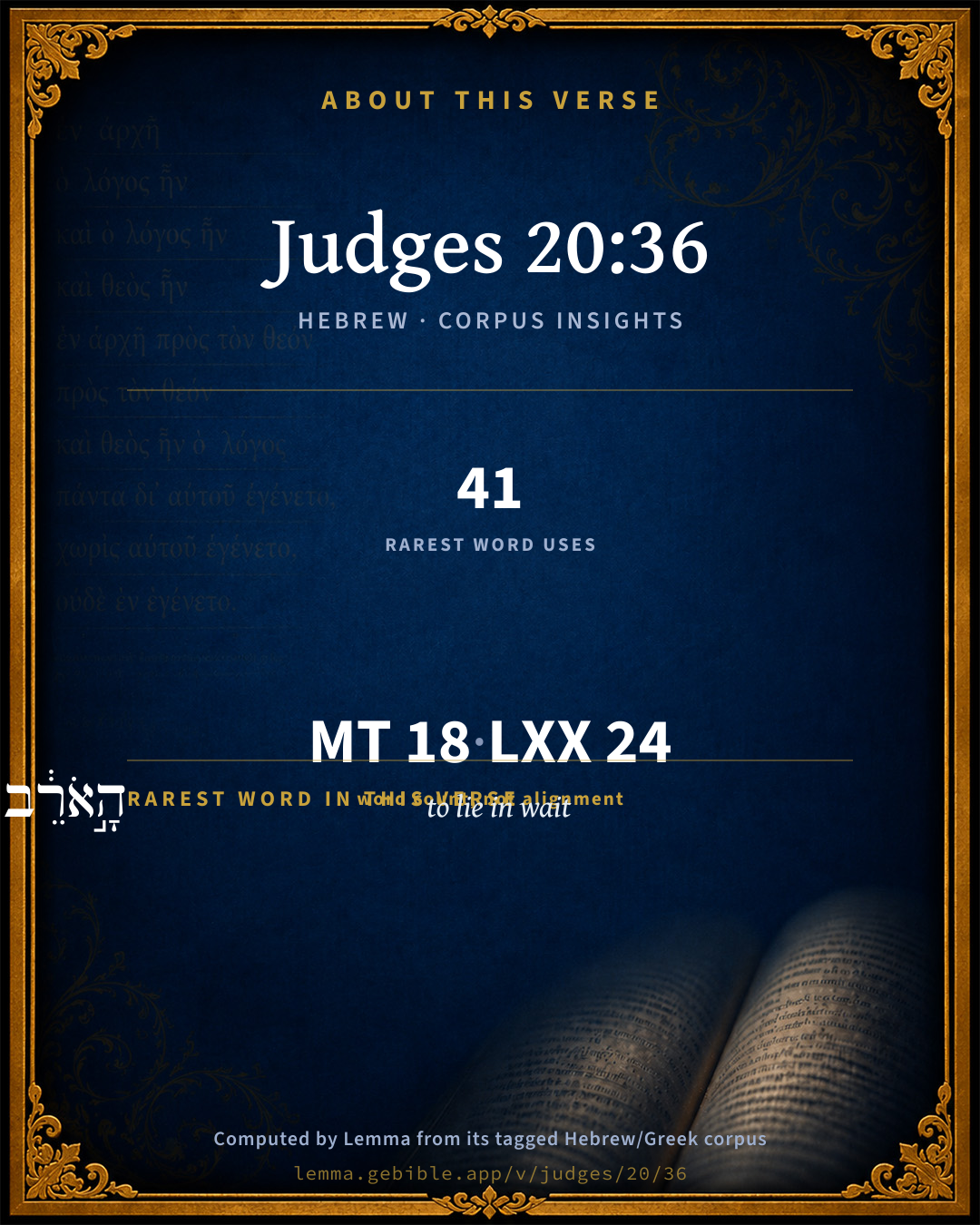
18
words
15
distinct lemmas
Historical
section

Shared distinctive vocabulary

הָ֣אֹרֵ֔ב to lie in wait H693 occurs in 39 verses of the Hebrew Bible. Also found in:

Grammatical profile

  • 6 verbs
  • 7 nouns
  • 2 prepositions
  • 2 conjunctions
  • 1 particle

Verb forms

  • וַיִּרְא֥וּ Qal · Sequential Imperfect
  • נִגָּ֑פוּ Niphal · Perfect
  • וַיִּתְּנ֨וּ Qal · Sequential Imperfect
  • בָֽטְחוּ֙ Qal · Perfect
  • הָ֣אֹרֵ֔ב Qal · Participle Active
  • שָׂ֖מוּ Qal · Perfect

Repetition

Words recur within this verse — often emphatic in Hebrew:

  • בִנְיָמִ֖ן Benjamin H1144 ×2
  • כִּ֣י that H3588 ×2
  • אֶל to H413 ×2

Hebrew & Septuagint length

In English translation the verse runs 31 words from the Hebrew and 31 from the Septuagint (LXX English) — the same length.

A rough comparison of the two English renderings, which tokenize alike — not a word-level alignment.

Word counts can differ between the Hebrew and the Greek without any difference in meaning — e.g. the Hebrew direct-object marker אֵת has no separate Greek word, and Greek often adds the article ὁ.

In the original languages it is 18 Hebrew tokens and 24 Greek tokens — but the two are counted differently (Hebrew bundles its prefixes and suffixes into one token; the Greek is in lemma form), so that isn’t a like-for-like length.

Cross-references

1

Topical passages linked to Judges 20:36 in the Treasury of Scripture Knowledge — connected by theme and wording, ordered by reader-vote popularity; previews shown in the World English Bible.

  • Joshua 8:15–29 Joshua and all Israel made as if they were beaten before them, and fled by the way of the wilderness.

Cross-references courtesy of OpenBible.info (CC BY 4.0).

Hebrew and Greek witnesses Masoretic Hebrew ↔ Greek Septuagint

The same verse in the two great witnesses to the Old Testament, shown verse-for-verse.

These are two independent witnesses, not word-aligned to each other, and the Septuagint is shown in lemma (dictionary) form.

Hebrew Judges 20:36 Masoretic · Westminster Leningrad Codex

וַיִּרְא֥וּ בְנֵֽי בִנְיָמִ֖ן כִּ֣י נִגָּ֑פוּ וַיִּתְּנ֨וּ אִֽישׁ יִשְׂרָאֵ֤ל מָקוֹם֙ לְבִנְיָמִ֔ן כִּ֤י בָֽטְחוּ֙ אֶל הָ֣אֹרֵ֔ב אֲשֶׁר שָׂ֖מוּ אֶל הַגִּבְעָֽה

So the children of Benjamin saw that they were struck; for the men of Israel gave place to Benjamin, because they trusted to the liers-in-wait whom they had set against Gibeah.

World English Bible · Public Domain

Greek LXX Judges 20:36 Septuagint · lemma form

καί ὁράω ὁ υἱός βενιαμίν ὅτι πλήσσω καί δίδωμι ἀνήρ ἰσραήλ τόπος ὁ βενιαμίν ὅτι ἐλπίζω πρός ὁ ἔνεδρον ὅς τίθημι ἐπί ὁ γαβαα

And the children of Benjamin saw that they were struck; and the men of Israel gave place to Benjamin, because they trusted in the ambuscade which they had prepared against Gabaa.

LXX2012 (modern English Septuagint) · Public Domain

On this verse, The Pulpit Commentary discusses the Septuagint’s reading. Read the note in Commentary ↓

Hebrew: Westminster Leningrad Codex (CC BY 4.0). Greek: Septuagint (public domain); English from LXX2012 (modern English Septuagint) (Public Domain). How the Septuagint differs from the Hebrew →

Targum (Aramaic paraphrase)

1

The Targum is the ancient Jewish Aramaic paraphrase of the Hebrew Scriptures — an interpretive translation, not the Hebrew text itself. Onkelos (literal) and Pseudo-Jonathan (expansive) render the Torah, and Jonathan the Prophets. Coverage is partial: where no permissively-licensed English translation exists for a verse, only the Aramaic is shown. This is verse-level text, not a word-by-word alignment to the Hebrew.

  1. Targum Jonathan Prophets (Joshua–Malachi)
    וַחֲזוֹ בְנֵי בִנְיָמִין אֲרֵי אִתְבָּרוּ וִיהֲבוּ אֱנַשׁ יִשְׂרָאֵל אֲתַר לְבִנְיָמִין אֲרֵי אִתְרְחִיצוּ עַל כְּמָנָא דְשַׁוִיאוּ עַל גִבְעֲתָא:

    (no public-domain English translation for this verse)

    Targum Jonathan — Aramaic: “Mikraot Gedolot” (public domain). English: “Sefaria Community Translation” (CC0 1.0 (public-domain dedication)); “London "Chaldee Paraphrase," 1871” (public domain). Text via Sefaria.

Commentary

Notes on Judges 20:36 from classic Christian and Jewish commentators (each source and its license shown beneath its notes). The classic Christian expositions comment on the surrounding passage and are grouped to its opening verse, so a note may address several verses; the Jewish commentaries on the Tanakh (Rashi and others) are per-verse, so they appear only where the commentator wrote on this verse.

Lemma curates 59 commentaries, every one of them public domain or Creative Commons licensed, each selected and text-cleaned for this edition rather than reprinted as found. About our sources →

Trapp's Complete Commentary

John Trapp

Jdg 20:36 So the children of Benjamin saw that they were smitten: for the men of Israel gave place to the Benjamites, because they trusted unto the liers in wait which they had set beside Gibeah.

Ver. 36. Because they trusted unto the liers in wait.] As the instruments; but they trusted in God as the chief agent.

John Trapp, A Commentary or Exposition upon All the Books of the Old and New Testament (1647–1656) — public domain. Text from a community e-Sword module.

Joseph Benson's Commentary

Jdg 20:36-37. The children of Benjamin saw that they were smitten — Namely, when they saw the flame in Gibeah, as mentioned Jdg 20:40. But after these words, in the following part of the verse, begins a relation of the whole day’s action, the particulars of which are related in the following verses. The liers in wait drew themselves along — Or extended themselves; whereas before they lay close, and contracted into a narrow compass, now they spread themselves, and marched in rank and file as armies do.

Joseph Benson's Commentary on the Old and New Testaments (1811–1818) — public domain. Text from a community e-Sword module.

Geneva Bible (1599)

Geneva Bible translators

Retired to draw them after.

Geneva Bible (1599) marginal notes — public domain. Text via Bolls.life.

Ellicott's Commentary for English Readers

(36) That they were smitten.—The “they” refers to the Israelites. The rest of the verse gives the reason for the feigned flight.

A Bible Commentary for English Readers, edited by Charles John Ellicott (1878–1897) — public domain. Text from a community e-Sword module.

The Cambridge Bible for Schools and Colleges

gen. ed. J. J. S. Perowne

36. the children of Benjamin] must refer to the 600 survivors. This half verse introduces the account of the flight, which is continued by Jdg_20:42.

Clause b may be regarded as a continuation of Jdg_20:29 in the narrative of A; the description of the feint is parallel to that in Jdg_20:32 b.

The Cambridge Bible for Schools and Colleges (gen. ed. J. J. S. Perowne; Cambridge University Press, 1878–1918) — public domain. Text from a community e-Sword module.

John Gill's Exposition

And the liers in wait hasted,.... When the time was come agreed upon for them to rise out of their ambush:

and rushed upon Gibeah; at unawares, with great force and violence entered the city, and took possession of it; or "extended" (x), or spread themselves unto it; before they lay close in a narrow compass, but now they put themselves in a regular order, and marched rank and file, and reached from the meadows in which they were, Jdg 20:33, to the city:

and the liers in wait drew themselves along; along the city, in every part of it, spread themselves all over it, and made themselves masters of every corner of it; or "made a long sound" (y) with a trumpet, protracted that to a great length, which was done to terrify the inhabitants, or to let the Israelites know they were possessed of the city:

and smote all the city with the edge of the sword; old men, women, and children, who were not able to bear arms.

(x) "extenderunt se", Tigurine version. (y) "pertraxerunt buccinae sonitum", Paguninus; so Jarchi and Limchi.

John Gill's Exposition of the Whole Bible (1746–1763) — public domain (CC PDM 1.0). Text via the HelloAO Bible API.

Haydock's Catholic Bible Commentary

Flee; some towards the city, others to the wilderness, and to Remmon, ver. 45. (Haydock) --- That. Hebrew, "because they confided in those whom they had place din ambush, near Gabaa." Hence they were not so eager to prevent their flight, by surrounding them.

George Leo Haydock (1774–1849), Haydock's Catholic Family Bible and Commentary, 1859 edition — public domain. Excludes Psalms (Douay-Rheims chapter numbering differs from Protestant) and Deuterocanonical books (Catholic canon only).

Whedon's Commentary on the Bible

Daniel D. Whedon

36. Gave place — Fled, as described in Jdg_20:32.

Daniel D. Whedon (gen. ed.), Commentary on the Old and New Testaments (1874–1909) — public domain. Text from a community e-Sword module.

The Pulpit Commentary

Vers. 36-41. The children of Benjamin saw that they were smitten. Not of course after 25, 000 of them had been smitten, but at that period of the battle more fully described in vers. 40, 41, when the Benjamites, looking behind them, saw Gibeah in flames, and immediately broke and fled towards the wilderness. In the latter half of this verse and in the following verses to ver. 41 the writer recapitulates all the preceding circumstances, some of which have been already mentioned, which led to the particular incident mentioned in the beginning of the verse, that "Benjamin saw that they were smitten;" viz., the feigned flight of the Israelites, the seizing and burning of Gibeah by the liers in wait, the signal of a great smoke, and the turning again of the flying Israelites. It was then that "the men of Benjamin saw that evil was come upon them," and turned their backs and fled. Thus vers. 36 (latter half)-41 bring us back through the details to the identical point already reached at the beginning of ver. 36. In vers. 39, 40 there is another retrograde movement in the narrative, in which the statement of vers. 31, 32 is repeated in order to bring into close juxtaposition Benjamin"s keen pursuit of the enemy with his terror when he saw the smoke rising in his rear. Hasted (ver. 37). This is an amplification with further particulars of ver. 33. The liers in wait not only came forth out of their place, but they made a dash to get into Gibeah before the men of Gibeah, who were pursuing the flying Israelites, could be aware of their intention. Rushed upon. Perhaps better rendered fell upon. It is exactly the same phrase as 1Sa_27:8, there rather tamely rendered in vaded and in ver. 10 made a road. Drew themselves along. Some take the word in the common sense of blowing the trumpet, but it rather means spread themselves out (execuyh , LXX) through the defenceless city, so as to slay and burn in all parts simultaneously. That they should make a great flame with smoke, etc. (ver. 38). The Hebrew of this verse is difficult to construe, but the A.V gives substantially the right sense. They seem to be the very orders given to the leader of the ambush. "Make them (the ambush) multiply to send up (i.e. send up in great quantities) the column of smoke from the city." It seems that the appearance of the smoke was the signal for the Israelites to turn (ver. 41). The flame, etc. (ver. 40). Rather, the column began to go up in (or as) a pillar of smoke. The flame of the city. Literally, the whole of the city, meaning of course the whole city in flames.

The Pulpit Commentary (1880–1919), ed. H.D.M. Spence-Jones & Joseph S. Exell — public domain. Text from a community e-Sword module.

unfoldingWord translationNotes

Door43 World Missions Community

The men of Israel had given ground to Benjamin, because they were counting on the men ... outside Gibeah

From this sentence until the end of verse 41 is background information that the writer inserted to explain to the readers how the ambush defeated the Benjamites. (See: Background Information)

had given ground to Benjamin

This is an idiom that means they intentionally retreated. AT: "had allowed Benjamin to move forward" (See: Idiom)

they were counting on the men

This is an idiom that means they trusted their men. (See: Idiom)

unfoldingWord translationNotes — © Distant Shores Media and the Door43 World Missions Community, licensed CC BY-SA 4.0. Source: git.door43.org/Door43/en_tn.

Rashi

Rabbi Shlomo Yitzchaki (Rashi)

The Yisroelite troops gave. Those in the field gave ground to Binyomin to escape to Givoh, since the Yisroelites depended on the ambushers to advance toward them.

Rashi on the Tanakh — English translations: “The Judaica Press complete Tanach with Rashi, translated by A. J. Rosenberg” (CC BY 4.0); “Pentateuch with Rashi's commentary by M. Rosenbaum and A.M. Silbermann, 1929-1934” (public domain); “The Metsudah Tanach series, Lakewood, N.J” (CC BY 4.0); and “The Book of Joshua, Metsudah Publications, 1997” (CC BY 4.0). Text via Sefaria.

Lesson kit

Teaching starters — assembled from the data on this page, not authored interpretation. Every prompt links to the verse data it draws on. Edit before teaching.

Judges, in the Historical, opens this verse with 18 words (15 distinct Hebrew lemmas). Its most distinctive word is ʼârab (“to lie in wait”). A historical commentator’s framing appears above. Read the whole chapter for the surrounding context.

Discussion questions

  1. The word ʼârab carries the sense “to lie in wait.” How does it shape the verse?
  2. How does Deuteronomy 19:11, which shares the word «to lie in wait», read alongside this verse?
  3. What does the repetition of “Benjamin” (2× in this one verse) do in this verse?
  4. These translations render this verse differently. What is at stake in choosing one wording over another?
  5. «וַיִּרְא֥וּ» is a Qal Sequential Imperfect verb. How does that grammatical form shape the action described?
  6. Compare how Trapp's Complete Commentary and Joseph Benson's Commentary read this verse. Where do they agree or differ?

Things to notice

Reading settings

Reading text

Shown beneath each verse's original-language words.

Old Testament
Old Testament edition

Read the OT as the Masoretic Hebrew (MT) or the Greek Septuagint (LXX).

English shown for the Greek Septuagint (in the Hebrew ↔ Greek comparison).

Comparing translations? Open the Compare panel on any verse page to stack up to four side by side.