
Exodus 4:15

Hebrew (Westminster Leningrad Codex) Exodus 4:15 appears in the Hebrew Old Testament. The text above is from the Westminster Leningrad Codex. Each word links to its Strong’s number, a concise gloss, and parsing drawn from the Open Scriptures Hebrew Bible morphology. Click any word for its full Brown-Driver-Briggs (BDB) entry.
Download image
Cite this verse

Exodus 4:15 (World English Bible). Public Domain. Lemma interlinear Bible study tool, https://lemma.gebible.app/v/exodus/4/15.

Show BibTeX & RIS
BibTeX
RIS
English Translation
You shall speak to him, and put the words in his mouth. I will be with your mouth, and with his mouth, and will teach you what you shall do.
World English Bible · Public Domain
Download a study sheet

One document with this verse’s original text, its word-by-word gloss line, the meaning frame, cross-references with their text, attributed commentary, and full source and license credits — printable, and it pastes into notes with its structure intact.

This verse Autodidact and up

Study sheet (.html) Plain text (.txt)

A passage Seminary Student

Up to 50 verses in one chapter. A passage sheet keeps up to 6 commentary sources and 12 cross-references per verse, in the order this page ranks them, and says so on the sheet whenever that leaves anything out. Ask for a single verse and you get the Autodidact verse sheet above.

Everything on this page stays free to read, with no account — the sheet is a download of what is already on screen, not access to it.

Want to remove ads? Support Godless Engineer
Compare translations 3

The same verse in 3 English versions, stacked beneath the original-language interlinear above. Click any original word for its lexicon entry.

Each is an independent rendering of the whole verse — the interlinear is not word-aligned to these translations.

Highlighted words mark where these versions differ — a whole-verse word diff, not a word-by-word alignment.

  • World English Bible Public Domain
    You shall speak to him, and put the words in his mouth. I will be with your mouth, and with his mouth, and will teach you what you shall do.
  • King James Version Public Domain
    And thou shalt speak unto him, and put words in his mouth: and I will be with thy mouth, and with his mouth, and will teach you what ye shall do.
  • unfoldingWord Literal Text CC BY-SA 4.0
    And you shall speak to him, and you shall put the words in his mouth. And I am with your mouth and with his mouth, and I will teach you both what you should do.

unfoldingWord Literal Text — © unfoldingWord, licensed CC BY-SA 4.0. Word-aligned USFM3 via Door43 (git.door43.org/unfoldingWord/en_ult).

Versions to compare (up to 4)

3 of 4 selected

Show all 18 translations

Every available English version of this verse, each an independent rendering of the whole verse.

  • World English Bible Public Domain
    You shall speak to him, and put the words in his mouth. I will be with your mouth, and with his mouth, and will teach you what you shall do.
  • Berean Standard Bible Public Domain
    You are to speak to him and put the words in his mouth. I will help both of you to speak, and I will teach you what to do.
  • Majority Standard Bible Public Domain
    You are to speak to him and put the words in his mouth. I will help both of you to speak, and I will teach you what to do.
  • King James Version Public Domain
    And thou shalt speak unto him, and put words in his mouth: and I will be with thy mouth, and with his mouth, and will teach you what ye shall do.
  • American Standard Version (1901) Public Domain
    And thou shalt speak unto him, and put the words in his mouth: and I will be with thy mouth, and with his mouth, and will teach you what ye shall do.
  • Revised Version (1885) Public Domain
    And thou shalt speak unto him, and put the words in his mouth: and I will be with thy mouth, and with his mouth, and will teach you what ye shall do.
  • Geneva Bible (1599) Public Domain
    Therefore thou shalt speake vnto him, and put the wordes in his mouth, and I will be with thy mouth, and with his mouth, and will teach you what ye ought to doe.
  • Douay-Rheims (1899) Public Domain
    Speak to him, and put my words in his mouth: and I will be in thy mouth, and in his mouth, and will shew you what you must do.
  • Young's Literal Translation Public Domain
    and thou hast spoken unto him, and hast set the words in his mouth, and I -- I am with thy mouth, and with his mouth, and have directed you that which ye do;
  • Literal Standard Version CC BY-SA 4.0
    and you have spoken to him, and have set the words in his mouth, and I am with your mouth, and with his mouth, and have directed you that which you do;
  • Unlocked Literal Bible CC BY-SA 4.0
    You will speak to him and put the words to say into his mouth. I will be with your mouth and with his mouth, and I will show you both what to do.
  • unfoldingWord Literal Text CC BY-SA 4.0
    And you shall speak to him, and you shall put the words in his mouth. And I am with your mouth and with his mouth, and I will teach you both what you should do.
  • Darby Bible Public Domain
    And thou shalt speak unto him, and put the words in his mouth; and I will be with thy mouth, and with his mouth, and will teach you what ye shall do.
  • World Messianic Bible Public Domain
    You shall speak to him, and put the words in his mouth. I will be with your mouth, and with his mouth, and will teach you what you shall do.
  • Webster's Bible Public Domain
    And thou shalt speak to him, and put words in his mouth: and I will be with thy mouth, and with his mouth, and will teach you what ye shall do.
  • Free Bible Version CC BY-SA 4.0
    Speak to him and tell him what to say. I will be your mouth and his mouth, and I will tell you what you are to do.
  • Bible in Basic English Public Domain
    Let him give ear to your voice, and you will put my words in his mouth; and I will be with your mouth and with his, teaching you what you have to do.
  • JPS Tanakh (1917) Public Domain
    And thou shalt speak unto him, and put the words in his mouth; and I will be with thy mouth, and with his mouth, and will teach you what ye shall do.

Literal Standard Version (2020), Covenant Press — licensed CC BY-SA 4.0. Text via the HelloAO Bible API (eBible.org). Unlocked Literal Bible (unfoldingWord) — licensed CC BY-SA 4.0. Text via the HelloAO Bible API (eBible.org). unfoldingWord Literal Text — © unfoldingWord, licensed CC BY-SA 4.0. Word-aligned USFM3 via Door43 (git.door43.org/unfoldingWord/en_ult). Free Bible Version, Dr. Jonathan Gallagher — licensed CC BY-SA 4.0. Text via the HelloAO Bible API (eBible.org).

Word by word

More ways to search: Search by grammar → Find every occurrence → Compare this word →

Practice this passage: Drill this verse → Learn its vocabulary →

וְהוֹרֵיתִ֣י
yârâh
H3384
“and · to throw”
Conjunction + Verb, Hiphil, Sequential Perfect, 1st Person, Common, Singular
Part of Speech
Conjunction + Verb
Stem
Hiphil
Form
Sequential Perfect
Person
1st Person
Gender
Common
Number
Singular
Full BDB Definition

Origin: a primitive root

TWOT: 910

to throw, shoot, cast, pour - (Qal) - to throw, cast - to cast, lay, set - to shoot arrows - to throw water, rain - (Niphal) to be shot - (Hiphil) - to throw, cast - to shoot - to point out, show - to direct, teach, instruct - to throw water, rain
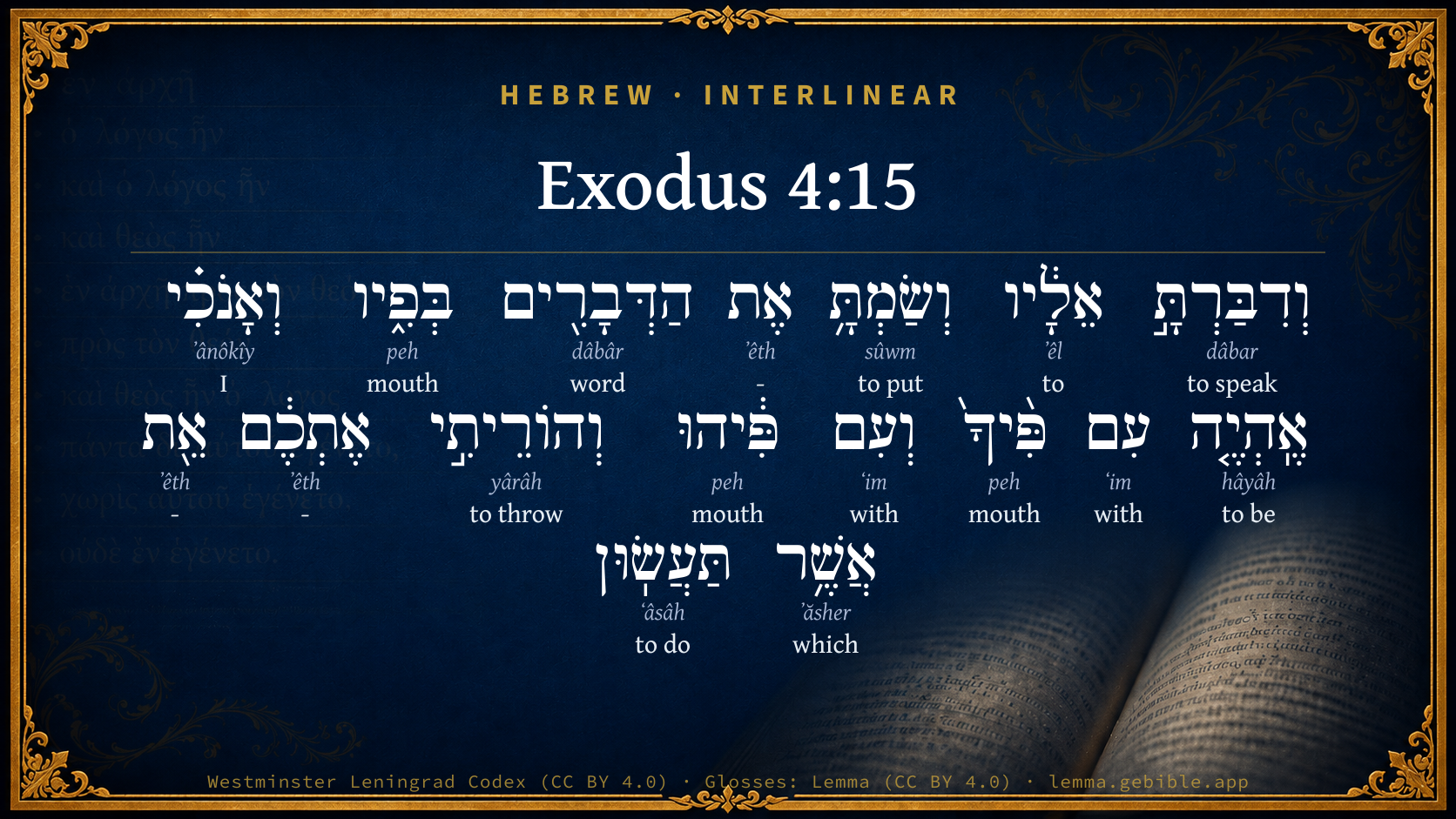
  1. וְדִבַּרְתָּ֣ dâbar H1696 “and · to speak” Conjunction + Verb, Piel, Sequential Perfect, 2nd Person, Masculine, Singular
  2. אֵלָ֔יו ʼêl H413 “to · him” Preposition + Suffix, Personal, 3rd Person, Masculine, Singular
  3. וְשַׂמְתָּ֥ sûwm H7760 “and · to put” Conjunction + Verb, Qal, Sequential Perfect, 2nd Person, Masculine, Singular
  4. אֶת ʼêth H853 “-” Particle, Direct Object
  5. הַדְּבָרִ֖ים dâbâr H1697 “the · words” Particle, Definite Article + Noun, Common, Masculine, Plural, Absolute
  6. בְּפִ֑יו peh H6310 “in/at · mouth · his” Preposition + Noun, Common, Masculine, Singular, Construct + Suffix, Personal, 3rd Person, Masculine, Singular
  7. וְאָנֹכִ֗י ʼânôkîy H595 “and · I” Conjunction + Pronoun, Personal, 1st Person, Common, Singular
  8. אֶֽהְיֶ֤ה hâyâh H1961 “to be” Verb, Qal, Imperfect, 1st Person, Common, Singular
  9. עִם ʻim H5973 “with” Preposition
  10. פִּ֨יךָ֙ peh H6310 “mouth · your” Noun, Common, Masculine, Singular, Construct + Suffix, Personal, 2nd Person, Masculine, Singular
  11. וְעִם ʻim H5973 “and · with” Conjunction + Preposition
  12. פִּ֔יהוּ peh H6310 “mouth · his” Noun, Common, Masculine, Singular, Construct + Suffix, Personal, 3rd Person, Masculine, Singular
  13. אֶתְכֶ֔ם ʼêth H853 “- · you” Particle, Direct Object + Suffix, Personal, 2nd Person, Masculine, Plural
  14. אֵ֖ת ʼêth H853 “-” Particle, Direct Object
  15. אֲשֶׁ֥ר ʼăsher H834 “which” Particle, Relative
  16. תַּעֲשֽׂוּן ʻâsâh H6213 “to do” Verb, Qal, Imperfect, 2nd Person, Masculine, Plural + Suffix, n

About this verse

These counts appear in no published source. They are computed here, from the morphology-tagged text and Lemma’s own curated glosses. What Lemma adds →

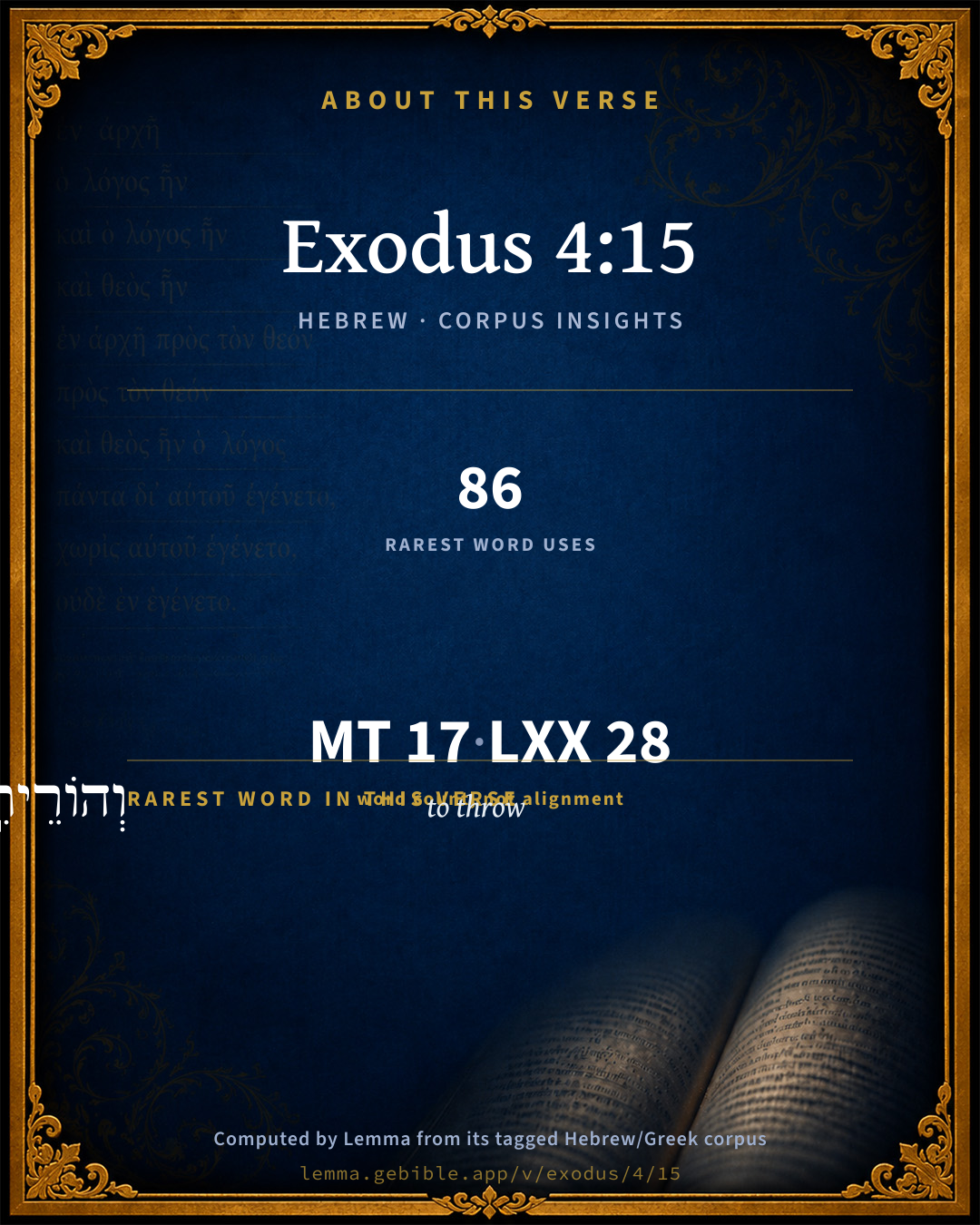
17
words
12
distinct lemmas
Pentateuch
section

Grammatical profile

  • 5 verbs
  • 4 nouns
  • 1 pronoun
  • 3 prepositions
  • 4 particles

Verb forms

  • וְדִבַּרְתָּ֣ Piel · Sequential Perfect
  • וְשַׂמְתָּ֥ Qal · Sequential Perfect
  • אֶֽהְיֶ֤ה Qal · Imperfect
  • וְהוֹרֵיתִ֣י Hiphil · Sequential Perfect
  • תַּעֲשֽׂוּן Qal · Imperfect

Repetition

Words recur within this verse — often emphatic in Hebrew:

  • בְּפִ֑יו mouth H6310 ×3
  • עִם with H5973 ×2

Hebrew & Septuagint length

In English translation the verse runs 30 words from the Hebrew and 34 from the Septuagint (LXX English) — closely comparable.

A rough comparison of the two English renderings, which tokenize alike — not a word-level alignment.

Word counts can differ between the Hebrew and the Greek without any difference in meaning — e.g. the Hebrew direct-object marker אֵת has no separate Greek word, and Greek often adds the article ὁ.

In the original languages it is 17 Hebrew tokens and 28 Greek tokens — but the two are counted differently (Hebrew bundles its prefixes and suffixes into one token; the Greek is in lemma form), so that isn’t a like-for-like length.

Cross-references

16

Topical passages linked to Exodus 4:15 in the Treasury of Scripture Knowledge — connected by theme and wording, ordered by reader-vote popularity; previews shown in the World English Bible.

  • Isaiah 51:16 I have put my words in your mouth, and have covered you in the shadow of my hand, that I may plant the heavens, and lay the foundations of the earth, and tell Zion, You are my people.
  • Numbers 23:5 Yahweh put a word in Balaam's mouth, and said, Return to Balak, and thus you shall speak.
  • Numbers 23:12 He answered and said, Must I not take heed to speak that which Yahweh puts in my mouth?
  • Numbers 23:16 Yahweh met Balaam, and put a word in his mouth, and said, Return to Balak, and thus shall you speak.
  • Deuteronomy 18:18 I will raise them up a prophet from among their brothers, like you; and I will put my words in his mouth, and he shall speak to them all that I shall command him.
  • Luke 21:15 for I will give you a mouth and wisdom which all your adversaries will not be able to withstand or to contradict.
  • Isaiah 59:21 As for me, this is my covenant with them, says Yahweh: my Spirit who is on you, and my words which I have put in your mouth, shall not depart out of your mouth, nor out of the mouth of your seed, nor out of the mouth of your seed's seed, says Yahweh, from henceforth and forever.
  • Jeremiah 1:9 Then Yahweh put forth his hand, and touched my mouth; and Yahweh said to me, Behold, I have put my words in your mouth:
  • Exodus 4:12 Now therefore go, and I will be with your mouth, and teach you what you shall speak."
  • Exodus 7:1–2 Yahweh said to Moses, "Behold, I have made you as God to Pharaoh; and Aaron your brother shall be your prophet.
  • Numbers 22:38 Balaam said to Balak, Behold, I have come to you: have I now any power at all to speak anything? the word that God puts in my mouth, that shall I speak.
  • 2 Samuel 14:3 and go in to the king, and speak on this manner to him. So Joab put the words in her mouth.
  • Matthew 28:20 teaching them to observe all things that I commanded you. Behold, I am with you always, even to the end of the age." Amen.
  • Deuteronomy 5:31 But as for you, stand you here by me, and I will speak to you all the commandment, and the statutes, and the ordinances, which you shall teach them, that they may do them in the land which I give them to possess it.
  • 1 Corinthians 11:23 For I received from the Lord that which also I delivered to you, that the Lord Jesus on the night in which he was betrayed took bread.
  • 1 Corinthians 15:1 Now I declare to you, brothers, the Gospel which I preached to you, which also you received, in which you also stand,

Cross-references courtesy of OpenBible.info (CC BY 4.0).

Hebrew and Greek witnesses Masoretic Hebrew ↔ Greek Septuagint

The same verse in the two great witnesses to the Old Testament, shown verse-for-verse.

These are two independent witnesses, not word-aligned to each other, and the Septuagint is shown in lemma (dictionary) form.

Hebrew Exodus 4:15 Masoretic · Westminster Leningrad Codex

וְדִבַּרְתָּ֣ אֵלָ֔יו וְשַׂמְתָּ֥ אֶת הַדְּבָרִ֖ים בְּפִ֑יו וְאָנֹכִ֗י אֶֽהְיֶ֤ה עִם פִּ֨יךָ֙ וְעִם פִּ֔יהוּ וְהוֹרֵיתִ֣י אֶתְכֶ֔ם אֵ֖ת אֲשֶׁ֥ר תַּעֲשֽׂוּן

You shall speak to him, and put the words in his mouth. I will be with your mouth, and with his mouth, and will teach you what you shall do.

World English Bible · Public Domain

Greek LXX Exodus 4:15 Septuagint · lemma form

καί εἶπον πρός αὐτός καί δίδωμι ὁ ῥῆμα ἐγώ εἰς ὁ στόμα αὐτός καί ἐγώ ἀναοἴγω ὁ στόμα σύ καί ὁ στόμα αὐτός καί συνβιβάζω σύ ὅς ποιέω

And you shall speak to him; and you shall put my words into his mouth, and I will open your mouth and his mouth, and I will instruct you in what you⌃ shall do.

LXX2012 (modern English Septuagint) · Public Domain

Hebrew: Westminster Leningrad Codex (CC BY 4.0). Greek: Septuagint (public domain); English from LXX2012 (modern English Septuagint) (Public Domain). How the Septuagint differs from the Hebrew →

Targum (Aramaic paraphrase)

2

The Targum is the ancient Jewish Aramaic paraphrase of the Hebrew Scriptures — an interpretive translation, not the Hebrew text itself. Onkelos (literal) and Pseudo-Jonathan (expansive) render the Torah, and Jonathan the Prophets. Coverage is partial: where no permissively-licensed English translation exists for a verse, only the Aramaic is shown. This is verse-level text, not a word-by-word alignment to the Hebrew.

  1. Targum Onkelos Torah (Genesis–Deuteronomy)
    וּתְמַלֵל עִמֵהּ וּתְשַׁוִי יָת פִּתְגָמַיָא בְּפוּמֵהּ וּמֵימְרִי יְהֵי עִם פּוּמָךְ וְעִם פּוּמֵהּ וְאַלֵיף יָתְכוֹן יָת דִי תַעְבְּדוּן:

    (no public-domain English translation for this verse)

    Targum Onkelos — Aramaic: “Onkelos Genesis” (public domain); “Onkelos Exodus” (public domain); “Onkelos Leviticus” (public domain); “Onkelos Numbers” (public domain); “Onkelos Deuteronomy” (public domain). English: “Sefaria Community Translation” (CC0 1.0 (public-domain dedication)); “J.W. Etheridge. The Targums of Onkelos and Jonathan Ben Uzziel on the Pentateuch. London: Longmans, Green, 1862” (public domain). Text via Sefaria.

  2. Targum Pseudo-Jonathan Torah (Genesis–Deuteronomy)
    וּתְמַלֵל עִמֵיהּ וּתְשַׁוֵי יַת פִּתְגָמַיָא בְּפוּמֵיהּ וּמֵימְרִי יְהֵי עִם מֵימַר פּוּמָךְ וְעִם מֵימַר פּוּמֵיהּ וְאַלִיף יַתְכוֹן יַת מַה דְתַעַבְּדוּן

    And thou shalt speak with him, and put the matter in his mouth, and My Word shall be with the word of thy mouth, and with the word of his mouth, and I will instruct you what you are to do.

    Targum Pseudo-Jonathan — Aramaic: “Targum Jonathan on Genesis” (public domain); “Targum Jonathan on Exodus” (public domain); “Targum Jonathan on Leviticus” (public domain); “Targum Jonathan on Numbers” (public domain); “Targum Jonathan on Deuteronomy” (public domain). English: “The Targum of Jonathan ben Uzziel, trans. J. W. Etheridge, London, 1862” (public domain). Text via Sefaria.

Commentary

Notes on Exodus 4:15 from classic Christian and Jewish commentators (each source and its license shown beneath its notes). The classic Christian expositions comment on the surrounding passage and are grouped to its opening verse, so a note may address several verses; the Jewish commentaries on the Tanakh (Rashi and others) are per-verse, so they appear only where the commentator wrote on this verse.

Lemma curates 59 commentaries, every one of them public domain or Creative Commons licensed, each selected and text-cleaned for this edition rather than reprinted as found. About our sources →

Trapp's Complete Commentary

John Trapp

Exo 4:15 And thou shalt speak unto him, and put words in his mouth: and I will be with thy mouth, and with his mouth, and will teach you what ye shall do.

Ver. 15. Will teach you.] {See Trapp on "Exo 4:11"} {See Trapp on "Exo 4:12"}

John Trapp, A Commentary or Exposition upon All the Books of the Old and New Testament (1647–1656) — public domain. Text from a community e-Sword module.

Joseph Benson's Commentary

Exo 4:15-16. I will be with thy mouth and with his mouth — Even Aaron that could speak well, yet could not speak to purpose, unless God were with his mouth; without the constant aids of divine grace, the best gifts will fail. Instead of God — To teach and to command him.

Joseph Benson's Commentary on the Old and New Testaments (1811–1818) — public domain. Text from a community e-Sword module.

Geneva Bible (1599)

Geneva Bible translators

Thou shalt instruct him what to say.

Geneva Bible (1599) marginal notes — public domain. Text via Bolls.life.

Adam Clarke's Commentary

Verse 15. I will be with thy mouth, and with his mouth] Ye shall be both, in all things which I appoint you to do in this business, under the continual inspiration of the Most High.

Adam Clarke's Commentary on the Bible (1810–1826) — public domain. Text from a community e-Sword/MySword module.

Ellicott's Commentary for English Readers

(15) Thou shalt . . . put words in his mouth, i.e., Tell him what he is to say—furnish the matter of his speeches, which he will then clothe with appropriate language.

With thy mouth.—Suggesting the matter to thee.

With his mouth.—Suggesting the language to him.

A Bible Commentary for English Readers, edited by Charles John Ellicott (1878–1897) — public domain. Text from a community e-Sword module.

The Cambridge Bible for Schools and Colleges

gen. ed. J. J. S. Perowne

15. put the words, &c.] cf. Num_22:38; Num_23:5; Num_23:12; Num_23:16.

I will be, &c.] The promise of v. 12 is extended here to both the brothers.

15, 16. Aaron is to be, as it were, Moses’ prophet, and to speak the words which Moses places in his mouth,—in particular, the words contained in Exo_3:16-17,—putting them in such a way, and supporting them with such arguments, as may satisfy the people of the reality of Moses’ commission. Cf. in P Exo_7:1.

The Cambridge Bible for Schools and Colleges (gen. ed. J. J. S. Perowne; Cambridge University Press, 1878–1918) — public domain. Text from a community e-Sword module.

John Gill's Exposition

And thou shalt speak unto him, and put words in his mouth,.... Or "things" (z), the matter and substance of what he should say, who being a man of words, an eloquent man, and a good spokesman, would put them into proper language, and express them fluently:

and I will be with thy mouth, and with his mouth, and will teach you what ye shall do; or speak what Moses should say to Aaron, and what Aaron should say to Pharaoh, and to the people of Israel; so that as Aaron was under Moses, and at his direction, they were both dependent on the Lord, and under his direction; and the one, as well as the other, needed his assistance, even Aaron that could speak well. Moses furnished him with matter, he put it into words, and both were instructed and influenced by the Lord what they should say and do.

(z) .

John Gill's Exposition of the Whole Bible (1746–1763) — public domain (CC PDM 1.0). Text via the HelloAO Bible API.

Albert Barnes' Notes on the Bible

Thou shalt speak - Moses thus retains his position as “mediator;” the word comes to him first, he transmits it to his brother.

Albert Barnes' Notes on the Bible (1834–1885) — public domain. Text from a community e-Sword/MySword module.

Matthew Poole's English Annotations

Put words in his mouth, i.e. instruct him what to speak, and command him freely and faithfully to express it. See Isa 51:16; 59:21.

Matthew Poole's English Annotations on the Holy Bible (1683–1685) — public domain. Text from a community e-Sword/MySword module.

Whedon's Commentary on the Bible

Daniel D. Whedon

15, 16. Moses was still to be the mediator, while Aaron was to be the interpreter of God’s word as he received it from Moses. Yet it is instructive to notice that as Moses advances in his work and grows in faith, (and shall we not say, wears away the desert rusticity?) Aaron gradually retires from the prominent position which at first he held, and Moses comes more forward. Aaron is the spokesman, but while we read of the lineage of “that Aaron and Moses,” yet it is always “Moses and Aaron” who come before Pharaoh. It is Aaron who casts down the rod which swallows up the magicians’ rods, and who smites Egypt with the first and mildest blows; but it is Moses who prostrates Pharaoh’s sorcerers with such a stroke that they lift their heads no more, (Exo_9:11,) and it is his rod that strikes the final terrible blows thereafter, till the Red Sea rolls back over Pharaoh.

Daniel D. Whedon (gen. ed.), Commentary on the Old and New Testaments (1874–1909) — public domain. Text from a community e-Sword module.

The Pulpit Commentary

Thou shalt speak unto him and put words in his mouth. Moses was to tell Aaron what to say furnish, i.e., the matter of his speeches and Aaron was to clothe this matter in fitting words. God promised to be with both of their mouths; with Moses", to make him give right directions to Aaron; with Aaron"s, to make him utter them persuasively: Moses" position was still the more honourable one, though Aaron"s might seem the higher to the people.

The Pulpit Commentary (1880–1919), ed. H.D.M. Spence-Jones & Joseph S. Exell — public domain. Text from a community e-Sword module.

John Wesley's Explanatory Notes

I will be with thy mouth and with his mouth - Even Aaron that could speak well, yet could not speak to purpose, unless God were with his mouth; without the constant aids of divine grace, the best gifts will fail.

John Wesley, Explanatory Notes Upon the Whole Bible (1754–1765) — public domain. Text via the GEBible commentary corpus.

Ramban (Nachmanides)

Rabbi Moshe ben Nachman (Ramban / Nachmanides)

AND I WILL BE WITH THY MOUTH. I.e., “to teach you that which you are to speak to Pharaoh.” G-d now told Moses that Aaron will speak on his behalf only to the people, as it is said, And he shall be thy spokesman unto the people, but Moses himself was to speak to Pharaoh. It is possible that this was out of respect to the king. But in the end, Moses came back and said, Behold, I am of uncircumcised lips, and how shall Pharaoh hearken unto me? G-d then permitted him that he should not speak even to Pharaoh. This [consent] was a distinction to Moses, and therefore He said there, See, I have set thee in G-d’s stead to Pharaoh, and Aaron thy brother shall be thy prophet., 7:1 And the intent of the expression [here in the verse], and I will be with his [Aaron’s] mouth, is that his words will find favor with everyone that will hear them.

Ramban (Nachmanides) on the Tanakh — English translation: “Commentary on the Torah by Ramban (Nachmanides). Translated and annotated by Charles B. Chavel. New York, Shilo Pub. House, 1971-1976” (CC BY 4.0). Text via Sefaria.

Lesson kit

Teaching starters — assembled from the data on this page, not authored interpretation. Every prompt links to the verse data it draws on. Edit before teaching.

Exodus, in the Pentateuch, opens this verse with 17 words (12 distinct Hebrew lemmas). Its most distinctive word is yârâh (“to throw”). A historical commentator’s framing appears above. Read the whole chapter for the surrounding context.

Discussion questions

  1. What does “to throw” (yârâh) contribute to the verse as a whole?
  2. Isaiah 51:16 shares this passage’s theme. How do the two illuminate each other?
  3. “mouth” occurs 3× in this one verse. What is the effect of the repetition?
  4. These translations render this verse differently. What is at stake in choosing one wording over another?
  5. The verb «וְדִבַּרְתָּ֣» is Piel Sequential Perfect. How does its form color the action?
  6. Reading how Trapp's Complete Commentary and Joseph Benson's Commentary read this verse, where do the two commentators agree and where do they part?

Things to notice

Reading settings

Reading text

Shown beneath each verse's original-language words.

Old Testament
Old Testament edition

Read the OT as the Masoretic Hebrew (MT) or the Greek Septuagint (LXX).

English shown for the Greek Septuagint (in the Hebrew ↔ Greek comparison).

Comparing translations? Open the Compare panel on any verse page to stack up to four side by side.