
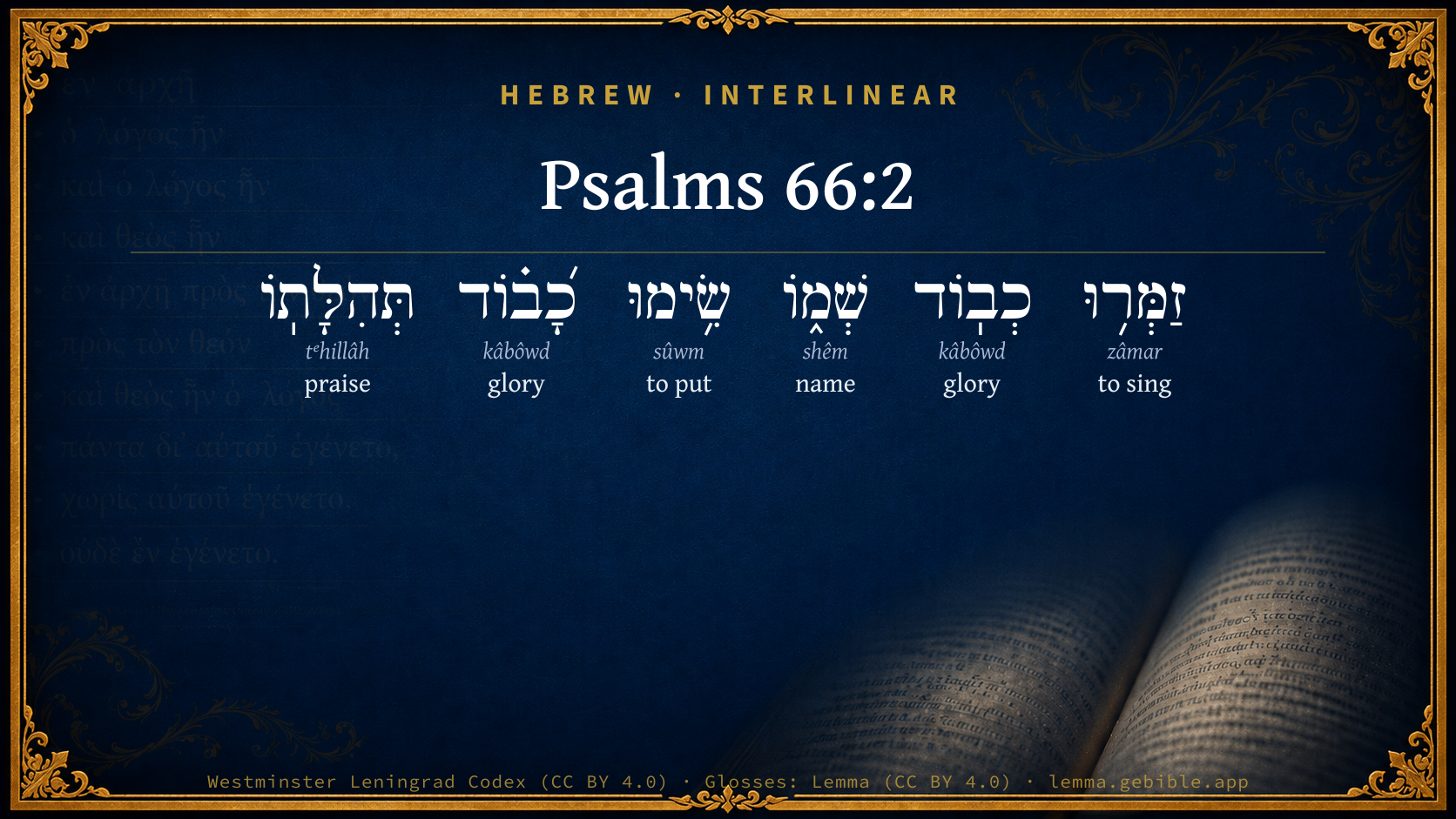
Psalms 66:2

Hebrew (Westminster Leningrad Codex) Psalms 66:2 appears in the Hebrew Old Testament. The text above is from the Westminster Leningrad Codex. Each word links to its Strong’s number, a concise gloss, and parsing drawn from the Open Scriptures Hebrew Bible morphology. Click any word for its full Brown-Driver-Briggs (BDB) entry.
Download image
Cite this verse

Psalms 66:2 (World English Bible). Public Domain. Lemma interlinear Bible study tool, https://lemma.gebible.app/v/psalms/66/2.

Show BibTeX & RIS
BibTeX
RIS
English Translation
Sing to the glory of his name! Offer glory and praise!
World English Bible · Public Domain
Download a study sheet

One document with this verse’s original text, its word-by-word gloss line, the meaning frame, cross-references with their text, attributed commentary, and full source and license credits — printable, and it pastes into notes with its structure intact.

This verse Autodidact and up

Study sheet (.html) Plain text (.txt)

A passage Seminary Student

Up to 50 verses in one chapter. A passage sheet keeps up to 6 commentary sources and 12 cross-references per verse, in the order this page ranks them, and says so on the sheet whenever that leaves anything out. Ask for a single verse and you get the Autodidact verse sheet above.

Everything on this page stays free to read, with no account — the sheet is a download of what is already on screen, not access to it.

Want to remove ads? Support Godless Engineer
Compare translations 3

The same verse in 3 English versions, stacked beneath the original-language interlinear above. Click any original word for its lexicon entry.

Each is an independent rendering of the whole verse — the interlinear is not word-aligned to these translations.

Highlighted words mark where these versions differ — a whole-verse word diff, not a word-by-word alignment.

  • World English Bible Public Domain
    Sing to the glory of his name! Offer glory and praise!
  • King James Version Public Domain
    Sing forth the honour of his name: make his praise glorious.
  • unfoldingWord Literal Text CC BY-SA 4.0
    Make music the glory of his name; make his praise glorious.

unfoldingWord Literal Text — © unfoldingWord, licensed CC BY-SA 4.0. Word-aligned USFM3 via Door43 (git.door43.org/unfoldingWord/en_ult).

Versions to compare (up to 4)

3 of 4 selected

Show all 18 translations

Every available English version of this verse, each an independent rendering of the whole verse.

  • World English Bible Public Domain
    Sing to the glory of his name! Offer glory and praise!
  • Berean Standard Bible Public Domain
    Sing the glory of His name; make His praise glorious.
  • Majority Standard Bible Public Domain
    Sing the glory of His name; make His praise glorious.
  • King James Version Public Domain
    Sing forth the honour of his name: make his praise glorious.
  • American Standard Version (1901) Public Domain
    Sing forth the glory of his name: Make his praise glorious.
  • Revised Version (1885) Public Domain
    Sing forth the glory of his name: make his praise glorious.
  • Geneva Bible (1599) Public Domain
    Sing forth the glory of his name: make his praise glorious.
  • Douay-Rheims (1899) Public Domain
    sing ye a psalm to his name; give glory to his praise.
  • Young's Literal Translation Public Domain
    Praise ye the honour of His name, Make ye honourable His praise.
  • Literal Standard Version CC BY-SA 4.0
    Praise the glory of His Name, || Make honorable His praise.
  • Unlocked Literal Bible CC BY-SA 4.0
    Sing out the glory of his name; make his praise glorious.
  • unfoldingWord Literal Text CC BY-SA 4.0
    Make music the glory of his name; make his praise glorious.
  • Darby Bible Public Domain
    Sing forth the glory of his name, make his praise glorious;
  • World Messianic Bible Public Domain
    Sing to the glory of his name! Offer glory and praise!
  • Webster's Bible Public Domain
    Sing forth the honor of his name: make his praise glorious.
  • Free Bible Version CC BY-SA 4.0
    Sing about his marvelous reputation; praise him for his goodness!
  • Bible in Basic English Public Domain
    Make a song in honour of his name: give praise and glory to him.
  • JPS Tanakh (1917) Public Domain
    Sing praises unto the glory of His name; make His praise glorious.

Literal Standard Version (2020), Covenant Press — licensed CC BY-SA 4.0. Text via the HelloAO Bible API (eBible.org). Unlocked Literal Bible (unfoldingWord) — licensed CC BY-SA 4.0. Text via the HelloAO Bible API (eBible.org). unfoldingWord Literal Text — © unfoldingWord, licensed CC BY-SA 4.0. Word-aligned USFM3 via Door43 (git.door43.org/unfoldingWord/en_ult). Free Bible Version, Dr. Jonathan Gallagher — licensed CC BY-SA 4.0. Text via the HelloAO Bible API (eBible.org).

Word by word

More ways to search: Search by grammar → Find every occurrence → Compare this word →

Practice this passage: Drill this verse → Learn its vocabulary →

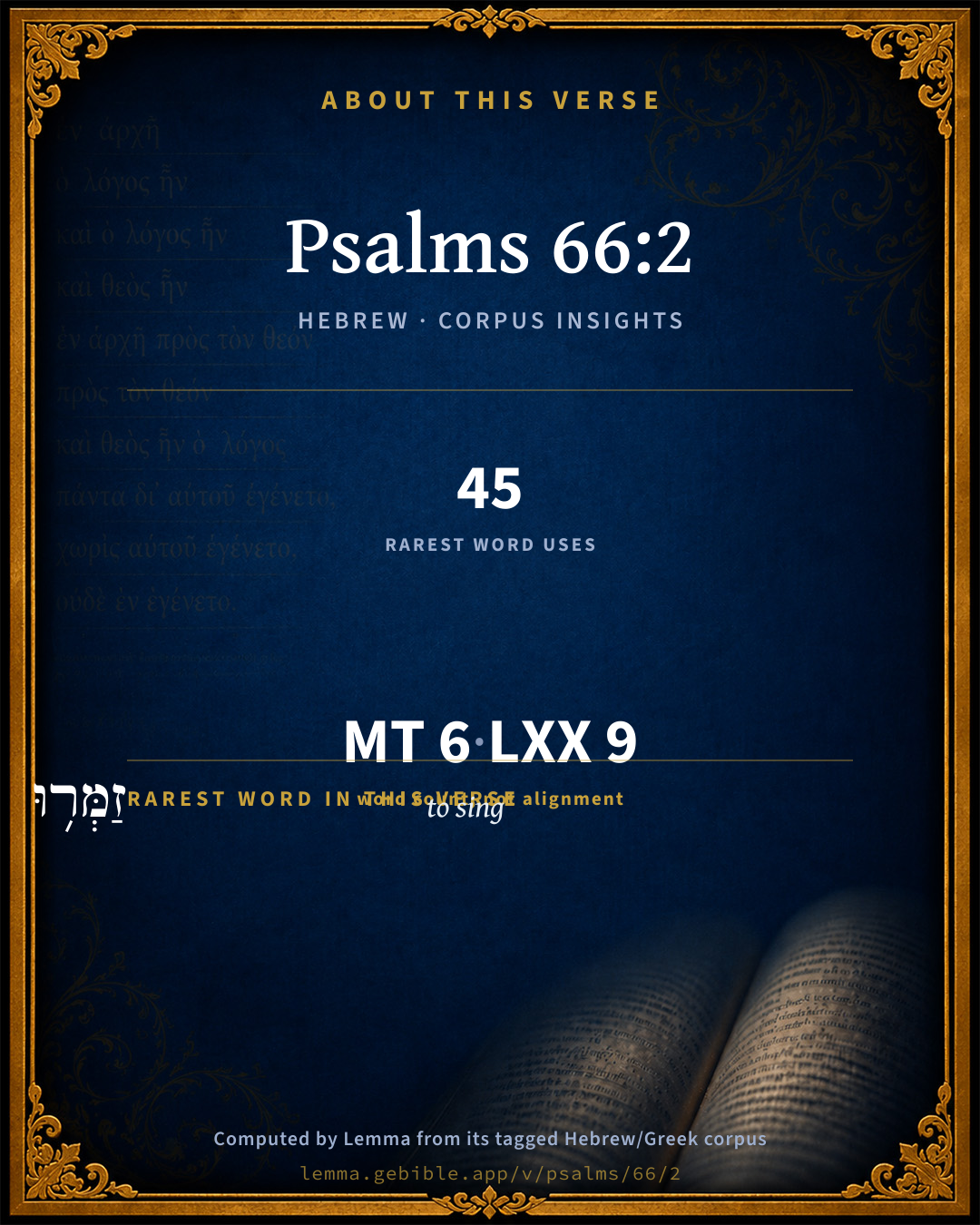
About this verse

These counts appear in no published source. They are computed here, from the morphology-tagged text and Lemma’s own curated glosses. What Lemma adds →

6
words
5
distinct lemmas
Wisdom
section

Shared distinctive vocabulary

זַמְּר֥וּ to sing H2167 occurs in 41 verses of the Hebrew Bible. Also found in:

Grammatical profile

  • 2 verbs
  • 4 nouns

Verb forms

  • זַמְּר֥וּ Piel · Imperative
  • שִׂ֥ימוּ Qal · Imperative

Repetition

A word recurs within this verse — often emphatic in Hebrew:

  • כְבֽוֹד glory H3519 ×2

Hebrew & Septuagint length

In English translation the verse runs 11 words from the Hebrew and 11 from the Septuagint (LXX English) — the same length.

A rough comparison of the two English renderings, which tokenize alike — not a word-level alignment.

Word counts can differ between the Hebrew and the Greek without any difference in meaning — e.g. the Hebrew direct-object marker אֵת has no separate Greek word, and Greek often adds the article ὁ.

In the original languages it is 6 Hebrew tokens and 9 Greek tokens — but the two are counted differently (Hebrew bundles its prefixes and suffixes into one token; the Greek is in lemma form), so that isn’t a like-for-like length.

Cross-references

16

Topical passages linked to Psalms 66:2 in the Treasury of Scripture Knowledge — connected by theme and wording, ordered by reader-vote popularity; previews shown in the World English Bible.

  • Psalms 105:2–3 Sing to him, sing praises to him! Tell of all his marvelous works.
  • Isaiah 49:13 Sing, heavens; and be joyful, earth; and break forth into singing, mountains: for Yahweh has comforted his people, and will have compassion on his afflicted.
  • Revelation 5:13 I heard every created thing which is in heaven, on the earth, under the earth, on the sea, and everything in them, saying, "To him who sits on the throne, and to the Lamb be the blessing, the honor, the glory, and the dominion, forever and ever! Amen!"
  • Isaiah 42:12 Let them give glory to Yahweh, and declare his praise in the islands.
  • Nehemiah 9:5 Then the Levites, Jeshua, and Kadmiel, Bani, Hashabneiah, Sherebiah, Hodiah, Shebaniah, [and] Pethahiah, said, Stand up and bless Yahweh your God from everlasting to everlasting; and blessed be your glorious name, which is exalted above all blessing and praise.
  • Psalms 107:22 Let them offer the sacrifices of thanksgiving, And declare his works with singing.
  • Isaiah 12:4–6 In that day you will say, "Give thanks to Yahweh! Call on his name. Declare his doings among the peoples. Proclaim that his name is exalted!
  • Revelation 4:8–11 The four living creatures, each one of them having six wings, are full of eyes around about and within. They have no rest day and night, saying, "Holy, holy, holy, holy, holy, holy, holy, holy, holy is the Lord God, the Almighty, who was and who is and who is to come!"
  • 1 Chronicles 29:10–13 Therefore David blessed Yahweh before all the assembly; and David said, You are blessed, Yahweh, the God of Israel our father, forever and ever.
  • Psalms 47:6–7 Sing praise to God, sing praises. Sing praises to our King, sing praises.
  • Psalms 72:18 Praise be to Yahweh God, the God of Israel, Who alone does marvelous deeds.
  • Psalms 79:9 Help us, God of our salvation, for the glory of your name. Deliver us, and forgive our sins, for your name's sake.
  • Psalms 96:3–10 Declare his glory among the nations, His marvelous works among all the peoples.
  • Psalms 106:2 Who can utter the mighty acts of Yahweh, Or fully declare all his praise?
  • Psalms 107:15 Let them praise Yahweh for his loving kindness, For his wonderful works to the children of men!
  • Isaiah 6:3 One called to another, and said, "Holy, holy, holy, is Yahweh of Hosts! The whole earth is full of his glory!"

Cross-references courtesy of OpenBible.info (CC BY 4.0).

Hebrew and Greek witnesses Masoretic Hebrew ↔ Greek Septuagint

The same verse in the two great witnesses to the Old Testament, shown verse-for-verse.

You’re reading Greek Psalm 65 (Hebrew Psalm 66). The Septuagint counts the superscription, so verse numbers can differ from the Hebrew — chapter-level alignment, not verse-by-verse. Numbering follows Rahlfs.

These are two independent witnesses, not word-aligned to each other, and the Septuagint is shown in lemma (dictionary) form.

Hebrew Psalms 66:2 Masoretic · Westminster Leningrad Codex

זַמְּר֥וּ כְבֽוֹד שְׁמ֑וֹ שִׂ֥ימוּ כָ֝ב֗וֹד תְּהִלָּתֽוֹ

Sing to the glory of his name! Offer glory and praise!

World English Bible · Public Domain

Greek LXX Greek Psalm 65:2 Septuagint · lemma form

ψάλω δή ὁ ὄνομα αὐτός δίδωμι δόξα αἴνεσις αὐτός

O sing praises to his name; give glory to his praise.

LXX2012 (modern English Septuagint) · Public Domain

On this verse, Ellicott's Commentary for English Readers discusses the Septuagint’s reading. Read the note in Commentary ↓

Hebrew: Westminster Leningrad Codex (CC BY 4.0). Greek: Septuagint (public domain); English from LXX2012 (modern English Septuagint) (Public Domain). How the Septuagint differs from the Hebrew →

Commentary

Notes on Psalms 66:2 from classic Christian and Jewish commentators (each source and its license shown beneath its notes). The classic Christian expositions comment on the surrounding passage and are grouped to its opening verse, so a note may address several verses; the Jewish commentaries on the Tanakh (Rashi and others) are per-verse, so they appear only where the commentator wrote on this verse.

Lemma curates 59 commentaries, every one of them public domain or Creative Commons licensed, each selected and text-cleaned for this edition rather than reprinted as found. About our sources →

Trapp's Complete Commentary

John Trapp

Psa 66:2 Sing forth the honour of his name: make his praise glorious.

Ver. 2. Make his praise glorious] Heb. Put glory to his praise; so Jos 7:19. God’s glory is as himself, eternal and infinite, no way capable of our addition or detraction; howbeit, to try how we prize it, and will exalt it, he declareth that he accounteth himself made more glorious by us when we receive him into our hearts as King of glory, and praise him accordingly.

John Trapp, A Commentary or Exposition upon All the Books of the Old and New Testament (1647–1656) — public domain. Text from a community e-Sword module.

J. A. Alexander on Psalms

Joseph Addison Alexander

2. (Psa 66:2) Sing the honour of his name; give (him) honour, (give) him praise. The honour or glory of his name is that due to his manifested excellence. See above, on Psa 29:2. Give, literally place or put, the verbs expressing these ideas being often interchanged in Hebrew. The same phrase that is here used occurs also in Jos 7:19, Isa 42:12, and is clearly equivalent to give honour in Psa 68:34, Jer 13:16. The form of the last clause is peculiar, give honour (as or to) his praise.

Joseph Addison Alexander, The Psalms Translated and Explained (1850) — public domain. Text from a community e-Sword module.

Tyndale Open Study Notes

Tyndale Open Resources

66:2 The glory of his name represents the perfection of God’s character.

Tyndale Open Study Notes — © Tyndale Open Resources, licensed CC BY-SA 4.0. Text via the HelloAO Bible API.

Jamieson, Fausset & Brown

Robert Jamieson, A. R. Fausset & David Brown

his name--as in Psa 29:2.

make his praise glorious--literally, "place honor, His praise," or, "as to His praise"; that is, let His praise be such as will glorify Him, or, be honorable to Him.

Jamieson, Fausset & Brown — Commentary Critical and Explanatory on the Whole Bible (1871) — public domain (CC PDM 1.0). Text via the HelloAO Bible API.

Adam Clarke's Commentary

Verse 2. The honour of his name] Let his glorious and merciful acts be the subject of your songs.

Adam Clarke's Commentary on the Bible (1810–1826) — public domain. Text from a community e-Sword/MySword module.

Ellicott's Commentary for English Readers

(2) Sing forth.—Literally, play on the harp.

Make his praise glorious.—So the LXX., but the construction is dubious. Literally, put glory his praise, meaning perhaps, in parallelism with the first clause, “make the Divine glory the subject of your praise.” But the opening words of the next verse, “say unto God, how,” &c, are so bald that a suspicion arises as to the arrangement of the text. Perhaps by bringing back the initial words of Psa_66:3 we get the true sense, “ascribe glory (and) speak praise to God.”

A Bible Commentary for English Readers, edited by Charles John Ellicott (1878–1897) — public domain. Text from a community e-Sword module.

The Cambridge Bible for Schools and Colleges

gen. ed. J. J. S. Perowne

2. Sing forth the honour of his name] Or, Hymn forth the glory Of his name: celebrate in a joyous psalm this fresh revelation of His character.

make his praise glorious] Or, perhaps, ascribe glory to praise him.

The Cambridge Bible for Schools and Colleges (gen. ed. J. J. S. Perowne; Cambridge University Press, 1878–1918) — public domain. Text from a community e-Sword module.

John Gill's Exposition

Sing forth the honour of his name,.... Meaning not any particular names of the Messiah, such as in Isa 9:6; or his name "Jesus", a Saviour; though they are all honourable and glorious, and furnish out sufficient matter for a song: but rather that by which he was made known to the sons of men, his Gospel; see Act 9:15. Which is a glorious Gospel; the truths of which may be expressed in a song of praise, to the honour and glory of Christ, and to the instruction and profit of men, Col 3:16. Or rather Christ himself is meant; his name often designs himself, Mat 12:21. There that is due unto him, and ought to be given which is done when all divine perfections and works are ascribed to him, divine worship is paid him, and the glory of salvation given him; which may be done in psalms, hymns, and spiritual songs;

make his praise glorious: let the high praises of him be in your mouths; give him, the most excellent praise; praise him in the best manner. This is done when we sing his praise with grace in our hears in exercise; when we with one mind and mouth glorify him; and when we honour him, the Son, as we honour the Father.

John Gill's Exposition of the Whole Bible (1746–1763) — public domain (CC PDM 1.0). Text via the HelloAO Bible API.

Albert Barnes' Notes on the Bible

Sing forth the honor of his name - That is, Celebrate in appropriate praise the honor due to his name. Make that honor known in connection with songs.

Make his praise glorious - literally, “place honor, his praise;” that is, Give him honor; give him praise. The meaning is, Set forth his praise with songs - with music - with shouts; - that will be the appropriate expression of the praise which is due to him.

Albert Barnes' Notes on the Bible (1834–1885) — public domain. Text from a community e-Sword/MySword module.

Matthew Poole's English Annotations

i.e. Praise him in an extraordinary and eminent degree, so as he may have much glory from you.

Matthew Poole's English Annotations on the Holy Bible (1683–1685) — public domain. Text from a community e-Sword/MySword module.

The Treasury of David

Charles H. Spurgeon

Ver. 2. Sing forth the honour of his name. The noise is to be modulated with tune and time, and fashioned into singing, for we adore the God of order and harmony. The honour of God should be our subject, and to honour him our object when we sing. To give glory to God is but to restore to him his own. It is our glory to be able to give God glory; and all our true glory should be ascribed unto God, for it is his glory. "All worship be to God only, "should be the motto of all true believers. The name, nature, and person of God are worthy of the highest honour.

Make his praise glorious. Let not his praise be mean and grovelling: let it arise with grandeur and solemnity before him. The pomp of the ancient festivals is not to be imitated by us, under this dispensation of the Spirit, but we are to throw so much of heart and holy reverence into all our worship that it shall be the best we can render. Heart worship and spiritual joy render praise more glorious than vestments, incense, and music could do.

Ver. 2. Make his praise glorious. Another meaning is, give or place glory, that is, your glory to his praise, be fully persuaded when you praise him that it will redound to your own glory, regard this as your own glory; praise him in such a way that all your praises may be given to glorify God; or, let your glory tend in this direction that he may be praised. Desire not the glory of eternal blessedness, unless for the praise of God, as the blessed spirits in that temple do nothing but say glory to God, and sing the hymn of his glory without end, "Holy, holy, holy." Lorinus.

None.

Psalms 66:3*

Charles H. Spurgeon's The Treasury of David (1869–1885) — public domain. Psalms only. Text from a community e-Sword/MySword module.

Whedon's Commentary on the Bible

Daniel D. Whedon

2. Make his praise glorious—Give glory as his praise, or make his glory praise. The nouns are in apposition, and the sense not easy. The English version, by treating one as an adjective, has given euphony of sound without clearness of thought. The idea seems to be, that as the praise of God consists in thankfully confessing and declaring his acts, we thus make his peculiar glory to consist of praise. This is the thought repeated and exegetically amplified in the next verse.

Daniel D. Whedon (gen. ed.), Commentary on the Old and New Testaments (1874–1909) — public domain. Text from a community e-Sword module.

The Pulpit Commentary

Sing forth the honour of his Name; rather, the glory of his Name. Make his praise glorious; or, recognize his glory in your praise of him; i.e. do not merely thank him for his kindness to you personally, but magnify him for his greatness and majesty.

The Pulpit Commentary (1880–1919), ed. H.D.M. Spence-Jones & Joseph S. Exell — public domain. Text from a community e-Sword module.

Rashi

Rabbi Shlomo Yitzchaki (Rashi)

Sing the glory of His name Sing in honor of His name. Or: Recite the glory of His name with music and song.

Rashi on the Tanakh — English translations: “The Judaica Press complete Tanach with Rashi, translated by A. J. Rosenberg” (CC BY 4.0); “Pentateuch with Rashi's commentary by M. Rosenbaum and A.M. Silbermann, 1929-1934” (public domain); “The Metsudah Tanach series, Lakewood, N.J” (CC BY 4.0); and “The Book of Joshua, Metsudah Publications, 1997” (CC BY 4.0). Text via Sefaria.

Lesson kit

Teaching starters — assembled from the data on this page, not authored interpretation. Every prompt links to the verse data it draws on. Edit before teaching.

Psalms, in the Wisdom, opens this verse with 6 words (5 distinct Hebrew lemmas). Its most distinctive word is zâmar (“to sing”). A historical commentator’s framing appears above. Read the whole chapter for the surrounding context.

Discussion questions

  1. How does “to sing” (zâmar) shape what this verse is saying?
  2. Judges 5:3 shares the word «to sing» with this verse. How do the two illuminate each other?
  3. “glory” occurs 2× in this one verse. What is the effect of the repetition?
  4. These translations render this verse differently. What is at stake in choosing one wording over another?
  5. The verb «זַמְּר֥וּ» is Piel Imperative. How does its form color the action?
  6. Reading how Trapp's Complete Commentary and J. A. Alexander on Psalms read this verse, where do the two commentators agree and where do they part?

Things to notice

Reading settings

Reading text

Shown beneath each verse's original-language words.

Old Testament
Old Testament edition

Read the OT as the Masoretic Hebrew (MT) or the Greek Septuagint (LXX).

English shown for the Greek Septuagint (in the Hebrew ↔ Greek comparison).

Comparing translations? Open the Compare panel on any verse page to stack up to four side by side.