Psalms 40:4

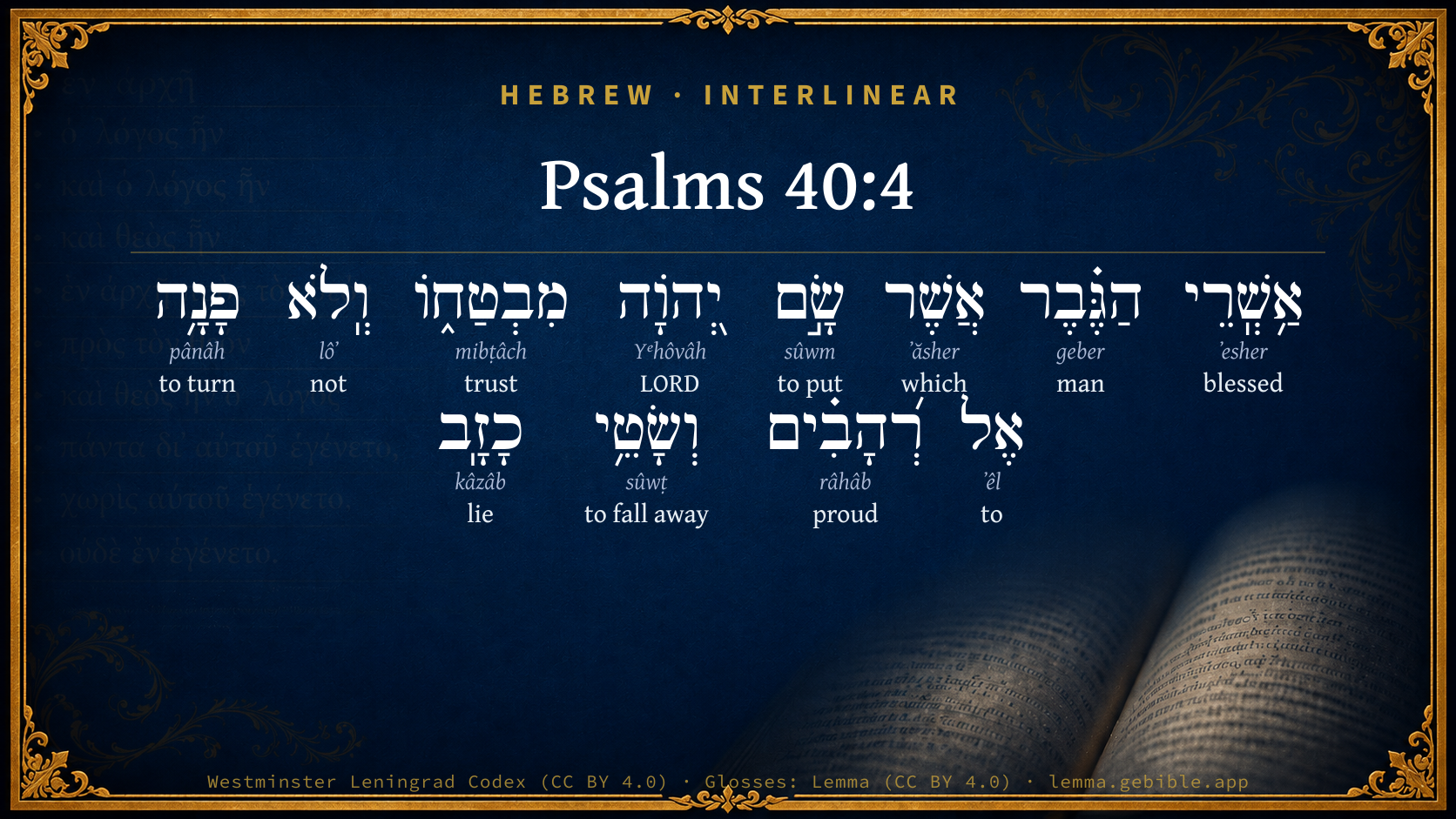
Hebrew (Westminster Leningrad Codex) Psalms 40:4 appears in the Hebrew Old Testament. The text above is from the Westminster Leningrad Codex. Each word links to its Strong’s number, a concise gloss, and parsing drawn from the Open Scriptures Hebrew Bible morphology. Click any word for its full Brown-Driver-Briggs (BDB) entry.
Download image
Cite this verse

Psalms 40:4 (World English Bible). Public Domain. Lemma interlinear Bible study tool, https://lemma.gebible.app/v/psalms/40/4.

Show BibTeX & RIS
BibTeX
RIS
English Translation
Blessed is the man who makes Yahweh his trust, And doesn't respect the proud, nor such as turn aside to lies.
World English Bible · Public Domain
Highlights
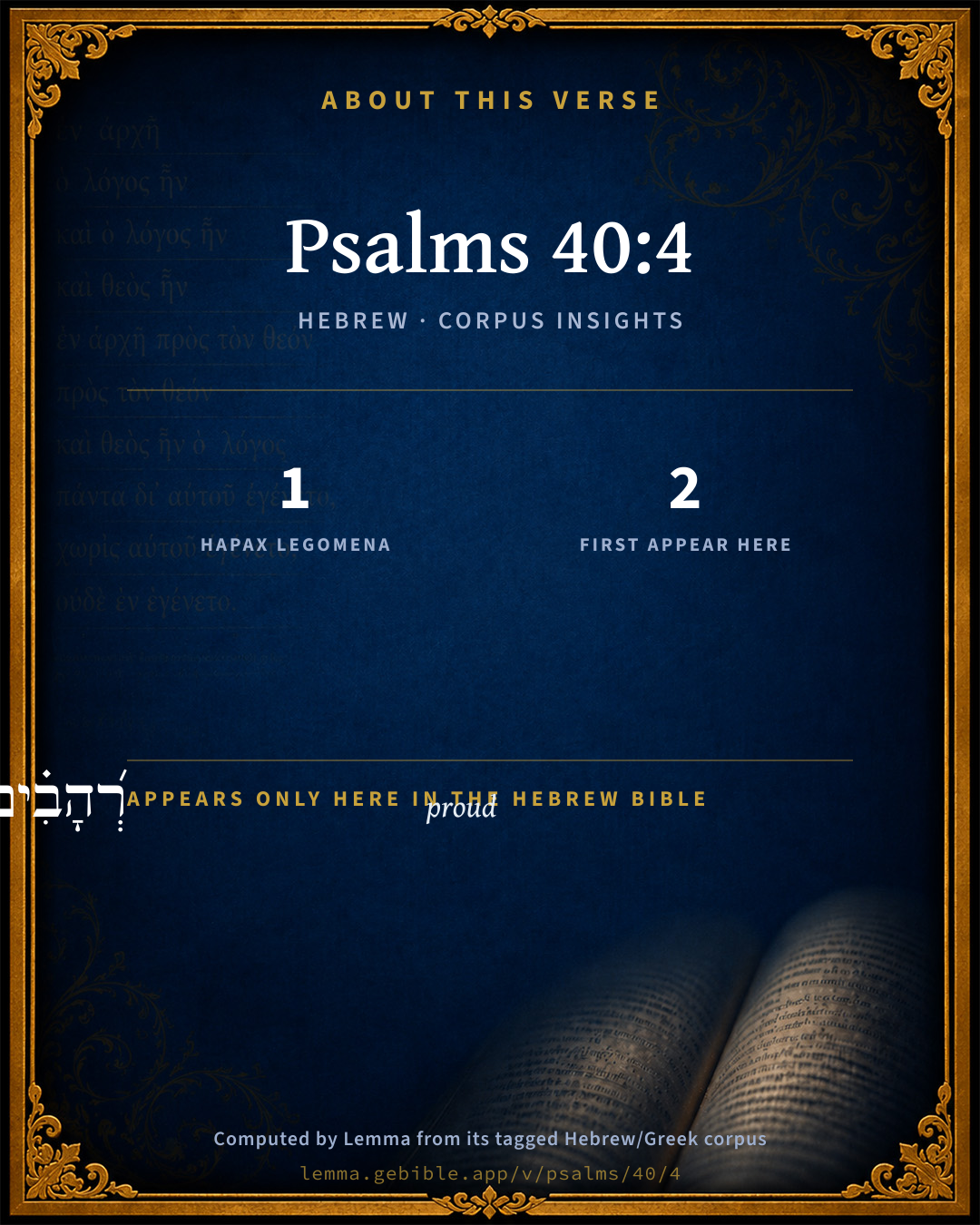
  • 1 hapax legomenon — only here in the Hebrew Bible
  • 2 first appearances in the Hebrew Bible
Full analysis ↓
Download a study sheet

One document with this verse’s original text, its word-by-word gloss line, the meaning frame, cross-references with their text, attributed commentary, and full source and license credits — printable, and it pastes into notes with its structure intact.

This verse Autodidact and up

Study sheet (.html) Plain text (.txt)

A passage Seminary Student

Up to 50 verses in one chapter. A passage sheet keeps up to 6 commentary sources and 12 cross-references per verse, in the order this page ranks them, and says so on the sheet whenever that leaves anything out. Ask for a single verse and you get the Autodidact verse sheet above.

Everything on this page stays free to read, with no account — the sheet is a download of what is already on screen, not access to it.

Want to remove ads? Support Godless Engineer
Compare translations 3

The same verse in 3 English versions, stacked beneath the original-language interlinear above. Click any original word for its lexicon entry.

Each is an independent rendering of the whole verse — the interlinear is not word-aligned to these translations.

Highlighted words mark where these versions differ — a whole-verse word diff, not a word-by-word alignment.

  • World English Bible Public Domain
    Blessed is the man who makes Yahweh his trust, And doesn't respect the proud, nor such as turn aside to lies.
  • King James Version Public Domain
    Blessed is that man that maketh the LORD his trust, and respecteth not the proud, nor such as turn aside to lies.
  • unfoldingWord Literal Text CC BY-SA 4.0
    The happinesses of the man who has made Yahweh his trust, and has not turned to the proud and the goers aside to falsehood!

unfoldingWord Literal Text — © unfoldingWord, licensed CC BY-SA 4.0. Word-aligned USFM3 via Door43 (git.door43.org/unfoldingWord/en_ult).

Versions to compare (up to 4)

3 of 4 selected

Show all 18 translations

Every available English version of this verse, each an independent rendering of the whole verse.

  • World English Bible Public Domain
    Blessed is the man who makes Yahweh his trust, And doesn't respect the proud, nor such as turn aside to lies.
  • Berean Standard Bible Public Domain
    Blessed is the man who has made the LORD his trust, who has not turned to the proud, nor to those who lapse into falsehood.
  • Majority Standard Bible Public Domain
    Blessed is the man who has made the LORD his trust, who has not turned to the proud, nor to those who lapse into falsehood.
  • King James Version Public Domain
    Blessed is that man that maketh the LORD his trust, and respecteth not the proud, nor such as turn aside to lies.
  • American Standard Version (1901) Public Domain
    Blessed is the man that maketh Jehovah his trust, And respecteth not the proud, nor such as turn aside to lies.
  • Revised Version (1885) Public Domain
    Blessed is the man that maketh the LORD his trust, and respecteth not the proud, nor such as turn aside to lies.
  • Geneva Bible (1599) Public Domain
    Blessed is the man that maketh the Lord his trust, and regardeth not the proude, nor such as turne aside to lyes.
  • Douay-Rheims (1899) Public Domain
    And he put a new canticle into my mouth, a song to our God. Many shall see, and shall fear: and they shall hope in the Lord.
  • Young's Literal Translation Public Domain
    O the happiness of the man Who hath made Jehovah his trust, And hath not turned unto the proud, And those turning aside to lies.
  • Literal Standard Version CC BY-SA 4.0
    O the blessedness of the man || Who has made YHWH his trust, || And has not turned to the proud, || And those turning aside to lies.
  • Unlocked Literal Bible CC BY-SA 4.0
    Blessed is the man who makes Yahweh his trust and does not honor the proud or those who turn away from him to lies.
  • unfoldingWord Literal Text CC BY-SA 4.0
    The happinesses of the man who has made Yahweh his trust, and has not turned to the proud and the goers aside to falsehood!
  • Darby Bible Public Domain
    Blessed is the man that hath made Jehovah his confidence, and turneth not to the proud, and to such as turn aside to lies.
  • World Messianic Bible Public Domain
    Blessed is the man who makes the LORD his trust, and doesn’t respect the proud, nor such as turn away to lies.
  • Webster's Bible Public Domain
    \\40:3\\And he hath put a new song in my mouth, even praise to our God: many shall see it, and fear, and shall trust in the LORD.
  • Free Bible Version CC BY-SA 4.0
    Happy are those who trust in the Lord, who do not look for help from the arrogant or from those who worship idols.
  • Bible in Basic English Public Domain
    Happy is the man who has faith in the Lord, and does not give honour to the men of pride or to those who are turned away to deceit.
  • JPS Tanakh (1917) Public Domain
    (40-5) Happy is the man that hath made the LORD his trust, and hath not turned unto the arrogant, nor unto such as fall away treacherously.

Literal Standard Version (2020), Covenant Press — licensed CC BY-SA 4.0. Text via the HelloAO Bible API (eBible.org). Unlocked Literal Bible (unfoldingWord) — licensed CC BY-SA 4.0. Text via the HelloAO Bible API (eBible.org). unfoldingWord Literal Text — © unfoldingWord, licensed CC BY-SA 4.0. Word-aligned USFM3 via Door43 (git.door43.org/unfoldingWord/en_ult). Free Bible Version, Dr. Jonathan Gallagher — licensed CC BY-SA 4.0. Text via the HelloAO Bible API (eBible.org).

Word by word

More ways to search: Search by grammar → Find every occurrence → Compare this word →

Practice this passage: Drill this verse → Learn its vocabulary →

רְ֝הָבִ֗ים
râhâb
H7295
“proud ones”
Noun, Common, Masculine, Plural, Absolute
Part of Speech
Noun
Type
Common
Gender
Masculine
Number
Plural
State
Absolute
Full BDB Definition

Origin: from H7292

TWOT: 2125a

proud, defiant
  1. אַ֥שְֽׁרֵי ʼesher H835 “blessed” Noun, Common, Masculine, Plural, Absolute
  2. הַגֶּ֗בֶר geber H1397 “the · man” Particle, Definite Article + Noun, Common, Masculine, Singular, Absolute
  3. אֲשֶׁר ʼăsher H834 “which” Particle, Relative
  4. שָׂ֣ם sûwm H7760 “to put” Verb, Qal, Perfect, 3rd Person, Masculine, Singular
  5. יְ֭הֹוָה Yᵉhôvâh H3068 “LORD” Noun, Proper
  6. מִבְטַח֑וֹ mibṭâch H4009 “trust · his” Noun, Common, Masculine, Singular, Construct + Suffix, Personal, 3rd Person, Masculine, Singular
  7. וְֽלֹא lôʼ H3808 “and · not” Conjunction + Particle, Negative
  8. פָנָ֥ה pânâh H6437 “to turn” Verb, Qal, Perfect, 3rd Person, Masculine, Singular
  9. אֶל ʼêl H413 “to” Preposition
  10. וְשָׂטֵ֥י sûwṭ H7750 “and · falling away” Conjunction + Verb, Qal, Participle Active, Masculine, Plural, Construct
  11. כָזָֽב kâzâb H3577 “lie” Noun, Common, Masculine, Singular, Absolute

About this verse

These counts appear in no published source. They are computed here, from the morphology-tagged text and Lemma’s own curated glosses. What Lemma adds →

12
words
12
distinct lemmas
Wisdom
section

Notable vocabulary

1 hapax legomenon — a word that appears only here in the entire Hebrew Bible:

  • רְ֝הָבִ֗ים proud H7295

First appearance in Scripture

These words make their first canonical appearance in the Hebrew Bible here:

  • רְ֝הָבִ֗ים proud H7295
  • וְשָׂטֵ֥י to fall away H7750

Shared distinctive vocabulary

וְשָׂטֵ֥י to fall away H7750 occurs in 2 verses of the Hebrew Bible. Also found in:

Grammatical profile

  • 3 verbs
  • 6 nouns
  • 1 preposition
  • 2 particles

Verb forms

  • שָׂ֣ם Qal · Perfect
  • פָנָ֥ה Qal · Perfect
  • וְשָׂטֵ֥י Qal · Participle Active

Hebrew & Septuagint length

In English translation the verse runs 21 words from the Hebrew and 22 from the Septuagint (LXX English) — closely comparable.

A rough comparison of the two English renderings, which tokenize alike — not a word-level alignment.

Word counts can differ between the Hebrew and the Greek without any difference in meaning — e.g. the Hebrew direct-object marker אֵת has no separate Greek word, and Greek often adds the article ὁ.

Cross-references

14

Topical passages linked to Psalms 40:4 in the Treasury of Scripture Knowledge — connected by theme and wording, ordered by reader-vote popularity; previews shown in the World English Bible.

  • Jeremiah 17:7–8 Blessed is the man who trusts in Yahweh, and whose trust Yahweh is.
  • Psalms 84:11–12 For Yahweh God is a sun and a shield. Yahweh will give grace and glory. He withholds no good thing from those who walk blamelessly.
  • Psalms 34:8 Oh taste and see that Yahweh is good. Blessed is the man who takes refuge in him.
  • Psalms 125:5 But as for those who turn aside to their crooked ways, Yahweh will lead them away with the workers of iniquity. Peace be on Israel.
  • Psalms 118:8–9 It is better to take refuge in Yahweh, Than to put confidence in man.
  • Psalms 2:12 Kiss the son, lest he be angry, and you perish in the way, For his wrath will soon be kindled. Blessed are all those who take refuge in him.
  • Romans 15:12–13 Again, Isaiah says, "There will be the root of Jesse, He who arises to rule over the Gentiles; On him will the Gentiles hope."
  • Psalms 15:4 In whose eyes a vile man is despised, But who honors those who fear Yahweh; He who keeps an oath even when it hurts, and doesn't change;
  • Jeremiah 10:14–15 Every man is become brutish [and is] without knowledge; every goldsmith is disappointed by his engraved image; for his molten image is falsehood, and there is no breath in them.
  • Jonah 2:8 Those who regard lying vanities forsake their own mercy.
  • 2 Thessalonians 2:9–11 even he whose coming is according to the working of Satan with all power and signs and lying wonders,
  • Psalms 101:3–7 I will set no vile thing before my eyes. I hate the deeds of faithless men. They will not cling to me.
  • Psalms 119:21 You have rebuked the proud who are cursed, Who wander from your commandments.
  • Isaiah 44:18–20 They don't know, neither do they consider: for he has shut their eyes, that they can't see; and their hearts, that they can't understand.

Cross-references courtesy of OpenBible.info (CC BY 4.0).

Hebrew and Greek witnesses Masoretic Hebrew ↔ Greek Septuagint

The same verse in the two great witnesses to the Old Testament, shown verse-for-verse.

You’re reading Greek Psalm 39 (Hebrew Psalm 40). The Septuagint counts the superscription, so verse numbers can differ from the Hebrew — chapter-level alignment, not verse-by-verse. Numbering follows Rahlfs.

These are two independent witnesses, not word-aligned to each other, and the Septuagint is shown in lemma (dictionary) form.

Hebrew Psalms 40:4 Masoretic · Westminster Leningrad Codex

אַ֥שְֽׁרֵי הַגֶּ֗בֶר אֲשֶׁר שָׂ֣ם יְ֭הֹוָה מִבְטַח֑וֹ וְֽלֹא פָנָ֥ה אֶל רְ֝הָבִ֗ים וְשָׂטֵ֥י כָזָֽב

Blessed is the man who makes Yahweh his trust, And doesn't respect the proud, nor such as turn aside to lies.

World English Bible · Public Domain

Greek LXX Greek Psalm 39:4 Septuagint · lemma form

καί ἐνβάλλω εἰς ὁ στόμα ἐγώ

Blessed is the man whose hope is in the name of the Lord, and who has not regarded vanities and false frenzies.

LXX2012 (modern English Septuagint) · Public Domain

On this verse, Ellicott's Commentary for English Readers discusses the Septuagint’s reading. Read the note in Commentary ↓

Hebrew: Westminster Leningrad Codex (CC BY 4.0). Greek: Septuagint (public domain); English from LXX2012 (modern English Septuagint) (Public Domain). How the Septuagint differs from the Hebrew →

Commentary

Notes on Psalms 40:4 from classic Christian and Jewish commentators (each source and its license shown beneath its notes). The classic Christian expositions comment on the surrounding passage and are grouped to its opening verse, so a note may address several verses; the Jewish commentaries on the Tanakh (Rashi and others) are per-verse, so they appear only where the commentator wrote on this verse.

Lemma curates 59 commentaries, every one of them public domain or Creative Commons licensed, each selected and text-cleaned for this edition rather than reprinted as found. About our sources →

Trapp's Complete Commentary

John Trapp

Psa 40:4 Blessed [is] that man that maketh the LORD his trust, and respecteth not the proud, nor such as turn aside to lies.

Ver. 4. Blessed is that man, &c.] See Psa 2:12.

And respecteth not the proud] Who are set in opposition to believers, as they are also, Hab 2:4. Self-justitiaries especially, and meritmongers: faith is a humbling grace.

Nor such as turn aside to lies] As do heretics and idolaters. These the true believer, out of the greatness of his spirit, slighteth, how great soever they be; animo magno nihil magnum.

John Trapp, A Commentary or Exposition upon All the Books of the Old and New Testament (1647–1656) — public domain. Text from a community e-Sword module.

The Biblical Illustrator

Joseph S. Exell

Psa_40:4

Blessed is the man who maketh the Lord his trust.

The blessedness of making the Lord our trust

I. What is implied by our trust.

1. That it rests in the Lord Himself.

2. It sets aside all self-confidence.

II. Some reasons why the man who makes the Lord his trust is blessed.

1. He acts in accordance with the Divine will.

2. There is stability in his trust; you may always depend upon it.

3. It bestows true manly dignity and freedom from all servile fears.

4. It gives quiet composure to the mind. (W. H. Horwood.)

The Lord our trust

The psalmist here expresses--

I. A peculiar habit of mind. What is implied in trusting in God?

1. A knowledge of His character.

2. It implies the consciousness of reconciliation.

3. Obedience.

4. Piety or devotion.

II. The happiness connected with this trust in the Lord.

1. See it by way of contrast. For how insufficient and unstable are the objects in which the world trusts. Riches, skill, virtue and the like.

2. In the perfections of the God in whom we trust. Think of all His attributes and each will minister to this happiness.

3. In what is prepared for such, both here and hereafter. (W. Wright.)

Faith commended

I. Faith has the divine approval. Wherever there is faith God is pleased with it. He has made it the main requirement of His gospel. It is the one thing needful in prayer. It is the mode and manner of the spiritual life, for the just shall live by faith.

II. This is highly reasonable. We love to be trusted, and are much troubled when we are not. It is our proper position towards God, and it supplies the link between us and Himself. The complete confidence of the heart is the essence of obedience and the fountain of it. And it is no objection that faith, trust, seems such a small matter. But within the compass of it there lies a force whose power would be difficult to measure. It is a virtue which contains within it seed enough to sow all the acreage of life with holiness.

III. And faith is blessedness. For in trouble it assures us that all things work together for good. And it releases from trouble. Read this psalm. It creates within him a deep peace and a holy elevation of character. We put down our foot on what seems thin as air and, behold, it is firm as a rock beneath us. But some one says, I could not live with nothing to depend upon. Is God nothing? The believer has nothing more, and what does he want more? And faith makes blessed in death. For the believer knows he cannot truly die. If ye will believe, ye shall have both heaven on earth and heaven in heaven. God uplift us from the miry clay of unbelief to the rock of confidence in Him. (C. H. Spurgeon.)

Trust in the Lord--the only way to happiness

As happy as a king is a common phrase; but history almost seems to say, As miserable as a king. In his last will Henry IV. spoke most sadly of his life, which he had misspended. The last words of Henry VIII. were, All is lost. I, Eleanor, by the wrath of God, Queen of England, so wrote Eleanor of Aquitaine, Queen of Henry II. Queen Mary begged that, when she died, not even the semblance of a crown might be put upon her brow. I am aweary of my life, said Queen Elizabeth to the French ambassador. And in the present time we have all seen how much there is in the lot of the Czar of all the Russias that none of us would like.

True happiness can never be realized, either by king or peasant, apart from God, and the wise king said very truly, Whoso trusteth in the Lord, happy is he.

The Biblical Illustrator, edited by Joseph S. Exell (c. 1880s–1900s) — public domain. Text from a community e-Sword module.

Joseph Benson's Commentary

Psa 40:4. Blessed is the man, &c. — I said, many shall trust in the Lord, and they shall not be losers by it, nor disappointed of their hope; but they are and shall be blessed. And respecteth not — ולא פנה, velo-panah, looketh not toward, namely, with delight and desire to imitate; or with confidence and expectation of relief; the proud — Or the mighty; the great and proud potentates of the world, to whom most men are apt to look and trust. Nor such as turn aside — From God, in whom alone they ought to trust. To lies — To lying vanities, such as worldly power, and wisdom, and riches, and all other earthly things or persons, in which men are prone to trust; which are called lies, because they promise more than they perform.

Joseph Benson's Commentary on the Old and New Testaments (1811–1818) — public domain. Text from a community e-Sword module.

J. A. Alexander on Psalms

Joseph Addison Alexander

5. (Psa 40:4). Happy the man who has made Jehovah his trust, and has not looked to proud (men) and (those) swerving to falsehood. From his own experience he draws a general conclusion, as to the safety and prosperity of those who trust in God. The first phrase is properly an exclamation, Oh the happinesses of the man, as in Psa 1:1; Psa 2:12; Psa 32:1-2; Psa 33:12. The next words in Hebrew have properly a local sense. Who has set Jehovah (as) his place of security, the form of the noun being one which has commonly a local meaning. See above, on Psa 27:1. The verb translated looked means strictly turned round towards an object for the purpose of looking at it. It may here imply confidence or trust, as cognate verbs do in Isa 17:7-8. Or it may convey the additional idea of taking sides, espousing the cause, joining the party, of those swerving, turning aside, apostatising, from the way of truth and duty, or from God himself. See above, on Psa 14:3; Psa 18:22 (21).

Joseph Addison Alexander, The Psalms Translated and Explained (1850) — public domain. Text from a community e-Sword module.

Geneva Bible (1599)

Geneva Bible translators

To follow their example, which he must needs do that trusteth not only in the Lord.

Geneva Bible (1599) marginal notes — public domain. Text via Bolls.life.

Jamieson, Fausset & Brown

Robert Jamieson, A. R. Fausset & David Brown

Blessed-- (Psa 1:1; Psa 2:12).

respecteth--literally, "turns towards," as an object of confidence.

turn aside--from true God and His law to falsehood in worship and conduct.

Jamieson, Fausset & Brown — Commentary Critical and Explanatory on the Whole Bible (1871) — public domain (CC PDM 1.0). Text via the HelloAO Bible API.

Adam Clarke's Commentary

Verse 4. Blessed is that man] The man must be blessed and happy who casts his soul, with all its burden of sin and wretchedness, at the footstool of God's mercy; for he will save all who come to him through the Son of his love.

Adam Clarke's Commentary on the Bible (1810–1826) — public domain. Text from a community e-Sword/MySword module.

John Calvin's Commentaries

4. Blessed is the man who hath set Jehovah for his confidence David here relates what ground for good hope his deliverance would give to all the faithful; inasmuch as, setting aside all the allurements of the world, they would thereby be encouraged to commit themselves with confidence to the protection of God; persuaded not only that they are happy who trust in him alone, but that all other expectations at variance with this are deceitful and cursed. This assurance is not natural to us, but is derived partly from the word of God, and partly from his works; although, as I have said before, the contemplation alone of the works of God would not kindle this light within us, unless God, illuminating us by his word, should show us his benevolence. After having promised to be gracious to us, in manifesting also his goodness by indubitable proofs, he confirms with his own hand what he had previously uttered with his lips. David, therefore, from the fact of his having been restored to life from the abyss of death, justly declares that the faithful are taught from this proof — what men are naturally so reluctant to believe — that they are happy who trust in God alone.

As the instability of our nature commonly tends to draw us downward, and as all of us, from our proneness to yield to delusions, are tempted by many wicked examples, David immediately adds, that he is blessed who regardeth not the proud Some, indeed, render רהבים, rehabim, the rich, or the great of this world, but improperly, in my opinion; because pride, and turning aside to lies, are two things which David here joins together. To regard the great of the earth, therefore, does not signify, as they suppose, to rely upon their power and riches, as if a man’s welfare depended thereupon, but it rather means to be carried away by their examples, to imitate their conduct. When we are everywhere constantly seeing men puffed up with pride, who despise God, and place their highest felicity in ambition, in fraud, in extortion, in guile, a perverse desire of imitating them steals upon us by degrees; and, especially when every thing turns out according to their wishes, a vain and delusive expectation solicits us to try the same course. David, therefore, wisely, and not without good reason, warns us, that in order to have our mind constantly fixed in simple reliance upon God alone, we must guard against those evil examples which ever seek to allure us on all sides to apostatise from him. Moreover, when he says that the proud turn aside to lying, or vanity, in this way he describes briefly the foolish confidence of the flesh. What else is the pride of those who put their own fancies in the place of God but a vain illusion? Certainly the man who, puffed up by the breath of fond conceit, arrogates any thing in the least degree to himself, flatters himself to his own destruction. In short, pride and vanity are opposed to the holy confidence which relies upon God alone; for there is nothing more difficult to the flesh than to trust in God alone, and the world is always full of proud and haughty men, who, soothing themselves with vain allurements, would soon corrupt the minds of the godly, if this arrest were not laid upon them, to restrain, as with a bridle, their erroneous and extravagant opinions.

John Calvin's Commentaries (1540-1563) — public domain. Text from the Calvin Translation Society English edition (1840s-50s) via the Christian Classics Ethereal Library (ccel.org). Calvin's coverage is partial (roughly two-thirds of the Bible); uncommented books and verses are honest gaps, never fabricated. The 19th-century editor's footnotes and remarks are omitted so the notes are faithfully Calvin's own voice.

Ellicott's Commentary for English Readers

(4) Respecteth not.—Better, turneth not towards proud men and false apostates. The words are, however, somewhat obscure. The LXX. and Vulg. have “vanities and false madnesses.” The words we have rendered false apostates are by some translated “turners after idols.” Idolatry is doubtless implied, but not expressed.

A Bible Commentary for English Readers, edited by Charles John Ellicott (1878–1897) — public domain. Text from a community e-Sword module.

The Cambridge Bible for Schools and Colleges

gen. ed. J. J. S. Perowne

4. Happy is the man that hath mada Jehovah his trust,

And hath not turned unto the arrogant, and false apostates.

The word for man is that used in Psa_34:8, where see note. For the opposite to ‘making Jehovah the object of trust’ see Psa_52:7.

respecteth not] Rather, as above, hath not turned unto: non est aversus ad … Jerome. The word is specially used of turning away from God to idols or false objects of confidence (Dunt. 29:18; Hos_3:1; Eze_29:16).

the proud &c.] The word for ‘proud’ suggests the idea of overbearing arrogance and ostentatious self-assertion: ‘such as turn aside to lies’, or as R.V. marg., fall away treacherously, are those who desert God and the right cause for false objects of reliance and false aims. Idolatry does not appear to be meant, at any rate exclusively. Happy the man who is not misled by appearances to despise God’s help, and seek the patronage of worldly men who boast of their own power.

4, 5. The blessedness of such a trust.

The Cambridge Bible for Schools and Colleges (gen. ed. J. J. S. Perowne; Cambridge University Press, 1878–1918) — public domain. Text from a community e-Sword module.

John Gill's Exposition

Blessed is the man that maketh the Lord his trust,.... For such are safe and secure in him, are possessed of all blessings of grace through him, have peace in their own souls now, and shall enjoy eternal happiness with him hereafter;

and respecteth not the proud; such as the Pharisees, and all self-righteous persons, who trust in themselves and their own righteousness, submit not to the righteousness of Christ, and despise others; to these such who trust in Christ have no respect; they neither esteem them, nor imitate them;

nor such as turn aside to lies; to idols, the lying vanities of the Gentiles; or to any doctrines injurious to the person, office, blood, righteousness, sacrifice, and grace of Christ; which are no other than lies, and which those who believe in Christ have no respect to, but abhor both them and the abettors of them.

John Gill's Exposition of the Whole Bible (1746–1763) — public domain (CC PDM 1.0). Text via the HelloAO Bible API.

Albert Barnes' Notes on the Bible

Blessed is that man that maketh the Lord his trust - See the notes at Psa 34:8. Compare Psa 27:1. Literally, here, “The blessings of the man who places Yahweh for his confidence;” that is, who makes Him his seeurity, or who feels that his security for happiness and salvation is in Him.

And respecteth not the proud - The haughty, or those who are confident in themselves. Literally, “who looks not to the proud;” that is, who does not depend on them for help and for salvation.

Nor such as turn aside to lies - Who depart from the straight path, and incline to that which is false and deceitful. The reference is to those who are easily made to swerve from that which is true and honest to that which is delusive and false. Their integrity cannot be confided in. There is no security that they will be disposed to do right. The idea is, that the man who trusts in God is blessed or happy, as compared with one who trusts in man; man confident in himself; man liable to fall into error; man who is easily led astray; man who is deceitful, and who cannot, therefore, be relied on. God is mighty, but not haughty; God never is drawn aside from the truth; he never deceives.

Albert Barnes' Notes on the Bible (1834–1885) — public domain. Text from a community e-Sword/MySword module.

Matthew Poole's English Annotations

His trust, i.e. his only trust or refuge, as appears from the following words: q.d. I said, many shall trust in the Lord; and they shall not be losers by it, nor disappointed of their hope, but they are and shall be blessed.

Respecteth not. Heb. looketh not towards, to wit, with love and delight, and desire to imitate them; or with confidence and expectation of relief from thence, as this phrase is oft used, as Psa 25:15; 69:3; 121:1; 141:8, and as the opposition of this clause to the foregoing seems to imply.

The proud or, the mighty, i.e. the great and proud potentates of the world, to whom most men are apt to look and trust, and in whom the psalmist forbids us to put our trust, Psa 146:3.

Such as turn aside, to wit, from God, in whom alone they ought to trust.

To lies, i.e. to lying vanities, such as worldly power, and wisdom, and riches, and all other earthly things or persons in which men are prone to trust; which are called lies here, and Psa 4:2; 62:9; Mic 1:14, and elsewhere, because they promise more than they can perform. See also Psa 7:14; 119:18; Hos 10:13; 12:1.

Matthew Poole's English Annotations on the Holy Bible (1683–1685) — public domain. Text from a community e-Sword/MySword module.

The Treasury of David

Charles H. Spurgeon

Ver. 4. Blessed. This is an exclamation similar to that of the first Psalm, "Oh, the happiness of the man." God's blessings are emphatic, "I wot that he whom thou blessest is blessed, "indeed and in very truth. Is that man that maketh the Lord his trust. Faith obtaineth promises. A simple single eyed confidence in God is the sure mark of blessedness. A man may be as poor as Lazarus, as hated as Mordecai, as sick as Hezekiah, as lonely as Elijah, but while his hand of faith can keep its hold on God, none of his outward afflictions can prevent his being numbered among the blessed; but the wealthiest and most prosperous man who has no faith is accursed, be he who he may. And respecteth not the proud. The proud expect all men to bow down and do them reverence, as if the worship of the golden calves were again set up in Israel; but believing men are too noble to honour mere money bags, or cringe before bombastic dignity. The righteous pay their respect to humble goodness, rather than to inflated self consequence. Our Lord Jesus was in this our bright example. No flattery of kings and great ones ever fell from his lips; he gave no honour to dishonourable men. The haughty were never his favourites. Nor such as turn aside to lies. Heresies and idolatries are lies, and so are avarice, worldliness, and pleasure seeking. Woe to those who follow such deceptions. Our Lord was ever both the truth and the lover of truth, and the father of lies had no part in him. We must never pay deference to apostates, time servers, and false teachers; they are an ill leaven, and the more we purge ourselves of them the better; they are blessed whom God preserves from all error in creed and practice. Judged by this verse, many apparently happy persons must be the reverse of blessed, for anything in the shape of a purse, a fine equipage, or a wealthy establishment, commands their reverence, whether the owner be a rake or a saint, an idiot or a philosopher. Verily, were the arch fiend of hell to start a carriage and pair, and live like a lord, he would have thousands who would court his acquaintance.

None.

Ver. 4. (last clause).

1. Find out who turn aside to liesAtheists, Papists, self righteous, lovers of sin.

2. Show their folly in turning aside from God and truth, and in turning to fallacies which lead to death.

3. Show how to be preserved from the like folly, by choosing truth, truthful persons, and above all the service of God.

Psalms 40:5*

Charles H. Spurgeon's The Treasury of David (1869–1885) — public domain. Psalms only. Text from a community e-Sword/MySword module.

Whedon's Commentary on the Bible

Daniel D. Whedon

4. That man—הגבר, (hageber,) the strong man, one who would be naturally tempted to trust in himself.

The proud—The arrogant, who despise others and outrage the rights of men.

Turn aside to lies— Apostates from truth and faithfulness, such as Absalom, Ahithophel, and their associate conspirators eleven years later.

Daniel D. Whedon (gen. ed.), Commentary on the Old and New Testaments (1874–1909) — public domain. Text from a community e-Sword module.

The Pulpit Commentary

Blessed is that man (rather, the man) that maketh the Lord his trust, and respecteth not the proud; or, turneth not to the proud does not go over to their party or espouse their principles. Absalom"s adherents are probably the persons intended. Nor such as turn aside to lies; i.e. "prefer falsehood to truth," the cause of the ungodly to that of God himself.

The Pulpit Commentary (1880–1919), ed. H.D.M. Spence-Jones & Joseph S. Exell — public domain. Text from a community e-Sword module.

John Wesley's Explanatory Notes

The proud - Or, the mighty, the great and proud potentates of the world, to whom most men are apt to look and trust. Turn - From God, in whom alone they ought to trust. To lies - To lying vanities, such as worldly power and wisdom, and riches, and all other earthly things, or persons, in which men are prone to trust: which are called lies, because they promise more than they perform.

John Wesley, Explanatory Notes Upon the Whole Bible (1754–1765) — public domain. Text via the GEBible commentary corpus.

Scofield Reference Notes

C. I. Scofield

trust

(See Scofield "Psa 2:12").

The Scofield Reference Bible (1917 edition), notes by C. I. Scofield — public domain. Text from a community e-Sword module.

Rashi

Rabbi Shlomo Yitzchaki (Rashi)

a new song The song of the sea.

Rashi on the Tanakh — English translations: “The Judaica Press complete Tanach with Rashi, translated by A. J. Rosenberg” (CC BY 4.0); “Pentateuch with Rashi's commentary by M. Rosenbaum and A.M. Silbermann, 1929-1934” (public domain); “The Metsudah Tanach series, Lakewood, N.J” (CC BY 4.0); and “The Book of Joshua, Metsudah Publications, 1997” (CC BY 4.0). Text via Sefaria.

Lesson kit

Teaching starters — assembled from the data on this page, not authored interpretation. Every prompt links to the verse data it draws on. Edit before teaching.

Psalms, in the Wisdom, opens this verse with 12 words (12 distinct Hebrew lemmas). Its most distinctive word is râhâb (“proud”). A historical commentator’s framing appears above. Read the whole chapter for the surrounding context.

Discussion questions

  1. How does “proud” (râhâb) shape what this verse is saying?
  2. This verse holds 1 word here found nowhere else in the Hebrew Bible. What might the rare word draw attention to?
  3. 2 words here appear for the first time in Scripture. What is being introduced at this debut?
  4. Psalms 101:3 shares the word «to fall away» with this verse. How do the two illuminate each other?
  5. These translations render this verse differently; the difference is in the English rendering, not the original. What questions does that raise?
  6. The verb «שָׂ֣ם» is Qal Perfect. How does its form color the action?
  7. Reading how Trapp's Complete Commentary and The Biblical Illustrator read this verse, where do the two commentators agree and where do they part?

Things to notice

  • 1 word in this verse appears nowhere else in the Hebrew Bible.
  • 2 words make their first canonical appearance in Scripture here.
  • These translations choose different wording for 18 words in this verse.
  • 12 distinct Hebrew lemmas span 12 words in this verse.

Reading settings

Reading text

Shown beneath each verse's original-language words.

Old Testament
Old Testament edition

Read the OT as the Masoretic Hebrew (MT) or the Greek Septuagint (LXX).

English shown for the Greek Septuagint (in the Hebrew ↔ Greek comparison).

Comparing translations? Open the Compare panel on any verse page to stack up to four side by side.