
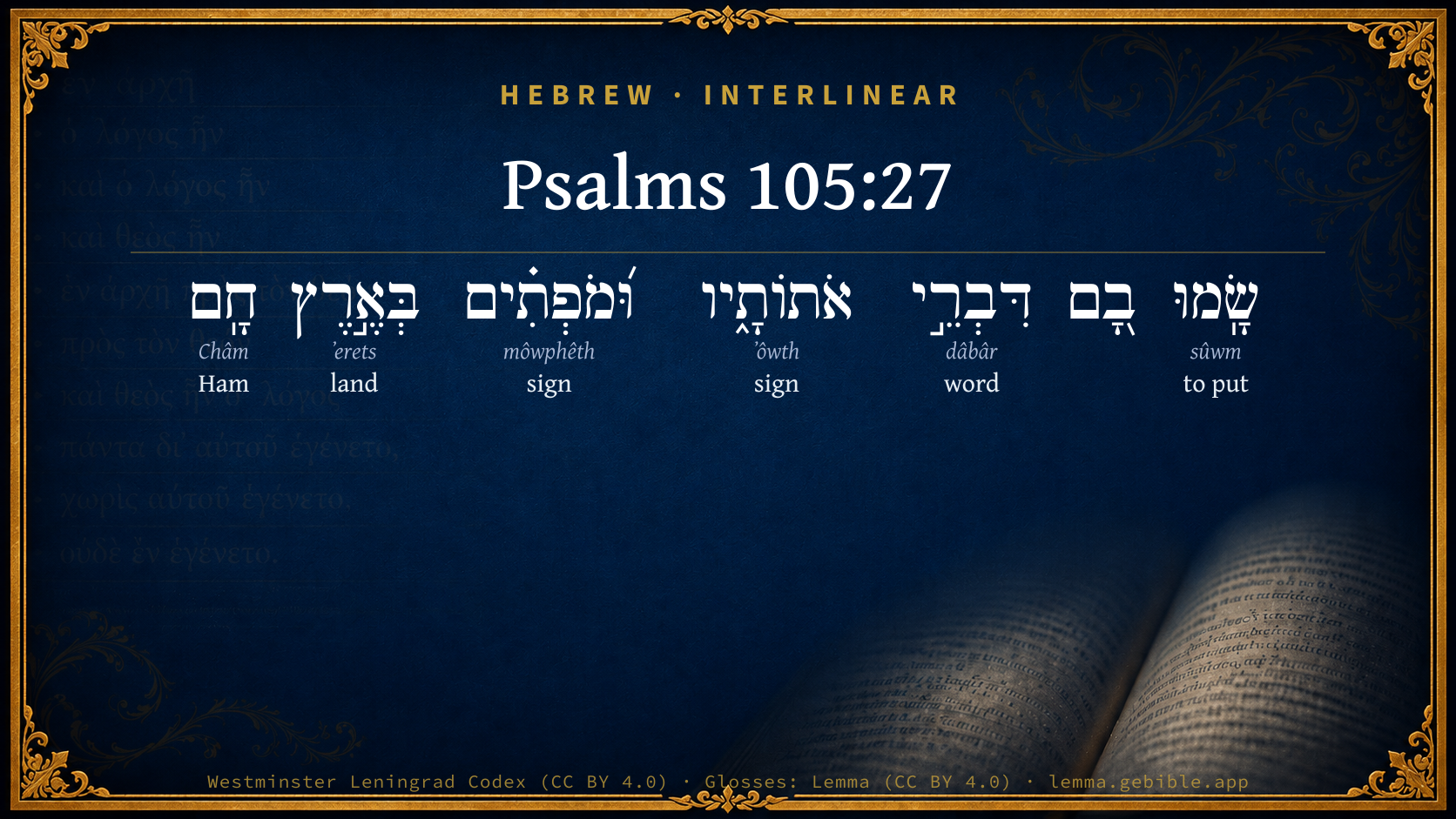
Psalms 105:27

Hebrew (Westminster Leningrad Codex) Psalms 105:27 appears in the Hebrew Old Testament. The text above is from the Westminster Leningrad Codex. Each word links to its Strong’s number, a concise gloss, and parsing drawn from the Open Scriptures Hebrew Bible morphology. Click any word for its full Brown-Driver-Briggs (BDB) entry.
Download image
Cite this verse

Psalms 105:27 (World English Bible). Public Domain. Lemma interlinear Bible study tool, https://lemma.gebible.app/v/psalms/105/27.

Show BibTeX & RIS
BibTeX
RIS
English Translation
They performed miracles among them, And wonders in the land of Ham.
World English Bible · Public Domain
Download a study sheet

One document with this verse’s original text, its word-by-word gloss line, the meaning frame, cross-references with their text, attributed commentary, and full source and license credits — printable, and it pastes into notes with its structure intact.

This verse Autodidact and up

Study sheet (.html) Plain text (.txt)

A passage Seminary Student

Up to 50 verses in one chapter. A passage sheet keeps up to 6 commentary sources and 12 cross-references per verse, in the order this page ranks them, and says so on the sheet whenever that leaves anything out. Ask for a single verse and you get the Autodidact verse sheet above.

Everything on this page stays free to read, with no account — the sheet is a download of what is already on screen, not access to it.

Want to remove ads? Support Godless Engineer
Compare translations 3

The same verse in 3 English versions, stacked beneath the original-language interlinear above. Click any original word for its lexicon entry.

Each is an independent rendering of the whole verse — the interlinear is not word-aligned to these translations.

Highlighted words mark where these versions differ — a whole-verse word diff, not a word-by-word alignment.

  • World English Bible Public Domain
    They performed miracles among them, And wonders in the land of Ham.
  • King James Version Public Domain
    They shewed his signs among them, and wonders in the land of Ham.
  • unfoldingWord Literal Text CC BY-SA 4.0
    They performed among them the matters of his signs, and his wonders in the land of Ham.

unfoldingWord Literal Text — © unfoldingWord, licensed CC BY-SA 4.0. Word-aligned USFM3 via Door43 (git.door43.org/unfoldingWord/en_ult).

Versions to compare (up to 4)

3 of 4 selected

Show all 18 translations

Every available English version of this verse, each an independent rendering of the whole verse.

  • World English Bible Public Domain
    They performed miracles among them, And wonders in the land of Ham.
  • Berean Standard Bible Public Domain
    They performed His miraculous signs among them, and wonders in the land of Ham.
  • Majority Standard Bible Public Domain
    They performed His miraculous signs among them, and wonders in the land of Ham.
  • King James Version Public Domain
    They shewed his signs among them, and wonders in the land of Ham.
  • American Standard Version (1901) Public Domain
    They set among them his signs, And wonders in the land of Ham.
  • Revised Version (1885) Public Domain
    They set among them his signs, and wonders in the land of Ham.
  • Geneva Bible (1599) Public Domain
    They shewed among them the message of his signes, and wonders in the land of Ham.
  • Douay-Rheims (1899) Public Domain
    He gave them power to shew his signs, and his wonders in the land of Cham.
  • Young's Literal Translation Public Domain
    They have set among them the matters of His signs, And wonders in the land of Ham.
  • Literal Standard Version CC BY-SA 4.0
    They have set among them the matters of His signs, || And wonders in the land of Ham.
  • Unlocked Literal Bible CC BY-SA 4.0
    They performed his signs among the Egyptians, his wonders in the land of Ham.
  • unfoldingWord Literal Text CC BY-SA 4.0
    They performed among them the matters of his signs, and his wonders in the land of Ham.
  • Darby Bible Public Domain
    They set his signs among them, and miracles in the land of Ham.
  • World Messianic Bible Public Domain
    They performed miracles among them, and wonders in the land of Ham.
  • Webster's Bible Public Domain
    They showed his signs among them, and wonders in the land of Ham.
  • Free Bible Version CC BY-SA 4.0
    They carried out his miraculous signs among the Egyptians, his wonders in the land of Ham.
  • Bible in Basic English Public Domain
    He let his signs be seen among the people, and his wonders in the land of Ham.
  • JPS Tanakh (1917) Public Domain
    They wrought among them His manifold signs, and wonders in the land of Ham.

Literal Standard Version (2020), Covenant Press — licensed CC BY-SA 4.0. Text via the HelloAO Bible API (eBible.org). Unlocked Literal Bible (unfoldingWord) — licensed CC BY-SA 4.0. Text via the HelloAO Bible API (eBible.org). unfoldingWord Literal Text — © unfoldingWord, licensed CC BY-SA 4.0. Word-aligned USFM3 via Door43 (git.door43.org/unfoldingWord/en_ult). Free Bible Version, Dr. Jonathan Gallagher — licensed CC BY-SA 4.0. Text via the HelloAO Bible API (eBible.org).

Word by word

More ways to search: Search by grammar → Find every occurrence → Compare this word →

Practice this passage: Drill this verse → Learn its vocabulary →

חָֽם
Châm
H2526
“Ham”
Noun, Proper
Part of Speech
Noun
Type
Proper
Full BDB Definition

Origin: the same as H2525

TWOT: None

Ham = "hot" - 2nd son of Noah, father of Canaan and of various peoples which were inhabitants of southern lands (noun proper masculine) - in late usage, a collective name for Egyptians (noun proper masculine) - the place where Chedorlaomer smote the Zuzim, probably in the territory of Ammonites (Gilead) east of the Jordan (noun proper locative)
  1. שָֽׂמוּ sûwm H7760 “to put” Verb, Qal, Perfect, 3rd Person, Common, Plural
  2. דִּבְרֵ֣י dâbâr H1697 “words of” Noun, Common, Masculine, Plural, Construct
  3. אֹתוֹתָ֑יו ʼôwth H226 “signs · his” Noun, Common, Both, Plural, Construct + Suffix, Personal, 3rd Person, Masculine, Singular
  4. וּ֝מֹפְתִ֗ים môwphêth H4159 “and · signs” Conjunction + Noun, Common, Masculine, Plural, Absolute
  5. בְּאֶ֣רֶץ ʼerets H776 “in/at · land of” Preposition + Noun, Common, Both, Singular, Construct

About this verse

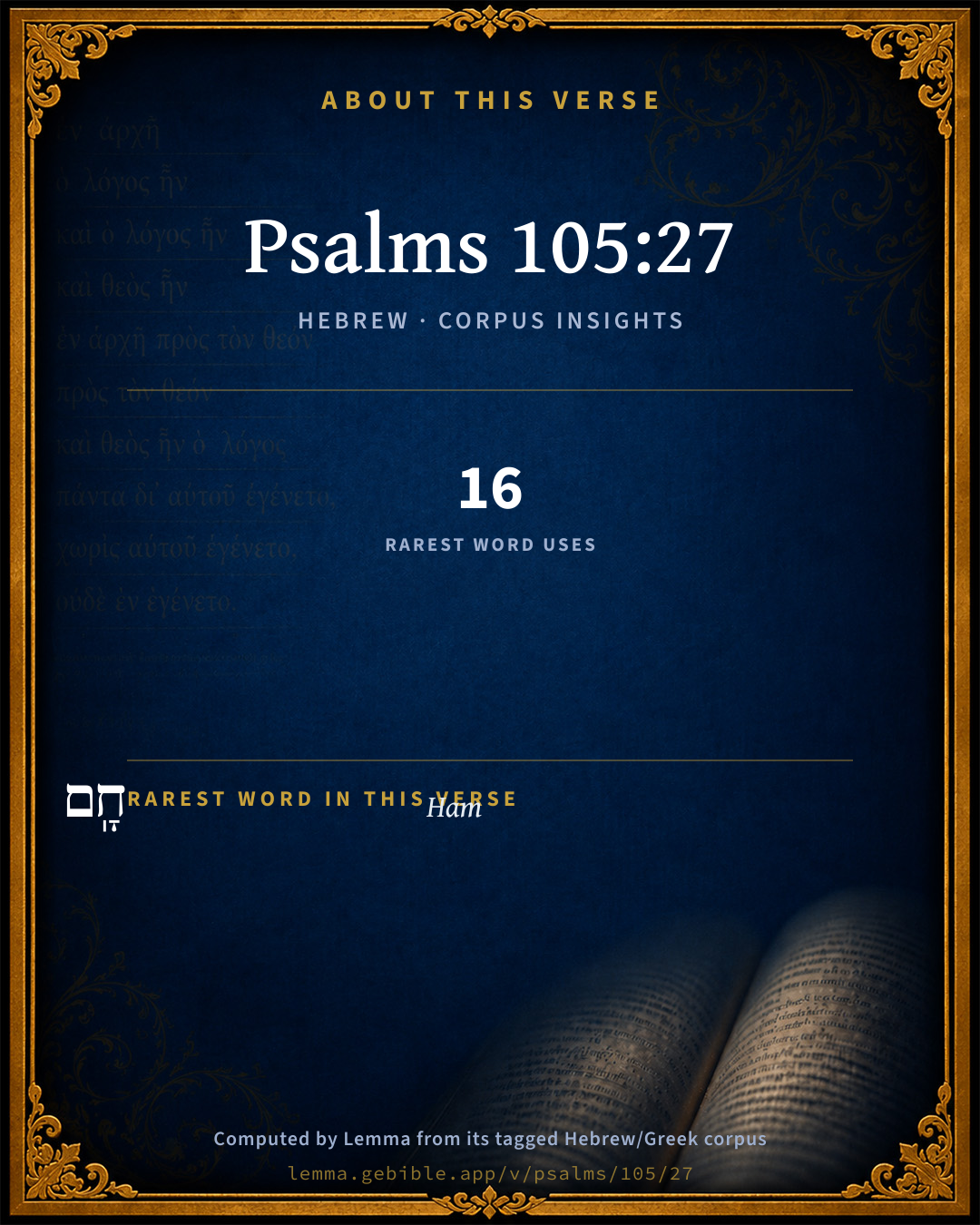
These counts appear in no published source. They are computed here, from the morphology-tagged text and Lemma’s own curated glosses. What Lemma adds →

7
words
6
distinct lemmas
Wisdom
section

Notable vocabulary

The rarest word here is חָֽם Ham H2526 — appearing just 16 times in the whole Hebrew Bible.

Shared distinctive vocabulary

חָֽם Ham H2526 occurs in 15 verses of the Hebrew Bible. Also found in:

Grammatical profile

  • 1 verb
  • 5 nouns
  • 1 preposition

Verb forms

  • שָֽׂמוּ Qal · Perfect

Hebrew & Septuagint length

In English translation the verse runs 12 words from the Hebrew and 14 from the Septuagint (LXX English) — closely comparable.

A rough comparison of the two English renderings, which tokenize alike — not a word-level alignment.

Word counts can differ between the Hebrew and the Greek without any difference in meaning — e.g. the Hebrew direct-object marker אֵת has no separate Greek word, and Greek often adds the article ὁ.

Cross-references

10

Topical passages linked to Psalms 105:27 in the Treasury of Scripture Knowledge — connected by theme and wording, ordered by reader-vote popularity; previews shown in the World English Bible.

  • Psalms 78:43–51 How he set his signs in Egypt, His wonders in the field of Zoan,
  • Nehemiah 9:10–11 and shown signs and wonders on Pharaoh, and on all his servants, and on all the people of his land; for you knew that they dealt proudly against them, and did get you a name, as it is this day.
  • Isaiah 63:11–12 Then he remembered the days of old, Moses [and] his people, [saying], Where is he who brought them up out of the sea with the shepherds of his flock? where is he who put his holy Spirit in the midst of them?
  • Jeremiah 32:20–21 who performed signs and wonders in the land of Egypt, even to this day, both in Israel and among [other] men; and made you a name, as in this day;
  • Exodus 7:1–11 Yahweh said to Moses, "Behold, I have made you as God to Pharaoh; and Aaron your brother shall be your prophet.
  • Deuteronomy 4:34 Or has God tried to go and take him a nation from the midst of [another] nation, by trials, by signs, and by wonders, and by war, and by a mighty hand, and by an outstretched arm, and by great terrors, according to all that Yahweh your God did for you in Egypt before your eyes?
  • Psalms 105:23 Israel also came into Egypt. Jacob sojourned in the land of Ham.
  • Psalms 105:28 He sent darkness, and made it dark. They didn't rebel against his words.
  • Psalms 106:22 Wondrous works in the land of Ham, And awesome things by the Red Sea.
  • Psalms 135:8–9 Who struck the firstborn of Egypt, Both of man and animal;

Cross-references courtesy of OpenBible.info (CC BY 4.0).

Hebrew and Greek witnesses Masoretic Hebrew ↔ Greek Septuagint

The same verse in the two great witnesses to the Old Testament, shown verse-for-verse.

You’re reading Greek Psalm 104 (Hebrew Psalm 105). The Septuagint counts the superscription, so verse numbers can differ from the Hebrew — chapter-level alignment, not verse-by-verse. Numbering follows Rahlfs.

These are two independent witnesses, not word-aligned to each other, and the Septuagint is shown in lemma (dictionary) form.

Hebrew Psalms 105:27 Masoretic · Westminster Leningrad Codex

שָֽׂמוּ בָ֭ם דִּבְרֵ֣י אֹתוֹתָ֑יו וּ֝מֹפְתִ֗ים בְּאֶ֣רֶץ חָֽם

They performed miracles among them, And wonders in the land of Ham.

World English Bible · Public Domain

Greek LXX Greek Psalm 104:27 Septuagint · lemma form

τίθημι ἐν αὐτός ὁ λόγος ὁ σημεῖον αὐτός καί ὁ τέρας ἐν γῆ χαμ

He established among them his signs, and his wonders in the land of Cham.

LXX2012 (modern English Septuagint) · Public Domain

On this verse, The Cambridge Bible for Schools and Colleges discusses the Septuagint’s reading. Read the note in Commentary ↓

Hebrew: Westminster Leningrad Codex (CC BY 4.0). Greek: Septuagint (public domain); English from LXX2012 (modern English Septuagint) (Public Domain). How the Septuagint differs from the Hebrew →

Commentary

Notes on Psalms 105:27 from classic Christian and Jewish commentators (each source and its license shown beneath its notes). The classic Christian expositions comment on the surrounding passage and are grouped to its opening verse, so a note may address several verses; the Jewish commentaries on the Tanakh (Rashi and others) are per-verse, so they appear only where the commentator wrote on this verse.

Lemma curates 59 commentaries, every one of them public domain or Creative Commons licensed, each selected and text-cleaned for this edition rather than reprinted as found. About our sources →

Trapp's Complete Commentary

John Trapp

Psa 105:27 They shewed his signs among them, and wonders in the land of Ham.

Ver. 27. They showed his signs] Heb. the words of his signs; for God’s wondrous works are vocal, they are real sermons of God’s power and justice. See Exo 4:8.

John Trapp, A Commentary or Exposition upon All the Books of the Old and New Testament (1647–1656) — public domain. Text from a community e-Sword module.

J. A. Alexander on Psalms

Joseph Addison Alexander

27. (Psa 105:27) They placed among them the words of his signs and wonders in the land of Ham. The first phrase seems to mean nothing more than set before them, or exhibited to them. Words of signs is by some understood to mean matters (or affairs) of signs, and to be either a pleonastic phrase for signs alone, or an emphatic phrase denoting all the signs. See above, on Psa 65:3. The first is a gratuitous assumption, the last a forced interpretation. Better than either is the explanation which gives to words its proper meaning, and supposes stress to be intentionally laid on the divine word of Jehovah, and the prophetic word of Moses and Aaron, in the way of threatening and command, as well as on the physical effects which followed these denunciations. Compare the use of words in Psa 7:1, and the explanation there given. Signs, i.e. tokens of God's presence and activity, and indications of his will. Wonders, prodigies, miracles, the same word that occurs above in ver. 5 (Psa 105:5).

Joseph Addison Alexander, The Psalms Translated and Explained (1850) — public domain. Text from a community e-Sword module.

Adam Clarke's Commentary

Verse 27. They showed his signs] Here is a reference to the plagues with which God afflicted the Egyptians. See the places in the margin, and the notes on them.

Adam Clarke's Commentary on the Bible (1810–1826) — public domain. Text from a community e-Sword/MySword module.

John Calvin's Commentaries

27. They set among them the words of his signs The prophet, in the first place, briefly glances at those things which Moses has detailed at greater length. Nor does he follow the order of the events observed in the history; for he contents himself with showing, that the deliverance of the chosen people was the work of God. He again distinguishes between the power of God, and the ministry of Moses and Aaron. He indeed asserts that these men performed miracles, but these miracles proceeded from God, so that celestial power was not obscurely displayed by their instrumentality.

John Calvin's Commentaries (1540-1563) — public domain. Text from the Calvin Translation Society English edition (1840s-50s) via the Christian Classics Ethereal Library (ccel.org). Calvin's coverage is partial (roughly two-thirds of the Bible); uncommented books and verses are honest gaps, never fabricated. The 19th-century editor's footnotes and remarks are omitted so the notes are faithfully Calvin's own voice.

Ellicott's Commentary for English Readers

(27) They shewed.—Literally, They placed, i.e., did.

His signs.—Literally (as in margin), the words of his tokens; but it may also be rendered, “the details of his signs.”(Comp. Psa_65:3 : “matters of iniquity,” or, “details of sin.”) So here, “details of signs,” i.e., signs in detail or sequence, sign after sign.

A Bible Commentary for English Readers, edited by Charles John Ellicott (1878–1897) — public domain. Text from a community e-Sword module.

The Cambridge Bible for Schools and Colleges

gen. ed. J. J. S. Perowne

27. They shewed &c.] Moses and Aaron. But the parallel passages in Psa_78:43; Exo_10:2 (cp. Jer_32:20) make it probable that we should follow most of the Ancient Versions (LXX, Aq. Symm. Syr. Jer.) in reading the singular, He set; and this agrees better with the context, as Jehovah is the subject in Psa_105:24-26; Psa_105:28-29.

his signs] Lit. the acts or matters of his signs (cp. the acts or matters of his wondrous works in Psa_145:5): i.e. his various signs: hardly, the words or message of his signs, “as being declarations of God’s will and command to let His people go.”

The Cambridge Bible for Schools and Colleges (gen. ed. J. J. S. Perowne; Cambridge University Press, 1878–1918) — public domain. Text from a community e-Sword module.

John Gill's Exposition

They showed his signs among them,.... The Egyptians to whom they were sent; that is, Moses and Aaron did. In the original it is, "the words of his signs" (x). They declared the words of God to them, that he would do such signs and wonders among them; or inflict such plagues upon them, in case they did not let Israel go: or they performed them according to the word of the Lord, as he commanded them, as well as taught the doctrines and instructions to be learned from them. The Septuagint and Vulgate Latin versions render it in the singular number, though contrary to the Hebrew text, and understand it of God, "he put the words of his signs in them"; in Moses and Aaron; or gave them orders and power to perform them: he put them "in both", as the Arabic version has it; or, "he did his signs by them", as the Syriac version.

And wonders in the land of Ham; or Egypt, as in Psa 105:23, meaning the miracles of the plagues, which are next particularly mentioned, though not all of them: the plagues of the murrain, and of the boils and blains, are omitted; the reason of which, according to Aben Ezra, is, because Pharaoh did not seek to Moses to remove them; and the other eight that are mentioned are not placed in the order in which they were done, the last but one being observed first.

(x) "verba signorum suorum", Pagninus, Montanus, Vatablus, Junius & Tremellius, &c.

John Gill's Exposition of the Whole Bible (1746–1763) — public domain (CC PDM 1.0). Text via the HelloAO Bible API.

Albert Barnes' Notes on the Bible

They shewed his signs among them - literally, “They placed among them the words of his signs.” So the margin. The reference is to the miracles performed in Egypt in bringing calamities upon the Egyptians to induce them to permit the children of Israel to go out from their bondage. They were the agents in setting these wonders before the Egyptians. The term words is employed here - “the words of his signs” - to keep up the idea that it was by the command of God that this was done, or by his word. It was by no power of their own, but only by the authority of God.

And wonders in the land of Ham - Miracles. Things suited to produce astonishment. See Psa 105:5.

Albert Barnes' Notes on the Bible (1834–1885) — public domain. Text from a community e-Sword/MySword module.

Matthew Poole's English Annotations

His signs, Heb. the words of his signs; an emphatical expression. First they boldly declared the word and will of God concerning the several plagues, and then they actually inflicted them.

Matthew Poole's English Annotations on the Holy Bible (1683–1685) — public domain. Text from a community e-Sword/MySword module.

The Treasury of David

Charles H. Spurgeon

Ver. 27. They showed his signs among them, and wonders in the land of Ham. The miracles which were wrought by Moses were the Lord's, not his own: signs, as being the marks of Jehovah's presence hence they are here called "his" and power. The plagues were "words of his signs" (see margin), that is to say, they were speaking marvels, which testified more plainly than words to the omnipotence of Jehovah, to his determination to be obeyed, to his anger at the obstinacy of Pharaoh. Never were discourses more plain, pointed, personal, or powerful, and yet it took ten of them to accomplish the end designed. In the preaching of the gospel there are words, and signs, and wonders and these leave men without excuse for their impenitence; to have the kingdom of God come nigh unto them, and yet to remain rebellious is the unhappy sin of obstinate spirits. Those are wonders of sin who see wonders of grace, and yet are unaffected by them: bad as he was, Pharaoh had not this guilt, for the prodigies which lie beheld were marvels of judgment and not of mercy.

Psalms 105:28*

Charles H. Spurgeon's The Treasury of David (1869–1885) — public domain. Psalms only. Text from a community e-Sword/MySword module.

Whedon's Commentary on the Bible

Daniel D. Whedon

27. His signs—Literally, the words of his signs; that is, the meaning of his miracles, which were the tokens of his supremacy and of his will.

Daniel D. Whedon (gen. ed.), Commentary on the Old and New Testaments (1874–1909) — public domain. Text from a community e-Sword module.

The Pulpit Commentary

They showed his signs among them; literally, the matters of his signs; i.e. his long series of signs. Aaron showed the earlier signs generally, (Exo_7:10, Exo_7:19, 20 8:6, 17) Moses the later ones. (Exo_9:10, 23 10:13, 22) And wonders in the land of Ham. (comp. ver. 23 and Psa_106:22)

Delivering judgments.

The "signs" here mentioned are the "plagues" which Jehovah sent on Egypt for the humbling of its weak but obstinate Pharaoh. They were "judgments" for Egypt; they were first steps of "deliverance" for Israel. So the salmist, regarding them from the standpoint of God"s dealing with his ancestors, very properly treats them as "delivering judgments." All Divine judgments are two-sided: we see what they are to those who are judged; we ought to see what they are to those who are called to learn through the judgments.

I WHAT ARE DIVINE JUDGMENTS TO THOSE WHO ENDURE THEM? Such the plagues were to Pharaoh and the Egyptians. Observe that the question really at issue was, the relative claim and ability of the Egyptian gods and Israel"s God. Then it is easy to see (and Dean Stanley, in his "Jewish Church," vol. 1. p. 102, helps us to illustrate) that the plagues demonstrated the helplessness of the idols, and the supreme power of Jehovah. And that is the proper issue of all Divine judgments. They are intended to break us off from all forms of self-trust, and to convince us of the supreme authority and power of God, who is "known by the judgments that he executeth." "When his judgments are abroad in the earth, the inhabitants of the world will learn righteousness.

II WHAT ARE DIVINE JUDGMENTS TO THOSE WHO WATCH THEM? Such were the Israelites, whose territory of Goshen was not affected by the plagues. But they were in danger of taking up with the idolatry of Egypt; they found it hard to keep true to the unseen Jehovah. So the judgments they did but observe, and did not feel, exerted a similar influence on them. They convinced them of the utter helplessness and uselessness of the Egyptian gods. They proved that the unseen Jehovah-God was practically effective in the actual scenes of nature and life. They even saw more than this. The judgments which thus fell on those who held them in bondage, were plainly beginnings of God"s deliverance for them. If they seemed to tighten the Egyptian hold, they really loosened it. And when the series of judgments reached their climax, Pharaoh and his Egyptians were ready enough to thrust them out. So, while to those who come under Divine judgments they prove humblings; to those who watch and learn, they seem to be Divine deliverances. R.T.

The Pulpit Commentary (1880–1919), ed. H.D.M. Spence-Jones & Joseph S. Exell — public domain. Text from a community e-Sword module.

Lesson kit

Teaching starters — assembled from the data on this page, not authored interpretation. Every prompt links to the verse data it draws on. Edit before teaching.

Psalms, in the Wisdom, opens this verse with 7 words (6 distinct Hebrew lemmas). Its most distinctive word is Châm (“Ham”). A historical commentator’s framing appears above. Read the whole chapter for the surrounding context.

Discussion questions

  1. What does “Ham” (Châm) contribute to the verse as a whole?
  2. How does Genesis 5:32, which shares the word «Ham», read alongside this verse?
  3. The translations on this page render this verse differently — a whole-verse word diff, not a word-by-word alignment. What might account for the different wordings?
  4. «שָֽׂמוּ» is a Qal Perfect verb. How does that grammatical form shape the action described?
  5. Compare how Trapp's Complete Commentary and J. A. Alexander on Psalms read this verse. Where do they agree or differ?

Things to notice

Reading settings

Reading text

Shown beneath each verse's original-language words.

Old Testament
Old Testament edition

Read the OT as the Masoretic Hebrew (MT) or the Greek Septuagint (LXX).

English shown for the Greek Septuagint (in the Hebrew ↔ Greek comparison).

Comparing translations? Open the Compare panel on any verse page to stack up to four side by side.