Exodus 8:12

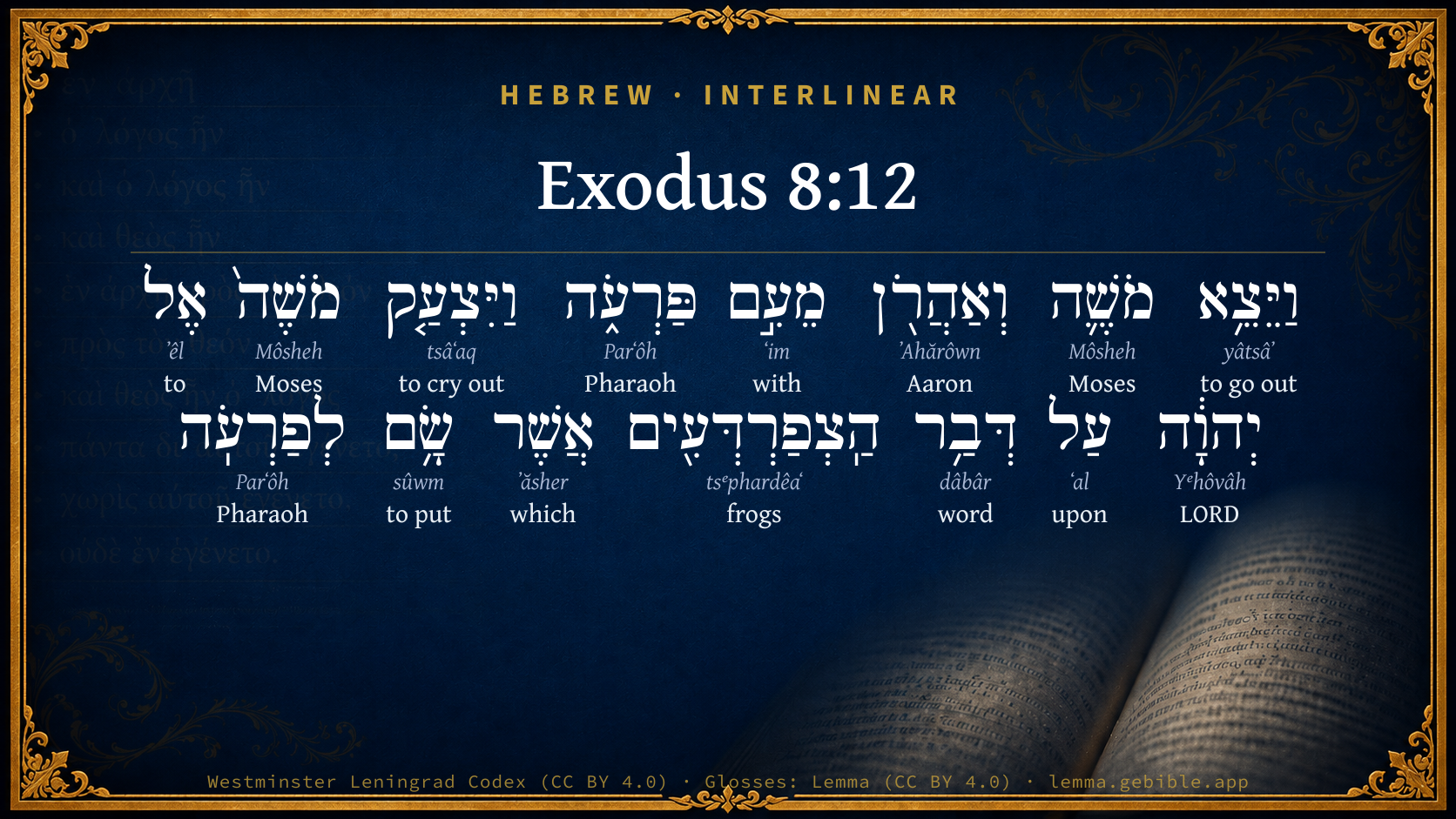
Hebrew (Westminster Leningrad Codex) Exodus 8:12 appears in the Hebrew Old Testament. The text above is from the Westminster Leningrad Codex. Each word links to its Strong’s number, a concise gloss, and parsing drawn from the Open Scriptures Hebrew Bible morphology. Click any word for its full Brown-Driver-Briggs (BDB) entry.
Download image
Cite this verse

Exodus 8:12 (World English Bible). Public Domain. Lemma interlinear Bible study tool, https://lemma.gebible.app/v/exodus/8/12.

Show BibTeX & RIS
BibTeX
RIS
English Translation
Moses and Aaron went out from Pharaoh, and Moses cried to Yahweh concerning the frogs which he had brought on Pharaoh.
World English Bible · Public Domain
Download a study sheet

One document with this verse’s original text, its word-by-word gloss line, the meaning frame, cross-references with their text, attributed commentary, and full source and license credits — printable, and it pastes into notes with its structure intact.

This verse Autodidact and up

Study sheet (.html) Plain text (.txt)

A passage Seminary Student

Up to 50 verses in one chapter. A passage sheet keeps up to 6 commentary sources and 12 cross-references per verse, in the order this page ranks them, and says so on the sheet whenever that leaves anything out. Ask for a single verse and you get the Autodidact verse sheet above.

Everything on this page stays free to read, with no account — the sheet is a download of what is already on screen, not access to it.

Want to remove ads? Support Godless Engineer
Compare translations 3

The same verse in 3 English versions, stacked beneath the original-language interlinear above. Click any original word for its lexicon entry.

Each is an independent rendering of the whole verse — the interlinear is not word-aligned to these translations.

Highlighted words mark where these versions differ — a whole-verse word diff, not a word-by-word alignment.

  • World English Bible Public Domain
    Moses and Aaron went out from Pharaoh, and Moses cried to Yahweh concerning the frogs which he had brought on Pharaoh.
  • King James Version Public Domain
    And Moses and Aaron went out from Pharaoh: and Moses cried unto the LORD because of the frogs which he had brought against Pharaoh.
  • unfoldingWord Literal Text CC BY-SA 4.0
    And Moses and Aaron went out from being with Pharaoh. And Moses cried out to Yahweh concerning the matter of the frogs that he had set on Pharaoh.

unfoldingWord Literal Text — © unfoldingWord, licensed CC BY-SA 4.0. Word-aligned USFM3 via Door43 (git.door43.org/unfoldingWord/en_ult).

Versions to compare (up to 4)

3 of 4 selected

Show all 18 translations

Every available English version of this verse, each an independent rendering of the whole verse.

  • World English Bible Public Domain
    Moses and Aaron went out from Pharaoh, and Moses cried to Yahweh concerning the frogs which he had brought on Pharaoh.
  • Berean Standard Bible Public Domain
    After Moses and Aaron had left Pharaoh, Moses cried out to the LORD for help with the frogs that He had brought against Pharaoh.
  • Majority Standard Bible Public Domain
    After Moses and Aaron had left Pharaoh, Moses cried out to the LORD for help with the frogs that He had brought against Pharaoh.
  • King James Version Public Domain
    And Moses and Aaron went out from Pharaoh: and Moses cried unto the LORD because of the frogs which he had brought against Pharaoh.
  • American Standard Version (1901) Public Domain
    And Moses and Aaron went out from Pharaoh: and Moses cried unto Jehovah concerning the frogs which he had brought upon Pharaoh.
  • Revised Version (1885) Public Domain
    And Moses and Aaron went out from Pharaoh: and Moses cried unto the LORD concerning the frogs which he had brought upon Pharaoh.
  • Geneva Bible (1599) Public Domain
    Then Moses and Aaron went out from Pharaoh: and Moses cryed vnto the Lord concerning the frogges, which hee had sent vnto Pharaoh.
  • Douay-Rheims (1899) Public Domain
    And Moses and Aaron went forth from Pharao: and Moses cried to the Lord for the promise, which he had made to Pharao concerning the frogs.
  • Young's Literal Translation Public Domain
    And Moses -- Aaron also -- goeth out from Pharaoh, and Moses crieth unto Jehovah, concerning the matter of the frogs which He hath set on Pharaoh;
  • Literal Standard Version CC BY-SA 4.0
    And Moses—Aaron also—goes out from Pharaoh, and Moses cries to YHWH concerning the matter of the frogs which He has set on Pharaoh;
  • Unlocked Literal Bible CC BY-SA 4.0
    Moses and Aaron went out from Pharaoh. Then Moses cried out to Yahweh concerning the frogs that he had brought on Pharaoh.
  • unfoldingWord Literal Text CC BY-SA 4.0
    And Moses and Aaron went out from being with Pharaoh. And Moses cried out to Yahweh concerning the matter of the frogs that he had set on Pharaoh.
  • Darby Bible Public Domain
    And Moses and Aaron went out from Pharaoh; and Moses cried to Jehovah because of the frogs that he had brought against Pharaoh.
  • World Messianic Bible Public Domain
    Moses and Aaron went out from Pharaoh, and Moses cried to the LORD concerning the frogs which he had brought on Pharaoh.
  • Webster's Bible Public Domain
    And Moses and Aaron went out from Pharaoh: and Moses cried to the LORD, because of the frogs which he had brought against Pharaoh.
  • Free Bible Version CC BY-SA 4.0
    Moses and Aaron left Pharaoh, and Moses pleaded with the Lord about the frogs he had sent against Pharaoh.
  • Bible in Basic English Public Domain
    Then Moses and Aaron went out from Pharaoh; and Moses made prayer to the Lord about the frogs which he had sent on Pharaoh.
  • JPS Tanakh (1917) Public Domain
    (8-8) And Moses and Aaron went out from Pharaoh; and Moses cried unto the LORD concerning the frogs, which He had brought upon Pharaoh.

Literal Standard Version (2020), Covenant Press — licensed CC BY-SA 4.0. Text via the HelloAO Bible API (eBible.org). Unlocked Literal Bible (unfoldingWord) — licensed CC BY-SA 4.0. Text via the HelloAO Bible API (eBible.org). unfoldingWord Literal Text — © unfoldingWord, licensed CC BY-SA 4.0. Word-aligned USFM3 via Door43 (git.door43.org/unfoldingWord/en_ult). Free Bible Version, Dr. Jonathan Gallagher — licensed CC BY-SA 4.0. Text via the HelloAO Bible API (eBible.org).

Word by word

More ways to search: Search by grammar → Find every occurrence → Compare this word →

Practice this passage: Drill this verse → Learn its vocabulary →

הַֽצְפַרְדְּעִ֖ים
tsᵉphardêaʻ
H6854
“the · frogs”
Particle, Definite Article + Noun, Common, Feminine, Plural, Absolute
Part of Speech
Particle + Noun
Type
Common
Gender
Feminine
Number
Plural
State
Absolute
Full BDB Definition

Origin: from H6852 and a word elsewhere unused meaning a swamp

TWOT: 1963

frogs
  1. וַיֵּצֵ֥א yâtsâʼ H3318 “and · to go out” Conjunction + Verb, Qal, Sequential Imperfect, 3rd Person, Masculine, Singular
  2. מֹשֶׁ֛ה Môsheh H4872 “Moses” Noun, Proper
  3. וְאַהֲרֹ֖ן ʼAhărôwn H175 “and · Aaron” Conjunction + Noun, Proper
  4. מֵעִ֣ם ʻim H5973 “from · with” Preposition + Preposition
  5. פַּרְעֹ֑ה Parʻôh H6547 “Pharaoh” Noun, Proper
  6. וַיִּצְעַ֤ק tsâʻaq H6817 “and · to cry out” Conjunction + Verb, Qal, Sequential Imperfect, 3rd Person, Masculine, Singular
  7. מֹשֶׁה֙ Môsheh H4872 “Moses” Noun, Proper
  8. אֶל ʼêl H413 “to” Preposition
  9. יְהוָ֔ה Yᵉhôvâh H3068 “LORD” Noun, Proper
  10. עַל ʻal H5921 “upon” Preposition
  11. דְּבַ֥ר dâbâr H1697 “word of” Noun, Common, Masculine, Singular, Construct
  12. אֲשֶׁר ʼăsher H834 “which” Particle, Relative
  13. שָׂ֥ם sûwm H7760 “to put” Verb, Qal, Perfect, 3rd Person, Masculine, Singular
  14. לְפַרְעֹֽה Parʻôh H6547 “to/for · Pharaoh” Preposition + Noun, Proper

About this verse

These counts appear in no published source. They are computed here, from the morphology-tagged text and Lemma’s own curated glosses. What Lemma adds →

15
words
13
distinct lemmas
Pentateuch
section

Notable vocabulary

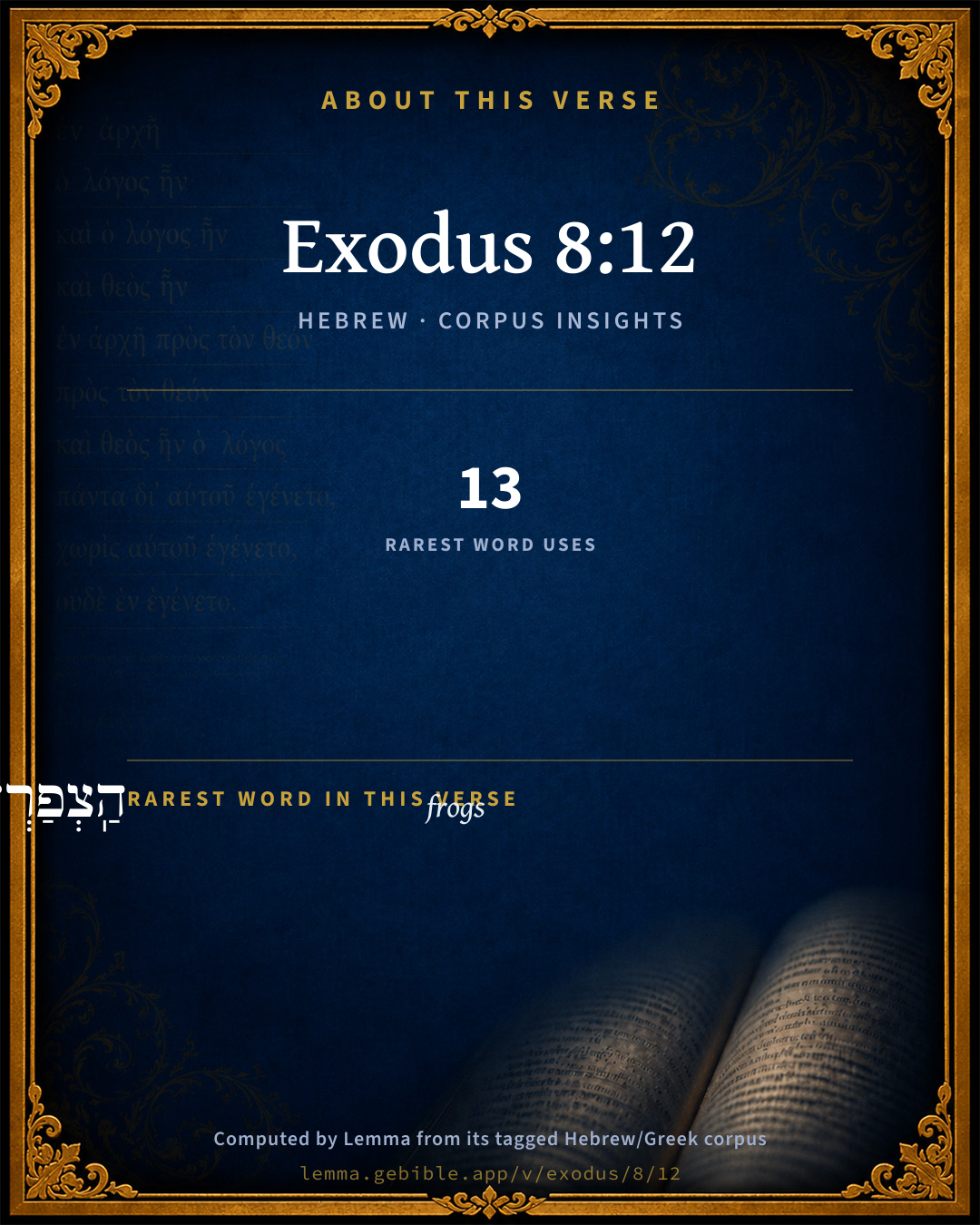
The rarest word here is הַֽצְפַרְדְּעִ֖ים frogs H6854 — appearing just 13 times in the whole Hebrew Bible.

Shared distinctive vocabulary

הַֽצְפַרְדְּעִ֖ים frogs H6854 occurs in 13 verses of the Hebrew Bible. Also found in:

Grammatical profile

  • 3 verbs
  • 8 nouns
  • 3 prepositions
  • 1 particle

Verb forms

  • וַיֵּצֵ֥א Qal · Sequential Imperfect
  • וַיִּצְעַ֤ק Qal · Sequential Imperfect
  • שָׂ֥ם Qal · Perfect

Repetition

Words recur within this verse — often emphatic in Hebrew:

  • מֹשֶׁ֛ה Moses H4872 ×2
  • פַּרְעֹ֑ה Pharaoh H6547 ×2

Hebrew & Septuagint length

In English translation the verse runs 21 words from the Hebrew and 24 from the Septuagint (LXX English) — closely comparable.

A rough comparison of the two English renderings, which tokenize alike — not a word-level alignment.

Word counts can differ between the Hebrew and the Greek without any difference in meaning — e.g. the Hebrew direct-object marker אֵת has no separate Greek word, and Greek often adds the article ὁ.

Cross-references

8

Topical passages linked to Exodus 8:12 in the Treasury of Scripture Knowledge — connected by theme and wording, ordered by reader-vote popularity; previews shown in the World English Bible.

  • James 5:16–18 Confess your offenses to one another, and pray one for another, that you may be healed. The effective, earnest prayer of a righteous man is powerfully effective.
  • Exodus 8:8 Then Pharaoh called for Moses and Aaron, and said, "Entreat Yahweh, that he take away the frogs from me, and from my people; and I will let the people go, that they may sacrifice to Yahweh."
  • Exodus 8:30 Moses went out from Pharaoh, and prayed to Yahweh.
  • Exodus 9:33 Moses went out of the city from Pharaoh, and spread abroad his hands to Yahweh; and the thunders and hail ceased, and the rain was not poured on the earth.
  • Exodus 10:18 He went out from Pharaoh, and prayed to Yahweh.
  • Exodus 32:11 Moses begged Yahweh his God, and said, "Yahweh, why does your wrath burn hot against your people, that you have brought forth out of the land of Egypt with great power and with a mighty hand?
  • 1 Samuel 12:23 Moreover as for me, far be it from me that I should sin against Yahweh in ceasing to pray for you: but I will instruct you in the good and the right way.
  • Ezekiel 36:37 Thus says the Lord Yahweh: For this, moreover, will I be inquired of by the house of Israel, to do it for them: I will increase them with men like a flock.

Cross-references courtesy of OpenBible.info (CC BY 4.0).

Hebrew and Greek witnesses Masoretic Hebrew ↔ Greek Septuagint

The same verse in the two great witnesses to the Old Testament, shown verse-for-verse.

These are two independent witnesses, not word-aligned to each other, and the Septuagint is shown in lemma (dictionary) form.

Hebrew Exodus 8:12 Masoretic · Westminster Leningrad Codex

וַיֵּצֵ֥א מֹשֶׁ֛ה וְאַהֲרֹ֖ן מֵעִ֣ם פַּרְעֹ֑ה וַיִּצְעַ֤ק מֹשֶׁה֙ אֶל יְהוָ֔ה עַל דְּבַ֥ר הַֽצְפַרְדְּעִ֖ים אֲשֶׁר שָׂ֥ם לְפַרְעֹֽה

Moses and Aaron went out from Pharaoh, and Moses cried to Yahweh concerning the frogs which he had brought on Pharaoh.

World English Bible · Public Domain

Greek LXX Exodus 8:12 Septuagint · lemma form

εἶπον δέ κύριος πρός μωυσῆς εἶπον ααρων ἐκτείνω ὁ χείρ ὁ ῥάβδος σύ καί πατάσσω ὁ χῶμα ὁ γῆ καί εἰμί σκνίψ ἐν τε ὁ ἄνθρωπος καί ἐν ὁ τετράπους καί ἐν πᾶς γῆ αἴγυπτος

And Moses and Aaron went forth from Pharao, and Moses cried to the Lord concerning the restriction of the frogs, as Pharao appointed him.

LXX2012 (modern English Septuagint) · Public Domain

Hebrew: Westminster Leningrad Codex (CC BY 4.0). Greek: Septuagint (public domain); English from LXX2012 (modern English Septuagint) (Public Domain). How the Septuagint differs from the Hebrew →

Targum (Aramaic paraphrase)

2

The Targum is the ancient Jewish Aramaic paraphrase of the Hebrew Scriptures — an interpretive translation, not the Hebrew text itself. Onkelos (literal) and Pseudo-Jonathan (expansive) render the Torah, and Jonathan the Prophets. Coverage is partial: where no permissively-licensed English translation exists for a verse, only the Aramaic is shown. This is verse-level text, not a word-by-word alignment to the Hebrew.

  1. Targum Onkelos Torah (Genesis–Deuteronomy)
    וַאֲמַר יְיָ לְמשֶׁה אֱמַר לְאַהֲרֹן אֲרֵים יָת חֻטְרָךְ וּמְחָא יָת עַפְרָא דְאַרְעָא וִיהֵא לְקַלְמְתָא בְּכָל אַרְעָא דְמִצְרָיִם:

    (no public-domain English translation for this verse)

    Targum Onkelos — Aramaic: “Onkelos Genesis” (public domain); “Onkelos Exodus” (public domain); “Onkelos Leviticus” (public domain); “Onkelos Numbers” (public domain); “Onkelos Deuteronomy” (public domain). English: “Sefaria Community Translation” (CC0 1.0 (public-domain dedication)); “J.W. Etheridge. The Targums of Onkelos and Jonathan Ben Uzziel on the Pentateuch. London: Longmans, Green, 1862” (public domain). Text via Sefaria.

  2. Targum Pseudo-Jonathan Torah (Genesis–Deuteronomy)
    וַאֲמַר יְיָ לְמשֶׁה אֵימַר לְאַהֲרן אֲרֵים יַת חוּטְרָךְ וּמְחֵי יַת עַפְרָא דְאַרְעָא וִיהֵי לְקַלְמֵי בְּכָל אַרְעָא דְמִצְרָיִם בְּרַם עַל יְדָךְ לֵית אֶפְשַׁר לְמִלְקֵי אַרְעָא דְבָהּ הֲוָת לָךְ שֵׁיזְבוּתָא כַּד קָטַלְתָּא יַת מִצְרָאֵי וְקַבִּילְתֵּיהּ

    And the Lord said to Mosheh, Speak unto Aharon, Lift up thy rod and smite the dust of the earth, and it shall become venomous insects in all the land of Mizraim. But it shall not be by thee that the ground shall be smitten, because therein for thee was (the means of) safety when thou hadst slain the Mizraite and it received him.

    Targum Pseudo-Jonathan — Aramaic: “Targum Jonathan on Genesis” (public domain); “Targum Jonathan on Exodus” (public domain); “Targum Jonathan on Leviticus” (public domain); “Targum Jonathan on Numbers” (public domain); “Targum Jonathan on Deuteronomy” (public domain). English: “The Targum of Jonathan ben Uzziel, trans. J. W. Etheridge, London, 1862” (public domain). Text via Sefaria.

Commentary

Notes on Exodus 8:12 from classic Christian and Jewish commentators (each source and its license shown beneath its notes). The classic Christian expositions comment on the surrounding passage and are grouped to its opening verse, so a note may address several verses; the Jewish commentaries on the Tanakh (Rashi and others) are per-verse, so they appear only where the commentator wrote on this verse.

Lemma curates 59 commentaries, every one of them public domain or Creative Commons licensed, each selected and text-cleaned for this edition rather than reprinted as found. About our sources →

Trapp's Complete Commentary

John Trapp

Exo 8:12 And Moses and Aaron went out from Pharaoh: and Moses cried unto the LORD because of the frogs which he had brought against Pharaoh.

Ver. 12. And Moses cried unto the Lord.] Not for Pharaoh’s conversion; for he knew he was past cure; but for his deliverance from the present plague, that the power of God might be the more manifested, and the tyrant’s conscience the more convinced.

John Trapp, A Commentary or Exposition upon All the Books of the Old and New Testament (1647–1656) — public domain. Text from a community e-Sword module.

Geneva Bible (1599)

Geneva Bible translators

Or, laid upon.

Geneva Bible (1599) marginal notes — public domain. Text via Bolls.life.

The Cambridge Bible for Schools and Colleges

gen. ed. J. J. S. Perowne

12. drought upon] appointed for, viz. as a sign. The marg. (referring the words to the promise of their removal, v. 10) is less probable.

The Cambridge Bible for Schools and Colleges (gen. ed. J. J. S. Perowne; Cambridge University Press, 1878–1918) — public domain. Text from a community e-Sword module.

John Gill's Exposition

And the Lord did according to the word of Moses,.... He heard his prayers, and fulfilled what he had promised Pharaoh:

and the frogs died out of the houses, and out of the villages, and out of the fields; the word for "villages" signifies "courts" (b), and may be so rendered here; and the sense is, that they not only died out of their dwelling houses, but out of their courtyards, and even out of their gardens, orchards, and fields, so that there were none near them to give any manner of trouble and offence. And their dying, and remaining dead upon the spot, were clear proofs that they were real frogs that were produced, and not in appearance only, as the frogs of the magicians might be; God could have caused them to return to the river from whence they came, or have annihilated them, or removed them out of sight in an instant; but the killing of them, and letting them lie dead, proved the truth of the miracle, and gave apparent evidence of it both ways, both in the bringing and removing them.

(b) "ex atriis", Montanus, Tigurine version, Piscator.

John Gill's Exposition of the Whole Bible (1746–1763) — public domain (CC PDM 1.0). Text via the HelloAO Bible API.

Matthew Poole's English Annotations

Or, as the place is fitly rendered by others, because of the word, or matter of, or about the frogs which he had given or propounded to Pharaoh. Because he had given his word both for the thing and the time of it, he prayed more earnestly lest God should be dishonoured, and Pharaoh have occasion of triumph. The Hebrew verbs to put and to give are frequently exchanged, as appears by comparing 1Ki 10:9, with 2Ch 9:8; and Isa 42:1, with Mat 12:18.

Moses cried unto the Lord: though he was assured that the frogs would depart at his word, yet he would use the means appointed by God for the accomplishment of it.

Matthew Poole's English Annotations on the Holy Bible (1683–1685) — public domain. Text from a community e-Sword/MySword module.

The Pulpit Commentary

Moses cried unto the Lord. The expression used is a strong one, and seems to imply special earnestness in the prayer. Moses had ventured to fix a definite time for the removal of the plague, without (so far as appears) any special command of God. Hence earnest prayer (as Kalisch notes) was doubly necessary. (Compare 1Ki_18:36, 1Ki_18:37)

The Pulpit Commentary (1880–1919), ed. H.D.M. Spence-Jones & Joseph S. Exell — public domain. Text from a community e-Sword module.

Rashi

Rabbi Shlomo Yitzchaki (Rashi)

אמר אל אהרן SAY UNTO AARON — The dust did not deserve to be smitten by Moses because it had protected him when he slew the Egyptian, for “he hid him in the sand”; and it was therefore smitten by Aaron (Tanchuma; Exodus Rabbah 10:7).

Rashi on the Tanakh — English translations: “The Judaica Press complete Tanach with Rashi, translated by A. J. Rosenberg” (CC BY 4.0); “Pentateuch with Rashi's commentary by M. Rosenbaum and A.M. Silbermann, 1929-1934” (public domain); “The Metsudah Tanach series, Lakewood, N.J” (CC BY 4.0); and “The Book of Joshua, Metsudah Publications, 1997” (CC BY 4.0). Text via Sefaria.

Lesson kit

Teaching starters — assembled from the data on this page, not authored interpretation. Every prompt links to the verse data it draws on. Edit before teaching.

Exodus, in the Pentateuch, opens this verse with 15 words (13 distinct Hebrew lemmas). Its most distinctive word is tsᵉphardêaʻ (“frogs”). A historical commentator’s framing appears above. Read the whole chapter for the surrounding context.

Discussion questions

  1. How does “frogs” (tsᵉphardêaʻ) shape what this verse is saying?
  2. How does Exodus 8:2, which shares the word «frogs», read alongside this verse?
  3. What does the repetition of “Moses” (2× in this one verse) do in this verse?
  4. These translations render this verse differently. What is at stake in choosing one wording over another?
  5. «וַיֵּצֵ֥א» is a Qal Sequential Imperfect verb. How does that grammatical form shape the action described?
  6. Compare how Trapp's Complete Commentary and Geneva Bible (1599) read this verse. Where do they agree or differ?

Things to notice

Reading settings

Reading text

Shown beneath each verse's original-language words.

Old Testament
Old Testament edition

Read the OT as the Masoretic Hebrew (MT) or the Greek Septuagint (LXX).

English shown for the Greek Septuagint (in the Hebrew ↔ Greek comparison).

Comparing translations? Open the Compare panel on any verse page to stack up to four side by side.