
Isaiah 28:25

Hebrew (Westminster Leningrad Codex) Isaiah 28:25 appears in the Hebrew Old Testament. The text above is from the Westminster Leningrad Codex. Each word links to its Strong’s number, a concise gloss, and parsing drawn from the Open Scriptures Hebrew Bible morphology. Click any word for its full Brown-Driver-Briggs (BDB) entry.
Download image
Cite this verse

Isaiah 28:25 (World English Bible). Public Domain. Lemma interlinear Bible study tool, https://lemma.gebible.app/v/isaiah/28/25.

Show BibTeX & RIS
BibTeX
RIS
English Translation
When he has leveled the surface of it, doesn't he cast abroad the dill, and scatter the cumin, and put in the wheat in rows, and the barley in the appointed place, and the spelt in the border of it?
World English Bible · Public Domain
Highlights
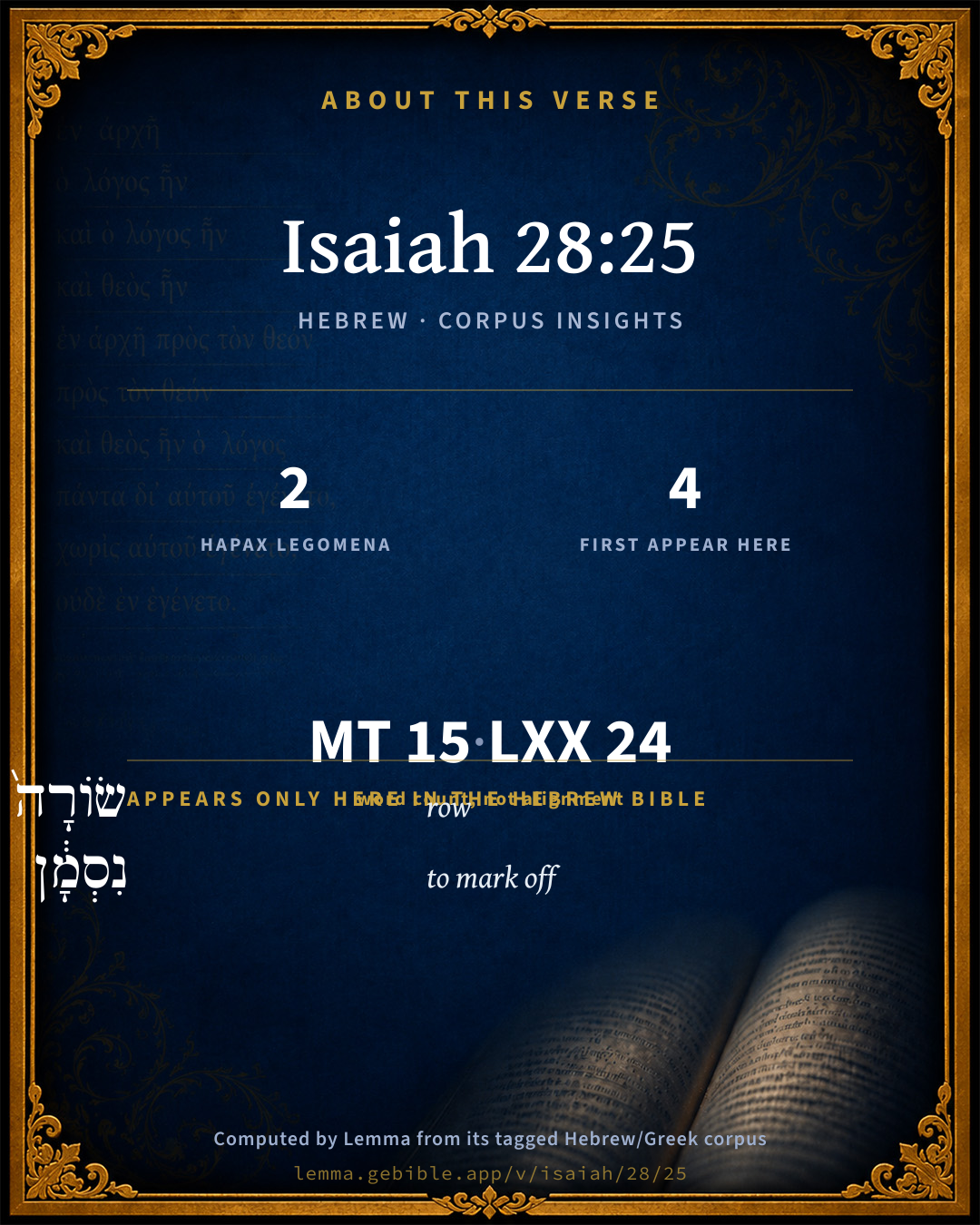
  • 2 hapax legomena — only here in the Hebrew Bible
  • 4 first appearances in the Hebrew Bible
Full analysis ↓
Download a study sheet

One document with this verse’s original text, its word-by-word gloss line, the meaning frame, cross-references with their text, attributed commentary, and full source and license credits — printable, and it pastes into notes with its structure intact.

This verse Autodidact and up

Study sheet (.html) Plain text (.txt)

A passage Seminary Student

Up to 50 verses in one chapter. A passage sheet keeps up to 6 commentary sources and 12 cross-references per verse, in the order this page ranks them, and says so on the sheet whenever that leaves anything out. Ask for a single verse and you get the Autodidact verse sheet above.

Everything on this page stays free to read, with no account — the sheet is a download of what is already on screen, not access to it.

Want to remove ads? Support Godless Engineer
Compare translations 3

The same verse in 3 English versions, stacked beneath the original-language interlinear above. Click any original word for its lexicon entry.

Each is an independent rendering of the whole verse — the interlinear is not word-aligned to these translations.

Highlighted words mark where these versions differ — a whole-verse word diff, not a word-by-word alignment.

  • World English Bible Public Domain
    When he has leveled the surface of it, doesn't he cast abroad the dill, and scatter the cumin, and put in the wheat in rows, and the barley in the appointed place, and the spelt in the border of it?
  • King James Version Public Domain
    When he hath made plain the face thereof, doth he not cast abroad the fitches, and scatter the cummin, and cast in the principal wheat and the appointed barley and the rie in their place?
  • unfoldingWord Literal Text CC BY-SA 4.0
    If he does not level its face and scatter black cumin and sprinkle cumin and put wheat a row and barley in appointed and spelt its border?

unfoldingWord Literal Text — © unfoldingWord, licensed CC BY-SA 4.0. Word-aligned USFM3 via Door43 (git.door43.org/unfoldingWord/en_ult).

Versions to compare (up to 4)

3 of 4 selected

Show all 18 translations

Every available English version of this verse, each an independent rendering of the whole verse.

  • World English Bible Public Domain
    When he has leveled the surface of it, doesn't he cast abroad the dill, and scatter the cumin, and put in the wheat in rows, and the barley in the appointed place, and the spelt in the border of it?
  • Berean Standard Bible Public Domain
    When he has leveled its surface, does he not sow caraway and scatter cumin? He plants wheat in rows and barley in plots, and rye within its border.
  • Majority Standard Bible Public Domain
    When he has leveled its surface, does he not sow caraway and scatter cumin? He plants wheat in rows and barley in plots, and rye within its border.
  • King James Version Public Domain
    When he hath made plain the face thereof, doth he not cast abroad the fitches, and scatter the cummin, and cast in the principal wheat and the appointed barley and the rie in their place?
  • American Standard Version (1901) Public Domain
    When he hath levelled the face thereof, doth he not cast abroad the fitches, and scatter the cummin, and put in the wheat in rows, and the barley in the appointed place, and the spelt in the border thereof?
  • Revised Version (1885) Public Domain
    When he hath made plain the face thereof, doth he not cast abroad the fitches, and scatter the cummin, and put in the wheat in rows and the barley in the appointed place and the spelt in the border thereof?
  • Geneva Bible (1599) Public Domain
    When he hath made it plaine, wil he not then sowe the fitches, and sowe cummin, and cast in wheat by measure, and the appointed barly and rye in their place?
  • Douay-Rheims (1899) Public Domain
    Will he not, when he hath made plain the surface thereof, sow gith, and scatter cummin, and put wheat in order, and barley, and millet, and vetches in their bounds?
  • Young's Literal Translation Public Domain
    Hath he not, if he have made level its face, Then scattered fitches, and cummin sprinkle, And hath placed the principal wheat, And the appointed barley, And the rie `in' its own border?
  • Literal Standard Version CC BY-SA 4.0
    Has he not, if he has made its face level, || Then scattered fitches, and sprinkles cumin, || And has placed the principal wheat, || And the appointed barley, || And the rye [in] its own border?
  • Unlocked Literal Bible CC BY-SA 4.0
    When he has prepared the ground, does he not scatter caraway seed, sow the cumin, put in the wheat in rows and the barley in the right place, and the spelt at its edges?
  • unfoldingWord Literal Text CC BY-SA 4.0
    If he does not level its face and scatter black cumin and sprinkle cumin and put wheat a row and barley in appointed and spelt its border?
  • Darby Bible Public Domain
    Doth he not, when he hath levelled the face thereof, cast abroad dill, and scatter cummin, and set the wheat in rows, and the barley in an appointed place, and the rye in its border?
  • World Messianic Bible Public Domain
    When he has leveled its surface, doesn’t he plant the dill, and scatter the cumin seed, and put in the wheat in rows, the barley in the appointed place, and the spelt in its place?
  • Webster's Bible Public Domain
    When he hath made even the face of it, doth he not cast abroad the vetches, and scatter the cummin, and cast in the principal wheat, and the appointed barley, and the rye in their place?
  • Free Bible Version CC BY-SA 4.0
    Once he has everything ready doesn't he sow seeds like dill and cumin, doesn't he plant wheat and barley in rows, with spelt grain as a border?
  • Bible in Basic English Public Domain
    When the face of the earth has been levelled, does he not put in the different sorts of seed, and the grain in lines, and the barley in its place, and the spelt at the edge?
  • JPS Tanakh (1917) Public Domain
    When he hath made plain the face thereof, doth he not cast abroad the black cummin, and scatter the cummin, and put in the wheat in rows and the barley in the appointed place and the spelt in the border thereof?

Literal Standard Version (2020), Covenant Press — licensed CC BY-SA 4.0. Text via the HelloAO Bible API (eBible.org). Unlocked Literal Bible (unfoldingWord) — licensed CC BY-SA 4.0. Text via the HelloAO Bible API (eBible.org). unfoldingWord Literal Text — © unfoldingWord, licensed CC BY-SA 4.0. Word-aligned USFM3 via Door43 (git.door43.org/unfoldingWord/en_ult). Free Bible Version, Dr. Jonathan Gallagher — licensed CC BY-SA 4.0. Text via the HelloAO Bible API (eBible.org).

Word by word

More ways to search: Search by grammar → Find every occurrence → Compare this word →

Practice this passage: Drill this verse → Learn its vocabulary →

שׂוֹרָה֙
sôwrâh
H7795
“row”
Noun, Common, Feminine, Singular, Absolute
Part of Speech
Noun
Type
Common
Gender
Feminine
Number
Singular
State
Absolute
Full BDB Definition

Origin: from H7786 in the primitive sense of H5493

TWOT: 2245a

row - meaning uncertain
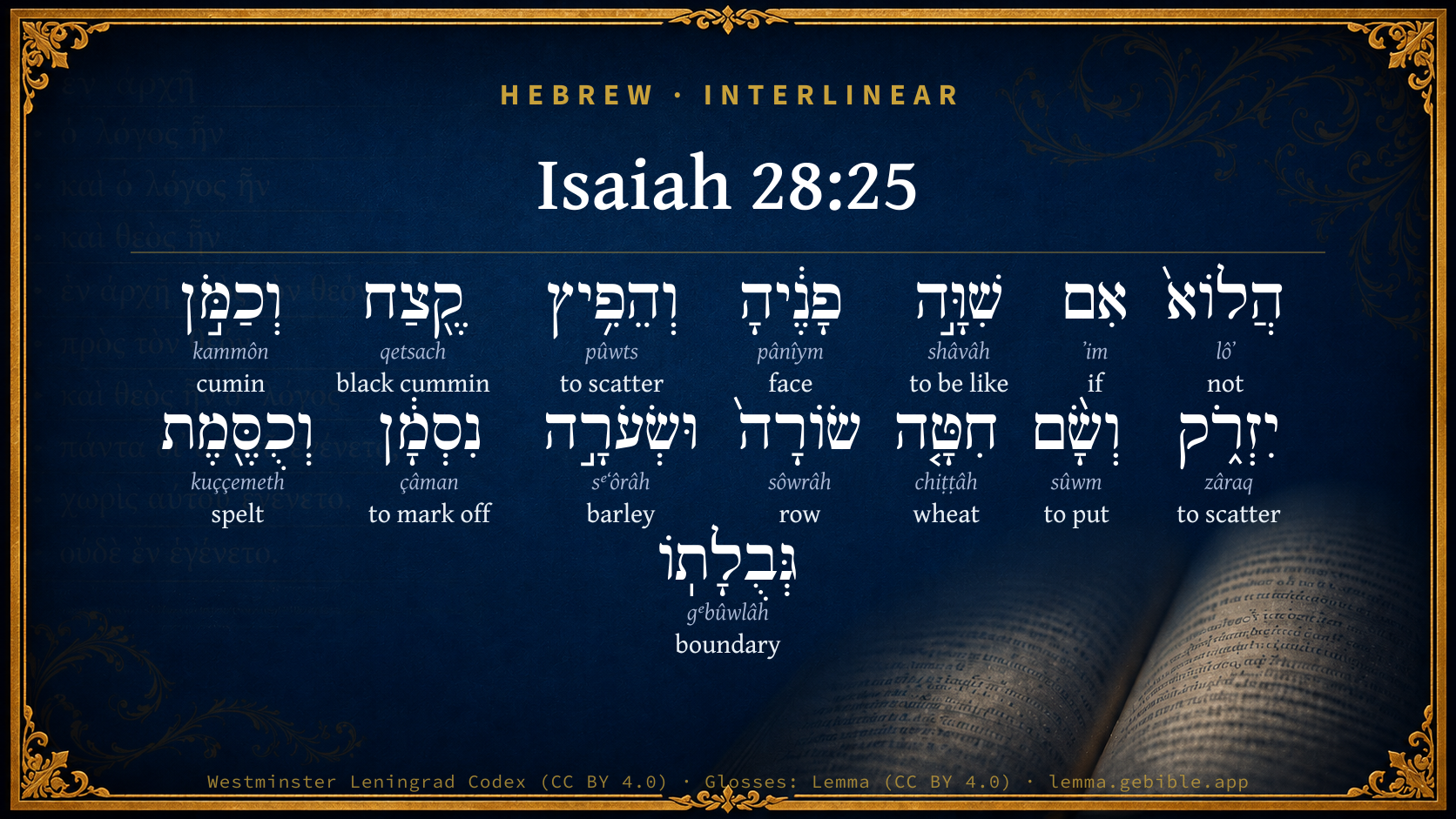
  1. הֲלוֹא֙ lôʼ H3808 “not” Particle, Interrogative + Particle, Negative
  2. אִם ʼim H518 “if” Conjunction
  3. שִׁוָּ֣ה shâvâh H7737 “to be like” Verb, Piel, Perfect, 3rd Person, Masculine, Singular
  4. פָנֶ֔יהָ pânîym H6440 “face(s) · her” Noun, Common, Both, Plural, Construct + Suffix, Personal, 3rd Person, Feminine, Singular
  5. וְהֵפִ֥יץ pûwts H6327 “and · to scatter” Conjunction + Verb, Hiphil, Sequential Perfect, 3rd Person, Masculine, Singular
  6. קֶ֖צַח qetsach H7100 “black cummin” Noun, Common, Masculine, Singular, Absolute
  7. וְכַמֹּ֣ן kammôn H3646 “and · cumin” Conjunction + Noun, Common, Masculine, Singular, Absolute
  8. יִזְרֹ֑ק zâraq H2236 “to scatter” Verb, Qal, Imperfect, 3rd Person, Masculine, Singular
  9. וְשָׂ֨ם sûwm H7760 “and · to put” Conjunction + Verb, Qal, Sequential Perfect, 3rd Person, Masculine, Singular
  10. חִטָּ֤ה chiṭṭâh H2406 “wheat” Noun, Common, Feminine, Singular, Absolute
  11. וּשְׂעֹרָ֣ה sᵉʻôrâh H8184 “and · barley” Conjunction + Noun, Common, Feminine, Singular, Absolute
  12. נִסְמָ֔ן çâman H5567 “marking off” Verb, Niphal, Participle Active, Masculine, Singular, Absolute
  13. וְכֻסֶּ֖מֶת kuççemeth H3698 “and · spelt” Conjunction + Noun, Common, Feminine, Singular, Absolute
  14. גְּבֻלָתֽוֹ gᵉbûwlâh H1367 “boundary · his” Noun, Common, Feminine, Singular, Construct + Suffix, Personal, 3rd Person, Masculine, Singular

About this verse

These counts appear in no published source. They are computed here, from the morphology-tagged text and Lemma’s own curated glosses. What Lemma adds →

15
words
15
distinct lemmas
Prophets
section

Notable vocabulary

2 hapax legomena — words that appear only here in the entire Hebrew Bible:

  • שׂוֹרָה֙ row H7795
  • נִסְמָ֔ן to mark off H5567

First appearance in Scripture

These words make their first canonical appearance in the Hebrew Bible here:

  • קֶ֖צַח black cummin H7100
  • וְכַמֹּ֣ן cumin H3646
  • שׂוֹרָה֙ row H7795
  • נִסְמָ֔ן to mark off H5567

Shared distinctive vocabulary

קֶ֖צַח black cummin H7100 occurs in 2 verses of the Hebrew Bible. Also found in:

Grammatical profile

  • 5 verbs
  • 8 nouns
  • 1 conjunction
  • 1 particle

Verb forms

  • שִׁוָּ֣ה Piel · Perfect
  • וְהֵפִ֥יץ Hiphil · Sequential Perfect
  • יִזְרֹ֑ק Qal · Imperfect
  • וְשָׂ֨ם Qal · Sequential Perfect
  • נִסְמָ֔ן Niphal · Participle Active

Hebrew & Septuagint length

In English translation the verse runs 40 words from the Hebrew and 31 from the Septuagint (LXX English) — closely comparable.

A rough comparison of the two English renderings, which tokenize alike — not a word-level alignment.

Word counts can differ between the Hebrew and the Greek without any difference in meaning — e.g. the Hebrew direct-object marker אֵת has no separate Greek word, and Greek often adds the article ὁ.

In the original languages it is 15 Hebrew tokens and 24 Greek tokens — but the two are counted differently (Hebrew bundles its prefixes and suffixes into one token; the Greek is in lemma form), so that isn’t a like-for-like length.

Cross-references

3

Topical passages linked to Isaiah 28:25 in the Treasury of Scripture Knowledge — connected by theme and wording, ordered by reader-vote popularity; previews shown in the World English Bible.

  • Ezekiel 4:9 Take for yourself also wheat, and barley, and beans, and lentils, and millet, and spelt, and put them in one vessel, and make you bread of it; [according to] the number of the days that you shall lie on your side, even three hundred ninety days, shall you eat of it.
  • Matthew 23:23 "Woe to you, scribes and Pharisees, hypocrites! For you tithe mint, dill, and cumin, and have left undone the weightier matters of the law: justice, mercy, and faith. But you ought to have done these, and not to have left the other undone.
  • Exodus 9:31–32 The flax and the barley were struck, for the barley was in the ear, and the flax was in bloom.

Cross-references courtesy of OpenBible.info (CC BY 4.0).

Hebrew and Greek witnesses Masoretic Hebrew ↔ Greek Septuagint

The same verse in the two great witnesses to the Old Testament, shown verse-for-verse.

These are two independent witnesses, not word-aligned to each other, and the Septuagint is shown in lemma (dictionary) form.

Hebrew Isaiah 28:25 Masoretic · Westminster Leningrad Codex

הֲלוֹא֙ אִם שִׁוָּ֣ה פָנֶ֔יהָ וְהֵפִ֥יץ קֶ֖צַח וְכַמֹּ֣ן יִזְרֹ֑ק וְשָׂ֨ם חִטָּ֤ה שׂוֹרָה֙ וּשְׂעֹרָ֣ה נִסְמָ֔ן וְכֻסֶּ֖מֶת גְּבֻלָתֽוֹ

When he has leveled the surface of it, doesn't he cast abroad the dill, and scatter the cumin, and put in the wheat in rows, and the barley in the appointed place, and the spelt in the border of it?

World English Bible · Public Domain

Greek LXX Isaiah 28:25 Septuagint · lemma form

οὐ ὅταν ὁμαλίζω αὐτός ὁ πρόσωπον τότε σπείρω μικρός μελάνθιον καί κύμινον καί πάλιν σπείρω πυρός καί κριθή καί ζέα ἐν ὁ ὅριον σύ

Does he not, when he has levelled the surface thereof, then sow the small black poppy, or cumin, and afterward sow wheat, and barley, and millet, and bread-corn in your borders?

LXX2012 (modern English Septuagint) · Public Domain

On this verse, Jamieson, Fausset & Brown discusses the Septuagint’s reading. Read the note in Commentary ↓

Hebrew: Westminster Leningrad Codex (CC BY 4.0). Greek: Septuagint (public domain); English from LXX2012 (modern English Septuagint) (Public Domain). How the Septuagint differs from the Hebrew →

Targum (Aramaic paraphrase)

1

The Targum is the ancient Jewish Aramaic paraphrase of the Hebrew Scriptures — an interpretive translation, not the Hebrew text itself. Onkelos (literal) and Pseudo-Jonathan (expansive) render the Torah, and Jonathan the Prophets. Coverage is partial: where no permissively-licensed English translation exists for a verse, only the Aramaic is shown. This is verse-level text, not a word-by-word alignment to the Hebrew.

  1. Targum Jonathan Prophets (Joshua–Malachi)
    הֲלָא אִם יְשַׁווּן בֵּית יִשְׂרָאֵל אַפֵיהוֹן לְמֶעְבַּד אוֹרַיְתָא וִיתוּב וְיַכְנֵישׁ יַתְהוֹן מִבֵּינֵי עַמְמַיָא דְאִינוּן מְבַדְרִין בֵּינֵיהוֹן הָא כְקִצְחָא וְכִכְמוֹנָא דְמִזְדְרִיק וְיַקְרֵיב יַתְהוֹן זַרְעֲיָן לְשִׁבְטֵיהוֹן הָא כְּזָרְעֵי חִטִין עַל בַּיִיר וּסְעוֹרִין עַל סוּמָנִין וְכוֹנְתִין עַל תְּחוּמִין:

    Is it not so? If the house of Israel would set their faces to do the law, and repent, then behold, He would gather them from among the nations, amongst whom they were dispersed, like fitches and cumin that are scattered: and, behold, he would bring their offspring together according to their tribes, as seed of wheat in the uncultivated field, and barley in the appointed place, and spelt in the borders.

    Targum Jonathan — Aramaic: “Mikraot Gedolot” (public domain). English: “Sefaria Community Translation” (CC0 1.0 (public-domain dedication)); “London "Chaldee Paraphrase," 1871” (public domain). Text via Sefaria.

Commentary

Notes on Isaiah 28:25 from classic Christian and Jewish commentators (each source and its license shown beneath its notes). The classic Christian expositions comment on the surrounding passage and are grouped to its opening verse, so a note may address several verses; the Jewish commentaries on the Tanakh (Rashi and others) are per-verse, so they appear only where the commentator wrote on this verse.

Lemma curates 59 commentaries, every one of them public domain or Creative Commons licensed, each selected and text-cleaned for this edition rather than reprinted as found. About our sources →

Trapp's Complete Commentary

John Trapp

Isa 28:25 When he hath made plain the face thereof, doth he not cast abroad the fitches, and scatter the cummin, and cast in the principal wheat and the appointed barley and the rie in their place?

Ver. 25. When he hath made plain.] Laid it level and equal.

Doth he not cast in the fitches?] See on Isa 28:24.

The appointed barley.] Hordeum signatum. Whatsoever is sealed with a seal is excellent in its own kind; so are all God’s sealed ones. {Eph 4:30}

John Trapp, A Commentary or Exposition upon All the Books of the Old and New Testament (1647–1656) — public domain. Text from a community e-Sword module.

Geneva Bible (1599)

Geneva Bible translators

As the plowman hath his appointed time, and divers instruments for his labor, so hath the Lord for his vengeance: for he punisheth some at one time, and some at another, some after one sort, and some after another, so that his chosen seed is beaten and tried, but not broken, as are the wicked.

Geneva Bible (1599) marginal notes — public domain. Text via Bolls.life.

Jamieson, Fausset & Brown

Robert Jamieson, A. R. Fausset & David Brown

face--the "surface" of the ground: "made plain," or level, by harrowing.

fitches--rather, "dill," or "fennel"; Nigella romana, with black seed, easily beaten out, used as a condiment and medicine in the East. So the Septuagint, "cummin" was used in the same way.

cast in . . . principal wheat--rather, plant the wheat in rows (for wheat was thought to yield the largest crop, by being planted sparingly [PLINY, Natural History, 18.21]); [MAURER]; "sow the wheat regularly" [HORSLEY]. But GESENIUS, like English Version, "fat," or "principal," that is, excellent wheat.

appointed barley--rather, "barley in its appointed place" [MAURER].

in their place--rather, "in its (the field's) border" [MAURER].

Jamieson, Fausset & Brown — Commentary Critical and Explanatory on the Whole Bible (1871) — public domain (CC PDM 1.0). Text via the HelloAO Bible API.

Ellicott's Commentary for English Readers

(25) Doth he not cast abroad the fitches. . . .?—Modern English would give vetches. Each verb is carefully chosen to describe the special process that belonged to each kind of seed. We have, as it were, an excerpt from the “Georgics” of Palestine. Identification in such cases is not always easy; but I follow Mr. Carruthers (Bible Educator, i. 38) in reading “fennel seed” for the “fitches” of the English version. This, proverbially among the smallest of seeds, so as to be a type of the microscopic unseen, was scattered broadcast; “cummin,” also proverbial for its smallness, was sown by a like process, with some technical variation, indicated by the use of the Hebrew words. Wheat and barley were “dropped in” more deliberately by the hand of the sower, and then (instead of “the rie in their place”), “vetches for the borders thereof,” these being used in the East as a kind of herbaceous hedge round the field of corn. The point of the enumeration is that the wise tiller of the soil is discriminating in his methods, and deals with each seed according to its nature. So is it, the prophet suggests through the parable which he does not interpret, with the great Husbandman, whose field is the world, and for whom the nations are as seed. For “cast in the principal wheat . . .” read set the wheat in lines and the barley in the appointed place.

A Bible Commentary for English Readers, edited by Charles John Ellicott (1878–1897) — public domain. Text from a community e-Sword module.

The Cambridge Bible for Schools and Colleges

gen. ed. J. J. S. Perowne

25. fitches (R.V. marg. black cummin [Nigella sativa]) and cummin [Cuminum sativum] are both mentioned only in this passage. Note the different methods of sowing; scatter (of the fitches), sow (of the cummin), plant (of wheat and barley). The planting of wheat, &c. in rows is a mark of the most careful husbandry, still practised in Yemen and Egypt.

the principal wheat] Rather: the wheat in rows (R.V.).

the appointed barley] a very difficult expression. Perhaps “barley in the appointed place” (R.V.). Both this adjective and that for “principal” are wanting in the LXX. and are deleted as mistakes or glosses by Cheyne and others.

the rye in their place] the spelt (others, “vetches”) as its border (see R.V.). The allusion apparently is to a custom of surrounding certain crops with a protecting border of hardier plants.

The Cambridge Bible for Schools and Colleges (gen. ed. J. J. S. Perowne; Cambridge University Press, 1878–1918) — public domain. Text from a community e-Sword module.

John Gill's Exposition

For his God doth instruct him to discretion, and doth teach him. God gives the husbandman instruction and discretion how to sow his seed, at what time, and in a proper place; for this refers to what goes before; though some think a new act is here intended, namely, threshing or beating out of corn, rendering the words, "and he" (the husbandman) "beateth it out, according to the discretion", or "judgment, his God teaches him" (h); which is expressed in general terms here, and is next particularly insisted on in the following verses Isa 28:27.

(h) "Excutit illud ad eam rationem, quam Deus, ipsius docet eum", Piscator, Gataker; "vel colligat", &c. Junius & Tremellius.

John Gill's Exposition of the Whole Bible (1746–1763) — public domain (CC PDM 1.0). Text via the HelloAO Bible API.

Albert Barnes' Notes on the Bible

When he hath made plain ... - That is, when he has leveled, or made smooth the surface of the ground by harrowing, or rolling it.

Doth he not scatter abroad - He does not sow one kind of grain merely, but different species according to the nature of the soil, or according to his wishes in regard to a crop.

The fitches - (קצח qetsach). Vulgate, Gith; a kind of cockle (Nigella Romana), an herb of sweet savor. Septuagint, Μικρόν μελάνθιον Mikron melanthion. The word ‘fitch’ denotes a small species of pea. The Hebrew word, however, which occurs nowhere else but here, probably denotes fennel, or dill, an herb whose seed the ancients mixed with their bread in order to give it a more agreeable relish.

And scatter the cummin - (כמן kammôn). Vulgate, Cyminum - ‘Cummin.’ Septuagint, Κύμινον Kuminon - also ‘Cummin.’ The word properly denotes an annual plant whose seeds have a bitterish warm taste with an aromatic flavor (Webster). The seeds of this plant were used as a condiment in sauces.

And cast in the principal wheat - Margin, ‘The wheat in the principal place.’ Vulgate, Per ordinem - ‘In its proper order, place, proportion.’ So Lowth, ‘In due measure.’ So Aben Ezra and Kimchi render it, ‘By measure;’ and they suppose it means that if too much wheat be sown on the land, it will grow too thick, and that the spires will crowd and suffocate each other. Our translators have rendered the word שׂורה s'ôrâh, ‘principal,’ as if it were derived from שׂרה s'ârâh, “to rule,” and seem to have supposed that it denoted wheat that was especially excellent, or distinguished for its good qualities. Gesenius supposes that it means ‘fat wheat,’ from an Arabic signification of the word. Probably the word is designed to denote “quality,” and to convey the idea that wheat is the principal, or chief grain that is sown; it is that which is most valued and esteemed.

And the appointed barley - The barley is a well-known grain. The word rendered ‘appointed’ (נסמן nisemân), occurs nowhere else in the Scriptures. Castellio, Taylor, Grotius, Calvin, our translators, and others, suppose that it is derived from a Hebrew word which does not now occur - סמן sâman, “to designate, to mark, to seal;” and that it means barley that had been put aside and marked as especially excellent, or seed-barley. In Chaldee, the word סמן simman occurs in the sense of “to seal, to mark, to designate” (Chaldee Par. Num 17:3; 2Ki 9:13; Est 5:1). The Septuagint, translated it κέγχρον kengchron, and the Vulgate, Aquila, and Theodotion, understand the word as denoting a species of grain, the millet. The idea is probably that expressed by Grotius, and in our version - of barley that had been selected as seed-barley on account of its excellent quality.

And the rye - Margin, ‘Spelt.’ The word usually denotes “spelt” - a kind of wheat now found in Flanders and Italy, called German wheat. It may, however, denote rye.

In their place - literally, ‘In the border.’ Septuagint, Ἐν τοῖς ὁρίοις σου En tois horiois sou - ‘In thy borders.’ The idea seems to be that the spelt or rye was sown in the borders of the field while the wheat was sown in the middle; or that the rye was sown in its “proper bounds,” or in the places which were adapted to it, and best suited to promote its growth.

Albert Barnes' Notes on the Bible (1834–1885) — public domain. Text from a community e-Sword/MySword module.

Haydock's Catholic Bible Commentary

Gith. Heberw ketsach. Septuagint, Greek: melanthion. (Haydock) (Pliny, [Natural History?] xx. 17.) (Menochius) --- Septuagint have not expressed all the terms of the original, (Haydock) being perhaps ignorant of their meaning. (St. Jerome)\

George Leo Haydock (1774–1849), Haydock's Catholic Family Bible and Commentary, 1859 edition — public domain. Excludes Psalms (Douay-Rheims chapter numbering differs from Protestant) and Deuterocanonical books (Catholic canon only).

Matthew Poole's English Annotations

Made plain the face thereof, by breaking the clods, which made it ragged and uneven.

The principal wheat; either,

1. The wheat, which is the principal or chief of all these grains; or,

2. The best wheat, which he prudently chooseth for seed.

The appointed barley; that proportion of barley which he appointed. Or, as others, the marked barley; or, the choice barley, which they laid aside in a sack for seed; and therefore set aside with a peculiar mark upon it. In their place, Heb. in his border; each seed in a several and proper place.

Matthew Poole's English Annotations on the Holy Bible (1683–1685) — public domain. Text from a community e-Sword/MySword module.

The Pulpit Commentary

When he hath made plain the face thereof; i.e. leveled it brought the ground to a tolerably even surface. Doth he not cast abroad the fitches? The Hebrew word translated "fitchesi.e. "vetches is qetsach, which is generally allowed to represent the Nigella sativa, a sort of ranun-cuhs, which is cultivated in many parts of the East for the sake of its seeds. These are black, and have an aromatic flavor. Dioscorides (3:83) and Pliny (19:8) say that they were sometimes mixed with bread. And scatter the cummin. "Cummin" (Cuminum sativum) is "an umbelliferous plant, something like fennel." The seeds or rather, berries have "a bitterish warm taste, with an aromatic flavor" ("Dict. of the Bible," vol. 1. p. 372). They seem to have been eaten as a relish with various kinds offood. And cast in the principal wheat; rather, and put in wheat in rows. Drill-ploughs, which would deposit grain in rows, were known to the Assyrians ("Ancient Monarchies," vol. 2. p. 198). And the rie in their place. Cussemeth, the word translated "rie," is probably the Holeus sorghum, or "spelt," which is largely cultivated in Palestine and other parts of the East, and is the ordinary material of the bread eaten by the poorer classes (see the "Pulpit Commentary" on Exodus, pp. 219, 220). For "in their place," Kay translates, "in its own border." The wheat and the barley and the spelt would all be sown separately, according to the direction of Lev_19:19, "Thou shalt not sow thy field with mingled seed."

The Pulpit Commentary (1880–1919), ed. H.D.M. Spence-Jones & Joseph S. Exell — public domain. Text from a community e-Sword module.

John Wesley's Explanatory Notes

Made plain - By breaking the clods. The wheat - The best which he chuses for seed. Barley - That proportion of barley which he appointed. Place - Hebrew. in his border; each seed in a several place.

John Wesley, Explanatory Notes Upon the Whole Bible (1754–1765) — public domain. Text via the GEBible commentary corpus.

J. A. Alexander on Isaiah

Joseph Addison Alexander

“Does he not, when he has levered the surface of it, cast abroad dill, and scatter cummin, and set wheat in rows, and barley (in the place) marked out, and spelt in his border?” That is to say, he attends to all these processes of husbandry successively, with due regard to time and place, and to the various crops to be produced. The words do not denote an indiscriminate sowing, but a careful planting, which is said to be still practiced in the oriental culture of wheat, and is thought by many to have been one of the causes of the wonderful fertility of Palestine in ancient times.

Joseph Addison Alexander, The Prophecies of Isaiah (1846–1847; New York: Scribner, 1870–1878) — public domain. Text from a community e-Sword module.

unfoldingWord translationNotes

Door43 World Missions Community

General Information:

Isaiah continues telling a parable to the people of Jerusalem. (See: Parables)

When he has prepared the ground

"When the farmer has plowed the soil"

does he not scatter caraway seed, sow the cumin, put in the wheat in rows and the barley in the right place, and the spelt at its edges?

Isaiah uses a question to make the people of Jerusalem think deeply. If your language does not have a word for each of these seeds, they can be stated more generally. AT: "he will certainly plant each kind of seed in the correct way and in the proper places." (See: Rhetorical Question)

caraway ... cumin

These are names of plants that are spices. Translators may represent them in general as seeds of spices used to spice food. (See: Translate Unknowns)

wheat ... barley ... spelt

These are all names of plants that are grains. Translators may represent them in general as seeds of grains. (See: Translate Unknowns)

His God instructs him; he teaches him wisely

These two phrases mean basically the same thing. AT: "Yahweh helps the farmer know how to care for each kind of plant" (See: Parallelism)

translationWords

seed

plant

wheat

God

teacher

wise

unfoldingWord translationNotes — © Distant Shores Media and the Door43 World Missions Community, licensed CC BY-SA 4.0. Source: git.door43.org/Door43/en_tn.

Rashi

Rabbi Shlomo Yitzchaki (Rashi)

Is it not so that the plowman, as soon as he plows, smooths the surface of the soil and afterwards sows.

he scatters the black cumin If he comes to sow black cumin, he sows it by scattering it, and if he comes to sow cumin, he sows it by casting it. קצח is a kind of food.

and he places the prominent wheat, and the barley for a sign, and the spelt on its borders And if he comes to sow grain, this is his custom. He sows the wheat in the middle of the furrow, and the barley he sows around it for a sign, and the spelt he sows on the borders of the field [and its boundaries]. שׂוֹרָה is an expression of ruling (שְׂרָרָה). He sows it in the center, and it appears ([printed editions] is found) to rule over the barley and the spelt.

Rashi on the Tanakh — English translations: “The Judaica Press complete Tanach with Rashi, translated by A. J. Rosenberg” (CC BY 4.0); “Pentateuch with Rashi's commentary by M. Rosenbaum and A.M. Silbermann, 1929-1934” (public domain); “The Metsudah Tanach series, Lakewood, N.J” (CC BY 4.0); and “The Book of Joshua, Metsudah Publications, 1997” (CC BY 4.0). Text via Sefaria.

Ibn Ezra

Rabbi Abraham ibn Ezra

שוה He hath made plain. Derived from שוה equal; comp. נשתוה alike (Prov. 27:15).

קצח A kind of cummin, but smaller and black.

שורה According to some, good; according to others, with measure; comp. במשורה with the measure (Lev. 19:35), and this is right.

ושערה And barley. It is well known.

נסמן Marked. Comp. סימן sign.

נבלתו In its place. Comp. מגבלות measured (Ex. 28:14)

Ibn Ezra on the Tanakh — English translations: “Sefaria Community Translation” (CC0 1.0 (public-domain dedication)); “Yalkut, Sifsei Chachomim Chumash, Metsudah Publications, 2009” (CC BY 4.0); and “Commentary of Ibn Ezra on Isaiah - trans. by M. Friedlander, 1873” (public domain). Text via Sefaria.

Lesson kit

Teaching starters — assembled from the data on this page, not authored interpretation. Every prompt links to the verse data it draws on. Edit before teaching.

Isaiah, in the Prophets, opens this verse with 15 words (15 distinct Hebrew lemmas). Its most distinctive word is sôwrâh (“row”). A historical commentator’s framing appears above. Read the whole chapter for the surrounding context.

Discussion questions

  1. The word sôwrâh carries the sense “row.” How does it shape the verse?
  2. This verse holds 2 words here found nowhere else in the Hebrew Bible. What might the rare words draw attention to?
  3. 4 words here appear for the first time in Scripture. What is being introduced at this debut?
  4. Isaiah 28:27 shares the word «black cummin» with this verse. How do the two illuminate each other?
  5. These translations render this verse differently; the difference is in the English rendering, not the original. What questions does that raise?
  6. The verb «שִׁוָּ֣ה» is Piel Perfect. How does its form color the action?
  7. Reading how Trapp's Complete Commentary and Geneva Bible (1599) read this verse, where do the two commentators agree and where do they part?

Things to notice

Reading settings

Reading text

Shown beneath each verse's original-language words.

Old Testament
Old Testament edition

Read the OT as the Masoretic Hebrew (MT) or the Greek Septuagint (LXX).

English shown for the Greek Septuagint (in the Hebrew ↔ Greek comparison).

Comparing translations? Open the Compare panel on any verse page to stack up to four side by side.