
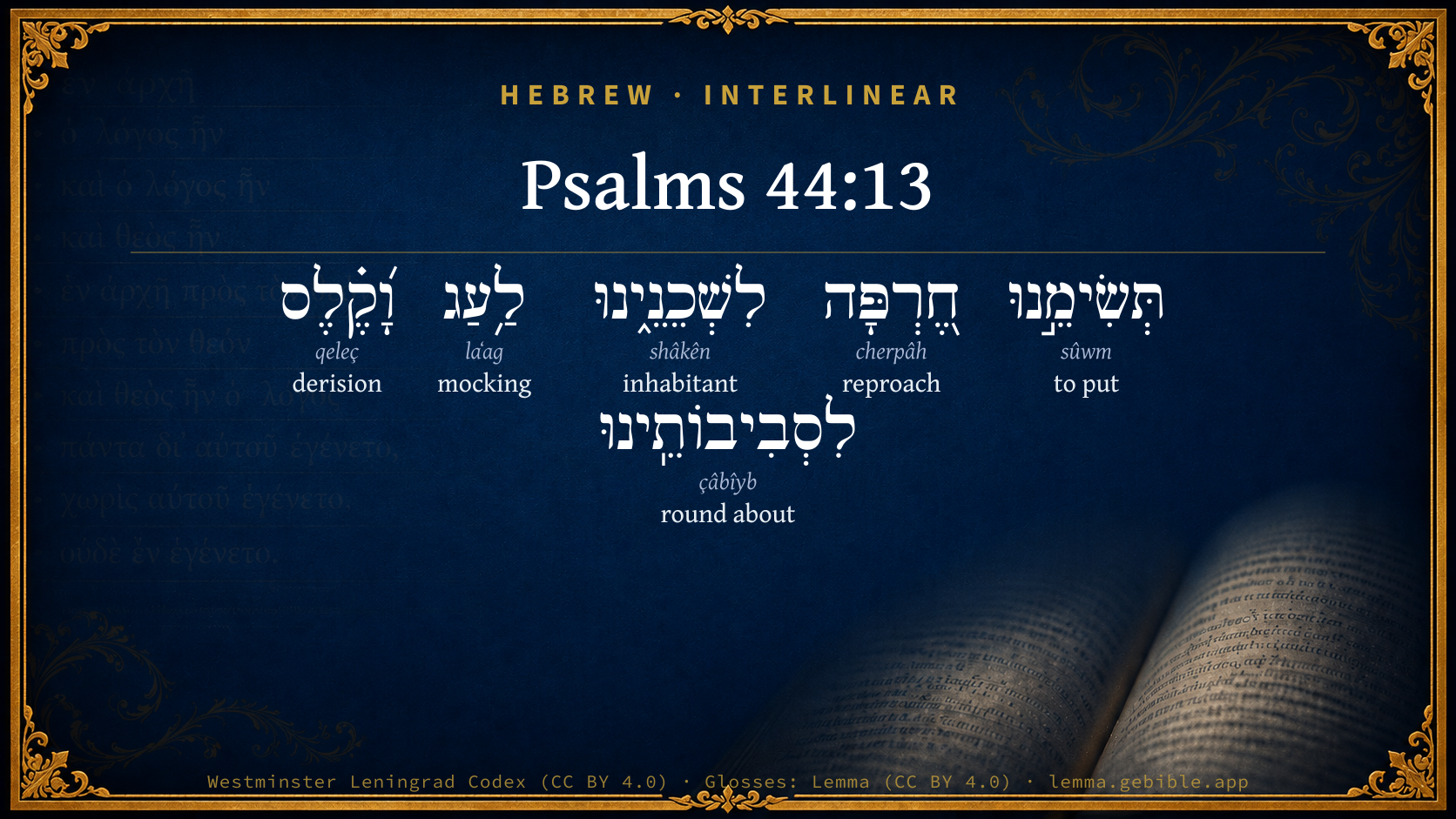
Psalms 44:13

Hebrew (Westminster Leningrad Codex) Psalms 44:13 appears in the Hebrew Old Testament. The text above is from the Westminster Leningrad Codex. Each word links to its Strong’s number, a concise gloss, and parsing drawn from the Open Scriptures Hebrew Bible morphology. Click any word for its full Brown-Driver-Briggs (BDB) entry.
Download image
Cite this verse

Psalms 44:13 (World English Bible). Public Domain. Lemma interlinear Bible study tool, https://lemma.gebible.app/v/psalms/44/13.

Show BibTeX & RIS
BibTeX
RIS
English Translation
You make us a reproach to our neighbors, A scoffing and a derision to those who are around us.
World English Bible · Public Domain
Highlights
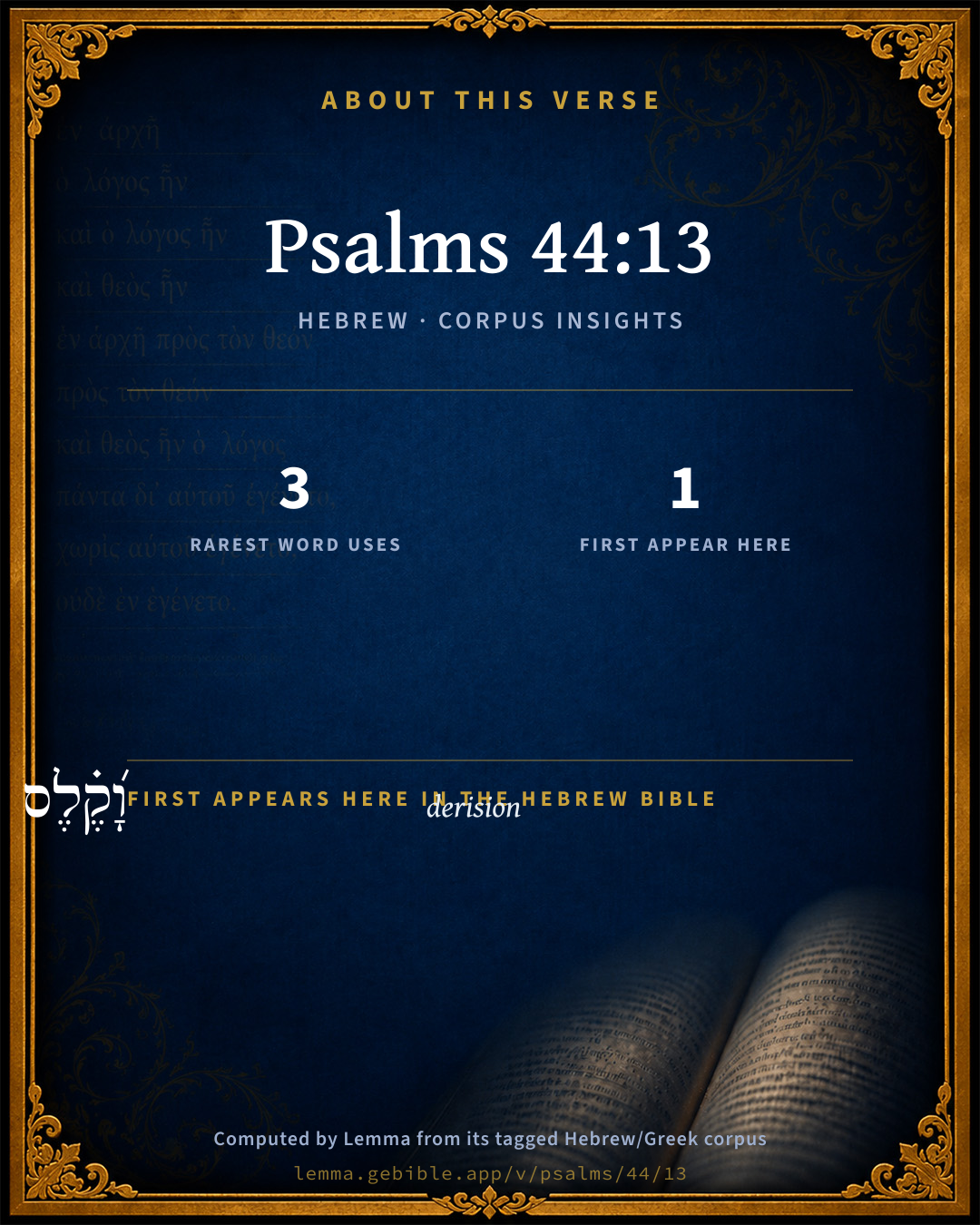
  • 1 first appearance in the Hebrew Bible
Full analysis ↓
Download a study sheet

One document with this verse’s original text, its word-by-word gloss line, the meaning frame, cross-references with their text, attributed commentary, and full source and license credits — printable, and it pastes into notes with its structure intact.

This verse Autodidact and up

Study sheet (.html) Plain text (.txt)

A passage Seminary Student

Up to 50 verses in one chapter. A passage sheet keeps up to 6 commentary sources and 12 cross-references per verse, in the order this page ranks them, and says so on the sheet whenever that leaves anything out. Ask for a single verse and you get the Autodidact verse sheet above.

Everything on this page stays free to read, with no account — the sheet is a download of what is already on screen, not access to it.

Want to remove ads? Support Godless Engineer
Compare translations 3

The same verse in 3 English versions, stacked beneath the original-language interlinear above. Click any original word for its lexicon entry.

Each is an independent rendering of the whole verse — the interlinear is not word-aligned to these translations.

Highlighted words mark where these versions differ — a whole-verse word diff, not a word-by-word alignment.

  • World English Bible Public Domain
    You make us a reproach to our neighbors, A scoffing and a derision to those who are around us.
  • King James Version Public Domain
    Thou makest us a reproach to our neighbours, a scorn and a derision to them that are round about us.
  • unfoldingWord Literal Text CC BY-SA 4.0
    You have made us a reproach to our neighbors, a scorn and a derision to around us.

unfoldingWord Literal Text — © unfoldingWord, licensed CC BY-SA 4.0. Word-aligned USFM3 via Door43 (git.door43.org/unfoldingWord/en_ult).

Versions to compare (up to 4)

3 of 4 selected

Show all 18 translations

Every available English version of this verse, each an independent rendering of the whole verse.

  • World English Bible Public Domain
    You make us a reproach to our neighbors, A scoffing and a derision to those who are around us.
  • Berean Standard Bible Public Domain
    You have made us a reproach to our neighbors, a mockery and derision to those around us.
  • Majority Standard Bible Public Domain
    You have made us a reproach to our neighbors, a mockery and derision to those around us.
  • King James Version Public Domain
    Thou makest us a reproach to our neighbours, a scorn and a derision to them that are round about us.
  • American Standard Version (1901) Public Domain
    Thou makest us a reproach to our neighbors, A scoffing and a derision to them that are round about us.
  • Revised Version (1885) Public Domain
    Thou makest us a reproach to our neighbours, a scorn and a derision to them that are round about us.
  • Geneva Bible (1599) Public Domain
    Thou makest vs a reproche to our neighbours, a iest and a laughing stocke to them that are round about vs.
  • Douay-Rheims (1899) Public Domain
    Thou hast sold thy people for no price: and there was no reckoning in the exchange of them.
  • Young's Literal Translation Public Domain
    Thou makest us a reproach to our neighbours, A scorn and a reproach to our surrounders.
  • Literal Standard Version CC BY-SA 4.0
    You make us a reproach to our neighbors, || A scorn and a reproach to our surrounders.
  • Unlocked Literal Bible CC BY-SA 4.0
    You make us a rebuke to our neighbors, scoffed and mocked by those around us.
  • unfoldingWord Literal Text CC BY-SA 4.0
    You have made us a reproach to our neighbors, a scorn and a derision to around us.
  • Darby Bible Public Domain
    Thou makest us a reproach to our neighbours, a mockery and a derision for them that are round about us;
  • World Messianic Bible Public Domain
    You make us a reproach to our neighbors, a scoffing and a derision to those who are around us.
  • Webster's Bible Public Domain
    \\44:12\\Thou sellest thy people for naught, and dost not increase thy wealth by their price.
  • Free Bible Version CC BY-SA 4.0
    You have made a mockery of us before our neighbors, we are ridiculed and laughed at by those around us.
  • Bible in Basic English Public Domain
    You have made us to be looked down on by our neighbours, we are laughed at and shamed by those who are round about us.
  • JPS Tanakh (1917) Public Domain
    (44-14) Thou makest us a taunt to our neighbours, a scorn and a derision to them that are round about us.

Literal Standard Version (2020), Covenant Press — licensed CC BY-SA 4.0. Text via the HelloAO Bible API (eBible.org). Unlocked Literal Bible (unfoldingWord) — licensed CC BY-SA 4.0. Text via the HelloAO Bible API (eBible.org). unfoldingWord Literal Text — © unfoldingWord, licensed CC BY-SA 4.0. Word-aligned USFM3 via Door43 (git.door43.org/unfoldingWord/en_ult). Free Bible Version, Dr. Jonathan Gallagher — licensed CC BY-SA 4.0. Text via the HelloAO Bible API (eBible.org).

Word by word

More ways to search: Search by grammar → Find every occurrence → Compare this word →

Practice this passage: Drill this verse → Learn its vocabulary →

About this verse

These counts appear in no published source. They are computed here, from the morphology-tagged text and Lemma’s own curated glosses. What Lemma adds →

6
words
6
distinct lemmas
Wisdom
section

Notable vocabulary

The rarest word here is וָ֝קֶ֗לֶס derision H7047 — appearing just 3 times in the whole Hebrew Bible.

First appearance in Scripture

This word makes its first canonical appearance in the Hebrew Bible here:

  • וָ֝קֶ֗לֶס derision H7047

Shared distinctive vocabulary

וָ֝קֶ֗לֶס derision H7047 occurs in 3 verses of the Hebrew Bible. Also found in:

Grammatical profile

  • 1 verb
  • 4 nouns
  • 1 adjective

Verb forms

  • תְּשִׂימֵ֣נוּ Qal · Imperfect

Hebrew & Septuagint length

In English translation the verse runs 19 words from the Hebrew and 19 from the Septuagint (LXX English) — the same length.

A rough comparison of the two English renderings, which tokenize alike — not a word-level alignment.

Word counts can differ between the Hebrew and the Greek without any difference in meaning — e.g. the Hebrew direct-object marker אֵת has no separate Greek word, and Greek often adds the article ὁ.

Cross-references

9

Topical passages linked to Psalms 44:13 in the Treasury of Scripture Knowledge — connected by theme and wording, ordered by reader-vote popularity; previews shown in the World English Bible.

  • Psalms 79:4 We have become a reproach to our neighbors, A scoffing and derision to those who are around us.
  • Psalms 80:6 You make us a source of contention to our neighbors. Our enemies laugh among themselves.
  • Jeremiah 24:9 I will even give them up to be tossed back and forth among all the kingdoms of the earth for evil; to be a reproach and a proverb, a taunt and a curse, in all places where I shall drive them.
  • Deuteronomy 28:37 You shall become an astonishment, a proverb, and a byword, among all the peoples where Yahweh shall lead you away.
  • Psalms 89:41 All who pass by the way rob him. He has become a reproach to his neighbors.
  • Psalms 89:51 With which your enemies have mocked, Yahweh, With which they have mocked the footsteps of your anointed one.
  • Psalms 123:3–4 Have mercy on us, Yahweh, have mercy on us, For we have endured much contempt.
  • Jeremiah 48:27 For wasn't Israel a derision to you? was he found among thieves? for as often as you speak of him, you wag the head.
  • Ezekiel 36:19–23 and I scattered them among the nations, and they were dispersed through the countries: according to their way and according to their doings I judged them.

Cross-references courtesy of OpenBible.info (CC BY 4.0).

Hebrew and Greek witnesses Masoretic Hebrew ↔ Greek Septuagint

The same verse in the two great witnesses to the Old Testament, shown verse-for-verse.

You’re reading Greek Psalm 43 (Hebrew Psalm 44). The Septuagint counts the superscription, so verse numbers can differ from the Hebrew — chapter-level alignment, not verse-by-verse. Numbering follows Rahlfs.

These are two independent witnesses, not word-aligned to each other, and the Septuagint is shown in lemma (dictionary) form.

Hebrew Psalms 44:13 Masoretic · Westminster Leningrad Codex

תְּשִׂימֵ֣נוּ חֶ֭רְפָּה לִשְׁכֵנֵ֑ינוּ לַ֥עַג וָ֝קֶ֗לֶס לִסְבִיבוֹתֵֽינוּ

You make us a reproach to our neighbors, A scoffing and a derision to those who are around us.

World English Bible · Public Domain

Greek LXX Greek Psalm 43:13 Septuagint · lemma form

ἀποδέω ὁ λαός σύ ἄνευ τιμή καί οὐ εἰμί πλῆθος ἐν ὁ ἄλλαγμα αὐτός

You have made us a reproach to our neighbors, a scorn and derision them that are round about us.

LXX2012 (modern English Septuagint) · Public Domain

Hebrew: Westminster Leningrad Codex (CC BY 4.0). Greek: Septuagint (public domain); English from LXX2012 (modern English Septuagint) (Public Domain). How the Septuagint differs from the Hebrew →

Commentary

Notes on Psalms 44:13 from classic Christian and Jewish commentators (each source and its license shown beneath its notes). The classic Christian expositions comment on the surrounding passage and are grouped to its opening verse, so a note may address several verses; the Jewish commentaries on the Tanakh (Rashi and others) are per-verse, so they appear only where the commentator wrote on this verse.

Lemma curates 59 commentaries, every one of them public domain or Creative Commons licensed, each selected and text-cleaned for this edition rather than reprinted as found. About our sources →

Trapp's Complete Commentary

John Trapp

Psa 44:13 Thou makest us a reproach to our neighbours, a scorn and a derision to them that are round about us.

Ver. 13. Thou makest us a reproach to our neighbours] This to a generous spirit is very grievous. The Cappadocians were noted for a servile people; and Tiberius said of his Romans, that they were homines ad servitutem parati men prepared for slavery, (Ammian. 1. 2). The Jews at this day hear ill among all nations for a nasty and sordid people. O Marcomanni, O Quades, O Sarmatae, tandem alios vobis deteriores inveni, said that emperor, O Marcomans, O Quades, O Sarmatians, I have at length found a more odious and contemptible people than you are any, meaning the Jews, with whose stench he was much annoyed.

John Trapp, A Commentary or Exposition upon All the Books of the Old and New Testament (1647–1656) — public domain. Text from a community e-Sword module.

J. A. Alexander on Psalms

Joseph Addison Alexander

14. (Psa 44:13). Thou wilt make us a reproach to our neighbours, a scoff and a jestto those around us. If this state of things continues, such will be the necessary issue. Make us, literally place us, set us up, expose us. See above, on Psa 39:9 (8), and with the whole verse compare Psa 79:4; Psa 89:42 (41).

Joseph Addison Alexander, The Psalms Translated and Explained (1850) — public domain. Text from a community e-Sword module.

Jamieson, Fausset & Brown

Robert Jamieson, A. R. Fausset & David Brown

(Compare Deu 28:37; Psa 79:4).

Jamieson, Fausset & Brown — Commentary Critical and Explanatory on the Whole Bible (1871) — public domain (CC PDM 1.0). Text via the HelloAO Bible API.

John Calvin's Commentaries

13 Thou hast made us a reproach to our neighbors Here the Psalmist speaks of their neighbors, who were all actuated either by some secret ill-will, or avowed enmity to the people of God. And certainly it often happens, that neighborhood, which ought to be the means of preserving mutual friendship, engenders all discord and strife. But there was a special reason in respect of the Jews; for they had taken possession of the country in spite of all men, and their religion being hateful to others, so to speak, served as a trumpet to stir up war, and inflamed their neighbors with rage against them. Many, too, cherished towards them a feeling of jealousy, such as the Idumeans, who were inflated on the ground of their circumcision, and imagined that they also worshipped the God of Abraham as well as the Jews. But what proved the greatest calamity to them was, that they were exposed to the reproach and derision of those who hated them on the ground of their worship of the true God. The faithful illustrate still farther the greatness of their calamity by another circumstance, telling us, in the last clause of the verse, that they were met by reproaches on all sides; for they were beset round about by their enemies, so that they would never have enjoyed one moment of peace unless God had miraculously preserved them. Nay, they add still farther, (verse 14,) that they were a proverb, a byword, or jest, even among the nations that were far off. The word משל, mashal, which is translated proverb, might be taken in the sense of a heavy imprecation or curse, as well as of a byword or jest; but the sense will be substantially the same, namely, that there were no people under heaven held in greater detestation, insomuch that their very name was bandied about every where in proverbial allusions, as a term of reproach. To the same purpose also is the wagging, or shaking of the head, which occurs in Psalm 22, of which we have already spoken. There can be no doubt that the faithful recognised this as inflicted upon them by the vengeance of God, of which mention was made in the Law. In order to arouse themselves to the consideration of the judgments of God, they carefully compared with the threatenings of God all the punishments which he inflicted upon them. But the Law had declared beforehand, in express terms, this derision of the Gentiles, which they now relate as a thing that had come to pass, (Deuteronomy 28:3.) Moreover, when it is said, among the heathen, and among the people, the repetition is very emphatic and expressive; for it was a thing quite unseemly and intolerable, that the heathen nations should presume to torment with their scoffings the chosen people of God, and revile them by their blasphemies at their pleasure. That the godly complained not of these things without cause is abundantly obvious from a passage in Cicero, in his oration in defense of Flaccus, in which that heathen orator, with his accustomed pride, scoffs no less against God than against the Jews, asserting that it was perfectly clear that they were a nation hated of the gods, inasmuch as they had often, and, as it were, from age to age, been wasted with so many misfortunes, and in the end subjected to a most miserable bondage, and kept, as it were, under the feet of the Romans.

John Calvin's Commentaries (1540-1563) — public domain. Text from the Calvin Translation Society English edition (1840s-50s) via the Christian Classics Ethereal Library (ccel.org). Calvin's coverage is partial (roughly two-thirds of the Bible); uncommented books and verses are honest gaps, never fabricated. The 19th-century editor's footnotes and remarks are omitted so the notes are faithfully Calvin's own voice.

Ellicott's Commentary for English Readers

(13, 14) These verses become very suggestive, if we refer them to one of those periods under the Seleucidæ, when the Jews were so frequently attacked on the Sabbath, and from their scrupulous regard to it would make no resistance.

A Bible Commentary for English Readers, edited by Charles John Ellicott (1878–1897) — public domain. Text from a community e-Sword module.

The Cambridge Bible for Schools and Colleges

gen. ed. J. J. S. Perowne

13. Repeated almost verbatim in Psa_79:4; cp. Psa_80:6. The neighbouring nations, Philistines, Edomites, Ammonites, Moabites, were always jealous of Israel, and ready to rejoice with a malicious delight at Israel’s humiliation.

The Cambridge Bible for Schools and Colleges (gen. ed. J. J. S. Perowne; Cambridge University Press, 1878–1918) — public domain. Text from a community e-Sword module.

John Gill's Exposition

Thou makest us a reproach to our neighbours,.... Which is the common lot of Christians: Christ and his apostles have given reason for the saints in all ages to expect it, and have fortified their minds to bear it patiently, yea, to esteem it an honour, and greater riches than the treasures of the antichristian Egypt;

a scorn and a derision to them that are round about us; being always represented as mean and despicable, and reckoned ignorant and accursed, and as the faith of the world, and the offscouring of all things.

John Gill's Exposition of the Whole Bible (1746–1763) — public domain (CC PDM 1.0). Text via the HelloAO Bible API.

Albert Barnes' Notes on the Bible

Thou makest us a reproach to our neighbors - Compare the notes at Psa 39:8. The word neighbors here refers to surrounding people or nations. They were reproached, scorned, and derided as forsaken by God, and given up to their foes. They no longer commanded the admiration of mankind as a prosperous, favored, happy people. Surrounding nations treated them with contempt as inspiring no fear, and as having nothing to entitle them to respect.

Albert Barnes' Notes on the Bible (1834–1885) — public domain. Text from a community e-Sword/MySword module.

Matthew Poole's English Annotations

They contemn our persons, and sport themselves in our miseries.

Matthew Poole's English Annotations on the Holy Bible (1683–1685) — public domain. Text from a community e-Sword/MySword module.

The Treasury of David

Charles H. Spurgeon

Ver. 13. Thou makest us a reproach to our neighbours. Scorn is always an intensely bitter ingredient in the cup of the oppressed. The taunts and jeers of the victors pain the vanquished almost as much as their swords and spears. It was a mystery indeed that God should suffer his royal nation, his peculiar people, to be taunted by all who dwelt near them. A scorn and a derision to them that are round about us. The down trodden people had become a common jest; "as base as Israel" cried the cruel tongue of the tyrant: so ordinary had the scorn become that the neighbouring nations, though perhaps equally oppressed, borrowed the language of the conquerors, and joined in the common mockery. To be a derision to both strong and weak, superiors, equals, and inferiors, is hard to bear. The tooth of scoffing bites to the bone. The psalmist sets forth the brutality of the enemy in many words, in order to move the pity of the Lord, to whose just anger he traced all the sorrows of his people: he used the very best of arguments, for the sufferings of his chosen touch the heart of God far more readily than any other reasonings. Blessed be his name, our great Advocate above knows how to avail himself of this powerful plea, and if we are at this hour enduring reproach for truth's sake, he will urge it before the eternal throne; and shall not God avenge his own elect? A father will not long endure to see his children despitefully entreated; he may put up with it for a little, but his love will speedily arouse his anger, and then it will fare ill with the persecutor and reviler.

None.

Ver. 13. Trial of cruel mockings; our conduct under them, comfort in them, and crown from them.

Psalms 44:14*

Charles H. Spurgeon's The Treasury of David (1869–1885) — public domain. Psalms only. Text from a community e-Sword/MySword module.

The Pulpit Commentary

Thou makest us a reproach to our neighbours. (comp. Psa_42:10 Psa_79:4 Psa_80:6) They would be reproached, not so much as cowards, or as weak and powerless themselves, but rather as having a weak and powerless God. (comp. 2Ki_18:33-35 2Ki_19:12) A scorn and a derision to them that are round about us. (For instances of the "scorn and derision" whereto the Israelites were exposed at the hands of the heathen, see 2Ki_18:23, 24 19:23, 24 Neh_2:19 Neh_4:2, 3 Psa_79:4 Psa_137:7)

The Pulpit Commentary (1880–1919), ed. H.D.M. Spence-Jones & Joseph S. Exell — public domain. Text from a community e-Sword module.

Keil & Delitzsch

C. F. Keil & F. Delitzsch

(Heb.: 44:14-17) To this defeat is now also added the shame that springs out of it. A distinction is made between the neighbouring nations, or those countries lying immediately round about Israel (סביבות, as in the exactly similar passage Psa 79:4, cf. Psa 80:7, which closely resembles it), and the nations of the earth that dwell farther away from Israel. משׁל is here a jesting, taunting proverb, and one that holds Israel up as an example of a nation undergoing chastisement (vid., Hab 2:6). The shaking of the head is, as in Psa 22:8, a gesture of malicious astonishment. In נגדּי תּמיד (as in Psa 38:18) we have both the permanent aspect or look and the perpetual consciousness. Instead of "shame covers my face," the expression is "the shame of my face covers me," i.e., it has overwhelmed my entire inward and outward being (cf. concerning the radical notions of בּושׁ, Ps 6:11, and חפר, Psa 34:6). The juxtaposition of "enemy and revengeful man" has its origin in Psa 8:3. In Psa 44:17 מקּול and מפּני alternate; the former is used of the impression made by the jeering voice, the other of the impression produced by the enraged mien.

Keil & Delitzsch — Biblical Commentary on the Old Testament (1861–1891) — public domain (CC PDM 1.0). Text via the HelloAO Bible API. (Old Testament only.)

Lesson kit

Teaching starters — assembled from the data on this page, not authored interpretation. Every prompt links to the verse data it draws on. Edit before teaching.

Psalms, in the Wisdom, opens this verse with 6 words (6 distinct Hebrew lemmas). Its most distinctive word is qeleç (“derision”). A historical commentator’s framing appears above. Read the whole chapter for the surrounding context.

Discussion questions

  1. How does “derision” (qeleç) shape what this verse is saying?
  2. The word “derision” first appears here in Scripture. What is being introduced at this debut?
  3. Psalms 79:4 shares the word «derision» with this verse. How do the two illuminate each other?
  4. These translations render this verse differently. What is at stake in choosing one wording over another?
  5. The verb «תְּשִׂימֵ֣נוּ» is Qal Imperfect. How does its form color the action?
  6. Reading how Trapp's Complete Commentary and J. A. Alexander on Psalms read this verse, where do the two commentators agree and where do they part?

Things to notice

Reading settings

Reading text

Shown beneath each verse's original-language words.

Old Testament
Old Testament edition

Read the OT as the Masoretic Hebrew (MT) or the Greek Septuagint (LXX).

English shown for the Greek Septuagint (in the Hebrew ↔ Greek comparison).

Comparing translations? Open the Compare panel on any verse page to stack up to four side by side.