
Psalms 115:18

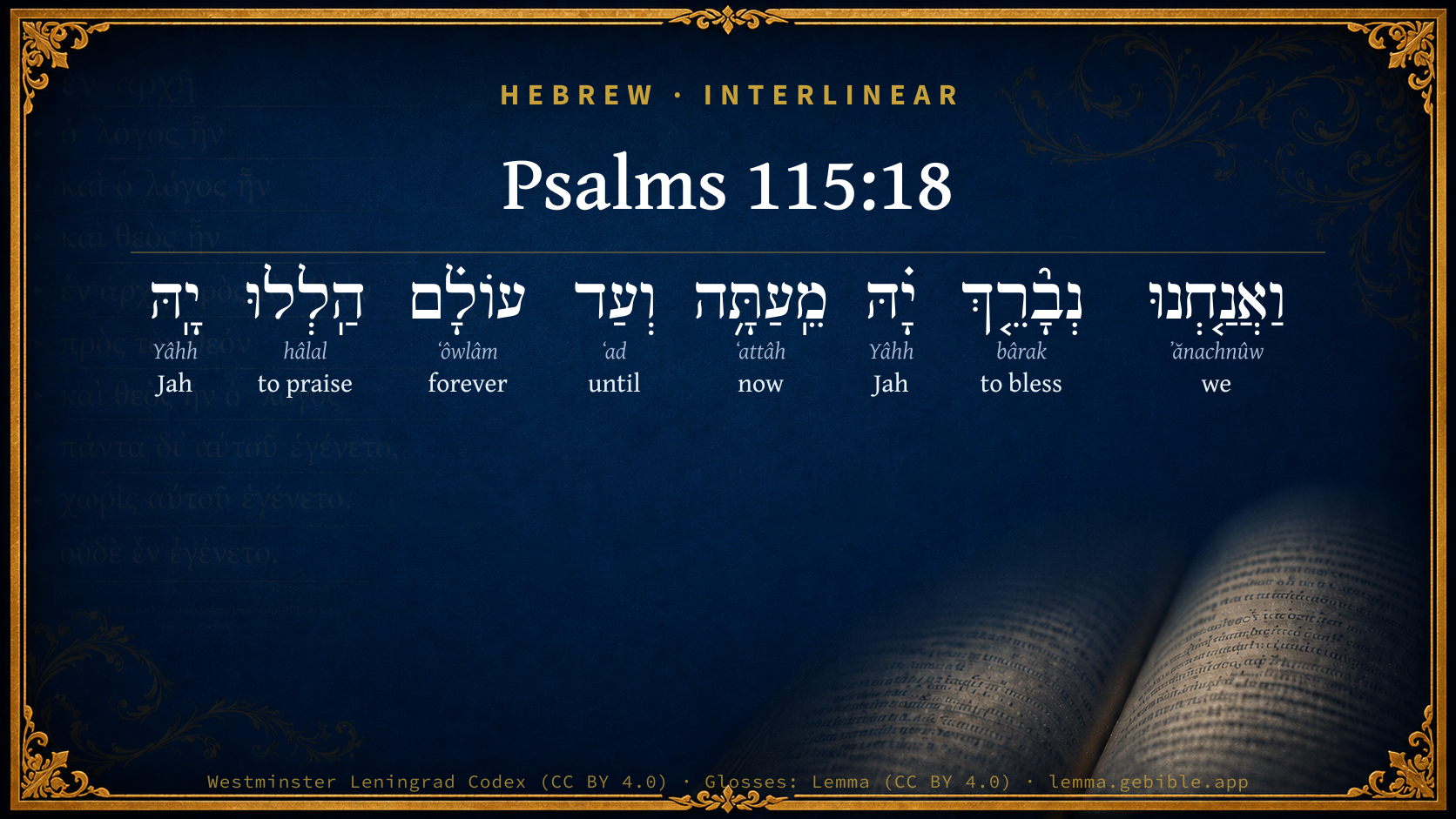
Hebrew (Westminster Leningrad Codex) Psalms 115:18 appears in the Hebrew Old Testament. The text above is from the Westminster Leningrad Codex. Each word links to its Strong’s number, a concise gloss, and parsing drawn from the Open Scriptures Hebrew Bible morphology. Click any word for its full Brown-Driver-Briggs (BDB) entry.
Download image
Cite this verse

Psalms 115:18 (World English Bible). Public Domain. Lemma interlinear Bible study tool, https://lemma.gebible.app/v/psalms/115/18.

Show BibTeX & RIS
BibTeX
RIS
English Translation
But we will bless Yah, From this time forth and forevermore. Praise Yah!
World English Bible · Public Domain
Download a study sheet

One document with this verse’s original text, its word-by-word gloss line, the meaning frame, cross-references with their text, attributed commentary, and full source and license credits — printable, and it pastes into notes with its structure intact.

This verse Autodidact and up

Study sheet (.html) Plain text (.txt)

A passage Seminary Student

Up to 50 verses in one chapter. A passage sheet keeps up to 6 commentary sources and 12 cross-references per verse, in the order this page ranks them, and says so on the sheet whenever that leaves anything out. Ask for a single verse and you get the Autodidact verse sheet above.

Everything on this page stays free to read, with no account — the sheet is a download of what is already on screen, not access to it.

Want to remove ads? Support Godless Engineer
Compare translations 3

The same verse in 3 English versions, stacked beneath the original-language interlinear above. Click any original word for its lexicon entry.

Each is an independent rendering of the whole verse — the interlinear is not word-aligned to these translations.

Highlighted words mark where these versions differ — a whole-verse word diff, not a word-by-word alignment.

  • World English Bible Public Domain
    But we will bless Yah, From this time forth and forevermore. Praise Yah!
  • King James Version Public Domain
    But we will bless the LORD from this time forth and for evermore. Praise the LORD.
  • unfoldingWord Literal Text CC BY-SA 4.0
    But we, we will bless Yah from now and to forever! Hallelu Yah!

unfoldingWord Literal Text — © unfoldingWord, licensed CC BY-SA 4.0. Word-aligned USFM3 via Door43 (git.door43.org/unfoldingWord/en_ult).

Versions to compare (up to 4)

3 of 4 selected

Show all 17 translations

Every available English version of this verse, each an independent rendering of the whole verse.

  • World English Bible Public Domain
    But we will bless Yah, From this time forth and forevermore. Praise Yah!
  • Berean Standard Bible Public Domain
    But it is we who will bless the LORD, both now and forevermore. Hallelujah!
  • Majority Standard Bible Public Domain
    But it is we who will bless the LORD, both now and forevermore. Hallelujah!
  • King James Version Public Domain
    But we will bless the LORD from this time forth and for evermore. Praise the LORD.
  • American Standard Version (1901) Public Domain
    But we will bless Jehovah From this time forth and for evermore. Praise ye Jehovah.
  • Revised Version (1885) Public Domain
    But we will bless the LORD from this time forth and for evermore. Praise ye the LORD.
  • Geneva Bible (1599) Public Domain
    But we will prayse the Lord from henceforth and for euer. Prayse ye the Lord.
  • Young's Literal Translation Public Domain
    And we, we bless Jah, From henceforth, and unto the age. Praise ye Jah!
  • Literal Standard Version CC BY-SA 4.0
    And we, we bless YAH, || From now on, and for all time. Praise YAH!
  • Unlocked Literal Bible CC BY-SA 4.0
    But we will bless Yahweh now and forevermore. Praise Yahweh.
  • unfoldingWord Literal Text CC BY-SA 4.0
    But we, we will bless Yah from now and to forever! Hallelu Yah!
  • Darby Bible Public Domain
    But *we* will bless Jah from this time forth and for evermore. Hallelujah!
  • World Messianic Bible Public Domain
    but we will bless the LORD, from this time forward and forever more. Praise the LORD!
  • Webster's Bible Public Domain
    But we will bless the LORD from this time forth and for ever. Praise the LORD.
  • Free Bible Version CC BY-SA 4.0
    But we the living will always praise the Lord. Praise the Lord!
  • Bible in Basic English Public Domain
    But we will give praise to the Lord now and for ever. Praise be to the Lord.
  • JPS Tanakh (1917) Public Domain
    But we will bless the LORD from this time forth and for ever. Hallelujah.

Literal Standard Version (2020), Covenant Press — licensed CC BY-SA 4.0. Text via the HelloAO Bible API (eBible.org). Unlocked Literal Bible (unfoldingWord) — licensed CC BY-SA 4.0. Text via the HelloAO Bible API (eBible.org). unfoldingWord Literal Text — © unfoldingWord, licensed CC BY-SA 4.0. Word-aligned USFM3 via Door43 (git.door43.org/unfoldingWord/en_ult). Free Bible Version, Dr. Jonathan Gallagher — licensed CC BY-SA 4.0. Text via the HelloAO Bible API (eBible.org).

Word by word

More ways to search: Search by grammar → Find every occurrence → Compare this word →

Practice this passage: Drill this verse → Learn its vocabulary →

About this verse

These counts appear in no published source. They are computed here, from the morphology-tagged text and Lemma’s own curated glosses. What Lemma adds →

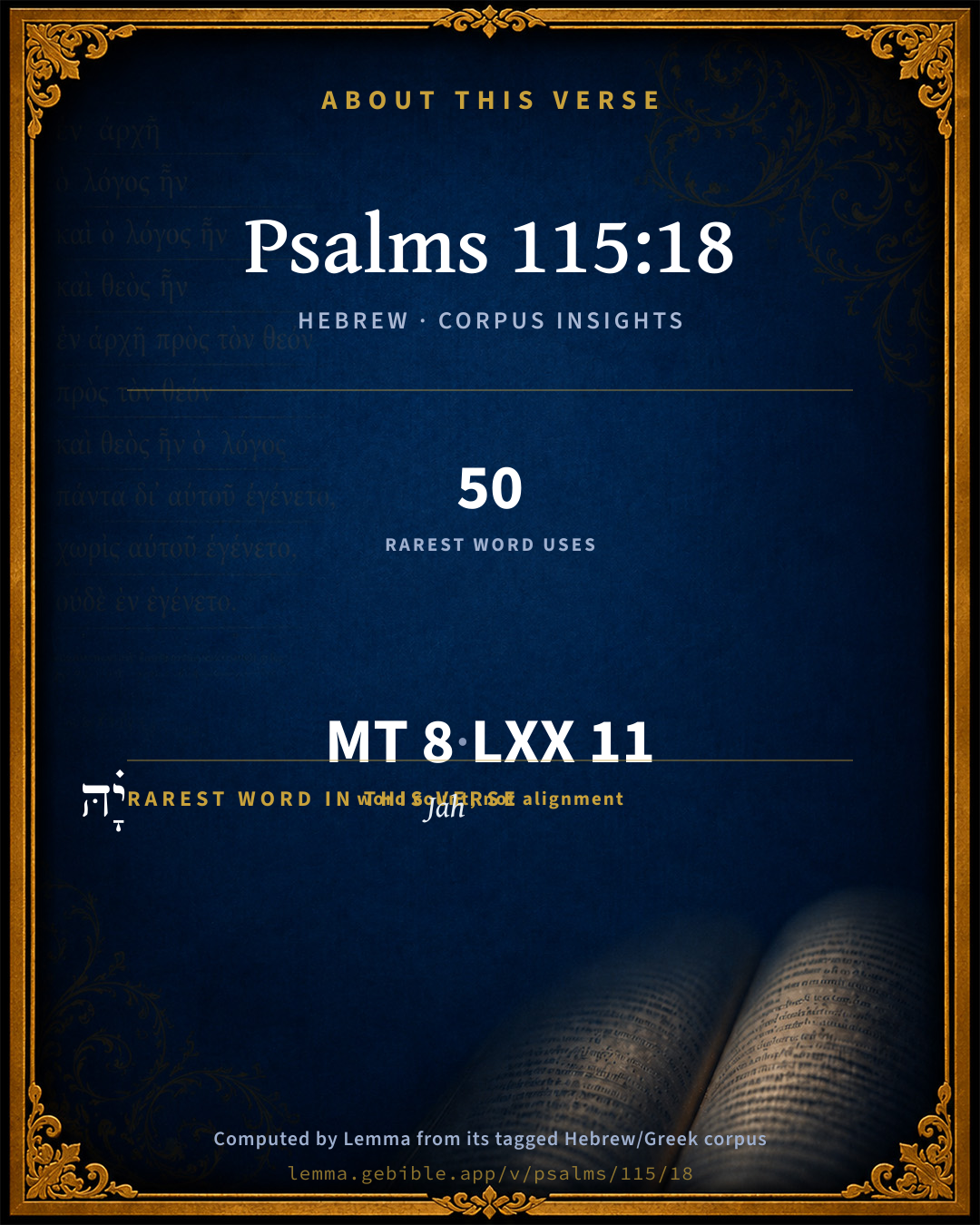
8
words
7
distinct lemmas
Wisdom
section

Shared distinctive vocabulary

יָ֗הּ Jah H3050 occurs in 46 verses of the Hebrew Bible. Also found in:

Grammatical profile

  • 2 verbs
  • 3 nouns
  • 1 pronoun
  • 1 preposition
  • 1 adverb

Verb forms

  • נְבָ֘רֵ֤ךְ Piel · Imperfect
  • הַֽלְלוּ Piel · Imperative

Repetition

A word recurs within this verse — often emphatic in Hebrew:

  • יָ֗הּ Jah H3050 ×2

Hebrew & Septuagint length

In the original languages it is 8 Hebrew tokens and 11 Greek tokens — but the two are counted differently (Hebrew bundles its prefixes and suffixes into one token; the Greek is in lemma form), so that isn’t a like-for-like length.

Cross-references

6

Topical passages linked to Psalms 115:18 in the Treasury of Scripture Knowledge — connected by theme and wording, ordered by reader-vote popularity; previews shown in the World English Bible.

  • Psalms 113:2 Blessed be the name of Yahweh, From this time forth and forevermore.
  • Daniel 2:20 Daniel answered, Blessed be the name of God forever and ever; for wisdom and might are his.
  • Psalms 118:17–19 I will not die, but live, And declare Yah's works.
  • Psalms 145:21 My mouth will speak the praise of Yahweh. Let all flesh bless his holy name forever and ever.
  • Revelation 5:13 I heard every created thing which is in heaven, on the earth, under the earth, on the sea, and everything in them, saying, "To him who sits on the throne, and to the Lamb be the blessing, the honor, the glory, and the dominion, forever and ever! Amen!"
  • Psalms 145:2 Every day I will praise you. I will extol your name forever and ever.

Cross-references courtesy of OpenBible.info (CC BY 4.0).

Hebrew and Greek witnesses Masoretic Hebrew ↔ Greek Septuagint

The same verse in the two great witnesses to the Old Testament, shown verse-for-verse.

You’re reading Greek Psalm 113 (Hebrew Psalm 115). The Septuagint counts the superscription, so verse numbers can differ from the Hebrew — chapter-level alignment, not verse-by-verse. Numbering follows Rahlfs.

These are two independent witnesses, not word-aligned to each other, and the Septuagint is shown in lemma (dictionary) form.

Hebrew Psalms 115:18 Masoretic · Westminster Leningrad Codex

וַאֲנַ֤חְנוּ נְבָ֘רֵ֤ךְ יָ֗הּ מֵֽעַתָּ֥ה וְעַד עוֹלָ֗ם הַֽלְלוּ יָֽהּ

But we will bless Yah, From this time forth and forevermore. Praise Yah!

World English Bible · Public Domain

Greek LXX Greek Psalm 113:18 Septuagint · lemma form

οἶκος ἀαρών ἐλπίζω ἐπί κύριος βοηθός αὐτός καί ὑπερασπιστής αὐτός εἰμί

No English rendering of this Greek verse — the small residue in the structurally divergent books.

On this verse, The Cambridge Bible for Schools and Colleges discusses the Septuagint’s reading. Read the note in Commentary ↓

Hebrew: Westminster Leningrad Codex (CC BY 4.0). Greek: Septuagint (public domain); English from a public-domain English Septuagint. How the Septuagint differs from the Hebrew →

Commentary

Notes on Psalms 115:18 from classic Christian and Jewish commentators (each source and its license shown beneath its notes). The classic Christian expositions comment on the surrounding passage and are grouped to its opening verse, so a note may address several verses; the Jewish commentaries on the Tanakh (Rashi and others) are per-verse, so they appear only where the commentator wrote on this verse.

Lemma curates 59 commentaries, every one of them public domain or Creative Commons licensed, each selected and text-cleaned for this edition rather than reprinted as found. About our sources →

Trapp's Complete Commentary

John Trapp

Psa 115:18 But we will bless the LORD from this time forth and for evermore. Praise the LORD.

Ver. 18. But we will bless the Lord] For if he lose his praise in us, he will lose it altogether; and so all things will come to nothing; quod absit.

John Trapp, A Commentary or Exposition upon All the Books of the Old and New Testament (1647–1656) — public domain. Text from a community e-Sword module.

J. A. Alexander on Psalms

Joseph Addison Alexander

18. (Psa 115:18) And (therefore) we will bless Jah from now even to eternity. Hallelujah! As it is not the dead who are to do it, and as we are still preserved alive, let us answer our vocation and the very end of our existence. The insensible transition from temporal to eternal praise is altogether natural. The hallelujah refers back to the expression praise Jah (hallelujah) in Psa 115:17. As if he had said, Let us do what, the dead can not, shout Hallelujah!

Joseph Addison Alexander, The Psalms Translated and Explained (1850) — public domain. Text from a community e-Sword module.

Adam Clarke's Commentary

Verse 18. But we will bless the Lord] Our fathers, who received so much from thy bounty, are dead, their tongues are silent in the grave; we are in their place, and wish to magnify thy name, for thou hast dealt bountifully with us. But grant us those farther blessings before we die which we so much need; and we will praise thee as living monuments of thy mercy, and the praise we begin now shall continue for ever and ever.

The Targum, for "neither any that go down into silence," has "nor any that descend into the house of earthly sepulture," that is, the tomb. The Anglo-Saxon: [A.S.], neither all they that go down into hell. Nogh the dede sal loue the Lorde, ne al that lyghtes in hell. Old Psalter. The word hell among our ancestors meant originally the covered, or hidden obscure place, from helan, to cover or conceal: it now expresses only the place of endless torment.

ANALYSIS OF THE HUNDRED AND FIFTEENTH PSALM

The prophet, being zealous of God's honour, which the heathens were solicitous to give to their idols, earnestly beseeches God to manifest that power which belongs to him alone, and which he will not give to another.

This Psalm, has four parts: -

I, His petition for God's honour, Ps 115:1; which belongs to no idol, Ps 115:3-9.

II. An exhortation to praise God, and hope in him, Ps 115:10-12.

III. The benefit that will arise from it, a blessing, Ps 115:12-16.

IV. A profession, that for the blessing they will bless God, Ps 115:17-18.

1. Some join this Psalm to the former, conceiving that the prophet, having expressed the goodness of God in the deliverance of his people from Egypt, would not have any of the glory attributed to Moses or Aaron, but wholly to God. Therefore he begins: -

1. "Not unto us," c. Or any leader among us.

2. "But unto thy name," &c. We seek it not take it wholly to thyself.

And this, for these reasons, he desires might always be shown to his people.

1. "Give glory to thy name," c. For the manifestation of his mercy.

2. "Do it for thy truth's sake." As a promise-keeping God.

3. "Wherefore should the heathen say," &c. Give them not occasion to blaspheme, as if thou hadst forsaken thy people. Should the heathen ask, we can answer: "As for our God, he is in the heavens, which his miracles testify. He can deliver or afflict his people as he pleases."

But where are their gods?

1. "Their idols are silver and gold." The mere productions of the earth.

2. "The work of men's hands." Works, and not makers of works.

3. They are of no use or power, though formed like men: "For they have mouths," &c. "They have hands, but they handle not," &c. They have not the power of articulating sounds they are lower than even the beasts that perish.

The prophet, having thus described the idols, now notices their makers.

1. "They that make them," c. Quite senseless people.

2. "So is every one that puts his trust," &c. Christ says, "Having eyes," &c. Mr 8:18

II. The prophet, having passed this sarcasm upon the idols and idolaters, leaves them, and exhorts the Israelites.

1. "O Israel, trust thou," &c. You are God's servants and to encourage them he adds, "He is their help," c. The protector of the whole nation.

2. "A house of Levi," &c. You are the leaders and guides in religion and therefore, you ought especially to trust in him who is the shield of your tribe.

3. "Ye that fear the Lord," c. In whatever nation you live for all who fear him, and do righteously, are accepted of him.

III. That this exhortation might be the deeper rooted, he puts them in mind that God "hath been mindful of us," by his special providence.

1. "He will bless the house of Israel" as a nation.

2. "He will bless the house of Aaron" as the priesthood.

3. "He will bless them that fear the Lord," c., without distinction.

The prophet, taking his example from God, pours his blessing upon them also, and upon their children.

1. "The Lord shall increase you," &c.

2. "Ye are the blessed of the Lord," &c. Though the world speak evil of you.

3. "The Lord which made heaven and earth." Which words are added that they may be assured that their blessings are real, and come forth from his hand directly and alone.

4. They come from one able to bless for, 1. The heaven, even the heavens, c. In them he especially shows his presence, majesty, and glory but sends his dews and rain upon the earth. 2. As for the earth, he hath given it, c., that by his blessing upon their labours they might have food and raiment therefore praise him.

IV. For this is the true end of their being: which he illustrates by an antithesis.

1. "For the dead praise not the Lord," c. These temporal blessings are not felt by the dead - they need them not: but the living should render continual thanks for them to God their author.

2. But we that are upon earth enjoy his protection and temporal care of us, and besides we have his far richer spiritual blessings therefore, "we will bless the Lord," &c., by ourselves while we live, and aim by our instructions and prayers that our posterity may do the same when we are gone down into silence.

3. However, ye that are alive this day, "praise ye the Lord."

Adam Clarke's Commentary on the Bible (1810–1826) — public domain. Text from a community e-Sword/MySword module.

The Cambridge Bible for Schools and Colleges

gen. ed. J. J. S. Perowne

18. But we (emphatic), we the living (as the LXX adds), will bless Jah. Cp. Psa_118:17; Isa_38:18 ff.

for evermore] In the spirit of faith the congregation sees no limit to the continuance of its existence or to its tribute of praise. What in the O.T. is a national hope becomes in the N.T. a personal hope.

The LXX and Jer. transfer the concluding Hallelujah to the beginning of Psalms 116.

The Cambridge Bible for Schools and Colleges (gen. ed. J. J. S. Perowne; Cambridge University Press, 1878–1918) — public domain. Text from a community e-Sword module.

John Gill's Exposition

But we will bless the Lord from this time forth and for evermore,.... The Septuagint, Vulgate Latin, Ethiopic, and Arabic versions, render it, "we who are alive"; both in a corporeal and in a spiritual sense who, as long as we live, and while we have a being, will bless the Lord; being made spiritually alive, quickened by the Spirit and grace of God, and so capable of ascribing blessing, praise, and glory to him, for all the great and good things he has done; and especially when in lively frames, or in the lively exercise of grace: and that from this time; under a sense of present favours, and outward mercies being renewed every day; yea, throughout the whole of life, and so to all eternity in the world above; see Isa 38:19.

Praise the Lord; let others do the same as we; let us join together in this work, now and hereafter.

Next: Psalms Chapter 116

John Gill's Exposition of the Whole Bible (1746–1763) — public domain (CC PDM 1.0). Text via the HelloAO Bible API.

Albert Barnes' Notes on the Bible

But we will bless the Lord ... - While life lasts; now and ever onward. Our lives are spared; and while those lives shall be continued they shall be spent in praise. We will transmit the praise to future times; and when we are dead, the voice of praise shall be prolonged by those who come after us. It may be added here that we have now higher and clearer views of the grave and of the future world than the psalmist had, and that though it is certain that our voices of praise must be stilled by death, yet in another world we shall continue the work of praise in strains more lofty than here, and in a continuance of service that shall never end. The grave is, indeed, before us all; but so is also heaven, if we belong to those who truly fear the Lord, and who sincerely worship him through Christ Jesus.

Albert Barnes' Notes on the Bible (1834–1885) — public domain. Text from a community e-Sword/MySword module.

Matthew Poole's English Annotations

But we will bless the Lord; but we hope for better things, that notwithstanding our present and urgent danger, yet thou wilt deliver us, and so give us occasion to bless thy name; whereby thou wilt have the praise and glory of our deliverance.

Matthew Poole's English Annotations on the Holy Bible (1683–1685) — public domain. Text from a community e-Sword/MySword module.

The Treasury of David

Charles H. Spurgeon

Ver. 18. But we will bless the LORD from this time forth and for evermore. We who are still living will take care that the praises of God shall not fail among the sons of men. Our afflictions and depressions of spirit shall not cause us to suspend our praises; neither shall old age, and increasing infirmities damp the celestial fires, nay, nor shall even death itself cause us to cease from the delightful occupation. The spiritually dead cannot praise God, but the life within us constrains us to do so. The ungodly may abide in silence, but we will lift up our voices to the praise of Jehovah. Even though for a time he may work no miracle, and we may see no peculiar interposition of his power, yet on the strength of what he has done in ages past we will continue to laud his name "until the day break, and the shadows flee away, "when he shall once more shine forth as the sun to gladden the faces of his children. The present time is auspicious for commencing a life of praise, since today he bids us hear his voice of mercy. "From this time forth" is the suggestion of wisdom, for this duty ought not to be delayed; and it is the dictate of gratitude, for there are pressing reasons for prompt thankfulness. Once begin praising God and we have entered upon an endless service. Even eternity cannot exhaust the reasons why God should be glorified.

Praise the Lord, or Hallelujah. Though the dead cannot, and the wicked will not, and the careless do not praise God, yet we will shout "Hallelujah" for ever and ever. Amen.

Charles H. Spurgeon's The Treasury of David (1869–1885) — public domain. Psalms only. Text from a community e-Sword/MySword module.

Whedon's Commentary on the Bible

Daniel D. Whedon

18. From this time—See note on Psa_113:2.

Daniel D. Whedon (gen. ed.), Commentary on the Old and New Testaments (1874–1909) — public domain. Text from a community e-Sword module.

The Pulpit Commentary

But we will bless the Lord; literally, we will bless Jah the shortened, and perhaps more emphatic, form of Jehovah. We, so long as we have any being, will sing praises unto our God (Psa_146:2) we will bless him, praise him, give thanks to him, from this time forth, and for evermore not an absolute assertion of immortality, but a strong instinctive anticipation of it. Praise the Lord. (see Ps 104-106, 113, etc.)

The Pulpit Commentary (1880–1919), ed. H.D.M. Spence-Jones & Joseph S. Exell — public domain. Text from a community e-Sword module.

Lesson kit

Teaching starters — assembled from the data on this page, not authored interpretation. Every prompt links to the verse data it draws on. Edit before teaching.

Psalms, in the Wisdom, opens this verse with 8 words (7 distinct Hebrew lemmas). Its most distinctive word is Yâhh (“Jah”). A historical commentator’s framing appears above. Read the whole chapter for the surrounding context.

Discussion questions

  1. What does “Jah” (Yâhh) contribute to the verse as a whole?
  2. Exodus 15:2 shares the word «Jah» with this verse. How do the two illuminate each other?
  3. “Jah” occurs 2× in this one verse. What is the effect of the repetition?
  4. These translations render this verse differently; the difference is in the English rendering, not the original. What questions does that raise?
  5. The verb «נְבָ֘רֵ֤ךְ» is Piel Imperfect. How does its form color the action?
  6. Reading how Trapp's Complete Commentary and J. A. Alexander on Psalms read this verse, where do the two commentators agree and where do they part?

Things to notice

Reading settings

Reading text

Shown beneath each verse's original-language words.

Old Testament
Old Testament edition

Read the OT as the Masoretic Hebrew (MT) or the Greek Septuagint (LXX).

English shown for the Greek Septuagint (in the Hebrew ↔ Greek comparison).

Comparing translations? Open the Compare panel on any verse page to stack up to four side by side.