
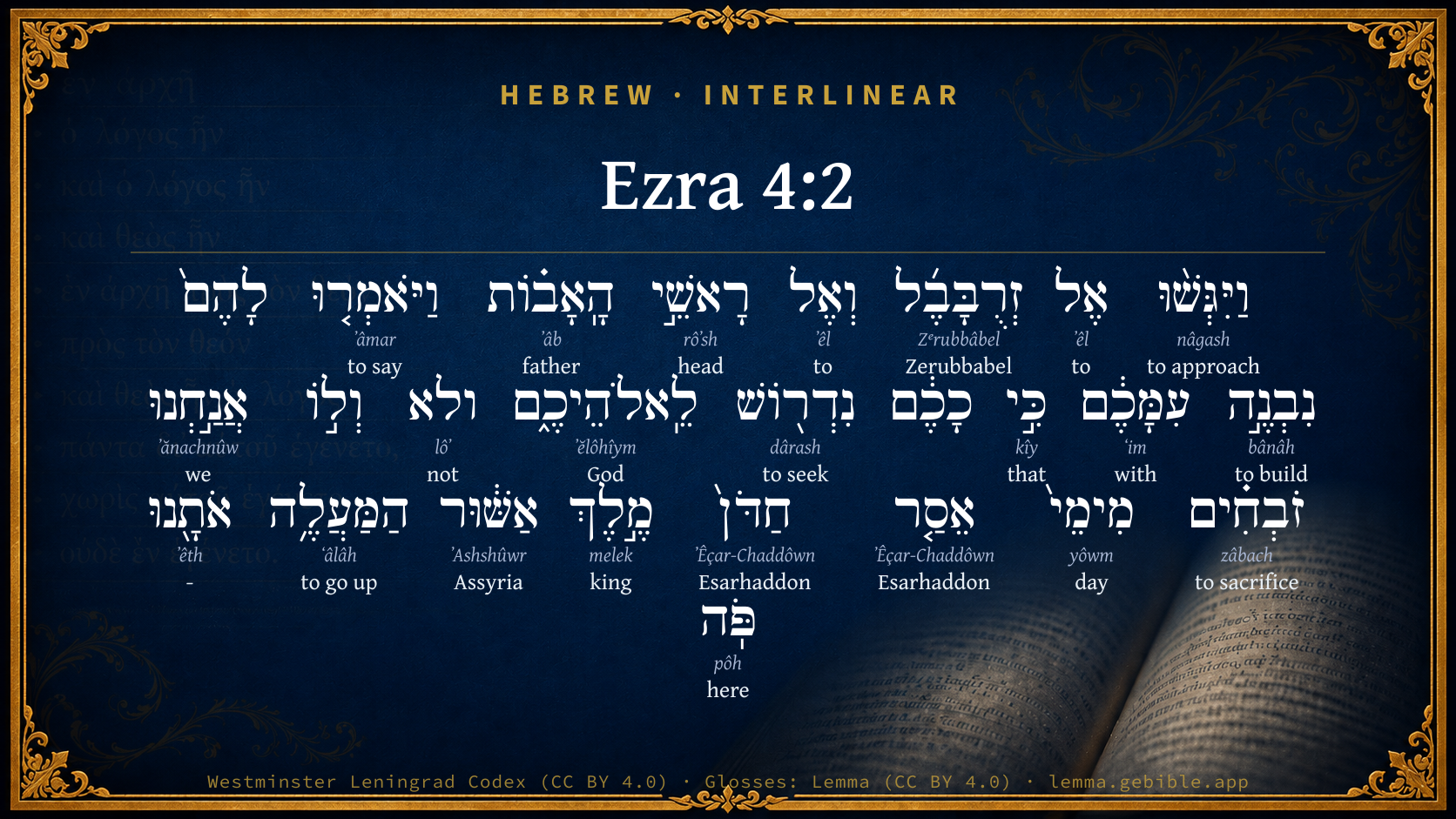
Ezra 4:2

Hebrew (Westminster Leningrad Codex) Ezra 4:2 appears in the Hebrew Old Testament. The text above is from the Westminster Leningrad Codex. Each word links to its Strong’s number, a concise gloss, and parsing drawn from the Open Scriptures Hebrew Bible morphology. Click any word for its full Brown-Driver-Briggs (BDB) entry.
Download image
Cite this verse

Ezra 4:2 (World English Bible). Public Domain. Lemma interlinear Bible study tool, https://lemma.gebible.app/v/ezra/4/2.

Show BibTeX & RIS
BibTeX
RIS
English Translation
then they drew near to Zerubbabel, and to the heads of fathers' [houses], and said to them, Let us build with you; for we seek your God, as you do; and we sacrifice to him since the days of Esar Haddon king of Assyria, who brought us up here.
World English Bible · Public Domain
Download a study sheet

One document with this verse’s original text, its word-by-word gloss line, the meaning frame, cross-references with their text, attributed commentary, and full source and license credits — printable, and it pastes into notes with its structure intact.

This verse Autodidact and up

Study sheet (.html) Plain text (.txt)

A passage Seminary Student

Up to 50 verses in one chapter. A passage sheet keeps up to 6 commentary sources and 12 cross-references per verse, in the order this page ranks them, and says so on the sheet whenever that leaves anything out. Ask for a single verse and you get the Autodidact verse sheet above.

Everything on this page stays free to read, with no account — the sheet is a download of what is already on screen, not access to it.

Want to remove ads? Support Godless Engineer
Compare translations 3

The same verse in 3 English versions, stacked beneath the original-language interlinear above. Click any original word for its lexicon entry.

Each is an independent rendering of the whole verse — the interlinear is not word-aligned to these translations.

Highlighted words mark where these versions differ — a whole-verse word diff, not a word-by-word alignment.

  • World English Bible Public Domain
    then they drew near to Zerubbabel, and to the heads of fathers' [houses], and said to them, Let us build with you; for we seek your God, as you do; and we sacrifice to him since the days of Esar Haddon king of Assyria, who brought us up here.
  • King James Version Public Domain
    Then they came to Zerubbabel, and to the chief of the fathers, and said unto them, Let us build with you: for we seek your God, as ye do; and we do sacrifice unto him since the days of Esarhaddon king of Assur, which brought us up hither.
  • unfoldingWord Literal Text CC BY-SA 4.0
    So they came to Zerubbabel and to the heads of the fathers and they said to them, “Let us build with you, for, like you, we seek your God and to him we have been sacrificing since the days of Esarhaddon, the king of Assyria, the one who caused us to come up here.”

unfoldingWord Literal Text — © unfoldingWord, licensed CC BY-SA 4.0. Word-aligned USFM3 via Door43 (git.door43.org/unfoldingWord/en_ult).

Versions to compare (up to 4)

3 of 4 selected

Show all 18 translations

Every available English version of this verse, each an independent rendering of the whole verse.

  • World English Bible Public Domain
    then they drew near to Zerubbabel, and to the heads of fathers' [houses], and said to them, Let us build with you; for we seek your God, as you do; and we sacrifice to him since the days of Esar Haddon king of Assyria, who brought us up here.
  • Berean Standard Bible Public Domain
    they approached Zerubbabel and the heads of the families, saying, “Let us build with you because, like you, we seek your God and have been sacrificing to Him since the time of King Esar-haddon of Assyria, who brought us here.”
  • Majority Standard Bible Public Domain
    they approached Zerubbabel and the heads of the families, saying, “Let us build with you because, like you, we seek your God and have been sacrificing to Him since the time of King Esar-haddon of Assyria, who brought us here.”
  • King James Version Public Domain
    Then they came to Zerubbabel, and to the chief of the fathers, and said unto them, Let us build with you: for we seek your God, as ye do; and we do sacrifice unto him since the days of Esarhaddon king of Assur, which brought us up hither.
  • American Standard Version (1901) Public Domain
    then they drew near to Zerubbabel, and to the heads of fathers' `houses', and said unto them, Let us build with you; for we seek your God, as ye do; and we sacrifice unto him since the days of Esar-haddon king of Assyria, who brought us up hither.
  • Revised Version (1885) Public Domain
    then they drew near to Zerubbabel, and to the heads of fathers’ houses, and said unto them, Let us build with you: for we seek your God, as ye do; and we do sacrifice unto him since the days of Esarhaddon king of Assyria, which brought us up hither.
  • Geneva Bible (1599) Public Domain
    And they came to Zerubbabel, and to the chiefe fathers, and sayd vnto them, We wil builde with you: for we seeke the Lord your God as ye do, and we haue sacrificed vnto him since the time of Esar Haddon king of Asshur, which brought vs vp hither.
  • Douay-Rheims (1899) Public Domain
    And they came to Zorobabel, and the chief of the fathers, and said to them: Let us build with you, for we seek your God as ye do: behold we have sacrificed to him, since the days of Asor Haddan king of Assyria, who brought us hither.
  • Young's Literal Translation Public Domain
    and they draw nigh unto Zerubbabel, and unto heads of the fathers, and say to them, `Let us build with you; for, like you, we seek to your God, and we are not sacrificing since the days of Esar-Haddon king of Asshur, who brought us up hither.'
  • Literal Standard Version CC BY-SA 4.0
    and they draw near to Zerubbabel, and to heads of the fathers, and say to them, “Let us build with you; for, like you, we seek to your God, and we are not sacrificing since the days of Esar-Haddon king of Asshur, who brought us up here.”
  • Unlocked Literal Bible CC BY-SA 4.0
    So they approached Zerubbabel and the heads of their ancestors' clans. They said to them, “Let us build with you, for, like you, we seek your God and have sacrificed to him since the days when Esarhaddon, king of Assyria, brought us to this place.”
  • unfoldingWord Literal Text CC BY-SA 4.0
    So they came to Zerubbabel and to the heads of the fathers and they said to them, “Let us build with you, for, like you, we seek your God and to him we have been sacrificing since the days of Esarhaddon, the king of Assyria, the one who caused us to come up here.”
  • Darby Bible Public Domain
    and they came to Zerubbabel and to the chief fathers, and said to them, We would build with you; for we seek your God, as ye; and we have sacrificed to him since the days of Esar-haddon king of Assyria, who brought us up hither.
  • World Messianic Bible Public Domain
    they came near to Zerubbabel, and to the heads of fathers’ households, and said to them, “Let us build with you, for we seek your God as you do; and we have been sacrificing to him since the days of Esar Haddon king of Assyria, who brought us up here.”
  • Webster's Bible Public Domain
    Then they came to Zerubbabel, and to the chief of the fathers, and said to them, Let us build with you: for we seek your God, as ye do; and we do sacrifice to him since the days of Esar-haddon king of Assur, who brought us up hither.
  • Free Bible Version CC BY-SA 4.0
    They came to Zerubbabel and the family leaders and said, “Please let us help you with the building work, for we worship your God like you do. In fact we have been sacrificing to him since the time of Esarhaddon king of Assyria, who brought us here.”
  • Bible in Basic English Public Domain
    Then they came to Zerubbabel and to the heads of families, and said to them, Let us take part in the building with you; for we are servants of your God, even as you are; and we have been making offerings to him from the days of Esar-haddon, king of Assyria, who put us here.
  • JPS Tanakh (1917) Public Domain
    then they drew near to Zerubbabel, and to the heads of fathers' houses, and said unto them: 'Let us build with you; for we seek your God, as ye do; and we do sacrifice unto Him since the days of Esarhaddon king of Assyria, who brought us up hither.'

Literal Standard Version (2020), Covenant Press — licensed CC BY-SA 4.0. Text via the HelloAO Bible API (eBible.org). Unlocked Literal Bible (unfoldingWord) — licensed CC BY-SA 4.0. Text via the HelloAO Bible API (eBible.org). unfoldingWord Literal Text — © unfoldingWord, licensed CC BY-SA 4.0. Word-aligned USFM3 via Door43 (git.door43.org/unfoldingWord/en_ult). Free Bible Version, Dr. Jonathan Gallagher — licensed CC BY-SA 4.0. Text via the HelloAO Bible API (eBible.org).

Word by word

More ways to search: Search by grammar → Find every occurrence → Compare this word →

Practice this passage: Drill this verse → Learn its vocabulary →

אֵסַ֤ר
ʼÊçar-Chaddôwn
H634
“Esarhaddon”
Noun, Proper
Part of Speech
Noun
Type
Proper
Full BDB Definition

Origin: of foreign derivation

TWOT: None

Esarhaddon = "Ashur has given a brother" - king of Assyria in the seventh-century BC
  1. וַיִּגְּשׁ֨וּ nâgash H5066 “and · to approach” Conjunction + Verb, Qal, Sequential Imperfect, 3rd Person, Masculine, Plural
  2. אֶל ʼêl H413 “to” Preposition
  3. זְרֻבָּבֶ֜ל Zᵉrubbâbel H2216 “Zerubbabel” Noun, Proper
  4. וְאֶל ʼêl H413 “and · to” Conjunction + Preposition
  5. רָאשֵׁ֣י rôʼsh H7218 “heads of” Noun, Common, Masculine, Plural, Construct
  6. הָֽאָב֗וֹת ʼâb H1 “the · fathers” Particle, Definite Article + Noun, Common, Masculine, Plural, Absolute
  7. וַיֹּאמְר֤וּ ʼâmar H559 “and · to say” Conjunction + Verb, Qal, Sequential Imperfect, 3rd Person, Masculine, Plural
  8. נִבְנֶ֣ה bânâh H1129 “to build” Verb, Qal, Imperfect, 1st Person, Common, Plural
  9. עִמָּכֶ֔ם ʻim H5973 “with · you” Preposition + Suffix, Personal, 2nd Person, Masculine, Plural
  10. כִּ֣י kîy H3588 “that” Conjunction
  11. נִדְר֖וֹשׁ dârash H1875 “to seek” Verb, Qal, Imperfect, 1st Person, Common, Plural
  12. לֵֽאלֹהֵיכֶ֑ם ʼĕlôhîym H430 “to/for · God(s) · your” Preposition + Noun, Common, Masculine, Plural, Construct + Suffix, Personal, 2nd Person, Masculine, Plural
  13. ולא lôʼ H3808 “and · not” Conjunction + Particle, Negative
  14. אֲנַ֣חְנוּ ʼănachnûw H587 “we” Pronoun, Personal, 1st Person, Common, Plural
  15. זֹבְחִ֗ים zâbach H2076 “sacrificing” Verb, Qal, Participle Active, Masculine, Plural, Absolute
  16. מִימֵי֙ yôwm H3117 “from · days of” Preposition + Noun, Common, Masculine, Plural, Construct
  17. חַדֹּן֙ ʼÊçar-Chaddôwn H634 “Esarhaddon” Noun, Proper
  18. מֶ֣לֶךְ melek H4428 “king of” Noun, Common, Masculine, Singular, Construct
  19. אַשּׁ֔וּר ʼAshshûwr H804 “Assyria” Noun, Proper
  20. הַמַּעֲלֶ֥ה ʻâlâh H5927 “the · going up” Particle, Definite Article + Verb, Hiphil, Participle Active, Masculine, Singular, Absolute
  21. אֹתָ֖נוּ ʼêth H853 “- · us” Particle, Direct Object + Suffix, Personal, 1st Person, Common, Plural
  22. פֹּֽה pôh H6311 “here” Adverb

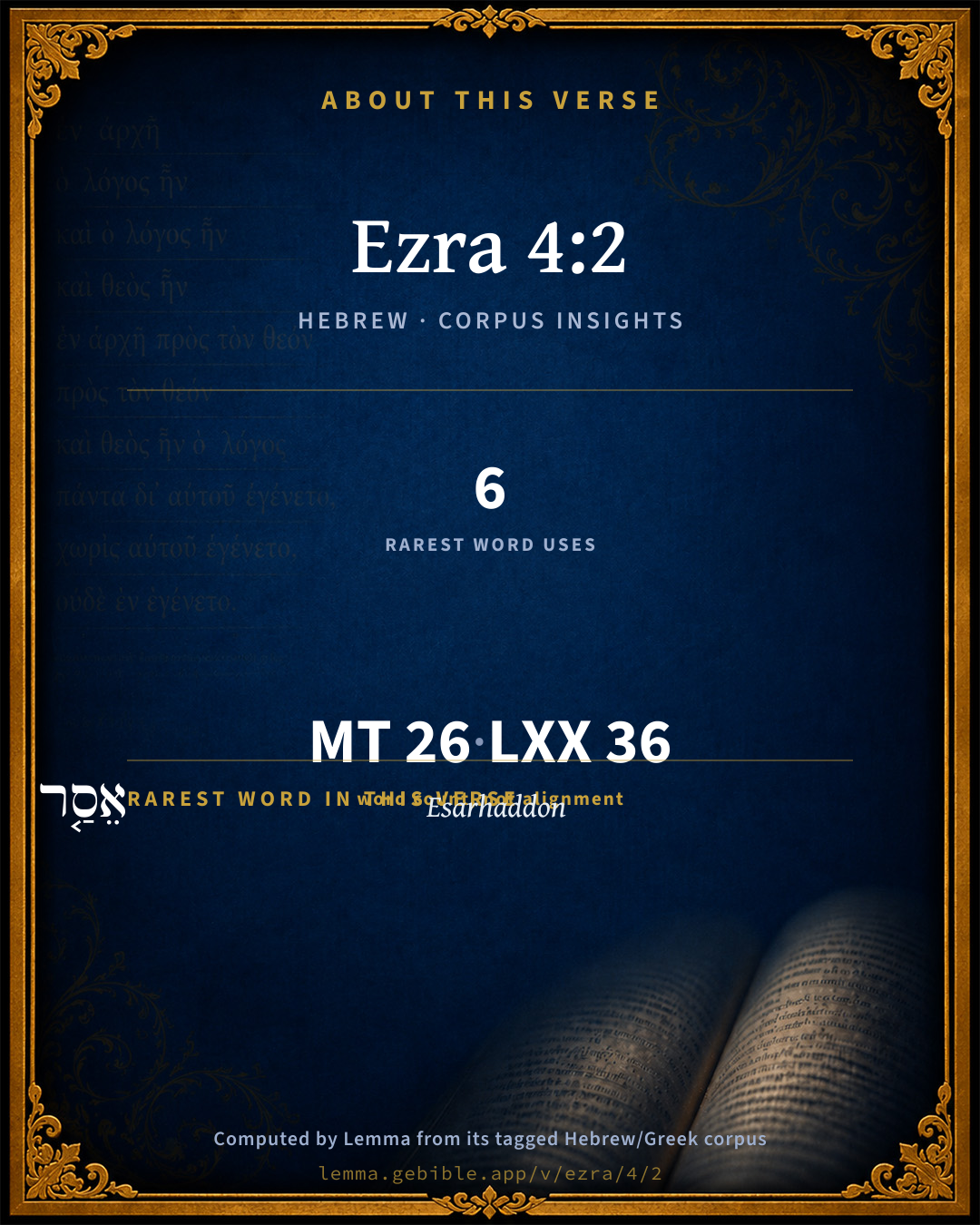
About this verse

These counts appear in no published source. They are computed here, from the morphology-tagged text and Lemma’s own curated glosses. What Lemma adds →

26
words
21
distinct lemmas
Historical
section

Notable vocabulary

The rarest word here is אֵסַ֤ר Esarhaddon H634 — appearing just 6 times in the whole Hebrew Bible.

Shared distinctive vocabulary

אֵסַ֤ר Esarhaddon H634 occurs in 3 verses of the Hebrew Bible. Also found in:

Grammatical profile

  • 6 verbs
  • 9 nouns
  • 2 pronouns
  • 5 prepositions
  • 1 conjunction
  • 1 adverb
  • 2 particles

Verb forms

  • וַיִּגְּשׁ֨וּ Qal · Sequential Imperfect
  • וַיֹּאמְר֤וּ Qal · Sequential Imperfect
  • נִבְנֶ֣ה Qal · Imperfect
  • נִדְר֖וֹשׁ Qal · Imperfect
  • זֹבְחִ֗ים Qal · Participle Active
  • הַמַּעֲלֶ֥ה Hiphil · Participle Active

Repetition

Words recur within this verse — often emphatic in Hebrew:

  • אֵסַ֤ר Esarhaddon H634 ×2
  • אֶל to H413 ×2

Hebrew & Septuagint length

In English translation the verse runs 49 words from the Hebrew and 49 from the Septuagint (LXX English) — the same length.

A rough comparison of the two English renderings, which tokenize alike — not a word-level alignment.

Word counts can differ between the Hebrew and the Greek without any difference in meaning — e.g. the Hebrew direct-object marker אֵת has no separate Greek word, and Greek often adds the article ὁ.

In the original languages it is 26 Hebrew tokens and 36 Greek tokens — but the two are counted differently (Hebrew bundles its prefixes and suffixes into one token; the Greek is in lemma form), so that isn’t a like-for-like length.

Cross-references

17

Topical passages linked to Ezra 4:2 in the Treasury of Scripture Knowledge — connected by theme and wording, ordered by reader-vote popularity; previews shown in the World English Bible.

  • 2 Kings 17:24 The king of Assyria brought men from Babylon, and from Cuthah, and from Avva, and from Hamath and Sepharvaim, and placed them in the cities of Samaria instead of the children of Israel; and they possessed Samaria, and lived in the cities of it.
  • 2 Kings 19:37 It happened, as he was worshipping in the house of Nisroch his god, that Adrammelech and Sharezer struck him with the sword: and they escaped into the land of Ararat. Esar Haddon his son reigned in his place.
  • Galatians 2:4 This was because of the false brothers secretly brought in, who stole in to spy out our liberty which we have in Christ Jesus, that they might bring us into bondage;
  • 2 Kings 17:27–33 Then the king of Assyria commanded, saying, Carry there one of the priests whom you brought from there; and let them go and dwell there, and let him teach them the law of the god of the land.
  • Genesis 10:11 Out of that land he went forth into Assyria, and built Nineveh, Rehoboth Ir, Calah,
  • 2 Kings 17:41 So these nations feared Yahweh, and served their engraved images; their children likewise, and their children's children, as did their fathers, so do they to this day.
  • Ezra 1:5 Then rose up the heads of fathers' [houses] of Judah and Benjamin, and the priests, and the Levites, even all whose spirit God had stirred to go up to build the house of Yahweh which is in Jerusalem.
  • Ezra 2:2 who came with Zerubbabel, Jeshua, Nehemiah, Seraiah, Reelaiah, Mordecai, Bilshan, Mispar, Bigvai, Rehum, Baanah. The number of the men of the people of Israel:
  • Ezra 3:2 Then stood up Jeshua the son of Jozadak, and his brothers the priests, and Zerubbabel the son of Shealtiel, and his brothers, and built the altar of the God of Israel, to offer burnt offerings thereon, as it is written in the law of Moses the man of God.
  • Ezra 3:12 But many of the priests and Levites and heads of fathers' [houses], the old men who had seen the first house, when the foundation of this house was laid before their eyes, wept with a loud voice; and many shouted aloud for joy:
  • Psalms 73:8 They scoff and speak with malice. In arrogance, they threaten oppression.
  • Proverbs 26:23–26 Like silver dross on an earthen vessel Are the lips of a fervent one with an evil heart.
  • Isaiah 37:37 So Sennacherib king of Assyria departed, and went and returned, and lived at Nineveh.
  • Hosea 14:3 Assyria can't save us. We won't ride on horses; Neither will we say any more to the work of our hands, 'Our gods!' For in you the fatherless finds mercy."
  • 2 Corinthians 11:13–15 For such men are false apostles, deceitful workers, masquerading as Christ's apostles.
  • 2 Timothy 3:8 Even as Jannes and Jambres opposed Moses, so do these also oppose the truth; men corrupted in mind, reprobate concerning the faith.
  • 2 Peter 2:1–2 But there also arose false prophets among the people, as among you also there will be false teachers, who will secretly bring in destructive heresies, denying even the Master who bought them, bringing on themselves swift destruction.

Cross-references courtesy of OpenBible.info (CC BY 4.0).

Hebrew and Greek witnesses Masoretic Hebrew ↔ Greek Septuagint

The same verse in the two great witnesses to the Old Testament, shown verse-for-verse.

These are two independent witnesses, not word-aligned to each other, and the Septuagint is shown in lemma (dictionary) form.

Hebrew Ezra 4:2 Masoretic · Westminster Leningrad Codex

וַיִּגְּשׁ֨וּ אֶל זְרֻבָּבֶ֜ל וְאֶל רָאשֵׁ֣י הָֽאָב֗וֹת וַיֹּאמְר֤וּ לָהֶם֙ נִבְנֶ֣ה עִמָּכֶ֔ם כִּ֣י כָכֶ֔ם נִדְר֖וֹשׁ לֵֽאלֹהֵיכֶ֑ם ולא וְל֣וֹ אֲנַ֣חְנוּ זֹבְחִ֗ים מִימֵי֙ אֵסַ֤ר חַדֹּן֙ מֶ֣לֶךְ אַשּׁ֔וּר הַמַּעֲלֶ֥ה אֹתָ֖נוּ פֹּֽה

then they drew near to Zerubbabel, and to the heads of fathers' [houses], and said to them, Let us build with you; for we seek your God, as you do; and we sacrifice to him since the days of Esar Haddon king of Assyria, who brought us up here.

World English Bible · Public Domain

Greek LXX Ezra 4:2 Septuagint · lemma form

καί ἐγγίζω πρός ζοροβαβελ καί πρός ὁ ἄρχων ὁ πατριά καί εἶπον αὐτός οἰκοδομέω μετά σύ ὅτι ὡς σύ ἐκζητέω ὁ θεός σύ καί αὐτός ἐγώ θυσιάζω ἀπό ἡμέρα ασαραδδων βασιλεύς ασσουρ ὁ φέρω ἐγώ ὧδε

And they drew near to Zorobabel, and to the heads of families, and said to them, We will build with you; for as you⌃ do, we seek to serve our God, and we do sacrifice to him from the days of Asaradan king of Assur, who brought us hither.

LXX2012 (modern English Septuagint) · Public Domain

In the Septuagint this is one book — Esdras B (2 Esdras): Ezra is chapters 1–10, Nehemiah 11–23.

On this verse, The Cambridge Bible for Schools and Colleges discusses the Septuagint’s reading. Read the note in Commentary ↓

Hebrew: Westminster Leningrad Codex (CC BY 4.0). Greek: Septuagint (public domain); English from LXX2012 (modern English Septuagint) (Public Domain). How the Septuagint differs from the Hebrew →

Commentary

Notes on Ezra 4:2 from classic Christian and Jewish commentators (each source and its license shown beneath its notes). The classic Christian expositions comment on the surrounding passage and are grouped to its opening verse, so a note may address several verses; the Jewish commentaries on the Tanakh (Rashi and others) are per-verse, so they appear only where the commentator wrote on this verse.

Lemma curates 59 commentaries, every one of them public domain or Creative Commons licensed, each selected and text-cleaned for this edition rather than reprinted as found. About our sources →

Trapp's Complete Commentary

John Trapp

Ezr 4:2 Then they came to Zerubbabel, and to the chief of the fathers, and said unto them, Let us build with you: for we seek your God, as ye [do]; and we do sacrifice unto him since the days of Esarhaddon king of Assur, which brought us up hither.

Ver. 2. Let us build with you] Craftily and treacherously do they offer their cost and pains, ut illis intermixti personas committerent, atque ita opus interverterent, saith one well; that, mingling with them, they might set them together by the ears, and so put a stop to the work. Thus Julian, to spite the Christians, first set the Jews to work to rebuild their temple; and when that would not be, he called home the Arian bishops out of banishment, to breed new broils in the Church. The Jesuits have a practice at this day of running over to the Lutheran Church, pretending to be converts, and to build with them; but it is only to keep up that bitter contention that is between the Calvinists and the Lutherans. And what ill offices they do among us at this day to heighten our divisions, and hinder the Reformation (by their wiles, much ensnared and hindered), good men are very sensible of. The Lord detect and defeat them.

For we seek your God, as ye do] Nay, not as ye do. See 2Ki 17:32-34, they feared the Lord, not filially, but for his lions; as the old Romans worshipped their Veiones, lest they should hurt them; and as the Caffrani (a people in India) worship devils in most terrible figure, that they may not punish them.

Since the days of Esarhaddon] Son and successor to Sennacherib, 2Ki 19:37, grandson to Salmaneser; after whom, it seems, he brought a new colony into the land of Samaria, who proved deadly enemies to God’s people.

John Trapp, A Commentary or Exposition upon All the Books of the Old and New Testament (1647–1656) — public domain. Text from a community e-Sword module.

Joseph Benson's Commentary

Ezr 4:2. They came to Zerubbabel, &c., and said, Let us build with you — Hearing that the temple was in building, they were presently aware that it would be a fatal blow to their superstition, and therefore set themselves to oppose it. But as they had not power to do it openly and by force, they endeavoured to do it secretly and by wiles. They offer their service to build with them, but only that by this conjunction with them they might pry into their counsels, find some matter of accusation against them, and thereby retard the work, while they pretended to further it. For we seek your God, as ye do — This was false; for though they sought the same God, they did not seek him only, nor seek him in the way he had appointed, as the true Jews did. And we do sacrifice unto him since the days of Esar-haddon — Son of Sennacherib, and after him king of Assyria, who brought or sent these persons thither, either, 1st, in the days of Shalmaneser, who reigned in Assyria but eight years before Esar-haddon, and so Esar-haddon might be one of his commanders, and the man by whom that colony was sent; or, 2d, in the reign of Esar-haddon, who sent a second colony to strengthen the first.

Joseph Benson's Commentary on the Old and New Testaments (1811–1818) — public domain. Text from a community e-Sword module.

Tyndale Open Study Notes

Tyndale Open Resources

4:2 King Esarhaddon of Assyria (680–669 BC) had deported the people of Israel to foreign lands and had relocated other conquered peoples to the land of Israel during the reign of King Manasseh in Judah. These foreigners had learned about the Lord when they entered the land of Israel but had also continued to worship their old gods (2 Kgs 17:27-34, 40-41).

Tyndale Open Study Notes — © Tyndale Open Resources, licensed CC BY-SA 4.0. Text via the HelloAO Bible API.

Jamieson, Fausset & Brown

Robert Jamieson, A. R. Fausset & David Brown

we seek your God, as ye do; and we do sacrifice unto him since the days of Esar-haddon . . . which brought us up hither--A very interesting explanation of this passage has been recently obtained from the Assyrian sculptures. On a large cylinder, deposited in the British Museum, there is inscribed a long and perfect copy of the annals of Esar-haddon, in which the details are given of a large deportation of Israelites from Palestine, and a consequent settlement of Babylonian colonists in their place. It is a striking confirmation of the statement made in this passage. Those Assyrian settlers intermarried with the remnant of Israelite women, and their descendants, a mongrel race, went under the name of Samaritans. Though originally idolaters, they were instructed in the knowledge of God, so that they could say, "We seek your God"; but they served Him in a superstitious way of their own (see on Kg2 17:26-34, Kg2 17:41).

Jamieson, Fausset & Brown — Commentary Critical and Explanatory on the Whole Bible (1871) — public domain (CC PDM 1.0). Text via the HelloAO Bible API.

Adam Clarke's Commentary

Verse 2. Let us build with you] We acknowledge the same God, are solicitous for his glory, and will gladly assist you in this work. But that they came with no friendly intention, the context proves.

Adam Clarke's Commentary on the Bible (1810–1826) — public domain. Text from a community e-Sword/MySword module.

Ellicott's Commentary for English Readers

(2) As ye do.—“They feared the Lord, and worshipped their own gods” (2Ki_17:33): thus they came either in the spirit of hypocrites or with an intention to unite their own idolatries with the pure worship of Jehovah. In any case, they are counted enemies of the God of Israel.

We do sacrifice unto Him since the days of Esar-haddon.—He ended his reign B.C. 668, and therefore the Samaritans speak from a tradition extending backwards a century and a half.

Which brought us up hither.—Thus they entirely leave out of consideration what residue of Israel was yet to be found among them.

A Bible Commentary for English Readers, edited by Charles John Ellicott (1878–1897) — public domain. Text from a community e-Sword module.

The Cambridge Bible for Schools and Colleges

gen. ed. J. J. S. Perowne

2. then they came &c.] R.V. then they drew near to Zerubbabel, and to the heads of fathers’ houses.

for we seek your God, as ye do] The claim to cooperate in the work of building the Temple is based upon the assertion of common worship. The phrase ‘to seek’ in the sense of ‘to worship’ is not uncommon in these books and in Chronicles. Cf. Ezr_6:21; 1Ch_22:19; 2Ch_15:13; 2Ch_17:4; 2Ch_31:21; 2Ch_34:3.

and we do sacrifice unto him] so R.V. text. R.V. margin. ‘Another reading is, yet we do no sacrifice since &c.’ The Hebrew words for “unto him” and “not” though written with a different second letter are pronounced in the same way, ‘lô’. The context as a rule makes it easy to distinguish the meaning. But there are some fifteen instances, in which the Hebrew Bibles preserve the tradition of confusion between the two words. It is even possible that the word ‘lô’ (‘unto him’) may have sometimes been written with the same second letter as the negative (e.g. Exo_21:8; 1Sa_2:3; 2Sa_16:18; 2Ki_8:10).

In this verse the Hebrew text has the letters of the negative; the margin has the letters of the pronoun.

The external evidence is in favour of the pronoun ‘unto him’, being supported by the K’ri, by the LXX. (αὐτῷ), the Vulgate (‘nos immolabimus victimas’ without a negative), the Syriac, Versions and by the parallel text in 1Es_5:69 (‘and do sacrifice unto him’).

Internal evidence may thus be summarized. In favour of the negative (‘yet we do no sacrifice’), it may be alleged

(1) that the statement contained in the alternative reading ‘we do sacrifice unto him’ would have no weight, since the Jews would at once reject as idolatrous sacrifices not offered at Jerusalem:

(2) that the Samaritan argument requires the negative. Having pleaded sameness of worship, they regret the omission of sacrifice and proceed to entreat that they may obtain this privilege by becoming sharers in the work.

In favour of the pronoun (‘unto him’) it may be replied

(1) that had the disputed word been the negative, it would stand in the Hebrew in the wrong place, i.e. before the pronoun ‘we’ instead of before the verb ‘sacrifice’:

(2) that the affirmative clause (‘and we do sacrifice unto him’) expands the force of the plea for common worship. That they had not sacrificed at Jerusalem hitherto, was, they could plead, either due to ignorance or a fault which they now wished to rectify:

(3) that the argument is strengthened by the assertion of long-established custom of sacrifice:

(4) that the pronoun ‘unto him’ was very liable to be altered to the negative by patriotic scribes who could not tolerate or credit the statement that their hated enemies had at such an early time done sacrifice to the God of Israel.

We conclude that the balance of probability preponderates for the reading ‘and we do sacrifice unto him’.

since the days of Esar-haddon king of Assur] R.V. Assyria. Esarhaddon succeeded Sennacherib (cf. 2Ki_19:37; Isa_37:38) and reigned over Assyria 12 years, 680–668.

His name in the Assyrian Inscriptions appears as ‘Assur-ak-iddin’ or ‘Assur sent a brother’. The Greek attempts to transliterate the name are very strange: the LXX. gives ‘Asbakappas’, 1Es_5:69 ‘Azbazareth’.

In the A.V. ‘Assur’ occurs also in Psa_83:8, Asshur in Num_24:22; Num_24:24; Eze_27:23; Eze_32:22; Hos_14:3. The difference in the spelling is purely arbitrary. The R.V. has altered ‘Assur’ to ‘Assyria’, but has left ‘Asshur’ in the above passages. This is to be regretted, since there is no difference in the original to justify the preservation of ‘Asshur’ by the side of ‘Assyria’ (see Gen_2:14; Eze_23:7; Hos_7:11; Hos_8:9; Hos_9:3; Hos_10:6; Hos_11:11).

The Cambridge Bible for Schools and Colleges (gen. ed. J. J. S. Perowne; Cambridge University Press, 1878–1918) — public domain. Text from a community e-Sword module.

John Gill's Exposition

Then they came to Zerubbabel, and the chief of the fathers,.... These they addressed, as knowing that if they could not prevail with them, they could never succeed in their design; and these were no doubt the principal of the Samaritans that applied:

and said unto them, let us build with you; that is, the temple, they proposed to join with them, and assist them in it; which proposal at first sight might seem very agreeable and welcome, and would have been so had they been sincere, but they were not; they hoped, by getting among them, to have sown discord among them, and disunited them; and so by these or other means to have retarded the building; or if it went forward, that they might have a claim to it as theirs, at least as to set up their own idols in a part of it; the reasons they gave follow:

for we seek your God as ye do; which was false, for they did not worship him alone, but with idols, nor in the same manner as the Jews did:

and we do sacrifice unto him; but even that could not recommend them to the Jews, since they ought not to sacrifice, even to the Lord himself, but at Jerusalem: there is a various reading here; the textual reading is, "we do not sacrifice"; that is, to idols; the marginal reading is, "we sacrifice to him", which we follow; Aben Ezra takes in both, perhaps most rightly; "we do not sacrifice to any other, but to him"; which was also false:

since the days of Esarhaddon, king of Assur, who brought us up hither; to Samaria, from Babylon, and other places; see Kg2 17:24.

John Gill's Exposition of the Whole Bible (1746–1763) — public domain (CC PDM 1.0). Text via the HelloAO Bible API.

Albert Barnes' Notes on the Bible

Compare 2Ki 17:24-28 notes.

Since the days - Esar-haddon reigned from 681-668 B.C. Thus, the Samaritans speak of what had taken place at least 130 years previously. There appear to have been at least three colonizations of Samaria by the Assyrian kings. The first is mentioned in 2Ki 17:24. Later in his reign Sargon added to these first settlers an Arabian element. Some 30 or 40 years afterward, Esarhaddon, his grandson, largely augmented the population by colonists drawn especially from the southeast parts of the Empire Ezr 4:10. Thus, the later Samaritans were an exceedingly mixed race.

Albert Barnes' Notes on the Bible (1834–1885) — public domain. Text from a community e-Sword/MySword module.

Haydock's Catholic Bible Commentary

Asor Haddan sent a priest to instruct these people, but Salmanasar had transported them into the country. (Calmet) --- They continued for some time worshipping idols alone, and afterwards they consented to pay the like adoration to the Lord, 4 Kings xvii. 24, &c. (Haydock) --- It is clear, from their petition, that they had as yet no temple. The first was erected by them on Garizim, by leave of Alexander the Great, as a retreat for Manasses, brother of the Jewish high priest, and other who would not be separated from their strange wives. (Josephus, [Antiquities?] xi.) --- Yet the Samaritan Chronicle, lately published, seems to give a higher antiquity to that temple, and pretends that a miracle declared in favour of the place. (Calmet) --- The fathers indeed adored there, (John iv. 20., and Genesis xii. 6,) and Josue erected an altar on Hebal, but the Samaritan copy says it was to be on Garizim, Deuteronomy xxvii. 4., and Josue viii. 30. (Haydock)

George Leo Haydock (1774–1849), Haydock's Catholic Family Bible and Commentary, 1859 edition — public domain. Excludes Psalms (Douay-Rheims chapter numbering differs from Protestant) and Deuterocanonical books (Catholic canon only).

Matthew Poole's English Annotations

Let us build with you: this they spake not sincerely, as appears from their disposition and designs discovered in the following history; but that by this conjunction with them they might pry into their counsels, and thereby get an opportunity to find some matter or pretences of accusation against them.

We seek your God, as ye do; for so they did, though in a mongrel way: see 2Ki 17:26, &c.

Esar-haddon king of Assur; son of Sennacherib, and after him king of Assyria, 2Ki 19:37; who brought or sent these persons hither, either,

1. In the days of Salmaneser, who lived and reigned in Assyria but eight years before Esar-haddon’s reign; and so Esar-haddon might be one of his most eminent commanders, and the man by whom that colony was sent. Or,

2. In the reign of Esar-haddon, who sent this second colony to supply and strengthen the first.

Matthew Poole's English Annotations on the Holy Bible (1683–1685) — public domain. Text from a community e-Sword/MySword module.

Whedon's Commentary on the Bible

Daniel D. Whedon

2. Let us build with you — Did they honestly desire to unite with the Jews in rebuilding the temple, or was this proposition made with evil design to provoke a quarrel, and find an occasion of hindering the work of the exiles? The context implies the latter. Already the hostile attitude of this foreign population had caused them fear, (Ezr_3:3,) and their subsequent opposition shows that they had no real friendship toward the Jews, and apparently only sought occasion to trouble and perplex them in their attempts to rebuild the temple of Jehovah. It is possible that some of the hostility was prompted by lingering elements of the old Israelitish enmity toward Judah, which may have been still represented by Israelites dwelling among these heathen colonists in the cities of Samaria. Such priests as had taught them to worship Jehovah (2Ki_17:28; 2Ki_17:32) may also have inspired them with sentiments of hostility toward the kingdom of Judah.

We seek your God — They had been taught by Israelitish priests to fear Jehovah, but they also served their own idol gods. See note, 2Ki_17:33.

Since the days of Esar-haddon — The first colonists of the depopulated towns of Samaria were settled there by Sargon, (see note on 2Ki_17:24,) but other colonists were also transported thither by later kings, as this verse shows. Esar-haddon was the son and successor of Sennacherib. On his accession to the throne of Assyria see note on 2Ki_19:37. He was the last Assyrian monarch whose name occurs in the Scriptures, and it was doubtless his captains who captured King Manasseh, and carried him to Babylon. 2Ch_33:11-13. It is suggested by Rawlinson (Ancient Mon., vol. ii, page 194) that this planting of foreign colonists in Samaria, in addition to what Sargon had previously done, was done in connexion with the restoration of Manasseh to his kingdom. He hoped by that measure to strengthen the hold of Assyria upon Palestine. Esar-haddon reigned thirteen years, and was one of the most enterprising and powerful of the Assyrian kings.

Assur — An incorrect form of anglicising the Hebrew word אשׁור, Asshur, or Assyria.

Daniel D. Whedon (gen. ed.), Commentary on the Old and New Testaments (1874–1909) — public domain. Text from a community e-Sword module.

The Pulpit Commentary

We seek your God, as ye do. "We seek your God" was true; "as ye do" was not true. The Samaritans worshipped Jehovah, but not, as the Jews did, exclusively. "They feared the Lord, and worshipped their own gods". (2Ki_17:33) Such worship dishonours Jehovah almost more than total neglect of him. Since the days of Esar-haddon. There was more than one colonisation of Central Palestine by the Assyrians. Sargon relates that he placed Arabians in the country; the writer of Kings tells us that it was occupied by Babylonians, Cuthaeans, Avites, Hamathites, and Sepharrites; (2Ki_17:24) the Samaritans themselves said that they were "Dinaites, Apharsathchites, Tarpelites, Apharsites, Archevites, Babylonians, Susanchites, Debarites, and Elamites" (infra, ver. 9). They attributed this last colonization to Esar-haddon. We may suspect that the second colonisation was by Sennacherib, who appears to have taken Babylon, Hamath, Sepharvaim, and Ivah or Avah. (2Ki_18:34) The result was that the Samaritans were a very mixed race.

The Pulpit Commentary (1880–1919), ed. H.D.M. Spence-Jones & Joseph S. Exell — public domain. Text from a community e-Sword module.

John Wesley's Explanatory Notes

With you - This they spake not sincerely, but that by this conjunction with them, they might pry into their counsels, and thereby find some matter of accusation against them. We seek - For so they did, though in a mongrel way, 2 Kings xvii, 26, &c. Esarhaddon - Son of Sennacherib, and after him king of Assyria, who brought or sent these persons hither, either,

1. in the day's of Salmanasar, who reigned in Assyria but eight years before Esarhaddon; and so Esarhaddon might be one of his commanders, and the man by whom that colony was sent. Or,

2. in the reign of Esarhaddon, who sent this second colony to strengthen the first.

John Wesley, Explanatory Notes Upon the Whole Bible (1754–1765) — public domain. Text via the GEBible commentary corpus.

Scofield Reference Notes

C. I. Scofield

for we seek

The people of the land sought to hinder the work in three ways:

(1) by seeking to draw the Jews into an unreal union, Ezr 4:3. (cf) 2Ki 17:32.

(2) by "weakening the hands of the people of Judah," Ezr 4:4 i.e, by withholding supplies, etc.; and

(3) by accusations lodged with Ahasuerus and Darius. The first was by far the most subtle and dangerous. The lives of Ezra and Nehemiah afford many illustrations of true separation. 2Co 6:14-18; 2Ti 2:19-21.

The Scofield Reference Bible (1917 edition), notes by C. I. Scofield — public domain. Text from a community e-Sword module.

Rashi

Rabbi Shlomo Yitzchaki (Rashi)

and said to them, “Let us build with you...” They said this in order that through them the work of the Temple should be disrupted, that they should build no more.

since the days of Esarhaddon the king of Assyria the son of Sannecherib, for after Sannecherib settled them there, as it says (II Kings 19:37, Isa. 37:38): “And he was prostrating himself in the temple of Nisroch his god, and Adramelech and Sharezer, his sons, slew him by the sword etc., and his son Esarhaddon reigned in his stead.”

Rashi on the Tanakh — English translations: “The Judaica Press complete Tanach with Rashi, translated by A. J. Rosenberg” (CC BY 4.0); “Pentateuch with Rashi's commentary by M. Rosenbaum and A.M. Silbermann, 1929-1934” (public domain); “The Metsudah Tanach series, Lakewood, N.J” (CC BY 4.0); and “The Book of Joshua, Metsudah Publications, 1997” (CC BY 4.0). Text via Sefaria.

Lesson kit

Teaching starters — assembled from the data on this page, not authored interpretation. Every prompt links to the verse data it draws on. Edit before teaching.

Ezra, in the Historical, opens this verse with 26 words (21 distinct Hebrew lemmas). Its most distinctive word is ʼÊçar-Chaddôwn (“Esarhaddon”). A historical commentator’s framing appears above. Read the whole chapter for the surrounding context.

Discussion questions

  1. The word ʼÊçar-Chaddôwn carries the sense “Esarhaddon.” How does it shape the verse?
  2. 2 Kings 19:37 shares the word «Esarhaddon» with this verse. How do the two illuminate each other?
  3. “Esarhaddon” occurs 2× in this one verse. What is the effect of the repetition?
  4. These translations render this verse differently. What is at stake in choosing one wording over another?
  5. The verb «וַיִּגְּשׁ֨וּ» is Qal Sequential Imperfect. How does its form color the action?
  6. Reading how Trapp's Complete Commentary and Joseph Benson's Commentary read this verse, where do the two commentators agree and where do they part?

Things to notice

Reading settings

Reading text

Shown beneath each verse's original-language words.

Old Testament
Old Testament edition

Read the OT as the Masoretic Hebrew (MT) or the Greek Septuagint (LXX).

English shown for the Greek Septuagint (in the Hebrew ↔ Greek comparison).

Comparing translations? Open the Compare panel on any verse page to stack up to four side by side.