
Numbers 32:17

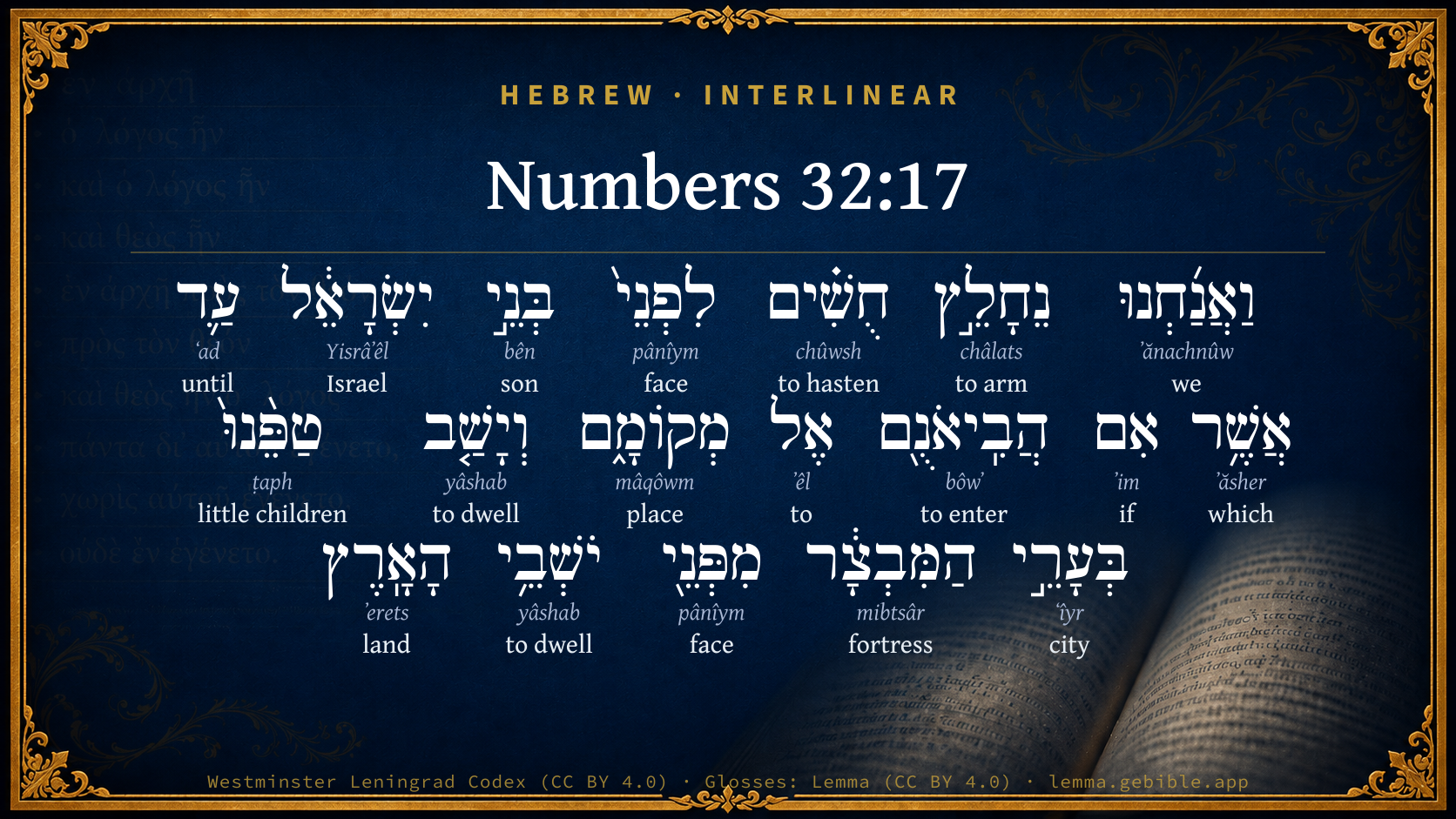
Hebrew (Westminster Leningrad Codex) Numbers 32:17 appears in the Hebrew Old Testament. The text above is from the Westminster Leningrad Codex. Each word links to its Strong’s number, a concise gloss, and parsing drawn from the Open Scriptures Hebrew Bible morphology. Click any word for its full Brown-Driver-Briggs (BDB) entry.
Download image
Cite this verse

Numbers 32:17 (World English Bible). Public Domain. Lemma interlinear Bible study tool, https://lemma.gebible.app/v/numbers/32/17.

Show BibTeX & RIS
BibTeX
RIS
English Translation
but we ourselves will be ready armed to go before the children of Israel, until we have brought them to their place: and our little ones shall dwell in the fortified cities because of the inhabitants of the land.
World English Bible · Public Domain
Highlights
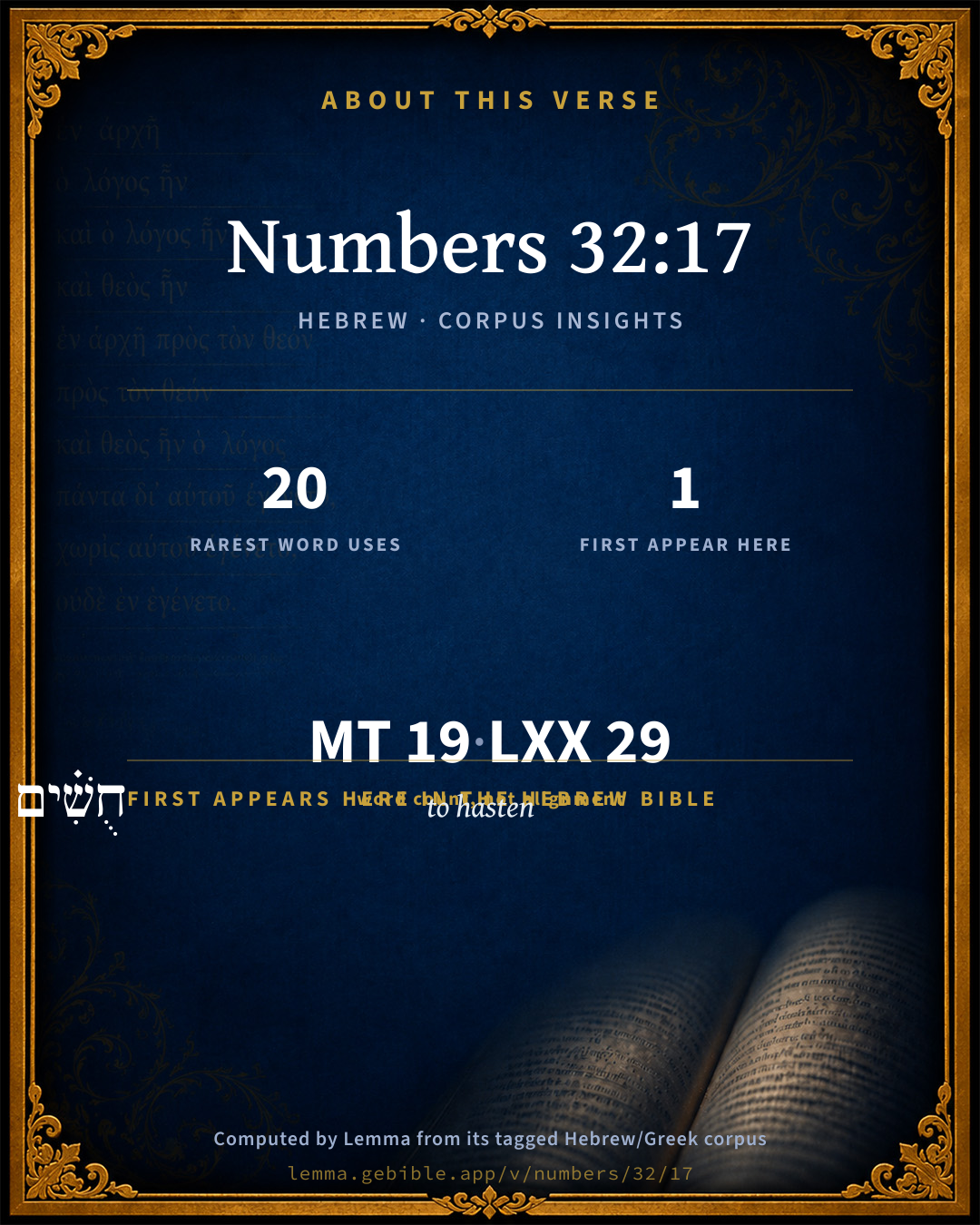
  • 1 first appearance in the Hebrew Bible
Full analysis ↓
Download a study sheet

One document with this verse’s original text, its word-by-word gloss line, the meaning frame, cross-references with their text, attributed commentary, and full source and license credits — printable, and it pastes into notes with its structure intact.

This verse Autodidact and up

Study sheet (.html) Plain text (.txt)

A passage Seminary Student

Up to 50 verses in one chapter. A passage sheet keeps up to 6 commentary sources and 12 cross-references per verse, in the order this page ranks them, and says so on the sheet whenever that leaves anything out. Ask for a single verse and you get the Autodidact verse sheet above.

Everything on this page stays free to read, with no account — the sheet is a download of what is already on screen, not access to it.

Want to remove ads? Support Godless Engineer
Compare translations 3

The same verse in 3 English versions, stacked beneath the original-language interlinear above. Click any original word for its lexicon entry.

Each is an independent rendering of the whole verse — the interlinear is not word-aligned to these translations.

Highlighted words mark where these versions differ — a whole-verse word diff, not a word-by-word alignment.

  • World English Bible Public Domain
    but we ourselves will be ready armed to go before the children of Israel, until we have brought them to their place: and our little ones shall dwell in the fortified cities because of the inhabitants of the land.
  • King James Version Public Domain
    But we ourselves will go ready armed before the children of Israel, until we have brought them unto their place: and our little ones shall dwell in the fenced cities because of the inhabitants of the land.
  • unfoldingWord Literal Text CC BY-SA 4.0
    And we ourselves will be equipped for war, hurrying before the face of the sons of Israel until when we have brought them into their place. And our children will dwell in the cities of the fortification because of the face of those who dwell in the land.

unfoldingWord Literal Text — © unfoldingWord, licensed CC BY-SA 4.0. Word-aligned USFM3 via Door43 (git.door43.org/unfoldingWord/en_ult).

Versions to compare (up to 4)

3 of 4 selected

Show all 18 translations

Every available English version of this verse, each an independent rendering of the whole verse.

  • World English Bible Public Domain
    but we ourselves will be ready armed to go before the children of Israel, until we have brought them to their place: and our little ones shall dwell in the fortified cities because of the inhabitants of the land.
  • Berean Standard Bible Public Domain
    But we will arm ourselves and be ready to go ahead of the Israelites until we have brought them into their place. Meanwhile, our little ones will remain in the fortified cities for protection from the inhabitants of the land.
  • Majority Standard Bible Public Domain
    But we will arm ourselves and be ready to go ahead of the Israelites until we have brought them into their place. Meanwhile, our little ones will remain in the fortified cities for protection from the inhabitants of the land.
  • King James Version Public Domain
    But we ourselves will go ready armed before the children of Israel, until we have brought them unto their place: and our little ones shall dwell in the fenced cities because of the inhabitants of the land.
  • American Standard Version (1901) Public Domain
    but we ourselves will be ready armed to go before the children of Israel, until we have brought them unto their place: and our little ones shall dwell in the fortified cities because of the inhabitants of the land.
  • Revised Version (1885) Public Domain
    but we ourselves will be ready armed to go before the children of Israel, until we have brought them unto their place: and our little ones shall dwell in the fenced cities because of the inhabitants of the land.
  • Geneva Bible (1599) Public Domain
    But we our selues will be readie armed to go before the children of Israel, vntill we haue brought them vnto their place: but our childre shall dwell in the defenced cities, because of the inhabitants of the lande.
  • Douay-Rheims (1899) Public Domain
    And we ourselves will go armed and ready for battle before the children of Israel, until we bring them in unto their places. Our little ones, and all we have, shall be in walled cities, for fear of the ambushes of the inhabitants.
  • Young's Literal Translation Public Domain
    and we -- we are armed hasting before the sons of Israel till that we have brought them in unto their place; and our infants have dwelt in the cities of defence because of the inhabitants of the land;
  • Literal Standard Version CC BY-SA 4.0
    but we are armed, hastening before the sons of Israel until we have brought them to their place; and our infants have dwelt in the cities of defense because of the inhabitants of the land;
  • Unlocked Literal Bible CC BY-SA 4.0
    However, we ourselves will be ready and armed to go with Israel's army until we have led them into their place. But our families will live in the fortified cities because of the other people who still live in this land.
  • unfoldingWord Literal Text CC BY-SA 4.0
    And we ourselves will be equipped for war, hurrying before the face of the sons of Israel until when we have brought them into their place. And our children will dwell in the cities of the fortification because of the face of those who dwell in the land.
  • Darby Bible Public Domain
    but we ourselves will go with diligence armed before the children of Israel, until we have brought them to their place; and our little ones shall dwell in the strong cities because of the inhabitants of the land.
  • World Messianic Bible Public Domain
    but we ourselves will be ready armed to go before the children of Israel, until we have brought them to their place. Our little ones shall dwell in the fortified cities because of the inhabitants of the land.
  • Webster's Bible Public Domain
    But we ourselves will go ready armed before the children of Israel, until we have brought them to their place: and our little ones shall dwell in the fortified cities, because of the inhabitants of the land.
  • Free Bible Version CC BY-SA 4.0
    But we will still get ourselves ready for battle, and we will be prepared to lead the Israelites until they can safely occupy their land. In the meantime, our children will stay behind, living in the fortified towns to protect them from the local people.
  • Bible in Basic English Public Domain
    But we ourselves will be ready armed to go before the children of Israel till we have taken them to their place: but our little ones will be safe in the walled towns against the people of the land.
  • JPS Tanakh (1917) Public Domain
    but we ourselves will be ready armed to go before the children of Israel, until we have brought them unto their place; and our little ones shall dwell in the fortified cities because of the inhabitants of the land.

Literal Standard Version (2020), Covenant Press — licensed CC BY-SA 4.0. Text via the HelloAO Bible API (eBible.org). Unlocked Literal Bible (unfoldingWord) — licensed CC BY-SA 4.0. Text via the HelloAO Bible API (eBible.org). unfoldingWord Literal Text — © unfoldingWord, licensed CC BY-SA 4.0. Word-aligned USFM3 via Door43 (git.door43.org/unfoldingWord/en_ult). Free Bible Version, Dr. Jonathan Gallagher — licensed CC BY-SA 4.0. Text via the HelloAO Bible API (eBible.org).

Word by word

More ways to search: Search by grammar → Find every occurrence → Compare this word →

Practice this passage: Drill this verse → Learn its vocabulary →

חֻשִׁ֗ים
chûwsh
H2363
“hastened”
Verb, Qal, Participle Passive, Masculine, Plural, Absolute
Part of Speech
Verb
Stem
Qal
Form
Participle Passive
Gender
Masculine
Number
Plural
State
Absolute
Full BDB Definition

Origin: a primitive root

TWOT: 631

to haste, make haste, hurry - (Qal) to make haste - (Hiphil) - to show haste, act quickly, hasten, come quickly - to enjoy, be excited
  1. וַאֲנַ֜חְנוּ ʼănachnûw H587 “and · we” Conjunction + Pronoun, Personal, 1st Person, Common, Plural
  2. נֵחָלֵ֣ץ châlats H2502 “to arm” Verb, Niphal, Imperfect, 1st Person, Common, Plural
  3. לִפְנֵי֙ pânîym H6440 “to/for · face(s) of” Preposition + Noun, Common, Both, Plural, Construct
  4. בְּנֵ֣י bên H1121 “sons of” Noun, Common, Masculine, Plural, Construct
  5. יִשְׂרָאֵ֔ל Yisrâʼêl H3478 “Israel” Noun, Proper
  6. עַ֛ד ʻad H5704 “until” Preposition
  7. אֲשֶׁ֥ר ʼăsher H834 “which” Particle, Relative
  8. אִם ʼim H518 “if” Conjunction
  9. הֲבִֽיאֹנֻ֖ם bôwʼ H935 “to enter · them” Verb, Hiphil, Perfect, 1st Person, Common, Plural + Suffix, Personal, 3rd Person, Masculine, Plural
  10. אֶל ʼêl H413 “to” Preposition
  11. מְקוֹמָ֑ם mâqôwm H4725 “place · their” Noun, Common, Masculine, Singular, Construct + Suffix, Personal, 3rd Person, Masculine, Plural
  12. וְיָשַׁ֤ב yâshab H3427 “and · to dwell” Conjunction + Verb, Qal, Sequential Perfect, 3rd Person, Masculine, Singular
  13. טַפֵּ֨נוּ֙ ṭaph H2945 “little children · our” Noun, Common, Masculine, Singular, Construct + Suffix, Personal, 1st Person, Common, Plural
  14. בְּעָרֵ֣י ʻîyr H5892 “in/at · cities of” Preposition + Noun, Common, Feminine, Plural, Construct
  15. הַמִּבְצָ֔ר mibtsâr H4013 “the · fortress” Particle, Definite Article + Noun, Common, Masculine, Singular, Absolute
  16. מִפְּנֵ֖י pânîym H6440 “from · face(s) of” Preposition + Noun, Common, Both, Plural, Construct
  17. יֹשְׁבֵ֥י yâshab H3427 “dwelling” Verb, Qal, Participle Active, Masculine, Plural, Construct
  18. הָאָֽרֶץ ʼerets H776 “the · land” Particle, Definite Article + Noun, Common, Both, Singular, Absolute

About this verse

These counts appear in no published source. They are computed here, from the morphology-tagged text and Lemma’s own curated glosses. What Lemma adds →

19
words
17
distinct lemmas
Pentateuch
section

Notable vocabulary

The rarest word here is חֻשִׁ֗ים to hasten H2363 — appearing just 20 times in the whole Hebrew Bible.

First appearance in Scripture

This word makes its first canonical appearance in the Hebrew Bible here:

  • חֻשִׁ֗ים to hasten H2363

Shared distinctive vocabulary

חֻשִׁ֗ים to hasten H2363 occurs in 20 verses of the Hebrew Bible. Also found in:

Grammatical profile

  • 5 verbs
  • 9 nouns
  • 1 pronoun
  • 2 prepositions
  • 1 conjunction
  • 1 particle

Verb forms

  • נֵחָלֵ֣ץ Niphal · Imperfect
  • חֻשִׁ֗ים Qal · Participle Passive
  • הֲבִֽיאֹנֻ֖ם Hiphil · Perfect
  • וְיָשַׁ֤ב Qal · Sequential Perfect
  • יֹשְׁבֵ֥י Qal · Participle Active

Repetition

Words recur within this verse — often emphatic in Hebrew:

  • לִפְנֵי֙ face H6440 ×2
  • וְיָשַׁ֤ב to dwell H3427 ×2

Hebrew & Septuagint length

In English translation the verse runs 39 words from the Hebrew and 40 from the Septuagint (LXX English) — closely comparable.

A rough comparison of the two English renderings, which tokenize alike — not a word-level alignment.

Word counts can differ between the Hebrew and the Greek without any difference in meaning — e.g. the Hebrew direct-object marker אֵת has no separate Greek word, and Greek often adds the article ὁ.

In the original languages it is 19 Hebrew tokens and 29 Greek tokens — but the two are counted differently (Hebrew bundles its prefixes and suffixes into one token; the Greek is in lemma form), so that isn’t a like-for-like length.

Cross-references

3

Topical passages linked to Numbers 32:17 in the Treasury of Scripture Knowledge — connected by theme and wording, ordered by reader-vote popularity; previews shown in the World English Bible.

  • Joshua 4:12–13 The children of Reuben, and the children of Gad, and the half-tribe of Manasseh, passed over armed before the children of Israel, as Moses spoke to them:
  • Numbers 32:29–32 Moses said to them, If the children of Gad and the children of Reuben will pass with you over the Jordan, every man who is armed to battle, before Yahweh, and the land shall be subdued before you; then you shall give them the land of Gilead for a possession:
  • Deuteronomy 3:18–20 I commanded you at that time, saying, Yahweh your God has given you this land to possess it: you shall pass over armed before your brothers the children of Israel, all the men of valor.

Cross-references courtesy of OpenBible.info (CC BY 4.0).

Hebrew and Greek witnesses Masoretic Hebrew ↔ Greek Septuagint

The same verse in the two great witnesses to the Old Testament, shown verse-for-verse.

These are two independent witnesses, not word-aligned to each other, and the Septuagint is shown in lemma (dictionary) form.

Hebrew Numbers 32:17 Masoretic · Westminster Leningrad Codex

וַאֲנַ֜חְנוּ נֵחָלֵ֣ץ חֻשִׁ֗ים לִפְנֵי֙ בְּנֵ֣י יִשְׂרָאֵ֔ל עַ֛ד אֲשֶׁ֥ר אִם הֲבִֽיאֹנֻ֖ם אֶל מְקוֹמָ֑ם וְיָשַׁ֤ב טַפֵּ֨נוּ֙ בְּעָרֵ֣י הַמִּבְצָ֔ר מִפְּנֵ֖י יֹשְׁבֵ֥י הָאָֽרֶץ

but we ourselves will be ready armed to go before the children of Israel, until we have brought them to their place: and our little ones shall dwell in the fortified cities because of the inhabitants of the land.

World English Bible · Public Domain

Greek LXX Numbers 32:17 Septuagint · lemma form

καί ἐγώ ἐνὁπλίζω προφυλακή πρότερος ὁ υἱός ἰσραήλ ἕως ἄν ἄγω αὐτός εἰς ὁ ἑαυτοῦ τόπος καί καταοἰκέω ὁ ἀποσκευή ἐγώ ἐν πόλις τειχίζω διά ὁ καταοἰκέω ὁ γῆ

and we will arm ourselves and go as an advanced guard before the children of Israel, until we shall have brought them into their place; and our possessions shall remain in walled cities because of the inhabitants of the land.

LXX2012 (modern English Septuagint) · Public Domain

Hebrew: Westminster Leningrad Codex (CC BY 4.0). Greek: Septuagint (public domain); English from LXX2012 (modern English Septuagint) (Public Domain). How the Septuagint differs from the Hebrew →

Targum (Aramaic paraphrase)

2

The Targum is the ancient Jewish Aramaic paraphrase of the Hebrew Scriptures — an interpretive translation, not the Hebrew text itself. Onkelos (literal) and Pseudo-Jonathan (expansive) render the Torah, and Jonathan the Prophets. Coverage is partial: where no permissively-licensed English translation exists for a verse, only the Aramaic is shown. This is verse-level text, not a word-by-word alignment to the Hebrew.

  1. Targum Onkelos Torah (Genesis–Deuteronomy)
    וַאֲנַחְנָא נִזְדָרֵיז מַבְעִין קֳדָם בְּנֵי יִשְׂרָאֵל עַד דִי נְעֵלִינוּן לְאַתְרֵהוֹן וְיֵתְבוּן טַפְלָנָא בְּקִרְוִין כְּרִיכִין מִן קֳדָם יַתְבֵי אַרְעָא

    (no public-domain English translation for this verse)

    Targum Onkelos — Aramaic: “Onkelos Genesis” (public domain); “Onkelos Exodus” (public domain); “Onkelos Leviticus” (public domain); “Onkelos Numbers” (public domain); “Onkelos Deuteronomy” (public domain). English: “Sefaria Community Translation” (CC0 1.0 (public-domain dedication)); “J.W. Etheridge. The Targums of Onkelos and Jonathan Ben Uzziel on the Pentateuch. London: Longmans, Green, 1862” (public domain). Text via Sefaria.

  2. Targum Pseudo-Jonathan Torah (Genesis–Deuteronomy)
    וַאֲנַחְנָא נִזְדְרַז מַבְעִין בְּגוֹ בְּנֵי יִשְרָאֵל עַד דִנְעִילוּנוּן לְאַתְרֵיהוֹן וְיֵתְבוּן טַפְלָנָא בְּקִרְוֵי חַקְלָא מִן קֳדָם יַתְבֵי אַרְעָא

    but we will go armed among the sons of Israel until we have brought them into their place: but our families shall dwell in towns defended against the inhabitants of the land.

    Targum Pseudo-Jonathan — Aramaic: “Targum Jonathan on Genesis” (public domain); “Targum Jonathan on Exodus” (public domain); “Targum Jonathan on Leviticus” (public domain); “Targum Jonathan on Numbers” (public domain); “Targum Jonathan on Deuteronomy” (public domain). English: “The Targum of Jonathan ben Uzziel, trans. J. W. Etheridge, London, 1862” (public domain). Text via Sefaria.

Commentary

Notes on Numbers 32:17 from classic Christian and Jewish commentators (each source and its license shown beneath its notes). The classic Christian expositions comment on the surrounding passage and are grouped to its opening verse, so a note may address several verses; the Jewish commentaries on the Tanakh (Rashi and others) are per-verse, so they appear only where the commentator wrote on this verse.

Lemma curates 59 commentaries, every one of them public domain or Creative Commons licensed, each selected and text-cleaned for this edition rather than reprinted as found. About our sources →

Joseph Benson's Commentary

Num 32:17. We ourselves will go — Either all, or as many of us as shall be thought necessary, leaving only so many as may be requisite to provide for the support and defence of our wives and children. Because of the inhabitants of the land — The Moabites and Edomites, or other neighbouring people, together with such of the Amorites as had saved themselves by flight, and would watch all opportunities of seeking to reinstate themselves in their lost possessions. Accordingly we find that forty thousand of the Reubenites and Gadites went over with their brethren, ready armed for war, to the plains of Jericho, Deu 3:18; Jos 4:12.

Joseph Benson's Commentary on the Old and New Testaments (1811–1818) — public domain. Text from a community e-Sword module.

Geneva Bible (1599)

Geneva Bible translators

In the land of Canaan.

Geneva Bible (1599) marginal notes — public domain. Text via Bolls.life.

Jamieson, Fausset & Brown

Robert Jamieson, A. R. Fausset & David Brown

and our little ones shall dwell in the fenced cities because of the inhabitants of the land--There was good policy in leaving a sufficient force to protect the conquered region lest the enemy should attempt reprisals; and as only forty thousand of the Reubenites and the Gadites, and a half of Manasseh, passed over the Jordan (Jos 4:13), there were left for the security of the new possessions 70,580 men, besides women and children under twenty years (compare Num 26:7, Num 26:18, Num 26:34).

We ourselves will go ready armed--that is, all of us in a collective body, or as many as may be deemed necessary, while the rest of our number shall remain at home to provide for the sustenance and secure the protection of our families and flocks. (See on Jos 4:12).

Jamieson, Fausset & Brown — Commentary Critical and Explanatory on the Whole Bible (1871) — public domain (CC PDM 1.0). Text via the HelloAO Bible API.

Adam Clarke's Commentary

Verse 17. Because of the inhabitants of the land.] These were the Ammonites, Moabites, Idumeans, and the remains of the Midianites and Amorites. But could the women and children even keep the defenced cities, when placed in them? This certainly cannot be supposed possible. Many of the men of war must of course stay behind. In the last census, chap. xxvi., the tribe of Reuben consisted of 43,730 men; the tribe of Gad, 40,500; the tribe of Manasseh, 52,700; the half of which is 26,350. Add this to the sum of the other two tribes, and the amount is 110,580. Now from Jos 4:13 we learn that of the tribes of Reuben and Gad, and the half of the tribe of Manasseh, only 40,000 armed men passed over Jordan to assist their brethren in the reduction of the land: consequently the number of 70,580 men were left behind for the defence of the women, the children, and the flocks. This was more than sufficient to defend them against a people already panic struck by their late discomfitures and reverses.

Adam Clarke's Commentary on the Bible (1810–1826) — public domain. Text from a community e-Sword/MySword module.

Ellicott's Commentary for English Readers

(17) Will go ready armed . . . —Or, will equip ourselves in haste.

And our little ones shall dwell . . . —The word taph, which is here rendered “little ones,” appears to include all the defenceless portion of the nation. (See Exo_12:37.)

A Bible Commentary for English Readers, edited by Charles John Ellicott (1878–1897) — public domain. Text from a community e-Sword module.

The Cambridge Bible for Schools and Colleges

gen. ed. J. J. S. Perowne

17. will be ready armed] Heb. has lit. ‘will arm ourselves hastening.’ But the expression is awkward, and the last word (חֻשִׁים) is doubtful. חֲמֻשִׁים should probably be read: will arm ourselves in battle array; cf. Exo_13:18, Jos_1:14; Jos_4:12.

our little ones] Including, of course, the wives and all members of the family who were not fighting men. God would take care of them while all the soldiers were fulfilling the sacred duty of conquering the land of Canaan (cf. Exo_34:24). An historical basis underlying the passage probably was that some portion of Gad took part in the battles on the west of Jordan. This seems to be referred to in the early poem in Deuteronomy 33 (Num_32:20 f.).

The Cambridge Bible for Schools and Colleges (gen. ed. J. J. S. Perowne; Cambridge University Press, 1878–1918) — public domain. Text from a community e-Sword module.

John Gill's Exposition

We will not return unto our houses,.... In the cities built or repaired by them, or to their families, and their substance, their flocks and their herds; all which they should leave behind them, and never think of returning to them:

until the children of Israel have inherited every man his inheritance; until all the tribes were settled in their respective places, and every family and everyone in them had their portion assigned them; and accordingly they did not return until the land was wholly subdued, nor even until every lot came up, and the land was divided by it, and the inheritance of the several tribes fixed, and even the cities of the Levites assigned to them out of the several tribes; see Jos 22:1.

John Gill's Exposition of the Whole Bible (1746–1763) — public domain (CC PDM 1.0). Text via the HelloAO Bible API.

Haydock's Catholic Bible Commentary

Cities, which in the space of two months they would repair sufficiently, so that their children might be protected against the Amorrhites, &c. They left strong garrisons, very prudently, to keep possession of the conquered country: 70,580 remained in the cities; while 40,000 went before their brethren. See chap. xxvi. 7, 18., and Josue iv. 13.

George Leo Haydock (1774–1849), Haydock's Catholic Family Bible and Commentary, 1859 edition — public domain. Excludes Psalms (Douay-Rheims chapter numbering differs from Protestant) and Deuterocanonical books (Catholic canon only).

Matthew Poole's English Annotations

We ourselves; either all, or as many of us as shall be thought necessary, leaving only so many as may be necessary to provide for the sustenance and defence of our wives and children here. See Jos 4:12,13.

The inhabitants of the land; the Moabites and Edomites, or other bordering people.

Matthew Poole's English Annotations on the Holy Bible (1683–1685) — public domain. Text from a community e-Sword/MySword module.

Whedon's Commentary on the Bible

Daniel D. Whedon

17. Ready armed — But we will equip ourselves hastily. This does not imply that the entire military strength of these two and a half tribes, 110,580 men, would march in the van of Israel, leaving their homes unprotected. It did imply that the flower of their armies would assist in the conquest of Canaan. Joshua (Jos_4:13) records the number as 40,000, “all mighty men of valour,” as the quota of the two and a half tribes. Jos_1:14, note.

Because of the inhabitants of the land — The Ammonites, Moabites, Idumaeans, and remnant of the Amorites and Midianites.

Daniel D. Whedon (gen. ed.), Commentary on the Old and New Testaments (1874–1909) — public domain. Text from a community e-Sword module.

The Pulpit Commentary

We ourselves will go ready armed. Rather, "we will equip ourselves in haste." xljne. They meant that they would not delay the forward movement of Israel, but would hasten to erect the necessary buildings, and to array themselves for war.

The Pulpit Commentary (1880–1919), ed. H.D.M. Spence-Jones & Joseph S. Exell — public domain. Text from a community e-Sword module.

John Wesley's Explanatory Notes

We ourselves - Either all, or as many as shall be thought necessary, leaving only so many as may be necessary to provide for the sustenance and defense of our wives and children here.

John Wesley, Explanatory Notes Upon the Whole Bible (1754–1765) — public domain. Text via the GEBible commentary corpus.

Rashi

Rabbi Shlomo Yitzchaki (Rashi)

ואנחנו נחלץ חשים means, AND WE SHALL ARM OURSELVES SPEEDILY, the last word being the same as in (Isaiah 8:3): “the spoil hasteth, the prey speedeth (חש)” and in (Isaiah 5:19), “Let Him make haste, let Him speed."

לפני בני ישראל BEFORE THE CHILDREN OF ISRAEL - i.e. at the head of the troops, because they were mighty men; for thus is it said of Gad, (Deuteronomy 30:20): “He teareth the arm, with the crown of the head”. Moses distinctly stated this to them in Sedrah אלה הדברים (Deuteronomy 3:18): “And I commanded you at that time … Ye shall pass over armed before the children of Israel, all ye men of valour”. And regarding the siege of Jericho it is written, (Joshua 6:13): “And the armed men (החלוץ) went before them”— this refers to the tribes of Reuben and Gad who thus fulfilled the conditions they had laid down.

וישב טפנו AND OUR LITTLE ONES SHALL STAY, so long as we are with our brethren waging war,

בערי המבצר IN THE FORTIFIED CITIES which we will now build (cf. v. 16 with v. 36).

Rashi on the Tanakh — English translations: “The Judaica Press complete Tanach with Rashi, translated by A. J. Rosenberg” (CC BY 4.0); “Pentateuch with Rashi's commentary by M. Rosenbaum and A.M. Silbermann, 1929-1934” (public domain); “The Metsudah Tanach series, Lakewood, N.J” (CC BY 4.0); and “The Book of Joshua, Metsudah Publications, 1997” (CC BY 4.0). Text via Sefaria.

Lesson kit

Teaching starters — assembled from the data on this page, not authored interpretation. Every prompt links to the verse data it draws on. Edit before teaching.

Numbers, in the Pentateuch, opens this verse with 19 words (17 distinct Hebrew lemmas). Its most distinctive word is chûwsh (“to hasten”). A historical commentator’s framing appears above. Read the whole chapter for the surrounding context.

Discussion questions

  1. How does “to hasten” (chûwsh) shape what this verse is saying?
  2. This is the first place “to hasten” appears in Scripture (first appears here). What does its debut here establish?
  3. How does Deuteronomy 32:35, which shares the word «to hasten», read alongside this verse?
  4. What does the repetition of “face” (2× in this one verse) do in this verse?
  5. These translations render this verse differently; the difference is in the English rendering, not the original. What questions does that raise?
  6. «נֵחָלֵ֣ץ» is a Niphal Imperfect verb. How does that grammatical form shape the action described?
  7. Compare how Joseph Benson's Commentary and Geneva Bible (1599) read this verse. Where do they agree or differ?

Things to notice

Reading settings

Reading text

Shown beneath each verse's original-language words.

Old Testament
Old Testament edition

Read the OT as the Masoretic Hebrew (MT) or the Greek Septuagint (LXX).

English shown for the Greek Septuagint (in the Hebrew ↔ Greek comparison).

Comparing translations? Open the Compare panel on any verse page to stack up to four side by side.