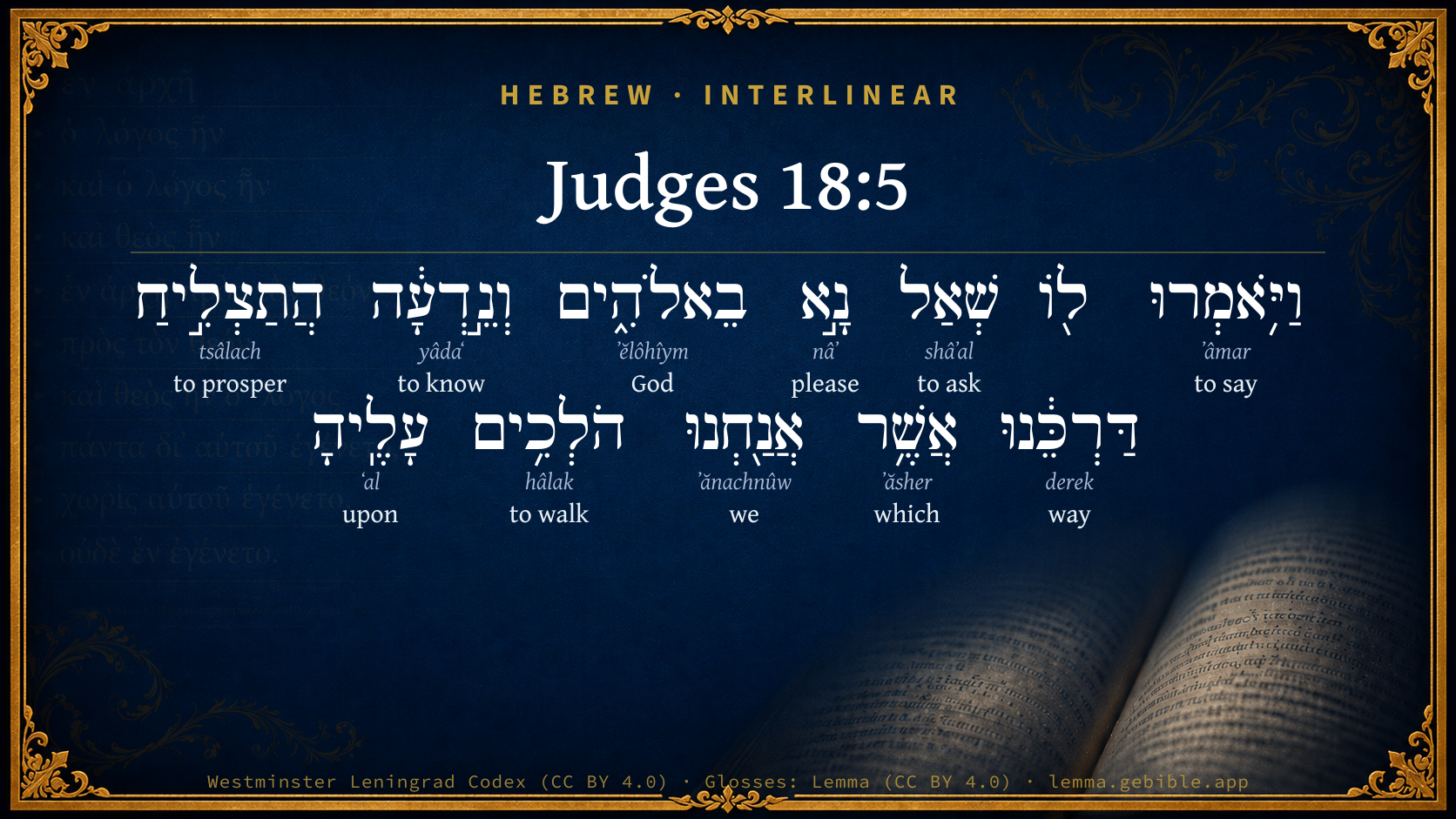
Judges 18:5

Hebrew (Westminster Leningrad Codex) Judges 18:5 appears in the Hebrew Old Testament. The text above is from the Westminster Leningrad Codex. Each word links to its Strong’s number, a concise gloss, and parsing drawn from the Open Scriptures Hebrew Bible morphology. Click any word for its full Brown-Driver-Briggs (BDB) entry.
Download image
Cite this verse

Judges 18:5 (World English Bible). Public Domain. Lemma interlinear Bible study tool, https://lemma.gebible.app/v/judges/18/5.

Show BibTeX & RIS
BibTeX
RIS
English Translation
They said to him, Ask counsel, we pray you, of God, that we may know whether our way which we go shall be prosperous.
World English Bible · Public Domain
Download a study sheet

One document with this verse’s original text, its word-by-word gloss line, the meaning frame, cross-references with their text, attributed commentary, and full source and license credits — printable, and it pastes into notes with its structure intact.

This verse Autodidact and up

Study sheet (.html) Plain text (.txt)

A passage Seminary Student

Up to 50 verses in one chapter. A passage sheet keeps up to 6 commentary sources and 12 cross-references per verse, in the order this page ranks them, and says so on the sheet whenever that leaves anything out. Ask for a single verse and you get the Autodidact verse sheet above.

Everything on this page stays free to read, with no account — the sheet is a download of what is already on screen, not access to it.

Want to remove ads? Support Godless Engineer
Compare translations 3

The same verse in 3 English versions, stacked beneath the original-language interlinear above. Click any original word for its lexicon entry.

Each is an independent rendering of the whole verse — the interlinear is not word-aligned to these translations.

Highlighted words mark where these versions differ — a whole-verse word diff, not a word-by-word alignment.

  • World English Bible Public Domain
    They said to him, Ask counsel, we pray you, of God, that we may know whether our way which we go shall be prosperous.
  • King James Version Public Domain
    And they said unto him, Ask counsel, we pray thee, of God, that we may know whether our way which we go shall be prosperous.
  • unfoldingWord Literal Text CC BY-SA 4.0
    And they said to him, “Please inquire of God that we may know, will our way prosper, upon which we going?”

unfoldingWord Literal Text — © unfoldingWord, licensed CC BY-SA 4.0. Word-aligned USFM3 via Door43 (git.door43.org/unfoldingWord/en_ult).

Versions to compare (up to 4)

3 of 4 selected

Show all 18 translations

Every available English version of this verse, each an independent rendering of the whole verse.

  • World English Bible Public Domain
    They said to him, Ask counsel, we pray you, of God, that we may know whether our way which we go shall be prosperous.
  • Berean Standard Bible Public Domain
    Then they said to him, “Please inquire of God to determine whether we will have a successful journey.”
  • Majority Standard Bible Public Domain
    Then they said to him, “Please inquire of God to determine whether we will have a successful journey.”
  • King James Version Public Domain
    And they said unto him, Ask counsel, we pray thee, of God, that we may know whether our way which we go shall be prosperous.
  • American Standard Version (1901) Public Domain
    And they said unto him, Ask counsel, we pray thee, of God, that we may know whether our way which we go shall be prosperous.
  • Revised Version (1885) Public Domain
    And they said unto him, Ask counsel, we pray thee, of God, that we may know whether our way which we go shall be prosperous.
  • Geneva Bible (1599) Public Domain
    Againe they said vnto him, Aske counsell nowe of God, that we may knowe whether the way which we goe, shalbe prosperous.
  • Douay-Rheims (1899) Public Domain
    Then they desired him to consult the Lord, that they might know whether their journey should be prosperous, and the thing should have effect.
  • Young's Literal Translation Public Domain
    And they say to him, `Ask, we pray thee, at God, and we know whether our way is prosperous on which we are going.'
  • Literal Standard Version CC BY-SA 4.0
    And they say to him, “Please ask of God, and we know whether our way on which we are going is prosperous.”
  • Unlocked Literal Bible CC BY-SA 4.0
    They said to him, “Please seek the advice of God, so we may know whether the journey we are going on will be successful.”
  • unfoldingWord Literal Text CC BY-SA 4.0
    And they said to him, “Please inquire of God that we may know, will our way prosper, upon which we going?”
  • Darby Bible Public Domain
    And they said to him, "Inquire of God, we pray thee, that we may know whether the journey on which we are setting out will succeed."
  • World Messianic Bible Public Domain
    They said to him, “Please ask counsel of God, that we may know whether our way which we go shall be prosperous.”
  • Webster's Bible Public Domain
    And they said to him, Ask counsel, we pray thee, of God, that we may know whether our way which we go shall be prosperous.
  • Free Bible Version CC BY-SA 4.0
    “Please ask the Lord for us so we can find out if our journey will be successful,” they asked him.
  • Bible in Basic English Public Domain
    Then they said, Do get directions from God for us, to see if the journey on which we are going will have a good outcome.
  • JPS Tanakh (1917) Public Domain
    And they said unto him: 'Ask counsel, we pray thee, of God, that we may know whether our way which we are going shall be prosperous.'

Literal Standard Version (2020), Covenant Press — licensed CC BY-SA 4.0. Text via the HelloAO Bible API (eBible.org). Unlocked Literal Bible (unfoldingWord) — licensed CC BY-SA 4.0. Text via the HelloAO Bible API (eBible.org). unfoldingWord Literal Text — © unfoldingWord, licensed CC BY-SA 4.0. Word-aligned USFM3 via Door43 (git.door43.org/unfoldingWord/en_ult). Free Bible Version, Dr. Jonathan Gallagher — licensed CC BY-SA 4.0. Text via the HelloAO Bible API (eBible.org).

Word by word

More ways to search: Search by grammar → Find every occurrence → Compare this word →

Practice this passage: Drill this verse → Learn its vocabulary →

הֲתַצְלִ֣יחַ
tsâlach
H6743
“to prosper”
Particle, Interrogative + Verb, Hiphil, Imperfect, 3rd Person, Feminine, Singular
Part of Speech
Particle + Verb
Stem
Hiphil
Form
Imperfect
Person
3rd Person
Gender
Feminine
Number
Singular
Full BDB Definition

Origin: a primitive root

TWOT: 1916 , 1917

(Qal) to rush - to advance, prosper, make progress, succeed, be profitable - (Qal) to prosper - (Hiphil) - to make prosperous, bring to successful issue, cause to prosper - to show or experience prosperity, prosper
  1. וַיֹּ֥אמְרוּ ʼâmar H559 “and · to say” Conjunction + Verb, Qal, Sequential Imperfect, 3rd Person, Masculine, Plural
  2. שְׁאַל shâʼal H7592 “ask” Verb, Qal, Imperative, 2nd Person, Masculine, Singular
  3. נָ֣א nâʼ H4994 “please” Particle, Exhortation
  4. בֵאלֹהִ֑ים ʼĕlôhîym H430 “in/at · God(s)” Preposition + Noun, Common, Masculine, Plural, Absolute
  5. וְנֵ֣דְעָ֔ה yâdaʻ H3045 “and · to know” Conjunction + Verb, Qal, Cohortative, 1st Person, Common, Plural
  6. דַּרְכֵּ֔נוּ derek H1870 “way · our” Noun, Common, Both, Singular, Construct + Suffix, Personal, 1st Person, Common, Plural
  7. אֲשֶׁ֥ר ʼăsher H834 “which” Particle, Relative
  8. אֲנַ֖חְנוּ ʼănachnûw H587 “we” Pronoun, Personal, 1st Person, Common, Plural
  9. הֹלְכִ֥ים hâlak H1980 “walking” Verb, Qal, Participle Active, Masculine, Plural, Absolute
  10. עָלֶֽיהָ ʻal H5921 “upon · her” Preposition + Suffix, Personal, 3rd Person, Feminine, Singular

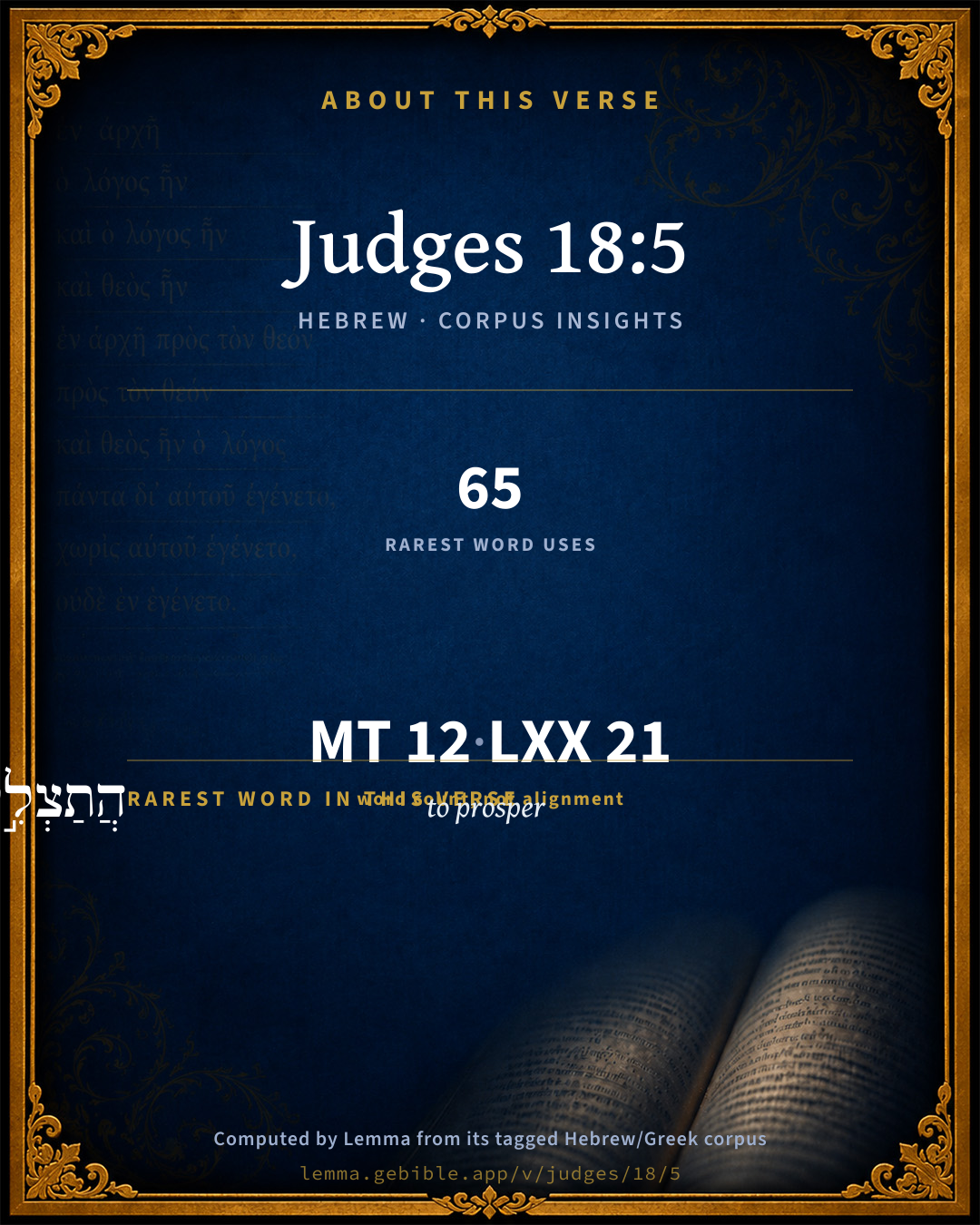
About this verse

These counts appear in no published source. They are computed here, from the morphology-tagged text and Lemma’s own curated glosses. What Lemma adds →

12
words
11
distinct lemmas
Historical
section

Grammatical profile

  • 5 verbs
  • 2 nouns
  • 1 pronoun
  • 2 prepositions
  • 2 particles

Verb forms

  • וַיֹּ֥אמְרוּ Qal · Sequential Imperfect
  • שְׁאַל Qal · Imperative
  • וְנֵ֣דְעָ֔ה Qal · Cohortative
  • הֲתַצְלִ֣יחַ Hiphil · Imperfect
  • הֹלְכִ֥ים Qal · Participle Active

Hebrew & Septuagint length

In English translation the verse runs 24 words from the Hebrew and 23 from the Septuagint (LXX English) — closely comparable.

A rough comparison of the two English renderings, which tokenize alike — not a word-level alignment.

Word counts can differ between the Hebrew and the Greek without any difference in meaning — e.g. the Hebrew direct-object marker אֵת has no separate Greek word, and Greek often adds the article ὁ.

In the original languages it is 12 Hebrew tokens and 21 Greek tokens — but the two are counted differently (Hebrew bundles its prefixes and suffixes into one token; the Greek is in lemma form), so that isn’t a like-for-like length.

Cross-references

9

Topical passages linked to Judges 18:5 in the Treasury of Scripture Knowledge — connected by theme and wording, ordered by reader-vote popularity; previews shown in the World English Bible.

  • 1 Kings 22:5 Jehoshaphat said to the king of Israel, Please inquire first for the word of Yahweh.
  • Isaiah 30:1 Woe to the rebellious children, says Yahweh, who take counsel, but not of me; and who make a league, but not of my Spirit, that they may add sin to sin,
  • Acts 8:10 to whom they all listened, from the least to the greatest, saying, "This man is that great power of God."
  • Hosea 4:12 My people consult with their wooded idol, And answer to a stick of wood. Indeed the spirit of prostitution has led them astray, And they have been unfaithful to their God.
  • Judges 17:5 The man Micah had a house of gods, and he made an ephod, and teraphim, and consecrated one of his sons, who became his priest.
  • Judges 17:13 Then said Micah, Now know I that Yahweh will do me good, seeing I have a Levite to my priest.
  • Judges 18:14 Then the five men who went to spy out the country of Laish answered, and said to their brothers, Do you know that there is in these houses an ephod, and teraphim, and an engraved image, and a molten image? now therefore consider what you have to do.
  • 2 Kings 16:15 King Ahaz commanded Urijah the priest, saying, On the great altar burn the morning burnt offering, and the evening meal-offering, and the king's burnt offering, and his meal-offering, with the burnt offering of all the people of the land, and their meal-offering, and their drink-offerings; and sprinkle on it all the blood of the burnt offering, and all the blood of the sacrifice: but the brazen altar shall be for me to inquire by.
  • Ezekiel 21:21 For the king of Babylon stood at the parting of the way, at the head of the two ways, to use divination: he shook the arrows back and forth, he consulted the teraphim, he looked in the liver.

Cross-references courtesy of OpenBible.info (CC BY 4.0).

Hebrew and Greek witnesses Masoretic Hebrew ↔ Greek Septuagint

The same verse in the two great witnesses to the Old Testament, shown verse-for-verse.

These are two independent witnesses, not word-aligned to each other, and the Septuagint is shown in lemma (dictionary) form.

Hebrew Judges 18:5 Masoretic · Westminster Leningrad Codex

וַיֹּ֥אמְרוּ ל֖וֹ שְׁאַל נָ֣א בֵאלֹהִ֑ים וְנֵ֣דְעָ֔ה הֲתַצְלִ֣יחַ דַּרְכֵּ֔נוּ אֲשֶׁ֥ר אֲנַ֖חְנוּ הֹלְכִ֥ים עָלֶֽיהָ

They said to him, Ask counsel, we pray you, of God, that we may know whether our way which we go shall be prosperous.

World English Bible · Public Domain

Greek LXX Judges 18:5 Septuagint · lemma form

καί εἶπον αὐτός ἐρωτάω δή ἐν ὁ θεός καί γιγνώσκω εἰ εὐοδόω ὁ ὁδός ἐγώ ἐν ὅς ἐγώ πορεύομαι ἐν αὐτός

And they said to him, Enquire now of God, and we shall know whether our way will prosper, on which we are going.

LXX2012 (modern English Septuagint) · Public Domain

Hebrew: Westminster Leningrad Codex (CC BY 4.0). Greek: Septuagint (public domain); English from LXX2012 (modern English Septuagint) (Public Domain). How the Septuagint differs from the Hebrew →

Targum (Aramaic paraphrase)

1

The Targum is the ancient Jewish Aramaic paraphrase of the Hebrew Scriptures — an interpretive translation, not the Hebrew text itself. Onkelos (literal) and Pseudo-Jonathan (expansive) render the Torah, and Jonathan the Prophets. Coverage is partial: where no permissively-licensed English translation exists for a verse, only the Aramaic is shown. This is verse-level text, not a word-by-word alignment to the Hebrew.

  1. Targum Jonathan Prophets (Joshua–Malachi)
    וַאֲמַרוּ לֵיהּ שְׁאֵיל כְּעַל בְמֵימְרָא דַייָ וְנֵידַע הַתַצְלַח אוֹרְחָנָא דִי אֲנַחְנָא אָזְלִין עֲלָהּ:

    (no public-domain English translation for this verse)

    Targum Jonathan — Aramaic: “Mikraot Gedolot” (public domain). English: “Sefaria Community Translation” (CC0 1.0 (public-domain dedication)); “London "Chaldee Paraphrase," 1871” (public domain). Text via Sefaria.

Commentary

Notes on Judges 18:5 from classic Christian and Jewish commentators (each source and its license shown beneath its notes). The classic Christian expositions comment on the surrounding passage and are grouped to its opening verse, so a note may address several verses; the Jewish commentaries on the Tanakh (Rashi and others) are per-verse, so they appear only where the commentator wrote on this verse.

Lemma curates 59 commentaries, every one of them public domain or Creative Commons licensed, each selected and text-cleaned for this edition rather than reprinted as found. About our sources →

Trapp's Complete Commentary

John Trapp

Jdg 18:5 And they said unto him, Ask counsel, we pray thee, of God, that we may know whether our way which we go shall be prosperous.

Ver. 5. Ask counsel, we pray thee, of God.] Videntur non minus leves fuisse quam Levita ille, saith Lavater. These Danites were as wise as this wandering Levite; and hearing of a teraphim, would needs have an oracle.

John Trapp, A Commentary or Exposition upon All the Books of the Old and New Testament (1647–1656) — public domain. Text from a community e-Sword module.

Adam Clarke's Commentary

Verse 5. Ask counsel - of God] As the Danites use the word אלהים Elohim here for God, we are necessarily led to believe that they meant the true God; especially as the Levite answers, Jdg 18:6, Before the LORD (יהוה Yehovah) is your way. Though the former word may be sometimes applied to idols, whom their votaries clothed with the attributes of God; yet the latter is never applied but to the true God alone. As the Danites succeeded according to the oracle delivered by the Levite, it is a strong presumption that the worship established by Micah was not of an idolatrous kind. It is really begging the question to assert, as many commentators have done, that the answer was either a trick of the Levite, or suggested by the devil; and that the success of the Danites was merely accidental. This is taking the thing by the worst handle, to support an hypothesis, and to serve a system. See the end of the preceding chapter. Jdg 17:13 (note)

Adam Clarke's Commentary on the Bible (1810–1826) — public domain. Text from a community e-Sword/MySword module.

Ellicott's Commentary for English Readers

(5) Ask counsel . . . of God.—Doubtless Jonathan showed them the glittering ephod. There were no prophets of whom to inquire, as in 1Ki_22:5; but their unauthorised inquiry was liable to the strong censure expressed in Isa_30:1, Hos_4:12. They might have at least consulted the high priest Phinehas, or some other national representative.

A Bible Commentary for English Readers, edited by Charles John Ellicott (1878–1897) — public domain. Text from a community e-Sword module.

The Cambridge Bible for Schools and Colleges

gen. ed. J. J. S. Perowne

5. Ask counsel … of God] i.e. by means of the ephod or sacred lot. To consult the divine will in this way was one of the special functions of the priesthood; see 1Sa_6:2; 1Sa_14:18 (RVm.), 1Sa_22:10, 1Sa_23:9-12 etc. So long as sacrificial acts were freely performed by laymen, the chief distinction of the priest doubtless lay in his qualification to give an oracle: W. R Smith, OTJC., p. 292.

The Cambridge Bible for Schools and Colleges (gen. ed. J. J. S. Perowne; Cambridge University Press, 1878–1918) — public domain. Text from a community e-Sword module.

John Gill's Exposition

And they said unto him, ask counsel, we pray thee, of God,.... They did not reprove him for assuming the priestly office, when they knew he was a Levite, such was the corruption of those times, and the great depravity and declensions they were fallen into; nor even for the idolatry he was guilty of, but encourage him in it, and thought they had got a fine opportunity, which they readily laid hold on, to have counsel asked for them of God, about the success of the errand they were sent about; to this they were led at sight of the ephod, which was like that in the tabernacle, and of the teraphim, images which, according to a notion that prevailed, when consulted, foretold future things; whether by God they meant the true God, who they thought would give an answer by these, or Micah's gods, is not certain; according to the Targum of Jonathan, they meant the true God, which paraphrases it,"ask of the Word of the Lord:"

that we may know whether our way which we go shall be prosperous or no; whether they should find out a proper place to dwell in, and be able to get possession of it.

John Gill's Exposition of the Whole Bible (1746–1763) — public domain (CC PDM 1.0). Text via the HelloAO Bible API.

Albert Barnes' Notes on the Bible

The sight of the ephod and teraphim suggested the notion of inquiring of God.

Albert Barnes' Notes on the Bible (1834–1885) — public domain. Text from a community e-Sword/MySword module.

Haydock's Catholic Bible Commentary

Lord (Elohim.) A title sometimes given to false gods. The Levite answered in the name of Jehova; whence it is inferred that they all adored the true God, though their worship was not clear of superstition. (Calmet)

George Leo Haydock (1774–1849), Haydock's Catholic Family Bible and Commentary, 1859 edition — public domain. Excludes Psalms (Douay-Rheims chapter numbering differs from Protestant) and Deuterocanonical books (Catholic canon only).

Matthew Poole's English Annotations

Ask counsel, we pray thee, of God, to wit, by thine ephod, or teraphim, or images, which they knew he had, Jdg 18:14.

Matthew Poole's English Annotations on the Holy Bible (1683–1685) — public domain. Text from a community e-Sword/MySword module.

Whedon's Commentary on the Bible

Daniel D. Whedon

5. Ask counsel — By means of the urim on the ephod which Micah had made for his sanctuary and priest. Jdg_17:5. It was a common custom in Israel thus to inquire of the Lord. Comp. Jdg_1:1; Jdg_20:18; 1Sa_23:1; 1Sa_4:9-12.

Daniel D. Whedon (gen. ed.), Commentary on the Old and New Testaments (1874–1909) — public domain. Text from a community e-Sword module.

The Pulpit Commentary

Ask counsel of God, or simply Ask God, as the identical phrase is rendered in Jud_1:2, where see note.

HOMILIES BY W.F. ADENEY Ver. 5. The religion of convenience.

I MEN WHO ARE UNWILLING TO DO THE WILL OF GOD ARE SOMETIMES ANXIOUS TO SECURE HIS HELP. These Danites are little better than freebooters; they are determined to go their own way; they have no wish to be guided by God; they simply wish to be assured of success. So there are many who have sufficient religious faith to desire the blessing of God on their life, but not sufficient to submit to his guidance and authority. True loyalty to God will make us not merely consult him as to the success of our work, but as to its rightness, and not merely inquire whether the way in which we are determined to go shall prosper, but ask what way God would have us take.

II THE PRAYER FOR PROSPERITY UNACCOMPANIED BY SUBMISSION TO GOD"S WILL DOES NOT JUSTIFY THE COURSE OF ACTION TO WHICH IT RELATES. We have superstitions about prayer. We are too ready to imagine that all is well if we have sought God"s blessing upon our work. But we have only a right to ask for this when we are doing right. Prayer cannot sanctify a bad action. The Danites were not justified in their marauding expedition because they first consulted a supposed Divine oracle. Men seek God"s blessing on their business while they conduct it dishonestly, on their country while they favour aggressive wars and national injustice, on their private lives while they pursue a worldly, perhaps even an immoral, course. Such conduct rather aggravates than mitigates guilt, because it betrays blindness of conscience in the searching light of God"s presence.

III AN ASSURANCE OF SUCCESS IS NO PROOF OF THE FAVOUR OF GOD. We are too ready to worship success as though it were a justification of the means by which it was attained. In this world, viewed from a human standpoint, goodness often fails and wickedness often succeeds. Our own feeling of assurance is no ground of reasonable confidence. They who are on the best of terms with themselves are not therefore on the best of terms with God. The timid, diffident, despondent soul may be really regarded with favour by God, while the vain, self-elated soul may be living under his frown. The faith which saves is not self-confidence nor the assurance of success, but submissive and obedient trust in a Lord and Saviour.

IV THEY WHO MAKE A CONVENIENCE OF RELIGION WILL FIND IN THE END THAT IT WILL BE THEIR CONDEMNING JUDGE. The priest told the Danites that their way was before the Lord. God would watch them. They had invoked his name. They would see ultimately what his presence involved. The recognition of God which is involved in seeking his blessing will increase our condemnation if we disregard his will. A.

The Pulpit Commentary (1880–1919), ed. H.D.M. Spence-Jones & Joseph S. Exell — public domain. Text from a community e-Sword module.

John Wesley's Explanatory Notes

Ask - By thine Ephod, and Teraphim, or images, which they knew he had, ver. 14.

John Wesley, Explanatory Notes Upon the Whole Bible (1754–1765) — public domain. Text via the GEBible commentary corpus.

unfoldingWord translationNotes

Door43 World Missions Community

translationWords

God

priest

peace

Yahweh

unfoldingWord translationNotes — © Distant Shores Media and the Door43 World Missions Community, licensed CC BY-SA 4.0. Source: git.door43.org/Door43/en_tn.

Rashi

Rabbi Shlomo Yitzchaki (Rashi)

Please inquire of God through the figurines, which communicate by sorcery.

Rashi on the Tanakh — English translations: “The Judaica Press complete Tanach with Rashi, translated by A. J. Rosenberg” (CC BY 4.0); “Pentateuch with Rashi's commentary by M. Rosenbaum and A.M. Silbermann, 1929-1934” (public domain); “The Metsudah Tanach series, Lakewood, N.J” (CC BY 4.0); and “The Book of Joshua, Metsudah Publications, 1997” (CC BY 4.0). Text via Sefaria.

Lesson kit

Teaching starters — assembled from the data on this page, not authored interpretation. Every prompt links to the verse data it draws on. Edit before teaching.

Judges, in the Historical, opens this verse with 12 words (11 distinct Hebrew lemmas). Its most distinctive word is tsâlach (“to prosper”). A historical commentator’s framing appears above. Read the whole chapter for the surrounding context.

Discussion questions

  1. The word tsâlach carries the sense “to prosper.” How does it shape the verse?
  2. 1 Kings 22:5 shares this passage’s theme. How do the two illuminate each other?
  3. The translations on this page render this verse differently — a whole-verse word diff, not a word-by-word alignment. What might account for the different wordings?
  4. The verb «וַיֹּ֥אמְרוּ» is Qal Sequential Imperfect. How does its form color the action?
  5. Reading how Trapp's Complete Commentary and Adam Clarke's Commentary read this verse, where do the two commentators agree and where do they part?

Things to notice

Reading settings

Reading text

Shown beneath each verse's original-language words.

Old Testament
Old Testament edition

Read the OT as the Masoretic Hebrew (MT) or the Greek Septuagint (LXX).

English shown for the Greek Septuagint (in the Hebrew ↔ Greek comparison).

Comparing translations? Open the Compare panel on any verse page to stack up to four side by side.