
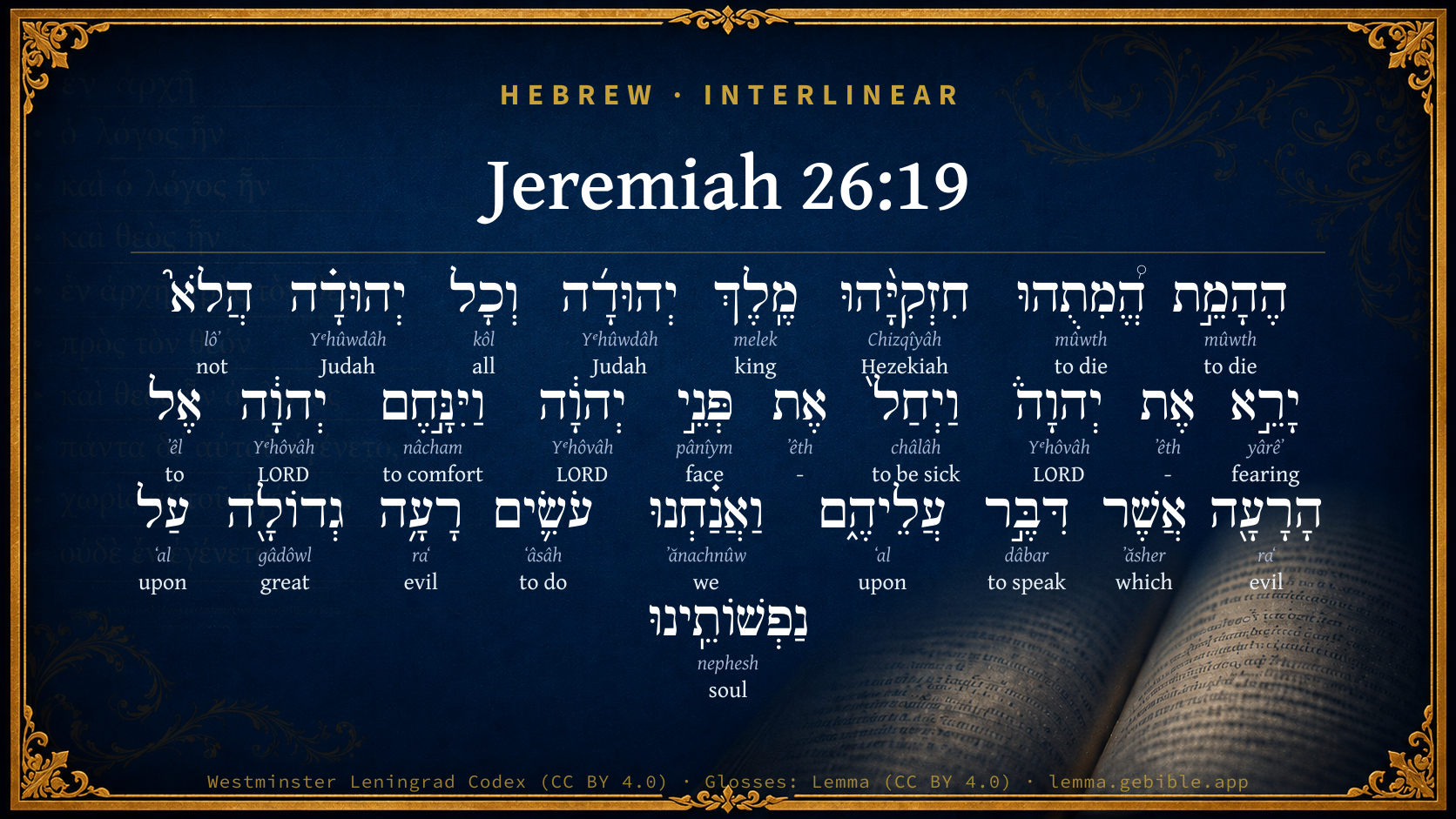
Jeremiah 26:19

Hebrew (Westminster Leningrad Codex) Jeremiah 26:19 appears in the Hebrew Old Testament. The text above is from the Westminster Leningrad Codex. Each word links to its Strong’s number, a concise gloss, and parsing drawn from the Open Scriptures Hebrew Bible morphology. Click any word for its full Brown-Driver-Briggs (BDB) entry.
Download image
Cite this verse

Jeremiah 26:19 (World English Bible). Public Domain. Lemma interlinear Bible study tool, https://lemma.gebible.app/v/jeremiah/26/19.

Show BibTeX & RIS
BibTeX
RIS
English Translation
Did Hezekiah king of Judah and all Judah put him to death? Didn't he fear Yahweh, and entreat the favor of Yahweh, and Yahweh repented him of the evil which he had pronounced against them? Thus should we commit great evil against our own souls.
World English Bible · Public Domain
Download a study sheet

One document with this verse’s original text, its word-by-word gloss line, the meaning frame, cross-references with their text, attributed commentary, and full source and license credits — printable, and it pastes into notes with its structure intact.

This verse Autodidact and up

Study sheet (.html) Plain text (.txt)

A passage Seminary Student

Up to 50 verses in one chapter. A passage sheet keeps up to 6 commentary sources and 12 cross-references per verse, in the order this page ranks them, and says so on the sheet whenever that leaves anything out. Ask for a single verse and you get the Autodidact verse sheet above.

Everything on this page stays free to read, with no account — the sheet is a download of what is already on screen, not access to it.

Want to remove ads? Support Godless Engineer
Compare translations 3

The same verse in 3 English versions, stacked beneath the original-language interlinear above. Click any original word for its lexicon entry.

Each is an independent rendering of the whole verse — the interlinear is not word-aligned to these translations.

Highlighted words mark where these versions differ — a whole-verse word diff, not a word-by-word alignment.

  • World English Bible Public Domain
    Did Hezekiah king of Judah and all Judah put him to death? Didn't he fear Yahweh, and entreat the favor of Yahweh, and Yahweh repented him of the evil which he had pronounced against them? Thus should we commit great evil against our own souls.
  • King James Version Public Domain
    Did Hezekiah king of Judah and all Judah put him at all to death? did he not fear the LORD, and besought the LORD, and the LORD repented him of the evil which he had pronounced against them? Thus might we procure great evil against our souls.
  • unfoldingWord Literal Text CC BY-SA 4.0
    Putting to death, did Hezekiah king of Judah and all Judah put him to death? Did he not fear Yahweh and entreat the face of Yahweh, and Yahweh relented concerning the evil that he had spoken against them? But we are doing great evil against ourselves.”

unfoldingWord Literal Text — © unfoldingWord, licensed CC BY-SA 4.0. Word-aligned USFM3 via Door43 (git.door43.org/unfoldingWord/en_ult).

Versions to compare (up to 4)

3 of 4 selected

Show all 18 translations

Every available English version of this verse, each an independent rendering of the whole verse.

  • World English Bible Public Domain
    Did Hezekiah king of Judah and all Judah put him to death? Didn't he fear Yahweh, and entreat the favor of Yahweh, and Yahweh repented him of the evil which he had pronounced against them? Thus should we commit great evil against our own souls.
  • Berean Standard Bible Public Domain
    Did Hezekiah king of Judah or anyone else in Judah put him to death? Did Hezekiah not fear the LORD and seek His favor, and did not the LORD relent of the disaster He had pronounced against them? But we are about to bring great harm on ourselves!”
  • Majority Standard Bible Public Domain
    Did Hezekiah king of Judah or anyone else in Judah put him to death? Did Hezekiah not fear the LORD and seek His favor, and did not the LORD relent of the disaster He had pronounced against them? But we are about to bring great harm on ourselves!”
  • King James Version Public Domain
    Did Hezekiah king of Judah and all Judah put him at all to death? did he not fear the LORD, and besought the LORD, and the LORD repented him of the evil which he had pronounced against them? Thus might we procure great evil against our souls.
  • American Standard Version (1901) Public Domain
    Did Hezekiah king of Judah and all Judah put him to death? did he not fear Jehovah, and entreat the favor of Jehovah, and Jehovah repented him of the evil which he had pronounced against them? Thus should we commit great evil against our own souls.
  • Revised Version (1885) Public Domain
    Did Hezekiah king of Judah and all Judah put him at all to death? did he not fear the LORD, and entreat the favour of the LORD, and the LORD repented him of the evil which he had pronounced against them? Thus should we commit great evil against our own souls,
  • Geneva Bible (1599) Public Domain
    Did Hezekiah King of Iudah, and all Iudah put him to death? did he not feare ye Lord, and prayed before the Lord, and the Lord repented him of the plague, that he had pronounced against them? Thus might we procure great euill against our soules.
  • Douay-Rheims (1899) Public Domain
    Did Ezechias king of Juda, and all Juda, condemn him to death? did they not fear the Lord, and beseech the face of the Lord: and the Lord repented of the evil that they had spoken against them? therefore we are doing a great evil against our souls.
  • Young's Literal Translation Public Domain
    `Put him at all to death did Hezekiah king of Judah, and all Judah? Did he not fear Jehovah? yea, he appeaseth the face of Jehovah, and Jehovah repenteth concerning the evil that He spake against them; and we are doing great evil against our souls.
  • Literal Standard Version CC BY-SA 4.0
    Did Hezekiah king of Judah and all Judah put him to death? Did he not fear YHWH? Indeed, he appeases the face of YHWH, and YHWH relents concerning the calamity that He spoke against them; and we are doing great evil against our souls.”
  • Unlocked Literal Bible CC BY-SA 4.0
    Did Hezekiah king of Judah and all of Judah put him to death? Did he not fear Yahweh and appease the face of Yahweh so that Yahweh would relent concerning the disaster that he proclaimed to them? So will we do greater evil against our own lives?”
  • unfoldingWord Literal Text CC BY-SA 4.0
    Putting to death, did Hezekiah king of Judah and all Judah put him to death? Did he not fear Yahweh and entreat the face of Yahweh, and Yahweh relented concerning the evil that he had spoken against them? But we are doing great evil against ourselves.”
  • Darby Bible Public Domain
    Did Hezekiah king of Judah and all Judah put him at all to death? Did he not fear Jehovah, and supplicate Jehovah, and Jehovah repented him of the evil that he had pronounced against them? And we should be doing a great evil against our souls.
  • World Messianic Bible Public Domain
    Did Hezekiah king of Judah and all Judah put him to death? Didn’t he fear the LORD, and entreat the favor of the LORD, and the LORD relented of the disaster which he had pronounced against them? We would commit great evil against our own souls that way!”
  • Webster's Bible Public Domain
    Did Hezekiah king of Judah and all Judah put him to death? did he not fear the LORD, and beseech the LORD, and the LORD repented of the evil which he had pronounced against them? Thus might we procure great evil against our souls.
  • Free Bible Version CC BY-SA 4.0
    Did Hezekiah king of Judah or anyone else in the country have him killed? Didn't Hezekiah respect the Lord and plead with him? Didn't the Lord change his mind about the disaster he had announced against them? But we are about to bring a great disaster on ourselves!”
  • Bible in Basic English Public Domain
    Did Hezekiah and all Judah put him to death? did he not in the fear of the Lord make prayer for the grace of the Lord, and the Lord let himself be turned from the decision he had made against them for evil? By this act we might do great evil against ourselves.
  • JPS Tanakh (1917) Public Domain
    Did Hezekiah king of Judah and all Judah put him at all to death? did he not fear the LORD, and entreat the favour of the LORD, and the LORD repented Him of the evil which He had pronounced against them? Thus might we procure great evil against our own souls.'

Literal Standard Version (2020), Covenant Press — licensed CC BY-SA 4.0. Text via the HelloAO Bible API (eBible.org). Unlocked Literal Bible (unfoldingWord) — licensed CC BY-SA 4.0. Text via the HelloAO Bible API (eBible.org). unfoldingWord Literal Text — © unfoldingWord, licensed CC BY-SA 4.0. Word-aligned USFM3 via Door43 (git.door43.org/unfoldingWord/en_ult). Free Bible Version, Dr. Jonathan Gallagher — licensed CC BY-SA 4.0. Text via the HelloAO Bible API (eBible.org).

Word by word

More ways to search: Search by grammar → Find every occurrence → Compare this word →

Practice this passage: Drill this verse → Learn its vocabulary →

יָרֵ֣א
yârêʼ
H3373
“fearing”
Adjective, Adjective, Masculine, Singular, Absolute
Part of Speech
Adjective
Type
Adjective
Gender
Masculine
Number
Singular
State
Absolute
Full BDB Definition

Origin: from H3372

TWOT: 907a

fearing, reverent, afraid
  1. הֶהָמֵ֣ת mûwth H4191 “to die” Particle, Interrogative + Verb, Hiphil, Infinitive Absolute
  2. הֱ֠מִתֻהוּ mûwth H4191 “to die · him” Verb, Hiphil, Perfect, 3rd Person, Common, Plural + Suffix, Personal, 3rd Person, Masculine, Singular
  3. חִזְקִיָּ֨הוּ Chizqîyâh H2396 “Hezekiah” Noun, Proper
  4. מֶֽלֶךְ melek H4428 “king of” Noun, Common, Masculine, Singular, Construct
  5. יְהוּדָ֜ה Yᵉhûwdâh H3063 “Judah” Noun, Proper
  6. וְכָל kôl H3605 “and · all of” Conjunction + Noun, Common, Masculine, Singular, Construct
  7. יְהוּדָ֗ה Yᵉhûwdâh H3063 “Judah” Noun, Proper
  8. הֲלֹא֮ lôʼ H3808 “not” Particle, Interrogative + Particle, Negative
  9. אֶת ʼêth H853 “-” Particle, Direct Object
  10. יְהוָה֒ Yᵉhôvâh H3068 “LORD” Noun, Proper
  11. וַיְחַל֙ châlâh H2470 “and · to be sick” Conjunction + Verb, Piel, Sequential Imperfect, 3rd Person, Masculine, Singular
  12. אֶת ʼêth H853 “-” Particle, Direct Object
  13. פְּנֵ֣י pânîym H6440 “face(s) of” Noun, Common, Both, Plural, Construct
  14. יְהוָ֔ה Yᵉhôvâh H3068 “LORD” Noun, Proper
  15. וַיִּנָּ֣חֶם nâcham H5162 “and · to comfort” Conjunction + Verb, Niphal, Sequential Imperfect, 3rd Person, Masculine, Singular
  16. יְהוָ֔ה Yᵉhôvâh H3068 “LORD” Noun, Proper
  17. אֶל ʼêl H413 “to” Preposition
  18. הָרָעָ֖ה raʻ H7451 “the · evil” Particle, Definite Article + Noun, Common, Feminine, Singular, Absolute
  19. אֲשֶׁר ʼăsher H834 “which” Particle, Relative
  20. דִּבֶּ֣ר dâbar H1696 “to speak” Verb, Piel, Perfect, 3rd Person, Masculine, Singular
  21. עֲלֵיהֶ֑ם ʻal H5921 “upon · them” Preposition + Suffix, Personal, 3rd Person, Masculine, Plural
  22. וַאֲנַ֗חְנוּ ʼănachnûw H587 “and · we” Conjunction + Pronoun, Personal, 1st Person, Common, Plural
  23. עֹשִׂ֛ים ʻâsâh H6213 “doing” Verb, Qal, Participle Active, Masculine, Plural, Absolute
  24. רָעָ֥ה raʻ H7451 “evil” Noun, Common, Feminine, Singular, Absolute
  25. גְדוֹלָ֖ה gâdôwl H1419 “great” Adjective, Adjective, Feminine, Singular, Absolute
  26. עַל ʻal H5921 “upon” Preposition
  27. נַפְשׁוֹתֵֽינוּ nephesh H5315 “souls · our” Noun, Common, Both, Plural, Construct + Suffix, Personal, 1st Person, Common, Plural

About this verse

These counts appear in no published source. They are computed here, from the morphology-tagged text and Lemma’s own curated glosses. What Lemma adds →

28
words
21
distinct lemmas
Prophets
section

Shared distinctive vocabulary

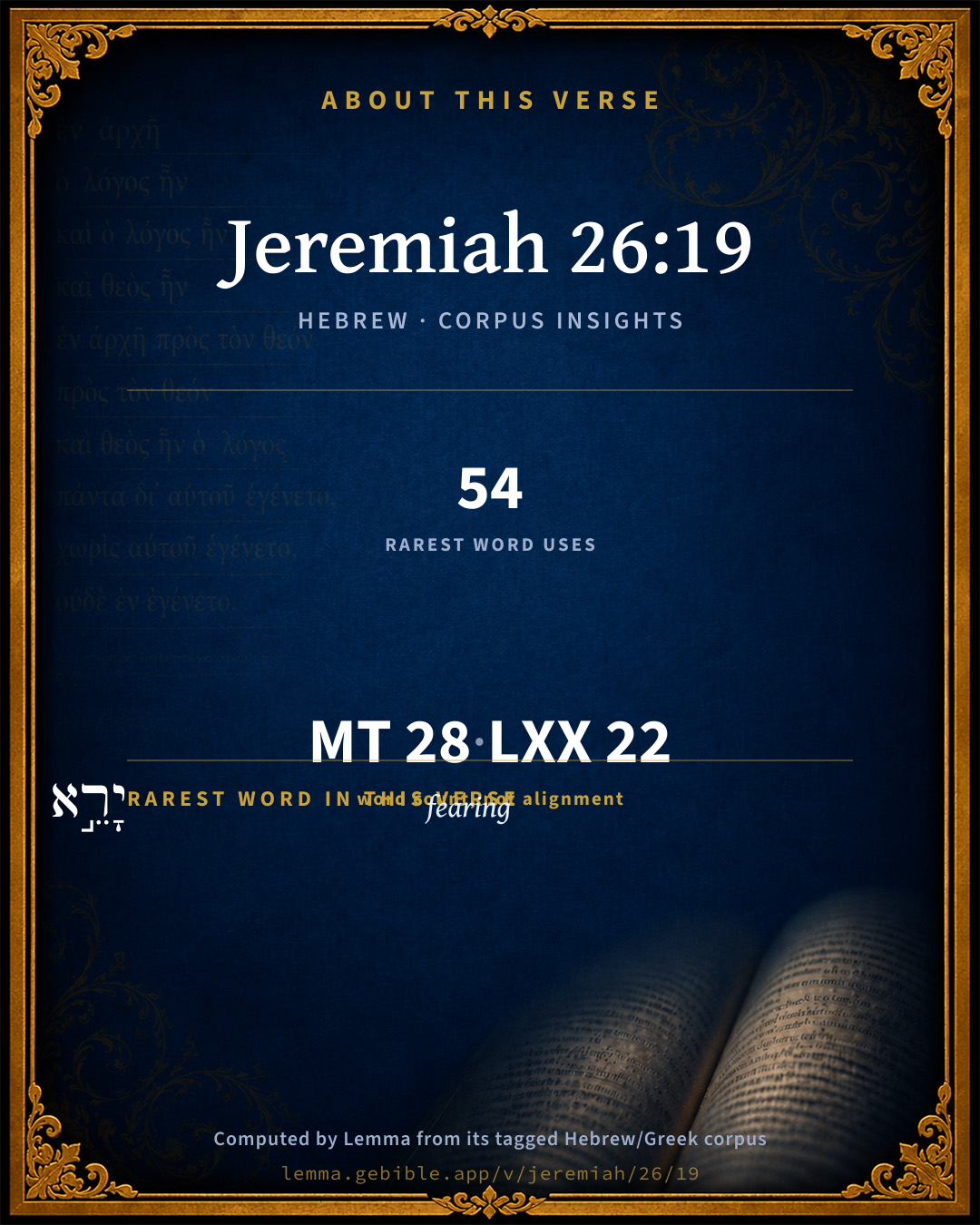
יָרֵ֣א fearing H3373 occurs in 54 verses of the Hebrew Bible. Also found in:

Grammatical profile

  • 6 verbs
  • 12 nouns
  • 2 adjectives
  • 1 pronoun
  • 3 prepositions
  • 4 particles

Verb forms

  • הֶהָמֵ֣ת Hiphil · Infinitive Absolute
  • הֱ֠מִתֻהוּ Hiphil · Perfect
  • וַיְחַל֙ Piel · Sequential Imperfect
  • וַיִּנָּ֣חֶם Niphal · Sequential Imperfect
  • דִּבֶּ֣ר Piel · Perfect
  • עֹשִׂ֛ים Qal · Participle Active

Repetition

Words recur within this verse — often emphatic in Hebrew:

  • יְהוָה֒ LORD H3068 ×3
  • הֶהָמֵ֣ת to die H4191 ×2
  • יְהוּדָ֜ה Judah H3063 ×2
  • הָרָעָ֖ה evil H7451 ×2
  • עֲלֵיהֶ֑ם upon H5921 ×2

Hebrew & Septuagint length

In the original languages it is 28 Hebrew tokens and 22 Greek tokens — but the two are counted differently (Hebrew bundles its prefixes and suffixes into one token; the Greek is in lemma form), so that isn’t a like-for-like length.

Cross-references

24

Topical passages linked to Jeremiah 26:19 in the Treasury of Scripture Knowledge — connected by theme and wording, ordered by reader-vote popularity; previews shown in the World English Bible.

  • Exodus 32:14 Yahweh repented of the evil which he said he would do to his people.
  • 2 Samuel 24:16 When the angel stretched out his hand toward Jerusalem to destroy it, Yahweh repented him of the evil, and said to the angel who destroyed the people, It is enough; now stay your hand. The angel of Yahweh was by the threshing floor of Araunah the Jebusite.
  • 2 Chronicles 29:6–11 For our fathers have trespassed, and done that which was evil in the sight of Yahweh our God, and have forsaken him, and have turned away their faces from the habitation of Yahweh, and turned their backs.
  • Isaiah 37:15–20 Hezekiah prayed to Yahweh, saying,
  • Numbers 35:33–34 So you shall not pollute the land in which you are: for blood, it pollutes the land; and no expiation can be made for the land for the blood that is shed therein, but by the blood of him who shed it.
  • 2 Chronicles 32:25–26 But Hezekiah didn't render again according to the benefit done to him; for his heart was lifted up: therefore there was wrath on him, and on Judah and Jerusalem.
  • Isaiah 37:1 It happened, when king Hezekiah heard it, that he tore his clothes, and covered himself with sackcloth, and went into the house of Yahweh.
  • Isaiah 37:4 It may be Yahweh your God will hear the words of Rabshakeh, whom the king of Assyria his master has sent to defy the living God, and will rebuke the words which Yahweh your God has heard. Therefore lift up your prayer for the remnant that is left.
  • Acts 5:39 But if it is of God, you will not be able to overthrow it, and you would be found even to be fighting against God!"
  • Numbers 16:38 even the censers of these sinners against their own lives; and let them be made beaten plates for a covering of the altar: for they offered them before Yahweh; therefore they are holy; and they shall be a sign to the children of Israel.
  • 2 Chronicles 32:20 Hezekiah the king, and Isaiah the prophet the son of Amoz, prayed because of this, and cried to heaven.
  • 2 Chronicles 34:21 Go you, inquire of Yahweh for me, and for those who are left in Israel and in Judah, concerning the words of the book that is found; for great is the wrath of Yahweh that is poured out on us, because our fathers have not kept the word of Yahweh, to do according to all that is written in this book.
  • Isaiah 26:21 For, behold, Yahweh comes forth out of his place to punish the inhabitants of the earth for their iniquity: the earth also shall disclose her blood, and shall no more cover her slain.
  • Jeremiah 26:3 It may be they will listen, and turn every man from his evil way; that I may repent me of the evil which I purpose to do to them because of the evil of their doings.
  • Jeremiah 26:15 Only know for certain that, if you put me to death, you will bring innocent blood on yourselves, and on this city, and on the inhabitants of it; for of a truth Yahweh has sent me to you to speak all these words in your ears.
  • Jeremiah 44:7 Therefore now thus says Yahweh, the God of hosts, the God of Israel: Why commit you [this] great evil against your own souls, to cut off from you man and woman, infant and suckling, out of the midst of Judah, to leave you none remaining;
  • Lamentations 4:13–14 [It is] because of the sins of her prophets, [and] the iniquities of her priests, That have shed the blood of the just in the midst of her.
  • Habakkuk 2:10 You have devised shame to your house, by cutting off many peoples, and have sinned against your soul.
  • Matthew 23:35 that on you may come all the righteous blood shed on the earth, from the blood of righteous Abel to the blood of Zachariah son of Barachiah, whom you killed between the sanctuary and the altar.
  • Matthew 27:24–25 So when Pilate saw that nothing was being gained, but rather that a disturbance was starting, he took water, and washed his hands before the multitude, saying, "I am innocent of the blood of this righteous person. You see to it."
  • Luke 3:19–20 but Herod the tetrarch, being reproved by him for Herodias, his brother's wife, and for all the evil things which Herod had done,
  • Revelation 6:9–10 When he opened the fifth seal, I saw underneath the altar the souls of those who had been killed for the Word of God, and for the testimony of the Lamb which they had.
  • Revelation 16:6 For they poured out the blood of the saints and the prophets, and you have given them blood to drink. They deserve this."
  • Revelation 18:20–24 Rejoice over her, O heaven, you saints, apostles, and prophets; for God has judged your judgment on her."

Cross-references courtesy of OpenBible.info (CC BY 4.0).

Hebrew and Greek witnesses Masoretic Hebrew ↔ Greek Septuagint

The same verse in the two great witnesses to the Old Testament, shown verse-for-verse.

These are two independent witnesses, not word-aligned to each other, and the Septuagint is shown in lemma (dictionary) form.

Hebrew Jeremiah 26:19 Masoretic · Westminster Leningrad Codex

הֶהָמֵ֣ת הֱ֠מִתֻהוּ חִזְקִיָּ֨הוּ מֶֽלֶךְ יְהוּדָ֜ה וְכָל יְהוּדָ֗ה הֲלֹא֮ יָרֵ֣א אֶת יְהוָה֒ וַיְחַל֙ אֶת פְּנֵ֣י יְהוָ֔ה וַיִּנָּ֣חֶם יְהוָ֔ה אֶל הָרָעָ֖ה אֲשֶׁר דִּבֶּ֣ר עֲלֵיהֶ֑ם וַאֲנַ֗חְנוּ עֹשִׂ֛ים רָעָ֥ה גְדוֹלָ֖ה עַל נַפְשׁוֹתֵֽינוּ

Did Hezekiah king of Judah and all Judah put him to death? Didn't he fear Yahweh, and entreat the favor of Yahweh, and Yahweh repented him of the evil which he had pronounced against them? Thus should we commit great evil against our own souls.

World English Bible · Public Domain

Greek LXX Structure differs

In the Septuagint, Jeremiah is about an eighth shorter than the Hebrew and arranges its material differently — the Oracles Against the Nations (Hebrew chapters 46–51) appear in the middle of the Greek book, after 25:13. Because the chapter and verse boundaries do not line up, a verse-for-verse comparison with the Hebrew is not shown.

A verse-for-verse comparison isn’t shown here because the chapters and verses don’t line up. Switch to the LXX edition with the MT / LXX toggle above to read the Greek directly.

On this verse, The Cambridge Bible for Schools and Colleges discusses the Septuagint’s reading. Read the note in Commentary ↓

Hebrew: Westminster Leningrad Codex (CC BY 4.0). Greek: Septuagint (public domain); English from a public-domain English Septuagint. How the Septuagint differs from the Hebrew →

Targum (Aramaic paraphrase)

1

The Targum is the ancient Jewish Aramaic paraphrase of the Hebrew Scriptures — an interpretive translation, not the Hebrew text itself. Onkelos (literal) and Pseudo-Jonathan (expansive) render the Torah, and Jonathan the Prophets. Coverage is partial: where no permissively-licensed English translation exists for a verse, only the Aramaic is shown. This is verse-level text, not a word-by-word alignment to the Hebrew.

  1. Targum Jonathan Prophets (Joshua–Malachi)
    הֲמִקְטַל קַטְלוֹהִי חִזְקִיָה מְלַךְ שִׁבְטָא דְבֵית יְהוּדָה הֲלֹא דָחִיל מִן קֳדָם יְיָ וְצַלֵי קֳדָם יְיָ וְתַב יְיָ מִן בִּישְׁתָא דְמַלֵיל עֲלֵיהוֹן וַאֲנַחְנָא גַרְמִין לְאַיְתָאָה בִישְׁתָא רַבְּתָא עַל נַפְשָׁתָא:

    (no public-domain English translation for this verse)

    Targum Jonathan — Aramaic: “Mikraot Gedolot” (public domain). English: “Sefaria Community Translation” (CC0 1.0 (public-domain dedication)); “London "Chaldee Paraphrase," 1871” (public domain). Text via Sefaria.

Commentary

Notes on Jeremiah 26:19 from classic Christian and Jewish commentators (each source and its license shown beneath its notes). The classic Christian expositions comment on the surrounding passage and are grouped to its opening verse, so a note may address several verses; the Jewish commentaries on the Tanakh (Rashi and others) are per-verse, so they appear only where the commentator wrote on this verse.

Lemma curates 59 commentaries, every one of them public domain or Creative Commons licensed, each selected and text-cleaned for this edition rather than reprinted as found. About our sources →

Trapp's Complete Commentary

John Trapp

Jer 26:19 Did Hezekiah king of Judah and all Judah put him at all to death? did he not fear the LORD, and besought the LORD, and the LORD repented him of the evil which he had pronounced against them? Thus might we procure great evil against our souls.

Ver. 19. Did Hezekiah king of Judah.] Laudable examples are to be remembered; and, as occasion requireth, imitated. That was a very good one of Constantine the Great, when the Arians brought accusations against the orthodox bishops, as here the false prophets did against Jeremiah, he burned them, and said, These accusations will have proper hearing at the last day of judgment. {a}

{a} Sozomen.

John Trapp, A Commentary or Exposition upon All the Books of the Old and New Testament (1647–1656) — public domain. Text from a community e-Sword module.

Geneva Bible (1599)

Geneva Bible translators

So that the city was not destroyed, but by miracle was delivered out of the hands of Sennacherib.

Geneva Bible (1599) marginal notes — public domain. Text via Bolls.life.

Jamieson, Fausset & Brown

Robert Jamieson, A. R. Fausset & David Brown

Hezekiah, so far from killing him, was led "to fear the Lord," and pray for remission of the sentence against Judah (Ch2 32:26).

Lord repented-- (Exo 32:14; Sa2 24:16).

Thus--if we kill Jeremiah.

Jamieson, Fausset & Brown — Commentary Critical and Explanatory on the Whole Bible (1871) — public domain (CC PDM 1.0). Text via the HelloAO Bible API.

John Calvin's Commentaries

Having now related what Micah had denounced, they added, Slaying, did Hezekiah the king of Judah and all Judah slay him? By the example of the pious King Hezekiah, they exhorted the people to shew kindness and docility, and shewed that it was an honor done both to God and to his prophets, not to be incensed against his reproofs and threatenings, however sharply they might have been goaded or however deeply they might have been wounded. But they further added, Did he not fear Jehovah? and supplicate the face of Jehovah? and did not Jehovah repent? They confirmed what Jeremiah had previously said, that there was no other remedy but to submit themselves calmly to prophetic instruction, and at the same time to flee to the mercy of God; for by the fear of God here is meant true conversion; what else is God’s fear than that reverence by which we shew that we are submissive to his will, because he is a Father and a Sovereign? Whosoever, then, owns God as a Father and a Sovereign, cannot do otherwise than to submit from the heart, to his good pleasure. Therefore the elders meant that Hezekiah and the whole people really turned to God. Now repentance, as it must be well known, contains two parts — the sinner becomes displeased with himself on account of his vices — and forsaking all the wicked lusts of the flesh, he desires to form his whole life and his actions according to the rule of God’s righteousness.

But they added, that they supplicated, etc. Though Jeremiah uses the singular number, he yet includes both the people and the king; he seems however to have used the singular number designedly, in order to commend the king, whose piety was extraordinary and almost incomparable. There is no doubt but that he pointed out the right way to others, that they might repent, and also that he humbly deprecated that vengeance, which justly filled their minds with terror. He, indeed, ascribed this especially to the pious king; but the same concern is also to be extended to the chief men and the whole body of the people, as we shall presently see; did he not then supplicate the face of Jehovah?

This second clause deserves special notice; for a sinner will never return to God except he has the hope of pardon and salvation, as we shall ever dread the presence of God, except the hope of reconciliation be offered to us. Hence the Scripture, whenever it speaks of repentance, at the same time adds faith. They are indeed things wholly distinct, and yet not contrary, and ought never to be separated, as some inconsiderately do. For repentance is a change of the whole life, and as it were a renovation; and faith teaches the guilty to flee to the mercy of God. But still we must observe that there is a difference between repentance and faith; and yet they so unite together, that he who tears the one from the other, entirely loses both. This is the order which the Prophet now follows in saying that Hezekiah supplicated the face of Jehovah For whence is the desire to pray, except from faith? It is not then enough for one to feel hatred and displeasure as to his sins, and to desire to be conformed to God’s will, except he thinks of reconciliation and pardon. The elders then pointed out the remedy, and shewed it as it were by the finger; for if the people after the example of Hezekiah and of others repented, then they were to flee to God’s mercy, and to testify their faith by praying God to be propitious to them.

Hence it follows, that Jehovah repented of the evil which he had spoken against them The Prophet now makes use of the plural number; we hence conclude that under the name of King Hezekiah alone he before included the whole people. God then repented of the evil As to this mode of speaking, I shall not now speak at large. We know that no change belongs to God; for whence comes repentance, except from this, — that many things happen unexpectedly which compel us to change our purpose? one had intended something; but he thought that that would be which never came to pass; it is therefore necessary for him to revoke what he had determined. Repentance then is the associate of ignorance. Now, as nothing is hid from God, so it can never be that he repents. How so? because he has never determined anything but according to his certain foreknowledge, for all things are before his eyes. But this kind of speaking, that God repents, that is, does not execute what he has announced, refers to what appears to men. It is no wonder that God thus condescendingly speaks to us; but, while this simplicity offends delicate and tender ears, we on the contrary wonder at God’s indulgence in thus coming down to us, and speaking according to the comprehension of our weak capacities. We now perceive how God may be said to repent, even when he does not execute what he had denounced. His purpose in the meantime remains fixed, and as James says,

“There is in him no shadow of turning.” (James 1:17.)

But a question may again be raised, How did God then repent of the evil which he had threatened both to the king and to the people? even because he deferred his vengeance; for God did not abrogate his decree or his proclamation, but spared Hezekiah and the people then living. Then the deferring of God’s vengeance is called his repentance; for Hezekiah did not experience what he had feared, inasmuch as he saw not the ruin of the city nor the sad and dreadful event which Micah had predicted.

Now this also is to be noticed, — that the pious king is here commended by the Holy Spirit, that he suffered himself to be severely reproved, though, as I have already said, he was not himself guilty. He had, indeed, a burning zeal, and was prepared to undergo any troubles in promoting the true worship of God; and yet he calmly and quietly bore with the Prophet, when he spoke of the destruction of the city and Temple, for he saw that he had need of such a helper. For however wisely may pious princes exert themselves in promoting the glory of God, yet Satan resists them. Hence they ever desire, as a matter of no small importance, to have true and faithful teachers to help, to assist and to strengthen them, and also to oppose their adversaries; for if teachers are silent or dissemble, a greater ill-will is entertained towards good princes and magistrates; for when with the drawn sword they defend the glory of God and his worship, while the teachers themselves are dumb dogs, all will cry out, “Oh! what does this severity mean? Our teachers spare our ears, but these do not spare even our blood.” It is, therefore, ever a desirable thing for good and pious kings to have bold and earnest teachers, who cry aloud and confirm the efforts of their princes. Such was the feeling of pious Hezekiah, as we may conclude from this passage. The rest I must defer.

John Calvin's Commentaries (1540-1563) — public domain. Text from the Calvin Translation Society English edition (1840s-50s) via the Christian Classics Ethereal Library (ccel.org). Calvin's coverage is partial (roughly two-thirds of the Bible); uncommented books and verses are honest gaps, never fabricated. The 19th-century editor's footnotes and remarks are omitted so the notes are faithfully Calvin's own voice.

Ellicott's Commentary for English Readers

(19) Did Hezekiah . . . put him at all to death?—Literally, make him die the death, the same phrase as in Jer_26:8. There is no special record of the repentance thus referred to, but it is quite in accord with Hezekiah’s general character, as seen in 2Ch_29:6-10 (which may be the occasion referred to) and 2Ch_32:26. The whole tone of the advice of “old experience,” approximating to something like “prophetic strain,” in this case, reminds us of the counsels of Gamaliel in Act_5:35-39. The closing words, “Thus might we procure great evil to our souls,” present an exact parallel to “lest haply we be found even to fight against God.” The result of the counsel thus given is left to be inferred. It obviously left the prophet free to continue his work as a preacher, though probably under a kind of police surveillance, like that implied in Jer_36:1-5. The favourable result is attributed in Jer_26:24 to the influence of Ahikam.

A Bible Commentary for English Readers, edited by Charles John Ellicott (1878–1897) — public domain. Text from a community e-Sword module.

The Cambridge Bible for Schools and Colleges

gen. ed. J. J. S. Perowne

19. Did Hezekiah … put him at all to death? [The words of Micah had been to the full as harsh-sounding as any that had been uttered by Jeremiah. Jeremiah was attacked for predicting the fall of the Temple and city; but Micah had said the same thing and no action was taken against him. The precedent supplied by the case of the former prophet therefore, the elders argue, is in favour of him who is now attacked. The passage is important as shewing that the reforms of Hezekiah were far from being attributable to the influence of Isaiah alone.

intreat the favour] lit. smooth the face, i.e. remove the frown (of an offended deity), appease; an anthropomorphism. Cp. Zec_7:2; Zec_8:21 f.; Mal_1:9.

the Lord repented] The LXX here, as in Jer_26:3; Jer_26:13, render ceased, from dislike to any expression savouring to their minds of anthropomorphism. But the word serves at any rate to remind us that “all prophecy is conditional. The prophets declare the great principles of God’s moral government, and apply them to individual cases. But, if the moral conditions of the cases to which these principles are applied be altered, the threatening or the promise is postponed, modified, or recalled.” C.B. (Cheyne) on Micah, l.c. In the present case the destruction here described was never altogether fulfilled. Co. points out the special interest that attaches to the above episode, as indicating what a deep impression the utterances of a prophet made upon the people, even after the lapse of a century.

The Cambridge Bible for Schools and Colleges (gen. ed. J. J. S. Perowne; Cambridge University Press, 1878–1918) — public domain. Text from a community e-Sword module.

John Gill's Exposition

Did Hezekiah king of Judah and all Judah put him at all to death?.... No, they did not: neither the king, by his own authority; nor the sanhedrim, the great court of judicature, for the nation; they never sought to take away his life, nor sat in council about it; they never arraigned him, and much less condemned him:

did he not fear the Lord, and besought the Lord; that is, Hezekiah; he did, as knowing that Micah was a prophet of the Lord, and sent by him; wherefore he received his prophecy with great awe and reverence, as coming from the Lord, and made his supplications to him that he would avert the judgments threatened:

and the Lord repented of the evil which he had pronounced against them? the king and his people, the city and the temple; and so the threatened evil came not upon them in their days:

thus might we procure great evil against our souls; should we put Jeremiah to death: it is therefore much more advisable to do as Hezekiah did, pray unto the Lord to avert the threatened evil, or otherwise it will be worse with us. This precedent is urged to strengthen the decree of the council in favour of Jeremiah.

John Gill's Exposition of the Whole Bible (1746–1763) — public domain (CC PDM 1.0). Text via the HelloAO Bible API.

Albert Barnes' Notes on the Bible

Thus might we procure ... - Rather, And we should commit a great evil against our own souls; i. e., by putting Jeremiah to death, we should commit a sin which would prove a great misfortune to ourselves.

Albert Barnes' Notes on the Bible (1834–1885) — public domain. Text from a community e-Sword/MySword module.

Matthew Poole's English Annotations

The interrogation here hath the force of a negation; that is, Hezekiah, and the sanhedrim in his time, did not go about to call him in question for his life, nor put him to death; his prophecy had a quite contrary effect on him; it begat in him an awe and dread of that God in whose name the prophet spake, and quickened him to apply himself to God by earnest prayer: and the course he took had a very good issue; the Lord did not do what he threatened to do. Now if we should take a quite contrary course, and put this man to death, we should do contrary to what that good prince did, (and that with good success,) do ourselves no good, but

procure great evil against our souls; that is, against ourselves, both bodies and souls strictly taken.

Matthew Poole's English Annotations on the Holy Bible (1683–1685) — public domain. Text from a community e-Sword/MySword module.

Whedon's Commentary on the Bible

Daniel D. Whedon

19. Did Hezekiah, etc. — What is here stated we learn from no other source. We are elsewhere told of Micah’s prophecy, and of Hezekiah’s prayer to God for protection from the mighty enemy, but not of the result here stated. Here, then, as in many other places, do we recognise a coming in of material from a source outside of the canonical Scriptures.

Besought the Lord — Literally, stroke the face of Jehovah.

Daniel D. Whedon (gen. ed.), Commentary on the Old and New Testaments (1874–1909) — public domain. Text from a community e-Sword module.

The Pulpit Commentary

Thus might we procure, etc.; rather, and we are about to commit a great evil against our souls (not merely "against ourselves"). The blood of the slain would cry for vengeance against his murderers, who would come to an untimely end, their "souls" being sent down to lead a miserable parody of a life (biov abiov ) in Sheol or Hades.

The Pulpit Commentary (1880–1919), ed. H.D.M. Spence-Jones & Joseph S. Exell — public domain. Text from a community e-Sword module.

John Wesley's Explanatory Notes

Thus - Now, if we should take a quite contrary course, and put this man to death, we should do ourselves no good, but procure great evil against our souls; that is against ourselves.

John Wesley, Explanatory Notes Upon the Whole Bible (1754–1765) — public domain. Text via the GEBible commentary corpus.

Scofield Reference Notes

C. I. Scofield

fear (See Scofield "Psa 19:9").

repented (See Scofield "Zec 8:14").

The Scofield Reference Bible (1917 edition), notes by C. I. Scofield — public domain. Text from a community e-Sword module.

Rashi

Rabbi Shlomo Yitzchaki (Rashi)

and he entreated Heb. וַיְחַל, an expression of prayer.

but we are doing great harm to ourselves if we kill him.

Rashi on the Tanakh — English translations: “The Judaica Press complete Tanach with Rashi, translated by A. J. Rosenberg” (CC BY 4.0); “Pentateuch with Rashi's commentary by M. Rosenbaum and A.M. Silbermann, 1929-1934” (public domain); “The Metsudah Tanach series, Lakewood, N.J” (CC BY 4.0); and “The Book of Joshua, Metsudah Publications, 1997” (CC BY 4.0). Text via Sefaria.

Lesson kit

Teaching starters — assembled from the data on this page, not authored interpretation. Every prompt links to the verse data it draws on. Edit before teaching.

Jeremiah, in the Prophets, opens this verse with 28 words (21 distinct Hebrew lemmas). Its most distinctive word is yârêʼ (“fearing”). A historical commentator’s framing appears above. Read the whole chapter for the surrounding context.

Discussion questions

  1. The word yârêʼ carries the sense “fearing.” How does it shape the verse?
  2. How does Genesis 22:12, which shares the word «fearing», read alongside this verse?
  3. What does the repetition of “LORD” (3× in this one verse) do in this verse?
  4. These translations render this verse differently. What is at stake in choosing one wording over another?
  5. «הֶהָמֵ֣ת» is a Hiphil Infinitive Absolute verb. How does that grammatical form shape the action described?
  6. Compare how Trapp's Complete Commentary and Geneva Bible (1599) read this verse. Where do they agree or differ?

Things to notice

Reading settings

Reading text

Shown beneath each verse's original-language words.

Old Testament
Old Testament edition

Read the OT as the Masoretic Hebrew (MT) or the Greek Septuagint (LXX).

English shown for the Greek Septuagint (in the Hebrew ↔ Greek comparison).

Comparing translations? Open the Compare panel on any verse page to stack up to four side by side.