
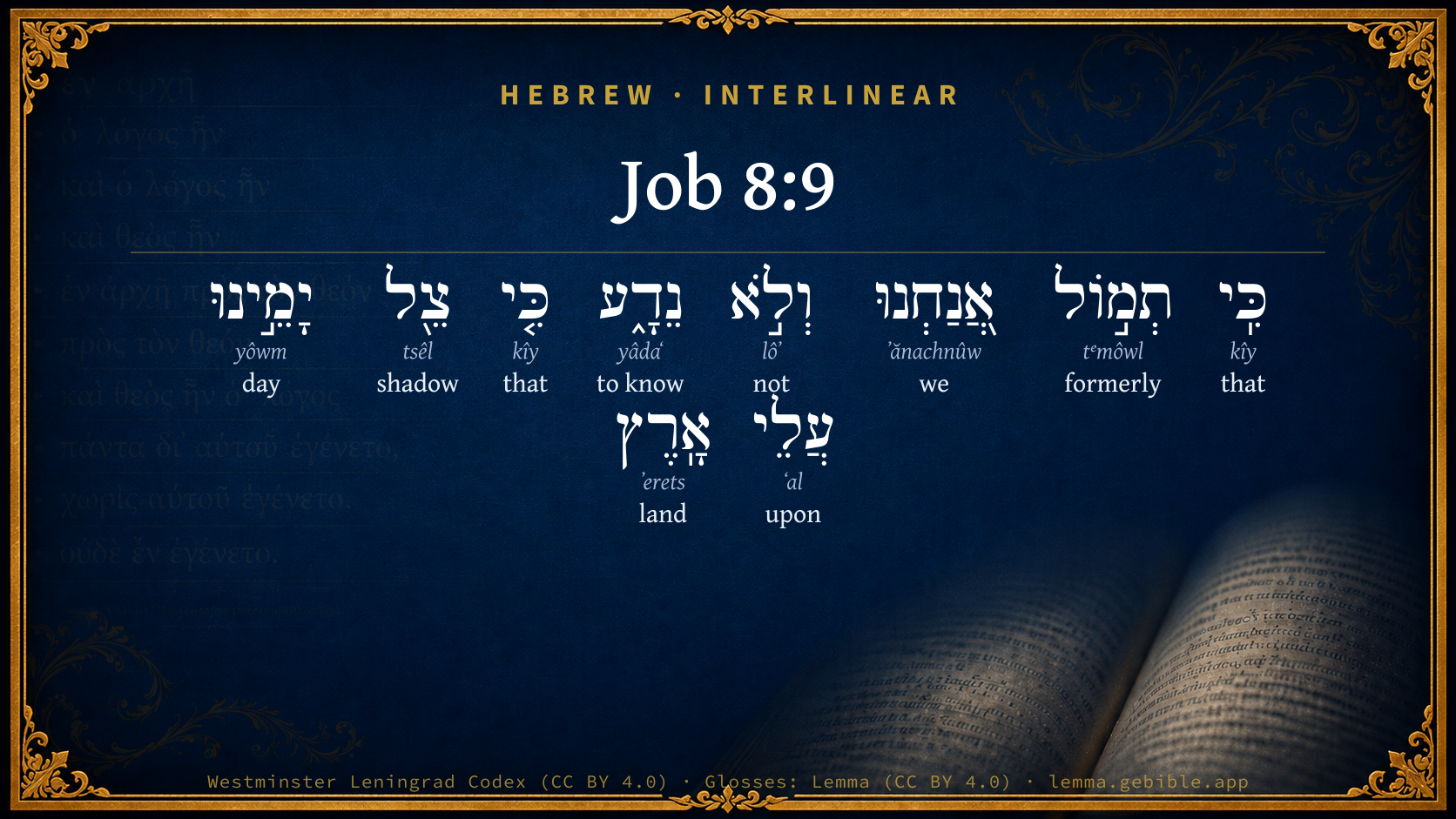
Job 8:9

Hebrew (Westminster Leningrad Codex) Job 8:9 appears in the Hebrew Old Testament. The text above is from the Westminster Leningrad Codex. Each word links to its Strong’s number, a concise gloss, and parsing drawn from the Open Scriptures Hebrew Bible morphology. Click any word for its full Brown-Driver-Briggs (BDB) entry.
Download image
Cite this verse

Job 8:9 (World English Bible). Public Domain. Lemma interlinear Bible study tool, https://lemma.gebible.app/v/job/8/9.

Show BibTeX & RIS
BibTeX
RIS
English Translation
(For we are but of yesterday, and know nothing, Because our days on earth are a shadow.)
World English Bible · Public Domain
Download a study sheet

One document with this verse’s original text, its word-by-word gloss line, the meaning frame, cross-references with their text, attributed commentary, and full source and license credits — printable, and it pastes into notes with its structure intact.

This verse Autodidact and up

Study sheet (.html) Plain text (.txt)

A passage Seminary Student

Up to 50 verses in one chapter. A passage sheet keeps up to 6 commentary sources and 12 cross-references per verse, in the order this page ranks them, and says so on the sheet whenever that leaves anything out. Ask for a single verse and you get the Autodidact verse sheet above.

Everything on this page stays free to read, with no account — the sheet is a download of what is already on screen, not access to it.

Want to remove ads? Support Godless Engineer
Compare translations 3

The same verse in 3 English versions, stacked beneath the original-language interlinear above. Click any original word for its lexicon entry.

Each is an independent rendering of the whole verse — the interlinear is not word-aligned to these translations.

Highlighted words mark where these versions differ — a whole-verse word diff, not a word-by-word alignment.

  • World English Bible Public Domain
    (For we are but of yesterday, and know nothing, Because our days on earth are a shadow.)
  • King James Version Public Domain
    (For we are but of yesterday, and know nothing, because our days upon earth are a shadow:)
  • unfoldingWord Literal Text CC BY-SA 4.0
    For we of yesterday and we do not know, for our days on earth a shadow.

unfoldingWord Literal Text — © unfoldingWord, licensed CC BY-SA 4.0. Word-aligned USFM3 via Door43 (git.door43.org/unfoldingWord/en_ult).

Versions to compare (up to 4)

3 of 4 selected

Show all 18 translations

Every available English version of this verse, each an independent rendering of the whole verse.

  • World English Bible Public Domain
    (For we are but of yesterday, and know nothing, Because our days on earth are a shadow.)
  • Berean Standard Bible Public Domain
    For we were born yesterday and know nothing; our days on earth are but a shadow.
  • Majority Standard Bible Public Domain
    For we were born yesterday and know nothing; our days on earth are but a shadow.
  • King James Version Public Domain
    (For we are but of yesterday, and know nothing, because our days upon earth are a shadow:)
  • American Standard Version (1901) Public Domain
    (For we are but of yesterday, and know nothing, Because our days upon earth are a shadow);
  • Revised Version (1885) Public Domain
    (For we are but of yesterday, and know nothing, because our days upon earth are a shadow:)
  • Geneva Bible (1599) Public Domain
    (For we are but of yesterday, and are ignorant: for our dayes vpon earth are but a shadowe)
  • Douay-Rheims (1899) Public Domain
    (For we are but of yesterday, and are ignorant that our days upon earth are but a shadow:)
  • Young's Literal Translation Public Domain
    (For of yesterday we `are', and we know not, For a shadow `are' our days on earth.)
  • Literal Standard Version CC BY-SA 4.0
    For we [are] of yesterday, and we do not know, || For our days [are] a shadow on earth.
  • Unlocked Literal Bible CC BY-SA 4.0
    (We were only born yesterday and know nothing because our days on earth are a shadow).
  • unfoldingWord Literal Text CC BY-SA 4.0
    For we of yesterday and we do not know, for our days on earth a shadow.
  • Darby Bible Public Domain
    For we are [but] of yesterday, and know nothing, for our days upon earth are a shadow.
  • World Messianic Bible Public Domain
    (For we are but of yesterday, and know nothing, because our days on earth are a shadow.)
  • Webster's Bible Public Domain
    (For we are but of yesterday, and know nothing, because our days upon earth are a shadow:)
  • Free Bible Version CC BY-SA 4.0
    Our days on earth fade as quickly as a passing shadow.
  • Bible in Basic English Public Domain
    (For we are but of yesterday, and have no knowledge, because our days on earth are gone like a shade:)
  • JPS Tanakh (1917) Public Domain
    For we are but of yesterday, and know nothing, because our days upon earth are a shadow —

Literal Standard Version (2020), Covenant Press — licensed CC BY-SA 4.0. Text via the HelloAO Bible API (eBible.org). Unlocked Literal Bible (unfoldingWord) — licensed CC BY-SA 4.0. Text via the HelloAO Bible API (eBible.org). unfoldingWord Literal Text — © unfoldingWord, licensed CC BY-SA 4.0. Word-aligned USFM3 via Door43 (git.door43.org/unfoldingWord/en_ult). Free Bible Version, Dr. Jonathan Gallagher — licensed CC BY-SA 4.0. Text via the HelloAO Bible API (eBible.org).

Word by word

More ways to search: Search by grammar → Find every occurrence → Compare this word →

Practice this passage: Drill this verse → Learn its vocabulary →

About this verse

These counts appear in no published source. They are computed here, from the morphology-tagged text and Lemma’s own curated glosses. What Lemma adds →

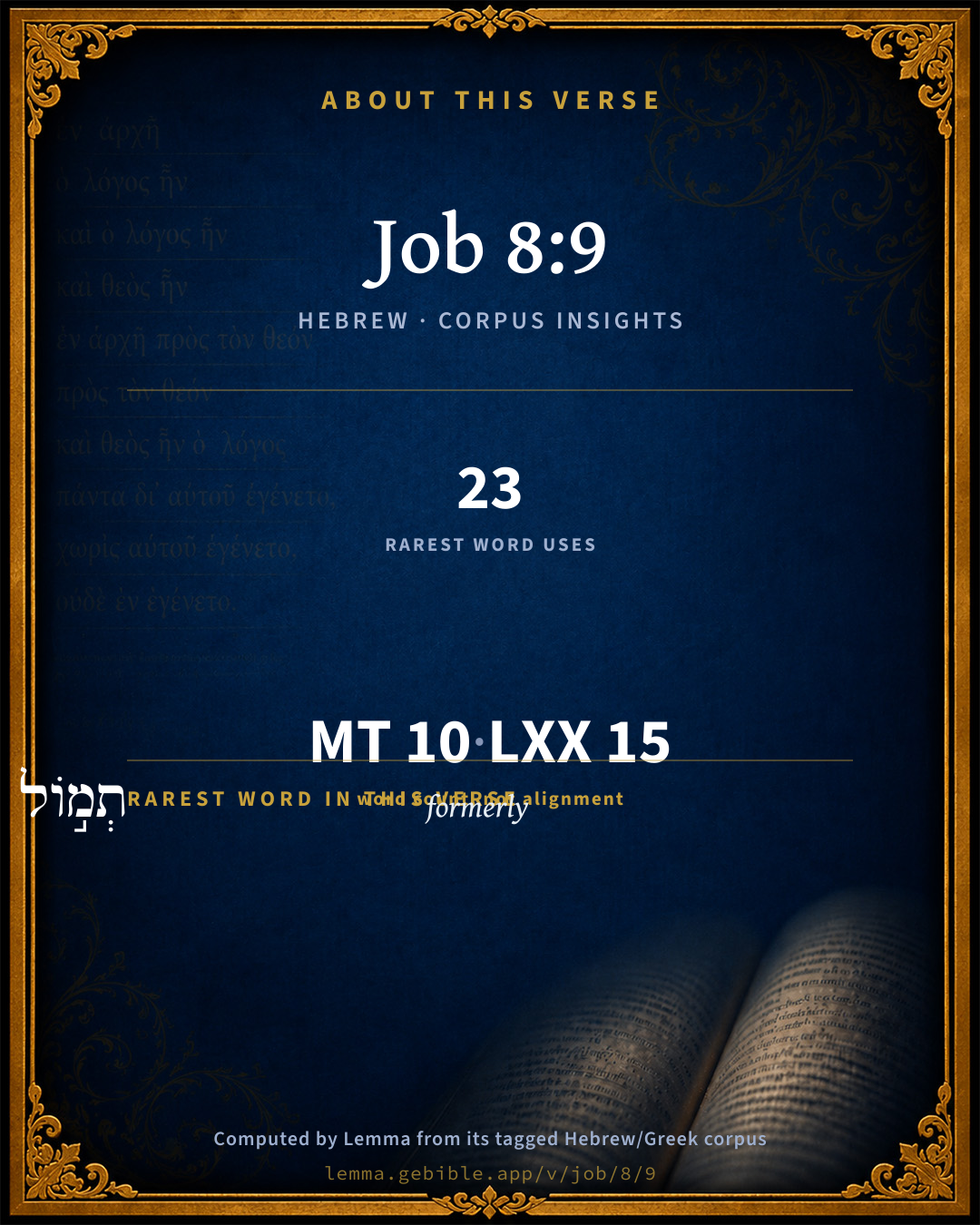
10
words
9
distinct lemmas
Wisdom
section

Notable vocabulary

The rarest word here is תְמ֣וֹל formerly H8543 — appearing just 23 times in the whole Hebrew Bible.

Shared distinctive vocabulary

תְמ֣וֹל formerly H8543 occurs in 22 verses of the Hebrew Bible. Also found in:

Grammatical profile

  • 1 verb
  • 3 nouns
  • 1 pronoun
  • 1 preposition
  • 2 conjunctions
  • 1 adverb
  • 1 particle

Verb forms

  • נֵדָ֑ע Qal · Imperfect

Repetition

A word recurs within this verse — often emphatic in Hebrew:

  • כִּֽי that H3588 ×2

Hebrew & Septuagint length

In English translation the verse runs 17 words from the Hebrew and 17 from the Septuagint (LXX English) — the same length.

A rough comparison of the two English renderings, which tokenize alike — not a word-level alignment.

Word counts can differ between the Hebrew and the Greek without any difference in meaning — e.g. the Hebrew direct-object marker אֵת has no separate Greek word, and Greek often adds the article ὁ.

In the original languages it is 10 Hebrew tokens and 15 Greek tokens — but the two are counted differently (Hebrew bundles its prefixes and suffixes into one token; the Greek is in lemma form), so that isn’t a like-for-like length.

Cross-references

8

Topical passages linked to Job 8:9 in the Treasury of Scripture Knowledge — connected by theme and wording, ordered by reader-vote popularity; previews shown in the World English Bible.

  • 1 Chronicles 29:15 For we are strangers before you, and foreigners, as all our fathers were: our days on the earth are as a shadow, and there is no abiding.
  • Psalms 144:4 Man is like a breath. His days are like a shadow that passes away.
  • Job 14:2 He comes forth like a flower, and is cut down. He also flees like a shadow, and doesn't continue.
  • Psalms 102:11 My days are like a long shadow. I have withered like grass.
  • Genesis 47:9 Jacob said to Pharaoh, "The days of the years of my pilgrimage are one hundred thirty years. Few and evil have been the days of the years of my life, and they have not attained to the days of the years of the life of my fathers in the days of their pilgrimage."
  • Job 7:6 My days are swifter than a weaver's shuttle, And are spent without hope.
  • Psalms 39:5 Behold, you have made my days handbreadths. My lifetime is as nothing before you. Surely every man stands as a breath." Selah.
  • Psalms 90:4 For a thousand years in your sight Are but as yesterday when it is past, As a watch in the night.

Cross-references courtesy of OpenBible.info (CC BY 4.0).

Hebrew and Greek witnesses Masoretic Hebrew ↔ Greek Septuagint

The same verse in the two great witnesses to the Old Testament, shown verse-for-verse.

These are two independent witnesses, not word-aligned to each other, and the Septuagint is shown in lemma (dictionary) form.

Hebrew Job 8:9 Masoretic · Westminster Leningrad Codex

כִּֽי תְמ֣וֹל אֲ֭נַחְנוּ וְלֹ֣א נֵדָ֑ע כִּ֤י צֵ֖ל יָמֵ֣ינוּ עֲלֵי אָֽרֶץ

(For we are but of yesterday, and know nothing, Because our days on earth are a shadow.)

World English Bible · Public Domain

Greek LXX Job 8:9 Septuagint · lemma form

χθιζός γάρ εἰμί καί οὐ οἶδα σκιά γάρ εἰμί ἐγώ ἐπί ὁ γῆ ὁ βίος

(for we are of yesterday, and know nothing; for our life upon the earth is a shadow:)

LXX2012 (modern English Septuagint) · Public Domain

Hebrew: Westminster Leningrad Codex (CC BY 4.0). Greek: Septuagint (public domain); English from LXX2012 (modern English Septuagint) (Public Domain). How the Septuagint differs from the Hebrew →

Commentary

Notes on Job 8:9 from classic Christian and Jewish commentators (each source and its license shown beneath its notes). The classic Christian expositions comment on the surrounding passage and are grouped to its opening verse, so a note may address several verses; the Jewish commentaries on the Tanakh (Rashi and others) are per-verse, so they appear only where the commentator wrote on this verse.

Lemma curates 59 commentaries, every one of them public domain or Creative Commons licensed, each selected and text-cleaned for this edition rather than reprinted as found. About our sources →

Trapp's Complete Commentary

John Trapp

Job 8:9 (For we [are but of] yesterday, and know nothing, because our days upon earth [are] a shadow:)

Ver. 9. For we are but of yesterday] Heb. We are yesterday, that is, yesterday’s offspring, upstarts, mushrooms, novices of very small standing in the world. And yet they were old men, Job 15:10. Eliphaz is esteemed to be a hundred and fifty, Bildad a hundred and forty, Zophar a hundred and twenty years old; and yet, in comparison to the fathers before the flood, they were but of yesterday, they had lived but a very little while, and were but of late time.

And know nothing] Neque experti sumus, saith Tremellius; the greatest part of our knowledge is but the least part of our ignorance: how can we know much, when our abode here is so short, our experience so little? Art longa, vita brevis, said Hippocrates, life is short, and art is long. Themistocles, though he lived a hundred and seven years, yet at his death complained, saying, Now I am to die when I begin to be wise. Solon said, that though old, yet he thought not himself too old to learn; and Julian the lawyer was wont to say, that when he had one foot in the grave, yet he would have the other in the school.

Because our days upon earth are a shadow] Fluxa, instabilis, et ipsa ultro abiens, saith Junius, unsubstantial, unsettled, uncertain, there is no hold nor tack in it, Psa 102:11 1Ch 29:15, What is man but a dream of a shadow, saith Pindarus; a shadow of smoke, saith Sophocles; a shadow of a shadow, saith Aeschylus, σκιας ουαρ, καπνου σκια, ειδωλον σκιας. He is therefore not a man, but a shadow of man (as Lamech’s second wife’s name was Zillah, a shadow of a wife, Tsillah, umbra ipsius, and as Menander calleth a false friend φιλου σκιαν, the shadow of a friend); he hath not so much as shadow of reason or true understanding, who, by spending the span, by wasting the shadow of this short life, after the ways of his own heart, bereaveth himself of a room in that city of pearls, and loseth the comforts of that life which lasteth for ever.

John Trapp, A Commentary or Exposition upon All the Books of the Old and New Testament (1647–1656) — public domain. Text from a community e-Sword module.

The Biblical Illustrator

Joseph S. Exell

Job_8:9

For we are but of yesterday, and know nothing, because our days upon earth are a shadow.

The intellectual poverty of life

The two unquestionable truths that Bildad here expresses are the transitoriness and the intellectual poverty of our mortal life. We know nothing. Bildad seems to indicate that our ignorance arises partly from the brevity of our life. We have no time to get knowledge.

1. We know nothing compared with what is to be known. This may be said of all created intelligences, even of those who are the most exalted in power and attainment. Each subsequent advance in science has shown us the comparative nothingness of all human knowledge.--Sir R. Peel.

2. We know nothing compared with what we might have known. There is a vast disproportion between the knowledge attainable by man on earth, and that which he actually attains. Our Maker sees the difference.

3. We know nothing compared with what we shall know in the future. There is a life beyond the grave for all, good and bad, a life, not of indolence, but of intense unremitting action,--the action of inquiry and reflection.

I. If we are thus so necessarily ignorant, it does not become us to criticise the ways of God. How often do we find some poor mortals arrogantly occupying the critics chair, in the great temple of truth, and even suggesting moral irregularities in the Divine procedure.

II. Difficulties in connection with a revelation from God are to be expected. Place in the hands of one deeply conscious of his ignorance, written with profundity of thought, and extensiveness of learning, and would he not expect to meet with difficulties in every page? How monstrous then it is for any man to expect to comprehend all the revelation of the Infinite Mind. The man who parades the difficulties of the Bible as a justification of his unbelief, or as an argument against its Divinity, is pitiably ignorant of his own ignorance. Were there no difficulties, you might reasonably question its heavenly authorship. Their existence is the signature of the Infinite.

III. The profoundest modesty should characterise us in the maintenance of our theological views. It is the duty of every man to get convictions of Divine truth for himself, to hold these convictions with firmness, and to promote them with earnestness; but at the same time, with a due consciousness of his own fallibility, and with a becoming deference to the judgment of others. The more knowledge, the more humility. True wisdom is ever modest. Those who live most in the light are most ready to veil their faces.

IV. Our perfection is to be found in moral qualities rather than in intellectual attainments. If our well-being consisted in exact and extensive information of our great Maker and His universe, we might well allow despair to settle on our spirits. Few have the talent to become scientific, fewer still the means; but all can love. And love is the fulfilling of the law; and love is heaven.

V. There must be an afterlife affording opportunities for the acquisition of knowledge. We are formed for the acquisition of knowledge. If we are so necessarily ignorant, and there be no hereafter, our destiny is not realised, and we have been made in vain.

VI. We should with rapturous gratitude avail ourselves of the merciful interposition of christ as our guide to immortality. Unaided reason has no torch to light us safely on our way. Our gracious Maker has met our ease, He has sent His Son. That Son stands by you and me, and says, Follow Me. (Homilist.)

On the ignorance of man, and the proper improvement of it

What do we know of ourselves? We carry about with us bodies curiously made; but we cannot see far into their inward frame and constitution. We experience the operation of many powers and faculties, but understand not what they are, or how they operate. We find that our wills instantaneously produce motion in our members, but when we endeavour to account for this we are entirely lost. The laws of union between the soul and the body, the nature of death, and the particular state into which it puts us; these and many other things relating to our own beings are absolutely incomprehensible to us. One of the greatest mysteries to man is man. What do we know of this earth, and its constitution and furniture? Almost all that we see of things is their outsides. The substance or essence of every object is unintelligible to us. We see no more than a link or two in the immense chain of causes and effects. There is not a single effect which we can trace to its primary cause. And what is this earth to the whole solar system? And what is the system of the sun to the system of the universe? And if we could take in the complete prospect of Gods works, there would still remain unknown an infinity of abstract truths and possibles. Observe too our ignorance of the plan and conduct of Divine providence in the government of the universe. We cannot say wherein consists the fitness of many particular dispensations of providence. There is a depth of wisdom in all Gods ways which we are incapable of tracing. The origin of evil is a point which in all ages has perplexed human reason. And then carry thought to the Deity Himself, and consider what we know of Him. His nature is absolutely unfathomable to us, and in the contemplation of it we see ourselves lost. This imperfection of our knowledge is plainly owing--

1. To the narrowness of our faculties.

2. To the lateness of our existence. We are but of yesterday.

3. To the disadvantageousness of our situation for observing nature and acquiring knowledge.

We are confined to a point of this earth, which itself is but a point compared with the rest of creation. Our subject ought to teach us the profoundest humility. There is nothing we are more apt to be proud of than our understanding. Our subject may be of particular use in answering many objections against providence, and in reconciling us to the orders and appointments of nature. There is an unsearchableness in Gods ways, and we ought not to expect to find them always free from darkness. Our subject should lead us to be contented with any real evidence which we can get. And our subject should lead our hopes and wishes to that future world where full day will break in upon our souls. (R. Price, D. D.)

Our days upon earth are a shadow.

Life a shadow

The author of Ecce Homo has remarked that Westminster Abbey is more attractive than St. Pauls Cathedral. The reason is obvious. Westminster Abbey is full of human interest. There lie our kings, poets, and conquerors. Statues of great men in characteristic attitudes confront us at every turn. St. Pauls, on the contrary, is comparatively barren in this respect. An imposing temple it is, nevertheless, almost empty. As much may be said of Dante and Milton. The poems of the former are occupied with the hopes and fears, loves and hates of those who were of like passions with ourselves, whereas the productions of the latter are occupied with heaven and hell rather than with our own familiar earth. To which of these classes the Bible belongs we need not state. While Divine in its origin, it is intensely human in its theme, end, and sympathies. Mans dangers and duties, character and condition, absorb the anxiety of each sacred writer. The text reminds us of this. It speaks of life. Our existence is compared to a shadow. The figure is a favourite one in the Old Testament. No less than eight times is it used. What does it mean?

I. A shadow is dark. We always associate the word with that which is gloomy and sombre. And, alas! how dark is life to many! To them the statement of Holy Writ emphatically applies, Man that is born of woman hath but a short time to live, and is full of misery. As Sydney Smith observed, We talk of human life as a journey, but how variously is that journey performed! There are those who come forth girt, and shod, and mantled, to walk on velvet lawns and smooth terraces, where every gale is arrested and every beam is tempered. There are others who walk on Alpine paths of life against driving misery and through stormy sorrows, over sharp afflictions; walk with bare feet and naked breast, jaded, mangled, and chill. Yonder is a poor lad, a wretched city arab. He cannot read or write. He does not know that there is a God. He has hardly heard the name of Christ. Father and mother he does not recollect. His days upon earth are a shadow. Here is a young widow, scarce out of her teens. Less than twelve months ago she was a blooming bride; now she weeps at her husbands grave. Her fondest earthly expectations are blasted. Her days upon the earth are a shadow. There is a large and prosperous household. Father and mother, son and daughter, have a noble ambition--to excel each other in kindness. Brothers and sisters emulate one another in affection. On a certain morning, however, a letter is laid upon the breakfast table which tells them that, by one blow of misfortune, they are ruined. The home nest is destroyed. They must go forth, separated for life, in order to procure their subsistence. Their days upon earth are a shadow. All lives are more or less shadow-like.

II. A shadow is not possible without light. Natural or artificial radiance is essential to shade. As much may be affirmed of our troubles. They are accompanied by the light of the Sun of Righteousness. To console us in all trial we have the light of Gods presence. When thou passest through the waters I will be with thee. A vessel crossing the Atlantic was suddenly struck with a terrible wind. She shivered and reeled under the stroke. Passengers and crew were thrown into confusion. The captains little girl awoke during the disturbance, and, raising herself in bed, said, Is father on deck? Assured that he was, she laid herself down quietly and slept again. We may do the same. Calmly ought we to trust our Heavenly Father, who is always with us in lifes storms. Does the reader remember the dying words of John Wesley? As he was drawing near his end he tried to write. But when he took up the pen he discovered that his right hand had forgotten its cunning. A friend offering to write for him asked, What shall I write? Nothing but this: The best of nil is, God with us. Such was the support of the expiring saint, and such is an unfailing source of strength to us in every hour of trial. We have also the light of Gods purpose. The very meaning of certain commonly used words bears important testimony to the kindly and wise object of the Lord in afflicting us. Punishment is derived from the Sanskrit pu, to cleanse. Castigation comes from castus, pure. Tribulation has grown out of tribulum, a threshing instrument, whereby the Roman husbandmen separated the corn from the husks. To quote from a living author: A Chinese mandarin who has a fancy for foreign trees gets an acorn. He puts it in a pot, places a glass shade over it, waters it, and gets an oak; but it is an oak only two feet high. God does differently. He puts the sapling out of doors; He gives it sunshine and pure air. Is that all? No. Hail whistles like bullets in its branches, and seems as if it would tear them to ribbands. But is the tree the worse for it? No; it is cleansed from blight and mildew. Then come storm and tempest, bowing the tree until it appears as if it must fall. But only a few rotten boughs are removed, and the roots take a firmer hold, making the tree stand like a rock. Then comes the lightning, like a flaming sword, rending down huge pieces. Surely the tree is marred and injured now! Not at all. The lightning has made a rent through which the sunlight reaches other parts. This is a picture of Gods dealings with us. The storms of trouble develop holiness and virtue. Two men stand by the ocean. As he looks at the grand green waves, galloping like Neptunes wild horses, and shaking their foaming manes with delight, one of them sees in the ocean an emblem of eternity, a symbol of infinitude, a manifestation of God. But the other, as he glances at it, sees in it nothing but a fluid composed of oxygen and hydrogen, forming a convenient means of sending out shiploads of corn and iron, silk and spices. To the pure all things are pure. Let us be righteous, and we shall find spiritual help in everything. If we have but a heart yearning after Christ, we shall never fail to get strength and solace from nature, revelation, and mankind. The same bee has a sting for its foe and honey for its friend. The same sun sustains and ripens a rooted tree, but kills the uprooted one. The sane wind and waves sink one ship and send another to its destination.

III. A shadow against with its substance. It corresponds in shape. The tree has a shadow, which is its precise similitude. It corresponds in size. A small house or stone has a small shadow. Life is a shadow. God is the sun. What is the substance? Eternity. Surely it is not outstraining the figure to say this. Life is a shadow of good things to come in the other world. But is it so? Is life a shadow of good things to come? That depends upon circumstances. The character of our being hereafter agrees with the character of our being here. The people of Ashantee believe that the rank and position of the dead in the other world are determined by the number of attendants he has. Hence, on the death of his mother, the king sacrificed three thousand of his subjects on her grave, that she might have a large retinue of followers, and therefore occupy a situation of eminence. In this horrible custom there is the germ of a solemn truth. Our moral and spiritual state in eternity are regulated by our experience in the present. Whatsoever a man soweth, that shall he also reap. He that is holy, let him be holy still; and he that is filthy, let him be filthy still. Oh, what a mighty argument on behalf of goodness! Be it not forgotten. God help us in our daily deeds to remember that our thoughts, feelings, acts, help to decide our everlasting destiny. May we so affectionately serve Christ and so zealously bless our fellows that our inevitable future may be bright and glorious.

IV. A shadow is useful. It is serviceable in many ways. Sometimes it saves life. The shadow of a great rock in a weary land is of more value than we in our climate can fully understand. Distance may be measured by shadows. The height of mountains has been discovered thus. Time, too, is ascertainable by shadows. Orientals are known to practise this method of finding the hour of the day. To be true followers of Christ, our fives, like the shadow, must be marked by utility. St. John closes his Gospel with these remarkable words, And there are also many other things which Jesus did, the which, if they should be written every one, I suppose that even the world itself could not contain the books that should be written. Nay (we feel inclined to say), not so, thou beloved disciple! Surely thou art wrong. Think again. Withdraw thy hyperbole of enthusiasm. We venture to correct thee. Less than the world itself; very much less will contain an accurate account of all thy blessed Master did. Peter gives us His whole biography in five words, Who went about doing good. Doing good; that was the entire work of Jesus. Good, good, good, nothing but good. Good of all kinds, good at all times, good to all sorts of men. To be His real servants, then, we must distinguish ourselves by usefulness. We can do so. It is astonishing how much may be accomplished. We have before quoted Sydney Smith; we will borrow another thought of him. He argues that if we resolve to make one person in each day happy, in ten years we shall have made no less than three thousand six hundred and fifty happy! Is not the effort worth making? Let us try the experiment. It will not be in vain. Neither shall we go unrewarded. No bliss is like that which attends benevolence.

V. A shadow is soon gone. It cannot last long. Speedily does it depart. Life is short. Our sojourn on earth soon ends. Do not then trifle with the Gospel. Your opportunity for seeking salvation will soon be gone. (T. R. Stevenson.)

Life as a shadow

On the face of the municipal buildings at Aberdeen is an old sundial, said to have been constructed by David Anderson in 1597. The motto is, Ut umbra, sic fugit vita.

The Biblical Illustrator, edited by Joseph S. Exell (c. 1880s–1900s) — public domain. Text from a community e-Sword module.

Joseph Benson's Commentary

Job 8:9. We are but of yesterday, &c. — But lately born, and therefore have but little knowledge and experience. We live not so long as they did to make observations on the methods of Divine Providence. “There are three things in this passage,” says Dr. Dodd, from Peters, “well worthy of our observation. As, first, his referring Job to their ancestors of former times as the best instructers in wisdom; then urging the comparative ignorance of the generation that then was, and the reason of it, namely, the shortness of men’s lives; We are but of yesterday, &c., human life being at this time in a swift decline, and reduced, in a few generations, from eight or nine hundred years to one hundred and fifty, or thereabouts: for, what is most to our purpose is, in the next place, his representing these long-lived ancestors of theirs, from whom they derived their wisdom, as living but an age or two before them: they were the men of the former age, or perhaps the fathers and grand-fathers of these. And it appears from the Scripture history, that Shem, the son of Noah, who lived five hundred years after the flood, might well have been a cotemporary with the grandfathers, or great- grand-fathers, of Job and his friends; and with what authority would such a one teach them! and with what attention would his instructions be received! Indeed, the fame of these restorers of the human race was so great for many ages after, that when mankind fell into the superstition of worshipping men-deities, there is little doubt to be made, but that these were the first mortals that were deified. The last thing I shall observe from the passage, is the style or manner in which the precepts of their ancestors were transmitted to them; and that is, by some apt simile or comparison, drawn from nature; and like a picture fitted to engage the attention, and by agreeably entertaining the imagination, to leave a strong impression on the memory. Such is that natural and beautiful comparison we have here; and which, by the way of introducing it, appears plainly to have been a proverbial saying delivered down from their forefathers; perhaps taught them from their cradles. Have not they then, says he, transmitted to thee this wise lesson? That, as the rush cannot grow up without mire, nor the flag without water, so neither can any thing flourish or prosper long without the blessing of Almighty God? and how should the ungodly, or the hypocrite, expect his blessing! One scarcely knows which to admire most, the piety of the sentiment, or the elegance and justness of the comparison.”

Joseph Benson's Commentary on the Old and New Testaments (1811–1818) — public domain. Text from a community e-Sword module.

Tyndale Open Study Notes

Tyndale Open Resources

8:9 born but yesterday and know nothing: Bildad suggested that Job’s generation was either born too late to be acquainted with ancient wisdom or was too young to have accumulated it.

Tyndale Open Study Notes — © Tyndale Open Resources, licensed CC BY-SA 4.0. Text via the HelloAO Bible API.

Geneva Bible (1599)

Geneva Bible translators

Meaning, that it is not enough to have the experience of ourselves, but to be confirmed by the examples of them that went before us.

Geneva Bible (1599) marginal notes — public domain. Text via Bolls.life.

Jamieson, Fausset & Brown

Robert Jamieson, A. R. Fausset & David Brown

of yesterday--that is, a recent race. We know nothing as compared with them because of the brevity of our lives; so even Jacob (Gen 47:9). Knowledge consisted then in the results of observation, embodied in poetical proverbs, and handed down by tradition. Longevity gave the opportunity of wider observation.

a shadow-- (Psa 144:4; Ch1 29:15).

Jamieson, Fausset & Brown — Commentary Critical and Explanatory on the Whole Bible (1871) — public domain (CC PDM 1.0). Text via the HelloAO Bible API.

Adam Clarke's Commentary

Verse 9. For we are but of yesterday, and know nothing] It is evident that Bildad refers to those times in which human life was protracted to a much longer date than that in which Job lived; when men, from the long period of eight or nine hundred years, had the opportunity of making many observations, and treasuring up a vast fund of knowledge and experience. In comparison with them, he considers that age as nothing, and that generation as being only of yesterday, not having had opportunity of laying up knowledge: nor could they expect it, as their days upon earth would be but a shadow, compared with that substantial time in which the fathers had lived. Perhaps there may be an allusion here to the shadow projected by the gnomon of a dial, during the time the sun is above the horizon. As is a single solar day, so is our life. The following beautiful motto I have seen on a sundial: UMBRAE SUMUS! "We are shadows!" referring to the different shadows by which the gnomon marked the hours, during the course of the day; and all intended to convey this moral lesson to the passengers: Your life is composed of time, marked out by such shadows as these. Such as time is, such are you; as fleeting, as transitory, as unsubstantial. These shadows lost, time is lost; time lost, soul lost! Reader take heed!

The writer of this book probably had before his eyes these words of David, in his last prayer, 1Ch 29:15: "For we are strangers before thee, and sojourners, as all our fathers were; our days upon earth are as a SHADOW, and there is no expectation. There is no reason to hope that they shall be prolonged; for our lives are limited down to threescore years and ten, as the average of the life even of old men.

Adam Clarke's Commentary on the Bible (1810–1826) — public domain. Text from a community e-Sword/MySword module.

John Gill's Exposition

Shall not they teach thee, and tell thee,.... That is, the men of the former age, and their fathers before them, Job is directed to inquire of, and to prepare for a search into their records and traditions; from whom he might reasonably expect to be taught and told things that would be very instructive and useful to him in his present circumstances:

and utter words out of their heart? such as were the effect of mature judgment and long observation, and which they had laid up in their hearts, and brought out from their treasure there; and, with the greatest faithfulness and sincerity, had either committed them to writing, or delivered them in a traditionary way to their posterity, to be communicated to theirs; and which might be depended upon as true and genuine, being men of probity, uprightness, and singleness of heart; who declared sincerely what they knew, and spoke not with a double heart, having no intention to deceive, as it cannot be thought they would impose upon their own children; and therefore Job might safely receive what they uttered, and depend upon it as truth and fact; and what they said, as Jarchi observes, is as follows; or what follows Bildad collected from them, and so might Job, and think he heard them "saying", as Piscator supplies the text, what is expressed in the following verses, if not in their words, yet as their sense.

John Gill's Exposition of the Whole Bible (1746–1763) — public domain (CC PDM 1.0). Text via the HelloAO Bible API.

Albert Barnes' Notes on the Bible

For we are but of yesterday - That is, we are of short life. We have had but few opportunities of observation compared with those who have gone before us. There can be no doubt that Bildad here refers to the longevity of the antecedent ages compared with the age of man at the time when he lived; and the passage, therefore, is of importance in order to fix the date of the poem. It shows that human life had been reduced in the time of Job within comparatively moderate limits, and that an important change had taken place in its duration. This reduction began not long after the flood, and was probably continued gradually until it reached the present limit of seventy years. This passage proves that Job could not have lived in the time of the greatest longevity of man; compare the Introduction, Section 3.

And know nothing - Margin, not. So the Hebrew literally, “we do not know.” The sense is, “we have had comparatively few opportunities for observation. From the comparative brevity of our lives, we see but little of the course of events. Our fathers lived through longer periods, and could mark more accurately the result of human conduct.” One suggestion may be made here, perhaps of considerable importance in explaining the course of argument in this book. The friends of Job maintained that the righteous would be rewarded in this life, and that the wicked would be overtaken by calamity. It may seem remarkable that they should have urged this so strenuously, when in the actual course of events as we now see them, there appears to be so slender a foundation for it in fact. But may this not be accounted for by the remark of Bildad in the verse under consideration? They appealed to their fathers.

They relied on the results of experience in those ancient times. When people lived 900 or 1,000 years; when one generation was longer than twelve generations are now, this fact would be much more likely to occur than as human life is now ordered. Things would have time to work themselves right. The wicked in that long tract of time would be likely to be overtaken by disgrace and calamity, and the righteous would outlive the detractions and calumnies of their enemies, and meet in their old age with the ample rewards of virtue. Should people now live through the same long period, the same thing substantially would occur. A man’s character, who is remembered at all, is fully established long before a thousand years have elapsed, and posterity does justice to the righteous and the wicked. If people lived during that time instead of being merely remembered, the same thing would be likely to occur. Justice would be done to character, and the world would, in general, render to a man the honor which he deserved. This fact may have been observed in the long lives of the people before the flood, and the result of the observation may have been embodied in proverbs, fragments of poems, and in traditionary sayings, and have been recorded by the sages of Arabia as indubitable maxims. With these maxims they came to the controversy with Job, and forgetful of the change necessarily made by the abbreviation of human life, they proceed to apply their maxims without mercy to him; and because he was overwhelmed with calamity, they assumed that therefore he must have been a wicked man.

Our days upon earth are a shadow - Comparisons of this kind are quite common in the Scriptures; see the notes at Job 7:6. A similar figure occurs in 1Ch 29:15 :

For we are strangers before thee,

And sojourners, as were all our fathers:

Our days upon earth are as a shadow,

Yea, there is no abiding.

An expression similar occurs in Aeschylus, Agam. v. 488, as quoted by Drusius and Dr. Good:

- εἴδωλον σκιᾶς eidōlon skias -

- The image or semblance of a shade -

So in Pindar, man is called σκιᾶς ὄναρ skias onar - the dream of a shade; and so by Sophocles, καπνοῦ σκιὰ kapnou skia - the shadow of smoke. All these mean the same thing, that the life of man is brief and transitory. Bildad designs to apply it not to man in general, but to the age in which he lived, as being disqualified by the shortness of life to make extended observations.

Albert Barnes' Notes on the Bible (1834–1885) — public domain. Text from a community e-Sword/MySword module.

Haydock's Catholic Bible Commentary

That. Hebrew, "because our days." (Haydock) --- Baldad strives, in vain, to prove what nobody contested. But he does not come to the point, and shew that Job was guilty. Past histories might have informed him that the just are often persecuted, like Abel, Abraham, Jacob, and Joseph. (Calmet) --- It is true, these were afterwards conforted in honour, except the first, who was slain, and better off in the other world. But Job might hope for the same treatment; and no man can be pronounced happy or miserable till his death. After a storm a calm frequently ensues; as Baldad might have seen verified in the person of his friend, if he had waited patiently, and not judged so peremptorily from equivocal arguments. (Haydock) --- We must allow, however, that what he said had been generally true. (Houbigant)

George Leo Haydock (1774–1849), Haydock's Catholic Family Bible and Commentary, 1859 edition — public domain. Excludes Psalms (Douay-Rheims chapter numbering differs from Protestant) and Deuterocanonical books (Catholic canon only).

Matthew Poole's English Annotations

But of yesterday; but lately born, and therefore have but little knowledge and experience, as it follows.

Our days upon earth are a shadow: this is meant either,

1. Of their lives in particular, which were far shorter than the lives of their ancestors, the patriarchs, whose long lives gave them opportunity to know and see the course of God’s providence towards good and bad men, and the differing ends and issues of their lives. Or,

2. Of men’s lives in general; which being very short, men’s observation reacheth but to very few events in comparison of those which may be known by the records and testimony of all former ages.

Matthew Poole's English Annotations on the Holy Bible (1683–1685) — public domain. Text from a community e-Sword/MySword module.

Whedon's Commentary on the Bible

Daniel D. Whedon

9. For we (are…) yesterday — Such is the terse original, as may be seen in the English version. The life of an individual is too short to comprehend the purposes of God. The astronomer gathers up the observations of all who have preceded him for a basis of reasoning. A like appeal Bildad makes to the moral observations of the past. Or he may intimate that the effusion he is about to cite contains the wisdom of one of the most aged patriarchs, whose opportunities for ripened knowledge far surpassed those of the short lives he and Job had thus far lived.

Touching the painful brevity of human life, the classics have nothing that vies with the abrupt expression of Bildad. By Sophocles man is called “the shadow of smoke,” and by AEschylus “the image of a shade.” Nor is the more extended moralizing of Saadi, the Persian poet, more impressive: “Surely the world is like a fading shadow, or like a guest who remains a night and then departs; or like a dream which a sleeping man has seen, which, when the night is gone, has vanished.” Compare 1Ch_29:15.

Daniel D. Whedon (gen. ed.), Commentary on the Old and New Testaments (1874–1909) — public domain. Text from a community e-Sword module.

The Pulpit Commentary

For we are but of yesterday. "We," i.e. "of the present generation, old men though we may be, are but of yesterday; our experience is as nothing compared with the long, long experience of the past centuries, wherein the men of old "hived wisdom with each studious year," not, like ourselves, hurried and pressed by the shortness of the term to which life is now reduced, but having ample time for reflection and consideration in their long lives of five, six, seven, centuries, (Gen_11:10-17) which enabled them to give their attention to everything in its turn, and to exhaust all the experiences that human life has to offer. And know nothing; i.e. comparatively. Sir Isaac Newton said that he felt like a child gathering shells upon the seashore, while the great ocean of truth lay unexplored before him. Because our days upon earth are a shadow. (Job_14:2 Psa_102:11 Isa_40:6) So brief and fleeting that they can scarcely be called a reality.

The Pulpit Commentary (1880–1919), ed. H.D.M. Spence-Jones & Joseph S. Exell — public domain. Text from a community e-Sword module.

John Wesley's Explanatory Notes

We, &c. - But lately born, and therefore have but little knowledge and experience. We live not so long as they did, to make observations on the methods of Divine Providence.

John Wesley, Explanatory Notes Upon the Whole Bible (1754–1765) — public domain. Text via the GEBible commentary corpus.

Lesson kit

Teaching starters — assembled from the data on this page, not authored interpretation. Every prompt links to the verse data it draws on. Edit before teaching.

Job, in the Wisdom, opens this verse with 10 words (9 distinct Hebrew lemmas). Its most distinctive word is tᵉmôwl (“formerly”). A historical commentator’s framing appears above. Read the whole chapter for the surrounding context.

Discussion questions

  1. How does “formerly” (tᵉmôwl) shape what this verse is saying?
  2. Genesis 31:2 shares the word «formerly» with this verse. How do the two illuminate each other?
  3. “that” occurs 2× in this one verse. What is the effect of the repetition?
  4. These translations render this verse differently; the difference is in the English rendering, not the original. What questions does that raise?
  5. The verb «נֵדָ֑ע» is Qal Imperfect. How does its form color the action?
  6. Reading how Trapp's Complete Commentary and The Biblical Illustrator read this verse, where do the two commentators agree and where do they part?

Things to notice

Reading settings

Reading text

Shown beneath each verse's original-language words.

Old Testament
Old Testament edition

Read the OT as the Masoretic Hebrew (MT) or the Greek Septuagint (LXX).

English shown for the Greek Septuagint (in the Hebrew ↔ Greek comparison).

Comparing translations? Open the Compare panel on any verse page to stack up to four side by side.