Micah 4:5

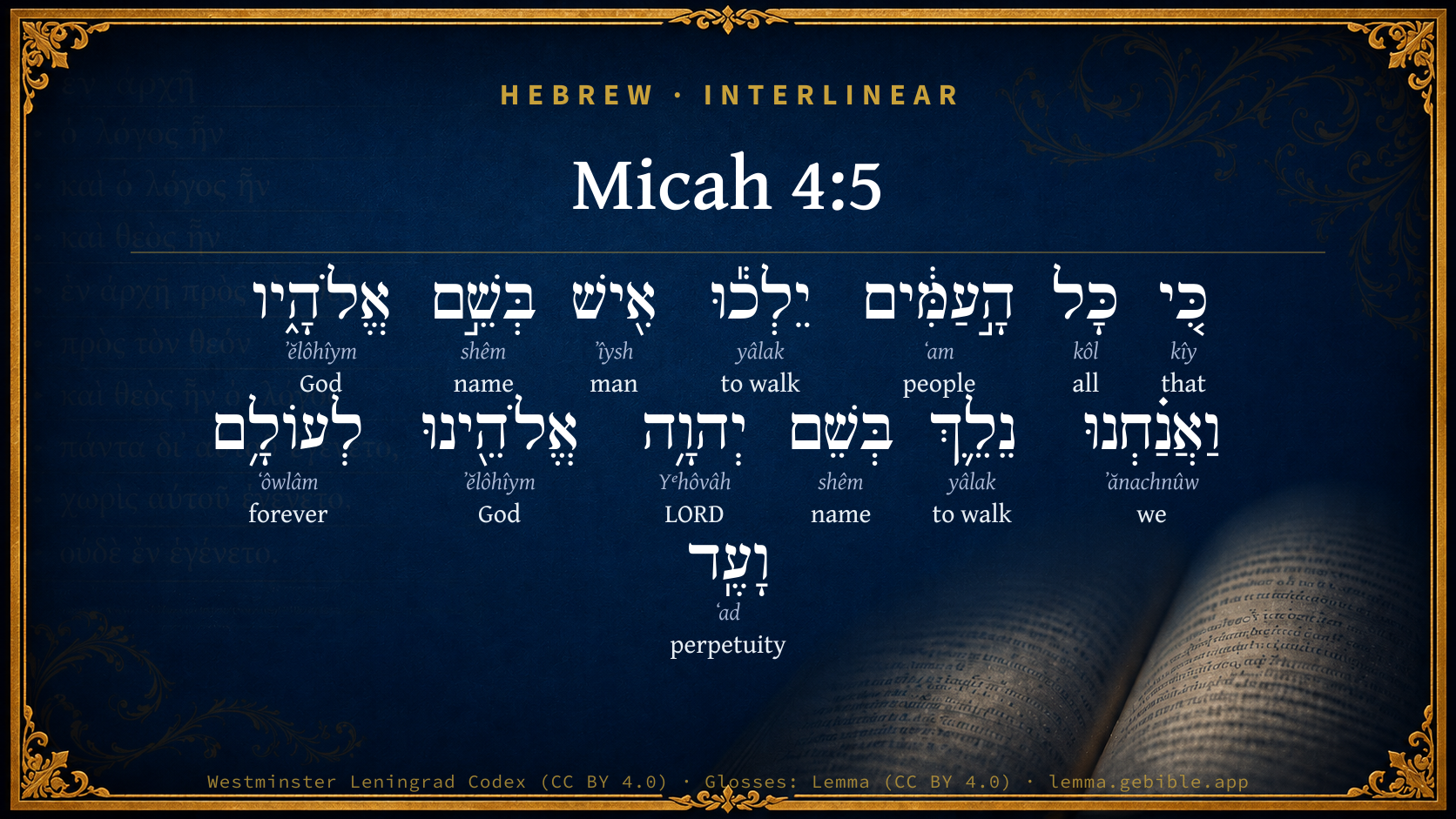
Hebrew (Westminster Leningrad Codex) Micah 4:5 appears in the Hebrew Old Testament. The text above is from the Westminster Leningrad Codex. Each word links to its Strong’s number, a concise gloss, and parsing drawn from the Open Scriptures Hebrew Bible morphology. Click any word for its full Brown-Driver-Briggs (BDB) entry.
Download image
Cite this verse

Micah 4:5 (World English Bible). Public Domain. Lemma interlinear Bible study tool, https://lemma.gebible.app/v/micah/4/5.

Show BibTeX & RIS
BibTeX
RIS
English Translation
Indeed all the nations may walk in the name of their gods; But we will walk in the name of Yahweh our God forever and ever.
World English Bible · Public Domain
Download a study sheet

One document with this verse’s original text, its word-by-word gloss line, the meaning frame, cross-references with their text, attributed commentary, and full source and license credits — printable, and it pastes into notes with its structure intact.

This verse Autodidact and up

Study sheet (.html) Plain text (.txt)

A passage Seminary Student

Up to 50 verses in one chapter. A passage sheet keeps up to 6 commentary sources and 12 cross-references per verse, in the order this page ranks them, and says so on the sheet whenever that leaves anything out. Ask for a single verse and you get the Autodidact verse sheet above.

Everything on this page stays free to read, with no account — the sheet is a download of what is already on screen, not access to it.

Want to remove ads? Support Godless Engineer
Compare translations 3

The same verse in 3 English versions, stacked beneath the original-language interlinear above. Click any original word for its lexicon entry.

Each is an independent rendering of the whole verse — the interlinear is not word-aligned to these translations.

Highlighted words mark where these versions differ — a whole-verse word diff, not a word-by-word alignment.

  • World English Bible Public Domain
    Indeed all the nations may walk in the name of their gods; But we will walk in the name of Yahweh our God forever and ever.
  • King James Version Public Domain
    For all people will walk every one in the name of his god, and we will walk in the name of the LORD our God for ever and ever.
  • unfoldingWord Literal Text CC BY-SA 4.0
    For all the peoples walk, each one, in the name of his god. But we, we will walk in the name of Yahweh our God forever and ever.

unfoldingWord Literal Text — © unfoldingWord, licensed CC BY-SA 4.0. Word-aligned USFM3 via Door43 (git.door43.org/unfoldingWord/en_ult).

Versions to compare (up to 4)

3 of 4 selected

Show all 18 translations

Every available English version of this verse, each an independent rendering of the whole verse.

  • World English Bible Public Domain
    Indeed all the nations may walk in the name of their gods; But we will walk in the name of Yahweh our God forever and ever.
  • Berean Standard Bible Public Domain
    Though each of the peoples may walk in the name of his god, yet we will walk in the name of the LORD our God forever and ever.
  • Majority Standard Bible Public Domain
    Though all the nations may walk in the name of their gods, yet we will walk in the name of the LORD our God forever and ever.
  • King James Version Public Domain
    For all people will walk every one in the name of his god, and we will walk in the name of the LORD our God for ever and ever.
  • American Standard Version (1901) Public Domain
    For all the peoples walk every one in the name of his god; and we will walk in the name of Jehovah our God for ever and ever.
  • Revised Version (1885) Public Domain
    For all the peoples will walk every one in the name of his god, and we will walk in the name of the LORD our God for ever and ever.
  • Geneva Bible (1599) Public Domain
    For all people will walke euery one in the name of his God, and we will walke in the Name of the Lord our God, for euer and euer.
  • Douay-Rheims (1899) Public Domain
    For all people will walk every one in the name of his god: but we will walk in the name of the Lord our God for ever and ever.
  • Young's Literal Translation Public Domain
    For all the peoples do walk, Each in the name of its god -- and we, We do walk in the name of Jehovah our God, To the age and for ever.
  • Literal Standard Version CC BY-SA 4.0
    For all the peoples walk, || Each in the name of its god—and we, || We walk in the Name of our God YHWH, || For all time and forever.
  • Unlocked Literal Bible CC BY-SA 4.0
    For all the peoples walk, each one, in the name of their god. But we will walk in the name of Yahweh our God forever and ever.
  • unfoldingWord Literal Text CC BY-SA 4.0
    For all the peoples walk, each one, in the name of his god. But we, we will walk in the name of Yahweh our God forever and ever.
  • Darby Bible Public Domain
    For all the peoples will walk every one in the name of his god; but we will walk in the name of Jehovah, our God for ever and ever.
  • World Messianic Bible Public Domain
    Indeed all the nations may walk in the name of their gods, but we will walk in the name of the LORD our God forever and ever.
  • Webster's Bible Public Domain
    For all people will walk every one in the name of his god, and we will walk in the name of the LORD our God for ever and ever.
  • Free Bible Version CC BY-SA 4.0
    Even though all the other nations follow their gods, we will follow the Lord our God forever and ever.
  • Bible in Basic English Public Domain
    For all the peoples will be walking, every one in the name of his god, and we will be walking in the name of the Lord our God for ever and ever.
  • JPS Tanakh (1917) Public Domain
    For let all the peoples walk each one in the name of its god, but we will walk in the name of the LORD our God for ever and ever.

Literal Standard Version (2020), Covenant Press — licensed CC BY-SA 4.0. Text via the HelloAO Bible API (eBible.org). Unlocked Literal Bible (unfoldingWord) — licensed CC BY-SA 4.0. Text via the HelloAO Bible API (eBible.org). unfoldingWord Literal Text — © unfoldingWord, licensed CC BY-SA 4.0. Word-aligned USFM3 via Door43 (git.door43.org/unfoldingWord/en_ult). Free Bible Version, Dr. Jonathan Gallagher — licensed CC BY-SA 4.0. Text via the HelloAO Bible API (eBible.org).

Word by word

More ways to search: Search by grammar → Find every occurrence → Compare this word →

Practice this passage: Drill this verse → Learn its vocabulary →

וָעֶֽד
ʻad
H5703
“and · perpetuity”
Conjunction + Noun, Common, Masculine, Singular, Absolute
Part of Speech
Conjunction + Noun
Type
Common
Gender
Masculine
Number
Singular
State
Absolute
Full BDB Definition

Origin: from H5710

TWOT: 1565a

perpetuity, for ever, continuing future - ancient (of past time) - for ever (of future time) - of continuous existence - for ever (of God's existence)
  1. כִּ֚י kîy H3588 “that” Conjunction
  2. כָּל kôl H3605 “all of” Noun, Common, Masculine, Singular, Construct
  3. הָ֣עַמִּ֔ים ʻam H5971 “the · peoples” Particle, Definite Article + Noun, Common, Masculine, Plural, Absolute
  4. יֵלְכ֕וּ yâlak H3212 “to walk” Verb, Qal, Imperfect, 3rd Person, Masculine, Plural
  5. אִ֖ישׁ ʼîysh H376 “man” Noun, Common, Masculine, Singular, Absolute
  6. בְּשֵׁ֣ם shêm H8034 “in/at · name of” Preposition + Noun, Common, Masculine, Singular, Construct
  7. אֱלֹהָ֑יו ʼĕlôhîym H430 “God(s) · his” Noun, Common, Masculine, Plural, Construct + Suffix, Personal, 3rd Person, Masculine, Singular
  8. וַאֲנַ֗חְנוּ ʼănachnûw H587 “and · we” Conjunction + Pronoun, Personal, 1st Person, Common, Plural
  9. נֵלֵ֛ךְ yâlak H3212 “to walk” Verb, Qal, Imperfect, 1st Person, Common, Plural
  10. בְּשֵׁם shêm H8034 “in/at · name of” Preposition + Noun, Common, Masculine, Singular, Construct
  11. יְהוָ֥ה Yᵉhôvâh H3068 “LORD” Noun, Proper
  12. אֱלֹהֵ֖ינוּ ʼĕlôhîym H430 “God(s) · our” Noun, Common, Masculine, Plural, Construct + Suffix, Personal, 1st Person, Common, Plural
  13. לְעוֹלָ֥ם ʻôwlâm H5769 “to/for · forever” Preposition + Noun, Common, Masculine, Singular, Absolute

About this verse

These counts appear in no published source. They are computed here, from the morphology-tagged text and Lemma’s own curated glosses. What Lemma adds →

14
words
11
distinct lemmas
Prophets
section

Shared distinctive vocabulary

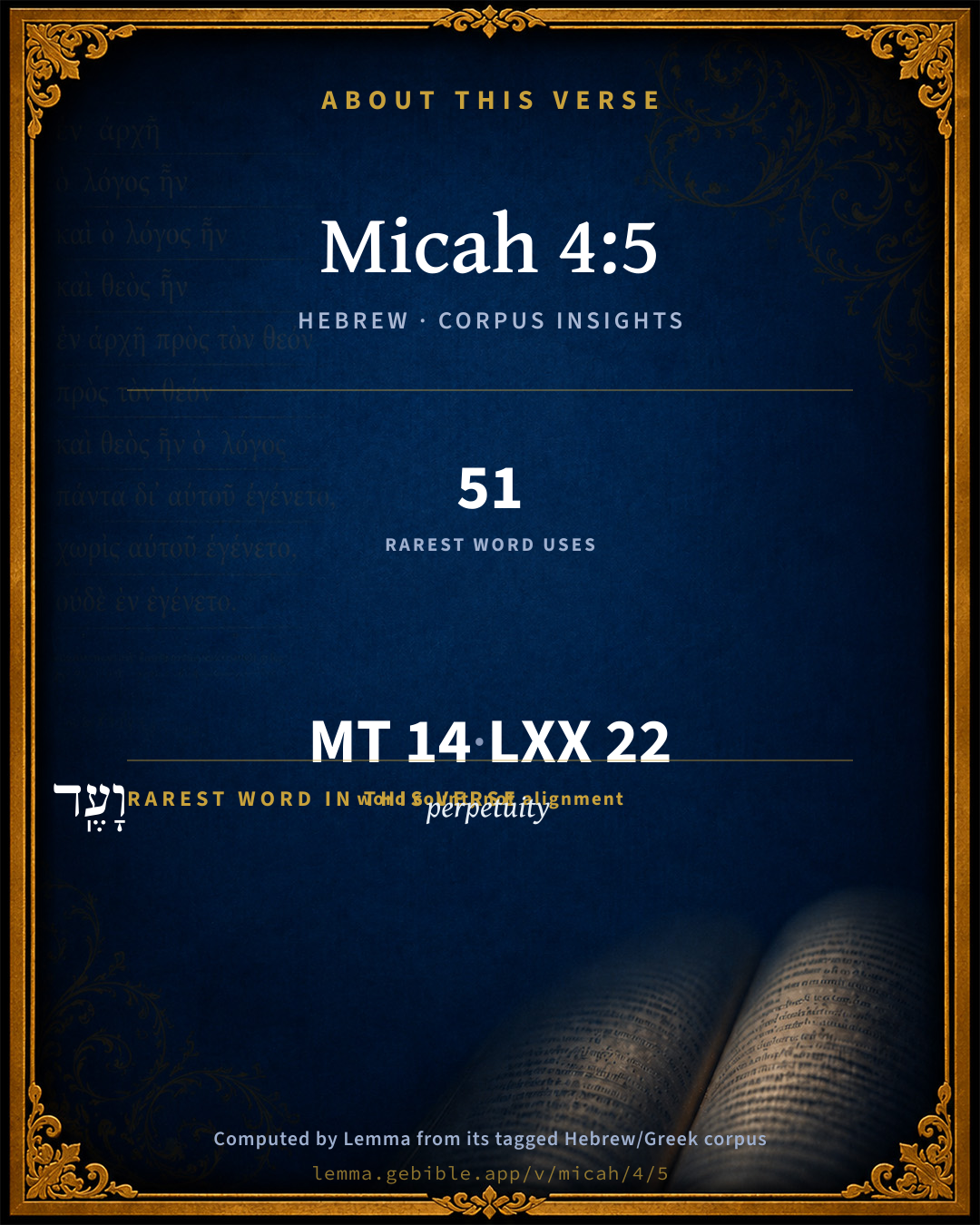
וָעֶֽד perpetuity H5703 occurs in 49 verses of the Hebrew Bible. Also found in:

Grammatical profile

  • 2 verbs
  • 10 nouns
  • 1 pronoun
  • 1 conjunction

Verb forms

  • יֵלְכ֕וּ Qal · Imperfect
  • נֵלֵ֛ךְ Qal · Imperfect

Repetition

Words recur within this verse — often emphatic in Hebrew:

  • יֵלְכ֕וּ to walk H3212 ×2
  • בְּשֵׁ֣ם name H8034 ×2
  • אֱלֹהָ֑יו God H430 ×2

Hebrew & Septuagint length

In English translation the verse runs 26 words from the Hebrew and 27 from the Septuagint (LXX English) — closely comparable.

A rough comparison of the two English renderings, which tokenize alike — not a word-level alignment.

Word counts can differ between the Hebrew and the Greek without any difference in meaning — e.g. the Hebrew direct-object marker אֵת has no separate Greek word, and Greek often adds the article ὁ.

In the original languages it is 14 Hebrew tokens and 22 Greek tokens — but the two are counted differently (Hebrew bundles its prefixes and suffixes into one token; the Greek is in lemma form), so that isn’t a like-for-like length.

Cross-references

14

Topical passages linked to Micah 4:5 in the Treasury of Scripture Knowledge — connected by theme and wording, ordered by reader-vote popularity; previews shown in the World English Bible.

  • Zechariah 10:12 I will strengthen them in Yahweh; And they will walk up and down in his name," says Yahweh.
  • Joshua 24:15 If it seem evil to you to serve Yahweh, choose you this day whom you will serve; whether the gods which your fathers served that were beyond the River, or the gods of the Amorites, in whose land you dwell: but as for me and my house, we will serve Yahweh.
  • Colossians 3:17 Whatever you do, in word or in deed, do all in the name of the Lord Jesus, giving thanks to God the Father, through him.
  • Psalms 48:14 For this God is our God forever and ever. He will be our guide even to death.
  • Psalms 145:1–2 I will exalt you, my God, the King. I will praise your name forever and ever.
  • Isaiah 2:5 House of Jacob, come, and let us walk in the light of Yahweh.
  • Genesis 17:1 When Abram was ninety-nine years old, Yahweh appeared to Abram, and said to him, "I am God Almighty. Walk before me, and be blameless.
  • 2 Kings 17:29 However every nation made gods of their own, and put them in the houses of the high places which the Samaritans had made, every nation in their cities in which they lived.
  • 2 Kings 17:34 To this day they do after the former manner: they don't fear Yahweh, neither do they after their statutes, or after their ordinances, or after the law or after the commandment which Yahweh commanded the children of Jacob, whom he named Israel;
  • Isaiah 26:8 Yes, in the way of your judgments, Yahweh, have we waited for you; to your name, even to your memorial [name], is the desire of our soul.
  • Colossians 2:6 As therefore you received Christ Jesus, the Lord, walk in him,
  • Exodus 3:14–15 God said to Moses, "I AM WHO I AM," and he said, "You shall tell the children of Israel this: "I AM has sent me to you."
  • Jeremiah 2:10–11 For pass over to the isles of Kittim, and see; and send to Kedar, and consider diligently; and see if there has been such a thing.
  • Psalms 71:16 I will come with the mighty acts of the Lord Yahweh. I will make mention of your righteousness, even of yours alone.

Cross-references courtesy of OpenBible.info (CC BY 4.0).

Hebrew and Greek witnesses Masoretic Hebrew ↔ Greek Septuagint

The same verse in the two great witnesses to the Old Testament, shown verse-for-verse.

These are two independent witnesses, not word-aligned to each other, and the Septuagint is shown in lemma (dictionary) form.

Hebrew Micah 4:5 Masoretic · Westminster Leningrad Codex

כִּ֚י כָּל הָ֣עַמִּ֔ים יֵלְכ֕וּ אִ֖ישׁ בְּשֵׁ֣ם אֱלֹהָ֑יו וַאֲנַ֗חְנוּ נֵלֵ֛ךְ בְּשֵׁם יְהוָ֥ה אֱלֹהֵ֖ינוּ לְעוֹלָ֥ם וָעֶֽד

Indeed all the nations may walk in the name of their gods; But we will walk in the name of Yahweh our God forever and ever.

World English Bible · Public Domain

Greek LXX Micah 4:5 Septuagint · lemma form

ὅτι πᾶς ὁ λαός πορεύομαι ἕκαστος ὁ ὁδός αὐτός ἐγώ δέ πορεύομαι ἐν ὄνομα κύριος θεός ἐγώ εἰς ὁ αἰών καί ἐπέκεινα

For all other nations shall walk everyone in his own way, but we will walk in the name of the Lord our God for ever and ever.

LXX2012 (modern English Septuagint) · Public Domain

Hebrew: Westminster Leningrad Codex (CC BY 4.0). Greek: Septuagint (public domain); English from LXX2012 (modern English Septuagint) (Public Domain). How the Septuagint differs from the Hebrew →

Targum (Aramaic paraphrase)

1

The Targum is the ancient Jewish Aramaic paraphrase of the Hebrew Scriptures — an interpretive translation, not the Hebrew text itself. Onkelos (literal) and Pseudo-Jonathan (expansive) render the Torah, and Jonathan the Prophets. Coverage is partial: where no permissively-licensed English translation exists for a verse, only the Aramaic is shown. This is verse-level text, not a word-by-word alignment to the Hebrew.

  1. Targum Jonathan Prophets (Joshua–Malachi)
    אֲרֵי כָל עַמְמַיָא יָהֲכוּן לַאֲבַדוֹן עַל דִי פְלָחוּ לְטַעֲוָתָא וַאֲנַחְנָא נִתְרְחֵיץ בְּמֵימְרָא דַייָ אֱלָהָנָא לְעַלְמָא וּלְעָלְמֵי עָלְמַיָא:

    (no public-domain English translation for this verse)

    Targum Jonathan — Aramaic: “Mikraot Gedolot” (public domain). English: “Sefaria Community Translation” (CC0 1.0 (public-domain dedication)); “London "Chaldee Paraphrase," 1871” (public domain). Text via Sefaria.

Commentary

Notes on Micah 4:5 from classic Christian and Jewish commentators (each source and its license shown beneath its notes). The classic Christian expositions comment on the surrounding passage and are grouped to its opening verse, so a note may address several verses; the Jewish commentaries on the Tanakh (Rashi and others) are per-verse, so they appear only where the commentator wrote on this verse.

Lemma curates 59 commentaries, every one of them public domain or Creative Commons licensed, each selected and text-cleaned for this edition rather than reprinted as found. About our sources →

Trapp's Complete Commentary

John Trapp

Mic 4:5 For all people will walk every one in the name of his god, and we will walk in the name of the LORD our God for ever and ever.

Ver. 5. For all people will walk every one in the name of his god] They will do so, they are resolved not to alter their religion; as Cicero said, Me ex ea opinione quam a maioribus accepi de cultu deorum, nullius unquam movebit oratio; I will never be dissuaded by any one from that way of Divine worship, which I have received from my forefathers. How wilful at this day are Jews, Papists, Pagans, heretics! And how much easier a matter do we find it to deal with twenty men’s reasons than with one’s man will! A wilful man stands as a stake in the midst of a stream, lets all pass by him, but he stands where he was. Nay, but we will have a king, say they, when they had nothing else to say. Nay, but I will curse howsoever, though against my conscience, said Balaam; and do not the Popish Balaamites as much as this, many of them? As for the vulgar sort of them, they are headlong and headstrong, resolved to retain contra gentes against the people, the senseless superstitions transmitted unto them by their progenitors. But what saith the oracle, Rev 14:7? "Fear God, and give glory to him; for the hour of his judgment is come: and" (whatever your ancestors did) "worship you him that made heaven, and earth, and the sea, and the fountains of waters."

And we will walk in the name of the Lord our God] This was well resolved, and is as well practised by all Christ’s faithful people, who dare not follow a multitude to do evil, Exo 23:2; dare not walk by their fathers’ practice, Jos 24:2; Jos 24:14-15, for they consider that no commandment doth so expressly threaten God’s judgments upon posterity as the second. They therefore resolve to walk in the name, that is, by the laws, and under the view of the Lord their God, who is "God of gods, and Lord of lords, a great God, a mighty, and a terrible," as Moses describeth him, in opposition to all other deities, whether so reputed or deputed, Deu 10:17.

For ever and ever] We will not only take a turn or two in his ways, as temporaries, who are hot at hand but soon tire; and give in but we will hold on a constant course of holiness, and not fail to follow the Lamb whithersoever he goeth, Psa 1:1-1; Joh 8:12; Joh 10:4; Joh 10:14; Rev 7:17. As for those apostates that change their God, that change their glory for that which doth not profit, as they therein commit a horrible wickedness, such as the heavens have cause to be astonished at, Jer 2:11-13; so they could not choose out for themselves a worse condition, Heb 10:37-38 : for what reaon? they put the Son of God to an open shame, Heb 6:6, (like as those that are carted among us are held out as a scorn) and do in effect say, that they have not found him such as they took him for.

John Trapp, A Commentary or Exposition upon All the Books of the Old and New Testament (1647–1656) — public domain. Text from a community e-Sword module.

The Biblical Illustrator

Joseph S. Exell

Mic_4:5

For all people will walk every one in the name of his God, and we will walk in the name of the Lord our God forever and ever

Every nation its God

That this chapter contains a prophecy of the glorious times of the Gospel is the general opinion of all Christian interpreters.

Some things are foretold in it which have never been accomplished in the times of the Jewish Church.

1. That there shall be a general confluence to the true religion and worship of God.

2. That this great and conspicuous society of the Church shall enjoy peace and tranquillity.

3. That internal zeal and devotion shall accompany all this external glory and happiness. That all these would admirably become the Christian Church cannot be doubted.

I. All nations and people generally have some god and religion or other. Atheism is contrary to the common sense of mankind. It will be very hard, if not impossible, to find any nation or people that have lived without a God.

II. All those nations and people that have any belief of a god, have also some devotion, and pay some remarkable reverence towards the deity. The nature and notion of God is so great that it cannot ordinarily miss of affecting men with the greatest seriousness. If any man acknowledges the true God, and has ripe notions of Him, he then apprehends a mighty majesty, invested with infinite power, wisdom, justice, and goodness. He that can think of such a God without a religious reverence must have either something below a human folly, or beyond a human hardiness.

III. The greater the god, and the truer the religion, the more ought to be the devotion. It is most genuine, natural, and reasonable, that the best religion should be attended with the greatest devotion, and the most holy lives. Show--

1. The excellency of our principles, and how much the religion which we profess is better than any other. Represent four things

(1) The antiquity of our religion.

(2) The credibility and easiness of its belief.

(3) The gravity and decency of its rituals.

(4) Its efficaciousness to make men generously good and holy.

IV. With the more ardent zeal and devotion we should treat the true God and the true religion.

1. We ought to be more steadfast and unmovable in our religion than other people are.

2. We ought to outstrip them in good life, in zeal and fervency, as much as we do in our principles and advantages. (J. Goodman, D. D.)

The great resolve

The name of the Lord is a strong tower. We invite you to go about Zion, tell the towers thereof. The various towers of this great spiritual fortress are nothing else than the titles and attributes with which, in His own inspired volume, God has seen meet to make Himself known.

I. Jehovah-Tsidkenu; the Tower of righteousness. Any shelter we can rear is a tower of sand--a citadel of bulrushes--that will leave us naked and defenceless in that solemn hour which is to try every mans work, and every mans righteousness, of what sort it is. Christ hath finished transgression, and made an end of sin, and made reconciliation for iniquity, and brought in everlasting righteousness. To attempt aught of our own by way of supplement or addition to the merits of the Divine surety, would be to seek to gild refined gold, or holding up the taper to help the sunlight.

II. Jehovah-Shalom; the Lord my peace. This spiritual tower of peace stands side by side with the tower of righteousness. The work of righteousness shall be peace. Having made peace, through the blood of His Cross. What a repose this Gospel peace gives amid all the petty troubles of life! It keeps the heart, as in a citadel or garrison. A calm elevation is imparted to the present, and the future can be contemplated undismayed. All that belongs to the Christian; his duties; his engagements; his very cares and difficulties are softened and mellowed with this calm tranquillity; just as in nature the setting sun transforms and metamorphoses the whole landscape into gold.

III. Jehovah-Shammah; the Tower of the Divine presence. God is everywhere. It is a blessed thing for the believer to bear constantly about with him the realised sense of the Divine nearness, and it is his peculiar privilege and prerogative to do so. He is the living God in nature and in providence, guiding and supervising all. But there is a nobler and preeminent sense in which His covenant people can flee into this strong tower. Walking in the name of their God, they can say, The Lord of hosts is with us. Our fellowship with the Father and with His Son Jesus Christ.

IV. Jehovah-Nissi; the Tower of defence. We are still in an enemys country. He that is for us is greater than all that can be against us. The Lord is our defence.

V. Jehovah-Jireh; the Tower of trust. A conquering army must keep near its supplies. And the Christian has His promises of assured help. Each apparently capricious turn in lifes way, all its accidents and incidents are the appointments of infinite wisdom; and they that know Thy name, shall put their trust in Thee. Trust is a staff not for level plains and smooth highways. It is the alpenstock, the pilgrim prop for the mountaineer, for the rugged ascent, for the slippery path, for the glacier crevasse. God is a rich, sure, willing, and wise Provider.

VI. Jehovah-Rophi; the Tower of healing. He proclaims as His name, I am the Lord that healeth thee. He is the true healing tree, which, cast into your bitterest Marsh pool, will make its waters sweet. (J. R. Macduff, D. D.)

Heathen zeal and Christian lukewarmness

The survey of missions under their most glorious aspects may keep men from considering them under less striking, but not less important points of view. Missions, whether successful or unsuccessful, so far as the conversion of pagans is concerned, return one hundredfold multiplied to the land whence they sprang,--return in demonstration of human corruption, and of the need of a Mediator; and of the truth and power of the Gospel,--return in a stimulus to self-examination, in incentive to prayer, and in warning against caring for others, and neglecting ourselves. It is a very peculiar use which may be said to be made of missions in our text. The heathen are surveyed not as abandoning their falsehood and superstition, but as adhering to them with the greatest earnestness and tenacity. From this steadfastness of the heathen the argument is drawn for making the resolve, And we will walk in the name of our Lord God forever and ever. If the pagan adheres to what is false, we will cleave to what is true. The tenacity with which false deities are adhered to, does but set in stronger light the fickleness of the professed servants of the true. What the missionary ascertains is not that idolaters refuse to add to the number of their idols, but only that they will not exchange their idols. If they admit new, they nevertheless adhere to the old. Shall the pagan adhere to his idols, because they were the idols of his fathers; and shall we virtually revolt from that God whom our ancestors served, and whose truth, though at the cost of substance and life, they handed down to us as the most precious possession? We may change our gods, if we will, yielding to the opposition of science, falsely so called; we may burn incense before images, which the madness of speculation would set up, when reason is too proud to bow meekly to revelation. In either case we should be changing our glory for that which cannot profit. Our God is the God of the Bible, a God who has revealed Himself through His Son, Jesus Christ, providing through His obedience and death for our pardon and life. We ask the missionaries this question, Has a people ceased to walk in the name of its god? They have as yet nothing very encouraging to answer. There are cases of individual conversion. The missionary report is a report of adhering to error, and opposition to truth. What inferences are to be drawn from this report--inferences reproachful to ourselves, or containing lessons which it may become us to study and apply with the utmost diligence? The gist of the text is, that the tenacity with which the heathen adhere to their idols, helps to condemn, or display in its atrociousness, the conduct of the Jew, or the Christian, who shall renounce or be cold in the service of his Creator and Redeemer. (Henry Mevill, B. D.)

Mans religious nature

It is trite to say that man has a religious nature. This verse suggests the wrong and the right development of this nature.

I. The wrong development. Idolatry. Polytheism proper is, and generally has been, the most popular religion in the world. Whence comes polytheism? The one great cause, which comprehends all others, is depravity. Which--

1. Involves moral corruption. What are heathen gods, as a rule, but the deification of the lower passions and vices of mankind?

2. Involves carnality. Hence they want a god they can see and handle and touch.

3. Involves thoughtlessness. Polytheism cannot stand reasoning.

II. The right development. What is that? Practical monotheism. We will walk in the name of the Lord our God forever and ever.

1. This is rational. The one God is the sum total of all moral properties, the Proprietor of all resources, and the Bestower of all existences and all the blessings therewith. What can be more rational than to walk in His way?

2. This is obligatory. No man is bound to walk in the name of an idol; nay, he is commanded not to. But every man is bound to walk in the name of the Lord--bound on the ground of His supreme excellence, His relations to man, and the obligation springing therefrom.

3. This is blessed. To walk in His name is to walk through sunny fields abounding with all beauty and fruitfulness. (Homilist.)

The Biblical Illustrator, edited by Joseph S. Exell (c. 1880s–1900s) — public domain. Text from a community e-Sword module.

The Preacher's Complete Homiletical Commentary

Joseph S. Exell (gen. ed.)

CRITICAL NOTES.

Mic_4:5. Name] i.e. profession, and in the strength of Jehovah (cf. 1Sa_17:45; Zec_10:12; Pro_18:10). Heathen gods can do nothing for them.

Mic_4:6. Halteth] Like sheep wearied in a journey. “Limping denotes the miserable condition into which the dispersed have been brought” (cf. Psa_35:15; Psa_38:18). [Keil]. This salvation will not fail, for all the miserable and scattered shall be assembled.

Mic_4:7. Reign] Expresses a perfect monarchy, as it never existed in present or past. “Micah does not mention the descendants of David here, but Jehovah himself, not to exclude the kingdom of David, but to show that God will prove that he was the author of that kingdom, and that all power is his. The prophet therefore indicates a certain difference here between that shadowy kingdom and the new kingdom which God will openly manifest at the advent of the Messiah” [Calvin].

Mic_4:8. Tower] Keeping up the metaphor from sheep, Jerusalem is the tower from which the king guards the flock. Messiah the Shepherd (chap. Mic_5:3); Israel the sheep (chap. Mic_7:14). Unto thee] Affirms more than to thee; expressing the conquest of every obstacle that blocks up the way to the goal [Keil].

HOMILETICS

CHRISTIANITY THE ONLY GUARANTEE FOB BETTER DAYS.—Mic_4:5

The prophet has just predicted a bright future for the Church. But Jehovah alone can bring it to pass. “For” idols are impotent, and those who worship them can do nothing. Christianity is the only hope of mankind. Human systems can never accomplish the work of God.

I. Ancient systems did not bring better days. What have the myths of Egypt, Persia, and India done? What did the religions of Greece and Rome accomplish? Many nations excelled in wealth, intelligence, and refinement, but were degraded in morals. Religion is always more potent than philosophy and culture. The latter can never affect the former. An inferior never changes the character of a superior power. Hence false religions become worse, gravitate to the centre of evil, and lose all influence to elevate and bless the world.

II. Modern systems cannot bring better days. If history and experience determine the fate of nations in the past; if Christianity has been the only power to cope with heathenism and eradicate evil, will the verdict for the future differ from the past? We may advance in commercial prosperity, education, and civilization, without improvement and elevation in morals. The religions of intellect and of emotion, of imagination and sentiment, the theories of philosophy and utility—which are the boast of the present day—will never abolish war and bring the anticipated millennium. In man we cannot trust. In systems half-human and half-divine we have no guarantee for the future. Our faith must stand not in the wisdom of man, but in the power of God. With this we shall be safe, happy, and triumphant. God has promised, and will accomplish better days.

“’Tis coming on the hills of time.

And this old world is growing brighter;

We may not see its dawn sublime,

But high hopes make the heart throb lighter.”

THE ZEAL OF IDOLATERS AN INCENTIVE TO CHRISTIAN LIFE

We may take Mic_4:5 as a resolution of Jewish and Gentile converts to cling to God and walk in his ways, exciting themselves by the example and spirit of idolaters, who were zealous and pertinacious in their ungodly course.

I. Every one has a god. It is a trite but true saying that man will worship. If he does not love the true, he will a false god—an idol. Under the Gospel, and in heathen nations, idolatry is prevalent.

II. Every one makes a profession of his god. “Every one in the name of his god”—that is, under the law and in conformity to the will of his god.

1. It is an open profession. They are not afraid nor ashamed of their profession.

2. It is a consistent profession. They “walk” in the fear, and not against the authority, of their god. Their moral conduct does not contradict their religious faith.

3. It is a stedfast profession. They “will walk.” They were constant and persevering in their practice. They were determined not to forsake their worship; for a nation will seldom change its gods (Jer_2:11).

4. It is a universal profession. For all will walk, “every one,” &c. Hence if these idolaters were so earnest and resolute, what should we do? says the prophet. Their ardour should kindle our indifference; their exactness shame our inconsistency; and their numbers provoke our efforts. Our confession and resolution should be, “We will walk in the name of the Lord our God.” This not occasionally, for since there is nothing unreasonable or wearying in this service, it should be “for ever and ever.”

THE KINGDOM OF CHRIST.—Mic_4:6-8

From the salvation promised even those that are scattered abroad and dwelling in misery will not be excluded. God will finally remove all impediments and bring his people together into one glorious and perpetual kingdom in Christ Jesus.

I. The seat of the kingdom. “The Lord shall reign over them in Mount Zion.” Zion is the place from which the law went out (Mic_4:2), and a type of the Christian Church (Isa_40:9; Isa_52:7). Jerusalem was the special abode of Jehovah, the seat of theocratic government, and the centre of prescribed worship. The Church now is the Mount of God, for elevation and dignity. Here he deigns to dwell, to bless his people, and rule the world. “The city of the Great King.”

II. The subjects of the kingdom. Jew and Gentile, the distant and most degraded, will be gathered together. Persons that are despised and forgotten by human governments, the indigent, and the poor, will become citizens of the Great King.

1. The morally weak. “Her that halteth.” Men are spiritually tired, maimed, and disjointed. Moral halting had been the chief sin of Israel, serving God and Baal (1Ki_18:21). Men halt, hesitate, and counterfeit in God’s service now.

2. The hopelessly scattered. “Her that is driven out.” Jews carried away by force, and Gentiles led by dumb idols (1Co_12:2). All that are dispersed like a flock from the fold of God. “I will save her that halteth, and gather her that was driven out” (Zep_3:16).

3. The grievously distressed. “Her that I have afflicted.” Men are not merely driven out from God, but are sick and afflicted in body and mind. When God afflicts them they are specially dear to him. All grievances shall be redressed, and all distempers healed. “I will seek that which was lost, and bring again that which was driven away, and will bind up that which was broken, and will strengthen that which was sick” (Eze_34:13-16).

III. The glory of the kingdom. The glory of the theocracy was obscured by the sins of kings and priests. Earthly monarchies decay and undergo eclipse; but the glory of this kingdom excelleth.

1. It will be dignified. The kingdom will come to the Church with a glory exceeding “even the first dominion.” It will shine with a greater lustre than the reigns of David and Solomon.

2. It will be strong. “A strong nation.” (a) Strong in numbers. The remnant scattered and depressed shall be restored and multiplied, like the stars of heaven or the sands on the sea-shore. (b) Strong in victory. It will no more be subdued by petty monarchs or neighbouring confederacies. But its strength is not human might, temporal greatness; but strong in spiritual warfare, in faith, and achievements. “A little one shall become a thousand, and a small one a strong nation.”

3. It will be perpetual. The Lord shall reign over them, “even for ever.” The valour and strength of David, the honour and wisdom of Solomon, were but shadows of this kingdom. The King eternal is not subject to mortality, nor exposed to danger. The glory of the Church and the height of its felicity are the constant presence and prerogatives of Christ Jesus. “The Lord God shall give unto him the throne of his father David; and he shall reign over the house of Jacob for ever; and of his kingdom there shall be no end.”

HOMILETIC HINTS AND OUTLINES

Mic_4:5. Contrasts in worship.

1. Men of the world reject God.

2. Men of the world worship their own god.

3. But Christians are determined to love and serve Jehovah. That which is the scandal to the world, to them is a motive to firmness and to union. There are different persuasions in the world, let us be true and cleave together in the right way. “We will walk in the name of the Lord.”

Mic_4:6-8. The flock of Christ.

1. The flock in a state of helplessness. Halt, scattered, and afflicted.

2. The flock gathered together by the Good Shepherd. Gathered by providence and found by grace.

3. The flock defended. From the “tower of the flock,” they are—

(1) inspected;

(2) environed;

(3) shielded. The Church is designed to be a defence and tower of spiritual strength. “At that time they shall call Jerusalem the throne of the Lord; and all the nations shall be gathered together unto it, to the name of the Lord, to Jerusalem.”

Mic_4:7. The Lord shall reign. As King, he—

1. Of rebels makes them subjects, willing to be ruled by him.

2. He preserves them in that privilege by his Spirit.

3. He gives them laws far better than those of the twelve tables in Rome, which yet far exceeded (saith Cicero) all the learned libraries of the philosophers in worth and weight.

4. He sweetly inclineth their wills to yield universal obedience thereunto, and to cross themselves so they may please him.

5. He rewards them with comfort and peace here, and with life eternal hereafter.

6. He destroys all the enemies of his Church, and then, at last, delivers up the kingdom to his Father (1Co_15:24); not his essential kingdom as God, but his economical kingdom as mediator [Trapp].

Mic_4:8. The world is a field, the Church a fold in that field; and a strong fold (strong as a tower), yea, a stronghold; Ophel, as it is styled in the next words; and that of the daughter of Zion, that is, of the Christian Church, the inviolable security whereof is here noted [Ibid.].

Come and arrive. He twice repeats the assurance, in equivalent words, for their fuller assurance, “to make the good tidings the gladder by repeating and enforcing them” [Pusey].

Mic_4:1-8. The kingdom of God.

1. Its central point: the glorified and exalted Zion, the source of the statutes and revelations; and through grace, the ancient, chosen seat of God’s dominion.

2. Its citizens: those who how towards it thirsting for righteousness, longing for salvation.

3. Its order: God’s law and God’s peace (Mic_4:3).

4. Its blessedness: rest, security, prosperity (Mic_4:4).

5. Its duration: eternal, like God himself (Mic_4:5) [Lange].

The Preacher's Complete Homiletical Commentary (gen. ed. Joseph S. Exell; Funk & Wagnalls, c. 1892) — public domain (pre-1929). A full-Bible homiletical/sermon-outline anthology covering 65 of 66 books (2 John is absent from the source module). Text from a community e-Sword module.

Keil & Delitzsch

C. F. Keil & F. Delitzsch

It will not be through any general humanitarian ideas and efforts, however, that the human race will reach this goal, but solely through the omnipotence and faithfulness of the Lord. The reason assigned for the promise points to this. Mic 4:5. "For all nations walk every man in the name of his God, but we walk in the name of Jehovah our God for ever and ever." This verse does not contain an exhortation, or a resolution to walk in the name of God, which involves an exhortation, in the sense of "if all nations walk, etc., then we will," etc.; for an admonition or a resolution neither suits the connection, in the midst of simple promises, nor the words themselves, since we should at any rate expect נלכה instead of נלך. The sameness in the form of the verbs ילכוּ and נלך requires that they should be understood in the same way. Walking in the name of God does not mean regulating the conduct according to the name of a God, i.e., according to the nature which expresses itself in the name, or worshipping him in a manner corresponding to his nature (Caspari), but walking in the strength of God, in which the nature of this God is displayed. This is the meaning of the phrase in Sa1 17:45 and Zac 10:12, where "I strengthen them in Jehovah" forms the basis of "and in His name will they walk" (compare Pro 18:10, "The name of the Lord is a strong tower"). But the gods of all the nations, i.e., of all the heathen, are worthless beings, without life, without strength. Jehovah, on the contrary, is the only true God, the almighty Creator and Governor of the world. And the heathen, with their worthless gods, can do nothing to Him and the nation which walks in His name, his strength. If, therefore, Israel rejoices for ever and ever in the strength of its God, the heathen nations cannot disturb the peace which He will create for Israel and all who accept His word. In this way is the promise in Mic 4:3 and Mic 4:4 explained in Mic 4:5. But this explanation assumes that, even at the time when many nations stream to the mountain of the Lord, there will still be nations that do not seek Jehovah and His word, - a thought which is still further expanded in v. Mic 5:4., and involves this consolation, that such opponents of the people of God as shall be still in existence will not be able to interfere with the salvation which has been prepared for it by its God.

Keil & Delitzsch — Biblical Commentary on the Old Testament (1861–1891) — public domain (CC PDM 1.0). Text via the HelloAO Bible API. (Old Testament only.)

MacLaren's Expositions of Holy Scripture

Alexander MacLaren

Micah

AS GOD, SO WORSHIPPER

Mic 4:5.

This is a statement of a general truth which holds good of all sorts of religion. ‘To walk’ is equivalent to carrying on a course of practical activity. ‘The name’ of a god is his manifested character. So the expression ‘Walk in the name’ means, to live and act according to, and with reference to, and in reliance on, the character of the worshipper’s god. In the Lord’s prayer the petition ‘Hallowed be Thy name’ precedes the petition ‘Thy will be done.’ From reverent thoughts about the name must flow life in reverent conformity to the will.

I. A man’s god is what rules his practical life.

Religion is dependence upon a Being recognised to be perfect and sovereign, whose will guides, and whose character moulds, the whole life. That general statement may be broken up into parts; and we may dwell upon the attitude of dependence, or of that of submission, or upon that of admiration and recognition of ideal perfection, or upon that of aspiration; but we come at last to the one thought-that the goal of religion is likeness and the truest worship is imitation. Such a view of the essence of religion gives point to the question, What is our god? and makes it a very easily applied, and very searching test, of our lives. Whatever we profess, that which we feel ourselves dependent on, that which we invest, erroneously or rightly, with supreme attributes of excellence, that which we aspire after as our highest good, that which shapes and orders the current of our lives, is our god. We call ourselves Christians. I am afraid that if we tried ourselves by such a test, many of us would fail to pass it. It would thin the ranks of all churches as effectually as did Gideon’s ordeal by water, which brought down a mob of ten thousand to a little steadfast band of three hundred. No matter to what church we belong, or how flaming our professions, our practical religion is determined by our answer to the question, What do we most desire? What do we most eagerly pursue? England has as much need as ever the house of Jacob had of the scathing words that poured like molten lead from the lips of Isaiah the son of Amoz, ‘Their land is full of silver and gold, neither is there any end of their treasures. Their land is also full of idols: they worship the work of their own hands.’ Money, knowledge, the good opinion of our fellows, success in a political career-these, and the like, are our gods. There is a worse idolatry than that which bows down before stocks and stones. The aims that absorb us; our highest ideal of excellence; that which possessed, we think would secure our blessedness; that lacking which everything else is insipid and vain-these are our gods: and the solemn prohibition may well be thundered in the ears of the unconscious idolaters not only in the English world, but also in the English churches. ‘Thou shalt not give My glory to another, nor My praise to graven images.’

II. The worshipper will resemble his god in character.

As we have already said, the goal of religion is likeness, and the truest worship is imitation. It is proved by the universal experience of humanity that the level of morality will never rise above the type enshrined in their gods; or if it does, in consequence of contact with a higher type in a higher religion, the old gods will be flung to the moles and the bats. ‘They that make them are like unto them; so is every one that trusteth in them.’ That is a universal truth. The worshippers were in the Prophet’s thought as dumb and dead as the idols. They who ‘worship vanity’ inevitably ‘become vain.’ A Venus or a Jupiter, a Baal or an Ashtoreth, sets the tone of morals.

This truth is abundantly enforced by observation of the characters of the men amongst us who are practical idolaters. They are narrowed and lowered to correspond with their gods. Low ideals can never lead to lofty lives. The worship of money makes the complexion yellow, like jaundice. A man who concentrates his life’s effort upon some earthly good, the attainment of which seems to be, so long as it is unattained, his passport to bliss, thereby blunts many a finer aspiration, and makes himself blind to many a nobler vision. Men who are always hunting after some paltry and perishable earthly good, become like dogs who follow scent with their noses at the ground, and are unconscious of everything a yard above their heads. We who live amidst the rush of a great commercial community see many instances of lives stiffened, narrowed, impoverished, and hardened by the fierce effort to become rich. And wherever we look with adequate knowledge over the many idolatries of English life, we see similar processes at work on character. Everywhere around us ‘the peoples are walking every one in the name of his god.’ That character constitutes the worshipper’s ideal; it is a pattern to which he aims to be assimilated; it is a good the possession of which he thinks will make him blessed; it is that for which he willingly sacrifices much which a clearer vision would teach him is far more precious than that for which he is content to barter it.

The idolaters walking in the name of their god is a rebuke to the Christian men who with faltering steps and many an aberration are seeking to walk in the name of the Lord their God. If He is in any real and deep sense ‘our God,’ we shall see in Him the realised ideal of all excellence, the fountain of all our blessedness, the supreme good for our seeking hearts, the sovereign authority to sway our wills; the measure of our conscious possession of Him will be the measure of our glad imitation of Him, and our joyful spirits, enfranchised by the assurance of our loving possession of Him who is love, will hear Him ever whisper to us, ‘Be ye perfect as your Father which is in heaven is perfect.’ The desire to reproduce in the narrow bounds of our human spirits the infinite beauties of the Lord our God will give elevation to our lives, and dignity to our actions attainable from no other source. If we hallow His name, we shall do His will, and earth will become a foretaste of heaven.

III. The worshipper will resemble his god in fate.

We may observe that it is only of God’s people that Micah in our text applies the words ‘for ever and ever.’ ‘The peoples’’ worship perishes. They walk for a time in the name of their god, but what comes of it at last is veiled in silence. It is Jehovah’s worshippers who walk in His name for ever and ever, and of whom the great words are true, ‘Because I live ye shall live also.’ We may be sure of this that all the divine attributes are pledged for our immortality; we may be sure, too, that a soul which here follows in the footsteps of Jesus, which in its earthly life walked in the name of the Lord its God, will continue across the narrow bridge, and go onward ‘for ever and ever’ in direct progress in the same direction in which it began on earth. The imitation, which is the practical religion of every Christian, has for its only possible result the climax of likeness. The partial likeness is attained on earth by contemplation, by aspiration, and by effort; but it is perfected in the heavens by the perfect vision of His perfect face. ‘We shall be like Him, for we shall see Him as He is.’ Not till it has reached its goal can the Christian life begun here be conceived as ended. It shall never be said of any one who tried by God’s help to walk ‘in the name of the Lord’ that he was lost in the desert, and never reached his journey’s end. The peoples who walked in the name of any false god will find their path ending as on the edge of a precipice, or in an unfathomable bog; loss, and woe, and shame will be their portion. But ‘the name of the Lord is a strong tower,’ into which whoever will may run and be safe, and to walk in the name of the Lord is to walk on a way ‘that shall be called the Way of Holiness, whereon no ravenous beast shall go up, but the redeemed shall walk there,’ and all that are on it ‘shall come with singing to Zion, and everlasting joy shall be upon their heads.’

Alexander MacLaren, Expositions of Holy Scripture (1904–1910) — public domain. Text from a community e-Sword module.

Geneva Bible (1599)

Geneva Bible translators

He showeth that the people of God ought to remain constant in their religion, albeit all the world should give themselves to their superstition and idolatry.

Geneva Bible (1599) marginal notes — public domain. Text via Bolls.life.

Jamieson, Fausset & Brown

Robert Jamieson, A. R. Fausset & David Brown

For--rather, Though it be that all people walk after their several gods, yet we (the Jews in the dispersion) will walk in the name of the Lord. So the Hebrew particle means in the Margin, Gen 8:21; Exo 13:17; Jos 17:18. The resolution of the exile Jews is: As Jehovah gives us hope of so glorious a restoration, notwithstanding the overthrow of our temple and nation, we must in confident reliance on His promise persevere in the true worship of Him, however the nations around, our superiors now in strength and numbers, walk after their gods [ROSENMULLER]. As the Jews were thoroughly weaned from idols by the Babylonian captivity, so they shall be completely cured of unbelief by their present long dispersion (Zac 10:8-12).

Jamieson, Fausset & Brown — Commentary Critical and Explanatory on the Whole Bible (1871) — public domain (CC PDM 1.0). Text via the HelloAO Bible API.

Adam Clarke's Commentary

Verse 5. Every one in the name of his god] This shall be the state of the Gentile world; but after the captivity, the Jews walked in the name of Jehovah alone; and acknowledge no other object of religious worship to the present day.

Adam Clarke's Commentary on the Bible (1810–1826) — public domain. Text from a community e-Sword/MySword module.

John Calvin's Commentaries

Micah, after having spoken of the restoration of the Church, now confirms the same truth, and shows that the faithful would have reason enough to cleave constantly to their God, and to despise all the superstitions of the world, and that though they may be tossed here and there by contrary opinions, they will yet continue in true religion. This verse then is connected with the kingdom of Christ; for until we are gathered, and Christ shines among us and rules us by his word, there can be in us no constancy, no firmness. But when under the auspices of Christ, we join together in one body the Church, such then becomes the constancy of our faith, that nothing can turn us from the right course, though new storms were at any time to arise, by which the whole world might be shaken, and though it were to happen that the universe should be agitated or pass away. We now understand what the Prophet means.

He therefore says, All nations shall walk every one in the name of his god. This sentence must be thus explained, — “Though nations be divided into various sects, and each be addicted to their own superstitions, yet we shall continue firm in the pure worship of God and in unity of faith.” But this question occurs, how could the Prophet say that there would be such discords in the world, when he had shortly before spoken of the Church being gathered and united together? for he had said, Come shall all nations, and each will say, Come, let us ascend into the mount of Jehovah. There seems to be here some sort of inconsistency, — that all nations would come to mount Zion, and yet that every people would have their own gods. But the solution is not difficult: the Prophet in this verse strengthens the faithful, until Christ should be revealed to the world: nor is there any doubt but the Prophet intended to sustain the confidence of the godly, who might have otherwise been overwhelmed a hundred times with despair. When the children of Israel were driven into exile, when their inheritance was taken away from them, when the temple had been demolished, when, in a word, no visible religion existed, they might, as I have said, have desponded, had not this promise come to their minds, — that God would restore mount Zion, and gather a Church from the whole world. But there was also need of some confirmation, and this is what the Prophet now subjoins. Hence he says, “Since the Lord gives you hope of so glorious a restoration, you ought to feel confidence. and, in reliance on his promise, to continue in his true worship, how much soever the Gentiles may serve their own idols, and boast that they have the true God. However, then, every one of the nations may take pride in their superstitions, you ought not to fluctuate, nor turn here and there, like reeds, which are tossed to and fro, as the wind changes; but ye shall continue firm and steady in your course; for ye know that God is true, who has once for all adopted you, and has promised that your salvation will be the object of his care, even when the world shall think you to be ruined and lost.”

We hence see that what the Prophet had in view was to raise up into confidence the minds of the godly in the midst not only of troubles, but of utter confusion. All nations then shall walk, that is, when the temple and the city shall be demolished, and the people be led into distant exile, the ungodly will, at the same time, triumph, every one will extol his own gods: though our God should not then appear, there will yet be no reason why we should be discouraged; but we ought to recomb on his word. We shall then walk in the name of our God, and that for ever and ever; that is, though it should happen that the world should a hundred times be turned and turned over again, there shall yet be no change in our minds: for as the truth of God is eternal, so also our faith ought to be constant and never to vary. Now the difficulty is removed, and we see how these two things agree, — that all nations shall come and with one consent worship God, and yet that to each of them there would be their own gods: for the diversity of time must be here regarded, when all nations would walk every one in the name of his god.

By saying, איש בשם אלהיו, aish beshem Aleiu, he touches, in an indirect way, on that variety which exists among men. Though all of them pertinaciously follow and defend their own superstitions yet each one fabricates a goal for himself. Thus it happens, that nothing is certain, for they follow only their own inventions. But this the Prophet meant only to touch by the way. His main object was that which I have stated, — that though the Church of God would be small, and should find a great multitude opposed to it, it ought not yet to succumb. We know how violent a thing is public consent; for when the majority conspire together, the small number, who entertain a different opinion, are, as it were instantly swallowed up. It is not then without reason that the Prophet exhorts the faithful here to an invincible firmness of mind, that they might triumph over all the nations. However small, then, might be the faithful in number, the Prophet wished them to look down, as it were from a higher place, not only on a large multitudes but on all mankind. Though then all nations walk, etc.: nor is the word כל, cal, all, superfluous, — though all nations shall walk, etc. There was then but one nation, the offspring of Abraham, among whom true religion existed; and it was a dreadful devastation, when God suffered the royal city and the temple to be pulled down, and the whole body of the people to be torn asunder, to be driven away here and there, so that no kingdom and no kind of civil community remained. Hence the Prophet intimates here, that though the faithful should find that in number and dignity they were far surpassed by their enemies, they yet should not despair. “Though then all the nations walked, every one in the name of their god, — though every people set up their superstitions against you, and all conspired against you together, yet stand ye firm and proceed in your course, and this not for a short time, but for ever and ever.” Now this passage shows that faith depends not on the suffrages of men, and that we ought not to regard what any one may think, or what may be the consent of all; for the truth of God alone ought to be deemed sufficient by us. How much soever, then, the whole world may oppose God, our faith ought not to be changeable, but remain firm on this strong foundation, — that God, who cannot deceive, has spoken. This is one thing. Then, in the second place, it must be added, that this firmness ought to be perpetual. Though then Satan may excite against us new troubles, since we have hitherto stood firm as to our faith in God’s word, let us proceed in the same course to the end. And the Prophet designedly added this verse; because he saw that the people would be subject to various and long-continued temptations. It was a long captivity: hence languor might have, as it were, wasted away all the confidence which the people then had. And further, after they returned from exile, we know how often and how grievously their faith was tried, when all their neighbors inimically assailed them, and when they were afterwards oppressed by cruel tyranny. This was the reason why the Prophet said that the children of God are to walk perpetually and to the end in his name

Though he gives the name of gods to the idols of the nations he yet shows that there is a great and striking difference; for the nations worship their own gods, which they had invented: or how did they derive their majesty and their power, except from the false imagination of men? But the Prophet says, We will walk in the name of Jehovah our God. He hence shows that the power and authority of God is not founded on any vain device of men, for he of himself exists, and will exist, though he were denied by the whole world. And this also confirms what I have already stated, — that the faithful ought thus to embrace the word of God, as they know that they have not to do with men, the credit of whom is doubtful and inconstant, but with him who is the true God, who cannot lie, and whose truth is immutable. Let us proceed —

John Calvin's Commentaries (1540-1563) — public domain. Text from the Calvin Translation Society English edition (1840s-50s) via the Christian Classics Ethereal Library (ccel.org). Calvin's coverage is partial (roughly two-thirds of the Bible); uncommented books and verses are honest gaps, never fabricated. The 19th-century editor's footnotes and remarks are omitted so the notes are faithfully Calvin's own voice.

Ellicott's Commentary for English Readers

(5) For all people will walk.—The comparatively near future to Micah, and the still distant future to us, are blended in the prophet’s vision: just as in the prophecies of our Lord the destruction of Jerusalem is described in terms which have their final accomplishment in the day of judgment. Micah’s description of the universal rule of Messiah is primarily applicable to the antecedent prosperity, after the return of the Jews from the captivity. The zeal of the Jews for Jehovah was stirred up after witnessing the example of “the children of this world” in Babylon. The devotion of the Babylonian princes to their god is strikingly evident in the diaries of Nebuchadnezzar and other prophets, as lately brought to light in The Records of the Past. That zealous Society for a national return to the strictness of the Law of Moses at first distinguished and honoured by the name of Pharisees took its rise after the return from the captivity.

A Bible Commentary for English Readers, edited by Charles John Ellicott (1878–1897) — public domain. Text from a community e-Sword module.

The Cambridge Bible for Schools and Colleges

gen. ed. J. J. S. Perowne

5. Transition. For all people will walk …] Rather, For all peoples walk, &c. The ideal time described in Mic_4:1-4 is still far distant. ‘The nations abroad all worship gods of their own; let us therefore all the more steadily walk in the name of our God.’ The ‘name’ of God is that side of His nature which can be revealed to man (sometimes spoken of, even in the Old Testament, as a Divine Person, e. g. Isa_30:27; Isa_59:19); and to walk in this name means to live in mystic union with God as He has revealed Himself, and under His protection. ‘To walk for ever and ever’ is opposed to the temporary ‘walking’ of the idolaters. ‘The everlasting God’ (Isa_40:28) confers the attribute of everlastingness on His people.’ Comp. Isa_45:16-17 (contrast between the destruction of the idolaters and the ‘everlasting salvation’ of Israel).

The Cambridge Bible for Schools and Colleges (gen. ed. J. J. S. Perowne; Cambridge University Press, 1878–1918) — public domain. Text from a community e-Sword module.

John Gill's Exposition

For all people will walk everyone in the name of his god,.... Till those times come before described; when many nations and people shall flock to the church, and there shall be such general peace and tranquillity as here promised; till then the nations of the earth shall retain their former religion, and the profession of it, with constancy, till they are otherwise instructed, as Aben Ezra; or till the Messiah shall turn them into the right way, as Kimchi; till that time comes, the Pagans will worship their idols, and continue in the idolatry of their ancestors; the Papists will retain their image worship, and hold to their lord god the pope, as they call him; the Mahometans will cleave to their prophet, and walk according to the rules he has left them to observe. Jarchi's note is,

"they shall go to destruction because of their idolatry;''

with which he says the Targum agrees, which is,

"all nations shall go according to the idols they have worshipped;''

or, as the king of Spain's Bible,

"they shall be guilty or condemned because they have worshipped idols:''

and we will walk in the name of the Lord our God for ever and ever; both in the mean while, and when those happy times shall come, and so through all generations as long as the world stands. This is the language of those that know the Lord, believe in him, and sincerely serve him; who determine in the strength of divine grace to continue in their profession of faith of him, in his worship and service, in his ways, truths, and ordinances, whatever others, do; and indeed are the more animated to it, when they observe how constant and steadfast idolaters, Pagans, Papists, and Mahometans, are in their false worship, both in the profession and practice of it. The Targum is,

"we will trust in the Word of the Lord our God for ever and ever;''

in Christ the essential Word; and so the phrase is expressive of faith, and a profession of faith in him; and of constant attendance upon his word and ordinances.

John Gill's Exposition of the Whole Bible (1746–1763) — public domain (CC PDM 1.0). Text via the HelloAO Bible API.

Albert Barnes' Notes on the Bible

For all people well walk, every one in the name of his god, and we will walk in the name of the Lord our God - Hitherto unsteadfastness had been the very characteristic sin of Israel. It was , “constant only in its inconstancy,” ever “falling away like their forefathers, starting aside like a broken bow” Psa 78:57. The pagan persevered in their worship, because it was evil or had evil in it, not checking but feeding their passions. Israel did not persevere in his, because it required him to deny himself things unlawful. “Hath a nation changed their gods which are yet no gods? But My people have changed their glow for that which doth not profit” Jer 2:11. Henceforth, the prophet professeth for his people, the true Israel, that he will be as steadfast in good, as the pagan in evil; so our Lord sets forth “the children of this world in their generation” Luk 16:8, as an example of wisdom to the children of light.

Cyril: “They who are eager to go up into the mountain of the Lord, and wish to learn thoroughly His ways, promise a ready obedience, and receive in themselves the glories of the life in Christ, and undertake with their whole strength to be earnest in all holiness. ‘For let every one,’ he saith, ‘in every country and city go the way himself chooseth, and pass his life, as to him seemeth good; but our care is Christ, and His laws we will make our straight path; we will walk along with Him; and that not for this life only, present or past, but yet more for what is beyond’ 2Ti 2:11-12; Rom 8:17; Rev 3:4. It is a faithful saying. For they who now suffer with Him, shall walk with Him forever, and with Him be glorified, and with Him reign. But they make Christ their care, who prefer nothing to His love, who cease from the vain distractions of the world, and seek rather righteousness and what is pleasing unto Him, and to excell in virtue. Such an one was the divine Paul; for he writeth, “I am crucified with Christ; and now no longer I live, but Christ liveth in me” Gal 2:20; and again, “I determined not to know anything among you, save Jesus Christ, and Him crucified” 1Co 2:2.

To “walk” is so uniformly in Holy Scripture used of a person’s moral or religious “ways” . p. 378, and above on Mic 2:11, p. 35. So again to walk with God, Gen 5:22 or before God, Gen 17:1 or contrary to God, Lev 26:21.) (as we say), that the prophet here too is doubtless speaking of the opposite religious ways of the pagan and of the future people of God. The “name” was often, in Hebrew, expressive of the character; and, in regard to God Himself, that Name which He vouchsafed to give to Himself , expressed His Self-existence, and, as a result, His Unchangeableness and His Faithfulness. The names, by which it was foretold that Christ should be called, express both His Deity and attributes ; the human Name, which He bare and vouchsafes to bear yet, was significant of His office for us, Saviour Mat 1:21.

To praise “the Name of the Lord” then, is to praise Him in that character or relation which He has revealed to us. : “He ‘walketh in the Name of the Lord,’ who ordereth every act and motion worthily of the vocation wherewith he is called, and, “whether he eateth or drinketh, doth all to the glory of God. 1Co 10:31” this promise hath its own reward; for it is “forever and ever.” They who “walk in the Name of the Lord,” shall “walk before Him in, the land of the living, forever and ever” Psa 116:9. Such walk on, with quickened steps, lingering not, “in the Name of the Lord our God,” that is, doing all things in His Name, as His great Name requires, conformed to the holiness and all other qualities which His Name expresseth. “For ever and ever, literally forever and yet, or, more strictly still, for that which is hidden and yet,” which is the utmost thought of eternity we can come to. Time indeed has no relation to eternity; for time, being God’s creature, is infinite. Still, practically to us, our nearest conception of eternity, is existence, on and on and on, an endless, unchanging, ever-prolonged future, lost in distance and hidden from us, and then, and yet, an ever-to-come yet, which shalt never come to an end. Well then may we not faint, as tho’ it were long to toil or to do without this or that, since the part of our way which lies amid toils and weariness is so short, and will soon be at an end; what lies beyond, in joy, is infinite in infinite joy, ever full and still ever a yet to come.

The prophet says, “we will walk;” , “uniting himself in longing, hope, faith, to the sons of the New Testament, that is, Christians, as his brethren, re-born by the grace of the same Christ;” , “ministers of the Old, heirs of the New Testament, because they loved through that same faith whereby we love; believing in the Incarnation, Passion, Resurrection of Christ yet to be, as we believe in it, having been.”

Albert Barnes' Notes on the Bible (1834–1885) — public domain. Text from a community e-Sword/MySword module.

Haydock's Catholic Bible Commentary

And ever. After the captivity the Gentiles continued to worship idols, and the Jews had a greater aversion for them; but when the gospel was propagated, idols fell into contempt, and the Jewish law was at an end, while heretics were varying continually. The Church alone is stable, and built upon the rock. (Calmet) --- All such quiet people as walk in the name of the Lord, will keep peace even with those who hate it, (Psalm cxix.) suffering persecution with joy, Hebrews x. 34. (St. Irenæus iv. 67.; St. Cyril, &c.) (Worthington)

George Leo Haydock (1774–1849), Haydock's Catholic Family Bible and Commentary, 1859 edition — public domain. Excludes Psalms (Douay-Rheims chapter numbering differs from Protestant) and Deuterocanonical books (Catholic canon only).

Matthew Poole's English Annotations

For: this is either a reason why they should be so safe, or else.a declaration of their resolution to take this course, that it may be so with them, and so the Hebrew particle may certainly be rendered.

All people will walk every one in the name of his god; it is a received rule that they ought, and it is a constant practice with the nations, they will pray to, depend on, and serve their gods, and think by this course to receive their expected blessings; they are constant to their gods, Jer 2:11.

We will walk in the name of the Lord our God; seek the Lord, embrace his law and worship, wait on him as the Fountain and Giver of all good: as he is the Lord who can give us vines and fig trees, and can give us safety under them; as he is our God, and engaged by promise to do all this for us; in his name we will walk, and so shall we be safe and enjoy all good from him; we will have no other lovers, nor go after them, though we. have done so, Hos 2:6,7. This was in letter and in part fulfilled, when upon their return out of captivity they did abandon all false gods, and worshipped God alone. And it is fulfilled more eminently in all the Israel of God, who turn from dumb idols to serve the living and true God.

For ever and ever; unchangeably, through the succession of ages, among the restored Jews and the redeemed Gentiles.

Matthew Poole's English Annotations on the Holy Bible (1683–1685) — public domain. Text from a community e-Sword/MySword module.

The Pulpit Commentary

This verse gives the reason why Israel is thus strong and safe. In the parallel passage in Isaiah (Isa_2:5) it is converted into an injunction to the house of Jacob. All people will walk; rather, all nations walk. Everyone in the name of his god. "To walk" is generally used of moral and religious habits; (e.g. 2Ch_17:4 Psa_89:31 Eze_5:6, etc.) so here the meaning is that all other nations adhere to their false gods, and frame their life and conduct relying on the power and protection of these inanities, and, by implication, shall find their hope deceived. And we will walk in the name of the Lord our God. This is the secret of Israel"s strength. The heathen can never prevail against the true believers who put their whole trust in the Lord, and live in union with him. By saying we, the prophet identifies himself with the faithful people. Forever and ever . The Church shall never fail. Heathen powers last for a time; the kingdom of Messiah is everlasting.

Man"s religious nature.

"For all people will walk every one in the name of his god, and we will walk in the Name of the Lord our God forever and ever." It is trite to say, what has been said a thousand times, that man has a religious nature. Albeit the practical recognition of the fact is of immense importance; without it, more than half the history of the world would be inexplicable, all methods for its true improvement would be futile, and man would pass through this world to another without a God or any hope for a future. This verse suggests the wrong and the right development of this nature.

I THE WRONG DEVELOPMENT. What is that? Idolatry. "All people will walk every one in the name of his god." Polytheism proper is, and generally has been, the most popular religion in the world. Men have gods which they have made, palpable objects which they fashioned after an ideal, and the ideal not unfrequently of the most base and loathsome kind. And they walk after these gods. The mariners in Jonah"s vessel, when the storm came on, cried every man unto his god. Whence the cause of polytheism?

The one great cause, which comprehends all others, is depravity. Depravity:

1. Involves moral corruption. What are heathen gods, as a rule, but the deification of the lower passions and vices of mankind?

2. Involves carnality. Depraved men are so carnal that they have no idea of real things which have not size and form and tangible properties. Hence they want a god they can see and handle and touch.

3. Involves thoughtlessnss. Polytheism cannot stand reasoning. It is supported by the thoughtless millions through the craft and sophistry of the priests. Every true thought will shatter a heathen deity.

II THE RIGHT DEVELOPMENT. What is that? Practical monotheism. "We will walk in the Name of the Lord our God forever and ever.

1. This is rational. The one God is the sum total of all moral properties, the Proprietor of all resources, and the Bestower of all the existences and all the blessings therewith. What can be more rational than to walk in his way? In truth, it is the only true rational way in life.

2. This is obligatory. No man is bound to walk in the name of an idol; nay, he is commanded not to do so. But every man is bound to walk in the Name of the Lord bound on the ground of his supreme excellence, his relations to man, and the obligation springing therefrom.

3. This is blessed. To walk in his Name is to walk through sunny fields abounding with all beauty and fruitfulness. D.T.

The Pulpit Commentary (1880–1919), ed. H.D.M. Spence-Jones & Joseph S. Exell — public domain. Text from a community e-Sword module.

John Wesley's Explanatory Notes

All people will walk - It is the practice of all nations, to serve their gods. Will walk - Seek the Lord, embrace his law and worship.

John Wesley, Explanatory Notes Upon the Whole Bible (1754–1765) — public domain. Text via the GEBible commentary corpus.

Rashi

Rabbi Shlomo Yitzchaki (Rashi)

For all peoples shall go, each one in the name of his god—Shall go to destruction because they worshipped idols. So did Jonathan render it.

Rashi on the Tanakh — English translations: “The Judaica Press complete Tanach with Rashi, translated by A. J. Rosenberg” (CC BY 4.0); “Pentateuch with Rashi's commentary by M. Rosenbaum and A.M. Silbermann, 1929-1934” (public domain); “The Metsudah Tanach series, Lakewood, N.J” (CC BY 4.0); and “The Book of Joshua, Metsudah Publications, 1997” (CC BY 4.0). Text via Sefaria.

Lesson kit

Teaching starters — assembled from the data on this page, not authored interpretation. Every prompt links to the verse data it draws on. Edit before teaching.

Micah, in the Prophets, opens this verse with 14 words (11 distinct Hebrew lemmas). Its most distinctive word is ʻad (“perpetuity”). A historical commentator’s framing appears above. Read the whole chapter for the surrounding context.

Discussion questions

  1. What does “perpetuity” (ʻad) contribute to the verse as a whole?
  2. How does Exodus 15:18, which shares the word «perpetuity», read alongside this verse?
  3. What does the repetition of “to walk” (2× in this one verse) do in this verse?
  4. These translations render this verse differently. What is at stake in choosing one wording over another?
  5. «יֵלְכ֕וּ» is a Qal Imperfect verb. How does that grammatical form shape the action described?
  6. Compare how Trapp's Complete Commentary and The Biblical Illustrator read this verse. Where do they agree or differ?

Things to notice

Reading settings

Reading text

Shown beneath each verse's original-language words.

Old Testament
Old Testament edition

Read the OT as the Masoretic Hebrew (MT) or the Greek Septuagint (LXX).

English shown for the Greek Septuagint (in the Hebrew ↔ Greek comparison).

Comparing translations? Open the Compare panel on any verse page to stack up to four side by side.