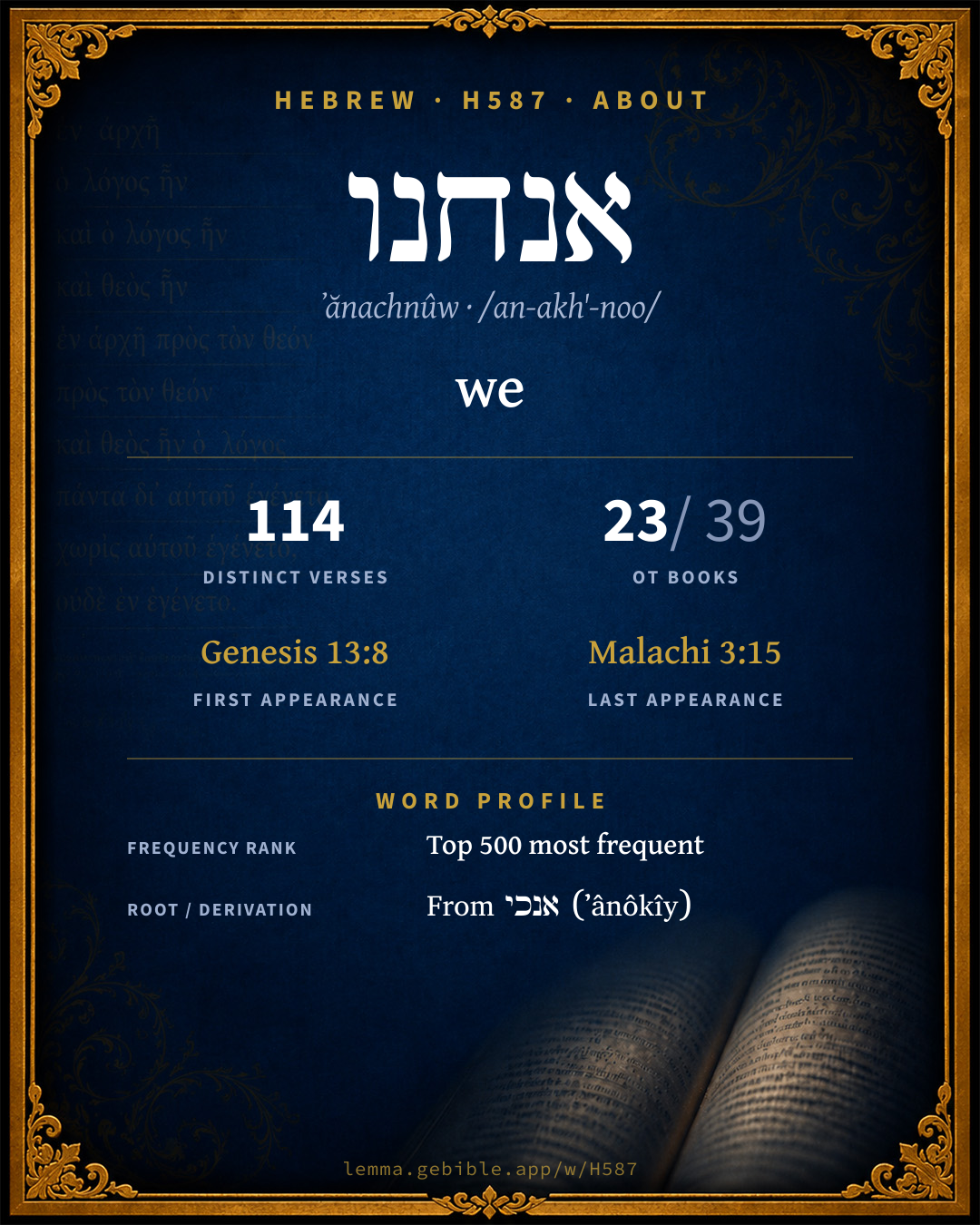
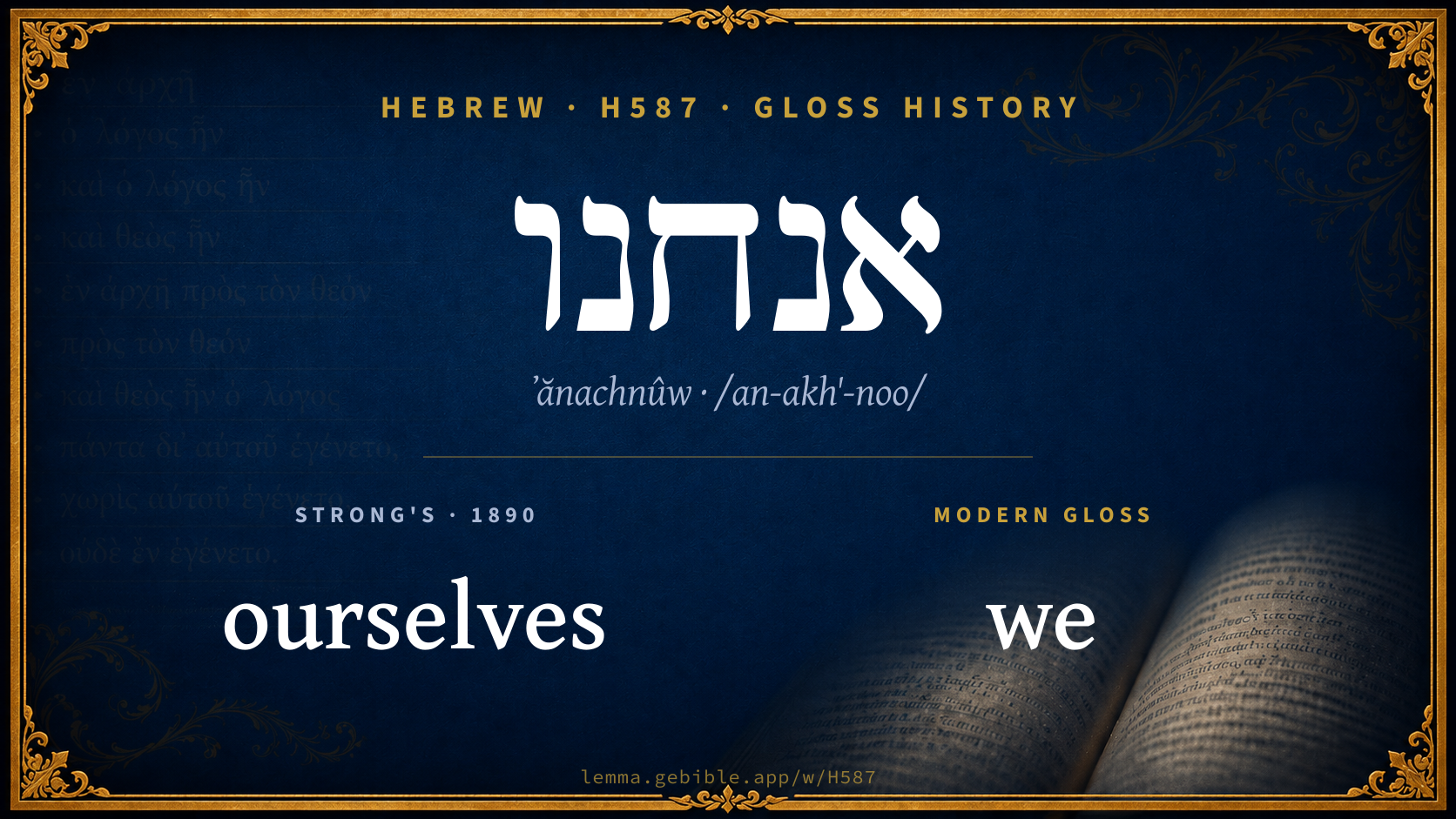
אֲנַ֫חְנוּ
we
Full lexicon entry — Brown-Driver-Briggs (BDB)
From Brown-Driver-Briggs (BDB)
Where this word appears
Grammar key — what these labels mean
Part of speech
- Pronoun
- A word standing in for a noun (“he,” “this,” “who”).
Person
- 1st Person
- The speaker (“I / we”).
Gender
- Common
- Either gender — not distinguished for this form.
Number
- Plural
- More than one (in Hebrew, generally three or more).
Every verse where H587 appears in the Book of Nehemiah — 15 distinct verses. Click any verse to open its interlinear word-by-word view. Verse text shown in the World English Bible for context — . Each verse’s Hebrew form is shown with its reference; the English is not keyword-highlighted, since the data carries no word-level English alignment. Use “Compare translations” on any verse to read it across multiple English versions. This concordance covers the Hebrew Bible; Septuagint (Greek Old Testament) occurrences are not indexed here.
Nehemiah
- Nehemiah 2:17 אֲנַ֣חְנוּ pron pers 1cp Then said I to them, You see the evil case that we are in, how Jerusalem lies waste, and the gates of it are burned with fire: come, and let us build up the wall of Jerusalem, that we be no more a reproach.
- Nehemiah 2:20 וַ/אֲנַ֥חְנוּ conj + pron pers 1cp Then answered I them, and said to them, The God of heaven, he will prosper us; therefore we his servants will arise and build: but you have no portion, nor right, nor memorial, in Jerusalem.
- Nehemiah 4:1 אֲנַ֤חְנוּ pron pers 1cp But it happened that when Sanballat heard that we were building the wall, he was angry, and took great indignation, and mocked the Jews.
- Nehemiah 4:10 וַ/אֲנַ֨חְנוּ֙ conj + pron pers 1cp Judah said, The strength of the bearers of burdens is decayed, and there is much rubbish; so that we are not able to build the wall.
- Nehemiah 4:19 וַ/אֲנַ֗חְנוּ conj + pron pers 1cp I said to the nobles, and to the rulers and to the rest of the people, The work is great and large, and we are separated on the wall, one far from another:
- Nehemiah 4:21 וַ/אֲנַ֖חְנוּ conj + pron pers 1cp So we worked in the work: and half of them held the spears from the rising of the morning until the stars appeared.
- Nehemiah 4:23 אֲנַ֥חְנוּ pron pers 1cp So neither I, nor my brothers, nor my servants, nor the men of the guard who followed me, none of us put off our clothes, everyone [went with] his weapon [to] the water.
- Nehemiah 5:2 אֲנַ֣חְנוּ pron pers 1cp For there were that said, We, our sons and our daughters, are many: let us get grain, that we may eat and live.
- Nehemiah 5:3 אֲנַ֣חְנוּ pron pers 1cp Some also there were that said, We are mortgaging our fields, and our vineyards, and our houses: let us get grain, because of the dearth.
- Nehemiah 5:5 אֲנַ֣חְנוּ pron pers 1cp Yet now our flesh is as the flesh of our brothers, our children as their children: and, behold, we bring into bondage our sons and our daughters to be servants, and some of our daughters are brought into bondage [already]: neither is it in our power to help it; for other men have our fields and our vineyards.
- Nehemiah 5:8 אֲנַ֣חְנוּ pron pers 1cp I said to them, We after our ability have redeemed our brothers the Jews, that were sold to the nations; and would you even sell your brothers, and should they be sold to us? Then held they their peace, and found never a word.
- Nehemiah 9:33 וַ/אֲנַ֥חְנוּ conj + pron pers 1cp However you are just in all that is come on us; for you have dealt truly, but we have done wickedly;
- Nehemiah 9:36 אֲנַ֥חְנוּ אֲנַ֥חְנוּ pron pers 1cp pron pers 1cp Behold, we are servants this day, and as for the land that you gave to our fathers to eat the fruit of it and the good of it, behold, we are servants in it.
- Nehemiah 9:37 אֲנָֽחְנוּ pron pers 1cp It yields much increase to the kings whom you have set over us because of our sins: also they have power over our bodies, and over our cattle, at their pleasure, and we are in great distress.
- Nehemiah 9:38 אֲנַ֛חְנוּ pron pers 1cp Yet for all this we make a sure covenant, and write it; and our princes, our Levites, [and] our priests, seal to it.
About this entry
At a glance — auto-summarized from this page’s data, not written by a person. Every figure links to its source below. This summary describes the numbers; it doesn’t interpret them.
אנחנו (ʼănachnûw) is a Hebrew word most often rendered “we.” Debuting at Genesis 13:8, it then recurs through the corpus. With 114 verses in 23 books, it is a common word in the Hebrew Bible. From the same root come אנכי, אנו and אנחנא. The sections below give every sense, occurrence, and version rendering.
Gloss history
Strong's 1890 vs modern scholarship
About this word
Strong's H587 catalogs a Hebrew word from the Hebrew Old Testament.
These counts are not copied from any lexicon or concordance. They are computed here, from the morphology-tagged Hebrew Old Testament. What Lemma adds →
- 114
- distinct verses
- The word appears in 114 distinct verses.
- 23 / 39
- OT books
- The word appears in 23 of 39 Old Testament books.
- #360
- by frequency
- Top 500 most frequent Hebrew words (rank 360 of 8,640 Hebrew words by occurrence).
View all 114 occurrences in the concordance →
By section of the Old Testament
By traditional corpus
Conventional, traditional groupings — biblical authorship is debated, so this is a traditional corpus grouping, not an authorship claim. Each share is this word’s portion of its verses in that division of the Hebrew canon. Each figure is a share of the word’s 114 distinct verses.
- Prophets (Nevi'im) 48 verses · 42%
- Writings (Ketuvim) 39 verses · 34%
- Torah (Pentateuch) 27 verses · 24%
How translations render this word
Counts come from each version’s own published word-to-Strong’s tagging or interlinear alignment — an approximate guide to how each version renders this word, not a word-level alignment the data otherwise carries. Because each total is that version’s own tagged count, the per-version totals vary from one another and need not match the appearance or distinct-verse counts above. These counts may also differ from a printed concordance because Lemma counts each distinctly tagged rendering and does not collapse phrase taggings into a single head-word total. This is a fixed set of word-tagged versions (KJV, ASV, BSB, ULT) and does not change with the reading translation you choose elsewhere. Each version’s license is shown beside its name below (and on Sources).
BDB lists this Strong’s number as 2 distinct words (homographs). Each count above pools all of them and is not split by sense — see the Senses section below. A low-frequency rendering may belong to a different one of those words, not the primary meaning.
- King James Version†: We 2×
- American Standard Version†: Us 2×
- Berean Standard Bible†: We 86×, Us 6×, We are 6×
- unfoldingWord Literal Text†: We 89×, Ourselves 14×, Are 8×
King James Version Public Domain
Renders H587 across 6† tagged occurrences — most commonly:
Plus 4 renderings that appear only once — usually multi-word phrases or single function words the recovered tagging swept in, not distinct renderings.
American Standard Version Public Domain
Renders H587 across 7† tagged occurrences — most commonly:
Plus 5 renderings that appear only once — usually multi-word phrases or single function words the recovered tagging swept in, not distinct renderings.
Berean Standard Bible Public Domain
Renders H587 across 112† tagged occurrences — most commonly:
Plus 8 renderings that appear only once — usually multi-word phrases or single function words the recovered tagging swept in, not distinct renderings. Not rendered by a distinct English word in 7 further occurrences.
unfoldingWord Literal Text CC BY-SA 4.0
Renders H587 across 131† tagged occurrences — most commonly:
Plus 5 renderings that appear only once — usually multi-word phrases or single function words the recovered tagging swept in, not distinct renderings.
Senses in the full BDB
What do BDB’s symbols mean?
BDB uses these scholarly abbreviations:
| Symbol | Meaning |
|---|---|
| 𝔊 | the Septuagint (the ancient Greek translation, LXX) |
| 𝔙 | the Vulgate (the Latin translation) |
| 𝔖 | the Syriac version (the Peshitta) |
| 𝔗 | the Targum (the Aramaic translation) |
| ψ | the Psalms |
| √ | root (the underlying root or stem) |
| ‖ | parallel passage (a synonymous or contrasted parallel) |
| † | the dagger: every passage where the word occurs is cited |
The 0 senses and sub-senses the full Brown-Driver-Briggs lexicon distinguishes for this word, in lexicon order (not ranked by frequency), with BDB’s own verbatim wording and sub-sense lettering. Shown in Hebrew script with BDB’s own scholarly abbreviations. The condensed entry is in the Lexicon Entry tab. See also the Forms in the corpus table below.
אנחנו I on. 1 pl. we v. infr.
אנחנו II on. 1 pl. comm. we (the pl. corresp. to אָנֹכִי, as אֲנוּ to אֲנִי
Senses from the full Brown-Driver-Briggs lexicon (Brown, Driver, Briggs; Oxford 1906 — public domain), digitized via Sefaria, supplemented by the OpenScriptures HebrewLexicon (CC BY 4.0). Full attribution on Sources.
Word origin
I. pron. 1 pl. we v. infr.
I. pron. 1 pl. comm. we (the pl. corresp. to אָנֹכִי, as אֲנוּ to אֲנִי; v. WSG p. 100; Ph. אנחן, Aramaic אֲנַחְנָא, 𝔗 also נַחְנָא, Syriac ܐܶܢܚܢܰܢ, ܐܶܢܰܚܢܰܢ, ܚܢܰܢ, Arabic نَحْنُ, Ethiopic ንሕነ ) Gn 13:8; 29:4; 37:7; 42:11, 13; Nu 9:7; Dt 1:28, 41; Jo 2:17, 18, etc. Like אֲנִי, following a ptcp. as its subj. Gn 19:13; Nu 10:29; Ju 19:18 2 K 18:26; appended to a vb. for emph. Ju 9:28 2 K 10:4; Is 20:6.
— Brown-Driver-Briggs (Oxford 1906, public domain), digitized via Sefaria, supplemented by the OpenScriptures HebrewLexicon (CC BY 4.0). See Sources.
Derived from אנכי (ʼânôkîy) (H595) — I.
Jastrow Dictionary
A second Hebrew/Aramaic lexicon for comparison, covering Aramaic and post-biblical (Talmudic, Targumic, Midrashic) usage that the biblical-Hebrew BDB does not. Matched by lemma rather than by Strong’s number, so a lemma may carry more than one Jastrow headword (shown separately below), and the entries cover usage well beyond the Bible.
אֲנַחְנָא
- pl. of אֲנָא, אֲנִי.
A Dictionary of the Targumim, the Talmud Babli and Yerushalmi, and the Midrashic Literature (Marcus Jastrow; London, Luzac, 1903) — Public Domain. Digitized via Sefaria. Digitized via Sefaria. Full attribution on Sources.
Forms in the corpus
The 30 distinct written forms H587 takes in the Hebrew Bible, most frequent first — each parse links to that state’s occurrences in the concordance. Hebrew forms include their vowel points and cantillation, so a single lemma takes many written forms.
| Form | Parsing | Example | Uses |
|---|---|---|---|
| אֲנַ֣חְנוּ | Pronoun, Personal, 1st Person, Common, Plural | Deuteronomy 1:28 | 11 |
| אֲנַ֔חְנוּ | Pronoun, Personal, 1st Person, Common, Plural | Ezra 9:9 | 9 |
| אֲנַ֖חְנוּ | Pronoun, Personal, 1st Person, Common, Plural | Genesis 43:18 | 9 |
| אֲנַ֥חְנוּ | Pronoun, Personal, 1st Person, Common, Plural | Ezekiel 33:10 | 9 |
| אֲנָֽחְנוּ | Pronoun, Personal, 1st Person, Common, Plural | Genesis 13:8 | 9 |
| וַ/אֲנַ֣חְנוּ | Pronoun, Personal, 1st Person, Common, Plural | Exodus 10:26 | 8 |
| אֲנַ֤חְנוּ | Pronoun, Personal, 1st Person, Common, Plural | Deuteronomy 1:41 | 7 |
| אֲנַ֨חְנוּ֙ | Pronoun, Personal, 1st Person, Common, Plural | Ezra 9:7 | 6 |
| אֲנָ֑חְנוּ | Pronoun, Personal, 1st Person, Common, Plural | Genesis 42:31 | 5 |
| וַ/אֲנַ֗חְנוּ | Pronoun, Personal, 1st Person, Common, Plural | 2 Chronicles 20:12 | 5 |
| אֲנַ֛חְנוּ | Pronoun, Personal, 1st Person, Common, Plural | Genesis 42:13 | 4 |
| אֲנַ֜חְנוּ | Pronoun, Personal, 1st Person, Common, Plural | Genesis 37:7 | 4 |
| וַ/אֲנַ֖חְנוּ | Pronoun, Personal, 1st Person, Common, Plural | Ezekiel 11:3 | 4 |
| וַ/אֲנַ֥חְנוּ | Pronoun, Personal, 1st Person, Common, Plural | Nehemiah 2:20 | 4 |
| אֲנַ֗חְנוּ | Pronoun, Personal, 1st Person, Common, Plural | Deuteronomy 5:25 | 3 |
| אֲנַ֨חְנוּ | Pronoun, Personal, 1st Person, Common, Plural | Daniel 9:18 | 3 |
| וַ/אֲנַ֤חְנוּ | Pronoun, Personal, 1st Person, Common, Plural | Psalms 79:13 | 3 |
| וַ/אֲנַ֨חְנוּ֙ | Pronoun, Personal, 1st Person, Common, Plural | Judges 16:5 | 3 |
| אֲנַ֕חְנוּ | Pronoun, Personal, 1st Person, Common, Plural | Genesis 44:9 | 2 |
| אֲנַ֧חְנוּ | Pronoun, Personal, 1st Person, Common, Plural | Deuteronomy 12:8 | 2 |
| אֲ֭נַחְנוּ | Pronoun, Personal, 1st Person, Common, Plural | Job 8:9 | 1 |
| אֲנַ֑חְנוּ | Pronoun, Personal, 1st Person, Common, Plural | Psalms 100:3 | 1 |
| אֲנַ֡חְנוּ | Pronoun, Personal, 1st Person, Common, Plural | 1 Samuel 30:14 | 1 |
| אֲנַחְנוּ֩ | Pronoun, Personal, 1st Person, Common, Plural | Ezra 9:7 | 1 |
| אֲנַחְנוּ֮ | Pronoun, Personal, 1st Person, Common, Plural | Genesis 42:21 | 1 |
| אנחנו | Pronoun, Personal, 1st Person, Common, Plural | Lamentations 5:7 | 1 |
| וַ/אֲנַ֓חְנוּ | Pronoun, Personal, 1st Person, Common, Plural | Psalms 20:7 | 1 |
| וַ/אֲנַ֛חְנוּ | Pronoun, Personal, 1st Person, Common, Plural | 2 Chronicles 13:10 | 1 |
| וַ/אֲנַ֜חְנוּ | Pronoun, Personal, 1st Person, Common, Plural | Numbers 32:17 | 1 |
| וַ֠/אֲנַחְנוּ | Pronoun, Personal, 1st Person, Common, Plural | 2 Chronicles 2:16 | 1 |
Same root — word family
Other BDB entries built from the same root as H587, grouped by Strong’s listed origin. These share a root / origin per the lexicon — not necessarily a shared meaning. Each links to that word’s own entry.
Derives from
Derived from this word
Proper names from this root
People and places named from this root — a name, not an additional meaning of the word.
Compare all same-root words → Showing 4 of 6 — not the complete family. 2 of the same-root words are proper names (people or places). They share a root, not necessarily a meaning.
Septuagint verse parallels
This word appears in 97 verses that also exist in the Greek Old Testament (Septuagint), out of the 114 Hebrew verses it occurs in. You can read those verses in Greek by switching the Old Testament edition to the Septuagint.
Read these verses in the Septuagint
- Genesis 13:8
- Exodus 10:26
- Numbers 9:7
- Deuteronomy 1:28
- Joshua 2:17
- Judges 9:28
- 1 Samuel 8:20
- 2 Samuel 5:1
- 1 Kings 3:18
- 2 Kings 6:1
- 1 Chronicles 11:1
- 2 Chronicles 2:16
This is a verse-level parallel only — the same verses exist in both the Hebrew and Greek Old Testaments. No word-level Hebrew↔Greek correspondence is claimed: the data carries no such alignment, so no Greek word is shown as this Hebrew word’s translation. Coverage is not total — the Septuagint omits the deuterocanon and renumbers the Psalms, so some Hebrew verses have no direct Greek parallel.