
Ezekiel 33:10

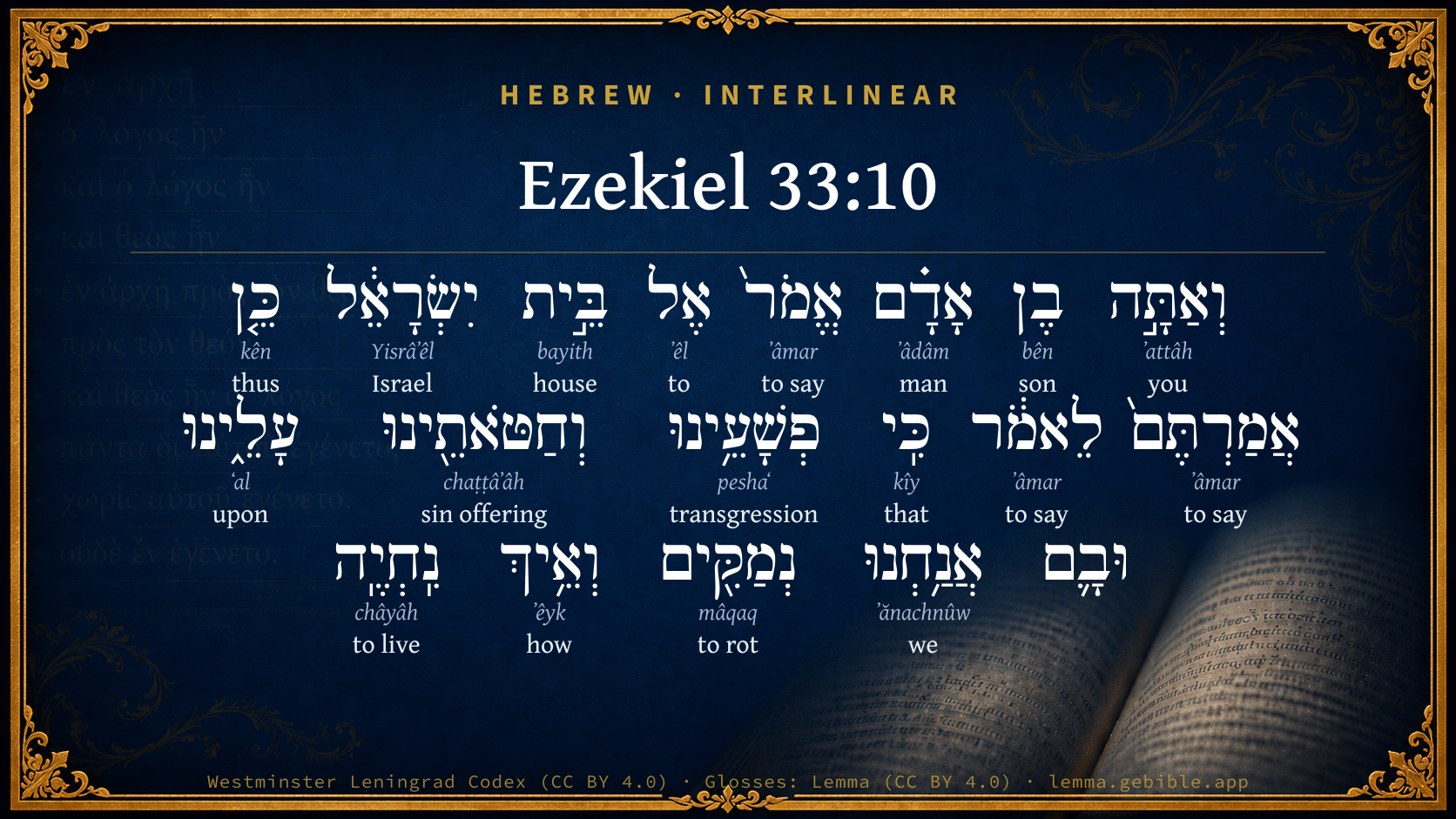
Hebrew (Westminster Leningrad Codex) Ezekiel 33:10 appears in the Hebrew Old Testament. The text above is from the Westminster Leningrad Codex. Each word links to its Strong’s number, a concise gloss, and parsing drawn from the Open Scriptures Hebrew Bible morphology. Click any word for its full Brown-Driver-Briggs (BDB) entry.
Download image
Cite this verse

Ezekiel 33:10 (World English Bible). Public Domain. Lemma interlinear Bible study tool, https://lemma.gebible.app/v/ezekiel/33/10.

Show BibTeX & RIS
BibTeX
RIS
English Translation
You, son of man, tell the house of Israel: Thus you speak, saying, Our transgressions and our sins are on us, and we pine away in them; how then can we live?
World English Bible · Public Domain
Download a study sheet

One document with this verse’s original text, its word-by-word gloss line, the meaning frame, cross-references with their text, attributed commentary, and full source and license credits — printable, and it pastes into notes with its structure intact.

This verse Autodidact and up

Study sheet (.html) Plain text (.txt)

A passage Seminary Student

Up to 50 verses in one chapter. A passage sheet keeps up to 6 commentary sources and 12 cross-references per verse, in the order this page ranks them, and says so on the sheet whenever that leaves anything out. Ask for a single verse and you get the Autodidact verse sheet above.

Everything on this page stays free to read, with no account — the sheet is a download of what is already on screen, not access to it.

Want to remove ads? Support Godless Engineer
Compare translations 3

The same verse in 3 English versions, stacked beneath the original-language interlinear above. Click any original word for its lexicon entry.

Each is an independent rendering of the whole verse — the interlinear is not word-aligned to these translations.

Highlighted words mark where these versions differ — a whole-verse word diff, not a word-by-word alignment.

  • World English Bible Public Domain
    You, son of man, tell the house of Israel: Thus you speak, saying, Our transgressions and our sins are on us, and we pine away in them; how then can we live?
  • King James Version Public Domain
    Therefore, O thou son of man, speak unto the house of Israel; Thus ye speak, saying, If our transgressions and our sins be upon us, and we pine away in them, how should we then live?
  • unfoldingWord Literal Text CC BY-SA 4.0
    So you, son of man, say to the house of Israel, ‘You are saying this, “Our transgressions and our sins are on us, and we are decaying in them! How can we live?”’

unfoldingWord Literal Text — © unfoldingWord, licensed CC BY-SA 4.0. Word-aligned USFM3 via Door43 (git.door43.org/unfoldingWord/en_ult).

Versions to compare (up to 4)

3 of 4 selected

Show all 18 translations

Every available English version of this verse, each an independent rendering of the whole verse.

  • World English Bible Public Domain
    You, son of man, tell the house of Israel: Thus you speak, saying, Our transgressions and our sins are on us, and we pine away in them; how then can we live?
  • Berean Standard Bible Public Domain
    Now as for you, son of man, tell the house of Israel that this is what they have said: ‘Our transgressions and our sins are heavy upon us, and we are wasting away because of them! How can we live?’
  • Majority Standard Bible Public Domain
    Now as for you, son of man, tell the house of Israel that this is what they have said: ‘Our transgressions and our sins are heavy upon us, and we are wasting away because of them! How can we live?’
  • King James Version Public Domain
    Therefore, O thou son of man, speak unto the house of Israel; Thus ye speak, saying, If our transgressions and our sins be upon us, and we pine away in them, how should we then live?
  • American Standard Version (1901) Public Domain
    And thou, son of man, say unto the house of Israel: Thus ye speak, saying, Our transgressions and our sins are upon us, and we pine away in them; how then can we live?
  • Revised Version (1885) Public Domain
    And thou, son of man, say unto the house of Israel: Thus ye speak, saying, Our transgressions and our sins are upon us, and we pine away in them; how then should we live?
  • Geneva Bible (1599) Public Domain
    Therefore, O thou sonne of man, speake vnto the house of Israel, Thus yee speake and say, If our transgressions and our sinnes bee vpon vs, and we are consumed because of them, howe should we then liue?
  • Douay-Rheims (1899) Public Domain
    Thou therefore, O son of man, say to the house of Israel: Thus you have spoken, saying: Our iniquities, and our sins are upon us, and we pine away in them: how then can we live?
  • Young's Literal Translation Public Domain
    And thou, son of man, say unto the house of Israel: Rightly ye have spoken, saying: Surely our transgressions and our sins `are' on us, And in them we are wasting away, How, then, do we live?
  • Literal Standard Version CC BY-SA 4.0
    And you, son of man, say to the house of Israel: You have spoken correctly, saying, || Surely our transgressions and our sins [are] on us, || And we are wasting away in them, || How, then, do we live?
  • Unlocked Literal Bible CC BY-SA 4.0
    So you, son of man, say to the house of Israel, 'You are saying this, “Our transgressions and our sins are on us, and we are decaying in them! How can we live?”'
  • unfoldingWord Literal Text CC BY-SA 4.0
    So you, son of man, say to the house of Israel, ‘You are saying this, “Our transgressions and our sins are on us, and we are decaying in them! How can we live?”’
  • Darby Bible Public Domain
    And thou, son of man, say unto the house of Israel, Thus ye speak, saying, Our transgressions and our sins are upon us, and we waste away in them, how then should we live?
  • World Messianic Bible Public Domain
    “You, son of man, tell the house of Israel: ‘You say this, “Our transgressions and our sins are on us, and we pine away in them. How then can we live?”’
  • Webster's Bible Public Domain
    Therefore, O thou son of man, speak to the house of Israel; Thus ye speak, saying, If our transgressions and our sins are upon us, and we pine away in them, how should we then live?
  • Free Bible Version CC BY-SA 4.0
    Son of man, tell the people of Israel that this is what they've been saying, ‘We recognize our sins and wrongs, and they weigh on us, wearing us out. How can we go on living?’
  • Bible in Basic English Public Domain
    And you, son of man, say to the children of Israel, You say, Our wrongdoing and our sins are on us and we are wasting away in them; how then may we have life?
  • JPS Tanakh (1917) Public Domain
    Therefore, O thou son of man, say unto the house of Israel: Thus ye speak, saying: Our transgressions and our sins are upon us, and we pine away in them; how then can we live?

Literal Standard Version (2020), Covenant Press — licensed CC BY-SA 4.0. Text via the HelloAO Bible API (eBible.org). Unlocked Literal Bible (unfoldingWord) — licensed CC BY-SA 4.0. Text via the HelloAO Bible API (eBible.org). unfoldingWord Literal Text — © unfoldingWord, licensed CC BY-SA 4.0. Word-aligned USFM3 via Door43 (git.door43.org/unfoldingWord/en_ult). Free Bible Version, Dr. Jonathan Gallagher — licensed CC BY-SA 4.0. Text via the HelloAO Bible API (eBible.org).

Word by word

More ways to search: Search by grammar → Find every occurrence → Compare this word →

Practice this passage: Drill this verse → Learn its vocabulary →

נְמַקִּ֖ים
mâqaq
H4743
“rotted”
Verb, Niphal, Participle Passive, Masculine, Plural, Absolute
Part of Speech
Verb
Stem
Niphal
Form
Participle Passive
Gender
Masculine
Number
Plural
State
Absolute
Full BDB Definition

Origin: a primitive root

TWOT: 1237

to decay, pine away, rot, fester - (Niphal) - to fester (of wounds) - to rot, rot away - to moulder away - to pine away - (Hiphil) to cause to rot
  1. וְאַתָּ֣ה ʼattâh H859 “and · you” Conjunction + Pronoun, Personal, 2nd Person, Masculine, Singular
  2. בֶן bên H1121 “son of” Noun, Common, Masculine, Singular, Construct
  3. אָדָ֗ם ʼâdâm H120 “man” Noun, Common, Masculine, Singular, Absolute
  4. אֱמֹר֙ ʼâmar H559 “say” Verb, Qal, Imperative, 2nd Person, Masculine, Singular
  5. אֶל ʼêl H413 “to” Preposition
  6. בֵּ֣ית bayith H1004 “house of” Noun, Common, Masculine, Singular, Construct
  7. יִשְׂרָאֵ֔ל Yisrâʼêl H3478 “Israel” Noun, Proper
  8. כֵּ֤ן kên H3651 “thus” Particle, Demonstrative
  9. אֲמַרְתֶּם֙ ʼâmar H559 “to say” Verb, Qal, Perfect, 2nd Person, Masculine, Plural
  10. לֵאמֹ֔ר ʼâmar H559 “to say” Preposition + Verb, Qal, Infinitive Construct
  11. כִּֽי kîy H3588 “that” Conjunction
  12. פְשָׁעֵ֥ינוּ peshaʻ H6588 “transgressions · our” Noun, Common, Masculine, Plural, Construct + Suffix, Personal, 1st Person, Common, Plural
  13. וְחַטֹּאתֵ֖ינוּ chaṭṭâʼâh H2403 “and · sin offerings · our” Conjunction + Noun, Common, Feminine, Plural, Construct + Suffix, Personal, 1st Person, Common, Plural
  14. עָלֵ֑ינוּ ʻal H5921 “upon · us” Preposition + Suffix, Personal, 1st Person, Common, Plural
  15. אֲנַ֥חְנוּ ʼănachnûw H587 “we” Pronoun, Personal, 1st Person, Common, Plural
  16. וְאֵ֥יךְ ʼêyk H349 “and · how” Conjunction + Particle, Interrogative
  17. נִֽחְיֶֽה châyâh H2421 “to live” Verb, Qal, Imperfect, 1st Person, Common, Plural

About this verse

These counts appear in no published source. They are computed here, from the morphology-tagged text and Lemma’s own curated glosses. What Lemma adds →

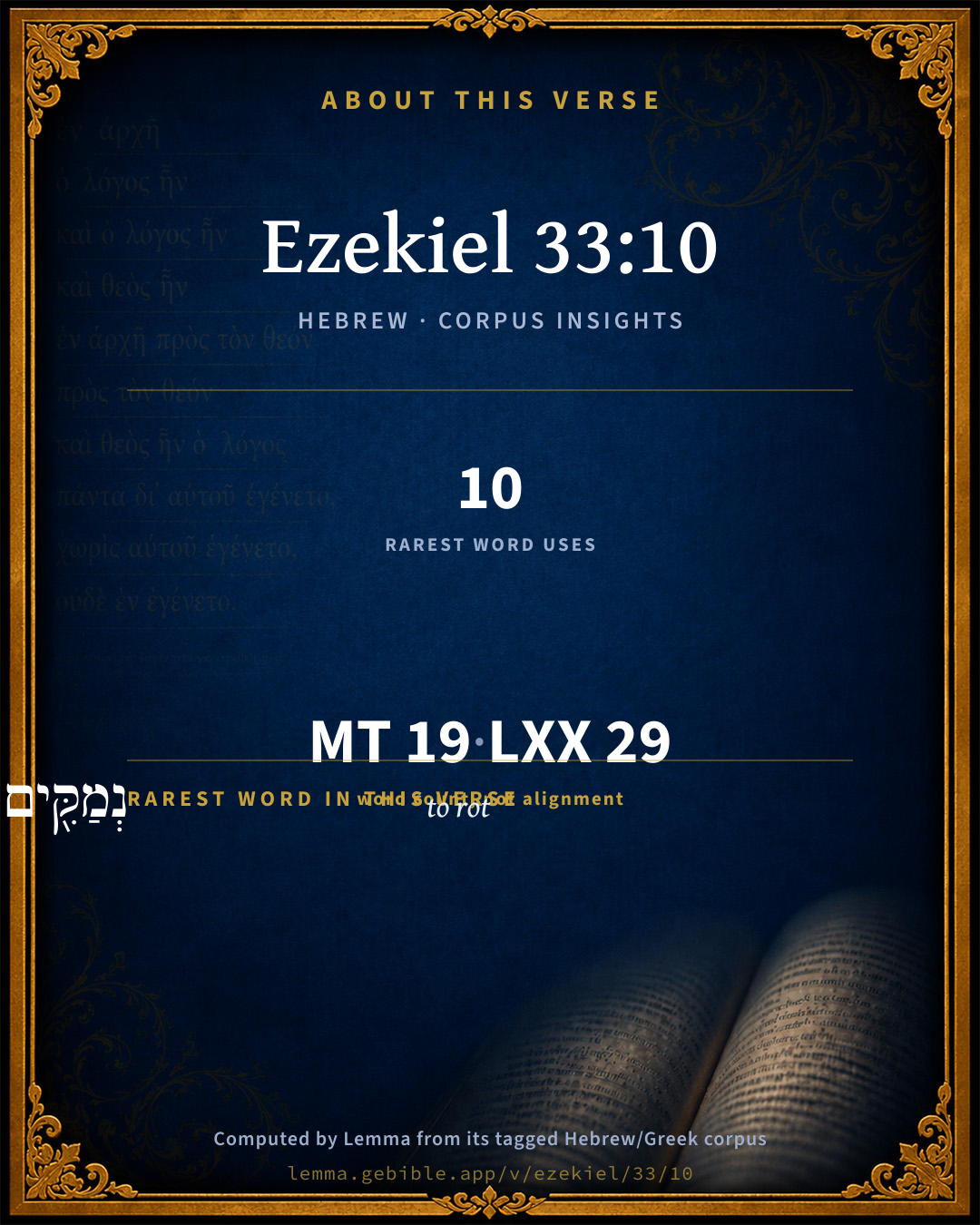
19
words
16
distinct lemmas
Prophets
section

Notable vocabulary

The rarest word here is נְמַקִּ֖ים to rot H4743 — appearing just 10 times in the whole Hebrew Bible.

Shared distinctive vocabulary

נְמַקִּ֖ים to rot H4743 occurs in 7 verses of the Hebrew Bible. Also found in:

Grammatical profile

  • 5 verbs
  • 6 nouns
  • 2 pronouns
  • 3 prepositions
  • 1 conjunction
  • 2 particles

Verb forms

  • אֱמֹר֙ Qal · Imperative
  • אֲמַרְתֶּם֙ Qal · Perfect
  • לֵאמֹ֔ר Qal · Infinitive Construct
  • נְמַקִּ֖ים Niphal · Participle Passive
  • נִֽחְיֶֽה Qal · Imperfect

Repetition

A word recurs within this verse — often emphatic in Hebrew:

  • אֱמֹר֙ to say H559 ×3

Hebrew & Septuagint length

In English translation the verse runs 32 words from the Hebrew and 36 from the Septuagint (LXX English) — closely comparable.

A rough comparison of the two English renderings, which tokenize alike — not a word-level alignment.

Word counts can differ between the Hebrew and the Greek without any difference in meaning — e.g. the Hebrew direct-object marker אֵת has no separate Greek word, and Greek often adds the article ὁ.

In the original languages it is 19 Hebrew tokens and 29 Greek tokens — but the two are counted differently (Hebrew bundles its prefixes and suffixes into one token; the Greek is in lemma form), so that isn’t a like-for-like length.

Cross-references

8

Topical passages linked to Ezekiel 33:10 in the Treasury of Scripture Knowledge — connected by theme and wording, ordered by reader-vote popularity; previews shown in the World English Bible.

  • Isaiah 49:14 But Zion said, Yahweh has forsaken me, and the Lord has forgotten me.
  • Ezekiel 37:11 Then he said to me, Son of man, these bones are the whole house of Israel: behold, they say, Our bones are dried up, and our hope is lost; we are clean cut off.
  • Leviticus 26:39 Those of you who are left will pine away in their iniquity in your enemies' lands; and also in the iniquities of their fathers shall they pine away with them.
  • Ezekiel 4:17 that they may want bread and water, and be dismayed one with another, and pine away in their iniquity.
  • Ezekiel 24:23 Your tires shall be on your heads, and your shoes on your feet: you shall not mourn nor weep; but you shall pine away in your iniquities, and moan one toward another.
  • Psalms 130:7 Israel, hope in Yahweh, For with Yahweh there is loving kindness. With him is abundant redemption.
  • Isaiah 51:20 Your sons have fainted, they lie at the head of all the streets, as an antelope in a net; they are full of the wrath of Yahweh, the rebuke of your God.
  • Jeremiah 2:25 Withhold your foot from being unshod, and your throat from thirst: but you said, It is in vain; no, for I have loved strangers, and after them will I go.

Cross-references courtesy of OpenBible.info (CC BY 4.0).

Hebrew and Greek witnesses Masoretic Hebrew ↔ Greek Septuagint

The same verse in the two great witnesses to the Old Testament, shown verse-for-verse.

These are two independent witnesses, not word-aligned to each other, and the Septuagint is shown in lemma (dictionary) form.

Hebrew Ezekiel 33:10 Masoretic · Westminster Leningrad Codex

וְאַתָּ֣ה בֶן אָדָ֗ם אֱמֹר֙ אֶל בֵּ֣ית יִשְׂרָאֵ֔ל כֵּ֤ן אֲמַרְתֶּם֙ לֵאמֹ֔ר כִּֽי פְשָׁעֵ֥ינוּ וְחַטֹּאתֵ֖ינוּ עָלֵ֑ינוּ וּבָ֛ם אֲנַ֥חְנוּ נְמַקִּ֖ים וְאֵ֥יךְ נִֽחְיֶֽה

You, son of man, tell the house of Israel: Thus you speak, saying, Our transgressions and our sins are on us, and we pine away in them; how then can we live?

World English Bible · Public Domain

Greek LXX Ezekiel 33:10 Septuagint · lemma form

καί σύ υἱός ἄνθρωπος εἶπον ὁ οἶκος ἰσραήλ οὕτως λαλέω λέγω ὁ πλάνη ἐγώ καί ὁ ἀνομία ἐγώ ἐπί ἐγώ εἰμί καί ἐν αὐτός ἐγώ τήκω καί πῶς ζάω

And you, son of man, say to the house of Israel; Thus have you⌃ spoken, saying, Our errors, and our iniquities weigh upon us, and we pine away in them, and how then shall we live?

LXX2012 (modern English Septuagint) · Public Domain

Hebrew: Westminster Leningrad Codex (CC BY 4.0). Greek: Septuagint (public domain); English from LXX2012 (modern English Septuagint) (Public Domain). How the Septuagint differs from the Hebrew →

Targum (Aramaic paraphrase)

1

The Targum is the ancient Jewish Aramaic paraphrase of the Hebrew Scriptures — an interpretive translation, not the Hebrew text itself. Onkelos (literal) and Pseudo-Jonathan (expansive) render the Torah, and Jonathan the Prophets. Coverage is partial: where no permissively-licensed English translation exists for a verse, only the Aramaic is shown. This is verse-level text, not a word-by-word alignment to the Hebrew.

  1. Targum Jonathan Prophets (Joshua–Malachi)
    וְאַתְּ בַּר אָדָם אֱמַר לְבֵית יִשְׂרָאֵל כֵּן אֲמַרְתּוּן לְמֵימָר אֲרֵי חוֹבָנָא וְחַטָאנָא עֲלָנָא מִתְיַהֲבִין וּבְהוֹן אֲנַחְנָא מִתְמְסִין וְאֵיכְדֵין נְחֵי:

    (no public-domain English translation for this verse)

    Targum Jonathan — Aramaic: “Mikraot Gedolot” (public domain). English: “Sefaria Community Translation” (CC0 1.0 (public-domain dedication)); “London "Chaldee Paraphrase," 1871” (public domain). Text via Sefaria.

Commentary

Notes on Ezekiel 33:10 from classic Christian and Jewish commentators (each source and its license shown beneath its notes). The classic Christian expositions comment on the surrounding passage and are grouped to its opening verse, so a note may address several verses; the Jewish commentaries on the Tanakh (Rashi and others) are per-verse, so they appear only where the commentator wrote on this verse.

Lemma curates 59 commentaries, every one of them public domain or Creative Commons licensed, each selected and text-cleaned for this edition rather than reprinted as found. About our sources →

Matthew Henry's Commentary

These verses are the substance of what we had before (Eze 18:20, etc.) and they are so full and express a declaration of the terms on which people stand with God (as the former were of the terms on which ministers stand) that it is no wonder that they are here repeated, as those were, though we had the substance of them before. Observe here,

I. The cavils of the people against God's proceedings with them. God was now in his providence contending with them, but their uncircumcised hearts were not as yet humbled, for they were industrious to justify themselves, though thereby they reflected on God. Two things they insisted upon, in their reproaches of God, and in both they added iniquity to their sin and misery to their punishment: - 1. They quarrelled with his promises and favours, as having no kindness nor sincerity in them, Eze 33:10. God had set life before them, but they plead that he had set it out of their reach, and therefore did but mock them with the mention of it. The prophet had said, some time ago (Eze 24:23), You shall pine away for your iniquities; with that word he had concluded his threatenings against Judah and Jerusalem; and this they now upbraided him with, as if it had been spoken absolutely, to drive them to despair; whereas it was spoken conditionally, to bring them to repentance. Thus are the sayings of God's ministers perverted by men of corrupt minds, who are inclined to pick quarrels. He puts them in hopes of life and happiness; and herein they would make him contradict himself; "for" (say they) "if our transgressions and our sins be upon us, as thou hast often told us they are, and if we must, as thou sayest, pine away in them, and wear out a miserable captivity in a fruitless repentance, how shall we then live? If this be our doom, there is no remedy. We die, we perish, we all perish." Note, It is very common for those that have been hardened with presumption when they were warned against sin to sink into despair when they are called to repent, and to conclude there is no hope of life for them. 2. They quarrelled with his threatenings and judgments, as having no justice or equity in them. They said, The way of the Lord is not equal (Eze 17:20), suggesting that God was partial in his proceedings, that with him there was respect of persons and that he was more severe against sin and sinners than there was cause.

II. Here is a satisfactory answer given to both these cavils.

1. Those that despaired of finding mercy with God are here answered with a solemn declaration of God's readiness to show mercy, Eze 33:11. When they spoke of pining away in their iniquity God sent the prophet to them, with all speed, to tell them that though their case was sad it was not desperate, but there was yet hope in Israel. (1.) It is certain that God has no delight in the ruin of sinners, nor does he desire it. If they will destroy themselves, he will glorify himself in it, but he has no pleasure in it, but would rather they should turn and live, for his goodness is that attribute of his which is most his glory, which is most his delight. He would rather sinners should turn and live than go on and die. He has said it, he has sworn it, that by these two immutable things, in both which it is impossible for God to lie, we might have strong consolation. We have his word and his oath; and, since he could swear by no greater, he swears by himself: As I live. They questioned whether they should live, though they did repent and reform; yea, says God, as sure as I live, true penitents shall live also; for their life is hid with Christ in God. (2.) It is certain that God is sincere and in earnest in the calls he gives sinners to repent: Turn you, turn you, from your evil way. To repent is to turn from our evil way; this God requires sinners to do; this he urges them to do by repeated pressing instances: Turn you, turn you. O that they would be prevailed with to turn, to turn quickly, without delay! This he will enable them to do if they will but frame their doings to turn to the Lord, Hos 5:4. For he has said, I will pour out my Spirit unto you, Pro 1:23. And in this he will accept of them; for it is not only what he commands, but what he courts them to. (3.) It is certain that, if sinners perish in their impenitency, it is owing to themselves; they die because they will die; and herein they act most absurdly and unreasonably: Why will you die, O house of Israel? God would have heard them, and they would not be heard.

2. Those that despaired of finding justice with God are here answered with a solemn declaration of the rule of judgment which God would go by in dealing with the children of men, which carries along with it the evidence of its own equity; he that runs may read the justice of it. The Jewish nation, as a nation, was now dead; it was ruined to all intents and purposes. The prophet must therefore deal with particular persons, and the rule of judgment concerning them is much like that concerning a nation, Jer 18:8-10. If God speak concerning it to build and to plant, and it do wickedly, he will recall his favours and leave it to ruin. But if he speak concerning it to pluck up and destroy, and it repent, he will revoke the sentence and deliver it. So it is here. In short, The most plausible professors, if they apostatize, shall certainly perish for ever in their apostasy from God; and the most notorious sinners, if they repent, shall certainly be happy for ever in their return to God. This is here repeated again and again, because it ought to be again and again considered, and preached over to our own hearts. This was necessary to be inculcated upon this stupid senseless people, that said, The way of the Lord is not equal; for these rules of judgment are so plainly just that they need no other confirmation of them than the repetition of them.

(1.) If those that have made a great profession of religion throw off their profession, quit the good ways of God and grow loose and carnal, sensual and worldly, the profession they made and all the religious performances with which they had for a great while kept up the credit of their profession shall stand them in no stead, but they shall certainly perish in their iniquity, Eze 33:12, Eze 33:13, Eze 33:18. [1.] God says to the righteous man that he shall surely live, Eze 33:13. He says it by his word, by his ministers. He that lives regularly, his own heart tells him, his neighbours tell him, He shall live. Surely such a man as this cannot but be happy. And it is certain, if he proceed and persevere in his righteousness, and if, in order to that, he be upright and sincere in it, if he be really as good as he seems to be, he shall live; he shall continue in the love of God and be for ever happy in that love. [2.] Righteous men, who have very good hopes of themselves and whom others have a very good opinion of, are yet in danger of turning to iniquity by trusting to their righteousness. So the case is put here: If he trust to his own righteousness, and commit iniquity, and come to make a trade of sin - if he not only take a false step, but turn aside into a false way and persist in it. This may possibly be the case of a righteous man, and it is the effect of his trusting to his own righteousness. Note, Many eminent professors have been ruined by a proud conceitedness of themselves and confidence in themselves. He trust to the merit of his own righteousness, and thinks he has already made God so much his debtor that now he may venture to commit iniquity, for he has righteousness enough in stock to make amends for it; he fancies that whatever evil deeds he may do hereafter he can be in no danger from them, having so many good deeds beforehand to counterbalance them. Or, He trust to the strength of his own righteousness, thinks himself now so well established in a course of virtue that he may thrust himself into any temptation and it cannot overcome him, and so by presuming on his own sufficiency he is brought to commit iniquity. By making bold on the confines of sin he is drawn at length into the depths of hell. This ruined the Pharisees; they trusted to themselves that they were righteous, and that their long prayers, and fasting twice in the week, would atone for their devouring widows' houses. [3.] If righteous men turn to iniquity, and return not to their righteousness, they shall certainly perish in their iniquity, and all the righteousness they have formerly done, all their prayers, and all their alms, shall be forgotten. No mention shall be made, no remembrance had, of their good deeds; they shall be overlooked, as if they had never been. The righteousness of the righteous shall not deliver him from the wrath of God, and the curse of the law, in the day of his transgression. When he becomes a traitor and a rebel, and takes up arms against his rightful Sovereign, it will not serve for him to plead in his own defence that formerly he was a loyal subject, and did many good services to the government. No; he shall not be able to live. The remembrance of his former righteousness shall be no satisfaction either to God's justice or his own conscience in the day that he sins, but rather shall, in the estimate of both, highly aggravate the sin and folly of his apostasy. And therefore for his iniquity that he committed he shall die, Eze 33:13. And again (Eze 33:18), He shall even die thereby; and it is owing to himself.

(2.) If those that have lived a wicked life repent and reform, forsake their wicked ways and become religious, their sins shall be pardoned, and they shall be justified and saved, if they persevere in their reformation. [1.] God says to the wicked, "Thou shalt surely die. The way that thou art in leads to destruction. The wages of thy sin is death, and thy iniquity will shortly be thy ruin." It was said to the righteous man, Thou shalt surely live, for his encouragement to proceed and persevere in the way of righteousness; but he made an ill use of it, and was emboldened by it to commit iniquity. It was said to the wicked man, Thou shalt surely die, for warning to him not to persist in his wicked ways; and he makes a good use of it, and is quickened thereby to return to God and duty. Thus even the threatenings of the word are to some, by the grace of God, a savour of life unto life, while even the promises of the word become to others, by their own corruption, a savour of death unto death. When God says to the wicked man, Thou shalt surely die, die eternally, it is to frighten him, not out of his wits, but out of his sins. [2.] There is many a wicked man who was hastening apace to his own destruction who yet is wrought upon by the grace of God to return and repent, and live a holy life. He turns from his sin (Eze 33:14), and is resolved that he will have no more to do with it; and, as an evidence of his repentance for wrong done, he restores the pledge (Eze 33:15) which he had taken uncharitably from the poor, he gives again that which he had robbed and taken unjustly from the rich. Nor does he only cease to do evil, but he learns to do well; he does that which is lawful and right, and makes conscience of his duty both to God and man - a great change, since, awhile ago, he neither feared God nor regarded man. But many such amazing changes, and blessed ones, have been wrought by the power of divine grace. He that was going on in the paths of death and the destroyer now walks in the statues of life, in the way of God's commandments, which has both life in it (Pro 12:28) and life at the end of it, Mat 19:17. And in this good way he perseveres without committing iniquity, though not free from remaining infirmity, yet under the dominion of no iniquity. He repents not of his repentance, nor returns to the commission of those gross sins which he before allowed himself in. [3.] He that does thus repent and return shall escape the ruin he was running into, and his former sins shall be no prejudice to his acceptance with God. Let him not pine away in his iniquity, for, if he confess and forsake it, he shall find mercy. He shall surely live; he shall not die, Eze 33:15. Again (Eze 33:16), He shall surely live. Again (Eze 33:19), He has done that which is lawful and right, and he shall live thereby. But will not his wickednesses be remembered against him? No; he shall not be punished for them (Eze 33:12): As for the wickedness of the wicked, though it was very heinous, yet he shall not fall thereby in the day that he turns from his wickedness. Now that it has become his grief it shall not be his ruin. Now that there is a settled separation between him and sin there shall be no longer a separation between him and God. Nay, he shall not be so much as upbraided with them (Eze 33:16): None of his sins that he has committed shall be mentioned unto him, either as a clog to his pardon or an allay to the comfort of it, or as any blemish and diminution to the glory that is prepared for him.

Now lay all this together, and then judge whether the way of the Lord be not equal, whether this will not justify God in the destruction of sinners and glorify him in the salvation of penitents. The conclusion of the whole matter is (Eze 33:20): "O you house of Israel, though you are all involved now in the common calamity, yet there shall be a distinction of persons made in the spiritual and eternal state, and I will judge you every one after his ways." Though they were sent into captivity by the lump, good fish and bad enclosed in the same net, yet there he will separate between the precious and the vile and will render to every man according to his works. Therefore God's way is equal and unexceptionable; but, as for the children of thy people, God turns them over to the prophet, as he did to Moses (Exo 32:7): "They are thy people; I can scarcely own them for mine." As for them, their way is unequal; this way which they have got of quarrelling with God and his prophets is absurd and unreasonable. In all disputes between God and his creatures it will certainly be found that he is in the right and they are in the wrong.

Matthew Henry's Commentary on the Whole Bible (1708–1710) — public domain (CC PDM 1.0). Text via the HelloAO Bible API.

Trapp's Complete Commentary

John Trapp

Eze 33:10 Therefore, O thou son of man, speak unto the house of Israel; Thus ye speak, saying, If our transgressions and our sins [be] upon us, and we pine away in them, how should we then live?

Ver. 10. Thus ye speak.] {a} But not well, while ye have hard thoughts of God and heavy thoughts of yourselves, as if your sins were unpardonable, and that ye were already ruined beyond relief; whereas true repentance is a ready remedy, a plank after shipwreck, that would set you safe, and render you right again. This they had been told before, {Eze 18:25-32} but to little purpose: the word was not mingled with faith in their hearts, and did therefore run through them, {Heb 2:1} as water runs through a riven vessel.

And we pine away in them.] Ita punimur ut pereamus. And so be punished and perish. This the prophet had threatened, {Eze 24:23} and they still stomachfully object it to him: it lay as hard meat, and they raise a cavil upon it, whereto the Lord answereth,

{a} Refricat verba desperantium. Omnis restitutionis species et spes a Deo nobis praecisa est.

John Trapp, A Commentary or Exposition upon All the Books of the Old and New Testament (1647–1656) — public domain. Text from a community e-Sword module.

Joseph Benson's Commentary

Eze 33:10-11. If our transgressions be upon us, &c. — If the unpardoned guilt of our sins lie upon us, and we be punished for them in the wasting of our country, the burning of our city, the abolishing the public worship of God, &c.; and we pine away in them — Experience their bitter consequences in famine and disease, and in a variety of other calamities; how shall we live? — How then can the promises of life belong to us? How can such assurances be true as were given us Eze 18:17-32? What ground can we have to hope for a recovery of our former condition? Or, how canst thou promise the continuance or restoration of any mercy to us? How can it be better with us than it is? If thy threatenings be true, it will be worse with us, and not better; and if they be not true, how can we trust thy promises of recovery? These are supposed to be the words of impious persons, who, pretending to despair of God’s mercies, take encouragement from thence to continue in their sins. Say, As I live, I have no pleasure in the death of the wicked — For an elucidation of this and the following verses to the 20th, compare chap. 18.; and see the notes there.

Joseph Benson's Commentary on the Old and New Testaments (1811–1818) — public domain. Text from a community e-Sword module.

Whedon's Commentary on the Bible

Daniel D. Whedon

10-20. Compare notes Eze_18:23-32. The people have ceased to excuse themselves, and now “pine away” in utter despair because of their sins. Whereupon the prophet reaffirms for their comfort the principles of God’s moral government, which he had previously announced in order to convict them of sin (Eze_18:23-32). They have indeed sinned, but the way of life is still open. God does not punish arbitrarily. He wishes all men to repent and live, and they have power to do this. It is sin that brings death, and each man’s destiny is determined by himself. Here is a splendid announcement of God’s justice and of man’s moral agency. Davidson has said that “this emancipation of the individual soul, whether from a doom inherited from a former generation or from one entailed on it by its own evil past, was perhaps the greatest contribution made by Ezekiel to the religious life and thought of his time.” The chief thought, which is intended to bring relief to the now hopeless people, is that the past is not irrevocable. There need be no doubt that Ezekiel intended these principles to awaken a national as well as an individual hope. The life of the nation, like that of the individual, is dependent upon its attitude toward righteousness. “Life,” according to the prophet, did not mean mere existence; but contained a spiritual element. (See Eze_20:11, etc.) No nation or individual could really live who was not doing justly, loving mercy, and walking humbly with God. Yet ye say (Eze_33:17; Eze_33:20) — Not in the same spirit as Eze_18:23; Eze_18:29. They then said that their heredity and their connection with the nation, not their personal transgressions, were to blame for their captivity and other calamities, but now (Eze_33:10) they acknowledge: “Our transgressions and our sins are upon us” (R.V.). The prophet seeks to show that in their despair they are now making the same evil charge against Jehovah, by denying his power to lift them out of their sin and trouble, which they had previously made by denying that their trouble was the consequence of their sins.

Daniel D. Whedon (gen. ed.), Commentary on the Old and New Testaments (1874–1909) — public domain. Text from a community e-Sword module.

Keil & Delitzsch

C. F. Keil & F. Delitzsch

As watchman over Israel, Ezekiel is to announce to those who are despairing of the mercy of God, that the Lord will preserve from destruction those who turn from their sin, and lead them into life. - Eze 33:10. Thou then, son of man, say to the house of Israel, Ye rightly say, Our transgressions and our sins lie upon us, and in them we vanish away; how, then, can we live? Eze 33:11. Say to them, As truly as I live, is the saying of the Lord Jehovah, I have no pleasure in the death of the sinner; but when the sinner turneth from his way, he shall live. Turn ye, turn ye from your evil ways! for why will ye die, O house of Israel? Eze 33:12. And thou, son of man, say to the sons of thy people, The righteousness of the righteous man will not deliver him in the day of his transgression, and the sinner will not fall through his sin in the day that he turneth from his sin, and the righteous man will not be able to live thereby in the day that he sinneth. Eze 33:13. If I say to the righteous man that he shall live, and he relies upon his righteousness and does wrong, all his righteousnesses will not be remembered; and for his wrong that he has done, he will die. Eze 33:14. If I say to the sinner, Thou shalt die, and he turns from his sin, and does justice and righteousness, Eze 33:15. So that the wicked returns the pledge, restores what has been robbed, walks in the statutes of life without doing wrong, he will live, not die. Eze 33:16. All his sins which he has committed shall not be remembered against him; he has done justice and righteousness, he will live. Eze 33:17. And the sons of thy people say, The way of the Lord is not right; but they - their way is not right. Eze 33:18. If the righteous man turneth from his righteousness and doeth wrong, he shall die thereby; Eze 33:19. But if the wicked man turneth from his wickedness and doeth right and righteousness, he will live thereby. Eze 33:20. And yet ye say, The way of the Lord is not right. I will judge you every one according to his ways, O house of Israel. - In Eze 33:10 and Eze 33:11 the prophet's calling for the future is set before him, inasmuch as God instructs him to announce to those who are in despair on account of their sins the gracious will of the Lord. The threat contained in the law (Lev 26:39), ימּקּוּ בּעונם, of which Ezekiel had repeatedly reminded the people with warning, and, last of all, when predicting the conquest and destruction of Jerusalem by the Chaldeans (compare Eze 4:17 and Eze 24:23), had pressed heavily upon their heart, when the threatened judgment took place, so that they quote the words, not "in self-defence," as Hvernick erroneously supposes, but in despair of any deliverance. Ezekiel is to meet this despair of little faith by the announcement that the Lord has no pleasure in the death of the sinner, but desires his conversion and his life. Ezekiel had already set this word of grave before the people in Eze 18:23, Eze 18:32, accompanied with the summons to salvation for them to lay to heart: there, it was done to overthrow the delusion that the present generation had to atone for the sins of the fathers; but here, to lift up the hearts of those who were despairing of salvation; and for this reason it is accompanied with the asseveration (wanting in Eze 18:23 and Eze 18:32): "as truly as I live, saith the Lord," and with the urgent appeal to repent and turn. But in order to preclude the abuse of this word of consolation by making it a ground of false confidence in their own righteousness, Ezekiel repeats in Eze 33:12-20 the principal thoughts contained in that announcement (Eze 18:20-32) - namely, first of all, in Eze 33:12-16, the thought that the righteousness of the righteous is of no avail to him if he gives himself up to the unrighteousness, and that the sinner will not perish on account of his sin if he turns from his wickedness and strives after righteousness (יכּשׁל , Eze 33:12, as in Hos 5:5; Jer 6:15; compare Eze 18:24-25, and Eze 18:21, Eze 18:22; and for Eze 33:14 and Eze 33:15, more especially Eze 18:5 and Eze 18:7); and then, secondly, in Eze 33:17-20, the reproof of those who find fault with the way of the Lord (compare Eze 18:25, Eze 18:27, Eze 18:29-30).

Keil & Delitzsch — Biblical Commentary on the Old Testament (1861–1891) — public domain (CC PDM 1.0). Text via the HelloAO Bible API. (Old Testament only.)

Tyndale Open Study Notes

Tyndale Open Resources

33:10-11 Our sins are heavy upon us . . . How can we survive? Now that the people of Israel were finally taking the prophet’s warnings seriously, there was danger of despair rather than a response of repentance and faith. Unlike deterministic fate, God’s judgment leaves room for forgiveness. The sovereign Lord takes no pleasure in the death of wicked people. Even wicked people . . . can live if they repent and turn from their wickedness.

Tyndale Open Study Notes — © Tyndale Open Resources, licensed CC BY-SA 4.0. Text via the HelloAO Bible API.

Geneva Bible (1599)

Geneva Bible translators

Thus the wicked when they hear God’s judgments for their sins, despair of his mercies, and murmur.

Geneva Bible (1599) marginal notes — public domain. Text via Bolls.life.

Jamieson, Fausset & Brown

Robert Jamieson, A. R. Fausset & David Brown

be upon us--that is, their guilt remain on us.

pine away in them--if we suffer the penalty threatened for them in Eze 24:23, according to the law (Lev 26:39).

how should we . . . live?--as Thou dost promise in Eze 33:5 (compare Eze 37:11; Isa 49:14).

Jamieson, Fausset & Brown — Commentary Critical and Explanatory on the Whole Bible (1871) — public domain (CC PDM 1.0). Text via the HelloAO Bible API.

Adam Clarke's Commentary

Verse 10. If our transgressions and our sins be upon us] They are upon us, as a grievous burden, too weighty for us to bear: how then can we live under such a load?

We pine away in them] In such circumstances how consoling is that word: "Come unto me, all ye who are heavy laden, and I will give you rest!"

Adam Clarke's Commentary on the Bible (1810–1826) — public domain. Text from a community e-Sword/MySword module.

Ellicott's Commentary for English Readers

(10) How should we then live?—Formerly, when the prophet had given them warning of impending judgments, the people had refused to believe: now, however, when those judgments had been realised, they despaired, and cried out, “If all this is in punishment for our sins, how can there yet be any hope for us?”

A Bible Commentary for English Readers, edited by Charles John Ellicott (1878–1897) — public domain. Text from a community e-Sword module.

The Cambridge Bible for Schools and Colleges

gen. ed. J. J. S. Perowne

10. If our transgressions] Better, direct: our transgressions … are upon us. The people had come to regard their calamities as due to their sins and evidence of them. They had come round to the prophet’s view of their history, for they saw his predictions fulfilled. But the new view came with a crushing weight upon them. The calamities of their country were unparalleled (Lam_1:12; Lam_2:13; Lam_2:20; Lam_3:1; Lam_4:6; Lam_4:9), and equally unparalleled must have been their guilt (Lam_1:9; Lam_1:14; Lam_2:14; Lam_4:13; Lam_5:7). And their calamities seemed final, their sin was expiable only by their complete destruction.

we pine away] Or, waste away. The word expresses not mental but physical wasting away, ending in complete dissolution. See the very similar figures, Isa_10:18; Isa_17:4; cf. Eze_4:17; Eze_24:23; Lev_26:39.

10–20. Despondency of the people, making the prophet’s appeals to them of none effect. Removal of the despair by two gracious words from the Lord.

The Cambridge Bible for Schools and Colleges (gen. ed. J. J. S. Perowne; Cambridge University Press, 1878–1918) — public domain. Text from a community e-Sword module.

John Gill's Exposition

Say unto them, as I live, saith the Lord,.... The following is the answer returned from the Lord by the prophet to their above complaint and reasoning; to which is premised the oath of God, showing the certainty, reality, and sincerity of what is said, which might be depended on as true:

I have no pleasure in the death of the wicked, &c. See Gill on Eze 18:23, Eze 18:31, Eze 18:32,

John Gill's Exposition of the Whole Bible (1746–1763) — public domain (CC PDM 1.0). Text via the HelloAO Bible API.

Haydock's Catholic Bible Commentary

Live? They suppose their case to be desperate, as their fathers had sinned, chap. xviii. The prophet shews that none are punished except for their own faults, (Calmet) and that "each one has free-will to be saved or to be lost." (St. Jerome)

George Leo Haydock (1774–1849), Haydock's Catholic Family Bible and Commentary, 1859 edition — public domain. Excludes Psalms (Douay-Rheims chapter numbering differs from Protestant) and Deuterocanonical books (Catholic canon only).

Matthew Poole's English Annotations

Speak, declare from me,

unto the house of Israel; the residue of the two tribes, which are brought to Babylon; or else to those already there, and here their brethren are on the way thitherward, since Jerusalem was taken.

Thus ye speak; thus ye discourse among themselves, object against God, and his prophet, and your own duty, some of you out of infirmity, others out of perverseness.

If our transgressions and our sins be upon us; the unpardoned guilt and the unsupportable punishment of our sins, who were warned and took not warning, do thus, as in the wasting our country, burning our city, abolishing the public worship of God, come upon us, we shall pine away, consume; it is too late to hope it will be better with us now, we should have heard and followed the counsel earlier, if we would have delivered our own souls. If the prophet spake true at first, there is no hope, say the weaker; if there be hope now after so peremptory menaces and so great execution, the prophet did not speak truth, say the perverse, and so concluded they would as they were run the hazard.

How should we then live? how can it be better with us? if the threats be true and sure, it will be worse; if not true, how are his promises to be rested on, that it will be better.

Matthew Poole's English Annotations on the Holy Bible (1683–1685) — public domain. Text from a community e-Sword/MySword module.

The Pulpit Commentary

Thus ye speak, saying, etc. At the earlier stage the prophet had to contend with scorn, incredulity, derision. (Eze_12:22) They trusted in the promises of the false prophets. (Eze_13:6) They laid to their soul the flattering unction that they were suffering, not for their own sins, but for the sins of their fathers. (Eze_18:2) Now they stand face to face with the fulfillment of the prophet"s words. They cherish no hopes, and they make no excuses. They have fallen into the abyss of despair. Admitting their own sin and the righteousness of their punishment, does not the very admission exclude hope? Who can bring life to those that are thus dead in trespasses and sins? The parallelism with Lev_26:39-42 is so striking that it can scarcely be accidental

A question of despair.

I THE CAUSE OF THE DESPAIR. The prophet has just been told that his responsibility is limited to his warning the people faithfully. If the watchman blows the trumpet lustily he can do no more. The blood of the careless people will then be on their own heads. But this truth, which gives consolation to the prophet, is alarming to the people. It is meant to be so. Yet the alarm may be taken in a wrong way. Instead of rousing themselves to meet and overcome the danger, the people may sink down paralyzed in the blankness of despair. The explanation of this despair is suggested by the language of the people.

1. A consciousness of guilt. The people perceive that their transgressions and their sins are upon them. The pilgrim feels the weight of his burden. The sudden awakening of an evil conscience plunges its possesser into midnight darkness. The new thing is not to know that wickedness was done; that knowledge was always possessed, though hitherto not much considered. It is to know that the sins still rest upon their doer, i.e. it is the feeling of present guilt for past deeds of wickedness.

2. An experience of the consequences of sin. "And we pine away in them." The death-penalty of sin does not come like a flash of lightning. Sin is a slow poison. It kills by a sort of spiritual consumption. With an awakening conscience the man perceives himself to be in a spiritual decline. No perception can be more provocative of despair.

II THE QUESTION IT AROUSES. "How should we then live?" The despair is not yet absolute, or it would not suggest such a question as this. The most awful despair does not live in Doubting Castle. It is immured in a black dungeon of certain negation. Possibly the question suggested does not expect any answer. It sees no reply, and does not believe that any can be given. The decline is so steadfast, and the disease of sin that causes it so deep-rooted, that the despairing soul cannot look for deliverance, and the question is a sort of expostulation offered to the prophet when he would take a more hopeful view. Still it is a question, and therefore it leaves room for an answer. It is much that men should be brought to ask such a question. Too many do not perceive their danger, though they live in sin unrepented and unrestrained. The question implies certain thoughts.

1. Sinners are in imminent peril of death. To those who are truly awakened the prospect must be alarming. But the danger is not the less for those who do not yet perceive it.

2. Men cannot save their own souls. These endangered people must look elsewhere for safety. Unless salvation comes from above, it cannot be had.

3. Men need light on the way of salvation. It is not visible to the eye of sense; it cannot be discovered by thinking. The world needs a gospel. The heathen pine away, not knowing the Divine source of life.

4. Christ answers the Question of despair with a gospel of hope. The answer is suggested in the next verse (Ver. 11). It is completed in the gospel of Christ.

Vers. 10-20. Men"s misconception of God"s government.

Men are naturally prone to merge themselves in the nation. This was, perhaps, a stronger habit among the Jews than among us. They could not understand how that, while God punished the nation, he could protect the individual. Israel may be depressed in fortune, while yet Daniel and his companions are elevated. Sodom may be destroyed, but Lot shall be preserved.

I SUFFERING OFTEN BLINDS MEN"S EYES TO GOD"S EQUITABLENESS. It is natural to suppose that luxurious prosperity is due to our merits; and, if adversity visits us, we judge ourselves to be hardly dealt with. Scarcely one man in a thousand realizes the fact that he deserves nothing, and that the common benefits of air and food are the unpurchased gifts of God. As soon as the suspension of Divine favors is felt we are disposed to complain. We cannot conceive that we have deserved such hardship. We see others, no more replete with virtue than ourselves, enveloped in silk and purple, riding abroad in gilded chariots. Does God really rule over the interests and fortunes of men? We have abandoned some evil courses: is not God going to reward us for this? Still, we can only think of our losses and our afflictions; we cannot see the higher benefits God is bringing to us. Through our blinding tears we can only see oppression and injustice. Through selfish tears we see only what we have lost, not what we have gained. We would rather discover injustice in God than iniquity within ourselves. Truly has it been said, "There"s none so blind as those who will not see.

II NATIONAL CALAMITY IS A SYMBOL OF PERSONAL PERDITION. The overthrow of a nation is something visible, impressive, startling. Yet it is not the worse thing that can happen to a man. He may have to transfer his political allegiance to another. He may have to live under a different set of laws and institutions. He may have to quit scenes in nature, with which he has been long familiar, for other scenes in a distant land. This loss, dishonor, banishment, are intended to remind him that there is a worse exile an exile from his spirit"s home, an exile from the kingdom of God, of which Canaan was but a symbol. To be compelled to dwell among idolaters was a gracious chastisement, to make his spirit recoil from the fear of dwelling forever among the foes of God. And if the Hebrew exile took to heart the lesson, that banishment to Babylon might become to him salvation.

III NATIONAL CALAMITY IS CONSONANT WITH PERSONAL WELL-BEING. The typical Jew was murmuring in Babylon that this destruction of the nation was incompatible with God"s promise of life a promise founded on personal repentance. "If our transgressions and our sins be upon us, and we pine away in them, how should we then live?" Their idea of life was free life in Judea. God"s idea of life was their return to allegiance and piety. "In his favor," and in this alone, they could find life. Consequently, a penitent Jew could have found the highest life, even while an exile in Babylon. If he personally felt and confessed his sin, if he reposed his soul on God"s great mercy, if he bowed his spirit to God"s will, and walked humbly with his God, this was life of the noblest kind. And, like a saint of later date, he could "rejoice even in tribulation." Better to dwell on Chebar"s banks in the society of Jehovah than to dwell in the palaces of Jerusalem without God as a Friend. If God be my God, exile has no terror for me. Where God is, there is my heaven.

IV RIGHTEOUSNESS MUST BE PERSONAL, NOT HEREDITARY NOR TRADITIONAL. The foolish and hurtful idea dwelt in the minds of the Jews that God"s former favor to them as a nation was a guarantee for all future security. It was a species of anti-nomianism. Their maxim was, "Once righteous, always righteous, notwithstanding our deeds.;" They imagined that they could not fall from their exalted position. It is marvelous how deep-rooted in some minds this prejudice respecting traditional piety becomes. But the fervid piety of former days will avail us nothing if faith and love are now dead. It is only a living faith, a present submission, that God accepts. And if our former faith and love have evaporated, there is clear evidence that it was only a pretence, and not the reality. To be accepted of God, and to be accounted worthy of heaven, I personally must be righteous. The righteousness of the nation is nothing else than the righteousness of the component parts. And unless I individually am righteous in God"s esteem, I shall be rejected and condemned in the great assize.

V PERSONAL RIGHTEOUSNESS HAS ITS BOOT IN SINCERE REPENTANCE. Repentance is the birth of right and honest feeling towards God. Whether our past feelings and actions have been wrong by way of omission or by way of guilty commission, the whole sin, greater or less, will be candidly confessed. Repentance does not consist in excessive grief, but in genuine turning a complete change of mind. The repentant man opens his mind to the light. He allows the light of truth to enter every part of his nature. He yields to the light. He follows the light. He submits his thought, his choice, his will, his life, to God his King. He welcomes the indwelling and the inworking of the Holy Spirit. Righteousness is gradually wrought into the warp and woof of his nature, and so he becomes the righteousness of God through his Spirit.

VI GOD"S COUNSELS ADVOCATING REPENTANCE ARE PROOFS OF HIS COMPASSION. Full well God knows that the possession of perfect righteousness is the noblest possession any man can acquire, and that this righteousness must begin in sincere and thorough repentance. We have a thousand proofs of God"s compassion towards the erring children of men. We have them especially in the gift of his only Son, and in the gift of his Divine Spirit. But the crowning proof of his compassion is in stooping to plead with men"s prejudices and pride. He remonstrates and entreats as if he were the party about to be benefited. Such self-forgetful love was never seen before on earth. It is distinctive of our redeeming God. And when he succeeds, and the human heart relents, then a new wave of joy rolls through the realm of heaven. "There is joy in the presence of the angels of God. D.

Vers. 10, 11The hope and the way of life.

Taking these words apart from their immediate application, as we may do without departing from their spirit and inner meaning, we are invited to think of

I HUMAN HOPELESSNESS. "Our transgressions and our sins are upon us, and we pine away in them." The men into whose lips these words are put are very far from being the only ones to whom they apply. All men everywhere may say the same all who live on in conscious departure from the will of God.

1. Sin bears its penalty with it; it enfeebles the body, it injures the mind, it lowers the life, it degrades the soul, it robs of Divine favor, of spiritual worth, of abiding peace.

2. It may become an increasing burden. It may indeed lead down to a most dangerous and deplorable insensibility, so that the sinful man no more knows how serious and fatal is his condition than does the man who lies down to sleep in the snow, or he who talks freely and happily in a delirium; but often the conscious burden of sin rests with a heavy and growing weight upon the soul, and despondency leads down to despair.

3. It ends in hopelessness; the man feels that he is "pining away," that there is nothing for him in the future, his heritage is forfeited; there is nothing beyond but the gates of death. But he has not taken into his account

II THE DIVINE DISPOSITION. "As I live... I have no pleasure in the death of the wicked," etc. There is much in this statement:

1. Regarded in its negative aspect. "God has no pleasure," etc. That may not seem much to us who have become habituated to think of him as a Divine Father; but it was very much indeed to those who had not thus learnt of Christ, very much indeed to those who lived in an age when the Divine powers were supposed to find a terrible satisfaction in the miseries they inflicted on their enemies. Then the cruelty of man was transferred, in thought, to the beings who were worshipped, and they were believed quite capable of taking pleasure in the sorrows and in the death of their devotees. But God tells us here that that is not his disposition. The reaping by guilty men of the full consequences of their sin against himself would give him no pleasure at all; it would not be to satisfy him that their course would go downward until it ended in death.

2. Regarded in its positive aspect. God would "that the wicked turn from his way and live." If the absence of any desire on the part of the Supreme that sin should go on and down to death gives a gleam of hope to the hopeless, how much light may not be gained from the presence of a distinct and positive desire on his part that the sinner should live? If God wills that it should be so, there can be no occasion to despair; there must be reason, and strong reason, to hope. To know that this is the Divine disposition is a great thing indeed; it is to have left midnight a long way behind; it is to have entered the dawn of the morning. But we have much further to go into the light of day; for the prophet"s message includes

III THE DIVINE CHALLENGE. "Turn ye for why will ye die?" This includes:

1. A summons to repentance. Clearly repentance is an act which it is open to any soul to render at once if he will. It is not therefore either

(1) the feeling of a certain amount of emotion, for this is not always at command; or

(2) a certain amount of good works done or sacred services performed, for this can only be the issue of time. Repentance is the turning of the heart and of the will to God and righteousness; it is the act of the soul by which it turns away from its evil course of godlessness and wrong-doing, and turns toward the Divine Father with the full and fixed intention of henceforth serving him in the ways of righteousness. To do that which any and every soul may do and should do without a day"s delay, God is summoning his disloyal servants. (see Act_17:30)

2. A gracious and powerful appeal. "Why will ye die?" Why should we die, when:

(1) Death means so sad and so great a sacrifice the loss of a human soul, capable of such beauty and such blessedness on the one hand, and of such baseness and such misery on the other hand?

(2) God has done such great things to save us; has so loved us as to give his only begotten Son to die for us, and by his death to restore us.

(3) The way of life is so free and so open to us all: "Whosoever believeth...shall not perish, but have everlasting life.

3. The life that is offered us in Christ means all that eternal life is found to be here and will prove to be hereafter. C.

The Pulpit Commentary (1880–1919), ed. H.D.M. Spence-Jones & Joseph S. Exell — public domain. Text from a community e-Sword module.

John Wesley's Explanatory Notes

Our sins - The unpardoned guilt, and the unsupportable punishment of our sins, in the wasting of our country, burning our city, abolishing the publick worship of God; we shall pine away, 'tis too late to hope. How - How can it be better with us?

John Wesley, Explanatory Notes Upon the Whole Bible (1754–1765) — public domain. Text via the GEBible commentary corpus.

unfoldingWord translationNotes

Door43 World Missions Community

General Information:

Yahweh continues giving Ezekiel his message to the Israelites.

the house of Israel

Here "house" represents people. AT: "the people of Israel" (See: Metonymy)

You are saying this

"This is what you have said"

Our transgressions and our sins are on us

Possible meanings are 1) "on us" is a metaphor that means they feel guilty for their transgressions and sins or 2) "on us" is a metaphor that means they realize that Yahweh is punishing them for their transgressions and sins. (See: Metaphor)

we are decaying in them

"we are rotting away because of them." Being destroyed because of sin is spoken of as if the person's flesh were rotting. AT: "they are destroying us" or "they are killing us" (See: Metaphor)

in them

"because of them"

How can we live?

The people ask this question to emphasize that they have no hope of living. AT: "We have no hope of living." or "We will certainly die." (See: Rhetorical Question)

As I live

"As surely as I am alive." Yahweh uses this expression to show that what he says next is certainly true. This is a way of making a solemn promise. See how you translated this in Ezekiel 5:11. AT: "I solemnly swear" (See: Idiom)

this is the Lord Yahweh's declaration

Yahweh speaks of himself by name to express the certainty of what he is declaring. See how you translated this in Ezekiel 5:11. AT: "this is what the Lord Yahweh has declared" or "this is what I, the Lord Yahweh, have declared" (See: First, Second, or Third Person)

I do not delight in the death of the wicked

The abstract noun "death" can be stated as "die." And the nominal adjective "the wicked" can be stated as "wicked people." AT: "It does not make me happy when wicked people die" (See: Abstract Nouns and Nominal Adjectives)

if the wicked repents from his way

Here "way" represents how a person behaves. AT: "if the wicked person stops doing bad things" (See: Metaphor)

For why should you die, house of Israel?

Yahweh uses this question to emphasize that he does not want the people of Israel to die. AT: "Do not choose to die, house of Israel!" (See: Rhetorical Question)

translationWords

transgress

sin

Lord Yahweh

declare

die

repent

unfoldingWord translationNotes — © Distant Shores Media and the Door43 World Missions Community, licensed CC BY-SA 4.0. Source: git.door43.org/Door43/en_tn.

Rashi

Rabbi Shlomo Yitzchaki (Rashi)

So have you spoken Therefore, you do not wish to repent, because you believe that repentance will not avail you.

Rashi on the Tanakh — English translations: “The Judaica Press complete Tanach with Rashi, translated by A. J. Rosenberg” (CC BY 4.0); “Pentateuch with Rashi's commentary by M. Rosenbaum and A.M. Silbermann, 1929-1934” (public domain); “The Metsudah Tanach series, Lakewood, N.J” (CC BY 4.0); and “The Book of Joshua, Metsudah Publications, 1997” (CC BY 4.0). Text via Sefaria.

Lesson kit

Teaching starters — assembled from the data on this page, not authored interpretation. Every prompt links to the verse data it draws on. Edit before teaching.

Ezekiel, in the Prophets, opens this verse with 19 words (16 distinct Hebrew lemmas). Its most distinctive word is mâqaq (“to rot”). A historical commentator’s framing appears above. Read the whole chapter for the surrounding context.

Discussion questions

  1. What does “to rot” (mâqaq) contribute to the verse as a whole?
  2. Leviticus 26:39 shares the word «to rot» with this verse. How do the two illuminate each other?
  3. “to say” occurs 3× in this one verse. What is the effect of the repetition?
  4. These translations render this verse differently; the difference is in the English rendering, not the original. What questions does that raise?
  5. The verb «אֱמֹר֙» is Qal Imperative. How does its form color the action?
  6. Reading how Matthew Henry's Commentary and Trapp's Complete Commentary read this verse, where do the two commentators agree and where do they part?

Things to notice

Reading settings

Reading text

Shown beneath each verse's original-language words.

Old Testament
Old Testament edition

Read the OT as the Masoretic Hebrew (MT) or the Greek Septuagint (LXX).

English shown for the Greek Septuagint (in the Hebrew ↔ Greek comparison).

Comparing translations? Open the Compare panel on any verse page to stack up to four side by side.