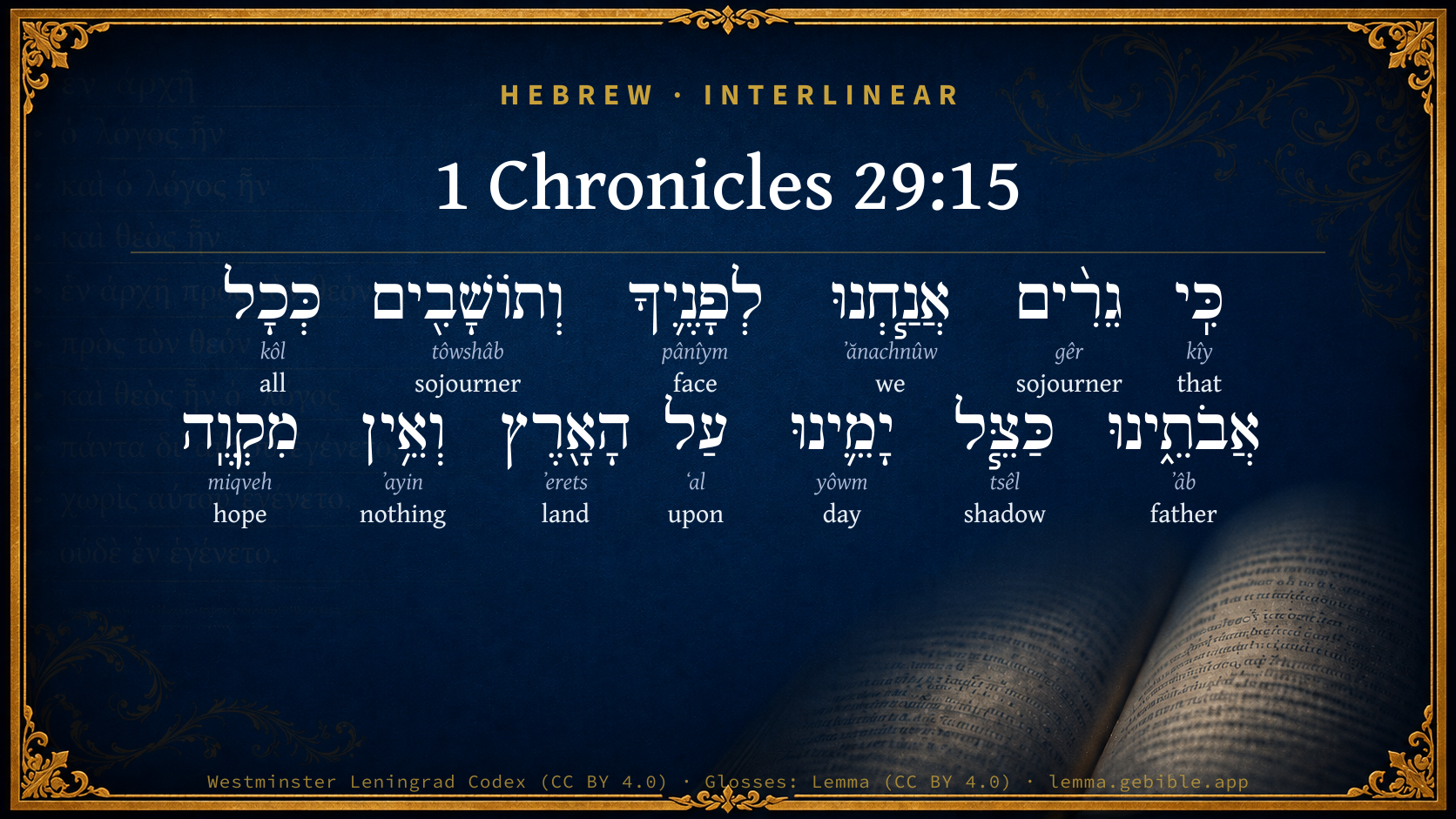
1 Chronicles 29:15

Hebrew (Westminster Leningrad Codex) 1 Chronicles 29:15 appears in the Hebrew Old Testament. The text above is from the Westminster Leningrad Codex. Each word links to its Strong’s number, a concise gloss, and parsing drawn from the Open Scriptures Hebrew Bible morphology. Click any word for its full Brown-Driver-Briggs (BDB) entry.
Download image
Cite this verse

1 Chronicles 29:15 (World English Bible). Public Domain. Lemma interlinear Bible study tool, https://lemma.gebible.app/v/1-chronicles/29/15.

Show BibTeX & RIS
BibTeX
RIS
English Translation
For we are strangers before you, and foreigners, as all our fathers were: our days on the earth are as a shadow, and there is no abiding.
World English Bible · Public Domain
Download a study sheet

One document with this verse’s original text, its word-by-word gloss line, the meaning frame, cross-references with their text, attributed commentary, and full source and license credits — printable, and it pastes into notes with its structure intact.

This verse Autodidact and up

Study sheet (.html) Plain text (.txt)

A passage Seminary Student

Up to 50 verses in one chapter. A passage sheet keeps up to 6 commentary sources and 12 cross-references per verse, in the order this page ranks them, and says so on the sheet whenever that leaves anything out. Ask for a single verse and you get the Autodidact verse sheet above.

Everything on this page stays free to read, with no account — the sheet is a download of what is already on screen, not access to it.

Want to remove ads? Support Godless Engineer
Compare translations 3

The same verse in 3 English versions, stacked beneath the original-language interlinear above. Click any original word for its lexicon entry.

Each is an independent rendering of the whole verse — the interlinear is not word-aligned to these translations.

Highlighted words mark where these versions differ — a whole-verse word diff, not a word-by-word alignment.

  • World English Bible Public Domain
    For we are strangers before you, and foreigners, as all our fathers were: our days on the earth are as a shadow, and there is no abiding.
  • King James Version Public Domain
    For we are strangers before thee, and sojourners, as were all our fathers: our days on the earth are as a shadow, and there is none abiding.
  • unfoldingWord Literal Text CC BY-SA 4.0
    For we foreigners to your face and settlers, like all of our fathers. Our days upon the earth like a shadow and without hope.

unfoldingWord Literal Text — © unfoldingWord, licensed CC BY-SA 4.0. Word-aligned USFM3 via Door43 (git.door43.org/unfoldingWord/en_ult).

Versions to compare (up to 4)

3 of 4 selected

Show all 18 translations

Every available English version of this verse, each an independent rendering of the whole verse.

  • World English Bible Public Domain
    For we are strangers before you, and foreigners, as all our fathers were: our days on the earth are as a shadow, and there is no abiding.
  • Berean Standard Bible Public Domain
    For we are foreigners and strangers in Your presence, as were all our forefathers. Our days on earth are like a shadow, without hope.
  • Majority Standard Bible Public Domain
    For we are foreigners and strangers in Your presence, as were all our forefathers. Our days on earth are like a shadow, without hope.
  • King James Version Public Domain
    For we are strangers before thee, and sojourners, as were all our fathers: our days on the earth are as a shadow, and there is none abiding.
  • American Standard Version (1901) Public Domain
    For we are strangers before thee, and sojourners, as all our fathers were: our days on the earth are as a shadow, and there is no abiding.
  • Revised Version (1885) Public Domain
    For we are strangers before thee, and sojourners, as all our fathers were: our days on the earth are as a shadow, and there is no abiding.
  • Geneva Bible (1599) Public Domain
    For we are stragers before thee, and soiourners, like all our fathers: our dayes are like ye shadowe vpon the earth, and there is none abiding.
  • Douay-Rheims (1899) Public Domain
    For we are sojourners before thee, and strangers, as were all our fathers. Our days upon earth are as a shadow, and there is no stay.
  • Young's Literal Translation Public Domain
    for sojourners we `are' before Thee, and settlers, like all our fathers; as a shadow `are' our days on the land, and there is none abiding.
  • Literal Standard Version CC BY-SA 4.0
    for we [are] sojourners and settlers before You, like all our fathers; our days on the land [are] as a shadow, and there is none abiding.
  • Unlocked Literal Bible CC BY-SA 4.0
    For we are strangers and travelers before you, as all our ancestors were. Our days on the earth are like a shadow, and there is no hope of remaining on earth.
  • unfoldingWord Literal Text CC BY-SA 4.0
    For we foreigners to your face and settlers, like all of our fathers. Our days upon the earth like a shadow and without hope.
  • Darby Bible Public Domain
    For we are strangers before thee, and sojourners, as all our fathers: our days on the earth are as a shadow, and there is no hope [of life].
  • World Messianic Bible Public Domain
    For we are strangers before you and foreigners, as all our fathers were. Our days on the earth are as a shadow, and there is no remaining.
  • Webster's Bible Public Domain
    For we are strangers before thee, and sojourners, as were all our fathers: our days on the earth are as a shadow, and there is no abiding.
  • Free Bible Version CC BY-SA 4.0
    In your eyes we are strangers and foreigners, just like our forefathers. Our time here on earth passes like a shadow, we have no hope of staying here long.
  • Bible in Basic English Public Domain
    For we, as all our fathers were, are like men from a strange country before you, who have got a place for a time in the land; our days on the earth are like a shade, and there is no hope of going on.
  • JPS Tanakh (1917) Public Domain
    For we are strangers before Thee, and sojourners, as all our fathers were: our days on the earth are as a shadow, and there is no abiding.

Literal Standard Version (2020), Covenant Press — licensed CC BY-SA 4.0. Text via the HelloAO Bible API (eBible.org). Unlocked Literal Bible (unfoldingWord) — licensed CC BY-SA 4.0. Text via the HelloAO Bible API (eBible.org). unfoldingWord Literal Text — © unfoldingWord, licensed CC BY-SA 4.0. Word-aligned USFM3 via Door43 (git.door43.org/unfoldingWord/en_ult). Free Bible Version, Dr. Jonathan Gallagher — licensed CC BY-SA 4.0. Text via the HelloAO Bible API (eBible.org).

Word by word

More ways to search: Search by grammar → Find every occurrence → Compare this word →

Practice this passage: Drill this verse → Learn its vocabulary →

מִקְוֶֽה
miqveh
H4723
“hope”
Noun, Common, Masculine, Singular, Absolute
Part of Speech
Noun
Type
Common
Gender
Masculine
Number
Singular
State
Absolute
Full BDB Definition

Origin: from H6960

TWOT: 1994c , 1995a

hope - hope - ground of hope - things hoped for, outcome - collection, collected mass
  1. כִּֽי kîy H3588 “that” Conjunction
  2. גֵרִ֨ים gêr H1616 “sojourners” Noun, Common, Masculine, Plural, Absolute
  3. אֲנַ֧חְנוּ ʼănachnûw H587 “we” Pronoun, Personal, 1st Person, Common, Plural
  4. לְפָנֶ֛יךָ pânîym H6440 “to/for · face(s) · your” Preposition + Noun, Common, Both, Plural, Construct + Suffix, Personal, 2nd Person, Masculine, Singular
  5. וְתוֹשָׁבִ֖ים tôwshâb H8453 “and · sojourners” Conjunction + Noun, Common, Masculine, Plural, Absolute
  6. כְּכָל kôl H3605 “like/as · all of” Preposition + Noun, Common, Masculine, Singular, Construct
  7. אֲבֹתֵ֑ינוּ ʼâb H1 “fathers · our” Noun, Common, Masculine, Plural, Construct + Suffix, Personal, 1st Person, Common, Plural
  8. כַּצֵּ֧ל tsêl H6738 “like/as the · shadow” Preposition, Determined + Noun, Common, Masculine, Singular, Absolute
  9. יָמֵ֛ינוּ yôwm H3117 “days · our” Noun, Common, Masculine, Plural, Construct + Suffix, Personal, 1st Person, Common, Plural
  10. עַל ʻal H5921 “upon” Preposition
  11. הָאָ֖רֶץ ʼerets H776 “the · land” Particle, Definite Article + Noun, Common, Both, Singular, Absolute
  12. וְאֵ֥ין ʼayin H369 “and · nothing” Conjunction + Particle, Negative

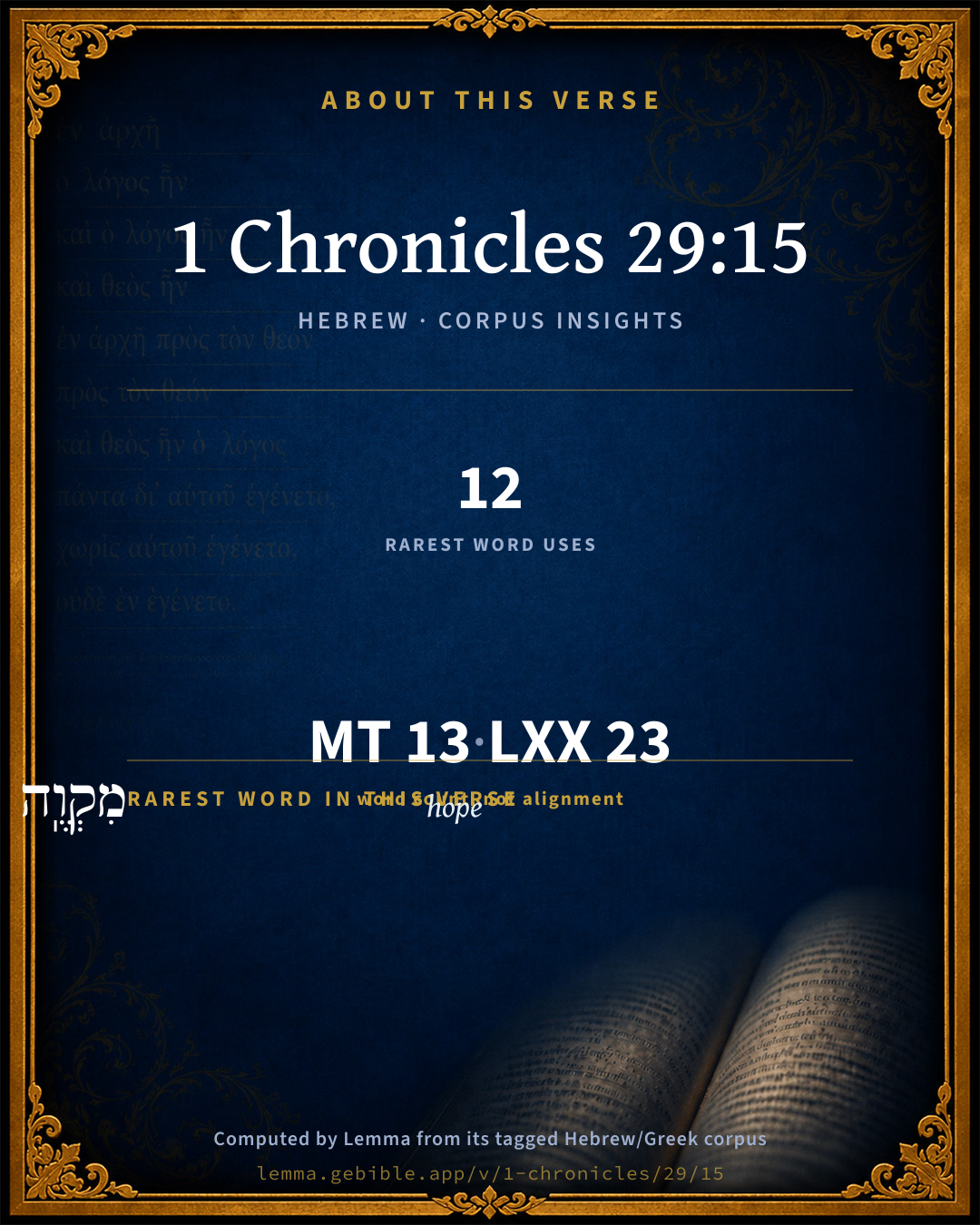
About this verse

These counts appear in no published source. They are computed here, from the morphology-tagged text and Lemma’s own curated glosses. What Lemma adds →

13
words
13
distinct lemmas
Historical
section

Notable vocabulary

The rarest word here is מִקְוֶֽה hope H4723 — appearing just 12 times in the whole Hebrew Bible.

Shared distinctive vocabulary

מִקְוֶֽה hope H4723 occurs in 10 verses of the Hebrew Bible. Also found in:

Grammatical profile

  • 9 nouns
  • 1 pronoun
  • 1 preposition
  • 1 conjunction
  • 1 particle

Hebrew & Septuagint length

In English translation the verse runs 27 words from the Hebrew and 27 from the Septuagint (LXX English) — the same length.

A rough comparison of the two English renderings, which tokenize alike — not a word-level alignment.

Word counts can differ between the Hebrew and the Greek without any difference in meaning — e.g. the Hebrew direct-object marker אֵת has no separate Greek word, and Greek often adds the article ὁ.

In the original languages it is 13 Hebrew tokens and 23 Greek tokens — but the two are counted differently (Hebrew bundles its prefixes and suffixes into one token; the Greek is in lemma form), so that isn’t a like-for-like length.

Cross-references

13

Topical passages linked to 1 Chronicles 29:15 in the Treasury of Scripture Knowledge — connected by theme and wording, ordered by reader-vote popularity; previews shown in the World English Bible.

  • Leviticus 25:23 "'The land shall not be sold in perpetuity, for the land is mine; for you are strangers and live as foreigners with me.
  • Psalms 102:11 My days are like a long shadow. I have withered like grass.
  • Psalms 144:4 Man is like a breath. His days are like a shadow that passes away.
  • Job 14:2 He comes forth like a flower, and is cut down. He also flees like a shadow, and doesn't continue.
  • Psalms 39:12 "Hear my prayer, Yahweh, and give ear to my cry. Don't be silent at my tears. For I am a stranger with you, A foreigner, as all my fathers were.
  • James 4:14 Whereas you don't know what your life will be like tomorrow. For what is your life? For you are a vapor, that appears for a little time, and then vanishes away.
  • Psalms 90:9 For all our days have passed away in your wrath. We bring our years to an end as a sigh.
  • Psalms 119:19 I am a stranger on the earth. Don't hide your commandments from me.
  • Isaiah 40:6–8 The voice of one saying, Cry. One said, What shall I cry? All flesh is grass, and all the glory of it is as the flower of the field.
  • Hebrews 11:13–16 These all died in faith, not having received the promises, but having seen them and embraced them from afar, and having confessed that they were strangers and pilgrims on the earth.
  • Genesis 47:9 Jacob said to Pharaoh, "The days of the years of my pilgrimage are one hundred thirty years. Few and evil have been the days of the years of my life, and they have not attained to the days of the years of the life of my fathers in the days of their pilgrimage."
  • Ecclesiastes 6:12 For who knows what is good for man in life, all the days of his vain life which he spends like a shadow? For who can tell a man what will be after him under the sun?
  • 1 Peter 2:11 Beloved, I beg you as foreigners and pilgrims, to abstain from fleshly lusts, which war against the soul;

Cross-references courtesy of OpenBible.info (CC BY 4.0).

Hebrew and Greek witnesses Masoretic Hebrew ↔ Greek Septuagint

The same verse in the two great witnesses to the Old Testament, shown verse-for-verse.

These are two independent witnesses, not word-aligned to each other, and the Septuagint is shown in lemma (dictionary) form.

Hebrew 1 Chronicles 29:15 Masoretic · Westminster Leningrad Codex

כִּֽי גֵרִ֨ים אֲנַ֧חְנוּ לְפָנֶ֛יךָ וְתוֹשָׁבִ֖ים כְּכָל אֲבֹתֵ֑ינוּ כַּצֵּ֧ל יָמֵ֛ינוּ עַל הָאָ֖רֶץ וְאֵ֥ין מִקְוֶֽה

For we are strangers before you, and foreigners, as all our fathers were: our days on the earth are as a shadow, and there is no abiding.

World English Bible · Public Domain

Greek LXX 1 Chronicles 29:15 Septuagint · lemma form

ὅτι πάροικος εἰμί ἐναντίον σύ καί παραοἰκέω ὡς πᾶς ὁ πατήρ ἐγώ ὡς σκιά ὁ ἡμέρα ἐγώ ἐπί γῆ καί οὐ εἰμί ὑπομονή

for we are strangers before you, and sojourners, as all our fathers were: our days upon the earth are as a shadow, and there is no remaining.

LXX2012 (modern English Septuagint) · Public Domain

Hebrew: Westminster Leningrad Codex (CC BY 4.0). Greek: Septuagint (public domain); English from LXX2012 (modern English Septuagint) (Public Domain). How the Septuagint differs from the Hebrew →

Commentary

Notes on 1 Chronicles 29:15 from classic Christian and Jewish commentators (each source and its license shown beneath its notes). The classic Christian expositions comment on the surrounding passage and are grouped to its opening verse, so a note may address several verses; the Jewish commentaries on the Tanakh (Rashi and others) are per-verse, so they appear only where the commentator wrote on this verse.

Lemma curates 59 commentaries, every one of them public domain or Creative Commons licensed, each selected and text-cleaned for this edition rather than reprinted as found. About our sources →

Trapp's Complete Commentary

John Trapp

1Ch 29:15 For we [are] strangers before thee, and sojourners, as [were] all our fathers: our days on the earth [are] as a shadow, and [there is] none abiding.

Ver. 15. For we are strangers before thee, and sojourners.] How, then, can we do better than deposit what we have in thy hands, and lay up treasure in heaven by laying it (lavishing, some may think it) out upon thy holy house, and so laying hold on eternal life; {1Ti 6:19} for here, alas, we have no abiding place, {Heb 13:14} and, as strangers, we are tenuis admodum fortunae, little worth.

As were all our fathers.] Who freely acknowledged it, {Gen 47:9 Heb 11:13} and carried themselves accordingly.

Our days on the earth are as a shadow.] A shadow of smoke, {a} a dream of a shadow, {b} as the heathen could say. A shadow seemeth to be something, when indeed it is nothing; so is man’s life: and the longer this shadow seemeth to be, the nearer their sun is to setting, who put far away from them the thoughts of death.

And there is none abiding.] Heb., Expectation of long life, or good days on earth.

{a} καπνου σκια. - AEschl.

{b} σκιας οναρ. - Pindar.

John Trapp, A Commentary or Exposition upon All the Books of the Old and New Testament (1647–1656) — public domain. Text from a community e-Sword module.

The Biblical Illustrator

Joseph S. Exell

1Ch_29:15-16

For we are strangers before Thee.

Human frailty and its lessons

Every solemn moment of human life discovers more or less its vanity. It is not only when we stand beside the grave and mourn the wreck of hopes sad aspirations buried out of eight. The marriage festival also awakens a sense of insecurity, and the shadow of parting is thrown over the commencing union. The meetings of friends recall the thought of their separation, sad the inauguration of great works of public ceremonial brings up the image of those changes which all end in dissolution. Thus was it with David, when on the last public ceremony of his kingly life he presented with his people the offerings for the temple to the God of Israel It was a turn of thought poetical and yet natural to break away from that splendid throng, laden with gold and silver and other offerings for the house of God, and resonant with the sounds of music and the acclamations of joy, to dwell upon the shadows of vanished generations, and to anticipate the day when the living race should be one shadow more added to the crowd that had passed away.

I. First, then, what are some of the lessons of humiliation taught by the shadowy and vanishing character of human existence?

1. The insufficiency of man, for his own happiness. If he is but a stranger and sojourner upon the earth, if he is only one of a succession of vanishing ciphers, if his days be only as a shadow that declineth, and which soon passes into darkness, is it possible for such a creature, if he have no higher resources, to be happy? At best we must say that happiness is only possible on one of two conditions. Either the nature of man must be capable of being satisfied with this transient existence, when it is prolonged to its greatest duration, or his nature must be capable of averting its view from all the risks and hazards which tend at any moment to bring it to a close. Could the longest life satisfy, man might have here some measure of true good; or could he forget the perils which threaten at any moment to shorten it, he might not be altogether miserable. But neither of these alternatives is possible. Take the longest and the most untroubled life, the most filled with worldly advantage and prosperity--can it satisfy the human soul upon the supposition that this is the whole of existence? No. The soul shrinks from annihiilation. But it it be impossible to be happy even with an untroubled life that vanishes into nothing, how much less when the shadow of death is constantly invading us and refusing to be put away! To forget the rapid flight of time and the certain descent to the grave is for us impossible. Our life is strewn with mementos of its speedy end. We have seen the summer flowers and the winter snows alike swept aside to prepare a grave. The insufficiency of man to be his own portion is thus only too visible. He cannot, because life does not contain sufficient scope for him, and because the little that it contains is checkered with the thread of death in all its texture. Man must learn that he is at best a frail and dying creature, and that if in this life only he have hope he is of all Gods creatures most miserable.

2. The blindness of human nature to its own mortality. We cannot make ourselves happy either by resting in life as a whole, or by shutting out the shadows of death which cloud it; but we are perpetually attempting to do so, and thus are fighting against the nature of things and against God. What is the whole struggle of the ungodly man but an attempt to build his all upon a mortal foundation; to make a pilgrimage a home, a shadow a reality, the surface of a river a solid and lasting pavement?

3. The third and last lesson of humiliation which I notice is the evil of sin. Sin is the parent of death, the grand destroyer of lifes joys, and the creator of its gloom, its shadow, and its insufficiency. Sin mows down all the generations of mankind with relentless sternness. The plague of sin has been in our bones, and therefore their strength has perished, and the beauty of man has consumed like a moth, and he has been altogether vanity.

II. Having thus spoken of lessons of humiliation, let me now mention some lessons of consolation that may be set over against the brevity and uncertainty of earthly existence. I confine myself to two drawn from the text.

1. We have for our consolation the knowledge of Gods eternity. We are, says the King of Israel, strangers before Thee. This is the first ray of comfort. It is like a rock in the midst of the tossing ocean. Take away an everlasting God, and what an awful sadness covers all! If there be no living personal Being before whom our little life is led, by whom its moments are measured out and its destinies fixed; if all be under the dominion of a dark, stern fate that knows and feels nothing, or of a blind chance that orders nothing; if we are tossed and driven upon a waste and melancholy ocean, which at last engulfs our frail bark in its dull, unconscious surge, with no sun or star or eternal eye looking down upon our struggles and our extinction--then, oh how dreary, how unrelieved the picture of utter hopelessness and emptiness, making it good for us that we had never been born! The eternity of a living God was Davids consolation, and that of all the fathers of Israel. It is not less ours; and from this high tower we look down with composure on all the waves of trouble, and feel that so long as we are not without God we can never be without hope in the world.

2. But we have also, for our consolation, the knowledge of Gods covenant love. David prays. The mutable and perishable addresses the Immutable and the Imperishable. He rests on the basis of a covenant. He is dealing with a God who has come near, who has His tabernacle with men, who is pacified towards them for their sins, who has compassion upon their sorrows and their death, and has delivered them from going down to the pit, having found a ransom. This is the inspiration of Davids prayer. His confession is not the melancholy utterance of natures despondency, which gives up all for lost. It is only the voice of pious humility, which renounces all creature trust, that it may recover all in God. We see more clearly than did David how God, the eternal Justice, is become the dying sinners friend and portion; how the greatness of His attributes harmonised in Christ, becomes the measure of the greatness of our deliverance; how, united to Him, our life is no more the shadow, but our death, and that which marks our true nature is not the evanescent, but the abiding and the eternal. Because I live, ye shall live also. Oh! be it ours to lay hold of this covenant of which Jesus is the Mediator; and then, in unison with the eternal God, we may defy death to leave on us the print of its corrupting finger, and to involve our existence in one permanent shadow, for He whose life is the light of men shall swallow up our death in victory, and neither things present nor things to come shall part us from His covenant love.

III. I now come, in the third and last place, to mention some lessons of exhortation arising out of our mortality and decay.

1. The first lesson of exhortation is to diligence in Gods work. David does not reason, as some do, What can shadows like us accomplish in building up the temple of God? This is an unworthy and an un-Christian despondency. As David served his generation, in spite of his keen perception of the evaneseance of human life in general, so should we. The Church of God has been brought to its present state of advancement by such shadows. Each generation has helped it forward, though by small degrees; and as the coral insects build the islands of the Pacific Ocean, so have these small and insignificant labourers of the human family, whose foundation is in the dust and who are crushed before the moth, reared up the walls of Jerusalem, and given it its present strength and beauty in the eyes of all nations. Let us repel the idea that our life is of little worth and value in relation to the advancement of the kingdom of God. The treasure may be in earthen vessels, but the excellency of the power is all the more seen to be Divine. Life is ours as death is theirs; and so long as we are in the world let us labour like our blessed and Divine Lord to be the light of the world.

2. Our second lesson of exhortation is to acquiesce in Gods appointments. David at this time felt himself on the edge of the grave, and was willing to hand over to Solomon the prosecution of the work on which his heart had so long been set. He felt that it belonged to God to choose His own instruments, and from a rapidly vanishing race to select such individuals for His work as to Him seemed best. We may apply this lesson in the way of teaching us to be willing to depart and leave the work of God to others, whenever He shall so ordain. But we may also apply it in another way, so as to teach us to be willing to remain, and do the work of God which has fallen into our hands, though others are withdrawn.

3. Our third lesson of exhortation is to prepare for our own departure. We must be strangely constituted if the removal of others awakens in us no foreboding of our own end. Are we, then, prepared? Preparation is of two kinds. The saint is prepared when he is doing with his might whatsoever his hand findeth to do; when he is steadfast and immovable, always abounding in the work of the Lord; when his eye is constantly directed towards the Cross that so he may wash away the stains of daily sin, and not less towards the throne that he may receive his daily instructions from his unseen Lord, and run in the way of His commandments with enlarged heart. But there is also, the preparation of the sinner, and this must begin at an earlier starting-point. Years have not repealed the law, Ye must be born again; nor has the multitude of feet smoothed an entrance into the Zion of God. (John Cairns.)

The grandeur of human opportunity

I. The shortness of life.

II. The grandeur of human opportunity.

1. There is no sign of sadness in the scene before us. Davids mind and heart are filled with the thought of God, and with the things of God.

2. This preparation for the building of the temple was an act of thanksgiving.

3. The splendour of the preparation is an evidence of Davids zeal for the house of the Lord. Giving was regarded by David, not as a duty, but a privilege--a grand opportunity of turning the mammon of unrighteousness to eternal account. Thin zeal for the house of God is one of the marked features of the Psalter (Psa_26:1-12; Psa_27:1-14; Psa_84:1-12; Psa_92:1-15; etc.).

III. Lessons.

1. The remembrance of the shortness of life (Psa_39:4), for the purpose of using time aright.

2. To take the measure of earthly things as we shall do when we look back over the day of life (Deu_32:29).

3. All that is done for the kingdom of God remains. Another generation may have to carry out what we only begin. (The Thinker.)

The transitoriness of life

I. To illustrate the assertion, No abiding. This may apply to--

1. Human honours.

2. The pleasures of sense.

3. Worldly profits.

4. Particularly to mans life.

To impress this truth, reflect--

(1) That we have sinful souls, and that therefore we must die. The wages of sin is death.

(2) On the frailty of our bodies and their liability to disease,

II. To direct to a proper improvement of the truth.

1. Immediately close with Christ the Saviour.

2. Diligently apply to your proper work.

(1) In relation to God. This is the work of God, that ye believe on Him whom He hath sent.

(2) In relation to yourselves. Salvation is a matter of the last importance.

(3) In relation to your neighbours. As ye have opportunity do good unto all men.

3. Cleave not to earthly things.

4. Murmur not under crosses.

5. Labour for the conversion of sinners.

Address--

1. The aged.

2. The young. (E. Brown.)

Strangers and sojourners

1. How short our stay is! The average life is less than thirty-five years. Multitudes die in infancy. No man can say that this is his home. He knows not how long he will remain. He is not even sure that he will be here to-morrow. He is a sojourner.

2. He is a stranger. He does not have time to become acquainted. The proper study of mankind may be man, but life is too short to make much proficiency in it. The average man has no real knowledge of his fellow-men. Of their inner lives he knows nothing.

3. Nor have we a better knowledge of the world. Who knows the secrets of rocks and hills, or the laws of vegetable life? Who understands the mighty forces of nature, or the mysteries of the visible universe? Who can interpret for me the message of the pebble beneath my feet? One of the wisest of mankind likened himself to a child playing on the shores of an unknown ocean. Sensible men no longer attempt to learn everything. Realising the shortness of the time, they select some particular branch of learning and count themselves fortunate if they succeed in mastering that ere death comes.

4. The brevity and uncertainty of mans sojourn make sad havoc with cherished plans and stamp his whole career with incompleteness. Mans tenure is feeble and precarious.

5. This solemn undertone of lifes song is often referred to in the Bible.

6. Out of the ashes of despair hope springs. The very words strangers and sojourners are suggestive of a place where man will be at home. The very brevity and incompleteness of earthly life raise the question whether there is not some complemental life. Since the powers are not developed, the character not matured, the plans not executed here, the mind instinctively believes that there is a place where they will be. What a waste, exclaims Burr, if death ends all! What a host of abortive and abandoned undertakings! Whole cities of houses in the first stages of building, and lo, all work finally suspended; whole navies in the dockyards with great keels fairly laid, and then left to rot! Who does such things? Here and there a fickle, foolish, or impoverished man, but certainly not the all-wise and all-mighty and steadfast God. A dead man is merely an evicted tenant. He has gone out of sight but not out of mind.

7. The Word of God sets this truth in the white light of revelation. Christ comforts His sorrowing disciples by reminding them of the mansions prepared for them.

8. This thought lends inspiration to endeavour and affords comfort under the troubles of life.

Conclusion:

1. Take the right road. That road begins and ends in Christ.

2. Make spiritual use of temporal things. True riches are spiritual, and temporal riches are of value only as they are used for spiritual ends. God will require an account of our stewardship.

3. Live by the faith of the Son of God. (Arthur J. Brown, D. D.)

The real nature of human life

I. As strangers here we ought to guard against an excessive and unrestrained indulgence of our appetites and passions. This objection will appear by reflecting--

1. Upon the nature of our present situation, and what our proper employment ought to be while we sojourn here. We are placed here in order to prepare for the perfection of the heavenly state. Our course ought to be a continued and gradual progress from lesser to higher degrees of piety and virtue. Like a river enlarging as it runs, these ought to increase, and flow in a stream continually augmented. It is a sign of a base and ignoble spirit to linger on the road, or set up his rest in a strange country, fond of its foreign entertainments, and neglecting to move towards his home, where alone his chief occupation and his chief happiness are to be found. As a man cannot easily travel who is heavily burdened, neither can any one make any progress in a virtuous course when fettered by the pleasures and interests of this world.

2. Upon the nature of those things which excite our desires and solicit our indulgence. These are: wealth, outward honours, fame, pleasure, everything included in the term prosperity. These are--

(1) Deceitful.

(2) Unsatisfying.

(3) Beyond our control.

3. That death will put a final period to them all.

II. As strangers here we ought with firmness to encounter and with patience to endure its difficulties and distresses. This is suggested--

1. By the nature of our journey through this life.

2. By reflecting on the origin of our afflictions and for what end they are intended. They are appointed by God, and are intended to improve man in virtue and happiness.

3. By the fleeting and shortlived character of our troubles and misfortunes. To the present state they are confined, and with our bodies they shall die. (J. Drysdale, D. D.)

Mankind considered as strangers and sojourners on earth

This proposition is liable to many mistakes. It does not mean--

1. That we are here in a place unsuited to us, for which we were not designed, or to which our Creator had either exiled us as a punishment or only placed us in for a certain period without having any particular view in so doing, till He could assign to us at some other time a different place in the territory of His dominion.

2. That we must be as indifferent to all the objects around us and take as little interest in them as travellers and strangers are wont to do in the several places of their short sojourn.

3. That we here are only obnoxious to toils, troubles, and sorrows, and incapable of real happiness, as though all that is so called existed nowhere but in the imagination, or as though we could here enjoy happiness merely in hope, in agreeable prospects of futurity. How, then, and in what sense are we strangers and sojourners on earth?

I. Since we have here no inheritance in the strictest import of the expression, since we possess nothing on the possession whereof we can rely.

II. In that we cannot here attain the whole of our destination, we cannot be and become all that our Creator designs. We here only begin to unfold our faculties.

III. We cannot here find all that we wish for and require, and what in itself may be good and desirable, but that alone which is proper for this station and for our present constitution. In the exercise of our faculties we frequently meet with insurmountable obstacles. Seldom can we do as much good and for so long a time as we could wish. We cannot here find happiness that fully satisfies, that is uninterrupted in its duration, and its enjoyment not subject to casualty or change.

IV. We are not appointed in perpetuity to this terrestrial life.

V. We have a country to which we are hastening, and in which alone we shall reach our destination. Improvement:

1. Seek nothing here that is not here to be found.

2. Be not surprised nor troubled at anything which is a natural consequence of your present condition, which is inseparable from the pilgrim life which you lead.

3. Beware of rendering your pilgrimage still more laborious by avoidable deviations and mistakes.

4. Reckon your present state always for that which it really is, and use it always to the purposes for which it is designed. It is not the term, but the way to the term. It is not the most perfect mode of existence and of life whereof you are capable, but only the first, the lowest stage of it.

5. Never be unmindful of your better, celestial country. (Anon.)

Strangers and sojourners

This expression is remarkable, they are strangers before the Lord. He knows them to be such, and it is by His wise and gracious appointment that they are so.

I. All true believers are strangers and sojourners upon earth, in respect to their actual state and condition. The saints in this world are like travellers in a foreign land, or like a merchant ship in a strange port; the day of return is set, and it only waits till the freight is ready.

II. With respect to their temper and disposition.

1. They manifest the disposition of strangers and sojourners by their comparative indifference to the things of the present world.

2. As strangers they intermeddle not with things that do not immediately concern them, and are not busybodies in other peoples matters.

3. Strangers long to be at home, are often sending home, and will be grieved if they do not hear from thence.

III. Real Christians are often treated like strangers by the men of the world. The principles by which they are actuated, the inward conflicts, joys, and consolations which they experience, the hopes and prospects which they entertain, are all unknown to the unbelieving world, who regard them only as so many misguided enthusiasts. Men wonder at their zeal and fervency, their mortification and self-denial, their courage and resolution. They also wonder that they do not run with them to the same excess of riot (1Pe_4:4).

IV. Christians are only sojourners. A sojourner is one who dwells in a strange country, in which he has no possession, but takes up a temporary residence (Lev_25:23; 1Pe_1:17).

V. Our being strangers and sojourners upon the earth is sufficiently illustrated and confirmed by our actual condition, or the shortness of time, and the mutability of our state. Inferences:

1. Let us learn to be more indifferent about things present.

2. The brevity of our state should teach us to improve time while we have it.

3. Adore the mercy and forbearance which did not cut us off in our sins.

4. Learn to live in the constant expectation of death and judgment, as if every day were to be the last.

5. If true believers in every age have been strangers and sojourners upon the earth, let us carefully examine how far this character belongs to us.

6. If we really bear the character of a pilgrim in a strange land, let us be careful to act upon it.

7. Let us bear with meekness and patience the troubles we may meet with by the way.

8. Let us endeavour to lead others into the way we are going (Num_10:29; Jer_6:16; Joh_14:6).

9. Learn to be kind-hearted to all who are travelling Zionward, to love as brethren and strengthen each others hands in the Lord. 10. Consider what a hearty welcome awaits you when you reach your destination. (B. Beddome, M. A.)

Strangers and sojourners

This is the testimony of an old man, a wise man, a great man.

I. We have here a description of human life--a pilgrimage. Other Scriptural figures--an arrow flying through the air; a race; a flower. No figure more aptly describes human life than that of a journey, as it represents the whole world in all its distinctions, rich and poor, wise and foolish, young and old, all journeying to their everlasting home.

II. An inference of Christian duty. (R. C. Dillon.)

Earth not a place of rest

I have read in classic literature of men pursued by the avenging furies; and in American story of certain Indians who, driven out of their hunting-grounds by the pursuing flames, ran on and on until, half-dead, they came to a noble river, and swiftly fording it sat round their chief as he struck his tent-pole into the ground and threw himself on the cool turf, crying, Alabama! Alabama! here we may rest. But no, before sleep had refreshed their weary bodies their new home was claimed by hostile tribes. Earth has no resting-place for souls. (J. Clifford, D. D.)

Folly of presuming on life

The late Mayor of Chicago uttered the following boast: I believe that I will live to see the day when Chicago will be the biggest city in America. I dont count the past. I have taken a new lease of life, and I intend to live more than half a century; and at the end of that half-century London will be trembling lest Chicago should surpass her. Within eight hours the bullet of the assassin had in ten brief minutes finished the earthly career of the author of the words I have quoted. (The Christian.)

All must be quitted

A fatal malady seized on Cardinal Mazarin, whilst engaged in affairs of State. He consulted Guenaud, the physician, who told him he had two months to live. Some days after, the Cardinal was seen in his nightcap and dressing-gown creeping along his picture-gallery and exclaiming, Must I quit all these? He saw a friend and held him: Look at that Correggio! this Venus of Titian! that incomparable Deluge of Caracci! Ah! my friend, I must quit all these. Farewell, dear pictures, that I love so dearly, and that cost me so much!

The Biblical Illustrator, edited by Joseph S. Exell (c. 1880s–1900s) — public domain. Text from a community e-Sword module.

Joseph Benson's Commentary

1Ch 29:15. For we are strangers before thee, &c. — Poor, despicable creatures. The land which we possess is thine, not ours; we are not the proprietors, but only thy tenants: and as our fathers once were mere strangers in it, even before men, so we at this day are no better before thee, having no absolute right in it, but only to travel through it, and sojourn in it for the short time we live in the world. This is equally true of all men, who on earth are but strangers and sojourners; while angels and saints in heaven are there at home. Our days on earth are as a shadow — David’s days had as much of substance in them as most men’s: for he was upon the whole a good man, a useful man, and now an old man. He lived long, and to good purpose; and yet he puts himself in the front of those who must acknowledge that their days on the earth are as a shadow: which speaks our life a vain life, a dark life, a transient life, and a life that will have its period, either in perfect light or perfect darkness. And there is none abiding — Hebrew, מקוה, mickve, expectation. We cannot expect much from earth, nor can we expect any long continuance in it. This is mentioned here as that which forbids us to boast of what we give to God and his cause, or to our poor and destitute fellow-creatures, or of the services we perform to him. We only give what we must shortly leave, and what we cannot keep to ourselves: and our services are confined to a mere scantling of time: they are the services of a short, uncertain life. What, therefore, can we pretend to merit by such gifts or services? and what right have we to boast, or think highly of ourselves, on account of them? Surely God does us a great favour that he will accept such offerings and services from us.

Joseph Benson's Commentary on the Old and New Testaments (1811–1818) — public domain. Text from a community e-Sword module.

Geneva Bible (1599)

Geneva Bible translators

And therefore have this land but lent to us for a time.

Hebrew, waiting for them to return.

Geneva Bible (1599) marginal notes — public domain. Text via Bolls.life.

Adam Clarke's Commentary

Verse 15. For we are strangers] We have here neither right nor property.

And sojourners] Lodging as it were for a night, in the mansion of another.

As were all our fathers] These were, as we are supported by thy bounty, and tenants at will to thee.

Our days on the earth are as a shadow] They are continually declining, fading, and passing away. This is the place of our sojourning, and here we have no substantial, permanent residence.

There is none abiding.] However we may wish to settle and remain in this state of things, it is impossible, because every earthly form is passing swiftly away, all is in a state of revolution and decay, and there is no abiding, מקוה mikveh, no expectation, that we shall be exempt from those changes and chances to which our fathers were subjected. "As the shadow of a bird flying in the air [ avir] of heaven, such are our days upon the earth; nor is there any hope to any son of man that he shall live for ever." - Targum.

Adam Clarke's Commentary on the Bible (1810–1826) — public domain. Text from a community e-Sword/MySword module.

Ellicott's Commentary for English Readers

(15) For we are strangers before thee, and sojourners.—Psa_39:12.

Our days on the earth are as a (the) shadow.—Job_8:9; Psa_144:4.

And there is none abiding.—Rather, and there is no hope; no outlook, no assured future, no hope of permanence. What is the ground for this plaintive turn in the thought? Merely, it would seem, to emphasise what has just been said. We, as creatures of a day, can have no abiding and absolute possession. Our good things are lent to us for a season only. As our fathers passed away, so shall we.

A Bible Commentary for English Readers, edited by Charles John Ellicott (1878–1897) — public domain. Text from a community e-Sword module.

The Cambridge Bible for Schools and Colleges

gen. ed. J. J. S. Perowne

15. strangers before thee, and sojourners] David describes himself and his people not as strangers to God, but as strangers dwelling before God. In ancient states foreigners were sometimes allowed to reside in the capital under the immediate protection of the king or of the heads of the state; cp. 1Sa_22:3-4; 1Sa_27:3; 2Sa_15:19; cp. also the position of the aliens at Athens. David appeals to God on the ground that Israel is immediately under God’s protection. Cp. Psa_39:12.

none abiding] R.V. no abiding, i.e. no continuance.

The Cambridge Bible for Schools and Colleges (gen. ed. J. J. S. Perowne; Cambridge University Press, 1878–1918) — public domain. Text from a community e-Sword module.

John Gill's Exposition

O Lord our God, all this store that we have prepared,.... Of gold, silver, &c. that he and his people had provided and contributed: the gold, according to Jacob Leon (r), amounted to 59,766 tons of gold, and 46,123 gilders, each ton to be reckoned at least 1000 pounds sterling; the silver, reduced to the value of gold, made 46,337 tons, and two hundred and fifty gilders; but both, according to Witsius (s), amounted to 20,585 tons of gold; and if the talents were talents of the sanctuary, and they double the common talents, as some say they were, it was as much more, and may well be expressed by

all this store, besides the brass, iron, &c.

to build thee an house for thine holy name; to perform holy and religious worship in it, for the glory of his name: cometh of

thine hand, and is all thine own: this he repeats, that God might have all the glory of all they had and did.

(r) Relation of Memorable Things in the Tabernacle and Temple, ch. 3. p. 14, 15. (s) Miscellan. tom. 2. p. 258.

John Gill's Exposition of the Whole Bible (1746–1763) — public domain (CC PDM 1.0). Text via the HelloAO Bible API.

Haydock's Catholic Bible Commentary

Strangers. We have nothing but what we have received from thee; and for how short a time! (Calmet) --- No stay. Hebrew, "none abiding, (Haydock; or) no hope" of being able to escape death, (Calmet) when we must leave all. How happy, therefore, are those who sent their treasures before them! (Haydock) --- All are pilgrims, with respect to heaven, Hebrews xiii. (Worthington)

George Leo Haydock (1774–1849), Haydock's Catholic Family Bible and Commentary, 1859 edition — public domain. Excludes Psalms (Douay-Rheims chapter numbering differs from Protestant) and Deuterocanonical books (Catholic canon only).

Matthew Poole's English Annotations

These words may contain a reason, either,

1. Of the first clause of 1Ch 29:14, Who am I &c., i.e. what mean and contemptible creatures are we, and how unworthy of so high a favour! for, saith he here, we, I and my people, as it is 1Ch 29:14, are strangers, &c, poor pilgrims, who bring nothing into the world, and pass hastily through it, and can carry nothing with us out of it. Or rather,

2. Of the last clause of that 14th verse, of thine own, &c. For the land which we possess is thine, not ours; we are not the proprietors or perpetual possessors of it, but only thy tenants: and as our fathers once were mere strangers in it, even with or before men, Psa 105:12; so we at this day are no better with or before thee, having no absolute right and title in it, but only to travel through it, and sojourn in it for that short time that we live in the world. And this the argument seems to be borrowed from Lev 25:23, where this is give as a reason why the inheritances of the land of Canaan could not be sold for ever, but only till the jubilee; for, saith God, the land is mine, as to dominion and propriety, for ye were (or for, or but you are) only strangers and sojourners with me.

There is none abiding: we only give to thee what we must shortly leave, and what we cannot keep to ourselves; and therefore it is a great favour that thou wilt accept such offerings; or, and therefore we are not perpetual possessors of this land, and the fruits of it, but only pilgrims and passengers through it.

Matthew Poole's English Annotations on the Holy Bible (1683–1685) — public domain. Text from a community e-Sword/MySword module.

Whedon's Commentary on the Bible

Daniel D. Whedon

15. None abiding — Hebrew, no hope; that is, no confidence or certain assurance of continuing long on earth.

Daniel D. Whedon (gen. ed.), Commentary on the Old and New Testaments (1874–1909) — public domain. Text from a community e-Sword module.

The Pulpit Commentary

Of the seven other clear occasions of occurrence of the word here translated abiding (hw,q]mi), it bears three times the meaning of "a gathering together" as of waters (Gen_1:10; Exo_7:19; Lev_11:36) The other four times it is translated in the Authorized Version "hope," either in the abstract, (Ezr_10:2) or in the personal object of it. (Jer_14:8 Jer_17:13 Jer_50:7) Probably the word "abiding,"as drawn from this latter aspect of the word, expresses with sufficient accuracy the intended meaning here.

Man but a sojourner.

Before "life and immortality" had been "brought to light," the brevity of man"s life on the earth seems to have caused much distress, even to godly people. There is a wailing tone about many of the Old Testament references to short life and remorseless death that seem but little in advance of the despairings of the pagan, who cried after his passing friend, "Vale, vale, aeternum vale!" A few specimens may be given. "For what is your life? It is even a valour, that appeareth for a little time, and then vanisheth away." "All flesh is grass, and all the goodliness thereof is as the flower of the field; the grass withereth, the flower fadeth, because the Spirit of the Lord bloweth upon it: surely the people is grass." "My days are swifter than a post: they flee away, they see no good. They are passed away as the swift ships: as the eagle that hasteth to the prey." "My days are swifter than a weaver"s shuttle, and are spent without hope." "Let me alone; for my days are vanity." There is, happily, another side to the Old Testament representations, and the pious men of the olden times looked away from swift passing life, and from the sorrow of death and separation, to the unchanging stability of the everlasting God, and the high and eternal hopes that rest upon his gracious provisions and promises. Transitoriness is the condition of present being, not for us men only, but also for all the created things with which we have to do. All nature tells of change and passing away; things are here for a little while, and then they vanish away. The winter snow falls lightly, and lies in its white purity mystic, wonderful over all the land; but soon it soils and browns and sinks away. The spring flowers that come, responsive to the low sunshine and the gentle breath, are so fragile, and they stay with us but such a little time, and then pass away. The summer blossoms multiply and stand thick over the ground, and they seem strong with their deep rich colouring; and yet they too wither and droop and pass away. The autumn fruits cluster on the tree branches, and grow big, and win their soft rich bloom of ripeness; but they too are plucked in due season, and pass away. The gay dress of varied leafage is soon stripped off by the wild winds; one or two trembling leaves cling long to the outmost boughs, but by-and-by even they fall and pass away. Down every channel of the hillside are borne the crumblings washed from the "everlasting hills," as we call them, that are, nevertheless, fast passing away. All around us is speaking of change and decay. The writing is on wasting rock and crumbling peak, on the old tower and the ivied wall, the flowing stream and the autumn tints, is no rest." Man and his world are but sojourners. Recall Coifi, the ancient Briton"s, figure of man"s brief life as a bird, coming out of the dark and flying through the lighted hall away out into the dark again; and illustrate and enforce the following points: The brevity of man"s life on the earth is designed to

I MAKE SERIOUS THE PRESENT. Its voice is, "Whatsoever thy hand findeth to do, do it with thy might. It says:

1. What has to be done should be done quickly.

2. What has to be done must be done earnestly.

3. And seeing the time is so short, and so much has to be accomplished, weneed much grace for the doing.

II GLORIFY THE FUTURE. By giving us the assurance that it is the home where we are to stay.

III SET THE PRESENT AND THE FUTURE IN RIGHT RELATIONS. Convincing us that we are here for some important purpose and mission; and that we are here on our way home, getting ready for the life at home by the experiences of our sojourning-time.

Should we then, as Christians, grieve that life is short, and we are only here on earth awhile as the stranger who turns aside to tarry for a night? Surely not, if we keep close home to our hearts the conviction that we are homeward bound. R.T.

The Pulpit Commentary (1880–1919), ed. H.D.M. Spence-Jones & Joseph S. Exell — public domain. Text from a community e-Sword module.

John Wesley's Explanatory Notes

Strangers - For the land which we possess is thine, not ours; we are not the proprietors but only thy tenants: and as our fathers once were mere strangers in it, even before men, so we at this day are no better before thee, having no absolute right in it, but only to travel through it, and sojourn in it for the short time that we live in the world. None abiding - We only give thee what we must shortly leave, and what we cannot keep to ourselves: and therefore it is a great favour that thou wilt accept such offerings. David's days had as much of substance in them as most men: for he was upon the whole a good man, an useful man, and now an old man. And yet he puts himself in the front of those who must acknowledge, that their days on the earth are as a shadow: which speaks of our life as a vain life, a dark life, a transient life, and a life that will have its period, either in perfect light or perfect darkness.

John Wesley, Explanatory Notes Upon the Whole Bible (1754–1765) — public domain. Text via the GEBible commentary corpus.

Keil & Delitzsch

C. F. Keil & F. Delitzsch

O Lord our God, all this store that we have prepared,.... Of gold, silver, &c. that he and his people had provided and contributed: the gold, according to Jacob Leon (r), amounted to 59,766 tons of gold, and 46,123 gilders, each ton to be reckoned at least 1000 pounds sterling; the silver, reduced to the value of gold, made 46,337 tons, and two hundred and fifty gilders; but both, according to Witsius (s), amounted to 20,585 tons of gold; and if the talents were talents of the sanctuary, and they double the common talents, as some say they were, it was as much more, and may well be expressed by

all this store, besides the brass, iron, &c.

to build thee an house for thine holy name; to perform holy and religious worship in it, for the glory of his name: cometh of

thine hand, and is all thine own: this he repeats, that God might have all the glory of all they had and did.

(r) Relation of Memorable Things in the Tabernacle and Temple, ch. 3. p. 14, 15. (s) Miscellan. tom. 2. p. 258.

Keil & Delitzsch — Biblical Commentary on the Old Testament (1861–1891) — public domain (CC PDM 1.0). Text via the HelloAO Bible API. (Old Testament only.)

Rashi

Rabbi Shlomo Yitzchaki (Rashi)

For we are strangers before You and we have no share or inheritance in the land and not a possession, only to live in it. An example is (Lev. 25:23): “...for you are only strangers and inhabitants with Me.”

like all our forefathers A man who has sons and estates and has sold all the estates, if his sons come to live in that estate days and years later, they are called strangers and inhabitants, but our forefathers were guests. And so did David say: We are not so, but both we and our forefathers are all strangers and inhabitants in the world, as it is written (Ps. 89:12): “The heaven is Yours, even the earth is Yours; the inhabited earth and the fullness thereof, You founded them.”

as a shadow are our days on the earth It is explained in Midrash Koheleth (Ecc. Rabbah 1:2): “Not like the shadow of a tree and not like a flying bird, which casts a shadow for days or years or casts a shadow for one hour, but like the shadow of the wings of a bee, which has wings but has no shadow.”

and there is no hope No one has hope that he will not die.

Rashi on the Tanakh — English translations: “The Judaica Press complete Tanach with Rashi, translated by A. J. Rosenberg” (CC BY 4.0); “Pentateuch with Rashi's commentary by M. Rosenbaum and A.M. Silbermann, 1929-1934” (public domain); “The Metsudah Tanach series, Lakewood, N.J” (CC BY 4.0); and “The Book of Joshua, Metsudah Publications, 1997” (CC BY 4.0). Text via Sefaria.

Lesson kit

Teaching starters — assembled from the data on this page, not authored interpretation. Every prompt links to the verse data it draws on. Edit before teaching.

1 Chronicles, in the Historical, opens this verse with 13 words (13 distinct Hebrew lemmas). Its most distinctive word is miqveh (“hope”). A historical commentator’s framing appears above. Read the whole chapter for the surrounding context.

Discussion questions

  1. What does “hope” (miqveh) contribute to the verse as a whole?
  2. Genesis 1:10 shares the word «hope» with this verse. How do the two illuminate each other?
  3. These translations render this verse differently; the difference is in the English rendering, not the original. What questions does that raise?
  4. Reading how Trapp's Complete Commentary and The Biblical Illustrator read this verse, where do the two commentators agree and where do they part?

Things to notice

Reading settings

Reading text

Shown beneath each verse's original-language words.

Old Testament
Old Testament edition

Read the OT as the Masoretic Hebrew (MT) or the Greek Septuagint (LXX).

English shown for the Greek Septuagint (in the Hebrew ↔ Greek comparison).

Comparing translations? Open the Compare panel on any verse page to stack up to four side by side.