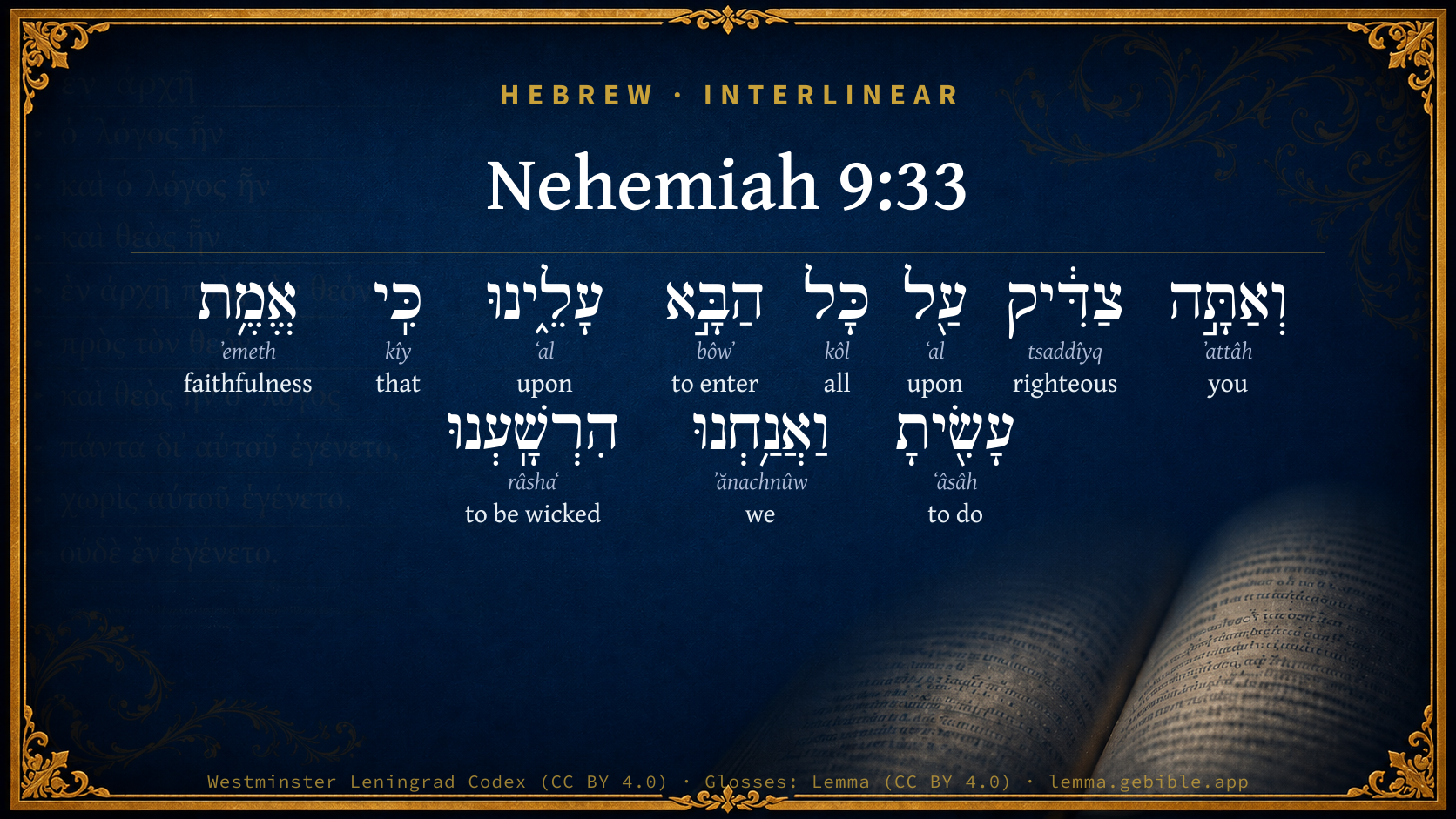
Nehemiah 9:33

Hebrew (Westminster Leningrad Codex) Nehemiah 9:33 appears in the Hebrew Old Testament. The text above is from the Westminster Leningrad Codex. Each word links to its Strong’s number, a concise gloss, and parsing drawn from the Open Scriptures Hebrew Bible morphology. Click any word for its full Brown-Driver-Briggs (BDB) entry.
Download image
Cite this verse

Nehemiah 9:33 (World English Bible). Public Domain. Lemma interlinear Bible study tool, https://lemma.gebible.app/v/nehemiah/9/33.

Show BibTeX & RIS
BibTeX
RIS
English Translation
However you are just in all that is come on us; for you have dealt truly, but we have done wickedly;
World English Bible · Public Domain
Download a study sheet

One document with this verse’s original text, its word-by-word gloss line, the meaning frame, cross-references with their text, attributed commentary, and full source and license credits — printable, and it pastes into notes with its structure intact.

This verse Autodidact and up

Study sheet (.html) Plain text (.txt)

A passage Seminary Student

Up to 50 verses in one chapter. A passage sheet keeps up to 6 commentary sources and 12 cross-references per verse, in the order this page ranks them, and says so on the sheet whenever that leaves anything out. Ask for a single verse and you get the Autodidact verse sheet above.

Everything on this page stays free to read, with no account — the sheet is a download of what is already on screen, not access to it.

Want to remove ads? Support Godless Engineer
Compare translations 3

The same verse in 3 English versions, stacked beneath the original-language interlinear above. Click any original word for its lexicon entry.

Each is an independent rendering of the whole verse — the interlinear is not word-aligned to these translations.

Highlighted words mark where these versions differ — a whole-verse word diff, not a word-by-word alignment.

  • World English Bible Public Domain
    However you are just in all that is come on us; for you have dealt truly, but we have done wickedly;
  • King James Version Public Domain
    Howbeit thou art just in all that is brought upon us; for thou hast done right, but we have done wickedly:
  • unfoldingWord Literal Text CC BY-SA 4.0
    And you are righteous concerning all that has come upon us. For you have acted faithfully; but as for us, we have acted wickedly.

unfoldingWord Literal Text — © unfoldingWord, licensed CC BY-SA 4.0. Word-aligned USFM3 via Door43 (git.door43.org/unfoldingWord/en_ult).

Versions to compare (up to 4)

3 of 4 selected

Show all 18 translations

Every available English version of this verse, each an independent rendering of the whole verse.

  • World English Bible Public Domain
    However you are just in all that is come on us; for you have dealt truly, but we have done wickedly;
  • Berean Standard Bible Public Domain
    You are just in all that has befallen us, because You have acted faithfully, while we have acted wickedly.
  • Majority Standard Bible Public Domain
    You are just in all that has befallen us, because You have acted faithfully, while we have acted wickedly.
  • King James Version Public Domain
    Howbeit thou art just in all that is brought upon us; for thou hast done right, but we have done wickedly:
  • American Standard Version (1901) Public Domain
    Howbeit thou art just in all that is come upon us; for thou hast dealt truly, but we have done wickedly;
  • Revised Version (1885) Public Domain
    Howbeit thou art just in all that is come upon us; for thou hast dealt truly, but we have done wickedly:
  • Geneva Bible (1599) Public Domain
    Surely thou art iust in all that is come vpon vs: for thou hast dealt truely, but we haue done wickedly.
  • Douay-Rheims (1899) Public Domain
    And thou art just in all things that have come upon us: because thou hast done truth, but we have done wickedly.
  • Young's Literal Translation Public Domain
    and Thou `art' righteous concerning all that hath come upon us, for truth Thou hast done, and we have done wickedly;
  • Literal Standard Version CC BY-SA 4.0
    And You [are] righteous concerning all that has come on us, || For You have done truth, || And we have done wickedly;
  • Unlocked Literal Bible CC BY-SA 4.0
    You are just in everything that has come on us, for you have dealt faithfully, but we have acted wickedly.
  • unfoldingWord Literal Text CC BY-SA 4.0
    And you are righteous concerning all that has come upon us. For you have acted faithfully; but as for us, we have acted wickedly.
  • Darby Bible Public Domain
    But thou art just in all that is come upon us; for thou hast acted according to truth, and we have done wickedly.
  • World Messianic Bible Public Domain
    However you are just in all that has come on us; for you have dealt truly, but we have done wickedly.
  • Webster's Bible Public Domain
    But thou art just in all that is brought upon us; for thou hast done right, but we have done wickedly:
  • Free Bible Version CC BY-SA 4.0
    But you have done what is right regarding everything that has happened to us. You have always acted faithfully, while we have done so much evil.
  • Bible in Basic English Public Domain
    But still, you have been in the right in everything which has come on us; you have been true to us, but we have done evil:
  • JPS Tanakh (1917) Public Domain
    Howbeit Thou art just in all that is come upon us; for Thou hast dealt truly, but we have done wickedly;

Literal Standard Version (2020), Covenant Press — licensed CC BY-SA 4.0. Text via the HelloAO Bible API (eBible.org). Unlocked Literal Bible (unfoldingWord) — licensed CC BY-SA 4.0. Text via the HelloAO Bible API (eBible.org). unfoldingWord Literal Text — © unfoldingWord, licensed CC BY-SA 4.0. Word-aligned USFM3 via Door43 (git.door43.org/unfoldingWord/en_ult). Free Bible Version, Dr. Jonathan Gallagher — licensed CC BY-SA 4.0. Text via the HelloAO Bible API (eBible.org).

Word by word

More ways to search: Search by grammar → Find every occurrence → Compare this word →

Practice this passage: Drill this verse → Learn its vocabulary →

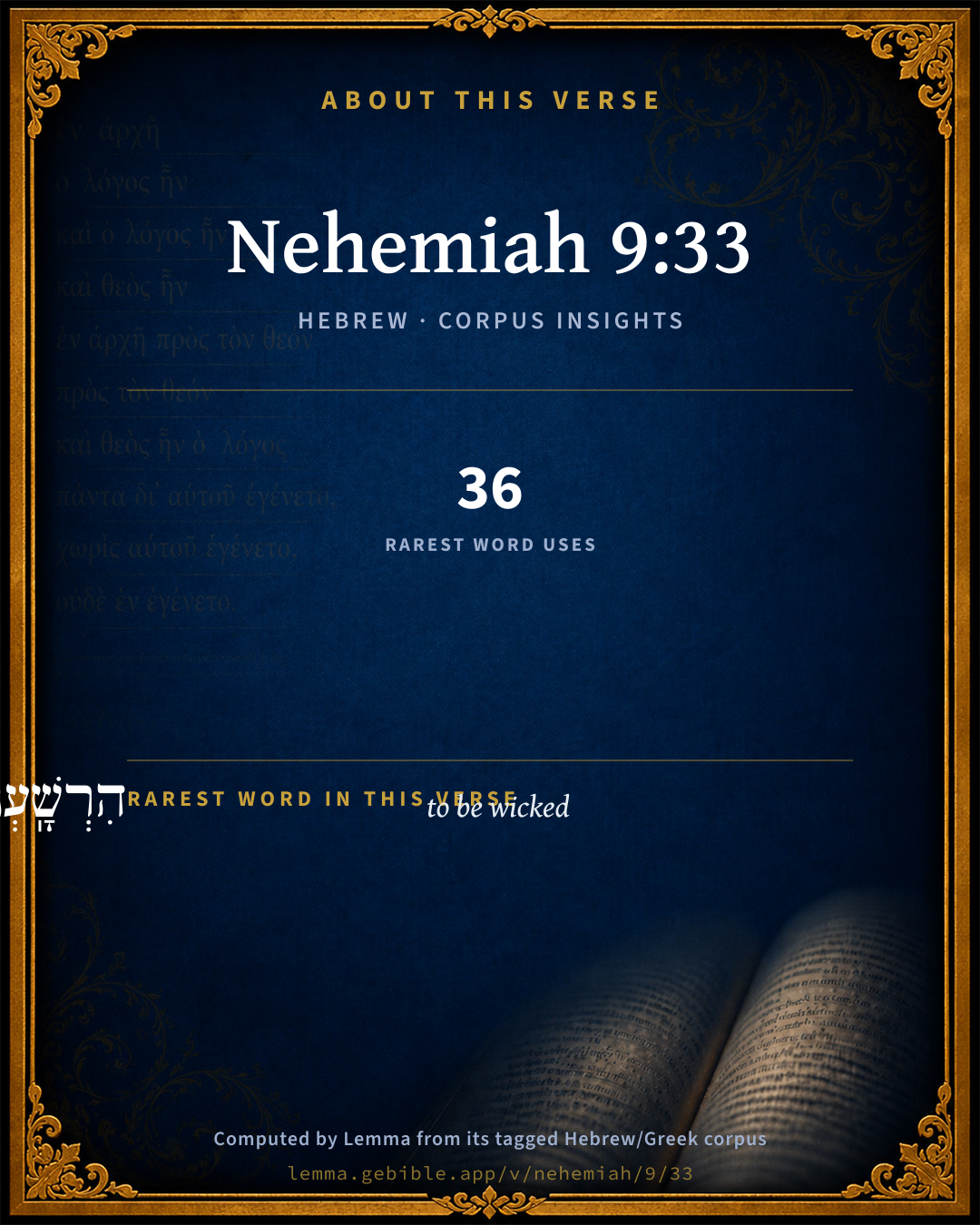
הִרְשָֽׁעְנוּ
râshaʻ
H7561
“to be wicked”
Verb, Hiphil, Perfect, 1st Person, Common, Plural
Part of Speech
Verb
Stem
Hiphil
Form
Perfect
Person
1st Person
Gender
Common
Number
Plural
Full BDB Definition

Origin: a primitive root

TWOT: 2222

to be wicked, act wickedly - (Qal) - to be wicked, act wickedly - to be guilty, be condemned - (Hiphil) - to condemn as guilty (in civil relations) - to condemn as guilty (in ethical or religious relations) - to act wickedly (in ethics and religion)
  1. וְאַתָּ֣ה ʼattâh H859 “and · you” Conjunction + Pronoun, Personal, 2nd Person, Masculine, Singular
  2. צַדִּ֔יק tsaddîyq H6662 “righteous” Adjective, Adjective, Masculine, Singular, Absolute
  3. עַ֖ל ʻal H5921 “upon” Preposition
  4. כָּל kôl H3605 “all of” Noun, Common, Masculine, Singular, Construct
  5. הַבָּ֣א bôwʼ H935 “the · entering” Particle, Definite Article + Verb, Qal, Participle Active, Masculine, Singular, Absolute
  6. עָלֵ֑ינוּ ʻal H5921 “upon · us” Preposition + Suffix, Personal, 1st Person, Common, Plural
  7. כִּֽי kîy H3588 “that” Conjunction
  8. אֱמֶ֥ת ʼemeth H571 “faithfulness” Noun, Common, Feminine, Singular, Absolute
  9. עָשִׂ֖יתָ ʻâsâh H6213 “to do” Verb, Qal, Perfect, 2nd Person, Masculine, Singular
  10. וַאֲנַ֥חְנוּ ʼănachnûw H587 “and · we” Conjunction + Pronoun, Personal, 1st Person, Common, Plural

About this verse

These counts appear in no published source. They are computed here, from the morphology-tagged text and Lemma’s own curated glosses. What Lemma adds →

11
words
10
distinct lemmas
Historical
section

Shared distinctive vocabulary

הִרְשָֽׁעְנוּ to be wicked H7561 occurs in 35 verses of the Hebrew Bible. Also found in:

Grammatical profile

  • 3 verbs
  • 2 nouns
  • 1 adjective
  • 2 pronouns
  • 2 prepositions
  • 1 conjunction

Verb forms

  • הַבָּ֣א Qal · Participle Active
  • עָשִׂ֖יתָ Qal · Perfect
  • הִרְשָֽׁעְנוּ Hiphil · Perfect

Repetition

A word recurs within this verse — often emphatic in Hebrew:

  • עַ֖ל upon H5921 ×2

Cross-references

10

Topical passages linked to Nehemiah 9:33 in the Treasury of Scripture Knowledge — connected by theme and wording, ordered by reader-vote popularity; previews shown in the World English Bible.

  • Genesis 18:25 Be it far from you to do things like that, to kill the righteous with the wicked, that so the righteous should be as the wicked. May that be far from you. Shouldn't the Judge of all the earth do right?"
  • Psalms 106:6 We have sinned with our fathers. We have committed iniquity. We have done wickedly.
  • Daniel 9:5–14 we have sinned, and have dealt perversely, and have done wickedly, and have rebelled, even turning aside from your precepts and from your ordinances;
  • Job 34:23 For he doesn't need to consider a man further, That he should go before God in judgment.
  • Leviticus 26:40–41 "'If they confess their iniquity, and the iniquity of their fathers, in their trespass which they trespassed against me, and also that, because they walked contrary to me,
  • Job 33:27 He sings before men, and says, 'I have sinned, and perverted that which was right, And it didn't profit me.
  • Psalms 119:137 You are righteous, Yahweh. Your judgments are upright.
  • Psalms 145:17 Yahweh is righteous in all his ways, And gracious in all his works.
  • Jeremiah 12:1 Righteous are you, Yahweh, when I contend with you; yet would I reason the cause with you: why does the way of the wicked prosper? why are all they at ease who deal very treacherously?
  • Lamentations 1:18 Yahweh is righteous; for I have rebelled against his commandment: Please hear all you peoples, and see my sorrow: My virgins and my young men are gone into captivity.

Cross-references courtesy of OpenBible.info (CC BY 4.0).

Hebrew and Greek witnesses Masoretic Hebrew ↔ Greek Septuagint

The same verse in the two great witnesses to the Old Testament, shown verse-for-verse.

These are two independent witnesses, not word-aligned to each other, and the Septuagint is shown in lemma (dictionary) form.

Hebrew Nehemiah 9:33 Masoretic · Westminster Leningrad Codex

וְאַתָּ֣ה צַדִּ֔יק עַ֖ל כָּל הַבָּ֣א עָלֵ֑ינוּ כִּֽי אֱמֶ֥ת עָשִׂ֖יתָ וַאֲנַ֥חְנוּ הִרְשָֽׁעְנוּ

However you are just in all that is come on us; for you have dealt truly, but we have done wickedly;

World English Bible · Public Domain

Greek LXX Structure differs

The Septuagint has no separate book of Nehemiah. Its Greek text is the second half of Esdras B (2 Esdras), chapters 11–23; Ezra is the first half (1–10).

A verse-for-verse comparison isn’t shown here because the chapters and verses don’t line up. Switch to the LXX edition with the MT / LXX toggle above to read the Greek directly.

On this verse, The Cambridge Bible for Schools and Colleges discusses the Septuagint’s reading. Read the note in Commentary ↓

Hebrew: Westminster Leningrad Codex (CC BY 4.0). Greek: Septuagint (public domain); English from a public-domain English Septuagint. How the Septuagint differs from the Hebrew →

Commentary

Notes on Nehemiah 9:33 from classic Christian and Jewish commentators (each source and its license shown beneath its notes). The classic Christian expositions comment on the surrounding passage and are grouped to its opening verse, so a note may address several verses; the Jewish commentaries on the Tanakh (Rashi and others) are per-verse, so they appear only where the commentator wrote on this verse.

Lemma curates 59 commentaries, every one of them public domain or Creative Commons licensed, each selected and text-cleaned for this edition rather than reprinted as found. About our sources →

Trapp's Complete Commentary

John Trapp

Neh 9:33 Howbeit thou [art] just in all that is brought upon us; for thou hast done right, but we have done wickedly:

Ver. 33. Howbeit thou art just] So Mauricius, the emperor, justified God, when he saw his wife and children butchered before his eyes by the traitor Phocas, and knew that himself should be soon after stewed in his own broth; he cried out, Just art thou, O Lord, and just are all thy judgments. So did the noble Du Plessy, when he heard of the death of his only son slain in Holland; which so grieved his mother, that soon after she died.

John Trapp, A Commentary or Exposition upon All the Books of the Old and New Testament (1647–1656) — public domain. Text from a community e-Sword module.

The Biblical Illustrator

Joseph S. Exell

Neh_9:33

Howbeit, Thou art just in all that is brought upon us.

The miseries of life; their origin and remedy

The miseries of life have been a fruitful theme to writers in all ages. Some have endeavoured to engage us in their contemplation for a wise and good end. Others have taken occasion from them to dispute the wisdom, justice, and goodness of God. Such notions, thus derogatory from the providence of God, tend, even in the best of men, if not timely eradicated, to weaken those impressions of reverence and gratitude which are necessary to add warmth to devotion and vigour to virtue. The teaching of Scripture is, that God is not to be charged with disregard of His creation. He created man for happiness, and this happiness was forfeited by a breach of the conditions to which it was annexed. Physical and moral evil entered the world together. To avoid misery we must avoid sin. Consider--

I. How few of the evils of life can justly be ascribed to God. We must carefully distinguish that which is actually appointed by Him from that which is only permitted, or that which is the consequence of something done to ourselves, and could not be prevented but by the interruption of those general laws which we term the course of nature or the established order of the universe. If we examine all the afflictions of mind, body, and estate by this rule, we shall find God not otherwise accessory to them than as He works no miracles to prevent them, as He suffers men to be masters of themselves, and restrains them only by coercions applied to their reason.

1. In making an estimate of the miseries that arise from the disorders of the body, we must consider how many diseases proceed from our own laziness, intemperance, or negligence; how many the vices or follies of our ancestors have transmitted to us.

2. Nor are the disquietudes of the mind less frequently excited by ourselves.

(1) Pride is the general source of our infelicity.

(2) Immoderate desires.

(3) Undue solicitude about future events which gives rise to harassing fears and anxieties.

3. Poverty is not always the effect of wickedness--it may often be the effect of virtue; but it is not certain that poverty is an evil.

II. How far a general piety might exempt community from those evils. A community, in which virtue should generally prevail, of which every member should fear God with his whole heart and love his neighbour as himself, where every man should labour to make himself perfect even as his Father which is in heaven is perfect, would find these evils practically non-existant.

III. How much in the present corrupt state of the world particular men may, by the practice of the duties of religion, promote their own happiness. (John Taylor, LL. D.)

God has done right

I. Right as to wisdom. It is of great importance for us to know, and to feel, especially when tossed on the billows and enveloped in the darkness of some heavy affliction, that God is infinitely wise, and that His wisdom can and will conduct all the circumstances of His people to a happy issue. This is absolutely necessary to the enjoyment of anything like calm security amidst such scenes. It is so in the common affairs of life. The soldier trusts in the wisdom of his general, and is calm in battle. The sailor trusts in the wisdom of his captain, and is calm in the tempest. The traveller has confidence in the wisdom of his guide, and pursues his course in peaceful security. And so, if believers would enjoy a calm and cheerful assurance in fighting the battles, braving the storms, and pursuing the pilgrimage of their present probation, they must have a settled and solid repose in the infallible wisdom of God. And they must seek this, not so much from the deductions of human reason, or the better lights of their own experience in relation to providence, as from the operations of faith in the Scripture revelations of God and His government.

II. Right as to justice. Amidst the afflictions of life, not only must we recognise and trust the infinite wisdom of God, but we must endeavour, by the lights of revelation and experience, to reconcile the justice of God with the afflictions of the righteous, and thus justify the ways of God to men. Men who only look on the surface of things and events, and judge from that, often charge God with being rigorous, unjust, and unrighteous in the operations and issues of His providence. All temporal sufferings are the righteous consequence of original or actual sin, and are frequently merited by the best of men. None can affirm that they are free from human frailties and sinful defects, and therefore they have no right to complain of the punishment of their sins. Our afflictions, generally, fall far below the guilt which we have contracted. The time is hastening on when the wisdom and justice of providence will be convincingly evident to all.

III. Right as to goodness. Thou art good, and doest good. Such was the testimony of the psalmist; such is the uniform testimony of revelation; and such, notwithstanding its mysteries, is the acknowledgment of universal providence. And it is very necessary for us to be convinced of this, and live under the perpetual and growing influence of it, amidst the tribulations of life. Else how can we be calm, secure, and happy?

1. Strive to understand God in your afflictions. From the absence of this intelligent view of Gods providence in affliction the greatest mischief often springs. Ignorance here, as everywhere else, is ever attended by distrust, fear, dissatisfaction, and wasting anxiety; while, on the other hand, intelligence produces confidence, serenity, contentedness, and a delightful peace and repose.

2. Learn to avoid a spirit of envy and murmuring. If God acts wisely, justly, and mercifully, in often permitting the wicked to live and prosper and the righteous to fall into great afflictions, then resign yourselves to His will, be satisfied with the dispensations of His hand, envy not the condition of others, neither murmur at your own. Consider well the folly, vanity, and misery of sinful prosperity, which rather needs your pity than your envy.

3. Learn to be firm and faithful in the service and cause of God. Afflictions have driven many from Christ and His kingdom. (W. Gregory.)

Gods proceedings in His justice sometimes inexplicable

Take a straight stick and put it into the water, then it will seem crooked; why? because we look upon it through two mediums, air and water. There lies the deceptio visus; thence it is that we cannot discern aright. Thus the proceedings of God in His justice, which in themselves are straight, without the least obliquity, seem unto us crooked. That wicked men should prosper, and good men be afflicted; that the Israelites should make the bricks, and the Egyptians dwell in the houses; that servants should ride on horseback, and princes go on foot--these are things that make the best Christians stagger in their judgments. And why? but because they look upon Gods proceedings through a double medium of flesh and spirit, that so all things seem to go cross, though indeed they go right enough. And hence it is that Gods proceedings in His justice are not so well discerned, the eyes of man alone being not competent judges thereof. (J. Spencer.)

The Biblical Illustrator, edited by Joseph S. Exell (c. 1880s–1900s) — public domain. Text from a community e-Sword module.

Geneva Bible (1599)

Geneva Bible translators

He confesseth that all these things came to them justly for their sins, but he appealeth from God’s justice to his mercies.

Geneva Bible (1599) marginal notes — public domain. Text via Bolls.life.

The Cambridge Bible for Schools and Colleges

gen. ed. J. J. S. Perowne

33. just] The same epithet as that rendered ‘righteous’ (c̣addîq) in Neh_9:8. See also Ezr_9:15.

brought] R.V. come.

done right] R.V. dealt truly. Literally ‘truth’ (LXX. ἀλήθειαν. Vulg. ‘veritatem’), i.e. Thou hast fulfilled thy word both in blessing and punishment: but we have been unfaithful to the covenant. Cf. Dan_9:14, ‘For the Lord our God is righteous in all his works which he doeth, and we have not obeyed his voice.’ The pronoun ‘we’ is emphatic; the speakers pass from reference to their forefathers, in order to accept for themselves the responsibility of association with the nation’s guilt.

The Cambridge Bible for Schools and Colleges (gen. ed. J. J. S. Perowne; Cambridge University Press, 1878–1918) — public domain. Text from a community e-Sword module.

John Gill's Exposition

Howbeit, thou art just in all that is brought upon us,.... They own the justice of God, could not complain of any wrong done them; and had he shown them no mercy at all, it was but what they deserved:

for thou hast done right, but we have done wickedly; he had done according to the truth of his word of promise, he had faithfully kept it, but they had transgressed his righteous law.

John Gill's Exposition of the Whole Bible (1746–1763) — public domain (CC PDM 1.0). Text via the HelloAO Bible API.

Haydock's Catholic Bible Commentary

Truth, fulfilled thy promises. We have broken the covenant.

George Leo Haydock (1774–1849), Haydock's Catholic Family Bible and Commentary, 1859 edition — public domain. Excludes Psalms (Douay-Rheims chapter numbering differs from Protestant) and Deuterocanonical books (Catholic canon only).

The Pulpit Commentary

The justice of God in punishing sinners.

"Howbeit thou art just in all that is brought upon us; for thou hast done right, but we have done wickedly." The words express a just and salutary conviction, and make an acknowledgment suitable to accompany an appeal to the Divine compassion.

I THE CONVICTION EXPRESSED. Of very great importance that we should not only verbally utter it, but sincerely feel it. How may we arrive at this conviction?

1. By faith in God"s essential rectitude. That he cannot be unrighteous in any of his proceedings. (see Deu_32:4)

2. By considering the rectitude and goodness of the laws against which we have sinned.

3. By remembering all that God has done to guard us against sin (see on ver. 29). If we sin notwithstanding, we are justly punished.

4. By calling to mind our sins. Their essential evil, their number and magnitude, and the circumstances which aggravate their guiltiness (God"s varied kindness, our opportunities, advantages, knowledge, convictions, good resolutions, etc.). Such a review will lead us to exclaim with Ezra, "Thou our God hast punished us less than our iniquities deserve". (Ezr_9:13)

5. By comparing what we endure with the Divine threatenings. The Israelites had been warned of the consequences of their rebellion against God. He was only fulfilling his word. So it is with us. What we suffer is no more, is indeed less, than we were warned to expect.

II THE BENEFITS OF SUCH A CONVICTION.

1. It will prevent our murmuring at our sufferings. "Wherefore doth a living man complain, a man for the punishment of his sins?". (Lam_3:39)

2. It will greatly aid in producing repentance. Suffering is likely to do its proper work in humbling us and making sin odious when we recognise the justice of God in inflicting it.

3. It will lead to an appeal to the mercy of God for deliverance. Such an appeal, made through Christ, will be regarded, while an appeal to justice would be as futile as groundless. Finally, observe that the goodness of God is as conspicuous as his justice in the sufferings he inflicts in this life. They have in view "our profit, that we may be partakers of his holiness," and so of true and everlasting blessedness. But if through our perversity they fail of this result, they are followed by the penalties of "judgment without mercy."

The Pulpit Commentary (1880–1919), ed. H.D.M. Spence-Jones & Joseph S. Exell — public domain. Text from a community e-Sword module.

John Wesley's Explanatory Notes

Thou art just. &c. - It becomes us, when we are under the rebukes of providence, be they ever so sharp, or ever so long continued, still to justify God, and to own we are punished less than our iniquities deserve.

John Wesley, Explanatory Notes Upon the Whole Bible (1754–1765) — public domain. Text via the GEBible commentary corpus.

Rashi

Rabbi Shlomo Yitzchaki (Rashi)

with all that has come upon us with the entire episode of the harsh tortures that have come upon us.

Rashi on the Tanakh — English translations: “The Judaica Press complete Tanach with Rashi, translated by A. J. Rosenberg” (CC BY 4.0); “Pentateuch with Rashi's commentary by M. Rosenbaum and A.M. Silbermann, 1929-1934” (public domain); “The Metsudah Tanach series, Lakewood, N.J” (CC BY 4.0); and “The Book of Joshua, Metsudah Publications, 1997” (CC BY 4.0). Text via Sefaria.

Lesson kit

Teaching starters — assembled from the data on this page, not authored interpretation. Every prompt links to the verse data it draws on. Edit before teaching.

Nehemiah, in the Historical, opens this verse with 11 words (10 distinct Hebrew lemmas). Its most distinctive word is râshaʻ (“to be wicked”). A historical commentator’s framing appears above. Read the whole chapter for the surrounding context.

Discussion questions

  1. What does “to be wicked” (râshaʻ) contribute to the verse as a whole?
  2. Exodus 22:9 shares the word «to be wicked» with this verse. How do the two illuminate each other?
  3. “upon” occurs 2× in this one verse. What is the effect of the repetition?
  4. These translations render this verse differently; the difference is in the English rendering, not the original. What questions does that raise?
  5. The verb «הַבָּ֣א» is Qal Participle Active. How does its form color the action?
  6. Reading how Trapp's Complete Commentary and The Biblical Illustrator read this verse, where do the two commentators agree and where do they part?

Things to notice

Reading settings

Reading text

Shown beneath each verse's original-language words.

Old Testament
Old Testament edition

Read the OT as the Masoretic Hebrew (MT) or the Greek Septuagint (LXX).

English shown for the Greek Septuagint (in the Hebrew ↔ Greek comparison).

Comparing translations? Open the Compare panel on any verse page to stack up to four side by side.