
Jeremiah 42:6

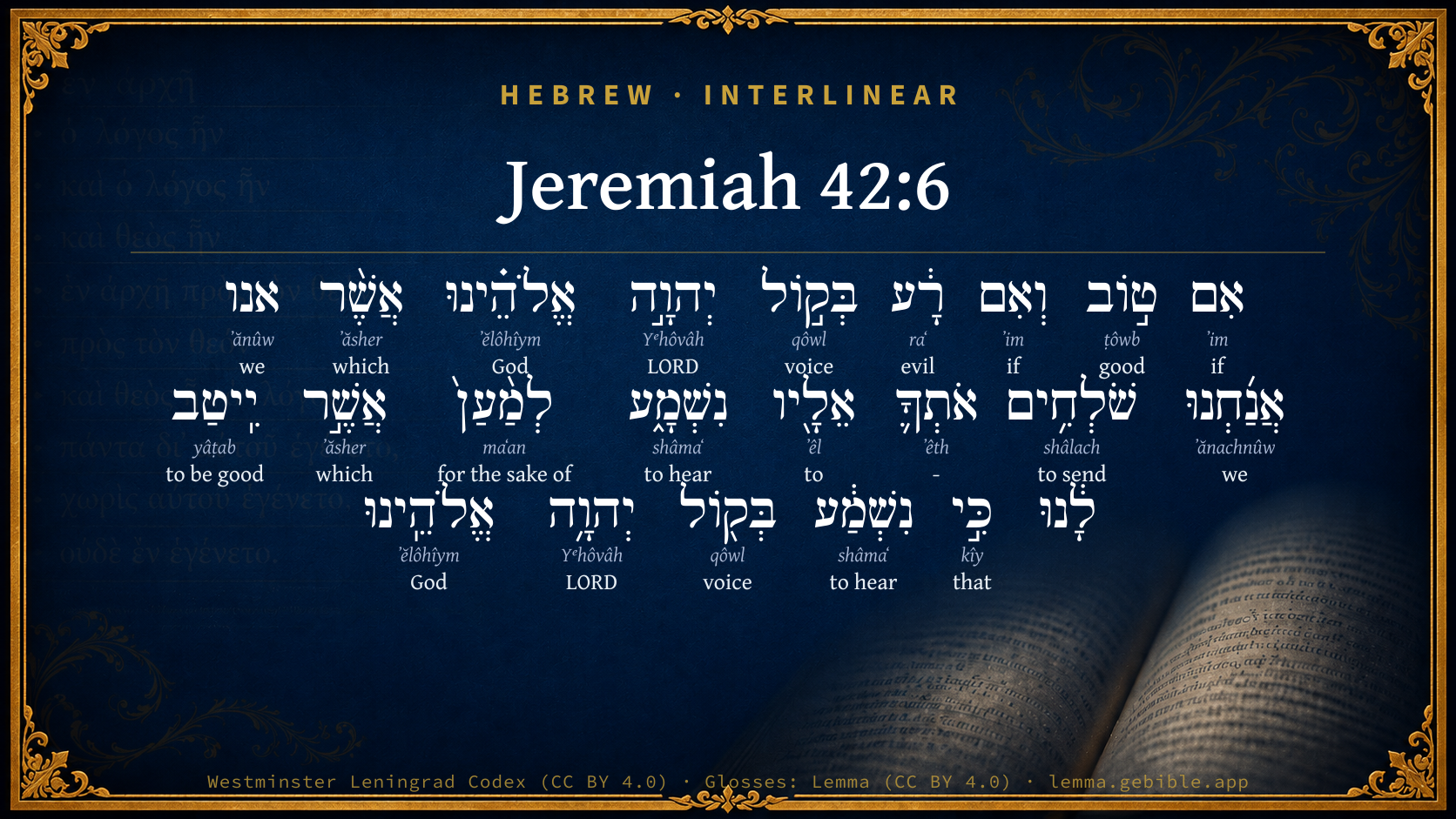
Hebrew (Westminster Leningrad Codex) Jeremiah 42:6 appears in the Hebrew Old Testament. The text above is from the Westminster Leningrad Codex. Each word links to its Strong’s number, a concise gloss, and parsing drawn from the Open Scriptures Hebrew Bible morphology. Click any word for its full Brown-Driver-Briggs (BDB) entry.
Download image
Cite this verse

Jeremiah 42:6 (World English Bible). Public Domain. Lemma interlinear Bible study tool, https://lemma.gebible.app/v/jeremiah/42/6.

Show BibTeX & RIS
BibTeX
RIS
English Translation
Whether it be good, or whether it be evil, we will obey the voice of Yahweh our God, to whom we send you; that it may be well with us, when we obey the voice of Yahweh our God.
World English Bible · Public Domain
Highlights
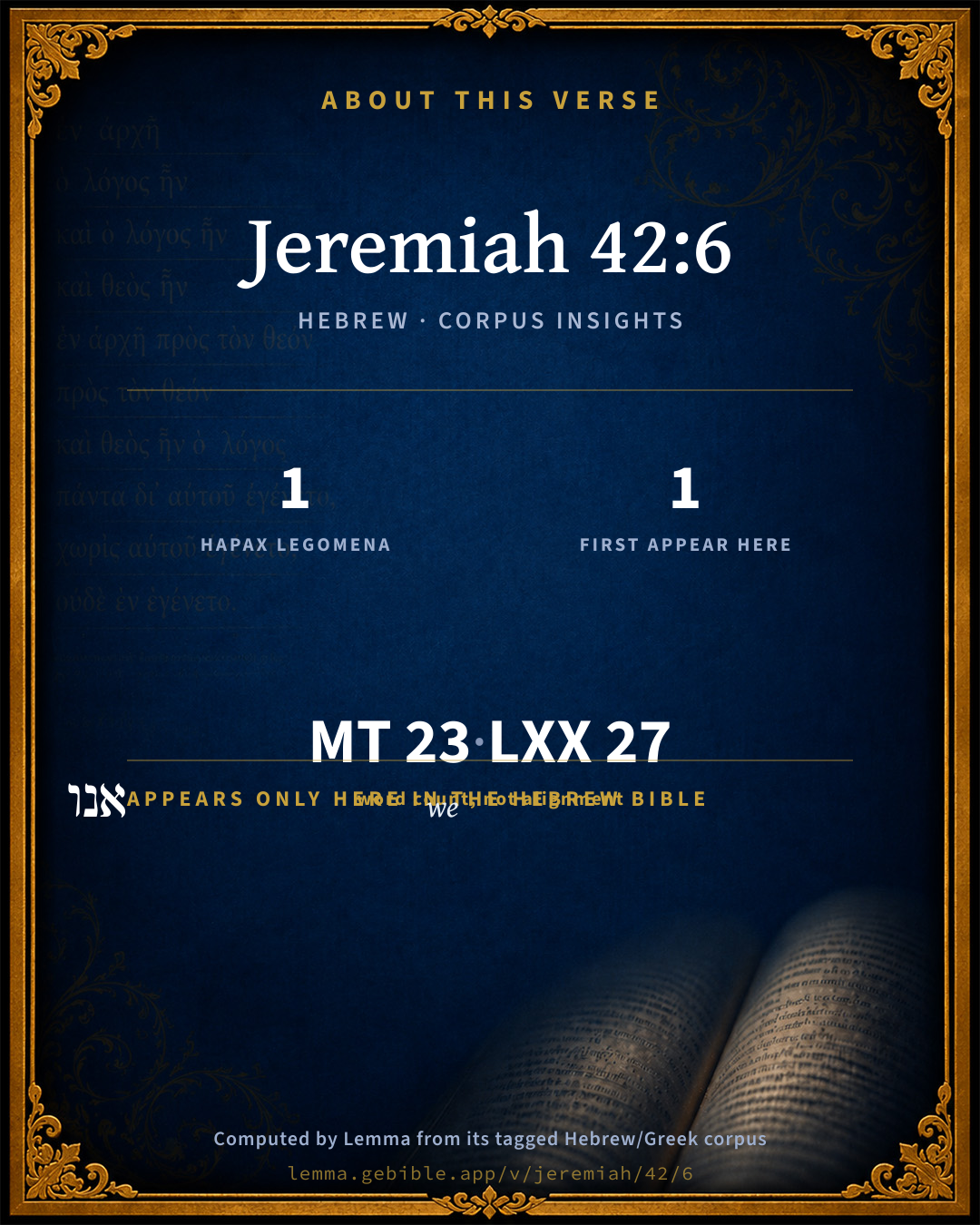
  • 1 hapax legomenon — only here in the Hebrew Bible
  • 1 first appearance in the Hebrew Bible
Full analysis ↓
Download a study sheet

One document with this verse’s original text, its word-by-word gloss line, the meaning frame, cross-references with their text, attributed commentary, and full source and license credits — printable, and it pastes into notes with its structure intact.

This verse Autodidact and up

Study sheet (.html) Plain text (.txt)

A passage Seminary Student

Up to 50 verses in one chapter. A passage sheet keeps up to 6 commentary sources and 12 cross-references per verse, in the order this page ranks them, and says so on the sheet whenever that leaves anything out. Ask for a single verse and you get the Autodidact verse sheet above.

Everything on this page stays free to read, with no account — the sheet is a download of what is already on screen, not access to it.

Want to remove ads? Support Godless Engineer
Compare translations 3

The same verse in 3 English versions, stacked beneath the original-language interlinear above. Click any original word for its lexicon entry.

Each is an independent rendering of the whole verse — the interlinear is not word-aligned to these translations.

Highlighted words mark where these versions differ — a whole-verse word diff, not a word-by-word alignment.

  • World English Bible Public Domain
    Whether it be good, or whether it be evil, we will obey the voice of Yahweh our God, to whom we send you; that it may be well with us, when we obey the voice of Yahweh our God.
  • King James Version Public Domain
    Whether it be good, or whether it be evil, we will obey the voice of the LORD our God, to whom we send thee; that it may be well with us, when we obey the voice of the LORD our God.
  • unfoldingWord Literal Text CC BY-SA 4.0
    Whether it is good or if it is bad, we will obey the voice of Yahweh our God, to whom we are sending you, so that it may be well with us when we obey the voice of Yahweh our God.”

unfoldingWord Literal Text — © unfoldingWord, licensed CC BY-SA 4.0. Word-aligned USFM3 via Door43 (git.door43.org/unfoldingWord/en_ult).

Versions to compare (up to 4)

3 of 4 selected

Show all 18 translations

Every available English version of this verse, each an independent rendering of the whole verse.

  • World English Bible Public Domain
    Whether it be good, or whether it be evil, we will obey the voice of Yahweh our God, to whom we send you; that it may be well with us, when we obey the voice of Yahweh our God.
  • Berean Standard Bible Public Domain
    Whether it is pleasant or unpleasant, we will obey the voice of the LORD our God to whom we are sending you, so that it may go well with us, for we will obey the voice of the LORD our God!”
  • Majority Standard Bible Public Domain
    Whether it is pleasant or unpleasant, we will obey the voice of the LORD our God to whom we are sending you, so that it may go well with us when we obey the voice of the LORD our God!”
  • King James Version Public Domain
    Whether it be good, or whether it be evil, we will obey the voice of the LORD our God, to whom we send thee; that it may be well with us, when we obey the voice of the LORD our God.
  • American Standard Version (1901) Public Domain
    Whether it be good, or whether it be evil, we will obey the voice of Jehovah our God, to whom we send thee; that it may be well with us, when we obey the voice of Jehovah our God.
  • Revised Version (1885) Public Domain
    Whether it be good, or whether it be evil, we will obey the voice of the LORD our God, to whom we send thee; that it may be well with us, when we obey the voice of the LORD our God.
  • Geneva Bible (1599) Public Domain
    Whether it be good or euill, we will obey the voyce of the Lord God, to whom we sende thee that it may be well with vs, when wee obey the voyce of the Lord our God.
  • Douay-Rheims (1899) Public Domain
    Whether it be good or evil, we will obey the voice of the Lord our God, to whom me send thee: that it may be well with us when we shall hearken to the voice of the Lord our God.
  • Young's Literal Translation Public Domain
    Whether good or evil, to the voice of Jehovah our God, to whom we are sending thee, we do hearken; because it is good for us when we hearken to the voice of Jehovah our God.'
  • Literal Standard Version CC BY-SA 4.0
    Whether [it is] good or evil, to the voice of our God YHWH, to whom we are sending you, we listen; because it is good for us when we listen to the voice of our God YHWH.”
  • Unlocked Literal Bible CC BY-SA 4.0
    Whether it is good or if it is bad, we will obey the voice of Yahweh our God, to whom we are sending you, so that it may be well with us when we obey the voice of Yahweh our God.”
  • unfoldingWord Literal Text CC BY-SA 4.0
    Whether it is good or if it is bad, we will obey the voice of Yahweh our God, to whom we are sending you, so that it may be well with us when we obey the voice of Yahweh our God.”
  • Darby Bible Public Domain
    Whether it be good or whether it be evil, we will hearken unto the voice of Jehovah our God, to whom we send thee; that it may be well with us when we hearken unto the voice of Jehovah our God.
  • World Messianic Bible Public Domain
    Whether it is good, or whether it is bad, we will obey the voice of the LORD our God, to whom we send you; that it may be well with us, when we obey the voice of the LORD our God.”
  • Webster's Bible Public Domain
    Whether it be good, or whether it be evil, we will obey the voice of the LORD our God, to whom we send thee; that it may be well with us, when we obey the voice of the LORD our God.
  • Free Bible Version CC BY-SA 4.0
    Good or bad, we will obey what the Lord our God says, the one we're asking you to speak to. That way everything will go well with us, because we will be obeying what the Lord our God says.”
  • Bible in Basic English Public Domain
    If it is good or if it is evil, we will be guided by the voice of the Lord our God, to whom we are sending you; so that it may be well for us when we give ear to the voice of the Lord our God.
  • JPS Tanakh (1917) Public Domain
    Whether it be good, or whether it be evil, we will hearken to the voice of the LORD our God, to whom we send thee; that it may be well with us, when we hearken to the voice of the LORD our God.'

Literal Standard Version (2020), Covenant Press — licensed CC BY-SA 4.0. Text via the HelloAO Bible API (eBible.org). Unlocked Literal Bible (unfoldingWord) — licensed CC BY-SA 4.0. Text via the HelloAO Bible API (eBible.org). unfoldingWord Literal Text — © unfoldingWord, licensed CC BY-SA 4.0. Word-aligned USFM3 via Door43 (git.door43.org/unfoldingWord/en_ult). Free Bible Version, Dr. Jonathan Gallagher — licensed CC BY-SA 4.0. Text via the HelloAO Bible API (eBible.org).

Word by word

More ways to search: Search by grammar → Find every occurrence → Compare this word →

Practice this passage: Drill this verse → Learn its vocabulary →

אנו
ʼănûw
H580
“we”
Pronoun, Personal, 1st Person, Common, Plural
Part of Speech
Pronoun
Type
Personal
Person
1st Person
Gender
Common
Number
Plural
Full BDB Definition

Origin: contracted for H587

TWOT: 128

we (first person plural - usually used for emphasis)
  1. אִם ʼim H518 “if” Conjunction
  2. ט֣וֹב ṭôwb H2896 “good” Adjective, Adjective, Masculine, Singular, Absolute
  3. וְאִם ʼim H518 “and · if” Conjunction + Conjunction
  4. רָ֔ע raʻ H7451 “evil” Adjective, Adjective, Masculine, Singular, Absolute
  5. בְּק֣וֹל qôwl H6963 “in/at · voice of” Preposition + Noun, Common, Masculine, Singular, Construct
  6. יְהוָ֣ה Yᵉhôvâh H3068 “LORD” Noun, Proper
  7. אֱלֹהֵ֗ינוּ ʼĕlôhîym H430 “God(s) · our” Noun, Common, Masculine, Plural, Construct + Suffix, Personal, 1st Person, Common, Plural
  8. אֲשֶׁ֨ר ʼăsher H834 “which” Particle, Relative
  9. אֲנַ֜חְנוּ ʼănachnûw H587 “we” Pronoun, Personal, 1st Person, Common, Plural
  10. שֹׁלְחִ֥ים shâlach H7971 “sending” Verb, Qal, Participle Active, Masculine, Plural, Absolute
  11. אֹתְךָ֛ ʼêth H853 “- · you” Particle, Direct Object + Suffix, Personal, 2nd Person, Masculine, Singular
  12. אֵלָ֖יו ʼêl H413 “to · him” Preposition + Suffix, Personal, 3rd Person, Masculine, Singular
  13. נִשְׁמָ֑ע shâmaʻ H8085 “to hear” Verb, Qal, Imperfect, 1st Person, Common, Plural
  14. לְמַ֨עַן֙ maʻan H4616 “for the sake of” Preposition
  15. אֲשֶׁ֣ר ʼăsher H834 “which” Particle, Relative
  16. יִֽיטַב yâṭab H3190 “to be good” Verb, Qal, Imperfect, 3rd Person, Masculine, Singular
  17. כִּ֣י kîy H3588 “that” Conjunction
  18. נִשְׁמַ֔ע shâmaʻ H8085 “to hear” Verb, Qal, Imperfect, 1st Person, Common, Plural
  19. בְּק֖וֹל qôwl H6963 “in/at · voice of” Preposition + Noun, Common, Masculine, Singular, Construct
  20. יְהוָ֥ה Yᵉhôvâh H3068 “LORD” Noun, Proper
  21. אֱלֹהֵֽינוּ ʼĕlôhîym H430 “God(s) · our” Noun, Common, Masculine, Plural, Construct + Suffix, Personal, 1st Person, Common, Plural

About this verse

These counts appear in no published source. They are computed here, from the morphology-tagged text and Lemma’s own curated glosses. What Lemma adds →

23
words
16
distinct lemmas
Prophets
section

Notable vocabulary

1 hapax legomenon — a word that appears only here in the entire Hebrew Bible:

First appearance in Scripture

This word makes its first canonical appearance in the Hebrew Bible here:

Grammatical profile

  • 4 verbs
  • 6 nouns
  • 2 adjectives
  • 2 pronouns
  • 3 prepositions
  • 3 conjunctions
  • 3 particles

Verb forms

  • שֹׁלְחִ֥ים Qal · Participle Active
  • נִשְׁמָ֑ע Qal · Imperfect
  • יִֽיטַב Qal · Imperfect
  • נִשְׁמַ֔ע Qal · Imperfect

Repetition

Words recur within this verse — often emphatic in Hebrew:

  • בְּק֣וֹל voice H6963 ×2
  • יְהוָ֣ה LORD H3068 ×2
  • אֱלֹהֵ֗ינוּ God H430 ×2
  • נִשְׁמָ֑ע to hear H8085 ×2
  • אִם if H518 ×2
  • אֲשֶׁ֨ר which H834 ×2

Hebrew & Septuagint length

In the original languages it is 23 Hebrew tokens and 27 Greek tokens — but the two are counted differently (Hebrew bundles its prefixes and suffixes into one token; the Greek is in lemma form), so that isn’t a like-for-like length.

Cross-references

12

Topical passages linked to Jeremiah 42:6 in the Treasury of Scripture Knowledge — connected by theme and wording, ordered by reader-vote popularity; previews shown in the World English Bible.

  • Jeremiah 7:23 but this thing I commanded them, saying, Listen to my voice, and I will be your God, and you shall be my people; and walk you in all the way that I command you, that it may be well with you.
  • Deuteronomy 5:29 Oh that there were such a heart in them, that they would fear me, and keep all my commandments always, that it might be well with them, and with their children forever!
  • Romans 8:7 because the mind of the flesh is hostile towards God; for it is not subject to God's law, neither indeed can it be.
  • Deuteronomy 5:33 You shall walk in all the way which Yahweh your God has commanded you, that you may live, and that it may be well with you, and that you may prolong your days in the land which you shall possess.
  • Deuteronomy 6:2–3 that you might fear Yahweh your God, to keep all his statutes and his commandments, which I command you, you, and your son, and your son's son, all the days of your life; and that your days may be prolonged.
  • Exodus 24:7 He took the book of the covenant and read it in the hearing of the people, and they said, "All that Yahweh has spoken will we do, and be obedient."
  • Joshua 24:24 The people said to Joshua, Yahweh our God will we serve, and to his voice will we listen.
  • Psalms 81:13–16 Oh that my people would listen to me, That Israel would walk in my ways!
  • Psalms 128:2 For you will eat the labor of your hands. You will be happy, and it will be well with you.
  • Isaiah 3:10 Tell the righteous "Good!" For they shall eat the fruit of their deeds.
  • Romans 7:7 What shall we say then? Is the law sin? May it never be! However, I wouldn't have known sin, except through the law. For I wouldn't have known coveting, unless the law had said, "You shall not covet."
  • Romans 7:13 Did then that which is good become death to me? May it never be! But sin, that it might be shown to be sin, by working death to me through that which is good; that through the commandment sin might become exceeding sinful.

Cross-references courtesy of OpenBible.info (CC BY 4.0).

Hebrew and Greek witnesses Masoretic Hebrew ↔ Greek Septuagint

The same verse in the two great witnesses to the Old Testament, shown verse-for-verse.

These are two independent witnesses, not word-aligned to each other, and the Septuagint is shown in lemma (dictionary) form.

Hebrew Jeremiah 42:6 Masoretic · Westminster Leningrad Codex

אִם ט֣וֹב וְאִם רָ֔ע בְּק֣וֹל יְהוָ֣ה אֱלֹהֵ֗ינוּ אֲשֶׁ֨ר אנו אֲנַ֜חְנוּ שֹׁלְחִ֥ים אֹתְךָ֛ אֵלָ֖יו נִשְׁמָ֑ע לְמַ֨עַן֙ אֲשֶׁ֣ר יִֽיטַב לָ֔נוּ כִּ֣י נִשְׁמַ֔ע בְּק֖וֹל יְהוָ֥ה אֱלֹהֵֽינוּ

Whether it be good, or whether it be evil, we will obey the voice of Yahweh our God, to whom we send you; that it may be well with us, when we obey the voice of Yahweh our God.

World English Bible · Public Domain

Greek LXX Structure differs

In the Septuagint, Jeremiah is about an eighth shorter than the Hebrew and arranges its material differently — the Oracles Against the Nations (Hebrew chapters 46–51) appear in the middle of the Greek book, after 25:13. Because the chapter and verse boundaries do not line up, a verse-for-verse comparison with the Hebrew is not shown.

A verse-for-verse comparison isn’t shown here because the chapters and verses don’t line up. Switch to the LXX edition with the MT / LXX toggle above to read the Greek directly.

Hebrew: Westminster Leningrad Codex (CC BY 4.0). Greek: Septuagint (public domain); English from a public-domain English Septuagint. How the Septuagint differs from the Hebrew →

Targum (Aramaic paraphrase)

1

The Targum is the ancient Jewish Aramaic paraphrase of the Hebrew Scriptures — an interpretive translation, not the Hebrew text itself. Onkelos (literal) and Pseudo-Jonathan (expansive) render the Torah, and Jonathan the Prophets. Coverage is partial: where no permissively-licensed English translation exists for a verse, only the Aramaic is shown. This is verse-level text, not a word-by-word alignment to the Hebrew.

  1. Targum Jonathan Prophets (Joshua–Malachi)
    אִם טָב וְאִם בִּישׁ לְמֵימְרָא דַייָ אֱלָהָנָא דִי אֲנַחְנָא שָׁלְחִין יָתָךְ לָקֳדָמוֹהִי נְקַבֵּל בְּדִיל דְיִיטַב לָנָא אֲרֵי נְקַבֵּיל לְמֵימְרָא דַייָ אֱלָהָנָא:

    (no public-domain English translation for this verse)

    Targum Jonathan — Aramaic: “Mikraot Gedolot” (public domain). English: “Sefaria Community Translation” (CC0 1.0 (public-domain dedication)); “London "Chaldee Paraphrase," 1871” (public domain). Text via Sefaria.

Commentary

Notes on Jeremiah 42:6 from classic Christian and Jewish commentators (each source and its license shown beneath its notes). The classic Christian expositions comment on the surrounding passage and are grouped to its opening verse, so a note may address several verses; the Jewish commentaries on the Tanakh (Rashi and others) are per-verse, so they appear only where the commentator wrote on this verse.

Lemma curates 59 commentaries, every one of them public domain or Creative Commons licensed, each selected and text-cleaned for this edition rather than reprinted as found. About our sources →

Trapp's Complete Commentary

John Trapp

Jer 42:6 Whether [it be] good, or whether [it be] evil, we will obey the voice of the LORD our God, to whom we send thee; that it may be well with us, when we obey the voice of the LORD our God.

Ver. 6. Whether it be good, or whether it be evil,] i.e., Whether it please us or cross us. Veniat, veniat verbum Domini: et submittemus ei, sexcenta si nobis essent colla, said a good man once - that is, Let God’s Word come to us once and he shall be obeyed, whatever come of it. These in the text seem to say as much, but they say it only; neither was it much to be liked that they were so free of their promises, and all in their own strength, without any condition of help from heaven: as if the matter had been wholly in their own hands, and they had free will to whatsoever good purpose or practice.

“ O caecas mentes hominum! ”

“O the blind mind of men”

We will obey the voice of the Lord.] Yes, as far as a few good words will go.

“ Pollicitis dives quilibet esse potest. ” - Ovid.

John Trapp, A Commentary or Exposition upon All the Books of the Old and New Testament (1647–1656) — public domain. Text from a community e-Sword module.

Jamieson, Fausset & Brown

Robert Jamieson, A. R. Fausset & David Brown

evil--not moral evil, which God cannot command (Jam 1:13), but what may be disagreeable and hard to us. Piety obeys God, without questioning, at all costs. See the instance defective in this, that it obeyed only so far as was agreeable to itself (Sa1 15:3, Sa1 15:9, Sa1 15:13-15, Sa1 15:20-23).

Jamieson, Fausset & Brown — Commentary Critical and Explanatory on the Whole Bible (1871) — public domain (CC PDM 1.0). Text via the HelloAO Bible API.

John Calvin's Commentaries

As the Jews spoke feignedly by assuming a character not their own, they profaned God’s name. But if we desire to prove our fidelity to God, the only way of acting is, to regard his word as binding, whether it be agreeable or otherwise, and never to murmur, as the ungodly do; for when God would have a yoke laid on them, they complain that his doctrine is too hard and burdensome. Away, then, with all those things which can render God’s word unacceptable to us, if we desire to give a sure proof of our fidelity. Hence they said, Whether it be good or evil, what God will lay down we will obey his voice.

They afterwards added, For which we send thee to him Here they still further cast themselves into toils. Jeremiah did not in express words require them to make an oath; they yet did make an oath; and then in various ways still more bound themselves over to punishment, if they became perjurers. They now shew that it would be a two-fold crime, should they disobey God; how? Had the Prophet been sent to them, they might have made excuses; though vain, they might yet have something to allege; but when they of their own accord asked God, when they offered of themselves to do this, and promised to be obedient in all things, it is evident that unless afterwards they acted according to their pledged faith, they must have been more inexcusable, because they tempted God: for who induced them to come to the Prophet? We hence see that God extorted from them what doubled their crime. But the more hypocrites attempt by disguises to conceal their impiety, the faster they bind themselves, and the more they kindle God’s wrath against themselves.

They then added, That it may be well with us when we obey the voice of Jehovah By this circumstance also they aggravated their crime. For if the Prophet had promised them a prosperous issue, they might not have believed; in that case they would have indeed sinned; but their wicked-ness would have been more tolerable than when they themselves had spoken, as though they were the organs of the Holy Spirit; they said themselves, It shall be well with us; it will be our chief happiness to follow the voice of God and to obey him. As, then, they thus protested to God and the Prophet, that they might appear to be God’s faithful servants, the greater condemnation they brought on themselves; for if they believed that nothing would turn out happily, except according to God’s command, how was it that they did not submit to God? why did they despise what was afterwards said by the Prophet? But as we have already said, as they deceived themselves by dealing falsely with God and profaning his holy name, let us learn and know that we can in no other way expect a happy issue in all that we do, but by obeying the voice of God; for whatever men may attempt of themselves, it will be accursed before God. This, then, is our only sure hope, that when we attempt nothing but what is according to God’s word, there will be a good and happy issue, though many things may happen otherwise than we hope or think.

John Calvin's Commentaries (1540-1563) — public domain. Text from the Calvin Translation Society English edition (1840s-50s) via the Christian Classics Ethereal Library (ccel.org). Calvin's coverage is partial (roughly two-thirds of the Bible); uncommented books and verses are honest gaps, never fabricated. The 19th-century editor's footnotes and remarks are omitted so the notes are faithfully Calvin's own voice.

John Gill's Exposition

Whether it be good, or whether it be evil,.... Not morally good, or evil; for nothing but what is good, and not evil, in this sense, can come from God; but whether pleasantly or profitably good or evil; whether agreeable or disagreeable, pleasing or displeasing, advantageous or not; whether it seemed to them good or evil, be it what it would in their opinion and esteem:

we will obey the voice of the Lord our God, to whom we send thee; this was well spoken, had they been sincere in it; and had they implored and depended on the grace of God to have enabled them to obey; but they spoke not in the uprightness of their hearts; and, did they, it was with too much confidence of their own strength, and the power of their free will:

that it may be well with us, when we obey the voice of the Lord our God; they spoke as if they knew their own interest; for so it was, that it was well or ill with those people, as they obeyed or disobeyed the voice of the Lord; and yet they acted not according to it; and, what was worse still, did not intend it. What a wretched scene of hypocrisy is here!

John Gill's Exposition of the Whole Bible (1746–1763) — public domain (CC PDM 1.0). Text via the HelloAO Bible API.

Albert Barnes' Notes on the Bible

We - The form used here occurs nowhere else in the Old Testament, but is the regular form of the pronoun in the Talmud. It is one out of many instances of Jeremiah using the popular instead of the literary language of his times.

Albert Barnes' Notes on the Bible (1834–1885) — public domain. Text from a community e-Sword/MySword module.

Haydock's Catholic Bible Commentary

Good or evil. That is, agreeable or disagreeable. (Challoner) --- It would have been well for them if they had been sincere, (ver. 10.; Haydock) and determined to comply whether the prophet announced prosperity or the reverse. (Worthington)

George Leo Haydock (1774–1849), Haydock's Catholic Family Bible and Commentary, 1859 edition — public domain. Excludes Psalms (Douay-Rheims chapter numbering differs from Protestant) and Deuterocanonical books (Catholic canon only).

Matthew Poole's English Annotations

The preceding words are a perfect oath, the form of which lies in a calling of God to witness the sincerity of the heart of those that swear, for a security to those to whom the oath is given, which also includeth a secret challenging God to take vengeance upon the persons that give that security, if they should not do accordingly as they promise; which speaketh the atheism of the heart of the false swearer; for did a man believe that there is a God, and that the Divine Being is infinite in power, and a true and faithful witness, it were impossible that he should challenge him to be revenged on him-for not doing what he never seriously intends to do, which was the case of these wicked men. The thing they promise is a perfect obedience to God’s will, whether grateful or ungrateful to them; and they further declare a conviction, that if they did it, it should be well with them, according to that, Deu 5:29; which showeth the mighty power of lusts in unregenerate hearts, and the mighty operations of the evil spirit in the children of disobedience, Eph 2:2; that although they be convinced that if they did obey the voice of God it would be well with them, yet they will not do it in things which they have a power to do.

Matthew Poole's English Annotations on the Holy Bible (1683–1685) — public domain. Text from a community e-Sword/MySword module.

Whedon's Commentary on the Bible

Daniel D. Whedon

6. Good, or… evil — That is, agreeable or disagreeable according as in accord with our wishes or opposed to them.

We will obey — The theory of these men was certainly perfect. “Piety obeys God without questioning, at all costs.” The pronoun here is anu, (אנו,) a form which occurs nowhere else in the Old Testament. It is, however, the ordinary form of the pronoun in the Talmud. It illustrates Jeremiah’s tendency to use the language of the people rather than that of literature.

Daniel D. Whedon (gen. ed.), Commentary on the Old and New Testaments (1874–1909) — public domain. Text from a community e-Sword module.

John Wesley's Explanatory Notes

Good or evil - Whether grateful or ungrateful to us.

John Wesley, Explanatory Notes Upon the Whole Bible (1754–1765) — public domain. Text via the GEBible commentary corpus.

Lesson kit

Teaching starters — assembled from the data on this page, not authored interpretation. Every prompt links to the verse data it draws on. Edit before teaching.

Jeremiah, in the Prophets, opens this verse with 23 words (16 distinct Hebrew lemmas). Its most distinctive word is ʼănûw (“we”). A historical commentator’s framing appears above. Read the whole chapter for the surrounding context.

Discussion questions

  1. The word ʼănûw carries the sense “we.” How does it shape the verse?
  2. 1 word here appears nowhere else in the Hebrew Bible. Why might the author reach for such rare wording?
  3. This is the first place “we” appears in Scripture (first appears here). What does its debut here establish?
  4. How does Jeremiah 7:23, which shares this passage’s theme, read alongside this verse?
  5. What does the repetition of “voice” (2× in this one verse) do in this verse?
  6. These translations render this verse differently. What is at stake in choosing one wording over another?
  7. «שֹׁלְחִ֥ים» is a Qal Participle Active verb. How does that grammatical form shape the action described?
  8. Compare how Trapp's Complete Commentary and Jamieson, Fausset & Brown read this verse. Where do they agree or differ?

Things to notice

  • 1 word in this verse appears nowhere else in the Hebrew Bible.
  • 1 word makes its first canonical appearance in Scripture here.
  • This verse counts 23 Hebrew ↔ 27 Greek words.
  • These translations choose different wording for 7 words in this verse.
  • “voice” occurs 2× in this single verse.

Reading settings

Reading text

Shown beneath each verse's original-language words.

Old Testament
Old Testament edition

Read the OT as the Masoretic Hebrew (MT) or the Greek Septuagint (LXX).

English shown for the Greek Septuagint (in the Hebrew ↔ Greek comparison).

Comparing translations? Open the Compare panel on any verse page to stack up to four side by side.