
Psalms 20:7

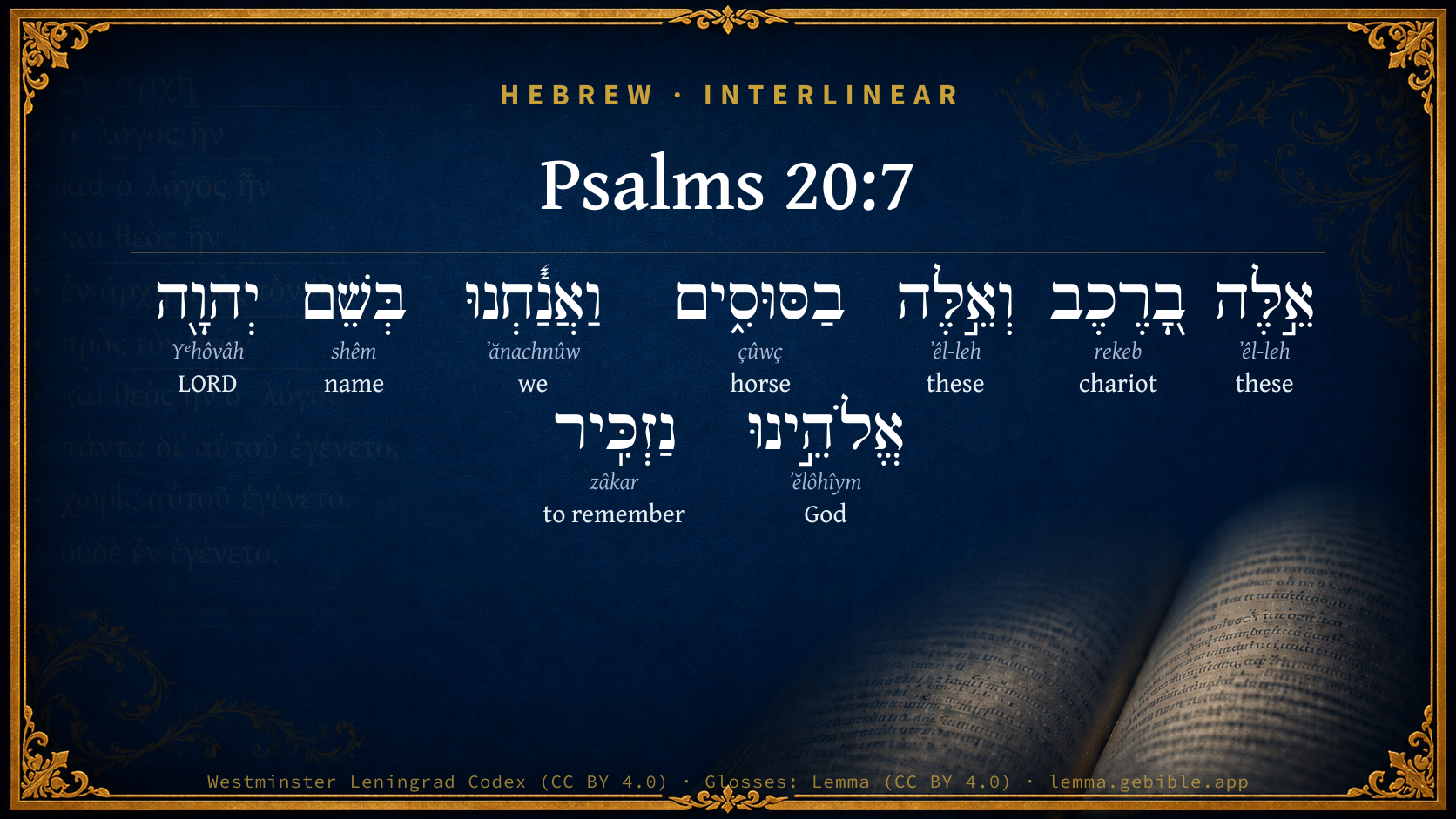
Hebrew (Westminster Leningrad Codex) Psalms 20:7 appears in the Hebrew Old Testament. The text above is from the Westminster Leningrad Codex. Each word links to its Strong’s number, a concise gloss, and parsing drawn from the Open Scriptures Hebrew Bible morphology. Click any word for its full Brown-Driver-Briggs (BDB) entry.
Download image
Cite this verse

Psalms 20:7 (World English Bible). Public Domain. Lemma interlinear Bible study tool, https://lemma.gebible.app/v/psalms/20/7.

Show BibTeX & RIS
BibTeX
RIS
English Translation
Some trust in chariots, and some in horses, But we trust the name of Yahweh our God.
World English Bible · Public Domain
Download a study sheet

One document with this verse’s original text, its word-by-word gloss line, the meaning frame, cross-references with their text, attributed commentary, and full source and license credits — printable, and it pastes into notes with its structure intact.

This verse Autodidact and up

Study sheet (.html) Plain text (.txt)

A passage Seminary Student

Up to 50 verses in one chapter. A passage sheet keeps up to 6 commentary sources and 12 cross-references per verse, in the order this page ranks them, and says so on the sheet whenever that leaves anything out. Ask for a single verse and you get the Autodidact verse sheet above.

Everything on this page stays free to read, with no account — the sheet is a download of what is already on screen, not access to it.

Want to remove ads? Support Godless Engineer
Compare translations 3

The same verse in 3 English versions, stacked beneath the original-language interlinear above. Click any original word for its lexicon entry.

Each is an independent rendering of the whole verse — the interlinear is not word-aligned to these translations.

Highlighted words mark where these versions differ — a whole-verse word diff, not a word-by-word alignment.

  • World English Bible Public Domain
    Some trust in chariots, and some in horses, But we trust the name of Yahweh our God.
  • King James Version Public Domain
    Some trust in chariots, and some in horses: but we will remember the name of the LORD our God.
  • unfoldingWord Literal Text CC BY-SA 4.0
    These in chariots and these in horses, but we will remember the name of Yahweh our God.

unfoldingWord Literal Text — © unfoldingWord, licensed CC BY-SA 4.0. Word-aligned USFM3 via Door43 (git.door43.org/unfoldingWord/en_ult).

Versions to compare (up to 4)

3 of 4 selected

Show all 18 translations

Every available English version of this verse, each an independent rendering of the whole verse.

  • World English Bible Public Domain
    Some trust in chariots, and some in horses, But we trust the name of Yahweh our God.
  • Berean Standard Bible Public Domain
    Some trust in chariots and others in horses, but we trust in the name of the LORD our God.
  • Majority Standard Bible Public Domain
    Some trust in chariots and others in horses, but we trust in the name of the LORD our God.
  • King James Version Public Domain
    Some trust in chariots, and some in horses: but we will remember the name of the LORD our God.
  • American Standard Version (1901) Public Domain
    Some `trust' in chariots, and some in horses; But we will make mention of the name of Jehovah our God.
  • Revised Version (1885) Public Domain
    Some trust in chariots, and some in horses: but we will make mention of the name of the LORD our God.
  • Geneva Bible (1599) Public Domain
    Some trust in chariots, and some in horses: but we will remember the Name of ye Lord our God.
  • Douay-Rheims (1899) Public Domain
    The Lord fulfil all thy petitions: now have I known that the Lord hath saved his anointed. He will hear him from his holy heaven: the salvation of his right hand is in powers.
  • Young's Literal Translation Public Domain
    Some of chariots, and some of horses, And we of the name of Jehovah our God Make mention.
  • Literal Standard Version CC BY-SA 4.0
    Some of chariots, and some of horses, || And we of the Name of our God YHWH || Make mention.
  • Unlocked Literal Bible CC BY-SA 4.0
    Some trust in chariots and others in horses, but we call on Yahweh our God.
  • unfoldingWord Literal Text CC BY-SA 4.0
    These in chariots and these in horses, but we will remember the name of Yahweh our God.
  • Darby Bible Public Domain
    Some make mention of chariots, and some of horses, but we of the name of Jehovah our God.
  • World Messianic Bible Public Domain
    Some trust in chariots, and some in horses, but we trust in the name of the LORD our God.
  • Webster's Bible Public Domain
    \\20:6\\Now I know that the LORD saveth his anointed; he will hear him from his holy heaven with the saving strength of his right hand.
  • Free Bible Version CC BY-SA 4.0
    Some trust in chariots and some in war horses, but we trust in who the Lord our God is.
  • Bible in Basic English Public Domain
    Some put their faith in carriages and some in horses; but we will be strong in the name of the Lord our God.
  • JPS Tanakh (1917) Public Domain
    (20-8) Some trust in chariots, and some in horses; but we will make mention of the name of the LORD our God.

Literal Standard Version (2020), Covenant Press — licensed CC BY-SA 4.0. Text via the HelloAO Bible API (eBible.org). Unlocked Literal Bible (unfoldingWord) — licensed CC BY-SA 4.0. Text via the HelloAO Bible API (eBible.org). unfoldingWord Literal Text — © unfoldingWord, licensed CC BY-SA 4.0. Word-aligned USFM3 via Door43 (git.door43.org/unfoldingWord/en_ult). Free Bible Version, Dr. Jonathan Gallagher — licensed CC BY-SA 4.0. Text via the HelloAO Bible API (eBible.org).

Word by word

More ways to search: Search by grammar → Find every occurrence → Compare this word →

Practice this passage: Drill this verse → Learn its vocabulary →

בָ֭רֶכֶב
rekeb
H7393
“in/at the · chariot”
Preposition, Determined + Noun, Common, Masculine, Singular, Absolute
Part of Speech
Preposition + Noun
Type
Common
Gender
Masculine
Number
Singular
State
Absolute
Full BDB Definition

Origin: from H7392

TWOT: 2163a

a team, chariot, chariotry, mill-stone, riders - chariotry, chariots - chariot (single) - upper millstone (as riding on lower millstone) - riders, troop (of riders), horsemen, pair of horsemen, men riding, ass-riders, camel-riders
  1. אֵ֣לֶּה ʼêl-leh H428 “these” Pronoun, Demonstrative, Common, Plural
  2. וְאֵ֣לֶּה ʼêl-leh H428 “and · these” Conjunction + Pronoun, Demonstrative, Common, Plural
  3. בַסּוּסִ֑ים çûwç H5483 “in/at the · horses” Preposition, Determined + Noun, Common, Masculine, Plural, Absolute
  4. וַאֲנַ֓חְנוּ ʼănachnûw H587 “and · we” Conjunction + Pronoun, Personal, 1st Person, Common, Plural
  5. בְּשֵׁם shêm H8034 “in/at · name of” Preposition + Noun, Common, Masculine, Singular, Construct
  6. יְהוָ֖ה Yᵉhôvâh H3068 “LORD” Noun, Proper
  7. אֱלֹהֵ֣ינוּ ʼĕlôhîym H430 “God(s) · our” Noun, Common, Masculine, Plural, Construct + Suffix, Personal, 1st Person, Common, Plural
  8. נַזְכִּֽיר zâkar H2142 “to remember” Verb, Hiphil, Imperfect, 1st Person, Common, Plural

About this verse

These counts appear in no published source. They are computed here, from the morphology-tagged text and Lemma’s own curated glosses. What Lemma adds →

9
words
8
distinct lemmas
Wisdom
section

Grammatical profile

  • 1 verb
  • 5 nouns
  • 3 pronouns

Verb forms

  • נַזְכִּֽיר Hiphil · Imperfect

Repetition

A word recurs within this verse — often emphatic in Hebrew:

  • אֵ֣לֶּה these H428 ×2

Hebrew & Septuagint length

In English translation the verse runs 17 words from the Hebrew and 20 from the Septuagint (LXX English) — closely comparable.

A rough comparison of the two English renderings, which tokenize alike — not a word-level alignment.

Word counts can differ between the Hebrew and the Greek without any difference in meaning — e.g. the Hebrew direct-object marker אֵת has no separate Greek word, and Greek often adds the article ὁ.

Cross-references

14

Topical passages linked to Psalms 20:7 in the Treasury of Scripture Knowledge — connected by theme and wording, ordered by reader-vote popularity; previews shown in the World English Bible.

  • Isaiah 31:1 Woe to those who go down to Egypt for help, and rely on horses, and trust in chariots because they are many, and in horsemen because they are very strong, but they don't look to the Holy One of Israel, neither seek Yahweh!
  • Jeremiah 17:5 Thus says Yahweh: Cursed is the man who trusts in man, and makes flesh his arm, and whose heart departs from Yahweh.
  • Proverbs 21:31 The horse is prepared for the day of battle; But victory is with Yahweh.
  • Psalms 33:16–17 There is no king saved by the multitude of a host. A mighty man is not delivered by great strength.
  • 2 Chronicles 32:8 with him is an arm of flesh; but with us is Yahweh our God to help us, and to fight our battles. The people rested themselves on the words of Hezekiah king of Judah.
  • 2 Chronicles 14:11 Asa cried to Yahweh his God, and said, Yahweh, there is none besides you to help, between the mighty and him who has no strength: help us, Yahweh our God; for we rely on you, and in your name are we come against this multitude. Yahweh, you are our God; don't let man prevail against you.
  • 2 Chronicles 20:12–20 Our God, will you not judge them? for we have no might against this great company that comes against us; neither know we what to do: but out eyes are on you.
  • Psalms 45:17 I will make your name to be remembered in all generations. Therefore the peoples shall give you thanks forever and ever.
  • 2 Chronicles 13:10–12 But as for us, Yahweh is our God, and we have not forsaken him; and [we have] priests ministering to Yahweh, the sons of Aaron, and the Levites in their work:
  • Isaiah 30:16 but you said, No, for we will flee on horses; therefore shall you flee: and, We will ride on the swift; therefore shall those who pursue you be swift.
  • 1 Samuel 13:5 The Philistines assembled themselves together to fight with Israel, thirty thousand chariots, and six thousand horsemen, and people as the sand which is on the sea-shore in multitude: and they came up, and encamped in Michmash, eastward of Beth Aven.
  • 2 Chronicles 13:16 The children of Israel fled before Judah; and God delivered them into their hand.
  • 2 Samuel 10:18 The Syrians fled before Israel; and David killed of the Syrians [the men of] seven hundred chariots, and forty thousand horsemen, and struck Shobach the captain of their host, so that he died there.
  • 2 Samuel 8:4 David took from him one thousand seven hundred horsemen, and twenty thousand footmen: and David hamstrung all the chariot horses, but reserved of them for one hundred chariots.

Cross-references courtesy of OpenBible.info (CC BY 4.0).

Hebrew and Greek witnesses Masoretic Hebrew ↔ Greek Septuagint

The same verse in the two great witnesses to the Old Testament, shown verse-for-verse.

You’re reading Greek Psalm 19 (Hebrew Psalm 20). The Septuagint counts the superscription, so verse numbers can differ from the Hebrew — chapter-level alignment, not verse-by-verse. Numbering follows Rahlfs.

These are two independent witnesses, not word-aligned to each other, and the Septuagint is shown in lemma (dictionary) form.

Hebrew Psalms 20:7 Masoretic · Westminster Leningrad Codex

אֵ֣לֶּה בָ֭רֶכֶב וְאֵ֣לֶּה בַסּוּסִ֑ים וַאֲנַ֓חְנוּ בְּשֵׁם יְהוָ֖ה אֱלֹהֵ֣ינוּ נַזְכִּֽיר

Some trust in chariots, and some in horses, But we trust the name of Yahweh our God.

World English Bible · Public Domain

Greek LXX Greek Psalm 19:7 Septuagint · lemma form

νῦν γιγνώσκω ὅτι σώζω κύριος ὁ χριστός αὐτός ἐπιἀκούω αὐτός ἐκ οὐρανός ἅγιος αὐτός ἐν δυναστεία ὁ σωτηρία ὁ δεξιός αὐτός

Some glory in chariots, and some in horses: but we will glory in the name of the Lord our God.

LXX2012 (modern English Septuagint) · Public Domain

On this verse, Adam Clarke's Commentary discusses the Septuagint’s reading. Read the note in Commentary ↓

Hebrew: Westminster Leningrad Codex (CC BY 4.0). Greek: Septuagint (public domain); English from LXX2012 (modern English Septuagint) (Public Domain). How the Septuagint differs from the Hebrew →

Commentary

Notes on Psalms 20:7 from classic Christian and Jewish commentators (each source and its license shown beneath its notes). The classic Christian expositions comment on the surrounding passage and are grouped to its opening verse, so a note may address several verses; the Jewish commentaries on the Tanakh (Rashi and others) are per-verse, so they appear only where the commentator wrote on this verse.

Lemma curates 59 commentaries, every one of them public domain or Creative Commons licensed, each selected and text-cleaned for this edition rather than reprinted as found. About our sources →

Trapp's Complete Commentary

John Trapp

Psa 20:7 Some [trust] in chariots, and some in horses: but we will remember the name of the LORD our God.

Ver. 7. Some trust in chariots, &c.] i.e. In their national accommodations and military provisions; but these were never true to those that trusted them. All is but an arm of flesh.

But we will remember, &c.] i.e. In the remembrance of his excellent attributes, whereof we have had such proof, we will take courage.

John Trapp, A Commentary or Exposition upon All the Books of the Old and New Testament (1647–1656) — public domain. Text from a community e-Sword module.

The Biblical Illustrator

Joseph S. Exell

Psa_20:7

Some trust in chariots, and some in horses: but we will remember the name of the Lord our God.

Remember the name of the Lord our God

By the name of God is meant the various properties and attributes of God. Now, whilst some trusted in earthly power, the Psalmist confides in the name of the Lord our God. It would seem to an ordinary observer, if he were ignorant of the Gospel, that the name of the Lord would excite terror rather than confidence. If there be good in the moral government of God, how much of suffering, evil and sorrow there are, notwithstanding. How then can confidence arise from remembering the Divine name? We distinctly admit that there are attributes of God which, because they seem arrayed against sinful beings, can hardly be supposed to be subjects of encouraging remembrance. The name of the Lord our God includes justice and holiness; and these are qualities from which we seem instinctively to shrink, as though we felt that they must necessarily be opposed to rebellious and polluted creatures. And so they must be. If there be certain Divine properties, the remembering of which might be comforting even to the disciple of natural religion, undoubtedly there are others which can furnish nothing but cause of disquietude, unless there be full acquaintance with the scheme of redemption. It is in respects such as these that natural theology, if it would keep its disciples at peace, must forbid their recollecting the name of the Lord their God. These are points which must be slurred over, for to examine them deeply would be to destroy all foundation of hope. But it is not so with the disciple of revealed religion. Blessed be the God and Father of our Lord Jesus Christ, there is no property involved in the Divine name from which we need shrink, none which is not actually ranged on our side, if we believe on Him who gave His life a ransom for the world. Did you ever consider what emphasis there is in St. Pauls answer to his own question, Who shall lay anything to the charge of Gods elect? His answer is, it is God that justifieth. What is there in the fact that it is God that justifieth, which proves that earth, and sea, and air might be ransacked for an accuser, but that none could be found who could make good any charge against Gods elect? Is it not because God is the justifying agent; not this property, not that attribute of God, but God Himself--God the combination of all possible perfections? If it be God that justifieth, the justification must be that in the effecting which holiness and justice concur. And therefore is it that all accusation is silenced; for if the satisfaction made to God on our behalf hath met every attribute of God, it is not possible that there should remain place for any charge. Justice as well as love demands our acceptance. Who can condemn when the Divine Judge Himself acquits, nay, pronounces approval? You should not fail to observe that our text furnishes a great criterion, and that we ought to test by it our spiritual condition. Is it, or is it not, our habit to remember the name of the Lord our God, whilst others, either neglectful of religion or adopting false systems, turn bewildered to chariots and horses? It is, if with David we have entered into covenant with God, through the Mediator: it cannot be, if we are still virtually aliens, living in the darkness and rebellion of nature. Oh, we too well know that there must be some amongst you whose only happiness is in keeping God out of their thoughts, and who are glad of any excuse for not considering His nature and attributes. Any chariot, any horse, which may bear them away from the contemplation of their Maker! What a state! To be afraid of meditating on that Being before whom they must inevitably appear, and who has power to destroy both body and soul in hell! If the banishing Him from your thoughts could finally keep you from contact with Him in His awfulness; if there were a chariot, if there were a horse, which would bear you away from His everlasting wrath, we might not wonder at your perseverance in forgetting Him to, the utmost of your power. Try for one hour to remember Gods name--Gods name as traced by natural theology, and yet more vividly by revealed. I know that you will be disturbed and appalled, I know that as one property after another of the Divine nature passes before you, you will shrink back, and be tempted to exclaim--Oh! for the chariot, oh! for the horse, to bear us away from this terrible God! But this is what we wish. We wish you to see in God a consuming fire,--a Being of terrors, and those terrors all armed to strike down and to crush you. But we do not wish you to be left in dismay; neither will you be. When remembering the name of the Lord has made you feel yourselves lost, you will hear with unspeakable gratitude how God laid your iniquities on His own well-beloved Son. If God out of Christ appeared to you a consuming fire, God in Christ should appear to you as a reconciled Father. (H. Melvill, B. D.)

Divine and human trust contrasted

I. The charge brought against those whose trust is merely human. There have been such always. Now, the guilt of such trust lies in the oversight of God,--regarding chariots and horses as sufficient in themselves. And we are inexcusable in this, because God, though invisible, is ever perceptible to the understanding. And all such trust is irrational. It has no solid foundation in reason or conscience.

II. The purpose. We will remember, etc. The trust of the Christian begins memory. It acts as a stimulant to the believer, and loosens every other bond and makes it easy to let go all which the world gives.

III. The consequences. They are brought down,. . .but we, etc. Now, the results of trust in human power are sad and unexpected. It was so with Pharaoh and his army. But they are in accordance with the natural course of things. If we sow to the flesh we shall of the flesh reap corruption. But the Christian trust issues in this--We are risen, and stand upright. (W. D. Horwood.)

Chariots and horses

I. The vanity and the variety of earthly dependences. Some trust in chariots and horses. They were the appendages of war; hence were forbidden to Israel, for war was not their trade, They had no standing, army. They were always to be conscious of the inadequacy of their own resources, and thus to be taught to trust implicitly in God. Nor were they to be exposed to the temptation of conquest. They were never so triumphant as when trusting in God alone. But the text points to the tendency which men have to trust in the creature rather than in the Creator (Jer_17:5-8).

II. The foundation of Christian peace and courage. But we will remember, etc. The name of the Lord is perpetually recurring in Scripture and has ever a deep and portentous meaning. The name of Jesus has now the same energy. The Lord our God--all the best blessings of time and eternity belong to the covenant of grace which is in Jesus. Is God our God? Can we adopt the words of the text? (W. G. Lewis.)

Trust in chariots and horses vain

France, in the Revolution, hung up her motto--Liberty equality, fraternity. Napoleon changed it to Infantry, cavalry, artillery, says Punch.

Christian loyalty

Every good Christian is necessarily a loyal man. The subject now considered is, the insufficiency of all human expedients to secure happiness for a people unless God be honoured in the councils of their rulers, and His name be remembered by themselves. Human policy, if separated from Divine wisdom, leads to ruin and disgrace; but they rise and stand upright who remember the name of the Lord our God. In what manner is a nation called upon to remember the name of the Lord our God? The right administration of justice and the true worship of God are the only sufficient securities for the permanent happiness of a state. It is the peculiar province of the law of God to instill a hatred of sin. Human laws may bind the hand, fetter the foot, and imprison the body, but nothing can control the heart, and curb the thoughts, and purify the motives by which we are influenced except the Spirit of God. He alone can subjugate the whole man. (A. Watson, M. A.)

.

Psa_21:1-13

The Biblical Illustrator, edited by Joseph S. Exell (c. 1880s–1900s) — public domain. Text from a community e-Sword module.

Joseph Benson's Commentary

Psa 20:7-9. Some trust in chariots — This again was spoken by the people. The word trust is not in the Hebrew, which is more literally translated, These in their chariots, and those on their horses, but we will remember, make mention of, or, celebrate, the name of the Lord our God; that is, we will remember, or make mention of it, so as to boast of or trust in it. They are brought down — From their horses and chariots, to which they trusted. Hebrew, כרעו, charegnu, they bowed down, as being unable to stand longer, because of their mortal wounds. See Jdg 5:27. But we are risen, and stand upright — Stand firmly, and keep the field. Let the king hear us — Either, 1st, David; and so the sense is, O Lord, preserve and assist the king, that, when we are distressed, and cry to him for help, he may be able and ready to help us: or, 2d, Let God, the supreme Monarch, the King of kings, and, in a peculiar manner, the King of Israel, hear and answer us, when we pray for our king and people. But Dr. Waterland renders the verse, very agreeably to the Hebrew, Lord, save the king. He (that is, the Lord) will hear us when we call.

Joseph Benson's Commentary on the Old and New Testaments (1811–1818) — public domain. Text from a community e-Sword module.

J. A. Alexander on Psalms

Joseph Addison Alexander

8. (Psa 20:7). These in chariots and these in horses, and we in the name of Jehovah our God, will glory. All the objects are connected by the same preposition with the same verb, namely, that at the end of the sentence. In order to retain the preposition, which must otherwise be varied, and thereby obscure the structure of the sentence, the verb glory, which is construed with the preposition in, has been substituted for the strict sense of the is verb, we will cause to be remembered, i. e. mention or commemorate. See Exo 23:13, Amo 6:10, Isa 48:1; Isa 63:7. The insertion of the verb trust, in the English versions of the first clause, is entirely gratuitous. These and these is the Hebrew idiom for some and others. Compare this to this, in Exo 14:20, Isa 6:3.—The verb, in the case before us, may have been selected in allusion to the cognate form in Psa 20:4 (3) above. "As God has remembered thy offerings, so we will cause his name to be remembered."—Our God is again emphatic and significant, as shewing that the whole psalm has reference to the covenant relation between God and his people represented by their theocratic sovereign. With the contrast in this verse compare 1Sa 17:45, Isa 31:3, Psa 33:16-17.

Joseph Addison Alexander, The Psalms Translated and Explained (1850) — public domain. Text from a community e-Sword module.

Tyndale Open Study Notes

Tyndale Open Resources

20:7 chariots and horses: These were instruments of war (see 33:16-17; 76:6; 147:10; Isa 30:16; 31:1-3).

Tyndale Open Study Notes — © Tyndale Open Resources, licensed CC BY-SA 4.0. Text via the HelloAO Bible API.

Jamieson, Fausset & Brown

Robert Jamieson, A. R. Fausset & David Brown

remember--or cause to remember, mention thankfully (Sa1 17:45; Psa 33:16).

Jamieson, Fausset & Brown — Commentary Critical and Explanatory on the Whole Bible (1871) — public domain (CC PDM 1.0). Text via the HelloAO Bible API.

Adam Clarke's Commentary

Verse 7. Some trust in chariots] The words of the original are short and emphatic: These in chariots; and these in horses; but we will record in the name of Jehovah our God. Or, as the Septuagint, μεγαλυνθησομεθα, "we shall be magnified." Or, as the Vulgate, invocabimus, "we shall invoke the name of the Lord." This and the following verse I suppose to be the words of David and his officers. And the mention of chariots and horses makes it likely that the war with the Ammonites and Syrians is that to which reference is made here; for they came against him with vast multitudes of horsemen and chariots. See 2Sa 10:6-8. According to the law, David could neither have chariots nor horses; and those who came against him with cavalry must have a very great advantage; but he saw that Jehovah his God was more than a match for all his foes, and in him he trusts with implicit confidence.

Adam Clarke's Commentary on the Bible (1810–1826) — public domain. Text from a community e-Sword/MySword module.

John Calvin's Commentaries

7. Some trust in chariots. I do not restrict this to the enemies of Israel, as is done by other interpreters. I am rather inclined to think that there is here a comparison between the people of God and all the rest of the world. We see how natural it is to almost all men to be the more courageous and confident the more they possess of riches, power and military forces. The people of God, therefore, here protest that they do not place their hope, as is the usual way with men, in their military forces and warlike apparatus, but only in the aid of God. As the Holy Spirit here sets the assistance of God in opposition to human strength, it ought to be particularly noticed, that whenever our minds come to be occupied by carnal confidence, they fall at the same time into a forgetfulness of God. It is impossible for him, who promises himself victory by confiding in his own strength, to have his eyes turned towards God. The inspired writer, therefore, uses the word remember, to show, that when the saints betake themselves to God, they must cast off every thing which would hinder them from placing an exclusive trust in him. This remembrance of God serves two important purposes to the faithful. In the first place, however much power and resources they may possess, it nevertheless withdraws them from all vain confidence, so that they do not expect any success except from the pure grace of God. In the second place, if they are bereft and utterly destitute of all succor, it notwithstanding so strengthens and encourages them, that they call upon God both with confidence and constancy. On the other hand, when ungodly men feel themselves strong and powerful, being blinded with pride, they do not hesitate boldly to despise God; but when they are brought into circumstances of distress, they are so terrified as not to know what to become. In short, the Holy Spirit here recommends to us the remembrance of God, which, retaining its efficacy both in the want and in the abundance of power, subdues the vain hopes with which the flesh is wont to be inflated. As the verb נזכיר, nazkir, which I have translated we will remember, is in the conjugation hiphil, some render it transitively, we shall cause to remember. But it is no new thing in Hebrew for verbs to be used as neuter which are properly transitive; and, therefore, I have adopted the exposition which seems to me the most suitable to this passage.

John Calvin's Commentaries (1540-1563) — public domain. Text from the Calvin Translation Society English edition (1840s-50s) via the Christian Classics Ethereal Library (ccel.org). Calvin's coverage is partial (roughly two-thirds of the Bible); uncommented books and verses are honest gaps, never fabricated. The 19th-century editor's footnotes and remarks are omitted so the notes are faithfully Calvin's own voice.

Ellicott's Commentary for English Readers

(7) Trust.—The poetry is weakened by the insertion of this word. Render, These in chariots and these on horses; but we in the name of Jehovah our God make boast. The mention of horses and chariots suggests a Syrian war, since the armies of Syria were peculiarly strong in this arm. For an interesting historical reference to this verse, see Macaulay’s Hist. of England, chap. ix.

A Bible Commentary for English Readers, edited by Charles John Ellicott (1878–1897) — public domain. Text from a community e-Sword module.

The Cambridge Bible for Schools and Colleges

gen. ed. J. J. S. Perowne

7. Some] The heathen enemy, like Pharaoh (Exodus 14), and Sennacherib (2Ki_19:23); not here heathenish Israelites, as in Isa_31:1-3.

But we will remember the name] R.V., But we will make mention of the name &c. This shall be our watchword and our strength. Cp. Jdg_7:18; 1Sa_17:45; 2Ch_16:8-9; Psa_33:16 f.; Isa_26:13; Hos_1:7.

The Cambridge Bible for Schools and Colleges (gen. ed. J. J. S. Perowne; Cambridge University Press, 1878–1918) — public domain. Text from a community e-Sword module.

John Gill's Exposition

Some trust in chariots, and some in horses,.... That is, in chariots and horses prepared for war; which, besides their use for carriage, did great annoyance to the enemy in battle, and were very terrible to them, and were greatly trusted in by those that possessed them, Deu 20:1; such chariots as were called "currus falcati", that had scythes at the sides of them, which being drove with fury among the infantry, cut them down as grass is mown with scythes; such the old Canaanites used, which were very terrible, Jos 17:16; and horses trained up for war do much execution in a battle by pawing and trampling; see Job 39:21; though these are vain things for safety, and not to be depended on, for salvation and victory are of the Lord, Psa 33:17; and such are the chariots and horses of the sun, and the idols in which the Gentiles trusted, Kg2 23:11; and all external things in which men depend for salvation, as fleshly privileges, outward works of righteousness, morality, a profession of religion, a round of duties, &c. all which are disclaimed by those who know the way of life and salvation by Christ, Hos 14:3;

but we will remember the name of the Lord our God; not any of the names by which the Lord God is called, as Elohim, Elshaddai, Jehovah, and the like; though each of these are worthy of remembrance, and greatly serve to encourage faith in him; but rather the perfections of God, such as the goodness, wisdom, and power of God, which are to be remembered and confided in; and not the friendship of princes, the schemes of human policy, and the outward forces of strength; or else God himself is intended, whose name is himself, and is a strong tower to the righteous: and to remember him is to bear him in mind, and not forget him; to have the desires of the soul towards him, and to the remembrance of him; and to make mention of him, of his names, attributes, word, and works; which is both for his glory and for the encouragement of faith in him, both in ourselves and others; it is to call upon his name in times of trouble, and at all times, and also to trust in him and not in an arm of flesh; for it stands opposed to trusting in chariots and horses; and it is to call to mind past instances of his goodness, wisdom, and power, and be thankful for them, and make use of them to engage confidence in him; and which should be done from the consideration of his being God and not man, and of his being our God, our covenant God and Father.

John Gill's Exposition of the Whole Bible (1746–1763) — public domain (CC PDM 1.0). Text via the HelloAO Bible API.

Albert Barnes' Notes on the Bible

Some trust in chariots - This (see the introduction to the psalm) seems to be a “general chorus” of the king and the people, expressing the fullest confidence in God, and showing the true ground of their reliance. The general meaning is, that their entire trust was in God. This is put in strong contrast with others, who relied, some on their chariots, and some on their horses, while “they” relied alone on God. They who trusted in horses and in chariots would be overcome; they who trusted in God alone would triumph. The word rendered chariots - רכב rekeb - means properly riding, and then a vehicle for “riding,” a wagon, a chariot. Here it refers to the war-chariot, or the vehicle for carrying armed men into battle. These furnished great advantages in war, by the speed with which they could be driven against an enemy, and by the facilities in fighting from them. They were usually very simple. They consisted of “a light pole suspended between and on the withers of a pair of horses, the after end resting on a light axle tree, with two low wheels. Upon the axle stood a light frame, open behind, and floored for the warrior and his charioteer, who both stood within. On the sides of the frame hung the war-bow, in its case; a large quiver with arrows and darts had commonly a particular sheath. In Persia, the chariots, elevated upon wheels of considerable diameter, had four horses abreast; and in early ages, there were occasionally hooks or scythes attached to the axles.” - Kitto, “Cyclo.” In early ages these constituted a main reliance in determining the result of a battle.

And some in horses - Some in cavalry, commonly a very material reliance in war. The use of horses in war was early known in the world, for we find mention of them in the earliest periods of history.

But we will remember the name of the Lord our God - That is, we will remember God - the name, as before remarked, often being used to denote the person. The meaning is, We will not forget that our reliance is not on armies, but on God, the living God. Whatever instrumentality we may employ, we will remember always that our hope is in God, and that he only can give success to our arms.

Albert Barnes' Notes on the Bible (1834–1885) — public domain. Text from a community e-Sword/MySword module.

Matthew Poole's English Annotations

Some trust; or, remember; which may better be applied out of the next clause.

We will remember; or, make mention of, to wit, so as to boast of it, or trust in it; for such things men oft remember or mention.

Matthew Poole's English Annotations on the Holy Bible (1683–1685) — public domain. Text from a community e-Sword/MySword module.

The Treasury of David

Charles H. Spurgeon

Ver. 7. Some trust in chariots, and some in horses: but we will remember the name of the Lord our God. About Michaelmas I was in the utmost extremity, and having gone out in very fine weather, I contemplated the azure heavens, and my heart was so strengthened in faith (which I do not ascribe to my own powers, but solely to the grace of God), that I thought within myself, "What an excellent thing it is when we have nothing, and can rely upon nothing, but yet are acquainted with the living God, who made heaven and earth, and place our confidence alone in him, which enables us to be so tranquil even in necessity!" Although I was well aware that I required something that very day, yet my heart was so strong in faith that I was cheerful, and of good courage. On coming home I was immediately waited upon by the overseer of the workmen and masons, who, as it was Saturday, required money to pay their wages. He expected the money to be ready, which he wished to go and pay, but enquired, however, whether I had received anything. "Has anything arrived?" asked he. I answered, "No, but I have faith in God." Scarcely had I uttered the words when a student was announced, who brought me thirty dollars from some one, whom he would not name. I then went into the room again, and asked the other "how much he required this time for the workmen's wages?" He answered, "Thirty dollars." "Here they are, "said I, and enquired at the same time, "if he needed any more?" He said, "No, "which very much strengthened the faith of both of us, since we so visibly saw the miraculous hand of God, who sent it at the very moment when it was needed. Augustus Herman Franke, 1663-1727.

Ver. 7. Some trust in chariots, etc. Vain is the confidence of all wickedness. In war, chariots, horses, navies, numbers, discipline, former successes, are relied on; but the battle is not to the strong. "Providence favours the strong battalions" may sound well in a worldling's ear, but neither Providence nor the Bible so teaches. In peace, riches, friends, ships, farms, stocks, are relied upon, yet they can neither help nor save. Let him that glorieth glory in the Lord. William S. Plumer.

Ver. 7. We will remember the name of the Lord our God. By the name of God is generally understood, in Holy Writ, the various properties and attributes of God: these properties and attributes make up and constitute the name of God. As when Solomon says, "The name of the Lord is a strong tower; the righteous runneth into it and is safe." And, by remembering, considering, meditating upon this name of God, the psalmist represents himself as comforted or strengthened, whatever might be the duties to which he was called, or the dangers to which he was exposed. Others were for looking to other sources of safety and strength, "some trusting in chariots, and some in horses; " but the psalmist always set himself to the "remembering the name of the Lord our God; "and always, it would seem, with satisfaction and success. And here is the peculiarity of the passage on which we wish to dwell, and from which we hope to draw important lessons and truthsthe psalmist "remembers the name of the Lord his God; "not any one property or attribute of God; but the whole combination of divine perfections. And he "remembers" this "name; "the expression implying, not a transient thought, but meditationconsideration; and yet the result of the recollection is gladness and confidence. Henry Melvill.

Ver. 7. It is easy to persuade papists to lean on priests and saints, on old rags and painted pictureson any idol; but it is hard to get a Protestant to trust in the living God. William Arnot, 1858.

Ver. 7. Weak man cannot choose but have some confidence without himself in case of apparent difficulties, and natural men do look first to some earthly thing wherein they confide. Some trust in chariots, and some in horses, some in one creature, some in another. The believer must quit his confidence in these things, whether he have them or want them, and must rely on what God hath promised in his word to do unto us. But we will remember the name of the Lord our God. David Dickson.

Ver. 7. They that trust in chariots and horses, will have no king but Caesar; but the "armies in heaven" which follow thee have themselves no arms, and no strength but in following thee. Isaac Williams.

Ver. 7. Numa being told that his enemies were coming upon him, as he was offering sacrifices, thought it was sufficient for his safety that he could say, I am about the service of my God. When Jehoshaphat had once established a preaching ministry in all the cities of Judah, then, and not till then, the fear of the Lord fell on the neighbouring nations, and they made no war; albeit, he had before that placed forces in all the fenced cities. Charles Bradbury.

Ver. 7.

"Some their warrior horses boast, Some their chariots marshalled host;

But our trust we will proclaim In our God Jehovah's name."

Richard Mant.

Ver. 7. Creature confidence. Apparently mighty, well adapted, showy, noisy, etc. Faithful trust. Silent, spiritual, divine, etc.

Ver. 7. The name of the Lord our God. Comfortable reflections from the name and character of the true God.

Psalms 20:8*

Charles H. Spurgeon's The Treasury of David (1869–1885) — public domain. Psalms only. Text from a community e-Sword/MySword module.

Whedon's Commentary on the Bible

Daniel D. Whedon

7. Chariots… horses—The most formidable war forces known to the nations west of the Indus, and here unmistakably identifying the Syrians, who were famous for their cavalry and war chariots. Hence they could fight advantageously only in plains. Note 1Ki_20:23; 1Ki_20:28. The contrast of the argument lies between human strength and divine power. 1Sa_17:45. The Hebrew kings were forbidden to multiply horses, as tempting them to luxury and military habits, (Deu_17:16;) but Solomon disobeyed (1Ki_10:25-28) this command. The horse was, anciently, chiefly used for war.

Daniel D. Whedon (gen. ed.), Commentary on the Old and New Testaments (1874–1909) — public domain. Text from a community e-Sword module.

The Pulpit Commentary

Some trust in chariots, and some in horses. The enemies of David towards the north Syrians of Zobah, and Maachah, and Damascus, and Beth-Rehob were especially formidable on account of their cavalry and their chariots. David on one occasion "took from Hadarezer, King of Zobah, a thousand chariots, and seven thousand horsemen". (1Ch_18:4) On another he "slew of the Syrians seven thousand men which fought in chariots". (1Ch_19:18)

His own troops appear to have consisted entirely of footmen. But we will remember the Name of the Lord our God. Our trust, i.e. , shall be in the Lord, who has commanded our kings "not to multiply horses". (Deu_17:16)

The Pulpit Commentary (1880–1919), ed. H.D.M. Spence-Jones & Joseph S. Exell — public domain. Text from a community e-Sword module.

John Wesley's Explanatory Notes

Remember - Trust in it.

John Wesley, Explanatory Notes Upon the Whole Bible (1754–1765) — public domain. Text via the GEBible commentary corpus.

unfoldingWord translationNotes

Door43 World Missions Community

Some trust in chariots and others in horses

Here "chariots" and "horses" represent a king's army. (See: Metonymy)

others in horses

The word "trust" is understood. AT: "other trust in horses" (See: Ellipsis)

we call ... we will rise

Here "we" refers to the writer and the readers. (See: Inclusive "We")

They will be brought down and fall

The word "They" refers to the people who trust in chariots and horses. This can be stated in active form. AT: "God will bring them down and make them fall" (See: Active or Passive)

brought down and fall

Both these verbs mean basically the same thing. Both of these stand for losing in battle. (See: Doublet)

we will rise and stand upright

"we will get up and stand up straight." These two phrases mean basically the same thing. Both of these stand for victory in battle. (See: Doublet)

translationWords

trust

chariot

horse

call

Yahweh

God

unfoldingWord translationNotes — © Distant Shores Media and the Door43 World Missions Community, licensed CC BY-SA 4.0. Source: git.door43.org/Door43/en_tn.

Rashi

Rabbi Shlomo Yitzchaki (Rashi)

Now I know This is the praise that we will sing now for this salvation that came to Joab and to Israel: I know that the Omnipresent desired me and has answered me from His holy heavens, for their salvation is my salvation.

Rashi on the Tanakh — English translations: “The Judaica Press complete Tanach with Rashi, translated by A. J. Rosenberg” (CC BY 4.0); “Pentateuch with Rashi's commentary by M. Rosenbaum and A.M. Silbermann, 1929-1934” (public domain); “The Metsudah Tanach series, Lakewood, N.J” (CC BY 4.0); and “The Book of Joshua, Metsudah Publications, 1997” (CC BY 4.0). Text via Sefaria.

Lesson kit

Teaching starters — assembled from the data on this page, not authored interpretation. Every prompt links to the verse data it draws on. Edit before teaching.

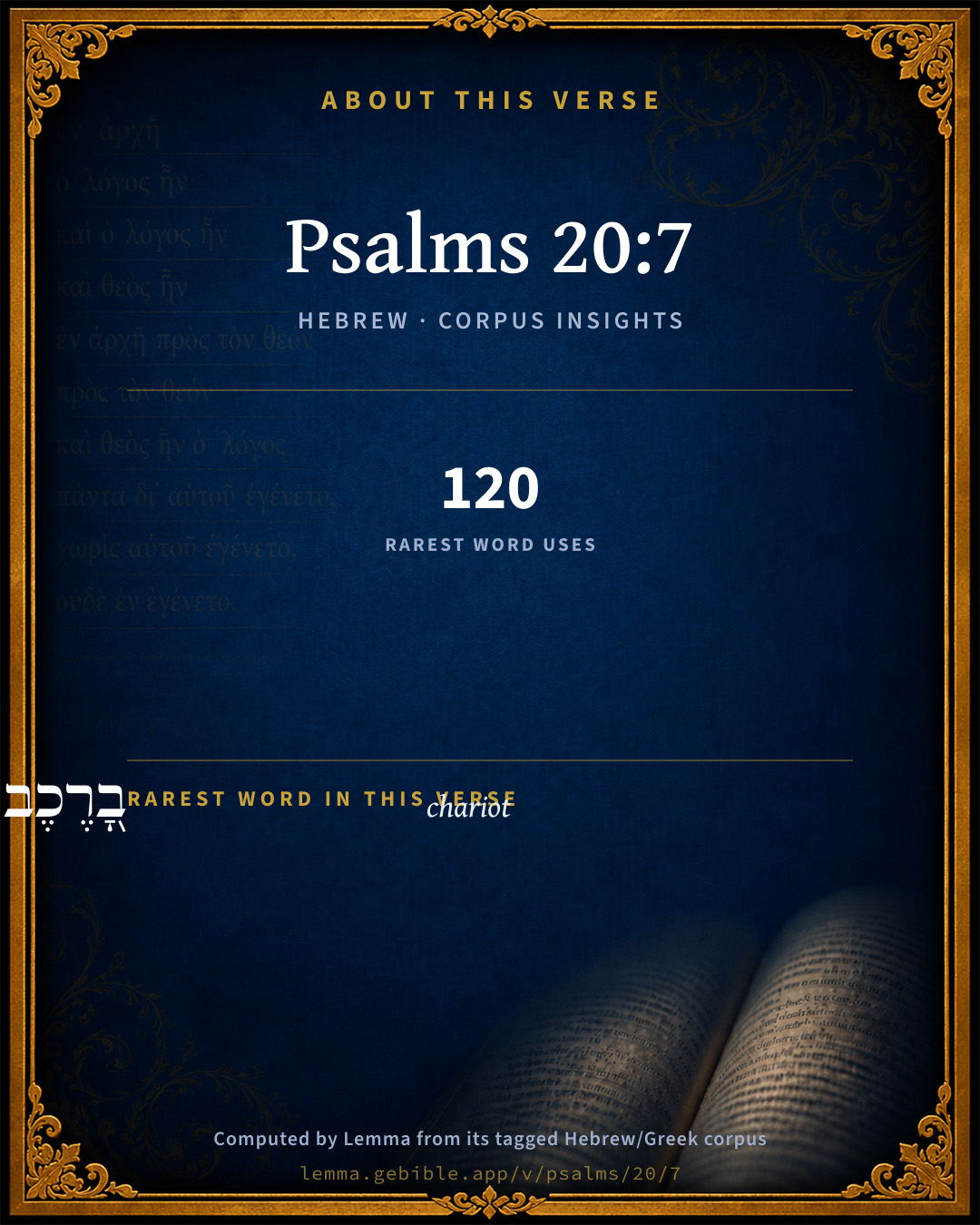
Psalms, in the Wisdom, opens this verse with 9 words (8 distinct Hebrew lemmas). Its most distinctive word is rekeb (“chariot”). A historical commentator’s framing appears above. Read the whole chapter for the surrounding context.

Discussion questions

  1. How does “chariot” (rekeb) shape what this verse is saying?
  2. How does Isaiah 31:1, which shares this passage’s theme, read alongside this verse?
  3. What does the repetition of “these” (2× in this one verse) do in this verse?
  4. These translations render this verse differently. What is at stake in choosing one wording over another?
  5. «נַזְכִּֽיר» is a Hiphil Imperfect verb. How does that grammatical form shape the action described?
  6. Compare how Trapp's Complete Commentary and The Biblical Illustrator read this verse. Where do they agree or differ?

Things to notice

  • These translations choose different wording for 6 words in this verse.
  • “these” occurs 2× in this single verse.
  • 8 distinct Hebrew lemmas span 9 words in this verse.

Reading settings

Reading text

Shown beneath each verse's original-language words.

Old Testament
Old Testament edition

Read the OT as the Masoretic Hebrew (MT) or the Greek Septuagint (LXX).

English shown for the Greek Septuagint (in the Hebrew ↔ Greek comparison).

Comparing translations? Open the Compare panel on any verse page to stack up to four side by side.