
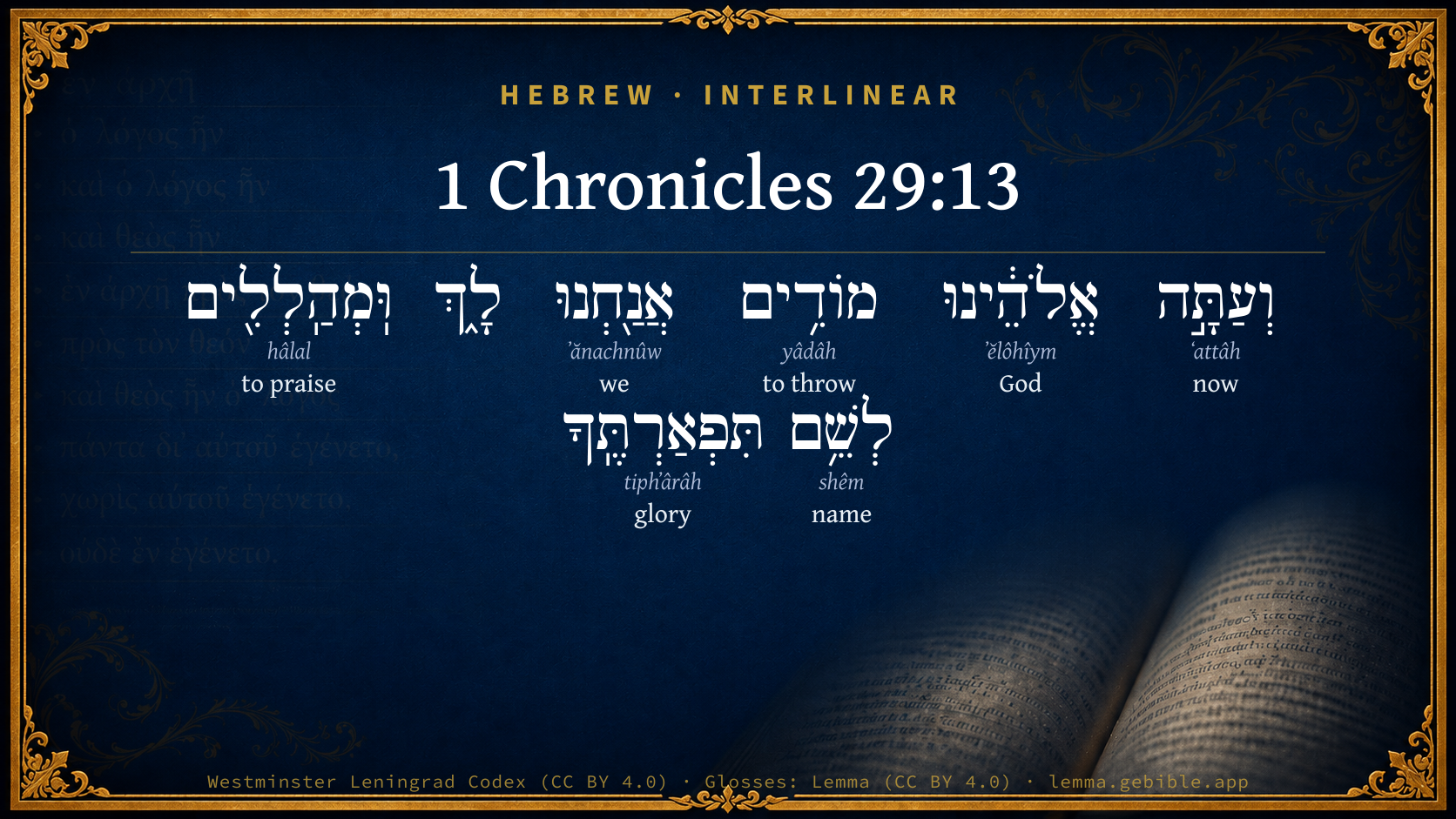
1 Chronicles 29:13

Hebrew (Westminster Leningrad Codex) 1 Chronicles 29:13 appears in the Hebrew Old Testament. The text above is from the Westminster Leningrad Codex. Each word links to its Strong’s number, a concise gloss, and parsing drawn from the Open Scriptures Hebrew Bible morphology. Click any word for its full Brown-Driver-Briggs (BDB) entry.
Download image
Cite this verse

1 Chronicles 29:13 (World English Bible). Public Domain. Lemma interlinear Bible study tool, https://lemma.gebible.app/v/1-chronicles/29/13.

Show BibTeX & RIS
BibTeX
RIS
English Translation
Now therefore, our God, we thank you, and praise your glorious name.
World English Bible · Public Domain
Download a study sheet

One document with this verse’s original text, its word-by-word gloss line, the meaning frame, cross-references with their text, attributed commentary, and full source and license credits — printable, and it pastes into notes with its structure intact.

This verse Autodidact and up

Study sheet (.html) Plain text (.txt)

A passage Seminary Student

Up to 50 verses in one chapter. A passage sheet keeps up to 6 commentary sources and 12 cross-references per verse, in the order this page ranks them, and says so on the sheet whenever that leaves anything out. Ask for a single verse and you get the Autodidact verse sheet above.

Everything on this page stays free to read, with no account — the sheet is a download of what is already on screen, not access to it.

Want to remove ads? Support Godless Engineer
Compare translations 3

The same verse in 3 English versions, stacked beneath the original-language interlinear above. Click any original word for its lexicon entry.

Each is an independent rendering of the whole verse — the interlinear is not word-aligned to these translations.

Highlighted words mark where these versions differ — a whole-verse word diff, not a word-by-word alignment.

  • World English Bible Public Domain
    Now therefore, our God, we thank you, and praise your glorious name.
  • King James Version Public Domain
    Now therefore, our God, we thank thee, and praise thy glorious name.
  • unfoldingWord Literal Text CC BY-SA 4.0
    And now, our God, we are giving thanks to you and praising the name of your glory.

unfoldingWord Literal Text — © unfoldingWord, licensed CC BY-SA 4.0. Word-aligned USFM3 via Door43 (git.door43.org/unfoldingWord/en_ult).

Versions to compare (up to 4)

3 of 4 selected

Show all 18 translations

Every available English version of this verse, each an independent rendering of the whole verse.

  • World English Bible Public Domain
    Now therefore, our God, we thank you, and praise your glorious name.
  • Berean Standard Bible Public Domain
    Now therefore, our God, we give You thanks, and we praise Your glorious name.
  • Majority Standard Bible Public Domain
    Now therefore, our God, we give You thanks, and we praise Your glorious name.
  • King James Version Public Domain
    Now therefore, our God, we thank thee, and praise thy glorious name.
  • American Standard Version (1901) Public Domain
    Now therefore, our God, we thank thee, and praise thy glorious name.
  • Revised Version (1885) Public Domain
    Now therefore, our God, we thank thee, and praise thy glorious name.
  • Geneva Bible (1599) Public Domain
    Now therefore our God, we thanke thee, and prayse thy glorious Name.
  • Douay-Rheims (1899) Public Domain
    Now therefore our God we give thanks to thee, and we praise thy glorious name.
  • Young's Literal Translation Public Domain
    `And now, our God, we are giving thanks to Thee, and giving praise to Thy beauteous name;
  • Literal Standard Version CC BY-SA 4.0
    And now, our God, we are giving thanks to You, and giving praise to Your beautiful Name;
  • Unlocked Literal Bible CC BY-SA 4.0
    Now then, our God, we thank you and praise your glorious name.
  • unfoldingWord Literal Text CC BY-SA 4.0
    And now, our God, we are giving thanks to you and praising the name of your glory.
  • Darby Bible Public Domain
    And now, our God, we thank thee, and praise thy glorious name.
  • World Messianic Bible Public Domain
    Now therefore, our God, we thank you and praise your glorious name.
  • Webster's Bible Public Domain
    Now therefore, our God, we thank thee, and praise thy glorious name.
  • Free Bible Version CC BY-SA 4.0
    Now our God we thank you, and we praise you and your glorious character.
  • Bible in Basic English Public Domain
    So now, our God, we give you praise, honouring the glory of your name.
  • JPS Tanakh (1917) Public Domain
    Now therefore, our God, we thank Thee, and praise Thy glorious name.

Literal Standard Version (2020), Covenant Press — licensed CC BY-SA 4.0. Text via the HelloAO Bible API (eBible.org). Unlocked Literal Bible (unfoldingWord) — licensed CC BY-SA 4.0. Text via the HelloAO Bible API (eBible.org). unfoldingWord Literal Text — © unfoldingWord, licensed CC BY-SA 4.0. Word-aligned USFM3 via Door43 (git.door43.org/unfoldingWord/en_ult). Free Bible Version, Dr. Jonathan Gallagher — licensed CC BY-SA 4.0. Text via the HelloAO Bible API (eBible.org).

Word by word

More ways to search: Search by grammar → Find every occurrence → Compare this word →

Practice this passage: Drill this verse → Learn its vocabulary →

תִּפְאַרְתֶּֽךָ
tiphʼârâh
H8597
“glory · your”
Noun, Common, Feminine, Singular, Construct + Suffix, Personal, 2nd Person, Masculine, Singular
Part of Speech
Noun
Type
Common
Gender
Feminine
Number
Singular
State
Construct
Full BDB Definition

Origin: from H6286

TWOT: 1726b

beauty, splendour, glory - beauty, finery (of garments, jewels) - glory - of rank, renown - as attribute of God - honour (or nation Israel) - glorying, boasting (of individual)
  1. וְעַתָּ֣ה ʻattâh H6258 “and · now” Conjunction + Adverb
  2. אֱלֹהֵ֔ינוּ ʼĕlôhîym H430 “God(s) · our” Noun, Common, Masculine, Plural, Construct + Suffix, Personal, 1st Person, Common, Plural
  3. מוֹדִ֥ים yâdâh H3034 “throwing” Verb, Hiphil, Participle Active, Masculine, Plural, Absolute
  4. אֲנַ֖חְנוּ ʼănachnûw H587 “we” Pronoun, Personal, 1st Person, Common, Plural
  5. וּֽמְהַֽלְלִ֖ים hâlal H1984 “and · praising” Conjunction + Verb, Piel, Participle Active, Masculine, Plural, Absolute
  6. לְשֵׁ֥ם shêm H8034 “to/for · name of” Preposition + Noun, Common, Masculine, Singular, Construct

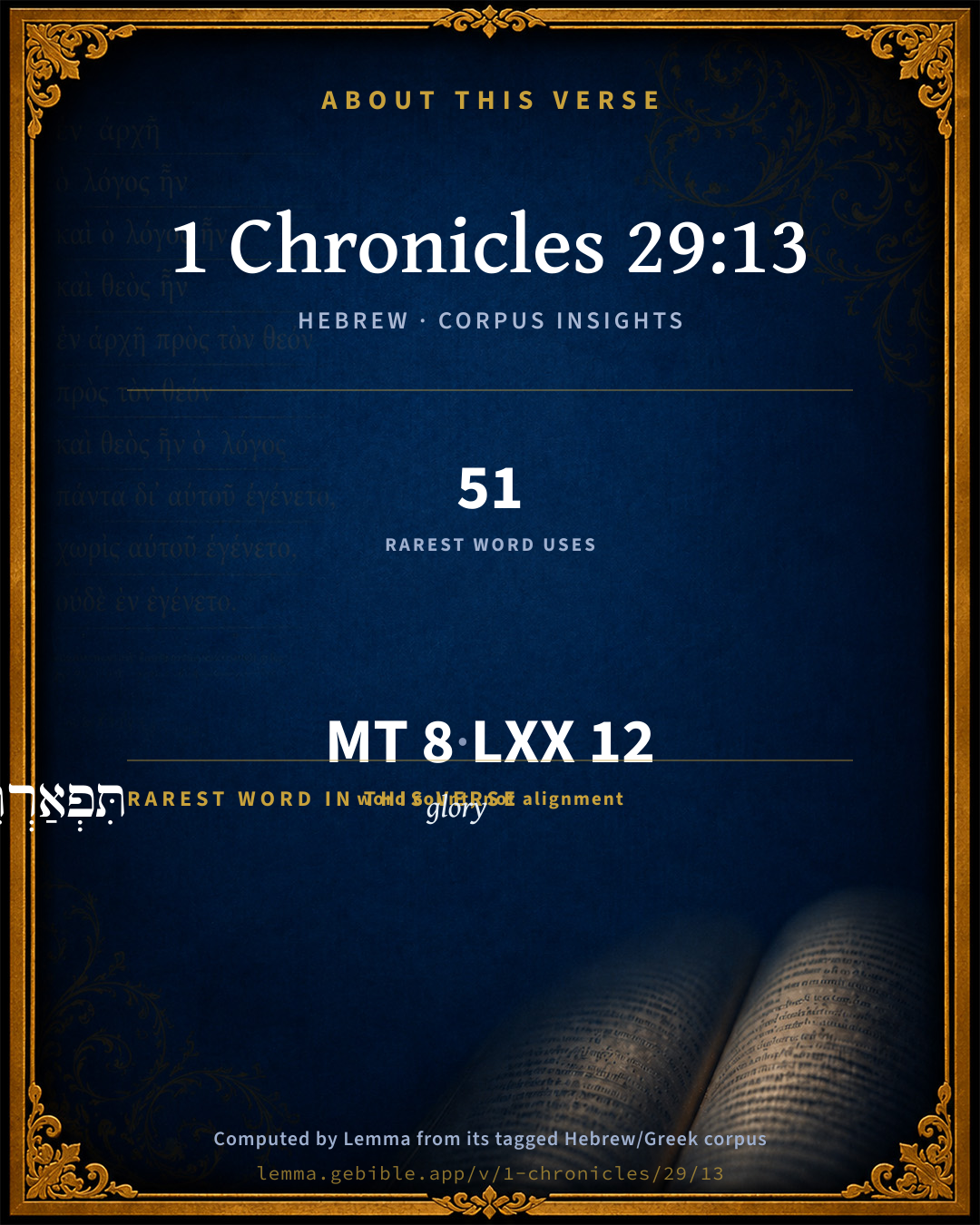
About this verse

These counts appear in no published source. They are computed here, from the morphology-tagged text and Lemma’s own curated glosses. What Lemma adds →

8
words
7
distinct lemmas
Historical
section

Shared distinctive vocabulary

תִּפְאַרְתֶּֽךָ glory H8597 occurs in 50 verses of the Hebrew Bible. Also found in:

Grammatical profile

  • 2 verbs
  • 3 nouns
  • 1 pronoun
  • 1 preposition
  • 1 adverb

Verb forms

  • מוֹדִ֥ים Hiphil · Participle Active
  • וּֽמְהַֽלְלִ֖ים Piel · Participle Active

Hebrew & Septuagint length

In English translation the verse runs 12 words from the Hebrew and 13 from the Septuagint (LXX English) — closely comparable.

A rough comparison of the two English renderings, which tokenize alike — not a word-level alignment.

Word counts can differ between the Hebrew and the Greek without any difference in meaning — e.g. the Hebrew direct-object marker אֵת has no separate Greek word, and Greek often adds the article ὁ.

In the original languages it is 8 Hebrew tokens and 12 Greek tokens — but the two are counted differently (Hebrew bundles its prefixes and suffixes into one token; the Greek is in lemma form), so that isn’t a like-for-like length.

Cross-references

7

Topical passages linked to 1 Chronicles 29:13 in the Treasury of Scripture Knowledge — connected by theme and wording, ordered by reader-vote popularity; previews shown in the World English Bible.

  • Psalms 106:1 Praise Yahweh! Give thanks to Yahweh, for he is good, For his loving kindness endures forever.
  • 2 Corinthians 9:15 Now thanks be to God for his unspeakable gift!
  • Psalms 105:1 Give thanks to Yahweh! Call on his name! Make his doings known among the peoples.
  • Daniel 2:23 I thank you, and praise you, you God of my fathers, who have given me wisdom and might, and have now made known to me what we desired of you; for you have made known to us the king's matter.
  • 2 Corinthians 2:14 Now thanks be to God, who always leads us in triumph in Christ, and reveals through us the sweet aroma of his knowledge in every place.
  • 2 Corinthians 8:16 But thanks be to God, who puts the same earnest care for you into the heart of Titus.
  • 1 Thessalonians 2:13 For this cause we also thank God without ceasing, that, when you received from us the word of the message of God, you accepted it not as the word of men, but, as it is in truth, the word of God, which also works in you who believe.

Cross-references courtesy of OpenBible.info (CC BY 4.0).

Hebrew and Greek witnesses Masoretic Hebrew ↔ Greek Septuagint

The same verse in the two great witnesses to the Old Testament, shown verse-for-verse.

These are two independent witnesses, not word-aligned to each other, and the Septuagint is shown in lemma (dictionary) form.

Hebrew 1 Chronicles 29:13 Masoretic · Westminster Leningrad Codex

וְעַתָּ֣ה אֱלֹהֵ֔ינוּ מוֹדִ֥ים אֲנַ֖חְנוּ לָ֑ךְ וּֽמְהַֽלְלִ֖ים לְשֵׁ֥ם תִּפְאַרְתֶּֽךָ

Now therefore, our God, we thank you, and praise your glorious name.

World English Bible · Public Domain

Greek LXX 1 Chronicles 29:13 Septuagint · lemma form

καί νῦν κύριος ἐκὁμολογέω σύ καί αἰνέω ὁ ὄνομα ὁ καύχησις σύ

And now, Lord, we give thanks to you, and praise your glorious name.

LXX2012 (modern English Septuagint) · Public Domain

Hebrew: Westminster Leningrad Codex (CC BY 4.0). Greek: Septuagint (public domain); English from LXX2012 (modern English Septuagint) (Public Domain). How the Septuagint differs from the Hebrew →

Commentary

Notes on 1 Chronicles 29:13 from classic Christian and Jewish commentators (each source and its license shown beneath its notes). The classic Christian expositions comment on the surrounding passage and are grouped to its opening verse, so a note may address several verses; the Jewish commentaries on the Tanakh (Rashi and others) are per-verse, so they appear only where the commentator wrote on this verse.

Lemma curates 59 commentaries, every one of them public domain or Creative Commons licensed, each selected and text-cleaned for this edition rather than reprinted as found. About our sources →

Trapp's Complete Commentary

John Trapp

1Ch 29:13 Now therefore, our God, we thank thee, and praise thy glorious name.

Ver. 13. And praise thy glorious name.] With our hearts, lips, and offerings, even the best of our substance, professing that we could esteem thee yet more and better if it were in our power. A thankful man is worth his weight in gold; he giveth the glory of all that he enjoyeth to God alone, like as solid bodies reflect the sun’s heat.

John Trapp, A Commentary or Exposition upon All the Books of the Old and New Testament (1647–1656) — public domain. Text from a community e-Sword module.

Joseph Benson's Commentary

1Ch 29:13-14. Now therefore, our God, we thank thee — The more we do for God, the more we are indebted to him for the honour of being employed in his service, and for grace to enable us in any measure to serve him. Doth he therefore thank that servant? said Jesus. No: but that servant has a great deal of reason to thank him. Who am I, and what is my people? — David was the most honourable person, and Israel the most honourable people, then in the world; yet thus he speaks of himself and them, as utterly unworthy of the divine cognizance and favour. David now appeared very great in the eyes of men, presiding in an august assembly, appointing his successor, and making a noble present to the honour of God; and yet, being little and low in his own eyes, he asks, Who am I, O Lord! that we should be able to offer so willingly — That thou shouldest give us both riches to make such an offering, and a willing heart to offer them, both which are the gifts and fruits of thy grace and mercy to us. God works ill his people both to will and to do, and it is a great instance of the power of his grace in us to be able to do his work willingly. Of thine own have we given thee — We return only what we have received, and therefore only pay a debt, or rather, the small part of a debt due to thee. Thus we ought to give God all the glory of all the good that is at any time done by ourselves or others. Our own good works must not be the matter of our pride, nor the good works of others of our flattery, but both the matter of our praise; for certainly it is the greatest honour and pleasure in the world faithfully to serve God.

Joseph Benson's Commentary on the Old and New Testaments (1811–1818) — public domain. Text from a community e-Sword module.

Ellicott's Commentary for English Readers

(13) Now therefore, our God, we thank thee.—And now, our God, we are thanking thee, and praising (participles in the Hebrew). Môdîm, “thanking,” occurs nowhere else, though the verb is common in other forms.

Thy glorious name.—The name of thy glory: here only. (Comp. Isa_63:14, and Psa_72:19.)

A Bible Commentary for English Readers, edited by Charles John Ellicott (1878–1897) — public domain. Text from a community e-Sword module.

John Gill's Exposition

Now therefore, our God, we thank thee, and praise thy glorious name. That he that was so great, and so much above them, should take notice of them, and bestow so many great and good things on them.

Now therefore, our God, we thank thee, and praise thy glorious name. That he that was so great, and so much above them, should take notice of them, and bestow so many great and good things on them.

1 Chronicles 29:14

ch1 29:14

ch1 29:14

ch1 29:14But who am I,.... Originally dust and ashes, a sinful creature, unworthy to receive anything from God, and of having the honour of doing anything for him:

and what is my people: subject to him, the least of all people, separated from the nations round about them, and despised by them:

that we should be able to offer so willingly after this sort? that they, who were a poor people, some years ago brought out of Egyptian bondage, should now be possessed of such an affluence, and have such a generous heart and liberal spirit given them, as to contribute in so large and liberal a manner as they had done; all was owing to the goodness of God to them, and the efficacy of his grace upon them:

for all things come of thee; all good things, temporal and spiritual; the Lord is the fountain of goodness, and Father of mercies:

and of thine own have we given thee; for there is nothing a man has but he has received from the Lord, and therefore can give nothing to him but his own, see Rom 11:35.

John Gill's Exposition of the Whole Bible (1746–1763) — public domain (CC PDM 1.0). Text via the HelloAO Bible API.

Keil & Delitzsch

C. F. Keil & F. Delitzsch

Now therefore, our God, we thank thee, and praise thy glorious name. That he that was so great, and so much above them, should take notice of them, and bestow so many great and good things on them.

Now therefore, our God, we thank thee, and praise thy glorious name. That he that was so great, and so much above them, should take notice of them, and bestow so many great and good things on them.

1 Chronicles 29:14

ch1 29:14

ch1 29:14

ch1 29:14But who am I,.... Originally dust and ashes, a sinful creature, unworthy to receive anything from God, and of having the honour of doing anything for him:

and what is my people: subject to him, the least of all people, separated from the nations round about them, and despised by them:

that we should be able to offer so willingly after this sort? that they, who were a poor people, some years ago brought out of Egyptian bondage, should now be possessed of such an affluence, and have such a generous heart and liberal spirit given them, as to contribute in so large and liberal a manner as they had done; all was owing to the goodness of God to them, and the efficacy of his grace upon them:

for all things come of thee; all good things, temporal and spiritual; the Lord is the fountain of goodness, and Father of mercies:

and of thine own have we given thee; for there is nothing a man has but he has received from the Lord, and therefore can give nothing to him but his own, see Rom 11:35.

Keil & Delitzsch — Biblical Commentary on the Old Testament (1861–1891) — public domain (CC PDM 1.0). Text via the HelloAO Bible API. (Old Testament only.)

Rashi

Rabbi Shlomo Yitzchaki (Rashi)

And now, our God, we give thanks to you for what You have imparted to us of Your good.

Rashi on the Tanakh — English translations: “The Judaica Press complete Tanach with Rashi, translated by A. J. Rosenberg” (CC BY 4.0); “Pentateuch with Rashi's commentary by M. Rosenbaum and A.M. Silbermann, 1929-1934” (public domain); “The Metsudah Tanach series, Lakewood, N.J” (CC BY 4.0); and “The Book of Joshua, Metsudah Publications, 1997” (CC BY 4.0). Text via Sefaria.

Lesson kit

Teaching starters — assembled from the data on this page, not authored interpretation. Every prompt links to the verse data it draws on. Edit before teaching.

1 Chronicles, in the Historical, opens this verse with 8 words (7 distinct Hebrew lemmas). Its most distinctive word is tiphʼârâh (“glory”). A historical commentator’s framing appears above. Read the whole chapter for the surrounding context.

Discussion questions

  1. What does “glory” (tiphʼârâh) contribute to the verse as a whole?
  2. Exodus 28:2 shares the word «glory» with this verse. How do the two illuminate each other?
  3. These translations render this verse differently; the difference is in the English rendering, not the original. What questions does that raise?
  4. The verb «מוֹדִ֥ים» is Hiphil Participle Active. How does its form color the action?
  5. Reading how Trapp's Complete Commentary and Joseph Benson's Commentary read this verse, where do the two commentators agree and where do they part?

Things to notice

Reading settings

Reading text

Shown beneath each verse's original-language words.

Old Testament
Old Testament edition

Read the OT as the Masoretic Hebrew (MT) or the Greek Septuagint (LXX).

English shown for the Greek Septuagint (in the Hebrew ↔ Greek comparison).

Comparing translations? Open the Compare panel on any verse page to stack up to four side by side.