Isaiah 64:8

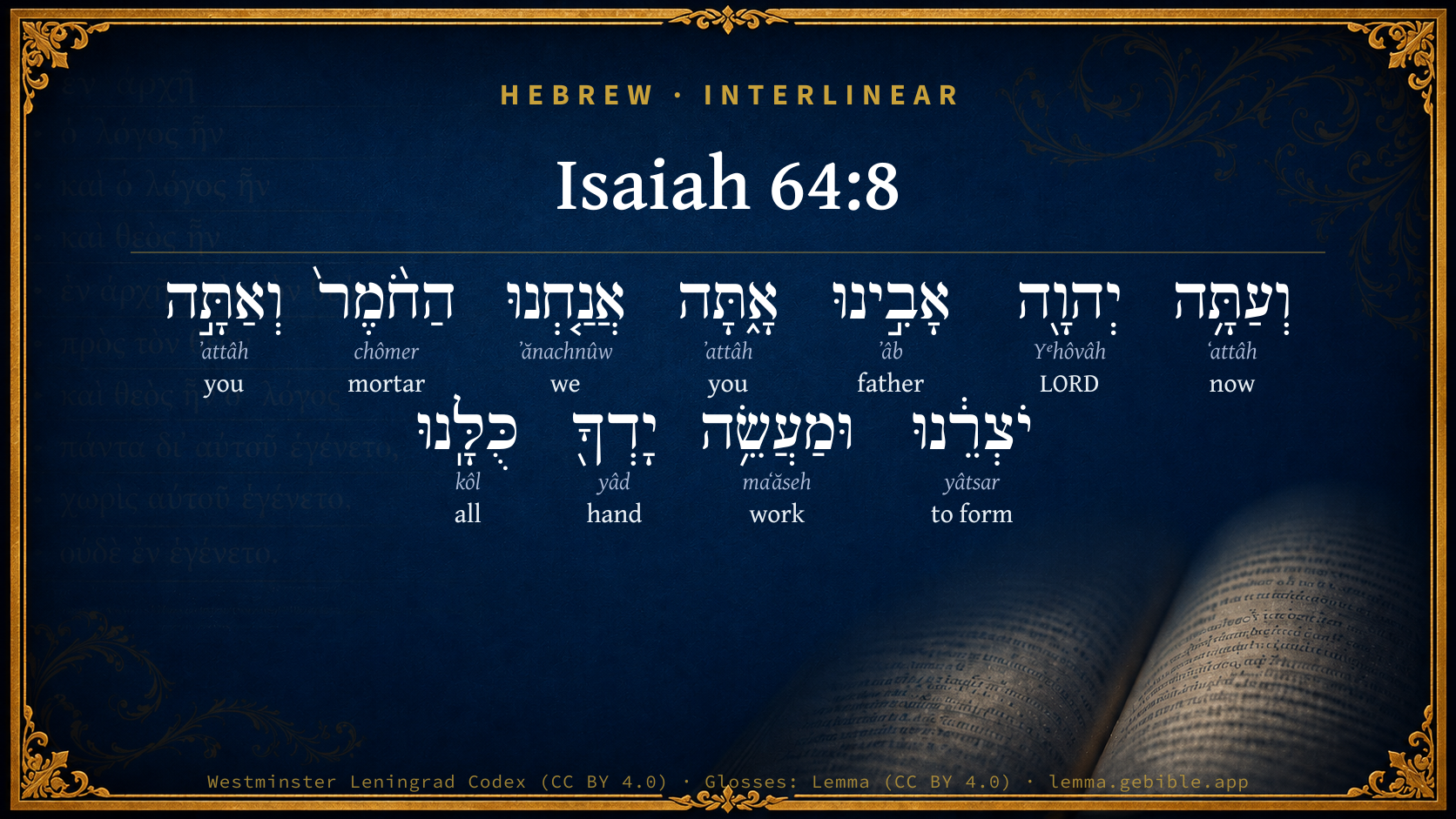
Hebrew (Westminster Leningrad Codex) Isaiah 64:8 appears in the Hebrew Old Testament. The text above is from the Westminster Leningrad Codex. Each word links to its Strong’s number, a concise gloss, and parsing drawn from the Open Scriptures Hebrew Bible morphology. Click any word for its full Brown-Driver-Briggs (BDB) entry.
Download image
Cite this verse

Isaiah 64:8 (World English Bible). Public Domain. Lemma interlinear Bible study tool, https://lemma.gebible.app/v/isaiah/64/8.

Show BibTeX & RIS
BibTeX
RIS
English Translation
But now, Yahweh, you are our Father; we are the clay, and you our potter; and we all are the work of your hand.
World English Bible · Public Domain
Download a study sheet

One document with this verse’s original text, its word-by-word gloss line, the meaning frame, cross-references with their text, attributed commentary, and full source and license credits — printable, and it pastes into notes with its structure intact.

This verse Autodidact and up

Study sheet (.html) Plain text (.txt)

A passage Seminary Student

Up to 50 verses in one chapter. A passage sheet keeps up to 6 commentary sources and 12 cross-references per verse, in the order this page ranks them, and says so on the sheet whenever that leaves anything out. Ask for a single verse and you get the Autodidact verse sheet above.

Everything on this page stays free to read, with no account — the sheet is a download of what is already on screen, not access to it.

Want to remove ads? Support Godless Engineer
Compare translations 3

The same verse in 3 English versions, stacked beneath the original-language interlinear above. Click any original word for its lexicon entry.

Each is an independent rendering of the whole verse — the interlinear is not word-aligned to these translations.

Highlighted words mark where these versions differ — a whole-verse word diff, not a word-by-word alignment.

  • World English Bible Public Domain
    But now, Yahweh, you are our Father; we are the clay, and you our potter; and we all are the work of your hand.
  • King James Version Public Domain
    But now, O LORD, thou art our father; we are the clay, and thou our potter; and we all are the work of thy hand.
  • unfoldingWord Literal Text CC BY-SA 4.0
    And now, Yahweh, you our Father. We the clay, and you our potter, and all of us the work of your hand.

unfoldingWord Literal Text — © unfoldingWord, licensed CC BY-SA 4.0. Word-aligned USFM3 via Door43 (git.door43.org/unfoldingWord/en_ult).

Versions to compare (up to 4)

3 of 4 selected

Show all 18 translations

Every available English version of this verse, each an independent rendering of the whole verse.

  • World English Bible Public Domain
    But now, Yahweh, you are our Father; we are the clay, and you our potter; and we all are the work of your hand.
  • Berean Standard Bible Public Domain
    But now, O LORD, You are our Father; we are the clay, and You are the potter; we are all the work of Your hand.
  • Majority Standard Bible Public Domain
    But now, O LORD, You are our Father; we are the clay, and You are the potter; we are all the work of Your hand.
  • King James Version Public Domain
    But now, O LORD, thou art our father; we are the clay, and thou our potter; and we all are the work of thy hand.
  • American Standard Version (1901) Public Domain
    But now, O Jehovah, thou art our Father; we are the clay, and thou our potter; and we all are the work of thy hand.
  • Revised Version (1885) Public Domain
    But now, O LORD, thou art our father; we are the clay, and thou our potter; and we all are the work of thy hand.
  • Geneva Bible (1599) Public Domain
    But now, O Lord, thou art our Father: we are the clay, and thou art our potter, and we all are the worke of thine hands.
  • Douay-Rheims (1899) Public Domain
    And now, O Lord, thou art our father, and we are clay: and thou art our maker, and we all are the works of thy hands.
  • Young's Literal Translation Public Domain
    And now, O Jehovah, thou `art' our Father, We `are' the clay, and Thou our Framer, And the work of Thy hand -- all of us.
  • Literal Standard Version CC BY-SA 4.0
    And now, O YHWH, You [are] our Father, || We [are] the clay, and You [are] our Framer, || And the work of Your hand—all of us.
  • Unlocked Literal Bible CC BY-SA 4.0
    Yet, Yahweh, you are our father; we are the clay. You are our potter; and we all are the work of your hand.
  • unfoldingWord Literal Text CC BY-SA 4.0
    And now, Yahweh, you our Father. We the clay, and you our potter, and all of us the work of your hand.
  • Darby Bible Public Domain
    And now, Jehovah, thou art our Father; we are the clay, and thou our potter; and we all are the work of thy hand.
  • World Messianic Bible Public Domain
    But now, LORD, you are our Father. We are the clay and you our potter. We all are the work of your hand.
  • Webster's Bible Public Domain
    \\64:9\\Be not very wroth, O LORD, neither remember iniquity for ever: behold, see, we beseech thee, we are all thy people.
  • Free Bible Version CC BY-SA 4.0
    But you, Lord, are our Father. We're the clay, you're the potter. You made us all with your own hands.
  • Bible in Basic English Public Domain
    Be not very angry, O Lord, and do not keep our sins in mind for ever: give ear to our prayer, for we are all your people.
  • JPS Tanakh (1917) Public Domain
    (64-7) But now, O LORD, Thou art our Father; we are the clay, and Thou our potter, and we all are the work of Thy hand.

Literal Standard Version (2020), Covenant Press — licensed CC BY-SA 4.0. Text via the HelloAO Bible API (eBible.org). Unlocked Literal Bible (unfoldingWord) — licensed CC BY-SA 4.0. Text via the HelloAO Bible API (eBible.org). unfoldingWord Literal Text — © unfoldingWord, licensed CC BY-SA 4.0. Word-aligned USFM3 via Door43 (git.door43.org/unfoldingWord/en_ult). Free Bible Version, Dr. Jonathan Gallagher — licensed CC BY-SA 4.0. Text via the HelloAO Bible API (eBible.org).

Word by word

More ways to search: Search by grammar → Find every occurrence → Compare this word →

Practice this passage: Drill this verse → Learn its vocabulary →

הַחֹ֨מֶר֙
chômer
H2563
“the · mortar”
Particle, Definite Article + Noun, Common, Masculine, Singular, Absolute
Part of Speech
Particle + Noun
Type
Common
Gender
Masculine
Number
Singular
State
Absolute
Full BDB Definition

Origin: from H2560

TWOT: TWOT- 683c

cement, mortar, clay - mortar, cement - clay - mire - heap - swelling, surging (of water) - homer - a unit of dry measure about 65 imperial gallons (300 liters)
  1. וְעַתָּ֥ה ʻattâh H6258 “and · now” Conjunction + Adverb
  2. יְהוָ֖ה Yᵉhôvâh H3068 “LORD” Noun, Proper
  3. אָבִ֣ינוּ ʼâb H1 “father · our” Noun, Common, Masculine, Singular, Construct + Suffix, Personal, 1st Person, Common, Plural
  4. אָ֑תָּה ʼattâh H859 “you” Pronoun, Personal, 2nd Person, Masculine, Singular
  5. אֲנַ֤חְנוּ ʼănachnûw H587 “we” Pronoun, Personal, 1st Person, Common, Plural
  6. וְאַתָּ֣ה ʼattâh H859 “and · you” Conjunction + Pronoun, Personal, 2nd Person, Masculine, Singular
  7. יֹצְרֵ֔נוּ yâtsar H3335 “forming · us” Verb, Qal, Participle Active, Masculine, Singular, Construct + Suffix, Personal, 1st Person, Common, Plural
  8. וּמַעֲשֵׂ֥ה maʻăseh H4639 “and · work of” Conjunction + Noun, Common, Masculine, Singular, Construct
  9. יָדְךָ֖ yâd H3027 “hand · your” Noun, Common, Both, Singular, Construct + Suffix, Personal, 2nd Person, Masculine, Singular
  10. כֻּלָּֽנוּ kôl H3605 “all · our” Noun, Common, Masculine, Singular, Construct + Suffix, Personal, 1st Person, Common, Plural

About this verse

These counts appear in no published source. They are computed here, from the morphology-tagged text and Lemma’s own curated glosses. What Lemma adds →

11
words
10
distinct lemmas
Prophets
section

Shared distinctive vocabulary

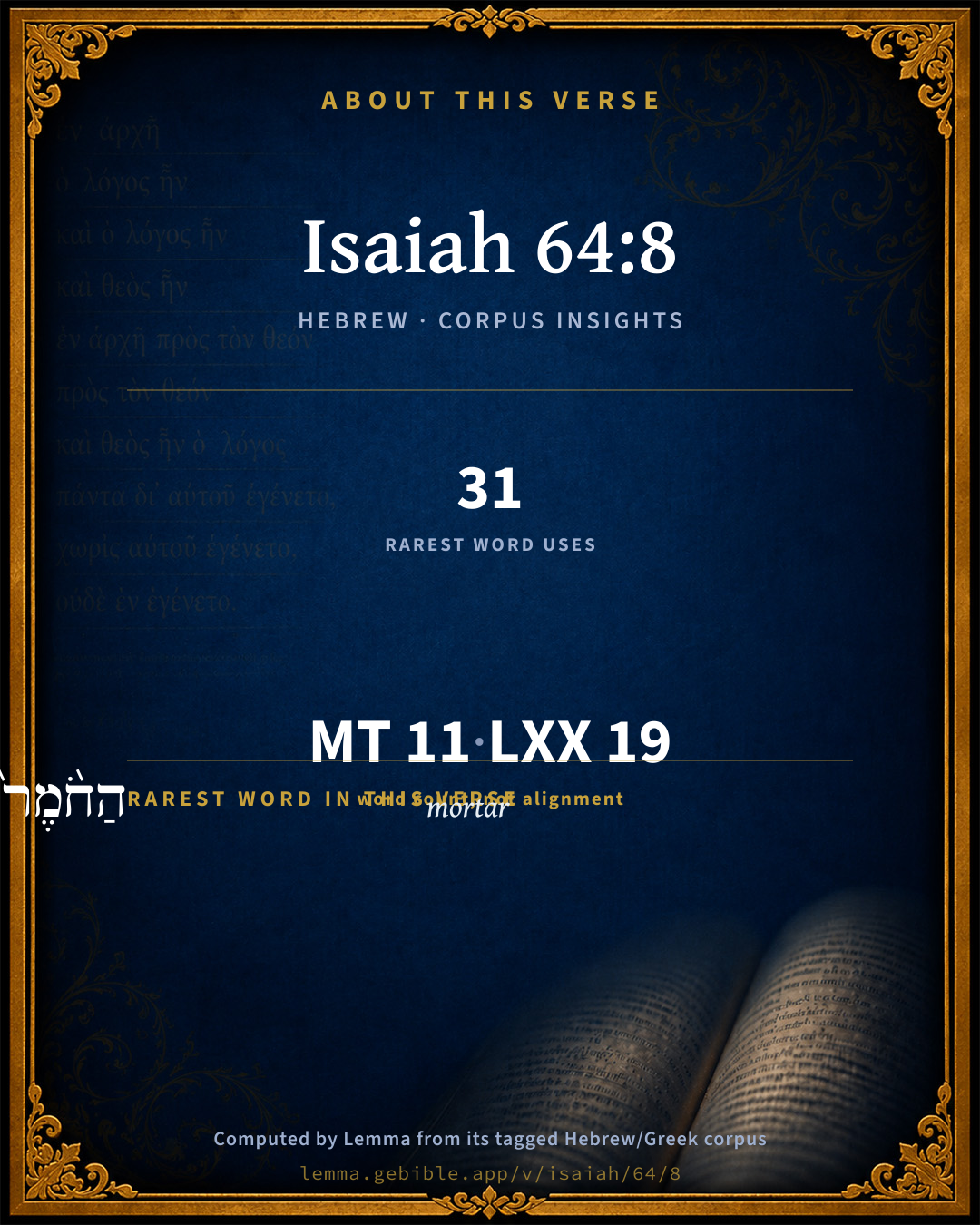
הַחֹ֨מֶר֙ mortar H2563 occurs in 26 verses of the Hebrew Bible. Also found in:

Grammatical profile

  • 1 verb
  • 6 nouns
  • 3 pronouns
  • 1 adverb

Verb forms

  • יֹצְרֵ֔נוּ Qal · Participle Active

Repetition

A word recurs within this verse — often emphatic in Hebrew:

  • אָ֑תָּה you H859 ×2

Hebrew & Septuagint length

In English translation the verse runs 24 words from the Hebrew and 20 from the Septuagint (LXX English) — closely comparable.

A rough comparison of the two English renderings, which tokenize alike — not a word-level alignment.

Word counts can differ between the Hebrew and the Greek without any difference in meaning — e.g. the Hebrew direct-object marker אֵת has no separate Greek word, and Greek often adds the article ὁ.

In the original languages it is 11 Hebrew tokens and 19 Greek tokens — but the two are counted differently (Hebrew bundles its prefixes and suffixes into one token; the Greek is in lemma form), so that isn’t a like-for-like length.

Cross-references

17

Topical passages linked to Isaiah 64:8 in the Treasury of Scripture Knowledge — connected by theme and wording, ordered by reader-vote popularity; previews shown in the World English Bible.

  • Ephesians 2:10 For we are his workmanship, created in Christ Jesus for good works, which God prepared before that we would walk in them.
  • Psalms 119:73 Your hands have made me and formed me. Give me understanding, that I may learn your commandments.
  • Jeremiah 18:2–6 Arise, and go down to the potter's house, and there I will cause you to hear my words.
  • Psalms 138:8 Yahweh will fulfill that which concerns me; Your loving kindness, Yahweh, endures forever. Don't forsake the works of your own hands.
  • Psalms 100:3 Know that Yahweh, he is God. It is he who has made us, and we are his. We are his people, and the sheep of his pasture.
  • Isaiah 29:16 You turn things upside down! Shall the potter be esteemed as clay; that the thing made should say of him who made it, He didn't make me; or the thing formed say of him who formed it, He has no understanding?
  • Isaiah 44:24 Thus says Yahweh, your Redeemer, and he who formed you from the womb: I am Yahweh, who makes all things; who stretches forth the heavens alone; who spreads abroad the earth (who is with me?);
  • Isaiah 45:9 Woe to him who strives with his Maker--a potsherd among the potsherds of the earth! Shall the clay ask him who fashions it, "What are you making?" or your work, "He has no hands?"
  • Isaiah 63:16 For you are our Father, though Abraham doesn't know us, and Israel does not acknowledge us: you, Yahweh, are our Father; our Redeemer from everlasting is your name.
  • Isaiah 43:7 everyone who is called by my name, and whom I have created for my glory, whom I have formed, yes, whom I have made.
  • Isaiah 44:21 Remember these things, Jacob, and Israel; for you are my servant: I have formed you; you are my servant: Israel, you shall not be forgotten by me.
  • Romans 9:20–24 But indeed, O man, who are you to reply against God? Will the thing formed ask him who formed it, "Why did you make me like this?"
  • Deuteronomy 32:6 Do you thus requite Yahweh, Foolish people and unwise? Isn't he your father who has bought you? He has made you, and established you.
  • Job 10:8–9 'Your hands have framed me and fashioned me altogether; Yet you destroy me.
  • Galatians 3:26 For you are all children of God, through faith in Christ Jesus.
  • Galatians 3:29 If you are Christ's, then you are Abraham's seed and heirs according to promise.
  • Exodus 4:22 You shall tell Pharaoh, 'Thus says Yahweh, Israel is my son, my firstborn,

Cross-references courtesy of OpenBible.info (CC BY 4.0).

Hebrew and Greek witnesses Masoretic Hebrew ↔ Greek Septuagint

The same verse in the two great witnesses to the Old Testament, shown verse-for-verse.

These are two independent witnesses, not word-aligned to each other, and the Septuagint is shown in lemma (dictionary) form.

Hebrew Isaiah 64:8 Masoretic · Westminster Leningrad Codex

וְעַתָּ֥ה יְהוָ֖ה אָבִ֣ינוּ אָ֑תָּה אֲנַ֤חְנוּ הַחֹ֨מֶר֙ וְאַתָּ֣ה יֹצְרֵ֔נוּ וּמַעֲשֵׂ֥ה יָדְךָ֖ כֻּלָּֽנוּ

But now, Yahweh, you are our Father; we are the clay, and you our potter; and we all are the work of your hand.

World English Bible · Public Domain

Greek LXX Isaiah 64:8 Septuagint · lemma form

μή ὀργίζω ἐγώ σφόδρα καί μή ἐν καιρός μιμνήσκω ἁμαρτία ἐγώ καί νῦν ἐπιβλέπω ὅτι λαός σύ πᾶς ἐγώ

And now, O Lord, you are our Father, and we are clay, all of us the work of your hands.

LXX2012 (modern English Septuagint) · Public Domain

On this verse, Adam Clarke's Commentary discusses the Septuagint’s reading. Read the note in Commentary ↓

Hebrew: Westminster Leningrad Codex (CC BY 4.0). Greek: Septuagint (public domain); English from LXX2012 (modern English Septuagint) (Public Domain). How the Septuagint differs from the Hebrew →

Targum (Aramaic paraphrase)

1

The Targum is the ancient Jewish Aramaic paraphrase of the Hebrew Scriptures — an interpretive translation, not the Hebrew text itself. Onkelos (literal) and Pseudo-Jonathan (expansive) render the Torah, and Jonathan the Prophets. Coverage is partial: where no permissively-licensed English translation exists for a verse, only the Aramaic is shown. This is verse-level text, not a word-by-word alignment to the Hebrew.

  1. Targum Jonathan Prophets (Joshua–Malachi)
    לָא יְהֵי רְגַז מִן קֳדָמָךְ יְיָ בָּנָא עַד לַחֲדָא לָא לְעַלְמָא תִדְכַּר חוֹבִי הָא גְלֵי קֳדָמָךְ דְעַמָךְ אֲנַחְנָא כּוּלָנָא:

    Let there not be, O Lord, very sore wrath from Thee against us, neither remember iniquities for ever: behold, it is revealed before Thee, that we are all Thy people.

    Targum Jonathan — Aramaic: “Mikraot Gedolot” (public domain). English: “Sefaria Community Translation” (CC0 1.0 (public-domain dedication)); “London "Chaldee Paraphrase," 1871” (public domain). Text via Sefaria.

Commentary

Notes on Isaiah 64:8 from classic Christian and Jewish commentators (each source and its license shown beneath its notes). The classic Christian expositions comment on the surrounding passage and are grouped to its opening verse, so a note may address several verses; the Jewish commentaries on the Tanakh (Rashi and others) are per-verse, so they appear only where the commentator wrote on this verse.

Lemma curates 59 commentaries, every one of them public domain or Creative Commons licensed, each selected and text-cleaned for this edition rather than reprinted as found. About our sources →

Trapp's Complete Commentary

John Trapp

Isa 64:8 But now, O LORD, thou [art] our father; we [are] the clay, and thou our potter; and we all [are] the work of thy hand.

Ver. 8. But now, O Lord, thou art our father.] Or, Yet now, O Lord, thou art our father; therefore "we shall not die," say they, {Heb 1:12} boldly, but warrantably. See on Isa 63:16.

We are the clay, and thou art our potter.] This was grown to a proverb among the heathens also, Kεραμος ο ανθρωπος, Man is a clod of clay; πηλος κομψως πεφυραμενος, A piece of clay neatly made up, saith Arian upon Epictetus. Fictus ex argilla et luto homulus, {a} saith Cicero. And Nigidius was surnamed Figulus, or the Potter, saith Augustine, because he used to say that man was nothing else but an earthen vessel. See 2Co 4:7; 2Co 5:1.

We are all the work of thy hands.] Both as made and remade by thee; therefore despise us not. {Job 10:8-9 Psa 138:8} Look upon the wounds of thy hands, and forsake not the work of thine hands, prayed Queen Elizabeth.

{a} Orat. ad Pison.

John Trapp, A Commentary or Exposition upon All the Books of the Old and New Testament (1647–1656) — public domain. Text from a community e-Sword module.

The Biblical Illustrator

Joseph S. Exell

Isa_64:8

But now, O Lord, Thou art our Father

God our King-Father

(Our Lord, Thou art our Father with the Lord is our King, Isa_33:22).

That conviction of a living God, as distinguished from the lifeless one, which is all that many have, made up of a mere bundle of catechetical doctrines, will create a demand for many other convictions besides. For, mark what question presses, so soon as God has been revealed to the soul; it is the deeply self-interested one, In what relation, or relations, does this almighty and glorious One stand to the individuals self? The answer given by our two texts, and much of the Scripture besides, is, that He is related to each of us both as a Father and a King. Now, not only is there no contrariety betwixt the ideas of these two relations; but, properly, there is no sentiment in the one which the other does not contain in some degree. Nevertheless, the idea of a Father contains more prominently the sentiment of bountiful and tender cherishing; when that of a King contains more prominently that of regulation and control; and it is not till we have combined them that we can form an adequate conception of the relation in which He stands to us. (W. Anderson, LL. D.)

Our King-Father or Father-King the memorial of God

Some may say they are identical; nor would I deny, with much warmth, they are. But when the better mode of impressing the heart is the subject of inquiry, not a little depends, I am persuaded, on the order in which the two ideas of the complex relation are presented.

1. Even metaphysically He is first our Father and then our King: the idea of the Divine paternity is the principal one, and that of the royalty the subordinate and qualifying one: He begets us as children before He rules us as subjects.

2. But, whatever may be the state of the question metaphysically, there can be no doubt that, in respect of practical and salutary effect on the heart, the assigning of the place of primary consideration to the relation of Father has a decided advantage. When men ask you, Who is God? let your reply be, He is our Father. And when they say, Is He not your King also? let your reply again be, He is; but first our Father, and more our Father than anything else. Even a heathen could say, as an apostle has approvingly told us, We are also His offspring. Although, in respect of our corporeal frames, we are in the predicament of the inferior animals; yet in respect of the nobler part of our constitutions--the immortal soul--in virtue of which, especially, we bear the Divine image, that has been communicated to us directly, by the breath of the Almighty (Ecc_12:7).

3. The thought is both solemnizing and animating; let us improve it to the ends of having our sense of responsibility deepened for filial reverence and obedience--for upholding the honour of Gods family, by the purity, the elevation, and dignity of our characters--and, also, for our treatment of all mankind as being of a Divine parentage.

4. But it is especially in respect of confidence in His loving-kindness, that I call at present for improvement of the meditation. (W. Anderson, LL. D.)

God the Father-King in redemption

1. Who is so ignorant as not to know that cold parental displeasure and warm parental affection arc frequently found co-existent; and who cannot easily conceive the truth of the following case? I knew a father who, after having long remonstrated in vain with a profligate son--from abhorrence of the sight and hearing of his abominations and profanities, and from respect to his own and familys peace and honour, turned him out of his house, and would not acknowledge him when he met him on the street. All the time he wept and prayed for him in secret, and gave directions to a friend to take care that his wretched boy should never suffer from want. Is the paternity of the human father more tender and amiable than that of the Divine? Hear how He himself vindicates His parental character: How shall I give thee up, Ephraim? etc. (Hos_11:8).

2. And yet hitherto I have not, properly, announced one syllable of the tidings of the Gospel. Nature and reason might have sufficed for conducting us all the length we have gone. We need other guidance for proceeding further. I stopped short in my simple story about that young man. What became of him? Well, he repented; returned to his fathers door, with humble confessions, and earnest promises of future well-doing; was taken in; and great was the joy that night throughout that dwelling. Now observe, that though the parallel does not terminate here, when tracing the analogy of the recovery of an outcast from the family of God, yet both lines receive the accession of new elements. On the part of God, there is the accession of the element of His royal character: and on the part of the sinner, the accession of the element of faith in a Mediator. The explanation is most important: it contains the secret of our salvation. Mark, therefore, that God does not re-admit the prodigal to His family, as an earthly father does, merely on account of his repentance; because, beside being a Father, He is a King. Consider, then, how this additional relationship of royalty is produced, and how it affects the Divine procedure. An earthly fathers administration of his family is a matter of privacy. Public interests are not concerned in it; and he may do with his own what pleases his humour. He may open his door and re-admit the prodigal, even without any repentance or confession, if he choose. But Gods family being the Public--the universal Public of created, moral intelligence; though this does not affect the personal love of the administrator, yet does it materially affect the mode of the administration. The family of children has enlarged into a kingdom of subjects; and though it be a Fathers heart, it must be a Kings policy by which the administration is conducted. Davids parental heart said, Spare the young man Absalom; his royal policy commissioned the army to fight him down as a rebel

3. What, then, is the state of our parallel now? It was sufficient for the re-admission of the prodigal into the earthly fathers house that he should be penitent. But the order of all good government of a kingdom is, that the violation of the laws shall be visited with penal suffering, before there be a restoration to the privileges of citizenship. Behold the mystery of our redemption! And see the advantage of our having assumed the paternity of God as His primary and most characteristic relationship. It is this paternity which, humanly speaking, goes in quest of means for saving us; and returns, exclaiming in triumph, Save from going down to the pit, for I have found a ransom. When we commence with the royal relationship, and make that the primary characteristic, there is danger that God may appear as being but coldly passive in the work of our salvation. But when we commence with the paternity of God, we more easily discover Him warmly active in the work of our salvation; with all a Fathers self-interested love devising and executing its scheme. Having found the means of ransom in the substitutionary death of His Son incarnated, He brings it to us, that we may carry it away for presentation at the tribunal of His government.

4. This representation will explain, as clearly as any other, the nature, the necessity, and the efficacy of faith. As being that principle which gives credit to the Divine testimony, it lays hold of the sacrifice which Gods paternal mercy has provided, and pleads with His royal justice that it be accepted as compensation for our transgressions. Mark the necessity of such faith. The gift which God has made of Christ to sinners of mankind universally is not the gift of pardon, but of the means of pardon, to be used to that end; and used by the sinner himself: for it would be unholy government to pardon a rebel, whatever might be the amplitude of satisfaction proffered on his behalf by another, if he himself despised or made light of the transaction.

5. Observe, now, a second time, the advantage of giving the paternal relation of God the first place in our meditation on His character. In virtue of this, the proclamation of the Gospel is not so much the proclamation of a King, declaring that no man shall be saved except through faith in that sacrifice; as it is the earnest entreaty of a Father that His children should believe, so as to be saved; when His paternal love shall enjoy them in their recovery to His home; yea, enjoy them. It is much for a child to enjoy his parent; but it is more for a parent to enjoy his child, as an object on which he may lavish his affection; and with all the yearnings of His paternity does God beseech the sinner to afford Him this Divine satisfaction.

6. Having explained the doctrine of Gods paternal love, I now call for its correlative duty, filial confidence on the part of His children.

7. When this first principle of ]parental honour, confidence in God, is secured, the honouring of Him, which consists in obedience, follows naturally and necessarily. (W. Anderson, LL. D.)

We are the clay and Thou our Potter

Clay and Potter

The nearest parallel to this application of the common image of clay and potter is, perhaps, Job_10:9. It is the plea of thecreature against seeming unreasonableness on the part of the Creator. Can the Potter allow the work on which He has lavished His utmost skill and care to be broken in pieces? (Prof. J. Skinner, D. D.)

Lessons from a pottery

Many years ago it was my privilege to visit the porcelain works at Worcester, and there I learned most of what I know about the potter and his art. We were first taken into a large showroom, where there were displayed the finished products of the potters skill and labour. Here we were glad to spend some time in looking upon the beauty and loveliness which the potter had created. In thinking upon what was exhibited there, what can be learned about the potter and his art with a view to understanding the work and grace of our heavenly Father as our Potter? There were two things that deeply impressed me. The first was the almost unlimited variety secured by the potter in his workmanship. There were not two pieces exactly alike. Everywhere you perceived the mind of the potter on the stretch, seeking to attain all possible variety of form, design and ornamentation. I said to myself. Well, there is one thing very clear about the earthly potter--he has determined that in his work there shall be an utmost absence of repetition, monotony, similarity. By infinite variety he reveals his skill and the fruitfulness of his mind. If God is our Potter, are we to think of Him in this respect as like unto the earthly potter? Go to His work in Nature. How much of monotony is there in any department of Gods creation? What does that mean for us? It means a very great deal for Christian life. As a young Christian, I had a way of greatly admiring other people. If I saw any person of decided and beautiful Christian character, my heart was impressed. But the mistake was that I also wanted to be like them! And if I saw any one doing a particular work for God I wanted to do something similar. This longing to be like other people became a great curse and hindrance. Then God had pity upon me, and showed me the mistake of it all, and said to me: I do not want to make you like anybody else in the universe; I want to make you something different from everybody else; and He graciously persuaded me to give myself up to Him, to let Him make me the one thing He wished to see me. No greater deliverance ever came into my life than that. Do not try to be like anybody. Do not be one of a set. It would be a thousand pities to go to heaven, and for the angels to say: We have seen this sort before! It will not be Christs fault if that should happen in your case. There is something that God wants to make each one of us that shaft reveal His glory in a way that nobody else does. The second thing to be noted about the work of the potter is this: His whole aim is to make of the clay, not a vessel for its own use, but a vessel for the joy and service of others. Let us realize that Christ is in our lives to turn them outward! When we had spent some time in the showroom, our guide bade us follow him. He at once led us through a door out into the works. What a change! We were now amid the noise and splash and dirt. First of all he directed our attention to a shelf, on which were some half-dozen lumps of what might be described as glass and chalk and clay. As a matter of fact, they were different kinds of clay. All you have just seen inside there has been made out of such materials. Who had bridged the gulf between the shapeless clay and the beautiful vessel? The potter--that is what he is for. We are the clay--the thing of possibility only. The Lord is the Potter; and He can take the clay, and by His skill and power and grace, make it into a thing of joy and beauty for evermore. But our guide soon led us on, and we saw something of the processes of the potters art. One of the first things he did with the clay was to put it into a mill, where it was ground for a week, ground until it was so fine that it would pass through silk with hundreds of meshes to the square inch. If the clay could have thought, how puzzled it would have been! It would have said: There was something of me once, but I am coming to nothing now. I caught a glimpse through that open door of all those lovely vessels and vases, and I thought the potter was going to make me into one such as they; but here it is only grind! grind! grind! What does it all mean? Experiences very much like that come to the soul that has surrendered itself to God. The methods and processes of the heavenly Potter are at times very perplexing, and in no discerned relation to the desired end. Be quite sure that God understands His own work! Trust Him. The next thing that struck me was the large use which the potter made of fire. I cannot tell you how many times the porcelain was put into the fire before it was finished. But there was this remarkable thing: it was never put into the fire unshielded. It was always enclosed in a strong outer vessel, closely sealed, so that the fire did its work, and yet no hurt came to the porcelain. Into the fire of trial and suffering God, our Potter, puts us all; but He never puts us in unshielded. When this white porcelain had been taken through a great many processes, it was put into the hands of skilful artists, whose work it was to adorn it with the glory of colour and design with which we are all familiar. When the porcelain left the hands of the artist, the finger of a child could have brushed away all that he had painted upon it. But our guide explained that the porcelain would go into the fire, and that the fire would open its pores, and take in the colouring, so that what the painter had put on it would become part of the very vessel itself. That illustrated to me this great truth, that we never become better people by merely knowing more. New truth in the mind is like the colouring upon the porcelain, and some failure of memory may remove it. But Gods way is, when we have got a new truth, to lead us into some trial, some fire, that will make that truth part of our very manhood. Lastly, we were taken into another room, and there the artists were all busy working with a black fluid, which they were putting on the beautiful, pure, white porcelain. I said to our guide, What are they doing here? Apparently they were disfiguring the porcelain. His answer was: They are putting on the gilt! When the porcelain goes into the fire, this black that you see upon it now will be transformed into Gilt. There are times when God seems to be disfiguring the lives of his people. What is He doing? Putting on the gilt. (G. C. Moore.)

The Biblical Illustrator, edited by Joseph S. Exell (c. 1880s–1900s) — public domain. Text from a community e-Sword module.

Joseph Benson's Commentary

Isa 64:8-9. But now, O Lord, thou art our Father — Notwithstanding all this, thou art our Father, having both created and adopted us; therefore pity us thy children; we are the clay, and thou our potter — We are in thy hands as clay in the hands of the potter: thou canst form us, and dispose of us as thou pleasest. And we will not quarrel with thee, however thou art pleased to deal with us. We are all the work of thy hands — Therefore forget us not, forsake us not, but spare, and preserve, and save us. Be not wroth with us very sore — But let thy anger be mitigated by the clemency and compassion of a father. Neither remember iniquity for ever — Thou hast been angry with us a long time, be not so for ever. Behold, &c. we are thy people — Thy peculiar people, Isa 63:19. Another argument to enforce the former petition.

Joseph Benson's Commentary on the Old and New Testaments (1811–1818) — public domain. Text from a community e-Sword module.

The Pulpit Commentary

But now, O Lord, thou art our Father. (see the comment on Isa_63:16) We are the clay, and thou our Potter. (comp. Isa_29:16 Isa_45:9) Thy hands have made us and fashioned us, both as individuals and as a nation. Thou hast lavished thy labour and thy skill upon us. Surely thou wilt not "forsake the work of thine own hands". (Psa_138:8)

Vers. 8-12. Pleas for mercy.

Israel had three main grounds on which they could rely in pleading to God for mercy.

I GOD WAS THEIR MAKER. The framer of a work cannot see without dissatisfaction the destruction of his work, or its deterioration, or its depravation to purposes lower. than those intended for it. This dissatisfaction is the greater, the more considerable the labour and the thought that has been expended upon the work, the greater the care that has been taken of it, the longer that it has been watched over. Israel, as far as earth was concerned, was God"s master-work, that in which God"s creative efforts had culminated. He had created the world for mankind, and mankind (in a certain sense) for Israel. He had loved and cherished Israel, watched over his work, protected and guarded it, for well-nigh a millennium. Israel might well feel that it had a tower of strength in the plea, "We are the work of thy hand" (ver. 8).

II GOD WAS THEIR FATHER. God had condescended to reveal himself as their "Father" at the time of the Exodus; (Deu_32:6) and ever since had constantly addressed them, through his prophets, as his "children". (Exo_3:22 Deu_32:19, 20 Psa_80:15 Psa_82:6 Psa_103:13 Pro_3:12 Pro_8:32 Isa_1:2, 4 30:1, 9 43:6 45:11 63:8 Hos_1:10 Hos_11:1, etc.) Rebellious, backsliding children, indeed, had they been; yet still not wholly renounced, not wholly cast off, not deprived of the name or of the rights of children. Thus they could plead with God his fatherhood, (Isa_63:16 Isa_64:8) and therewith claim his tender care, and kind consideration, and merciful forgiveness, and gracious protection, and powerful aid against their enemies. A Father could not but pity his children, could not but be ready, on their turning to him with true penitence and humble confession of sin (vers. 5-7), to receive them and reinstate them in his favour.

III GOD WAS THEIR KING. The Israelites were not only God"s "children they were "his people." He had acknowledged them as such from the days of Moses. (Exo_3:7, 10 7:16 8:1, etc.) He had taken them to himself to be his "peculiar treasure a kingdom of priests, and an holy nation". (Exo_19:5, Exo_19:6) He had actually directed the policy of their state, as king, for several centuries. (Jud_1:8:23 1Sa_8:7 1Sa_10:19 1Sa_12:12) They had rejected him, when they insisted on having a king "like the nations"; (1Sa_8:5) but, with the Captivity, his kingly right had revived, (Hos_13:10) and they could properly appeal to him as "his people" (ver. 9).

The Christian Church, "Israel after the Spirit," is equally entitled to make these pleas with "Israel after the flesh." God is their Maker; God is their Father. (Mat_5:45, 48 6:1-9, etc. ) Christ is their King. (Joh_18:36) But they have also a further plea; Christ is their Redeemer; he has borne their sins he has suffered in their stead he has made atonement for them. In his Name they can "go boldly to the throne of grace", (Heb_4:16) secure that they will "obtain mercy, and find grace to help in time of need.

Vers. 8-12. A twofold plea.

The prophet addresses himself to God in earnest prayer for Divine interposition, and he uses a twofold plea.

I THE INTIMACY AND FULNESS OF GOD"S RELATIONSHIP.

1. God was their Creator. He made them as truly as the potter fashions the clay; they were his workmanship (ver. 8).

2. God was their Father. He had cared for them and bestowed on them his parental love; would he abandon his own children?

3. God was their Redeemer. He had rescued them from bondage, had given them their heritage, had made them "his people" (ver. 9). So fully and so intimately is God related to us now, and we can use the same terms with a deeper and larger meaning, taught of Christ and redeemed by his blood.

II THE SEVERITY OF THEIR DISTRESS. Zion a wilderness, Jerusalem a desolation, "the holy and beautiful house" a calcined ruin, the beauty of the land a barrenness and a blot. The extremity of the Church"s misery, its utter helplessness without Divine relief, is a strong plea with which to come to him who gave himself for it and lives to establish it. C.

Our Father and our Potter.

"But now, O Lord, thou art our Father; we are the clay, and thou cur Potter; and we all are the work of thy hand." The prophet here is making no such assertion of the absolute sovereignty of God as we associate with the figure of the potter because of St. Paul"s use of it in Rom_9:20, Rom_9:21. Here the power of the great Potter is made the ground of prayer. "The clay intreats him to fashion it according to his will, and has faith in his readiness, as well as in his power, to comply with that prayer. The thought of the "potter" becomes, in this aspect of it, one with that of the fatherhood of God." Fausset says, "Unable to mould themselves aright, they beg the sovereign will of God to mould them into salvation, even as he made them at first, and is their Father." The idea of the fatherhood of God, as held by the Jews, differs as materially from the idea held by us, as our impressions of human fatherhood differs from theirs. To us the association of "father" and "potter" is incongruous; but to Easterns, who hold the absolute rights of fathers, it was quite a natural association. What may we learn by the linking of the two terms together?

I Potter reminds us that God can answer our prayer BY THE MASTERY OF OUR CIRCUMSTANCES. The clay must yield under the potter"s hands. He makes of it what. vessel he pleases. He makes or mars as he pleases. So we say, "Our times are in thine hands." All belonging to us is fully within the Divine control. He can mould as he pleases the "clay" of our circumstances, so that our prayers shall be answered. The "we" of the text is not "we as individuals," but "we inclusive of all our surroundings and associations.

II Father reminds us that God can answer our prayers UPON DUE CONSIDERATION OF US. Father brings in the element of feeling and personal relationship. Beyond what God can do, we have the most gracious assurances as to what he will do. This should lead us on to the Christian conception of answer to prayer, based on our Lord"s words, "If ye then know how to give good gifts unto your children, how much more shall your heavenly Father give good things to them that ask him? R.T.

The Pulpit Commentary (1880–1919), ed. H.D.M. Spence-Jones & Joseph S. Exell — public domain. Text from a community e-Sword module.

Tyndale Open Study Notes

Tyndale Open Resources

64:8 clay . . . potter: See also 29:16; 45:9; Rom 9:20-21.

Tyndale Open Study Notes — © Tyndale Open Resources, licensed CC BY-SA 4.0. Text via the HelloAO Bible API.

Geneva Bible (1599)

Geneva Bible translators

Albeit, O Lord, by thy just judgment thou mayest utterly destroy us as the potter may his pot, yet we appeal to thy mercies, whereby it hath pleased thee to adopt us to be thy children.

Geneva Bible (1599) marginal notes — public domain. Text via Bolls.life.

Jamieson, Fausset & Brown

Robert Jamieson, A. R. Fausset & David Brown

father-- (Isa 63:16).

clay . . . potter-- (Isa 29:16; Isa 45:9). Unable to mould themselves aright, they beg the sovereign will of God to mould them unto salvation, even as He made them at the first, and is their "Father."

Jamieson, Fausset & Brown — Commentary Critical and Explanatory on the Whole Bible (1871) — public domain (CC PDM 1.0). Text via the HelloAO Bible API.

Adam Clarke's Commentary

Verse 8. But, now, O Lord, thou art our Father - "But thou, O JEHOVAH, thou art our Father"] For ועתה veattah, and now, five MSS., one of them ancient, and the two oldest editions, 1486 and 1488, have ואתה veattah, and thou; and so the Chaldee seems to have read. The repetition has great force. The other word may be well spared. "But now, O Lord, thou art our Father." How very affectionate is the complaint in this and the following verses! But how does the distress increase, when they recollect the desolations of the temple, and ruin of public worship, Isa 64:11: "Our holy and beautiful house, where our fathers praised thee, is burnt up with fire," &c.

We all are the work of thy hand] Three MSS. (two of them ancient) and the Septuagint read מעשה maaseh, the work, without the conjunction ו vau prefixed. And for ידך yadecha, thy hand, the Bodleian, and two others MSS., the Septuagint, Syriac, and Vulgate read ידיך yadeycha, thy hands, in the plural number. - L.

Adam Clarke's Commentary on the Bible (1810–1826) — public domain. Text from a community e-Sword/MySword module.

Ellicott's Commentary for English Readers

(8) We are the clay, and thou our potter . . .—Commonly, partly, perhaps, from St. Paul’s application of the image in Rom_9:20-21, and Isaiah’s own use of it in Isa_29:16, we associate the idea of the potter with that of simple arbitrary sovereignty. Here, however (as in Jer_18:6), another aspect is presented to us, and the power of the Great Potter is made the ground of prayer. The “clay” entreats Him to fashion it according to His will, and has faith in His readiness, as well as His power, to comply with that prayer. The thought of the “potter” becomes, in this aspect of it, one with that of the Fatherhood of God.

A Bible Commentary for English Readers, edited by Charles John Ellicott (1878–1897) — public domain. Text from a community e-Sword module.

The Cambridge Bible for Schools and Colleges

gen. ed. J. J. S. Perowne

8. thou art our father] See on Isa_63:16.

we are the clay, and thou our potter] The nearest parallel to this application of the common image of clay and potter is perhaps Job_10:9. It is the plea of the creature against seeming unreasonableness on the part of the Creator. Can the potter allow the work on which he has lavished his utmost skill and care to be broken in pieces?

8–12. The prayer now ends in a direct and touching supplication, supported by various pleas, that Jehovah will at last cause His wrath against His people to cease.

The Cambridge Bible for Schools and Colleges (gen. ed. J. J. S. Perowne; Cambridge University Press, 1878–1918) — public domain. Text from a community e-Sword module.

John Gill's Exposition

But now, O Lord, thou art our father,.... Notwithstanding all that we have done against thee, and thou hast done to us, the relation of a father continues; thou art our Father by creation and adoption; as he was in a particular manner to the Jews, to whom belonged the adoption; and therefore this relation is pleaded, that mercy might be shown them; and so the Targum,

"and thou, Lord, thy mercies towards us "are" many (or let them be many) as a father towards "his" children.''

We are the clay, and thou our potter: respecting their original formation out of the dust of the earth; and so expressing humility in themselves, and yet ascribing greatness to God, who had curiously formed them, as the potter out of the clay forms vessels for various uses: it may respect their formation as a body politic and ecclesiastic, which arose from small beginnings, under the power and providence of God; see Deu 32:6,

and we all are the work of thy hand; and therefore regard us, and destroy us not; as men do not usually destroy their own works: these relations to God, and circumstances in which they were as creatures, and as a body civil and ecclesiastic, are used as arguments for mercy and favour.

John Gill's Exposition of the Whole Bible (1746–1763) — public domain (CC PDM 1.0). Text via the HelloAO Bible API.

Albert Barnes' Notes on the Bible

But now, O Lord, thou art our Father - (See the notes at Isa 63:16).

We are the clay - The idea seems to be, that their condition then had been produced by him as clay is moulded by the potter, and that they were to be returned and restored entirely by him - as they had no more power to do it than the clay had to shape itself. The sense is, that they were wholly in his hand and at his disposal (see the notes at Isa 29:16; Isa 45:9).

And thou our potter - Thou hast power to mould us as the potter does the clay.

And we all are the work of thy hand - That is, as the vessel made by the potter is his work. We have been formed by thee, and we are dependent on thee to make us what thou wilt have us to be. This whole verse is an acknowledgment of the sovereignty of God. It expresses the feeling which all have when under conviction of sin; and when they are sensible that they are exposed to the divine displeasure for their transgressions. Then they feel that if they are to be saved, it must be by the mere sovereignty of God; and then they implore his interposition to ‘mould and guide them at his will.’

Albert Barnes' Notes on the Bible (1834–1885) — public domain. Text from a community e-Sword/MySword module.

Matthew Poole's English Annotations

But now, O Lord, thou art our Father; an argument or pathetical plea for pity; or, Notwithstanding all this, thou art our Father, both by creation and by adoption, therefore pity us thy children.

We are the clay; a metonymy of the matter, clay for the vessels made of clay; or, we are clay, pointing at our original matter; or it may relate to their state, that God framed them in a body civil and ecclesiastical, out of a confused multitude; they plead at the same time their own frailty, why they would be pitied; and God’s covenant interest in them, why he should pity them.

We all are the work of thy hand; another argument of the same nature with the former, Psa 138:8, not only as men, but as a body of men made thy peculiar.

Matthew Poole's English Annotations on the Holy Bible (1683–1685) — public domain. Text from a community e-Sword/MySword module.

Whedon's Commentary on the Bible

Daniel D. Whedon

8. Thou art our Father — To the very few thou art the spiritual Father. The confession here reaches the point when God accepts, and becomes a heavenly Father.

Clay — In the hands of God, as moulder, are all penitent men when God does accept, and then he forms them by discipline to the character they should have. God works creatively and renewingly in and upon all who will let him. To choose is our work. He chooses not for us. We yield our rebellion. He does not this for us; but if we continue obedient he does all the rest.

Daniel D. Whedon (gen. ed.), Commentary on the Old and New Testaments (1874–1909) — public domain. Text from a community e-Sword module.

John Wesley's Explanatory Notes

Our father - Notwithstanding all this thou art our father both by creation, and by adoption, therefore pity us thy children.

John Wesley, Explanatory Notes Upon the Whole Bible (1754–1765) — public domain. Text via the GEBible commentary corpus.

J. A. Alexander on Isaiah

Joseph Addison Alexander

“And now, Jehovah, our father (art) Thou, we the clay and Thou our potter, and the work of Thy hands (are) we all.” Instead of relying upon any supposed merits of their own, they appeal to their very dependence upon God, as a reason why he should have mercy on them. The Prophet here resumes the thought of Isa 63:16, where, as here, the paternity ascribed to God is not that of natural creation in the case of individuals, but the creation of the church or chosen people, and of Israel as a spiritual and ideal person. The figure of the potter and the clay, implying absolute authority and power, is used twice before (Isa 29:6; Isa 45:9), and is one of the connecting links between these later prophecies and the undisputed portion of Isaiah. There is more dignity in the original expression than in the English phrase ‘our potter’, as the Hebrew word properly denotes ‘one forming or imparting shape to anything’, though specially applied in usage to a workman in clay, when that material is mentioned. The same plea, derived from the relation of the creature to the maker, is used in Psa 138:8, ‘forsake not the work of Thy hands.’ (Compare Psa 76:1; Psa 79:1). In either case there is a tacit appeal to the covenant and promise in Gen 17:7; Lev 26:42-45; Deu 7:6; Deu 26:17; Deuteronomy 18.

Joseph Addison Alexander, The Prophecies of Isaiah (1846–1847; New York: Scribner, 1870–1878) — public domain. Text from a community e-Sword module.

Scofield Reference Notes

C. I. Scofield

our father

Here the reference is to relationship through creation, rather than through faith, as in Act 17:28; Act 17:29. (See Scofield "Act 17:29").

The Scofield Reference Bible (1917 edition), notes by C. I. Scofield — public domain. Text from a community e-Sword module.

unfoldingWord translationNotes

Door43 World Missions Community

General Information:

The people of Israel continue speaking to Yahweh.

we are the clay. You are our potter; and we all are the work of your hand

This means God created the people of Israel. (See: Metaphor)

call to mind

This refers to remembering the past. (See: Idiom)

look at us all

Isaiah asks Yahweh to pay attention to their situation. (See: Personification)

translationWords

Yahweh

ancestor

hand

anger

mind

sin

people of God

unfoldingWord translationNotes — © Distant Shores Media and the Door43 World Missions Community, licensed CC BY-SA 4.0. Source: git.door43.org/Door43/en_tn.

Ibn Ezra

Rabbi Abraham ibn Ezra

Be not wroth very sore, for Thou hast been very angry.

We are all Thy people now.

Ibn Ezra on the Tanakh — English translations: “Sefaria Community Translation” (CC0 1.0 (public-domain dedication)); “Yalkut, Sifsei Chachomim Chumash, Metsudah Publications, 2009” (CC BY 4.0); and “Commentary of Ibn Ezra on Isaiah - trans. by M. Friedlander, 1873” (public domain). Text via Sefaria.

Lesson kit

Teaching starters — assembled from the data on this page, not authored interpretation. Every prompt links to the verse data it draws on. Edit before teaching.

Isaiah, in the Prophets, opens this verse with 11 words (10 distinct Hebrew lemmas). Its most distinctive word is chômer (“mortar”). A historical commentator’s framing appears above. Read the whole chapter for the surrounding context.

Discussion questions

  1. How does “mortar” (chômer) shape what this verse is saying?
  2. How does Genesis 11:3, which shares the word «mortar», read alongside this verse?
  3. What does the repetition of “you” (2× in this one verse) do in this verse?
  4. These translations render this verse differently. What is at stake in choosing one wording over another?
  5. «יֹצְרֵ֔נוּ» is a Qal Participle Active verb. How does that grammatical form shape the action described?
  6. Compare how Trapp's Complete Commentary and The Biblical Illustrator read this verse. Where do they agree or differ?

Things to notice

Reading settings

Reading text

Shown beneath each verse's original-language words.

Old Testament
Old Testament edition

Read the OT as the Masoretic Hebrew (MT) or the Greek Septuagint (LXX).

English shown for the Greek Septuagint (in the Hebrew ↔ Greek comparison).

Comparing translations? Open the Compare panel on any verse page to stack up to four side by side.