
Jeremiah 44:19

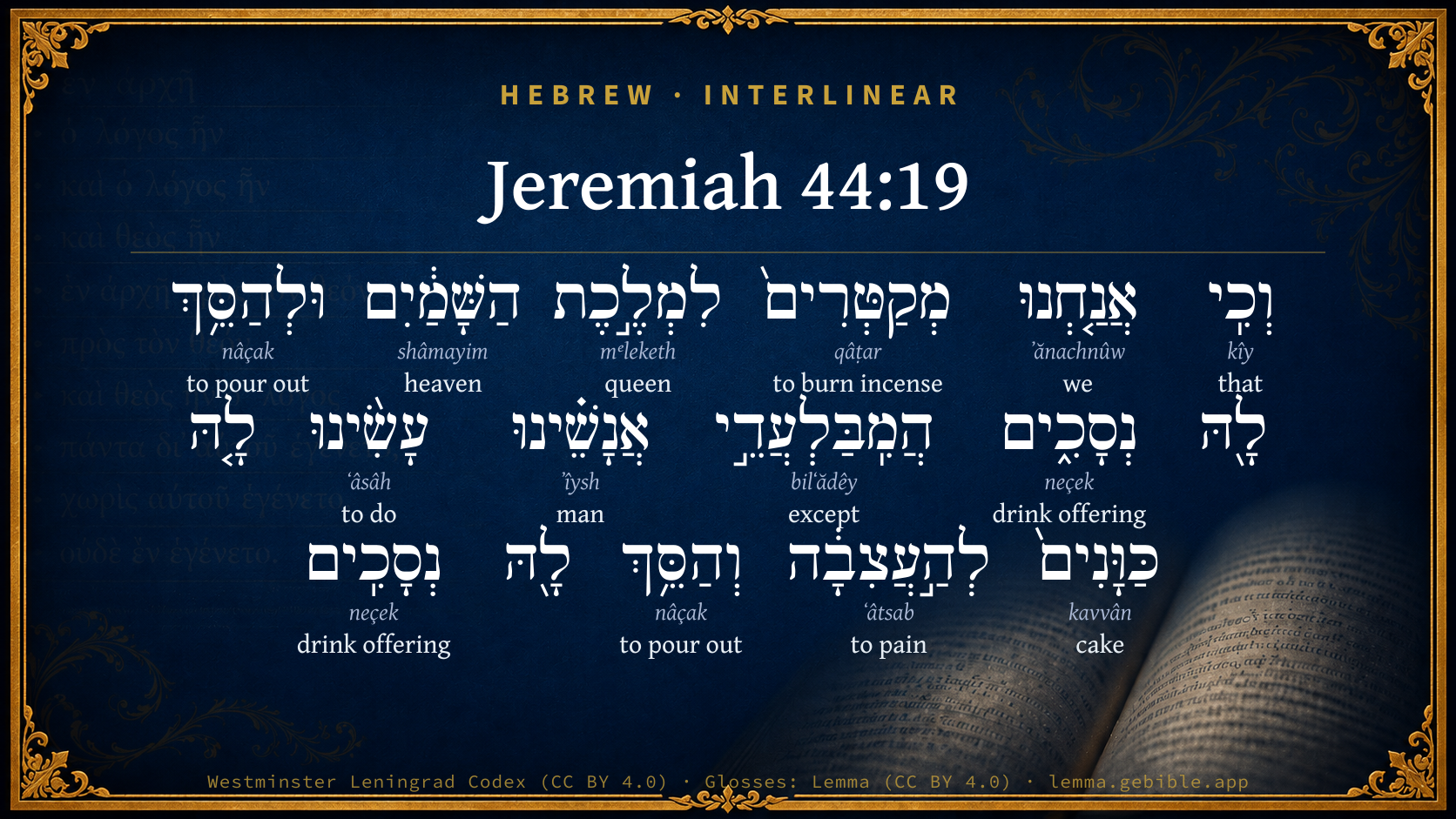
Hebrew (Westminster Leningrad Codex) Jeremiah 44:19 appears in the Hebrew Old Testament. The text above is from the Westminster Leningrad Codex. Each word links to its Strong’s number, a concise gloss, and parsing drawn from the Open Scriptures Hebrew Bible morphology. Click any word for its full Brown-Driver-Briggs (BDB) entry.
Download image
Cite this verse

Jeremiah 44:19 (World English Bible). Public Domain. Lemma interlinear Bible study tool, https://lemma.gebible.app/v/jeremiah/44/19.

Show BibTeX & RIS
BibTeX
RIS
English Translation
When we burned incense to the queen of the sky, and poured out drink-offerings to her, did we make her cakes to worship her, and pour out drink-offerings to her, without our husbands?
World English Bible · Public Domain
Download a study sheet

One document with this verse’s original text, its word-by-word gloss line, the meaning frame, cross-references with their text, attributed commentary, and full source and license credits — printable, and it pastes into notes with its structure intact.

This verse Autodidact and up

Study sheet (.html) Plain text (.txt)

A passage Seminary Student

Up to 50 verses in one chapter. A passage sheet keeps up to 6 commentary sources and 12 cross-references per verse, in the order this page ranks them, and says so on the sheet whenever that leaves anything out. Ask for a single verse and you get the Autodidact verse sheet above.

Everything on this page stays free to read, with no account — the sheet is a download of what is already on screen, not access to it.

Want to remove ads? Support Godless Engineer
Compare translations 3

The same verse in 3 English versions, stacked beneath the original-language interlinear above. Click any original word for its lexicon entry.

Each is an independent rendering of the whole verse — the interlinear is not word-aligned to these translations.

Highlighted words mark where these versions differ — a whole-verse word diff, not a word-by-word alignment.

  • World English Bible Public Domain
    When we burned incense to the queen of the sky, and poured out drink-offerings to her, did we make her cakes to worship her, and pour out drink-offerings to her, without our husbands?
  • King James Version Public Domain
    And when we burned incense to the queen of heaven, and poured out drink offerings unto her, did we make her cakes to worship her, and pour out drink offerings unto her, without our men?
  • unfoldingWord Literal Text CC BY-SA 4.0
    The women said, “When we were making incense offerings before the queen of heaven and pouring out drink offerings to her, was it against our husbands that we did these things, making cakes in her image and pouring out drink offerings to her?”

unfoldingWord Literal Text — © unfoldingWord, licensed CC BY-SA 4.0. Word-aligned USFM3 via Door43 (git.door43.org/unfoldingWord/en_ult).

Versions to compare (up to 4)

3 of 4 selected

Show all 18 translations

Every available English version of this verse, each an independent rendering of the whole verse.

  • World English Bible Public Domain
    When we burned incense to the queen of the sky, and poured out drink-offerings to her, did we make her cakes to worship her, and pour out drink-offerings to her, without our husbands?
  • Berean Standard Bible Public Domain
    “Moreover,” said the women, “when we burned incense to the Queen of Heaven and poured out drink offerings to her, was it without our husbands’ knowledge that we made sacrificial cakes in her image and poured out drink offerings to her?”
  • Majority Standard Bible Public Domain
    “Moreover,” said the women, “when we burned incense to the Queen of Heaven and poured out drink offerings to her, was it without our husbands’ knowledge that we made sacrificial cakes in her image and poured out drink offerings to her?”
  • King James Version Public Domain
    And when we burned incense to the queen of heaven, and poured out drink offerings unto her, did we make her cakes to worship her, and pour out drink offerings unto her, without our men?
  • American Standard Version (1901) Public Domain
    And when we burned incense to the queen of heaven, and poured out drink-offerings unto her, did we make her cakes to worship her, and pour out drink-offerings unto her, without our husbands?
  • Revised Version (1885) Public Domain
    And when we burned incense to the queen of heaven, and poured out drink offerings unto her, did we make her cakes to worship her, and pour out drink offerings unto her, without our husbands?
  • Geneva Bible (1599) Public Domain
    And when we burnt incense to ye Queene of heauen, and powred out drinke offerings vnto her, did wee make her cakes to make her glad, and powre out drinke offerings vnto her without our husbands?
  • Douay-Rheims (1899) Public Domain
    And if we offer sacrifice to the queen of heaven, and pour out drink offerings to her: did we make cakes to worship her, to pour out drink offerings to her, without our husbands?
  • Young's Literal Translation Public Domain
    and when we are making perfume to the queen of the heavens, and pouring out to her libations -- without our husbands have we made for her cakes to idolize her, and to pour out to her libations?'
  • Literal Standard Version CC BY-SA 4.0
    and when we are making incense to the queen of the heavens, and pouring out drink-offerings to her—have we made cakes for her to idolize her, and to pour out drink-offerings to her, without our husbands?”
  • Unlocked Literal Bible CC BY-SA 4.0
    The women said, “When we were making incense offerings before the queen of heaven and pouring out drink offerings to her, was it against our husbands that we did these things, making cakes in her image and pouring out drink offerings to her?”
  • unfoldingWord Literal Text CC BY-SA 4.0
    The women said, “When we were making incense offerings before the queen of heaven and pouring out drink offerings to her, was it against our husbands that we did these things, making cakes in her image and pouring out drink offerings to her?”
  • Darby Bible Public Domain
    And when we burned incense to the queen of the heavens and poured out drink-offerings to her, did we make for her cakes to portray her, and pour out drink-offerings to her, without our husbands?
  • World Messianic Bible Public Domain
    The women said, “When we burned incense to the queen of the sky and poured out drink offerings to her, did we make her cakes to worship her, and pour out drink offerings to her, without our husbands?”
  • Webster's Bible Public Domain
    And when we burned incense to the queen of heaven, and poured out drink-offerings to her, did we make for her cakes to worship her, and pour out drink-offerings to her, without our men?
  • Free Bible Version CC BY-SA 4.0
    “On top of that,” the women added, “when we burned incense to the Queen of Heaven and poured out drink offerings to worship her, did we do this without our husbands knowing about it, that we baked cakes stamped with her image and poured out drink offerings to worship her?”
  • Bible in Basic English Public Domain
    And the women said, When we were burning perfumes to the queen of heaven and draining out drink offerings to her, did we make cakes in her image and give her our drink offerings without the knowledge of our husbands?
  • JPS Tanakh (1917) Public Domain
    And is it we that offer to the queen of heaven, and pour out drink-offerings unto her? did we make her cakes in her image, and pour out drink-offerings unto her, without our husbands?'

Literal Standard Version (2020), Covenant Press — licensed CC BY-SA 4.0. Text via the HelloAO Bible API (eBible.org). Unlocked Literal Bible (unfoldingWord) — licensed CC BY-SA 4.0. Text via the HelloAO Bible API (eBible.org). unfoldingWord Literal Text — © unfoldingWord, licensed CC BY-SA 4.0. Word-aligned USFM3 via Door43 (git.door43.org/unfoldingWord/en_ult). Free Bible Version, Dr. Jonathan Gallagher — licensed CC BY-SA 4.0. Text via the HelloAO Bible API (eBible.org).

Word by word

More ways to search: Search by grammar → Find every occurrence → Compare this word →

Practice this passage: Drill this verse → Learn its vocabulary →

כַּוָּנִים֙
kavvân
H3561
“cakes”
Noun, Common, Masculine, Plural, Absolute
Part of Speech
Noun
Type
Common
Gender
Masculine
Number
Plural
State
Absolute
Full BDB Definition

Origin: from H3559

TWOT: 964f

cake, sacrificial cake
  1. וְכִֽי kîy H3588 “and · that” Conjunction + Conjunction
  2. אֲנַ֤חְנוּ ʼănachnûw H587 “we” Pronoun, Personal, 1st Person, Common, Plural
  3. מְקַטְּרִים֙ qâṭar H6999 “burning incense” Verb, Piel, Participle Active, Masculine, Plural, Absolute
  4. לִמְלֶ֣כֶת mᵉleketh H4446 “to/for · queen of” Preposition + Noun, Common, Feminine, Singular, Construct
  5. הַשָּׁמַ֔יִם shâmayim H8064 “the · heaven(s)” Particle, Definite Article + Noun, Common, Masculine, Plural, Absolute
  6. וּלְהַסֵּ֥ךְ nâçak H5258 “and · to pour out” Conjunction + Preposition + Verb, Hiphil, Infinitive Construct
  7. נְסָכִ֑ים neçek H5262 “drink offerings” Noun, Common, Masculine, Plural, Absolute
  8. הֲמִֽבַּלְעֲדֵ֣י bilʻădêy H1107 “from · except” Particle, Interrogative + Preposition + Preposition
  9. אֲנָשֵׁ֗ינוּ ʼîysh H376 “men · our” Noun, Common, Masculine, Plural, Construct + Suffix, Personal, 1st Person, Common, Plural
  10. עָשִׂ֨ינוּ ʻâsâh H6213 “to do” Verb, Qal, Perfect, 1st Person, Common, Plural
  11. לְהַ֣עֲצִבָ֔ה ʻâtsab H6087 “to pain · her” Preposition + Verb, Hiphil, Infinitive Construct + Suffix, Personal, 3rd Person, Feminine, Singular
  12. וְהַסֵּ֥ךְ nâçak H5258 “and · to pour out” Conjunction + Verb, Hiphil, Infinitive Absolute
  13. נְסָכִֽים neçek H5262 “drink offerings” Noun, Common, Masculine, Plural, Absolute

About this verse

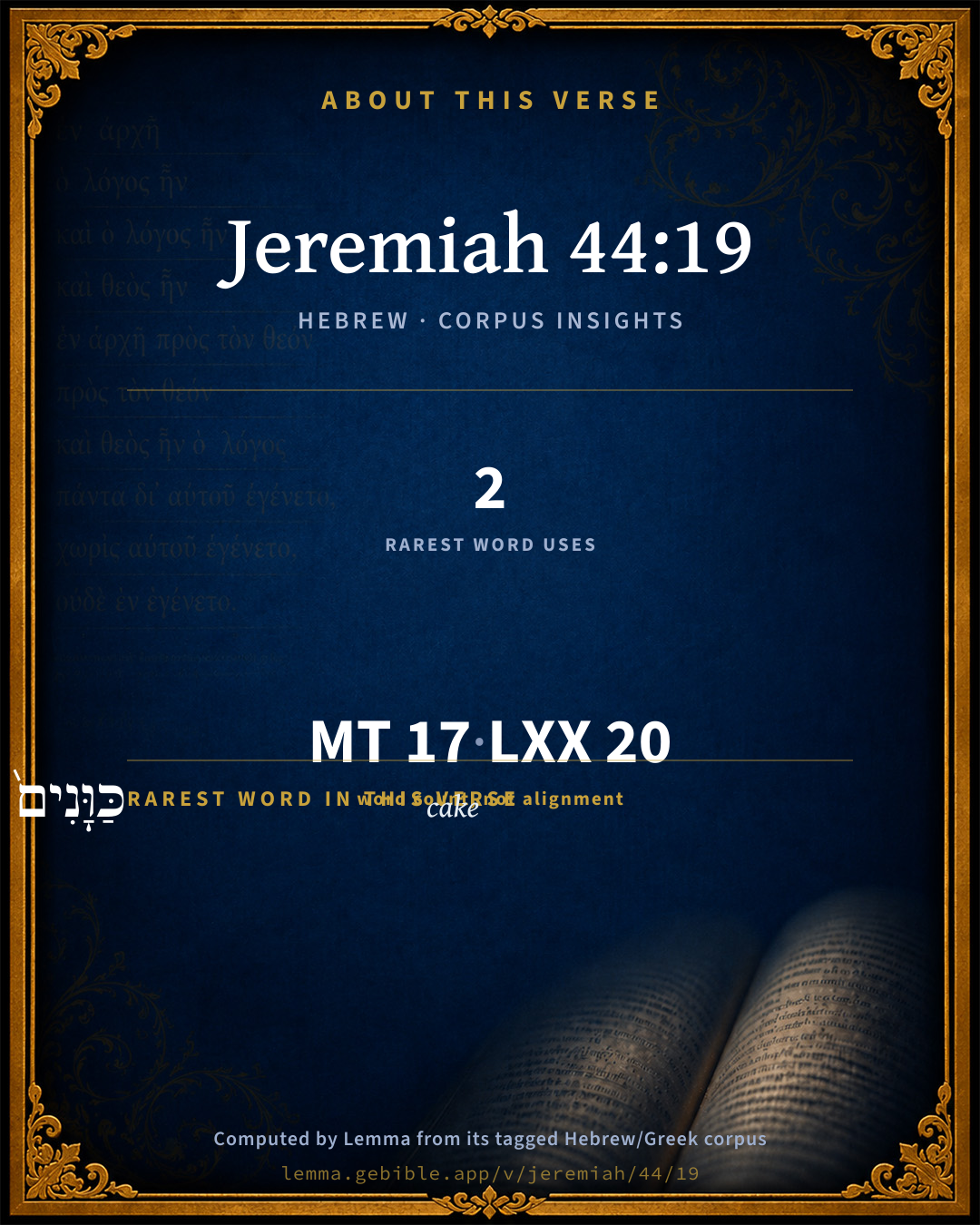
These counts appear in no published source. They are computed here, from the morphology-tagged text and Lemma’s own curated glosses. What Lemma adds →

17
words
12
distinct lemmas
Prophets
section

Notable vocabulary

The rarest word here is כַּוָּנִים֙ cake H3561 — appearing just 2 times in the whole Hebrew Bible.

Shared distinctive vocabulary

כַּוָּנִים֙ cake H3561 occurs in 2 verses of the Hebrew Bible. Also found in:

Grammatical profile

  • 5 verbs
  • 6 nouns
  • 1 pronoun
  • 4 prepositions
  • 1 conjunction

Verb forms

  • מְקַטְּרִים֙ Piel · Participle Active
  • וּלְהַסֵּ֥ךְ Hiphil · Infinitive Construct
  • עָשִׂ֨ינוּ Qal · Perfect
  • לְהַ֣עֲצִבָ֔ה Hiphil · Infinitive Construct
  • וְהַסֵּ֥ךְ Hiphil · Infinitive Absolute

Repetition

Words recur within this verse — often emphatic in Hebrew:

  • וּלְהַסֵּ֥ךְ to pour out H5258 ×2
  • נְסָכִ֑ים drink offering H5262 ×2

Hebrew & Septuagint length

In the original languages it is 17 Hebrew tokens and 20 Greek tokens — but the two are counted differently (Hebrew bundles its prefixes and suffixes into one token; the Greek is in lemma form), so that isn’t a like-for-like length.

Cross-references

11

Topical passages linked to Jeremiah 44:19 in the Treasury of Scripture Knowledge — connected by theme and wording, ordered by reader-vote popularity; previews shown in the World English Bible.

  • Jeremiah 7:18 The children gather wood, and the fathers kindle the fire, and the women knead the dough, to make cakes to the queen of the sky, and to pour out drink-offerings to other gods, that they may provoke me to anger.
  • Jeremiah 44:15 Then all the men who knew that their wives burned incense to other gods, and all the women who stood by, a great assembly, even all the people who lived in the land of Egypt, in Pathros, answered Jeremiah, saying,
  • Genesis 3:6 When the woman saw that the tree was good for food, and that it was a delight to the eyes, and that the tree was to be desired to make one wise, she took of the fruit of it, and ate; and she gave some to her husband with her, and he ate.
  • Genesis 3:11–12 God said, "Who told you that you were naked? Have you eaten from the tree that I commanded you not to eat from?"
  • Genesis 3:16–17 To the woman he said, "I will greatly multiply your pain in childbirth. In pain you will bring forth children. Your desire will be for your husband, and he will rule over you."
  • Numbers 30:6–7 If she be [married] to a husband, while her vows are on her, or the rash utterance of her lips, with which she has bound her soul,
  • Deuteronomy 7:3–4 neither shall you make marriages with them; your daughter you shall not give to his son, nor his daughter shall you take to your son.
  • 1 Kings 21:25 (But there was none like Ahab, who did sell himself to do that which was evil in the sight of Yahweh, whom Jezebel his wife stirred up.
  • 2 Chronicles 21:6 He walked in the way of the kings of Israel, as did the house of Ahab; for he had the daughter of Ahab as wife: and he did that which was evil in the sight of Yahweh.
  • Proverbs 11:21 Most assuredly, the evil man will not be unpunished, But the seed of the righteous will be delivered.
  • Mark 6:19–27 Herodias set herself against him, and desired to kill him, but she couldn't,

Cross-references courtesy of OpenBible.info (CC BY 4.0).

Hebrew and Greek witnesses Masoretic Hebrew ↔ Greek Septuagint

The same verse in the two great witnesses to the Old Testament, shown verse-for-verse.

These are two independent witnesses, not word-aligned to each other, and the Septuagint is shown in lemma (dictionary) form.

Hebrew Jeremiah 44:19 Masoretic · Westminster Leningrad Codex

וְכִֽי אֲנַ֤חְנוּ מְקַטְּרִים֙ לִמְלֶ֣כֶת הַשָּׁמַ֔יִם וּלְהַסֵּ֥ךְ לָ֖הּ נְסָכִ֑ים הֲמִֽבַּלְעֲדֵ֣י אֲנָשֵׁ֗ינוּ עָשִׂ֨ינוּ לָ֤הּ כַּוָּנִים֙ לְהַ֣עֲצִבָ֔ה וְהַסֵּ֥ךְ לָ֖הּ נְסָכִֽים

When we burned incense to the queen of the sky, and poured out drink-offerings to her, did we make her cakes to worship her, and pour out drink-offerings to her, without our husbands?

World English Bible · Public Domain

Greek LXX Structure differs

In the Septuagint, Jeremiah is about an eighth shorter than the Hebrew and arranges its material differently — the Oracles Against the Nations (Hebrew chapters 46–51) appear in the middle of the Greek book, after 25:13. Because the chapter and verse boundaries do not line up, a verse-for-verse comparison with the Hebrew is not shown.

A verse-for-verse comparison isn’t shown here because the chapters and verses don’t line up. Switch to the LXX edition with the MT / LXX toggle above to read the Greek directly.

Hebrew: Westminster Leningrad Codex (CC BY 4.0). Greek: Septuagint (public domain); English from a public-domain English Septuagint. How the Septuagint differs from the Hebrew →

Targum (Aramaic paraphrase)

1

The Targum is the ancient Jewish Aramaic paraphrase of the Hebrew Scriptures — an interpretive translation, not the Hebrew text itself. Onkelos (literal) and Pseudo-Jonathan (expansive) render the Torah, and Jonathan the Prophets. Coverage is partial: where no permissively-licensed English translation exists for a verse, only the Aramaic is shown. This is verse-level text, not a word-by-word alignment to the Hebrew.

  1. Targum Jonathan Prophets (Joshua–Malachi)
    וַאֲרֵי אֲנַחְנָא מַסְקָן בּוּסְמִין לְכוֹכְבַת שְׁמַיָא וּמְנַסְכִן לָהּ נִסְכִּין הֲבַר מִגַבְרָנָא עֲבַדְנָא לָהּ כַּרְדוּטִין לְטַעֲוָתָא וּמְנַסְכָן לָהּ נִסְכִּין:

    (no public-domain English translation for this verse)

    Targum Jonathan — Aramaic: “Mikraot Gedolot” (public domain). English: “Sefaria Community Translation” (CC0 1.0 (public-domain dedication)); “London "Chaldee Paraphrase," 1871” (public domain). Text via Sefaria.

Commentary

Notes on Jeremiah 44:19 from classic Christian and Jewish commentators (each source and its license shown beneath its notes). The classic Christian expositions comment on the surrounding passage and are grouped to its opening verse, so a note may address several verses; the Jewish commentaries on the Tanakh (Rashi and others) are per-verse, so they appear only where the commentator wrote on this verse.

Lemma curates 59 commentaries, every one of them public domain or Creative Commons licensed, each selected and text-cleaned for this edition rather than reprinted as found. About our sources →

Trapp's Complete Commentary

John Trapp

Jer 44:19 And when we burned incense to the queen of heaven, and poured out drink offerings unto her, did we make her cakes to worship her, and pour out drink offerings unto her, without our men?

Ver. 19. And when we burnt incense to the queen of heaven.] So the Papists also call the Virgin Mary, and idolise her, as the word here rendered to worship her doth properly signify: Idoli reiectitii appellationem in eam transferentes.

Did we make her cakes without our men?] i.e., Without our husbands’ privity and approbation. But is that a sufficient excuse? Should not God be obeyed rather than men? A wife is not to perform such blind obedience to her husband as Plutarch prescribeth, when he layeth it as a law of wedlock on the wife to acknowledge and worship the same gods, and none else, but those whom her husband honoureth and reputeth for gods. {a}

{a} Plutarch. Moral., 318.

John Trapp, A Commentary or Exposition upon All the Books of the Old and New Testament (1647–1656) — public domain. Text from a community e-Sword module.

Geneva Bible (1599)

Geneva Bible translators

This teacheth us how great danger it is for the husbands to permit their wives anything whereof they be not assured by God’s word: for thereby they take an occasion to justify their doings, and their husbands shall give an account thereof before God, read Isa. 3:25.

Or, to appease her.

Geneva Bible (1599) marginal notes — public domain. Text via Bolls.life.

Jamieson, Fausset & Brown

Robert Jamieson, A. R. Fausset & David Brown

make . . . cakes to worship her--MAURER translates, "to form her image." Crescent-shaped cakes were offered to the moon. Vulgate supports English Version.

without our men--The women mentioned (Jer 44:15); "a great multitude" here speak: we have not engaged in secret night orgies which might justly be regarded unfavorably by our husbands: our sacred rites have been open, and with their privity. They wish to show how unreasonable it is that Jeremiah should oppose himself alone to the act of all, not merely women, but men also. The guilty, like these women, desire to shield themselves under the complicity of others. Instead of helping one another towards heaven, husband and wife often ripen one another for hell.

Jamieson, Fausset & Brown — Commentary Critical and Explanatory on the Whole Bible (1871) — public domain (CC PDM 1.0). Text via the HelloAO Bible API.

Adam Clarke's Commentary

Verse 19. And when we burned incense to the queen of heaven] The MOON seems to have been called מלכת melecheth, as the SUN was called מלך molech. The Hindoos pour out water to the sun thrice a day; and to the moon whenever they worship her.

The idolatrous worship of these people was a sort of imitation of the worship of the true God; only sacrifice was not common in it. The factious women here tell us in what it consisted.

1. They burnt incense to the moon, and perhaps to the sun and the planets.

2. They poured out libations to her.

3. They made and consecrated cakes to her.

All these were prescribed in the worship of the true GOD. See, among others, Ex 29:23, c. Le 2:4; Le 23:16; and Nu 6:15. And the women vindicate their conduct by asserting that they did all this by the consent of their husbands: "Did we worship her without our men?"

Adam Clarke's Commentary on the Bible (1810–1826) — public domain. Text from a community e-Sword/MySword module.

John Calvin's Commentaries

They brought forward another argument, that they were not a small portion, but the whole people, who then flourished in prosperity, when they offered incense to idols. We know that but a few remained of that large multitude, which lived when the kingdom as yet existed. They said then that they were not the sole authors of this superstition, but that it was practiced by a large number of men, even the whole people, when Jerusalem was full of inhabitants, and the whole country.

Some explain this of the women, but improperly, as I think. The masculine gender is sometimes applied to women, but seldom, and it is harsh, and then it agrees not with this passage, where the whole context shews that men are spoken of; but one reason only leads them to think so, and that is frivolous. It is said, Have we done this without our men? When, therefore, they said that they had not acted without the men, it has immediately occurred to inter-prefers that the women spoke; but the word is in the masculine gender. It is well known that אנשים, anushim, mean sometimes the aged, and also the princes who bear rule, as it is evident from other passages. But here that small band which remained brought forward the consent of a large multitude, as though they had said, “We here are many against thee who standest alone; but if thou comparest the ancient condition of the city and of the land with our miserable state, when the kingdom flourished, when the city remained in safety, when the whole country was full of inhabitants, did they not all then, with one consent, worship the stars and the workmanship of the heavens? Since, then, this religion has been approved by the consent of so many, what meanest thou in attempting to take it away from us?”

We now, then, perceive the design of the Prophet, or rather we understand the meaning of those whom he has introduced as the speakers. They then said that they did not offer incense and pour out libations without their men, that is, without that large multitude, which afterwards perished or was consumed; and thus they set up against him, as a cloud, a large number of men, as the Papists do at this day, who, by means of consent, only fight against the truth, of God for the purpose of overwhelming it. In like manner did these wretched men contend with Jeremiah; and this pretext was their shield, that the whole people, before the city was demolished, followed these superstitions: We have, then, not done this without our men, pouring out libations and offering incense. It now follows, —

John Calvin's Commentaries (1540-1563) — public domain. Text from the Calvin Translation Society English edition (1840s-50s) via the Christian Classics Ethereal Library (ccel.org). Calvin's coverage is partial (roughly two-thirds of the Bible); uncommented books and verses are honest gaps, never fabricated. The 19th-century editor's footnotes and remarks are omitted so the notes are faithfully Calvin's own voice.

Ellicott's Commentary for English Readers

(19) Without our men.—Better, as in the margin, without our husbands. We have here, it is obvious, the very words of the women who were stung by what they looked on as Jeremiah’s intimation that the chief guilt lay on them. They disclaim any special responsibility. Their husbands had joined in the worship, or had, at least, sanctioned it.

A Bible Commentary for English Readers, edited by Charles John Ellicott (1878–1897) — public domain. Text from a community e-Sword module.

The Cambridge Bible for Schools and Colleges

gen. ed. J. J. S. Perowne

19. worship] The alternative in mg. suggests that her image may have been stamped upon them. For “cakes” See on Jer_7:18.

without our husbands] According to Num_30:6 f., which in its present form doubtless represents a much older practice, the consent of the husband was necessary before the wife’s vow could be binding. The women plead that they had their husbands’ approval in this worship. Let Jeremiah therefore settle the matter with them.

The Cambridge Bible for Schools and Colleges (gen. ed. J. J. S. Perowne; Cambridge University Press, 1878–1918) — public domain. Text from a community e-Sword module.

John Gill's Exposition

And when we burnt incense to the queen of heaven, and poured out drink offerings unto her,.... Which they owned they did, and which they were not ashamed of, and were determined to go on with; and were only sorry that they had at any time omitted such service:

did we make cakes to worship her; or, "to make her glad" (g), as Kimchi; interpreting the word by an antiphrasis; it having a contrary signification, to grieve or to make sorrowful; and from hence idols have their name sometimes, because in the issue they bring grief and trouble to their worshippers; hence some render it, "to make her an idol" (h); or them, the cakes, an idol; these had, as Jarchi says, the likeness of the idol impressed upon them:

and pour out drink offerings unto her, without our men? they own they did these things but not without the knowledge and consent at least, if not with the presence, of their husbands; hence these words seem to be the words of the women. Some indeed think they speak all along, from Jer 44:16; or one in the name of the rest; it may be one of Zedekiah's daughters; but however, if the men spoke what is said in the preceding verses, the women, being provoked, could hold their peace no longer, but broke in, and uttered these words; though some render the last clause, "without our principal men" (i); and so take them to be the words of the people in general; who urge, in their own defence, that what they did they did with the direction, approbation, and leading example of their kings and governors.

(g) "ad exhilarandum illud", Calvin; "ad laetificaudum eam", Munster, Pagninus. (h) "Idolificando", Piscator; so Ben Melech; "ut faciamus illas idolum", Cocceius. (i) "absque praestantibus viris nostris", Junius & Tremellius.

John Gill's Exposition of the Whole Bible (1746–1763) — public domain (CC PDM 1.0). Text via the HelloAO Bible API.

Albert Barnes' Notes on the Bible

Burned ... poured ... did - Or, burn ... pour ... do.

To worship her - Rather, to represent her image. The cakes Jer 7:18 were made in the shape of a crescent to represent the moon.

Our men - i. e., our husbands (margin). They had the authority of their husbands for what they were doing. Jeremiah must leave them alone, and discuss the matter with those who alone had the right to interfere.

Albert Barnes' Notes on the Bible (1834–1885) — public domain. Text from a community e-Sword/MySword module.

Haydock's Catholic Bible Commentary

Worship. Hebrew, "to represent." The cakes had a crescent on them. (Calmet) See Hesychius in Greek: selenai. --- Husbands. The women are most zealous. But all partook of this idolatry, chap. vii. 18. (Calmet)

George Leo Haydock (1774–1849), Haydock's Catholic Family Bible and Commentary, 1859 edition — public domain. Excludes Psalms (Douay-Rheims chapter numbering differs from Protestant) and Deuterocanonical books (Catholic canon only).

Matthew Poole's English Annotations

Their last argument is drawn from the evils that had befallen them since they had left worshipping the sun, moon, and stars; thus strangely making their omission of that the cause of their sufferings, their former doing of which was indeed the true cause. They had lost their husbands in the siege and in battles, and had suffered famine and hunger; and all because they had burnt incense to other gods: they interpret these providences as a punishment of them for not doing it as they had formerly used to do. So bad interpreters are those of God’s providences, who indulge their lusts in opposition to God’s law.

Matthew Poole's English Annotations on the Holy Bible (1683–1685) — public domain. Text from a community e-Sword/MySword module.

Whedon's Commentary on the Bible

Daniel D. Whedon

19. Make her cakes to worship her — The meaning of the word translated to worship has been entirely misapprehended by the translators. Its import is, “to represent her image,” alluding to the crescent shape of the cakes. The same word is used in Job_10:8, and is there translated “fashioned.” Keil’s version expresses the sense well. “Have we made cakes to her, making an image of her and pouring out libations to her, without our husbands?”

Without our men — Showing that this is the language of the women, and that the men agreed with them in their idolatry. It could not be pleaded that their vows were unlawful because they had not the consent of their husbands.

Daniel D. Whedon (gen. ed.), Commentary on the Old and New Testaments (1874–1909) — public domain. Text from a community e-Sword module.

The Pulpit Commentary

This part of the reply belongs to the women, who declare that, their husbands" consent having been given to their vow, Jeremiah has no right to interfere. (see Num_30:6, Num_30:7) Burned...poured, etc.; rather, burn, pour. Did we, etc.; rather, do we, etc. To worship her. The sense of the Hebrew is doubtful; but the best reading seems that of Rashi, Graf, and Dr. Payne Smith, "to make her image." Without our men; rather, without our husbands.

The husband"s responsibility.

"Did we make her cakes to worship her... without our men?" These women pleaded that they had their husbands" sanction for what they did. It could not have been otherwise considering the subordinate position women occupied in Oriental nations. No doubt, therefore, the husbands and the male heads of families generally not only permitted, but even prompted these things. Hence it was some sort of excuse and defence for these women thus engaged in idolatrous worship. Such defence is allowed in human law. For the husband, by Christ"s law as well as man"s, is the head of the wife. If so, then the chief responsibility and the chief guiltiness on account of the sin of the household rest on the man at the head of it. The especial blessing of God was pronounced on Abraham because, says God, "I know him, that he will command his household after him." The anger of God came on Eli because he failed to do this. To escape such guilt, let husbands:

1. Be in the Lord themselves.

2. Marry only in the Lord.

3. Be careful to maintain family religion.

4. Set themselves to seek the grace of God"s regenerating Spirit for all their households. C.

The Pulpit Commentary (1880–1919), ed. H.D.M. Spence-Jones & Joseph S. Exell — public domain. Text from a community e-Sword module.

Rashi

Rabbi Shlomo Yitzchaki (Rashi)

without our husbands Without their knowledge.

cakes in her image Heb. כונים להעצבה, molds in the shape of idols (idols in the shape of a young lady as above ch. 22:28).

Rashi on the Tanakh — English translations: “The Judaica Press complete Tanach with Rashi, translated by A. J. Rosenberg” (CC BY 4.0); “Pentateuch with Rashi's commentary by M. Rosenbaum and A.M. Silbermann, 1929-1934” (public domain); “The Metsudah Tanach series, Lakewood, N.J” (CC BY 4.0); and “The Book of Joshua, Metsudah Publications, 1997” (CC BY 4.0). Text via Sefaria.

Lesson kit

Teaching starters — assembled from the data on this page, not authored interpretation. Every prompt links to the verse data it draws on. Edit before teaching.

Jeremiah, in the Prophets, opens this verse with 17 words (12 distinct Hebrew lemmas). Its most distinctive word is kavvân (“cake”). A historical commentator’s framing appears above. Read the whole chapter for the surrounding context.

Discussion questions

  1. What does “cake” (kavvân) contribute to the verse as a whole?
  2. How does Jeremiah 7:18, which shares the word «cake», read alongside this verse?
  3. What does the repetition of “to pour out” (2× in this one verse) do in this verse?
  4. The translations on this page render this verse differently — a whole-verse word diff, not a word-by-word alignment. What might account for the different wordings?
  5. «מְקַטְּרִים֙» is a Piel Participle Active verb. How does that grammatical form shape the action described?
  6. Compare how Trapp's Complete Commentary and Geneva Bible (1599) read this verse. Where do they agree or differ?

Things to notice

Reading settings

Reading text

Shown beneath each verse's original-language words.

Old Testament
Old Testament edition

Read the OT as the Masoretic Hebrew (MT) or the Greek Septuagint (LXX).

English shown for the Greek Septuagint (in the Hebrew ↔ Greek comparison).

Comparing translations? Open the Compare panel on any verse page to stack up to four side by side.