
Psalms 20:8

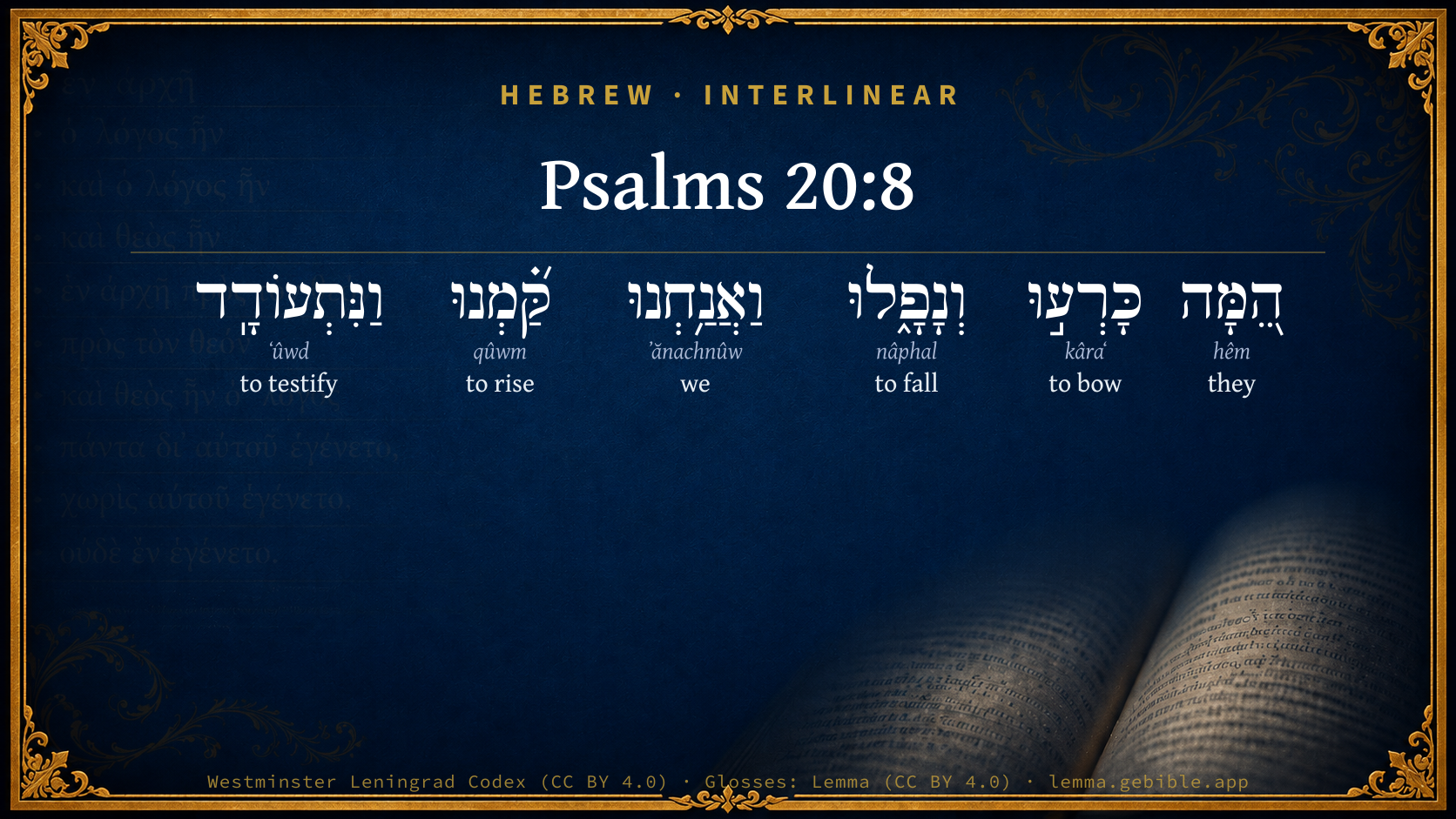
Hebrew (Westminster Leningrad Codex) Psalms 20:8 appears in the Hebrew Old Testament. The text above is from the Westminster Leningrad Codex. Each word links to its Strong’s number, a concise gloss, and parsing drawn from the Open Scriptures Hebrew Bible morphology. Click any word for its full Brown-Driver-Briggs (BDB) entry.
Download image
Cite this verse

Psalms 20:8 (World English Bible). Public Domain. Lemma interlinear Bible study tool, https://lemma.gebible.app/v/psalms/20/8.

Show BibTeX & RIS
BibTeX
RIS
English Translation
They are bowed down and fallen, But we rise up, and stand upright.
World English Bible · Public Domain
Download a study sheet

One document with this verse’s original text, its word-by-word gloss line, the meaning frame, cross-references with their text, attributed commentary, and full source and license credits — printable, and it pastes into notes with its structure intact.

This verse Autodidact and up

Study sheet (.html) Plain text (.txt)

A passage Seminary Student

Up to 50 verses in one chapter. A passage sheet keeps up to 6 commentary sources and 12 cross-references per verse, in the order this page ranks them, and says so on the sheet whenever that leaves anything out. Ask for a single verse and you get the Autodidact verse sheet above.

Everything on this page stays free to read, with no account — the sheet is a download of what is already on screen, not access to it.

Want to remove ads? Support Godless Engineer
Compare translations 3

The same verse in 3 English versions, stacked beneath the original-language interlinear above. Click any original word for its lexicon entry.

Each is an independent rendering of the whole verse — the interlinear is not word-aligned to these translations.

Highlighted words mark where these versions differ — a whole-verse word diff, not a word-by-word alignment.

  • World English Bible Public Domain
    They are bowed down and fallen, But we rise up, and stand upright.
  • King James Version Public Domain
    They are brought down and fallen: but we are risen, and stand upright.
  • unfoldingWord Literal Text CC BY-SA 4.0
    They bow down and fall, but we rise and stand upright!

unfoldingWord Literal Text — © unfoldingWord, licensed CC BY-SA 4.0. Word-aligned USFM3 via Door43 (git.door43.org/unfoldingWord/en_ult).

Versions to compare (up to 4)

3 of 4 selected

Show all 18 translations

Every available English version of this verse, each an independent rendering of the whole verse.

  • World English Bible Public Domain
    They are bowed down and fallen, But we rise up, and stand upright.
  • Berean Standard Bible Public Domain
    They collapse and fall, but we rise up and stand firm.
  • Majority Standard Bible Public Domain
    They collapse and fall, but we rise up and stand firm.
  • King James Version Public Domain
    They are brought down and fallen: but we are risen, and stand upright.
  • American Standard Version (1901) Public Domain
    They are bowed down and fallen; But we are risen, and stand upright.
  • Revised Version (1885) Public Domain
    They are bowed down and fallen: but we are risen, and stand upright.
  • Geneva Bible (1599) Public Domain
    They are brought downe and fallen, but we are risen, and stand vpright.
  • Douay-Rheims (1899) Public Domain
    Some trust in chariots, and some in horses: but we will call upon the name of the Lord our God.
  • Young's Literal Translation Public Domain
    They -- they have bowed and have fallen, And we have risen and station ourselves upright.
  • Literal Standard Version CC BY-SA 4.0
    They have bowed and have fallen, || And we have risen and station ourselves upright.
  • Unlocked Literal Bible CC BY-SA 4.0
    They will be brought down and fall, but we will rise and stand upright!
  • unfoldingWord Literal Text CC BY-SA 4.0
    They bow down and fall, but we rise and stand upright!
  • Darby Bible Public Domain
    They are bowed down and fallen; but we are risen and stand upright.
  • World Messianic Bible Public Domain
    They are bowed down and fallen, but we rise up, and stand upright.
  • Webster's Bible Public Domain
    \\20:7\\Some trust in chariots, and some in horses: but we will remember the name of the LORD our God.
  • Free Bible Version CC BY-SA 4.0
    They collapse and fall down, but we rise and stand up.
  • Bible in Basic English Public Domain
    They are bent down and made low; but we have been lifted up.
  • JPS Tanakh (1917) Public Domain
    (20-9) They are bowed down and fallen; but we are risen, and stand upright.

Literal Standard Version (2020), Covenant Press — licensed CC BY-SA 4.0. Text via the HelloAO Bible API (eBible.org). Unlocked Literal Bible (unfoldingWord) — licensed CC BY-SA 4.0. Text via the HelloAO Bible API (eBible.org). unfoldingWord Literal Text — © unfoldingWord, licensed CC BY-SA 4.0. Word-aligned USFM3 via Door43 (git.door43.org/unfoldingWord/en_ult). Free Bible Version, Dr. Jonathan Gallagher — licensed CC BY-SA 4.0. Text via the HelloAO Bible API (eBible.org).

Word by word

More ways to search: Search by grammar → Find every occurrence → Compare this word →

Practice this passage: Drill this verse → Learn its vocabulary →

About this verse

These counts appear in no published source. They are computed here, from the morphology-tagged text and Lemma’s own curated glosses. What Lemma adds →

6
words
6
distinct lemmas
Wisdom
section

Shared distinctive vocabulary

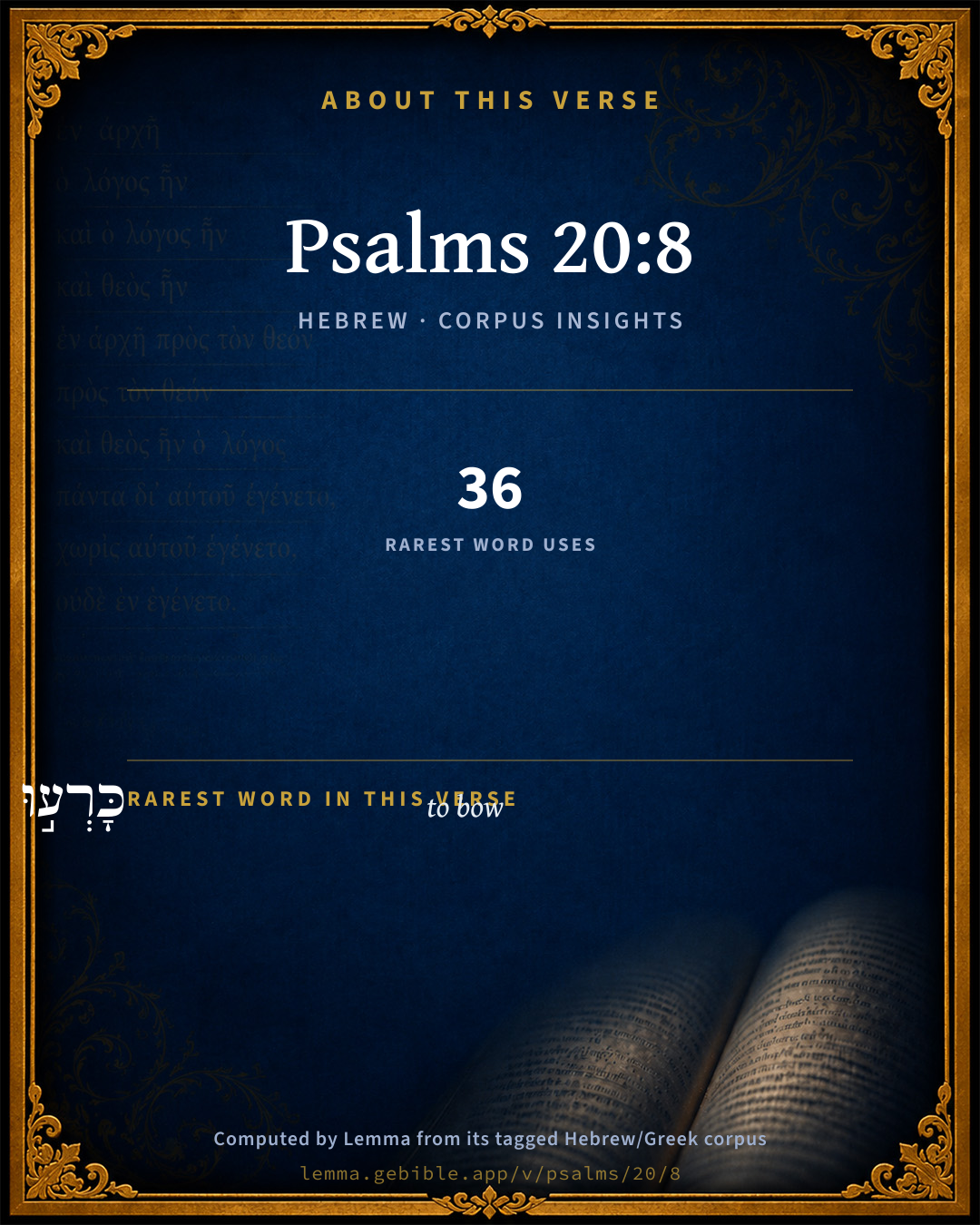
כָּרְע֣וּ to bow H3766 occurs in 32 verses of the Hebrew Bible. Also found in:

Grammatical profile

  • 4 verbs
  • 2 pronouns

Verb forms

  • כָּרְע֣וּ Qal · Perfect
  • וְנָפָ֑לוּ Qal · Sequential Perfect
  • קַּ֝֗מְנוּ Qal · Perfect
  • וַנִּתְעוֹדָֽד Hithpolel · Sequential Imperfect

Hebrew & Septuagint length

In English translation the verse runs 13 words from the Hebrew and 14 from the Septuagint (LXX English) — closely comparable.

A rough comparison of the two English renderings, which tokenize alike — not a word-level alignment.

Word counts can differ between the Hebrew and the Greek without any difference in meaning — e.g. the Hebrew direct-object marker אֵת has no separate Greek word, and Greek often adds the article ὁ.

Cross-references

6

Topical passages linked to Psalms 20:8 in the Treasury of Scripture Knowledge — connected by theme and wording, ordered by reader-vote popularity; previews shown in the World English Bible.

  • Psalms 125:1 Those who trust in Yahweh are as Mount Zion, Which can't be moved, but remains forever.
  • Micah 7:8 Don't rejoice against me, my enemy. When I fall, I will arise. When I sit in darkness, Yahweh will be a light to me.
  • Psalms 34:21–22 Evil shall kill the wicked. Those who hate the righteous shall be condemned.
  • Jeremiah 17:7–8 Blessed is the man who trusts in Yahweh, and whose trust Yahweh is.
  • Judges 5:31 So let all your enemies perish, Yahweh: But let those who love him be as the sun when he goes forth in his might. The land had rest forty years.
  • Psalms 146:5–9 Happy is he who has the God of Jacob for his help, Whose hope is in Yahweh, his God:

Cross-references courtesy of OpenBible.info (CC BY 4.0).

Hebrew and Greek witnesses Masoretic Hebrew ↔ Greek Septuagint

The same verse in the two great witnesses to the Old Testament, shown verse-for-verse.

You’re reading Greek Psalm 19 (Hebrew Psalm 20). The Septuagint counts the superscription, so verse numbers can differ from the Hebrew — chapter-level alignment, not verse-by-verse. Numbering follows Rahlfs.

These are two independent witnesses, not word-aligned to each other, and the Septuagint is shown in lemma (dictionary) form.

Hebrew Psalms 20:8 Masoretic · Westminster Leningrad Codex

הֵ֭מָּה כָּרְע֣וּ וְנָפָ֑לוּ וַאֲנַ֥חְנוּ קַּ֝֗מְנוּ וַנִּתְעוֹדָֽד

They are bowed down and fallen, But we rise up, and stand upright.

World English Bible · Public Domain

Greek LXX Greek Psalm 19:8 Septuagint · lemma form

οὗτος ἐν ἅρμα καί οὗτος ἐν ἵππος ἐγώ δέ ἐν ὄνομα κύριος θεός ἐγώ μεγαλύνω

They are overthrown and fallen: but we are risen, and have been set upright.

LXX2012 (modern English Septuagint) · Public Domain

Hebrew: Westminster Leningrad Codex (CC BY 4.0). Greek: Septuagint (public domain); English from LXX2012 (modern English Septuagint) (Public Domain). How the Septuagint differs from the Hebrew →

Commentary

Notes on Psalms 20:8 from classic Christian and Jewish commentators (each source and its license shown beneath its notes). The classic Christian expositions comment on the surrounding passage and are grouped to its opening verse, so a note may address several verses; the Jewish commentaries on the Tanakh (Rashi and others) are per-verse, so they appear only where the commentator wrote on this verse.

Lemma curates 59 commentaries, every one of them public domain or Creative Commons licensed, each selected and text-cleaned for this edition rather than reprinted as found. About our sources →

Trapp's Complete Commentary

John Trapp

Psa 20:8 They are brought down and fallen: but we are risen, and stand upright.

Ver. 8. They are brought down, &c.] They lie flat by the fall they have taken, being confuted in their confidences, as Benhadad was of old; as of late, the French at the battle of Agincourt, Sigismund the young king of Hungary, and many others.

But we are risen] Who before seemed to lay along, Et tanquam sideratos humi serpere. God helpeth his when forsaken of their hopes almost.

John Trapp, A Commentary or Exposition upon All the Books of the Old and New Testament (1647–1656) — public domain. Text from a community e-Sword module.

J. A. Alexander on Psalms

Joseph Addison Alexander

9. (Psa 20:8). They have bowed and fallen, and we have risen and stood upright. Here, as in Psa 20:7 (6), the past tense expresses the certainty of the event, or rather the confidence with which it is expected. The emphatic they at the beginning means the enemies and oppressors of God's people. We have arisen seems to imply a previous prostration and subjection.—The last verb occurs only here in this form, which is properly reflexive, and may be explained to mean, we have straightened ourselves up.

Joseph Addison Alexander, The Psalms Translated and Explained (1850) — public domain. Text from a community e-Sword module.

Geneva Bible (1599)

Geneva Bible translators

The worldlings that put not their only trust in God.

Geneva Bible (1599) marginal notes — public domain. Text via Bolls.life.

Jamieson, Fausset & Brown

Robert Jamieson, A. R. Fausset & David Brown

They--that is, who trust in horses, &c.

stand upright--literally, "we have straightened ourselves up from our distress and fears."

Jamieson, Fausset & Brown — Commentary Critical and Explanatory on the Whole Bible (1871) — public domain (CC PDM 1.0). Text via the HelloAO Bible API.

Adam Clarke's Commentary

Verse 8. They are brought down and fallen] They were so confident of victory that they looked upon it as already gained. They who trusted in their horses and chariots are bowed down, and prostrated on the earth: they are all overthrown.

But we are risen] We who have trusted in the name of Jehovah are raised up from all despondency; and we stand upright - we shall conquer, and go on to conquer.

Adam Clarke's Commentary on the Bible (1810–1826) — public domain. Text from a community e-Sword/MySword module.

John Calvin's Commentaries

8. They are bowed down. It is probable that there is here pointed out, as it were with the finger, the enemies of Israel, whom God had overthrown, when they regarded no event as less likely to happen. There is contained in the words a tacit contrast between the cruel pride with which they had been lifted up for a time when they audaciously rushed forward to make havoc of all things on the one hand, and the oppression of the people of God on the other. The expression, to rise, is applied only to those who were before sunk or fallen; and, on the other hand, the expression, bowed down and fallen, is with propriety applied to those who were lifted up with pride and presumption. The prophet therefore teaches by the event, how much more advantageous it is for us to place all our confidence in God than to depend upon our own strength.

John Calvin's Commentaries (1540-1563) — public domain. Text from the Calvin Translation Society English edition (1840s-50s) via the Christian Classics Ethereal Library (ccel.org). Calvin's coverage is partial (roughly two-thirds of the Bible); uncommented books and verses are honest gaps, never fabricated. The 19th-century editor's footnotes and remarks are omitted so the notes are faithfully Calvin's own voice.

Ellicott's Commentary for English Readers

(8) Stand upright.—We seem to see a whole battle fought before our eyes, in which those formerly struck down rise, and returning to the fight, beat off their foes, and in their turn lay them low. “We were fallen, but have risen, and stand upright.”

A Bible Commentary for English Readers, edited by Charles John Ellicott (1878–1897) — public domain. Text from a community e-Sword module.

The Cambridge Bible for Schools and Colleges

gen. ed. J. J. S. Perowne

8. They are brought down] R.V., They are bowed down; the same word as in Psa_18:39. It is still the language of faith, anticipating the entire subjugation of the enemy, and the triumph of Israel.

The Cambridge Bible for Schools and Colleges (gen. ed. J. J. S. Perowne; Cambridge University Press, 1878–1918) — public domain. Text from a community e-Sword module.

John Gill's Exposition

They are brought down and fallen,.... These are they that rode in chariots and on horses, and trusted in them; who are brought down from their places of honour and safety; and fall, not into the hands of their enemies, and into a low and mean estate, but to the ground by death; as also such who, being like Capernaum, lifted up to heaven with their own outward attainments, and think to get thither by them, are brought down to hell, and fall into the pit of corruption;

but we are risen, and stand upright; who remember the name of the Lord, and trust in him; the church is sometimes in a very low and depressed condition; it consists of a poor and an afflicted people, and who are persecuted by men; so the church has been under the Heathen Roman emperors, and under the Papacy, and will be as long as she is in the wilderness, and the witnesses prophesy in sackcloth; and especially when they will be slain, and their bodies lie on the earth unburied; but these shall rise and stand upright, and ascend to heaven; there will be a glorious state of the church; there will be a reviving of the interest of Christ, through the bringing in the fulness and forces of the Gentiles, and the conversion of the Jews; the dry bones will live again, and stand upon their feet, an exceeding great army; in those days the righteous will flourish and have abundance of peace and prosperity. This may also include the first resurrection, which the saints will have a part in; the dead in Christ will rise first, and will stand before the Lord with confidence, and not be ashamed; when the ungodly shall not stand in judgment, nor sinners in, the congregation of the righteous; for though these words are expressed in the present tense, because of the certainty of them, they belong to future times; hence the following petitions.

John Gill's Exposition of the Whole Bible (1746–1763) — public domain (CC PDM 1.0). Text via the HelloAO Bible API.

Albert Barnes' Notes on the Bible

They are brought down and fallen - That is, those who trust in chariots and horses. The reference here is undoubtedly to the enemies against whom the king was about to wage war, and the language here is indicative of his certain conviction that they would be vanquished. So certain was he now of this that he could speak of it as if it were already done. “They “are” brought down.” He sees them in anticipation prostrate and subdued; he goes forth to war with the certainty on his mind that this would occur. The word rendered “brought down” - כרע kâra‛ - means “to bend,” “to bow” (as the knees); and then it refers to one who bows down before an enemy, that is, one who is subdued, Isa 10:4; Isa 65:12; Psa 72:9; Psa 78:31.

But we are risen, and stand upright - That is, he sees this in anticipation. He is certain of success and triumph. Depressed though we may now be, yet we are certain of victory.

Albert Barnes' Notes on the Bible (1834–1885) — public domain. Text from a community e-Sword/MySword module.

Matthew Poole's English Annotations

They are brought down from their horses and chariots, to which they trusted. Heb. They bowed down, as being unable to stand longer, because of their mortal wounds. Compare Jdg 5:27.

But we stand firmly upon our legs, and keep the field, as conquerors use to do.

Matthew Poole's English Annotations on the Holy Bible (1683–1685) — public domain. Text from a community e-Sword/MySword module.

The Treasury of David

Charles H. Spurgeon

Ver. 8. How different the end of those whose trusts are different! The enemies of God are uppermost at first, but they ere long are brought down by force, or else fall of their own accord. Their foundation is rotten, and therefore when the time comes it gives way under them; their chariots are burned in the fire, and their horses die of pestilence, and where is their boasted strength? As for those who rest on Jehovah, they are often cast down at the first onset, but an Almighty arm uplifts them, and they joyfully stand upright. The victory of Jesus is the inheritance of his people. The world, death, Satan, and sin, shall all be trampled beneath the feet of the champions of faith; while those who rely upon an arm of flesh shall be ashamed and confounded for ever.

Ver. 8. They are brought down, from their horses and chariots in which they trusted. Hebrew: they bowed down, as being unable to stand longer because of their mortal wounds. Compare Jud 5:27. "Stand upright." Standing firmly upon our legs, and keeping the field, as conquerors use to do. Matthew Poole.

Ver. 8. Tables turned.

Psalms 20:9*

Charles H. Spurgeon's The Treasury of David (1869–1885) — public domain. Psalms only. Text from a community e-Sword/MySword module.

The Pulpit Commentary

They are brought down and fallen; but we are risen, and stand upright. Confident of the result, the speaker represents it as already achieved. He sees the enemy bowed down to the earth, and fallen; he sees the host of Israel erect and triumphant. All stands out clearly before his vision, as though he were an actual spectator of the fight.

The Pulpit Commentary (1880–1919), ed. H.D.M. Spence-Jones & Joseph S. Exell — public domain. Text from a community e-Sword module.

John Wesley's Explanatory Notes

Brought down - From their horses and chariots, to which they trusted. Stand - Stand firmly, and keep the field.

John Wesley, Explanatory Notes Upon the Whole Bible (1754–1765) — public domain. Text via the GEBible commentary corpus.

Rashi

Rabbi Shlomo Yitzchaki (Rashi)

These trust in chariots Some nations trust in their iron chariots, and some trust in horses, but we pray in the name of the Lord, because the salvation is His. נזכיר is an expression of burning sacrifices and of prayer, as (in Isa. 66:3): “he who burns (מזכיר) frankincense,” (and in Lev. 2:2): “its memorial part (אזכרתה).” Therefore, they kneel and fall...

Rashi on the Tanakh — English translations: “The Judaica Press complete Tanach with Rashi, translated by A. J. Rosenberg” (CC BY 4.0); “Pentateuch with Rashi's commentary by M. Rosenbaum and A.M. Silbermann, 1929-1934” (public domain); “The Metsudah Tanach series, Lakewood, N.J” (CC BY 4.0); and “The Book of Joshua, Metsudah Publications, 1997” (CC BY 4.0). Text via Sefaria.

Lesson kit

Teaching starters — assembled from the data on this page, not authored interpretation. Every prompt links to the verse data it draws on. Edit before teaching.

Psalms, in the Wisdom, opens this verse with 6 words (6 distinct Hebrew lemmas). Its most distinctive word is kâraʻ (“to bow”). A historical commentator’s framing appears above. Read the whole chapter for the surrounding context.

Discussion questions

  1. How does “to bow” (kâraʻ) shape what this verse is saying?
  2. Genesis 49:9 shares the word «to bow» with this verse. How do the two illuminate each other?
  3. These translations render this verse differently; the difference is in the English rendering, not the original. What questions does that raise?
  4. The verb «כָּרְע֣וּ» is Qal Perfect. How does its form color the action?
  5. Reading how Trapp's Complete Commentary and J. A. Alexander on Psalms read this verse, where do the two commentators agree and where do they part?

Things to notice

Reading settings

Reading text

Shown beneath each verse's original-language words.

Old Testament
Old Testament edition

Read the OT as the Masoretic Hebrew (MT) or the Greek Septuagint (LXX).

English shown for the Greek Septuagint (in the Hebrew ↔ Greek comparison).

Comparing translations? Open the Compare panel on any verse page to stack up to four side by side.