Joshua 9:8

Hebrew (Westminster Leningrad Codex) Joshua 9:8 appears in the Hebrew Old Testament. The text above is from the Westminster Leningrad Codex. Each word links to its Strong’s number, a concise gloss, and parsing drawn from the Open Scriptures Hebrew Bible morphology. Click any word for its full Brown-Driver-Briggs (BDB) entry.
Download image
Cite this verse

Joshua 9:8 (World English Bible). Public Domain. Lemma interlinear Bible study tool, https://lemma.gebible.app/v/joshua/9/8.

Show BibTeX & RIS
BibTeX
RIS
English Translation
They said to Joshua, We are your servants. Joshua said to them, Who are you? and from whence come you?
World English Bible · Public Domain
Download a study sheet

One document with this verse’s original text, its word-by-word gloss line, the meaning frame, cross-references with their text, attributed commentary, and full source and license credits — printable, and it pastes into notes with its structure intact.

This verse Autodidact and up

Study sheet (.html) Plain text (.txt)

A passage Seminary Student

Up to 50 verses in one chapter. A passage sheet keeps up to 6 commentary sources and 12 cross-references per verse, in the order this page ranks them, and says so on the sheet whenever that leaves anything out. Ask for a single verse and you get the Autodidact verse sheet above.

Everything on this page stays free to read, with no account — the sheet is a download of what is already on screen, not access to it.

Want to remove ads? Support Godless Engineer
Compare translations 3

The same verse in 3 English versions, stacked beneath the original-language interlinear above. Click any original word for its lexicon entry.

Each is an independent rendering of the whole verse — the interlinear is not word-aligned to these translations.

Highlighted words mark where these versions differ — a whole-verse word diff, not a word-by-word alignment.

  • World English Bible Public Domain
    They said to Joshua, We are your servants. Joshua said to them, Who are you? and from whence come you?
  • King James Version Public Domain
    And they said unto Joshua, We are thy servants. And Joshua said unto them, Who are ye? and from whence come ye?
  • unfoldingWord Literal Text CC BY-SA 4.0
    And they said to Joshua, “We your servants.” And Joshua said to them, “Who are you, and where have you come from?”

unfoldingWord Literal Text — © unfoldingWord, licensed CC BY-SA 4.0. Word-aligned USFM3 via Door43 (git.door43.org/unfoldingWord/en_ult).

Versions to compare (up to 4)

3 of 4 selected

Show all 18 translations

Every available English version of this verse, each an independent rendering of the whole verse.

  • World English Bible Public Domain
    They said to Joshua, We are your servants. Joshua said to them, Who are you? and from whence come you?
  • Berean Standard Bible Public Domain
    “We are your servants,” they said to Joshua. Then Joshua asked them, “Who are you and where have you come from?”
  • Majority Standard Bible Public Domain
    “We are your servants,” they said to Joshua. Then Joshua asked them, “Who are you and where have you come from?”
  • King James Version Public Domain
    And they said unto Joshua, We are thy servants. And Joshua said unto them, Who are ye? and from whence come ye?
  • American Standard Version (1901) Public Domain
    And they said unto Joshua, We are thy servants. And Joshua said unto them, Who are ye? and from whence come ye?
  • Revised Version (1885) Public Domain
    And they said unto Joshua, We are thy servants. And Joshua said unto them, Who are ye? and from whence come ye?
  • Geneva Bible (1599) Public Domain
    And they said vnto Ioshua, We are thy seruants. Then Ioshua saide vnto them, Who are ye? and whence come ye?
  • Douay-Rheims (1899) Public Domain
    But they said to Josue: We are thy servants. Josue said to them: Who are you? and whence came you?
  • Young's Literal Translation Public Domain
    and they say unto Joshua, `Thy servants we `are'.' And Joshua saith unto them, `Who `are' ye? and whence come ye?'
  • Literal Standard Version CC BY-SA 4.0
    And they say to Joshua, “We [are] your servants.” And Joshua says to them, “Who [are] you? And where do you come from?”
  • Unlocked Literal Bible CC BY-SA 4.0
    They said to Joshua, “We are your servants.” Joshua said to them, “Who are you? Where did you come from?”
  • unfoldingWord Literal Text CC BY-SA 4.0
    And they said to Joshua, “We your servants.” And Joshua said to them, “Who are you, and where have you come from?”
  • Darby Bible Public Domain
    And they said unto Joshua, We are thy servants. And Joshua said to them, Who are ye? and from whence come ye?
  • World Messianic Bible Public Domain
    They said to Joshua, “We are your servants.” Joshua said to them, “Who are you? Where do you come from?”
  • Webster's Bible Public Domain
    And they said to Joshua, we are thy servants. And Joshua said to them, Who are ye? and whence come ye?
  • Free Bible Version CC BY-SA 4.0
    “We are your servants,” they replied. “But who are you? Where do you come from?” Joshua asked.
  • Bible in Basic English Public Domain
    And they said to Joshua, We are your servants. Then Joshua said to them, Who are you and where do you come from?
  • JPS Tanakh (1917) Public Domain
    And they said unto Joshua: 'We are thy servants.' And Joshua said unto them: 'Who are ye? and from whence come ye?'

Literal Standard Version (2020), Covenant Press — licensed CC BY-SA 4.0. Text via the HelloAO Bible API (eBible.org). Unlocked Literal Bible (unfoldingWord) — licensed CC BY-SA 4.0. Text via the HelloAO Bible API (eBible.org). unfoldingWord Literal Text — © unfoldingWord, licensed CC BY-SA 4.0. Word-aligned USFM3 via Door43 (git.door43.org/unfoldingWord/en_ult). Free Bible Version, Dr. Jonathan Gallagher — licensed CC BY-SA 4.0. Text via the HelloAO Bible API (eBible.org).

Word by word

More ways to search: Search by grammar → Find every occurrence → Compare this word →

Practice this passage: Drill this verse → Learn its vocabulary →

וּמֵאַ֥יִן
ʼayin
H370
“and · from · where”
Conjunction + Preposition + Particle, Interrogative
Part of Speech
Conjunction + Preposition + Particle
Type
Interrogative
Full BDB Definition

Origin: probably identical with H369 in the sense of query (compare H336 )

TWOT: 75f

where?, whence?
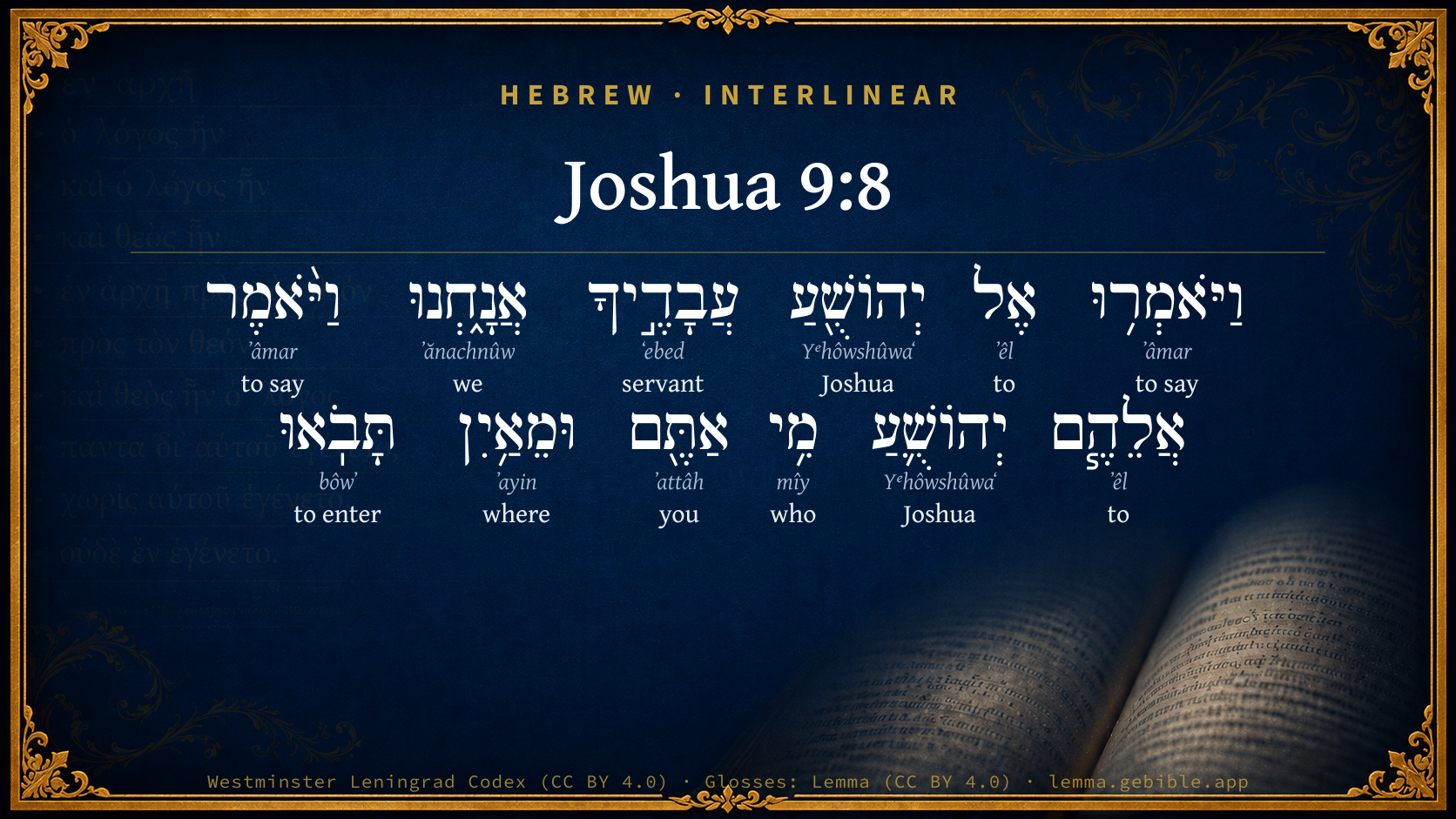
  1. וַיֹּאמְר֥וּ ʼâmar H559 “and · to say” Conjunction + Verb, Qal, Sequential Imperfect, 3rd Person, Masculine, Plural
  2. אֶל ʼêl H413 “to” Preposition
  3. יְהוֹשֻׁ֖עַ Yᵉhôwshûwaʻ H3091 “Joshua” Noun, Proper
  4. עֲבָדֶ֣יךָ ʻebed H5650 “servants · your” Noun, Common, Masculine, Plural, Construct + Suffix, Personal, 2nd Person, Masculine, Singular
  5. אֲנָ֑חְנוּ ʼănachnûw H587 “we” Pronoun, Personal, 1st Person, Common, Plural
  6. וַיֹּ֨אמֶר ʼâmar H559 “and · to say” Conjunction + Verb, Qal, Sequential Imperfect, 3rd Person, Masculine, Singular
  7. אֲלֵהֶ֧ם ʼêl H413 “to · them” Preposition + Suffix, Personal, 3rd Person, Masculine, Plural
  8. יְהוֹשֻׁ֛עַ Yᵉhôwshûwaʻ H3091 “Joshua” Noun, Proper
  9. מִ֥י mîy H4310 “who” Particle, Interrogative
  10. אַתֶּ֖ם ʼattâh H859 “you” Pronoun, Personal, 2nd Person, Masculine, Plural
  11. תָּבֹֽאוּ bôwʼ H935 “to enter” Verb, Qal, Imperfect, 2nd Person, Masculine, Plural

About this verse

These counts appear in no published source. They are computed here, from the morphology-tagged text and Lemma’s own curated glosses. What Lemma adds →

12
words
9
distinct lemmas
Historical
section

Notable vocabulary

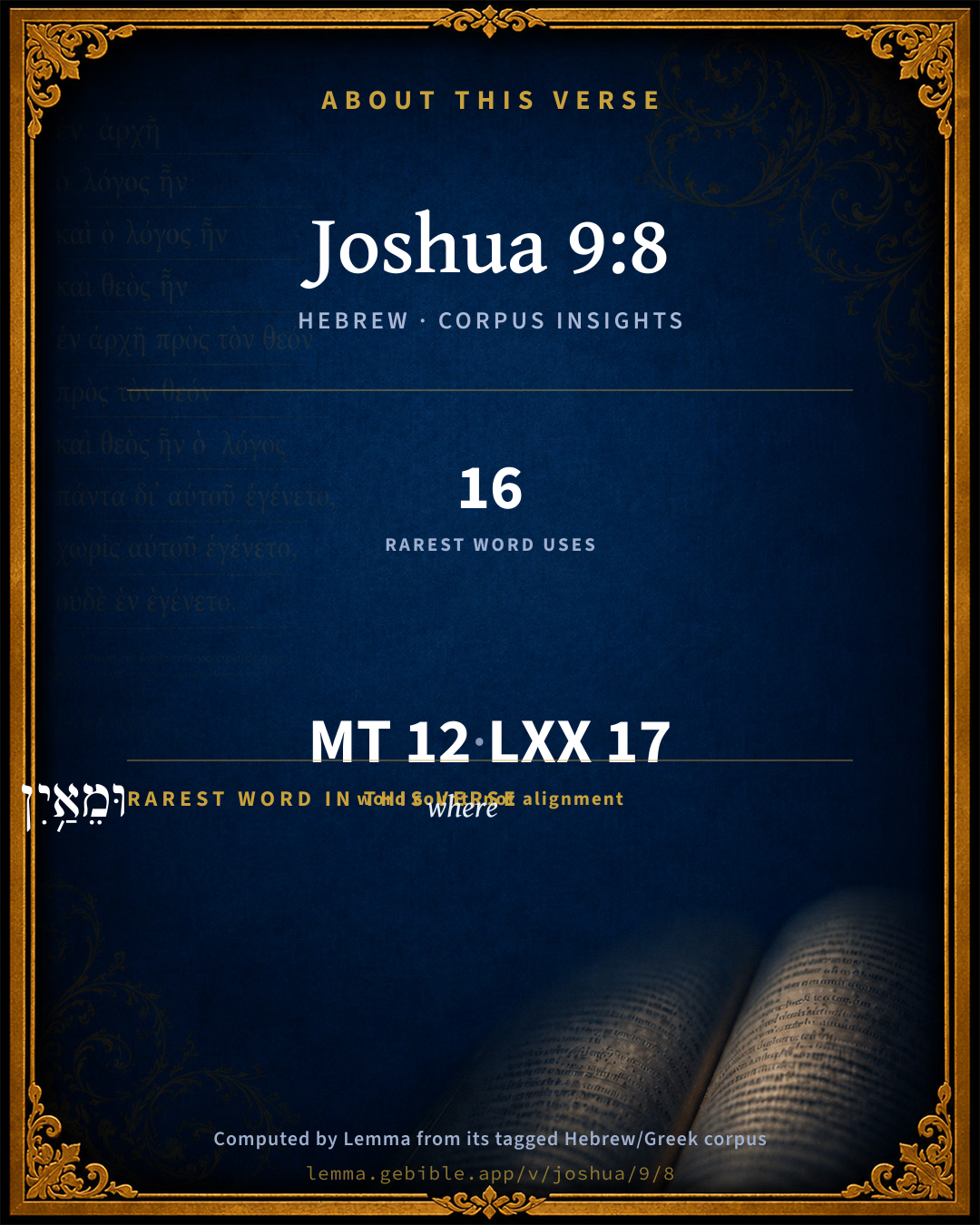
The rarest word here is וּמֵאַ֥יִן where H370 — appearing just 16 times in the whole Hebrew Bible.

Shared distinctive vocabulary

וּמֵאַ֥יִן where H370 occurs in 16 verses of the Hebrew Bible. Also found in:

Grammatical profile

  • 3 verbs
  • 3 nouns
  • 2 pronouns
  • 2 prepositions
  • 2 particles

Verb forms

  • וַיֹּאמְר֥וּ Qal · Sequential Imperfect
  • וַיֹּ֨אמֶר Qal · Sequential Imperfect
  • תָּבֹֽאוּ Qal · Imperfect

Repetition

Words recur within this verse — often emphatic in Hebrew:

  • וַיֹּאמְר֥וּ to say H559 ×2
  • יְהוֹשֻׁ֖עַ Joshua H3091 ×2
  • אֶל to H413 ×2

Hebrew & Septuagint length

In English translation the verse runs 20 words from the Hebrew and 22 from the Septuagint (LXX English) — closely comparable.

A rough comparison of the two English renderings, which tokenize alike — not a word-level alignment.

Word counts can differ between the Hebrew and the Greek without any difference in meaning — e.g. the Hebrew direct-object marker אֵת has no separate Greek word, and Greek often adds the article ὁ.

In the original languages it is 12 Hebrew tokens and 17 Greek tokens — but the two are counted differently (Hebrew bundles its prefixes and suffixes into one token; the Greek is in lemma form), so that isn’t a like-for-like length.

Cross-references

8

Topical passages linked to Joshua 9:8 in the Treasury of Scripture Knowledge — connected by theme and wording, ordered by reader-vote popularity; previews shown in the World English Bible.

  • Deuteronomy 20:11 It shall be, if it make you answer of peace, and open to you, then it shall be, that all the people who are found therein shall become tributary to you, and shall serve you.
  • 2 Kings 10:5 He who was over the household, and he who was over the city, the elders also, and those who brought up [the children], sent to Jehu, saying, We are your servants, and will do all that you shall bid us; we will not make any man king: you do that which is good in your eyes.
  • Joshua 9:11 Our elders and all the inhabitants of our country spoke to us, saying, Take provision in your hand for the journey, and go to meet them, and tell them, We are your servants: and now make you a covenant with us.
  • Genesis 9:25–26 He said, "Cursed be Canaan; A servant of servants will he be to his brothers."
  • Joshua 9:23 Now therefore you are cursed, and there shall never fail to be of you bondservants, both wood cutters and drawers of water for the house of my God.
  • Joshua 9:25 Now, behold, we are in your hand: as it seems good and right to you to do to us, do.
  • Joshua 9:27 That day Joshua made those wood cutters and drawers of water for the congregation, and for the altar of Yahweh, to this day, in the place which he should choose.
  • 1 Kings 9:20–21 As for all the people who were left of the Amorites, the Hittites, the Perizzites, the Hivites, and the Jebusites, who were not of the children of Israel;

Cross-references courtesy of OpenBible.info (CC BY 4.0).

Hebrew and Greek witnesses Masoretic Hebrew ↔ Greek Septuagint

The same verse in the two great witnesses to the Old Testament, shown verse-for-verse.

These are two independent witnesses, not word-aligned to each other, and the Septuagint is shown in lemma (dictionary) form.

Hebrew Joshua 9:8 Masoretic · Westminster Leningrad Codex

וַיֹּאמְר֥וּ אֶל יְהוֹשֻׁ֖עַ עֲבָדֶ֣יךָ אֲנָ֑חְנוּ וַיֹּ֨אמֶר אֲלֵהֶ֧ם יְהוֹשֻׁ֛עַ מִ֥י אַתֶּ֖ם וּמֵאַ֥יִן תָּבֹֽאוּ

They said to Joshua, We are your servants. Joshua said to them, Who are you? and from whence come you?

World English Bible · Public Domain

Greek LXX Joshua 9:8 Septuagint · lemma form

καί εἶπον πρός ἰησοῦς οἰκέτης σύ εἰμί καί εἶπον πρός αὐτός ἰησοῦς πόθεν εἰμί καί πόθεν παραγίγνομαι

And they said to Joshua, We are your servants: and Joshua said to them, Whence are you⌃, and whence have you⌃ come?

LXX2012 (modern English Septuagint) · Public Domain

On this verse, The Preacher's Complete Homiletical Commentary discusses the Septuagint’s reading. Read the note in Commentary ↓

Hebrew: Westminster Leningrad Codex (CC BY 4.0). Greek: Septuagint (public domain); English from LXX2012 (modern English Septuagint) (Public Domain). How the Septuagint differs from the Hebrew →

Targum (Aramaic paraphrase)

1

The Targum is the ancient Jewish Aramaic paraphrase of the Hebrew Scriptures — an interpretive translation, not the Hebrew text itself. Onkelos (literal) and Pseudo-Jonathan (expansive) render the Torah, and Jonathan the Prophets. Coverage is partial: where no permissively-licensed English translation exists for a verse, only the Aramaic is shown. This is verse-level text, not a word-by-word alignment to the Hebrew.

  1. Targum Jonathan Prophets (Joshua–Malachi)
    וַאֲמַרוּ לִיהוֹשֻׁעַ עַבְדָךְ אֲנַחְנָא וַאֲמַר לְהוֹן יְהוֹשֻׁעַ מָן אַתּוּן וּמְנָן אֲתֵיתוּן:

    (no public-domain English translation for this verse)

    Targum Jonathan — Aramaic: “Mikraot Gedolot” (public domain). English: “Sefaria Community Translation” (CC0 1.0 (public-domain dedication)); “London "Chaldee Paraphrase," 1871” (public domain). Text via Sefaria.

Commentary

Notes on Joshua 9:8 from classic Christian and Jewish commentators (each source and its license shown beneath its notes). The classic Christian expositions comment on the surrounding passage and are grouped to its opening verse, so a note may address several verses; the Jewish commentaries on the Tanakh (Rashi and others) are per-verse, so they appear only where the commentator wrote on this verse.

Lemma curates 59 commentaries, every one of them public domain or Creative Commons licensed, each selected and text-cleaned for this edition rather than reprinted as found. About our sources →

Trapp's Complete Commentary

John Trapp

Jos 9:8 And they said unto Joshua, We [are] thy servants. And Joshua said unto them, Who [are] ye? and from whence come ye?

Ver. 8. We are thy servants.] We come not to capitulate with thee, but to receive conditions from thee; and to be wholly at thine appointment. A servant is υπηρετης και οργανον, saith Aristotle, the master’s underling and instrument.

John Trapp, A Commentary or Exposition upon All the Books of the Old and New Testament (1647–1656) — public domain. Text from a community e-Sword module.

The Preacher's Complete Homiletical Commentary

Joseph S. Exell (gen. ed.)

CRITICAL NOTES.—

Jos_9:8. We are thy servants] This was not a declaration of fealty, but is rather to be read as an expression of courtesy (Gen_32:4; Gen_1:18), very adroitly introduced to turn aside the pointed question, which, however, Joshua abruptly presses back upon them.

Jos_9:10. All that He did to the two kings of the Amorites, etc.] They craftily omit all reference to the miracle at the crossing of the Jordan, and to the victories at Jericho and Ai, “because it would have been impossible for the rumour of those events to reach them, if they came, as they said, from so distant a land” (Masius).

Jos_9:14. They took of their victuals] Marg., “They received the men by reason of their victuals.” There seems no reason to suppose that the Israelites ate of the bread in token of their disposition to enter into covenant. They judged by the evidence of the dried bread, instead of asking counsel of the Lord by the Urim and Thummim (Num_27:21).

MAIN HOMILETICS OF THE PARAGRAPH.—Jos_9:8-15

AN ANCIENT ESTIMATE OF THE VALUE OF LIFE

We see in these Gibeonites and their history:—

I. An overwhelming conviction of being on the side of error, and thus, in these hours of danger, on the side of weakness. The Gibeonites did not lack courage. This very mission to Joshua was boldly conceived, boldly executed, and boldly defended. There is a singular freedom from trepidation in the telling of what, perhaps, was necessarily a clumsy story. This is manifest in their reply to the closely pressed question of the Israelites, recorded in the eighth and ninth verses. Nothing but a bold presence could have passed so poor a coinage. Even through the fear in which these men go to treat for their lives, boldness is evident. Moreover, the Gibeonites had a reputation for valour among their own countrymen: “Gibeon was a great city, as one of the royal cities; it was greater than Ai, and all the men thereof were mighty” (chap. Jos_10:2). But these Gibeonites had become convinced that might and bravery would not avail them. They had heard “what Joshua had done unto Jericho and Ai,” and putting the story of these recent triumphs and the tidings of several other marvellous events together, they were convinced that the Israelites were fighting on the side of God and of truth. Men judge their gods from a very utilitarian point of view. Just then the gods of the Gibeonites were manifestly very useless; and these cool-headed people, seeing that the help of Jehovah was something immensely different from the help of Baal or Ashtoreth, determined on a change of place, as a natural outcome of their change of faith. Let who will judge the manner of their change, for that was full of error and meanness; as to the fact, they did what myriads of people have done in all ages; they proved their former religious notions to be useless in the day of trial, and they went over to the side of power. They believed in God because of the prowess of God’s people (Jos_9:9-10; Jos_9:24). It was a poor, low, selfish faith, no doubt; make a discount for their surroundings, and their previous habits of religious thought and feeling, and they began with God as a great many people begin now—in the day of their trouble they sought the Lord. This view seems to have been common to the four cities of the Gibeonite republic: in this low measure of faith, a nation was born in a day.

1. To some men the mighty works of God bring conviction, while in others they provoke a yet more deliberate rebellion. The same story of Divine triumphs had gone through the whole land; as it was in Rome when Paul preached Christ, so it was in Canaan when God proclaimed Himself by many and marvellous works; “Some believed the things which were spoken, and some believed not.” It is ever thus, and probably ever will be. The colliery explosion, the railway accident, the ravages of disease, bring some men to meditate and to believe; others, the same providences harden. “Take heed how ye hear.”

2. In times of great danger the conviction of error is also the conviction of weakness. Only truth is always strong, and everywhere strong. When Peter asked, “Who is he that will harm you, if ye be followers of that which is good?” he preached not only to human hearts, but out of a human heart. It does us good to hear such an exultant question from Peter. Peter did not set a problem; he proclaimed an experience. Peter had set himself to seek safety behind the sword: that failed. Peter had followed afar off: that did not answer. Peter had tried to shield himself by lying, and by ungratefully shirking the responsibility of a trying connection: that led, within the same hour, to bitter tears. Peter had tried the other way. He followed embodied Goodness to Galilee, and, lo! it spake of love even to the denier, and said, “Feed my sheep.” Peter had followed that which was good at Pentecost, and three thousand were added to the Lord. Peter followed that which was good, and it led him to prison; an angel delivered him. Thus had it been all his life; error had made him weak always, truth and righteousness had been strength everywhere. It is refreshing to hear such a challenge, when it comes to us from such lips. All might has its time of failure, saving the might which goes with truth. The “wooden walls of old England” are as reeds and rushes before the armaments of to-day. A granite fortress is of no good to the man who is dying. A man’s intellectual power cannot make him strong to overcome his own fatal accident or fever. A noble imagination can do little in a prison, saving to mark with a keener sensitiveness the narrowness of the limits which confine the man. The “almighty dollar,” as our American friends say when they wish to indicate the power of riches, is no match for an outraged and offended conscience. In some emergency or other, all things are weak, saving truth; when life is in danger, nothing but truth can make a man feel secure from harm. Happy is he who long before that trial comes has learned to cry, “Thy truth shall be my shield and buckler.”

II. An irrepressible desire to preserve life, before which everything else has to give way. These men placed their safety above everything else.

1. Every man thinks life precious. “Life,” said a recent writer, “is lovely every way. Even if we look upon it as an isolated thing existing apart from the rest of nature, and using the inorganic world merely as a dead pedestal on which to sustain itself, it is still beautiful.” The tallest and sublimest mountain would be simply a gigantic upheaval of desolation, but for the life which clothes its sides. The barren face of the cliff gathers not a little of its beauty from the background of life on which it is set. The long reach of the sea shore could be no holiday resort, but for beautifying life which is behind it. If life around us is esteemed so precious, perhaps it is not wonderful that we value even more highly the life that is within us.

2. Some men will do anything, or almost anything, to preserve their lives. Satan said, “Skin for skin, yea, all that a man hath, will he give for his life.” As pertaining to Job, the estimate was wrong. Here was a man who could say, as many others have done, “Though He may slay me, yet will I trust in Him.” As pertaining to Satan’s own children, the estimate was right. It seems to have been nearly correct as applying to these Gibeonites. (a.) Think of their shameful disguise. Probably they were the wisest and ablest men of this royal city, and yet they could demean themselves to dress up like this in order to be suffered to live, (b.) Think of their low cunning. The attire of their minds was more “clouted” than their sandals, and their manhood more “mouldy” and “spotted” than their bread, (c.) Think of their lies. The story which they told had no beginning in truth, and no end of falsehoods. It was a garb of falsities, woven throughout, with hardly a seam of truth to hold it honestly together. (d.) Think of their wretched use of the name of God, and of their new-found faith in God. On the one side, they pleaded their belief in Him; on the other, there was no depth of meanness and hypocrisy to which they did not prove themselves willing to descend. Thus these men, in endeavouring to save their lives, sacrificed everything for which true men would have deemed it worth while to live at all.

3. Life may be purchased too dearly. Dishonour of this deliberate nature was far too much to pay for its preservation. He who has lived long enough to forget that life has any dignity, has lived too long. Milton said rightly:

“Nor love thy life, nor hate; but while thou liv’st

Live well; how long, how short, permit to Heaven.”

Every man who professes to believe in God, should be ready to say, with one of the later inhabitants of Canaan, “Because Thy loving kindness is better than life, my lips shall praise Thee.”

III. The unmistakable earnestness of some men triumphing over other men. These Gibeonites succeeded in their purpose by their real and genuine earnestness. We cannot commend their conduct in its details. Their manner of endeavouring to obtain this league was wrong. The earnestness, in itself, was good. The lord of the unjust steward commended him for doing a wise thing; he did not commend the manner in which the provision was made. The steward was commended for his wisdom in providing for the future, but not for his dishonest method. It is thus that these Gibeonites are to be commended: their aim to preserve life was right, their manner was wrong. Addressing the people of Wotton, Rowland Hill exclaimed, “Because I am in earnest, men call me an enthusiast. When I first came into this part of the country, I was walking on yonder hill, and saw a gravel-pit fall in, and bury three human beings alive. I lifted up my voice for help so loud, that I was heard in the town below, at a distance of near a mile. Help came and rescued two of the sufferers. No one called me an enthusiast then; and when I see eternal destruction ready to fall on my fellow men, and about to entomb them irrecoverably in eternal woe, and call aloud on them to escape, shall I be called an enthusiast now?” No man should be disconcerted by the charge of enthusiasm.

1. If we are seeking to save our own lives, we shall do nothing without earnestness. The Bible has no word of blame for the enthusiast. It reserves its reproaches for the indifferent. “The kingdom of heaven suffereth violence and the violent take it by force.”

2. If we are seeking to save others’ lives, earnestness is equally necessary. Simeon, of Cambridge, is said to have kept the portrait of Henry Martyn in his study. Move where he would through the apartments, it seemed to keep its eyes upon him, and ever to say to him, “Be earnest, be earnest I don’t trifle, don’t trifle!” It is said that Simeon would gently bow to the speaking picture, and with a smile reply, “Yes, I will be earnest; I will, I will be in earnest; I will not trifle, for souls are perishing, and Jesus is to be glorified.” If we would not go home alone, we too must be in earnest. The life of the soul is seldom saved, perhaps never, without deep spiritual earnestness.

IV. A very low measure of faith tacitly accepted by God. Bp. Hall says: “If the secret counsel of the Almighty had not designed these men to be spared, Joshua could not have been deceived by their entreaty.” No doubt that is true. But for the fact that God had resolved to spare them, we may rest assured that something would have betrayed them. Their secret would have come to the light ere the league had been concluded. But for this conclusion we are not left to conjecture. About four hundred years afterwards Saul slew some of the Gibeonites. What came of that breach of this covenant? God sent a famine on Israel for three years; and when David enquired of the Lord, the Lord answered, “It is for Saul, and for his bloody house, because he slew the Gibeonites.” It is not till seven of Saul’s sons have been hanged, and the covenant made here at Gilgal has been thus honoured by Israel, that we read, “And after that God was intreated for the land.” Thus did God set His own seal to the league which the Israelites made with these Gibeonites. Perhaps there is nothing in the whole word of God more encouraging to the anxious than this incident. The case of the Ninevites is encouraging. The threat of destruction had gone out against them; yet they said, “Who can tell if the Lord will turn from His fierce anger?” In that hope they were saved. Here, the threatening was in specially emphatic terms. The Israelites were solemnly charged to make no covenant with the Canaanites. The slaughter had already begun. Then God saw these poor men believing in His power, believing in the protection He was able to afford. In that faith God saw these men come begging for their lives. He saw the meanness and deception and lying with which these men clothed themselves within and without. But God also saw their faith, and because of that faith, poor and low as it was, His meroy forbore to expose them. He suffered the eyes of Joshua and the princes to be blinded: nay, the story is so clumsy and stupid, that we are almost inclined to feel of these Israelites, that “their eyes were holden that they should not know” this deception as such. This is more encouraging than the case of the penitent thief, for against him there was the divinely appointed vow. God knew the training of these Gibeonites, and He had pity; God heard their lying, and abhorred the deception; God saw their faith, and if He made not haste to deliver, He made no movement to expose them to destruction. Through this incident God says in the Old Testament what Christ says to Jairus in the New: “Only believe.” The poor selfish faith of these idolaters is suffered to become life to those who, already, were as good as dead.

OUTLINES AND COMMENTS ON THE VERSES

Jos_9:3-6.—DECEPTION AND ITS ADJUNCTS.

I. Deception is by putting on appearances which are unreal and false. The garb, and utterances, and conduct of these Gibeonites, furnish a lively and somewhat prolonged illustration of this obvious assertion. The imposition described in this chapter vividly depicts several of the more prominent features which are so often common to cases of deliberate deception.

1. Assistance is often sought from dress. The man who wishes to appear what he is not clothes himself in false garments. Dress has been distinctive almost ever since it has been worn. Different nations dress each in its own way. Offices, dignities, professions, the classes of society in which men move, are all indicated by distinctive dress. The phrase “plain clothes” indicates an entire genus of clothing which is official, or professional, to classify the various species of which would probably require an amount of patient perseverance hardly so much as suspected even by the most conscientious and laborious botanist; and then the “plain clothes,” themselves, would have to be arranged into endless divisions which may be roughly indicated by the two great “families” of the sexes, and thence by such words as fabric, texture, colour, shape, quality, etc. Language is said to have needed a Babel to confuse it, and to cause it to diverge into the numerous tongues and dialects of the earth; dress has reached a similar diversity by the force of its own inherent power. The practice of dressing in false garments, to aid deception, is certainly not of modern origin, however common it may be now. Rebekah took the raiment of Esau in which to clothe Jacob, and then put upon the hands of the younger brother “the skins of the kids of the goats.” When the wife of Jeroboam wished to deceive Ahijah, she disguised herself, and “feigned to be another.” Zechariah was bidden to say concerning the prophets: “Neither shall they wear a rough garment to deceive.” This easy device of the Gibeonites is one which has probably been practised almost from the beginning. He who seeks to transgress will readily find aids to transgression.

2. To render deception complete, other outward belongings have to be brought into harmony with the dress. The bread and the wineskins were chosen to match the character selected. The expression of the face would have to be one of languor and weariness, and weariness in the tones would be necessary to harmonise with weariness in appearance. To all this, and more, there was added direct and continuous lying. When a man deliberately begins to sin, he should understand that be is only beginning; the new character which has been chosen must be made complete and unique. The more perfect the unity, the less is the danger of exposure. Thus, very literally, he who offends in one point is likely to be guilty in all.

3. Deception sometimes requires, not only that outward things shall be unreal, but that inward graces shall also be assumed. These Gibeonites had to deal with men before whom it was convenient to assume both humility and religious fear. We cannot charge them with hypocrisy in their manifestation of godly fear; judging by the way in which they were afterwards protected by God, they should, perhaps, be credited with religious sincerity. Of one thing we may be confident: when men go as far in deceiving others as did these Gibeonites, it will need little more than the necessity to tempt them to feign religious feelings also.

4. Whatever may be the form of its manifestation, the seat of deception is ever in the heart. It is there that truth suffers distortion most severely. The outward guise of a deceiver, however fair it may be, is always ugly morally, because it is false; but the deformity of the heart is ever greater than the deformity of the act. Hearts are deceitful when the deceit never takes shape in actions, and that which we see always represents but a small part of that which is. How divine must be the patience which not only bears with what we see, but with the grosser impurities of the corrupt heart, only a few of which impurities are ever witnessed by men. Young might well regard the hiding of corruption at its source as the outcome of Divine compassion. He tells us truly:

“Heaven’s Sovereign saves all beings but Himself

That hideous sight, a naked human heart.”

Let us not forget that our inmost life is exposed to the gaze of the Lord. As among their fellows, men may say to each other, Let us

“Sleek o’er our rugged looks,

And make our faces vizards to our hearts,

Disguising what they are;”

but no outward assumption of innocence will hide us for a moment from Him who searches us, and knows our hearts; who tries us, and knows our thoughts.

II. Deception has not only various guises, but many purposes. It lays all external things on earth under tribute for its garments: its purposes are not limited to earth, but enter heaven also. Imitating these “fathers of all modern diplomacy,” men practise deception for political objects. Sometimes they seek to deceive in order to preserve life, or to serve ambition, or even to secure so comparatively small a possession as monetary gain. But deception is also attempted even before God. Prayer goeth out of “feigned lips.” Love is not always “without dissimulation,” even when it approaches Christ; it may but draw near, like Judas, to inflict the kiss of betrayal. Even at the door of heaven, deceivers dare to stand and say: “When saw we Thee an hungred, or athirst, or a stranger, or naked, or sick, or in prison, and did not minister unto Thee? “

III. Deception is not merely sin in the present; it is usually a pledge to sin also in the future. No one who deceives others for a guilty purpose wishes to be discovered. The very character of such imposition supposes that it shall be repeated as often as may be necessary to prevent exposure. Thus this sin deliberately proposes as much future sin as may be necessary to hide the wickedness of the past. It is not merely an advance into the territory of transgression; it is a “burning of the bridges,” to prevent any retreat into purity and integrity. The deceiver not only forfeits his truthfulness for the time being, but mortgages it for the time to come.

IV. The guilt of deception is not to be judged by the measure of its success, but rather by its purpose and method. The object of deception may be not only innocent, but praiseworthy, in which case, providing that the manner of misleading be harmless, only the purist who judges God’s law by its letter would hold it to be sinful. No one thinks of calling Joseph wicked, “because he spake roughly” unto his brethren, and took other measures to deceive them, till the time was come to make himself known. The command to place the cup in the sack of Benjamin might, to some, seem hardly justifiable; but the rough bearing and stern treatment under which Joseph chose to conceal his kinship, till he could win his brethren back to true brotherhood, can scarcely be reckoned blameworthy. Even our Lord, on one occasion, prudently concealed His intention of being present at the Feast of Tabernacles. The language in Joh_7:8, may or may not be ambiguous, in either view it was truthful; but coupling the reservation made in the language with the going up “in secret” which followed, there can be little doubt, to a fair-minded reader, that our Lord designed, for a time, to conceal His purpose. And why not? The way of truth binds no one to reveal all his intentions to every questioner. It is doubtless inexpedient that even innocent concealment should be practised often, because its frequent repetition would beget suspicion, and create an unhealthy influence; but for deception to be actually sinful, the deceiver must employ wrong methods, or contemplate some guilty purpose. In either of these cases the deceit attempted is a sin, irrespective of success or failure.

V. Deception is often but for a short time, and, in any case, must end with eternity. This piece of craft on the part of these Hivites was fully exposed but a few days later. If not earlier, all deception will be made manifest before the judgment seat of Christ. What is more, the heart’s sense of its own guilt, in every sinful act of the kind, will have to be acknowledged. Then, even as was felt at the time of transgression, the person who sent down word that he was “not at home,” will confess that he lied; and every equivocation, not needing to await the verdict of the Judge, will be pronounced innocent or guilty by each man’s own conscience. A pure life needs little restraint from law, and will not concern itself much with mere questions of casuistry; an impure heart will always be on the safer side when it interprets the letter of Divine truth so as to limit its liberty in the direction of worldliness. He who abstains from “all appearance of evil,” will be in little danger of having to condemn himself in eternity for the thing which he allowed himself in time.

Jos_9:7-9.—THE MISERY AND MEANNESS WHICH WAIT ON IMPOSITION.

I. Impostors are in constant danger Of detection. The Inquisition in Spain is said to have contained many refined instruments of torture. Imposition is continually provoking enquiry; and, to the guilty, the inquisition of Truth must be as severe an ordeal as the Inquisition of the Romish Church.

II. Impostors are repeatedly tempted to fresh iniquity. “Peradventure ye dwell among us.” … “Who are ye?” etc. Thus the way of sin is ever down hill.

III. Impostors are continually subject to fresh humiliations. “We are thy servants.” “Because of the name of the Lord thy God” are we come. Beneath the lowest depth of degradation to which he has descended, the liar is ever finding “a lower still.”

IV. Impostors render even their sincerest words liable to suspicion. This concern about God was probably real; the string of falsities by which the expression of it was surrounded, make it appear the most monstrous imposition of all.

Jos_9:8.—THE ABUSE OF THE COURTESIES OF LIFE.

The words, “We are thy servants,” seem used here to turn aside the question in the previous verse. Consider:

I. Courtesy as the expression of truth.

II. Courtesy as used to hide the truth.

III. Courtesy as a means to secure an end.

“The Trick of the Gibeonites:—

“I. Shrewdly thought out. II. Cunningly carried out. III. Detected and punished.

“There is no thread so finely spun, but comes at last before the sun.

“Lying and deceit bring no blessing. Humble words alone do not accomplish it; they must also be true.”—[Lange.]

“This history warns the congregation of God at all times of the craft and disguises of the world, which often, when it would be an advantage to it, seeks recognition and admission into the kingdom of God.”—[Gsrlach.]

“Nothing is found fitter to deceive God’s people than a counterfeit copy of age. Here are old sacks, old bottles, old shoes, old garments, old bread. It is no new policy, that Satan would beguile us with a vain colour of antiquity, clothing falsehood in rags.… If we be caught with this Gibeonite stratagem, it is a sign we have not consulted God.

“There is no wisdom in staying till a judgment come home to us: the only way to avoid it is to meet it half-way.”—[Bp. Hall.]

Jos_9:9-11. THE FAME OF GOD.

The Gospels make repeated mention of “the fame of Jesus,” which “went abroad into all the land,” in the days of the Saviour’s ministry. Only in two instances does this word appear to be applied to God in the Old Testament. On one occasion the expression comes from the leader of God’s people. Moses makes the fame of God, in bringing the Israelites out of Egypt, a plea for Divine mercy to them in the wilderness (Num_14:15-16). On the other occasion, it is these idolatrous Hivites who say, We have heard the fame of Him, and all that He did in Egypt. Consider:—

I. The fame of God in its cause.

1. The works of the Lord had been many and marvellous.

2. Divine power had been steadily and consistently directed against idolatry and sin. God’s hand had been lifted against sin, (a) when committed by the Egyptians, (b) when seen in His own people, (c) when indulged in by the Canaanites.

3. The mercy of the Lord had continuously spared and forgiven the penitent. It mattered not whether the suppliants were His own people, or those who were guilty as Rahab; sincere penitence was sure to be followed by Divine mercy.

4. The Lord had safely shielded from their enemies all who had walked in His fear. No malice or might of men had ever been able to harm His people, so long as they were obedient. Thus, even in these ancient days, was the fame of the Lord spread abroad through all that region.

II. The fame of God in its influence.

1. It filled with fear all who were not manifestly under Divine protection. Rahab or Achan, the Gibeonites or the Canaanites, it mattered not; to be without God’s covenanted mercy, was to have a heart that “melted and became as water.”

2. The mere fame of God, while sufficient to work fear, did not, in itself, move men to holiness. These Gibeonites come with prayer, but also with lying. The fountain, troubled by fear, and not yet purified by love, sent forth, at the same place, both sweet water and bitter.

III. The fame of God in its issues.

1. Some heard of it, and they were hardened, and presently perished.

2. Some heard of it, and sought and found life.

3. Those who were saved found deliverance, not only for themselves, but for their defenceless children.

4. It is to be hoped that many whose lives were thus spared were afterwards saved spiritually.

IV. The fame of God in its relation to God’s people.

1. They should do nothing by which the Divine fame is marred.

2. They should continually make that fame known.

Jos_9:14-15.—ASKING COUNSEL OF THE LORD.

Through omitting to consult God by Urim and Thummim, Joshua and the princes of the congregation too hastily covenanted to spare the lives of these Gibeonites. What the Divine answer would have been, we are not told, and conjectures are useless. Possibly the Gibeonites would still have been spared; for although God had forbidden His people to make any covenant with the inhabitants of the land, He had not forfeited His own prerogative of mercy. These Hivites might still have been saved, as Rahab and her family had been saved. But although Joshua’s oath may not have altered the issue, Joshua and the princes did wrong to swear that oath. God designed that Jacob should be preferred before Esau, but although the elder was to serve the younger, the conduct of Rebekah and Jacob was nevertheless blameable. God does not need our transgression of His commandments, in order to maintain either the truth of His promise, or the mercy of His character.

These verses teach us three principal truths:—

I. He who walks in his own light must not wonder if the light prove to be darkness. Pliny said, “No man is wise at all times.” Hare writes, “The intellect of the wise is like glass: it admits the light of heaven, and reflects it.” Nature itself teaches us, on every hand, that we need light from the Author of Light.

1. The apparent plainness of the way should not prevent us in enquiring of God. The Israelites took it for granted that the case made out by these Gibeonites was clear. Scripture does not often give examples of men who acted in error through omitting to pray; it prefers, instead of this, to shew us how many have triumphed through prayer. Perhaps in the stronger light of the life to come we shall see that not only has our true wisdom been in answer to prayer, but our serious errors have all occurred for the want of prayer.

2. The past success of our career should lead us continually to Him from whom all success comes. The repeated triumphs of the Israelites had unconsciously given them a sense of importance. Had they been filled with the spirit of dependence, they would not have needed to be reminded of the desirability of appealing to God; as it was, probably it did not so much as occur to them that this was necessary.

II. He who asks counsel of God may look for direction from God. The reproof which the history gives, teaches us that if Joshua had sought the Lord, he would certainly have been answered.

1. The encouragements given to the Israelites to ask Divine counsel were many and plain, (a) The method of seeking Divine guidance was fully and clearly pointed out (cf. Exo_28:30; Num_27:18-21). The blessing of the Urim and Thummim had been specially pronounced by Moses on the tribe of Levi as its choicest heritage. The Septuagint renders these two words by expressions signifying “manifestation” and “truth.” However obscure the subject of the Urim and Thummim may be to us, we must not forget that it was comparatively clear to the Israelites, (b) The history of prayer, as it pertained to Israel, was no less encouraging. In the captivity of Egypt, on the borders of the Red Sea, and during the forty years’ wandering in the wilderness, the people had many times proved in their own experience the blessedness of waiting on the Lord.

2. The encouragements given to men now to ask counsel of God are far more numerous than they were of old. We have the light cast upon prayer by the example of Christ, by the promises of the New Testament, and by the experience of godly men in all ages. We have the light cast upon the character of God by the life of Christ. To us every generation of men, and every page of Scripture, join in saying, “If any of you lack wisdom, let him ask of God, that giveth to all men liberally, and upbraideth not; and it shall be given him.”

III. He who is guided by God may expect to be preserved from the errors which are natural and common to men. Had Joshua but enquired of the Lord, he would not have been betrayed into this mistake. The rebuke given in the narrative, because of the error which was committed, is given on the assumption that had Joshua consulted God, the error would not have been possible. Our darkness is a consequence of our opinion that we see; our true light results from that sense of ignorance which drives us to ask guidance from our Father in heaven.

The Preacher's Complete Homiletical Commentary (gen. ed. Joseph S. Exell; Funk & Wagnalls, c. 1892) — public domain (pre-1929). A full-Bible homiletical/sermon-outline anthology covering 65 of 66 books (2 John is absent from the source module). Text from a community e-Sword module.

Adam Clarke's Commentary

Verse 8. We are thy servants.] This appears to have been the only answer they gave to the question of the Israelitish elders, and this they gave to Joshua, not to them, as they saw that Joshua was commander-in-chief of the host.

Who are ye? and from whence come ye?] To these questions, from such an authority, they felt themselves obliged to give an explicit answer; and they do it very artfully by a mixture of truth, falsehood, and hypocrisy.

Adam Clarke's Commentary on the Bible (1810–1826) — public domain. Text from a community e-Sword/MySword module.

The Cambridge Bible for Schools and Colleges

gen. ed. J. J. S. Perowne

8. Who are ye?] To this is to be noticed that they made no direct reply. They adroitly evaded the question by dwelling on the fact that they were Joshua’s “servants” (comp. Gen_32:4; Gen_50:18).

The Cambridge Bible for Schools and Colleges (gen. ed. J. J. S. Perowne; Cambridge University Press, 1878–1918) — public domain. Text from a community e-Sword module.

John Gill's Exposition

And they said unto Joshua, we are thy servants,.... Not that they meant to be subjects of his, and tributaries to him; but this they said in great humility and lowliness of mind, being willing to be or do anything he should enjoin them. Abarbinel observes, that this they proposed to Joshua singly, not to be servants to all the people, but to him only, and to have him for their head and governor:

and Joshua, said, who are ye? and from whence come ye? by what name are ye called? and from what country do ye come? suspecting, as it should seem, that they were the inhabitants of Canaan; or however he was cautious and upon his guard, lest they should be such, and yet was not enough upon his guard to prevent imposition.

John Gill's Exposition of the Whole Bible (1746–1763) — public domain (CC PDM 1.0). Text via the HelloAO Bible API.

Haydock's Catholic Bible Commentary

Servants. They did not mean to submit to servitude, but to make a league; otherwise they would not have needed to have recourse to such artifices. (Calmet) --- But finding that no other terms could be procured, they were willing, at any rate, to save their lives. (Haydock)

George Leo Haydock (1774–1849), Haydock's Catholic Family Bible and Commentary, 1859 edition — public domain. Excludes Psalms (Douay-Rheims chapter numbering differs from Protestant) and Deuterocanonical books (Catholic canon only).

Matthew Poole's English Annotations

We are thy servants; we desire a league with you upon your own terms; we are ready to accept of any conditions.

Who are ye? and from whence come ye? for this free and general concession of theirs gave Joshua just cause to suspect that they were of the cursed Canaanites.

Matthew Poole's English Annotations on the Holy Bible (1683–1685) — public domain. Text from a community e-Sword/MySword module.

Whedon's Commentary on the Bible

Daniel D. Whedon

8. We are thy servants — This expression hardly implies that these Gibeonites anticipated their destiny of serfdom, as some suppose; it is rather a common oriental mode of speech by which inferiors becomingly address a superior. Compare Gen_43:28; Gen_44:7.

Who are ye? — Joshua seeks to draw from them their nationality and their country, but he is baffled by their vague reply.

Daniel D. Whedon (gen. ed.), Commentary on the Old and New Testaments (1874–1909) — public domain. Text from a community e-Sword module.

The Pulpit Commentary

We are thy servants. This does not mean altogether, as ver. 9 shows, that the Gibeonites intended by this embassy to reduce themselves to servitude. Their object, as Grotius remarks, was rather to form an alliance on terms of something like equality. The phrase was one common in the East as a token of respect. (e.g., Gen_32:4, 18 50:18 2Ki_10:5 2Ki_16:7) But no doubt the Gibeonites (see ver. 11) expected to have a tribute laid on them. And they would willingly accept such an impost, for, as Ewald remarks ("History of Israel," 4:3), their object was "to secure the peace which a mercantile inland city especially requires". (see also note on Jos_3:10) From whence come ye? Joshua uses the imperfect, not the perfect, tense here. Commentators are divided about its meaning. Some suppose that the perfect, "from whence have ye come?" is mere direct and abrupt than "from whence may you have come?" or, "from whence were you coming?" and certainly an indirect question is in most languages considered more respectful than a direct one. (see Gen_42:7) But perhaps with Ewald we may regard it simply as implying that their mission was still in progress.

The Pulpit Commentary (1880–1919), ed. H.D.M. Spence-Jones & Joseph S. Exell — public domain. Text from a community e-Sword module.

John Wesley's Explanatory Notes

Thy servants - We desire a league with you upon your own terms; we are ready to accept of any conditions. From whence came ye - For this free and general concession gave Joshua cause to suspect that they were Canaanites.

John Wesley, Explanatory Notes Upon the Whole Bible (1754–1765) — public domain. Text via the GEBible commentary corpus.

Keil & Delitzsch

C. F. Keil & F. Delitzsch

To the further question put by Joshua, where they had come from, the Gibeonites replied, "From a very distant land have thy servants come, because of the name of Jehovah thy God," or as they themselves proceed at once to explain: "for we have heard the fame (fama) of Him, and all that He did in Egypt, and to Sihon and Og, the two kings of the Amorites." They very wisely say nothing about the miracles connected with the crossing of the Jordan and the taking of Jericho, since, "as the inhabitants of a very far distant region, they could not have heard anything about things that had occurred so lately, even by report" (Masius).

Keil & Delitzsch — Biblical Commentary on the Old Testament (1861–1891) — public domain (CC PDM 1.0). Text via the HelloAO Bible API. (Old Testament only.)

Lesson kit

Teaching starters — assembled from the data on this page, not authored interpretation. Every prompt links to the verse data it draws on. Edit before teaching.

Joshua, in the Historical, opens this verse with 12 words (9 distinct Hebrew lemmas). Its most distinctive word is ʼayin (“where”). A historical commentator’s framing appears above. Read the whole chapter for the surrounding context.

Discussion questions

  1. How does “where” (ʼayin) shape what this verse is saying?
  2. How does Genesis 29:4, which shares the word «where», read alongside this verse?
  3. What does the repetition of “to say” (2× in this one verse) do in this verse?
  4. These translations render this verse differently; the difference is in the English rendering, not the original. What questions does that raise?
  5. «וַיֹּאמְר֥וּ» is a Qal Sequential Imperfect verb. How does that grammatical form shape the action described?
  6. Compare how Trapp's Complete Commentary and The Preacher's Complete Homiletical Commentary read this verse. Where do they agree or differ?

Things to notice

Reading settings

Reading text

Shown beneath each verse's original-language words.

Old Testament
Old Testament edition

Read the OT as the Masoretic Hebrew (MT) or the Greek Septuagint (LXX).

English shown for the Greek Septuagint (in the Hebrew ↔ Greek comparison).

Comparing translations? Open the Compare panel on any verse page to stack up to four side by side.