Joshua 2:17

Hebrew (Westminster Leningrad Codex) Joshua 2:17 appears in the Hebrew Old Testament. The text above is from the Westminster Leningrad Codex. Each word links to its Strong’s number, a concise gloss, and parsing drawn from the Open Scriptures Hebrew Bible morphology. Click any word for its full Brown-Driver-Briggs (BDB) entry.
Download image
Cite this verse

Joshua 2:17 (World English Bible). Public Domain. Lemma interlinear Bible study tool, https://lemma.gebible.app/v/joshua/2/17.

Show BibTeX & RIS
BibTeX
RIS
English Translation
The men said to her, We will be guiltless of this your oath which you have made us to swear.
World English Bible · Public Domain
Download a study sheet

One document with this verse’s original text, its word-by-word gloss line, the meaning frame, cross-references with their text, attributed commentary, and full source and license credits — printable, and it pastes into notes with its structure intact.

This verse Autodidact and up

Study sheet (.html) Plain text (.txt)

A passage Seminary Student

Up to 50 verses in one chapter. A passage sheet keeps up to 6 commentary sources and 12 cross-references per verse, in the order this page ranks them, and says so on the sheet whenever that leaves anything out. Ask for a single verse and you get the Autodidact verse sheet above.

Everything on this page stays free to read, with no account — the sheet is a download of what is already on screen, not access to it.

Want to remove ads? Support Godless Engineer
Compare translations 3

The same verse in 3 English versions, stacked beneath the original-language interlinear above. Click any original word for its lexicon entry.

Each is an independent rendering of the whole verse — the interlinear is not word-aligned to these translations.

Highlighted words mark where these versions differ — a whole-verse word diff, not a word-by-word alignment.

  • World English Bible Public Domain
    The men said to her, We will be guiltless of this your oath which you have made us to swear.
  • King James Version Public Domain
    And the men said unto her, We will be blameless of this thine oath which thou hast made us swear.
  • unfoldingWord Literal Text CC BY-SA 4.0
    And the men said to her, “We innocent from this oath of yours that you have made us swear:

unfoldingWord Literal Text — © unfoldingWord, licensed CC BY-SA 4.0. Word-aligned USFM3 via Door43 (git.door43.org/unfoldingWord/en_ult).

Versions to compare (up to 4)

3 of 4 selected

Show all 18 translations

Every available English version of this verse, each an independent rendering of the whole verse.

  • World English Bible Public Domain
    The men said to her, We will be guiltless of this your oath which you have made us to swear.
  • Berean Standard Bible Public Domain
    The men said to her, “We will not be bound by this oath you made us swear
  • Majority Standard Bible Public Domain
    The men said to her, “We will not be bound by this oath you made us swear
  • King James Version Public Domain
    And the men said unto her, We will be blameless of this thine oath which thou hast made us swear.
  • American Standard Version (1901) Public Domain
    And the men said unto her, We will be guiltless of this thine oath which thou hast made us to swear.
  • Revised Version (1885) Public Domain
    And the men said unto her, We will be guiltless of this thine oath which thou hast made us to swear.
  • Geneva Bible (1599) Public Domain
    And the men said vnto her, We will be blamelesse of this thine othe, which thou hast made vs sweare.
  • Douay-Rheims (1899) Public Domain
    Then she let them down with a cord out of a window: for her house joined close to the wall.
  • Young's Literal Translation Public Domain
    And the men say unto her, `We are acquitted of this thine oath which thou hast caused us to swear:
  • Literal Standard Version CC BY-SA 4.0
    And the men say to her, “We are acquitted of this, your oath, which you have caused us to swear:
  • Unlocked Literal Bible CC BY-SA 4.0
    The men said to her, “We will be not be bound to the promises of the oath you made us swear to, if you do not do this.
  • unfoldingWord Literal Text CC BY-SA 4.0
    And the men said to her, “We innocent from this oath of yours that you have made us swear:
  • Darby Bible Public Domain
    And the men said to her, We will be quit of this thine oath which thou hast made us swear.
  • World Messianic Bible Public Domain
    The men said to her, “We will be guiltless of this your oath which you’ve made us to swear.
  • Webster's Bible Public Domain
    And the men said to her, We will be blameless of this thy oath which thou hast made us swear.
  • Free Bible Version CC BY-SA 4.0
    The men had told her, “We will be freed from the promise you made us swear,
  • Bible in Basic English Public Domain
    And the men said to her, We will only be responsible for this oath which you have made us take,
  • JPS Tanakh (1917) Public Domain
    And the men said unto her: 'We will be guiltless of this thine oath which thou hast made us to swear.

Literal Standard Version (2020), Covenant Press — licensed CC BY-SA 4.0. Text via the HelloAO Bible API (eBible.org). Unlocked Literal Bible (unfoldingWord) — licensed CC BY-SA 4.0. Text via the HelloAO Bible API (eBible.org). unfoldingWord Literal Text — © unfoldingWord, licensed CC BY-SA 4.0. Word-aligned USFM3 via Door43 (git.door43.org/unfoldingWord/en_ult). Free Bible Version, Dr. Jonathan Gallagher — licensed CC BY-SA 4.0. Text via the HelloAO Bible API (eBible.org).

Word by word

More ways to search: Search by grammar → Find every occurrence → Compare this word →

Practice this passage: Drill this verse → Learn its vocabulary →

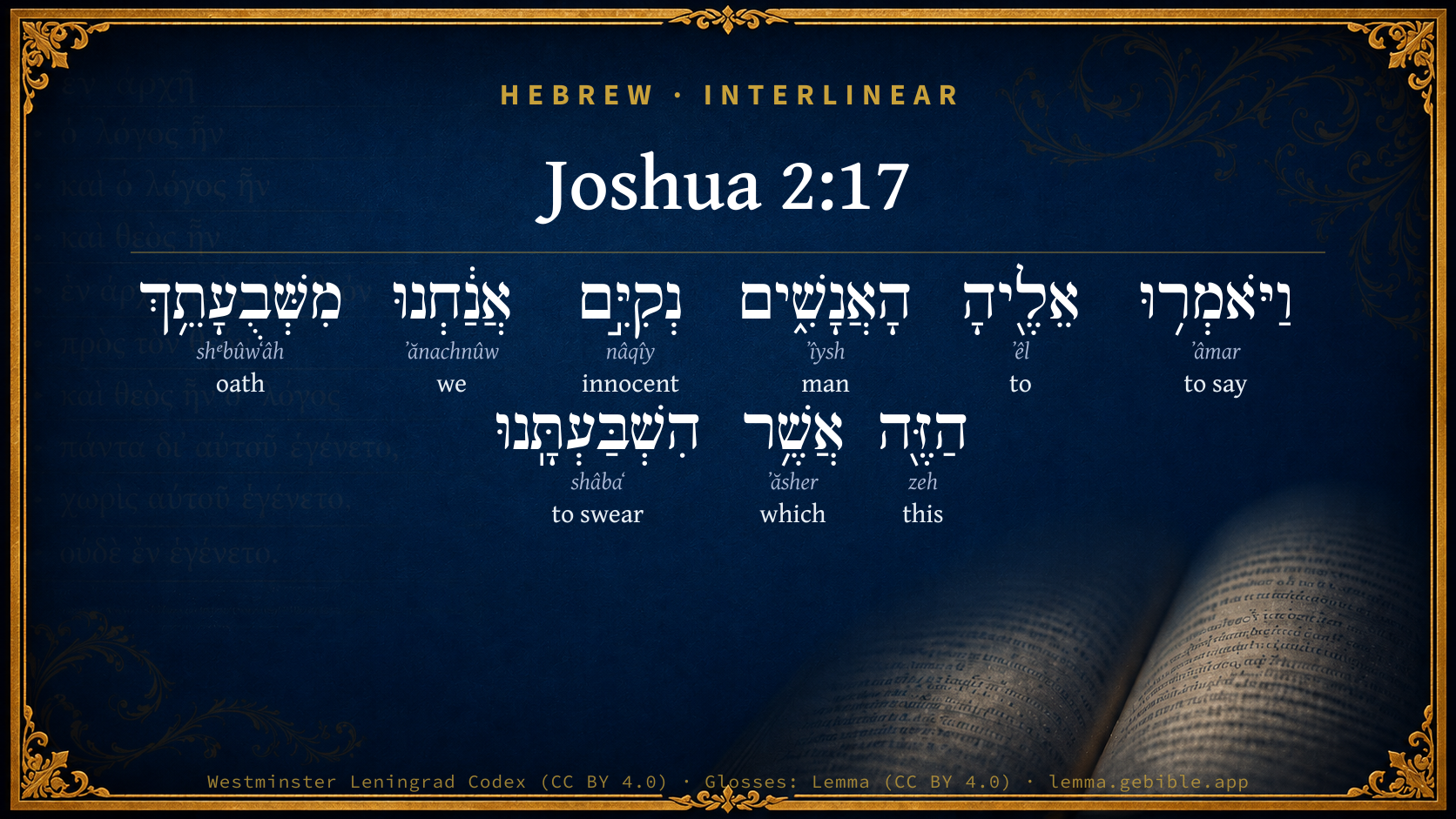
מִשְּׁבֻעָתֵ֥ךְ
shᵉbûwʻâh
H7621
“from · oath · your”
Preposition + Noun, Common, Feminine, Singular, Construct + Suffix, Personal, 2nd Person, Feminine, Singular
Part of Speech
Preposition + Noun
Type
Common
Gender
Feminine
Number
Singular
State
Construct
Full BDB Definition

Origin: pass part of H7650

TWOT: 2319a

oath, curse - oath - attesting of innocence - curse - oath (of Jehovah)
  1. וַיֹּאמְר֥וּ ʼâmar H559 “and · to say” Conjunction + Verb, Qal, Sequential Imperfect, 3rd Person, Masculine, Plural
  2. אֵלֶ֖יהָ ʼêl H413 “to · her” Preposition + Suffix, Personal, 3rd Person, Feminine, Singular
  3. הָאֲנָשִׁ֑ים ʼîysh H376 “the · men” Particle, Definite Article + Noun, Common, Masculine, Plural, Absolute
  4. נְקִיִּ֣ם nâqîy H5355 “innocent” Adjective, Adjective, Masculine, Plural, Absolute
  5. אֲנַ֔חְנוּ ʼănachnûw H587 “we” Pronoun, Personal, 1st Person, Common, Plural
  6. הַזֶּ֖ה zeh H2088 “the · this” Particle, Definite Article + Pronoun, Demonstrative, Masculine, Singular
  7. אֲשֶׁ֥ר ʼăsher H834 “which” Particle, Relative
  8. הִשְׁבַּעְתָּֽנוּ shâbaʻ H7650 “to swear · us” Verb, Hiphil, Perfect, 2nd Person, Feminine, Singular + Suffix, Personal, 1st Person, Common, Plural

About this verse

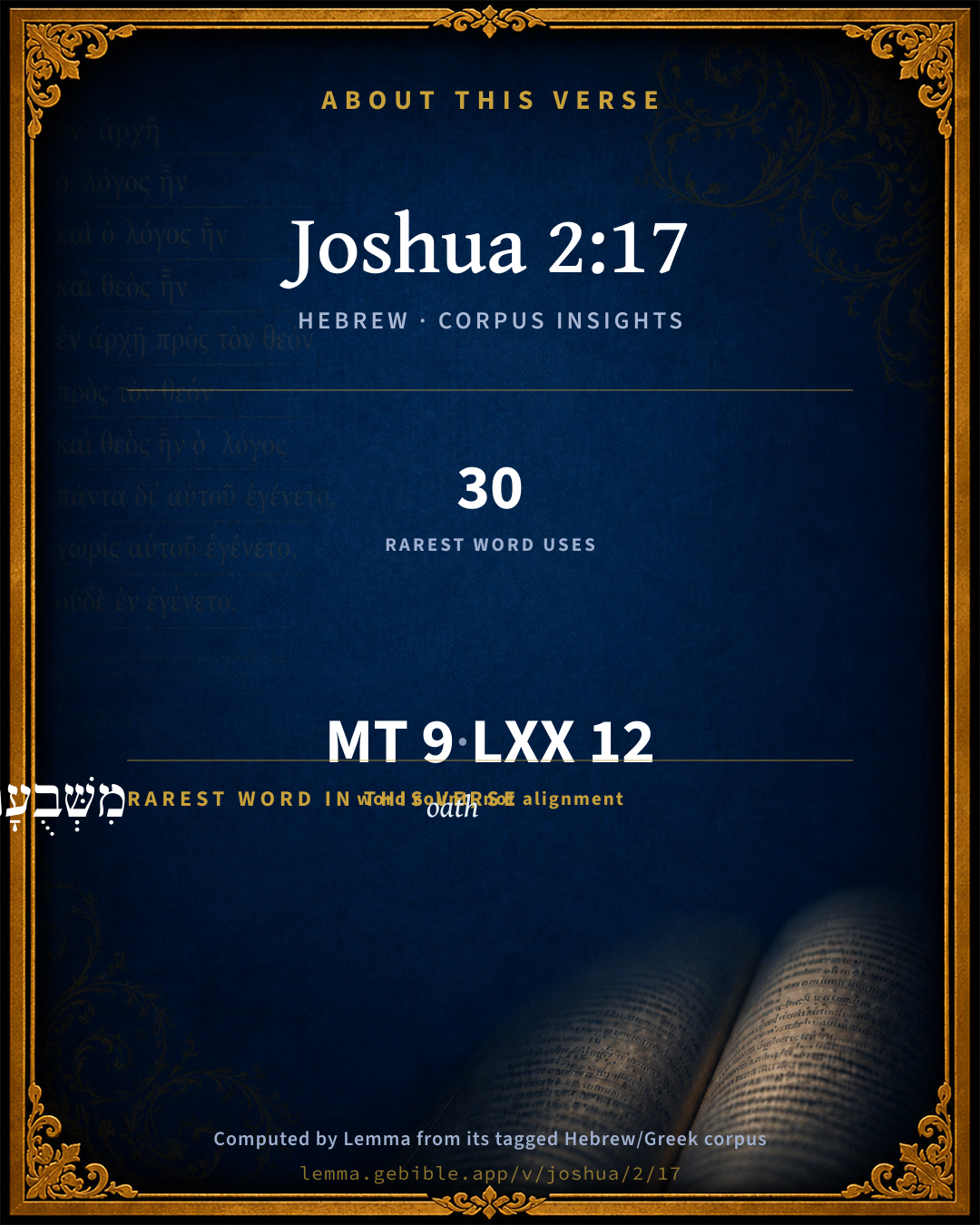
These counts appear in no published source. They are computed here, from the morphology-tagged text and Lemma’s own curated glosses. What Lemma adds →

9
words
9
distinct lemmas
Historical
section

Shared distinctive vocabulary

מִשְּׁבֻעָתֵ֥ךְ oath H7621 occurs in 29 verses of the Hebrew Bible. Also found in:

Grammatical profile

  • 2 verbs
  • 2 nouns
  • 1 adjective
  • 2 pronouns
  • 1 preposition
  • 1 particle

Verb forms

  • וַיֹּאמְר֥וּ Qal · Sequential Imperfect
  • הִשְׁבַּעְתָּֽנוּ Hiphil · Perfect

Hebrew & Septuagint length

In English translation the verse runs 20 words from the Hebrew and 13 from the Septuagint (LXX English) — the Septuagint runs noticeably shorter here. See the side-by-side →

A rough comparison of the two English renderings, which tokenize alike — not a word-level alignment.

Word counts can differ between the Hebrew and the Greek without any difference in meaning — e.g. the Hebrew direct-object marker אֵת has no separate Greek word, and Greek often adds the article ὁ.

In the original languages it is 9 Hebrew tokens and 12 Greek tokens — but the two are counted differently (Hebrew bundles its prefixes and suffixes into one token; the Greek is in lemma form), so that isn’t a like-for-like length.

Cross-references

7

Topical passages linked to Joshua 2:17 in the Treasury of Scripture Knowledge — connected by theme and wording, ordered by reader-vote popularity; previews shown in the World English Bible.

  • Numbers 30:2 When a man vows a vow to Yahweh, or swears an oath to bind his soul with a bond, he shall not break his word; he shall do according to all that proceeds out of his mouth.
  • 2 Samuel 21:7 But the king spared Mephibosheth, the son of Jonathan the son of Saul, because of Yahweh's oath that was between them, between David and Jonathan the son of Saul.
  • Genesis 24:3–8 I will make you swear by Yahweh, the God of heaven and the God of the earth, that you shall not take a wife for my son of the daughters of the Canaanites, among whom I live.
  • Leviticus 19:11–12 "'You shall not steal; neither shall you deal falsely, nor lie to one another.
  • 2 Samuel 21:1–2 There was a famine in the days of David three years, year after year; and David sought the face of Yahweh. Yahweh said, It is for Saul, and for his bloody house, because he put to death the Gibeonites.
  • Exodus 20:7 "You shall not take the name of Yahweh your God in vain, for Yahweh will not hold him guiltless who takes his name in vain.
  • Joshua 2:20 But if you utter this our business, then we shall be guiltless of your oath which you have made us to swear.

Cross-references courtesy of OpenBible.info (CC BY 4.0).

Hebrew and Greek witnesses Masoretic Hebrew ↔ Greek Septuagint

The same verse in the two great witnesses to the Old Testament, shown verse-for-verse.

Here the Septuagint runs noticeably shorter than the Hebrew — LXX2012 (modern English Septuagint) 13 words vs World English Bible 20. A rough length comparison of the two English translations, not a word-level alignment — read both below.

These are two independent witnesses, not word-aligned to each other, and the Septuagint is shown in lemma (dictionary) form.

Hebrew Joshua 2:17 Masoretic · Westminster Leningrad Codex

וַיֹּאמְר֥וּ אֵלֶ֖יהָ הָאֲנָשִׁ֑ים נְקִיִּ֣ם אֲנַ֔חְנוּ מִשְּׁבֻעָתֵ֥ךְ הַזֶּ֖ה אֲשֶׁ֥ר הִשְׁבַּעְתָּֽנוּ

The men said to her, We will be guiltless of this your oath which you have made us to swear.

World English Bible · Public Domain

Greek LXX Joshua 2:17 Septuagint · lemma form

καί εἶπον ὁ ἀνήρ πρός αὐτός ἀθῷος εἰμί ὁ ὅρκος σύ οὗτος

And the men said to her, We are clear of this your oath.

LXX2012 (modern English Septuagint) · Public Domain

Hebrew: Westminster Leningrad Codex (CC BY 4.0). Greek: Septuagint (public domain); English from LXX2012 (modern English Septuagint) (Public Domain). How the Septuagint differs from the Hebrew →

Targum (Aramaic paraphrase)

1

The Targum is the ancient Jewish Aramaic paraphrase of the Hebrew Scriptures — an interpretive translation, not the Hebrew text itself. Onkelos (literal) and Pseudo-Jonathan (expansive) render the Torah, and Jonathan the Prophets. Coverage is partial: where no permissively-licensed English translation exists for a verse, only the Aramaic is shown. This is verse-level text, not a word-by-word alignment to the Hebrew.

  1. Targum Jonathan Prophets (Joshua–Malachi)
    וַאֲמַרוּ לָהּ גֻבְרַיָא זַכָּאִין אֲנַחְנָא מִמוֹמָתֵךְ הָדָא דְקַיֵמְתָּ עֲלָנָא:

    (no public-domain English translation for this verse)

    Targum Jonathan — Aramaic: “Mikraot Gedolot” (public domain). English: “Sefaria Community Translation” (CC0 1.0 (public-domain dedication)); “London "Chaldee Paraphrase," 1871” (public domain). Text via Sefaria.

Commentary

Notes on Joshua 2:17 from classic Christian and Jewish commentators (each source and its license shown beneath its notes). The classic Christian expositions comment on the surrounding passage and are grouped to its opening verse, so a note may address several verses; the Jewish commentaries on the Tanakh (Rashi and others) are per-verse, so they appear only where the commentator wrote on this verse.

Lemma curates 59 commentaries, every one of them public domain or Creative Commons licensed, each selected and text-cleaned for this edition rather than reprinted as found. About our sources →

Trapp's Complete Commentary

John Trapp

Jos 2:17 And the men said unto her, We [will be] blameless of this thine oath which thou hast made us swear.

Ver. 17. We will be blameless of this thine oath,] q.d, Great haste though we have, yet will we clear up the terms whereunto we have sworn, to prevent the danger or rebut the suspicion of perjury. An oath is not to be taken but with a great deal of caution and circumspection, {Gen 24:3-5} not in jest, but in judgment, {Jer 4:2 Isa 48:1} not rashly and unadvisedly, {Lev 5:4 1Sa 14:39; 1Sa 14:44} as those that swear in heat and choler, when they should with fear, {Deu 10:20} discerning the nature of an oath, the necessity, the conditions and circumstances.

John Trapp, A Commentary or Exposition upon All the Books of the Old and New Testament (1647–1656) — public domain. Text from a community e-Sword module.

Joseph Benson's Commentary

Jos 2:17. The men said — Or, had said; namely, before she let them down; it being very improbable either that she would dismiss them before the condition was agreed on, or that she would discourse with them, or they with her, about such secret and weighty things after they were let down, when others might overhear them. Blameless — That is, free from guilt or reproach if it be violated; namely, if the following condition be not observed.

Joseph Benson's Commentary on the Old and New Testaments (1811–1818) — public domain. Text from a community e-Sword module.

Keil & Delitzsch

C. F. Keil & F. Delitzsch

In conclusion, the spies guarded against any arbitrary interpretation and application of their oath, by imposing three conditions, on the non-fulfilment of which they would be released from their oath. הזּה for הזּאת is to be explained in Jos 2:17 from the fact that the gender is often disregarded in the use of the pronoun (see Ewald, 183, a.), and in Jos 2:18 from the fact that there the gender is determined by the nomen rectum (see Ewald, 317, d.).

Jos 2:18

The first condition was, that when the town was taken Rahab should make her house known to the Israelites, by binding "the cord of this crimson thread," i.e., this cord made of crimson thread, in the window from which she had let them down. The demonstrative "this" leads to the conclusion adopted by Luther and others, that "this cord" is the rope (חבל) mentioned in Jos 2:15, as no other word had been mentioned to which they could refer; and the fact that nothing has been said about the sign in question being either given or received, precludes the idea that the spies gave the cord to Rahab for a sign. The crimson or scarlet colour of the cord (שׁני = שׁני תּולעת; see at Exo 25:4), as the colour of vigorous life, made this cord an expressive sign of the preservation of Rahab's life and the lives of her relations. The second condition was, that when the town was taken, Rahab should collect together her parents, and her brothers and her sisters, into her own house.

Jos 2:19-20

Whoever went outside the door, his blood should be upon his own head; i.e., if he was slain outside by the Israelitish soldiers, he should bear his death as his own fault. But every one who was with her in the house, his blood should fall upon their (the spies') head, if any hand was against them, i.e., touched them or did them harm (vid., Exo 9:3). The formula, "his blood be upon his head," is synonymous with the legal formula, "his blood be upon him" (Lev 20:9). The third condition (Jos 2:20) is simply a repetition of the principal condition laid down at the very outset (Jos 2:14).

Keil & Delitzsch — Biblical Commentary on the Old Testament (1861–1891) — public domain (CC PDM 1.0). Text via the HelloAO Bible API. (Old Testament only.)

Geneva Bible (1599)

Geneva Bible translators

We shall be discharged of our oath if thou dost perform this condition that followeth: for so shalt thou and thine be delivered.

Geneva Bible (1599) marginal notes — public domain. Text via Bolls.life.

The Cambridge Bible for Schools and Colleges

gen. ed. J. J. S. Perowne

17. We will be blameless] Or, “We are blameless.” We must supply “unless you do what we shall now say unto you.” Comp. Gen_24:41, “Then shalt thou be clear from this my oath, when thou comest to my kindred; and if they give not thee one, thou shalt be clear from my oath.” Wyclif renders it “we schulen be giltles of this oath.”

The Cambridge Bible for Schools and Colleges (gen. ed. J. J. S. Perowne; Cambridge University Press, 1878–1918) — public domain. Text from a community e-Sword module.

John Gill's Exposition

And the men said unto her,.... Some think that this discourse, which passed between the spies and her, was while in the house before she let them down, or otherwise they would have been in danger of being overheard, and so the whole affair discovered; but as it was on the other side of the house, and under the wall of the city, and without it, they might with the greater safety converse together:

we will be blameless of this thine oath which thou hast made us swear; that is, they would most faithfully and punctually keep it, it should be sacred to them, and she should have no occasion to lay any blame upon them in the least.

John Gill's Exposition of the Whole Bible (1746–1763) — public domain (CC PDM 1.0). Text via the HelloAO Bible API.

Matthew Poole's English Annotations

The men said, or, had said; namely, before she let them down; it being very improbable, either that she would dismiss them before the condition was expressed and agreed; or that she would discourse with them, or they with her, about such secret and weighty things after they were let down, when others might overhear them; or that she should begin her discourse in her chamber, and not finish it till they were gone out of her house.

Object. They spoke this after they were let down; for it follows, Jos 2:18, this-thread which thou didst let us down by.

Answ. Those words may be thus rendered, which thou dost let us down by, i.e. art about to do it; it being frequent for the pretertense to be used of a thing about to be done, by an enallage of tenses, as Jos 10:15.

Blameless of this thine oath, i.e. free from guilt or reproach if it be violated, namely, if the following condition be not observed.

Matthew Poole's English Annotations on the Holy Bible (1683–1685) — public domain. Text from a community e-Sword/MySword module.

Whedon's Commentary on the Bible

Daniel D. Whedon

17. We will be blameless of this thine oath — That is, released from the oath which we have taken, provided you do not fulfil the following conditions.

Daniel D. Whedon (gen. ed.), Commentary on the Old and New Testaments (1874–1909) — public domain. Text from a community e-Sword module.

The Pulpit Commentary

We will be blameless. Perhaps "we would be blameless," and therefore we make the conditions which follow. Something must be supplied to fill up the sense. The most ordinary rule would be to translate "we are blameless," i.e., by making these conditions. But the former yields a better sense.

The Pulpit Commentary (1880–1919), ed. H.D.M. Spence-Jones & Joseph S. Exell — public domain. Text from a community e-Sword module.

John Wesley's Explanatory Notes

Said - Or, had said; namely, before she let them down; it being very improbable, either that she would dismiss them before the condition was agreed on; or that she would discourse with them, or they with her, about such secret and weighty things after they were let down, when others might overhear them. Blameless - That is, free from guilt or reproach if it be violated, namely, if the following condition be not observed.

John Wesley, Explanatory Notes Upon the Whole Bible (1754–1765) — public domain. Text via the GEBible commentary corpus.

Rashi

Rabbi Shlomo Yitzchaki (Rashi)

We will be free. We are holding you responsible for this, we depend on you to make this sign.

Rashi on the Tanakh — English translations: “The Judaica Press complete Tanach with Rashi, translated by A. J. Rosenberg” (CC BY 4.0); “Pentateuch with Rashi's commentary by M. Rosenbaum and A.M. Silbermann, 1929-1934” (public domain); “The Metsudah Tanach series, Lakewood, N.J” (CC BY 4.0); and “The Book of Joshua, Metsudah Publications, 1997” (CC BY 4.0). Text via Sefaria.

Lesson kit

Teaching starters — assembled from the data on this page, not authored interpretation. Every prompt links to the verse data it draws on. Edit before teaching.

Joshua, in the Historical, opens this verse with 9 words (9 distinct Hebrew lemmas). Its most distinctive word is shᵉbûwʻâh (“oath”). The Greek Septuagint runs shorter here. A historical commentator’s framing appears above. Read the whole chapter for the surrounding context.

Discussion questions

  1. What does “oath” (shᵉbûwʻâh) contribute to the verse as a whole?
  2. Genesis 24:8 shares the word «oath» with this verse. How do the two illuminate each other?
  3. Compared with the Hebrew, the Septuagint runs shorter here. What questions does that raise?
  4. These translations render this verse differently; the difference is in the English rendering, not the original. What questions does that raise?
  5. The verb «וַיֹּאמְר֥וּ» is Qal Sequential Imperfect. How does its form color the action?
  6. Reading how Trapp's Complete Commentary and Joseph Benson's Commentary read this verse, where do the two commentators agree and where do they part?

Things to notice

Reading settings

Reading text

Shown beneath each verse's original-language words.

Old Testament
Old Testament edition

Read the OT as the Masoretic Hebrew (MT) or the Greek Septuagint (LXX).

English shown for the Greek Septuagint (in the Hebrew ↔ Greek comparison).

Comparing translations? Open the Compare panel on any verse page to stack up to four side by side.