
Judges 9:28

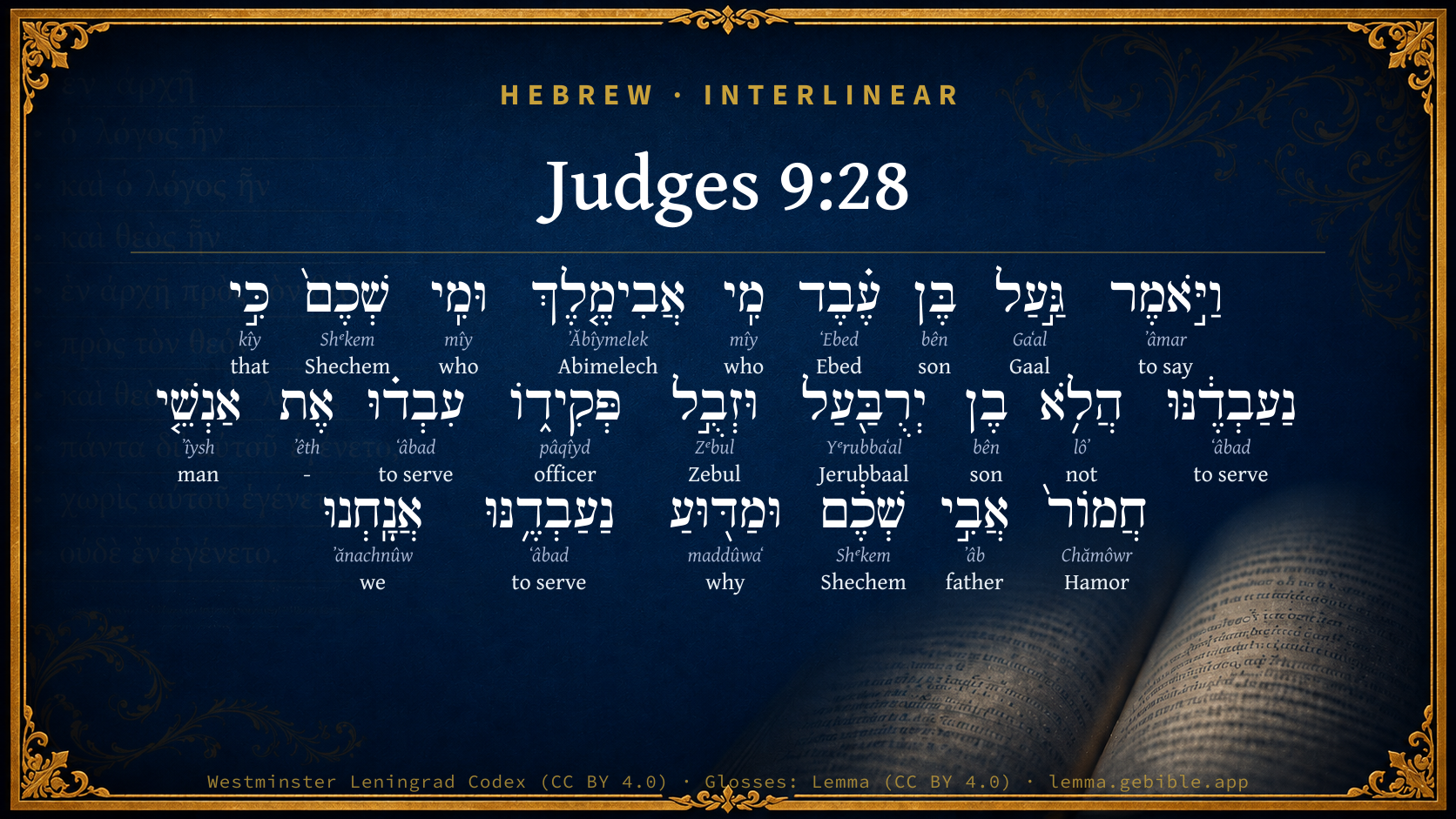
Hebrew (Westminster Leningrad Codex) Judges 9:28 appears in the Hebrew Old Testament. The text above is from the Westminster Leningrad Codex. Each word links to its Strong’s number, a concise gloss, and parsing drawn from the Open Scriptures Hebrew Bible morphology. Click any word for its full Brown-Driver-Briggs (BDB) entry.
Download image
Cite this verse

Judges 9:28 (World English Bible). Public Domain. Lemma interlinear Bible study tool, https://lemma.gebible.app/v/judges/9/28.

Show BibTeX & RIS
BibTeX
RIS
English Translation
Gaal the son of Ebed said, Who is Abimelech, and who is Shechem, that we should serve him? Isn't he the son of Jerubbaal? and Zebul his officer? serve you the men of Hamor the father of Shechem: but why should we serve him?
World English Bible · Public Domain
Highlights
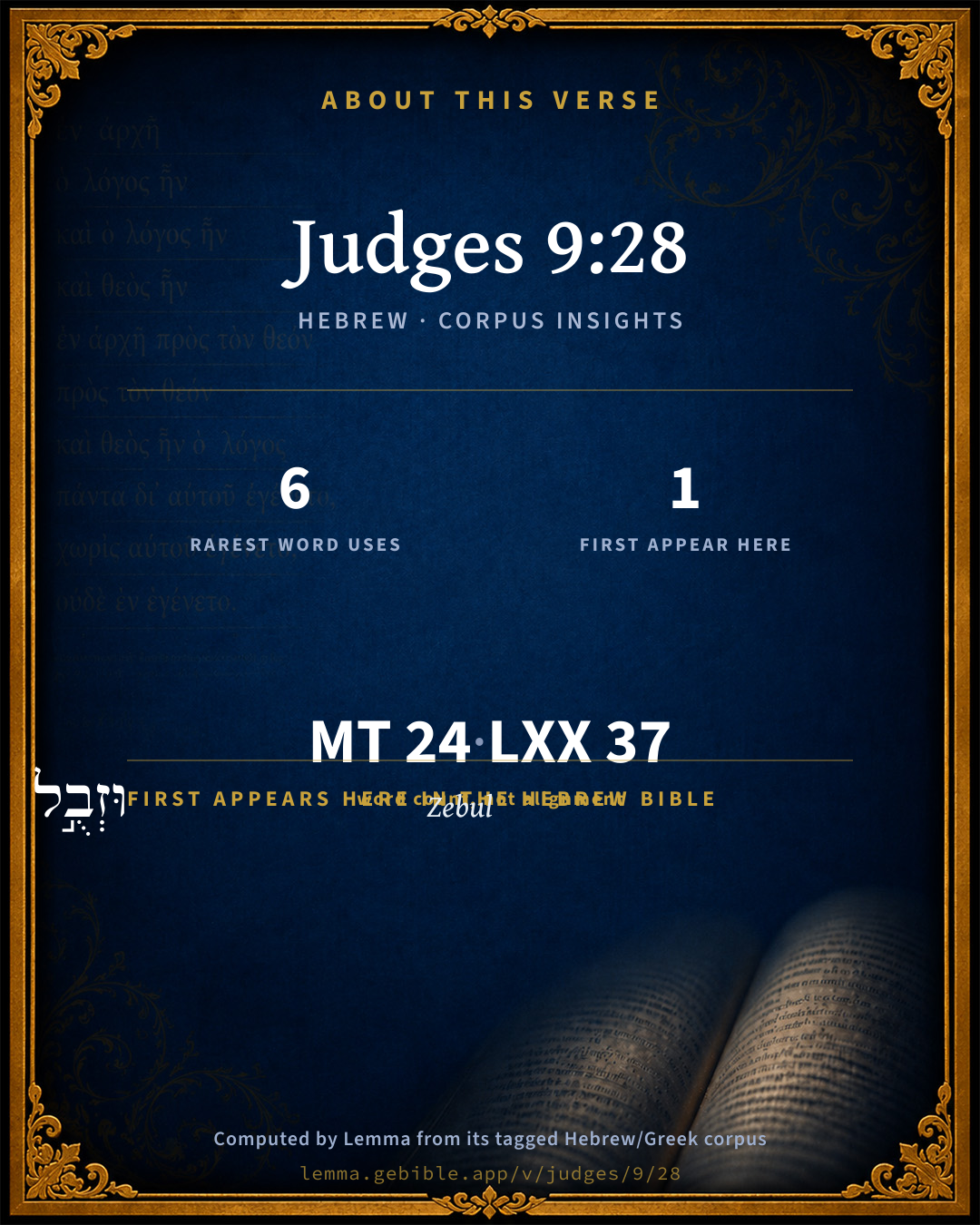
  • 1 first appearance in the Hebrew Bible
Full analysis ↓
Download a study sheet

One document with this verse’s original text, its word-by-word gloss line, the meaning frame, cross-references with their text, attributed commentary, and full source and license credits — printable, and it pastes into notes with its structure intact.

This verse Autodidact and up

Study sheet (.html) Plain text (.txt)

A passage Seminary Student

Up to 50 verses in one chapter. A passage sheet keeps up to 6 commentary sources and 12 cross-references per verse, in the order this page ranks them, and says so on the sheet whenever that leaves anything out. Ask for a single verse and you get the Autodidact verse sheet above.

Everything on this page stays free to read, with no account — the sheet is a download of what is already on screen, not access to it.

Want to remove ads? Support Godless Engineer
Compare translations 3

The same verse in 3 English versions, stacked beneath the original-language interlinear above. Click any original word for its lexicon entry.

Each is an independent rendering of the whole verse — the interlinear is not word-aligned to these translations.

Highlighted words mark where these versions differ — a whole-verse word diff, not a word-by-word alignment.

  • World English Bible Public Domain
    Gaal the son of Ebed said, Who is Abimelech, and who is Shechem, that we should serve him? Isn't he the son of Jerubbaal? and Zebul his officer? serve you the men of Hamor the father of Shechem: but why should we serve him?
  • King James Version Public Domain
    And Gaal the son of Ebed said, Who is Abimelech, and who is Shechem, that we should serve him? is not he the son of Jerubbaal? and Zebul his officer? serve the men of Hamor the father of Shechem: for why should we serve him?
  • unfoldingWord Literal Text CC BY-SA 4.0
    Then Gaal, the son of Ebed, said, “Who Abimelech, and who Shechem, that we should serve him? not the son of Jerubbaal, and Zebul his deputy? Serve the men of Hamor, the father of Shechem. But we, why should we serve him?

unfoldingWord Literal Text — © unfoldingWord, licensed CC BY-SA 4.0. Word-aligned USFM3 via Door43 (git.door43.org/unfoldingWord/en_ult).

Versions to compare (up to 4)

3 of 4 selected

Show all 18 translations

Every available English version of this verse, each an independent rendering of the whole verse.

  • World English Bible Public Domain
    Gaal the son of Ebed said, Who is Abimelech, and who is Shechem, that we should serve him? Isn't he the son of Jerubbaal? and Zebul his officer? serve you the men of Hamor the father of Shechem: but why should we serve him?
  • Berean Standard Bible Public Domain
    Then Gaal son of Ebed said, “Who is Abimelech, and who is Shechem, that we should serve him? Is he not the son of Jerubbaal, and is not Zebul his officer? You are to serve the men of Hamor, the father of Shechem. Why should we serve Abimelech?
  • Majority Standard Bible Public Domain
    Then Gaal son of Ebed said, “Who is Abimelech, and who is Shechem, that we should serve him? Is he not the son of Jerubbaal, and is not Zebul his officer? You are to serve the men of Hamor, the father of Shechem. Why should we serve Abimelech?
  • King James Version Public Domain
    And Gaal the son of Ebed said, Who is Abimelech, and who is Shechem, that we should serve him? is not he the son of Jerubbaal? and Zebul his officer? serve the men of Hamor the father of Shechem: for why should we serve him?
  • American Standard Version (1901) Public Domain
    And Gaal the son of Ebed said, Who is Abimelech, and who is Shechem, that we should serve him? is not he the son of Jerubbaal? and Zebul his officer? serve ye the men of Hamor the father of Shechem: but why should we serve him?
  • Revised Version (1885) Public Domain
    And Gaal the son of Ebed said, Who is Abimelech, and who is Shechem, that we should serve him? is not he the son of Jerubbaal? and Zebul his officer? serve ye the men of Hamor the father of Shechem: but why should we serve him?
  • Geneva Bible (1599) Public Domain
    Then Gaal the sonne of Ebed sayde, Who is Abimelech? and who is Shechem, that wee should serue him? Is he not the sonne of Ierubbaal? and Zebul is his officer? Serue rather the men of Hamor the father of Shechem: for why should we serue him?
  • Douay-Rheims (1899) Public Domain
    And Gaal the son of Obed cried: Who is Abimelech, and what is Sichem, that we should serve him? Is he not the son of Jerobaal, and hath made Zebul his servant ruler over the men of Emor the father of Sichem? Why then shall we serve him?
  • Young's Literal Translation Public Domain
    And Gaal son of Ebed saith, `Who `is' Abimelech, and who `is' Shechem, that we serve him? is `he' not son of Jerubbaal? and Zebul his commander? Serve ye the men of Hamor father of Shechem, and wherefore do we serve him -- we?
  • Literal Standard Version CC BY-SA 4.0
    And Gaal son of Ebed says, “Who [is] Abimelech, and who [is] Shechem, that we serve him? Is [he] not son of Jerubba‘al? And his commander Zebul? The men of Hamor father of Shechem serve you, and why do we serve him—we?
  • Unlocked Literal Bible CC BY-SA 4.0
    Gaal son of Ebed, said, “Who is Abimelech, and who is Shechem, that we should serve him? Is he not the son of Jerub Baal? Is Zebul not his officer? Serve the men of Hamor, Shechem's father! Why should we serve Abimelech?
  • unfoldingWord Literal Text CC BY-SA 4.0
    Then Gaal, the son of Ebed, said, “Who Abimelech, and who Shechem, that we should serve him? not the son of Jerubbaal, and Zebul his deputy? Serve the men of Hamor, the father of Shechem. But we, why should we serve him?
  • Darby Bible Public Domain
    And Ga'al the son of Ebed said, "Who is Abim'elech, and who are we of Shechem, that we should serve him? Did not the son of Jerubba'al and Zebul his officer serve the men of Hamor the father of Shechem? Why then should we serve him?
  • World Messianic Bible Public Domain
    Gaal the son of Ebed said, “Who is Abimelech, and who is Shechem, that we should serve him? Isn’t he the son of Jerubbaal? Isn’t Zebul his officer? Serve the men of Hamor the father of Shechem, but why should we serve him?
  • Webster's Bible Public Domain
    And Gaal the son of Ebed said, Who is Abimelech, and who is Shechem, that we should serve him; is not he the son of Jerubbaal? and Zebul his officer? Serve the men of Hamor the father of Shechem: for why should we serve him?
  • Free Bible Version CC BY-SA 4.0
    “Who is this Abimelech?” asked Gaal, son of Ebed. “And who is Shechem, that we should have to serve him? Isn't he the son of Jerub-baal, while Zebul is actually the one in charge? You should serve the family of Hamor, the father of Shechem. Why should we have to serve Abimelech?
  • Bible in Basic English Public Domain
    And Gaal, the son of Ebed, said, Who is Abimelech and who is Shechem, that we are to be his servants? Is it not right for the son of Jerubbaal and Zebul his captain to be servants to the men of Hamor, the father of Shechem? But why are we to be his servants?
  • JPS Tanakh (1917) Public Domain
    And Gaal the son of Ebed said: 'Who is Abimelech, and who is Shechem, that we should serve him? is not he the son of Jerubbaal? and Zebul his officer? serve ye the men of Hamor the father of Shechem; but why should we serve him?

Literal Standard Version (2020), Covenant Press — licensed CC BY-SA 4.0. Text via the HelloAO Bible API (eBible.org). Unlocked Literal Bible (unfoldingWord) — licensed CC BY-SA 4.0. Text via the HelloAO Bible API (eBible.org). unfoldingWord Literal Text — © unfoldingWord, licensed CC BY-SA 4.0. Word-aligned USFM3 via Door43 (git.door43.org/unfoldingWord/en_ult). Free Bible Version, Dr. Jonathan Gallagher — licensed CC BY-SA 4.0. Text via the HelloAO Bible API (eBible.org).

Word by word

More ways to search: Search by grammar → Find every occurrence → Compare this word →

Practice this passage: Drill this verse → Learn its vocabulary →

עֶ֗בֶד
ʻEbed
H5651
“Ebed”
Noun, Proper
Part of Speech
Noun
Type
Proper
Full BDB Definition

Origin: the same as H5650

TWOT: None

Ebed = "servant" - father of Gaal in the time of the judges - son of Jonathan and one of the sons of Adin who returned from exile with Ezra
  1. וַיֹּ֣אמֶר ʼâmar H559 “and · to say” Conjunction + Verb, Qal, Sequential Imperfect, 3rd Person, Masculine, Singular
  2. גַּ֣עַל Gaʻal H1603 “Gaal” Noun, Proper
  3. בֶּן bên H1121 “son of” Noun, Common, Masculine, Singular, Construct
  4. מִֽי mîy H4310 “who” Particle, Interrogative
  5. אֲבִימֶ֤לֶךְ ʼĂbîymelek H40 “Abimelech” Noun, Proper
  6. וּמִֽי mîy H4310 “and · who” Conjunction + Particle, Interrogative
  7. שְׁכֶם֙ Shᵉkem H7927 “Shechem” Noun, Proper
  8. כִּ֣י kîy H3588 “that” Conjunction
  9. נַעַבְדֶ֔נּוּ ʻâbad H5647 “to serve · us” Verb, Qal, Imperfect, 1st Person, Common, Plural + Suffix, Personal, 1st Person, Common, Plural
  10. הֲלֹ֥א lôʼ H3808 “not” Particle, Interrogative + Particle, Negative
  11. בֶן bên H1121 “son of” Noun, Common, Masculine, Singular, Construct
  12. יְרֻבַּ֖עַל Yᵉrubbaʻal H3378 “Jerubbaal” Noun, Proper
  13. וּזְבֻ֣ל Zᵉbul H2083 “and · Zebul” Conjunction + Noun, Proper
  14. פְּקִיד֑וֹ pâqîyd H6496 “officer · his” Noun, Common, Masculine, Singular, Construct + Suffix, Personal, 3rd Person, Masculine, Singular
  15. עִבְד֗וּ ʻâbad H5647 “serve” Verb, Qal, Imperative, 2nd Person, Masculine, Plural
  16. אֶת ʼêth H853 “-” Particle, Direct Object
  17. אַנְשֵׁ֤י ʼîysh H376 “men of” Noun, Common, Masculine, Plural, Construct
  18. חֲמוֹר֙ Chămôwr H2544 “Hamor” Noun, Proper
  19. אֲבִ֣י ʼâb H1 “father of” Noun, Common, Masculine, Singular, Construct
  20. שְׁכֶ֔ם Shᵉkem H7927 “Shechem” Noun, Proper
  21. וּמַדּ֖וּעַ maddûwaʻ H4069 “and · why” Conjunction + Particle, Interrogative
  22. נַעַבְדֶ֥נּוּ ʻâbad H5647 “to serve · us” Verb, Qal, Imperfect, 1st Person, Common, Plural + Suffix, Personal, 1st Person, Common, Plural
  23. אֲנָֽחְנוּ ʼănachnûw H587 “we” Pronoun, Personal, 1st Person, Common, Plural

About this verse

These counts appear in no published source. They are computed here, from the morphology-tagged text and Lemma’s own curated glosses. What Lemma adds →

24
words
19
distinct lemmas
Historical
section

Notable vocabulary

The rarest word here is עֶ֗בֶד Ebed H5651 — appearing just 6 times in the whole Hebrew Bible.

First appearance in Scripture

This word makes its first canonical appearance in the Hebrew Bible here:

  • וּזְבֻ֣ל Zebul H2083

Shared distinctive vocabulary

עֶ֗בֶד Ebed H5651 occurs in 6 verses of the Hebrew Bible. Also found in:

Grammatical profile

  • 4 verbs
  • 13 nouns
  • 1 pronoun
  • 1 conjunction
  • 5 particles

Verb forms

  • וַיֹּ֣אמֶר Qal · Sequential Imperfect
  • נַעַבְדֶ֔נּוּ Qal · Imperfect
  • עִבְד֗וּ Qal · Imperative
  • נַעַבְדֶ֥נּוּ Qal · Imperfect

Repetition

Words recur within this verse — often emphatic in Hebrew:

  • נַעַבְדֶ֔נּוּ to serve H5647 ×3
  • בֶּן son H1121 ×2
  • שְׁכֶם֙ Shechem H7927 ×2
  • מִֽי who H4310 ×2

Hebrew & Septuagint length

In English translation the verse runs 44 words from the Hebrew and 52 from the Septuagint (LXX English) — closely comparable.

A rough comparison of the two English renderings, which tokenize alike — not a word-level alignment.

Word counts can differ between the Hebrew and the Greek without any difference in meaning — e.g. the Hebrew direct-object marker אֵת has no separate Greek word, and Greek often adds the article ὁ.

In the original languages it is 24 Hebrew tokens and 37 Greek tokens — but the two are counted differently (Hebrew bundles its prefixes and suffixes into one token; the Greek is in lemma form), so that isn’t a like-for-like length.

Cross-references

5

Topical passages linked to Judges 9:28 in the Treasury of Scripture Knowledge — connected by theme and wording, ordered by reader-vote popularity; previews shown in the World English Bible.

  • Genesis 34:2 Shechem the son of Hamor the Hivite, the prince of the land, saw her. He took her, lay with her, and humbled her.
  • 1 Samuel 25:10 Nabal answered David's servants, and said, Who is David? and who is the son of Jesse? there are many servants now-a-days who break away every man from his master.
  • Genesis 34:6 Hamor the father of Shechem went out to Jacob to talk with him.
  • 1 Kings 12:16 When all Israel saw that the king didn't listen to them, the people answered the king, saying, What portion have we in David? neither have we inheritance in the son of Jesse: to your tents, Israel: now see to your own house, David. So Israel departed to their tents.
  • 2 Samuel 20:1 There happened to be there a base fellow, whose name was Sheba, the son of Bichri, a Benjamite: and he blew the trumpet, and said, We have no portion in David, neither have we inheritance in the son of Jesse: every man to his tents, Israel.

Cross-references courtesy of OpenBible.info (CC BY 4.0).

Hebrew and Greek witnesses Masoretic Hebrew ↔ Greek Septuagint

The same verse in the two great witnesses to the Old Testament, shown verse-for-verse.

These are two independent witnesses, not word-aligned to each other, and the Septuagint is shown in lemma (dictionary) form.

Hebrew Judges 9:28 Masoretic · Westminster Leningrad Codex

וַיֹּ֣אמֶר גַּ֣עַל בֶּן עֶ֗בֶד מִֽי אֲבִימֶ֤לֶךְ וּמִֽי שְׁכֶם֙ כִּ֣י נַעַבְדֶ֔נּוּ הֲלֹ֥א בֶן יְרֻבַּ֖עַל וּזְבֻ֣ל פְּקִיד֑וֹ עִבְד֗וּ אֶת אַנְשֵׁ֤י חֲמוֹר֙ אֲבִ֣י שְׁכֶ֔ם וּמַדּ֖וּעַ נַעַבְדֶ֥נּוּ אֲנָֽחְנוּ

Gaal the son of Ebed said, Who is Abimelech, and who is Shechem, that we should serve him? Isn't he the son of Jerubbaal? and Zebul his officer? serve you the men of Hamor the father of Shechem: but why should we serve him?

World English Bible · Public Domain

Greek LXX Judges 9:28 Septuagint · lemma form

καί εἶπον γααλ υἱός ιωβηλ τίς εἰμί αβιμελεχ καί τίς εἰμί υἱός συχεμ ὅτι δουλεύω αὐτός οὐ υἱός ιεροβααλ καί ζεβουλ ἐπισκοπός αὐτός δοῦλος αὐτός σύν ὁ ἀνήρ εμμωρ πατήρ συχεμ καί τίς ὅτι δουλεύω αὐτός ἐγώ

And Gaal the son of Jobel said, Who is Abimelech, and who is the son of Sychem, that we should serve him? Is he not the son of Jerobaal, and is not Zebul his steward, his servant with the son of Emmor the father of Sychem? and why should we serve him?

LXX2012 (modern English Septuagint) · Public Domain

On this verse, Ellicott's Commentary for English Readers discusses the Septuagint’s reading. Read the note in Commentary ↓

Hebrew: Westminster Leningrad Codex (CC BY 4.0). Greek: Septuagint (public domain); English from LXX2012 (modern English Septuagint) (Public Domain). How the Septuagint differs from the Hebrew →

Targum (Aramaic paraphrase)

1

The Targum is the ancient Jewish Aramaic paraphrase of the Hebrew Scriptures — an interpretive translation, not the Hebrew text itself. Onkelos (literal) and Pseudo-Jonathan (expansive) render the Torah, and Jonathan the Prophets. Coverage is partial: where no permissively-licensed English translation exists for a verse, only the Aramaic is shown. This is verse-level text, not a word-by-word alignment to the Hebrew.

  1. Targum Jonathan Prophets (Joshua–Malachi)
    וַאֲמַר גַעַל בַּר עֶבֶד מַן אֲבִימֶלֶךְ וּמַן שְׁכֶם אֲרֵי נִפְלְחִנֵיהּ הֲלָא בַּר יְרוּבַּעַל וּזְבֻל שׁוּלְטְנֵיהּ פְּלַחוּ יַת אֱנָשֵׁי חֲמוֹר אֲבוּהִי דִשְׁכֶם וּמָא דֵין נִפְלְחִנֵיהּ אֲנַחְנָא:

    (no public-domain English translation for this verse)

    Targum Jonathan — Aramaic: “Mikraot Gedolot” (public domain). English: “Sefaria Community Translation” (CC0 1.0 (public-domain dedication)); “London "Chaldee Paraphrase," 1871” (public domain). Text via Sefaria.

Commentary

Notes on Judges 9:28 from classic Christian and Jewish commentators (each source and its license shown beneath its notes). The classic Christian expositions comment on the surrounding passage and are grouped to its opening verse, so a note may address several verses; the Jewish commentaries on the Tanakh (Rashi and others) are per-verse, so they appear only where the commentator wrote on this verse.

Lemma curates 59 commentaries, every one of them public domain or Creative Commons licensed, each selected and text-cleaned for this edition rather than reprinted as found. About our sources →

Trapp's Complete Commentary

John Trapp

Jdg 9:28 And Gaal the son of Ebed said, Who [is] Abimelech, and who [is] Shechem, that we should serve him? [is] not [he] the son of Jerubbaal? and Zebul his officer? serve the men of Hamor the father of Shechem: for why should we serve him?

Ver. 28. Who is Abimelech, and who is Shechem?] Or, Who is Shechem? q.d., Is it so contemptible a city, that so base a fellow as Abimelech should have the sovereignty over it?

Is not he the son of Jerubbaal?] That is, Of one who bereft us of that religion, Baal worship, which is now happily re-established. Thus, this cunning fellow raketh together arguments of all sorts, whereby to wind himself into the people’s affections, and to get the government of the city.

And Zebul his officer?] His viceroy. O rem miseram! Dominum ferre non potuimus, et conservo servimus, {a} But why did they not turn Zebul, Abimelech’s intelligencer, out of this city? This, Gaal drove at doubtless, but could not obtain.

Serve the men of Hamor the father Shechem.] Who was rather a father than a ruler of this city: serve such as are descended of him (so Gaal pretended to be, as some think), or at least, will resemble him in fatherly lenity.

{a} Cicer., Epist., lib. xii.

John Trapp, A Commentary or Exposition upon All the Books of the Old and New Testament (1647–1656) — public domain. Text from a community e-Sword module.

Joseph Benson's Commentary

Jdg 9:28. Who is Abimelech — What is he but a base-born person, a cruel tyrant, and one every way unworthy to govern you? Who is Shechem — That is, Abimelech, named in the foregoing words, and described in those which follow. He is called Shechem for the Shechemite. The sense is, Who is this Shechemite? For so he was by the mother’s side, born of a woman of your city, and she but his concubine and servant; why should you submit to one so basely descended? Of Jerubbaal — Of Gideon, a person famous only by his fierceness against that Baal which you justly honour and reverence, whose altar he overthrew, and whose worship he endeavoured to abolish. And Zebul — And you are so mean-spirited, that you do not only submit to him, but suffer his very servants to bear rule over you; and particularly this ignoble and hateful Zebul. Serve the men of Hamor, &c. — If you love bondage, call in the old master and lord of the place; choose not an upstart, as Abimelech is; but rather take one of the old stock, one descended from Hamor, (Gen 34:2,) who did not carry himself like a tyrant, as Abimelech did; but like a father of his city. This he might speak sincerely, as being himself a Canaanite and Shechemite, and possibly came from one of those little ones whom Simeon and Levi spared when they slew all the grown males, Gen 34:29. And it may be that he was one of the royal blood, a descendant of Hamor who hereby sought to insinuate himself into the government, as it follows, Jdg 9:29, Would to God that this people were under my hand; which he might judge the people more likely to choose, both because they were now united with the Canaanites in religion, and because their present distress might oblige them to put themselves under him, a vigilant and expert commander.

Joseph Benson's Commentary on the Old and New Testaments (1811–1818) — public domain. Text from a community e-Sword module.

Jamieson, Fausset & Brown

Robert Jamieson, A. R. Fausset & David Brown

would to God this people were under my hand--He seems to have been a boastful, impudent, and cowardly person, totally unfit to be a leader in a revolutionary crisis. The consequence was that he allowed himself to be drawn into an ambush, was defeated, the city of Shechem destroyed and strewn with salt. The people took refuge in the stronghold, which was set on fire, and all in it perished.

Jamieson, Fausset & Brown — Commentary Critical and Explanatory on the Whole Bible (1871) — public domain (CC PDM 1.0). Text via the HelloAO Bible API.

Adam Clarke's Commentary

Verse 28. Zebul his officer] פקידו pekido, his overseer; probably governor of Shechem in his absence.

Adam Clarke's Commentary on the Bible (1810–1826) — public domain. Text from a community e-Sword/MySword module.

Ellicott's Commentary for English Readers

(28) Who is Abimelech?—This is obviously contemptuous, like “Who is David? and who is the son of Jesse?” in 1Sa_25:10.

Who is Shechem?—The meaning of this clause is very obscure. It can hardly be a contrast between the insignificance of Abimelech and the grandeur of Shechem (Vulg., quœ est Shechem?). Some say that “Shechem” means “Abimelech;” but there is no trace of kings assuming the name of the place over which they rule, nor does the LXX. mend matters much by interpolating the words, “who is the son of Shechem?”

The son of Jerubbaal?—And, therefore, on the father’s side, disconnected both with Ephraimites and Canaanites; and the Baal-fighter’s son has no claim on Baal-worshippers.

And Zebul his officer?—We are not even under the rule of Abimelech, but of his underling.

Serve the men of Hamor.—Here the LXX., Vulg., and other versions adopt a different punctuation and a different reading. But there is no reason to alter the text. The Canaanites were powerful; the Ephraimites had apostatised to their religion; even Abimelech bears a Canaanite name (Gen_26:1), and owed his power to his Hivite blood. Gaal says in effect. “Why should we serve this son of an upstart alien when we might return to the allegiance of the descendants of our old native prince Hamor, whose son Shechem was the hero eponymos of the city?” (Gen_33:19; Jos_24:32).

A Bible Commentary for English Readers, edited by Charles John Ellicott (1878–1897) — public domain. Text from a community e-Sword module.

The Cambridge Bible for Schools and Colleges

gen. ed. J. J. S. Perowne

28. who is Shechem?] i.e. what is Abimelech’s kingdom, that we should be bound to obey him? does it belong to him of right?

is not … serve ye] As it stands the text does not make sense; read the imperat. serve ye as a perf., they served, and translate Did not the son of J. and Z. his officer serve the men of Hamor, the father of Shechem? why then should we serve him? Gaal works upon the Shechemites’ national pride: ‘this chief of yours and his lieutenant were once the servants of the ancient race which sprang from Hamor (the traditional founder of Shechem, cf. Genesis 34); are we, the freemen of Shechem, to become the servants of this usurping half-breed?’ The emphasis is on we, in antithesis to ‘the son of J.’ etc.

The Cambridge Bible for Schools and Colleges (gen. ed. J. J. S. Perowne; Cambridge University Press, 1878–1918) — public domain. Text from a community e-Sword module.

John Gill's Exposition

And would to God this people were under my hand,.... Or government, that I were but the ruler of their city, and general of their forces:

then would I remove Abimelech; from his kingly office, and rid Shechem of him, and all the country round about, and indeed remove him out of the world:

and he said to Abimelech; as if he was present, in a hectoring and blustering manner; or he said what follows to his officer under him, that represented him; or he sent a messenger to him, saying:

increase thine army, and come out; bidding him defiance, challenging him to come into the open field and fight him, and bring as many forces along with him as he could or would, not doubting but he should be a match for him; and the men of Shechem would see they had nothing to fear from him, having such a man as Gaal at the head of them; this he said to engage the Shechemites to make him their ruler.

John Gill's Exposition of the Whole Bible (1746–1763) — public domain (CC PDM 1.0). Text via the HelloAO Bible API.

Haydock's Catholic Bible Commentary

Sichem. Why should this ancient city be thus degraded? This son of Jerobaal deigns not to reside among us, but sets one of his servants over us! (Haydock) --- He mentions Jerobaal instead of Gedeon, to remind the people of the indignity formerly offered to their great idol, by the father of their present ruler. (Menochius) --- Hebrew may have another sense. "Who is Abimelech?....Is he not the son of Jerobaal, and Zebul his officer? Serve the men of Hemor," &c. It seems that Gaal was of the race of Chanaan, by the manner in which he speaks of Hemor, whose history is given, Genesis xxxiv. Many of the same nations might still inhabit Sichem, (Calmet) which made the people so bold and zealous in the adoration of Baal. (Haydock) --- The insidious Gaal hence takes occasion to propose to his countrymen, that they had better acknowledge the authority of their ancient magistrates, who occupied the place of Hemor. (Calmet) --- But he immediately insinuates, that the most effectual method to expel the tyrant, would be to vest him with the sovereign authority. (Haydock) (ver. 29.) --- The party of Abimelech was now the weaker. (Calmet)

George Leo Haydock (1774–1849), Haydock's Catholic Family Bible and Commentary, 1859 edition — public domain. Excludes Psalms (Douay-Rheims chapter numbering differs from Protestant) and Deuterocanonical books (Catholic canon only).

Matthew Poole's English Annotations

Who is Abimelech? what is he but a base-born person, an ambitious, imperious, and cruel tyrant, and one every way unfit and unworthy to govern you?

Who is Shechem? Shechem is here the name, either,

1. Of the place or city of Shechem; and so the Hebrew particle mi, who, is put for mah, what, as it is Jdg 13:17; and then the sense of the place is this: Consider how obscure and unworthy a person Abimelech is, and what a potent and honourable city Shechem is; and judge you whether it be fit that such a city should be subject to such a person. Or rather,

2. Of a person, even of Abimelech, named in the foregoing words, and described in those which follow;

the son of Jerubbaal, between which Shechem is hemmed in, and therefore cannot conveniently belong to any other. He is called Shechem for the Shechemite, by a metonymy of the subject, whereby the place is put for the person contained in it, and belonging to it; as Egypt, Ethiopia, Seba, Judea, Macedonia, and Achaia, &c., are put for the people of those countries Job 1:15; 6:19; Psa 68:31; 105:38; Isa 43:3; Mat 3:5; Rom 15:26. Thus mi is taken properly, and the sense is, Who is this Shechemite? for so he was by the mother’s side, born of a woman of your city, and she but his concubine and servant; why should you submit to one so basely descended?

The son of Jerubbaal, i.e. of Gideon; a person obscure by his on n confession, Jdg 6:15, and famous only by his boldness and fierceness against that Baal which you justly honour and reverence, whose altar he overthrew, and whose worship he endeavoured to abolish.

And Zebul his officer; and you are so unworthy and mean-spirited, that you do not only submit to him, but suffer his very servants to bear rule over you, and enslave you; and particularly this noble and hateful person Zebul. Serve the men of Hamor the father of Shechem: if you love bondage, call in the old master and lord of the place; choose not an upstart, as Abimelech is; but rather take one of the old stock, one descended from Hamor, Gen 34:2, who did not carry himself like a tyrant, as Abimelech did, but like a father of his city of Shechem. This he might speak, either,

1. Sincerely, as being himself a Canaanite and a Shechemite, and possibly come from one of those little ones whom Simeon and Levi spared when they slew all the grown males, Gen 34:29. And it may be that he was one of the royal blood, a descendant of Hamor, who hereby sought to insinuate himself into their minds and government, as it follows, Jdg 9:29, Would to God this people were under my hand! which he might judge the people more likely to do, both because they were now united with the Canaanites in religion, and because their present distress might oblige them to put themselves under him, who seemed or pretended to be a valiant and expert commander. Or,

2. In way of derision, he being an Israelite: If you are so servile, serve some of the children of Hamor; which because you rightly judge to be absurd and dishonourable, do not now submit to a far baser person; but cast off his yoke, and recover your lost liberties.

Matthew Poole's English Annotations on the Holy Bible (1683–1685) — public domain. Text from a community e-Sword/MySword module.

Whedon's Commentary on the Bible

Daniel D. Whedon

28. Who is Abimelech — A most contemptuous question, implying that Abimelech was unworthy of respect. Compare 1Sa_25:10.

Who is Shechem — Shechem is not here opposed to Abimelech, as many commentators have supposed — that is, How contemptible is Abimelech on the one hand, and how noble is Shechem on the other! — for both words have the same grammatical and logical construction; but Shechem is to be understood of that part of the citizens of the place who were loyal to the king, and obedient to the authority of Zebul, the governor of the city. Among these were probably many of Abimelech’s kindred, for “the house of his mother’s father” had evidently no little influence in Shechem, (note, Jdg_9:1,) and they would naturally be opposed to this insurrection against the rule of their brother. Jdg_9:3. Zebul, the governor, was opposed to the rebellion, for his anger was kindled when he heard of what Gaal had said and done, (Jdg_9:30,) and with him, doubtless, many of the Shechemites sympathized. So to the question, Who is Abimelech? corresponds the answer, Son of Jerubbaal; and to Who is Shechem? corresponds, Zebul his officer, involving, of course, all the Shechemites who sympathized with Zebul and were loyal to Abimelech. The antithesis is between Abimelech and this part of the Shechemites on the one hand, and the we, with whom Gaal identifies himself, on the other. These latter are called the men of Hamor the father of Shechem, that is, descendants of that ancient and noble prince who had founded the city, and called it Shechem, after the name of his son. Gen_33:19. It is altogether probable that a remnant of that ancient Hivite family still abode in Shechem, and might, with much plausibility, assume to be patricians of that capital of their fathers. Why should the descendants of such a family serve the son of the hated Baal-fighter, the destroyer of their idols?

Daniel D. Whedon (gen. ed.), Commentary on the Old and New Testaments (1874–1909) — public domain. Text from a community e-Sword module.

The Pulpit Commentary

And Gaal, etc. Gaal now saw his opportunity, and encouraged the revolt. Who is Abimelech, and who is Shechem, that we should serve him? The meaning of these words, though somewhat obscure at first, becomes plain if we compare the two similar passages, 1Ki_12:16. In the first we have the contemptuous question, "Who is David?" and in the second the analogous one, "What portion have we in David?" but in both we have the same person described by different terms: "Who is David? and who is the son of Jesse?" and, "What portion have we in David? neither have we inheritance in the son of Jesse." Here, therefore, it is clear that Shechem is merely another name for Abimelech; and it is easy to see why. Abimelech"s mother was a Canaanite bondwoman, a Shechemite; and the plea for making Abimelech king was, "for he is our brother" (vers. 2, 3). Shechem, or the son of Shechem, was therefore a natural description of Abimelech. But, adds Gaal, is not he the son of Jerubbaal? and (is not) Zebul his officer? i.e. he is not a real Shechemite; he is the son of Jerubbaal; and what right has he to reign over you Shechemites? And why should Zebul lord it over you? He is only Abimelech"s officer, No; serve the men of Hamor the father of Shechem. Fling off the yoke of the Abi-ezrite stranger, and set up a real Canaanite government from the old race of Hamor, the true founder and head of Shechem. (of 1Ch_2:50-52)

The Pulpit Commentary (1880–1919), ed. H.D.M. Spence-Jones & Joseph S. Exell — public domain. Text from a community e-Sword module.

John Wesley's Explanatory Notes

Who is Abimelech - What is he but a base-born person, a cruel tyrant, and one every way unworthy to govern you? Who is Shechem - That is, Abimelech, named in the foregoing words, and described in those which follow. He is called Shechem for the Shechemite. The sense is, who is this Shechemite? For so he was by the mother's side, born of a woman of your city, and she but his concubine and servant; why should you submit to one so basely descended? Of Jerubbaal - Of Gideon, a person famous only by his fierceness against that Baal which you justly honour and reverence, whose altar he overthrew, and whose worship he endeavoured to abolish. And Zebul - And you are so mean spirited, that you do not only submit to him, but suffer his very servants to bear rule over you; and particularly, this ignoble and hateful Zebul. Serve, &c. - If you love bondage, call in the old master and Lord of the place; chuse not an upstart, as Abimelech is; but rather take one of the old flock, one descended from Hamor, Gen. xxxiv, 2, who did not carry himself like a tyrant, as Abimelech did; but like a father of his city. This he might speak sincerely, as being himself a Canaanite and Shechemite, and possibly came from one of those little ones whom Simeon and Levi spared when they slew all the grown males, Gen. xxxiv, 29. And it may be that he was one of the royal blood, a descendent of Hamor, who hereby sought to insinuate himself into the government, as it follows, ver. 29. Would to God that this people were under my hand; which he might judge the people more likely to chuse both because they were now united with the Canaanites in religion; and because their present distress might oblige them to put themselves under him, a valiant and expert commander.

John Wesley, Explanatory Notes Upon the Whole Bible (1754–1765) — public domain. Text via the GEBible commentary corpus.

unfoldingWord translationNotes

Door43 World Missions Community

Gaal ... Ebed

See how you translated these names in Judges 9:26.

Who is Abimelech, and who is Shechem, that we should serve him?

Gaal uses a question to emphasize that the people of Shechem should not serve Abimelech. AT: "We should not serve Abimelech!" (See: Rhetorical Question)

Who is Abimelech, and who is Shechem, that we should serve him?

Both of these questions means the same thing. Gaal refers to Abimelech as "Shechem" because Abimelech's mother was from Shechem. AT: "We should not serve Abimelech, that is, Shechem!" (See: Parallelism and Rhetorical Question)

Is he not the son of Jerub Baal? Is Zebul not his officer?

Gaal uses a question to emphasize that the people of Shechem should not serve Abimelech. AT: "He is just the son of Jerub Baal, and Zebul is just his officer." (See: Rhetorical Question)

Jerub Baal

This is another name for Gideon. See how you translated this in Judges 6:32.

Zebul

This is the name of a man. (See: How to Translate Names)

Serve the men of Hamor, Shechem's father

Gaal means the people of Shechem should serve those who descended from Hamor, that is, those who are truly Canaanites, and not serve someone whose father was an Israelite.

Why should we serve Abimelech?

Gaal uses a question to emphasize that the people of Shechem should not serve Abimelech. AT: "We should not serve Abimelech!" (See: Rhetorical Question)

I wish that this people were under my command

"I wish that I ruled the people of Shechem"

translationWords

Abimelech

Shechem

servant

Hamor

command

unfoldingWord translationNotes — © Distant Shores Media and the Door43 World Missions Community, licensed CC BY-SA 4.0. Source: git.door43.org/Door43/en_tn.

Rashi

Rabbi Shlomo Yitzchaki (Rashi)

Who is Avimelech, and who is Shechem. Who is Avimelech to control Shechem, and who is Shechem to be subjugated to Avimelech? Is not Avimelech Yerubaal's son, from Ofros, of the Aviezrites?

And his henchman Zevul? The city superintendent, named Zevul, is Avimelech's henchman. His master cannot justify his authority over the city; thus his appointee, as well, is a non-entity.

Serve the people of Chamor. If you want to get yourselves leaders, come serve the men of Chamor, who ruled the land in early times.

But why must we serve him? Avimelech.

Rashi on the Tanakh — English translations: “The Judaica Press complete Tanach with Rashi, translated by A. J. Rosenberg” (CC BY 4.0); “Pentateuch with Rashi's commentary by M. Rosenbaum and A.M. Silbermann, 1929-1934” (public domain); “The Metsudah Tanach series, Lakewood, N.J” (CC BY 4.0); and “The Book of Joshua, Metsudah Publications, 1997” (CC BY 4.0). Text via Sefaria.

Lesson kit

Teaching starters — assembled from the data on this page, not authored interpretation. Every prompt links to the verse data it draws on. Edit before teaching.

Judges, in the Historical, opens this verse with 24 words (19 distinct Hebrew lemmas). Its most distinctive word is ʻEbed (“Ebed”). A historical commentator’s framing appears above. Read the whole chapter for the surrounding context.

Discussion questions

  1. How does “Ebed” (ʻEbed) shape what this verse is saying?
  2. This is the first place “Zebul” appears in Scripture (first appears here). What does its debut here establish?
  3. How does Judges 9:26, which shares the word «Ebed», read alongside this verse?
  4. What does the repetition of “to serve” (3× in this one verse) do in this verse?
  5. The translations on this page render this verse differently — a whole-verse word diff, not a word-by-word alignment. What might account for the different wordings?
  6. «וַיֹּ֣אמֶר» is a Qal Sequential Imperfect verb. How does that grammatical form shape the action described?
  7. Compare how Trapp's Complete Commentary and Joseph Benson's Commentary read this verse. Where do they agree or differ?

Things to notice

Reading settings

Reading text

Shown beneath each verse's original-language words.

Old Testament
Old Testament edition

Read the OT as the Masoretic Hebrew (MT) or the Greek Septuagint (LXX).

English shown for the Greek Septuagint (in the Hebrew ↔ Greek comparison).

Comparing translations? Open the Compare panel on any verse page to stack up to four side by side.