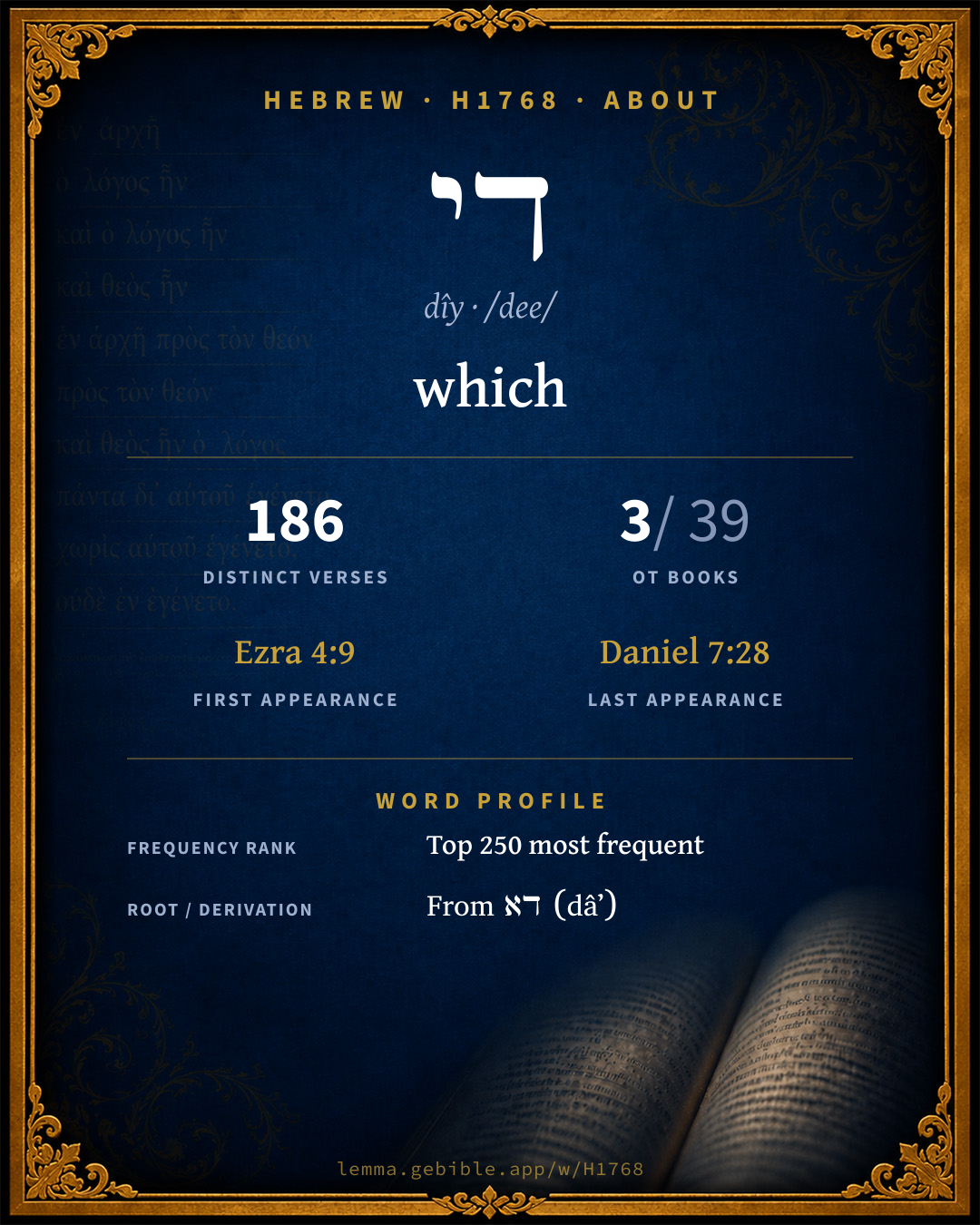
דִּי
which
also: who, that fuller range ↓
Full lexicon entry — Brown-Driver-Briggs (BDB)
From Brown-Driver-Briggs (BDB)
Where this word appears
Grammar key — what these labels mean
Part of speech
- Particle
- A short function word — article, negation, interrogative, the sign of the direct object, and the like.
- Conjunction
- A joining word (e.g. “and,” “but”) linking words or clauses.
- Pronoun
- A word standing in for a noun (“he,” “this,” “who”).
- Adjective
- A word that describes or qualifies a noun.
State
- Absolute
- The independent form of a noun, not bound to a following word.
Person
- 3rd Person
- The one spoken about (“he / she / it / they”).
Gender
- Common
- Either gender — not distinguished for this form.
- Feminine
- Grammatically feminine.
- Both
- Attested as both masculine and feminine.
Number
- Singular
- One.
Every verse where H1768 appears in the Book of Daniel — 130 distinct verses. Click any verse to open its interlinear word-by-word view. Verse text shown in the World English Bible for context — . Each verse’s Hebrew form is shown with its reference; the English is not keyword-highlighted, since the data carries no word-level English alignment. Use “Compare translations” on any verse to read it across multiple English versions. This concordance covers the Hebrew Bible; Septuagint (Greek Old Testament) occurrences are not indexed here.
Daniel
- Daniel 2:8 דִּ֥י דִּ֣י דִּ֥י ptcl rel conj ptcl rel The king answered, I know of a certainty that you would gain time, because you see the thing is gone from me.
- Daniel 2:9 דִּ֣י דִּ֥י דִּ֥י ptcl rel ptcl rel ptcl rel But if you don't make known to me the dream, there is but one law for you; for you have prepared lying and corrupt words to speak before me, until the time be changed: therefore tell me the dream, and I shall know that you can show me the interpretation of it.
- Daniel 2:10 דִּ֚י דִּ֚י ptcl rel conj The Chaldeans answered before the king, and said, There is not a man on the earth who can show the king's matter, because no king, lord, or ruler, has asked such a thing of any magician, or enchanter, or Chaldean.
- Daniel 2:11 דִֽי דִּ֥י דִּ֚י ptcl rel ptcl rel ptcl rel It is a rare thing that the king requires, and there is no other who can show it before the king, except the gods, whose dwelling is not with flesh.
- Daniel 2:14 דִּ֣י דִּ֚י ptcl rel ptcl rel Then Daniel returned answer with counsel and prudence to Arioch the captain of the king's guard, who was gone forth to kill the wise men of Babylon;
- Daniel 2:15 דִֽי ptcl rel he answered Arioch the king's captain, Why is the decree so urgent from the king? Then Arioch made the thing known to Daniel.
- Daniel 2:16 דִּ֚י ptcl rel Daniel went in, and desired of the king that he would appoint him a time, and he would show the king the interpretation.
- Daniel 2:18 דִּ֣י conj that they would desire mercies of the God of heaven concerning this secret; that Daniel and his companions should nor perish with the rest of the wise men of Babylon.
- Daniel 2:19 דִֽי ptcl rel Then was the secret revealed to Daniel in a vision of the night. Then Daniel blessed the God of heaven.
- Daniel 2:20 דִּֽי דִּ֧י דִּ֥י ptcl rel conj ptcl rel Daniel answered, Blessed be the name of God forever and ever; for wisdom and might are his.
- Daniel 2:23 דִּ֧י דִּֽי דִּֽי ptcl rel ptcl rel conj I thank you, and praise you, you God of my fathers, who have given me wisdom and might, and have now made known to me what we desired of you; for you have made known to us the king's matter.
- Daniel 2:24 דִּ֚י ptcl rel Therefore Daniel went in to Arioch, whom the king had appointed to destroy the wise men of Babylon; he went and said thus to him: Don't destroy the wise men of Babylon; bring me in before the king, and I will show to the king the interpretation.
- Daniel 2:25 דִּֽי דִּ֣י דִּ֥י ptcl rel ptcl rel ptcl rel Then Arioch brought in Daniel before the king in haste, and said thus to him, I have found a man of the children of the captivity of Judah, who will make known to the king the interpretation.
- Daniel 2:26 דִּ֥י דִֽי ptcl rel ptcl rel The king answered Daniel, whose name was Belteshazzar, Are you able to make known to me the dream which I have seen, and the interpretation of it?
- Daniel 2:27 דִּֽי ptcl rel Daniel answered before the king, and said, The secret which the king has demanded can neither wise men, enchanters, magicians, nor soothsayers, show to the king;
- Daniel 2:28 דִּ֥י ptcl rel but there is a God in heaven who reveals secrets, and he has made known to the king Nebuchadnezzar what shall be in the latter days. Your dream, and the visions of your head on your bed, are these:
- Daniel 2:29 דִּ֥י דִ֥י ptcl rel ptcl rel as for you, O king, your thoughts came [into your mind] on your bed, what should happen hereafter; and he who reveals secrets has made known to you what shall happen.
- Daniel 2:30 דִּֽי דִּ֤י ptcl rel ptcl rel But as for me, this secret is not revealed to me for any wisdom that I have more than any living, but to the intent that the interpretation may be made known to the king, and that you may know the thoughts of your heart.
- Daniel 2:32 דִּֽי דִּ֣י דִּ֥י ptcl rel ptcl rel ptcl rel As for this image, its head was of fine gold, its breast and its arms of silver, its belly and its thighs of brass,
- Daniel 2:33 דִּ֣י דִּ֣י דִּ֥י ptcl rel ptcl rel ptcl rel its legs of iron, its feet part of iron, and part of clay.
- Daniel 2:34 דִּ֣י דִּי דִּ֥י ptcl rel ptcl rel ptcl rel You saw until a stone was cut out without hands, which struck the image on its feet that were of iron and clay, and broke them in pieces.
- Daniel 2:35 דִּֽי ptcl rel Then was the iron, the clay, the brass, the silver, and the gold, broken in pieces together, and became like the chaff of the summer threshing floors; and the wind carried them away, so that no place was found for them: and the stone that struck the image became a great mountain, and filled the whole earth.
- Daniel 2:37 דִּ֚י ptcl rel You, O king, are king of kings, to whom the God of heaven has given the kingdom, the power, and the strength, and the glory;
- Daniel 2:38 דִּ֣י דִּ֥י ptcl rel ptcl rel and wherever the children of men dwell, the animals of the field and the birds of the sky has he given into your hand, and has made you to rule over them all: you are the head of gold.
- Daniel 2:39 דִּ֣י דִּ֥י ptcl rel ptcl rel After you shall arise another kingdom inferior to you; and another third kingdom of brass, which shall bear rule over all the earth.
- Daniel 2:40 דִּ֤י דִּֽי conj ptcl rel The fourth kingdom shall be strong as iron, because iron breaks in pieces and subdues all things; and as iron that crushes all these, shall it break in pieces and crush.
- Daniel 2:41 וְ/דִֽי דִּֽי דִ֥י דִּ֣י conj + conj ptcl rel ptcl rel conj Whereas you saw the feet and toes, part of potters' clay, and part of iron, it shall be a divided kingdom; but there shall be in it of the strength of the iron, because you saw the iron mixed with miry clay.
- Daniel 2:43 די וְ/דִ֣י כְ/דִ֣י conj conj + conj conj + conj Whereas you saw the iron mixed with miry clay, they shall mingle themselves with the seed of men; but they shall not cling to one another, even as iron does not mingle with clay.
- Daniel 2:44 דִּ֧י דִּ֤י ptcl rel ptcl rel In the days of those kings shall the God of heaven set up a kingdom which shall never be destroyed, nor shall the sovereignty of it be left to another people; but it shall break in pieces and consume all these kingdoms, and it shall stand forever.
- Daniel 2:45 דִּֽי דִּ֣י דִּי דִּ֥י conj ptcl rel ptcl rel ptcl rel Because you saw that a stone was cut out of the mountain without hands, and that it broke in pieces the iron, the brass, the clay, the silver, and the gold; the great God has made known to the king what shall happen hereafter: and the dream is certain, and the interpretation of it sure.
- Daniel 2:47 דִּ֣י דִּ֣י ptcl rel conj The king answered to Daniel, and said, Of a truth your God is the God of gods, and the Lord of kings, and a revealer of secrets, seeing you have been able to reveal this secret.
- Daniel 2:49 דִּ֚י ptcl rel Daniel requested of the king, and he appointed Shadrach, Meshach, and Abednego, over the affairs of the province of Babylon: but Daniel was in the gate of the king.
- Daniel 3:1 דִּֽי ptcl rel Nebuchadnezzar the king made an image of gold, whose height was sixty cubits, and the breadth of it six cubits: he set it up in the plain of Dura, in the province of Babylon.
- Daniel 3:2 דִּ֥י ptcl rel Then Nebuchadnezzar the king sent to gather together the satraps, the deputies, and the governors, the judges, the treasurers, the counselors, the sheriffs, and all the rulers of the provinces, to come to the dedication of the image which Nebuchadnezzar the king had set up.
- Daniel 3:3 דִּ֥י דִּ֥י ptcl rel ptcl rel Then the satraps, the deputies, and the governors, the judges, the treasurers, the counselors, the sheriffs, and all the rulers of the provinces, were gathered together to the dedication of the image that Nebuchadnezzar the king had set up; and they stood before the image that Nebuchadnezzar had set up.
- Daniel 3:5 דִּֽי דִּ֥י ptcl rel ptcl rel that whenever you hear the sound of the horn, flute, zither, lyre, harp, pipe, and all kinds of music, you fall down and worship the golden image that Nebuchadnezzar the king has set up;
- Daniel 3:6 דִּי pron indef 3bs and whoever doesn't fall down and worships shall the same hour be cast into the midst of a burning fiery furnace.
- Daniel 3:7 כְּ/דִ֣י דִּ֥י prep + ptcl rel ptcl rel Therefore at that time, when all the peoples heard the sound of the horn, flute, zither, lyre, harp, pipe, and all kinds of music, all the peoples, the nations, and the languages, fell down and worshiped the golden image that Nebuchadnezzar the king had set up.
- Daniel 3:8 דִּ֥י ptcl rel Therefore at that time certain Chaldeans came near, and brought accusation against the Jews.
- Daniel 3:10 דִּ֣י דִּֽי ptcl rel ptcl rel You, O king, have made a decree, that every man that shall hear the sound of the horn, flute, zither, lyre, harp, pipe, and all kinds of music, shall fall down and worship the golden image;
- Daniel 3:11 דִּי pron indef 3cs and whoever doesn't fall down and worship shall be cast into the midst of a burning fiery furnace.
- Daniel 3:12 דִּֽי דִּ֥י ptcl rel ptcl rel There are certain Jews whom you have appointed over the affairs of the province of Babylon: Shadrach, Meshach, and Abednego; these men, O king, have not regarded you: they don't serve your gods, nor worship the golden image which you have set up.
- Daniel 3:14 דִּ֥י ptcl rel Nebuchadnezzar answered them, Is it on purpose, Shadrach, Meshach, and Abednego, that you don't serve my god, nor worship the golden image which I have set up?
- Daniel 3:15 דִּ֣י דִּֽי דִֽי דֵּ֥י ptcl rel ptcl rel ptcl rel ptcl rel Now if you are ready whenever you hear the sound of the horn, flute, zither, lyre, harp, pipe, and all kinds of music to you fall down and worship the image which I have made, [well]: but if you don't worship, you shall be cast the same hour into the midst of a burning fiery furnace; and who is that god that shall deliver you out of my hands?
- Daniel 3:17 דִּֽי ptcl rel If it be [so], our God whom we serve is able to deliver us from the burning fiery furnace; and he will deliver us out of your hand, O king.
- Daniel 3:18 דִּ֤י דִּ֥י ptcl rel ptcl rel But if not, be it known to you, O king, that we will not serve your gods, nor worship the golden image which you have set up.
- Daniel 3:19 דִּ֥י ptcl rel Then was Nebuchadnezzar full of fury, and the form of his visage was changed against Shadrach, Meshach, and Abednego: [therefore] he spoke, and commanded that they should heat the furnace seven times more than it was wont to be heated.
- Daniel 3:20 דִּ֣י ptcl rel He commanded certain mighty men who were in his army to bind Shadrach, Meshach, and Abednego, [and] to cast them into the burning fiery furnace.
- Daniel 3:22 דִּ֞י דִּ֤י דִּ֥י conj ptcl rel ptcl rel Therefore because the king's commandment was urgent, and the furnace exceeding hot, the flame of the fire killed those men who took up Shadrach, Meshach, and Abednego.
- Daniel 3:25 דִּ֣י ptcl rel He answered, Look, I see four men loose, walking in the midst of the fire, and they have no hurt; and the aspect of the fourth is like a son of the gods.
- Daniel 3:26 דִּֽי ptcl rel Then Nebuchadnezzar came near to the mouth of the burning fiery furnace: he spoke and said, Shadrach, Meshach, and Abednego, you servants of the Most High God, come forth, and come here. Then Shadrach, Meshach, and Abednego came forth out of the midst of the fire.
- Daniel 3:27 דִּי֩ ptcl rel The satraps, the deputies, and the governors, and the king's counselors, being gathered together, saw these men, that the fire had no power on their bodies, nor was the hair of their head singed, neither were their pants changed, nor had the smell of fire passed on them.
- Daniel 3:28 דִּֽי דִּֽי דִּ֥י דִּ֠י ptcl rel conj ptcl rel conj Nebuchadnezzar spoke and said, Blessed be the God of Shadrach, Meshach, and Abednego, who has sent his angel, and delivered his servants who trusted in him, and have changed the king's word, and have yielded their bodies, that they might not serve nor worship any god, except their own God.
- Daniel 3:29 דִּי֩ דִּֽי דִּֽי דִּ֣י דִּֽי ptcl rel ptcl rel ptcl rel conj ptcl rel Therefore I make a decree, that every people, nation, and language, which speak anything evil against the God of Shadrach, Meshach, and Abednego, shall be cut in pieces, and their houses shall be made a dunghill; because there is no other god who is able to deliver after this sort.
- Daniel 4:1 דִּֽי ptcl rel Nebuchadnezzar the king, to all the peoples, nations, and languages, who dwell in all the earth: Peace be multiplied to you.
- Daniel 4:2 דִּ֚י ptcl rel It has seemed good to me to show the signs and wonders that the Most High God has worked toward me.
- Daniel 4:6 דִּֽי ptcl rel Therefore made I a decree to bring in all the wise men of Babylon before me, that they might make known to me the interpretation of the dream.
- Daniel 4:8 דִּֽי וְ/דִ֛י ptcl rel conj + ptcl rel But at the last Daniel came in before me, whose name was Belteshazzar, according to the name of my god, and in whom is the spirit of the holy gods: and I told the dream before him, [saying],
- Daniel 4:9 דִּ֣י דִּ֠י דִֽי ptcl rel ptcl rel ptcl rel Belteshazzar, master of the magicians, because I know that the spirit of the holy gods is in you, and no secret troubles you, tell me the visions of my dream that I have seen, and the interpretation of it.
- Daniel 4:15 דִּֽי דִּ֣י ptcl rel Particle Nevertheless leave the stump of its roots in the earth, even with a band of iron and brass, in the tender grass of the field; and let it be wet with the dew of the sky: and let his portion be with the animals in the grass of the earth:
- Daniel 4:17 דִּ֣י דִּֽי דִּ֤י ptcl rel ptcl rel pron indef cs The sentence is by the decree of the watchers, and the demand by the word of the holy ones; to the intent that the living may know that the Most High rules in the kingdom of men, and gives it to whoever he will, and sets up over it the lowest of men.
- Daniel 4:18 דִּ֣י דִּ֛י conj conj This dream I, king Nebuchadnezzar, have seen; and you, Belteshazzar, declare the interpretation, because all the wise men of my kingdom are not able to make known to me the interpretation; but you are able; for the spirit of the holy gods is in you.
- Daniel 4:19 דִּֽי ptcl rel Then Daniel, whose name was Belteshazzar, was stricken mute for a while, and his thoughts troubled him. The king answered, Belteshazzar, don't let the dream, or the interpretation, trouble you. Belteshazzar answered, My lord, the dream be to those who hate you, and the interpretation of it to your adversaries.
- Daniel 4:20 דִּ֣י דִּ֥י ptcl rel ptcl rel The tree that you saw, which grew, and was strong, whose height reached to the sky, and the sight of it to all the earth;
- Daniel 4:22 דִּ֥י ptcl rel it is you, O king, that are grown and become strong; for your greatness is grown, and reaches to the sky, and your dominion to the end of the earth.
- Daniel 4:23 וְ/דִ֣י דִּֽי דִּ֣י דִּֽי conj + ptcl rel ptcl rel Particle ptcl rel Whereas the king saw a watcher and a holy one coming down from the sky, and saying, Hew down the tree, and destroy it; nevertheless leave the stump of the roots of it in the earth, even with a band of iron and brass, in the tender grass of the field, and let it be wet with the dew of the sky: and let his portion be with the animals of the field, until seven times pass over him;
- Daniel 4:24 דִּ֥י ptcl rel this is the interpretation, O king, and it is the decree of the Most High, which is come on my lord the king:
- Daniel 4:25 דִּֽי דִּֽי דִּ֥י ptcl rel ptcl rel pron rel cs that you shall be driven from men, and your dwelling shall be with the animals of the field, and you shall be made to eat grass as oxen, and shall be wet with the dew of the sky, and seven times shall pass over you; until you know that the Most High rules in the kingdom of men, and gives it to whoever he will.
- Daniel 4:26 וְ/דִ֣י דִּ֣י דִּ֣י דִּ֥י conj + ptcl rel ptcl rel adj Adjective fs ptcl rel Whereas they commanded to leave the stump of the roots of the tree; your kingdom shall be sure to you, after that you shall have known that the heavens do rule.
- Daniel 4:29 דִּ֥י Particle At the end of twelve months he was walking in the royal palace of Babylon.
- Daniel 4:30 דִּֽי ptcl rel The king spoke and said, Is not this great Babylon, which I have built for the royal dwelling-place, by the might of my power and for the glory of my majesty?
- Daniel 4:32 דִּֽי דִּֽי דִּ֥י ptcl rel ptcl rel pron rel cs and you shall be driven from men; and they dwelling shall be with the animals of the field; you shall be made to eat grass as oxen; and seven times shall pass over you; until you know that the Most High rules in the kingdom of men, and gives it to whoever he will.
- Daniel 4:33 דִּ֥י ptcl rel The same hour was the thing fulfilled on Nebuchadnezzar: and he was driven from men, and ate grass as oxen, and his body was wet with the dew of the sky, until his hair was grown like eagles' [feathers], and his nails like birds' [claws].
- Daniel 4:34 דִּ֤י conj At the end of the days I, Nebuchadnezzar, lifted up my eyes to heaven, and my understanding returned to me, and I blessed the Most High, and I praised and honored him who lives forever; for his dominion is an everlasting dominion, and his kingdom from generation to generation.
- Daniel 4:35 דִּֽי ptcl rel All the inhabitants of the earth are reputed as nothing; and he does according to his will in the army of heaven, and among the inhabitants of the earth; and none can stay his hand, or tell him, What do you?
- Daniel 4:37 דִּ֤י וְ/דִי֙ ptcl rel conj + ptcl rel Now I, Nebuchadnezzar, praise and extol and honor the King of heaven; for all his works are truth, and his ways justice; and those who walk in pride he is able to abase.
- Daniel 5:2 דִּ֤י דִּ֣י ptcl rel ptcl rel Belshazzar, while he tasted the wine, commanded to bring the golden and silver vessels which Nebuchadnezzar his father had taken out of the temple which was in Jerusalem; that the king and his lords, his wives and his concubines, might drink from it.
- Daniel 5:3 דִּ֣י דִּֽי דִּ֣י ptcl rel ptcl rel ptcl rel Then they brought the golden vessels that were taken out of the temple of the house of God which was at Jerusalem; and the king and his lords, his wives and his concubines, drank from them.
- Daniel 5:5 דִּ֣י דִּֽי דִּ֣י דִּ֥י Particle Particle Particle ptcl rel In the same hour came forth the fingers of a man's hand, and wrote over against the lampstand on the plaster of the wall of the king's palace: and the king saw the part of the hand that wrote.
- Daniel 5:7 דִּ֣י דִּֽי דִֽי ptcl rel ptcl rel Particle The king cried aloud to bring in the enchanters, the Chaldeans, and the soothsayers. The king spoke and said to the wise men of Babylon, Whoever shall read this writing, and show me the interpretation of it, shall be clothed with purple, and have a chain of gold about his neck, and shall be the third ruler in the kingdom.
- Daniel 5:11 דִּ֠י ptcl rel There is a man in your kingdom, in whom is the spirit of the holy gods; and in the days of your father light and understanding and wisdom, like the wisdom of the gods, were found in him; and the king Nebuchadnezzar your father, the king, [I say], your father, made him master of the magicians, enchanters, Chaldeans, and soothsayers;
- Daniel 5:12 דִּ֣י דִּֽי conj ptcl rel because an excellent spirit, and knowledge, and understanding, interpreting of dreams, and showing of dark sentences, and dissolving of doubts, were found in the same Daniel, whom the king named Belteshazzar. Now let Daniel be called, and he will show the interpretation.
- Daniel 5:13 דִּֽי דִּ֣י דִּ֥י ptcl rel ptcl rel ptcl rel Then was Daniel brought in before the king. The king spoke and said to Daniel, Are you that Daniel, who are of the children of the captivity of Judah, whom the king my father brought out of Judah?
- Daniel 5:14 דִּ֛י conj I have heard of you, that the spirit of the gods is in you, and that light and understanding and excellent wisdom are found in you.
- Daniel 5:15 דִּֽי conj Now the wise men, the enchanters, have been brought in before me, that they should read this writing, and make known to me the interpretation of it; but they could not show the interpretation of the thing.
- Daniel 5:16 דִּֽי דִֽי ptcl rel ptcl rel But I have heard of you, that you can give interpretations, and dissolve doubts; now if you can read the writing, and make known to me the interpretation of it, you shall be clothed with purple, and have a chain of gold about your neck, and shall be the third ruler in the kingdom.
- Daniel 5:19 דִּ֣י דִּֽי וְ/דִֽי וְ/דִֽי וְ/דִֽי ptcl rel ptcl rel conj + ptcl rel conj + ptcl rel conj + ptcl rel and because of the greatness that he gave him, all the peoples, nations, and languages trembled and feared before him: whom he would he killed, and whom he would he kept alive; and whom he would he raised up, and whom he would he put down.
- Daniel 5:20 וּ/כְ/דִי֙ conj + conj + conj But when his heart was lifted up, and his spirit was hardened so that he dealt proudly, he was deposed from his kingly throne, and they took his glory from him:
- Daniel 5:21 דִּֽי דִּֽי דִּ֥י ptcl rel ptcl rel pron indef 3cs and he was driven from the sons of men, and his heart was made like the animals', and his dwelling was with the wild donkeys; he was fed with grass like oxen, and his body was wet with the dew of the sky; until he knew that the Most High God rules in the kingdom of men, and that he sets up over it whoever he will.
- Daniel 5:22 דִּ֥י conj You his son, Belshazzar, have not humbled your heart, though you knew all this,
- Daniel 5:23 דִֽי דִּ֠י דִּֽי ptcl rel ptcl rel ptcl rel but have lifted up yourself against the Lord of heaven; and they have brought the vessels of his house before you, and you and your lords, your wives and your concubines, have drunk wine from them; and you have praised the gods of silver and gold, of brass, iron, wood, and stone, which don't see, nor hear, nor know; and the God in whose hand your breath is, and whose are all your ways, you have not glorified.
- Daniel 5:24 דִֽי ptcl rel Then was the part of the hand sent from before him, and this writing was inscribed.
- Daniel 5:25 דִּ֣י ptcl rel This is the writing that was inscribed: MENE, MENE, TEKEL, UPHARSIN.
- Daniel 5:29 דִֽי דִּֽי ptcl rel conj Then commanded Belshazzar, and they clothed Daniel with purple, and put a chain of gold about his neck, and made proclamation concerning him, that he should be the third ruler in the kingdom.
- Daniel 6:1 דִּ֥י ptcl rel It pleased Darius to set over the kingdom one hundred twenty satraps, who should be throughout the whole kingdom;
- Daniel 6:2 דִּ֥י דִּֽי ptcl rel ptcl rel and over them three presidents, of whom Daniel was one; that these satraps might give account to them, and that the king should have no damage.
- Daniel 6:3 דִּ֣י conj Then this Daniel was distinguished above the presidents and the satraps, because an excellent spirit was in him; and the king thought to set him over the whole realm.
- Daniel 6:4 דִּֽי conj Then the presidents and the satraps sought to find occasion against Daniel as touching the kingdom; but they could find no occasion nor fault, because he was faithful, neither was there any error or fault found in him.
- Daniel 6:5 דִּ֣י ptcl rel Then said these men, We shall not find any occasion against this Daniel, except we find it against him concerning the law of his God.
- Daniel 6:7 דִּ֣י דִּֽי ptcl rel ptcl rel All the presidents of the kingdom, the deputies and the satraps, the counselors and the governors, have consulted together to establish a royal statute, and to make a strong interdict, that whoever shall ask a petition of any god or man for thirty days, save of you, O king, he shall be cast into the den of lions.
- Daniel 6:8 דִּ֣י דִּי ptcl rel ptcl rel Now, O king, establish the interdict, and sign the writing, that it not be changed, according to the law of the Medes and Persians, which doesn't alter.
- Daniel 6:10 כְּ/דִ֨י דִּֽי דִּֽי conj + conj ptcl rel conj When Daniel knew that the writing was signed, he went into his house (now his windows were open in his chamber toward Jerusalem) and he kneeled on his knees three times a day, and prayed, and gave thanks before his God, as he did before.
- Daniel 6:12 דִּ֣י דִּֽי דִּי conj ptcl rel ptcl rel Then they came near, and spoke before the king concerning the king's interdict: Haven't you signed an interdict, that every man who shall make petition to any god or man within thirty days, save to you, O king, shall be cast into the den of lions? The king answered, The thing is true, according to the law of the Medes and Persians, which doesn't alter.
- Daniel 6:13 דִּ֣י דִּי֩ דִּ֣י דִּ֣י ptcl rel ptcl rel ptcl rel ptcl rel Then answered they and said before the king, That Daniel, who is of the children of the captivity of Judah, doesn't regard you, O king, nor the interdict that you have signed, but makes his petition three times a day.
- Daniel 6:14 כְּ/דִ֧י conj + conj Then the king, when he heard these words, was sore displeased, and set his heart on Daniel to deliver him; and he labored until the going down of the sun to rescue him.
- Daniel 6:15 דִּֽי דִּֽי דִּֽי ptcl rel ptcl rel ptcl rel Then these men assembled together to the king, and said to the king, Know, O king, that it is a law of the Medes and Persians, that no interdict nor statute which the king establishes may be changed.
- Daniel 6:16 דִּ֣י דִּ֣י ptcl rel ptcl rel Then the king commanded, and they brought Daniel, and cast him into the den of lions. [Now] the king spoke and said to Daniel, Your God whom you serve continually, he will deliver you.
- Daniel 6:17 דִּ֛י conj A stone was brought, and laid on the mouth of the den; and the king sealed it with his own signet, and with the signet of his lords; that nothing might be changed concerning Daniel.
- Daniel 6:19 דִֽי ptcl rel Then the king arose very early in the morning, and went in haste to the den of lions.
- Daniel 6:20 דִּ֣י ptcl rel When he came near to the den to Daniel, he cried with a lamentable voice; the king spoke and said to Daniel, Daniel, servant of the living God, is your God, whom you serve continually, able to deliver you from the lions?
- Daniel 6:22 דִּ֤י conj My God has sent his angel, and has shut the lions' mouths, and they have not hurt me; because as before him innocence was found in me; and also before you, O king, have I done no hurt.
- Daniel 6:23 דִּ֖י conj Then was the king exceeding glad, and commanded that they should take Daniel up out of the den. So Daniel was taken up out of the den, and no manner of hurt was found on him, because he had trusted in his God.
- Daniel 6:24 דִּֽי דִּ֣י דִּֽי ptcl rel ptcl rel ptcl rel The king commanded, and they brought those men who had accused Daniel, and they cast them into the den of lions, them, their children, and their wives; and the lions had the mastery of them, and broke all their bones in pieces, before they came to the bottom of the den.
- Daniel 6:25 דִּֽי ptcl rel Then king Darius wrote to all the peoples, nations, and languages, who dwell in all the earth: Peace be multiplied to you.
- Daniel 6:26 דִּ֣י דִּי דִּי דִּֽי conj ptcl rel conj ptcl rel I make a decree, that in all the dominion of my kingdom men tremble and fear before the God of Daniel; for he is the living God, and steadfast forever, His kingdom that which shall not be destroyed; and his dominion shall be even to the end.
- Daniel 6:27 דִּ֚י conj He delivers and rescues, and he works signs and wonders in heaven and in earth, who has delivered Daniel from the power of the lions.
- Daniel 7:4 דִּֽי דִּי ptcl rel ptcl rel The first was like a lion, and had eagle's wings: I saw until the wings of it were plucked, and it was lifted up from the earth, and made to stand on two feet as a man; and a man's heart was given to it.
- Daniel 7:6 דִּי ptcl rel After this I saw, and, behold, another, like a leopard, which had on its back four wings of a bird; the animal had also four heads; and dominion was given to it.
- Daniel 7:7 דִּֽי דִּ֣י ptcl rel ptcl rel After this I saw in the night-visions, and, behold, a fourth animal, awesome and powerful, and strong exceedingly; and it had great iron teeth; it devoured and broke in pieces, and stamped the residue with its feet: and it was diverse from all the animals that were before it; and it had ten horns.
- Daniel 7:9 דִּ֤י דִּי ptcl rel ptcl rel I saw until thrones were placed, and one who was ancient of days sat: his clothing was white as snow, and the hair of his head like pure wool; his throne was fiery flames, [and] the wheels of it burning fire.
- Daniel 7:10 דִּי ptcl rel A fiery stream issued and came forth from before him: thousands of thousands ministered to him, and ten thousand times ten thousand stood before him: the judgment was set, and the books were opened.
- Daniel 7:11 דִּ֥י דִּ֨י ptcl rel ptcl rel I saw at that time because of the voice of the great words which the horn spoke; I saw even until the animal was slain, and its body destroyed, and it was given to be burned with fire.
- Daniel 7:14 דִּֽי דִּי ptcl rel ptcl rel There was given him dominion, and glory, and a kingdom, that all the peoples, nations, and languages should serve him: his dominion is an everlasting dominion, which shall not pass away, and his kingdom that which shall not be destroyed.
- Daniel 7:17 דִּ֥י ptcl rel These great animals, which are four, are four kings, who shall arise out of the earth.
- Daniel 7:19 דִּֽי דִּֽי דִּֽי ptcl rel ptcl rel ptcl rel Then I desired to know the truth concerning the fourth animal, which was diverse from all of them, exceedingly terrible, whose teeth were of iron, and its nails of brass; which devoured, broke in pieces, and stamped the residue with its feet;
- Daniel 7:20 דִּ֣י דִּ֣י ptcl rel ptcl rel and concerning the ten horns that were on its head, and the other [horn] which came up, and before which three fell, even that horn that had eyes, and a mouth that spoke great things, whose look was more stout than its fellows.
- Daniel 7:22 דִּֽי ptcl rel until the ancient of days came, and judgment was given to the saints of the Most High, and the time came that the saints possessed the kingdom.
- Daniel 7:23 דִּ֥י ptcl rel Thus he said, The fourth animal shall be a fourth kingdom on earth, which shall be diverse from all the kingdoms, and shall devour the whole earth, and shall tread it down, and break it in pieces.
- Daniel 7:27 דִּ֚י ptcl rel The kingdom and the dominion, and the greatness of the kingdoms under the whole the sky, shall be given to the people of the saints of the Most High: his kingdom is an everlasting kingdom, and all dominions shall serve and obey him.
- Daniel 7:28 דִֽי ptcl rel Here is the end of the matter. As for me, Daniel, my thoughts much troubled me, and my face was changed in me: but I kept the matter in my heart.
About this entry
At a glance — auto-summarized from this page’s data, not written by a person. Every figure links to its source below. This summary describes the numbers; it doesn’t interpret them.
די (dîy) is a Hebrew word most often rendered “which.” Daniel dominates its distribution — 130 of 186 verses. The Hebrew Bible uses it across 186 verses — common. It first appears in Ezra 4:9. Ranging over 3 senses, its meaning includes “who” and “that”. For the data behind this summary, explore the sense tree and the renderings breakdown below.
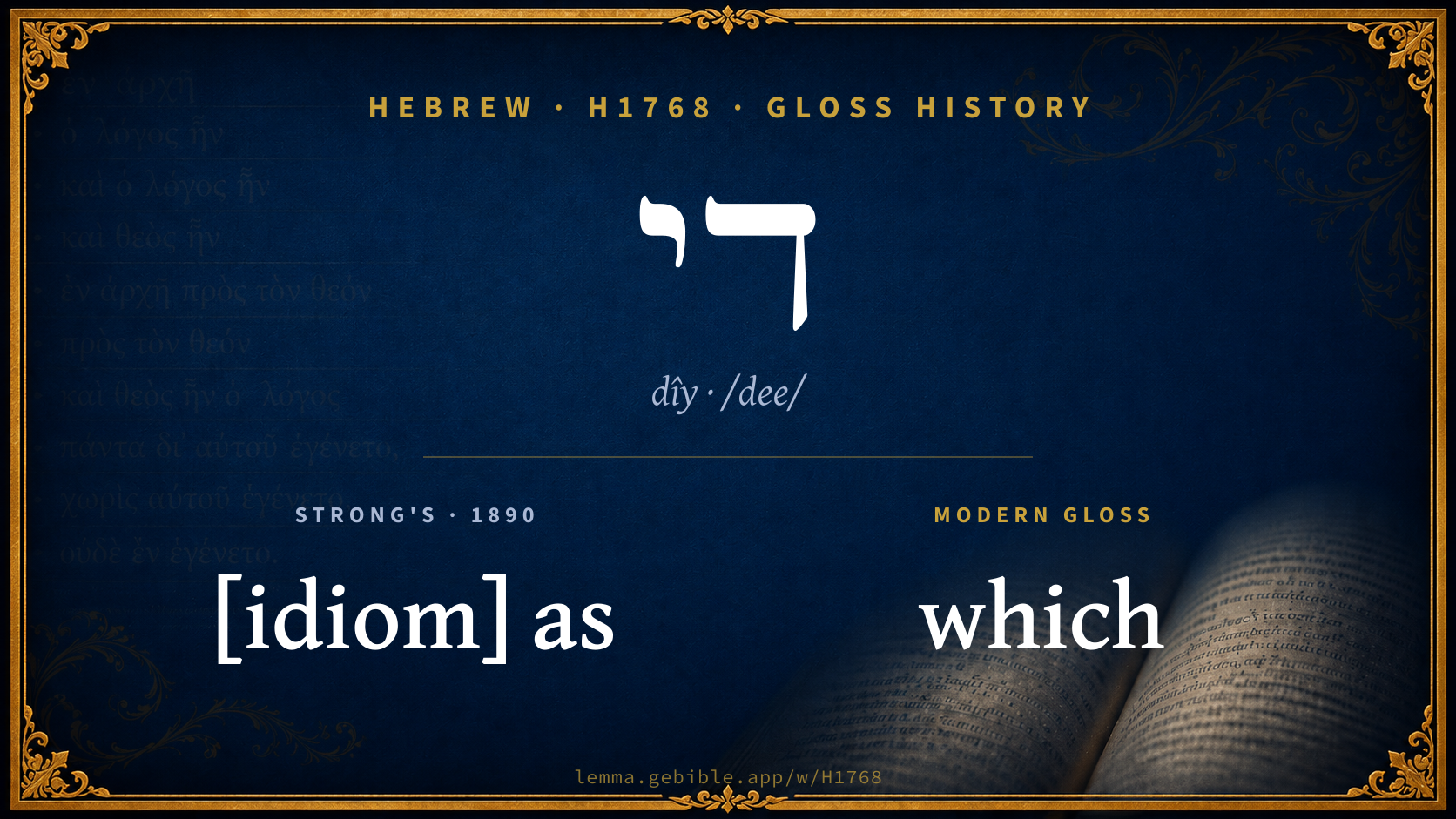
Gloss history
Strong's 1890 vs modern scholarship
About this word
Strong's H1768 catalogs a Hebrew word from the Hebrew Old Testament.
These counts are not copied from any lexicon or concordance. They are computed here, from the morphology-tagged Hebrew Old Testament. What Lemma adds →
- 186
- distinct verses
- The word appears in 186 distinct verses.
- 3 / 39
- OT books
- The word appears in 3 of 39 Old Testament books.
- #142
- by frequency
- Top 250 most frequent Hebrew words (rank 142 of 8,640 Hebrew words by occurrence).
View all 186 occurrences in the concordance →
By section of the Old Testament
By traditional corpus
Conventional, traditional groupings — biblical authorship is debated, so this is a traditional corpus grouping, not an authorship claim. Each share is this word’s portion of its verses in that division of the Hebrew canon. Each figure is a share of the word’s 186 distinct verses.
- Writings (Ketuvim) 185 verses · 99%
- Prophets (Nevi'im) 1 verse · 1%
How translations render this word
Counts come from each version’s own published word-to-Strong’s tagging or interlinear alignment — an approximate guide to how each version renders this word, not a word-level alignment the data otherwise carries. Because each total is that version’s own tagged count, the per-version totals vary from one another and need not match the appearance or distinct-verse counts above. These counts may also differ from a printed concordance because Lemma counts each distinctly tagged rendering and does not collapse phrase taggings into a single head-word total. This is a fixed set of word-tagged versions (KJV, ASV, BSB, ULT) and does not change with the reading translation you choose elsewhere. Each version’s license is shown beside its name below (and on Sources).
- King James Version: Of 3×, That 2×
- American Standard Version: That 3×, Of 2×
- Berean Standard Bible: That 53×, Of 31×, Who 18×
- unfoldingWord Literal Text: That 103×, Of 67×, Who 35×
King James Version Public Domain
Renders H1768 across 15 tagged occurrences — most commonly:
Plus 10 renderings that appear only once — usually multi-word phrases or single function words the recovered tagging swept in, not distinct renderings. Not rendered by a distinct English word in 4 further occurrences.
American Standard Version Public Domain
Renders H1768 across 14 tagged occurrences — most commonly:
Plus 9 renderings that appear only once — usually multi-word phrases or single function words the recovered tagging swept in, not distinct renderings.
Berean Standard Bible Public Domain
Renders H1768 across 172 tagged occurrences — most commonly:
Plus other, less common renderings. Plus 21 renderings that appear only once — usually multi-word phrases or single function words the recovered tagging swept in, not distinct renderings. Not rendered by a distinct English word in 171 further occurrences.
unfoldingWord Literal Text CC BY-SA 4.0
Renders H1768 across 356 tagged occurrences — most commonly:
Plus other, less common renderings. Plus 31 renderings that appear only once — usually multi-word phrases or single function words the recovered tagging swept in, not distinct renderings.
Senses in BDB
The 3 senses BDB distinguishes for this word, in lexicon order (not ranked by frequency or importance). The full entry — with sub-senses — is in the Lexicon Entry tab.
- who, which, that (particle of relation)
- that of, which belongs to, that (mark of genitive)
- that, because (conjunction)
Word origin
דִּי part. of relation, who, which, that, used also as mark of gen. and conj. that, because
— Brown-Driver-Briggs (Oxford 1906, public domain), digitized via Sefaria, supplemented by the OpenScriptures HebrewLexicon (CC BY 4.0). See Sources.
Derived from דא (dâʼ) (H1668).
Jastrow Dictionary
A second Hebrew/Aramaic lexicon for comparison, covering Aramaic and post-biblical (Talmudic, Targumic, Midrashic) usage that the biblical-Hebrew BDB does not. Matched by lemma rather than by Strong’s number, so a lemma may carry more than one Jastrow headword (shown separately below), and the entries cover usage well beyond the Bible.
דְּ־
- a prefix, corresp. to h. שֶׁ־, of, who, which, that (quod). Targ. Gen. XXXI, 42. Ib. IX, 5; a. v. fr.—Ber. 2ᵃ זמן ק"ש דשכיבה the time of reading the Sh’ma of bed-time (Deut. VI, 7). Ib. ליתני דערבית וכ׳ let him first state that of (the law concerning) the evening prayer. Ib. הא קמ"ל דכפרה וכ׳ we are given to understand (by implication) that &c. Ib. ממאי דהאי וכ׳ whence is it proved that this uba &c.? Ib.ᵇ ואינהו דמחשכי וכ׳ and it was they who (as an exception) worked late and early; a. v. fr.—[This prefix is used for the formation of what may be named Difel nouns, as דְּבֵיתָא, דִּכְמָא &c., a. Dispeel nouns as דִּיסְקַרְתָּא &c.] e.g. Deuteronomy 6:7
דִּי
- 1. who, which, where, whom &c. Dan. IV, 5; a. fr.—Targ. Gen. XXIV, 27. Targ. Ps. LXXIII, 27; a. fr.—Mostly as prefix: דִּי־, דִּ־, דְּ־, v. דְּ־.—With personal pronouns דִּידִי, דִּילִי; דִּידָךְ, דִּידֵיךְ, דִּילָךְ, דִּילִיךְ; דִּידֵיה, דִּידָהּ, דִּילֵיה, דִּילָהּ; דִּידָן, דִּילָן; דִּידְכוֹן, דִּלְכוֹן, דִּידְכוּ, דִּידְכֶן; דִּידְהוֹן, דִּידְהוּ, דִּידְהִי mine, thine &c. Targ. O. Gen. XXXI, 16 דילנא (Y. די לנא). Targ. O. ib. XXXIII, 9; a. fr.—B. Bath. 4ᵇ דידי ודידיה הוא it is mine and his. Ib. עבד דידיה he made the ḥazith on his side, v. חָזִית. Ber. 2ᵇ בין השמשות דידך thy definition of ben hash-sh’mashoth. Tam. 32ᵃ דידי טבא מדידכו my advice is better than yours. Gitt. 84ᵇ דילכון your countryman (Rab Kahăna). B. Kam. 117ᵇ דילכון אמרי דילהון היא I believed (learning) was yours (the Palestineans’); but it is theirs (the Babylonians’); Succ. 44ᵃ דִּלְכוֹן, דִּלְהוֹן.—Ḥull. 42ᵇ תנא דידן the author or compiler of our Mishnah. Deut. R. s. 2 ר"י דידיה אמר R. J. said in his own name. Ab. Zar. 17ᵃ פליגא דידיה אדידיה there is a discrepancy between two opinions of his. Y. Ḥag. II, 78ᵃ top מן דידכֶן; Y. Snh. VI, 23ᶜ bot. מן דידכון one of yours. e.g. Daniel 4:5
- 2. that (quod). Dan. IV, 3; a. fr.—Y. Taan. IV, 67ᶜ bot. די תעניתא that it is a fast-day. e.g. Daniel 4:3
דִּי II
- = דְּאִי, for if. Y. R. Hasḥ. I, 56ᵇ, די לא כן. Also דִּילָא, דִּלָא for if not. Y. Ter. V, 43ᶜ; a. fr.—דִּילָכֵן, דִּלָכֵן for if not so. Y. Shebi. IV, 35ᵃ bot.; a. fr. V. דִּל.
דַּי
- sufficiency, plenty; constr. דֵּי enough for; דּיִּי enough for me, דַּיֶּיךָ enough for thee &c. Nidd. I, 1 דַּיָּין שעתן they have enough for the time being, i.e. the unclean condition, now discovered, has no retrospective effect, opp. מפְּקִידָה לפקידה. Pes. 8ᵇ דַּיֵּינוּ we should have been contented. Taan. 24ᵇ דַּיּוֹ בקב וכ׳ (Ms. M. דַּיי לו קב) he is contented with a Kab of &c. B. Kam. II, 5 (25ᵃ) דיו לבא מן הדין וכ׳ it is sufficient for the law which is derived by conclusion ad majus to be as strict as the law from which it is derived, i.e. you cannot go beyond the latter. B. Kam. ור"ט לית ליה דיו does R. T. not follow the principle of dayyo (that the derived law cannot go beyond the original)? והא דיו דאורייתא הוא is not the principle of dayyo biblical?—Gen. R. s. 21 דייך פפוס it is enough for thee, Papus, i.e. say no more; a. fr.—With prefix כְּדַי (v. כְּדָיי), constr. כְּדֵי as much as is required for, corresponding to, as conj. in order to. Maasr. V, 6 ומצא כ׳ מדתו and found a quantity corresponding to what he had measured into it (reasonably increased); יתר על כ׳ מדתו more than the reasonable quantity.—כ׳ דיבור or תוך כ׳ ד׳ as much, within as much, time as is needed for an utterance (e.g. a greeting, v. Y. Ber. I, 4ᵇ). B. Kam. 73ᵃ, a. fr. תוך כ׳ דיבור כדיבור דמי two statements following each other immediately are considered one. Ib. 73ᵇ תרי ת׳ כ׳ ד׳ there are two different intervals comprised under the expression tokh k’d’e dibbur. Snh. 31ᵇ bot. כ׳ לחלוק וכ׳ in order to give honor to &c. Ib. 32ᵃ bot. כ׳ שלא תנעול דלת וכ׳ in order not to make loans too difficult, v. דֶּלֶת; a. fr.
דִּי־
- (representing δις-, δύο) two, twice, cmp. דּוּ III.
A Dictionary of the Targumim, the Talmud Babli and Yerushalmi, and the Midrashic Literature (Marcus Jastrow; London, Luzac, 1903) — Public Domain. Digitized via Sefaria. Digitized via Sefaria. Full attribution on Sources.
Forms in the corpus
The 32 distinct written forms H1768 takes in the Hebrew Bible, most frequent first — each parse links to that state’s occurrences in the concordance. Hebrew forms include their vowel points and cantillation, so a single lemma takes many written forms.
| Form | Parsing | Example | Uses |
|---|---|---|---|
| דִּֽי | Particle, Relative | Daniel 2:20 | 85 |
| דִּ֣י | Particle, Relative | Daniel 2:9 | 80 |
| דִּ֥י | Particle, Relative | Daniel 2:8 | 55 |
| דִּי | Particle, Relative | Daniel 2:34 | 23 |
| דִֽי | Particle, Relative | Daniel 2:11 | 18 |
| דִּ֚י | Particle, Relative | Daniel 2:10 | 16 |
| דִּ֤י | Particle, Relative | Daniel 2:30 | 14 |
| דִּ֠י | Particle, Relative | Daniel 4:9 | 6 |
| דִּ֛י | Conjunction | Daniel 4:18 | 6 |
| דִּ֖י | Particle, Relative | Ezra 4:24 | 5 |
| דִּי֩ | Particle, Relative | Daniel 3:27 | 5 |
| דִּ֧י | Particle, Relative | Daniel 2:23 | 4 |
| וְ/דִֽי | Particle, Relative | Daniel 5:19 | 4 |
| וְ/דִ֣י | Particle, Relative | Daniel 4:23 | 3 |
| דִי | Particle, Relative | Ezra 6:5 | 3 |
| דִּ֞י | Conjunction | Daniel 3:22 | 2 |
| דִ֥י | Particle, Relative | Daniel 2:29 | 2 |
| דִּ֨י | Particle, Relative | Daniel 7:11 | 2 |
| ד/הוא | Particle, Accusative | Ezra 4:9 | 1 |
| דִי֩ | Pronoun, Indefinite, Common, Singular | Ezra 7:18 | 1 |
| דִּ֗י | Particle, Relative | Ezra 7:23 | 1 |
| דִּ֡י | Conjunction | Ezra 4:15 | 1 |
| דֵּ֥י | Particle, Relative | Daniel 3:15 | 1 |
| די | Conjunction | Daniel 2:43 | 1 |
| וְ/דִ֛י | Particle, Relative | Daniel 4:8 | 1 |
| וְ/דִ֧י | Particle, Relative | Ezra 7:25 | 1 |
| וְ/דִי֙ | Particle, Relative | Daniel 4:37 | 1 |
| וּ/כְ/דִי֙ | Conjunction | Daniel 5:20 | 1 |
| כְ/דִ֣י | Conjunction | Daniel 2:43 | 1 |
| כְּ/דִ֣י | Particle, Relative | Daniel 3:7 | 1 |
| כְּ/דִ֧י | Conjunction | Daniel 6:14 | 1 |
| כְּ/דִ֨י | Conjunction | Daniel 6:10 | 1 |
Same root — word family
Other BDB entries built from the same root as H1768, grouped by Strong’s listed origin. These share a root / origin per the lexicon — not necessarily a shared meaning. Each links to that word’s own entry.
Derives from
Shares the same root
Proper names from this root
People and places named from this root — a name, not an additional meaning of the word.
Compare all same-root words → 1 of the same-root words is a proper name (a person or place). They share a root, not necessarily a meaning.
Septuagint verse parallels
This word appears in 173 verses that also exist in the Greek Old Testament (Septuagint), out of the 186 Hebrew verses it occurs in. You can read those verses in Greek by switching the Old Testament edition to the Septuagint.
Read these verses in the Septuagint
This is a verse-level parallel only — the same verses exist in both the Hebrew and Greek Old Testaments. No word-level Hebrew↔Greek correspondence is claimed: the data carries no such alignment, so no Greek word is shown as this Hebrew word’s translation. Coverage is not total — the Septuagint omits the deuterocanon and renumbers the Psalms, so some Hebrew verses have no direct Greek parallel.