
Daniel 4:26

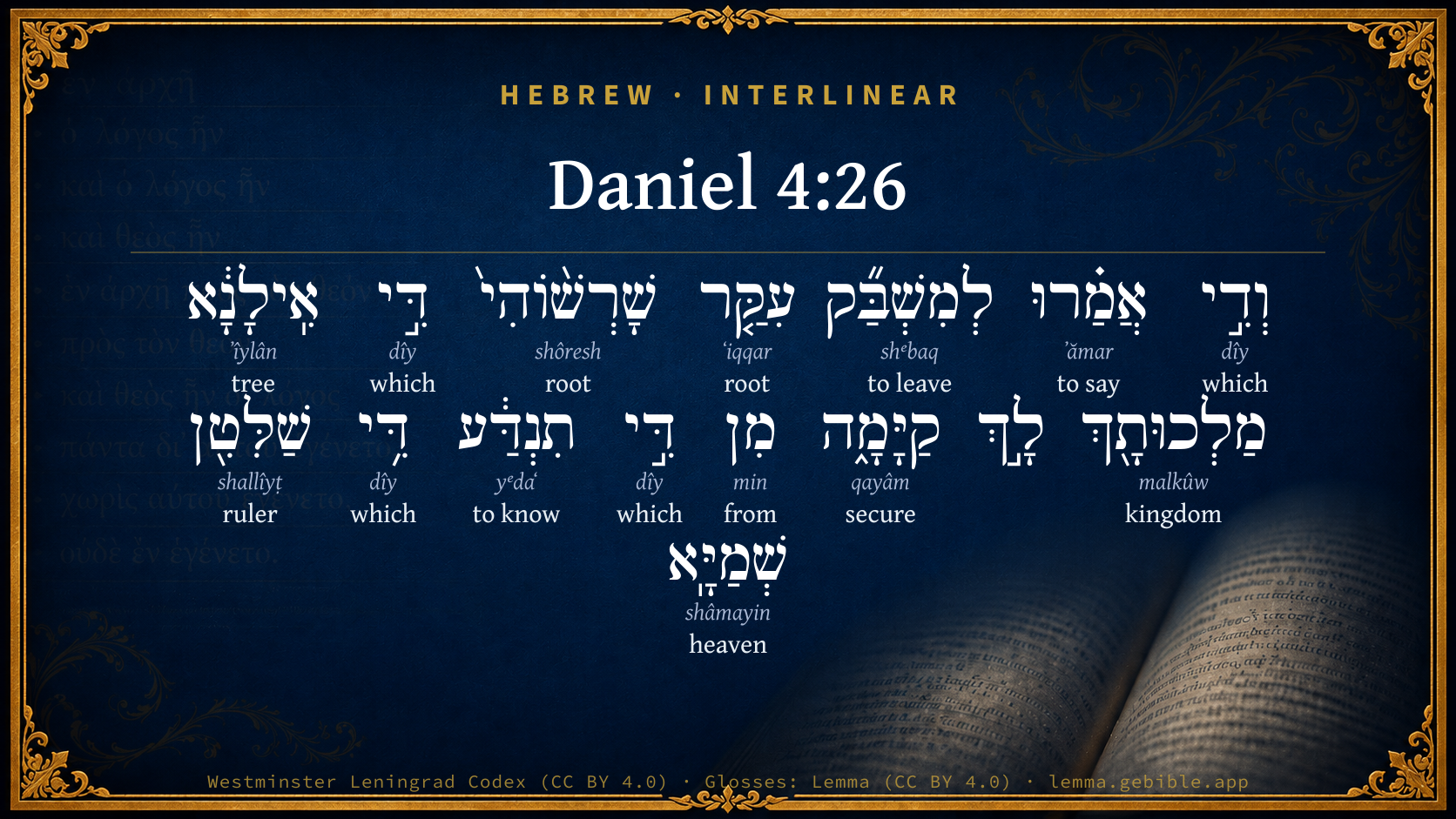
Hebrew (Westminster Leningrad Codex) Daniel 4:26 appears in the Hebrew Old Testament. The text above is from the Westminster Leningrad Codex. Each word links to its Strong’s number, a concise gloss, and parsing drawn from the Open Scriptures Hebrew Bible morphology. Click any word for its full Brown-Driver-Briggs (BDB) entry.
Download image
Cite this verse

Daniel 4:26 (World English Bible). Public Domain. Lemma interlinear Bible study tool, https://lemma.gebible.app/v/daniel/4/26.

Show BibTeX & RIS
BibTeX
RIS
English Translation
Whereas they commanded to leave the stump of the roots of the tree; your kingdom shall be sure to you, after that you shall have known that the heavens do rule.
World English Bible · Public Domain
Highlights Full analysis ↓
Download a study sheet

One document with this verse’s original text, its word-by-word gloss line, the meaning frame, cross-references with their text, attributed commentary, and full source and license credits — printable, and it pastes into notes with its structure intact.

This verse Autodidact and up

Study sheet (.html) Plain text (.txt)

A passage Seminary Student

Up to 50 verses in one chapter. A passage sheet keeps up to 6 commentary sources and 12 cross-references per verse, in the order this page ranks them, and says so on the sheet whenever that leaves anything out. Ask for a single verse and you get the Autodidact verse sheet above.

Everything on this page stays free to read, with no account — the sheet is a download of what is already on screen, not access to it.

Want to remove ads? Support Godless Engineer
Compare translations 3

The same verse in 3 English versions, stacked beneath the original-language interlinear above. Click any original word for its lexicon entry.

Each is an independent rendering of the whole verse — the interlinear is not word-aligned to these translations.

Highlighted words mark where these versions differ — a whole-verse word diff, not a word-by-word alignment.

  • World English Bible Public Domain
    Whereas they commanded to leave the stump of the roots of the tree; your kingdom shall be sure to you, after that you shall have known that the heavens do rule.
  • King James Version Public Domain
    And whereas they commanded to leave the stump of the tree roots; thy kingdom shall be sure unto thee, after that thou shalt have known that the heavens do rule.
  • unfoldingWord Literal Text CC BY-SA 4.0
    And as it was commanded to leave the stump of the roots of the tree, your kingdom will be assured to you from the time you recognize that Heaven rules.

unfoldingWord Literal Text — © unfoldingWord, licensed CC BY-SA 4.0. Word-aligned USFM3 via Door43 (git.door43.org/unfoldingWord/en_ult).

Versions to compare (up to 4)

3 of 4 selected

Show all 18 translations

Every available English version of this verse, each an independent rendering of the whole verse.

  • World English Bible Public Domain
    Whereas they commanded to leave the stump of the roots of the tree; your kingdom shall be sure to you, after that you shall have known that the heavens do rule.
  • Berean Standard Bible Public Domain
    As for the command to leave the stump of the tree with its roots, your kingdom will be restored to you as soon as you acknowledge that Heaven rules.
  • Majority Standard Bible Public Domain
    As for the command to leave the stump of the tree with its roots, your kingdom will be restored to you as soon as you acknowledge that Heaven rules.
  • King James Version Public Domain
    And whereas they commanded to leave the stump of the tree roots; thy kingdom shall be sure unto thee, after that thou shalt have known that the heavens do rule.
  • American Standard Version (1901) Public Domain
    And whereas they commanded to leave the stump of the roots of the tree; thy kingdom shall be sure unto thee, after that thou shalt have known that the heavens do rule.
  • Revised Version (1885) Public Domain
    And whereas they commanded to leave the stump of the tree roots; thy kingdom shall be sure unto thee, after that thou shalt have known that the heavens do rule.
  • Geneva Bible (1599) Public Domain
    At the end of twelue moneths, he walked in the royall palace of Babel.
  • Douay-Rheims (1899) Public Domain
    But whereas he commanded, that the stump of the roots thereof, that is, of the tree, should be left: thy kingdom shall remain to thee after thou shalt have known that power is from heaven.
  • Young's Literal Translation Public Domain
    And that which they said -- to leave the stump of the roots of the tree; thy kingdom for thee abideth, after that thou knowest that the heavens are ruling.
  • Literal Standard Version CC BY-SA 4.0
    And that which they said—to leave the stump of the roots of the tree; your kingdom abides for you, after that you know that the heavens are ruling.
  • Unlocked Literal Bible CC BY-SA 4.0
    As it was commanded to leave the stump of the roots of the tree, in this way your kingdom will be returned to you from the time you learn that heaven rules.
  • unfoldingWord Literal Text CC BY-SA 4.0
    And as it was commanded to leave the stump of the roots of the tree, your kingdom will be assured to you from the time you recognize that Heaven rules.
  • Darby Bible Public Domain
    And whereas it was commanded to leave the stump of the roots of the tree; thy kingdom shall remain unto thee, after that thou shalt know that the heavens do rule.
  • World Messianic Bible Public Domain
    Whereas it was commanded to leave the stump of the roots of the tree, your kingdom shall be sure to you after you know that Heaven rules.
  • Webster's Bible Public Domain
    And whereas they commanded to leave the stump of the tree roots; thy kingdom shall be sure to thee, after that thou shalt have known that the heavens do rule.
  • Free Bible Version CC BY-SA 4.0
    However, as it was decreed, the stump and its roots were to be left in the ground. Your kingdom will be restored to you when you acknowledge that Heaven rules.
  • Bible in Basic English Public Domain
    And as they gave orders to let the broken end and the roots of the tree be, so your kingdom will be safe for you after it is clear to you that the heavens are ruling.
  • JPS Tanakh (1917) Public Domain
    (4-23) And whereas it was commanded to leave the stump of the roots of the tree, thy kingdom shall be sure unto thee, after that thou shalt have known that the heavens do rule.

Literal Standard Version (2020), Covenant Press — licensed CC BY-SA 4.0. Text via the HelloAO Bible API (eBible.org). Unlocked Literal Bible (unfoldingWord) — licensed CC BY-SA 4.0. Text via the HelloAO Bible API (eBible.org). unfoldingWord Literal Text — © unfoldingWord, licensed CC BY-SA 4.0. Word-aligned USFM3 via Door43 (git.door43.org/unfoldingWord/en_ult). Free Bible Version, Dr. Jonathan Gallagher — licensed CC BY-SA 4.0. Text via the HelloAO Bible API (eBible.org).

Word by word

More ways to search: Search by grammar → Find every occurrence → Compare this word →

Practice this passage: Drill this verse → Learn its vocabulary →

קַיָּמָ֑ה
qayâm
H7011
“secure”
Adjective, A
Part of Speech
Adjective
Full BDB Definition

Origin: from H6966

TWOT: 2968b

secure, enduring
  1. וְדִ֣י dîy H1768 “and · which” Adjective, C + Particle, Relative
  2. אֲמַ֗רוּ ʼămar H560 “to say” Adjective, V, Plural
  3. לְמִשְׁבַּ֞ק shᵉbaq H7662 “to leave” Adjective, R + Verb, Qal, Infinitive Construct
  4. עִקַּ֤ר ʻiqqar H6136 “root of” Adjective, N, Common
  5. שָׁרְשׁ֨וֹהִי֙ shôresh H8330 “roots · his” Adjective, N, Common + Suffix, Personal, 3rd Person, Masculine, Singular
  6. דִּ֣י dîy H1768 “which” Adjective, T
  7. אִֽילָנָ֔א ʼîylân H363 “tree · the” Adjective, N, Common + Particle, Definite Article
  8. מַלְכוּתָ֖ךְ malkûw H4437 “kingdom · your” Adjective, N, Common + Suffix, Personal, 2nd Person, Masculine, Singular
  9. מִן min H4481 “from” Adjective, R
  10. דִּ֣י dîy H1768 “which” Adjective, A
  11. תִנְדַּ֔ע yᵉdaʻ H3046 “to know” Adjective, V
  12. דִּ֥י dîy H1768 “which” Adjective, T
  13. שַׁלִּטִ֖ן shallîyṭ H7990 “ruler” Adjective, A
  14. שְׁמַיָּֽא shâmayin H8065 “heaven(s) · the” Adjective, N, Common + Particle, Definite Article

About this verse

These counts appear in no published source. They are computed here, from the morphology-tagged text and Lemma’s own curated glosses. What Lemma adds →

16
words
12
distinct lemmas
Prophets
section

Notable vocabulary

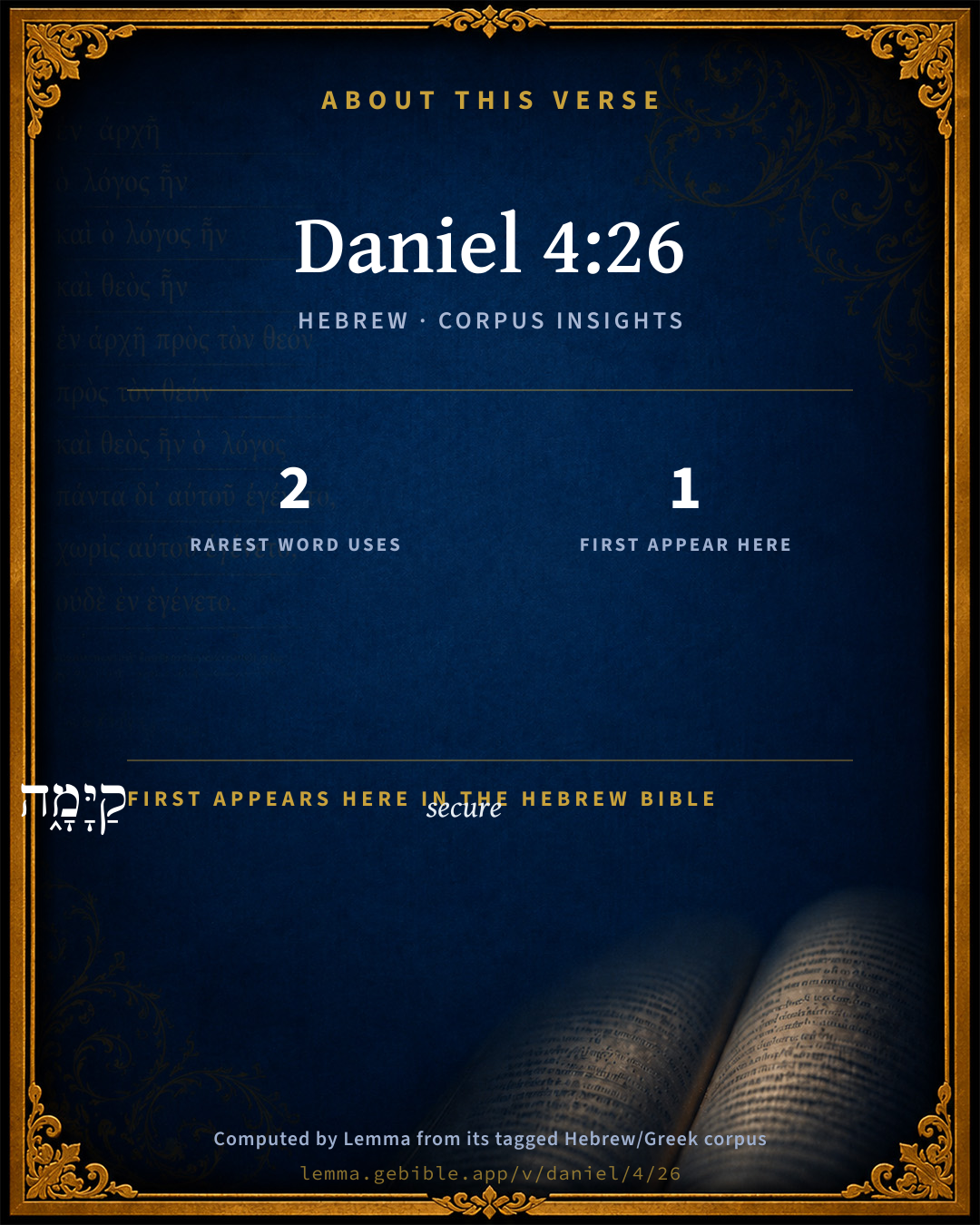
The rarest word here is קַיָּמָ֑ה secure H7011 — appearing just 2 times in the whole Hebrew Bible.

First appearance in Scripture

This word makes its first canonical appearance in the Hebrew Bible here:

  • קַיָּמָ֑ה secure H7011

Shared distinctive vocabulary

קַיָּמָ֑ה secure H7011 occurs in 2 verses of the Hebrew Bible. Also found in:

Grammatical profile

  • 1 verb
  • 12 adjectives
  • 3 particles

Verb forms

  • לְמִשְׁבַּ֞ק Qal · Infinitive Construct

Repetition

A word recurs within this verse — often emphatic in Hebrew:

  • וְדִ֣י which H1768 ×4

Hebrew & Septuagint length

In English translation the verse runs 31 words from the Hebrew and 11 from the Septuagint (LXX English) — the Septuagint runs noticeably shorter here. See the side-by-side →

A rough comparison of the two English renderings, which tokenize alike — not a word-level alignment.

Word counts can differ between the Hebrew and the Greek without any difference in meaning — e.g. the Hebrew direct-object marker אֵת has no separate Greek word, and Greek often adds the article ὁ.

Cross-references

7

Topical passages linked to Daniel 4:26 in the Treasury of Scripture Knowledge — connected by theme and wording, ordered by reader-vote popularity; previews shown in the World English Bible.

  • Daniel 4:15 Nevertheless leave the stump of its roots in the earth, even with a band of iron and brass, in the tender grass of the field; and let it be wet with the dew of the sky: and let his portion be with the animals in the grass of the earth:
  • Daniel 2:37 You, O king, are king of kings, to whom the God of heaven has given the kingdom, the power, and the strength, and the glory;
  • Daniel 4:23 Whereas the king saw a watcher and a holy one coming down from the sky, and saying, Hew down the tree, and destroy it; nevertheless leave the stump of the roots of it in the earth, even with a band of iron and brass, in the tender grass of the field, and let it be wet with the dew of the sky: and let his portion be with the animals of the field, until seven times pass over him;
  • Matthew 5:34 but I tell you, don't swear at all: neither by heaven, for it is the throne of God;
  • Matthew 21:20 When the disciples saw it, they marveled, saying, "How did the fig tree immediately wither away?"
  • Luke 15:18 I will get up and go to my father, and will tell him, "Father, I have sinned against heaven, and in your sight.
  • Luke 15:21 The son said to him, 'Father, I have sinned against heaven, and in your sight. I am no longer worthy to be called your son.'

Cross-references courtesy of OpenBible.info (CC BY 4.0).

Hebrew and Greek witnesses Masoretic Hebrew ↔ Greek Septuagint

The same verse in the two great witnesses to the Old Testament, shown verse-for-verse.

Here the Septuagint runs noticeably shorter than the Hebrew — LXX2012 (modern English Septuagint) 11 words vs World English Bible 31. A rough length comparison of the two English translations, not a word-level alignment — read both below.

These are two independent witnesses, not word-aligned to each other, and the Septuagint is shown in lemma (dictionary) form.

Hebrew Daniel 4:26 Masoretic · Westminster Leningrad Codex

וְדִ֣י אֲמַ֗רוּ לְמִשְׁבַּ֞ק עִקַּ֤ר שָׁרְשׁ֨וֹהִי֙ דִּ֣י אִֽילָנָ֔א מַלְכוּתָ֖ךְ לָ֣ךְ קַיָּמָ֑ה מִן דִּ֣י תִנְדַּ֔ע דִּ֥י שַׁלִּטִ֖ן שְׁמַיָּֽא

Whereas they commanded to leave the stump of the roots of the tree; your kingdom shall be sure to you, after that you shall have known that the heavens do rule.

World English Bible · Public Domain

Greek LXX Daniel 4:26 Septuagint · lemma form

ἕως δέ πρωΐ πᾶς τελέω ἐπί σύ ναβουχοδονοσορ βασιλεύς βαβυλών καί οὐ ὑστερέω ἀπό πᾶς οὗτος οὐδείς ἐγώ ναβουχοδονοσορ βασιλεύς βαβυλών ἑπτά ἔτος πεδάω χόρτος ὡς βοῦς ψωμίζω ἐγώ καί ἀπό ὁ χλόη ὁ γῆ ἐσθίω καί μετά ἔτος ἑπτά δίδωμι ὁ ψυχή ἐγώ εἰς δέησις καί ἀξιόω περί ὁ ἁμαρτία ἐγώ κατά πρόσωπον κύριος ὁ θεός ὁ οὐρανός καί περί ὁ ἄγνοια ἐγώ ὁ θεός ὁ θεός ὁ μέγας δέομαι καί ὁ θρίξ ἐγώ γίγνομαι ὡς πτέρυξ ἀετός ὁ ὄνυξ ἐγώ ὡσεί λέων ἀλλοιόω ὁ σάρξ ἐγώ καί ὁ καρδία ἐγώ γυμνός περιπατέω μετά ὁ θηρίον ὁ γῆ ἐνύπνιον ὁράω καί ὑπόνοια ἐγώ λαμβάνω καί διά χρόνος ὕπνος ἐγώ λαμβάνω πολύς καί νυσταγμός ἐπιπίπτω ἐγώ

After a twelvemonth, as he walked in his palace in Babylon,

LXX2012 (modern English Septuagint) · Public Domain

On this verse, The Pulpit Commentary discusses the Septuagint’s reading. Read the note in Commentary ↓

Hebrew: Westminster Leningrad Codex (CC BY 4.0). Greek: Septuagint (public domain); English from LXX2012 (modern English Septuagint) (Public Domain). How the Septuagint differs from the Hebrew →

Commentary

Notes on Daniel 4:26 from classic Christian and Jewish commentators (each source and its license shown beneath its notes). The classic Christian expositions comment on the surrounding passage and are grouped to its opening verse, so a note may address several verses; the Jewish commentaries on the Tanakh (Rashi and others) are per-verse, so they appear only where the commentator wrote on this verse.

Lemma curates 59 commentaries, every one of them public domain or Creative Commons licensed, each selected and text-cleaned for this edition rather than reprinted as found. About our sources →

Trapp's Complete Commentary

John Trapp

Dan 4:26 And whereas they commanded to leave the stump of the tree roots; thy kingdom shall be sure unto thee, after that thou shalt have known that the heavens do rule.

Ver. 26. And whereas they commanded.] See Dan 4:15; and further observe how God tempereth his judgments with mercy, and that out of his mere philanthropy.

That the heavens,] i.e., The God of heaven. {Luk 15:21 Mat 21:25}

John Trapp, A Commentary or Exposition upon All the Books of the Old and New Testament (1647–1656) — public domain. Text from a community e-Sword module.

The Biblical Illustrator

Joseph S. Exell

Dan_4:26

The heavens do rule.

The All-embracing Providence of God

The heavens, emblem of that Divine government that encircles the universe, the all-embracing superintendence of Almighty love.

I. It rules MIND as well as MATTER. The whole material universe, organic and inorganic, from the smallest atom and the tiniest insect, are under its absolute direction. There is no chance in the formation, posture, or motion of any particle of the creation. But the heavens do rule mind as well as matter. All the impulses, thoughts, and volitions of every intelligent mind are under Divine control, The heavens do rule matter by force, and mind by motive.

II. It rules the MINUTE as well as the VAST. Great and small are relative terms. In the eye of God they have no existence; and what we call little not only influences the great, but reveals as much too of the interest of the Almighty love.

III. It rules the EVIL as well as the GOOD. The heavens do rule sinners as well as saints, devils as well as angels. The wrath of man shall praise Him, and the remainder of wrath He will restrain.

1. A word to the materialist. Why be so foolish as to regard matter as at once the subject and the sovereign, the ruled and the ruler?

2. A word to the rebellious. Why oppose the Divine? You cannot master the heavens. Their bursting storms will shatter your bark, and kindle lightnings that will scathe you.

3. A word to the Christly. Let faith in the all-embracing Providence inspire you with a heroism which shall brave all enemies, a magnanimity that shall raise you above the crushing power of the greatest trials.

The Biblical Illustrator, edited by Joseph S. Exell (c. 1880s–1900s) — public domain. Text from a community e-Sword module.

Geneva Bible (1599)

Geneva Bible translators

After that Daniel had declared this vision: and this his pride declareth that it is not in man to convert to God, except his Spirit move him: seeing that these terrible threatenings could not move him to repent.

Geneva Bible (1599) marginal notes — public domain. Text via Bolls.life.

Jamieson, Fausset & Brown

Robert Jamieson, A. R. Fausset & David Brown

thou shalt have known, &c.--a promise of spiritual grace to him, causing the judgment to humble, not harden, his heart.

heavens do rule--The plural is used, as addressed to Nebuchadnezzar, the head of an organized earthly kingdom, with various principalities under the supreme ruler. So "the kingdom of heaven" (Mat 4:17; Greek, "kingdom of the heavens") is a manifold organization, composed of various orders of angels, under the Most High (Eph 1:20-21; Eph 3:10; Col 1:16).

Jamieson, Fausset & Brown — Commentary Critical and Explanatory on the Whole Bible (1871) — public domain (CC PDM 1.0). Text via the HelloAO Bible API.

Adam Clarke's Commentary

Verse 26. Thy kingdom shall he sure unto thee] No new king was set up; Evil-merodach his son was regent during his father's insanity.

Adam Clarke's Commentary on the Bible (1810–1826) — public domain. Text from a community e-Sword/MySword module.

John Calvin's Commentaries

Here Daniel closes the interpretation of the dream, and shews how God did not treat King Nebuchadnezzar so severely by not giving way to clemency. He mitigates, indeed, the extreme rigor of the punishment, to induce Nebuchadnezzar to call upon God and repent, through indulging the hope of pardon, as a clearer exhortation will afterwards follow. But Daniel now prepares him for penitence, by swing His kingdom should stand For God might cast him out from intercourse with mankind, and thus he would always remain among wild beasts. He might instantly remove him from the world; but this is a mark of his clemency, since he wished to restore him, not to a merely moderate station, but to his former dignity, as if it had never been trenched upon. We see, therefore, how useful the dream was to King Nebuchadnezzar, so long as he did not despise the Prophet’s holy admonition, through ingratitude towards God; because Daniel not only predicted the slaughter which was at hand, but brought at the same time a message of reconciliation. God, therefore, had instructed the king to some purpose, unless he had been unteachable and perverse, like the majority of mankind. Besides, we may gather from this the general doctrine of our being invited to repentance when God puts an end to his chastisements; since he sets before us a taste of his clemency to induce in us the hope of his being entreated, if we only fly to him heartily and sincerely, We must notice also what Daniel adds in the second part of the verse, from which thou mayest know that there is power in heaven: for under these words the promise of spiritual grace is included. Since God will not only punish the king of Babylon, to humble him, but will work in him and change his mind, as he afterwards fulfilled, though at a long interval.

From which thou shalt know, then, says he, that power is in heaven I have stated the grace of the Spirit to be here promised, as we know how badly men profit, even if God repeats his stripes an hundredfold. Such is the hardness and obstinacy of our hearts — for we rather grow more and more obdurate, while God calls us to repentance. And, doubtless, Nebuchadnezzar had been like Pharaoh, unless God had humbled him, not only with outward penalties, but had added also the inward instinct of his Spirit, to allow himself to be instructed, and to submit himself to the judgment and power of heaven. Daniel means this when he says, Wherefore thou shalt know; for Nebuchadnezzar would never have acquired this knowledge of his own accord, unless he had been touched by the secret movement of the Spirit. He adds, That there is power in heaven; meaning, God governs the world and exercises supreme power; for he here contrasts heaven with earth, meaning all mankind. For if kings see all filings tranquil around them, and if no one causes them terror, they think themselves beyond all chance of danger, as they say; and through being desirous of certainty in their station, they look round on all sides, but never raise their eyes upwards to heaven, as if God did not concern himself to behold the kingdoms of the earth, and to set up whom he would, and to prostrate all the proud. The princes of this world never consider their power to be from heaven, as if this were entirely out of God’s hands; but, as I have said, they look right and left, before and behind. This is the reason why Daniel said, Power is from heaven. There is a contrast then between God and all mankind, as if he had said, Thou shalt know God reigns — as we have formerly seen. It follows:

John Calvin's Commentaries (1540-1563) — public domain. Text from the Calvin Translation Society English edition (1840s-50s) via the Christian Classics Ethereal Library (ccel.org). Calvin's coverage is partial (roughly two-thirds of the Bible); uncommented books and verses are honest gaps, never fabricated. The 19th-century editor's footnotes and remarks are omitted so the notes are faithfully Calvin's own voice.

Ellicott's Commentary for English Readers

(26) They commanded—i.e., the watchers. We observe, however, in Dan_4:13 that the command is only ascribed to one of the watchers. This makes it appear that they form a council in which one acts in behalf of all.

Thy kingdom.—To make the sense plain we must supply before this word, “The interpretation of it is,” or some sentence to that effect.

Shall be sure.—Literally, shall arise. No successor shall be appointed during his life.

Do rule—i.e., the heavens, or One in heaven ruleth the kingdoms of men.

A Bible Commentary for English Readers, edited by Charles John Ellicott (1878–1897) — public domain. Text from a community e-Sword module.

The Cambridge Bible for Schools and Colleges

gen. ed. J. J. S. Perowne

26. they commanded] viz. the watchers (cf. Dan_4:17). Or, in accordance with the principle just explained, it was commanded.

sure] i.e. confirmed, secure: cf. Dan_6:26 (‘stedfast’). The object of the humiliation was (Dan_4:25 b) to teach the king that his power was not his own, but delegated to him by God, the supreme ruler of the world; provision was therefore made that when he had learnt this lesson his kingdom should be restored to him (cf. Dan_4:32 b).

that the heavens do rule] The use of ‘heaven,’ either as a metonym, or as an expression of reverence, for God, does not occur elsewhere in the O.T.; but it is found in the Apocrypha, as 1Ma_3:18, R.V. [contrast 1Sa_14:6], 19 (cf. 1Ma_4:60), 1Ma_4:10; 1Ma_4:24; 1Ma_4:55, 2Ma_9:20; and it is especially frequent in the Mishna, as Abhoth, i. 3, ‘and let the fear of Heaven be upon you’; ii. 16, ‘let all thy deeds be in the name of Heaven’; iv. 7, ‘whoso profaneth the name of Heaven in secret, they punish him (i.e. he is punished) openly.’ Cf. Luk_15:18; Luk_15:21[243].

[243] See further examples in Dalman, l.c., pp. 178–180; and cf. Schürer2, ii. 454.

In connexion with the phrase here employed, it may be remarked that the original Jewish sense of the expression, ‘kingdom of heaven,’ is the rule, or government, of heaven[244].

[244] Dalman, pp. 75–77.

The Cambridge Bible for Schools and Colleges (gen. ed. J. J. S. Perowne; Cambridge University Press, 1878–1918) — public domain. Text from a community e-Sword module.

John Gill's Exposition

All this came upon the king Nebuchadnezzar. All that was signified in the dream, his madness, the removal of him from the administration of government, and the brutal life he lived for seven years; for this was not a mere parable or fiction, as some have thought, framed to describe the state and punishment of a proud man, but was a real fact; though it is not made mention of by any historians, excepting what has been observed before out of Abydenus (n); see Gill on Dan 4:16, yet there is no reason to doubt of the truth of it, from this relation of Daniel; and is further confirmed by his observing the same to Belshazzar his grandson some years after it was done, as a known thing, and as an unquestionable matter of fact, Dan 5:20.

(n) Apud Eubseb. Praepar. Evangel. l. 9. c. 41. p. 457.

John Gill's Exposition of the Whole Bible (1746–1763) — public domain (CC PDM 1.0). Text via the HelloAO Bible API.

Albert Barnes' Notes on the Bible

And whereas they commanded - The watchers, Dan 4:15. Compare Dan 4:17.

To leave the stump of the tree roots - Or, to leave roots to the stump of the tree; that is, it was not to be dug up, or wholly destroyed, but vitality was to be left in the ground. The Chaldee here is the same as in Dan 4:15, “leave the stump of his roots.”

Thy kingdom shall be sure unto thee - That is, thou shalt not die under this calamity, but after it has passed away shalt be restored to authority. It might have been supposed that this meant that the authority would survive in his family, and that those who were to succeed him would reign - as shoots spring up after the parent tree has fallen; but Daniel was directed to an interpretation which is not less in accordance with the fair meaning of the dream than this would have been.

After that thou shalt have known that the heavens do rule - That God rules, This was the great lesson which the event was designed to teach, and when that should have been learned, there would be a propriety that he should be restored to his throne, and should proclaim this to the world.

Albert Barnes' Notes on the Bible (1834–1885) — public domain. Text from a community e-Sword/MySword module.

Matthew Poole's English Annotations

There shall be no other king chosen in thy room all the time thou livest as a stump of a tree. Thou shalt recover all again, young branches shall sprout out of thee, Job 14:7-9.

After that thou shalt have known that the heavens do rule: see Dan 4:34,35, &c. If princes will not learn and know this, God will beat it into them. This is the end of all God’s rods upon them, if they would hear the voice of them, and him that hath appointed them, 2Ch 33:12,13; Psa 119:67,71; Mic 6:9. Though Nebuchadnezzar never proved a convert, yet God made him acknowledge this truth upon his restoration.

Matthew Poole's English Annotations on the Holy Bible (1683–1685) — public domain. Text from a community e-Sword/MySword module.

Whedon's Commentary on the Bible

Daniel D. Whedon

26. Rather, so soon as thou shalt recognize that the heavens do rule. This is the first time in Jewish literature that “the heavens” is used for the “God of heaven.” (Compare Dan_3:1.) In the Mishna this is a common form, as also in the Apocrypha (for example, 1 Macc. iv). It might be added, however, that Bel is addressed in the inscriptions as the “great heavens.”

Daniel D. Whedon (gen. ed.), Commentary on the Old and New Testaments (1874–1909) — public domain. Text from a community e-Sword module.

The Pulpit Commentary

And whereas they commanded to leave the stump of the tree roots; thy kingdom shall be. sure unto thee, after that thou shalt have known that the heavens do rule. The Septuagint Version here is different, and not so good as the received text, "And (as for) the root of the tree which was left and not rooted out, the place of thy throne shall be preserved to thee to a season and an hour; behold, for thee they are prepared, and they shall bring judgment upon thee. The Lord liveth in heaven, and his power is in all the earth." The last clause here is plainly a paraphrase of "the heavens do rule." "A season and an hour" is a doublet, and since it is to be observed that the phrase, "after that thou shalt have known," is omitted, we may deduce that thindda", "thou shalt know," is, by transposition of letters, read liddan. Theodotion, who is usually slavish in his following of the Aramaic construction, renders here, "And because they said, Suffer the stump (fuhn) of the roots of the tree." This suggests that in the text before Theodotion mere is omitted from qb (l"mishbaq), and it was read wqb (leishbaqoo), meaning, according to the Mandaitic form of the verb, "they shall leave a form in accordance with the previous construction, then further altered to the second person plural. The end of the verse is also slightly different, "Until thou shalt know the heavenly power," reading here shooltan dee shemya"instead of shaltan shemya. The Peshitta renders, "till thou shalt know that power is from the heaven (min shemya)." Mr. Bevan remarks on this usage of "heavens" for "God," which he compares with the Mishna and with the New Testament. He does not observe that the difficulty all the translators have with the phrase is a proof that, when the versions were made, it was even then not a common usage; hence that its introduction here was not due to the influence of the Mishnaic Hebrew stretching back, but was owing rather to the peculiar circumstances of Daniel. Professor Bevan"s reference to the New Testament is mistaken. In no case in the New Testament is ouranoi used for "God." Even in the Greek Apocrypha is no usage precisely equivalent. Daniel, by using the phrase he did, put himself on the same level as the heathen king pride against the gods (ubriv), and of this, by implication, is Nebuchadnezzar here accused. Certainly the words of his inscriptions do not indicate anything of this sort. In fact, many of the phrases in the prayer to Marduk in the India House Inscription indicate reverent humility almost Christian. Still, these phrases might be due, to some extent, to political custom. The relation of a polytheist to his gods is a psychological enigma to a civilized monotheist. On the one hand, he recognizes his dependence on the god; on the other, he considers the god honoured by his worship, and therefore owing him certain duties in return.

The Pulpit Commentary (1880–1919), ed. H.D.M. Spence-Jones & Joseph S. Exell — public domain. Text from a community e-Sword module.

John Wesley's Explanatory Notes

The heavens do rule - That God, who sits in heaven rules over all.

John Wesley, Explanatory Notes Upon the Whole Bible (1754–1765) — public domain. Text via the GEBible commentary corpus.

unfoldingWord translationNotes

Door43 World Missions Community

General Information:

Verses 19-33 use the third person to describe the punishment of Nebuchadnezzar. (See: First, Second, or Third Person)

heaven rules

Here "heaven" refers to God who lives in heaven. AT: "God in heaven is the ruler of all" (See: Metonymy)

let my advice be acceptable to you

This can be stated in active form. AT: "please accept my advice" (See: Active or Passive)

Turn away from your iniquities

Here rejecting iniquity is spoken of as turning away from it. AT: "Reject your iniquities" (See: Metaphor)

the oppressed

This nominal adjective refers to people who are oppressed. AT: "people who are oppressed" (See: Nominal Adjectives)

it may be that your prosperity will be extended

This can be stated in active form. AT: "God may extend your prosperity" (See: Active or Passive)

translationWords

command

kingdom

heaven

sin

iniquity

mercy

oppress

unfoldingWord translationNotes — © Distant Shores Media and the Door43 World Missions Community, licensed CC BY-SA 4.0. Source: git.door43.org/Door43/en_tn.

Rashi

Rabbi Shlomo Yitzchaki (Rashi)

he was walking [as translated,] he was walking.

Rashi on the Tanakh — English translations: “The Judaica Press complete Tanach with Rashi, translated by A. J. Rosenberg” (CC BY 4.0); “Pentateuch with Rashi's commentary by M. Rosenbaum and A.M. Silbermann, 1929-1934” (public domain); “The Metsudah Tanach series, Lakewood, N.J” (CC BY 4.0); and “The Book of Joshua, Metsudah Publications, 1997” (CC BY 4.0). Text via Sefaria.

Lesson kit

Teaching starters — assembled from the data on this page, not authored interpretation. Every prompt links to the verse data it draws on. Edit before teaching.

Daniel, in the Prophets, opens this verse with 16 words (12 distinct Hebrew lemmas). Its most distinctive word is qayâm (“secure”). The Greek Septuagint runs shorter here. A historical commentator’s framing appears above. Read the whole chapter for the surrounding context.

Discussion questions

  1. How does “secure” (qayâm) shape what this verse is saying?
  2. This is the first place “secure” appears in Scripture (first appears here). What does its debut here establish?
  3. How does Daniel 6:26, which shares the word «secure», read alongside this verse?
  4. What does the repetition of “which” (4× in this one verse) do in this verse?
  5. The Septuagint runs shorter here than the Hebrew. What might account for the difference?
  6. The translations on this page render this verse differently — a whole-verse word diff, not a word-by-word alignment. What might account for the different wordings?
  7. «לְמִשְׁבַּ֞ק» is a Qal Infinitive Construct verb. How does that grammatical form shape the action described?
  8. Compare how Trapp's Complete Commentary and The Biblical Illustrator read this verse. Where do they agree or differ?

Things to notice

  • 1 word makes its first canonical appearance in Scripture here.
  • These translations choose different wording for 16 words in this verse.
  • “which” occurs 4× in this single verse.
  • 12 distinct Hebrew lemmas span 16 words in this verse.

Reading settings

Reading text

Shown beneath each verse's original-language words.

Old Testament
Old Testament edition

Read the OT as the Masoretic Hebrew (MT) or the Greek Septuagint (LXX).

English shown for the Greek Septuagint (in the Hebrew ↔ Greek comparison).

Comparing translations? Open the Compare panel on any verse page to stack up to four side by side.