
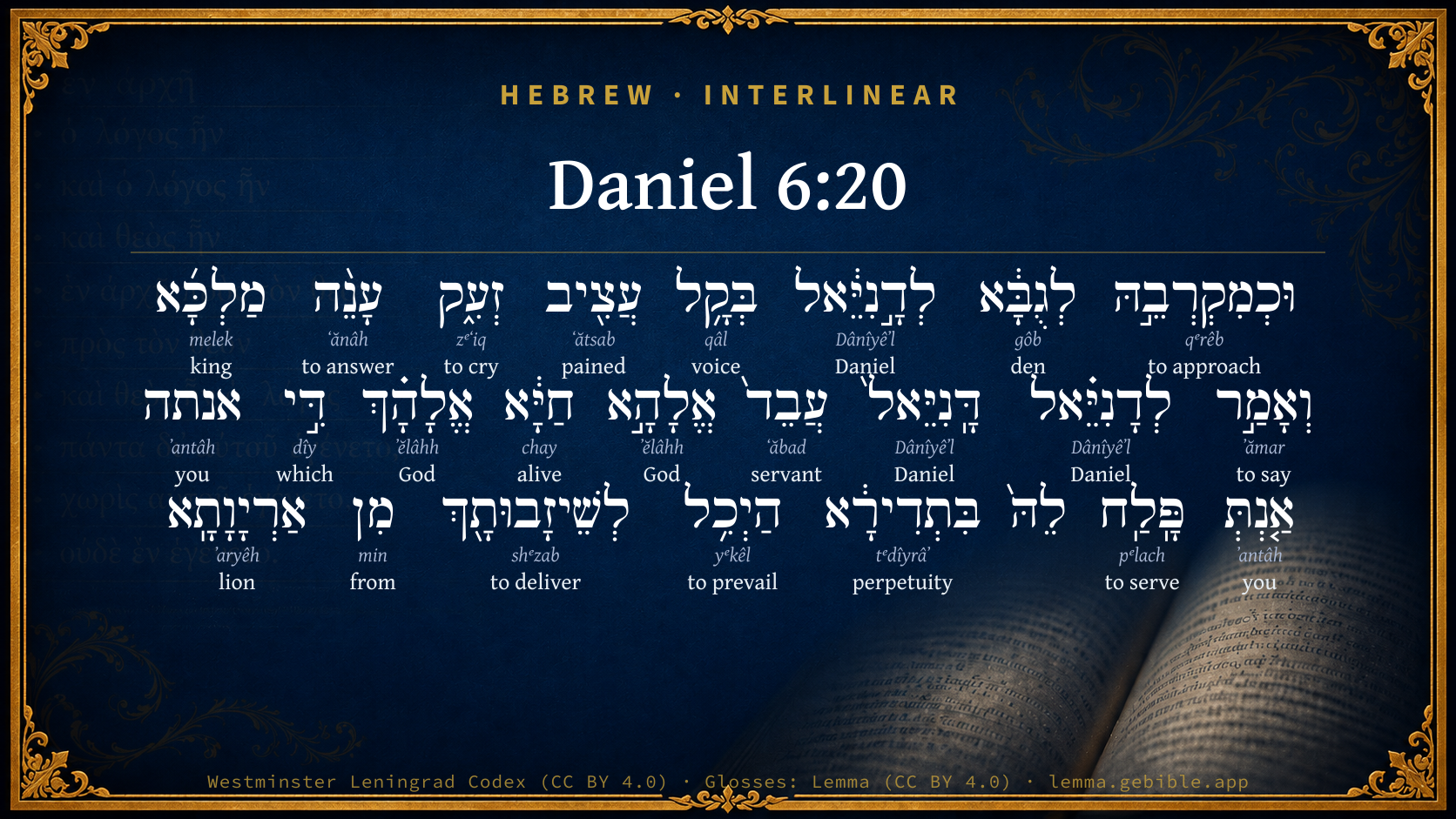
Daniel 6:20

Hebrew (Westminster Leningrad Codex) Daniel 6:20 appears in the Hebrew Old Testament. The text above is from the Westminster Leningrad Codex. Each word links to its Strong’s number, a concise gloss, and parsing drawn from the Open Scriptures Hebrew Bible morphology. Click any word for its full Brown-Driver-Briggs (BDB) entry.
Download image
Cite this verse

Daniel 6:20 (World English Bible). Public Domain. Lemma interlinear Bible study tool, https://lemma.gebible.app/v/daniel/6/20.

Show BibTeX & RIS
BibTeX
RIS
English Translation
When he came near to the den to Daniel, he cried with a lamentable voice; the king spoke and said to Daniel, Daniel, servant of the living God, is your God, whom you serve continually, able to deliver you from the lions?
World English Bible · Public Domain
Highlights
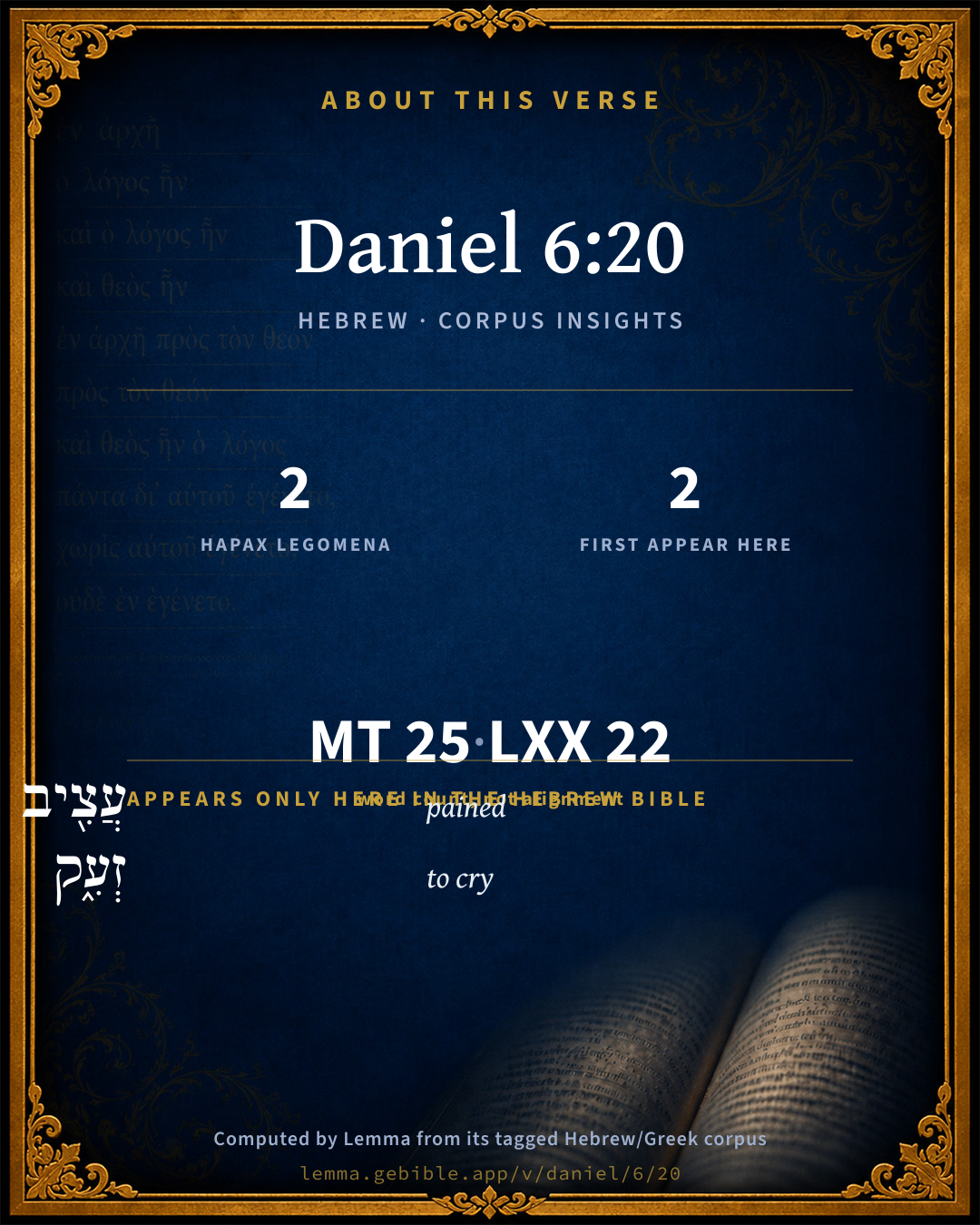
  • 2 hapax legomena — only here in the Hebrew Bible
  • 2 first appearances in the Hebrew Bible
Full analysis ↓
Download a study sheet

One document with this verse’s original text, its word-by-word gloss line, the meaning frame, cross-references with their text, attributed commentary, and full source and license credits — printable, and it pastes into notes with its structure intact.

This verse Autodidact and up

Study sheet (.html) Plain text (.txt)

A passage Seminary Student

Up to 50 verses in one chapter. A passage sheet keeps up to 6 commentary sources and 12 cross-references per verse, in the order this page ranks them, and says so on the sheet whenever that leaves anything out. Ask for a single verse and you get the Autodidact verse sheet above.

Everything on this page stays free to read, with no account — the sheet is a download of what is already on screen, not access to it.

Want to remove ads? Support Godless Engineer
Compare translations 3

The same verse in 3 English versions, stacked beneath the original-language interlinear above. Click any original word for its lexicon entry.

Each is an independent rendering of the whole verse — the interlinear is not word-aligned to these translations.

Highlighted words mark where these versions differ — a whole-verse word diff, not a word-by-word alignment.

  • World English Bible Public Domain
    When he came near to the den to Daniel, he cried with a lamentable voice; the king spoke and said to Daniel, Daniel, servant of the living God, is your God, whom you serve continually, able to deliver you from the lions?
  • King James Version Public Domain
    And when he came to the den, he cried with a lamentable voice unto Daniel: and the king spake and said to Daniel, O Daniel, servant of the living God, is thy God, whom thou servest continually, able to deliver thee from the lions?
  • unfoldingWord Literal Text CC BY-SA 4.0
    As he came near to the den to Daniel, he cried out in a troubled voice. The king responded and said to Daniel, “O Daniel, servant of the living God, has your God, whom you serve continually, been able to deliver you from the lions?”

unfoldingWord Literal Text — © unfoldingWord, licensed CC BY-SA 4.0. Word-aligned USFM3 via Door43 (git.door43.org/unfoldingWord/en_ult).

Versions to compare (up to 4)

3 of 4 selected

Show all 18 translations

Every available English version of this verse, each an independent rendering of the whole verse.

  • World English Bible Public Domain
    When he came near to the den to Daniel, he cried with a lamentable voice; the king spoke and said to Daniel, Daniel, servant of the living God, is your God, whom you serve continually, able to deliver you from the lions?
  • Berean Standard Bible Public Domain
    When he reached the den, he cried out in a voice of anguish, “O Daniel, servant of the living God, has your God, whom you serve continually, been able to deliver you from the lions?”
  • Majority Standard Bible Public Domain
    When he reached the den, he cried out in a voice of anguish, “O Daniel, servant of the living God, has your God, whom you serve continually, been able to deliver you from the lions?”
  • King James Version Public Domain
    And when he came to the den, he cried with a lamentable voice unto Daniel: and the king spake and said to Daniel, O Daniel, servant of the living God, is thy God, whom thou servest continually, able to deliver thee from the lions?
  • American Standard Version (1901) Public Domain
    And when he came near unto the den to Daniel, he cried with a lamentable voice; the king spake and said to Daniel, O Daniel, servant of the living God, is thy God, whom thou servest continually, able to deliver thee from the lions?
  • Revised Version (1885) Public Domain
    And when he came near unto the den to Daniel, he cried with a lamentable voice: the king spake and said to Daniel, O Daniel, servant of the living God, is thy God, whom thou servest continually, able to deliver thee from the lions?
  • Geneva Bible (1599) Public Domain
    And when he came to the denne, he cryed with a lamentable voyce vnto Daniel: and the King spake, and saide to Daniel, O Daniel, the seruant of ye liuing God, is not thy God (whom thou alway seruest) able to deliuer thee from the lyons?
  • Douay-Rheims (1899) Public Domain
    And coming near to the den, cried with a lamentable voice to Daniel, and said to him: Daniel, servant of the living God, hath thy God, whom thou servest always, been able, thinkest thou, to deliver thee from the lions?
  • Young's Literal Translation Public Domain
    and at his coming near to the den, to Daniel, with a grieved voice, he crieth. The king hath answered and said to Daniel, O Daniel, servant of the living God, thy God, whom thou art serving continually, is He able to deliver thee from the lions?'
  • Literal Standard Version CC BY-SA 4.0
    and at his coming near to the den, to Daniel, with a grieved voice, he cries. The king has answered and said to Daniel, “O Daniel, servant of the living God, your God, whom you are serving continually, is He able to deliver you from the lions?”
  • Unlocked Literal Bible CC BY-SA 4.0
    As he came near to the den, he called out to Daniel in a sad voice, saying to Daniel, “Daniel, servant of the living God, has your God, whom you serve continually, been able to save you from the lions?”
  • unfoldingWord Literal Text CC BY-SA 4.0
    As he came near to the den to Daniel, he cried out in a troubled voice. The king responded and said to Daniel, “O Daniel, servant of the living God, has your God, whom you serve continually, been able to deliver you from the lions?”
  • Darby Bible Public Domain
    And when he came near unto the den, he cried with a mournful voice unto Daniel: the king spoke and said unto Daniel, O Daniel, servant of the living God, hath thy God whom thou servest continually been able to save thee from the lions?
  • World Messianic Bible Public Domain
    When he came near to the den to Daniel, he cried with a troubled voice. The king spoke and said to Daniel, “Daniel, servant of the living God, is your God, whom you serve continually, able to deliver you from the lions?”
  • Webster's Bible Public Domain
    \\6:19\\Then the king arose very early in the morning, and went in haste to the den of lions.
  • Free Bible Version CC BY-SA 4.0
    As he approached the den, he called out anxiously to Daniel, “Daniel, servant of the living God whom you honor so faithfully, was your God able to save you from the lions?”
  • Bible in Basic English Public Domain
    Then very early in the morning the king got up and went quickly to the lions' hole.
  • JPS Tanakh (1917) Public Domain
    (6-21) And when he came near unto the den to Daniel, he cried with a pained voice; the king spoke and said to Daniel: 'O Daniel, servant of the living God, is thy God, whom thou servest continually, able to deliver thee from the lions?'

Literal Standard Version (2020), Covenant Press — licensed CC BY-SA 4.0. Text via the HelloAO Bible API (eBible.org). Unlocked Literal Bible (unfoldingWord) — licensed CC BY-SA 4.0. Text via the HelloAO Bible API (eBible.org). unfoldingWord Literal Text — © unfoldingWord, licensed CC BY-SA 4.0. Word-aligned USFM3 via Door43 (git.door43.org/unfoldingWord/en_ult). Free Bible Version, Dr. Jonathan Gallagher — licensed CC BY-SA 4.0. Text via the HelloAO Bible API (eBible.org).

Word by word

More ways to search: Search by grammar → Find every occurrence → Compare this word →

Practice this passage: Drill this verse → Learn its vocabulary →

עֲצִ֖יב
ʻătsab
H6088
“pained”
Adjective, A
Part of Speech
Adjective
Full BDB Definition

Origin: corresponding to H6087

TWOT: 2925

to pain, grieve - (Peal) pained (participle)
  1. וּכְמִקְרְבֵ֣הּ qᵉrêb H7127 “and · like/as · to approach · him” Adjective, C + Preposition + Verb, Qal, Infinitive Construct + Suffix, Personal, 3rd Person, Masculine, Singular
  2. לְגֻבָּ֔א gôb H1358 “to/for · den · the” Adjective, R + Noun, Common, Masculine, Singular, Determined + Particle, Definite Article
  3. לְדָ֣נִיֵּ֔אל Dânîyêʼl H1841 “to/for · Daniel” Adjective, R + Noun, Proper
  4. בְּקָ֥ל qâl H7032 “in/at · voice” Adjective, R + Noun, Common, Masculine, Singular, Absolute
  5. זְעִ֑ק zᵉʻiq H2200 “to cry” Adjective, V, Plural
  6. עָנֵ֨ה ʻănâh H6032 “answering” Adjective, V
  7. מַלְכָּ֜א melek H4430 “king · the” Adjective, N, Common + Particle, Definite Article
  8. וְאָמַ֣ר ʼămar H560 “and · saying” Adjective, C + Verb, Qal, Participle Active, Masculine, Singular, Absolute
  9. לְדָנִיֵּ֗אל Dânîyêʼl H1841 “to/for · Daniel” Adjective, R + Noun, Proper
  10. דָּֽנִיֵּאל֙ Dânîyêʼl H1841 “Daniel” Adjective, N
  11. עֲבֵד֙ ʻăbad H5649 “servant of” Adjective, N, Common
  12. אֱלָהָ֣א ʼĕlâhh H426 “God · the” Adjective, N, Common + Particle, Definite Article
  13. חַיָּ֔א chay H2417 “alive · the” Adjective, A + Particle, Definite Article
  14. אֱלָהָ֗ךְ ʼĕlâhh H426 “God · your” Adjective, N, Common + Suffix, Personal, 2nd Person, Masculine, Singular
  15. דִּ֣י dîy H1768 “which” Adjective, T
  16. אנתה ʼantâh H607 “you” Adjective, P
  17. אַ֤נְתְּ ʼantâh H607 “you” Adjective, P
  18. פָּֽלַֽח pᵉlach H6399 “serving” Adjective, V
  19. בִּתְדִירָ֔א tᵉdîyrâʼ H8411 “in/at · perpetuity · the” Adjective, R + Noun, Common, Feminine, Singular, Determined + Particle, Definite Article
  20. הַיְכִ֥ל yᵉkêl H3202 “to prevail” Adjective, T + Verb, Qal, Perfect, 3rd Person, Masculine, Singular
  21. לְשֵׁיזָבוּתָ֖ךְ shᵉzab H7804 “to deliver · you” Adjective, R + Verb, e, Infinitive Construct + Suffix, Personal, 2nd Person, Masculine, Singular
  22. מִן min H4481 “from” Adjective, R
  23. אַרְיָוָתָֽא ʼaryêh H744 “lions · the” Adjective, N, Common + Particle, Definite Article

About this verse

These counts appear in no published source. They are computed here, from the morphology-tagged text and Lemma’s own curated glosses. What Lemma adds →

25
words
20
distinct lemmas
Prophets
section

Notable vocabulary

2 hapax legomena — words that appear only here in the entire Hebrew Bible:

  • עֲצִ֖יב pained H6088
  • זְעִ֑ק to cry H2200

First appearance in Scripture

These words make their first canonical appearance in the Hebrew Bible here:

  • עֲצִ֖יב pained H6088
  • זְעִ֑ק to cry H2200

Shared distinctive vocabulary

בִּתְדִירָ֔א perpetuity H8411 occurs in 2 verses of the Hebrew Bible. Also found in:

Grammatical profile

  • 4 verbs
  • 3 nouns
  • 12 adjectives
  • 6 particles

Verb forms

  • וּכְמִקְרְבֵ֣הּ Qal · Infinitive Construct
  • וְאָמַ֣ר Qal · Participle Active
  • הַיְכִ֥ל Qal · Perfect
  • לְשֵׁיזָבוּתָ֖ךְ Infinitive Construct

Repetition

Words recur within this verse — often emphatic in Hebrew:

  • לְדָ֣נִיֵּ֔אל Daniel H1841 ×3
  • אֱלָהָ֣א God H426 ×2
  • אנתה you H607 ×2

Hebrew & Septuagint length

In English translation the verse runs 42 words from the Hebrew and 36 from the Septuagint (LXX English) — closely comparable.

A rough comparison of the two English renderings, which tokenize alike — not a word-level alignment.

Word counts can differ between the Hebrew and the Greek without any difference in meaning — e.g. the Hebrew direct-object marker אֵת has no separate Greek word, and Greek often adds the article ὁ.

In the original languages it is 25 Hebrew tokens and 22 Greek tokens — but the two are counted differently (Hebrew bundles its prefixes and suffixes into one token; the Greek is in lemma form), so that isn’t a like-for-like length.

Cross-references

28

Topical passages linked to Daniel 6:20 in the Treasury of Scripture Knowledge — connected by theme and wording, ordered by reader-vote popularity; previews shown in the World English Bible.

  • 1 Chronicles 16:11 Seek you Yahweh and his strength; Seek his face forever more.
  • Daniel 6:27 He delivers and rescues, and he works signs and wonders in heaven and in earth, who has delivered Daniel from the power of the lions.
  • Hebrews 7:25 Therefore he is also able to save to the uttermost those who draw near to God through him, seeing he ever lives to make intercession for them.
  • Daniel 6:16 Then the king commanded, and they brought Daniel, and cast him into the den of lions. [Now] the king spoke and said to Daniel, Your God whom you serve continually, he will deliver you.
  • 2 Timothy 4:16–18 At my first defense, no one came to help me, but all left me. May it not be held against them.
  • Daniel 3:17 If it be [so], our God whom we serve is able to deliver us from the burning fiery furnace; and he will deliver us out of your hand, O king.
  • 1 Thessalonians 5:17–18 Pray without ceasing.
  • James 1:25 But he who looks into the perfect law, the law of freedom, and continues, not being a hearer who forgets but a doer of the work, this man will be blessed in what he does.
  • Genesis 18:14 Is anything too hard for Yahweh? At the set time I will return to you, when the season comes round, and Sarah will have a son."
  • Numbers 11:23 Yahweh said to Moses, Has Yahweh's hand grown short? now shall you see whether my word shall happen to you or not.
  • Psalms 71:14–18 But I will always hope, And will add to all of your praise.
  • Proverbs 23:17–18 Don't let your heart envy sinners; But rather fear Yahweh all the day long.
  • Jeremiah 32:17 Ah Lord Yahweh! behold, you have made the heavens and the earth by your great power and by your outstretched arm; there is nothing too hard for you,
  • Hosea 12:6 Therefore turn to your God. Keep kindness and justice, And wait for your God continually.
  • Luke 18:1 He also spoke a parable to them that they must always pray, and not give up,
  • 2 Corinthians 1:10 who delivered us out of so great a death, and does deliver; on whom we have set our hope that he will also still deliver us;
  • Psalms 73:23 Nevertheless, I am continually with you. You have held my right hand.
  • Daniel 3:15 Now if you are ready whenever you hear the sound of the horn, flute, zither, lyre, harp, pipe, and all kinds of music to you fall down and worship the image which I have made, [well]: but if you don't worship, you shall be cast the same hour into the midst of a burning fiery furnace; and who is that god that shall deliver you out of my hands?
  • Daniel 3:28–29 Nebuchadnezzar spoke and said, Blessed be the God of Shadrach, Meshach, and Abednego, who has sent his angel, and delivered his servants who trusted in him, and have changed the king's word, and have yielded their bodies, that they might not serve nor worship any god, except their own God.
  • Luke 1:37 For everything spoken by God is possible."
  • Colossians 4:2 Continue steadfastly in prayer, watching therein with thanksgiving;
  • 2 Timothy 1:12 For this cause I suffer also these things. Yet I am not ashamed, for I know him whom I have believed, and I am persuaded that he is able to guard that which I have committed to him against that day.
  • Jude 1:24 Now to him who is able to keep them from stumbling, and to present you faultless before the presence of his glory in great joy,
  • Numbers 14:15–16 Now if you shall kill this people as one man, then the nations which have heard the fame of you will speak, saying,
  • Psalms 119:112 I have set my heart to perform your statutes forever, Even to the end.
  • Psalms 146:2 While I live, I will praise Yahweh. I will sing praises to my God as long as I exist.
  • Acts 6:4 But we will continue steadfastly in prayer and in the ministry of the word."
  • Romans 2:7 to those who by patience in well-doing seek for glory and honor and incorruptibility, eternal life;

Cross-references courtesy of OpenBible.info (CC BY 4.0).

Hebrew and Greek witnesses Masoretic Hebrew ↔ Greek Septuagint

The same verse in the two great witnesses to the Old Testament, shown verse-for-verse.

These are two independent witnesses, not word-aligned to each other, and the Septuagint is shown in lemma (dictionary) form.

Hebrew Daniel 6:20 Masoretic · Westminster Leningrad Codex

וּכְמִקְרְבֵ֣הּ לְגֻבָּ֔א לְדָ֣נִיֵּ֔אל בְּקָ֥ל עֲצִ֖יב זְעִ֑ק עָנֵ֨ה מַלְכָּ֜א וְאָמַ֣ר לְדָנִיֵּ֗אל דָּֽנִיֵּאל֙ עֲבֵד֙ אֱלָהָ֣א חַיָּ֔א אֱלָהָ֗ךְ דִּ֣י אנתה אַ֤נְתְּ פָּֽלַֽח לֵהּ֙ בִּתְדִירָ֔א הַיְכִ֥ל לְשֵׁיזָבוּתָ֖ךְ מִן אַרְיָוָתָֽא

When he came near to the den to Daniel, he cried with a lamentable voice; the king spoke and said to Daniel, Daniel, servant of the living God, is your God, whom you serve continually, able to deliver you from the lions?

World English Bible · Public Domain

Greek LXX Daniel 6:20 Septuagint · lemma form

καί ὁ βασιλεύς δαρεῖος ὀρθρίζω πρωΐ καί παραλαμβάνω μετά ἑαυτοῦ ὁ σατράπης καί πορεύομαι ἵστημι ἐπί ὁ στόμα ὁ λάκκος ὁ λέων

And when he drew near to the den, he cried with a loud voice, Daniel, servant of the living God, has your God, whom you serve continually, been able to deliver you from the lion's mouth?

LXX2012 (modern English Septuagint) · Public Domain

Hebrew: Westminster Leningrad Codex (CC BY 4.0). Greek: Septuagint (public domain); English from LXX2012 (modern English Septuagint) (Public Domain). How the Septuagint differs from the Hebrew →

Commentary

Notes on Daniel 6:20 from classic Christian and Jewish commentators (each source and its license shown beneath its notes). The classic Christian expositions comment on the surrounding passage and are grouped to its opening verse, so a note may address several verses; the Jewish commentaries on the Tanakh (Rashi and others) are per-verse, so they appear only where the commentator wrote on this verse.

Lemma curates 59 commentaries, every one of them public domain or Creative Commons licensed, each selected and text-cleaned for this edition rather than reprinted as found. About our sources →

Trapp's Complete Commentary

John Trapp

Dan 6:20 And when he came to the den, he cried with a lamentable voice unto Daniel: [and] the king spake and said to Daniel, O Daniel, servant of the living God, is thy God, whom thou servest continually, able to deliver thee from the lions?

Ver. 20. And when he came to the den, he cried with a lamentable voice.] With a piteous distressed voice: far otherwise than did Daniel, {Dan 6:21} who chose rather to be cast into the den of lions than to carry about a lion in his bosom, an enraged conscience, as did Darius here, and afterwards Theodoricus, king of Italy, who had caused Boetius and Symmachus to be unjustly beheaded, but carried the horror of it to his grave. How good is it, therefore, to keep the bird in the bosom always singing as Daniel did, and as those primitive Christians, who chose rather ad leonem proieci quam ad lenonem, {a} to be thrown to lions without than to be left to lusts within, such fleshly lusts as war against the soul, {1Pe 2:11} against the peace of it principally.

Is thy God, whom thou servest continually.] A far deal better than did Cardinal Wolsey, who yet, when he came in a morning out of his privy chamber, most commonly heard two masses; and whatever business he had in the daytime (when he was Lord Chancellor), he would not go to bed with any part of his service unsaid, no, not so much as one collect. {b} Nevertheless, when he was sent for up by Henry VIII to be put into the Tower, he bewailed himself, and said that if he had been as careful to serve God as he ever was to please the king, it would have been much better with him. To be a "servant of the living God" {c} is an argument of safety. {Dan 3:17 Psa 143:12}

{a} Tertul.

{b} The Life and Death of Cardinal Wolsey, p. 18.

{c} Semetipsam detestatus est quod Regi potius quam Deo placere studuisset. - Scult.

John Trapp, A Commentary or Exposition upon All the Books of the Old and New Testament (1647–1656) — public domain. Text from a community e-Sword module.

The Biblical Illustrator

Joseph S. Exell

Dan_6:20

O Daniel, servant of the living God, is thy God, whom thou servest continually, able to deliver thee from the lions?

The Lions Den

The empire of Babylonia and Chaldea passed into the hands of a new dynasty, and King Belshazzar was slain in a night-assault upon his capital. On that very night he had clothed Daniel in scarlet, and made him the third ruler in the kingdom. This was providential; for, had Daniel been in obscurity, he would have been little likely to attract the notice of Darius; but, observing him in the palace, clothed in scarlet, Darius would naturally ask who he was, and enquire into his antecedents. The fame of his wisdom would he quickly told. Hence it was not at all surprising that Darius took great notice of Daniel, weighed his character, observed his conduct, and, after a while, exalted him to be prime minister of his realm. Daniels prosperity and honours excited the envy of the courtiers. Can they discover a flaw in his accounts? Can they question the impartiality of his judgment? Can they detect a lack of loyalty in the administration of his government? Can they find fault with his private life? Nay; but is there nothing against him? Is Daniel such a four-square man that he is more than a match for them? At length the devil, who does not often run short of devices, puts them up to a fresh plot. O Satan, thou art full of all subtlety! Let us contrive a new law, say they, that shall bring his piety and his patriotism into conflict. They managed to involve the king himself in their iniquitous device, and to entangle him in such a way that he must either sacrifice his favourite courtier, or compromise his own truthfulness, and violate the sacred traditions of the empire. A royal statute was framed, and a decree published, forbidding any petition to be asked of God or man for thirty day. How preposterous! But when was there ever a despot who was not, sooner or later, deserted of his wits? The passion for power, when indulged without restraint, will lead a man to the utmost foolishness, and urge him to a madness of vanity. There are many, nowadays, who hate nothing so much so a religious man. All the epithets in the catalogue of scandal are too good for the man who offers homage to God in everything. An infidel may be reputed honest, intelligent, and worthy of respect; but a genuine Christian is at once denounced as a hypocrite. So they told the king that the laws of his empire must be kept inviolate; good, loyal souls as they were, that would not have a statute broken for the world! There is an end to your monarchy if your royal proclamations are not to be respected! God, in his providence and grace, preserved his servant.

I. First, I want to set before you DANIELS EARLY AND ENTIRE CONSECRATION TO THE SERVICE OF GOD. The king said, Thy God whom thou servest continually. This was no empty compliment. His scrupulous uprightness had become so habitual that it was like an instinct of his nature. Daniel began to serve God in his youth. They, who give their morning to God, shall find that, in beginning early, they can keep pace with their work all the day. Happy Daniel, thus continually to serve his God from his youth up! For a while, Daniel retires into the shade. You hear nothing of him till Belshazzar ascends the throne, but he is still serving his God; I doubt not, sometimes ministering to his poorer brethren, and visiting the sick; but often in his chamber, by prayer and by study of the Scriptures, seeking and finding communion with the Most High. On a sudden, Belshazzar summons him to his presence. There is a mysterious writing on the wall, which can be read by no eye, and interpreted by no lip, but his. How confidently he speaks, This is the writing! And again, This is the interpretation. His word commends itself to the conscience; no man dares to gainsay it. He is promoted to the highest honour in the realm; now what will he do? There has been a change of monarchs, but there is no change in Daniel. No time-server, he stand to his principles at all times. Servant of the living God is still his title. He had taken for his motto, when he began life, I serve God and he retains the motto to his lifes close. The glory of his God was his one object throughout all his days; he never swerved. He is prime minister of the greatest monarch of the age; yet he abhors the idolatry of the heathen, and maintains his allegiance to him who ruleth in the heavens. They can find no flaw in him, though the eyes of envy watch him from early morning to dewy eve. O, it is a hard thing to serve God in high places! Many a man did seem to adorn the doctrine of God our Saviour when humbly earning his livelihood by the toil of his hands, and eating his bread in the sweat of his face; but, afterwards, when advanced to ease aria opulence, he turned his back upon his friends, and forsook the Lord. Be very jealous of yourselves If you are rising in the world. Now note the effect of what Daniel did. It is comparatively easy to follow the Lord in bright days; but the sun of prosperity suddenly darkens, and the man of God is encompassed with perils. If he continues in his holy course, he will forfeit the kings favour, and lose his life in the most dreadful manner. What will Daniels determination be? Oh, the true grit is in him! He is a blade of the true Jerusalem manufacture, and is not to be broken. He will do just as he did before. Ah! some of us little know what these pinches mean. There are a few of you who do; you have endured torture without accepting deliverance. Witness the man who has a shop, which brings him in more profit on a Sunday than it does all the rest of the days of the week; and who says, It must be one thing or the other; I cannot go to the Tabernacle, and keep my shop open too; which shall it be? His faith proves stronger than his fear. The shutters are closed on the first day of the week. I daresay, had Daniel gone to consult Mr. Prudent Thrifty, and asked his advice, he would have said, Well, you see, it is a very important thing for us to have you at the head of affairs; I do not think you ought to throw away such an opportunity as you have of doing good. It is not absolutely necessary for you to pray for thirty days! Would it not be better for you to trim a little, and yield a point or two? You do distinguished service to our cause; and, by keeping your position, you will be putting yourself to the non-plus. By compromise you will obtain concessions. Worldly wisdom is worth your study. At the call of duty, never parley with danger. Here I would remark that the only service to God which is real, genuine, remunerative, is this continual service that sticks at nothing. Any hungry dog will follow you in the streets if you but entice him with a piece of meat, or a bit of biscuit. How closely he keeps to your heels! But, after a while, the bait is gone, and the dog retreats. That is like many a professor. There is some little pleasure in religion, or some advantage, and so he follows Christ but, after a while, there is an attraction elsewhere; and, impelled by greed rather than gratitude, he pursues it. Oh, those time-servers, who look one way and pull the other, like the wherry-men upon the stream! As for Lord Fair-Speech, Lord Time-Server, Mr. Smooth-Man, Mr. Anything, Mr. Facing-both-Ways, Mr. Two-Tongues and all the members of their club, Mr. By-Ends included, the entire company of them will be swept away when the Judge comes with the besom of destruction. I know you feel the force of this truth. How you loathe a friend who will not stick to you in dark times! This is but a picture of yourselves if you try to follow Jesus Christ only when you are in the society of his people, and as easily lend yourselves to sing a frivolous or lewd song when you are with the ungodly. That faith which lives on Jesus only, rests on Jesus solely, builds on Jesus wholly, and shows itself in earnest prayer, will give you a consistency and decision of character that will make you like Daniel in your days.

II. Now, secondly, WHO WAS THIS GOD WHOM DANIEL SERVED CONTINUALLY? Let me ask,--Is Daniels God worthy of our worship? I ask the question in all earnestness, because I feel positive that multitudes of men have a religion that, in their own judgment, is hardly worth debating about, far less worth dying for. Is the God and Father of our Lord Jesus Christ worthy of our love and our life? Words are wanting to tell the gratitude and joy that we cherish towards God, who is rich in mercy, for his great love wherewith he loved us even when we were dead in sins. By faith, I understand that the blessed Son of God redeemed my soul with his own hearts blood; and, by sweet experience, I know that he raised me up from the pit of dark despair, and set my feet on the rock. He died for me; this is the root of every satisfaction I have. You must be the best judges of your own religion, whether or not it is worth suffering for. If it is not full of immortality, I would not advise you to risk your reputation on retaining it. If it is only a fair profession, you may well blush for it as a foul delusion. Then there comes another question,--Is Daniels God able to deliver us from the lions? You who are suffering just now for the cross of Christ, you who know what it is to be losers for Jesus, to stand out and to endure pains and penalties as Daniel did,--you are well aware that the lions are fierce and furious creatures. They are not stuffed animals, having the name without the nature of those beasts of prey. So, the sufferings of a Christian are not sentimental, they are real. The lions have sharp teeth, and they would have devoured you, only divine grace has found a means of delivering you out of their mouths. I ask the man, who has given up a profitable appointment because he would not be false to his convictions, whether, on shorter commons, he has not found the sweeter luxury of contentment? I asked him whether he has not enjoyed, on a harder pillow, more refreshing sleep! But should we even dwell among lions till we die, what joy it shall be to leave the lions, and be linked with saints and holy angels in the beatific hereafter! Is thy God, whom thou servest continually, able to deliver thee from the lions? And with a cheerful shout, loud as the voice of thunder, they cry, In all these things we are more than conquerors through him that loved us. I look down upon another lions den. There, sons and daughters of sorrow are tossed on beds of sickness. Thus they have lain for months, perhaps for years, all hope of health extinguished, all prospect of pleasure passed; their limbs paralyzed, their sight failing, their hearing dull; calamities of every kind have befallen them. God has permitted the great lions of affliction to come howling round. Tell me, ye Daniels, has your God been able to deliver you out of the mouths of the lions? And I hear each one say, Bless the Lord, O my soul! and all in chorus sing, saying Not one good thing hath failed of all that the Lord our God hath promised; our shoes have have been iron and brass, and as our days so has our strength been. Shall I strain my parable too far if I turn my eye upon another lions den? It lies in a deep valley. We call this place the valley of the shadow of death. Methinks I am gazing now on the forms of shivering men and women as they are dragged down by the lions. One after another my familiar friends descend into the grave; and I ask them, in the hour of their departure, Is thy God, whom thou servest continually, able to deliver thee from the lions? Calm is their countenance, and clear their voice, as each one chants his solo, O death, where is thy sting? O grave, where is thy victory? Thanks be to God, which giveth us the victory through our Lord Jesus Christ! So, at length, this lions den loses all its terror. Then I look into another den; it is almost empty. There is a lion in it,--a grim old lion, but I do not see so much as a bone to tell the tale of itsvictims. Of a sudden, I look upwards, and, lo! I see myriads of immortal souls, and they all tell me, Our God delivered us from the grave, and rifled the tomb of its prey. By a glorious resurrection, he has brought all his ransomed people forth to meet their Lord at the great day of his appearing. There shall they stand before the throne of God, for he hath broken the teeth of the lion, and rescued all his children from the power of the adversary. (C. H. Spurgeon.)

The Servant of God Delivered

I. THE KINGS DENOMINATION OF DANIEL is worthy of remark. He does not address him as first of the presidents; but says, O Daniel, servant of the living God. This was an honour above any official station--angels and archangels can occupy no higher position. It was better for Daniel to have been a servant of the living God than to have been the first president of Persia. His piety was not a sickly, fitful, feverish, fashionable thing; his devotion was deeply rooted; he served God continually, not occasionally. His religion was so natural to him that he could not hide it; everything he did proved him to be a man that feared and loved God. O, what a living power there would be in religion if it were acted out in our social walks and public conduct, and not shut up to mould all week within the walls of our churches! Why should your labour and talents, influence and time, be principally devoted to the world which is passing away? The surest way to peace, and honour, and usefulness, is in the service of God.

II. THE REASON FOR GODS INTERFERENCE IN DANIELS BEHALF WAS NOT THAT HIS CONDUCT REALLY MERITED SUCH AN INTERPOSITION. The meaning is, that God, being a witness of his innocence, indicated it by this interposition. You may learn, therefore, from this case, that God is the vindicator of his people.

III. THE PERSONAL PROPERTY IN GOD, referred to both in the kings words and in Daniels reply, is remarkable. The king said to Daniel, Is thy God, whom thou servest continually, able to deliver thee from the lions? And Daniel replies, My God hath sent his angel and shut the lions mouths, that they have not hurt me. Mark the difference. Darius had heard of God by the hearing of the ear, Daniel was acquainted with him as a friend and father. (W. A. Scott.)

The Biblical Illustrator, edited by Joseph S. Exell (c. 1880s–1900s) — public domain. Text from a community e-Sword module.

Tyndale Open Study Notes

Tyndale Open Resources

6:20 Was your God . . . able? There was no question about whether Daniel had served God faithfully, so if God didn’t rescue him it would have told the king that God was not able to do so. • living God: The king probably knew what Daniel’s God had done during the reigns of Nebuchadnezzar and Belshazzar. The expression living God is particularly used in the Bible to contrast the Lord with lifeless idols (see, e.g., Deut 5:26; Josh 3:10; Isa 37:17-18).

Tyndale Open Study Notes — © Tyndale Open Resources, licensed CC BY-SA 4.0. Text via the HelloAO Bible API.

Geneva Bible (1599)

Geneva Bible translators

This declareth that Darius was not touched with the true knowledge of God, because he doubted of his power.

Geneva Bible (1599) marginal notes — public domain. Text via Bolls.life.

Jamieson, Fausset & Brown

Robert Jamieson, A. R. Fausset & David Brown

living God--having life Himself, and able to preserve thy life; contrasted with the lifeless idols. Darius borrowed the phrase from Daniel; God extorting from an idolater a confession of the truth.

thou servest continually--in times of persecution, as well as in times of peace.

is thy God . . . able--the language of doubt, yet hope.

Jamieson, Fausset & Brown — Commentary Critical and Explanatory on the Whole Bible (1871) — public domain (CC PDM 1.0). Text via the HelloAO Bible API.

Adam Clarke's Commentary

Verse 20. He cried with a lamentable voice] His heart, full of grief, affected his speech.

Servant of the living God] The king was convinced that, unless his God saved him, his destruction was inevitable.

Adam Clarke's Commentary on the Bible (1810–1826) — public domain. Text from a community e-Sword/MySword module.

John Calvin's Commentaries

WANT of time compelled me to break off our last Lecture at the point where Daniel relates how the king approached the cave Now he reports his words, — O Daniel, servant of the living God! thy God whom thou worshipest constantly, has he been able to deliver thee? says he. Darius declares the God of Israel to be the living One. But if there is a living God, he excludes all those imaginary deities whom men fancy for themselves by their own ingenuity. For it is necessary that deity should be one, and this principle is acknowledged by even the profane. However men may be deluded by their dreams, yet they all confess the impossibility of having more gods than one. They distort, indeed, God’s character, but they cannot deny his unity. When Darius uttered this praise of the God of Israel, he confesses all other deities to be mere fictions; but he shews how, as I have said, the profane hold the first principle, but afterwards allow it to escape entirely from their thoughts. This passage does not prove, as some allege, the real conversion of King Darius, and his sincere adoption of true piety; for he always worshipped his own idols, but thought it sufficient if he raised the God of Israel to the highest rank. But, as we know, God cannot admit a companion, for he is jealous of his own glory. (Isaiah 42:8.) It was too cold, then, for Darius simply to acknowledge the God whom Daniel worshipped to be superior to all others; because where God reigns, all idols must of necessity be reduced to nothing; as also it is said in the Psalms, Let God reign, and let the gods of all nations fall before him. Darius then proceeded so far as to devote himself to the true and only God, but was compelled to pay the greatest respect to Israel’s God. Meanwhile he always remained sunk in his own superstitions to which he had been accustomed.

He afterwards adds, Thy God, whom thou worshipest continually, could he free thee from the lions? He here speaks doubtfully, as unbelievers do, who seem to have some ground for hope, but no firm or sure persuasion in their own minds. I suppose this invocation to be natural, since a certain secret instinct naturally impels men to fly to God; for although scarcely one in twenty leans upon God’s word, yet all men call upon God occasionally. They wish to discover whether God desires to assist them and to aid them in their necessities; meanwhile, as I have said, there is no firm persuasion in their hearts, which was the state of the mind of King Darius. Could God deliver thee? says he; as if God’s power could possibly be doubted! If he had said, Has God delivered thee? this would have been tolerable. For God was not bound by any law to be always snatching his people from death, since, we very well know, this rests entirely with his good pleasure. When, therefore, he permits his people to suffer under the lusts of the impious, his power is by no means diminished, since their liberation depends upon his mere will and pleasure. His power, therefore, ought by no means to be called in question. We observe, that Darius was never truly converted, and never distinctly acknowledged the true and only God, but was seized with a blind fear, which, whether he would or not, compelled him to attribute the supreme honor to Israel’s God. And this was not an ingenuous confession, but was rather extorted from him. It now follows: —

John Calvin's Commentaries (1540-1563) — public domain. Text from the Calvin Translation Society English edition (1840s-50s) via the Christian Classics Ethereal Library (ccel.org). Calvin's coverage is partial (roughly two-thirds of the Bible); uncommented books and verses are honest gaps, never fabricated. The 19th-century editor's footnotes and remarks are omitted so the notes are faithfully Calvin's own voice.

Ellicott's Commentary for English Readers

(20) Is thy God . . . able?—The faith of this king is very weak. In Dan_6:16 he expressed a vague hope that God would protect His servant. That hope seems now to have died out, though afterwards (Dan_6:26) it appears stronger than that of Nebuchadnezzar. (Comp. Dan_4:37.) The phrase “living God” is remarkable, coming as it does from a heathen king. (See 1Sa_17:36.)

A Bible Commentary for English Readers, edited by Charles John Ellicott (1878–1897) — public domain. Text from a community e-Sword module.

The Cambridge Bible for Schools and Colleges

gen. ed. J. J. S. Perowne

20. when he came] as he drew near.

with a lamentable voice] or, with a pained voice. The same expression (with an inappreciable difference of form) occurs in the Targ. (Ps.-Jon.) of Exo_12:31, and in that of Est_4:1.

and the king, &c.] the king answered and said.

the living God] The same emphatic and significant title, found in Deu_5:26; Jos_3:10; 1Sa_17:26; 1Sa_17:36; 2Ki_19:4; 2Ki_19:16; Jer_10:10; Jer_23:36; Hos_1:10; Psa_42:2; Psa_84:2.

The Cambridge Bible for Schools and Colleges (gen. ed. J. J. S. Perowne; Cambridge University Press, 1878–1918) — public domain. Text from a community e-Sword module.

John Gill's Exposition

Then said Daniel unto the king,.... Whose voice he knew, though the tone of it was so much altered:

O king, live for ever; he does not reproach him for delivering him into the hands of his enemies, and suffering him to be cast into that place, which he might have prevented, had he had more resolution; he knew it was done with reluctance, though with weakness; which he does not upbraid him with, but freely forgives him, and wishes him health, long life, and prosperity.

John Gill's Exposition of the Whole Bible (1746–1763) — public domain (CC PDM 1.0). Text via the HelloAO Bible API.

Albert Barnes' Notes on the Bible

He cried with a lamentable voice - A voice full of anxious solicitude. Literally, “a voice of grief.” Such a cry would be natural on such an occasion.

O Daniel, servant of the living God - The God who has life; who imparts life; and who can preserve life. This was the appellation, probably, which he had heard Daniel use in regard to God, and it is one which he would naturally employ on such an occasion as this; feeling that the question of life was entirely in his hands.

Whom thou servest continually - At all times, and in all circumstances: as a captive in a distant land; in places of honor and power; when surrounded by the great who worship other gods; and when threatened with death for your devotion to the service of God. This had been the character of Daniel, and it was natural to refer to it now.

Albert Barnes' Notes on the Bible (1834–1885) — public domain. Text from a community e-Sword/MySword module.

Matthew Poole's English Annotations

Servant of the living God: this was a commendation both of Daniel and his God, though he served both very coarsely.

Is thy God able to deliver thee? is he omnipotent? surely if ever he will put forth his power, it will be in thy case, for thou servest him continually, thou wilt not be frightened from his service by savage beasts, by ramping and roaring lions; now it will appear what thy God will do for his servant. Ah, poor king, God is a better Master to his servants than thou art, even to Daniel.

Matthew Poole's English Annotations on the Holy Bible (1683–1685) — public domain. Text from a community e-Sword/MySword module.

John Wesley's Explanatory Notes

Able to deliver - What he doubted of, we are sure of, that the servants of the living God, have a master who is able to deliver them and bear them out in his service.

John Wesley, Explanatory Notes Upon the Whole Bible (1754–1765) — public domain. Text via the GEBible commentary corpus.

Rashi

Rabbi Shlomo Yitzchaki (Rashi)

at dawn Aram. בִּשְׁפַרְפָרָה, at the rise of dawn, and there are many [examples of this] in Targum Jonathan.

arose to the light of morning He arose at the light of morning, not after three hours, like other kings.

and in haste went to the pit of the lions [as translated,] and in haste went to the pit of the lions.

Rashi on the Tanakh — English translations: “The Judaica Press complete Tanach with Rashi, translated by A. J. Rosenberg” (CC BY 4.0); “Pentateuch with Rashi's commentary by M. Rosenbaum and A.M. Silbermann, 1929-1934” (public domain); “The Metsudah Tanach series, Lakewood, N.J” (CC BY 4.0); and “The Book of Joshua, Metsudah Publications, 1997” (CC BY 4.0). Text via Sefaria.

Lesson kit

Teaching starters — assembled from the data on this page, not authored interpretation. Every prompt links to the verse data it draws on. Edit before teaching.

Daniel, in the Prophets, opens this verse with 25 words (20 distinct Hebrew lemmas). Its most distinctive word is ʻătsab (“pained”). A historical commentator’s framing appears above. Read the whole chapter for the surrounding context.

Discussion questions

  1. What does “pained” (ʻătsab) contribute to the verse as a whole?
  2. 2 words here appear nowhere else in the Hebrew Bible. Why might the author reach for such rare wording?
  3. 2 words make their first appearance in Scripture here. What does this debut establish?
  4. How does Daniel 6:16, which shares the word «perpetuity», read alongside this verse?
  5. What does the repetition of “Daniel” (3× in this one verse) do in this verse?
  6. These translations render this verse differently; the difference is in the English rendering, not the original. What questions does that raise?
  7. «וּכְמִקְרְבֵ֣הּ» is a Qal Infinitive Construct verb. How does that grammatical form shape the action described?
  8. Compare how Trapp's Complete Commentary and The Biblical Illustrator read this verse. Where do they agree or differ?

Things to notice

  • 2 words in this verse appear nowhere else in the Hebrew Bible.
  • 2 words make their first canonical appearance in Scripture here.
  • This verse counts 25 Hebrew ↔ 22 Greek words.
  • These translations choose different wording for 14 words in this verse.
  • “Daniel” occurs 3× in this single verse.

Reading settings

Reading text

Shown beneath each verse's original-language words.

Old Testament
Old Testament edition

Read the OT as the Masoretic Hebrew (MT) or the Greek Septuagint (LXX).

English shown for the Greek Septuagint (in the Hebrew ↔ Greek comparison).

Comparing translations? Open the Compare panel on any verse page to stack up to four side by side.