
Daniel 2:29

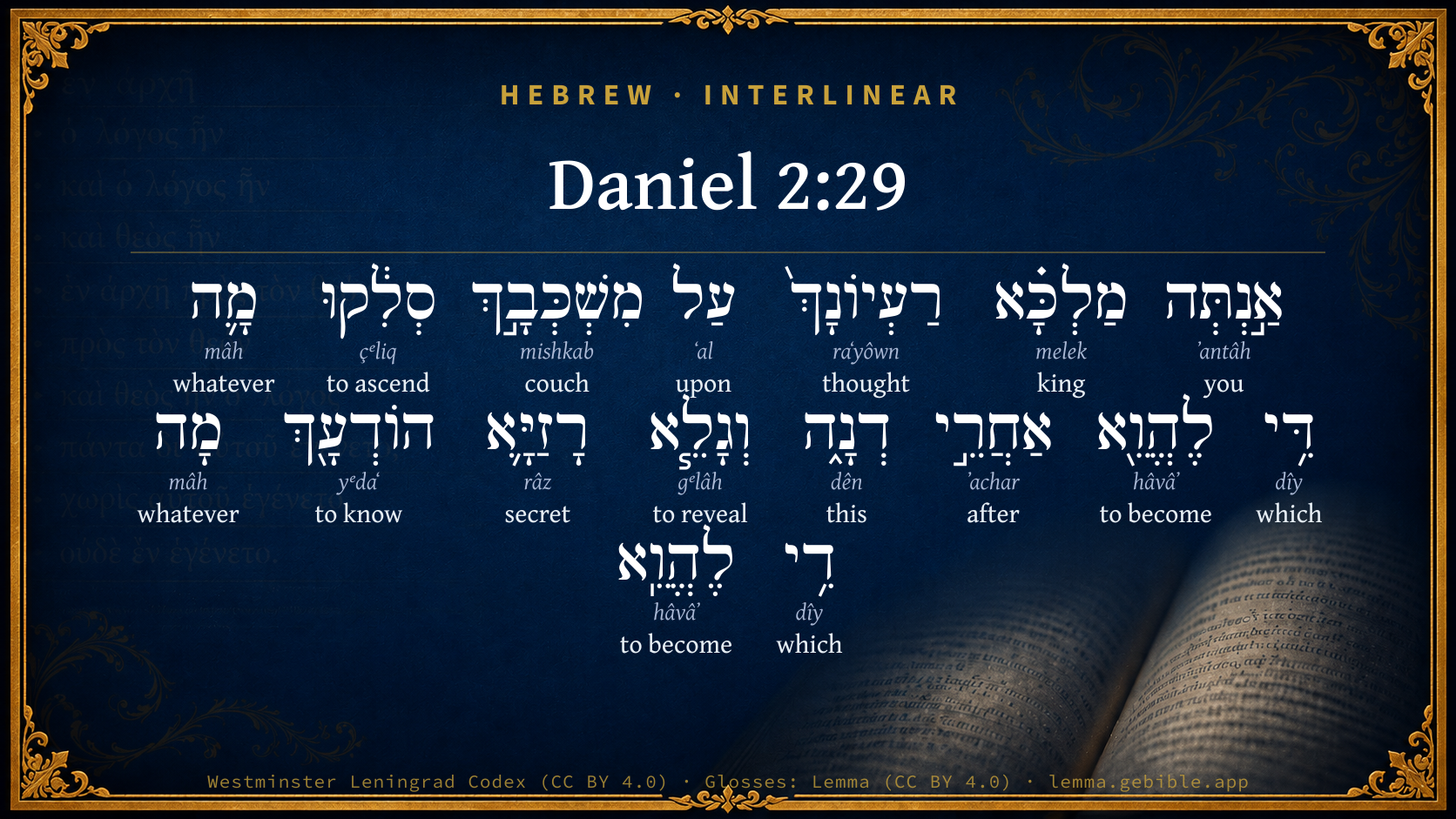
Hebrew (Westminster Leningrad Codex) Daniel 2:29 appears in the Hebrew Old Testament. The text above is from the Westminster Leningrad Codex. Each word links to its Strong’s number, a concise gloss, and parsing drawn from the Open Scriptures Hebrew Bible morphology. Click any word for its full Brown-Driver-Briggs (BDB) entry.
Download image
Cite this verse

Daniel 2:29 (World English Bible). Public Domain. Lemma interlinear Bible study tool, https://lemma.gebible.app/v/daniel/2/29.

Show BibTeX & RIS
BibTeX
RIS
English Translation
as for you, O king, your thoughts came [into your mind] on your bed, what should happen hereafter; and he who reveals secrets has made known to you what shall happen.
World English Bible · Public Domain
Highlights
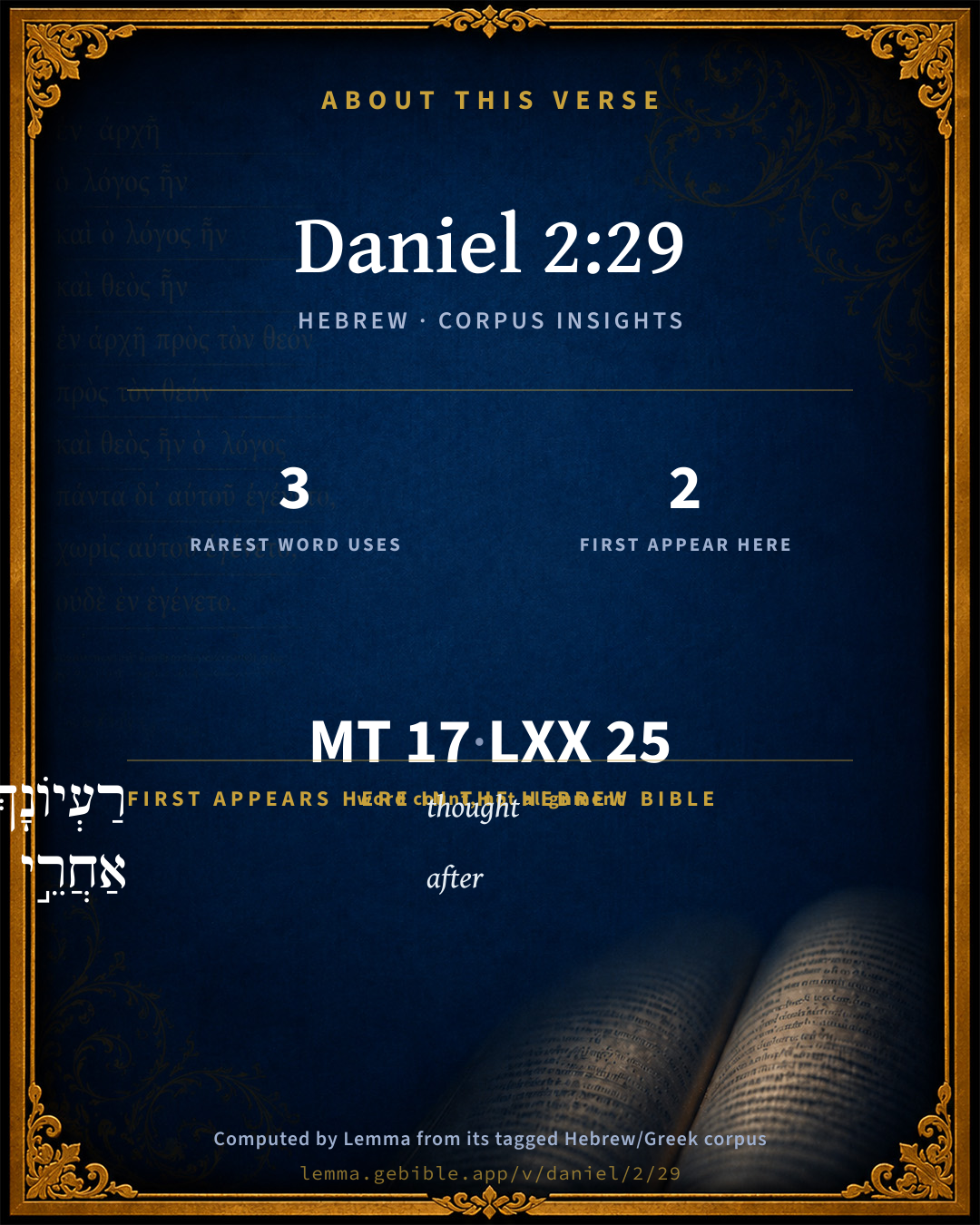
  • 2 first appearances in the Hebrew Bible
Full analysis ↓
Download a study sheet

One document with this verse’s original text, its word-by-word gloss line, the meaning frame, cross-references with their text, attributed commentary, and full source and license credits — printable, and it pastes into notes with its structure intact.

This verse Autodidact and up

Study sheet (.html) Plain text (.txt)

A passage Seminary Student

Up to 50 verses in one chapter. A passage sheet keeps up to 6 commentary sources and 12 cross-references per verse, in the order this page ranks them, and says so on the sheet whenever that leaves anything out. Ask for a single verse and you get the Autodidact verse sheet above.

Everything on this page stays free to read, with no account — the sheet is a download of what is already on screen, not access to it.

Want to remove ads? Support Godless Engineer
Compare translations 3

The same verse in 3 English versions, stacked beneath the original-language interlinear above. Click any original word for its lexicon entry.

Each is an independent rendering of the whole verse — the interlinear is not word-aligned to these translations.

Highlighted words mark where these versions differ — a whole-verse word diff, not a word-by-word alignment.

  • World English Bible Public Domain
    as for you, O king, your thoughts came [into your mind] on your bed, what should happen hereafter; and he who reveals secrets has made known to you what shall happen.
  • King James Version Public Domain
    As for thee, O king, thy thoughts came into thy mind upon thy bed, what should come to pass hereafter: and he that revealeth secrets maketh known to thee what shall come to pass.
  • unfoldingWord Literal Text CC BY-SA 4.0
    As for you, O king, your thoughts on your bed turned to what would happen after this, and he who reveals mysteries has made known to you what is going to happen.

unfoldingWord Literal Text — © unfoldingWord, licensed CC BY-SA 4.0. Word-aligned USFM3 via Door43 (git.door43.org/unfoldingWord/en_ult).

Versions to compare (up to 4)

3 of 4 selected

Show all 18 translations

Every available English version of this verse, each an independent rendering of the whole verse.

  • World English Bible Public Domain
    as for you, O king, your thoughts came [into your mind] on your bed, what should happen hereafter; and he who reveals secrets has made known to you what shall happen.
  • Berean Standard Bible Public Domain
    As you lay on your bed, O king, your thoughts turned to the future, and the Revealer of Mysteries made known to you what will happen.
  • Majority Standard Bible Public Domain
    As you lay on your bed, O king, your thoughts turned to the future, and the Revealer of Mysteries made known to you what will happen.
  • King James Version Public Domain
    As for thee, O king, thy thoughts came into thy mind upon thy bed, what should come to pass hereafter: and he that revealeth secrets maketh known to thee what shall come to pass.
  • American Standard Version (1901) Public Domain
    as for thee, O king, thy thoughts came `into thy mind' upon thy bed, what should come to pass hereafter; and he that revealeth secrets hath made known to thee what shall come to pass.
  • Revised Version (1885) Public Domain
    as for thee, O king, thy thoughts came into thy mind upon thy bed, what should come to pass hereafter: and he that revealeth secrets hath made known to thee what shall come to pass.
  • Geneva Bible (1599) Public Domain
    O King, when thou wast in thy bedde, thoughts came into thy mind, what should come to passe hereafter, and he that reueyleth secretes, telleth thee, what shall come.
  • Douay-Rheims (1899) Public Domain
    Thou, O king, didst begin to think in thy bed, what should come to pass hereafter: and he that revealeth mysteries shewed thee what shall come to pass.
  • Young's Literal Translation Public Domain
    Thou, O king, thy thoughts on thy bed have come up `concerning' that which `is' to be after this, and the Revealer of secrets hath caused thee to know that which `is' to be.
  • Literal Standard Version CC BY-SA 4.0
    You, O king, your thoughts on your bed have come up [concerning] that which [is] to be after this, and the Revealer of secrets has caused you to know that which [is] to be.
  • Unlocked Literal Bible CC BY-SA 4.0
    As for you, king, your thoughts on your bed were about things to come, and the one who reveals mysteries has made known to you what is about to happen.
  • unfoldingWord Literal Text CC BY-SA 4.0
    As for you, O king, your thoughts on your bed turned to what would happen after this, and he who reveals mysteries has made known to you what is going to happen.
  • Darby Bible Public Domain
    -- as for thee, O king, thy thoughts arose upon thy bed, what should come to pass hereafter; and he that revealeth secrets hath made known to thee what shall come to pass.
  • World Messianic Bible Public Domain
    “As for you, O king, your thoughts came on your bed, what should happen hereafter; and he who reveals secrets has made known to you what will happen.
  • Webster's Bible Public Domain
    As for thee, O king, thy thoughts came into thy mind upon thy bed, what should come to pass hereafter: and he that revealeth secrets maketh known to thee what shall come to pass.
  • Free Bible Version CC BY-SA 4.0
    As Your Majesty lay there, your thoughts turned to the future, and the revealer of mysteries showed you what would take place.
  • Bible in Basic English Public Domain
    As for you, O King, the thoughts which came to you on your bed were of what will come about after this: and the unveiler of secrets has made clear to you what is to come.
  • JPS Tanakh (1917) Public Domain
    as for thee, O king, thy thoughts came into thy mind upon thy bed, what should come to pass hereafter; and He that revealeth secrets hath made known to thee what shall come to pass.

Literal Standard Version (2020), Covenant Press — licensed CC BY-SA 4.0. Text via the HelloAO Bible API (eBible.org). Unlocked Literal Bible (unfoldingWord) — licensed CC BY-SA 4.0. Text via the HelloAO Bible API (eBible.org). unfoldingWord Literal Text — © unfoldingWord, licensed CC BY-SA 4.0. Word-aligned USFM3 via Door43 (git.door43.org/unfoldingWord/en_ult). Free Bible Version, Dr. Jonathan Gallagher — licensed CC BY-SA 4.0. Text via the HelloAO Bible API (eBible.org).

Word by word

More ways to search: Search by grammar → Find every occurrence → Compare this word →

Practice this passage: Drill this verse → Learn its vocabulary →

אַחֲרֵ֣י
ʼachar
H311
“after”
Adjective, R
Part of Speech
Adjective
Full BDB Definition

Origin: corresponding to H310

TWOT: 2568

after
  1. אַ֣נְתְּה ʼantâh H607 “you” Adjective, P
  2. מַלְכָּ֗א melek H4430 “king · the” Adjective, N, Common + Particle, Definite Article
  3. רַעְיוֹנָךְ֙ raʻyôwn H7476 “thoughts · your” Adjective, N, Common + Suffix, Personal, 2nd Person, Masculine, Singular
  4. עַל ʻal H5922 “upon” Adjective, R
  5. מִשְׁכְּבָ֣ךְ mishkab H4903 “couch · your” Adjective, N, Common + Suffix, Personal, 2nd Person, Masculine, Singular
  6. סְלִ֔קוּ çᵉliq H5559 “to ascend” Adjective, V, Plural
  7. מָ֛ה mâh H4101 “whatever” Adjective, P, Feminine
  8. דִּ֥י dîy H1768 “which” Adjective, T
  9. לֶהֱוֵ֖א hâvâʼ H1934 “to become” Adjective, V
  10. דְנָ֑ה dên H1836 “this” Adjective, P
  11. וְגָלֵ֧א gᵉlâh H1541 “and · revealing” Adjective, C + Verb, Qal, Participle Active, Masculine, Singular, Construct
  12. רָזַיָּ֛א râz H7328 “secrets · the” Adjective, N, Common + Particle, Definite Article
  13. הוֹדְעָ֖ךְ yᵉdaʻ H3046 “to know · you” Adjective, V, Plural + Suffix, Personal, 2nd Person, Masculine, Singular
  14. מָה mâh H4101 “whatever” Adjective, P, Feminine
  15. דִ֥י dîy H1768 “which” Adjective, T
  16. לֶהֱוֵֽא hâvâʼ H1934 “to become” Adjective, V

About this verse

These counts appear in no published source. They are computed here, from the morphology-tagged text and Lemma’s own curated glosses. What Lemma adds →

17
words
14
distinct lemmas
Prophets
section

Notable vocabulary

The rarest word here is אַחֲרֵ֣י after H311 — appearing just 3 times in the whole Hebrew Bible.

First appearance in Scripture

These words make their first canonical appearance in the Hebrew Bible here:

  • רַעְיוֹנָךְ֙ thought H7476
  • אַחֲרֵ֣י after H311

Shared distinctive vocabulary

אַחֲרֵ֣י after H311 occurs in 3 verses of the Hebrew Bible. Also found in:

Grammatical profile

  • 1 verb
  • 14 adjectives
  • 2 particles

Verb forms

  • וְגָלֵ֧א Qal · Participle Active

Repetition

Words recur within this verse — often emphatic in Hebrew:

  • מָ֛ה whatever H4101 ×2
  • לֶהֱוֵ֖א to become H1934 ×2
  • דִּ֥י which H1768 ×2

Hebrew & Septuagint length

In English translation the verse runs 31 words from the Hebrew and 31 from the Septuagint (LXX English) — the same length.

A rough comparison of the two English renderings, which tokenize alike — not a word-level alignment.

Word counts can differ between the Hebrew and the Greek without any difference in meaning — e.g. the Hebrew direct-object marker אֵת has no separate Greek word, and Greek often adds the article ὁ.

In the original languages it is 17 Hebrew tokens and 25 Greek tokens — but the two are counted differently (Hebrew bundles its prefixes and suffixes into one token; the Greek is in lemma form), so that isn’t a like-for-like length.

Cross-references

5

Topical passages linked to Daniel 2:29 in the Treasury of Scripture Knowledge — connected by theme and wording, ordered by reader-vote popularity; previews shown in the World English Bible.

  • Daniel 2:28 but there is a God in heaven who reveals secrets, and he has made known to the king Nebuchadnezzar what shall be in the latter days. Your dream, and the visions of your head on your bed, are these:
  • Daniel 2:47 The king answered to Daniel, and said, Of a truth your God is the God of gods, and the Lord of kings, and a revealer of secrets, seeing you have been able to reveal this secret.
  • Amos 4:13 For, behold, he who forms the mountains, And creates the wind, And declares to man what is his thought; Who makes the morning darkness, And treads on the high places of the Earth: Yahweh, the God of hosts, is his name."
  • Daniel 2:22 he reveals the deep and secret things; he knows what is in the darkness, and the light dwells with him.
  • Ezekiel 38:10 Thus says the Lord Yahweh: It shall happen in that day, that things shall come into your mind, and you shall devise an evil device:

Cross-references courtesy of OpenBible.info (CC BY 4.0).

Hebrew and Greek witnesses Masoretic Hebrew ↔ Greek Septuagint

The same verse in the two great witnesses to the Old Testament, shown verse-for-verse.

These are two independent witnesses, not word-aligned to each other, and the Septuagint is shown in lemma (dictionary) form.

Hebrew Daniel 2:29 Masoretic · Westminster Leningrad Codex

אַ֣נְתְּה מַלְכָּ֗א רַעְיוֹנָךְ֙ עַל מִשְׁכְּבָ֣ךְ סְלִ֔קוּ מָ֛ה דִּ֥י לֶהֱוֵ֖א אַחֲרֵ֣י דְנָ֑ה וְגָלֵ֧א רָזַיָּ֛א הוֹדְעָ֖ךְ מָה דִ֥י לֶהֱוֵֽא

as for you, O king, your thoughts came [into your mind] on your bed, what should happen hereafter; and he who reveals secrets has made known to you what shall happen.

World English Bible · Public Domain

Greek LXX Daniel 2:29 Septuagint · lemma form

σύ βασιλεύς κατακλίνω ἐπί ὁ κοίτη σύ ὁράω πᾶς ὅσος δέω γίγνομαι ἐπί ἔσχατος ὁ ἡμέρα καί ὁ ἀνακαλύπτω μυστήριον δηλόω σύ ὅς δέω γίγνομαι

O king: your thoughts upon your bed arose as to what must come to pass hereafter: and he that reveals mysteries has made known to you what must come to pass.

LXX2012 (modern English Septuagint) · Public Domain

On this verse, The Pulpit Commentary discusses the Septuagint’s reading. Read the note in Commentary ↓

Hebrew: Westminster Leningrad Codex (CC BY 4.0). Greek: Septuagint (public domain); English from LXX2012 (modern English Septuagint) (Public Domain). How the Septuagint differs from the Hebrew →

Commentary

Notes on Daniel 2:29 from classic Christian and Jewish commentators (each source and its license shown beneath its notes). The classic Christian expositions comment on the surrounding passage and are grouped to its opening verse, so a note may address several verses; the Jewish commentaries on the Tanakh (Rashi and others) are per-verse, so they appear only where the commentator wrote on this verse.

Lemma curates 59 commentaries, every one of them public domain or Creative Commons licensed, each selected and text-cleaned for this edition rather than reprinted as found. About our sources →

Trapp's Complete Commentary

John Trapp

Dan 2:29 As for thee, O king, thy thoughts came [into thy mind] upon thy bed, what should come to pass hereafter: and he that revealeth secrets maketh known to thee what shall come to pass.

Ver. 29. Thy thoughts came into thy mind upon thy bed.] Kingdoms have their cares, crowns are stuffed with thorns. These thoughts in the text were preparatory to the ensuing dream, {Ecc 5:2} the chief efficient or author whereof was God.

And he that revealeth secrets maketh known to thee.] Yea, maketh thee a conduit of divine revelation to the Church.

John Trapp, A Commentary or Exposition upon All the Books of the Old and New Testament (1647–1656) — public domain. Text from a community e-Sword module.

Scofield Reference Notes

C. I. Scofield

what should come

Times (of the Gentiles), Dan 2:29-45; Rev 16:19; Luk 21:24.

The Scofield Reference Bible (1917 edition), notes by C. I. Scofield — public domain. Text from a community e-Sword module.

Tyndale Open Study Notes

Tyndale Open Resources

2:29-30 God had shown the king the long march of future history. Nebuchadnezzar was keenly interested in history, pursuing knowledge of the past and seeking to make a place for himself as history went forward. God wanted Nebuchadnezzar to understand the course of history, perhaps to impress upon him that Israel’s God, the God of heaven, is the God of all history.

Tyndale Open Study Notes — © Tyndale Open Resources, licensed CC BY-SA 4.0. Text via the HelloAO Bible API.

Ibn Ezra

Rabbi Abraham ibn Ezra

[Daniel 2:29] Ant malka (אַנְתְּ מַלְכָּא - You, O king): He [Daniel] mentioned what came up upon his [the king's] mind (mah sheʿalah ʿal libbo - מַה שֶׁעָלָה עַל לִבּוֹ) while lying down (bishokhvo - בְּשָׁכְבוֹ), that he [the king] thought about what would be after this (mah sheyihyeh acharav - מַה שֶׁיִּהְיֶה אַחֲרָיו). [Ibn Ezra clarifies that Daniel is referring back to the king's own musings about the future, mentioned in the verse].

Ibn Ezra on the Tanakh — English translations: “Sefaria Community Translation” (CC0 1.0 (public-domain dedication)); “Yalkut, Sifsei Chachomim Chumash, Metsudah Publications, 2009” (CC BY 4.0); and “Commentary of Ibn Ezra on Isaiah - trans. by M. Friedlander, 1873” (public domain). Text via Sefaria.

Jamieson, Fausset & Brown

Robert Jamieson, A. R. Fausset & David Brown

God met with a revelation Nebuchadnezzar, who had been meditating on the future destiny of his vast empire.

Jamieson, Fausset & Brown — Commentary Critical and Explanatory on the Whole Bible (1871) — public domain (CC PDM 1.0). Text via the HelloAO Bible API.

John Calvin's Commentaries

He again confirms what I have just touched upon, for he wished to impress this upon the king’s mind — that God was the author of the dream, to induce the king to prepare for its interpretation with becoming sobriety, modesty, and docility. For unless he had been seriously affected, he would have despised Daniel’s interpretation; just as we see men fail to profit through their own pride or carelessness even when God addresses. them familiarly. Hence we must observe this order, and be fully prepared to listen to God, and learn to put a bridle upon ourselves on hearing his sacred name, never rejecting whatever he proposes to us, but treating it with proper gravity. This is the true reason why Daniel repeats again that King Nebuchadnezzar was divinely instructed in future events. He says, in the first clause, The king’s thoughts ascended, — the phrase is Hebrew and. Chaldee. Thoughts are said to ascend when they are revolved in the brain or head, as we formerly saw — this vision was in thy head; since the seat of the reasoning faculty is in the head. Daniel therefore asserts the king to be anxious about futurity, as the greatest monarchs think of what shall happen after their death, and every one dreams about enjoying the empire of the whole world. So King Nebuchadnezzar was very probably indulging these thoughts. But it follows immediately, that his thoughts could non profit him unless God unveiled the future, because it was his peculiar office, says the Prophet, to reveal secrets, Here we see clearly how vainly men disturb themselves when they turn over and over again subjects which surpass their abilities. King Nebuchadnezzar might have fatigued himself for a, long time without profit if he had not been instructed by the oracle. Hence there is weight in these words — He who reveals secrets has explained to the king what shall happen; that is, thou canst not understand the dream by thine own thoughts, but God has deemed thee worthy of this peculiar favor when he wished to make thee conscious of mysteries which had been otherwise altogether hidden from thee, for thou couldst never have penetrated to such a depth.

He afterwards adds —

John Calvin's Commentaries (1540-1563) — public domain. Text from the Calvin Translation Society English edition (1840s-50s) via the Christian Classics Ethereal Library (ccel.org). Calvin's coverage is partial (roughly two-thirds of the Bible); uncommented books and verses are honest gaps, never fabricated. The 19th-century editor's footnotes and remarks are omitted so the notes are faithfully Calvin's own voice.

Ellicott's Commentary for English Readers

(29) Hereafter—i.e., in the course of history, not only in the Messianic days.

A Bible Commentary for English Readers, edited by Charles John Ellicott (1878–1897) — public domain. Text from a community e-Sword module.

The Cambridge Bible for Schools and Colleges

gen. ed. J. J. S. Perowne

29. came into thy mind] lit. came up,—the corresponding Heb. word followed by ‘upon the heart,’ being a Heb. idiom for occur to, be thought of by: cf. 2Es_3:1; and see Isa_65:17; Jer_3:16; Jer_7:31; Jer_19:5; Jer_32:35; Jer_44:21; Jer_51:50; Act_7:23. The king, as he lay awake at night, was meditating on the future, speculating, it may be, upon the future destinies of his kingdom, or the success of his projects for the beautification of his capital; and the dream, it seems to be implied, was the form into which, under Providence, his thoughts gradually shaped themselves. In a dream, the images and impressions, which the mind, while in a waking state, has received, are recombined into new, and often fantastic forms; in the present case, a colossal and strangely constructed statue was the form which the recombination ultimately produced.

The Cambridge Bible for Schools and Colleges (gen. ed. J. J. S. Perowne; Cambridge University Press, 1878–1918) — public domain. Text from a community e-Sword module.

John Gill's Exposition

As for thee, O king,.... So far as thou hast any concern in this matter, or with respect to thee, the following was thy case; these the circumstances and situation in which thou wert:

thy thoughts came into thy mind upon thy bed, which should come to pass hereafter; as he lay on his bed, either sleeping or waking, very probably the latter, his thoughts were employed about this great monarchy he had erected, and what would be the issue of it; and was very desirous of knowing what successors he should have in it, and how long it would continue, and what would be the fate of it; when he fell asleep upon this, and had a dream agreeable to his waking thoughts:

and he that revealeth secrets: a periphrasis of the God of heaven, as in the preceding verse:

maketh known unto thee what shall come to pass; this he did by the dream he gave him, though he had forgot it; and now by restoring that, and the interpretation of it, by Daniel.

John Gill's Exposition of the Whole Bible (1746–1763) — public domain (CC PDM 1.0). Text via the HelloAO Bible API.

Albert Barnes' Notes on the Bible

As for thee, O king, thy thoughts came into thy mind upon thy bed - Margin, “up;” that is, thy thoughts ascended. The Chaldee is, “thy thoughts ascended” - סלקוּ selı̂qû. So the Greek: “Thy thoughts ascended (ἀνέβησαν anebēsan) upon thy couch.” There is, evidently, some allusion to the thoughts “ascending,” or “going up;” and perhaps the idea is, that they were employed on important subjects - an idea which we now express by saying that one’s thoughts are “elevated,” as contrasted with those which are “low” and “grovelling.”

What should come to pass hereafter - It would seem most probable from this, that the thoughts of Nebuchadnezzar were occupied with this subject in his waking moments on his bed, and that the dream was grafted on this train of thought when he fell asleep. Nothing is more probable than that his thoughts might be thus occupied. The question respecting his successor; the changes which might occur; the possibility of revolutions in other kingdoms, or in the provinces of his own vast empire, all were topics on which his mind would probably be employed. As God designed, too, to fix his thoughts particularly on that general subjects the changes which were to occur in his empire - such an occasion, when his attention was greatly engrossed with the subject, would be very suitable to impart the knowledge which he did by this vision. Daniel refers to this, probably, because it would do much to confirm the monarch in the belief of his inspiration, if he referred to the train of thought which had preceded the dream; as it is not improbable that the king would remember his “waking” thoughts on the subject, though his “dream” was forgotten.

Albert Barnes' Notes on the Bible (1834–1885) — public domain. Text from a community e-Sword/MySword module.

Haydock's Catholic Bible Commentary

Begin. By thus telling what thoughts the king had entertained before his dream, he would be heard with greater confidence. (Worthington)

George Leo Haydock (1774–1849), Haydock's Catholic Family Bible and Commentary, 1859 edition — public domain. Excludes Psalms (Douay-Rheims chapter numbering differs from Protestant) and Deuterocanonical books (Catholic canon only).

The Pulpit Commentary

As for thee, O king, thy thoughts came into thy mind m on thy bed, what should come to pass hereafter: and he that revealeth secrets maketh known to thee what shall come to pass. This verse is of somewhat suspicious authenticity, the renderings of the different versions show such a diversity of text. The Septuagint rendering is very brief, being merely a version of the last clause, "He that revealeth secrets (musthria) showed that which behoveth to be." This has the appearance as if the translators here rendered the last word as an infinitive, taking l as not the preformatvre of the third person future, but as the sign of the infinitive. It is not necessarily so, because it may be that dei" is regarded as included in aweh"l, (lehave"). Theodotion is in closer agreement with the Massoretic, "O king, thy thoughts upon thy bed raised up what behoved to be after these things; and he that revealeth secrets hath made known to thee what behoveth to be." The Peshitta renders slightly differently, Thou, O king, thy thoughts arose in thy heart on account of what should be in the latter days, and he that revealeth secrets made known to thee what shall be." Even Jerome, who is usually pretty close to the Massoretic text, differs a little here. "Thou, O king, didst begin to think upon thy couch what would be after these things; and he who revealeth mysteries showeth thee what shall be." Paulus Tellensis has broken away from the Septuagint, supplying the clause omitted, not improbably from Theodotion, "Thou, O king, when. thou layest upon thy couch, sawest all things which behoved to happen in the last days; and he who revealeth secrets hath showed to thee what behoved to be." Altogether, with the exception of the last clause, which is evidenced by all the versions, we doubt the authenticity of this verse. However, the interpolation, if we have a case of it here, must have been of old date, as is indicated by the archaic form htna (antah), which becomes in the Q"ri tna (ant). Whether an interpolation or part of the original text, the picture suggested is very natural. The young conqueror, who had already secured the whole of South-Western Asia to the river of Egypt, was occupying his thoughts in speculating what should come after him. He falls asleep, and the subject of his waking thoughts becomes the subject of his dreams.

The Pulpit Commentary (1880–1919), ed. H.D.M. Spence-Jones & Joseph S. Exell — public domain. Text from a community e-Sword module.

unfoldingWord translationNotes

Door43 World Missions Community

General Information:

Daniel continues talking to the king.

the one who reveals mysteries

This phrase refers to God. AT: "God, who reveals mysteries" or "God, who makes mysteries known" (See: Assumed Knowledge and Implicit Information)

this mystery was not revealed to me

This can be stated in active form. AT: "God did not reveal this mystery to me" (See: Active or Passive)

This mystery was revealed to me so that you

This can be stated in active form. AT: "He revealed the mystery to me so that you" (See: Active or Passive)

know the thoughts deep within you

This phrase is using the word "you" referring to the person's mind. AT: "know the thoughts deep inside your mind" (See: Synecdoche)

translationWords

king

reveal

know

wise

life

unfoldingWord translationNotes — © Distant Shores Media and the Door43 World Missions Community, licensed CC BY-SA 4.0. Source: git.door43.org/Door43/en_tn.

Rashi

Rabbi Shlomo Yitzchaki (Rashi)

your thoughts Aram. רַעְיוֹנָיךְ.

came while on your bed What you were thinking of during the day, what would be after you, came [to you] on your bed.

and the Revealer of secrets and the Holy One, blessed be He, Who reveals secrets, let you know what will come about.

Rashi on the Tanakh — English translations: “The Judaica Press complete Tanach with Rashi, translated by A. J. Rosenberg” (CC BY 4.0); “Pentateuch with Rashi's commentary by M. Rosenbaum and A.M. Silbermann, 1929-1934” (public domain); “The Metsudah Tanach series, Lakewood, N.J” (CC BY 4.0); and “The Book of Joshua, Metsudah Publications, 1997” (CC BY 4.0). Text via Sefaria.

Lesson kit

Teaching starters — assembled from the data on this page, not authored interpretation. Every prompt links to the verse data it draws on. Edit before teaching.

Daniel, in the Prophets, opens this verse with 17 words (14 distinct Hebrew lemmas). Its most distinctive word is ʼachar (“after”). A historical commentator’s framing appears above. Read the whole chapter for the surrounding context.

Discussion questions

  1. How does “after” (ʼachar) shape what this verse is saying?
  2. 2 words here appear for the first time in Scripture. What is being introduced at this debut?
  3. Daniel 2:45 shares the word «after» with this verse. How do the two illuminate each other?
  4. “whatever” occurs 2× in this one verse. What is the effect of the repetition?
  5. These translations render this verse differently; the difference is in the English rendering, not the original. What questions does that raise?
  6. The verb «וְגָלֵ֧א» is Qal Participle Active. How does its form color the action?
  7. Reading how Trapp's Complete Commentary and Scofield Reference Notes read this verse, where do the two commentators agree and where do they part?

Things to notice

Reading settings

Reading text

Shown beneath each verse's original-language words.

Old Testament
Old Testament edition

Read the OT as the Masoretic Hebrew (MT) or the Greek Septuagint (LXX).

English shown for the Greek Septuagint (in the Hebrew ↔ Greek comparison).

Comparing translations? Open the Compare panel on any verse page to stack up to four side by side.