
Daniel 5:23

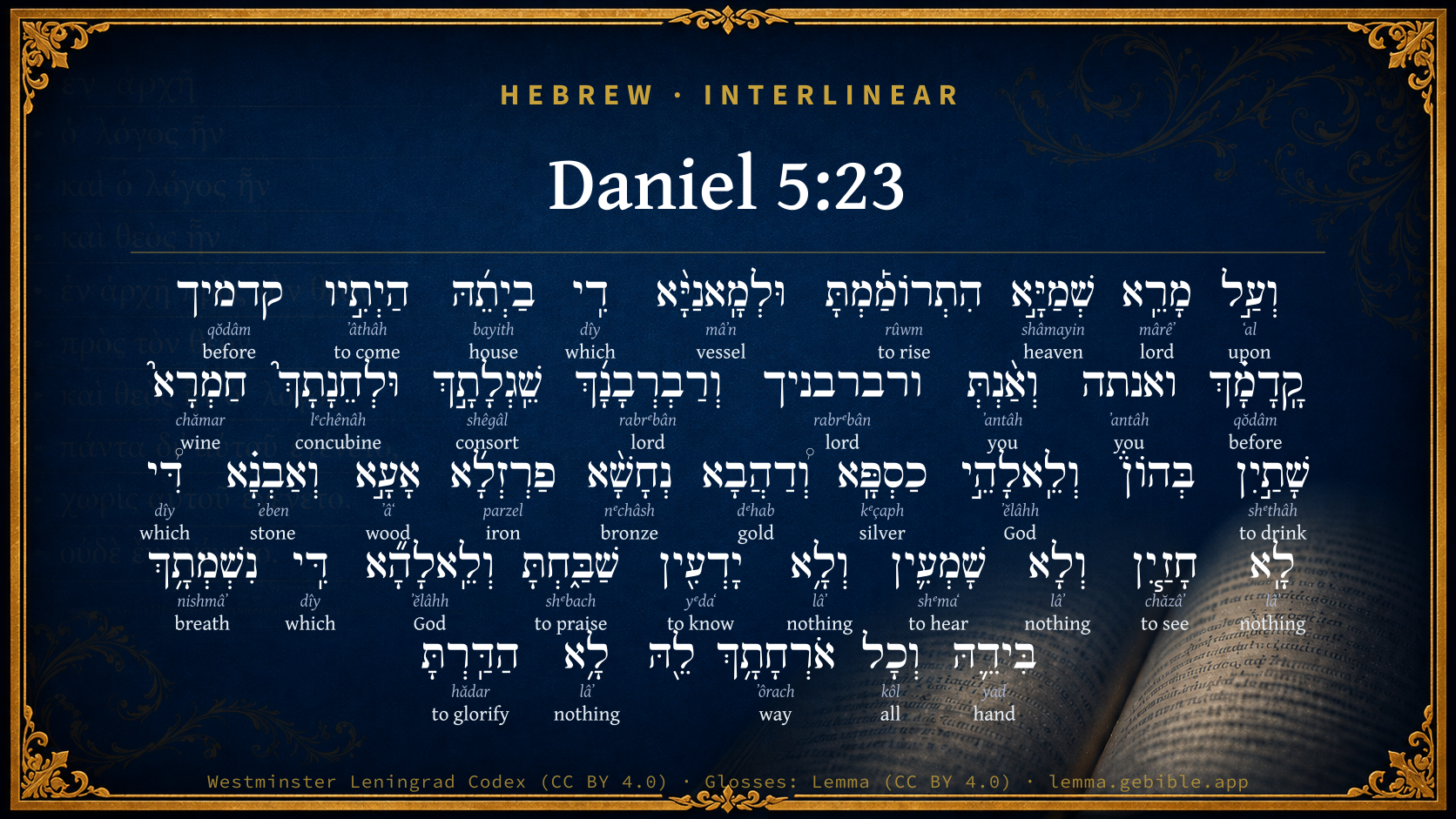
Hebrew (Westminster Leningrad Codex) Daniel 5:23 appears in the Hebrew Old Testament. The text above is from the Westminster Leningrad Codex. Each word links to its Strong’s number, a concise gloss, and parsing drawn from the Open Scriptures Hebrew Bible morphology. Click any word for its full Brown-Driver-Briggs (BDB) entry.
Download image
Cite this verse

Daniel 5:23 (World English Bible). Public Domain. Lemma interlinear Bible study tool, https://lemma.gebible.app/v/daniel/5/23.

Show BibTeX & RIS
BibTeX
RIS
English Translation
but have lifted up yourself against the Lord of heaven; and they have brought the vessels of his house before you, and you and your lords, your wives and your concubines, have drunk wine from them; and you have praised the gods of silver and gold, of brass, iron, wood, and stone, which don't see, nor hear, nor know; and the God in whose hand your breath is, and whose are all your ways, you have not glorified.
World English Bible · Public Domain
Highlights
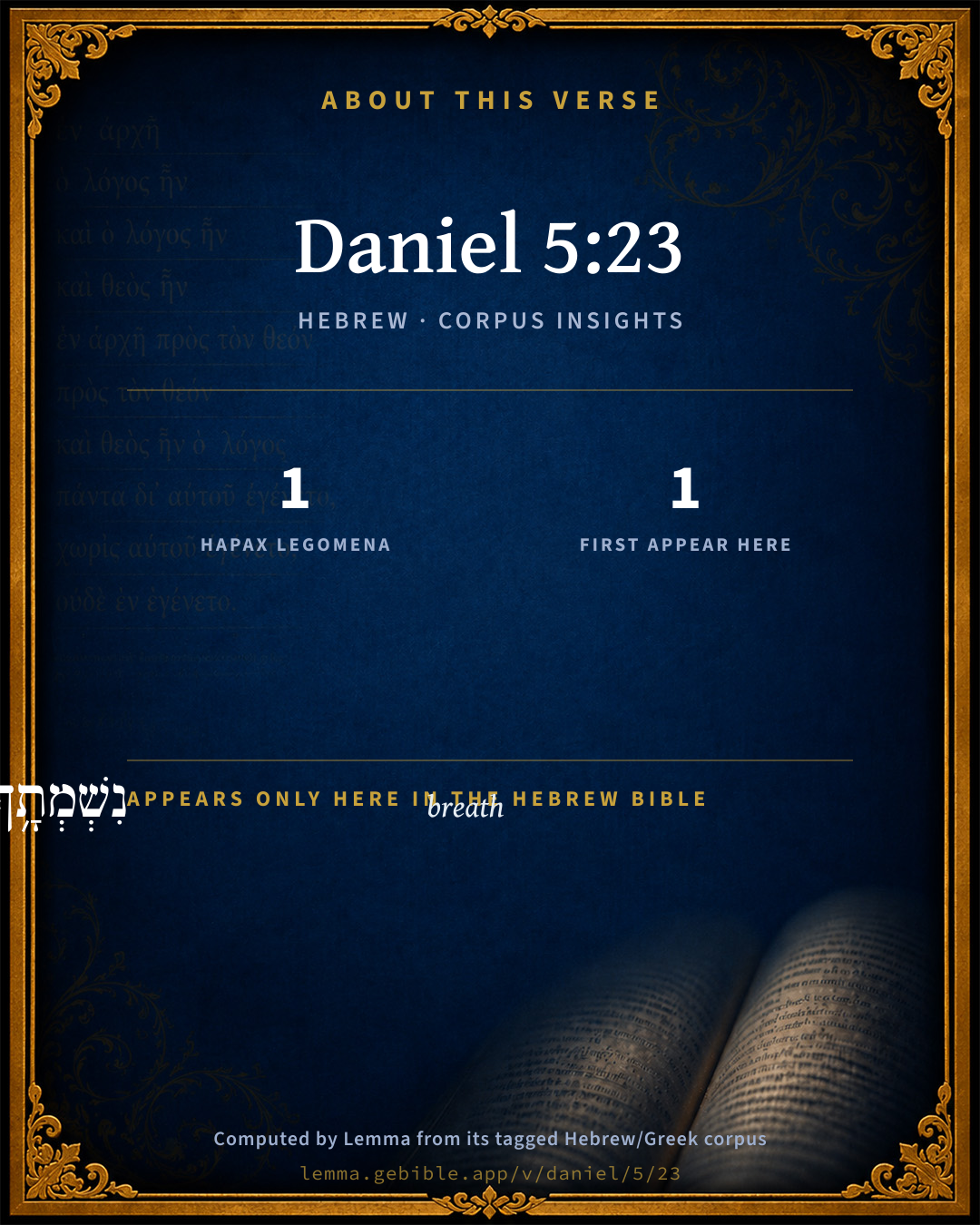
  • 1 hapax legomenon — only here in the Hebrew Bible
  • 1 first appearance in the Hebrew Bible
Full analysis ↓
Download a study sheet

One document with this verse’s original text, its word-by-word gloss line, the meaning frame, cross-references with their text, attributed commentary, and full source and license credits — printable, and it pastes into notes with its structure intact.

This verse Autodidact and up

Study sheet (.html) Plain text (.txt)

A passage Seminary Student

Up to 50 verses in one chapter. A passage sheet keeps up to 6 commentary sources and 12 cross-references per verse, in the order this page ranks them, and says so on the sheet whenever that leaves anything out. Ask for a single verse and you get the Autodidact verse sheet above.

Everything on this page stays free to read, with no account — the sheet is a download of what is already on screen, not access to it.

Want to remove ads? Support Godless Engineer
Compare translations 3

The same verse in 3 English versions, stacked beneath the original-language interlinear above. Click any original word for its lexicon entry.

Each is an independent rendering of the whole verse — the interlinear is not word-aligned to these translations.

Highlighted words mark where these versions differ — a whole-verse word diff, not a word-by-word alignment.

  • World English Bible Public Domain
    but have lifted up yourself against the Lord of heaven; and they have brought the vessels of his house before you, and you and your lords, your wives and your concubines, have drunk wine from them; and you have praised the gods of silver and gold, of brass, iron, wood, and stone, which don't see, nor hear, nor know; and the God in whose hand your breath is, and whose are all your ways, you have not glorified.
  • King James Version Public Domain
    But hast lifted up thyself against the Lord of heaven; and they have brought the vessels of his house before thee, and thou, and thy lords, thy wives, and thy concubines, have drunk wine in them; and thou hast praised the gods of silver, and gold, of brass, iron, wood, and stone, which see not, nor hear, nor know: and the God in whose hand thy breath is, and whose are all thy ways, hast thou not glorified:
  • unfoldingWord Literal Text CC BY-SA 4.0
    Instead, you have lifted yourself up against the Lord of heaven. The vessels of his house have been brought in before you, and you and your nobles, your wives and your concubines have drunk wine from them, and you praised the gods of silver and gold, bronze, iron, wood, and stone, which do not see, hear, or know, but you have not honored the God in whose hand is your breath and whose are all your ways.

unfoldingWord Literal Text — © unfoldingWord, licensed CC BY-SA 4.0. Word-aligned USFM3 via Door43 (git.door43.org/unfoldingWord/en_ult).

Versions to compare (up to 4)

3 of 4 selected

Show all 18 translations

Every available English version of this verse, each an independent rendering of the whole verse.

  • World English Bible Public Domain
    but have lifted up yourself against the Lord of heaven; and they have brought the vessels of his house before you, and you and your lords, your wives and your concubines, have drunk wine from them; and you have praised the gods of silver and gold, of brass, iron, wood, and stone, which don't see, nor hear, nor know; and the God in whose hand your breath is, and whose are all your ways, you have not glorified.
  • Berean Standard Bible Public Domain
    Instead, you have exalted yourself against the Lord of heaven. The vessels from His house were brought to you, and as you drank wine from them with your nobles, wives, and concubines, you praised your gods of silver and gold, bronze and iron, wood and stone, which cannot see or hear or understand. But you have failed to glorify the God who holds in His hand your very breath and all your ways.
  • Majority Standard Bible Public Domain
    Instead, you have exalted yourself against the Lord of heaven. The vessels from His house were brought to you, and as you drank wine from them with your nobles, wives, and concubines, you praised your gods of silver and gold, bronze and iron, wood and stone, which cannot see or hear or understand. But you have failed to glorify the God who holds in His hand your very breath and all your ways.
  • King James Version Public Domain
    But hast lifted up thyself against the Lord of heaven; and they have brought the vessels of his house before thee, and thou, and thy lords, thy wives, and thy concubines, have drunk wine in them; and thou hast praised the gods of silver, and gold, of brass, iron, wood, and stone, which see not, nor hear, nor know: and the God in whose hand thy breath is, and whose are all thy ways, hast thou not glorified:
  • American Standard Version (1901) Public Domain
    but hast lifted up thyself against the Lord of heaven; and they have brought the vessels of his house before thee, and thou and thy lords, thy wives and thy concubines, have drunk wine from them; and thou hast praised the gods of silver and gold, of brass, iron, wood, and stone, which see not, nor hear, nor know; and the God in whose hand thy breath is, and whose are all thy ways, hast thou not glorified.
  • Revised Version (1885) Public Domain
    but hast lifted up thyself against the Lord of heaven; and they have brought the vessels of his house before thee, and thou and thy lords, thy wives and thy concubines, have drunk wine in them; and thou hast praised the gods of silver, and gold, of brass, iron, wood, and stone, which see not, nor hear, nor know: and the God in whose hand thy breath is, and whose are all thy ways, hast thou not glorified:
  • Geneva Bible (1599) Public Domain
    But hast lift thy selfe vp against the Lord of heauen, and they haue brought the vessels of his House before thee, and thou and thy princes, thy wiues and thy concubines haue drunke wine in them, and thou hast praysed the gods of siluer and golde, of brasse, yron, wood and stone, which neither see, neither heare, nor vnderstand: and the God in whose hand thy breath is and all thy wayes, him hast thou not glorified.
  • Douay-Rheims (1899) Public Domain
    But hast lifted thyself up against the Lord of heaven: and the vessels of his house have been brought before thee: and thou, and thy nobles, and thy wives, and thy concubines have drunk wine in them: and thou hast praised the gods of silver, and of gold, and of brass, of iron, and of wood, and of stone, that neither see, nor hear, nor feel: but the God who hath thy breath in his hand, and all thy ways, thou hast not glorified.
  • Young's Literal Translation Public Domain
    and against the Lord of the heavens thou hast lifted up thyself; and the vessels of His house they have brought in before thee, and thou, and thy great men, thy wives, and thy concubines, are drinking wine with them, and gods of silver, and of gold, of brass, of iron, of wood, and of stone, that are not seeing, nor hearing, nor knowing, thou hast praised: and the God in whose hand `is' thy breath, and all thy ways, Him thou hast not honoured.
  • Literal Standard Version CC BY-SA 4.0
    and against the Lord of the heavens you have lifted up yourself; and the vessels of His house they have brought in before you, and you, and your great men, your wives, and your concubines, are drinking wine with them, and gods of silver, and of gold, of bronze, of iron, of wood, and of stone, that are not seeing, nor hearing, nor knowing, you have praised: and the God in whose hand [is] your breath, and all your ways, Him you have not honored.
  • Unlocked Literal Bible CC BY-SA 4.0
    You have lifted yourself up against the Lord of heaven. From his house they brought you the containers that you, your nobles, your wives and your concubines drank wine from, and you praised the idols made of silver and gold, bronze, iron, wood, and stone—idols that do not see, hear, or know anything. You have not honored the God who holds your breath in his hand and who knows all your ways.
  • unfoldingWord Literal Text CC BY-SA 4.0
    Instead, you have lifted yourself up against the Lord of heaven. The vessels of his house have been brought in before you, and you and your nobles, your wives and your concubines have drunk wine from them, and you praised the gods of silver and gold, bronze, iron, wood, and stone, which do not see, hear, or know, but you have not honored the God in whose hand is your breath and whose are all your ways.
  • Darby Bible Public Domain
    but hast lifted up thyself against the Lord of the heavens; and they have brought the vessels of his house before thee, and thou and thy nobles, thy wives and thy concubines, have drunk wine in them; and thou hast praised the gods of silver and gold, of brass, iron, wood, and stone, which see not, nor hear, nor know; and the God in whose hand thy breath is, and whose are all thy ways, hast thou not glorified:
  • World Messianic Bible Public Domain
    but have lifted up yourself against the Lord of heaven; and they have brought the vessels of his house before you, and you and your lords, your wives, and your concubines, have drunk wine from them. You have praised the gods of silver and gold, of bronze, iron, wood, and stone, which don’t see, or hear, or know; and you have not glorified the God in whose hand your breath is, and whose are all your ways.
  • Webster's Bible Public Domain
    But hast lifted up thyself against the Lord of heaven; and they have brought the vessels of his house before thee, and thou, and thy lords, thy wives, and thy concubines, have drank wine in them; and thou hast praised the gods of silver, and gold, of brass, iron, wood, and stone, which see not, nor hear, nor know: and the God in whose hand thy breath is, and whose are all thy ways, thou hast not glorified.
  • Free Bible Version CC BY-SA 4.0
    You have arrogantly defied the Lord of heaven and you had the cups and bowls of his Temple brought to you. You and your nobles, your wives and concubines, drank wine from them as you praised gods made of silver, gold, bronze, iron, wood, and stone that can't see or hear or know anything. But you have not honored God who holds in his hand your very breath and everything you do.
  • Bible in Basic English Public Domain
    But you have been lifting yourself up against the Lord of heaven, and they have put the vessels of his house before you, and you and your lords, your wives and your women, have taken wine in them; and you have given praise to gods of silver and gold, of brass and iron and wood and stone, who are without the power of seeing or hearing, and without knowledge: and to the God in whose hand your breath is, and whose are all your ways, you have not given glory;
  • JPS Tanakh (1917) Public Domain
    but hast lifted up thyself against the Lord of heaven; and they have brought the vessels of His house before thee, and thou and thy lords, thy consorts and thy concubines, have drunk wine in them; and thou hast praised the gods of silver, and gold, of brass, iron, wood, and stone, which see not, nor hear, nor know; and the God in whose hand thy breath is, and whose are all thy ways, hast thou not glorified;

Literal Standard Version (2020), Covenant Press — licensed CC BY-SA 4.0. Text via the HelloAO Bible API (eBible.org). Unlocked Literal Bible (unfoldingWord) — licensed CC BY-SA 4.0. Text via the HelloAO Bible API (eBible.org). unfoldingWord Literal Text — © unfoldingWord, licensed CC BY-SA 4.0. Word-aligned USFM3 via Door43 (git.door43.org/unfoldingWord/en_ult). Free Bible Version, Dr. Jonathan Gallagher — licensed CC BY-SA 4.0. Text via the HelloAO Bible API (eBible.org).

Word by word

More ways to search: Search by grammar → Find every occurrence → Compare this word →

Practice this passage: Drill this verse → Learn its vocabulary →

נִשְׁמְתָ֥ךְ
nishmâʼ
H5396
“breath · your”
Adjective, N, Common + Suffix, Personal, 2nd Person, Masculine, Singular
Part of Speech
Adjective
Gender
Common
Full BDB Definition

Origin: corresponding to H5397

TWOT: 2876

breath, spirit
  1. וְעַ֣ל ʻal H5922 “and · upon” Adjective, C + Preposition
  2. מָרֵֽא mârêʼ H4756 “lord of” Adjective, N, Common
  3. שְׁמַיָּ֣א shâmayin H8065 “heaven(s) · the” Adjective, N, Common + Particle, Definite Article
  4. הִתְרוֹמַ֡מְתָּ rûwm H7313 “to rise” Adjective, V, Plural
  5. וּלְמָֽאנַיָּ֨א mâʼn H3984 “and · to/for · vessels · the” Adjective, C + Particle, Direct Object + Noun, Common, Masculine, Plural, Determined + Particle, Definite Article
  6. דִֽי dîy H1768 “which” Adjective, T
  7. בַיְתֵ֜הּ bayith H1005 “house · his” Adjective, N, Common + Suffix, Personal, 3rd Person, Masculine, Singular
  8. הַיְתִ֣יו ʼâthâh H858 “to come” Adjective, V, Plural
  9. קדמיך qŏdâm H6925 “before · you” Adjective, R + Suffix, Personal, 2nd Person, Masculine, Singular
  10. קָֽדָמָ֗ךְ qŏdâm H6925 “before · you” Adjective, R + Suffix, Personal, 2nd Person, Masculine, Singular
  11. ואנתה ʼantâh H607 “and · you” Adjective, C + Pronoun, Personal, 2nd Person, Masculine, Singular
  12. וְאַ֨נְתְּ ʼantâh H607 “and · you” Adjective, C + Pronoun, Personal, 2nd Person, Masculine, Singular
  13. ורברבניך rabrᵉbân H7261 “and · lords · your” Adjective, C + Noun, Common, Masculine, Plural, Construct + Suffix, Personal, 2nd Person, Masculine, Singular
  14. וְרַבְרְבָנָ֜ךְ rabrᵉbân H7261 “and · lord · your” Adjective, C + Noun, Common, Masculine, Singular, Construct + Suffix, Personal, 2nd Person, Masculine, Singular
  15. שֵֽׁגְלָתָ֣ךְ shêgâl H7695 “consorts · your” Adjective, N, Common + Suffix, Personal, 2nd Person, Masculine, Singular
  16. וּלְחֵנָתָךְ֮ lᵉchênâh H3904 “and · concubines · your” Adjective, C + Noun, Common, Feminine, Plural, Construct + Suffix, Personal, 2nd Person, Masculine
  17. חַמְרָא֮ chămar H2562 “wine · the” Adjective, N, Common + Particle, Definite Article
  18. שָׁתַ֣יִן shᵉthâh H8355 “drinking” Adjective, V
  19. וְלֵֽאלָהֵ֣י ʼĕlâhh H426 “and · to/for · gods of” Adjective, C + Preposition + Noun, Common, Masculine, Plural, Construct
  20. כַסְפָּֽא kᵉçaph H3702 “silver · the” Adjective, N, Common + Particle, Definite Article
  21. וְ֠דַהֲבָא dᵉhab H1722 “and · gold · the” Adjective, C + Noun, Common, Masculine, Singular, Determined + Particle, Definite Article
  22. נְחָשָׁ֨א nᵉchâsh H5174 “bronze · the” Adjective, N, Common + Particle, Definite Article
  23. פַרְזְלָ֜א parzel H6523 “iron · the” Adjective, N, Common + Particle, Definite Article
  24. אָעָ֣א ʼâʻ H636 “wood · the” Adjective, N, Common + Particle, Definite Article
  25. וְאַבְנָ֗א ʼeben H69 “and · stone · the” Adjective, C + Noun, Common, Feminine, Singular, Determined + Particle, Definite Article
  26. דִּ֠י dîy H1768 “which” Adjective, T
  27. לָֽא lâʼ H3809 “nothing” Adjective, T
  28. חָזַ֧יִן chăzâʼ H2370 “seeing” Adjective, V
  29. וְלָא lâʼ H3809 “and · nothing” Adjective, C + Particle, Negative
  30. שָׁמְעִ֛ין shᵉmaʻ H8086 “hearing” Adjective, V
  31. וְלָ֥א lâʼ H3809 “and · nothing” Adjective, C + Particle, Negative
  32. יָדְעִ֖ין yᵉdaʻ H3046 “knowing” Adjective, V
  33. שַׁבַּ֑חְתָּ shᵉbach H7624 “to praise” Adjective, V, Plural
  34. וְלֵֽאלָהָ֞א ʼĕlâhh H426 “and · to/for · God · the” Adjective, C + Preposition + Noun, Common, Masculine, Singular, Determined + Particle, Definite Article
  35. דִּֽי dîy H1768 “which” Adjective, T
  36. בִּידֵ֛הּ yad H3028 “in/at · hand · his” Adjective, R + Noun, Common, Feminine, Singular, Construct + Suffix, Personal, 3rd Person, Masculine, Singular
  37. וְכָל kôl H3606 “and · all of” Adjective, C + Noun, Common, Masculine, Singular, Construct
  38. אֹרְחָתָ֥ךְ ʼôrach H735 “ways · your” Adjective, N, Common + Suffix, Personal, 2nd Person, Masculine, Singular
  39. לָ֥א lâʼ H3809 “nothing” Adjective, T
  40. הַדַּֽרְתָּ hădar H1922 “to glorify” Adjective, V, Plural

About this verse

These counts appear in no published source. They are computed here, from the morphology-tagged text and Lemma’s own curated glosses. What Lemma adds →

43
words
32
distinct lemmas
Prophets
section

Notable vocabulary

1 hapax legomenon — a word that appears only here in the entire Hebrew Bible:

  • נִשְׁמְתָ֥ךְ breath H5396

First appearance in Scripture

This word makes its first canonical appearance in the Hebrew Bible here:

  • נִשְׁמְתָ֥ךְ breath H5396

Shared distinctive vocabulary

אֹרְחָתָ֥ךְ way H735 occurs in 2 verses of the Hebrew Bible. Also found in:

Grammatical profile

  • 6 nouns
  • 22 adjectives
  • 2 pronouns
  • 1 preposition
  • 12 particles

Repetition

Words recur within this verse — often emphatic in Hebrew:

  • לָֽא nothing H3809 ×4
  • קדמיך before H6925 ×2
  • ורברבניך lord H7261 ×2
  • וְלֵֽאלָהֵ֣י God H426 ×2
  • דִֽי which H1768 ×3
  • ואנתה you H607 ×2

Hebrew & Septuagint length

In English translation the verse runs 78 words from the Hebrew and 84 from the Septuagint (LXX English) — closely comparable.

A rough comparison of the two English renderings, which tokenize alike — not a word-level alignment.

Word counts can differ between the Hebrew and the Greek without any difference in meaning — e.g. the Hebrew direct-object marker אֵת has no separate Greek word, and Greek often adds the article ὁ.

Cross-references

38

Topical passages linked to Daniel 5:23 in the Treasury of Scripture Knowledge — connected by theme and wording, ordered by reader-vote popularity; previews shown in the World English Bible.

  • Job 12:10 In whose hand is the life of every living thing, The breath of all mankind?
  • Daniel 4:37 Now I, Nebuchadnezzar, praise and extol and honor the King of heaven; for all his works are truth, and his ways justice; and those who walk in pride he is able to abase.
  • Isaiah 2:12 For there will be a day of Yahweh of Hosts for all that is proud and haughty, And for all that is lifted up; And it shall be brought low:
  • Isaiah 37:23 Whom have you defied and blasphemed? and against whom have you exalted your voice and lifted up your eyes on high? [even] against the Holy One of Israel.
  • Jeremiah 10:23 Yahweh, I know that the way of man is not in himself: it is not in man who walks to direct his steps.
  • Job 31:4 Doesn't he see my ways, And number all my steps?
  • Psalms 115:4–8 Their idols are silver and gold, The work of men's hands.
  • Proverbs 20:24 A man's steps are from Yahweh; How then can man understand his way?
  • Jeremiah 50:29 Call together the archers against Babylon, all those who bend the bow; encamp against her round about; let none of it escape: recompense her according to her work; according to all that she has done, do to her; for she has been proud against Yahweh, against the Holy One of Israel.
  • 2 Kings 14:10 You have indeed struck Edom, and your heart has lifted you up: glory of it, and abide at home; for why should you meddle to [your] hurt, that you should fall, even you, and Judah with you?
  • Psalms 139:3 You search out my path and my lying down, And are acquainted with all my ways.
  • Isaiah 37:19 and have cast their gods into the fire: for they were no gods, but the work of men's hands, wood and stone; therefore they have destroyed them.
  • Daniel 5:2–4 Belshazzar, while he tasted the wine, commanded to bring the golden and silver vessels which Nebuchadnezzar his father had taken out of the temple which was in Jerusalem; that the king and his lords, his wives and his concubines, might drink from it.
  • Habakkuk 2:18–19 "What value does the engraved image have, that its maker has engraved it; the molten image, even the teacher of lies, that he who fashions its form trusts in it, to make mute idols?
  • Romans 1:21–23 Because, knowing God, they didn't glorify him as God, neither gave thanks, but became vain in their reasoning, and their senseless heart was darkened.
  • Hebrews 4:13 There is no creature that is hidden from his sight, but all things are naked and laid open before the eyes of him with whom we have to do.
  • Genesis 2:7 Yahweh God formed man from the dust of the ground, and breathed into his nostrils the breath of life; and man became a living soul.
  • Genesis 14:19 He blessed him, and said, "Blessed be Abram of God Most High, possessor of heaven and earth:
  • Judges 16:23 The lords of the Philistines gathered them together to offer a great sacrifice to Dagon their god, and to rejoice; for they said, Our god has delivered Samson our enemy into our hand.
  • 1 Samuel 5:1–9 Now the Philistines had taken the ark of God, and they brought it from Ebenezer to Ashdod.
  • Job 34:14–15 If he set his heart on himself, If he gathered to himself his spirit and his breath;
  • Psalms 104:29 You hide your face: they are troubled; You take away their breath: they die, and return to the dust.
  • Psalms 115:16 The heavens are the heavens of Yahweh; But the earth has he given to the children of men.
  • Psalms 135:15–17 The idols of the nations are silver and gold, The work of men's hands.
  • Psalms 146:4 His spirit departs, and he returns to the earth. In that very day, his thoughts perish.
  • Isaiah 33:10 Now will I arise, says Yahweh; now will I lift up myself; now will I be exalted.
  • Isaiah 42:5 Thus says God Yahweh, he who created the heavens, and stretched them forth; he who spread abroad the earth and that which comes out of it; he who gives breath to the people on it, and spirit to those who walk therein:
  • Isaiah 46:6–7 Some pour out gold from the bag, and weigh silver in the balance. They hire a goldsmith, and he makes it a god. They fall down--yes, they worship.
  • Ezekiel 28:2 Son of man, tell the prince of Tyre, Thus says the Lord Yahweh: Because your heart is lifted up, and you have said, I am a god, I sit in the seat of God, in the midst of the seas; yet you are man, and not God, though you did set your heart as the heart of God;-
  • Ezekiel 28:5 by your great wisdom [and] by your traffic have you increased your riches, and your heart is lifted up because of your riches;-
  • Ezekiel 28:17 Your heart was lifted up because of your beauty; you have corrupted your wisdom by reason of your brightness: I have cast you to the ground; I have laid you before kings, that they may see you.
  • Ezekiel 31:10 Therefore thus said the Lord Yahweh: Because you are exalted in stature, and he has set his top among the thick boughs, and his heart is lifted up in his height;
  • Habakkuk 2:4 Behold, his soul is puffed up. It is not upright in him, but the righteous will live by his faith.
  • Acts 17:25 neither is he served by men's hands, as though he needed anything, seeing he himself gives to all life and breath, and all things.
  • Acts 17:28–29 'For in him we live, and move, and have our being.' As some of your own poets have said, 'For we are also his offspring.'
  • 1 Corinthians 8:4 Therefore concerning the eating of things sacrificed to idols, we know that no idol is anything in the world, and that there is no other God but one.
  • 1 Timothy 3:6 not a new convert, lest being puffed up he fall into the same condemnation as the devil.
  • Revelation 13:5–6 A mouth speaking great things and blasphemy was given to him. Authority to make war for forty-two months was given to him.

Cross-references courtesy of OpenBible.info (CC BY 4.0).

Hebrew and Greek witnesses Masoretic Hebrew ↔ Greek Septuagint

The same verse in the two great witnesses to the Old Testament, shown verse-for-verse.

These are two independent witnesses, not word-aligned to each other, and the Septuagint is shown in lemma (dictionary) form.

Hebrew Daniel 5:23 Masoretic · Westminster Leningrad Codex

וְעַ֣ל מָרֵֽא שְׁמַיָּ֣א הִתְרוֹמַ֡מְתָּ וּלְמָֽאנַיָּ֨א דִֽי בַיְתֵ֜הּ הַיְתִ֣יו קדמיך קָֽדָמָ֗ךְ ואנתה וְאַ֨נְתְּ ורברבניך וְרַבְרְבָנָ֜ךְ שֵֽׁגְלָתָ֣ךְ וּלְחֵנָתָךְ֮ חַמְרָא֮ שָׁתַ֣יִן בְּהוֹן֒ וְלֵֽאלָהֵ֣י כַסְפָּֽא וְ֠דַהֲבָא נְחָשָׁ֨א פַרְזְלָ֜א אָעָ֣א וְאַבְנָ֗א דִּ֠י לָֽא חָזַ֧יִן וְלָא שָׁמְעִ֛ין וְלָ֥א יָדְעִ֖ין שַׁבַּ֑חְתָּ וְלֵֽאלָהָ֞א דִּֽי נִשְׁמְתָ֥ךְ בִּידֵ֛הּ וְכָל אֹרְחָתָ֥ךְ לֵ֖הּ לָ֥א הַדַּֽרְתָּ

but have lifted up yourself against the Lord of heaven; and they have brought the vessels of his house before you, and you and your lords, your wives and your concubines, have drunk wine from them; and you have praised the gods of silver and gold, of brass, iron, wood, and stone, which don't see, nor hear, nor know; and the God in whose hand your breath is, and whose are all your ways, you have not glorified.

World English Bible · Public Domain

Greek LXX Daniel 5:23 Septuagint · lemma form
And you have been exalted against the Lord God of heaven; and they have brought before you the vessels of his house, and you, and your nobles, and your mistresses, and your concubines, have drunk wine out of them; and you have praised the gods of gold, and silver, and brass, and iron, and wood, and stone, which see not, and which hear not, and know not: and the God in whose hand are your breath, and all your ways has you not glorified.

LXX2012 (modern English Septuagint) · Public Domain

Hebrew: Westminster Leningrad Codex (CC BY 4.0). Greek: Septuagint (public domain); English from LXX2012 (modern English Septuagint) (Public Domain). How the Septuagint differs from the Hebrew →

Commentary

Notes on Daniel 5:23 from classic Christian and Jewish commentators (each source and its license shown beneath its notes). The classic Christian expositions comment on the surrounding passage and are grouped to its opening verse, so a note may address several verses; the Jewish commentaries on the Tanakh (Rashi and others) are per-verse, so they appear only where the commentator wrote on this verse.

Lemma curates 59 commentaries, every one of them public domain or Creative Commons licensed, each selected and text-cleaned for this edition rather than reprinted as found. About our sources →

Trapp's Complete Commentary

John Trapp

Dan 5:23 But hast lifted up thyself against the Lord of heaven; and they have brought the vessels of his house before thee, and thou, and thy lords, thy wives, and thy concubines, have drunk wine in them; and thou hast praised the gods of silver, and gold, of brass, iron, wood, and stone, which see not, nor hear, nor know: and the God in whose hand thy breath [is], and whose [are] all thy ways, hast thou not glorified:

Ver. 23. But hast lifted up thyself against the Lord of heaven.] As did also Pharaoh, Sennacherib, Herod, {Act 12:21-23} whose acts were set forth with false and flattering praises by Nicholas Damascenus, as Josephus {a} complaineth; but so are not Belshazzar’s by holy Daniel, who yet is almost his only historiographer.

And whose are all thy ways.] Chald., Thy whole journey.

{a} Antiq., lib. xvi. cap. 11.

John Trapp, A Commentary or Exposition upon All the Books of the Old and New Testament (1647–1656) — public domain. Text from a community e-Sword module.

The Biblical Illustrator

Joseph S. Exell

Dan_5:23

And the God in whose hand thy breath is.

Providence, when it pleases, can soon humble the haughtiest, and alarm the boldest sinner.

I. Let us CONSIDER THE ACCOUNT GIVEN OF OUR DEPENDENCE UPON GOD: In his hand our breath is, and his are all our ways. We cannot imagine that this was particular to Belshazzar. It may as truly be affirmed of every other man as of him. Independence is not a quality that belongs, and can be applied, to a creature. It is the attribute of God alone, the Creator. We exist, for He gave us Being. We continue to be, because He preserves us. If we escape any of those numberless evils and dangers to which the constitution of our nature and our condition in this world expose us every day and hour, it is not to be ascribed to our own care and caution alone as its cause; no, our safety is from the power and goodness of God exercised towards us. We are secure while Providence graciously vouchsafes its protection, but not a moment without it. Let us ask ourselves, who guards us by day and by night, in perils at home and perils abroad? God is our shield (Psa_84:11). Who furnishes the food with which our bodies are supported: and refreshed? Who covers them with raiment for defence and ornament? These are gifts of God to men. Nothing is without the ordination or permission of His providence. Our breath, our life, our ways, all the events of life, and the right conduct of it, are His. The wide extended universe is His family, over which He exercises a constant government. He is the father and the friend of it. On the providence of God we all depend; a doctrine most acceptable and comfortable to His own children; to them who fear, and love, and obey Him. Sinners, if they believe at all, or think at all, must from hence discern in how foolish and how dangerous a course they are engaged. Can they bear the thought of having Him for their enemy who made and rules the world by His power? It is the fool only that refuses to fear and glorify God. Irreligion is destruction. Were I speaking to princes and nobles of the earth, who are too apt to be unmindful of it, I would, from the text, sound this doctrine in their ears: You who are the highest amongst men, depend upon Divine providence no less than the meanest subject and servant you have. Our breath, as the prophet expresses it, is in the hand of God. The breath is the life. And whence did we draw this breath of life at the first? The great God inspired it into the human frame. In like manner the succession of generations is maintained.

II. THE OBLIGATION WE ARE UNDER IN CONSEQUENCE OF OUR CONSTANT AND ABSOLUTE DEPENDENCE UPON GOD; we must glorify Him. Belshazzar did not. This was his sin. And it was both his shame and his ruin. It may be asked, perhaps, What can man do, by which God can be glorified? Can man be profitable to his Maker? Can our goodness extend to Him, and add to His honour? Is it any pleasure to the Almighty that we are righteous, or is it gain to Him that we make our ways perfect?

1. In answer to this, it is proper to remark that there is a sense in which we may, and therefore ought, to glorify God. This would not otherwise have been made the subject of a Divine command; and yet such it is. The neglect of this could not, upon any other supposition, have been reproached.

2. Let me observe that the expression of glorifying God is not to be taken in the strictest and literal sense of it, but in some such manner as I am now going to describe. When our minds are possessed with proper and suitable sentiments of God, as the greatest, the wisest, the best of all beings, as righteous in all His ways, and holy in all His works when, by converse with the word of God, the mind is enlightened with the knowledge of God, and of His will, and the heart is under an impression of the Divine attributes and excellencies; when we reverently bow to His majesty, are awed by the consideration of His justice and omnipotence; when we admire and adore His universal and infallible wisdom; when His mercy melts us into repentance; when we place our happiness, our greatest happiness, while we are in the world, in His favour; when, upon impartial examination of ourselves, we have reason to hope and believe that this is our case, then do we glorify God. In this temper, in this behaviour, we manifest a becoming reverence of those perfections which are the glory of the Divine nature. And who is there amongst us so insensible as to be doubtful one moment whether this be his duty or not? Let reason and conscience speak, and be heard, and conviction will follow.

III. THE GUILT AND DANGER OF NOT GLORIFYING GOD.

1. Let our thoughts dwell upon the guilt contracted by such a behaviour. What! O man, art thou forgetful of Him who made thee, who has distinguished and adorned thy nature with those intellectual and moral powers that render thee capable of knowing, contemplating, worshipping, obeying, imitating, enjoying Him for ever? Ingratitude to a sincere and generous friend we condemn, and with the justest reason.

2. From hence we may easily perceive and estimate our danger, if we live, not to God, but to ourselves; not to His glory, but to the lusts of our own hearts, or the vanity of our own minds. Sometimes it is seen that persons of this sort are overtaken by the judgments of God in this world, and they cannot escape; but miseries beyond all imagination await them in another, which are not to be avoided in any other way than by a timely and hearty repentance. Belshazzar was confident, presumptuous, insolent in impiety.

Lessons:

1. Learn from hence what should be the main view and end of all your actions; to wit, to honour God and please Him, that so you may enjoy Him. You were created to glorify God. The enjoyment of Him will follow. And in that consists the supreme and eternal happiness of mankind.

2. Let us examine ourselves that we may know ourselves, and the true state of our souls, upon a point of the clearest and utmost importance to us. Has God been in all our thoughts--or in great measure excluded from them? How have we lived?--to Him, or to ourselves? Have we glorified Him with our bodies and our spirits, which are His? Do not go on to provoke and defy the justice of an omnipotent God, jealous of His own honour, but humble yourselves before Him.

3. That we may maintain a just sense of our dependence upon God, and live to His glory, we must keep up the practice and the spirit of prayer.

Glorify God in this world, and you shall be glorified with Him in the world that is to come. (E. Sandercock.)

Dependence on God for Life

Though Belshazzar was a heathen, yet he ought to have known and realised his absolute dependence upon God, in whom he lived, and moved, and had his being.

I. I am to consider THAT GOD IS THE PRESERVER OF THE LIVES OF MEN. He is certainly the giver, and of consequence the preserver of life. We cannot conceive that God can give mankind independent life any more than independent existence. Life is sustained and preserved by secondary causes; and all the secondary causes of the preservation of life are under the entire control of God, who can make them the means of destroying as well as of preserving life. All the elements, the air, the earth, the water, and the fire, which serve to preserve life, may he and often are employed by God to destroy it. It appears from the whole course of providence that God constantly carries the lives of all men in His hand. And this truth is plainly and abundantly taught in Scripture. God is called the fountain of life. Job calls Him the preserver of man. David says He is the preserver of man and beast.

II. THAT MEN OUGHT TO MAINTAIN A REALISING SENSE OF THIS IMPORTANT TRUTH.

1. They are all capable of realising it. The horse and the mule, the crane and the swallow, and all the animal creation, are dependent upon God for life, and breath, and all things; but these mere animals are entirely destitute of capacity to know that God is their creator and preserver. This exempts them from all obligations to know and realise their entire and constant dependence upon their creator and preserver. But men are made wiser than the beasts of the field and the fowls of heaven, and the inspiration of the Almighty has given them understanding to trace their own existence and the existence of all created natures up to the first and supreme cause. The sailor, the soldier, the infidel, will instantaneously cry to God to preserve their lives, when death or imminent danger appears near.

2. God requires all men to live under an habitual sense of their constant dependence upon Him, as the preserver and disposer of life. He has informed them in His word that He has determined the number of their months and days, and fixed the hounds of life, over which they cannot pass, He has told them, There is no man that hath power over the spirit to retain it in the day of death.

3. Good men do realise their constant and absolute dependence upon God for the preservation of life. This is the language of some of the best men whose views and feelings are recorded in the Bible. Job speaks very freely and fully upon this subject. He says unto God, Remember, I beseech thee, that thou hast made me as the clay, and wilt thou bring me into dust again? Thou has clothed me with skin and flesh, and and wilt thou bring me into dust again? Thou hast clothed me with skin and flesh, and visitation hath preserved my spirit. David says, As for me, I will call upon God, and the Lord shall save me. Evening, and morning, and at noon, will I pray, and cry aloud; and he shall hear my voice. He hath delivered my soul in peace from the battle that was against me. Thy vows are upon me, O God; I will render praise unto thee; for thou hast delivered my soul from death: wilt thou not deliver my feet from falling, that I may walk before God in the light of the living? For thou hast delivered my soul from death, mine eyes from tears, and my feet from falling. I will walk before the Lord in the land of the living. Ezra and Nehemiah frequently acknowledged the power and goodness of God in the preservation of their lives. Paul used to make his promises under a sense of his dependence upon the preserving power and goodness of God. Unreserved submission to God always flows from a sense of absolute dependence upon Him.

4. Men ought to maintain a realising sense of their constant dependence upon God for the preservation of life, in order to form all their temporal and spiritual designs with wisdom and propriety. If God be the preserver and disposer of life, then He is the disposer of all things which are connected with and dependent on life. If the lives of all men are in the sovereign hand of God, then the world and the things of the world are in the sovereign hand of God; and while men view their own lives and the lives of all other men, and the world in which they all live, as in the hands of God, the world and all things in it appear very different from what they do when God the preserver and disposer of all is out of sight and out of mind. Their views, opinions, and conduct are greatly altered. And the reason is obvious. When they realise their own dependence, and the dependence of all men and of all things upon God, it fills their minds with a realising sense of His universal presence and providence. This cuts off all dependence upon themselves, and upon others, which sinks them and the world into their proper vanity and insignificance.

5. If men would consider how much God does for them to preserve their lives, they could not help feeling their obligation of maintaining an habitual sense of His power and goodness in their constant preservation. God must do a great deal to preserve the lives of such weak, feeble, careless creatures as mankind are. He must continue the regular succession of the various seasons. He must preserve the animal creation, to nourish, feed and clothe the human species, and preserve them from the snares, the arrows and means of death. He must constantly govern the winds and waves, and all the elements. He must watch over every individual person every moment. He must strengthen every nerve, and guide every motion of the body, and all the motions, affections and volitions of the mind. He must guide every step we take, and determine every circumstance of life.

6. What peculiar methods God has taken to make mankind continually sensible of his supporting and preserving hand. He has not only preserved their lives, but preserved them in such a manner, and under such circumstances, as are best adapted to make deep and lasting impressions on their minds of their constant and absolute dependence upon Him for life and breath and all things. He has preserved them from running into innumerable dangers into which they would have run had it not been for His internal or external restraints. He has preserved them from the same dangers which proved fatal to others. David was astonished at the preservation of his own long life, and exclaimed, I am as a wonder unto many! Jeremiah was deeply affected with the preserving goodness of God. He cried, It is of the Lords mercies that we are not consumed!

Improvement:

1. If all men ought to realise that God is the preserver and disposer of their lives, we have reason to think that they generally live in the neglect of this important duty. They generally cast off fear, and restrain prayer before God. They do not call upon God in the morning or in the evening, from day to day, from week to week, from month to month, and from year to year, unless something takes place to alarm their fears, and constrain them to realise their dependence upon Him in whose hand their breath is, and whoso are all their ways. They generally feel and act as though they were entirely independent of their creator and constant preserver. They feel sufficient to preserve their own lives and supply their own wants in time to come, as they imagine they have done in time past. Thus they boast of tomorrow, though they know not what a day may bring forth. Is this the folly, stupidity and presumption of only a few individuals of mankind? No. It is the folly, stupidity and presumption of the great majority in every heathen and Christian nation on earth. This world is full of rational and immortal creatures, who say in their hearts and by their conduct, there is no God for them to fear, or love, or glorify.

2. Since all men ought to realise that they are constantly and entirely dependent upon God for the preservation of life, they must be inexcusable for pursuing any modes of conduct which they know tend to banish such a realising sense of the Divine presence and preservation from their minds. According to this criterion, it is easy to see the criminality of loving and pursuing the things of the world supremely. Supreme love to the world must necessarily banish supreme love to God from the heart. Though all men ought to be industrious in their various useful and lawful callings, yet they ought to labour in such a manner, and from such motives, as shall not indispose or unfit them for any religious duties. What was it that banished from the mind of Belshazzar a realising sense of the preserving goodness of that God whom his father had known, and whom he had known, and in whose hand his breath was, and whose were all his ways? Was it not his vain company, his vain amusements, and abominable festivals? Similar causes will produce similar effects in every age and in every part of the world. Prodigality, profaneness, intemperance, vain amusements, and worldly-mindedness, will always lead men to forget God, their maker, preserver and benefactor.

3. If men ought to realise that God is their preserver then they ought to use those means which He has appointed to keep in their minds a deep and abiding sense of His supremacy and of their dependence. Reading the Bible has a happy tendency to bring and keep God in view. Prayer has a direct and powerful tendency to raise the attention and hearts of men to God, and give them a realising sense of His supremacy, and their dependence upon Him for life, and breath, and all things.

4. If God be the preserver and disposer of the lives of men, how fast must the guilt of those arise and increase who never glorify Him, in whose hand their breath is, and whose are all their ways! How many mercies have they received and abused! How many talents have they buried or perverted! How much have they injured God, their fellow-men, and themselves!

5. The patience of God towards this atheistical, guilty, and ungrateful world is astonishingly great. He is constantly displaying before their eyes His power, His wisdom, and His goodness, in preserving their lives, and loading them with the rich blessings of His providence and grace; and yet they overlook the hand and the heart of Him in whose hand is their breath, and whose are all their ways.

6. That all impenitent sinners are constantly and imminently exposed to temporal and eternal ruin. It is of the Lords mercies that they have not before now been consumed. His patience is not boundless, but limited. (N. Enmons, D.D.)

The Man Who Failed of His Lifes Purpose

Such, in one single sentence, brief, pregnant and inexorable, is the summing up of the case against a doomed man. There were a great many other things that might have been said; this in itself was enough. There is nothing said about his licentiousness; there is no mention of his cruelty; but the case against him is summed up in this single charge, The God in whose hand thy breath is, and whose are all thy ways, thou hast not glorified. This is an offence that is taken cognisance of by no human tribunal, or else which of us should escape the judge? It is a sin that society itself by no means condemns severely, or else society would have to pronounce sentence neon itself. It is the distinguishing sin of the man who may justly and truthfully be called a man of the world; for when a man becomes a man of the world, he puts something else in the place of God. Again, it is perhaps the most frequent sin that is ever committed, a sin committed by a larger number of persons than any other sin. There are comparatively few murderers in the world; there are a large number of those who have committed other acts of immorality. Other things may be charged against each cue of us, but if this point can be proven, it is enough. It is all that will be required in the court of Heaven to seal the doom of the most soil-righteous and self-complacent Pharisee that ever walked on the face of this earth. Man exists for the glory of God. There is no professing Christian who would be disposed to deny that this is the final cause of mans existence; and yet while we are all ready to make the theological admission how few comparatively there are who have any adequate apprehension of the truth that is contained in these words. In what sense may it be affirmed that man exists for the glory of God? Now it strikes us, on first contemplating the subject, that whatever else man can do or cannot do, surely there is one thing that must be beyond his power. It is impossible that any of us can add to the infinite glories of the Divine Being. I mean to say we can neither diminish the lustre of His eternal glory on the one hand, nor can we add to it on the other. The character of God is and must be beyond our reach. How can we glorify Him if He is so far beyond our reach? You cannot increase the light of the sun. Do as you may, get up an illumination, accumulate all the light that this world can possibly give forth; let all the gas lamps, and all the electic lights, and all the other appliances of modern science be employed for the purpose, yet the sun is just as bright as it was before, and no brighter. All your efforts cannot make it brighter; but at the same time it is possible for you, in a certain sense, to extend the power of the sun. On the Continent of America, and even in our own land, there are vast subterranean caverns which the rays of the suns light have never reached. Now, if by some gigantic effort of engineering skill we can remove the superincumbent mass of earth and permit the rays of the sun to strike down into those vast recesses of the world, what should we thus be doing? Why, obviously, relatively to this world in which we live, we should be increasing the supremacy of the sun, so to speak; we should be extending its power to a portion of territory which had not hitherto been affected by it. Is it not even so with regard to God? We cannot increase Gods own absolute glory. But it is possible for us to pass that glory on into regions where its presence has not yet, at any rate, been realised. There may be hearts in this very congregation which are like those subterranean caves. Light has long been streaming down upon the fallen world. Saints have seen it in their generation, and that glorious light has illumined their whole life, and again and again there has proceeded from their lips the invitation to their fellow sinners, Come ye, and let us walk in the light of God. Now, just in proportion as this invitation is complied with, and one heart after another is opened up to the saving influence of the Divine grace, we may say that Gods glory is increased in this round world. Summing the thing up, we may say briefly that it is the blessed privilege of man, first of all, to glorify God by witnessing to the power of His grace to sustain, to defend and to exalt the soul that by faith commits itself to Him. What a marvellous thing it is that the power of the Everlasting God can lift the poor, frail Christian out of his weakness and place him above his temptation, make him a conqueror in the strife, even when he is striving against the fearful powers of hell! This is just what Gods saints have been testifying to in every age, and by this testimony the glow of God is continually being advanced. It is possible for man to glorify God by the voluntary acceptance of the Divine law as the law of human will. The character of God has been aspersed, and the authority of God has been challenged by fallen intelligences of evil. The child of God that accepts the will of God as the law of his conduct is a standing testimony to the perfection of that will. It is his own voluntary choice, and he chooses it because he discovers in it all that his own human nature most requires, all that is most necessary for the full development of that which is truest and noblest and best within him, and further, for the full and sufficient gratification of his creature-like nature. This leads us on to a further point; God is to be glorified by man in the ultimate and final destiny which He is preparing for man. Triumphant man shall bear witness for all eternity to the perfection of that Divine will, in submission to which he has attained to his own highest well-being. And thus, in the fourth place, man shall witness to the glow of God by bearing an indirect, though a most eloquent testimony to the perfections of the Divine character. It has always been the work of Satan, ever since he began to perform the part of the tempter, to endeavour to present to the human mind false views of God. What a triumphant answer will be returned to those slanders of the great enemy of God and man, by the fact that in the voluntary acceptance of the will of God, as the law of human conduct, man pays the very highest tribute that can possibly be paid by an intelligent being to the perfections of the moral character of that God from whom he originated. How is it possible for us to dishonour God, or at any rate, how is it possible for us to rob God of His glory? Obviously, we cannot dishonour Him more than by ignoring Him altogether. If I wanted to dishonour any one of you, that is probably the very first course I should adopt. If anyone wants to insult another with whom he is acquainted, the common way of doing it is to pass the man, to cut him dead, as we call it, in the street. How many persons there are who, throughout the whole course of their past lives, have been dishonouring God by ignoring Him! I want to ask you a question, a very plain one, that you will all be able to answer one way or another. I want to ask you how far your lives would have been different if from your early infancy you had been persuaded that there was no God at all? I can fancy some of you making answer, Well, of course, if I had not believed in God, I should never have attended a place of worship, I should never have said my prayers, I should never have attempted to study the Bible. Well, we are ready to make those admissions; but are they considerable? You attend church once a week; of course, that in itself is merely a mechanical performance that has exercised no considerable influence upon your life. I am not asking about the outward movements of your bodies, but of the effect produced upon your moral nature by your religious profession. Let us look at it again. Would you have been a very different person from what yon are if you had actually believed that there was no God? You have lived so many years in the world; ask yourself, with a determination to get a truthful answer, How many of those years have I consciously spent for Gods glory? How many days in those years? How many hours in one single day? Have I ever recognised Gods glory as the end of my being at all? Have I ever definitely put it before me as the thing for which I live? Where has God been in your conversation? How many of you are there who would have to confess, if you told the truth--Nowhere! Have you ever talked about Him in your life? In your daily conduct, in your dealings with your fellow-men, how much of your labour has been consciously undertaken with a view to advancing the glory of God? Now the very first thing needed is that we should be convicted of our sin in dishonouring and ignoring God who now calls us back to Himself. Yet again, we dishonour God when, even if we do not ignore Him, we repudiate the means of salvation which He, at an infinite cost, has provided for us. In other words, we dishonour God when we act as though we could dispense with His assistance. Now, then, we come to enquire holy many of us have accepted that which has been purchased for us at such a price? Are you saying in your heart, My life has bean one of such earnest religion, that I really do not require this provision of Divine love; I can get on tolerably well without it; though my life may not have been absolutely perfect, yet it has been such a good sort of life that I do not think that God can have anything considerable against it; therefore I am content to take my chance. Now, if any of you in your hearts are talking in that way, I just want to ask you what you are doing? Is there any way in which you can more effectually dishonour the wisdom, and love, and mercy of God than by turning your back on His unspeakable gift? Practically, you are pointing to the Cross of Calvary, and saying, There is something altogether ridiculous in that display of Divine love; it was never needed; why should God have given His Son? Would it not be quite enough if God had sent His Son to preach righteousness to us? If He had been content with delivering the sermon on the mount, and a few other moral precepts, and there had left the matter, it would have been all right. It is quite possible for as to mend ourselves, to improve our own way, and gradually to become fit for the Kingdom of Heaven. Why should He have given His Son to die? In other words, you are doing all that in you lies to stultify the wisdom and the love of the Most High God. Again, we dishonour God (and this point finds a special illustration from the narrative with which our text is connected) when we appropriate to some other use that which has been designed for Himself. Know ye not, says the apostle, that your bodies are the temple of the Holy Ghost? This ought to be the ease with every one of you. Our manhood has been given to us in order that we might render it back to God, and in order that it may be inhabited by God. Now, let us gauge ourselves by this. Are those bodies of yours temples of the Holy Ghost? Whether you will or whether you will not, you do belong to God. You may ignore His claim, you may sin against His right, you may defraud Him of His due, you may profane His sanctuary, you may take His sacred things and dedicate them to the service of His great rival, you may become a devout worshipper at the shrine of the god of this world--your whole life may be sacrilegious in the truest and deepest sense of the word--yet you cannot get away from the awful responsibility which rests upon you in virtue of the fact that whether you will, or win not, you do belong to God. Even at this moment, while I speak, that which was true of Belshazzar is true of you. God holds your breath in His hand; all your ways belong to Him; at any moment He may open His hand, and your breath is gone; at any moment He may lay claim to those ways of yours, and because they have been ways of perversity instead of ways of obedience, He may be and will be justified in calling you to account for them. Every moment of your time is His; every possibility of influence that you possess is His; every affection of your heart is His; every operation of your understanding is His; your position and rank is His. Wherever you look you are surrounded by Gods claim, and you cannot get away from it. Those golden vessels of the sanctuary are, as it were, within your hand, but instead of the consecrated wine, instead of the sacred offering, instead of the holy use, ah! what do we see? One life-long profanation. And now I come to the awful and overwhelming thought of what lies before you if you continue in your present career. Will God be baffled? Will His purposes be defeated? Having created you for His glory, shall you exist only for His shame? Not so. The everlasting God will have His need of glory out of every one of us. He desires to have it in your voluntary offering of yourself to Him. But if He may not have it so, He will have it otherwise. (W. Hay Aitken M.A.)

Mans Absolute Dependence Upon God

I. THAT MANS EXISTENCE IS IN THE HANDS OF GOD. In whose hand thy breath is. Reason teaches this. All existence is either conditioned or unconditioned--dependent or independent. The latter implies the former. Man and all creatures belong to the former. The Bible implies this. It is full of the doctrine that in him we live, and move, etc. Religion realises this. A practical consciousness of our dependence upon God is the spirit of religion. There are at least two practical conclusions deducible from this the most obvious and the most solemn of truths.

1. That if our existence is thus absolutely dependent upon Him, we should be ruled in everything by His will. Since every breath we draw is in His hands, to do anything from our own mere choice, without consulting Him, is at once presumptuous--rebellions--hazardous.

2. That if our existence is thus absolutely dependent on Him, we should seek to love Him supremely as the chief good. Dependency upon a being whom we dislike is a state of misery. The greater the dependency and dislike, the greater the misery. The poor slave is miserable on this account. Still death relieves him. But nothing can relieve me from my dependency upon the Eternal. His eye will be on me through eternal ages; every pulse, every breath, of my being will come from Him.

II. THAT MANS ACTIONS ARE UNDER THE SOVEREIGNTY OF GOD. Whose are all thy ways. Not only is our existence His, but our ways, actions, are, in a sense, His. Our thoughts, utterances, movements, are under His absolute control. There are only two classes of actions amongst all his intelligent creatures

1. That class which originates in His will. Created goodness everywhere instinctively ascribes itself to God.

2. That class which originates against the Divine will. Such are all sinful actions. The instincts of conscience, the principles of the decalogue, the history of providence, the mediation of Christ, the tendency of the Gospel, the work of the Spirit, all show that sin is against the will of God. The question for a creature to determine is not, whether he shall serve his Maker or not, for serve Him he must; but whether he shall serve Him against his will or by his will, as an angel or as a demon.

III. MANS GRAND OBJECT SHOULD BE TO GLORIFY GOD. What is it to glorify Him? It includes reception and reflection. There must be a right reception of Him. The glory of God is in giving, not in receiving; and man glorifies Him by receiving all that He offers with a spirit of reverence, gratitude, and love. There must be a right reflection of Him. What He gives should be manifested. The heavens, the ocean, the landscape, glorify God; they show forth to the reasoning universe what He has given them. God has given man intelligent, moral, immortal, mind; and there is more of Him to be seen in one such mind than in the whole material creation. But what God has given must not only be shown forth, but shown forth according to His will. Hobbes, Byron, Dryden, Napoleon, and thousands of others have shown forth in striking aspects the wonderful nature with which their Maker endowed them; but they did not do so according to His will, and, therefore, they did not glorify Him. To glorify God is rightly to receive from Him, and rightly to reflect what you receive. Souls should be to Him what planets are to the sun; catch his glowing beams, and then fling the radiance on the whole sphere in which they move. On every sinners brow you may inscribe the words--The God, in whose hand thy breath is and whose are all thy ways, thou hast not glorified. Thou hast, perhaps, built up a fortune, mastered the sciences, distinguished thyself in every branch of polite learning, gained a high position in the social scale, and won a splendid name; but the God in whose hand thy breath is, and whose are all thy ways, thou hast not glorified; and everything else thou hast done goes for nothing. Shouldst thou pass through this brief life, and enter eternity With this sentence written against thee, better thou hadst never been. (Homilist.)

Mans Chief End

Misfortune makes some men wise and sober-minded, but others it only stirs up to folly and madness. Belshazzars folly seems to have reached its height when already the enemy were knocking at the gates. Suddenly, however, in the midst of the revelry, the king is startled by a strange and ominous sight. Instantly the king is sobered, is almost paralysed with fear, and summons his wise men to read the writing end explain its meaning. But the wise men are baffled, and their perplexity only adds to the terror of the king. Now, it seems to me that the words of our text, in which the venerable seer sums up the lifes wickedness of the Babylonian king, are words which sum up the life-story of every unsaved man. They lay no stress upon the form of evil, which is largely accidental; they throw all the emphasis upon the essence of sin, which consists in mans failure to glorify God.

I. MANS CHIEF END, OR THE GREAT BUSINESS OF LIFE. The prophet reminds the king that life and position are the gift of God. He setteth up one and putteth down another. In His hand is mans breath, and mans condition in life is fixed by His appointment. Man comes into the world without any volition of his own, and he goes out of it when Gods time comes, whether he will or not. Now, every child born into the world is born for a purpose, and in the case of all who die in infancy one may safely say that purpose has been fulfilled. Are there not multitudes of men and women who have never realised that man has a chief end--who have never sought answers to such great questions as these: Whence came I? Why am I here? Whither am I going? The God in whose hand thy breath is has given thee life for a purpose; He has protected thee in infancy and childhood, and has preserved thee until now for a purpose. And not only is ones breath in Gods hands; the prophet reminds the king that all his ways--that is, not the mode in which he has spent his life, but his worldlyposition and circumstances and destiny--have all been determined by the will of God. And that is true of every man. God assigns to each the home in which he shall be born and brought up; He has determined the social position and circumstance of every one of us, and on His will, too, does our final destiny depend. And this, too, He has done for a purpose, and has given to each of us opportunities of usefulness that are available to no others but ourselves. If, then, man depends on God, if life and position be His gift, if mans final destiny be in the hands of God, and if God has sent each man into the world for a definite purpose, surely it is the business of a wise man to find out what that purpose is, and to seek to realise it. The king has failed of his lifes purpose, and is condemned because he has not glorified the God in whose hand his life and destiny are. Clearly, then mans chief end is to glorify God. But we must not be content with merely saying that the great business of life is to glorify God. We must make sure that we understand what these words mean, and we must accept all the light that is thrown upon them by the teaching of the New Testament, and especially by the words and example of Jesus Christ. Belshazzars life was summed up in the words, The God in whose hand thy breath is, and whose are all thy ways, thou hast not glorified. Christs life was summed up in these other words, I have glorified Thee on the earth, having finished the work which Thou gavest Me to do. Belshazzar had paid no heed to the voice of God. Christ had done the will of God perfectly in all things. The motto of the one life was, Not Thy will but mine be done; the motto of the other, Not My will but Thine. To glorify God is to honour God, and God is honoured only by those who acknowledge His glory, and do His will in their daily life. For God is not glorified by those who set apart an hour on the Sabbath for His worship, and who forget Him and His will during the rest of the week. If Christs life teaches anything it surely teaches this, that He glorified God just as worthily in the workshop at Nazareth as in teaching and preaching the things of the kingdom. It is not enough to know the will of God, for God is glorified only by those who do His will. To read the Bible is a good thing only if the knowledge there gained be wisely used. What is the good of knowing that he that believeth not the Son shall not see life, but the wrath of God abideth on him, unless that knowledge leads a man to faith in Christ? Surely there is no folly like the folly of the man who prides himself on his knowledge of the Bible, and is yet not restrained by that knowledge from acting contrary to the will of God. What would you think of the workman who was continually breaking some of the printed regulations if he met the foremans rebuke by the statement that he read over the regulations every meal hour, and knew more about them than any other man in the shop? He glorifies God who in all simplicity and earnestness accepts the will of God as the rule of faith and conduct.

II. BELSHAZZARS FAILURE TO FULFILL LIFES PURPOSE. The God in whose hand thy breath is, and whose are all thy ways, thou hast not glorified. That is a startling summary of this mans wickedness--all the more startling because of its severe simplicity. If man had drawn up the indictment against the king who was already on the threshold of eternity the charge against him would have been a different one. It would have consisted of many counts, and would have condescended on many particulars. And, in sober truth, in the ease of Belshazzar, there was room enough for many a charge. He was a man about whom history has nothing good to say. An Oriental despot who slew whom he would; a vain, tyrannical king, whose will was law; a licentious ruler, who used his power to gratify his own desires--such was the character of the man who had been weighed in the balances and found wanting. But the Lords prophet does not condescend on particular crimes; for that there is no need. He fulminates against him this great solemn charge: The God in whose hand thy breath is, and whose are are thy ways, thou hast not glorified. In mans judgment that does not seem a very serious crime, and yet, in the judgment of God and of Gods prophet, it is the very essence of sin. For sin consists not so much in definite acts of wickedness as in a wrong relation towards God. Judge thyself as in the light of eternity and the presence of God. Can you look hack over your past life, blameless as it is in the judgment of men, without being forced to make this confession: The God in whose hand my breath is I have not glorified ? You, too, have failed in the great purpose of life if you have not made it your business to glorify God. In the opinion of the world your life may have been a success; you may have risen from poverty to wealth, or have gained a succession of social victories, yet in the judgment of Heaven your life has been a dismal failure, if the God in whose hand thy breath is thou hast not glorified. Are you perplexed as to the first step in this now and nobler life? Then let me point you to the cross of Christ. He who rejects the salvation which God at infinite cost has provided thereby dishonours God. Let God this day have the glory of saving thee, and seek, through fellowship with Jesus Christ, strength henceforth to glorify God, in whose hand thy breath is, and whose are all thy ways. (A. Soutar, M.A.)

The Biblical Illustrator, edited by Joseph S. Exell (c. 1880s–1900s) — public domain. Text from a community e-Sword module.

Jamieson, Fausset & Brown

Robert Jamieson, A. R. Fausset & David Brown

whose are all thy ways-- (Jer 10:23).

Jamieson, Fausset & Brown — Commentary Critical and Explanatory on the Whole Bible (1871) — public domain (CC PDM 1.0). Text via the HelloAO Bible API.

Adam Clarke's Commentary

Verse 23. But hast lifted up thyself against the Lord] And the highest evidence of this rebellion was, the profaning the sacred vessels of the Lord's house.

Adam Clarke's Commentary on the Bible (1810–1826) — public domain. Text from a community e-Sword/MySword module.

John Calvin's Commentaries

The Prophet continues his own sentence, and confirms what I have said, namely, King Belshazzar was intractable and willfully blind to God’s judgment. For thou hast raised thyself, says he, against the Lord of heaven. If he had raised himself thus insolently against men, his sin would be worthy of punishment; but when he had provoked God on purpose, this arrogance neither could nor ought to be borne. Again, therefore, the Prophet increases the guilt of the king’s pride by saying, he raised himself against the King of heaven He also expresses the manner of his doing so, by commanding the vessels of the temple to be brought to sight; he drank from them This profanation was an indecent sacrilege, but Belshazzar was not content with that indignity; he used these vessels for luxury and foul debauchery, abusing them in the company of concubines and abandoned women; and added a yet greater reproach against God, in praising his gods of silver and gold, brass and iron, wood and stone, which cannot feel. This had not been said previously; but since Daniel here sustains the character of a teacher, he does not relate the events so shortly as at first. When he said at the beginning of this chapter, Belshazzar celebrated that impure banquet, he spoke historically; but he now executes, as I have said, the office of a teacher. Thou, says he, hast praised the gods made of corruptible material, who neither see, nor hear, nor understand; but thou hast defrauded the living God of his honor, in whose hand is thy life, on which thou dependest, and whence all in which thou boastest proceeds. Because thou hast so despised the living God, who had been so gracious unto thee, this ingratitude was both base and shameful. We see, therefore, how severely the Prophet reproves the impious tyrant of sacrilege, and mad rashness, and foul ingratitude towards God. I pass over these things lightly, since they have been treated elsewhere. It now follows, —

John Calvin's Commentaries (1540-1563) — public domain. Text from the Calvin Translation Society English edition (1840s-50s) via the Christian Classics Ethereal Library (ccel.org). Calvin's coverage is partial (roughly two-thirds of the Bible); uncommented books and verses are honest gaps, never fabricated. The 19th-century editor's footnotes and remarks are omitted so the notes are faithfully Calvin's own voice.

Ellicott's Commentary for English Readers

(23) Gods of silver . . .—Comp. Deu_4:28. Belshazzar had exceeded those limits of authority over Israel which he had by right of conquest. The Israelites were, indeed, his subjects, but he had no right to blaspheme their God. For similar instances of men exceeding the limits of their authority while acting as ministers of God’s chastisement, see Isa_10:5-18; Jer_51:20-25; Hosea 14, 5.

Not glorified—i.e., dishonoured.

A Bible Commentary for English Readers, edited by Charles John Ellicott (1878–1897) — public domain. Text from a community e-Sword module.

The Cambridge Bible for Schools and Colleges

gen. ed. J. J. S. Perowne

23. and they have brought, &c.] See Dan_5:2-4.

which see not, nor hear, nor know] Cf. Deu_4:28; Psa_115:5-6; Psa_135:16-17.

in whose hand thy breath is] who is the author of thy life and being. Cf. Gen_2:7; Job_12:10.

thy ways] i.e. thy destinies. Cf. Jer_10:23.

The Cambridge Bible for Schools and Colleges (gen. ed. J. J. S. Perowne; Cambridge University Press, 1878–1918) — public domain. Text from a community e-Sword module.

John Gill's Exposition

But hast lifted up thyself against the Lord of heaven,.... Who made it, and dwells in it; from whence he beholds all the actions of the children of men, and will bring them to an account for them; and yet, though so high and great, such was the insolence of this king, that he dared to lift up himself against him, as if he was above him, and greater than he; and indeed so it may be rendered, "above the Lord of heaven" (x); which showed his great pride and vanity, his want of knowledge, both of himself, and of the true God. This name of God is the same with Beelsamen (y); by which the Phoenicians used to call him:

and they have brought the vessels of his house before thee; that is, his servants by his orders had brought the vessels of the temple at Jerusalem, which Nebuchadnezzar had took from thence, and set them upon his table for him and his company to drink out of; which is an instance of the pride of his heart, and of his daring boldness and impiety; see Dan 5:2,

and thou, and thy lords, thy wives, and thy concubines, have drank wine in them; even that very day or night: this Daniel had knowledge of by some means or another; and his intelligence was so good that he could with great certainty affirm it:

and thou hast praised the gods of silver, and gold, of brass, iron, wood, and stone; see Dan 5:4,

which see not, nor hear, nor know; no more, than the various metals and materials of which they are made; and therefore it must be great madness and folly to praise such as gods that are below men, and even brutes; have neither the sense of animals, nor the knowledge of men; see Psa 115:4,

and the God in whose hand thy breath is; who gave it to him at first, and as yet continued it in him, and could take it away when he pleased: and whose are all thy ways; counsels and designs, works and actions; under whose direction and control they all are; the events, issue, and success of which all depend upon him; see Jer 10:23,

him hast thou not glorified; by owning him as the only true God; ascribing all he was and had unto him, and giving due worship, adoration, and honour to him; but, on the contrary, setting up his idol gods above him, and treating him, and everything belonging to him, with ignominy and contempt.

(x) "super Dominum coeli", Montanus; "super Dominum scelorum", Michaelis. (y) Sanchoniatho apud Euseb. Praepar. Evangel. l. 1. c. 9. p. 34.

John Gill's Exposition of the Whole Bible (1746–1763) — public domain (CC PDM 1.0). Text via the HelloAO Bible API.

Albert Barnes' Notes on the Bible

But hast lifted up thyself against the Lord of heaven - The God who had so signally rebuked and humbled Nebuchadnezzar. The monarch had done this, it would seem, during the whole of his reign, and now by a crowning act of impiety he had evinced special disregard of him, and contempt for him, by profaning the sacred vessels of his temple.

And they have brought the vessels of his house before thee ... - See the note at Dan 5:2.

And the God in whose hand thy breath is - Under whose power, and at whose disposal, is thy life. While you have been celebrating the praises of idol gods, who can do you neither good nor evil, you have been showing special contempt for that great Being who keeps you in existence, and who has power to take away your life at any moment. What is here said of Belshazzar is true of all men - high and low, rich and poor, bond and free, princes and people. It is a deeply affecting consideration, that the breath, on which our life depends, and which is itself so frail a thing, is in the “hand” of a Being who is invisible to us, over whom we can have no control; who can arrest it when he pleases; who has given us no intimation when he will do it, and who often does it so suddenly as to defy all previous calculation and hope. Nothing is more absolute than the power which God holds over the breath of men, yet there is nothing which is less recognized than that power, and nothing which men are less disposed to acknowledge than their dependence on him for it.

And whose are all thy ways - That is, he has power to control thee in all thy ways. You can go nowhere without his permission; you can never, when abroad, return to your home without the direction of his providence. What is here said, also, is as true of all others as it was of the Chaldean prince. “It is not in man that walketh to direct his steps.” “A man’s heart deviseth his way, but the Lord directeth his steps.” None of us can take a step without his permission; none can go forth on a journey to a distant land without his constant superintending care; none can return without his favor. And yet how little is this recognized! How few feel it when they go out and come in; when they go forth to their daily employments; when they start on a voyage or journey; when they propose to return to their homes!

Hast thou not glorified - That is, thou hast not honored him by a suitable acknowledgment of dependence on him.

Albert Barnes' Notes on the Bible (1834–1885) — public domain. Text from a community e-Sword/MySword module.

Haydock's Catholic Bible Commentary

Vessels. Only part had been returned to Sedecias: (Chap. i. 2.) but they were taken again, and kept in the palace, or in the temple of Bel. (Haydock) --- Breath, or soul. (Genesis ii. 7.) (Calmet)

George Leo Haydock (1774–1849), Haydock's Catholic Family Bible and Commentary, 1859 edition — public domain. Excludes Psalms (Douay-Rheims chapter numbering differs from Protestant) and Deuterocanonical books (Catholic canon only).

Matthew Poole's English Annotations

He instanceth in three or four things.

1. They have brought the vessels of his house before thee to drink wine in them, to profane them in your idolatrous feast, and ye have all polluted them with your filthy, blasphemous mouths, concubines and all.

2. Ye have praised the idol gods of metal, wood, and stone, which cannot hear, nor see, nor know.

3. And hast not glorified the true God, in whose hands thy breath is, and all thy ways. Yea, thou hast highly dishonoured, and affronted, and reproached him.

Matthew Poole's English Annotations on the Holy Bible (1683–1685) — public domain. Text from a community e-Sword/MySword module.

The Pulpit Commentary

Ver. 23 (last clause).

Natural religion.

I WE HAVE NATURAL RELATIONS WITH GOD. Men often act as though we had no relations with God but those we voluntarily assume in religious worship, so that if we chose we could have nothing to do with God. This is a gross delusion. We have relations with God

(1) apart from our will; and

(2) apart from our consciousness, dependent upon our very nature and existence in the world.

1. Our life is dependent on God. In his hand our"breath is." He is the First Cause the Origin of life. (Gen_1:24-27) He is also the constant Sustainer of life, and without him we could not continue to exist for one moment, any more than we could live without the air we breathe. (Job_12:10 Act_17:25) Therefore the existence and the continuance of our life depend on Iris will. (Num_16:22) These facts are not affected by our ideas about God. If they are facts, they apply as much to the atheist as to the theist, and to the most godless as to the most devout.

2. Our destiny is shaped by God. "Whose are all our ways." We think to carve out our own career, and no doubt it is largely dependent on our conduct; but it is subject to numberless apparent accidents, which are really governed by the providence of God. (Jam_4:14, Jam_4:15)

II OUR NATURAL RELATIONS WITH GOD MAKE IT OUR DUTY TO GLORIFY HIM. As our primary relations with God are nut dependent on our own will, so our obligations toward God cannot be regulated by our free choice. Religious obligations are not simply determined by our "profession," nor can they be discarded by our renunciation of any connection with religious worship, Church relationship, etc. We are all subjects of God"s spiritual kingdom, whether we will or no. The man who refuses to submit to its laws is not to be regarded as an alien, but as a deserter and a rebel. Therefore, though Belshazzar had never professed obedience to God, he was not exonerated from blame when he failed to render it.

1. The universal human duty of glorifying God is determined by the fact that we are all enjoying life and its advantages simply as the fruits of the goodness of God.

2. It may be enforced by the reflection that since we are entirely in the hands of God, no attempt to rebel against him can ultimately succeed. (Isa_40:15)

III THE NEGLECT OF OUR DUTY TO GLORIFY GOD IS THE ROOT OF ALL SIN, This is the one sin to which Daniel calls attention, although Belshazzar was guilty of all kinds of wickedness. So long as we live in the effort to honour and serve God, our conscience will be kept pure; but when God is dethroned from the shrine of our hearts, all forms of evil take his place. Idolatry, the worship of false gods, is only possible when the worship of the true God is neglected. Profanity is the direct opposite of the reverence which glorifies God. Indulgence in sinful pleasures is only possible when the pure pleasures of Divine things are lost. Thus the special sins seen in Belshazzar in the incident of his feast are all connected with the neglect of the honour and service of God.

Note:

1. The very blessings which are proofs of the goodness of God are oftenused as temptations to allure us from our duty to glorify him.

2. Godlessness may bring present delights, but it must ensure future ruin.

The Pulpit Commentary (1880–1919), ed. H.D.M. Spence-Jones & Joseph S. Exell — public domain. Text from a community e-Sword module.

Lesson kit

Teaching starters — assembled from the data on this page, not authored interpretation. Every prompt links to the verse data it draws on. Edit before teaching.

Daniel, in the Prophets, opens this verse with 43 words (32 distinct Hebrew lemmas). Its most distinctive word is nishmâʼ (“breath”). A historical commentator’s framing appears above. Read the whole chapter for the surrounding context.

Discussion questions

  1. How does “breath” (nishmâʼ) shape what this verse is saying?
  2. 1 word here appears nowhere else in the Hebrew Bible. Why might the author reach for such rare wording?
  3. This is the first place “breath” appears in Scripture (first appears here). What does its debut here establish?
  4. How does Daniel 4:37, which shares the word «way», read alongside this verse?
  5. What does the repetition of “nothing” (4× in this one verse) do in this verse?
  6. The translations on this page render this verse differently — a whole-verse word diff, not a word-by-word alignment. What might account for the different wordings?
  7. Compare how Trapp's Complete Commentary and The Biblical Illustrator read this verse. Where do they agree or differ?

Things to notice

  • 1 word in this verse appears nowhere else in the Hebrew Bible.
  • 1 word makes its first canonical appearance in Scripture here.
  • These translations choose different wording for 13 words in this verse.
  • “nothing” occurs 4× in this single verse.
  • 32 distinct Hebrew lemmas span 43 words in this verse.

Reading settings

Reading text

Shown beneath each verse's original-language words.

Old Testament
Old Testament edition

Read the OT as the Masoretic Hebrew (MT) or the Greek Septuagint (LXX).

English shown for the Greek Septuagint (in the Hebrew ↔ Greek comparison).

Comparing translations? Open the Compare panel on any verse page to stack up to four side by side.