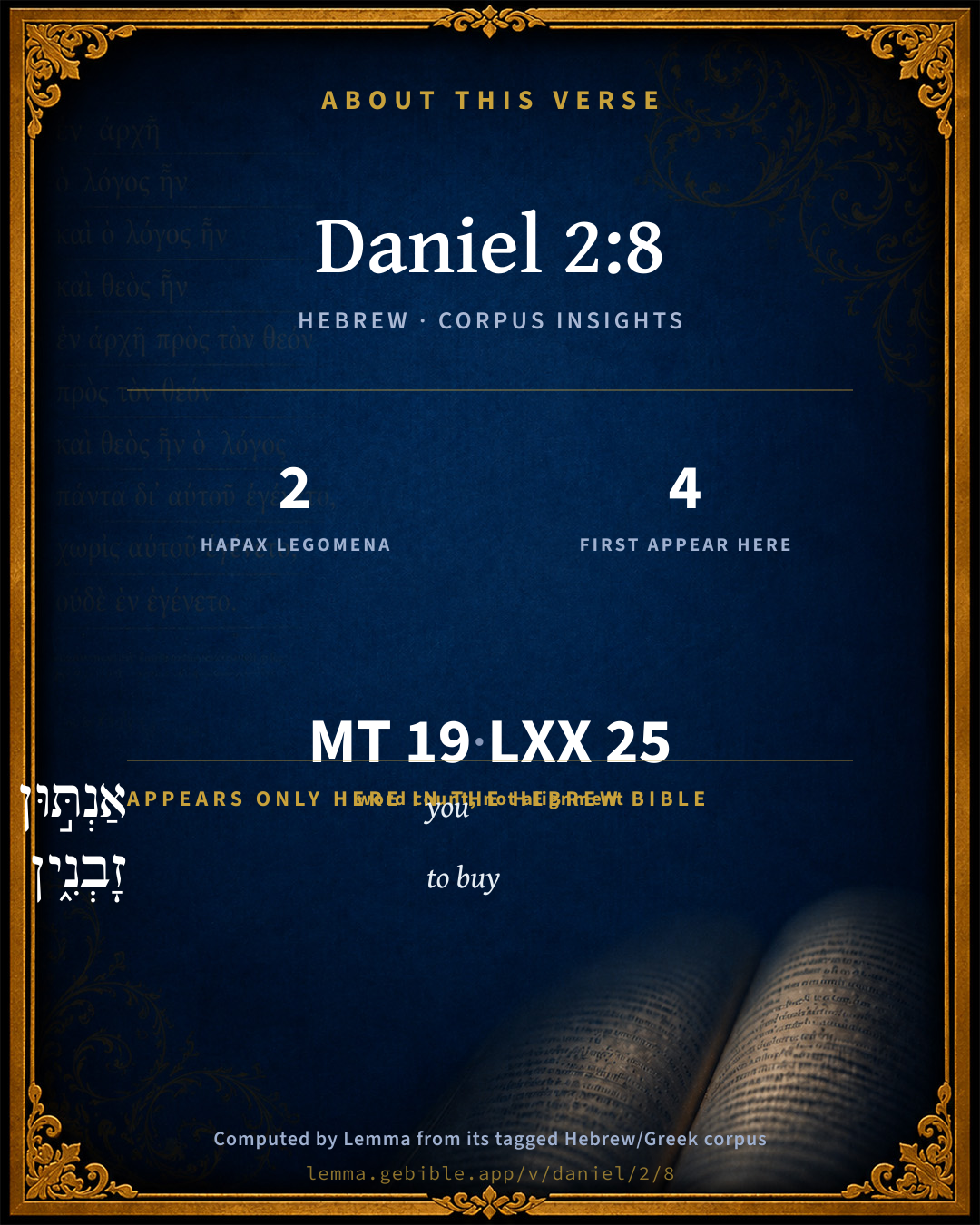
Daniel 2:8

Hebrew (Westminster Leningrad Codex) Daniel 2:8 appears in the Hebrew Old Testament. The text above is from the Westminster Leningrad Codex. Each word links to its Strong’s number, a concise gloss, and parsing drawn from the Open Scriptures Hebrew Bible morphology. Click any word for its full Brown-Driver-Briggs (BDB) entry.
Download image
Cite this verse

Daniel 2:8 (World English Bible). Public Domain. Lemma interlinear Bible study tool, https://lemma.gebible.app/v/daniel/2/8.

Show BibTeX & RIS
BibTeX
RIS
English Translation
The king answered, I know of a certainty that you would gain time, because you see the thing is gone from me.
World English Bible · Public Domain
Highlights
  • 2 hapax legomena — only here in the Hebrew Bible
  • 4 first appearances in the Hebrew Bible
Full analysis ↓
Download a study sheet

One document with this verse’s original text, its word-by-word gloss line, the meaning frame, cross-references with their text, attributed commentary, and full source and license credits — printable, and it pastes into notes with its structure intact.

This verse Autodidact and up

Study sheet (.html) Plain text (.txt)

A passage Seminary Student

Up to 50 verses in one chapter. A passage sheet keeps up to 6 commentary sources and 12 cross-references per verse, in the order this page ranks them, and says so on the sheet whenever that leaves anything out. Ask for a single verse and you get the Autodidact verse sheet above.

Everything on this page stays free to read, with no account — the sheet is a download of what is already on screen, not access to it.

Want to remove ads? Support Godless Engineer
Compare translations 3

The same verse in 3 English versions, stacked beneath the original-language interlinear above. Click any original word for its lexicon entry.

Each is an independent rendering of the whole verse — the interlinear is not word-aligned to these translations.

Highlighted words mark where these versions differ — a whole-verse word diff, not a word-by-word alignment.

  • World English Bible Public Domain
    The king answered, I know of a certainty that you would gain time, because you see the thing is gone from me.
  • King James Version Public Domain
    The king answered and said, I know of certainty that ye would gain the time, because ye see the thing is gone from me.
  • unfoldingWord Literal Text CC BY-SA 4.0
    The king answered and said, “I know for certain that you are trying to gain time because you see that the word from me is firm.

unfoldingWord Literal Text — © unfoldingWord, licensed CC BY-SA 4.0. Word-aligned USFM3 via Door43 (git.door43.org/unfoldingWord/en_ult).

Versions to compare (up to 4)

3 of 4 selected

Show all 18 translations

Every available English version of this verse, each an independent rendering of the whole verse.

  • World English Bible Public Domain
    The king answered, I know of a certainty that you would gain time, because you see the thing is gone from me.
  • Berean Standard Bible Public Domain
    The king replied, “I know for sure that you are stalling for time, because you see that my word is final.
  • Majority Standard Bible Public Domain
    The king replied, “I know for sure that you are stalling for time because you see that my word is final.
  • King James Version Public Domain
    The king answered and said, I know of certainty that ye would gain the time, because ye see the thing is gone from me.
  • American Standard Version (1901) Public Domain
    The king answered and said, I know of a certainty that ye would gain time, because ye see the thing is gone from me.
  • Revised Version (1885) Public Domain
    The king answered and said, I know of a certain that ye would gain time, because ye see the thing is gone from me.
  • Geneva Bible (1599) Public Domain
    Then the King answered, and sayd, I knowe certeinly that ye would gaine the time, because ye see the thing is gone from me.
  • Douay-Rheims (1899) Public Domain
    The king answered, and said: I know for certain that you seek to gain time, since you know that the thing is gone from me.
  • Young's Literal Translation Public Domain
    The king hath answered and said, `Of a truth I know that time ye are gaining, because that ye have seen that the thing is gone from me,
  • Literal Standard Version CC BY-SA 4.0
    The king has answered and said, “Of a truth I know that you are gaining time, because that you have seen that the thing is gone from me,
  • Unlocked Literal Bible CC BY-SA 4.0
    The king answered, “I know for certain that you want more time because you see how firm my decision is about this.
  • unfoldingWord Literal Text CC BY-SA 4.0
    The king answered and said, “I know for certain that you are trying to gain time because you see that the word from me is firm.
  • Darby Bible Public Domain
    The king answered and said, I know of a certainty that ye would gain time, because ye see the word is gone forth from me;
  • World Messianic Bible Public Domain
    The king answered, “I know of a certainty that you are trying to gain time, because you see the thing has gone from me.
  • Webster's Bible Public Domain
    The king answered and said, I know of certainty that ye would gain the time, because ye see the thing is gone from me.
  • Free Bible Version CC BY-SA 4.0
    “It's obvious to me that you're just trying to buy time!” said the king. “You can see that I can't remember the dream.
  • Bible in Basic English Public Domain
    The king made answer and said, I am certain that you are attempting to get more time, because you see that my decision is fixed;
  • JPS Tanakh (1917) Public Domain
    The king answered and said: 'I know of a truth that ye would gain time, inasmuch as ye see the thing is certain with me,

Literal Standard Version (2020), Covenant Press — licensed CC BY-SA 4.0. Text via the HelloAO Bible API (eBible.org). Unlocked Literal Bible (unfoldingWord) — licensed CC BY-SA 4.0. Text via the HelloAO Bible API (eBible.org). unfoldingWord Literal Text — © unfoldingWord, licensed CC BY-SA 4.0. Word-aligned USFM3 via Door43 (git.door43.org/unfoldingWord/en_ult). Free Bible Version, Dr. Jonathan Gallagher — licensed CC BY-SA 4.0. Text via the HelloAO Bible API (eBible.org).

Word by word

More ways to search: Search by grammar → Find every occurrence → Compare this word →

Practice this passage: Drill this verse → Learn its vocabulary →

אַנְתּ֣וּן
ʼantûwn
H608
“you”
Adjective, P
Part of Speech
Adjective
Full BDB Definition

Origin: plural of H607

TWOT: 2593

you, thou (second person plural)
  1. עָנֵ֤ה ʻănâh H6032 “answering” Adjective, V
  2. מַלְכָּא֙ melek H4430 “king · the” Adjective, N, Common + Particle, Definite Article
  3. וְאָמַ֔ר ʼămar H560 “and · saying” Adjective, C + Verb, Qal, Participle Active, Masculine, Singular, Absolute
  4. מִן min H4481 “from” Adjective, R
  5. יַצִּיב֙ yatstsîyb H3330 “true” Adjective, A
  6. יָדַ֣ע yᵉdaʻ H3046 “knowing” Adjective, V
  7. אֲנָ֔ה ʼănâʼ H576 “I” Adjective, P, Construct
  8. דִּ֥י dîy H1768 “which” Adjective, T
  9. עִדָּנָ֖א ʻiddân H5732 “time · the” Adjective, N, Common + Particle, Definite Article
  10. זָבְנִ֑ין zᵉban H2084 “buying” Adjective, V
  11. כָּל kôl H3606 “all” Adjective, C + Conjunction
  12. קֳבֵל֙ qᵉbêl H6903 “before” Adjective, C
  13. דִּ֣י dîy H1768 “which” Adjective, C
  14. חֲזֵית֔וֹן chăzâʼ H2370 “to see” Adjective, V, Plural
  15. דִּ֥י dîy H1768 “which” Adjective, T
  16. אַזְדָּ֖א ʼăzâd H230 “gone” Adjective, A
  17. מִנִּ֥י min H4481 “from · me” Adjective, R + Suffix, Personal, 1st Person, Common, Singular
  18. מִלְּתָֽא millâh H4406 “word · the” Adjective, N, Common + Particle, Definite Article

About this verse

These counts appear in no published source. They are computed here, from the morphology-tagged text and Lemma’s own curated glosses. What Lemma adds →

19
words
16
distinct lemmas
Prophets
section

Notable vocabulary

2 hapax legomena — words that appear only here in the entire Hebrew Bible:

  • אַנְתּ֣וּן you H608
  • זָבְנִ֑ין to buy H2084

First appearance in Scripture

These words make their first canonical appearance in the Hebrew Bible here:

  • יַצִּיב֙ true H3330
  • עִדָּנָ֖א time H5732
  • אַנְתּ֣וּן you H608
  • זָבְנִ֑ין to buy H2084

Shared distinctive vocabulary

אַזְדָּ֖א gone H230 occurs in 2 verses of the Hebrew Bible. Also found in:

Grammatical profile

  • 1 verb
  • 14 adjectives
  • 1 conjunction
  • 3 particles

Verb forms

  • וְאָמַ֔ר Qal · Participle Active

Repetition

Words recur within this verse — often emphatic in Hebrew:

  • דִּ֥י which H1768 ×3
  • מִן from H4481 ×2

Hebrew & Septuagint length

In English translation the verse runs 22 words from the Hebrew and 26 from the Septuagint (LXX English) — closely comparable.

A rough comparison of the two English renderings, which tokenize alike — not a word-level alignment.

Word counts can differ between the Hebrew and the Greek without any difference in meaning — e.g. the Hebrew direct-object marker אֵת has no separate Greek word, and Greek often adds the article ὁ.

In the original languages it is 19 Hebrew tokens and 25 Greek tokens — but the two are counted differently (Hebrew bundles its prefixes and suffixes into one token; the Greek is in lemma form), so that isn’t a like-for-like length.

Cross-references

2

Topical passages linked to Daniel 2:8 in the Treasury of Scripture Knowledge — connected by theme and wording, ordered by reader-vote popularity; previews shown in the World English Bible.

  • Ephesians 5:16 redeeming the time, because the days are evil.
  • Colossians 4:5 Walk in wisdom toward those who are outside, redeeming the time.

Cross-references courtesy of OpenBible.info (CC BY 4.0).

Hebrew and Greek witnesses Masoretic Hebrew ↔ Greek Septuagint

The same verse in the two great witnesses to the Old Testament, shown verse-for-verse.

These are two independent witnesses, not word-aligned to each other, and the Septuagint is shown in lemma (dictionary) form.

Hebrew Daniel 2:8 Masoretic · Westminster Leningrad Codex

עָנֵ֤ה מַלְכָּא֙ וְאָמַ֔ר מִן יַצִּיב֙ יָדַ֣ע אֲנָ֔ה דִּ֥י עִדָּנָ֖א אַנְתּ֣וּן זָבְנִ֑ין כָּל קֳבֵל֙ דִּ֣י חֲזֵית֔וֹן דִּ֥י אַזְדָּ֖א מִנִּ֥י מִלְּתָֽא

The king answered, I know of a certainty that you would gain time, because you see the thing is gone from me.

World English Bible · Public Domain

Greek LXX Daniel 2:8 Septuagint · lemma form

καί εἶπον αὐτός ὁ βασιλεύς ἐπί ἀλήθεια οἶδα ὅτι καιρός σύ ἐκἀγοράζω καθάπερ ὁράω ὅτι ἀποἵστημι ἀπό ἐγώ ὁ πρᾶγμα καθάπερ οὖν προςτάσσω οὕτως εἰμί

And the king answered and said, I verily know that you⌃ are trying to gain time, because you⌃ see that the thing has gone from me.

LXX2012 (modern English Septuagint) · Public Domain

On this verse, The Pulpit Commentary discusses the Septuagint’s reading. Read the note in Commentary ↓

Hebrew: Westminster Leningrad Codex (CC BY 4.0). Greek: Septuagint (public domain); English from LXX2012 (modern English Septuagint) (Public Domain). How the Septuagint differs from the Hebrew →

Commentary

Notes on Daniel 2:8 from classic Christian and Jewish commentators (each source and its license shown beneath its notes). The classic Christian expositions comment on the surrounding passage and are grouped to its opening verse, so a note may address several verses; the Jewish commentaries on the Tanakh (Rashi and others) are per-verse, so they appear only where the commentator wrote on this verse.

Lemma curates 59 commentaries, every one of them public domain or Creative Commons licensed, each selected and text-cleaned for this edition rather than reprinted as found. About our sources →

Trapp's Complete Commentary

John Trapp

Dan 2:8 The king answered and said, I know of certainty that ye would gain the time, because ye see the thing is gone from me.

Ver. 8. I know of certainty.] There is no halting before a cripple. Politicians can sound the depth of one another. {Dan 11:27}

That ye would gain the time.] Chald., Buy or redeem it - that is, make your advantage of it to evade the danger. And indeed if these sorcerers could have gained longer time much might have been done; for either the king might have died or been employed in war, or pacified by the mediation of friends, &c. Time often cooleth the rage of hasty men. {as 1Sa 25:33} How Hubert de Burgo, Earl of Kent, escaped the king’s wrath by a little respite, see Goodwin’s Catalogue of Bish., p. 193.

John Trapp, A Commentary or Exposition upon All the Books of the Old and New Testament (1647–1656) — public domain. Text from a community e-Sword module.

The Biblical Illustrator

Joseph S. Exell

Dan_2:8

I know of certainty that ye would gain the time.

A Meditation for the New Year

The magicians wished to gain time, hoping that the king might remember his dream, or that something might happen to extricate them from the dreadful dilemma. Notice the two main thoughts and the suggestions suitable to the season.

I. TIME IS ON MANS SIDE. We are often made to feel that Men of the world know how precious sometimes is an extension of credit for a month, a week, a day, even an hour. Give the perplexed man time, and he will know how to act. It is all a question of time. On the higher plane of things this is specially true. Morally speaking, time is of infinite consequence to us.

1. Time is another word for mercy. So long as we enjoy the shelter of time, we are safe from the judgments which our sins have provoked. All the retributive suffering of this life is light indeed compared with the retributions which await the transgressor farther on; it is but the spilling of the red vials. Flee from the wrath to come. The fulness of penalty is reserved.

2. Time is another word for opportunity. It is not bare duration that is granted us, but a period rich in influences, succours, instrumentalities, and inspirations. To say that time is lengthened out is to say that the Word of God is continued to us, the means of grace, the privilege of prayer, the influences of the Spirit, all the fulness of the blessing of the redeeming gospel. Life teems with chances of getting good and doing good.

3. Time is another word for hope. Whilst time is granted, wonderful changes are possible.

II. THE PERIOD APPROACHES WHEN TIME CAN NO LONGER BE ON OUR SIDE. It was thus with these Magi; they had nearly exhausted the kings patience. An end comes necessarily to all respites. The business man in difficulties gains time, the bill is renewed, it is again and again renewed; but the inexorable day dawns. So a limit is fixed to the opportunities of the religious life. The dispensation of mercy and opportunity is soon past.

1. Most appropriate to the season is the spirit of thankfulness. All have reason to thank God for the past year. Thy saints shall bless Thee. They bless Thee for the sweet spring, the opulent summer, the mellow autumn, the stern winter, and for those larger, richer spaces of heavenly blessing which accompany the circling year. They bless Thee for three hundred and sixty-five days and nights burdened with spiritual benediction and hallowing influence. The unconverted also have reason to thank God for sparing mercy. Job asks, Why do the wicked live, and become old? There is but one answer: Because God delighteth in mercy.

2. The spirit of humiliation becomes us. How much more good we might have gained! Instead of ending the year with a bosom full of sheaves, too many of us with shamefacedness bring to God only a few blighted ears and withered leaves.

3. The season demands the spirit of consecration. New scenes and opportunities open to us; let us be faithful, and God shall restore unto us the years that the caterpillar has wasted. (W. L. Watkinson.)

The Biblical Illustrator, edited by Joseph S. Exell (c. 1880s–1900s) — public domain. Text from a community e-Sword module.

Ibn Ezra

Rabbi Abraham ibn Ezra

[Daniel 2:8] ʿAneh malka (עָנֵה מַלְכָּא - Answered the king): [The king says:] Truly (min yatziv - מִן־יַצִּיב, lit. "from certainty") I know that you are buying time (ʿiddana antun zavnin - עִדָּנָא אַנְתּוּן זָבְנִין). The meaning is: you are delaying the hour/stalling. This is because (kol kovel di - כָּל־קֳבֵל דִּי) you saw that the word/decree (mill'ta - מִלְּתָא) is established/certain (azda - אַזְדָּא) from me. And it [the decree] is: "If you do not make the dream known to me, your sentence (dat'khon - דָּתְכוֹן) is one" [cf. Daniel 2:9] – the sentence (ha-dat - הַדָּת) that I gave, that you will be killed. And the Dalet (ד) of [the word] hizdaminton (הִזְדַּמִּנְתּוּן - "you have prepared/agreed upon" [found in Daniel 2:9]) [stands] instead of the Tav (ת) of the Hitpael conjugation [due to assimilation]. And Rabbi Marinus said: that similarly the word hizzakku (הִזַּכּוּ - "cleanse yourselves," Isaiah 1:16) is like hizdakku (הִזְדַּכּוּ - hypothetical form). But it is not plausible for it (hizzakku) to be from the Nifal conjugation because of the dagesh [strong dot] in the Khaf (כּ). And Rabbi Moshe [ibn Gikatilla] HaKohen Sefardi said: that it (hizzakku) is the Hitpael conjugation, and the dagesh in the Zayin (זּ) is due to the assimilation of the Tav (ת) [meaning the original form was hithzakku (הִתְזַכּוּ)]. And this is correct in my eyes.

Ibn Ezra on the Tanakh — English translations: “Sefaria Community Translation” (CC0 1.0 (public-domain dedication)); “Yalkut, Sifsei Chachomim Chumash, Metsudah Publications, 2009” (CC BY 4.0); and “Commentary of Ibn Ezra on Isaiah - trans. by M. Friedlander, 1873” (public domain). Text via Sefaria.

Geneva Bible (1599)

Geneva Bible translators

Hebrew, redeem the time.

Geneva Bible (1599) marginal notes — public domain. Text via Bolls.life.

Jamieson, Fausset & Brown

Robert Jamieson, A. R. Fausset & David Brown

gain . . . time--literally, "buy." Compare Eph 5:16; Col 4:5, where the sense is somewhat different.

the thing is gone from me--(See on Dan 2:5).

Jamieson, Fausset & Brown — Commentary Critical and Explanatory on the Whole Bible (1871) — public domain (CC PDM 1.0). Text via the HelloAO Bible API.

Adam Clarke's Commentary

Verse 8. That ye would gain the time] The king means either that they wished to prolong the time that he might recollect it, or get indifferent about it; or that they might invent something in the place of it; or make their escape to save their lives, after having packed up their valuables. See Da 2:9.

Adam Clarke's Commentary on the Bible (1810–1826) — public domain. Text from a community e-Sword/MySword module.

John Calvin's Commentaries

The king’s exception now follows: — I know, says he, that ye would gain time, since you are aware that the matter has gone from me, or the word has been pronounced, if we adopt the former sense. The king here accuses them of more disgraceful cunning, since the Magi have nothing to offer, and so desire to escape as soon as they know that the king has lost all remembrance of his dream. It is just as if he had said — You promised me to be sure interpreters of my dream, but this is false; for if I could narrate the dream, it would be easy to prove your arrogance, since ye cannot explain that enigma; but as lye know I have forgotten my dream, for that reason ye ask me to relate it; but this is only to gain time, says he; thus ye manage to conceal your ignorance and retain your credit for knowledge. But if my dream still remained in my memory I should soon detect your ignorance, for we cannot perform your boasting. We see, therefore, how the king here loads the Magi with a new crime, because they were impostors who deluded the people with false boastings; and hence he shews them worthy of death, unless they relate his dream. The argument indeed is utterly vicious; but it is not surprising when tyrants appear in the true colors of their cruelty. Meanwhile we must remember what I have said. — the Magi deserved this reproof, for they were puffed up with vanity and made false promises, through conjecturing the future from dreams, auguries, and the like. But in the king’s case, nothing was more unjust. than to invent such a crime against the Magi, since if they deceived others it arose from being self-deceived. They were blinded and fascinated by the foolish persuasion of their own wisdom, and had no intention of deceiving the king; for they thought something might immediately occur which would free his mind from all anxiety. But the king always pursued the blindest impulse of his rage. Meanwhile we must notice the origin of this feeling, — he was divinely tormented, and could not rest a single moment till he obtained an explanation of his dream. He next adds, If ye do not explain my dream, this sentence alone remains for you, says he; that is, it is already decreed concerning you all, I shall not inquire particularly which of you is in fault and which wishes to deceive me; but I will utterly cut off all the tribe of the Magi, and no one shall escape punishment, unless ye explain to me both the dream and its interpretation.

John Calvin's Commentaries (1540-1563) — public domain. Text from the Calvin Translation Society English edition (1840s-50s) via the Christian Classics Ethereal Library (ccel.org). Calvin's coverage is partial (roughly two-thirds of the Bible); uncommented books and verses are honest gaps, never fabricated. The 19th-century editor's footnotes and remarks are omitted so the notes are faithfully Calvin's own voice.

Ellicott's Commentary for English Readers

(8) Gain time.—They hoped that by continual postponement they would induce the king to let the matter pass over; or, if not, that they might be able to wheedle the dream out of him,

A Bible Commentary for English Readers, edited by Charles John Ellicott (1878–1897) — public domain. Text from a community e-Sword module.

The Cambridge Bible for Schools and Colleges

gen. ed. J. J. S. Perowne

8. of certainty] We should say now, ‘of a certainty.’ Murray quotes from North’s Plutarch (1580), ‘It is of certainty that her proper name was Nicostrata.’

would gain time (R.V.)] lit. are buying the time. Their repeated request to the king to tell them his dream is proof to him that they have no power to reveal secrets, and that they could not therefore interpret his dream, even though he were to describe it to them: hence he charges them with buying the time, i.e. with endeavouring to defer the fatal moment when the truth must appear, and when their inability to interpret his dream must be exposed.

because ye see that the word spoken by me is sure, (9) That, if, &c.] Because you see that I am resolved to punish you, if you do not fulfil the conditions I lay down (Dan_2:5).

The Cambridge Bible for Schools and Colleges (gen. ed. J. J. S. Perowne; Cambridge University Press, 1878–1918) — public domain. Text from a community e-Sword module.

John Gill's Exposition

The king answered and said, I know of certainty,.... I see plainly and clearly what you are at, and am fully assured you mean nothing, but that

ye would gain the time: or buy (f), or redeem time, as in Eph 5:16, prolong time, put off the answer to longer time; spin out time, as people do in buying and selling; or have it in their possession and power when to answer; and so by gaining time, or being master of it, might hope something would turn up to their advantage, and extricate them out of their present difficulties:

because ye see the thing is gone from me; the dream he could not remember; or because the decree was certain which he had determined concerning them; See Gill on Dan 2:5.

(f) "quod tempus vos emitis", Pagninus, Munster; "ementes", Montanus; "vos tempus redimere", Junius & Tremellius, Piscator.

John Gill's Exposition of the Whole Bible (1746–1763) — public domain (CC PDM 1.0). Text via the HelloAO Bible API.

Albert Barnes' Notes on the Bible

The king answered and said, I know of certainty that ye would gain the time - Margin, “buy.” The Chaldee word זבנין zâbenı̂yn (from זבן zeban) means, to get for oneself, buy, gain, procure. Greek, ἐξαγοράζετε exagorazete - “that ye redeem time;” and so the Vulgate - quod tempus redimitis. The idea is, that they saw that they could not comply with his requisition, and that their asking him Dan 2:7 to state the dream was only a pretext for delay, in the hope that in the interval some device might be hit on by them to appease him, or to avert his threatened indignation. It would be natural to suppose that they might hope that on reflection he would become more calm, and that, although they “might” not be able to recal the dream and explain it, yet it would be seen to be unreasonable to expect or demand it. The king seems to have supposed that some such thoughts were passing through their minds, and he charges on them such a project. The argument of the king seems to have been something like this: “They who can explain a dream correctly can as well tell what it is as what its interpretation is, for the one is as much the result of Divine influence as the other; and if men can hope for Divine help in the one case, why not in the other? As you cannot, therefore, recal the dream, it is plain that you cannot interpret it; and your only object in demanding to know it is, that you may ward off as long as possible the execution of the threatened sentence, and, if practicable, escape it altogether.” It is not improbable that what they said was more than the simple request recorded in Dan 2:7. They would naturally enlarge on it, by attempting to show how unreasonable was the demand of the king in the case, and their arguments would give a fair pretext for what he here charges on them.

Because ye see the thing is gone from me - According to the interpretation proposed in Dan 2:5, the “dream.” The meaning is, “You see that I have forgotten it. I have made a positive statement on that point. There can be no hope, therefore, that it can be recalled, and it is clear that your only object must be to gain time. Nothing can be gained by delay, and the matter may therefore be determined at once, and your conduct be construed as a confession that you cannot perform what is required, and the sentence proceed without delay.” This makes better sense, it seems to me, than to suppose that he means that a sentence had gone forth from him that if they could not recal and interpret it they should be put to death.

Albert Barnes' Notes on the Bible (1834–1885) — public domain. Text from a community e-Sword/MySword module.

Haydock's Catholic Bible Commentary

Gain. Literally, "redeem" (Haydock) --- St. Paul uses a similar expression, exhorting us to save our souls even at the expense of our temporal interest. (Calmet) --- The diviners wished to give the king’s fury time to abate, (Haydock) and to save their lives; (Calmet) or delay punishment, at least, as much as possible. (Haydock)

George Leo Haydock (1774–1849), Haydock's Catholic Family Bible and Commentary, 1859 edition — public domain. Excludes Psalms (Douay-Rheims chapter numbering differs from Protestant) and Deuterocanonical books (Catholic canon only).

Matthew Poole's English Annotations

This ye do in policy, to escape punishment; when taken up with other affairs, I may forget to make further inquiry after this thing, but it shall not serve your turn.

Matthew Poole's English Annotations on the Holy Bible (1683–1685) — public domain. Text from a community e-Sword/MySword module.

The Pulpit Commentary

The king answered and said, I know of certainty that ye would gain the time, because ye see the thing is gone from me. The versions here do not differ in any essential point. The king now becomes certain of the treasonable purpose of the soothsayers. The word zeban means not so much "gain" as "purchase," "barter." To the king the meaning of their obstinate refusal to submit to his requirements is that they know that some great advantage may be gained by the king, or some great disaster forefended, if he only knows the meaning of this dream, and that if the king does not submit to them and yield up his decree, and, putting his pride under his feet, tell them the dream, the time when its revelation may be taken advantage of may be passed. In these matters everything was supposed to depend on the thing to be done being done precisely at the right conjunction of the planets. His last utterance seems almost to rise to agony, "Because ye see the thing is fixed away from me!" We have the same word (azda) translated here, as in the fifth verse, "gone." As we saw above, its real meaning is rather "fixed," "settled," "determined." His decree had gone out, and he would not nay, so strongly had he willed at that it was as it" he could not alter his decision. It has been regarded as bearing on this passage that St. Paul (Eph_5:16) uses the same word as that by which the Greek versions translate zeban , "redeeming the time, because the days are evil." The meaning of the apostle is to some extent in contrast to that here. Believers are, as it were, to purchase the time from the evil days. Nebuchadnezzar thought the astrologers were, as it were, ira.suing by their delays to buy the auspicious moment for the kingdom from under his feet. It is a mistaken idea that he thought they merely wished to gain time. It would I seem, from what we read further of his treatment of Daniel"s request lot time, that, had they merely asked for time, Nebuchadnezzar would have granted their request. He had staked his faith in their ability to unfold any mystery on this one test, and they seemed to him obstinately to refuse to submit to it. To believe them unable to reveal the truth that he wished, would be to overturn all the fabric of his faith in the religion of his fathers; therefore, with all the strength of a strong man. and all the blind faith of a fanatic, he will not acknowledge the inability of the soothsayers to tell him his dream; it must be obstinacy, he thinks, that prevents the soothsayers telling him, and that obstinacy must have a sinister purpose. There is a clause in the Septuagint completing this verse, but it is not parallel with any clause in the Massoretic text: "Then just as I have ordered, thus shall it be." This probably is an alternative rendering. Azda is taken in what is now regarded as its meaning which is fixed," or "decreed," in which case this final clause might be rendered, "What is fixed from me is a decree;" and of this the above-mentioned clause is a somewhat free rendering. This interpretation of the clause confirms our view of the situation.

The Pulpit Commentary (1880–1919), ed. H.D.M. Spence-Jones & Joseph S. Exell — public domain. Text from a community e-Sword module.

Rashi

Rabbi Shlomo Yitzchaki (Rashi)

in truth, I know [as translated,] in truth, I know.

truth Aram. יַצִיב, a true and permanent thing.

that this time you are doomed Aram. דִּי עִדָּנָא אַנְתוּן זַבְנִין, that this time you are delivered to death.

because you see because you see that the matter escaped me, but you repeatedly ask me to tell you.

Rashi on the Tanakh — English translations: “The Judaica Press complete Tanach with Rashi, translated by A. J. Rosenberg” (CC BY 4.0); “Pentateuch with Rashi's commentary by M. Rosenbaum and A.M. Silbermann, 1929-1934” (public domain); “The Metsudah Tanach series, Lakewood, N.J” (CC BY 4.0); and “The Book of Joshua, Metsudah Publications, 1997” (CC BY 4.0). Text via Sefaria.

Lesson kit

Teaching starters — assembled from the data on this page, not authored interpretation. Every prompt links to the verse data it draws on. Edit before teaching.

Daniel, in the Prophets, opens this verse with 19 words (16 distinct Hebrew lemmas). Its most distinctive word is ʼantûwn (“you”). A historical commentator’s framing appears above. Read the whole chapter for the surrounding context.

Discussion questions

  1. What does “you” (ʼantûwn) contribute to the verse as a whole?
  2. 2 words here appear nowhere else in the Hebrew Bible. Why might the author reach for such rare wording?
  3. 4 words make their first appearance in Scripture here. What does this debut establish?
  4. How does Daniel 2:5, which shares the word «gone», read alongside this verse?
  5. What does the repetition of “which” (3× in this one verse) do in this verse?
  6. These translations render this verse differently; the difference is in the English rendering, not the original. What questions does that raise?
  7. «וְאָמַ֔ר» is a Qal Participle Active verb. How does that grammatical form shape the action described?
  8. Compare how Trapp's Complete Commentary and The Biblical Illustrator read this verse. Where do they agree or differ?

Things to notice

  • 2 words in this verse appear nowhere else in the Hebrew Bible.
  • 4 words make their first canonical appearance in Scripture here.
  • This verse counts 19 Hebrew ↔ 25 Greek words.
  • These translations choose different wording for 10 words in this verse.
  • “which” occurs 3× in this single verse.

Reading settings

Reading text

Shown beneath each verse's original-language words.

Old Testament
Old Testament edition

Read the OT as the Masoretic Hebrew (MT) or the Greek Septuagint (LXX).

English shown for the Greek Septuagint (in the Hebrew ↔ Greek comparison).

Comparing translations? Open the Compare panel on any verse page to stack up to four side by side.