
Daniel 7:10

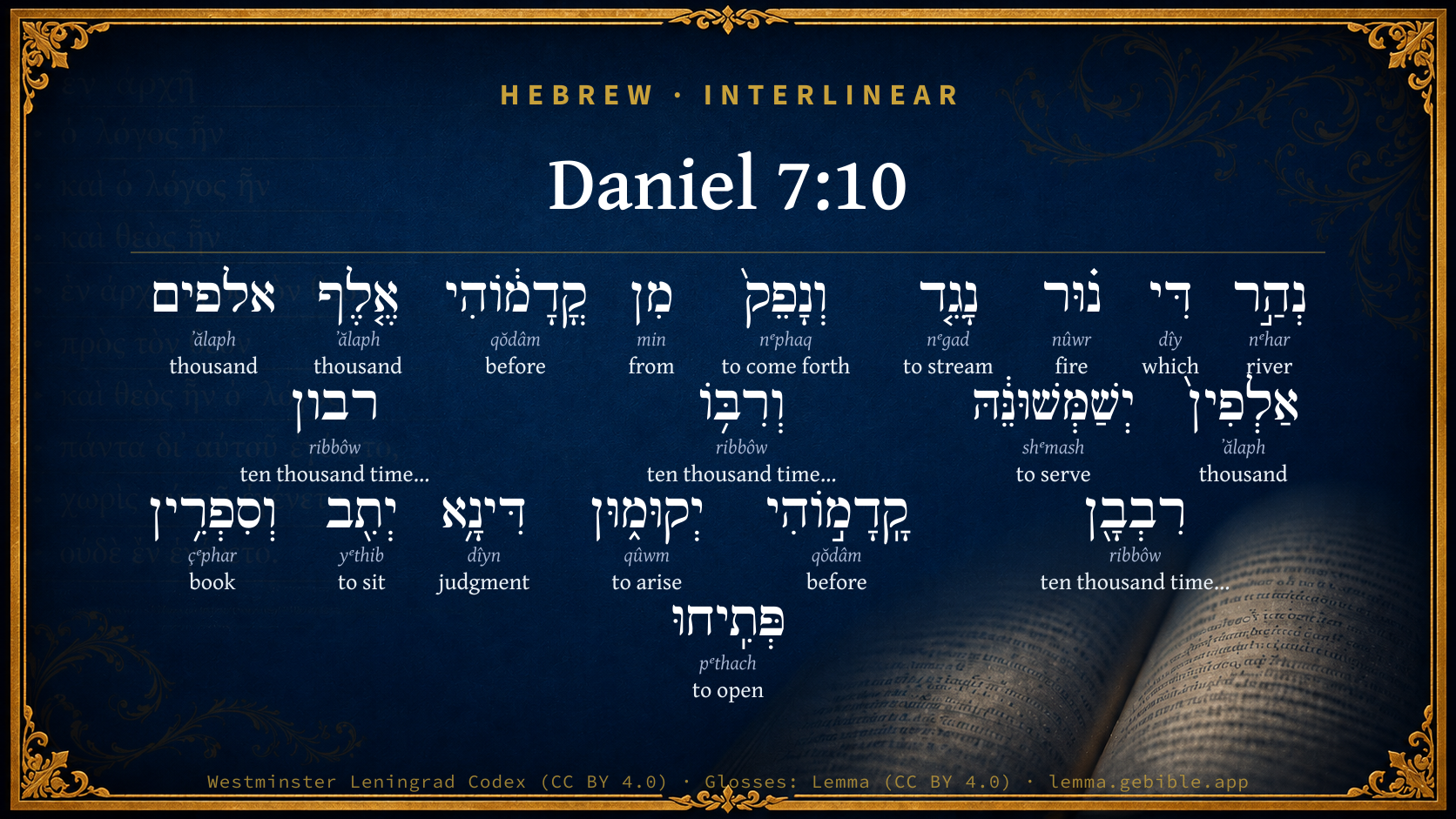
Hebrew (Westminster Leningrad Codex) Daniel 7:10 appears in the Hebrew Old Testament. The text above is from the Westminster Leningrad Codex. Each word links to its Strong’s number, a concise gloss, and parsing drawn from the Open Scriptures Hebrew Bible morphology. Click any word for its full Brown-Driver-Briggs (BDB) entry.
Download image
Cite this verse

Daniel 7:10 (World English Bible). Public Domain. Lemma interlinear Bible study tool, https://lemma.gebible.app/v/daniel/7/10.

Show BibTeX & RIS
BibTeX
RIS
English Translation
A fiery stream issued and came forth from before him: thousands of thousands ministered to him, and ten thousand times ten thousand stood before him: the judgment was set, and the books were opened.
World English Bible · Public Domain
Highlights
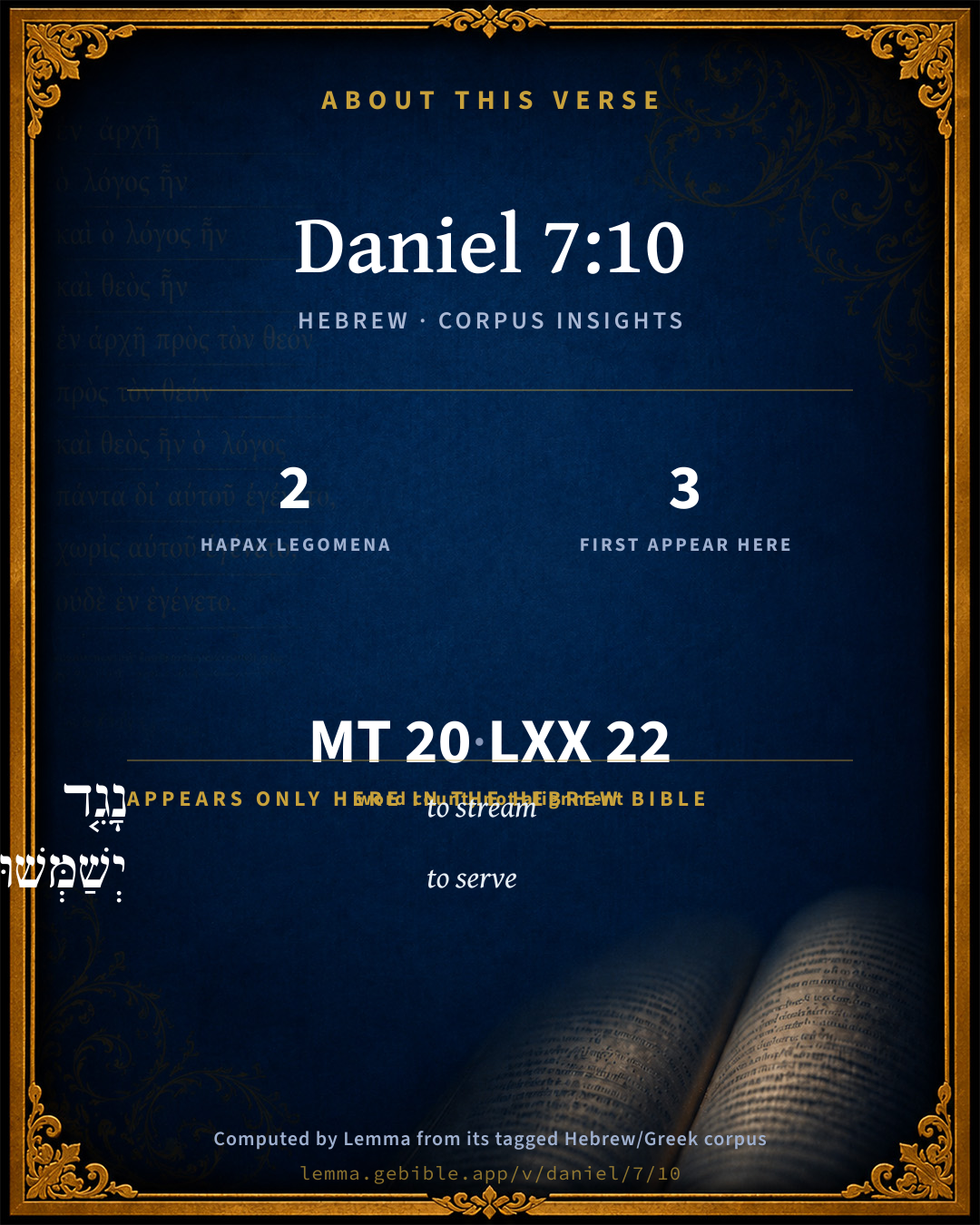
  • 2 hapax legomena — only here in the Hebrew Bible
  • 3 first appearances in the Hebrew Bible
Full analysis ↓
Download a study sheet

One document with this verse’s original text, its word-by-word gloss line, the meaning frame, cross-references with their text, attributed commentary, and full source and license credits — printable, and it pastes into notes with its structure intact.

This verse Autodidact and up

Study sheet (.html) Plain text (.txt)

A passage Seminary Student

Up to 50 verses in one chapter. A passage sheet keeps up to 6 commentary sources and 12 cross-references per verse, in the order this page ranks them, and says so on the sheet whenever that leaves anything out. Ask for a single verse and you get the Autodidact verse sheet above.

Everything on this page stays free to read, with no account — the sheet is a download of what is already on screen, not access to it.

Want to remove ads? Support Godless Engineer
Compare translations 3

The same verse in 3 English versions, stacked beneath the original-language interlinear above. Click any original word for its lexicon entry.

Each is an independent rendering of the whole verse — the interlinear is not word-aligned to these translations.

Highlighted words mark where these versions differ — a whole-verse word diff, not a word-by-word alignment.

  • World English Bible Public Domain
    A fiery stream issued and came forth from before him: thousands of thousands ministered to him, and ten thousand times ten thousand stood before him: the judgment was set, and the books were opened.
  • King James Version Public Domain
    A fiery stream issued and came forth from before him: thousand thousands ministered unto him, and ten thousand times ten thousand stood before him: the judgment was set, and the books were opened.
  • unfoldingWord Literal Text CC BY-SA 4.0
    A river of fire was flowing and coming out from before him; thousands upon thousands served him, and myriads upon myriads were standing before him. The court sat, and the books were opened.

unfoldingWord Literal Text — © unfoldingWord, licensed CC BY-SA 4.0. Word-aligned USFM3 via Door43 (git.door43.org/unfoldingWord/en_ult).

Versions to compare (up to 4)

3 of 4 selected

Show all 18 translations

Every available English version of this verse, each an independent rendering of the whole verse.

  • World English Bible Public Domain
    A fiery stream issued and came forth from before him: thousands of thousands ministered to him, and ten thousand times ten thousand stood before him: the judgment was set, and the books were opened.
  • Berean Standard Bible Public Domain
    A river of fire was flowing, coming out from His presence. Thousands upon thousands attended Him, and myriads upon myriads stood before Him. The court was convened, and the books were opened.
  • Majority Standard Bible Public Domain
    A river of fire was flowing, coming out from His presence. Thousands upon thousands attended Him, and myriads upon myriads stood before Him. The court was convened, and the books were opened.
  • King James Version Public Domain
    A fiery stream issued and came forth from before him: thousand thousands ministered unto him, and ten thousand times ten thousand stood before him: the judgment was set, and the books were opened.
  • American Standard Version (1901) Public Domain
    A fiery stream issued and came forth from before him: thousands of thousands ministered unto him, and ten thousand times ten thousand stood before him: the judgment was set, and the books were opened.
  • Revised Version (1885) Public Domain
    A fiery stream issued and came forth from before him: thousand thousands ministered unto him, and ten thousand times ten thousand stood before him: the judgment was set, and the books were opened.
  • Geneva Bible (1599) Public Domain
    A fierie streame yssued, and came foorth from before him: thousand thousandes ministred vnto him, and tenne thousand thousands stoode before him: the iudgement was set, and the bookes opened.
  • Douay-Rheims (1899) Public Domain
    A swift stream of fire issued forth from before him: thousands of thousands ministered to him, and ten thousand times a hundred thousand stood before him: the judgment sat, and the books were opened.
  • Young's Literal Translation Public Domain
    A flood of fire is proceeding and coming forth from before Him, a thousand thousands do serve Him, and a myriad of myriads before Him do rise up, the Judge is seated, and the books have been opened.
  • Literal Standard Version CC BY-SA 4.0
    A flood of fire is proceeding and coming forth from before Him, one million serve Him and one hundred million rise up before Him, judgment has been set, and the scrolls have been opened.
  • Unlocked Literal Bible CC BY-SA 4.0
    A river of fire flowed out from before him; millions served him, and one hundred million were standing before him. The court was in session, and the books were opened.
  • unfoldingWord Literal Text CC BY-SA 4.0
    A river of fire was flowing and coming out from before him; thousands upon thousands served him, and myriads upon myriads were standing before him. The court sat, and the books were opened.
  • Darby Bible Public Domain
    A stream of fire issued and came forth from before him; thousand thousands ministered unto him, and ten thousand times ten thousand stood before him: the judgment was set, and the books were opened.
  • World Messianic Bible Public Domain
    A fiery stream issued and came out from before him. Thousands of thousands ministered to him. Ten thousand times ten thousand stood before him. The judgment was set. The books were opened.
  • Webster's Bible Public Domain
    A fiery stream issued and came forth from before him: thousand thousands ministered to him, and ten thousand times ten thousand stood before him: the judgment was set and the books were opened.
  • Free Bible Version CC BY-SA 4.0
    A stream of fire poured out, flowing from before him. A thousand thousands attended him; ten thousand times ten thousand stood before him. The court sat to begin its judgment, and the books were opened.
  • Bible in Basic English Public Domain
    A stream of fire was flowing and coming out from before him: a thousand thousands were his servants, and ten thousand times ten thousand were in their places before him: the judge was seated and the books were open.
  • JPS Tanakh (1917) Public Domain
    A fiery stream issued and came forth from before him; thousand thousands ministered unto him, and ten thousand times ten thousand stood before him; the judgment was set, and the books were opened.

Literal Standard Version (2020), Covenant Press — licensed CC BY-SA 4.0. Text via the HelloAO Bible API (eBible.org). Unlocked Literal Bible (unfoldingWord) — licensed CC BY-SA 4.0. Text via the HelloAO Bible API (eBible.org). unfoldingWord Literal Text — © unfoldingWord, licensed CC BY-SA 4.0. Word-aligned USFM3 via Door43 (git.door43.org/unfoldingWord/en_ult). Free Bible Version, Dr. Jonathan Gallagher — licensed CC BY-SA 4.0. Text via the HelloAO Bible API (eBible.org).

Word by word

More ways to search: Search by grammar → Find every occurrence → Compare this word →

Practice this passage: Drill this verse → Learn its vocabulary →

נָגֵ֤ד
nᵉgad
H5047
“streaming”
Adjective, V
Part of Speech
Adjective
Full BDB Definition

Origin: corresponding to H5046

TWOT: 2846

(Pael) to stream, flow
  1. נְהַ֣ר nᵉhar H5103 “river” Adjective, N, Common
  2. דִּי dîy H1768 “which” Adjective, T
  3. נ֗וּר nûwr H5135 “fire” Adjective, N, Common
  4. וְנָפֵק֙ nᵉphaq H5312 “and · coming forth” Adjective, C + Verb, Qal, Participle Active, Masculine, Singular, Absolute
  5. מִן min H4481 “from” Adjective, R
  6. קֳדָמ֔וֹהִי qŏdâm H6925 “before · him” Adjective, R + Suffix, Personal, 3rd Person, Masculine, Singular
  7. אֶ֤לֶף ʼălaph H506 “thousand” Adjective, A, Common
  8. אלפים ʼălaph H506 “thousand” Adjective, A, Common
  9. אַלְפִין֙ ʼălaph H506 “thousand” Adjective, A, Common
  10. יְשַׁמְּשׁוּנֵּ֔הּ shᵉmash H8120 “to serve · him” Adjective, V + Suffix, Personal, 3rd Person, Masculine, Singular
  11. וְרִבּ֥וֹ ribbôw H7240 “and · ten thousand times ten thousand” Adjective, C + Adjective, Cardinal number, Feminine, Singular, Construct
  12. רבון ribbôw H7240 “ten thousand times ten thousand” Adjective, A, Common
  13. רִבְבָ֖ן ribbôw H7240 “ten thousand times ten thousand” Adjective, A, Common
  14. קָֽדָמ֣וֹהִי qŏdâm H6925 “before · him” Adjective, R + Suffix, Personal, 3rd Person, Masculine, Singular
  15. יְקוּמ֑וּן qûwm H6966 “to arise” Adjective, V
  16. דִּינָ֥א dîyn H1780 “judgment · the” Adjective, N, Common + Particle, Definite Article
  17. יְתִ֖ב yᵉthib H3488 “to sit” Adjective, V, Plural
  18. וְסִפְרִ֥ין çᵉphar H5609 “and · books” Adjective, C + Noun, Common, Masculine, Plural, Absolute
  19. פְּתִֽיחוּ pᵉthach H6606 “to open” Adjective, V, Plural

About this verse

These counts appear in no published source. They are computed here, from the morphology-tagged text and Lemma’s own curated glosses. What Lemma adds →

20
words
15
distinct lemmas
Prophets
section

Notable vocabulary

2 hapax legomena — words that appear only here in the entire Hebrew Bible:

  • נָגֵ֤ד to stream H5047
  • יְשַׁמְּשׁוּנֵּ֔הּ to serve H8120

First appearance in Scripture

These words make their first canonical appearance in the Hebrew Bible here:

  • נָגֵ֤ד to stream H5047
  • יְשַׁמְּשׁוּנֵּ֔הּ to serve H8120
  • וְרִבּ֥וֹ ten thousand times ten thousand H7240

Shared distinctive vocabulary

פְּתִֽיחוּ to open H6606 occurs in 2 verses of the Hebrew Bible. Also found in:

Grammatical profile

  • 1 verb
  • 1 noun
  • 17 adjectives
  • 1 particle

Verb forms

  • וְנָפֵק֙ Qal · Participle Active

Repetition

Words recur within this verse — often emphatic in Hebrew:

  • אֶ֤לֶף thousand H506 ×3
  • וְרִבּ֥וֹ ten thousand times ten thousand H7240 ×3
  • קֳדָמ֔וֹהִי before H6925 ×2

Hebrew & Septuagint length

In English translation the verse runs 34 words from the Hebrew and 29 from the Septuagint (LXX English) — closely comparable.

A rough comparison of the two English renderings, which tokenize alike — not a word-level alignment.

Word counts can differ between the Hebrew and the Greek without any difference in meaning — e.g. the Hebrew direct-object marker אֵת has no separate Greek word, and Greek often adds the article ὁ.

In the original languages it is 20 Hebrew tokens and 22 Greek tokens — but the two are counted differently (Hebrew bundles its prefixes and suffixes into one token; the Greek is in lemma form), so that isn’t a like-for-like length.

Cross-references

19

Topical passages linked to Daniel 7:10 in the Treasury of Scripture Knowledge — connected by theme and wording, ordered by reader-vote popularity; previews shown in the World English Bible.

  • Isaiah 30:27 Behold, the name of Yahweh comes from far, burning with his anger, and in thick rising smoke: his lips are full of indignation, and his tongue is as a devouring fire;
  • Deuteronomy 33:2 He said, Yahweh came from Sinai, Rose from Seir to them; He shined forth from Mount Paran, He came from the ten thousands of holy ones: At his right hand was a fiery law for them.
  • Revelation 20:11–15 I saw a great white throne, and him who sat on it, from whose face the earth and the heaven fled away. There was found no place for them.
  • Psalms 50:3 Our God comes, and does not keep silent. A fire devours before him. It is very tempestuous around him.
  • Revelation 5:11 I saw, and I heard something like a voice of many angels around the throne, the living creatures, and the elders; and the number of them was ten thousands of ten thousands, and thousands of thousands;
  • 1 Kings 22:19 [Micaiah] said, Therefore hear you the word of Yahweh: I saw Yahweh sitting on his throne, and all the host of heaven standing by him on his right hand and on his left.
  • Nahum 1:5–6 The mountains quake before him, and the hills melt away. The earth trembles at his presence, yes, the world, and all who dwell in it.
  • Psalms 68:17 The chariots of God are tens of thousands and thousands of thousands. The Lord is among them, from Sinai, into the sanctuary.
  • Psalms 96:11–13 Let the heavens be glad, and let the earth rejoice. Let the sea roar, and it's fullness!
  • Psalms 97:2–3 Clouds and darkness are around him. Righteousness and justice are the foundation of his throne.
  • Malachi 3:16–18 Then those who feared Yahweh spoke one with another; and Yahweh listened, and heard, and a book of memory was written before him, for those who feared Yahweh, and who honored his name.
  • Matthew 25:31 "But when the Son of Man comes in his glory, and all the holy angels with him, then he will sit on the throne of his glory.
  • Jude 1:14 About these also Enoch, the seventh from Adam, prophesied, saying, "Behold, the Lord came with ten thousands of his holy ones,
  • Isaiah 30:33 For a Topheth is prepared of old; yes, for the king it is made ready; he has made it deep and large; the pile of it is fire and much wood; the breath of Yahweh, like a stream of sulfur, does kindle it.
  • Daniel 7:22 until the ancient of days came, and judgment was given to the saints of the Most High, and the time came that the saints possessed the kingdom.
  • Isaiah 66:15–16 For, behold, Yahweh will come with fire, and his chariots shall be like the whirlwind; to render his anger with fierceness, and his rebuke with flames of fire.
  • Daniel 7:26 But the judgment shall be set, and they shall take away his dominion, to consume and to destroy it to the end.
  • Zechariah 14:5 You shall flee by the valley of my mountains; for the valley of the mountains shall reach to Azel; yes, you shall flee, just like you fled from before the earthquake in the days of Uzziah king of Judah. Yahweh my God will come, and all the holy ones with you.
  • Hebrews 12:22 But you have come to Mount Zion, and to the city of the living God, the heavenly Jerusalem, and to innumerable hosts of angels,

Cross-references courtesy of OpenBible.info (CC BY 4.0).

Hebrew and Greek witnesses Masoretic Hebrew ↔ Greek Septuagint

The same verse in the two great witnesses to the Old Testament, shown verse-for-verse.

These are two independent witnesses, not word-aligned to each other, and the Septuagint is shown in lemma (dictionary) form.

Hebrew Daniel 7:10 Masoretic · Westminster Leningrad Codex

נְהַ֣ר דִּי נ֗וּר נָגֵ֤ד וְנָפֵק֙ מִן קֳדָמ֔וֹהִי אֶ֤לֶף אלפים אַלְפִין֙ יְשַׁמְּשׁוּנֵּ֔הּ וְרִבּ֥וֹ רבון רִבְבָ֖ן קָֽדָמ֣וֹהִי יְקוּמ֑וּן דִּינָ֥א יְתִ֖ב וְסִפְרִ֥ין פְּתִֽיחוּ

A fiery stream issued and came forth from before him: thousands of thousands ministered to him, and ten thousand times ten thousand stood before him: the judgment was set, and the books were opened.

World English Bible · Public Domain

Greek LXX Daniel 7:10 Septuagint · lemma form

καί ἐκπορεύομαι κατά πρόσωπον αὐτός ποταμός πῦρ χίλιοι χιλιάς θεραπεύω αὐτός καί μύριοι μυριάς παραἵστημι αὐτός καί κριτήριον καταἵζω καί βίβλος ἀναοἴγω

A stream of fire rushed forth before him: thousand thousands ministered to him, and ten thousands of myriads, attended upon him: the judgment sat, and the books were opened.

LXX2012 (modern English Septuagint) · Public Domain

On this verse, The Cambridge Bible for Schools and Colleges discusses the Septuagint’s reading. Read the note in Commentary ↓

Hebrew: Westminster Leningrad Codex (CC BY 4.0). Greek: Septuagint (public domain); English from LXX2012 (modern English Septuagint) (Public Domain). How the Septuagint differs from the Hebrew →

Commentary

Notes on Daniel 7:10 from classic Christian and Jewish commentators (each source and its license shown beneath its notes). The classic Christian expositions comment on the surrounding passage and are grouped to its opening verse, so a note may address several verses; the Jewish commentaries on the Tanakh (Rashi and others) are per-verse, so they appear only where the commentator wrote on this verse.

Lemma curates 59 commentaries, every one of them public domain or Creative Commons licensed, each selected and text-cleaned for this edition rather than reprinted as found. About our sources →

Trapp's Complete Commentary

John Trapp

Dan 7:10 A fiery stream issued and came forth from before him: thousand thousands ministered unto him, and ten thousand times ten thousand stood before him: the judgment was set, and the books were opened.

Ver. 10. A fiery stream issued and came forth from before him.] The last and great judgment must needs be very dreadful, where, beside that wicked men shall give account with all the world flaming about their ears, the law they shall be judged by is a fiery law, {Deu 33:2} the tribunal of fire, {Eze 1:27} the judge a consuming fire; {Heb 12:29} his attendants flaming seraphims; his pleading with sinners shall be in flames of fire; {2Th 1:8} the trial of their works shall be by fire; {1Co 3:13} the place of punishment a lake of fire, fed with tormenting temper, and kindled by the breath of the Lord. {Isa 30:33} Well may the "sinners in Zion be afraid, and fearfulness surprise hypocrites"; well may they run away, if they can at least tell whither, with these words in their mouths, "Who among us shall dwell with this devouring fire? who among us shall dwell with everlasting burnings?" {Isa 33:14}

Thousand thousands ministered unto him.] There is an innumerable company of angels, {Heb 12:22} and when Christ cometh to judge the world, he shall bring them all with him, not one being left behind him in heaven, {Mat 16:27} that he may have their assistance in the sentence and execution of judgment. {1Co 6:2-3}

The judgment was set, {a} and the books were opened.] Terms taken from judgments among men, wherein indictments are read, proofs are produced, laws also are considered. The books that shall here be opened are God’s records and conscience’s register. Quae scripta sunt non atramento sed flagitiorum inquinamento, saith Ambrose, which are written, not with ink, but with sin’s filth.

I beheld then because of the voice of the great words.] As Antichrist shall be judged for his blasphemies, so shall all ungodly men for their hard speeches, {Jdg 1:15} yea, for their waste words. {Mat 12:36}

{a} Sedendo et quiescendo anima fit prudens. - Aristot. Physic., lib. vi.

John Trapp, A Commentary or Exposition upon All the Books of the Old and New Testament (1647–1656) — public domain. Text from a community e-Sword module.

Tyndale Open Study Notes

Tyndale Open Resources

7:10 Taken together, the millions and many millions indicate numbers beyond calculation. • the books: God keeps records and uses them as the basis for his judgment (cp. 10:21; 12:1; Exod 32:32; Pss 69:28; 139:16; Mal 3:16; Phil 4:3; Rev 20:12, 15; 21:27).

Tyndale Open Study Notes — © Tyndale Open Resources, licensed CC BY-SA 4.0. Text via the HelloAO Bible API.

Geneva Bible (1599)

Geneva Bible translators

That is, an infinite number of Angels, which were ready to execute his commandment.

This is meant of the first coming of Christ, when as the will of God was plainly revealed by his Gospel.

Geneva Bible (1599) marginal notes — public domain. Text via Bolls.life.

Jamieson, Fausset & Brown

Robert Jamieson, A. R. Fausset & David Brown

thousand . . . ministered unto him--so at the giving of the law (Deu 33:2; Psa 68:17; Heb 12:22; Jde 1:14).

ten . . . thousand before him--image from the Sanhedrim, in which the father of the consistory sat with his assessors on each side, in the form of a semicircle, and the people standing before him.

judgment was set--The judges sat (Rev 20:4).

books . . . opened-- (Rev 20:12). Forensic image; all the documents of the cause at issue, connected with the condemnation of Antichrist and his kingdom, and the setting up of Messiah's kingdom. Judgment must pass on the world as being under the curse, before the glory comes; but Antichrist offers glory without the cross, a renewed world without the world being judged.

Jamieson, Fausset & Brown — Commentary Critical and Explanatory on the Whole Bible (1871) — public domain (CC PDM 1.0). Text via the HelloAO Bible API.

Adam Clarke's Commentary

Verse 10. A fiery stream issued] This is not spoken of the final judgment; but of that which he was to execute upon this fourth beast, the Roman empire; and the little boasting horn, which is a part of the fourth beast, and must fall when the other falls.

Adam Clarke's Commentary on the Bible (1810–1826) — public domain. Text from a community e-Sword/MySword module.

John Calvin's Commentaries

Daniel proceeds with what he commenced in the former verse. He says a splendor or stream of fire; for נהר, neher, may be used in both senses, since נהר, neher, signifies both “to flow” and “to shine.” Yet, since he previously spoke of splendor, the word “stream” will suit the passage very well; for a fiery stream issued from the presence of God, which both inundated and burnt up the land. Without doubt God wished to inspire his Prophet with fear for the purpose of arousing him the better, as we never sufficiently comprehend his majesty unless when humbled; and we cannot experience this humility without fear. This is the reason why God always shows something terrible when he appears to his servants, not merely to create astonishment, but to excite their fear and reverence. Hence God seems to have considered this point in this vision, when the stream took its rise from his appearance, even a river of flame. Afterwards he adds, numberless attendants stood before him. Without the slightest doubt, the Prophet here speaks of angels. He says there were thousands of thousands, or ten times a hundred thousand; and again, ten thousand times ten thousand, that is, ten thousand myriads. Here the numbers are not reckoned, but God signifies his having at hand the greatest forces obedient to his will, and far surpassing any armies which the greatest; and most powerful princes collect. This passage teaches us that angels were created for the purpose of receiving and executing the commands of God, and of being the ministers of God, as it were his hands in heaven and in earth. As regards numbers, no wonder many myriads are enumerated by the Prophet. Christ said,

“Can I not ask the Father and he will send a legion?” (Matthew 26:53.)

So, in this passage, Daniel says there were numberless angels under God’s hand, and there was no need of collecting armies after the manner of princes, since they are always present and intent on obedience. Thus they immediately fulfill all his commands, as angels run swiftly throughout heaven and earth. We also perceive the supreme power of the Almighty denoted here, as if the Prophet had said — God is not like a king or a judge merely by title, but he possesses the greatest and most unlimited power; he has myriads of satellites ever at hand for the purpose of fulfilling and executing his supreme will. And in this sense he says, they stood before him. He uses the word for ministry or service, and afterwards, adds, to stand. For ministers cannot always render their service as quickly as their rulers desire. But the angelic method is different. Not only were they prepared to obey, but in a moment they understand what God wishes and commands without needing time for compliance. We see even the greatest princes cannot immediately carry out their decrees, because their ministers are not always at hand. But there is no necessity for dwelling longer upon angels. Daniel adds, The judgment was fixed, and the books were opened. Although God alone is eminent and conspicuous above the angels, and the height of their glory and dignity does not obscure the supreme empire of the Almighty, yet, as we have formerly said, he deems them worthy of the honor of being placed as councilors on each side of him, and that for the sake of illustrating his own majesty. For we have stated that nobles do not sit at the side of monarchs to diminish his majesty or to attract it to themselves, but rather to reflect the magnitude and power of the monarch more fully. This is the reason why the Prophet joins angels with God, not as allies, but simply as his councilors.

I refer the phrase, the books were opened, to the preaching of the gospel. Although God was recognized in Judea, as it is said in the 76th Psalm, (Psalm 76:2,) yet this acknowledgment was but slight and involved in many figures. God was revealed through enigmas until Christ’s coming; but then he manifested himself truly, just like opening books previously shut. There is therefore a contrast to be observed here between that obscure season which preceded the coming of Christ, and the clearness which now shines under the gospel. Because, therefore, God was plainly made known after the Sun of righteousness arose, according to the Prophet Malachi, (Malachi 4:2,) this is the reason why the books are now said to have been opened at that season. Meanwhile, we confess that God was not altogether hidden, nor did he speak from astonishment, but this is said comparatively by the Prophet, as the books were opened whenever God openly appeared as the Judge, Father, and Preserver of the world, in the person of his only begotten Son. It afterwards follows: —

John Calvin's Commentaries (1540-1563) — public domain. Text from the Calvin Translation Society English edition (1840s-50s) via the Christian Classics Ethereal Library (ccel.org). Calvin's coverage is partial (roughly two-thirds of the Bible); uncommented books and verses are honest gaps, never fabricated. The 19th-century editor's footnotes and remarks are omitted so the notes are faithfully Calvin's own voice.

Ellicott's Commentary for English Readers

(10) The books—i.e., the unerring record of man’s thoughts, words, and deeds, which is written in the unfailing memory of God. (Comp. Exo_32:32; Psa_56:8; Psa_69:28; Isa_4:3; Mal_3:16.)

A Bible Commentary for English Readers, edited by Charles John Ellicott (1878–1897) — public domain. Text from a community e-Sword module.

The Cambridge Bible for Schools and Colleges

gen. ed. J. J. S. Perowne

10. a stream of fire … from before him] For ‘from before,’ cf. Dan_5:24; and on Dan_6:10. Comp. also Rev_1:14, ‘his eyes were as a flame of fire.’

thousand thousands] Cf. Deu_33:2, R.V. (if the existing Heb. text of line 4 is correct); also 1Ki_22:19; Zec_14:5 end, R.V.; Enoch i. 9 (cited, with slight verbal differences [see Charles’ ed. p. 327], in Judges 14, 15 [for ‘saints’ in Dan_7:14, A.V., see the note on Dan_8:13]). The present passage is doubtless the source of Enoch xiv. 22 (cited on Dan_7:9), xl. 1 (cited below, p. 106); cf. lx. 1, lxxi. 8, 13; and of Rev_5:11.

ministered … stood] Better, were ministering … were standing, the tenses being as in Dan_4:12.

stood before him] viz. in attendance: cf. for the idiom 1Ki_10:8.

the judgement was set] i.e. (in accordance with the old English sense of the expression) was seated: the Aram. is lit. sat, ‘judgement’ being used here in a concrete sense for the judges; cf. LXX., Theod., τὸ κριτήριον ἐκάθισεν, Vulg. judicium sedit; and see Dan_7:26, ‘shall sit’. The Almighty is represented as holding a court of judgement. For was set in this sense see in A.V., Mat_5:1 (‘when he was set,’ i.e. was seated), Mat_27:19; Heb_8:1 (R.V. sat down); Psa_9:4 (P.B.V), ‘thou art set (i.e. hast seated thyself) in the throne that judgest right.’ W. A. Wright quotes, from an old writer, ‘When they were sette’ (viz. at table).

and the books were opened] the books in which the deeds of men are recorded—in particular the deeds of the four ‘beasts,’ representing the four empires. Cf. Rev_20:12, ‘And I saw the dead, great and small, standing before the throne; and books were opened; … and the dead were judged out of the things which were written in the books, according to their works:’ also 2Es_6:20; Apoc. of Baruch xxiv. 1; Ascension of Isaiah (ed. Dillmann, 1877), ix. 22; Enoch xlvii. 3 (cited on p. 106), lxxxix. 70, 71, 76, 77, xc. 20, xcviii. 7, 8, civ. 7,—all passages speaking of the deeds of men being recorded in books, which are afterwards opened in heaven. See further Charles’s note on Enoch xlvii. 3; and comp. Abhoth ii. 1, ‘Know what is above thee, a seeing eye, and a hearing ear, and all thy deeds written in a book.’ The germ of the representation is to be found most probably in the figurative expressions in Isa_65:6 (‘Behold, it is written before me’: cf. Jer_17:1); Mal_3:16 (cf. Est_6:1); Psa_56:8.

The Cambridge Bible for Schools and Colleges (gen. ed. J. J. S. Perowne; Cambridge University Press, 1878–1918) — public domain. Text from a community e-Sword module.

John Gill's Exposition

A fiery stream issued and came forth from before him,.... Or, "a river of fire" (s); which denotes the copious judgments of God, the abundance of them; the full flow of his wrath, and the fierceness of it; and also its rapidity, which cannot be resisted and stopped:

thousand thousands ministered unto him; attended upon him, waiting his orders, and ready to execute them; an innumerable company of angels, Psa 103:20,

and ten thousand times ten thousand stood before him; to be judged by him; the numerous inhabitants of the several monarchies, with their kings; particularly all the antichristian states, and the worshippers of the beast, whom the whole world went after, Rev 13:3,

the judgment was set; that is, the court was set; the Judge was upon the bench, and all his assessors and apparitors about him, and that ministered to him:

and the books were opened; both to take the trial in writing, and to produce evidence against the criminals; the book of God's purposes and decrees concerning these beasts; the book of prophecies relating to them; the book of God's remembrance, and of their own consciences, with respect to the evils committed by them; and the book of records, statutes, and laws made in such cases; even the book of the Scriptures, which contains the revelation of the will of God. In some things there is a likeness between this and the last and future judgment, and in other things a disagreement; the Judge in both is a divine Person, the eternal God, omniscient, omnipotent, holy, just, and true, which is absolutely necessary for carrying on such a process; none but God over all is equal to such a work: in the last judgment, as in this, there will be thrones; the throne of God and of the Lamb, particularly a great white throne, a symbol of purity, justice, and equity, on which the Judge himself will sit, and execute judgment, from whose presence the earth and heaven will flee away; and besides, there will be other thrones for the martyrs of Jesus, and true professors of his name, to sit upon as spectators, witnesses, and approvers of the solemn procedure, and shall reign with Christ a thousand years: likewise the number of the persons judged, as here, will be very great, even innumerable; all, both small and great, as to age or dignity, will stand before the Judge, to be judged by him, and receive their sentence from him; and there will be books for that purpose, as here, even the same, and particularly the book of life, in which, if a man's name is not written, he will be cast into the lake of fire; see Rev 20:4, but in other things they differ; here the Judge is God the Father, the first Person in the Trinity, called the Ancient of days, distinguished from Christ, said to be like the Son of man; whereas the last and future judgment will be committed to the Son of God, the second Person, who is ordained Judge of quick and dead; and who will come a second time to judge the world in righteousness; and, though the description of the Ancient of days will agree well enough with him, he having the same glorious perfections his Father has, which qualify him for a Judge; see Rev 1:14, yet it is certain not he, but his divine Father, is intended: nor in the account of the future judgment is there any mention of "a fiery stream" issuing forth before him, as here, for the burning of the body of the beast; unless the lake of fire may be thought to answer to it, into which will be cast all such who have no part in the Lamb, nor a name in his book of life: however, the accounts of both are very awful and striking; and this may be considered as a type, example, presage, and pledge, of the future judgment; this will be at the beginning of the spiritual reign of Christ, when antichrist will be destroyed with the breath of his mouth, and the brightness of his coming; the judgment of the saints will be at the beginning of his personal reign, even of the quick and dead, those that will be found alive, and those that will be raised from the dead, at his appearing and kingdom; and the judgment of the wicked will be at the close of it, or at the end of the Millennium; see Rev 20:5.

(s) "fluvius ignis", Montanus, Junius & Tremellius, Piscator, Cocceius, Michaelis.

John Gill's Exposition of the Whole Bible (1746–1763) — public domain (CC PDM 1.0). Text via the HelloAO Bible API.

Albert Barnes' Notes on the Bible

A fiery stream issued and came forth from before him - Streams of fire seemed to burst forth from his throne. Representations of this kind abound in the Scriptures to illustrate the majesty and glory of God. Compare Rev 4:5, “And out of the throne proceeded lightnings, and thunderings, and voices.” Exo 19:16; Hab 3:4; Psa 18:8.

Thousand thousands ministered unto him - “A thousand of thousands;” that is, thousands multiplied a thousand times. The mind is struck with the fact that there are thousands present - and then the number seems as great as if those thousands were multiplied a thousand times. The idea is that there was an immense - a countless host. The reference here is to the angels, and God is often represented as attended with great numbers of these celestial beings when he comes down to our world. Deu 33:2, “he came with ten thousands of saints;” that is, of holy ones. Psa 68:17, “the chariots of God are twenty thousand, even thousands of angels.” Compare Jud 1:14. The word “ministered” means that they attended on him.

And ten thousand times ten thousand stood before him - An innumerable host. These were not to be judged, but were attendants on him as he pronounced sentence. The judgment here referred to was not on the world at large, but on the beast, preparatory to giving the kingdom to the one who was like the Son of man Dan 7:13-14.

The judgment was set - That is, all the arrangements for a solemn act of judgment were made, and the process of the judgment commenced.

And the books were opened - As containing the record of the deeds of those who were to be judged. Compare Rev 20:12. The great Judge is represented as having before him the record of all the deeds on which judgment was to be pronounced, and to be about to pronounce sentence according to those deeds. The judgment here referred to seems to have been some solemn act on the part of God transferring the power over the world, from what had long swayed it, to the saints. As already remarked, the necessary interpretation of the passage does not require us to understand this of a literal and visible judgment - of a personal appearing of the “Ancient of days” - of a formal application to him by “one like the Son of man” Dan 7:13 - or of a public and visible making over to him of a kingdom upon the earth. It is to be remembered that all this passed in vision before the mind of the prophet; that it is a symbolic representation; and that we are to find the fulfillment of this in some event changing the course of empire - putting a period to the power represented by the “beast” and the “horn,” and causing that power to pass into other hands - producing a change as great on the earth as if such a solemn act of judgment were passed. The nature of the representation requires that we should look for the fulfillment of this in some great and momentous change in human affairs - some events that would take away the power of the “beast,” and that would cause the dominion to pass into other hands. On the fulfillment, see the notes at Dan 7:26.

Albert Barnes' Notes on the Bible (1834–1885) — public domain. Text from a community e-Sword/MySword module.

Haydock's Catholic Bible Commentary

Fire. Psalm xcvi. 3. --- Thousands. Greek implies one million and one hundred millions. (Menochius) --- The angels are very numerous, particularly the highest, styled assistants. (St. Thomas Aquinas; Worthington)

George Leo Haydock (1774–1849), Haydock's Catholic Family Bible and Commentary, 1859 edition — public domain. Excludes Psalms (Douay-Rheims chapter numbering differs from Protestant) and Deuterocanonical books (Catholic canon only).

Matthew Poole's English Annotations

A fiery stream issued; see Psa 1 3; noting his justice and wrath, in giving sentence and executing it.

Ten thousand times ten thousand stood before him: this is the great assize.

The judgment was set, and the books were opened: see Rev 20:11,12. This, say some, is spoken agreeable to the Synedrium or Sanhedrim, and after the manner of men, and notes the book of life, of God’s eternal decree, the book of God’s omniscience, &c.

Matthew Poole's English Annotations on the Holy Bible (1683–1685) — public domain. Text from a community e-Sword/MySword module.

Whedon's Commentary on the Bible

Daniel D. Whedon

10. This vision of Jehovah’s judgment seat is worthy of Ezekiel. (See Ezekiel 1, 10). The dreamer cannot count the angelic hosts which stand by the thousand thousands in humble obedience before Him as “the judgment is set” (or, “the assize is begun”). It was no new idea that all the deeds of men were recorded by a heavenly scribe. This appears in the Egyptian records centuries before the era of Moses or Joseph, and was an early belief among the Hebrews (Exo_12:1; Exo_32:32; Isa_4:3; Mal_3:16; compare Rev_20:12). The Old Testament generally emphasizes the fact that there is a “book of life” in which the names and sufferings of the pious are recorded; but in this passage it is the sins of evil empires, and especially the blasphemies of the “little horn” which the open book reveals. Thomson says: “We are not to regard this as the final judgment. Daniel is, rather, admitted into the presence of God in the heavens and sees his judgment being continually prepared against the wicked.”

Daniel D. Whedon (gen. ed.), Commentary on the Old and New Testaments (1874–1909) — public domain. Text from a community e-Sword module.

The Pulpit Commentary

God"s books.

"The books were opened.

I GOD HAS BOOKS.

1. The book of remembrance.

(1) God keeps a record of his people"s troubles. (Psa_56:8) He is not ignorant of them, nor indifferent to them. He takes notice and gives sympathy. He will take account of them in the future, turning them to good, or compensating for the endurance of them.

(2) God keeps an account of his people"s faithfulness. (Mal_3:16) Though they appear to be forgotten, their humble service is all noted.

(3) God preserves a remembrance of men"s sins. God forgets sin when he forgives it, but till then our forgetting it does not remove it from his book of remembrance, any more than our forgetting a bond releases us from the obligation of it when it is presented.

1. The book of life. St. Paul refers to those "whose names are written in the book of life" (Php_4:3; see also Exo_32:33; Rev_3:5) God preserves a record of the heirs of eternal life. He knows them, if men do not. He takes note of them individually; their names are written. The world is redeemed, not in the mass, but individually. Each one of us either has or has not his name written down in the "book of lift.." The most important question for each to ask is whether his name is there.

2. The book of the future. The future is known to God, and the course of providence and redemption by which he will work out his purposes of righteousness and mercy is determined. (Rev_5:1) Sudden changes surprise us, but they were anticipated by God. There is no chance, but an overruling wisdom fixes the great landmarks of the future.

II GOD"S BOOKS ARE SEALED.

1. The book of remembrance is sealed. We have no present visible proof that Got notes our trouble, our fidelity, or our sin. We may forget our past, and it will lie hidden and silent.

2. The book of life is sealed.

(1) We may have sure evidences of our redemption, but we cannot directly read our names in the book of life. Perhaps the reason for this is that we may walk by faith and experience its discipline.

(2) We cannot read the names of others. Therefore we cannot pronounce judgment on them, nor say how many or who will be saved.

3. The book of the future is sealed. Prophecy has extracted a few pages. But the great volume will only be unrolled as it is accomplished. It is best that we should not know the future, as we only have sufficient strength to bear the burden of the present. (Mat_6:34) It is best also because we can learn to walk humbly and trustfully, while we resign the future to the care of our Father in heaven. (Mat_6:32)

III GOD"S BOOKS WILL BE OPENED. The judgment-day will be first of all a day of revelation. The decrees of reward and punishment will follow the opening of God"s books.

1. The record of our conduct will be brought to light. Forgotten deeds will be remembered, and the truth of character made clear. (1Co_14:25) Hidden sin will be revealed. Unrecognized merit will be honoured.

2. The roll of the redeemed will be read. Not one of God"s people will be forgotten. Christ will own the humblest of his followers.

3. The purposes of God concerning the future will declare themselves. The book of the future is unrolled by degrees as time passes. But its most momentous contents will be those which will be made clear when the great facts of the unseen world are first brought to light. Then God"s purposes with mankind will be understood as we on earth can never comprehend them.

The Pulpit Commentary (1880–1919), ed. H.D.M. Spence-Jones & Joseph S. Exell — public domain. Text from a community e-Sword module.

unfoldingWord translationNotes

Door43 World Missions Community

General Information:

Daniel continues to describe his vision of the court in heaven and the response to the fourth animal that he saw in Daniel 7:7.

General Information:

Most of the text of verses 9-14 is symbolic language with parallel lines that have similar meaning. For this reason, the ULB and UDB present them in poetic form. (See: Symbolic Language and Parallelism)

A river of fire flowed out from before him

The quick way in which fire came from the presence of God is spoken of as if it was water flowing in a river. AT: "Fire poured out in front of him like water in a river" (See: Metaphor)

before him

The word "him" refers to God, the Ancient of Days from Daniel 7:9.

millions

This probably refers to a large group rather than to a precise number. AT: "thousands of thousands" or "great numbers of people"

one hundred million

This probably refers to a large group rather than to a precise number. AT: "tens of thousands times tens of thousands" or "uncountable numbers of people"

The court was in session

This means that God, the judge, was ready to investigate the evidence and make his judgment. AT: "The judge was ready to judge" or "The judge was seated"

the books were opened

These are the books that contain the evidence to be used in court. AT: "the books of evidence were opened"

translationWords

fire

servant

unfoldingWord translationNotes — © Distant Shores Media and the Door43 World Missions Community, licensed CC BY-SA 4.0. Source: git.door43.org/Door43/en_tn.

Rashi

Rabbi Shlomo Yitzchaki (Rashi)

of fire [as translated,] of fire.

a burning fire [as translated,] a burning fire.

was flowing and emerging [as translated,] was flowing and emerging.

serve Him i.e., the Ancient of Days.

justice was established The judgment is established before Him.

and the books were opened The books were opened; the book of the transgressions and the evils that they committed.

Rashi on the Tanakh — English translations: “The Judaica Press complete Tanach with Rashi, translated by A. J. Rosenberg” (CC BY 4.0); “Pentateuch with Rashi's commentary by M. Rosenbaum and A.M. Silbermann, 1929-1934” (public domain); “The Metsudah Tanach series, Lakewood, N.J” (CC BY 4.0); and “The Book of Joshua, Metsudah Publications, 1997” (CC BY 4.0). Text via Sefaria.

Lesson kit

Teaching starters — assembled from the data on this page, not authored interpretation. Every prompt links to the verse data it draws on. Edit before teaching.

Daniel, in the Prophets, opens this verse with 20 words (15 distinct Hebrew lemmas). Its most distinctive word is nᵉgad (“to stream”). A historical commentator’s framing appears above. Read the whole chapter for the surrounding context.

Discussion questions

  1. How does “to stream” (nᵉgad) shape what this verse is saying?
  2. 2 words here appear nowhere else in the Hebrew Bible. Why might the author reach for such rare wording?
  3. 3 words make their first appearance in Scripture here. What does this debut establish?
  4. How does Daniel 6:10, which shares the word «to open», read alongside this verse?
  5. What does the repetition of “thousand” (3× in this one verse) do in this verse?
  6. The translations on this page render this verse differently — a whole-verse word diff, not a word-by-word alignment. What might account for the different wordings?
  7. «וְנָפֵק֙» is a Qal Participle Active verb. How does that grammatical form shape the action described?
  8. Compare how Trapp's Complete Commentary and Tyndale Open Study Notes read this verse. Where do they agree or differ?

Things to notice

  • 2 words in this verse appear nowhere else in the Hebrew Bible.
  • 3 words make their first canonical appearance in Scripture here.
  • This verse counts 20 Hebrew ↔ 22 Greek words.
  • These translations choose different wording for 23 words in this verse.
  • “thousand” occurs 3× in this single verse.

Reading settings

Reading text

Shown beneath each verse's original-language words.

Old Testament
Old Testament edition

Read the OT as the Masoretic Hebrew (MT) or the Greek Septuagint (LXX).

English shown for the Greek Septuagint (in the Hebrew ↔ Greek comparison).

Comparing translations? Open the Compare panel on any verse page to stack up to four side by side.