
Daniel 7:20

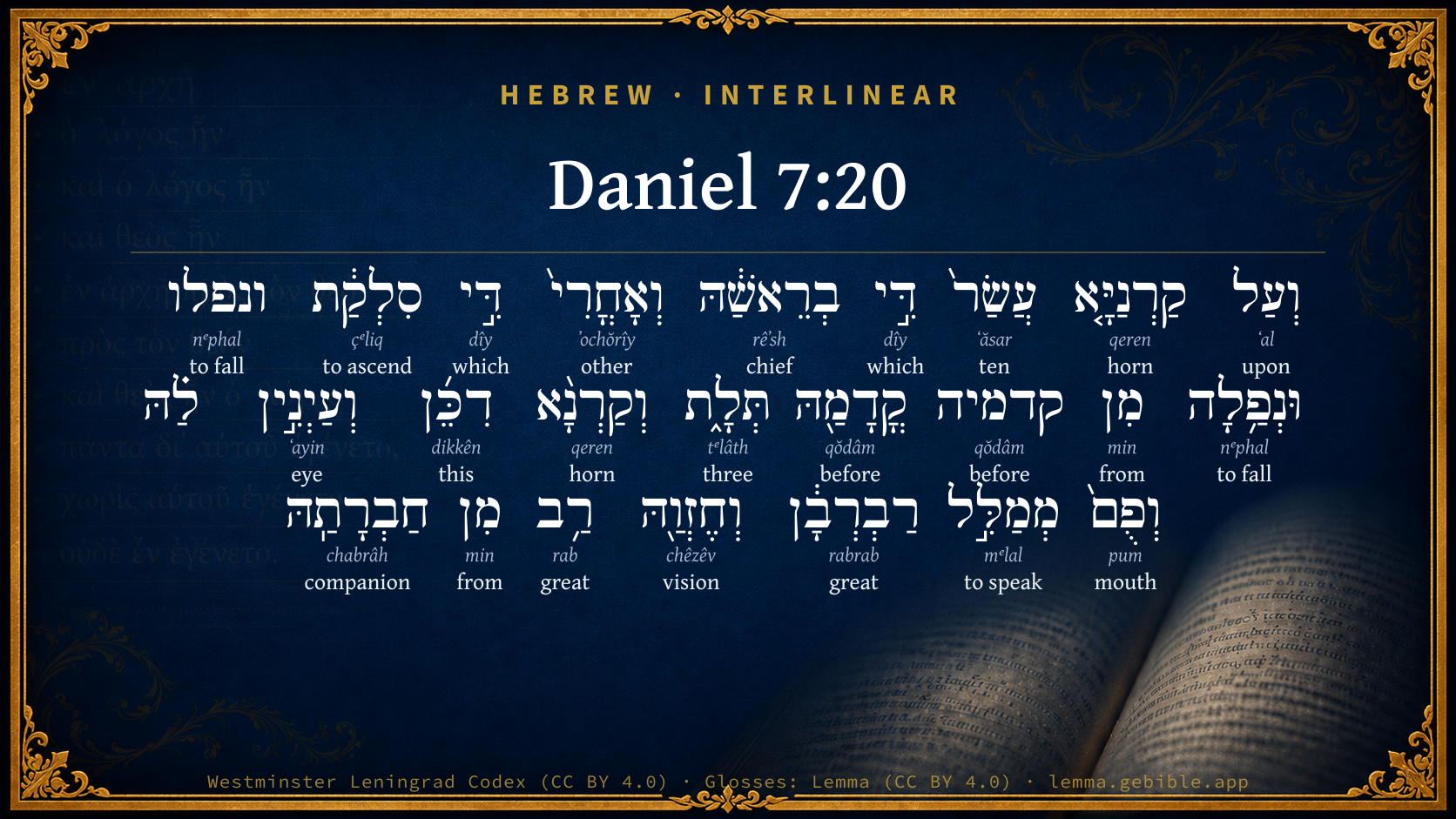
Hebrew (Westminster Leningrad Codex) Daniel 7:20 appears in the Hebrew Old Testament. The text above is from the Westminster Leningrad Codex. Each word links to its Strong’s number, a concise gloss, and parsing drawn from the Open Scriptures Hebrew Bible morphology. Click any word for its full Brown-Driver-Briggs (BDB) entry.
Download image
Cite this verse

Daniel 7:20 (World English Bible). Public Domain. Lemma interlinear Bible study tool, https://lemma.gebible.app/v/daniel/7/20.

Show BibTeX & RIS
BibTeX
RIS
English Translation
and concerning the ten horns that were on its head, and the other [horn] which came up, and before which three fell, even that horn that had eyes, and a mouth that spoke great things, whose look was more stout than its fellows.
World English Bible · Public Domain
Highlights
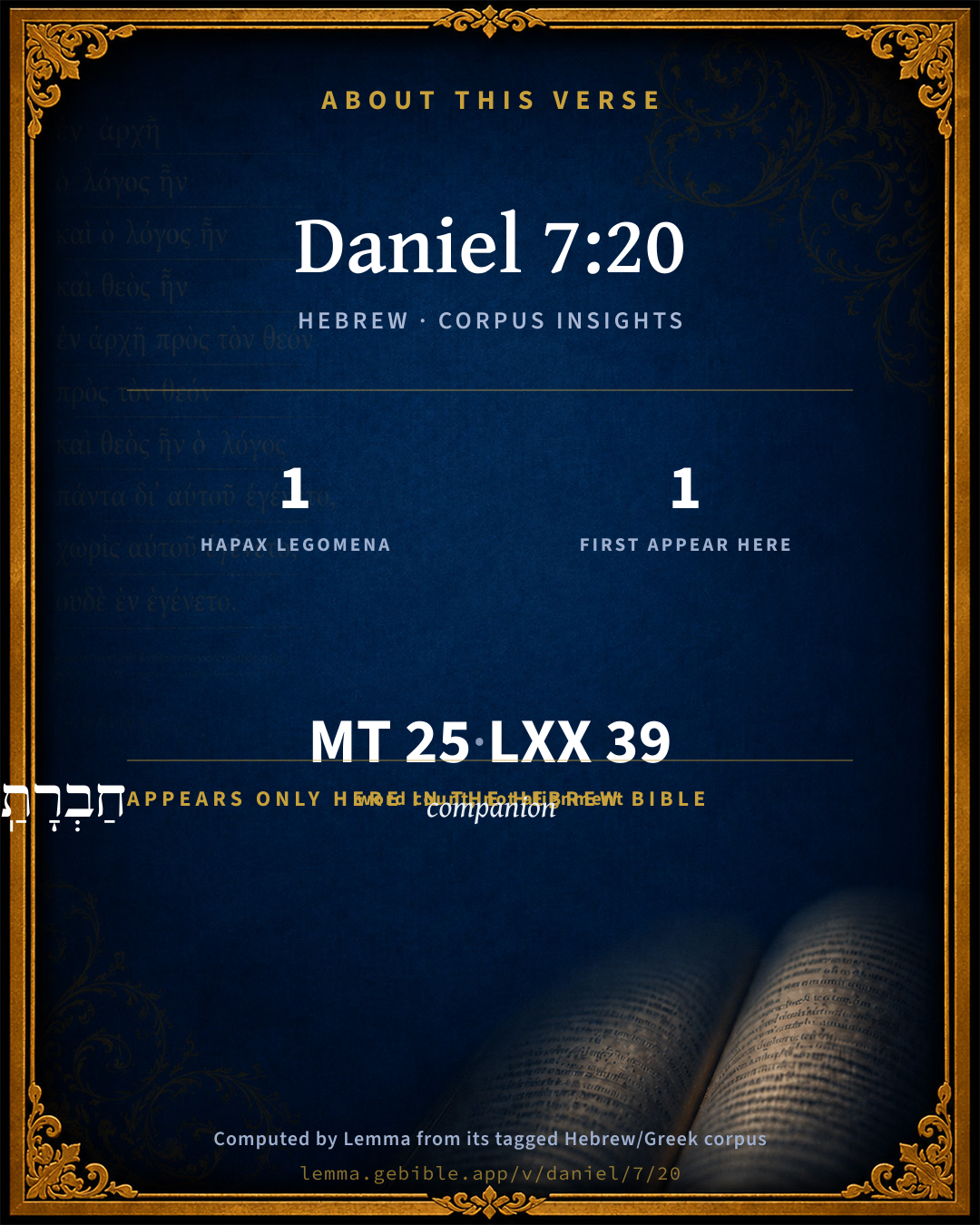
  • 1 hapax legomenon — only here in the Hebrew Bible
  • 1 first appearance in the Hebrew Bible
Full analysis ↓
Download a study sheet

One document with this verse’s original text, its word-by-word gloss line, the meaning frame, cross-references with their text, attributed commentary, and full source and license credits — printable, and it pastes into notes with its structure intact.

This verse Autodidact and up

Study sheet (.html) Plain text (.txt)

A passage Seminary Student

Up to 50 verses in one chapter. A passage sheet keeps up to 6 commentary sources and 12 cross-references per verse, in the order this page ranks them, and says so on the sheet whenever that leaves anything out. Ask for a single verse and you get the Autodidact verse sheet above.

Everything on this page stays free to read, with no account — the sheet is a download of what is already on screen, not access to it.

Want to remove ads? Support Godless Engineer
Compare translations 3

The same verse in 3 English versions, stacked beneath the original-language interlinear above. Click any original word for its lexicon entry.

Each is an independent rendering of the whole verse — the interlinear is not word-aligned to these translations.

Highlighted words mark where these versions differ — a whole-verse word diff, not a word-by-word alignment.

  • World English Bible Public Domain
    and concerning the ten horns that were on its head, and the other [horn] which came up, and before which three fell, even that horn that had eyes, and a mouth that spoke great things, whose look was more stout than its fellows.
  • King James Version Public Domain
    And of the ten horns that were in his head, and of the other which came up, and before whom three fell; even of that horn that had eyes, and a mouth that spake very great things, whose look was more stout than his fellows.
  • unfoldingWord Literal Text CC BY-SA 4.0
    and about the ten horns that were on its head, and the other that came up, and before which three fell down, namely, that horn which had eyes and a mouth speaking great things, and which was greater in appearance than its companions.

unfoldingWord Literal Text — © unfoldingWord, licensed CC BY-SA 4.0. Word-aligned USFM3 via Door43 (git.door43.org/unfoldingWord/en_ult).

Versions to compare (up to 4)

3 of 4 selected

Show all 18 translations

Every available English version of this verse, each an independent rendering of the whole verse.

  • World English Bible Public Domain
    and concerning the ten horns that were on its head, and the other [horn] which came up, and before which three fell, even that horn that had eyes, and a mouth that spoke great things, whose look was more stout than its fellows.
  • Berean Standard Bible Public Domain
    I also wanted to know about the ten horns on its head and the other horn that came up, before which three of them fell—the horn whose appearance was more imposing than the others, with eyes and with a mouth that spoke words of arrogance.
  • Majority Standard Bible Public Domain
    I also wanted to know about the ten horns on its head and the other horn that came up, before which three of them fell—the horn whose appearance was more imposing than the others, with eyes and with a mouth that spoke words of arrogance.
  • King James Version Public Domain
    And of the ten horns that were in his head, and of the other which came up, and before whom three fell; even of that horn that had eyes, and a mouth that spake very great things, whose look was more stout than his fellows.
  • American Standard Version (1901) Public Domain
    and concerning the ten horns that were on its head, and the other `horn' which came up, and before which three fell, even that horn that had eyes, and a mouth that spake great things, whose look was more stout than its fellows.
  • Revised Version (1885) Public Domain
    and concerning the ten horns that were on his head, and the other horn which came up, and before which three fell; even that horn that had eyes, and a mouth that spake great things, whose look was more stout than his fellows.
  • Geneva Bible (1599) Public Domain
    Also to know of the tenne hornes that were in his head, and of the other which came vp, before whome three fell, and of the horne that had eyes, and of the mouth that spake presumptuous thinges, whose looke was more stoute then his fellowes.
  • Douay-Rheims (1899) Public Domain
    And concerning the ten horns that he had on his head: and concerning the other that came up, before which three horns fell: and of that horn that had eyes, and a mouth speaking great things, and was greater than the rest.
  • Young's Literal Translation Public Domain
    and concerning the ten horns that `are' in its heads, and of the other that came up, and before which three have fallen, even of that horn that hath eyes, and a mouth speaking great things, and whose appearance `is' great above its companions.
  • Literal Standard Version CC BY-SA 4.0
    and concerning the ten horns that [are] in its heads, and of the other that came up, and before which three have fallen, even of that horn that has eyes, and a mouth speaking great things, and whose appearance [is] great above its companions.
  • Unlocked Literal Bible CC BY-SA 4.0
    I wanted to know about the ten horns on its head, and about the other horn that grew up, and before which the three horns fell down. I wanted to know about the horn that had eyes and about the mouth that boasted about great things and that seemed greater than its companions.
  • unfoldingWord Literal Text CC BY-SA 4.0
    and about the ten horns that were on its head, and the other that came up, and before which three fell down, namely, that horn which had eyes and a mouth speaking great things, and which was greater in appearance than its companions.
  • Darby Bible Public Domain
    and concerning the ten horns that were in its head, and the other that came up, and before which three fell: even that horn that had eyes, and a mouth speaking great things, and whose look was more imposing than its fellows.
  • World Messianic Bible Public Domain
    and concerning the ten horns that were on its head and the other horn which came up, and before which three fell, even that horn that had eyes and a mouth that spoke arrogantly, whose look was more stout than its fellows.
  • Webster's Bible Public Domain
    And of the ten horns that were in his head, and of the other which came up, and before whom three fell; even of that horn that had eyes, and a mouth that spoke very great things, whose look was more stout than his fellows.
  • Free Bible Version CC BY-SA 4.0
    I also wanted to know about the ten horns on its head, and the other one that came up later, causing three of the other horns to fall. This horn looked more impressive than the others and had eyes and a mouth that made arrogant boasts.
  • Bible in Basic English Public Domain
    And about the ten horns on his head and the other which came up, causing the fall of three; that horn which had eyes, and a mouth saying great things, which seemed to be greater than the other horns.
  • JPS Tanakh (1917) Public Domain
    and concerning the ten horns that were on its head, and the other horn which came up, and before which three fell; even that horn that had eyes, and a mouth that spoke great things, whose appearance was greater than that of its fellows.

Literal Standard Version (2020), Covenant Press — licensed CC BY-SA 4.0. Text via the HelloAO Bible API (eBible.org). Unlocked Literal Bible (unfoldingWord) — licensed CC BY-SA 4.0. Text via the HelloAO Bible API (eBible.org). unfoldingWord Literal Text — © unfoldingWord, licensed CC BY-SA 4.0. Word-aligned USFM3 via Door43 (git.door43.org/unfoldingWord/en_ult). Free Bible Version, Dr. Jonathan Gallagher — licensed CC BY-SA 4.0. Text via the HelloAO Bible API (eBible.org).

Word by word

More ways to search: Search by grammar → Find every occurrence → Compare this word →

Practice this passage: Drill this verse → Learn its vocabulary →

חַבְרָתַֽהּ
chabrâh
H2273
“companions · her”
Adjective, N, Common + Suffix, Personal, 3rd Person, Feminine, Singular
Part of Speech
Adjective
Gender
Common
Full BDB Definition

Origin: from H2269

TWOT: 2717b

associate, fellow, companion
  1. וְעַל ʻal H5922 “and · upon” Adjective, C + Preposition
  2. קַרְנַיָּ֤א qeren H7162 “horns · the” Adjective, N, Common + Particle, Definite Article
  3. עֲשַׂר֙ ʻăsar H6236 “ten” Adjective, A, Common
  4. דִּ֣י dîy H1768 “which” Adjective, T
  5. בְרֵאשַׁ֔הּ rêʼsh H7217 “in/at · chief · her” Adjective, R + Noun, Common, Masculine, Singular, Construct + Suffix, Personal, 3rd Person, Feminine, Singular
  6. וְאָחֳרִי֙ ʼochŏrîy H317 “and · other” Adjective, C + Adjective, Adjective, Feminine, Singular, Absolute
  7. דִּ֣י dîy H1768 “which” Adjective, T
  8. סִלְקַ֔ת çᵉliq H5559 “to ascend” Adjective, V, Plural
  9. ונפלו nᵉphal H5308 “and · to fall” Adjective, C + Verb, Qal, Perfect, 3rd Person, Masculine, Plural
  10. וּנְפַ֥לָה nᵉphal H5308 “and · to fall” Adjective, C + Verb, Qal, Perfect, 3rd Person, Feminine, Plural
  11. מִן min H4481 “from” Adjective, R
  12. קדמיה qŏdâm H6925 “before · her” Adjective, R + Suffix, Personal, 3rd Person, Feminine, Singular
  13. קֳדָמַ֖הּ qŏdâm H6925 “before · her” Adjective, R + Suffix, Personal, 3rd Person, Feminine, Singular
  14. תְּלָ֑ת tᵉlâth H8532 “three” Adjective, A, Common
  15. וְקַרְנָ֨א qeren H7162 “and · horn · the” Adjective, C + Noun, Common, Feminine, Singular, Determined + Particle, Definite Article
  16. דִכֵּ֜ן dikkên H1797 “this” Adjective, P, Construct
  17. וְעַיְנִ֣ין ʻayin H5870 “and · eyes” Adjective, C + Noun, Common, Feminine, Plural, Absolute
  18. וְפֻם֙ pum H6433 “and · mouth” Adjective, C + Noun, Common, Masculine, Singular, Absolute
  19. מְמַלִּ֣ל mᵉlal H4449 “speaking” Adjective, V
  20. רַבְרְבָ֔ן rabrab H7260 “great” Adjective, A
  21. וְחֶזְוַ֖הּ chêzêv H2376 “and · vision · her” Adjective, C + Noun, Common, Masculine, Singular, Construct + Suffix, Personal, 3rd Person, Feminine, Singular
  22. רַ֥ב rab H7229 “great” Adjective, A
  23. מִן min H4481 “from” Adjective, R

About this verse

These counts appear in no published source. They are computed here, from the morphology-tagged text and Lemma’s own curated glosses. What Lemma adds →

25
words
19
distinct lemmas
Prophets
section

Notable vocabulary

1 hapax legomenon — a word that appears only here in the entire Hebrew Bible:

  • חַבְרָתַֽהּ companion H2273

First appearance in Scripture

This word makes its first canonical appearance in the Hebrew Bible here:

  • חַבְרָתַֽהּ companion H2273

Shared distinctive vocabulary

דִכֵּ֜ן this H1797 occurs in 3 verses of the Hebrew Bible. Also found in:

Grammatical profile

  • 2 verbs
  • 4 nouns
  • 16 adjectives
  • 1 preposition
  • 2 particles

Verb forms

  • ונפלו Qal · Perfect
  • וּנְפַ֥לָה Qal · Perfect

Repetition

Words recur within this verse — often emphatic in Hebrew:

  • קַרְנַיָּ֤א horn H7162 ×2
  • ונפלו to fall H5308 ×2
  • קדמיה before H6925 ×2
  • דִּ֣י which H1768 ×2
  • מִן from H4481 ×2

Hebrew & Septuagint length

In English translation the verse runs 43 words from the Hebrew and 40 from the Septuagint (LXX English) — closely comparable.

A rough comparison of the two English renderings, which tokenize alike — not a word-level alignment.

Word counts can differ between the Hebrew and the Greek without any difference in meaning — e.g. the Hebrew direct-object marker אֵת has no separate Greek word, and Greek often adds the article ὁ.

In the original languages it is 25 Hebrew tokens and 39 Greek tokens — but the two are counted differently (Hebrew bundles its prefixes and suffixes into one token; the Greek is in lemma form), so that isn’t a like-for-like length.

Cross-references

5

Topical passages linked to Daniel 7:20 in the Treasury of Scripture Knowledge — connected by theme and wording, ordered by reader-vote popularity; previews shown in the World English Bible.

  • Daniel 7:8 I considered the horns, and, behold, there came up among them another horn, a little one, before which three of the first horns were plucked up by the roots: and, behold, in this horn were eyes like the eyes of a man, and a mouth speaking great things.
  • Daniel 7:23 Thus he said, The fourth animal shall be a fourth kingdom on earth, which shall be diverse from all the kingdoms, and shall devour the whole earth, and shall tread it down, and break it in pieces.
  • Daniel 7:11 I saw at that time because of the voice of the great words which the horn spoke; I saw even until the animal was slain, and its body destroyed, and it was given to be burned with fire.
  • Daniel 8:9–11 Out of one of them came forth a little horn, which grew exceeding great, toward the south, and toward the east, and toward the glorious [land].
  • Daniel 11:36–37 The king shall do according to his will; and he shall exalt himself, and magnify himself above every god, and shall speak marvelous things against the God of gods; and he shall prosper until the indignation be accomplished; for that which is determined shall be done.

Cross-references courtesy of OpenBible.info (CC BY 4.0).

Hebrew and Greek witnesses Masoretic Hebrew ↔ Greek Septuagint

The same verse in the two great witnesses to the Old Testament, shown verse-for-verse.

These are two independent witnesses, not word-aligned to each other, and the Septuagint is shown in lemma (dictionary) form.

Hebrew Daniel 7:20 Masoretic · Westminster Leningrad Codex

וְעַל קַרְנַיָּ֤א עֲשַׂר֙ דִּ֣י בְרֵאשַׁ֔הּ וְאָחֳרִי֙ דִּ֣י סִלְקַ֔ת ונפלו וּנְפַ֥לָה מִן קדמיה קֳדָמַ֖הּ תְּלָ֑ת וְקַרְנָ֨א דִכֵּ֜ן וְעַיְנִ֣ין לַ֗הּ וְפֻם֙ מְמַלִּ֣ל רַבְרְבָ֔ן וְחֶזְוַ֖הּ רַ֥ב מִן חַבְרָתַֽהּ

and concerning the ten horns that were on its head, and the other [horn] which came up, and before which three fell, even that horn that had eyes, and a mouth that spoke great things, whose look was more stout than its fellows.

World English Bible · Public Domain

Greek LXX Daniel 7:20 Septuagint · lemma form

καί περί ὁ δέκα κέρας αὐτός ὁ ἐπί ὁ κεφαλή καί ὁ εἷς ὁ ἄλλος ὁ προςφύω καί ἐκπίπτω διά αὐτός τρεῖς καί ὁ κέρας ἐκεῖνος ἔχω ὀφθαλμός καί στόμα λαλέω μέγας καί ὁ πρόσοψις αὐτός ὑπερφέρω ὁ ἄλλος

and concerning it ten horns that were in its head, and the other that came up, and rooted up some of the former, which had eyes, and a mouth speaking great things, and his look was bolder than the rest.

LXX2012 (modern English Septuagint) · Public Domain

Hebrew: Westminster Leningrad Codex (CC BY 4.0). Greek: Septuagint (public domain); English from LXX2012 (modern English Septuagint) (Public Domain). How the Septuagint differs from the Hebrew →

Commentary

Notes on Daniel 7:20 from classic Christian and Jewish commentators (each source and its license shown beneath its notes). The classic Christian expositions comment on the surrounding passage and are grouped to its opening verse, so a note may address several verses; the Jewish commentaries on the Tanakh (Rashi and others) are per-verse, so they appear only where the commentator wrote on this verse.

Lemma curates 59 commentaries, every one of them public domain or Creative Commons licensed, each selected and text-cleaned for this edition rather than reprinted as found. About our sources →

Trapp's Complete Commentary

John Trapp

Dan 7:20 And of the ten horns that [were] in his head, and [of] the other which came up, and before whom three fell; even [of] that horn that had eyes, and a mouth that spake very great things, whose look [was] more stout than his fellows.

Ver. 20. And of the ten horns.] See Dan 7:7.

And of the other that came up.] See Dan 7:8.

Whose look was more stout than his fellows,] i.e., Than the ten horns. Antichrist exalteth himself above kings, and above all that is august. {2Th 2:4} {See Trapp on "2Th 2:4"}

John Trapp, A Commentary or Exposition upon All the Books of the Old and New Testament (1647–1656) — public domain. Text from a community e-Sword module.

Geneva Bible (1599)

Geneva Bible translators

This is meant of the fourth beast, which was more terrible than the others.

Geneva Bible (1599) marginal notes — public domain. Text via Bolls.life.

Jamieson, Fausset & Brown

Robert Jamieson, A. R. Fausset & David Brown

look . . . more stout than . . . fellows--namely, than that of the other horns.

Jamieson, Fausset & Brown — Commentary Critical and Explanatory on the Whole Bible (1871) — public domain (CC PDM 1.0). Text via the HelloAO Bible API.

John Calvin's Commentaries

He says, therefore, He also inquired about the ten horns which were on the head of the beast, and of the other horn which had arisen, meaning the small one, and concerning the three horns falling from the face of the beast. We have shewn how provinces were denoted by the tell horns, and how the difference between the Roman Empire and other monarchies was pointed out, because there never was one supreme ruler at Rome, except when Syria and Marius exercised their usurped authority — but each for only a short time. Here then the continual state of the Roman Empire is under review, for it was not simply a single animal, as it had ten horns. A finite number is put for an indefinite one. With regard to the little horn, I said it referred to the Caesars, who attracted the whole government of the state to themselves, after depriving the people of their liberty and the senate of their power, while even under their sway some dignity was continued to the senate and some majesty retained by the people. We have explained also how the three horns were broken; that is, how craftily the Caesars infringed upon and diminished the strength of both people and senate. Lastly, we have accounted for this little horn being displayed with human eyes, since the Caesars exercised their dominion with cunning, when they pretended to be only tribunes of the people, and allowed the ensigns of empire to remain in the hands of the consuls; for when they came into the senate, they sat in a lowly situation in curule scats prepared for the tribunes. As, therefore, they tyrannized with such cleverness and cunning, instead of by open violence, they are said to be endowed with the eyes of a man. Then as to the tongue, the sense is the same; for although they always professed the consular power to be supreme in the state, yet they could not restrain themselves, but vomited forth many reproachful speeches. On the one side, we see them remarkable for eyes, and on the other, for the tongue. And its aspect was terrible beyond its companions This seems not to belong peculiarly to the little horn which had arisen among the ten, but rather to the fourth beast. But if any one wishes to understand it of the little horn, I will not contest the point, as it will thus make tolerable sense. But I rather embrace my former opinion, for it is not surprising to find the Prophet after his discourse on the little horn, returning to the beast himself.

John Calvin's Commentaries (1540-1563) — public domain. Text from the Calvin Translation Society English edition (1840s-50s) via the Christian Classics Ethereal Library (ccel.org). Calvin's coverage is partial (roughly two-thirds of the Bible); uncommented books and verses are honest gaps, never fabricated. The 19th-century editor's footnotes and remarks are omitted so the notes are faithfully Calvin's own voice.

The Cambridge Bible for Schools and Colleges

gen. ed. J. J. S. Perowne

20. And concerning the ten horns that were on his head, and the other which came up, and before which, &c.] See Dan_7:8.

even of that horn, &c.] and as regards that horn, it had eyes, &c.

very great things] great things: the expression is exactly the same as in Dan_7:8.

whose look, &c.] whose appearance was greater than (that of) its fellows. The adj. is the usual one for ‘great’ in Aramaic. The horn, though called a ‘little’ one (Dan_7:8), must be supposed to have grown rapidly to a portentous size: cf. esp. Dan_8:9.

The Cambridge Bible for Schools and Colleges (gen. ed. J. J. S. Perowne; Cambridge University Press, 1878–1918) — public domain. Text from a community e-Sword module.

John Gill's Exposition

And of the ten horns,.... That is, Daniel desired to know the truth of the ten horns, or the meaning of them what they signified, and who they pointed at, of which in Dan 7:7, here it is added,

that were in his head; observing the situation of them; thought the horns of a beast could hardly be thought to be elsewhere:

and of the other which came up, and before whom three fell; particularly he was very desirous to know the meaning of a single horn, which rose up among the rest, and before which three of the other horns fell, being plucked up by the roots:

even of that horn that had eyes, and a mouth that spake very great things: See Gill on Dan 7:8,

whose look was more stout than his fellows; than the other beasts, or rather than the other horns; either than his fellow bishops, claiming an authority over them, as being universal bishop; or than the kings and princes of the earth, setting up himself above all that is called god, emperors and kings; taking to himself all power in heaven and in earth; a power to depose kings, and absolve their subjects from allegiance to them, and even over the consciences of men; so that his look is more bold and impudent than others, as well as more fierce and terrible, threatening kings and kingdoms with his bulls, anathemas, and interdicts: or, "whose appearance is greater than his fellows" (i); in pomp and splendour, making a greater show and figure than the kings of the earth, and claiming a superiority over them.

(i) "cujus aspectus", Munster; "et aspectus ejus major sociis suis", Pagninus.

John Gill's Exposition of the Whole Bible (1746–1763) — public domain (CC PDM 1.0). Text via the HelloAO Bible API.

Albert Barnes' Notes on the Bible

And of the ten horns ... - See the notes at Dan 7:7-8.

Whose look was more stout than his fellows - literally, “whose aspect was greater than that of its companions.” This does not mean that its look or aspect was more fierce or severe than that of the others, but that the appearance of the horn was greater - רב rab. In Dan 7:8, this is described as a “little horn;” and to understand this, and reconcile the two, we must suppose that the seer watched this as it grew until it became the largest of the number. Three fell before it, and it outgrew in size all the others until it became the most prominent. This would clearly denote that the kingdom or the authority referred to by this eleventh horn would be more distinct and prominent than either of the others - would become so conspicuous and important as in fact to concentrate and embody all the power of the beast.

Albert Barnes' Notes on the Bible (1834–1885) — public domain. Text from a community e-Sword/MySword module.

Matthew Poole's English Annotations

And of the ten horns; what they meant.

Whose look was more stout than his fellows, i.e. he had more power and more fierceness. This is wont to be interpreted of Antiochus, and the persecuting emperors, because it agrees well to them.

Matthew Poole's English Annotations on the Holy Bible (1683–1685) — public domain. Text from a community e-Sword/MySword module.

Rashi

Rabbi Shlomo Yitzchaki (Rashi)

and [the] three [that] fell before it and three of the first ones fell before it.

and the horn that was like this and that had eyes and the horn that was like this, and had eyes, as is written above.

Rashi on the Tanakh — English translations: “The Judaica Press complete Tanach with Rashi, translated by A. J. Rosenberg” (CC BY 4.0); “Pentateuch with Rashi's commentary by M. Rosenbaum and A.M. Silbermann, 1929-1934” (public domain); “The Metsudah Tanach series, Lakewood, N.J” (CC BY 4.0); and “The Book of Joshua, Metsudah Publications, 1997” (CC BY 4.0). Text via Sefaria.

Lesson kit

Teaching starters — assembled from the data on this page, not authored interpretation. Every prompt links to the verse data it draws on. Edit before teaching.

Daniel, in the Prophets, opens this verse with 25 words (19 distinct Hebrew lemmas). Its most distinctive word is chabrâh (“companion”). A historical commentator’s framing appears above. Read the whole chapter for the surrounding context.

Discussion questions

  1. The word chabrâh carries the sense “companion.” How does it shape the verse?
  2. This verse holds 1 word here found nowhere else in the Hebrew Bible. What might the rare word draw attention to?
  3. The word “companion” first appears here in Scripture. What is being introduced at this debut?
  4. Daniel 2:31 shares the word «this» with this verse. How do the two illuminate each other?
  5. “horn” occurs 2× in this one verse. What is the effect of the repetition?
  6. These translations render this verse differently; the difference is in the English rendering, not the original. What questions does that raise?
  7. The verb «ונפלו» is Qal Perfect. How does its form color the action?
  8. Reading how Trapp's Complete Commentary and Geneva Bible (1599) read this verse, where do the two commentators agree and where do they part?

Things to notice

  • 1 word in this verse appears nowhere else in the Hebrew Bible.
  • 1 word makes its first canonical appearance in Scripture here.
  • This verse counts 25 Hebrew ↔ 39 Greek words.
  • These translations choose different wording for 18 words in this verse.
  • “horn” occurs 2× in this single verse.

Reading settings

Reading text

Shown beneath each verse's original-language words.

Old Testament
Old Testament edition

Read the OT as the Masoretic Hebrew (MT) or the Greek Septuagint (LXX).

English shown for the Greek Septuagint (in the Hebrew ↔ Greek comparison).

Comparing translations? Open the Compare panel on any verse page to stack up to four side by side.