
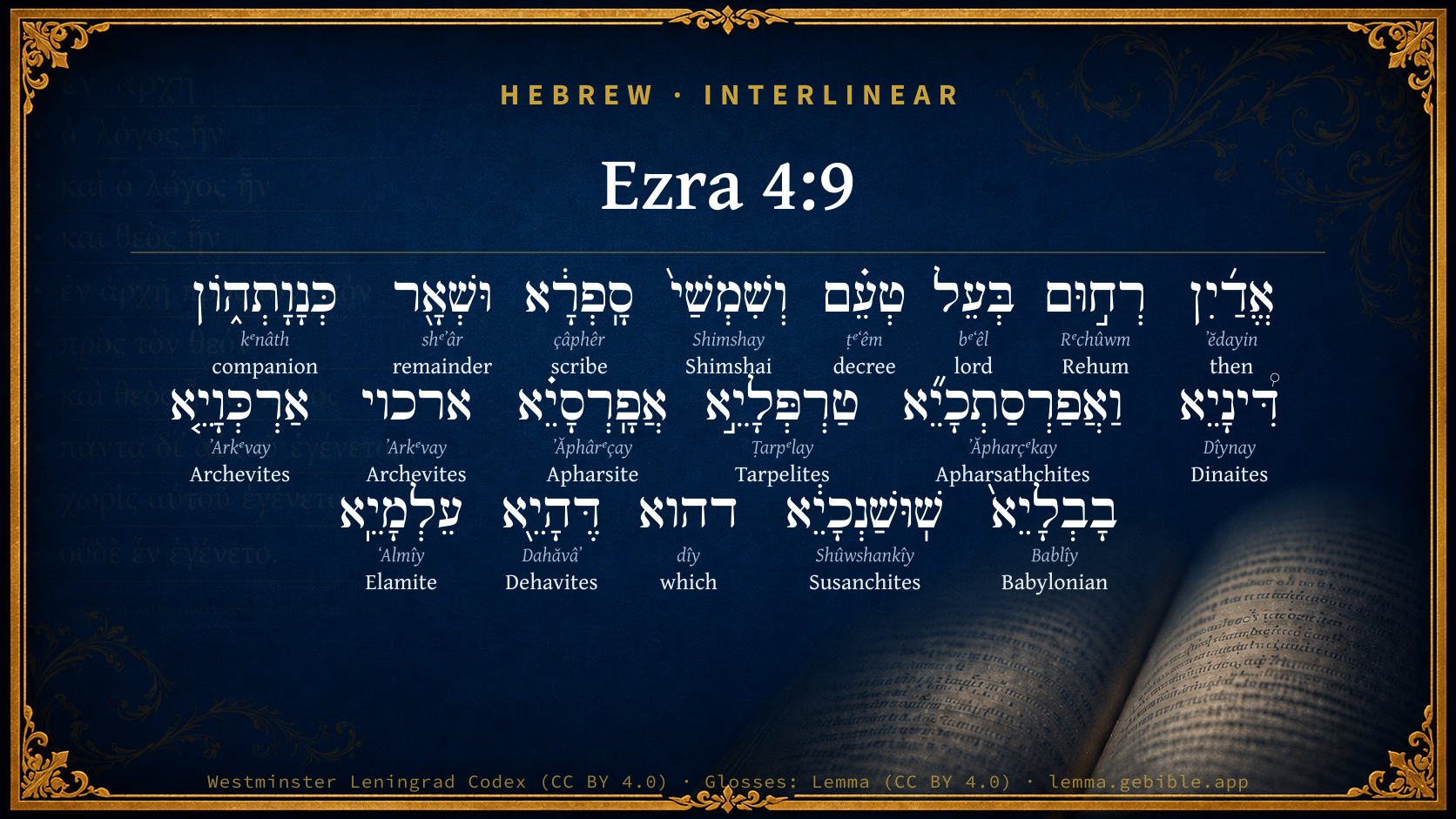
Ezra 4:9

Hebrew (Westminster Leningrad Codex) Ezra 4:9 appears in the Hebrew Old Testament. The text above is from the Westminster Leningrad Codex. Each word links to its Strong’s number, a concise gloss, and parsing drawn from the Open Scriptures Hebrew Bible morphology. Click any word for its full Brown-Driver-Briggs (BDB) entry.
Download image
Cite this verse

Ezra 4:9 (World English Bible). Public Domain. Lemma interlinear Bible study tool, https://lemma.gebible.app/v/ezra/4/9.

Show BibTeX & RIS
BibTeX
RIS
English Translation
then [wrote] Rehum the chancellor, and Shimshai the scribe, and the rest of their companions, the Dinaites, and the Apharsathchites, the Tarpelites, the Apharsites, the Archevites, the Babylonians, the Shushanchites, the Dehaites, the Elamites,
World English Bible · Public Domain
Highlights
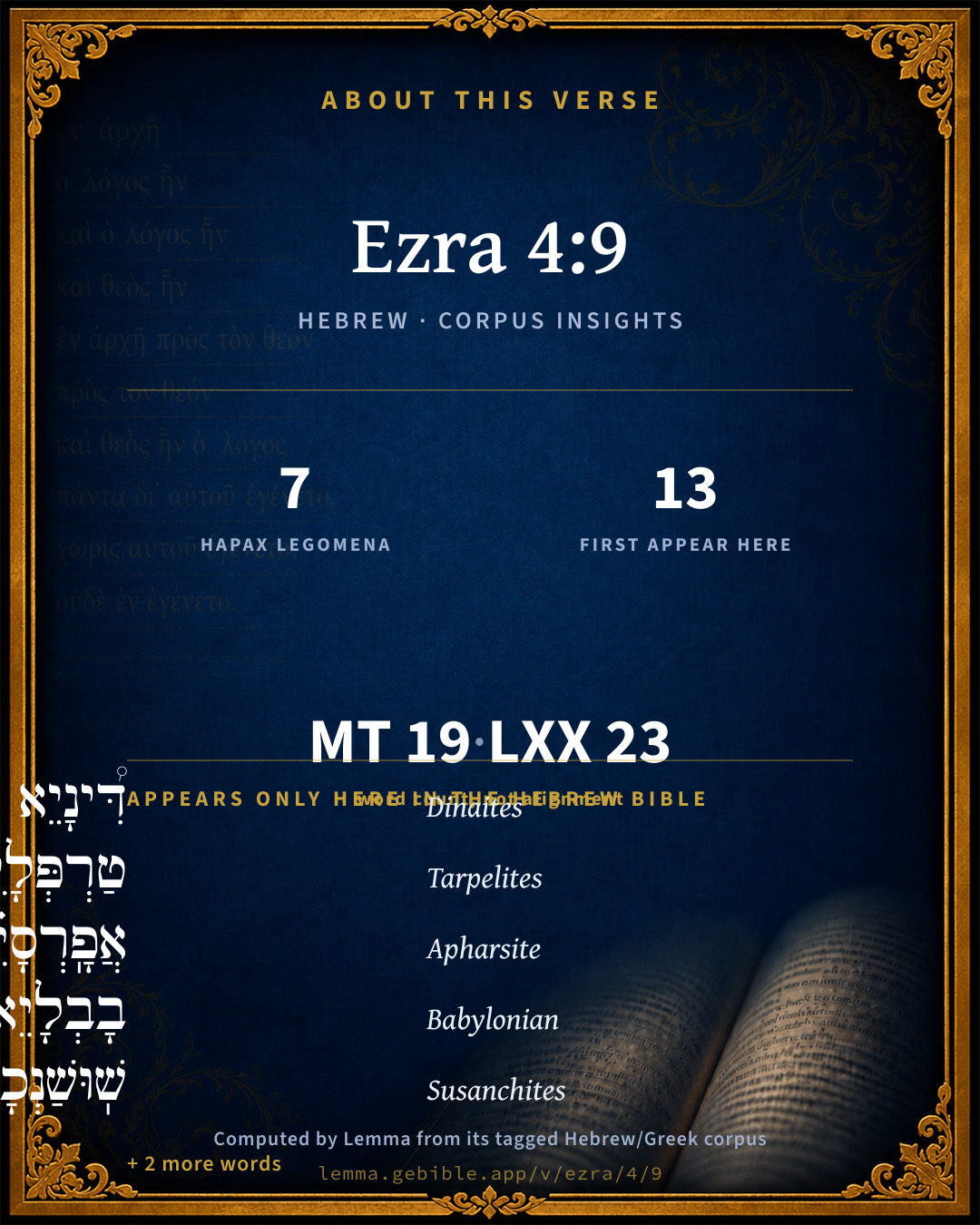
  • 6 hapax legomena — only here in the Hebrew Bible
  • 13 first appearances in the Hebrew Bible
Full analysis ↓
Download a study sheet

One document with this verse’s original text, its word-by-word gloss line, the meaning frame, cross-references with their text, attributed commentary, and full source and license credits — printable, and it pastes into notes with its structure intact.

This verse Autodidact and up

Study sheet (.html) Plain text (.txt)

A passage Seminary Student

Up to 50 verses in one chapter. A passage sheet keeps up to 6 commentary sources and 12 cross-references per verse, in the order this page ranks them, and says so on the sheet whenever that leaves anything out. Ask for a single verse and you get the Autodidact verse sheet above.

Everything on this page stays free to read, with no account — the sheet is a download of what is already on screen, not access to it.

Want to remove ads? Support Godless Engineer
Compare translations 3

The same verse in 3 English versions, stacked beneath the original-language interlinear above. Click any original word for its lexicon entry.

Each is an independent rendering of the whole verse — the interlinear is not word-aligned to these translations.

Highlighted words mark where these versions differ — a whole-verse word diff, not a word-by-word alignment.

  • World English Bible Public Domain
    then [wrote] Rehum the chancellor, and Shimshai the scribe, and the rest of their companions, the Dinaites, and the Apharsathchites, the Tarpelites, the Apharsites, the Archevites, the Babylonians, the Shushanchites, the Dehaites, the Elamites,
  • King James Version Public Domain
    Then wrote Rehum the chancellor, and Shimshai the scribe, and the rest of their companions; the Dinaites, the Apharsathchites, the Tarpelites, the Apharsites, the Archevites, the Babylonians, the Susanchites, the Dehavites, and the Elamites,
  • unfoldingWord Literal Text CC BY-SA 4.0
    Then Rehum, a lord of decree, and Shimshai the scribe, and the rest of their companions, the judges and the rulers, the officials, the Persians, the Erechites, the Babylonians, the Susaites (that is, the Elamites),

unfoldingWord Literal Text — © unfoldingWord, licensed CC BY-SA 4.0. Word-aligned USFM3 via Door43 (git.door43.org/unfoldingWord/en_ult).

Versions to compare (up to 4)

3 of 4 selected

Show all 18 translations

Every available English version of this verse, each an independent rendering of the whole verse.

  • World English Bible Public Domain
    then [wrote] Rehum the chancellor, and Shimshai the scribe, and the rest of their companions, the Dinaites, and the Apharsathchites, the Tarpelites, the Apharsites, the Archevites, the Babylonians, the Shushanchites, the Dehaites, the Elamites,
  • Berean Standard Bible Public Domain
    From Rehum the commander, Shimshai the scribe, and the rest of their associates—the judges and officials over Tripolis, Persia, Erech and Babylon, the Elamites of Susa,
  • Majority Standard Bible Public Domain
    From Rehum the commander, Shimshai the scribe, and the rest of their associates—the judges and officials over Tripolis, Persia, Erech and Babylon, the Elamites of Susa,
  • King James Version Public Domain
    Then wrote Rehum the chancellor, and Shimshai the scribe, and the rest of their companions; the Dinaites, the Apharsathchites, the Tarpelites, the Apharsites, the Archevites, the Babylonians, the Susanchites, the Dehavites, and the Elamites,
  • American Standard Version (1901) Public Domain
    then `wrote' Rehum the chancellor, and Shimshai the scribe, and the rest of their companions, the Dinaites, and the Apharsathchites, the Tarpelites, the Apharsites, the Archevites, the Babylonians, the Shushanchites, the Dehaites, the Elamites,
  • Revised Version (1885) Public Domain
    then wrote Rehum the chancellor, and Shimshai the scribe, and the rest of their companions; the Dinaites, and the Apharsathchites, the Tarpelites, the Apharsites, the Archevites, the Babylonians, the Shushanchites, the Dehaites, the Elamites,
  • Geneva Bible (1599) Public Domain
    Then wrote Rehum the chauncelour, and Shimshai the scribe, and their companions Dinaie, and Apharsathcaie, Tarpelaie, Apharsaie, Archeuaie, Bablaie, Shushanchaie, Dehaue, Elmaie,
  • Douay-Rheims (1899) Public Domain
    Reum Beelteem, and Samsai the scribe and the rest of their counsellors, the Dinites, and the Apharsathacites, the Therphalites, the Apharsites, the Erchuites, the Babylonians, the Susanechites, the Dievites, and the Elamites,
  • Young's Literal Translation Public Domain
    Then Rehum counsellor, and Shimshai scribe, and the rest of their companions, Dinaites, and Apharsathchites, Tarpelites, Apharsites, Archevites, Babylonians, Susanchites, (who are Elamites),
  • Literal Standard Version CC BY-SA 4.0
    Then Rehum counselor, and Shimshai scribe, and the rest of their companions, Dinaites, and Apharsathchites, Tarpelites, Apharsites, Archevites, Babylonians, Susanchites (who are Elamites),
  • Unlocked Literal Bible CC BY-SA 4.0
    Then Rehum, Shimshai, and their companions, who were judges and other officers in the government, the Persians, men from Erech and Babylon, and the men from Susa (that is, the Elamites)—they wrote a letter—
  • unfoldingWord Literal Text CC BY-SA 4.0
    Then Rehum, a lord of decree, and Shimshai the scribe, and the rest of their companions, the judges and the rulers, the officials, the Persians, the Erechites, the Babylonians, the Susaites (that is, the Elamites),
  • Darby Bible Public Domain
    Rehum the chancellor, and Shimshai the scribe, and the rest of their companions, the Dinaites, and the Apharsathchites, the Tarpelites, the Apharsites, the Archevites, the Babylonians, the Shushanchites, the Dehaites, the Elamites,
  • World Messianic Bible Public Domain
    Then Rehum the chancellor, Shimshai the scribe, and the rest of their companions, the Dinaites, and the Apharsathchites, the Tarpelites, the Apharsites, the Archevites, the Babylonians, the Shushanchites, the Dehaites, the Elamites,
  • Webster's Bible Public Domain
    Then wrote Rehum the chancellor, and Shimshai the scribe, and the rest of their companions; the Dianites, the Apharsathchites, the Tarpelites, the Apharsites, the Archevites, the Babylonians, the Susanchites, the Dehavites, and the Elamites,
  • Free Bible Version CC BY-SA 4.0
    This comes from Rehum the officer in command, Shimshai the scribe, and fellow officers: the judges and officials and those in charge of Persia, Erech and Babylon, the Elamites of Susa,
  • Bible in Basic English Public Domain
    The letter was sent by Rehum, the chief ruler, and Shimshai the scribe and their friends; the Dinaites and the Apharsathchites, the Tarpelites, the Apharsites, the Archevites, the Babylonians, the Shushanchites, the Dehaites, the Elamites,
  • JPS Tanakh (1917) Public Domain
    then wrote Rehum the commander, and Shimshai the scribe, and the rest of their companions; the Dinites, and the Apharesattechites, the Tarpelites, the Apharesites, the Archevites, the Babylonians, the Shushanchites, the Dehites, the Elamites,

Literal Standard Version (2020), Covenant Press — licensed CC BY-SA 4.0. Text via the HelloAO Bible API (eBible.org). Unlocked Literal Bible (unfoldingWord) — licensed CC BY-SA 4.0. Text via the HelloAO Bible API (eBible.org). unfoldingWord Literal Text — © unfoldingWord, licensed CC BY-SA 4.0. Word-aligned USFM3 via Door43 (git.door43.org/unfoldingWord/en_ult). Free Bible Version, Dr. Jonathan Gallagher — licensed CC BY-SA 4.0. Text via the HelloAO Bible API (eBible.org).

Word by word

More ways to search: Search by grammar → Find every occurrence → Compare this word →

Practice this passage: Drill this verse → Learn its vocabulary →

דִּ֠ינָיֵא
Dîynay
H1784
“Dinaites · the”
Adjective, N, Common + Particle, Definite Article
Part of Speech
Adjective + Particle
Type
Definite Article
Full BDB Definition

Origin: patrial from an uncertain primitive

TWOT: None

Dinaites = "judgment" - the name of some of the Cuthaean colonists who were placed in the cities of Samaria after the captivity of the ten tribes
  1. אֱדַ֜יִן ʼĕdayin H116 “then” Adjective, D
  2. רְח֣וּם Rᵉchûwm H7348 “Rehum” Adjective, N
  3. בְּעֵל bᵉʻêl H1169 “lord of” Adjective, N, Common
  4. טְעֵ֗ם ṭᵉʻêm H2942 “decree” Adjective, N, Common
  5. וְשִׁמְשַׁי֙ Shimshay H8124 “and · Shimshai” Adjective, C + Noun, Proper
  6. סָֽפְרָ֔א çâphêr H5613 “scribe · the” Adjective, N, Common + Particle, Definite Article
  7. וּשְׁאָ֖ר shᵉʼâr H7606 “and · remainder of” Adjective, C + Noun, Common, Masculine, Singular, Construct
  8. כְּנָוָתְה֑וֹן kᵉnâth H3675 “companions · their” Adjective, N, Common + Suffix, Personal, 3rd Person, Masculine, Plural
  9. וַאֲפַרְסַתְכָיֵ֞א ʼĂpharçᵉkay H671 “and · Apharsathchites · the” Adjective, C + Noun, Common, Masculine, Plural, Determined + Particle, Definite Article
  10. טַרְפְּלָיֵ֣א Ṭarpᵉlay H2967 “Tarpelites · the” Adjective, N, Common + Particle, Definite Article
  11. אֲפָֽרְסָיֵ֗א ʼĂphârᵉçay H670 “Apharsites · the” Adjective, N + Particle, Definite Article
  12. ארכוי ʼArkᵉvay H756 “Archevites” Adjective, N
  13. אַרְכְּוָיֵ֤א ʼArkᵉvay H756 “Archevites · the” Adjective, N + Particle, Definite Article
  14. בָבְלָיֵא֙ Bablîy H896 “Babylonians · the” Adjective, N + Particle, Definite Article
  15. שֽׁוּשַׁנְכָיֵ֔א Shûwshankîy H7801 “Susanchites · the” Adjective, N + Particle, Definite Article
  16. דהוא dîy H1768 “which” Adjective, T + Particle, Accusative
  17. דֶּהָיֵ֖א Dahăvâʼ H1723 “Dehavites · the” Adjective, N + Particle, Definite Article
  18. עֵלְמָיֵֽא ʻAlmîy H5962 “Elamites · the” Adjective, N + Particle, Definite Article

About this verse

These counts appear in no published source. They are computed here, from the morphology-tagged text and Lemma’s own curated glosses. What Lemma adds →

19
words
18
distinct lemmas
Historical
section

Notable vocabulary

7 hapax legomena — words that appear only here in the entire Hebrew Bible:

  • דִּ֠ינָיֵא Dinaites H1784
  • טַרְפְּלָיֵ֣א Tarpelites H2967
  • אֲפָֽרְסָיֵ֗א Apharsite H670
  • בָבְלָיֵא֙ Babylonian H896
  • שֽׁוּשַׁנְכָיֵ֔א Susanchites H7801
  • דֶּהָיֵ֖א Dehavites H1723

First appearance in Scripture

These words make their first canonical appearance in the Hebrew Bible here (13 in total — showing 8):

  • אֱדַ֜יִן then H116
  • וּשְׁאָ֖ר remainder H7606
  • כְּנָוָתְה֑וֹן companion H3675
  • דִּ֠ינָיֵא Dinaites H1784
  • וַאֲפַרְסַתְכָיֵ֞א Apharsathchites H671
  • טַרְפְּלָיֵ֣א Tarpelites H2967
  • אֲפָֽרְסָיֵ֗א Apharsite H670
  • ארכוי Archevites H756

Grammatical profile

  • 2 nouns
  • 6 adjectives
  • 11 particles

Repetition

A word recurs within this verse — often emphatic in Hebrew:

  • ארכוי Archevites H756 ×2

Hebrew & Septuagint length

In English translation the verse runs 34 words from the Hebrew and 31 from the Septuagint (LXX English) — closely comparable.

A rough comparison of the two English renderings, which tokenize alike — not a word-level alignment.

Word counts can differ between the Hebrew and the Greek without any difference in meaning — e.g. the Hebrew direct-object marker אֵת has no separate Greek word, and Greek often adds the article ὁ.

In the original languages it is 19 Hebrew tokens and 23 Greek tokens — but the two are counted differently (Hebrew bundles its prefixes and suffixes into one token; the Greek is in lemma form), so that isn’t a like-for-like length.

Cross-references

13

Topical passages linked to Ezra 4:9 in the Treasury of Scripture Knowledge — connected by theme and wording, ordered by reader-vote popularity; previews shown in the World English Bible.

  • Ezra 5:6 The copy of the letter that Tattenai, the governor beyond the River, and Shetharbozenai, and his companions the Apharsachites, who were beyond the River, sent to Darius the king;
  • Ezra 6:6 Now therefore, Tattenai, governor beyond the River, Shetharbozenai, and your companions the Apharsachites, who are beyond the River, be you far from there:
  • 2 Kings 17:24 The king of Assyria brought men from Babylon, and from Cuthah, and from Avva, and from Hamath and Sepharvaim, and placed them in the cities of Samaria instead of the children of Israel; and they possessed Samaria, and lived in the cities of it.
  • 2 Kings 17:30–31 The men of Babylon made Succoth-benoth, and the men of Cuth made Nergal, and the men of Hamath made Ashima,
  • Genesis 10:22 The sons of Shem: Elam, Asshur, Arpachshad, Lud, and Aram.
  • Esther 1:2 that in those days, when the king Ahasuerus sat on the throne of his kingdom, which was in Shushan the palace,
  • Esther 2:3 and let the king appoint officers in all the provinces of his kingdom, that they may gather together all the beautiful young virgins to Shushan the palace, to the house of the women, to the custody of Hegai the king's chamberlain, keeper of the women; and let their things for purification be given them;
  • Isaiah 21:2 A grievous vision is declared to me; the treacherous man deals treacherously, and the destroyer destroys. Go up, Elam; besiege, Media; all the sighing of it have I made to cease.
  • Jeremiah 25:25 and all the kings of Zimri, and all the kings of Elam, and all the kings of the Medes;
  • Jeremiah 49:34 The word of Yahweh that came to Jeremiah the prophet concerning Elam, in the beginning of the reign of Zedekiah king of Judah, saying,
  • Ezekiel 32:24 There is Elam and all her multitude round about her grave; all of them slain, fallen by the sword, who are gone down uncircumcised into the lower parts of the earth, who caused their terror in the land of the living, and have borne their shame with those who go down to the pit.
  • Daniel 8:2 I saw in the vision; now it was so, that when I saw, I was in Shushan the palace, which is in the province of Elam; and I saw in the vision, and I was by the river Ulai.
  • Acts 2:9 Parthians, Medes, Elamites, and people from Mesopotamia, Judea, Cappadocia, Pontus, Asia,

Cross-references courtesy of OpenBible.info (CC BY 4.0).

Hebrew and Greek witnesses Masoretic Hebrew ↔ Greek Septuagint

The same verse in the two great witnesses to the Old Testament, shown verse-for-verse.

These are two independent witnesses, not word-aligned to each other, and the Septuagint is shown in lemma (dictionary) form.

Hebrew Ezra 4:9 Masoretic · Westminster Leningrad Codex

אֱדַ֜יִן רְח֣וּם בְּעֵל טְעֵ֗ם וְשִׁמְשַׁי֙ סָֽפְרָ֔א וּשְׁאָ֖ר כְּנָוָתְה֑וֹן דִּ֠ינָיֵא וַאֲפַרְסַתְכָיֵ֞א טַרְפְּלָיֵ֣א אֲפָֽרְסָיֵ֗א ארכוי אַרְכְּוָיֵ֤א בָבְלָיֵא֙ שֽׁוּשַׁנְכָיֵ֔א דהוא דֶּהָיֵ֖א עֵלְמָיֵֽא

then [wrote] Rehum the chancellor, and Shimshai the scribe, and the rest of their companions, the Dinaites, and the Apharsathchites, the Tarpelites, the Apharsites, the Archevites, the Babylonians, the Shushanchites, the Dehaites, the Elamites,

World English Bible · Public Domain

Greek LXX Ezra 4:9 Septuagint · lemma form

ὅδε κρίνω ραουμ βααλταμ καί σαμσαι ὁ γραμματεύς καί ὁ κατάλοιπος σύνδουλος ἐγώ διναῖοι αφαρσαθαχαῖοι ταρφαλλαῖοι αφαρσαῖοι αρχυαῖοι βαβυλώνιος σουσαναχαῖοι ὅς εἰμί ηλαμαῖοι

Thus has judged Reum the chancellor, and Sampsa the scribe, and the rest of our fellow-servants, the Dinaeans, the Apharsathachaeans, the Tarphalaeans, the Apharsaeans, the Archyaeans, the Babylonians, the Susanachaeans, Davaeans,

LXX2012 (modern English Septuagint) · Public Domain

In the Septuagint this is one book — Esdras B (2 Esdras): Ezra is chapters 1–10, Nehemiah 11–23.

On this verse, Haydock's Catholic Bible Commentary discusses the Septuagint’s reading. Read the note in Commentary ↓

Hebrew: Westminster Leningrad Codex (CC BY 4.0). Greek: Septuagint (public domain); English from LXX2012 (modern English Septuagint) (Public Domain). How the Septuagint differs from the Hebrew →

Commentary

Notes on Ezra 4:9 from classic Christian and Jewish commentators (each source and its license shown beneath its notes). The classic Christian expositions comment on the surrounding passage and are grouped to its opening verse, so a note may address several verses; the Jewish commentaries on the Tanakh (Rashi and others) are per-verse, so they appear only where the commentator wrote on this verse.

Lemma curates 59 commentaries, every one of them public domain or Creative Commons licensed, each selected and text-cleaned for this edition rather than reprinted as found. About our sources →

The Cambridge Bible for Schools and Colleges

gen. ed. J. J. S. Perowne

9. then wrote &c.] Although Ezr_4:8 ends with ‘in this sort’, the actual copy of the letter is not given until Ezr_4:11. Ezr_4:9-10 describe more minutely the senders, whose names were perhaps attached to the letter.

Nine of the nationalities from which the Samaritan colonists had been drawn are here mentioned by name; and the existence of many other varieties is implied in Ezr_4:10.

Scholars have been able approximately to identify the names.

the Dinaites] are probably the ‘Dayani’, a tribe mentioned in the inscriptions of Tiglath-pilesar and other Assyrian kings as inhabiting Western Armenia. If this identification be correct, it illustrates the very different sources from which Samaria had been colonised.

the Apharsathchites] These have not yet been recognized with any certainty in the inscriptions. Rawlinson identifies with the Apharsachites (Ezr_5:6, Ezr_6:6) and considers the ‘Apharsites’, the second name below, to be an accidental repetition of the same word. He understands ‘the Persians’ to be meant in each case. Other scholars deny that any Assyrian king was ever in a position to have obtained colonists from Persia. Frid. Delitzsch suggests the inhabitants of one of the two great Median towns ‘Partakka’ and ‘Partukka’ mentioned in Esarhaddon’s inscriptions.

the Tarpelites] Rawlinson identifies with ‘Tuplai’, which name appears in the Inscriptions as equivalent to the Greek τιβαρηνοί, a tribe on the coast of Pontus.

Tripolis in Northern Phoenicia is suggested by another scholar (Hitzig).

the Apharsites] See above. Identified probably with a Median tribe mentioned in the inscriptions of Sennacherib as dwellers in the district of Parsua.

the Archevites] The dwellers in Warka, a town S.E. of Babylon, the same as Erech (Gen_10:10).

the Babylonians] i.e. dwellers in Babylon,—in Esarhaddon’s days the capital of the subject province of Babylonia, Nineveh being the capital of the Empire. Possibly inhabitants expelled for insurrection.

the Susanchites] The dwellers in Susa, one of the capitals of the Persian Empire, mentioned in Neh_1:1, Dan_8:2, and Esther, the chief town of Elam.

the Dehavites] Rawlinson identifies with the Dai (? Daghestan), a Persian tribe mentioned by Herodotus (i. 125); Frid. Delitzsch, with the dwellers in the town called ‘Du-ua’ mentioned in an Assyrian inscription (747 b.c.).

the Elamites] dwellers in Elam, ‘the Highlands’ or Elymais, the country lying E. of Babylonia, having Persia on its eastern, Media on its northern frontier.

The Cambridge Bible for Schools and Colleges (gen. ed. J. J. S. Perowne; Cambridge University Press, 1878–1918) — public domain. Text from a community e-Sword module.

Trapp's Complete Commentary

John Trapp

Ezr 4:9 Then [wrote] Rehum the chancellor, and Shimshai the scribe, and the rest of their companions; the Dinaites, the Apharsathchites, the Tarpelites, the Apharsites, the Archevites, the Babylonians, the Susanchites, the Dehavites, [and] the Elamites,

Ver. 9. The Dinaites, the Apharsathchites, the Tarpelites] This was not unity, but conspiracy, of a rabble of rebels against God and his people. So Psa 83:5-6, &c., "They have consulted together with one consent: they are confederate against thee: the tabernacles of Edom, and the Ishmaelites; of Moab, and the Hagarenes," &c. A whole legion of devils could agree to enter into one poor man, to vex him; and to act as one in that possession.

John Trapp, A Commentary or Exposition upon All the Books of the Old and New Testament (1647–1656) — public domain. Text from a community e-Sword module.

Tyndale Open Study Notes

Tyndale Open Resources

4:9 Adding greetings from an assortment of key political figures and local ethnic leaders would give credibility to the letter’s accusations and ensure that the message would have maximum political weight. • Judges were trusted court officials who knew the Persian laws. • Having the support of people from the Mesopotamian cities of Babylon and Erech and the Persian city of Susa would make the case against the Jews more persuasive.

Tyndale Open Study Notes — © Tyndale Open Resources, licensed CC BY-SA 4.0. Text via the HelloAO Bible API.

Geneva Bible (1599)

Geneva Bible translators

These were certain people which the Assyrians placed in Samaria instead of the ten tribes.

Geneva Bible (1599) marginal notes — public domain. Text via Bolls.life.

Jamieson, Fausset & Brown

Robert Jamieson, A. R. Fausset & David Brown

the Dinaites--The people named were the colonists sent by the Babylonian monarch to occupy the territory of the ten tribes. "The great and noble Asnappar" was Esar-haddon. Immediately after the murder of Sennacherib, the Babylonians, Medes, Armenians, and other tributary people seized the opportunity of throwing off the Assyrian yoke. But Esar-haddon having, in the thirtieth year of his reign, recovered Babylon and subdued the other rebellious dependents, transported numbers of them into the waste cities of Samaria, most probably as a punishment of their revolt [HALES].

Jamieson, Fausset & Brown — Commentary Critical and Explanatory on the Whole Bible (1871) — public domain (CC PDM 1.0). Text via the HelloAO Bible API.

Ellicott's Commentary for English Readers

(9) Then wrote . . .—This verse and the following give the general superscription of the letter which the Persian officials wrote for the Samaritans: introduced, however, in a very peculiar manner, and to be followed by another introduction in Ezr_4:11. Of the names by which the Samaritans think fit to distinguish themselves the Apharsites and Dehavites are Persians; the Babylonians the original races of Babylon, Cuthah and Ava (2Ki_17:24); the Susanchites are from Susa; the Apharsathchites, probably the Pharathia-kites, a predatory people of Media; the Archevites, inhabitants of Erech (Gen_10:10). The Dinaites and Tarpelites can be only conjecturally identified.

A Bible Commentary for English Readers, edited by Charles John Ellicott (1878–1897) — public domain. Text from a community e-Sword module.

John Gill's Exposition

And the rest of the nations whom the great and noble Asnappar brought over,.... The river Euphrates:

and set in the cities of Samaria; placed there in the room of the Israelites carried captive; this Asnappar was, according to Jarchi and others (l) Sennacherib; but, with Grotius, Shalmaneser; rather he was Esarhaddon, the son of the former, and grandson of the latter; so Dr. Prideaux (m); though he might be only some commander of the Assyrian monarch, who carried them over by his orders:

and the rest that are on this side the river; the river Euphrates:

and at such a time; which may respect the date of the letter, which, no doubt, was expressed, though not here given; or this, as some think, was the same with our &c. something following, unto King Artaxerxes greeting, or something like that; though David de Pomis (n) takes it to be the general name of the people beyond the river.

(l) Kimchi Sepher Shorash. fol. 166. 2. & Vajikra Rabba in ib. T. Bab. Sanhedrin, fol. 94. 1. (m) Connexion, &c. vol. 1. p. 30. (n) Tzemach David, fol. 63. 3.

John Gill's Exposition of the Whole Bible (1746–1763) — public domain (CC PDM 1.0). Text via the HelloAO Bible API.

Albert Barnes' Notes on the Bible

These verses form the superscription or address of the letter (Ezr 4:11, etc.) sent to Artaxerxes.

The Dinaites were probably colonists from Dayan, a country often mentioned in the Assyrian inscriptions as bordering on Cilicia and Cappadocia. No satisfactory explanation can be given of the name Apharsathchites (see Ezr 5:6 note). The Tarpelites were colonists from the nation which the Assyrians called Tuplai, the Greeks “Tibareni,” and the Hebrews generally “Tubal.” (It is characteristic of the later Hebrew language to insert the letter “r” (resh) before labials. Compare Darmesek for Dammesek, 2Ch 28:23 margin). The Apharsites were probably “the Persians;” the Archevites, natives of Erech (Warka) Gen 10:10; the Susanchites, colonists from Shushan or Susa; the Dehavites, colonists from the Persian tribe of the Dai; and the Elamites, colonists from Elam or Elymais, the country of which Susa was the capital.

Ezr 4:10

A snapper was perhaps the official employed by Esar-haddon Ezr 4:2 to settle the colonists in their new country.

On this side the river - literally, “beyond the river,” a phrase used of Palestine by Ezra, Nehemiah, and in the Book of Kings, as designating the region west of the Euphrates.

And at such a time - Rather, “and so forth.” The phrase is vague, nearly equivalent to the modern use of et cetaera. It recurs in marginal references.

Albert Barnes' Notes on the Bible (1834–1885) — public domain. Text from a community e-Sword/MySword module.

Haydock's Catholic Bible Commentary

Counsellors. Septuagint and Syriac, "of our fellow-servants." Chaldean, "colleagues." This letter, and as far as chap. vi. 16, is in the Chaldean language. --- Dinites, perhaps the Denarenians. (Junius) (4 Kings xvii. 24.) (Calmet)

George Leo Haydock (1774–1849), Haydock's Catholic Family Bible and Commentary, 1859 edition — public domain. Excludes Psalms (Douay-Rheims chapter numbering differs from Protestant) and Deuterocanonical books (Catholic canon only).

Matthew Poole's English Annotations

Several people thus called from the several places of that vast Assyrian empire, from whence they were fetched, and who were united together into one body, and sent as one colony by the Assyrian monarchs into these parts.

Matthew Poole's English Annotations on the Holy Bible (1683–1685) — public domain. Text from a community e-Sword/MySword module.

Whedon's Commentary on the Bible

Daniel D. Whedon

9. Of the names here given to the colonists according to the various cities or provinces of the Assyrian empire, the Dinaites, Apharsathchites, Tarpelites, and Apharsites are otherwise unknown. The various conjectures as to their origin are not worth recording. The Archevites were, perhaps, from the Babylonian city Erech. Gen_10:10. The Babylonians were undoubtedly either from the city or province of Babylon. Compare 2Ki_17:24. The Susanchites were evidently from Susa or Shushan, which became the metropolis of the Persian empire, (Neh_1:1; Est_1:2,) but was originally the capital of the land of Elam. The Dehavites are generally thought to be identical with the Davi or Dahi of Herodotus, Strabo, and other classic writers, a Persian nomadic tribe, “whose name,” says Rawlinson, (Herod., i, p. 338,) “is equivalent to the Latin ‘Rustici,’ and who were spread over the whole country from the Caspian to the Persian Gulf and the Tigris.” The Elamites were natives of the province of which Shushan was the capital, (Dan_8:2,) and which was originally settled by the descendants of Shem. Gen_10:22.

Daniel D. Whedon (gen. ed.), Commentary on the Old and New Testaments (1874–1909) — public domain. Text from a community e-Sword module.

The Pulpit Commentary

The Dinaites, etc. It is curious that the Samaritans, instead of using a general appellation, describe themselves under the names of the various nations and cities which had furnished the colonists of whom they were the descendants. It would seem that they were not yet, in the time of the Pseudo-Smerdis, amalgamated into a single people. From the list of names we may gather that the colonists of Esar-haddon"s time had been derived chiefly from Southern Babylonia and the adjacent regions of Susiana, Persia, and Elymais. The Babylonians, Susanchites, and Elamites speak for themselves, and require no explanation. The Archevites are the people of Ereeh or Orchoe (now Warka), a city to the south-east of Babylon. The Apharsites are no doubt Persians; the Dehavites, Dai or Dahae, a tribe located in Persia Proper ("Herod.," 1:125). If uncertainty attaches to any of the names, it is to two only the Dinaites and the Tarpelites. Of these, the Dinaites are probably the people of Dayan, a country bordering on Cilicia, whose inhabitants are often mentioned by the Assyrian monarchs. The Tarpelites have been regarded as the people of Tripolis; but it is improbable that that city had as yet received its Greek name. Perhaps they are the Tuplai, or people of Tubal, mentioned in Scripture and the Assyrian inscriptions, the letter r being an euphonic addition, as in Darmesek for Dammesek sharbith for shebeth, and the like.

The Pulpit Commentary (1880–1919), ed. H.D.M. Spence-Jones & Joseph S. Exell — public domain. Text from a community e-Sword module.

unfoldingWord translationNotes

Door43 World Missions Community

Erech ... Susa

names of cities (See: How to Translate Names)

Ashurbanipal

This is a name of a man. (See: How to Translate Names)

the Province Beyond the River

This is the name of the province that was west of the Euphrates River. It was across the river from the city of Susa. (See: How to Translate Names)

translationWords

Babylon

Elam

Samaria

unfoldingWord translationNotes — © Distant Shores Media and the Door43 World Missions Community, licensed CC BY-SA 4.0. Source: git.door43.org/Door43/en_tn.

Rashi

Rabbi Shlomo Yitzchaki (Rashi)

Then Aram. אֱדַיִן, equivalent to the Hebrew אָז.

Rehum the name of a man.

the secretary Aram. בְּעֵל טְעֵם secretary and master of words.

the Dinites, the Apharesattechites, etc. All these are names of nations whom Sennacherib repatriated in the cities of Samaria.

the Apharesites They are the Persians whom Sennacherib settled in the cities of Samaria.

the Archevites They are the people of Erech, as it says (Gen. 10:10): “and Erech and Accad and Calneh.”

the Babylonians the people of Babylon.

the Shushanchites the people of Shushan, the capital.

the Elamites the people of Elam. Sennacherib settled all of these peoples in the land of Israel, and all of them were settling and concurring with the commission of this letter.

Rashi on the Tanakh — English translations: “The Judaica Press complete Tanach with Rashi, translated by A. J. Rosenberg” (CC BY 4.0); “Pentateuch with Rashi's commentary by M. Rosenbaum and A.M. Silbermann, 1929-1934” (public domain); “The Metsudah Tanach series, Lakewood, N.J” (CC BY 4.0); and “The Book of Joshua, Metsudah Publications, 1997” (CC BY 4.0). Text via Sefaria.

Lesson kit

Teaching starters — assembled from the data on this page, not authored interpretation. Every prompt links to the verse data it draws on. Edit before teaching.

Ezra, in the Historical, opens this verse with 19 words (18 distinct Hebrew lemmas). Its most distinctive word is Dîynay (“Dinaites”). A historical commentator’s framing appears above. Read the whole chapter for the surrounding context.

Discussion questions

  1. How does “Dinaites” (Dîynay) shape what this verse is saying?
  2. 7 words here appear nowhere else in the Hebrew Bible. Why might the author reach for such rare wording?
  3. 13 words make their first appearance in Scripture here. What does this debut establish?
  4. How does Ezra 5:6, which shares this passage’s theme, read alongside this verse?
  5. What does the repetition of “Archevites” (2× in this one verse) do in this verse?
  6. These translations render this verse differently. What is at stake in choosing one wording over another?
  7. Compare how The Cambridge Bible for Schools and Colleges and Trapp's Complete Commentary read this verse. Where do they agree or differ?

Things to notice

  • 7 words in this verse appear nowhere else in the Hebrew Bible.
  • 13 words make their first canonical appearance in Scripture here.
  • This verse counts 19 Hebrew ↔ 23 Greek words.
  • These translations choose different wording for 19 words in this verse.
  • “Archevites” occurs 2× in this single verse.

Reading settings

Reading text

Shown beneath each verse's original-language words.

Old Testament
Old Testament edition

Read the OT as the Masoretic Hebrew (MT) or the Greek Septuagint (LXX).

English shown for the Greek Septuagint (in the Hebrew ↔ Greek comparison).

Comparing translations? Open the Compare panel on any verse page to stack up to four side by side.