
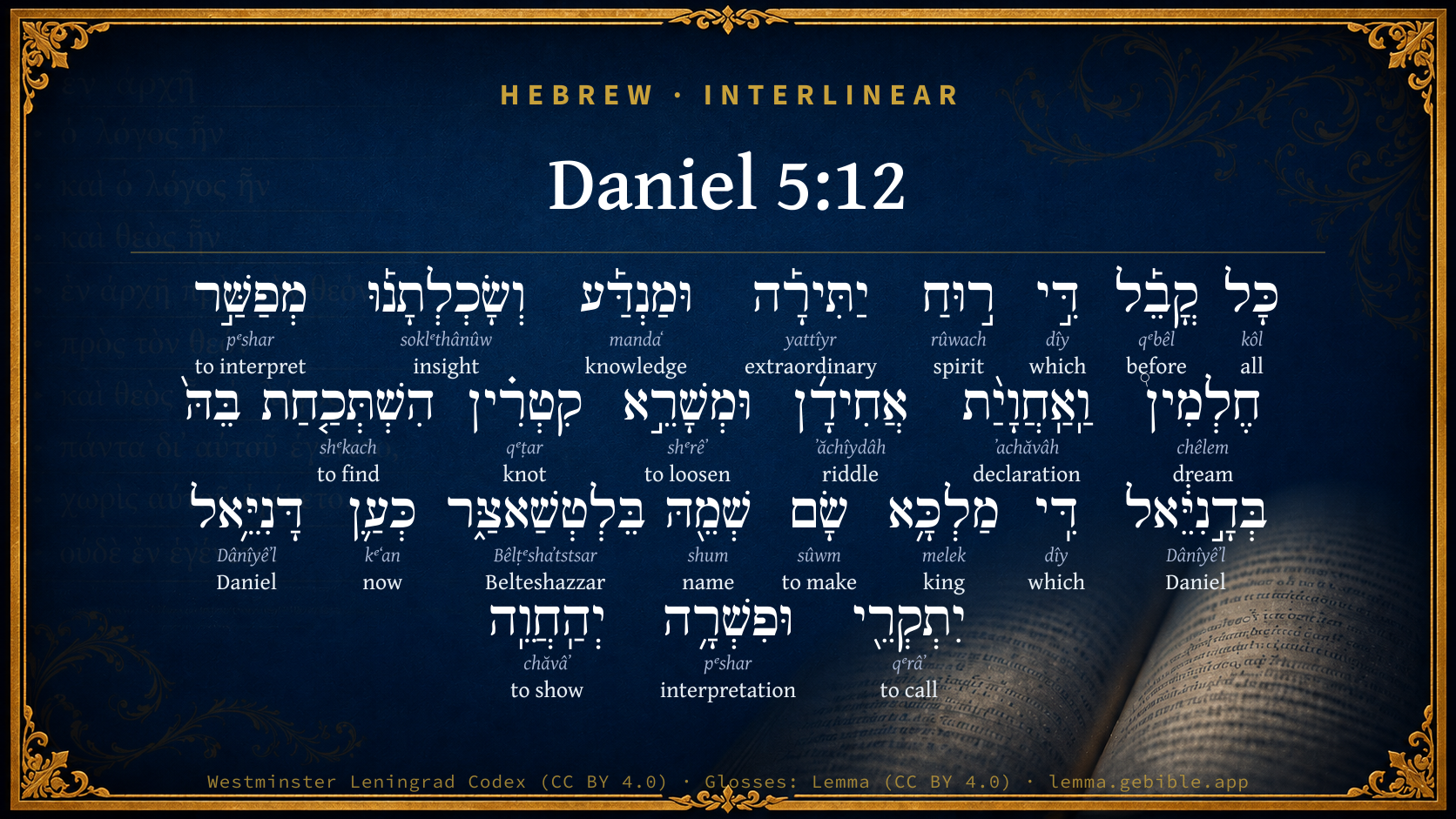
Daniel 5:12

Hebrew (Westminster Leningrad Codex) Daniel 5:12 appears in the Hebrew Old Testament. The text above is from the Westminster Leningrad Codex. Each word links to its Strong’s number, a concise gloss, and parsing drawn from the Open Scriptures Hebrew Bible morphology. Click any word for its full Brown-Driver-Briggs (BDB) entry.
Download image
Cite this verse

Daniel 5:12 (World English Bible). Public Domain. Lemma interlinear Bible study tool, https://lemma.gebible.app/v/daniel/5/12.

Show BibTeX & RIS
BibTeX
RIS
English Translation
because an excellent spirit, and knowledge, and understanding, interpreting of dreams, and showing of dark sentences, and dissolving of doubts, were found in the same Daniel, whom the king named Belteshazzar. Now let Daniel be called, and he will show the interpretation.
World English Bible · Public Domain
Highlights
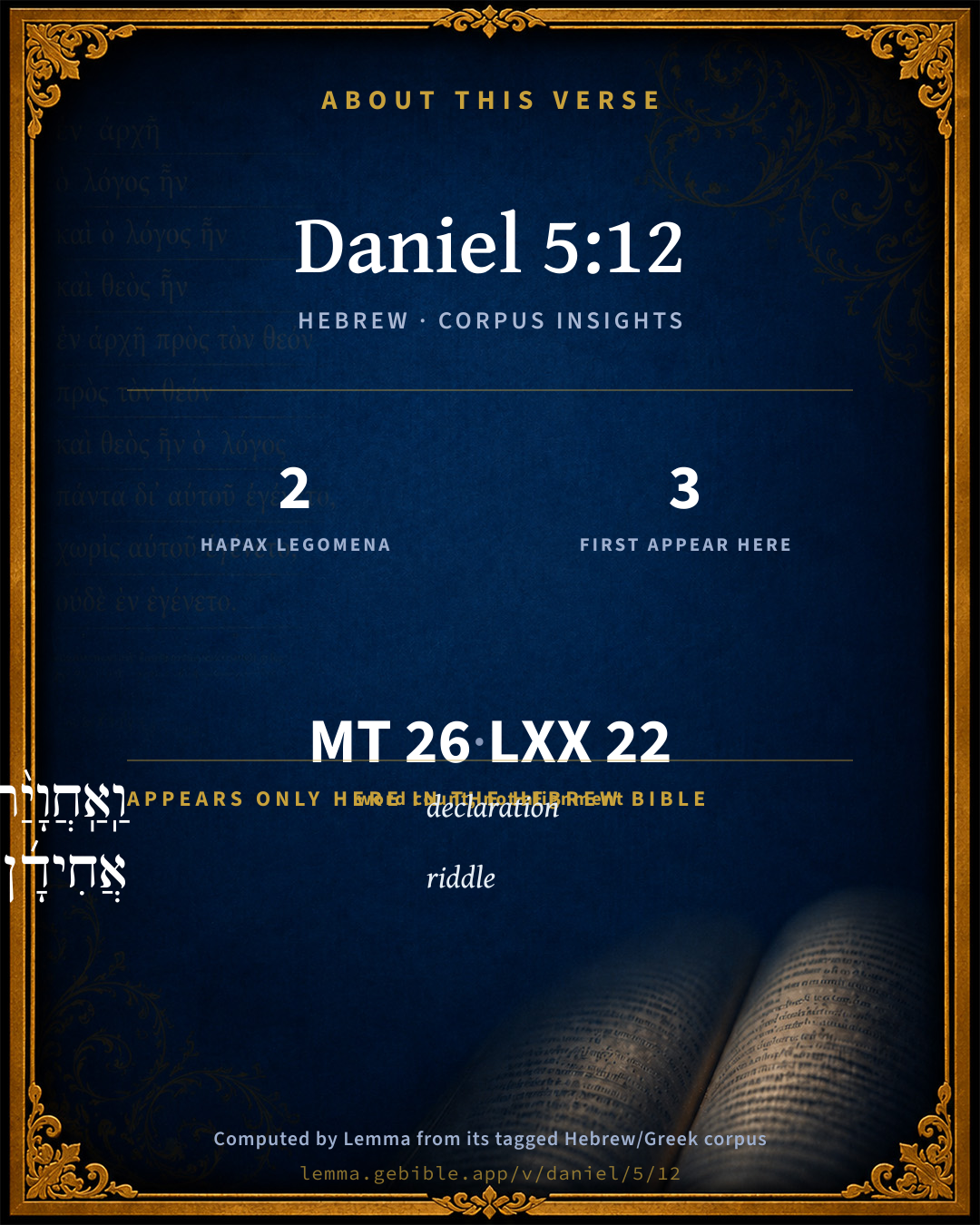
  • 2 hapax legomena — only here in the Hebrew Bible
  • 3 first appearances in the Hebrew Bible
Full analysis ↓
Download a study sheet

One document with this verse’s original text, its word-by-word gloss line, the meaning frame, cross-references with their text, attributed commentary, and full source and license credits — printable, and it pastes into notes with its structure intact.

This verse Autodidact and up

Study sheet (.html) Plain text (.txt)

A passage Seminary Student

Up to 50 verses in one chapter. A passage sheet keeps up to 6 commentary sources and 12 cross-references per verse, in the order this page ranks them, and says so on the sheet whenever that leaves anything out. Ask for a single verse and you get the Autodidact verse sheet above.

Everything on this page stays free to read, with no account — the sheet is a download of what is already on screen, not access to it.

Want to remove ads? Support Godless Engineer
Compare translations 3

The same verse in 3 English versions, stacked beneath the original-language interlinear above. Click any original word for its lexicon entry.

Each is an independent rendering of the whole verse — the interlinear is not word-aligned to these translations.

Highlighted words mark where these versions differ — a whole-verse word diff, not a word-by-word alignment.

  • World English Bible Public Domain
    because an excellent spirit, and knowledge, and understanding, interpreting of dreams, and showing of dark sentences, and dissolving of doubts, were found in the same Daniel, whom the king named Belteshazzar. Now let Daniel be called, and he will show the interpretation.
  • King James Version Public Domain
    Forasmuch as an excellent spirit, and knowledge, and understanding, interpreting of dreams, and shewing of hard sentences, and dissolving of doubts, were found in the same Daniel, whom the king named Belteshazzar: now let Daniel be called, and he will shew the interpretation.
  • unfoldingWord Literal Text CC BY-SA 4.0
    because an excellent spirit, knowledge, and insight for interpreting dreams, explaining riddles and solving problems were found in this Daniel, whom the king named Belteshazzar. Now let Daniel be called and he will show the interpretation.”

unfoldingWord Literal Text — © unfoldingWord, licensed CC BY-SA 4.0. Word-aligned USFM3 via Door43 (git.door43.org/unfoldingWord/en_ult).

Versions to compare (up to 4)

3 of 4 selected

Show all 18 translations

Every available English version of this verse, each an independent rendering of the whole verse.

  • World English Bible Public Domain
    because an excellent spirit, and knowledge, and understanding, interpreting of dreams, and showing of dark sentences, and dissolving of doubts, were found in the same Daniel, whom the king named Belteshazzar. Now let Daniel be called, and he will show the interpretation.
  • Berean Standard Bible Public Domain
    did this because Daniel, the one he named Belteshazzar, was found to have an extraordinary spirit, as well as knowledge, understanding, and the ability to interpret dreams, explain riddles, and solve difficult problems. Summon Daniel, therefore, and he will give you the interpretation.”
  • Majority Standard Bible Public Domain
    did this because Daniel, the one he named Belteshazzar, was found to have an extraordinary spirit, as well as knowledge, understanding, and the ability to interpret dreams, explain riddles, and solve difficult problems. Summon Daniel, therefore, and he will give you the interpretation.”
  • King James Version Public Domain
    Forasmuch as an excellent spirit, and knowledge, and understanding, interpreting of dreams, and shewing of hard sentences, and dissolving of doubts, were found in the same Daniel, whom the king named Belteshazzar: now let Daniel be called, and he will shew the interpretation.
  • American Standard Version (1901) Public Domain
    forasmuch as an excellent spirit, and knowledge, and understanding, interpreting of dreams, and showing of dark sentences, and dissolving of doubts, were found in the same Daniel, whom the king named Belteshazzar. Now let Daniel be called, and he will show the interpretation.
  • Revised Version (1885) Public Domain
    forasmuch as an excellent spirit, and knowledge, and understanding, interpreting of dreams, and shewing of dark sentences, and dissolving of doubts, were found in the same Daniel, whom the king named Belteshazzar. Now let Daniel be called, and he will shew the interpretation.
  • Geneva Bible (1599) Public Domain
    Because a more excellent spirit, and knowledge, and vnderstanding (for hee did expound dreames, and declare hard sentences, and dissolued doubtes) were founde in him, euen in Daniel, whome the King named Belteshazzar: nowe let Daniel be called, and hee will declare the interpretation.
  • Douay-Rheims (1899) Public Domain
    Because a greater spirit, and knowledge, and understanding, and interpretation of dreams, and shewing of secrets, and resolving of difficult things, were found in him, that is, in Daniel: whom the king named Baltarsar. Now therefore let Daniel be called for, and he will tell the interpretation.
  • Young's Literal Translation Public Domain
    because that an excellent spirit, and knowledge, and understanding, interpreting of dreams, and showing of enigmas, and loosing of knots was found in him, in Daniel, whose name the king made Belteshazzar: now let Daniel be called, and the interpretation he doth show.'
  • Literal Standard Version CC BY-SA 4.0
    because that an excellent spirit, and knowledge, and understanding, interpreting of dreams, and showing of enigmas, and loosing of knots was found in him, in Daniel, whose name the king made Belteshazzar: now let Daniel be called, and the interpretation he shows.”
  • Unlocked Literal Bible CC BY-SA 4.0
    An excellent spirit, knowledge, understanding, interpreting of dreams, explaining riddles and solving problems—these qualities were found in this man Daniel, whom the king named Belteshazzar. Now call for Daniel and he will tell you the meaning of what has been written.”
  • unfoldingWord Literal Text CC BY-SA 4.0
    because an excellent spirit, knowledge, and insight for interpreting dreams, explaining riddles and solving problems were found in this Daniel, whom the king named Belteshazzar. Now let Daniel be called and he will show the interpretation.”
  • Darby Bible Public Domain
    forasmuch as an excellent spirit, and knowledge, and understanding, interpreting of dreams, and shewing of hard sentences, and solving of problems, were found in the same Daniel, whom the king named Belteshazzar. Now let Daniel be called, and he will shew the interpretation.
  • World Messianic Bible Public Domain
    because an excellent spirit, knowledge, understanding, interpreting of dreams, showing of dark sentences, and dissolving of doubts were found in the same Daniel, whom the king named Belteshazzar. Now let Daniel be called, and he will show the interpretation.”
  • Webster's Bible Public Domain
    Forasmuch as an excellent spirit, and knowledge, and understanding, the interpreting of dreams, and showing of hard sentences, and dissolving of doubts, were found in the same Daniel, whom the king named Belteshazzar: now let Daniel be called, and he will show the interpretation.
  • Free Bible Version CC BY-SA 4.0
    because Daniel (called Belteshazzar by the king) was found to have an excellent mind, full of understanding and insight, and also able to interpret dreams, explain mysteries, and solve difficult problems. Call Daniel in and let him explain what this means to you.”
  • Bible in Basic English Public Domain
    Because a most special spirit, and knowledge and reason and the power of reading dreams and unfolding dark sayings and answering hard questions, were seen to be in him, even in Daniel (named Belteshazzar by the king): now let Daniel be sent for, and he will make clear the sense of the writing.
  • JPS Tanakh (1917) Public Domain
    forasmuch as a surpassing spirit, and knowledge, and understanding, interpreting of dreams, and declaring of riddles, and loosing of knots, were found in the same Daniel, whom the king named Belteshazzar. Now let Daniel be called, and he will declare the interpretation.'

Literal Standard Version (2020), Covenant Press — licensed CC BY-SA 4.0. Text via the HelloAO Bible API (eBible.org). Unlocked Literal Bible (unfoldingWord) — licensed CC BY-SA 4.0. Text via the HelloAO Bible API (eBible.org). unfoldingWord Literal Text — © unfoldingWord, licensed CC BY-SA 4.0. Word-aligned USFM3 via Door43 (git.door43.org/unfoldingWord/en_ult). Free Bible Version, Dr. Jonathan Gallagher — licensed CC BY-SA 4.0. Text via the HelloAO Bible API (eBible.org).

Word by word

More ways to search: Search by grammar → Find every occurrence → Compare this word →

Practice this passage: Drill this verse → Learn its vocabulary →

וַֽאַֽחֲוָיַ֨ת
ʼachăvâh
H263
“and · declaration”
Adjective, C + Verb, Hiphil, Infinitive Construct
Part of Speech
Adjective + Verb
Stem
Hiphil
Form
Infinitive Construct
Full BDB Definition

Origin: corresponding to H262

TWOT: 2722a

declaration, a declaring
  1. כָּל kôl H3606 “all” Adjective, C + Conjunction
  2. קֳבֵ֡ל qᵉbêl H6903 “before” Adjective, C
  3. דִּ֣י dîy H1768 “which” Adjective, C
  4. ר֣וּחַ rûwach H7308 “spirit” Adjective, N, Common
  5. יַתִּירָ֡ה yattîyr H3493 “extraordinary” Adjective, A
  6. וּמַנְדַּ֡ע mandaʻ H4486 “and · knowledge” Adjective, C + Noun, Common, Masculine, Singular, Absolute
  7. וְשָׂכְלְתָנ֡וּ soklᵉthânûw H7924 “and · insight” Adjective, C + Noun, Common, Feminine, Singular, Absolute
  8. מְפַשַּׁ֣ר pᵉshar H6590 “interpreting” Adjective, V
  9. חֶלְמִין֩ chêlem H2493 “dreams” Adjective, N, Common
  10. אֲחִידָ֜ן ʼăchîydâh H280 “riddles” Adjective, N, Common
  11. וּמְשָׁרֵ֣א shᵉrêʼ H8271 “and · loosening” Adjective, C + Verb, Piel, Participle Active, Masculine, Plural, Construct
  12. קִטְרִ֗ין qᵉṭar H7001 “knots” Adjective, N, Common
  13. הִשְׁתְּכַ֤חַת shᵉkach H7912 “to find” Adjective, V, Plural
  14. בְּדָ֣נִיֵּ֔אל Dânîyêʼl H1841 “in/at · Daniel” Adjective, R + Noun, Proper
  15. דִּֽי dîy H1768 “which” Adjective, T
  16. מַלְכָּ֥א melek H4430 “king · the” Adjective, N, Common + Particle, Definite Article
  17. שָׂם sûwm H7761 “to make” Adjective, V, Plural
  18. שְׁמֵ֖הּ shum H8036 “name · his” Adjective, N, Common + Suffix, Personal, 3rd Person, Masculine, Singular
  19. בֵּלְטְשַׁאצַּ֑ר Bêlṭᵉshaʼtstsar H1096 “Belteshazzar” Adjective, N
  20. כְּעַ֛ן kᵉʻan H3705 “now” Adjective, D
  21. דָּנִיֵּ֥אל Dânîyêʼl H1841 “Daniel” Adjective, N
  22. יִתְקְרֵ֖י qᵉrâʼ H7123 “to call” Adjective, V
  23. וּפִשְׁרָ֥ה pᵉshar H6591 “and · interpretation · the” Adjective, C + Noun, Common, Masculine, Singular, Determined + Particle, Definite Article
  24. יְהַֽחֲוֵֽה chăvâʼ H2324 “to show” Adjective, V

About this verse

These counts appear in no published source. They are computed here, from the morphology-tagged text and Lemma’s own curated glosses. What Lemma adds →

26
words
23
distinct lemmas
Prophets
section

Notable vocabulary

2 hapax legomena — words that appear only here in the entire Hebrew Bible:

  • וַֽאַֽחֲוָיַ֨ת declaration H263
  • אֲחִידָ֜ן riddle H280

First appearance in Scripture

These words make their first canonical appearance in the Hebrew Bible here:

  • מְפַשַּׁ֣ר to interpret H6590
  • וַֽאַֽחֲוָיַ֨ת declaration H263
  • אֲחִידָ֜ן riddle H280

Shared distinctive vocabulary

מְפַשַּׁ֣ר to interpret H6590 occurs in 2 verses of the Hebrew Bible. Also found in:

Grammatical profile

  • 2 verbs
  • 3 nouns
  • 18 adjectives
  • 1 conjunction
  • 2 particles

Verb forms

  • וַֽאַֽחֲוָיַ֨ת Hiphil · Infinitive Construct
  • וּמְשָׁרֵ֣א Piel · Participle Active

Repetition

Words recur within this verse — often emphatic in Hebrew:

  • בְּדָ֣נִיֵּ֔אל Daniel H1841 ×2
  • דִּ֣י which H1768 ×2

Hebrew & Septuagint length

In English translation the verse runs 42 words from the Hebrew and 54 from the Septuagint (LXX English) — closely comparable.

A rough comparison of the two English renderings, which tokenize alike — not a word-level alignment.

Word counts can differ between the Hebrew and the Greek without any difference in meaning — e.g. the Hebrew direct-object marker אֵת has no separate Greek word, and Greek often adds the article ὁ.

In the original languages it is 26 Hebrew tokens and 22 Greek tokens — but the two are counted differently (Hebrew bundles its prefixes and suffixes into one token; the Greek is in lemma form), so that isn’t a like-for-like length.

Cross-references

12

Topical passages linked to Daniel 5:12 in the Treasury of Scripture Knowledge — connected by theme and wording, ordered by reader-vote popularity; previews shown in the World English Bible.

  • Daniel 5:14 I have heard of you, that the spirit of the gods is in you, and that light and understanding and excellent wisdom are found in you.
  • Daniel 6:3 Then this Daniel was distinguished above the presidents and the satraps, because an excellent spirit was in him; and the king thought to set him over the whole realm.
  • Daniel 1:7 The prince of the eunuchs gave names to them: to Daniel he gave [the name of] Belteshazzar; and to Hananiah, [of] Shadrach; and to Mishael, [of] Meshach; and to Azariah, [of] Abednego.
  • Proverbs 12:26 A righteous person is cautious in friendship, But the way of the wicked leads them astray.
  • Daniel 5:16 But I have heard of you, that you can give interpretations, and dissolve doubts; now if you can read the writing, and make known to me the interpretation of it, you shall be clothed with purple, and have a chain of gold about your neck, and shall be the third ruler in the kingdom.
  • Psalms 16:3 As for the saints who are in the earth, They are the excellent ones in whom is all my delight.
  • Daniel 4:8 But at the last Daniel came in before me, whose name was Belteshazzar, according to the name of my god, and in whom is the spirit of the holy gods: and I told the dream before him, [saying],
  • 2 Chronicles 9:1–2 When the queen of Sheba heard of the fame of Solomon, she came to prove Solomon with hard questions at Jerusalem, with a very great train, and camels that bore spices, and gold in abundance, and precious stones: and when she was come to Solomon, she talked with him of all that was in her heart.
  • Proverbs 17:27 He who spares his words has knowledge. He who is even tempered is a man of understanding.
  • 1 Kings 10:1–3 When the queen of Sheba heard of the fame of Solomon concerning the name of Yahweh, she came to prove him with hard questions.
  • Daniel 4:19 Then Daniel, whose name was Belteshazzar, was stricken mute for a while, and his thoughts troubled him. The king answered, Belteshazzar, don't let the dream, or the interpretation, trouble you. Belteshazzar answered, My lord, the dream be to those who hate you, and the interpretation of it to your adversaries.
  • Colossians 1:29 for which I also labor, striving according to his working, which works in me mightily.

Cross-references courtesy of OpenBible.info (CC BY 4.0).

Hebrew and Greek witnesses Masoretic Hebrew ↔ Greek Septuagint

The same verse in the two great witnesses to the Old Testament, shown verse-for-verse.

These are two independent witnesses, not word-aligned to each other, and the Septuagint is shown in lemma (dictionary) form.

Hebrew Daniel 5:12 Masoretic · Westminster Leningrad Codex

כָּל קֳבֵ֡ל דִּ֣י ר֣וּחַ יַתִּירָ֡ה וּמַנְדַּ֡ע וְשָׂכְלְתָנ֡וּ מְפַשַּׁ֣ר חֶלְמִין֩ וַֽאַֽחֲוָיַ֨ת אֲחִידָ֜ן וּמְשָׁרֵ֣א קִטְרִ֗ין הִשְׁתְּכַ֤חַת בֵּהּ֙ בְּדָ֣נִיֵּ֔אל דִּֽי מַלְכָּ֥א שָׂם שְׁמֵ֖הּ בֵּלְטְשַׁאצַּ֑ר כְּעַ֛ן דָּנִיֵּ֥אל יִתְקְרֵ֖י וּפִשְׁרָ֥ה יְהַֽחֲוֵֽה

because an excellent spirit, and knowledge, and understanding, interpreting of dreams, and showing of dark sentences, and dissolving of doubts, were found in the same Daniel, whom the king named Belteshazzar. Now let Daniel be called, and he will show the interpretation.

World English Bible · Public Domain

Greek LXX Daniel 5:12 Septuagint · lemma form

καί πνεῦμα ἅγιος ἐν αὐτός εἰμί καί ἐν ὁ ἡμέρα ὁ πατήρ σύ ὁ βασιλεύς σύγκριμα ὑπέρογκος ὑποδεικνύω ναβουχοδονοσορ ὁ πατήρ σύ

For there is an excellent spirit in him, and sense and understanding in him, interpreting dreams as he does, and answering hard questions, and solving difficulties: it is Daniel, and the king gave him the name of Baltasar: now then let him be called, and he shall tell you the interpretation of the writing.

LXX2012 (modern English Septuagint) · Public Domain

Hebrew: Westminster Leningrad Codex (CC BY 4.0). Greek: Septuagint (public domain); English from LXX2012 (modern English Septuagint) (Public Domain). How the Septuagint differs from the Hebrew →

Commentary

Notes on Daniel 5:12 from classic Christian and Jewish commentators (each source and its license shown beneath its notes). The classic Christian expositions comment on the surrounding passage and are grouped to its opening verse, so a note may address several verses; the Jewish commentaries on the Tanakh (Rashi and others) are per-verse, so they appear only where the commentator wrote on this verse.

Lemma curates 59 commentaries, every one of them public domain or Creative Commons licensed, each selected and text-cleaned for this edition rather than reprinted as found. About our sources →

Trapp's Complete Commentary

John Trapp

Dan 5:12 Forasmuch as an excellent spirit, and knowledge, and understanding, interpreting of dreams, and shewing of hard sentences, and dissolving of doubts, were found in the same Daniel, whom the king named Belteshazzar: now let Daniel be called, and he will shew the interpretation.

Ver. 12. Forasmuch as an excellent spirit, &c.] Very excellent is the grace of the Spirit in godly hearts, {Col 1:29} neither can natural conscience do less than stoop and strike sail to the image of God in whomsoever.

And dissolving of doubts.] Chald., Knots; that is, perplexed and obscure speeches and sentences.

Now let Daniel be called.] Who will not obtrude himself, nor, like the marigold, open and shut with the sun; but, as the violet, which grows low and hangs the head downward, hiding itself also with its own leaves, so Daniel, were it not that the fragrant smell of his many virtues betrayed him to the world, would choose to live and die in his self-contenting secrecy.

John Trapp, A Commentary or Exposition upon All the Books of the Old and New Testament (1647–1656) — public domain. Text from a community e-Sword module.

Ibn Ezra

Rabbi Abraham ibn Ezra

[Daniel 5:12] To explain riddles (וְאַֽחֲוָיַ֨ת אֲחִידָ֜ן - v'achawayat achidan) [and solve problems (וּמְשָׁרֵ֣א קִטְרִ֗ין - u'm'share kitrin)]: [This means] telling [the meaning of] riddles (מַגִּיד חִידוֹת - maggid chidot) and untying knots (וּמַתִּיר קְשׁוּרִים - u'matir k'shurim).

Ibn Ezra on the Tanakh — English translations: “Sefaria Community Translation” (CC0 1.0 (public-domain dedication)); “Yalkut, Sifsei Chachomim Chumash, Metsudah Publications, 2009” (CC BY 4.0); and “Commentary of Ibn Ezra on Isaiah - trans. by M. Friedlander, 1873” (public domain). Text via Sefaria.

John Calvin's Commentaries

The queen here assigns the reason why Daniel had obtained the honor of being esteemed the prince and master of all the wise men; because she said, An excellent spirit was found in him, as he interpreted dreams, revealed secrets, and solved difficulties The three gifts in which Daniel excelled are here enumerated, and this proves him to have surpassed the other magi, since none of them could be compared with him. The magi boasted in their ability to interpret dreams, to solve all difficulties, and explain enigmas; but this boast of theirs was twice shewn to be vanity and folly. The queen therefore deservedly claims these three qualities for Daniel, while shewing his superiority to all others. Hence she reasons with authority when she says, A name was imposed upon him by the king. We have already spoken of this name, Belteshazzar; but the queen now refers to this name, to inform the king in what great esteem and honor he was held by his grandfather. The name of his father is here expressed, since Belshazzar might despise all strangers; yet reason would dictate the propriety of deferring to the judgment of his grandfather, whom every one knew to be a most remarkable character, whom God humbled for a time, as we saw, and as Daniel will now allude to it. Let us proceed, —

John Calvin's Commentaries (1540-1563) — public domain. Text from the Calvin Translation Society English edition (1840s-50s) via the Christian Classics Ethereal Library (ccel.org). Calvin's coverage is partial (roughly two-thirds of the Bible); uncommented books and verses are honest gaps, never fabricated. The 19th-century editor's footnotes and remarks are omitted so the notes are faithfully Calvin's own voice.

Ellicott's Commentary for English Readers

(12) Forasmuch as.—The effect of these words is to combine the two facts mentioned in Dan_5:11, and to make the advice at the end of this verse more forcible. “Because Daniel is a wise man, and has proved his wisdom in the days of Nebuchadnezzar, therefore send for him now.”

Dissolving of doubts.—See marginal alternative; and for an illustration comp. Records of the Past, vol. iii., p. 141.

A Bible Commentary for English Readers, edited by Charles John Ellicott (1878–1897) — public domain. Text from a community e-Sword module.

The Cambridge Bible for Schools and Colleges

gen. ed. J. J. S. Perowne

12. an excellent spirit] a surpassing spirit, i.e. pre-eminent ability. Cf. Dan_5:14, Dan_6:3; and see on Dan_2:31. The Aramaic word used stands often in the Syriac version of the N.T. for πλεῖον and περισσότερον, as Mat_6:25; Mat_11:9; Mat_12:42.

interpreting … dissolving] These two English words are, of course, substantives. The meaning of the passage is, no doubt, given correctly, but it involves a change of punctuation: in the original, the two words, as actually pointed, are participles and out of construction with the context.

shewing of hard sentences] declaring of riddles. As Prof. Bevan remarks, the two Aramaic words here used correspond exactly to the two Hebrew words found in Jdg_14:14-15; Jdg_14:19, and there rendered ‘declare the riddle.’ ‘Hard’ or (R.V.) ‘dark sentences,’ or ‘sayings’ (Psa_49:4; Psa_78:2; Pro_1:6) is an obscure expression, the retention of which in the R.V. is to be regretted. The Hebrew word is the same as that which is used in 1Ki_10:1 of the ‘hard questions’ with which the Queen of Sheba plied Solomon. It is also used of an allegory Eze_17:2, of an ‘enigma’ of life, Psa_49:4, of a truth taught indirectly Psa_78:2, and of a satirical poem, containing indirect, taunting allusions, Hab_2:6. Orientals love both actual riddles and also indirect, figurative modes of speech; and the power of explaining either the one or the other is highly esteemed by them.

dissolving of doubts] loosing of knots: i.e. either solving of difficulties (cf. the same word in the Talm., Jebamoth 61a (‘I see a knot [difficulty] here,’ 107b ‘they made two knots [raised two difficulties] against him’; it has also the same sense of perplexity in Syriac, P.S[258] col. 3591); or (Bevan) untying of magic knots or spells (cf. this sense of the word in Syriac, ‘tiers of knots,’ of a species of enchanters, ‘incantations and knots,’ P.S[259] l. c.), to accomplish which demanded special skill.

[258] .S. R. Payne Smith, Thesaurus Syriacus.

[259] .S. R. Payne Smith, Thesaurus Syriacus.

whom the king named Belteshazzar] See Dan_1:7.

and he will shew] declare (Dan_5:7).

The Cambridge Bible for Schools and Colleges (gen. ed. J. J. S. Perowne; Cambridge University Press, 1878–1918) — public domain. Text from a community e-Sword module.

John Gill's Exposition

Forasmuch as an excellent spirit,.... A superior spirit to all the wise men in Babylon for natural knowledge and political wisdom; and he had yet a more excellent spirit which she knew nothing of, and was no judge of; a spirit of real grace, and true piety and devotion:

and knowledge, and understanding, interpreting of dreams; of which interpreting two of Nebuchadnezzar's was a proof:

and showing hard sentences: or explaining enigmas and riddles, or proverbial, parabolical, and figurative phrases and expressions:

and dissolving of doubts: or untying knots, solving problems, and answering knotty, intricate, and difficult questions:

were found in the same Daniel, whom the king named Belteshazzar; the prince of his eunuchs gave him that name, perhaps by the king's order; however, it was confirmed by him; he called him by it, and says it was according to the name of his god; see Dan 1:7,

now let Daniel be called, and he will show the interpretation; this she was confident of, from the knowledge she had of the above facts.

John Gill's Exposition of the Whole Bible (1746–1763) — public domain (CC PDM 1.0). Text via the HelloAO Bible API.

Albert Barnes' Notes on the Bible

Forasmuch as an excellent spirit - Not an excellent spirit in the sense in which that phrase is sometimes used now, as denoting a good and pious spirit, but a spirit or mind that excels; that is, that is “distinguished” for wisdom and knowledge.

Interpreting of dreams - Margin, “or, of an interpreter.” This was regarded as a great attainment, and was supposed to prove that one who could do it was inspired by the gods.

And showing of hard sentences - The meaning of enigmatical or obscure sentences. To be able to do this was supposed to indicate great attainments, and was a knowledge that was much coveted. Compare Pro 1:6 : “To understand a proverb, and the interpretation; the words of the wise, and their dark sayings.”

And dissolving of doubts - Margin, “or, a dissolver of knots.” So the Chaldee. This language is still common in the East, to denote one who has skill in explaining difficult subjects. “In the copy of a patent given to Sir John Chardin in Persia, we find it is addressed ‘to the Lords of lords, who have the presence of a lion, the aspect of Deston; the princes who have the stature of Tahemtenten, who seem to be in the time of Ardevon, the regents who carry the majesty of Ferribours. The conquerors of kingdoms. Superintendents that unloose all manner of knots, and who are under the ascendant of Mercury,’” etc. - Taylor’s “Fragments to Calmet’s Dict.,” No. 174. The language used here would be applicable to the explanation of any difficult and perplexing subject.

Whom the king named Belteshazzar - That is, the name was given to him by his authority (see the note at Joh 1:7), and it was by this name that he called him when he addressed him, Dan 4:9.

Albert Barnes' Notes on the Bible (1834–1885) — public domain. Text from a community e-Sword/MySword module.

Keil & Delitzsch

C. F. Keil & F. Delitzsch

The remarkable endowments of Daniel are again stated (according to Dan 5:11) to give weight to the advice that he should be called in. The words from מפשּׁר [interpreting] to פטרין [doubts] are an explanatory parenthetical clause, after which the following verb, according to rule, joins itself to שׂכלתנוּ. In the parenthetical clause the nomen actonis אחויה [showing] is used instead of the participle, whereby the representation of the continued capability lying in the participle is transferred to that of each separate instance; literally, interpreting dreams, the explanation of mysteries and dissolving knots. The allusion of פטרין משׁרא to קטרי חר משׁתּרין, Dan 5:6, is only apparent, certainly is not aimed at, since the former of these expressions has an entirely different meaning. Knots stands figuratively for involved complicated problems. That Daniel did not at first appear along with the wise men, but was only called after the queen had advised it, is to be explained on this simple ground, that he was no longer president over the magicians, but on the occasion of a new king ascending the throne had lost that situation, and been put into another office (cf. Dan 8:27). The words of the queen do not prove that Belshazzar was not acquainted with Daniel, but only show that he had forgotten the service rendered by him to Nebuchadnezzar; for according to Dan 5:13 he was well acquainted with the personal circumstances of Daniel.

Keil & Delitzsch — Biblical Commentary on the Old Testament (1861–1891) — public domain (CC PDM 1.0). Text via the HelloAO Bible API. (Old Testament only.)

Rashi

Rabbi Shlomo Yitzchaki (Rashi)

All because, etc. because a superior spirit, knowledge and understanding are within him, and the talent to tell riddles.

and untie knots The revelation of all secrets is found in Daniel.

Rashi on the Tanakh — English translations: “The Judaica Press complete Tanach with Rashi, translated by A. J. Rosenberg” (CC BY 4.0); “Pentateuch with Rashi's commentary by M. Rosenbaum and A.M. Silbermann, 1929-1934” (public domain); “The Metsudah Tanach series, Lakewood, N.J” (CC BY 4.0); and “The Book of Joshua, Metsudah Publications, 1997” (CC BY 4.0). Text via Sefaria.

Lesson kit

Teaching starters — assembled from the data on this page, not authored interpretation. Every prompt links to the verse data it draws on. Edit before teaching.

Daniel, in the Prophets, opens this verse with 26 words (23 distinct Hebrew lemmas). Its most distinctive word is ʼachăvâh (“declaration”). A historical commentator’s framing appears above. Read the whole chapter for the surrounding context.

Discussion questions

  1. How does “declaration” (ʼachăvâh) shape what this verse is saying?
  2. 2 words here appear nowhere else in the Hebrew Bible. Why might the author reach for such rare wording?
  3. 3 words make their first appearance in Scripture here. What does this debut establish?
  4. How does Daniel 5:16, which shares the word «to interpret», read alongside this verse?
  5. What does the repetition of “Daniel” (2× in this one verse) do in this verse?
  6. The translations on this page render this verse differently — a whole-verse word diff, not a word-by-word alignment. What might account for the different wordings?
  7. «וַֽאַֽחֲוָיַ֨ת» is a Hiphil Infinitive Construct verb. How does that grammatical form shape the action described?
  8. Compare how Trapp's Complete Commentary and Ibn Ezra read this verse. Where do they agree or differ?

Things to notice

  • 2 words in this verse appear nowhere else in the Hebrew Bible.
  • 3 words make their first canonical appearance in Scripture here.
  • This verse counts 26 Hebrew ↔ 22 Greek words.
  • These translations choose different wording for 18 words in this verse.
  • “Daniel” occurs 2× in this single verse.

Reading settings

Reading text

Shown beneath each verse's original-language words.

Old Testament
Old Testament edition

Read the OT as the Masoretic Hebrew (MT) or the Greek Septuagint (LXX).

English shown for the Greek Septuagint (in the Hebrew ↔ Greek comparison).

Comparing translations? Open the Compare panel on any verse page to stack up to four side by side.